
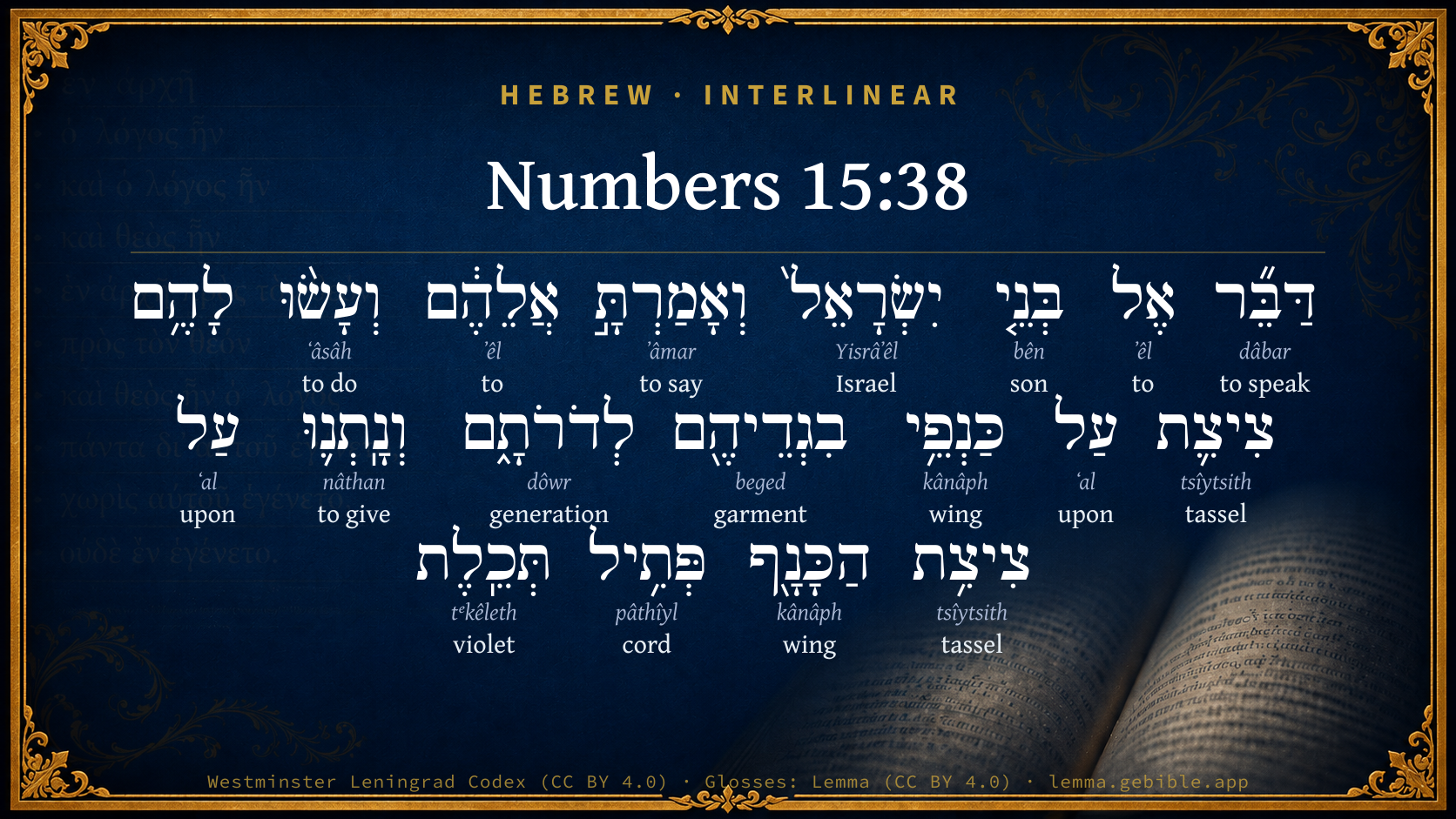
Numbers 15:38

Hebrew (Westminster Leningrad Codex) Numbers 15:38 appears in the Hebrew Old Testament. The text above is from the Westminster Leningrad Codex. Each word links to its Strong’s number, a concise gloss, and parsing drawn from the Open Scriptures Hebrew Bible morphology. Click any word for its full Brown-Driver-Briggs (BDB) entry.
Download image
Cite this verse

Numbers 15:38 (World English Bible). Public Domain. Lemma interlinear Bible study tool, https://lemma.gebible.app/v/numbers/15/38.

Show BibTeX & RIS
BibTeX
RIS
English Translation
Speak to the children of Israel, and bid those who they make them fringes in the borders of their garments throughout their generations, and that they put on the fringe of each border a cord of blue:
World English Bible · Public Domain
Highlights
  • 1 first appearance in the Hebrew Bible
Full analysis ↓
Download a study sheet

One document with this verse’s original text, its word-by-word gloss line, the meaning frame, cross-references with their text, attributed commentary, and full source and license credits — printable, and it pastes into notes with its structure intact.

This verse Autodidact and up

Study sheet (.html) Plain text (.txt)

A passage Seminary Student

Up to 50 verses in one chapter. A passage sheet keeps up to 6 commentary sources and 12 cross-references per verse, in the order this page ranks them, and says so on the sheet whenever that leaves anything out. Ask for a single verse and you get the Autodidact verse sheet above.

Everything on this page stays free to read, with no account — the sheet is a download of what is already on screen, not access to it.

Want to remove ads? Support Godless Engineer
Compare translations 3

The same verse in 3 English versions, stacked beneath the original-language interlinear above. Click any original word for its lexicon entry.

Each is an independent rendering of the whole verse — the interlinear is not word-aligned to these translations.

Highlighted words mark where these versions differ — a whole-verse word diff, not a word-by-word alignment.

  • World English Bible Public Domain
    Speak to the children of Israel, and bid those who they make them fringes in the borders of their garments throughout their generations, and that they put on the fringe of each border a cord of blue:
  • King James Version Public Domain
    Speak unto the children of Israel, and bid them that they make them fringes in the borders of their garments throughout their generations, and that they put upon the fringe of the borders a ribband of blue:
  • unfoldingWord Literal Text CC BY-SA 4.0
    “Speak to the sons of Israel and say to them, ‘And they shall make for themselves a tassel on the hems of their clothes for their generations, and they shall put on the tassel of the hem a cord of blue,

unfoldingWord Literal Text — © unfoldingWord, licensed CC BY-SA 4.0. Word-aligned USFM3 via Door43 (git.door43.org/unfoldingWord/en_ult).

Versions to compare (up to 4)

3 of 4 selected

Show all 18 translations

Every available English version of this verse, each an independent rendering of the whole verse.

  • World English Bible Public Domain
    Speak to the children of Israel, and bid those who they make them fringes in the borders of their garments throughout their generations, and that they put on the fringe of each border a cord of blue:
  • Berean Standard Bible Public Domain
    “Speak to the Israelites and tell them that throughout the generations to come they are to make for themselves tassels for the corners of their garments, with a blue cord on each tassel.
  • Majority Standard Bible Public Domain
    “Speak to the Israelites and tell them that throughout the generations to come they are to make for themselves tassels for the corners of their garments, with a blue cord on each tassel.
  • King James Version Public Domain
    Speak unto the children of Israel, and bid them that they make them fringes in the borders of their garments throughout their generations, and that they put upon the fringe of the borders a ribband of blue:
  • American Standard Version (1901) Public Domain
    Speak unto the children of Israel, and bid them that they make them fringes in the borders of their garments throughout their generations, and that they put upon the fringe of each border a cord of blue:
  • Revised Version (1885) Public Domain
    Speak unto the children of Israel, and bid them that they make them fringes in the borders of their garments throughout their generations, and that they put upon the fringe of each border a cord of blue:
  • Geneva Bible (1599) Public Domain
    Speake vnto the children of Israel, and bid them that they make them fringes vpon the borders of their garments throughout their generations, and put vpon the fringes of the borders a ryband of blewe silke.
  • Douay-Rheims (1899) Public Domain
    Speak to the children of Israel, and thou shalt tell them I to make to themselves fringes in the corners of their garments, putting in them ribands of blue:
  • Young's Literal Translation Public Domain
    `Speak unto the sons of Israel, and thou hast said unto them, and they have made for themselves fringes on the skirts of their garments, to their generations, and they have put on the fringe of the skirt a ribbon of blue,
  • Literal Standard Version CC BY-SA 4.0
    “Speak to the sons of Israel, and you have commanded to them, and they have made fringes on the skirts of their garments for themselves, throughout their generations, and they have put a ribbon of blue on the fringe of the skirt,
  • Unlocked Literal Bible CC BY-SA 4.0
    “Speak to the descendants of Israel and command them to make for themselves tassels to hang from the borders of their garments, to hang them from each border by a blue cord. They must do this throughout their people's generations.
  • unfoldingWord Literal Text CC BY-SA 4.0
    “Speak to the sons of Israel and say to them, ‘And they shall make for themselves a tassel on the hems of their clothes for their generations, and they shall put on the tassel of the hem a cord of blue,
  • Darby Bible Public Domain
    Speak unto the children of Israel, and bid them that they make them tassels on the corners of their garments, throughout their generations, and that they attach to the tassel of the corners a lace of blue;
  • World Messianic Bible Public Domain
    “Speak to the children of Israel, and tell them that they should make themselves fringes on the borders of their garments throughout their generations, and that they put on the fringe of each border a cord of blue.
  • Webster's Bible Public Domain
    Speak to the children of Israel, and bid them that they make them fringes on the borders of their garments throughout their generations, and that they put upon the fringe of the borders a ribin of blue:
  • Free Bible Version CC BY-SA 4.0
    “Tell the Israelites that for all future generations you must make tassels for the hems of your clothes and attach them with blue cord.
  • Bible in Basic English Public Domain
    Say to the children of Israel that through all their generations they are to put on the edges of their robes an ornament of twisted threads, and in every ornament a blue cord;
  • JPS Tanakh (1917) Public Domain
    'Speak unto the children of Israel, and bid them that they make them throughout their generations fringes in the corners of their garments, and that they put with the fringe of each corner a thread of blue.

Literal Standard Version (2020), Covenant Press — licensed CC BY-SA 4.0. Text via the HelloAO Bible API (eBible.org). Unlocked Literal Bible (unfoldingWord) — licensed CC BY-SA 4.0. Text via the HelloAO Bible API (eBible.org). unfoldingWord Literal Text — © unfoldingWord, licensed CC BY-SA 4.0. Word-aligned USFM3 via Door43 (git.door43.org/unfoldingWord/en_ult). Free Bible Version, Dr. Jonathan Gallagher — licensed CC BY-SA 4.0. Text via the HelloAO Bible API (eBible.org).

Word by word

More ways to search: Search by grammar → Find every occurrence → Compare this word →

Practice this passage: Drill this verse → Learn its vocabulary →

צִיצִ֛ת
tsîytsith
H6734
“tassel”
Noun, Common, Feminine, Singular, Absolute
Part of Speech
Noun
Type
Common
Gender
Feminine
Number
Singular
State
Absolute
Full BDB Definition

Origin: from H6731

TWOT: 1912

fringe, tassel, lock
  1. דַּבֵּ֞ר dâbar H1696 “speak” Verb, Piel, Imperative, 2nd Person, Masculine, Singular
  2. אֶל ʼêl H413 “to” Preposition
  3. בְּנֵ֤י bên H1121 “sons of” Noun, Common, Masculine, Plural, Construct
  4. יִשְׂרָאֵל֙ Yisrâʼêl H3478 “Israel” Noun, Proper
  5. וְאָמַרְתָּ֣ ʼâmar H559 “and · to say” Conjunction + Verb, Qal, Sequential Perfect, 2nd Person, Masculine, Singular
  6. אֲלֵהֶ֔ם ʼêl H413 “to · them” Preposition + Suffix, Personal, 3rd Person, Masculine, Plural
  7. וְעָשׂ֨וּ ʻâsâh H6213 “and · to do” Conjunction + Verb, Qal, Sequential Perfect, 3rd Person, Common, Plural
  8. עַל ʻal H5921 “upon” Preposition
  9. כַּנְפֵ֥י kânâph H3671 “wings of” Noun, Common, Feminine, Dual, Construct
  10. בִגְדֵיהֶ֖ם beged H899 “garments · their” Noun, Common, Masculine, Plural, Construct + Suffix, Personal, 3rd Person, Masculine, Plural
  11. לְדֹרֹתָ֑ם dôwr H1755 “to/for · generations · their” Preposition + Noun, Common, Masculine, Plural, Construct + Suffix, Personal, 3rd Person, Masculine, Plural
  12. וְנָֽתְנ֛וּ nâthan H5414 “and · to give” Conjunction + Verb, Qal, Sequential Perfect, 3rd Person, Common, Plural
  13. עַל ʻal H5921 “upon” Preposition
  14. צִיצִ֥ת tsîytsith H6734 “tassel of” Noun, Common, Feminine, Singular, Construct
  15. הַכָּנָ֖ף kânâph H3671 “the · wing” Particle, Definite Article + Noun, Common, Feminine, Singular, Absolute
  16. פְּתִ֥יל pâthîyl H6616 “cord of” Noun, Common, Masculine, Singular, Construct
  17. תְּכֵֽלֶת tᵉkêleth H8504 “violet” Noun, Common, Feminine, Singular, Absolute

About this verse

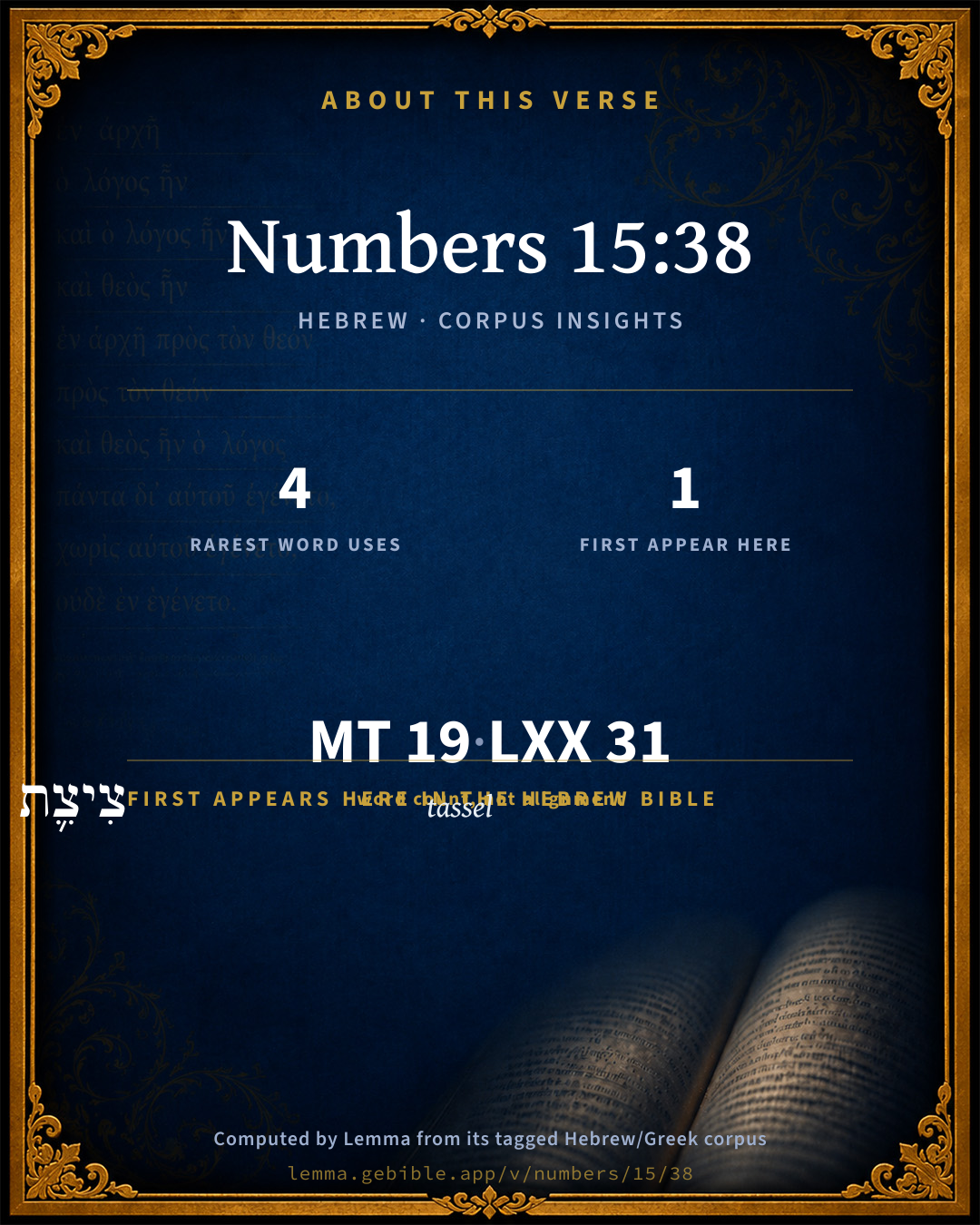
These counts appear in no published source. They are computed here, from the morphology-tagged text and Lemma’s own curated glosses. What Lemma adds →

19
words
14
distinct lemmas
Pentateuch
section

Notable vocabulary

The rarest word here is צִיצִ֛ת tassel H6734 — appearing just 4 times in the whole Hebrew Bible.

First appearance in Scripture

This word makes its first canonical appearance in the Hebrew Bible here:

  • צִיצִ֛ת tassel H6734

Shared distinctive vocabulary

צִיצִ֛ת tassel H6734 occurs in 3 verses of the Hebrew Bible. Also found in:

Grammatical profile

  • 4 verbs
  • 10 nouns
  • 5 prepositions

Verb forms

  • דַּבֵּ֞ר Piel · Imperative
  • וְאָמַרְתָּ֣ Qal · Sequential Perfect
  • וְעָשׂ֨וּ Qal · Sequential Perfect
  • וְנָֽתְנ֛וּ Qal · Sequential Perfect

Repetition

Words recur within this verse — often emphatic in Hebrew:

  • צִיצִ֛ת tassel H6734 ×2
  • עַל upon H5921 ×2
  • כַּנְפֵ֥י wing H3671 ×2
  • אֶל to H413 ×2

Hebrew & Septuagint length

In English translation the verse runs 37 words from the Hebrew and 41 from the Septuagint (LXX English) — closely comparable.

A rough comparison of the two English renderings, which tokenize alike — not a word-level alignment.

Word counts can differ between the Hebrew and the Greek without any difference in meaning — e.g. the Hebrew direct-object marker אֵת has no separate Greek word, and Greek often adds the article ὁ.

In the original languages it is 19 Hebrew tokens and 31 Greek tokens — but the two are counted differently (Hebrew bundles its prefixes and suffixes into one token; the Greek is in lemma form), so that isn’t a like-for-like length.

Cross-references

4

Topical passages linked to Numbers 15:38 in the Treasury of Scripture Knowledge — connected by theme and wording, ordered by reader-vote popularity; previews shown in the World English Bible.

  • Matthew 23:5 But all their works they do to be seen by men. They make their phylacteries broad, enlarge the fringes of their garments,
  • Deuteronomy 22:12 You shall make you fringes on the four borders of your cloak, with which you cover yourself.
  • Matthew 9:20 Behold, a woman who had an issue of blood for twelve years came behind him, and touched the tassels of his garment;
  • Luke 8:44 came behind him, and touched the fringe of his cloak, and immediately the flow of her blood stopped.

Cross-references courtesy of OpenBible.info (CC BY 4.0).

Hebrew and Greek witnesses Masoretic Hebrew ↔ Greek Septuagint

The same verse in the two great witnesses to the Old Testament, shown verse-for-verse.

These are two independent witnesses, not word-aligned to each other, and the Septuagint is shown in lemma (dictionary) form.

Hebrew Numbers 15:38 Masoretic · Westminster Leningrad Codex

דַּבֵּ֞ר אֶל בְּנֵ֤י יִשְׂרָאֵל֙ וְאָמַרְתָּ֣ אֲלֵהֶ֔ם וְעָשׂ֨וּ לָהֶ֥ם צִיצִ֛ת עַל כַּנְפֵ֥י בִגְדֵיהֶ֖ם לְדֹרֹתָ֑ם וְנָֽתְנ֛וּ עַל צִיצִ֥ת הַכָּנָ֖ף פְּתִ֥יל תְּכֵֽלֶת

Speak to the children of Israel, and bid those who they make them fringes in the borders of their garments throughout their generations, and that they put on the fringe of each border a cord of blue:

World English Bible · Public Domain

Greek LXX Numbers 15:38 Septuagint · lemma form

λαλέω ὁ υἱός ἰσραήλ καί εἶπον πρός αὐτός καί ποιέω ἑαυτοῦ κράσπεδον ἐπί ὁ πτερυγίον ὁ ἱμάτιον αὐτός εἰς ὁ γενεά αὐτός καί ἐπιτίθημι ἐπί ὁ κράσπεδον ὁ πτερυγίον κλῶσμα ὑακίνθινος

Speak to the children of Israel, and you shall tell them; and let them make for themselves fringes upon the borders of their garments throughout their generations: and you⌃ shall put upon the fringes of the borders a lace of blue.

LXX2012 (modern English Septuagint) · Public Domain

On this verse, Ellicott's Commentary for English Readers discusses the Septuagint’s reading. Read the note in Commentary ↓

Hebrew: Westminster Leningrad Codex (CC BY 4.0). Greek: Septuagint (public domain); English from LXX2012 (modern English Septuagint) (Public Domain). How the Septuagint differs from the Hebrew →

Targum (Aramaic paraphrase)

2

The Targum is the ancient Jewish Aramaic paraphrase of the Hebrew Scriptures — an interpretive translation, not the Hebrew text itself. Onkelos (literal) and Pseudo-Jonathan (expansive) render the Torah, and Jonathan the Prophets. Coverage is partial: where no permissively-licensed English translation exists for a verse, only the Aramaic is shown. This is verse-level text, not a word-by-word alignment to the Hebrew.

  1. Targum Onkelos Torah (Genesis–Deuteronomy)
    מַלֵל עִם בְּנֵי יִשְׂרָאֵל וְתֵימַר לְהוֹן וְיַעֲבְּדוּן לְהוֹן כְּרוּסְפְּדִין עַל כַּנְפֵי כְסוּתְהוֹן לְדָרֵיהוֹן וְיִתְּנוּן עַל כְּרוּסְפְּדָא דְכַנְפָא חוּטָא דִתְכֶלְתָּא

    (no public-domain English translation for this verse)

    Targum Onkelos — Aramaic: “Onkelos Genesis” (public domain); “Onkelos Exodus” (public domain); “Onkelos Leviticus” (public domain); “Onkelos Numbers” (public domain); “Onkelos Deuteronomy” (public domain). English: “Sefaria Community Translation” (CC0 1.0 (public-domain dedication)); “J.W. Etheridge. The Targums of Onkelos and Jonathan Ben Uzziel on the Pentateuch. London: Longmans, Green, 1862” (public domain). Text via Sefaria.

  2. Targum Pseudo-Jonathan Torah (Genesis–Deuteronomy)
    מַלֵיל עִם בְּנֵי יִשְרָאֵל וְתֵימַר לְהוֹן וְיַעַבְדִין לְהוֹן צִיצְיָיתָא לָא מִן נִימַיָא וְלָא מִן סִיסַיָא וְלָא מִן גַרְדַיָא אֱלָהֵן לְשׁוּמְהוֹן יַעַבְדוּנוּן וְיִפְסְקוּן רֵישֵׁי חוּטֵיהוֹן וְיִתְּלוּן בַּחֲמֵשֶׁת קִיטְרִין אַרְבָּעָה בְּגוֹ תְלָתָא עַל אַרְבַּעַת אַנְפֵּי גוּלֵיהוֹן דְמִתְעַטְפִין בְּהוֹן לְדָרֵיהוֹן וְיִתְּנוּן עַל אַנְפָּא גוּלְיַתְהוֹן שְׁזִיר דְתִכְלָא

    Speak with the sons of Israel, and bid them make for themselves fringes, not of threads, nor of yarns, nor of fibres, but after a manner of their own (lesumhon) shall they make them, and shall cut off the heads of their filaments, and suspend by five ligatures, four in the midst of three, upon the four corners of their garment in which they enwrap themselves, unto their generations; and they shall put upon the edge of their robes an embroidery of hyacinth (shezir de-thikela).

    Targum Pseudo-Jonathan — Aramaic: “Targum Jonathan on Genesis” (public domain); “Targum Jonathan on Exodus” (public domain); “Targum Jonathan on Leviticus” (public domain); “Targum Jonathan on Numbers” (public domain); “Targum Jonathan on Deuteronomy” (public domain). English: “The Targum of Jonathan ben Uzziel, trans. J. W. Etheridge, London, 1862” (public domain). Text via Sefaria.

Commentary

Notes on Numbers 15:38 from classic Christian and Jewish commentators (each source and its license shown beneath its notes). The classic Christian expositions comment on the surrounding passage and are grouped to its opening verse, so a note may address several verses; the Jewish commentaries on the Tanakh (Rashi and others) are per-verse, so they appear only where the commentator wrote on this verse.

Lemma curates 59 commentaries, every one of them public domain or Creative Commons licensed, each selected and text-cleaned for this edition rather than reprinted as found. About our sources →

Trapp's Complete Commentary

John Trapp

Num 15:38 Speak unto the children of Israel, and bid them that they make them fringes in the borders of their garments throughout their generations, and that they put upon the fringe of the borders a ribband of blue:

Ver. 38. That they may make them fringes.] {See Trapp on "Mat 23:5"}

A ribband of blue.] This sky coloured ribbon taught them, that though their commoration was on earth, their conversation should be in heaven. {Php 3:20}

John Trapp, A Commentary or Exposition upon All the Books of the Old and New Testament (1647–1656) — public domain. Text from a community e-Sword module.

The Biblical Illustrator

Joseph S. Exell

Num_15:38-40

Put upon the fringe . . . a ribband of blue.

The law of the fringe and ribband

Provision had been just now made by the law for the pardon of sins of ignorance and infirmity, now here is an expedient provided for the preventing of such sins. They are ordered to make fringes upon the borders of their garments, which were to be memorandums to them of their duty, that they might not sin through forgetfulness.

1. The sign appointed is a fringe of silk, or thread, or worsted, or the garment itself ravelled at the bottom, and a blue ribband bound on the top of it to keep it tight (Num_15:38). The Jews being a peculiar people, they were thus distinguished from their neighbours in their dress, as well as in their diet; and taught by such little instances of singularity, not to be conformed to the way of the heathen in greater things. Thus likewise they proclaimed themselves Jews wherever they were, as those that were not ashamed of God and His law.

2. The intention of it was to remind them that they were a peculiar people. They were not appointed for the trimming and adorning of their clothes, but to stir up their pure minds by way of remembrance (2Pe_3:1). That they might look upon the fringe, and remember the commandments. Many look upon their ornaments to feed their pride, but they must look upon these ornaments to awaken their consciences to a sense of their duty, that their religion might constantly beset them, and they might carry it about with them, as they did their clothes, wherever they went. It was intended particularly to be a preservation from idolatry, That ye seek not after your own heart, and your own eyes, in your religious worship. Yet it may extend also to the whole conversation; for nothing is more contrary to Gods honour and our own true interest than to walk in the way of our heart, and in the sight of our eyes; for the imagination of the heart is evil, and so is the lust of the eyes. (Matthew Henry, D. D.)

The ribband of blue

The chief use of clothing is defence against the chills and variations of the weather; two subordinate uses are for the promotion of beauty, and for distinction of office. We can be at no loss to perceive that there are mental uses corresponding to the above which require for the soul spiritual clothing. The soul has its summer and its winter, and all the varieties of a mental year. There are seasons of hopefulness and brilliancy in which we have all the elasticity and promise of spring; there are states of peaceful warmth, of continued serene happiness; the souls calm sunshine and the heartfelt joy which bespeak the spirits summer; but there are likewise periods of decreasing warmth, of incipient depressions, and coolnesses to what has formerly yielded the highest pleasure; until at length we arrive at states of painful cold, the joylessness, the hopelessness, and the sadness, which ate the characteristics of the winter of the soul. In this wintry state storms of distressing fears and darkening doubts will rush upon the soul. Strong delusions that we may believe a lie, will, like fierce tempests, howl about us. Thrice happy are they who remember that the Divine Word will be a blessing in joy and in sorrow, in sickness and in health, in summer and in winter; but they should also bear in mind, that to be a protection in all seasons the Divine mercy has provided us with spiritual clothing. The doctrines of religion, when intelligently adopted and adapted to our particular states, serve this important purpose. And when those doctrines are, as they ought to be, full, comprehensive, and complete, applying themselves to all the departments of human affection, thought, and life, they make a complete dress. We are, then, to speak to the Israelites who are typified by those of our text, the spiritual Israelites; and say first that they clothe themselves with genuine doctrines of Divine truth, with the garments of salvation, and next, that they especially make them fringes in the borders of their garments. After we have meditated upon the doctrines of religion, and seen their fitness to our own states of mind and heart, thus clothed ourselves in them, the next part of our duty is to bring them into life. Many there are who put on religion as a dress for the head, and even also for the breast, but do not bring it down to the feet. But we are to make a border for our garments, and the border must be a fringe. The distinctive feature of a fringe is, that the material of which it is composed is divided into small portions firmly united at the upper part, but hanging with separate forms of beauty at the lower. The idea suggested by this is, that religion must be employed in all the small affairs of daily life as well as on great occasions; the lowest part of our spiritual dress must be a fringe. We are, however, not only commanded to have a fringe to our garments, but to have upon the fringe a ribband of blue. And this leads us to consider the correspondence of colours. Natural colours, we know, originate in natural light. They are the separation of the beauties which are bound up in the sunbeam, and their reflection to the human eye. There is a trinity of fundamental colours, red, blue, and yellow. From the blending of these in varied proportions all others are made. Red, the colour of fire, is the symbol of the truths of love, the fire of the soul. Blue, the colour of the azure depths of the sky, is symbolic of the deep things of the Spirit of God, on which faith delights to gaze. Yellow is the hue of truth which applies to outward life, and in combination with blue it makes green, which corresponds to truth in the letter of the Word, made simple to the common eye of mankind. Blue gives a sense of clearness and depth, in which it surpasses all other hues. Blue, then, is the colour which represents the spirit of the Holy Word, the depths of heavenly wisdom. There is, however, cold blue, as it has more of white in it, and warm blue, as it derives a certain hue from red. There has also been some difficulty in determining the exact shade meant by Techeleth, the Hebrew name for this colour. But from a full consideration of this subject we are satisfied it was the name for blue tinged with red, from violet to purple. And this very strikingly brings out the Divine lesson by correspondence. While the blue indicates that in our demeanour in life we should be correct, in harmony with the spirit of truth, the red hue indicates that all our truth ought to be softened and warmed by love. Speak the truth in love, said the apostle, and to remind them of this duty God commanded the ribband of warm blue to be worn upon the fringe of their garments by the sons of Israel. It is religion in life that is observed by and is attractive to good men. When it not only enlightens the head and rules the heart, but comes down to the skirt of the garment, infusing justice, kindness, and courtesy in every act and word, then it has an eloquence which will inspire many a well-disposed heart to say, We will go with you, for we have heard that God is with you. Let your good works and your good words so shine before men, that they may glorify your Father who is in heaven. (J. Bayley, Ph. D.)

The ordinance of the fringes: gracious reminders of Divine commands

I. The proneness of man to forget the commandments of the Lord. This tendency arises from--

1. The sinfulness of human nature.

2. The worldly spirit which so largely prevails in human society.

II. The arrangements which God has made to remind man of his commandments.

1. The means which God employs to remind us of His commandments.

(1) The Bible. In this He not only reveals His will concerning us, but illustrates and enforces it in various ways so that we might not forget it.

(2) The Holy Spirit. He influences our spirits; speaks in us by means of conscience, &c.

(3) Holy examples. In these the will of God is drawn out in living characters.

(4) Warning examples of the evil consequences of overlooking His commands. These witness to us that it is perilous to forget the Divine will, and admonish us against doing so.

2. The design of God in reminding us of His commandments. That ye wander not after your own heart and your own eyes, after which ye use to go a whoring; that ye may remember and do all My commandments, and be holy unto your God. Recollection of the will of God must be followed by obedience to that will, or it will be worse than useless.

III. The grounds upon which God requires from us this recollection of and obedience to His commands.

1. His personal relation to us.

2. His gracious doings for us. (W. Jones.)

Remembrancers

How wonderful is what we call association! I hang some thought upon an object, and say, Whenever I come hither, ring for me as a bell of joy; and upon another I fasten an experience, saying to it, Toll to me of sadness; and to another, Give forth some bold, inspiring strain; and to another, Speak to me always of hope. And, thereafter, each thing, true to its nature, whether it be tree, or place, or rock, or house, or that which is therein, never forgets its lesson. Yea, and when we forget, they make us to remember, singing to us the notes which we had taught them. Thus the heart, though it may not dismember itself, to give a soul to the material world, has yet a power half to create in physical things a soul in each for itself. So its life is written out, and it keeps a journal upon trees, upon hills, upon the face of heaven. Is it not for this, then, that in turn God has used every object in nature, every event in life, every function of society, every affection and endearment of human love, yea, and things that are not, the very silences of the world, and memories that are but disembodied events, to represent to us by association His nature and affections? Thus the heaven and the earth do speak of God, and the great natural world is but another Bible, which clasps and binds the written one; for nature and grace are one. Grace is the heart of the flower, and nature but its surrounding petals. (H. W. Beecher.)

Association

Thus a house becomes sacred. Every room has a thousand memories. Every door and window is clustered with associations. And when, after long years, we go back to the house of our infancy, faces look out upon us, and an invisible multitude stand in gate and portal to welcome us, and we hear airy voices speaking again the old words of our childhood. (H. W. Beecher.)

The Biblical Illustrator, edited by Joseph S. Exell (c. 1880s–1900s) — public domain. Text from a community e-Sword module.

Joseph Benson's Commentary

Num 15:38. Fringes — These were certain threads, or ends, standing out a little farther than the rest of their garments, left there for this use. In the borders — That is, in the four borders or quarters, as it is, Deu 22:12. Of their garments — Of their upper garments. This was practised by the Pharisees in Christ’s time, who are noted for making their borders larger than ordinary. A riband — To make it more obvious to the sight, and consequently more serviceable to the use here mentioned. Of blue — Or, purple.

Joseph Benson's Commentary on the Old and New Testaments (1811–1818) — public domain. Text from a community e-Sword module.

Jamieson, Fausset & Brown

Robert Jamieson, A. R. Fausset & David Brown

bid them that they make them fringes in the borders of their garments--These were narrow strips, in a wing-like form, wrapped over the shoulders and on various parts of the attire. "Fringe," however, is the English rendering of two distinct Hebrew words--the one meaning a narrow lappet or edging, called the "hem" or "border" (Mat 23:5; Luk 8:44), which, in order to make it more attractive to the eye and consequently more serviceable to the purpose described, was covered with a riband of blue or rather purple color; the other term signifies strings with tassels at the end, fastened to the corners of the garment. Both of these are seen on the Egyptian and Assyrian frocks; and as the Jewish people were commanded by express and repeated ordinances to have them, the fashion was rendered subservient, in their case, to awaken high and religious associations--to keep them in habitual remembrance of the divine commandments.

Jamieson, Fausset & Brown — Commentary Critical and Explanatory on the Whole Bible (1871) — public domain (CC PDM 1.0). Text via the HelloAO Bible API.

Adam Clarke's Commentary

Verse 38. Bid them - make them fringes] We learn from Nu 15:39 that these fringes were emblematical of the various commands of God. That there was any analogy between a fringe and a precept, it would be bold to assert; but when a thing is appointed to represent another, no matter how different, that first object be comes the regular representative or sign of the other. There is no analogy between the term bread and the farinaceous nutritive substance thereby signified; but because this term is used to express and represent that thing, every person thus understands it; and when the word bread is seen or heard, a perfect knowledge, not of the letters which compose that word, but of the thing signified by it, is conveyed to the mind. So the fringes, being appointed by God to represent and bring to mind the commandments of God, Nu 15:39, the mention or sight of them conveyed the intelligence intended. All the Jews wore these, and so probably did our Lord; see Mt 9:20, where the word κρασπεον is rather to be understood of the fringe than of the hem of his garment.

Adam Clarke's Commentary on the Bible (1810–1826) — public domain. Text from a community e-Sword/MySword module.

Ellicott's Commentary for English Readers

(38) That they make them fringes . . . —Better, That they make them tassels on the corners of their garments throughout their generations, and that they put upon the tassel of the corner (i.e., on each tassel) a thread (or cord) of blue. The tassels (zirith) appear to be the same as the gedilim (fringes) of Deu_22:12. The outer garment of the Jews was a fourcornered cloth, which was also used by the poor as a counterpane (Exo_22:26-27). It appears to have been commonly used with a hole in the centre, through which the head was put, so that one-half covered the front and the other the back of the body. These tassels, or fringes (LXX. κράσπεδα—craspeda), were enlarged by the Pharisees to exhibit their punctilious fulfilment of the Law (Matt. xiii 5). Great sanctity was attached to these fringes or tassels, and for this cause the woman with the issue of blood desired to touch a kraspedon of our Saviour’s garment (Mat_9:20).

A Bible Commentary for English Readers, edited by Charles John Ellicott (1878–1897) — public domain. Text from a community e-Sword module.

The Cambridge Bible for Schools and Colleges

gen. ed. J. J. S. Perowne

38. that they make them tassels upon the corners of their garments] This is commanded (with different words for ‘tassels’ and ‘garments’) in Deu_22:12. No statement is there made as to the reason for the observance. It was probably a very ancient custom, dating from a time when such tassels were superstitiously worn as magical charms. Here, however, it has been invested with a higher religious significance. The practice is referred to in the N.T., Mat_14:36, Mar_6:56 (E.V. ‘border of his garment’); and it continues among the Jews to this day. In the synagogue all males over thirteen years of age wear a special garment called a tallith, which ‘consists of an oblong cloth with a tassel at each corner. The head is passed through a hole in the middle of the cloth, which hangs over the breast and back.’ See art. ‘Fringes’ in Hastings’ DB. ii.

upon the tassel of each corner a thread of violet] in order to fasten it to the garment.

The Cambridge Bible for Schools and Colleges (gen. ed. J. J. S. Perowne; Cambridge University Press, 1878–1918) — public domain. Text from a community e-Sword module.

John Gill's Exposition

And it shall be unto you for a fringe,.... The blue ribbon or lace shall be in or upon the fringe to fasten it:

that ye may look upon it; the blue lace making the whole the more conspicuous: from hence the Jews gather, that the night is not the time for wearing fringe, which lessens the sight, and it is not so easily seen; and that night garments are not obliged to have the fringe on them; and yet, they say, a blind man is bound to wear it, because, though he cannot see it, others can (g):

and remember all the commandments of the Lord, and do them: this is the general use, end, and design of the fringes, that upon sight of them they might be put in mind of the commandments and put upon the practice of them; these being at the four corners of their vestments, let them look which way they would downwards, before or behind, or on either side, they could not but see them: and the many threads in them might put them in mind of the many precepts they were to observe; and the white colour, the purity and holiness of them; and the blue or sky-coloured lace might lead them to observe the heavenly original of them; or being of a purple colour rather, might direct them to the blood of Christ, for the remission of the transgressions of them: the Jews have many fanciful things about the use and virtue of these fringes, not worthy of notice; and they say, that such who are careful to observe this law of the fringe, are worthy to see the face of the divine Majesty, and will be preserved from evil spirits (h):

and that ye seek not after your own heart and your own eyes; to have and enjoy, and do those things, in matters of worship, which were of their own devising, and pleasing in their sight, as well as in moral things, what were agreeable to their carnal hearts, and make for the gratification of their senses:

after which ye use to go a whoring; which seems to restrain the sense pretty much to idolatry, to false and superstitious worship, which are often in Scripture expressed by fornication and whoredom; though other sins and lusts also are sometimes signified by the same words.

(g) Maimon. in Misn. Ediot, c. 4. sect. 10. & Hilchot Tzitzith, c. 3. sect. 7. Schulchan Aruch, p. 1. c. 17. 1. & 18. 1. (h) Baal Hatturim in loc. Schulchan Aruch, p. 1. c. 24. sect. 1, 6.

John Gill's Exposition of the Whole Bible (1746–1763) — public domain (CC PDM 1.0). Text via the HelloAO Bible API.

Albert Barnes' Notes on the Bible

That they put upon the fringe of the borders a ribband of blue - Reader that they add to the fringes of the borders (or corners) a thread of blue (compare the marginal references). These fringes are considered to be of Egypttian origin. The ordinary outer Jewish garment was a quadrangular piece of cloth like a modern plaid, to the corners of which, in conformity with this command, a tassel was attached. Each tassel had a conspicuous thread of deep blue, this color being doubtless symbolic of the heavenly origin of the commandments of which it was to serve as a memento. Tradition determined that the other threads should be white - this color being an emblem of purity (compare Isa 1:18). The arrangement of the threads and knots, to which the Jews attached the greatest importance, was so adjusted as to set forth symbolically the 613 precepts of which the Law was believed to consist. In our Lord’s time the Pharisees enlarged their fringes Mat 23:5 in order to obtain reputation for their piety. In later times howerer, the Jews have worn the fringed garment (tālı̂̄th) of a smaller size and as an under-dress. Its use is still retained, especially at morning prayer in the Synagogue.

Albert Barnes' Notes on the Bible (1834–1885) — public domain. Text from a community e-Sword/MySword module.

Haydock's Catholic Bible Commentary

Fringes. The Pharisees enlarged these fringes through hypocrisy, (Matthew xxiii. 5,) to appear more zealous than other men for the law of God. (Challoner) --- Our Saviour conformed to this law, Luke viii. 44. Moses shews that these fringes were to be made for the cloak, which was square, and not for the tunic, Deuteronomy xxii. 12. The colour, in St. Justin Martyr’s time, was purple. (Dialogue with Trypho) It seems that the Phœnicians were accustomed to wear such fringes. Sidoniam picto chlamidem circumdata limbo. (Virgil, Æneid iv.) (Calmet) --- God ordained that his people should be thus distinguished from other nations. (Tirinus)

George Leo Haydock (1774–1849), Haydock's Catholic Family Bible and Commentary, 1859 edition — public domain. Excludes Psalms (Douay-Rheims chapter numbering differs from Protestant) and Deuterocanonical books (Catholic canon only).

Matthew Poole's English Annotations

Fringes were certain threads or ends of their garments, standing out a little further than the rest of their garments, left there for this use.

In the borders, i.e. in the four borders or quarters, as it is Deu 22:12. Heb. wings, which is oft used for borders or ends, as Rth 3:9; 1Sa 15:27; 24:5, &c.

Of their garments, i.e. of their upper garment, or that wherewith they covered themselves, as is expressed Deu 22:12. This was practised by the Pharisees in Christ’s time, who are noted for making their borders larger than ordinary, Mat 23:5; and by Christ himself, as may gathered from Luk 8:44.

A riband, to make it more obvious to the sight, and consequently more serviceable to the use here mentioned.

Of blue, or, of a purple colour, as the Jewish writers agree, whose opinion is the more considerable, because it was matter of constant practice among them.

Matthew Poole's English Annotations on the Holy Bible (1683–1685) — public domain. Text from a community e-Sword/MySword module.

Whedon's Commentary on the Bible

Daniel D. Whedon

38. Fringes — The Hebrew tzeetzeeth, fringe or tassel, is used only in this statute and in Eze_8:3, where it is rendered “a lock of mine head.” The fringe was not originated by this law, but it existed before as the ordinary mode of finishing the robe, the ends of the woof being left to preserve the cloth from raveling, the riband of blue, (or cord, improperly lace, Exo_28:28; Exo_28:37 — thread, Jdg_16:9 — bracelets, (cord, R.V.,) Gen_38:18; Gen_38:25 — and wire, (of gold,) Exo_39:3 — or rather dark violet, being added to strengthen the border. The outer robe, a quadrangular piece of cloth, was so worn that two of the corners hung down in front ornamented with this dark violet thread. To this fringe the Jews subsequently attached great sanctity, and the Pharisees enlarged it and the thread to an undue width, (Mat_23:5, note,) as an indication of their greater respect for the precepts of the law of Moses. The impress of consecration to the holy God was stamped on the life of the Israelite in ordinances extending to the most minute things, that he might always realize the voice of Jehovah, saying, “Be ye holy, for I am holy.” These tassels were to remind him every moment to think on all his commands, and not to be guided by the imaginations of his heart and the lust of his eyes. Stier, in his comment on Christ’s summary of the law, as comprised in love, (Mat_22:40,) interprets the riband of blue as a type of love, and the fringes as the separate precepts scattered through the law and the prophets.

Daniel D. Whedon (gen. ed.), Commentary on the Old and New Testaments (1874–1909) — public domain. Text from a community e-Sword module.

The Pulpit Commentary

Bid them that they make them fringes. txiyxi, probably tassels. It seems to signify something flower-like and bright, like the blooms on a shrub; the word xyxi. is applied to the shining plate of gold upon Aaron"s head-band. (Exo_28:36) In Jer_48:9 it seems to mean a wing, and in Eze_8:3 txiyxi is a lock of hair. The exact meaning must be gathered from the context, and on the whole that suggests a tassel rather than a fringe. The word sylidiG, used in the parallel passage Deu_22:12, seems to have this meaning. The Septuagint renders it by kraspida , which is adopted in the Gospels. (see Mat_23:5) In the borders of their garments. Literally, "on the wings," epi ta pterugia . The outer garment (dgB here, tWsK in Deu_22:12) was worn like a plaid, so folded that the four corners were dependent, and on each of these corners was to be hung a tassel. It was also used as a coverlet by the poor. (Exo_22:27) That they put upon the fringe of the borders a ribband of blue. Rather, "that they put a string (or thread) of hyacinth-blue upon the tassel of the wing." Septuagint, klwsma uakinyinon . This may have been a blue string with which to fasten the tassel to the corner of the garment, as if it were the stalk on which this flower grew; or it may have been a prominent blue thread in the tassel itself. The later Jews seem to have understood it in this sense, and concerned themselves greatly with the symbolical arrangements of the blue and other threads, and the method in which they were knotted together, so as to set forth the whole law with all its several commandments. The later Jews, however, have always contrived, with all their minute observance, to break the plain letter of the law: thus the modern talith is an under, and not an upper, garment.

The Pulpit Commentary (1880–1919), ed. H.D.M. Spence-Jones & Joseph S. Exell — public domain. Text from a community e-Sword module.

John Wesley's Explanatory Notes

Fringes - These were certain threads or ends, standing out a little further than the rest of their garments, lest there for this use. In the borders - That is, in the four borders or quarters, as it is, Deut. xxii, 12. Of their garments - Of their upper garments. This was practiced by the Pharisees in Christ's time, who are noted for making their borders larger than ordinary. A ribband - To make it more obvious to the sight, and consequently more serviceable to the use here mentioned. Of blue - Or, purple.

John Wesley, Explanatory Notes Upon the Whole Bible (1754–1765) — public domain. Text via the GEBible commentary corpus.

Scofield Reference Notes

C. I. Scofield

ribband of blue

The ribband of blue. Blue, the heavenly colour, used upon the borders of the priests’ garments signified that the servants of God were to be heavenly in obedience and character, and separate from earthly ambitions and desires.

The Scofield Reference Bible (1917 edition), notes by C. I. Scofield — public domain. Text from a community e-Sword module.

Rashi

Rabbi Shlomo Yitzchaki (Rashi)

ועשו להם ציצת THAT THEY MAKE THEM A FRINGE — It is called צצית, because of the threads that hang down from it. Similar is, (Ezekiel 8:3) “and he caught me by the curls (ציצת) of my head’’. (The word denotes something twisted as threads or curls). — Another explanation is: it is called ציצת because of the command associated with it (v. 39) “and ye shall look at it”. Similar is, “looking (מציץ) from the lattice” (Song 2:9). (The word therefore denotes “something looked at”) (Sifrei Bamidbar 115).

תכלת BLUE PURPLE — It is the blue dye of (obtained from) the blood of the Chilazon (a kind of shell-fish).

Rashi on the Tanakh — English translations: “The Judaica Press complete Tanach with Rashi, translated by A. J. Rosenberg” (CC BY 4.0); “Pentateuch with Rashi's commentary by M. Rosenbaum and A.M. Silbermann, 1929-1934” (public domain); “The Metsudah Tanach series, Lakewood, N.J” (CC BY 4.0); and “The Book of Joshua, Metsudah Publications, 1997” (CC BY 4.0). Text via Sefaria.

Lesson kit

Teaching starters — assembled from the data on this page, not authored interpretation. Every prompt links to the verse data it draws on. Edit before teaching.

Numbers, in the Pentateuch, opens this verse with 19 words (14 distinct Hebrew lemmas). Its most distinctive word is tsîytsith (“tassel”). A historical commentator’s framing appears above. Read the whole chapter for the surrounding context.

Discussion questions

  1. How does “tassel” (tsîytsith) shape what this verse is saying?
  2. This is the first place “tassel” appears in Scripture (first appears here). What does its debut here establish?
  3. How does Numbers 15:39, which shares the word «tassel», read alongside this verse?
  4. What does the repetition of “tassel” (2× in this one verse) do in this verse?
  5. These translations render this verse differently. What is at stake in choosing one wording over another?
  6. «דַּבֵּ֞ר» is a Piel Imperative verb. How does that grammatical form shape the action described?
  7. Compare how Trapp's Complete Commentary and The Biblical Illustrator read this verse. Where do they agree or differ?

Things to notice

Reading settings

Reading text

Shown beneath each verse's original-language words.

Old Testament
Old Testament edition

Read the OT as the Masoretic Hebrew (MT) or the Greek Septuagint (LXX).

English shown for the Greek Septuagint (in the Hebrew ↔ Greek comparison).

Comparing translations? Open the Compare panel on any verse page to stack up to four side by side.