

Zechariah 3:4

Hebrew (Westminster Leningrad Codex) Zechariah 3:4 appears in the Hebrew Old Testament. The text above is from the Westminster Leningrad Codex. Each word links to its Strong’s number, a concise gloss, and parsing drawn from the Open Scriptures Hebrew Bible morphology. Click any word for its full Brown-Driver-Briggs (BDB) entry.
Download image
Cite this verse

Zechariah 3:4 (World English Bible). Public Domain. Lemma interlinear Bible study tool, https://lemma.gebible.app/v/zechariah/3/4.

Show BibTeX & RIS
BibTeX
RIS
English Translation
He answered and spoke to those who stood before him, saying, "Take the filthy garments off of him." To him he said, "Behold, I have caused your iniquity to pass from you, and I will clothe you with rich clothing."
World English Bible · Public Domain
Download a study sheet

One document with this verse’s original text, its word-by-word gloss line, the meaning frame, cross-references with their text, attributed commentary, and full source and license credits — printable, and it pastes into notes with its structure intact.

This verse Autodidact and up

Study sheet (.html) Plain text (.txt)

A passage Seminary Student

Up to 50 verses in one chapter. A passage sheet keeps up to 6 commentary sources and 12 cross-references per verse, in the order this page ranks them, and says so on the sheet whenever that leaves anything out. Ask for a single verse and you get the Autodidact verse sheet above.

Everything on this page stays free to read, with no account — the sheet is a download of what is already on screen, not access to it.

Want to remove ads? Support Godless Engineer
Compare translations 3

The same verse in 3 English versions, stacked beneath the original-language interlinear above. Click any original word for its lexicon entry.

Each is an independent rendering of the whole verse — the interlinear is not word-aligned to these translations.

Highlighted words mark where these versions differ — a whole-verse word diff, not a word-by-word alignment.

  • World English Bible Public Domain
    He answered and spoke to those who stood before him, saying, "Take the filthy garments off of him." To him he said, "Behold, I have caused your iniquity to pass from you, and I will clothe you with rich clothing."
  • King James Version Public Domain
    And he answered and spake unto those that stood before him, saying, Take away the filthy garments from him. And unto him he said, Behold, I have caused thine iniquity to pass from thee, and I will clothe thee with change of raiment.
  • unfoldingWord Literal Text CC BY-SA 4.0
    And he answered and said to the ones standing to the face of him, saying, “Remove the filthy garments from upon him.” And he said to him, “See, I have caused your iniquity to pass away from you, and I will clothe you fine clothing.”

unfoldingWord Literal Text — © unfoldingWord, licensed CC BY-SA 4.0. Word-aligned USFM3 via Door43 (git.door43.org/unfoldingWord/en_ult).

Versions to compare (up to 4)

3 of 4 selected

Show all 18 translations

Every available English version of this verse, each an independent rendering of the whole verse.

  • World English Bible Public Domain
    He answered and spoke to those who stood before him, saying, "Take the filthy garments off of him." To him he said, "Behold, I have caused your iniquity to pass from you, and I will clothe you with rich clothing."
  • Berean Standard Bible Public Domain
    So the angel said to those standing before him, “Take off his filthy clothes!” Then he said to Joshua, “See, I have removed your iniquity, and I will clothe you with splendid robes.”
  • Majority Standard Bible Public Domain
    So the angel said to those standing before him, “Take off his filthy clothes!” Then he said to Joshua, “See, I have removed your iniquity, and I will clothe you with splendid robes.”
  • King James Version Public Domain
    And he answered and spake unto those that stood before him, saying, Take away the filthy garments from him. And unto him he said, Behold, I have caused thine iniquity to pass from thee, and I will clothe thee with change of raiment.
  • American Standard Version (1901) Public Domain
    And he answered and spake unto those that stood before him, saying, Take the filthy garments from off him. And unto him he said, Behold, I have caused thine iniquity to pass from thee, and I will clothe thee with rich apparel.
  • Revised Version (1885) Public Domain
    And he answered and spake unto those that stood before him, saying, Take the filthy garments from off him. And unto him he said, Behold, I have caused thine iniquity to pass from thee, and I will clothe thee with rich apparel.
  • Geneva Bible (1599) Public Domain
    And he answered and spake vnto those that stoode before him, saying, Take away the filthie garments from him. And vnto him hee saide, Behold, I haue caused thine iniquitie to depart from thee, and I wil clothe thee with change of raiment.
  • Douay-Rheims (1899) Public Domain
    Who answered, and said to them that stood before him, saying: Take away the filthy garments from him. And he said to him: Behold I have taken away thy iniquity, and have clothed thee with change of garments.
  • Young's Literal Translation Public Domain
    And he answereth and speaketh unto those standing before him, saying: `Turn aside the filthy garments from off him.' And he saith unto him, `See, I have caused thine iniquity to pass away from off thee, so as to clothe thee with costly apparel.'
  • Literal Standard Version CC BY-SA 4.0
    And He answers and speaks to those standing before Him, saying, “Turn aside the filthy garments from off him.” And He says to him, “See, I have caused your iniquity to pass away from off you, so as to clothe you with costly apparel.”
  • Unlocked Literal Bible CC BY-SA 4.0
    The angel spoke and said to those who stood before him, “Remove the filthy garments from upon him.” Then he said to Joshua, “Look! I have caused your iniquity to pass from you and I will dress you in fine clothing.”
  • unfoldingWord Literal Text CC BY-SA 4.0
    And he answered and said to the ones standing to the face of him, saying, “Remove the filthy garments from upon him.” And he said to him, “See, I have caused your iniquity to pass away from you, and I will clothe you fine clothing.”
  • Darby Bible Public Domain
    And he spoke and said unto those that stood before him, saying, Take away the filthy garments from off him. And unto him he said, See, I have caused thine iniquity to pass from thee, and I clothe thee with festival-robes.
  • World Messianic Bible Public Domain
    He answered and spoke to those who stood before him, saying, “Take the filthy garments off him.” To him he said, “Behold, I have caused your iniquity to pass from you, and I will clothe you with rich clothing.”
  • Webster's Bible Public Domain
    And he answered and spoke to those that stood before him, saying, Take away the filthy garments from him. And to him he said, Behold, I have caused thy iniquity to pass from thee, and I will clothe thee with change of raiment.
  • Free Bible Version CC BY-SA 4.0
    The angel said to those standing there, “Take off his filthy clothes.” Then he said to Joshua, “See how I have taken away your sins from you, and now I am dressing you with fine clothes.”
  • Bible in Basic English Public Domain
    And he made answer and said to those who were there before him, Take the unclean robes off him, and let him be clothed in clean robes;
  • JPS Tanakh (1917) Public Domain
    And he answered and spoke unto those that stood before him, saying: 'Take the filthy garments from off him.' And unto him he said: 'Behold, I cause thine iniquity to pass from thee, and I will clothe thee with robes.'

Literal Standard Version (2020), Covenant Press — licensed CC BY-SA 4.0. Text via the HelloAO Bible API (eBible.org). Unlocked Literal Bible (unfoldingWord) — licensed CC BY-SA 4.0. Text via the HelloAO Bible API (eBible.org). unfoldingWord Literal Text — © unfoldingWord, licensed CC BY-SA 4.0. Word-aligned USFM3 via Door43 (git.door43.org/unfoldingWord/en_ult). Free Bible Version, Dr. Jonathan Gallagher — licensed CC BY-SA 4.0. Text via the HelloAO Bible API (eBible.org).

Word by word

More ways to search: Search by grammar → Find every occurrence → Compare this word →

Practice this passage: Drill this verse → Learn its vocabulary →

הַצֹּאִ֖ים
tsôwʼ
H6674
“the · filthy”
Particle, Definite Article + Adjective, Adjective, Masculine, Plural, Absolute
Part of Speech
Particle + Adjective
Type
Adjective
Gender
Masculine
Number
Plural
State
Absolute
Full BDB Definition

Origin: from an unused root meaning to issue

TWOT: 1884

(BDB) filthy (adjective) - (CLBL) filth (noun masculine)
  1. וַיַּ֣עַן ʻânâh H6030 “and · to answer” Conjunction + Verb, Qal, Sequential Imperfect, 3rd Person, Masculine, Singular
  2. וַיֹּ֗אמֶר ʼâmar H559 “and · to say” Conjunction + Verb, Qal, Sequential Imperfect, 3rd Person, Masculine, Singular
  3. אֶל ʼêl H413 “to” Preposition
  4. הָעֹמְדִ֤ים ʻâmad H5975 “the · standing” Particle, Definite Article + Verb, Qal, Participle Active, Masculine, Plural, Absolute
  5. לְפָנָיו֙ pânîym H6440 “to/for · face(s) · his” Preposition + Noun, Common, Both, Plural, Construct + Suffix, Personal, 3rd Person, Masculine, Singular
  6. לֵאמֹ֔ר ʼâmar H559 “to say” Preposition + Verb, Qal, Infinitive Construct
  7. הָסִ֛ירוּ çûwr H5493 “turn aside” Verb, Hiphil, Imperative, 2nd Person, Masculine, Plural
  8. הַבְּגָדִ֥ים beged H899 “the · garments” Particle, Definite Article + Noun, Common, Masculine, Plural, Absolute
  9. מֵעָלָ֑יו ʻal H5921 “from · upon · him” Preposition + Preposition + Suffix, Personal, 3rd Person, Masculine, Singular
  10. וַיֹּ֣אמֶר ʼâmar H559 “and · to say” Conjunction + Verb, Qal, Sequential Imperfect, 3rd Person, Masculine, Singular
  11. אֵלָ֗יו ʼêl H413 “to · him” Preposition + Suffix, Personal, 3rd Person, Masculine, Singular
  12. רְאֵ֨ה râʼâh H7200 “see” Verb, Qal, Imperative, 2nd Person, Masculine, Singular
  13. הֶעֱבַ֤רְתִּי ʻâbar H5674 “to pass over” Verb, Hiphil, Perfect, 1st Person, Common, Singular
  14. מֵעָלֶ֨יךָ֙ ʻal H5921 “from · upon · you” Preposition + Preposition + Suffix, Personal, 2nd Person, Masculine, Singular
  15. עֲוֺנֶ֔ךָ ʻâvôn H5771 “iniquity · your” Noun, Common, Both, Singular, Construct + Suffix, Personal, 2nd Person, Masculine, Singular
  16. וְהַלְבֵּ֥שׁ lâbash H3847 “and · to clothe” Conjunction + Verb, Hiphil, Infinitive Absolute
  17. אֹתְךָ֖ ʼêth H853 “- · you” Particle, Direct Object + Suffix, Personal, 2nd Person, Masculine, Singular
  18. מַחֲלָצֽוֹת machălâtsâh H4254 “robes” Noun, Common, Feminine, Plural, Absolute

About this verse

These counts appear in no published source. They are computed here, from the morphology-tagged text and Lemma’s own curated glosses. What Lemma adds →

19
words
15
distinct lemmas
Prophets
section

Notable vocabulary

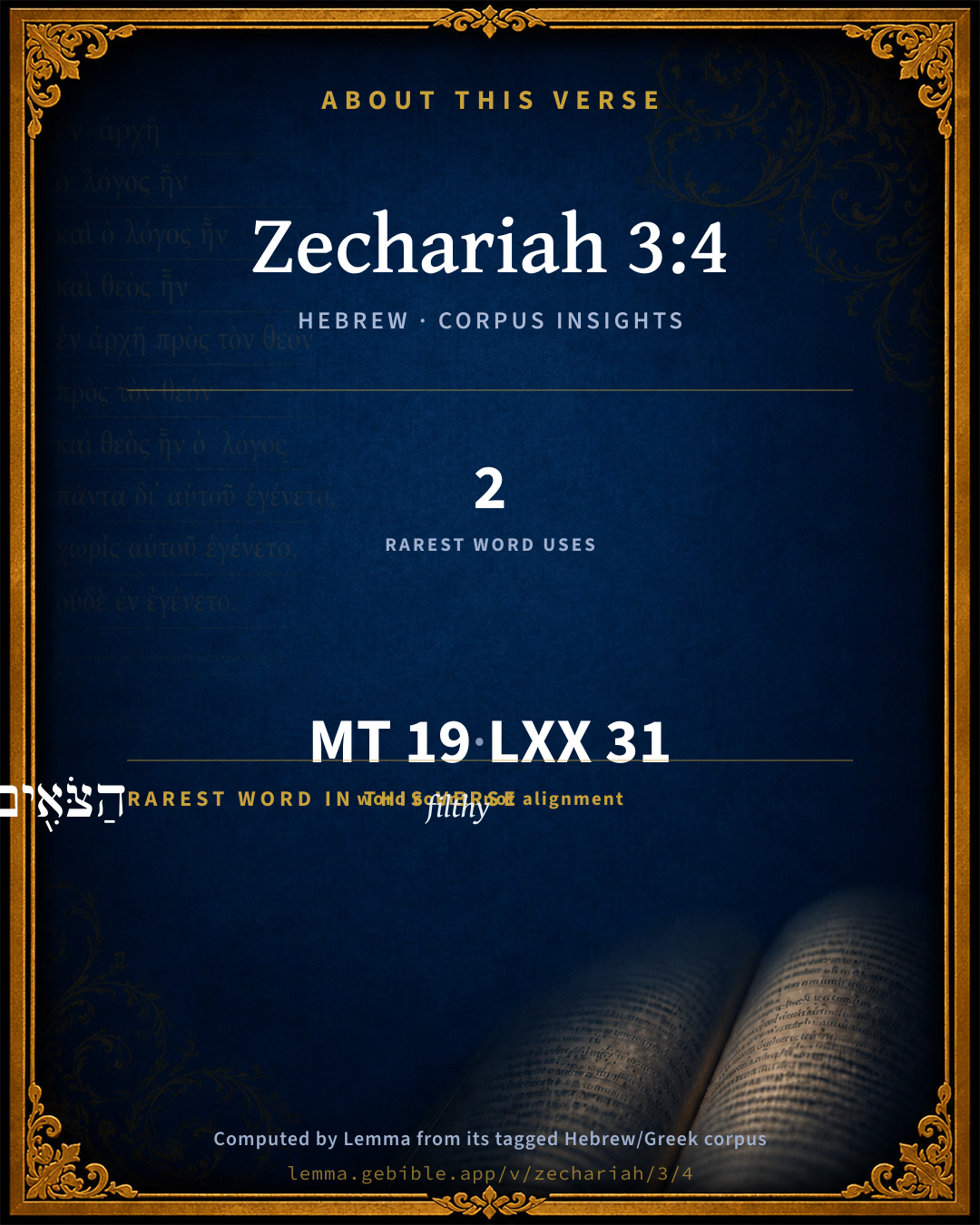
The rarest word here is הַצֹּאִ֖ים filthy H6674 — appearing just 2 times in the whole Hebrew Bible.

Shared distinctive vocabulary

הַצֹּאִ֖ים filthy H6674 occurs in 2 verses of the Hebrew Bible. Also found in:

Grammatical profile

  • 9 verbs
  • 4 nouns
  • 1 adjective
  • 4 prepositions
  • 1 particle

Verb forms

  • וַיַּ֣עַן Qal · Sequential Imperfect
  • וַיֹּ֗אמֶר Qal · Sequential Imperfect
  • הָעֹמְדִ֤ים Qal · Participle Active
  • לֵאמֹ֔ר Qal · Infinitive Construct
  • הָסִ֛ירוּ Hiphil · Imperative
  • וַיֹּ֣אמֶר Qal · Sequential Imperfect
  • רְאֵ֨ה Qal · Imperative
  • הֶעֱבַ֤רְתִּי Hiphil · Perfect
  • וְהַלְבֵּ֥שׁ Hiphil · Infinitive Absolute

Repetition

Words recur within this verse — often emphatic in Hebrew:

  • וַיֹּ֗אמֶר to say H559 ×3
  • מֵעָלָ֑יו upon H5921 ×2
  • אֶל to H413 ×2

Hebrew & Septuagint length

In English translation the verse runs 40 words from the Hebrew and 12 from the Septuagint (LXX English) — the Septuagint runs noticeably shorter here. See the side-by-side →

A rough comparison of the two English renderings, which tokenize alike — not a word-level alignment.

Word counts can differ between the Hebrew and the Greek without any difference in meaning — e.g. the Hebrew direct-object marker אֵת has no separate Greek word, and Greek often adds the article ὁ.

In the original languages it is 19 Hebrew tokens and 31 Greek tokens — but the two are counted differently (Hebrew bundles its prefixes and suffixes into one token; the Greek is in lemma form), so that isn’t a like-for-like length.

Cross-references

29

Topical passages linked to Zechariah 3:4 in the Treasury of Scripture Knowledge — connected by theme and wording, ordered by reader-vote popularity; previews shown in the World English Bible.

  • Isaiah 61:10 I will greatly rejoice in Yahweh, my soul shall be joyful in my God; for he has clothed me with the garments of salvation, he has covered me with the robe of righteousness, as a bridegroom decks himself with a garland, and as a bride adorns herself with her jewels.
  • Luke 15:22 "But the father said to his servants, 'Bring out the best robe, and put it on him. Put a ring on his hand, and shoes on his feet.
  • Ezekiel 36:25 I will sprinkle clean water on you, and you shall be clean: from all your filthiness, and from all your idols, will I cleanse you.
  • Revelation 7:14 I told him, "My lord, you know." He said to me, "These are those who came out of the great tribulation. They washed their robes, and made them white in the Lamb's blood.
  • Isaiah 43:25 I, even I, am he who blots out your transgressions for my own sake; and I will not remember your sins.
  • Revelation 19:7–8 Let us rejoice and be exceedingly glad, and let us give the glory to him. For the marriage of the Lamb has come, and his wife has made herself ready."
  • Isaiah 61:3 to appoint to those who mourn in Zion, to give to them a garland for ashes, the oil of joy for mourning, the garment of praise for the spirit of heaviness; that they may be called trees of righteousness, the planting of Yahweh, that he may be glorified.
  • Micah 7:18 Who is a God like you, who pardons iniquity, And passes over the disobedience of the remnant of his heritage? He doesn't retain his anger forever, Because he delights in loving kindness.
  • Zechariah 3:7 "Thus says Yahweh of hosts: 'If you will walk in my ways, and if you will keep my charge, then you also shall judge my house, and shall also keep my courts, and I will give you a place of access among these who stand by.
  • Psalms 51:9 Hide your face from my sins, And blot out all of my iniquities.
  • Zechariah 3:9 For, behold, the stone that I have set before Joshua; on one stone are seven eyes: behold, I will engrave the engraving of it,' says Yahweh of Hosts, 'and I will remove the iniquity of that land in one day.
  • 1 Corinthians 6:11 Such were some of you, but you were washed. But you were sanctified. But you were justified in the name of the Lord Jesus, and in the Spirit of our God.
  • Hebrews 8:12 For I will be merciful to their unrighteousness. I will remember their sins and lawless deeds no more."
  • Isaiah 6:2–3 Above him stood the seraphim. Each one had six wings. With two he covered his face. With two he covered his feet. With two he flew.
  • Isaiah 6:5–7 Then I said, "Woe is me! For I am undone, because I am a man of unclean lips, and I dwell in the midst of a people of unclean lips: for my eyes have seen the King, Yahweh of Hosts!"
  • Isaiah 52:1 Awake, awake, put on your strength, Zion; put on your beautiful garments, Jerusalem, the holy city: for henceforth there shall no more come into you the uncircumcised and the unclean.
  • Zechariah 3:1 He showed me Joshua the high priest standing before the angel of Yahweh, and Satan standing at his right hand to be his adversary.
  • Luke 1:19 The angel answered him, "I am Gabriel, who stands in the presence of God. I was sent to speak to you, and to bring you this good news.
  • John 1:29 The next day, he saw Jesus coming to him, and said, "Behold, the Lamb of God, who takes away the sin of the world!
  • Romans 6:23 For the wages of sin is death, but the free gift of God is eternal life in Christ Jesus our Lord.
  • Galatians 3:27–28 For as many of you as were baptized into Christ have put on Christ.
  • Philippians 3:7–9 However, what things were gain to me, these have I counted loss for Christ.
  • Colossians 3:10 and have put on the new man, that is being renewed in knowledge after the image of his Creator,
  • 2 Samuel 12:13 David said to Nathan, "I have sinned against Yahweh." Nathan said to David, "Yahweh also has put away your sin. You will not die.
  • 1 Kings 22:19 [Micaiah] said, Therefore hear you the word of Yahweh: I saw Yahweh sitting on his throne, and all the host of heaven standing by him on his right hand and on his left.
  • Psalms 32:1–2 Blessed is he whose disobedience is forgiven, Whose sin is covered.
  • Romans 3:22 even the righteousness of God through faith in Jesus Christ to all and on all those who believe. For there is no distinction,
  • 2 Corinthians 5:21 For him who knew no sin he made to be sin on our behalf; so that in him we might become the righteousness of God.
  • Revelation 5:11 I saw, and I heard something like a voice of many angels around the throne, the living creatures, and the elders; and the number of them was ten thousands of ten thousands, and thousands of thousands;

Cross-references courtesy of OpenBible.info (CC BY 4.0).

Hebrew and Greek witnesses Masoretic Hebrew ↔ Greek Septuagint

The same verse in the two great witnesses to the Old Testament, shown verse-for-verse.

Here the Septuagint runs noticeably shorter than the Hebrew — LXX2012 (modern English Septuagint) 12 words vs World English Bible 40. A rough length comparison of the two English translations, not a word-level alignment — read both below.

These are two independent witnesses, not word-aligned to each other, and the Septuagint is shown in lemma (dictionary) form.

Hebrew Zechariah 3:4 Masoretic · Westminster Leningrad Codex

וַיַּ֣עַן וַיֹּ֗אמֶר אֶל הָעֹמְדִ֤ים לְפָנָיו֙ לֵאמֹ֔ר הָסִ֛ירוּ הַבְּגָדִ֥ים הַצֹּאִ֖ים מֵעָלָ֑יו וַיֹּ֣אמֶר אֵלָ֗יו רְאֵ֨ה הֶעֱבַ֤רְתִּי מֵעָלֶ֨יךָ֙ עֲוֺנֶ֔ךָ וְהַלְבֵּ֥שׁ אֹתְךָ֖ מַחֲלָצֽוֹת

He answered and spoke to those who stood before him, saying, "Take the filthy garments off of him." To him he said, "Behold, I have caused your iniquity to pass from you, and I will clothe you with rich clothing."

World English Bible · Public Domain

Greek LXX Zechariah 3:4 Septuagint · lemma form

καί ἀποκρίνω καί εἶπον πρός ὁ ἵστημι πρό πρόσωπον αὐτός λέγω ἀποαἱρέω ὁ ἱμάτιον ὁ ῥυπαρός ἀπό αὐτός καί εἶπον πρός αὐτός ἰδού ἀποαἱρέω ὁ ἀνομία σύ καί ἐνδύω αὐτός ποδήρης

Now Jesus was clothed in filthy raiment, and stood before the angel.

LXX2012 (modern English Septuagint) · Public Domain

On this verse, Ellicott's Commentary for English Readers discusses the Septuagint’s reading. Read the note in Commentary ↓

Hebrew: Westminster Leningrad Codex (CC BY 4.0). Greek: Septuagint (public domain); English from LXX2012 (modern English Septuagint) (Public Domain). How the Septuagint differs from the Hebrew →

Targum (Aramaic paraphrase)

1

The Targum is the ancient Jewish Aramaic paraphrase of the Hebrew Scriptures — an interpretive translation, not the Hebrew text itself. Onkelos (literal) and Pseudo-Jonathan (expansive) render the Torah, and Jonathan the Prophets. Coverage is partial: where no permissively-licensed English translation exists for a verse, only the Aramaic is shown. This is verse-level text, not a word-by-word alignment to the Hebrew.

  1. Targum Jonathan Prophets (Joshua–Malachi)
    וַאֲתִיב וַאֲמַר לְדִמְשַׁמְשִׁין קֳדָמוֹהִי לְמֵימָר וַאֲמָרוּ לֵיהּ וְיַפֵּיק נְשִׁין דְלָא כָשְׁרִין לִכְהוּנְתָּא מִבֵּיתֵיהּ וַאֲמַר לֵיהּ חֲזֵי דְאַדְעֵיתִי מִנָךְ חוֹבָךְ וְאַלְבִּישַׁת יָתָךְ זַכְוָן:

    (no public-domain English translation for this verse)

    Targum Jonathan — Aramaic: “Mikraot Gedolot” (public domain). English: “Sefaria Community Translation” (CC0 1.0 (public-domain dedication)); “London "Chaldee Paraphrase," 1871” (public domain). Text via Sefaria.

Commentary

Notes on Zechariah 3:4 from classic Christian and Jewish commentators (each source and its license shown beneath its notes). The classic Christian expositions comment on the surrounding passage and are grouped to its opening verse, so a note may address several verses; the Jewish commentaries on the Tanakh (Rashi and others) are per-verse, so they appear only where the commentator wrote on this verse.

Lemma curates 59 commentaries, every one of them public domain or Creative Commons licensed, each selected and text-cleaned for this edition rather than reprinted as found. About our sources →

Trapp's Complete Commentary

John Trapp

Zec 3:4 And he answered and spake unto those that stood before him, saying, Take away the filthy garments from him. And unto him he said, Behold, I have caused thine iniquity to pass from thee, and I will clothe thee with change of raiment.

Ver. 4. And he answered and spake to those that stood before him] i.e. To the angels that waited upon him. Est autem hoc humanitus dictum, saith Junius. This is spoken after the manner of men; for properly men are washed, justified, and sanctified by the merit and Spirit of Christ alone, 1Co 6:11. But the Lord Christ speaketh thus to the created angels, his ministers; to show that he who only hath power to forgive sins doth yet therein employ the holy ministry for an instrument. See 1Co 9:18 Job 33:23-24.

Take away the filthy garments] Those symbols of his sinfulness, {See Trapp on "Zec 3:8"} so his sins were pardoned in heaven. But because it is small comfort to a condemned person to have a pardon granted him unless he know it, and be assured of it, thereof it followeth,

And unto him he said, Behold] By what thou hast seen in the angel’s stripping of thee,

I have caused thine iniquities to pass from thee] Transtuli peccatum, as he once said to David, I have taken away thy sin, I have transferred it upon myself: speaking to my Father for thee, as once Paul did to Philemon for his son Onesimus, "if he hath wronged thee, or oweth thee ought, put that on mine account, I will repay it," Phm 1:18-19. This is the greatest happiness that can befall a man in this world, Psa 32:1-2, and could not but be a singular comfort to these poor Jews, priest and people, amidst their manifold afflictions. A man that hath gotten his pardon is not troubled though he lose his glove, or handkerchief, nor though it should prove a rainy day. "Being justified by faith we glory in tribulation," Rom 5:1; Rom 5:3. Feri, Domino, feri nam a peccatis absolutus sum, saith Luther: Strike, Lord, strike, while thou wilt; my sins are pardoned. I thank thee, O Lord (said another, in his great extremity), for all my pain; and I beseech thee, if thou think good, to add to it a hundred fold. But behold a further honour; as mercies seldom come single.

And I will clothe thee with change of raiment] i.e. I will change thy rags into robes, thy stained clouts into clean clothing. Thou shalt be arrayed with the righteousness of the saints, Rev 19:8, that twofold righteousness, imputed and imparted; that of justification, and this other of sanctification; that as an undercoat, this as an upper; that clean and pure, this white and bright: both must be had from Christ, who is made unto us of God not only wisdom, but righteousness, sanctification, and redemption, 1Co 1:30 2Co 5:19. Surely as our apparel is not bred of us, neither grows out of our bodies, so neither does this change of raiment in the text. But the blessed Lamb of God clotheth us with his own fleece, which is long enough and large enough to cover all our defects and deformities, and to set us forth to the admiration of angels. As he taketh upon him our sins, so he putteth upon us his righteousness. This is a blessed exchange indeed, a sure pledge of our peace with him, and with God by him. We read in our own chronicles that Edward, surnamed Ironside (in whom England was lost), and Canute, the first Danish king, after many encounters and equal fights, at length embraced a present agreement; which was made by parting England between them two, and confirmed by oath and sacrament, putting on each other’s apparel and arms, as a ceremony to express the atonement of their minds, as if they had made transaction of their persons each to other; Canute became Edmund, and Edmund Canute. Even such an exchange I may say of apparel is between Christ and the pardoned sinner, &c. Christ puts upon his Church his own comeliness, decks his spouse with his own jewels, as Isaac did Rebecca; clothes her with needlework, and makes her more glorious within than Esther ever was in all her beauty and bravery.; rejoiceth over her, as the bridegroom over his bride; yea, is ravished in his love to her, with one of her eyes lifted up to him in prayer or meditation, with one chain of her neck, that chain of his own graces in her, Son 4:9.

John Trapp, A Commentary or Exposition upon All the Books of the Old and New Testament (1647–1656) — public domain. Text from a community e-Sword module.

The Biblical Illustrator

Joseph S. Exell

Zec_3:4-5

Take away the filthy garments from him

Removal of guilt

Zechariah was shown the state and condition of Gods Church in his day, and the change wrought upon that Church; a change that must be wrought on all that belong to the Lord God Almighty, and which is wrought by Divine power and grace alone.

Here is a scenic representation of Gospel truth. Joshua was clothed in filthy garments. Why did he so appear, and in such a presence? That his condition, and yours, and mine, in the presence of a Holy God, may be likened to filthy, polluted, unclean, defiled garments. Satan stood at his right hand to resist him. This alludes to the prevailing custom of placing an accused person before a bar of justice, and bringing his accuser upon his right hand to prefer the charge against him. Satan is the accuser of the brethren. Having rebuked Satan, our Advocate addresses Himself to them that stood by. Take away the filthy garments from him. This is the Old Testament description of the removal of guilt, the manifestation of salvation by grace. We must in this manner go to God in our filthy garments. Wait not to try to change your heart, as you would your raiment. Prayer is necessary, but prayer is no qualification; repentence is necessary, but repentance does not qualify for Gods mercy. Come, poor self-condemned sinner, just as you are. The filthy garment is removed from everyone whose heart is moved by Gods grace, though he know it not. What is represented by the change of raiment? The clothing with righteousness of our blessed Redeemer. The righteousness of the Lord Jesus Christ is a robe long enough to cover the sinner completely, it is as broad as the law of God; those that are enrobed in it need fear no stormy blast, either through their journey, or at their journeys end There is nothing to be compared in importance, to us all, with the knowledge of Jesus Christ as the full, perfect, and complete Saviour of our souls. (A. Hewlett, M. A.)

So they set a fair mitre upon his head, and clothed him with garments--

The mitre of priesthood

This book was written in the midst of a process of reconstruction. The people, or at least a handful of the people of Israel, had come back from Babylon to a ruined city, but by the guidance and leadership of Zerubbabel and Joshua, and those prophets of God, Haggai, Zechariah, and Malachi, the little handful or remnant of the people commenced to reconstruct their state, their city, and temple. It was of little use to build the temple while the priesthood was so degraded as Malachi tells us it was. The priests offered upon the altar of God contemptible sacrifices--they were content to bring to it the halt, the lame, the blind, such as they would not bring to their governor. They looked upon the whole service they rendered as hardly worth their care and energy, so ill were they repaid. You will notice at the end of the chapter we read that Joshua and his fellows were men for a sign, that is, they were types of the spiritual priesthood of the present time. We may not exercise our priestly office any more than we exercise our royal prerogative; yet in Gods sight we have a spiritual faculty of standing between God and man, speaking to God for man and to man for God. Is it not a fact that there are men and women here who are priests, but they need to be reconstructed, who are called to exercise this spiritual prerogative, but they have not a fair mitre upon their head? Let them set a fair mitre upon his head.

I. We consider the persons thus adorned, lest any here might suppose that they could not claim the fair mitre. You will see it is Joshua who receives the fair mitre, the person who at first stands before us clothed with filthy garments. Filthy garments always indicate some slur upon the character, some stain on the white robe of the dress of the soul. It may be that you are sensible that your robe is soiled, and as you come to the searching light of Gods angel--the angel of Gods presence--you are more than ever conscious of the wrinkles in your white robe. When you first came to the Cross of Christ you washed your robes and made them white in His blood, but you have failed to keep them so. The father sits down at the family altar, takes the old Bible and turns over its leaves, but all the time that he essays to act as priest of the family he is conscious that during the past twenty-four hours he has soiled his garments by impure thoughts or wrong imaginations. It may be that some young man here, who, indeed, is a true child of God, has allowed the sin of foul impurity, of unclean desire, to stain his robes; some housewife here has yielded to that today which soils her garments. But even you, in your filthy garment, may yet by the grace of God receive the fillet, the mitre. You will notice not only was Joshua clothed with these filthy garments, but he was the object of Satans accusation; Satan stood beside and indicated his disgrace. Do you not suppose the great accuser still does this? When just now you bowed in prayer, and your thoughts, were wandering to your pleasure or business, Satan saw it and said, Christ, do You notice there is not one in all those people truly in prayer? And when your minister speaks and his motives are vanity or pride, again the evil spirit stands to accuse us; he says to Christ, Here is Thy chosen servant, but it would be better for me to cast him out of Thy hand and find another to do Thy work better. And so there is never a negligence, a sin, or a fault but what Satan catches it and casts it upon Christ, because he can wound Christ best by showing up our filth and sin. You will notice also that Joshua was like a charred brand: you know how a piece of wood put in the fire will soon blacken and be consumed; a precious letter, a banknote, or cheque, by mistake has been taken by your servant to your wastepaper basket and put into the furnace, and when taken out it is so blackened, yellow, or charred, as to be almost undecipherable; and I suppose I am speaking to plenty of men here who have the marks of fire upon them. But though charred as you are, He will pluck you from the burning, and is prepared this very night to adorn your brow with this fillet, this mitre of His Holy Spirit which will equip you to exercise your power as a priest of God.

II. I ought to mark the prepratory process, because one has often found, in talking to people about the blessed Holy Spirit, that there has not been any deep preparatory previous work, and it is quite impossible for you to receive the appointing of the Holy Ghost unless you have submitted yourself to the previous work of that same Spirit. Whilst the Holy Spirit of Pentecost is more especially the Spirit of power, He is also the Spirit of cleansing, purification, and sanctification. There is a previous process, but with God that process need not take long. This process is indicated in the vision thus: He said, Behold, I have caused thine iniquity to pass from thee, and I will clothe thee with change of raiment. And we are told at the close of the chapter that God can put away the iniquity of man in a single day. Imagine all the sin rising over England, Scotland, and Wales today; this little island surrounded by our four seas; imagine and remember God says He can put away the sin of a land in one day, and that day was when Jesus died. If the Lord during His three hours crucifixion was able to expiate and put away the sin of the world, how long will it take for Him to expiate the sin which is already expiated? Will you allow Him now, the great High Priest, to put away your filthy garments, to cause your guilt to leave you, and to give you instead the sense of Gods forgiveness? That is not all. The there must come a moment in a mans life when he stands before the angel of God, when certain habits which he once permitted are shown to be altogether unworthy of his Christian character, and he puts off the works of the flesh. You see things in a different light. I feel that the man who does not drop habit after habit, indulgence after indulgence, is not growing; just as a tree may tell us its age by the rings of wood, so we can mark the growth of a man by what he has dropped. I am not here to tell you what to give up, it is not my purpose to add commandments to the decalogue, but to say that a mans growth is determined by what he is prepared to renounce. He does not think it hard to renounce them, because he is receiving so much more; he drops the less to take the better. Just as when we come to the moment of death I do not suppose we shall think about dying, because the radiant light of that world beyond will attract us, and reaching out our two hands towards it, before we know we have died, we shall have passed into heaven. So now we are attracted always by the heavenly vision. O Christ, cause these habits, associations, indulgences, which have been rotting our heart and holding us back, cause these things to pass. Then there is a change of raiment: you must put on the Lord Jesus; make no provision for the flesh, but put on the perfect character of Jesus Christ. This is the deep truth that we do not all remember, I think; we are more anxious for the negative than the positive; more taken up with what we give up than with what we take on. You see here is Joshua: when I began to speak, he stood there clothed with soiled garments, and Satan stands beside him; but the scene is altered now, the filthy garments have been dropped. He has been bathed in water, and he is clothed with fair and beautiful robes, the emblem of some soul here. Satan has vanished, there is no further record of his accusing Joshua, because Christ had rebuked him; and when Christ throws the aegis of His protection round a soul, then Satan sneaks away. Christ has said, I have chosen this man, plucked him as a brand from the fire, and am not likely to cast him back. Avaunt. And ashamed and disappointed he sneaks away. And so the soul that stood ashamed and downcast, knowing every sneer of the devil was true, now looks into the face of the blessed Angel--Christ--and says, O Advocate, Priest of God, O most blessed lover of my soul, what can I render to Thee for Thine advocacy and intercession, by virtue of which the very tempter is vanquished?

III. Still, though Satan is gone, Joshua wants the crown of the priesthood, the insignia, the mitre of the priesthood. The mitre, you know, as worn by the bishop, is golden. It is an emblem of the ancient idea of the cloven tongues of fire, but is a faint rendering of the Greek, for on the day of Pentecost the fire came as a glow of light or fire into the room, and then there was distributed a flame upon each meekly bowed head. But still the mitre is the emblem of the ancient thought. The mitre, fillet, or turban, if you compare this with Leviticus and Numbers, and these again with the epistles, stands without doubt for the anointing of the Holy Spirit, not for the bishop alone, but for every one of us. You cannot do priestly work until you have got it; you cannot plead with God as intercessor, and cannot speak to men with power until you have got your fair mitre. You may have your clean robe, but if you have no mitre, you are unable to act as priest. The Lord Jesus for thirty years had a stainless robe of purity and beauty, and as He walked on the hills round Nazareth in intercourse with His Father, there was in Him neither spot nor blemish; yet I think I shall be within the confines of preaching the Word of God when I say that in a sense our Lord had not the fair mitre upon His head until He went down into the Jordan and was baptized, thus identifying Himself with man; then having fulfilled all righteousness, as He came up out of the water, beneath that blue sky, the Spirit of God, in the fitting emblem of a doves wing, came upon Him, and the fair mitre abode upon His head. He went forth into Galilee and said, The Spirit of the Lord is upon Me. So when He left the Church of God He blessed them and said in effect, Peter, John, and the rest of you, tarry in Jerusalem until you get your fair mitre; and though they have been cleansed with fellowship with Him, and by His most precious blood, they waited together in the upper room, until that mystic sign to which I have alluded--the fair mitre--was put upon the head of one hundred and twenty, and upon many since then. Many a soul I have had to do with has spent long years with white robes, but without the fair mitre. You must have the anointing power of the Holy Spirit of Pentecost if you are to do the Churchs work in the world. It is noticeable that Zechariah said, Let them set a fair mitre upon his head. Zechariah, you have no right to say that--an angel should do it; you are a prophet, and Joshua is a priest, and there used to be antagonism between the prophets and the priesthood; but Zechariah said, Let them put a fair mitre upon his head, and they did. The prophet and priest are united by the Holy Ghost. How can you have it? Not by agonising, not by wrestling and struggling, but by first receiving, because Jesus Christ, the angel of Jehovah, waits to give it. There is nothing He wants more to give you than this. You ask me how you know when you have got it? I will tell you. You receive it by faith; you received forgiveness without emotion; you must not gauge your reception by emotion, or you will be disappointed: emotion must not be trusted. You receive it by faith; you may receive it now, at any moment. The indication you have got it is not emotion: it is two things. First, a new sense of the sweetness of the presence of Jesus; for the Holy Spirit never reveals Himself, but always reveals Christ. Secondly, a quiet power over other men. These are men for a sign. and I close with one most precious promise: Hear now, O Joshua the high priest, if thou wilt walk in My ways, and if thou wilt keep My charge--I give this as a parting message,--then thou shalt also judge My house, and shalt also keep My courts, and I wall give thee places of access among these that stand by. This is not got by wrestling, but by trusting; so will you be brought within the tuner circle of Christs presence. Let them set a fair mitre upon his head. (F. B. Meyer, B. A.)

The Biblical Illustrator, edited by Joseph S. Exell (c. 1880s–1900s) — public domain. Text from a community e-Sword module.

Tyndale Open Study Notes

Tyndale Open Resources

3:4 Take off his filthy clothes: This action dramatizes the removal of sin and guilt from Jeshua and the Hebrew people, restoring them to their former position through God’s cleansing.

Tyndale Open Study Notes — © Tyndale Open Resources, licensed CC BY-SA 4.0. Text via the HelloAO Bible API.

Geneva Bible (1599)

Geneva Bible translators

He showeth of what apparel he speaketh, which is, when our filthy sins are taken away, and we are clad with God’s mercies, which is meant of the spiritual restitution.

See verse 3.

Geneva Bible (1599) marginal notes — public domain. Text via Bolls.life.

Jamieson, Fausset & Brown

Robert Jamieson, A. R. Fausset & David Brown

those that stood before him--the ministering angels (compare the phrase in Kg1 10:8; Dan 1:5).

Take away the filthy garments--In Zac 3:9 it is "remove the iniquity of that land"; therefore Joshua represents the land.

from him--literally, "from upon him"; pressing upon him as an overwhelming burden.

change of raiment--festal robes of the high priest, most costly and gorgeous; symbol of Messiah's imputed righteousness (Mat 22:11). The restoration of the glory of the priesthood is implied: first, partially, at the completion of the second temple; fully realized in the great High Priest Jesus, whose name is identical with Joshua (Heb 4:8), the Representative of Israel, the "kingdom of priests" (Exo 19:6); once clad in the filthy garments of our vileness, but being the chosen of the Father (Isa 42:1; Isa 44:1; Isa 49:1-3), He hath by death ceased from sin, and in garments of glory entered the heavenly holy place as our High Priest (Heb 8:1; Heb 9:24). Then, as the consequence (Pe1 2:5), realized in the Church generally (Luk 15:22; Rev 19:8), and in Israel in particular (Isa 61:10; compare Isa 3:6; Isa 66:21).

Jamieson, Fausset & Brown — Commentary Critical and Explanatory on the Whole Bible (1871) — public domain (CC PDM 1.0). Text via the HelloAO Bible API.

Adam Clarke's Commentary

Verse 4. Take away the filthy garments] The Jews wore sackcloth in times of public calamity; probably the filthy garments refer to this. Let their clothing be changed. I have turned again their captivity; I will fully restore them, and blot out all their iniquities.

Adam Clarke's Commentary on the Bible (1810–1826) — public domain. Text from a community e-Sword/MySword module.

John Calvin's Commentaries

We now see that he who is often said to be Jehovah is called an angel: the name therefore of Angel as well as of Jehovah, I doubt not, ought to be applied to the person of Christ, who is truly and really God, and at the same time a Mediator between the Father and the faithful: and hence he authoritatively commanded the angels who were present; for Christ was there, but with his hosts. While therefore the angels were standing by, ready to obey, he is said to have bidden them to strip the high priest of his mean garments.

Afterwards the angel addresses Joshua himself, See, I slave made to pass from thee thine iniquity, and now I will clothe thee with new or other garments When the angel said that he had taken away iniquity, he justly reminded them of the filthiness contracted by the priest as well as by the people; for they had denuded themselves of all glory by their iniquities. We hence see that the mouths of the Jews were here closed, that they might not clamor against God, because he suffered them still to continue in their sordid condition, for they deserved to continue in such a state; and the Lord for this reason called their filth, iniquity. He further teaches us, that though the Jews fully deserved by their sins to rot in their struggle and filthiness, yet the Lord would not finally allow their unworthiness to prevent him from affording relief.

The import of the prophecy then is this, — That however much the mean outward condition of the high priest might offend the Jews, they were still to entertain hope; for the remedy was in God’s power, who would at length change the dishonor and reproach of the high priest into very great glory, even when the time of gratuitous remission or of good pleasure arrived.

John Calvin's Commentaries (1540-1563) — public domain. Text from the Calvin Translation Society English edition (1840s-50s) via the Christian Classics Ethereal Library (ccel.org). Calvin's coverage is partial (roughly two-thirds of the Bible); uncommented books and verses are honest gaps, never fabricated. The 19th-century editor's footnotes and remarks are omitted so the notes are faithfully Calvin's own voice.

Ellicott's Commentary for English Readers

(4) Those that stood before him is an expression meaning courtiers and counsellors (1Ki_13:6-8); and here, probably, means angels of inferior grade to the “angel of the Lord.”

Thine iniquity—i.e., of thee, and of the people whose representative thou art.

And I will clothe thee.—Better, and I clothe thee. The tense is “the aorist of immediate past.” (Comp. Gr. ἐδεξάμην, “I welcome.”) LXX. change the mood and person, and render καὶ ἐνδύσατε αὐτὸν ποδήρη, “and clothe ye him with a long garment.”

Change of raiment.—The word means simply different garments to the filthy ones in which he was clothed before: clean ones, in fact. (See next verse.) The figure seems to be borrowed from Isa_61:10 : “He hath clothed me with garments of salvation, He hath clothed me with a robe of righteousness.” That it does not mean “festal garments” is shown by the ordinary word for “garments” being used in Zec_3:5.

A Bible Commentary for English Readers, edited by Charles John Ellicott (1878–1897) — public domain. Text from a community e-Sword module.

The Cambridge Bible for Schools and Colleges

gen. ed. J. J. S. Perowne

4. he] i.e. the Angel of Jehovah.

those that stood before him] Angels of inferior order, who though not previously mentioned were in attendance, as was fitting, upon the Angel of the Lord. Compare for the expression Gen_41:46; Deu_1:38; Dan_1:5.

change of raiment] The Hebrew word here used only occurs beside in Isa_3:22, “changeable suits of apparel,” where number and variety, frequent changing, rather than costliness or magnificence, though that of course may be implied, appears to be the subject of rebuke. So here a change of dress, not necessarily different in kind, but pure instead of being defiled, is promised. The R. V. however, renders rich apparel here, and festival robes in Isaiah.

The Cambridge Bible for Schools and Colleges (gen. ed. J. J. S. Perowne; Cambridge University Press, 1878–1918) — public domain. Text from a community e-Sword module.

John Gill's Exposition

And he answered, and spake,.... That is, the Angel of the Lord, before whom Joshua stood, answered to the accusations of Satan, and the entreaties of Joshua: and spake

unto those that stood before him; not the fellows that sat before Joshua, Zac 3:8 for the priests, who were Joshua's fellows, could not take away sin; nor indeed can ministers of the Gospel, only ministerially or declaratively, as instruments, in bringing the good news of pardon to the comfort of distressed minds; whom the ministering angels may here represent, that stood before Christ the Archangel, the Head of all principalities and powers, and who are ministering spirits to him; and so the Targum paraphrases it,

"and he said to them who ministered before him;''

who, though they can not expiate sin, or make atonement for it, may bring the tidings of pardon to a poor fallen believer:

saying, Take away the filthy garments from him; it may be observed, that the garments of the priests were to be new and fair, according to the Jewish canons (i); and if they became filthy, they did not whiten them, nor wash them, but left them for threads (or wicks of candles), and put on new; and so orders are here given not to wash the filthy garments of Joshua, but to take them away: it is not, take him, Satan, the address is not to him; nor angels, who are spoken to, take away this filthy creature from me, I can not bear the sight of him; but take away his sins, not the being, power, or sense of them; nor does it signify making atonement for them, or removing them out of the sight of justice; but a taking them away out of Joshua's sight, and giving him a sense of pardon, a comfortable view of it, in which angels and ministers of the word may be assisting; see Isa 6:6 and is effectually done, when Christ, who has power to forgive sin, makes an application of forgiving grace himself, as follows:

and unto him he said; that is, the Angel of the Lord said to Joshua:

Behold, I have caused thine iniquity to pass from thee; which shows that he had sinned, and interprets the filthy garments he was clothed with: Christ took his iniquity upon himself, bore and made satisfaction for it, and removed it as far from him as the east from the west; and now caused the guilt of it to pass from his conscience, and gave him a comfortable view of the free and full pardon of it. The word "behold" is prefixed to this declaration of pardon, to ascertain the truth of it, to fix his attention to it, and raise his admiration at it:

and I will clothe thee with change of raiment; garments to put on and off; for, in those hot countries, they used to shift their garments often; and these do not design priestly garments, such as the high priest put on, on the day of atonement, when he put off his common garments, and, having done his work, shifted again, Lev 16:23 such change of garments the high priest, indeed, had; and so had the common priests; for they did not wear the same garments, when out of service, as when in it; See Gill on Eze 42:14, Eze 44:19; but priestly garments seem rather to be intended in the following verses, which were put on along with the mitre: change of raiment here rather signify such as used to be wore on festivals and holy days, rich, valuable, precious garments; such as men wore when they went abroad, and appeared in company, and upon return home put off again; and especially clean neat garments, as some render the word (k), in opposition to filthy ones Joshua was clothed with: when arraigned persons put on sordid garments, they were said, "moutare vestem", to change their apparel; but here clean, instead of filthy garments, are called change of raiment with great propriety; and a happy exchange is this indeed! The word is in the plural number, and may point at more garments than one, different suits of apparel, with which changes might be frequently made, both for delight and refreshment; and may have regard to the several garments of believers in Christ, of all good men, partakers of the grace of God: they have the garment of an outward holy conversation, which they are to watch and keep, lest they walk naked; and which, as it is often spotted with sin, they wash and make white in the blood of the Lamb: and there is the integrity and faithfulness of the saints in the performance of their duty, in their several stations of life; and especially of those in public office, in the discharge of that; who, as Job, put on righteousness, and it clothes them, and judgment is as a robe and diadem to them, Job 29:14 and there is the garment of internal holiness, the new man, consisting of the various graces of the spirit, which is put on as a garment, and makes believers all glorious within; as well as their clothing is of wrought gold, the righteousness of Christ; the principal garment, called the robe of righteousness, and garments of salvation; the best robe, and wedding garment, fine linen, clean and white, which is the righteousness or righteousnesses of the saints, Rev 19:8 and so the Targum renders the word here, "with righteousnesses": though, as one change of raiment, or suit of apparel, may be meant, so one sort of righteousness only may be pointed at, even the one obedience of Christ, or his justifying righteousness; which may be so called, to denote the excellency and fulness of it, being sufficient to clothe and justify all the elect of God; like raiment, this is not in the saints, but put upon them, and covers them, and keeps them warm; protects from injuries, and beautifies and adorns: this robe of righteousness Christ has wrought out for his people, and he clothes them with it; it is his gift unto them, and they receive it from him; by which they are freed from all sin and condemnation, and their persons and services are accepted with God.

(i) Maimon. Cele Hamikdash, c. 8. sect. 4, 5. (k) "vestibus aliis", i. e. "puris", Munster; "mundas et pretiosas", Vatablus; "vestes elegantiores et cultiores", Drusius; "vestibus mundioribus", Grotius; "vestibus mundis", Burkius; "significat in genere vestes decoras et pretiosas", ib.

John Gill's Exposition of the Whole Bible (1746–1763) — public domain (CC PDM 1.0). Text via the HelloAO Bible API.

Albert Barnes' Notes on the Bible

And He spake to those who stood before Him - the ministering angels who had waited on the Angel of the Lord to do His bidding.

See, I have caused thine iniquity to pass from thee - The pardoning words of the Lord to David by Nathan, “The Lord too hath put away thy sin” 2Sa 12:13. “And clothe thee with change of raiment, that is, such as were taken off and reserved for great occasions. As the filthy garments were not necessarily other than the high priest’s vesture, symbolically defiled through the sins of the people, so neither need these be other than the priestly garments in their purity and freshness. The words imply the condition, not the nature of the vestment. (Cyril: “The high priest having been thus taken to represent the whole people, the filthy garments would be no unclear symbol of the wickedness of the people. For clad, as it were, with their sins, with the ill-effaceable spot of ungodliness, they abode in captivity, subject to retribution, paying the penalty of their unholy deeds. But when God had pity on them, He bade them be freed from their defilements, and in a manner re-clad with justifying grace. He indicates to them the end of their toils. For where remission of sin is, there follows of necessity freedom from the evils brought through sin.” He adds that a clean mitre should be put upon his head, (Cyril), “that so we might understand that the glory of the priesthood ever, in a sort, concurs with the condition of the people. For the boast of the priesthood is the purity of those in their charge. As then when the people was in sin, the raiment of the priest also was in a manner defiled, so if it were again well-approved, pure and bright is the fashion of the priesthood, and free its access to God. So the inspired Paul having ministered to the Gentiles the Gospel of Christ, seeing them advancing in graces, writes, “By your boast, brethren, which I have in Christ Jesus” 1Co 15:31, and, “my joy and crown” Phi 4:1.

Albert Barnes' Notes on the Bible (1834–1885) — public domain. Text from a community e-Sword/MySword module.

Haydock's Catholic Bible Commentary

Change, such as were worn on festivals. This shewed that the people should exchange adversity for joy.

George Leo Haydock (1774–1849), Haydock's Catholic Family Bible and Commentary, 1859 edition — public domain. Excludes Psalms (Douay-Rheims chapter numbering differs from Protestant) and Deuterocanonical books (Catholic canon only).

Matthew Poole's English Annotations

And he; the Lord Christ, who purifieth his church, who purgeth away her sin, and clothes her with rich and clean garments.

Answered; so the Hebrew, and so this prophet speaks, though no question went before. It is an idiom of that language.

Spake; commanded.

Those that stood before him; some of the attendants, those ministerial angels, who were Christ’s servants, and as such are represented standing before him.

Take away the filthy garments; remove, or cause them to be removed, from him, as altogether unbecoming his person, office, and employments. These filthy garments those angels took away, but another hand takes away what is signified by this emblem.

From him; from this high priest Joshua.

He, Christ, the Lamb of God, said,

Behold, I have caused thine iniquity to pass from thee: what angels could not take away, Christ did; he removed the filth of sin, the guilt and stain of it.

I will clothe, adorn and beautify,

thee, O Joshua, with change of raiment; clean and rich, emblem of graces and spiritual excellencies given to him.

Matthew Poole's English Annotations on the Holy Bible (1683–1685) — public domain. Text from a community e-Sword/MySword module.

The Pulpit Commentary

He answered. The Angel of Jehovah answered the mute petition of Joshua. Those that stood before him. The attendant angels, who waited on the Angel of Jehovah to do his pleasure (see note on ver. 1). Take away the filthy garments. This symbolized remission of sins and restoration to favour, as the following words explain, I will clothe thee with change of raiment; Revised Version, with rich apparel. The word machalatsoth occurs also in Isa_3:22, and may mean either "change of raiment," or "costly raiment;" or the meanings may be combined in the sense of "festal robes," only worn on great occasions and changed after the occasion. They are used here as symbols of righteousness and glory. Not only is the sin pardoned, but the wearer is restored to the full glory of his state. The LXX makes the words to be addressed to the attendants, "Clothe ye him in a robe flowing to the feet" (podhrh , the word used for Aaron"s priestly garment, Exo_28:4; Ecc 45:8).

The Pulpit Commentary (1880–1919), ed. H.D.M. Spence-Jones & Joseph S. Exell — public domain. Text from a community e-Sword module.

John Wesley's Explanatory Notes

And he - Christ. Unto those - Ministerial angels. I have caused - What angels could not take away, Christ did; he removed the filth of sin, the guilt and stain of it. With change of raiment - Clean and rich, the emblem of holiness.

John Wesley, Explanatory Notes Upon the Whole Bible (1754–1765) — public domain. Text via the GEBible commentary corpus.

Scofield Reference Notes

C. I. Scofield

clothe

(See Scofield "Gen 3:21").

The Scofield Reference Bible (1917 edition), notes by C. I. Scofield — public domain. Text from a community e-Sword module.

unfoldingWord translationNotes

Door43 World Missions Community

those who stood before him

The word "him" refers to the angel. The phrase refers to other angels who were present.

Look

"Pay attention, because what I am about to say is both true and important"

I have caused your iniquity to pass from you

Since Joshua's garments were symbolic of his sinfulness, by removing his garments, the angel removed Joshua's iniquity. Causing iniquity to pass from him is an idiom that means that he had removed Joshua's iniquity. AT: "I have removed your iniquity from you" (See: Idiom)

dress you in fine clothing

Here fine clothing symbolizes righteousness. (See: Symbolic Language)

Let them put

Here the word "them" refers to the other angels who were present.

turban

a long piece of cloth wrapped around the head

translationWords

angel

iniquity

unfoldingWord translationNotes — © Distant Shores Media and the Door43 World Missions Community, licensed CC BY-SA 4.0. Source: git.door43.org/Door43/en_tn.

Rashi

Rabbi Shlomo Yitzchaki (Rashi)

“Take the filthy garments off him.” Let his sons separate from their wives, and he will be forgiven.

clean garments A change of beautiful garments; i.e., merits. Since he compared the iniquity to filthy garments, he compares the merit to clean garments; beautiful, white garments.

Rashi on the Tanakh — English translations: “The Judaica Press complete Tanach with Rashi, translated by A. J. Rosenberg” (CC BY 4.0); “Pentateuch with Rashi's commentary by M. Rosenbaum and A.M. Silbermann, 1929-1934” (public domain); “The Metsudah Tanach series, Lakewood, N.J” (CC BY 4.0); and “The Book of Joshua, Metsudah Publications, 1997” (CC BY 4.0). Text via Sefaria.

Lesson kit

Teaching starters — assembled from the data on this page, not authored interpretation. Every prompt links to the verse data it draws on. Edit before teaching.

Zechariah, in the Prophets, opens this verse with 19 words (15 distinct Hebrew lemmas). Its most distinctive word is tsôwʼ (“filthy”). The Greek Septuagint runs shorter here. A historical commentator’s framing appears above. Read the whole chapter for the surrounding context.

Discussion questions

  1. How does “filthy” (tsôwʼ) shape what this verse is saying?
  2. Zechariah 3:3 shares the word «filthy» with this verse. How do the two illuminate each other?
  3. “to say” occurs 3× in this one verse. What is the effect of the repetition?
  4. Compared with the Hebrew, the Septuagint runs shorter here. What questions does that raise?
  5. These translations render this verse differently; the difference is in the English rendering, not the original. What questions does that raise?
  6. The verb «וַיַּ֣עַן» is Qal Sequential Imperfect. How does its form color the action?
  7. Reading how Trapp's Complete Commentary and The Biblical Illustrator read this verse, where do the two commentators agree and where do they part?

Things to notice

Reading settings

Reading text

Shown beneath each verse's original-language words.

Old Testament
Old Testament edition

Read the OT as the Masoretic Hebrew (MT) or the Greek Septuagint (LXX).

English shown for the Greek Septuagint (in the Hebrew ↔ Greek comparison).

Comparing translations? Open the Compare panel on any verse page to stack up to four side by side.