
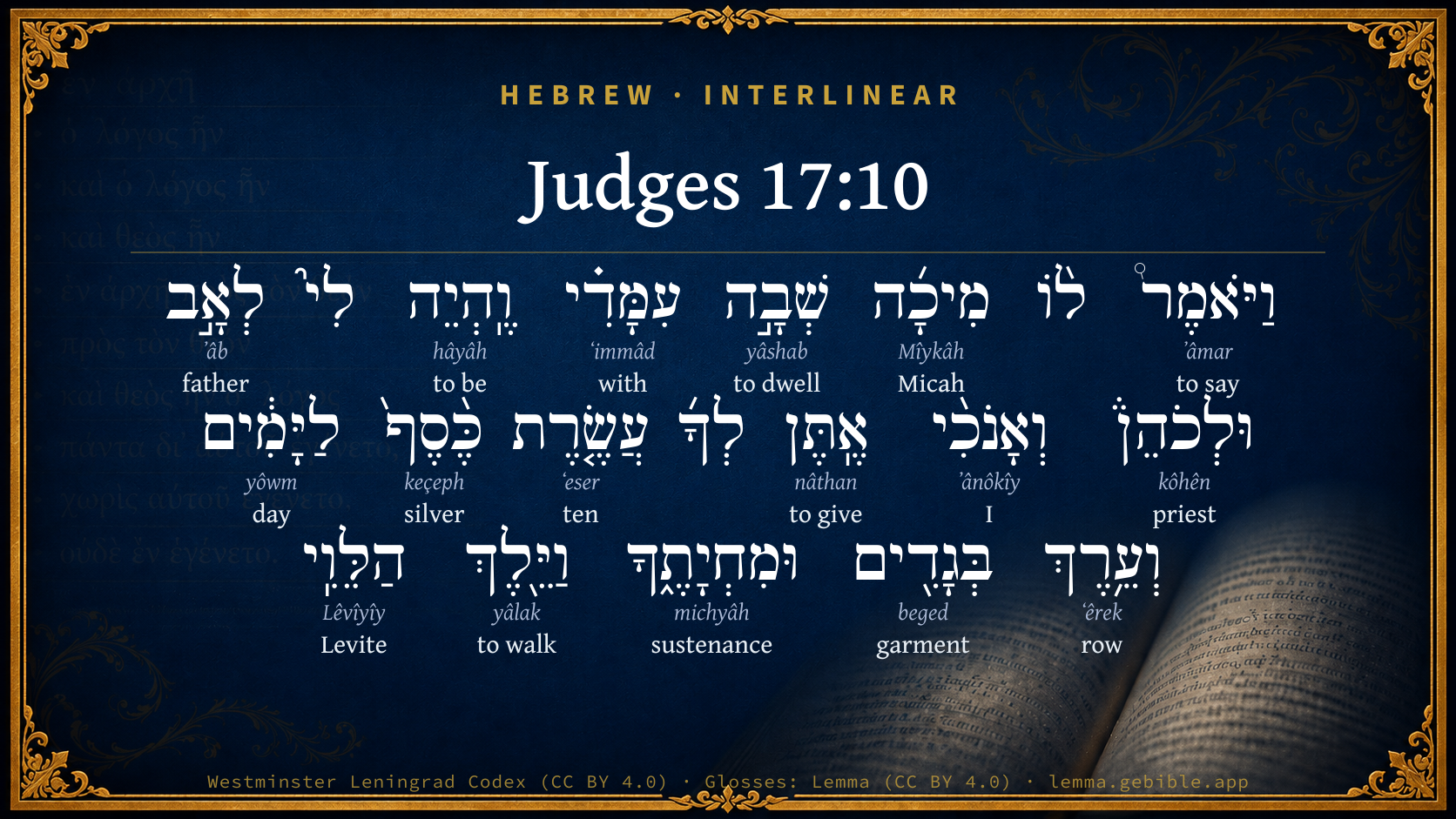
Judges 17:10

Hebrew (Westminster Leningrad Codex) Judges 17:10 appears in the Hebrew Old Testament. The text above is from the Westminster Leningrad Codex. Each word links to its Strong’s number, a concise gloss, and parsing drawn from the Open Scriptures Hebrew Bible morphology. Click any word for its full Brown-Driver-Briggs (BDB) entry.
Download image
Cite this verse

Judges 17:10 (World English Bible). Public Domain. Lemma interlinear Bible study tool, https://lemma.gebible.app/v/judges/17/10.

Show BibTeX & RIS
BibTeX
RIS
English Translation
Micah said to him, Dwell with me, and be to me a father and a priest, and I will give you ten [pieces] of silver by the year, and a suit of clothing, and your food. So the Levite went in.
World English Bible · Public Domain
Download a study sheet

One document with this verse’s original text, its word-by-word gloss line, the meaning frame, cross-references with their text, attributed commentary, and full source and license credits — printable, and it pastes into notes with its structure intact.

This verse Autodidact and up

Study sheet (.html) Plain text (.txt)

A passage Seminary Student

Up to 50 verses in one chapter. A passage sheet keeps up to 6 commentary sources and 12 cross-references per verse, in the order this page ranks them, and says so on the sheet whenever that leaves anything out. Ask for a single verse and you get the Autodidact verse sheet above.

Everything on this page stays free to read, with no account — the sheet is a download of what is already on screen, not access to it.

Want to remove ads? Support Godless Engineer
Compare translations 3

The same verse in 3 English versions, stacked beneath the original-language interlinear above. Click any original word for its lexicon entry.

Each is an independent rendering of the whole verse — the interlinear is not word-aligned to these translations.

Highlighted words mark where these versions differ — a whole-verse word diff, not a word-by-word alignment.

  • World English Bible Public Domain
    Micah said to him, Dwell with me, and be to me a father and a priest, and I will give you ten [pieces] of silver by the year, and a suit of clothing, and your food. So the Levite went in.
  • King James Version Public Domain
    And Micah said unto him, Dwell with me, and be unto me a father and a priest, and I will give thee ten shekels of silver by the year, and a suit of apparel, and thy victuals. So the Levite went in.
  • unfoldingWord Literal Text CC BY-SA 4.0
    And Micah said to him, “Stay with me and be to me for a father and for a priest, and I myself will give to you ten silver for the days, and a set of garments and your sustenance.” So the Levite went.

unfoldingWord Literal Text — © unfoldingWord, licensed CC BY-SA 4.0. Word-aligned USFM3 via Door43 (git.door43.org/unfoldingWord/en_ult).

Versions to compare (up to 4)

3 of 4 selected

Show all 18 translations

Every available English version of this verse, each an independent rendering of the whole verse.

  • World English Bible Public Domain
    Micah said to him, Dwell with me, and be to me a father and a priest, and I will give you ten [pieces] of silver by the year, and a suit of clothing, and your food. So the Levite went in.
  • Berean Standard Bible Public Domain
    “Stay with me,” Micah said to him, “and be my father and priest, and I will give you ten shekels of silver per year, a suit of clothes, and your provisions.” So the Levite went in
  • Majority Standard Bible Public Domain
    “Stay with me,” Micah said to him, “and be my father and priest, and I will give you ten shekels of silver per year, a suit of clothes, and your provisions.” So the Levite went in
  • King James Version Public Domain
    And Micah said unto him, Dwell with me, and be unto me a father and a priest, and I will give thee ten shekels of silver by the year, and a suit of apparel, and thy victuals. So the Levite went in.
  • American Standard Version (1901) Public Domain
    And Micah said unto him, Dwell with me, and be unto me a father and a priest, and I will give thee ten `pieces' of silver by the year, and a suit of apparel, and thy victuals. So the Levite went in.
  • Revised Version (1885) Public Domain
    And Micah said unto him, Dwell with me, and be unto me a father and a priest, and I will give thee ten pieces of silver by the year, and a suit of apparel, and thy victuals. So the Levite went in.
  • Geneva Bible (1599) Public Domain
    Then Michah said vnto him, Dwell with me, and be vnto me a father and a Priest, and I will giue thee ten shekels of siluer by yeere, and a sute of apparell, and thy meate and drinke. So the Leuite went in.
  • Douay-Rheims (1899) Public Domain
    And Michas said: Stay with me, and be unto me a father and a priest, and I will give thee every year ten pieces of silver, and a double suit of apparel, and thy victuals.
  • Young's Literal Translation Public Domain
    And Micah saith to him, `Dwell with me, and be to me for a father and for a priest, and I give to thee ten silverlings for the days, and a suit of garments, and thy sustenance;' and the Levite goeth `in'.
  • Literal Standard Version CC BY-SA 4.0
    And Micah says to him, “Dwell with me, and be for a father and for a priest to me, and I give ten pieces of silver to you for the days, and a suit of garments, and your sustenance”; and the Levite goes [in].
  • Unlocked Literal Bible CC BY-SA 4.0
    Micah said to him, “Stay with me, and be to me a father and a priest. I will give you ten pieces of silver a year, a suit of clothes, and your food.” So the Levite went into his house.
  • unfoldingWord Literal Text CC BY-SA 4.0
    And Micah said to him, “Stay with me and be to me for a father and for a priest, and I myself will give to you ten silver for the days, and a set of garments and your sustenance.” So the Levite went.
  • Darby Bible Public Domain
    And Micah said to him, "Stay with me, and be to me a father and a priest, and I will give you ten pieces of silver a year, and a suit of apparel, and your living."
  • World Messianic Bible Public Domain
    Micah said to him, “Dwell with me, and be to me a father and a priest, and I will give you ten pieces of silver per year, a suit of clothing, and your food.” So the Levite went in.
  • Webster's Bible Public Domain
    And Micah said to him, Dwell with me, and be to me a father and a priest, and I will give thee ten shekels of silver by the year, and a suit of apparel, and thy victuals. So the Levite went in.
  • Free Bible Version CC BY-SA 4.0
    “Come and stay here with me. You can be my ‘father’ and priest, and I'll give you ten shekels of silver a year, plus your clothes and food.” So the Levite went inside
  • Bible in Basic English Public Domain
    Then Micah said to him, Make your living-place with me, and be a father and a priest to me, and I will give you ten shekels of silver a year and your clothing and food.
  • JPS Tanakh (1917) Public Domain
    And Micah said unto him: 'Dwell with me, and be unto me a father and a priest, and I will give thee ten pieces of silver by the year, and a suit of apparel, and thy victuals.' So the Levite went in.

Literal Standard Version (2020), Covenant Press — licensed CC BY-SA 4.0. Text via the HelloAO Bible API (eBible.org). Unlocked Literal Bible (unfoldingWord) — licensed CC BY-SA 4.0. Text via the HelloAO Bible API (eBible.org). unfoldingWord Literal Text — © unfoldingWord, licensed CC BY-SA 4.0. Word-aligned USFM3 via Door43 (git.door43.org/unfoldingWord/en_ult). Free Bible Version, Dr. Jonathan Gallagher — licensed CC BY-SA 4.0. Text via the HelloAO Bible API (eBible.org).

Word by word

More ways to search: Search by grammar → Find every occurrence → Compare this word →

Practice this passage: Drill this verse → Learn its vocabulary →

וּמִחְיָתֶ֑ךָ
michyâh
H4241
“and · sustenance · your”
Conjunction + Noun, Common, Feminine, Singular, Construct + Suffix, Personal, 2nd Person, Masculine, Singular
Part of Speech
Conjunction + Noun
Type
Common
Gender
Feminine
Number
Singular
State
Construct
Full BDB Definition

Origin: from H2421

TWOT: 644h

preservation of life, sustenance - preservation of life - sustenance - reviving - the quick of the flesh, live flesh, tender or raw flesh
  1. וַיֹּאמֶר֩ ʼâmar H559 “and · to say” Conjunction + Verb, Qal, Sequential Imperfect, 3rd Person, Masculine, Singular
  2. מִיכָ֜ה Mîykâh H4318 “Micah” Noun, Proper
  3. שְׁבָ֣ה yâshab H3427 “dwell” Verb, Qal, Imperative, 2nd Person, Masculine, Singular + Suffix, h
  4. עִמָּדִ֗י ʻimmâd H5978 “with · me” Preposition + Suffix, Personal, 1st Person, Common, Singular
  5. וֶֽהְיֵה hâyâh H1961 “and · be” Conjunction + Verb, Qal, Imperative, 2nd Person, Masculine, Singular
  6. לְאָ֣ב ʼâb H1 “to/for · father” Preposition + Noun, Common, Masculine, Singular, Absolute
  7. וּלְכֹהֵן֒ kôhên H3548 “and · to/for · priest” Conjunction + Preposition + Noun, Common, Masculine, Singular, Absolute
  8. וְאָנֹכִ֨י ʼânôkîy H595 “and · I” Conjunction + Pronoun, Personal, 1st Person, Common, Singular
  9. אֶֽתֶּן nâthan H5414 “to give” Verb, Qal, Imperfect, 1st Person, Common, Singular
  10. עֲשֶׂ֤רֶת ʻeser H6235 “ten” Adjective, Cardinal number, Masculine, Singular, Construct
  11. כֶּ֨סֶף֙ keçeph H3701 “silver” Noun, Common, Masculine, Singular, Absolute
  12. לַיָּמִ֔ים yôwm H3117 “to/for the · days” Preposition, Determined + Noun, Common, Masculine, Plural, Absolute
  13. וְעֵ֥רֶךְ ʻêrek H6187 “and · row of” Conjunction + Noun, Common, Masculine, Singular, Construct
  14. בְּגָדִ֖ים beged H899 “garments” Noun, Common, Masculine, Plural, Absolute
  15. וַיֵּ֖לֶךְ yâlak H3212 “and · to walk” Conjunction + Verb, Qal, Sequential Imperfect, 3rd Person, Masculine, Singular
  16. הַלֵּוִֽי Lêvîyîy H3881 “the · Levite” Particle, Definite Article + Noun, Gentilic, Masculine, Singular, Absolute

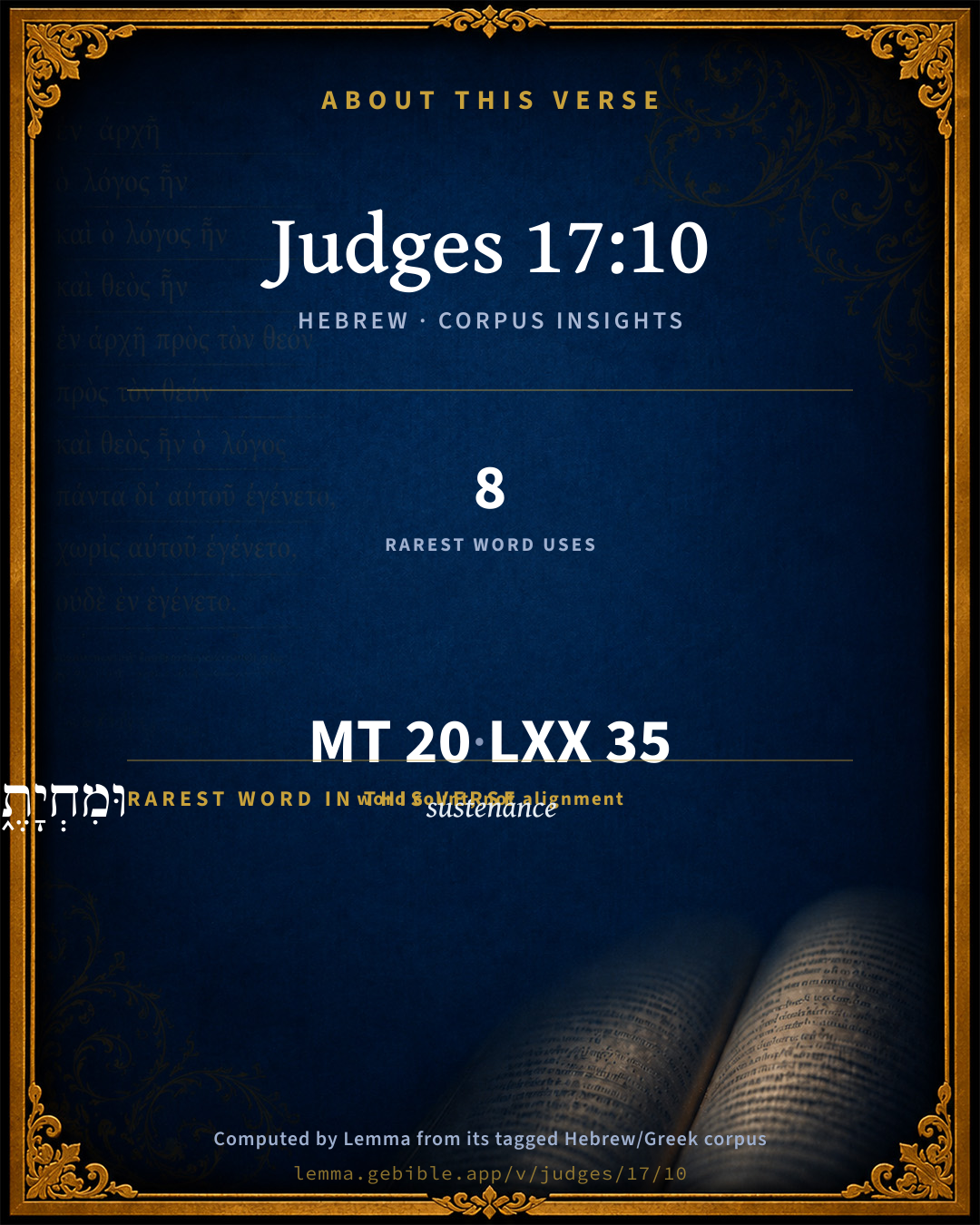
About this verse

These counts appear in no published source. They are computed here, from the morphology-tagged text and Lemma’s own curated glosses. What Lemma adds →

20
words
17
distinct lemmas
Historical
section

Notable vocabulary

The rarest word here is וּמִחְיָתֶ֑ךָ sustenance H4241 — appearing just 8 times in the whole Hebrew Bible.

Shared distinctive vocabulary

וּמִחְיָתֶ֑ךָ sustenance H4241 occurs in 8 verses of the Hebrew Bible. Also found in:

Grammatical profile

  • 5 verbs
  • 9 nouns
  • 1 adjective
  • 1 pronoun
  • 4 prepositions

Verb forms

  • וַיֹּאמֶר֩ Qal · Sequential Imperfect
  • שְׁבָ֣ה Qal · Imperative
  • וֶֽהְיֵה Qal · Imperative
  • אֶֽתֶּן Qal · Imperfect
  • וַיֵּ֖לֶךְ Qal · Sequential Imperfect

Hebrew & Septuagint length

In English translation the verse runs 41 words from the Hebrew and 37 from the Septuagint (LXX English) — closely comparable.

A rough comparison of the two English renderings, which tokenize alike — not a word-level alignment.

Word counts can differ between the Hebrew and the Greek without any difference in meaning — e.g. the Hebrew direct-object marker אֵת has no separate Greek word, and Greek often adds the article ὁ.

In the original languages it is 20 Hebrew tokens and 35 Greek tokens — but the two are counted differently (Hebrew bundles its prefixes and suffixes into one token; the Greek is in lemma form), so that isn’t a like-for-like length.

Cross-references

14

Topical passages linked to Judges 17:10 in the Treasury of Scripture Knowledge — connected by theme and wording, ordered by reader-vote popularity; previews shown in the World English Bible.

  • 1 Peter 5:2 Shepherd the flock of God which is among you, exercising the oversight, not under compulsion, but voluntarily, not for dishonest gain, but willingly;
  • John 12:6 Now he said this, not because he cared for the poor, but because he was a thief, and having the money box, used to steal what was put into it.
  • Genesis 45:8 So now it wasn't you who sent me here, but God, and he has made me a father to Pharaoh, lord of all his house, and ruler over all the land of Egypt.
  • Judges 17:11 The Levite was content to dwell with the man; and the young man was to him as one of his sons.
  • Judges 18:19–20 They said to him, Hold your peace, lay your hand on your mouth, and go with us, and be to us a father and a priest: is it better for you to be priest to the house of one man, or to be priest to a tribe and a family in Israel?
  • 1 Samuel 2:36 It shall happen, that everyone who is left in your house shall come and bow down to him for a piece of silver and a loaf of bread, and shall say, Please put me into one of the priests' offices, that I may eat a morsel of bread.
  • 2 Kings 6:21 The king of Israel said to Elisha, when he saw them, My father, shall I strike them? shall I strike them?
  • 2 Kings 8:8–9 The king said to Hazael, Take a present in your hand, and go, meet the man of God, and inquire of Yahweh by him, saying, Shall I recover of this sickness?
  • 2 Kings 13:14 Now Elisha was fallen sick of his sickness of which he died: and Joash the king of Israel came down to him, and wept over him, and said, My father, my father, the chariots of Israel and the horsemen of it!
  • Job 29:16 I was a father to the needy. The cause of him who I didn't know, I searched out.
  • Isaiah 22:21 and I will cloth him with your robe, and strengthen him with your belt, and I will commit your government into his hand; and he shall be a father to the inhabitants of Jerusalem, and to the house of Judah.
  • Ezekiel 13:19 You have profaned me among my people for handfuls of barley and for pieces of bread, to kill the souls who should not die, and to save the souls alive who should not live, by your lying to my people who listen to lies.
  • Matthew 26:15 and said, "What are you willing to give me, that I should deliver him to you?" They weighed out for him thirty pieces of silver.
  • 1 Timothy 6:10 For the love of money is a root of all kinds of evil. Some have been led astray from the faith in their greed, and have pierced themselves through with many sorrows.

Cross-references courtesy of OpenBible.info (CC BY 4.0).

Hebrew and Greek witnesses Masoretic Hebrew ↔ Greek Septuagint

The same verse in the two great witnesses to the Old Testament, shown verse-for-verse.

These are two independent witnesses, not word-aligned to each other, and the Septuagint is shown in lemma (dictionary) form.

Hebrew Judges 17:10 Masoretic · Westminster Leningrad Codex

וַיֹּאמֶר֩ ל֨וֹ מִיכָ֜ה שְׁבָ֣ה עִמָּדִ֗י וֶֽהְיֵה לִי֮ לְאָ֣ב וּלְכֹהֵן֒ וְאָנֹכִ֨י אֶֽתֶּן לְךָ֜ עֲשֶׂ֤רֶת כֶּ֨סֶף֙ לַיָּמִ֔ים וְעֵ֥רֶךְ בְּגָדִ֖ים וּמִחְיָתֶ֑ךָ וַיֵּ֖לֶךְ הַלֵּוִֽי

Micah said to him, Dwell with me, and be to me a father and a priest, and I will give you ten [pieces] of silver by the year, and a suit of clothing, and your food. So the Levite went in.

World English Bible · Public Domain

Greek LXX Judges 17:10 Septuagint · lemma form

καί εἶπον αὐτός μιχαιας καταἧμαι μετά ἐγώ καί γίγνομαι ἐγώ εἰς πατήρ καί εἰς ἱερεύς καί ἐγώ δίδωμι σύ δέκα ἀργύριον εἰς ἡμέρα καί στολή ἱμάτιον καί ὁ πρός ζωή σύ καί πορεύομαι ὁ λευίτης

And Michaias said to him, Dwell with me, and be to me a father and a priest; and I will give you ten pieces of silver by the year, and a change of raiment, and your living.

LXX2012 (modern English Septuagint) · Public Domain

On this verse, The Cambridge Bible for Schools and Colleges discusses the Septuagint’s reading. Read the note in Commentary ↓

Hebrew: Westminster Leningrad Codex (CC BY 4.0). Greek: Septuagint (public domain); English from LXX2012 (modern English Septuagint) (Public Domain). How the Septuagint differs from the Hebrew →

Targum (Aramaic paraphrase)

1

The Targum is the ancient Jewish Aramaic paraphrase of the Hebrew Scriptures — an interpretive translation, not the Hebrew text itself. Onkelos (literal) and Pseudo-Jonathan (expansive) render the Torah, and Jonathan the Prophets. Coverage is partial: where no permissively-licensed English translation exists for a verse, only the Aramaic is shown. This is verse-level text, not a word-by-word alignment to the Hebrew.

  1. Targum Jonathan Prophets (Joshua–Malachi)
    וַאֲמַר לֵיהּ מִיכָה תִּיב עִמִי וֶהֱוֵי לִי לְאַב וּלְכָהִין וַאֲנָא אֶתֵּן לָךְ עֲסַר סַלְעִין דִכְסַף לִזְמַן עִידַן וְזוּג לְבוּשִׁין וּפַּרְנָסָתָךְ וַאֲזַל לֵיוָאָה:

    (no public-domain English translation for this verse)

    Targum Jonathan — Aramaic: “Mikraot Gedolot” (public domain). English: “Sefaria Community Translation” (CC0 1.0 (public-domain dedication)); “London "Chaldee Paraphrase," 1871” (public domain). Text via Sefaria.

Commentary

Notes on Judges 17:10 from classic Christian and Jewish commentators (each source and its license shown beneath its notes). The classic Christian expositions comment on the surrounding passage and are grouped to its opening verse, so a note may address several verses; the Jewish commentaries on the Tanakh (Rashi and others) are per-verse, so they appear only where the commentator wrote on this verse.

Lemma curates 59 commentaries, every one of them public domain or Creative Commons licensed, each selected and text-cleaned for this edition rather than reprinted as found. About our sources →

Trapp's Complete Commentary

John Trapp

Jdg 17:10 And Micah said unto him, Dwell with me, and be unto me a father and a priest, and I will give thee ten [shekels] of silver by the year, and a suit of apparel, and thy victuals. So the Levite went in.

Ver. 10. Be unto me a father and a priest,] As a father he would respect him, though but a young man, because a priest. The Papists’ respect to their hedge priests, under the name of padres, fathers, will rise up in judgment against us.

And I will give thee ten shekels of silver, &c] A poor slender salary. This man had eleven hundred pieces of silver to bestow upon his idols, but ten shekels is held wages enough for his priest. So Louis XI of France allowed his chaplains twenty shillings a month: but for his physician, {a} one John Cotiers, he allowed him ten thousand crowns a month. In Ireland formerly ministers had no more maintenance than the pasture of two milk cowes, &c. In the whole province of Connaught, the stipend of the incumbent was not above forty shillings, in some places but sixteen shillings. {b} Now, blessed be God, the matter is well amended there, and very good encouragement promised to preachers that shall go over, Stipendia honoraria, with an honourable respect.

So the Levite went in.] Graeculus esuriens. Hunger will snap at anything, where there is not grace to restrain men.

{a} [Barber; Cottier, p. 348.]

{b} Heyl., Geog.

John Trapp, A Commentary or Exposition upon All the Books of the Old and New Testament (1647–1656) — public domain. Text from a community e-Sword module.

Joseph Benson's Commentary

Jdg 17:10. Be unto me a father — That is, a priest, a spiritual father, a teacher or instructer. He pretends reverence and submission to him; and what is wanting in his wages, he pays him in titles.

Joseph Benson's Commentary on the Old and New Testaments (1811–1818) — public domain. Text from a community e-Sword module.

Jamieson, Fausset & Brown

Robert Jamieson, A. R. Fausset & David Brown

Micah said unto him, Dwell with me, and be unto me a father--a spiritual father, to conduct the religious services of my establishment. He was to receive, in addition to his board, a salary of ten shekels of silver, equal to 25 shillings a year.

a suit of apparel--not only dress for ordinary use, but vestments suitable for the discharge of his priestly functions.

Jamieson, Fausset & Brown — Commentary Critical and Explanatory on the Whole Bible (1871) — public domain (CC PDM 1.0). Text via the HelloAO Bible API.

Adam Clarke's Commentary

Verse 10. Be unto me a father and a priest] Thou shalt be master of my house, as if thou wert my father; and, as priest, thou shalt appear in the presence of God for me. The term father is often used to express honour and reverence.

Ten shekels of silver] About thirty shillings per annum, with board, lodging, and clothes. Very good wages in those early times.

Adam Clarke's Commentary on the Bible (1810–1826) — public domain. Text from a community e-Sword/MySword module.

Ellicott's Commentary for English Readers

(10) Be unto me a father and a priest.—The title “father” is here ecclesiastical, like “papa,” “pope,” &c, and this title was given to spiritual directors, as we find in several other passages in the Bible (2Ki_2:12; 2Ki_5:13; 2Ki_6:21; Isa_22:21, &c.). Micah knew enough of the law to be aware of the extreme irregularity of his conduct in making one of his own sons his priest.

Ten shekels of silver.—Thus the grandson of Moses became priest of an idolatrous worship at a salary of 25s. a year!

By the year.—Literally, by days. (Comp. Lev_25:29.)

A suit of apparel.—The Vulgate renders these words “a double robe.” It seems to mean either “an order of garments” or “the value of garments,” i.e., “your clothes.”

A Bible Commentary for English Readers, edited by Charles John Ellicott (1878–1897) — public domain. Text from a community e-Sword module.

The Cambridge Bible for Schools and Colleges

gen. ed. J. J. S. Perowne

10. father] A title of honour given to a priest Jdg_18:19, a counsellor Gen_45:8, cf. [Apocr.] Esther 16:11, 1Ma_11:32, a prophet 2Ki_2:12; 2Ki_6:21, a master 2Ki_5:13, a king 1Sa_24:11.

ten pieces of silver … victuals] The Levite has to seek a home and maintenance; and he receives a payment of money for his services, cf. 1Sa_2:36. At the more important sanctuaries, however, or when the cultus was more developed, the priests derived their income from portions of the sacrifices and offerings, cf. 1Sa_2:13 ff., 1Sa_2:28. This was the rule in the Babylonian and Phoenician cults, and the Deuteronomic law reflects a similar custom: ‘no portion nor inheritance’ is allowed to the Levitical priests (Deu_10:9 etc., cf. Num_18:23 P); they are dependent upon firstfruits, sacrificial feasts, tithes; and their support is a moral charge on the community, Deu_12:18 f., Deu_14:25-29, Deu_16:11, Deu_18:1-8. In a supplementary law of the Priestly Code a change was introduced, and 48 cities were assigned to the Levites (Num_35:1-8, Jos_21:1-42), but there is no evidence that this regulation was ever carried out.

So the Levite went in] Hebr. went away, departed, as in Jdg_17:8; but this gives a wrong sense. Moreover, no writer could have composed anything so clumsy as and the Levite departed, and the Levite was content (Jdg_17:11). The first phrase may be a stray fragment of one of the two narratives, or it is merely a doublet of the phrase which follows (Studer and others). The Vulgate omits and the L. departed; the LXX in Jdg_17:11 reads and he was content.

11b. and the young man was] Continuing Jdg_17:7.

12a. consecrated] installed, Jdg_17:5 n., continuing 11b: and was in the house of M. continues 11a.

The Cambridge Bible for Schools and Colleges (gen. ed. J. J. S. Perowne; Cambridge University Press, 1878–1918) — public domain. Text from a community e-Sword module.

John Gill's Exposition

And Micah said unto him, dwell with me,.... Hearing that he was a Levite, he thought him a fit man for his purpose, and would give some credit to, and put a better face upon his new form of worship, and therefore, without further inquiry after him and his character, invites him to make his abode with him:

and be unto me a father and a priest; a father to instruct him in the knowledge of divine things; so prophets were called fathers, and their disciples their sons; and a priest to offer sacrifices for him, and to consult before him by his teraphim upon occasion:

and I will give thee ten shekels of silver by the year; or yearly, which was but a small sum, a poor salary for a priest, at most amounting but to twenty five shillings, and scarce so much:

and a suit of apparel; or "an order of apparel" (m); such as was fit for one of his rank and order as a priest to wear, so Jarchi and Abarbinel; or a couple of garments, as the Targum and Septuagint, a double suit of apparel, according to the order of the season, one for summer and another for winter, as Kimchi and Ben Melech:

and thy victuals; his meat and drink:

so thy Levite went in; into his house, and it looks as if the parley was made, and the bargain struck at the door, Micah being at it as the Levite passed by, or came to it upon his knocking at it; he went after his counsel and advice, as Jarchi, or to do his business, as Kimchi.

(m) "irdinem vestimentorum", Pagninus, Montanus, Muuster, Vatablus; "demensum vestimentorum", Tigurine version.

John Gill's Exposition of the Whole Bible (1746–1763) — public domain (CC PDM 1.0). Text via the HelloAO Bible API.

Albert Barnes' Notes on the Bible

Ten shekels - About 25 shillings to 26 shillings (see Exo 38:24).

Albert Barnes' Notes on the Bible (1834–1885) — public domain. Text from a community e-Sword/MySword module.

Haydock's Catholic Bible Commentary

A father. So he styles him out of respect, as we do our directors. (Haydock) --- It is a title of dignity, Esther xvi. 11., 2 Machabees xiv. 37., and 2 Paralipomenon ii. 13. (Calmet) --- Pieces, sicles. --- Double suit, one for summer and another for winter, (Menochius) or such as might be worn on common, or on sacred occasions, unless it rather mean a cloak and a tunic; (Calmet) a change of dress, chap. xiv. 13.

George Leo Haydock (1774–1849), Haydock's Catholic Family Bible and Commentary, 1859 edition — public domain. Excludes Psalms (Douay-Rheims chapter numbering differs from Protestant) and Deuterocanonical books (Catholic canon only).

Matthew Poole's English Annotations

A father and a priest; for, a father; that is, a priest; a spiritual father, a teacher or instructor, for such are called fathers: see 2Ki 6:21; 8:9; 13:14; Isa 22:21. He pretends reverence and submission to him; and what is wanting in his wages he pays him in empty titles.

Matthew Poole's English Annotations on the Holy Bible (1683–1685) — public domain. Text from a community e-Sword/MySword module.

Whedon's Commentary on the Bible

Daniel D. Whedon

10. A father and a priest — A spiritual counsellor as well as a priest. The word father is here a title of respect and reverence. Compare Gen_45:8; 2Ki_6:21.

Ten shekels of silver by the year — A little more than six dollars. A small sum, indeed, but, with food and clothing, probably ample for his comfort in those simple times.

Daniel D. Whedon (gen. ed.), Commentary on the Old and New Testaments (1874–1909) — public domain. Text from a community e-Sword module.

The Pulpit Commentary

Vers. 10, 11. A father. This is not a common application of the word father in the Old Testament. The prominent idea seems to be one of honour, combined with authority to teach and advise. It is applied to prophets, (2Ki_2:12 2Ki_6:21 2Ki_13:14) and to Joseph. (Gen_45:8) The idea is implied in the converse phrase of son, applied to those to whom the prophets stood in "the relation of spiritual fathers. (see 2Ki_8:9 Pro_4:10, Pro_4:20, and frequently elsewhere) The abuse of the feeling which dictates the term as applied to human teachers is reproved by our. (Mat_23:9) It has been freely used in the Christian Church, as in the titles papa or pope applied to bishops, abbot and abbas, father in God, fathers of the Church, etc. Here there is perhaps a special reference to the function of Micah"s priest to ask counsel of God, and then give that counsel to those who came to inquire (see note to ver. 5). It may be added that the idea of counsellor seems to be inherent in the word cohen or priest, as in 2Sa_8:18 1Ki_4:5, etc. Ten shekels a little over a pound of our money, but probably equivalent to when considered relatively to articles of consumption. A suit of apparel. There is great doubt as to the exact meaning of the word rendered suit in this connection. The word means anything arranged, i.e. put in a rank, or row, or order. In Exo_40:23 it is applied to the shewbread: "He ordered the bread in order." Thence it came to mean the estimation or worth of a person or thing some-what as we use the word rank. From this last sense some interpret the word here to mean the worth or price of his clothes. Others, including St. Jerome and the Septuagint, interpret it a pair of vestments, meaning summer and winter clothing. But perhaps the A.V, suit, meaning the whole set of under and upper garments, is after all the best interpretation. The Levite went in. The Hebrew is went , i.e. according to the common use of the word, went his way. And such is probably the meaning here. He went his way to consider the proposal made to him. The result is given in the next verse: And the Levite was content, etc.

The Pulpit Commentary (1880–1919), ed. H.D.M. Spence-Jones & Joseph S. Exell — public domain. Text from a community e-Sword module.

John Wesley's Explanatory Notes

A father - That is, a priest, a spiritual father, a teacher or instructor. He pretends reverence and submission to him; and what is wanting in his wages, he pays him in titles.

John Wesley, Explanatory Notes Upon the Whole Bible (1754–1765) — public domain. Text via the GEBible commentary corpus.

Keil & Delitzsch

C. F. Keil & F. Delitzsch

Micah made this proposal to the Levite: "Dwell with me, and become my father and priest; I will give thee ten shekels of silver yearly, and fitting out with clothes and maintenance." אב, father, is an honourable title give to a priest as a paternal friend and spiritual adviser, and is also used with reference to prophets in Kg2 6:21 and Kg2 13:14, and applied to Joseph in Gen 45:8. ליּמים, for the days, sc., for which a person was engaged, i.e., for the year (cf. Sa1 27:7, and Lev 25:29). "And the Levite went," i.e., went to Micah's house. This meaning is evident from the context. The repetition of the subject, "the Levite," precludes our connecting it with the following verb ויּואל. - In Jdg 17:11-13 the result is summed up. The Levite resolved (see at Deu 1:5) to dwell with Micah, who treated him as one of his sons, and entrusted him with the priesthood at his house of God. And Micah rejoiced that he had got a Levite as priest, and said, "Now I know that Jehovah will prosper me." This belief, or, to speak more correctly, superstition, for which Micah was very speedily to atone, proves that at that time the tribe of Levi held the position assigned it in the law of Moses; that is to say, that it was regarded as the tribe elected by God for the performance of divine worship.

Keil & Delitzsch — Biblical Commentary on the Old Testament (1861–1891) — public domain (CC PDM 1.0). Text via the HelloAO Bible API. (Old Testament only.)

unfoldingWord translationNotes

Door43 World Missions Community

a father and a priest

The word "father" is here used in the sense of an advisor, and not to a literal father. AT: "an advisor and a priest" (See: Metonymy)

I will give you ten pieces of silver a year

"I will give you ten pieces of silver each year"

a suit of clothes

"a set of clothes"

So the Levite went into his house

It is implied that the Levite accepted Micah's offer, and therefore, entered Micah's house. AT: "So the Levite accepted his offer and went into his house" (See: Assumed Knowledge and Implicit Information)

the young man became to Micah like one of his sons

The relationship between the Levite and Micah became like the close relationship between a father and son. AT: "the young man became close to Micah and was like one of his sons" (See: Simile)

translationWords

life

priest

silver

Levi

son

unfoldingWord translationNotes — © Distant Shores Media and the Door43 World Missions Community, licensed CC BY-SA 4.0. Source: git.door43.org/Door43/en_tn.

Rashi

Rabbi Shlomo Yitzchaki (Rashi)

Per year At the year's end.

An appropriate wardrobe A pair of outfits appropriate for everyone's yearly requirements.

An appropriate wardrobe. "Appareillement" in old French.

And your board Your meals.

The Levi acquiesced [lit. went] Followed his advice.

Rashi on the Tanakh — English translations: “The Judaica Press complete Tanach with Rashi, translated by A. J. Rosenberg” (CC BY 4.0); “Pentateuch with Rashi's commentary by M. Rosenbaum and A.M. Silbermann, 1929-1934” (public domain); “The Metsudah Tanach series, Lakewood, N.J” (CC BY 4.0); and “The Book of Joshua, Metsudah Publications, 1997” (CC BY 4.0). Text via Sefaria.

Lesson kit

Teaching starters — assembled from the data on this page, not authored interpretation. Every prompt links to the verse data it draws on. Edit before teaching.

Judges, in the Historical, opens this verse with 20 words (17 distinct Hebrew lemmas). Its most distinctive word is michyâh (“sustenance”). A historical commentator’s framing appears above. Read the whole chapter for the surrounding context.

Discussion questions

  1. What does “sustenance” (michyâh) contribute to the verse as a whole?
  2. How does Genesis 45:5, which shares the word «sustenance», read alongside this verse?
  3. These translations render this verse differently; the difference is in the English rendering, not the original. What questions does that raise?
  4. «וַיֹּאמֶר֩» is a Qal Sequential Imperfect verb. How does that grammatical form shape the action described?
  5. Compare how Trapp's Complete Commentary and Joseph Benson's Commentary read this verse. Where do they agree or differ?

Things to notice

Reading settings

Reading text

Shown beneath each verse's original-language words.

Old Testament
Old Testament edition

Read the OT as the Masoretic Hebrew (MT) or the Greek Septuagint (LXX).

English shown for the Greek Septuagint (in the Hebrew ↔ Greek comparison).

Comparing translations? Open the Compare panel on any verse page to stack up to four side by side.