
2 Kings 9:13

Hebrew (Westminster Leningrad Codex) 2 Kings 9:13 appears in the Hebrew Old Testament. The text above is from the Westminster Leningrad Codex. Each word links to its Strong’s number, a concise gloss, and parsing drawn from the Open Scriptures Hebrew Bible morphology. Click any word for its full Brown-Driver-Briggs (BDB) entry.
Download image
Cite this verse

2 Kings 9:13 (World English Bible). Public Domain. Lemma interlinear Bible study tool, https://lemma.gebible.app/v/2-kings/9/13.

Show BibTeX & RIS
BibTeX
RIS
English Translation
Then they hurried, and took every man his garment, and put it under him on the top of the stairs, and blew the trumpet, saying, Jehu is king.
World English Bible · Public Domain
Download a study sheet

One document with this verse’s original text, its word-by-word gloss line, the meaning frame, cross-references with their text, attributed commentary, and full source and license credits — printable, and it pastes into notes with its structure intact.

This verse Autodidact and up

Study sheet (.html) Plain text (.txt)

A passage Seminary Student

Up to 50 verses in one chapter. A passage sheet keeps up to 6 commentary sources and 12 cross-references per verse, in the order this page ranks them, and says so on the sheet whenever that leaves anything out. Ask for a single verse and you get the Autodidact verse sheet above.

Everything on this page stays free to read, with no account — the sheet is a download of what is already on screen, not access to it.

Want to remove ads? Support Godless Engineer
Compare translations 3

The same verse in 3 English versions, stacked beneath the original-language interlinear above. Click any original word for its lexicon entry.

Each is an independent rendering of the whole verse — the interlinear is not word-aligned to these translations.

Highlighted words mark where these versions differ — a whole-verse word diff, not a word-by-word alignment.

  • World English Bible Public Domain
    Then they hurried, and took every man his garment, and put it under him on the top of the stairs, and blew the trumpet, saying, Jehu is king.
  • King James Version Public Domain
    Then they hasted, and took every man his garment, and put it under him on the top of the stairs, and blew with trumpets, saying, Jehu is king.
  • unfoldingWord Literal Text CC BY-SA 4.0
    And they hurried and took, a man his garment, and they put under him at the top of the steps. And they blew on a shofar, and they said, “Jehu is king.”

unfoldingWord Literal Text — © unfoldingWord, licensed CC BY-SA 4.0. Word-aligned USFM3 via Door43 (git.door43.org/unfoldingWord/en_ult).

Versions to compare (up to 4)

3 of 4 selected

Show all 18 translations

Every available English version of this verse, each an independent rendering of the whole verse.

  • World English Bible Public Domain
    Then they hurried, and took every man his garment, and put it under him on the top of the stairs, and blew the trumpet, saying, Jehu is king.
  • Berean Standard Bible Public Domain
    Quickly, each man took his garment and put it under Jehu on the bare steps. Then they blew the ram’s horn and proclaimed, “Jehu is king!”
  • Majority Standard Bible Public Domain
    Quickly, each man took his garment and put it under Jehu on the bare steps. Then they blew the ram’s horn and proclaimed, “Jehu is king!”
  • King James Version Public Domain
    Then they hasted, and took every man his garment, and put it under him on the top of the stairs, and blew with trumpets, saying, Jehu is king.
  • American Standard Version (1901) Public Domain
    Then they hasted, and took every man his garment, and put it under him on the top of the stairs, and blew the trumpet, saying, Jehu is king.
  • Revised Version (1885) Public Domain
    Then they hasted, and took every man his garment, and put it under him on the top of the stairs, and blew the trumpet, saying, Jehu is king.
  • Geneva Bible (1599) Public Domain
    Then they made haste, and tooke euerie man his garment, and put it vnder him on the top of the staires, and blewe the trumpet, saying, Iehu is King.
  • Douay-Rheims (1899) Public Domain
    Then they made haste and taking every man his garment laid it under his feet, after the manner of a judgment seat, and they sounded the trumpet, and said: Jehu is king.
  • Young's Literal Translation Public Domain
    And they haste and take each his garment, and put `it' under him at the top of the stairs, and blow with a trumpet, and say, `Reigned hath Jehu!'
  • Literal Standard Version CC BY-SA 4.0
    And they hurry—each [one]—and take his garment, and put [it] under him at the top of the stairs, and blow with a horn, and say, “Jehu has reigned!”
  • Unlocked Literal Bible CC BY-SA 4.0
    Then each of them quickly took off his outer garment and put it under Jehu at the top of the steps. They blew the trumpet and said, “Jehu is king.”
  • unfoldingWord Literal Text CC BY-SA 4.0
    And they hurried and took, a man his garment, and they put under him at the top of the steps. And they blew on a shofar, and they said, “Jehu is king.”
  • Darby Bible Public Domain
    Then they hasted and took every man his garment, and put it under him on the very stairs, and blew with trumpets, and said, Jehu is king!
  • World Messianic Bible Public Domain
    Then they hurried, and each man took his cloak, and put it under him on the top of the stairs, and blew the shofar, saying, “Jehu is king.”
  • Webster's Bible Public Domain
    Then they hasted, and took every man his garment, and put it under him on the top of the stairs, and blew with trumpets, saying, Jehu is king.
  • Free Bible Version CC BY-SA 4.0
    They quickly grabbed their cloaks and spread them on the bare steps. They blew the trumpet and shouted, “Jehu is king!”
  • Bible in Basic English Public Domain
    Then straight away everyone took his robe and put it under him on the top of the steps, and, sounding the horn, they said, Jehu is king.
  • JPS Tanakh (1917) Public Domain
    Then they hastened, and took every man his garment, and put it under him on the top of the stairs, and blew the horn, saying: 'Jehu is king.'

Literal Standard Version (2020), Covenant Press — licensed CC BY-SA 4.0. Text via the HelloAO Bible API (eBible.org). Unlocked Literal Bible (unfoldingWord) — licensed CC BY-SA 4.0. Text via the HelloAO Bible API (eBible.org). unfoldingWord Literal Text — © unfoldingWord, licensed CC BY-SA 4.0. Word-aligned USFM3 via Door43 (git.door43.org/unfoldingWord/en_ult). Free Bible Version, Dr. Jonathan Gallagher — licensed CC BY-SA 4.0. Text via the HelloAO Bible API (eBible.org).

Word by word

More ways to search: Search by grammar → Find every occurrence → Compare this word →

Practice this passage: Drill this verse → Learn its vocabulary →

גֶּ֣רֶם
gerem
H1634
“bone of”
Noun, Common, Masculine, Singular, Construct
Part of Speech
Noun
Type
Common
Gender
Masculine
Number
Singular
State
Construct
Full BDB Definition

Origin: from H1633

TWOT: 382a

bone, strength, bare?, self? - bone - strength, strong-boned - self?, bare? (of stairs)
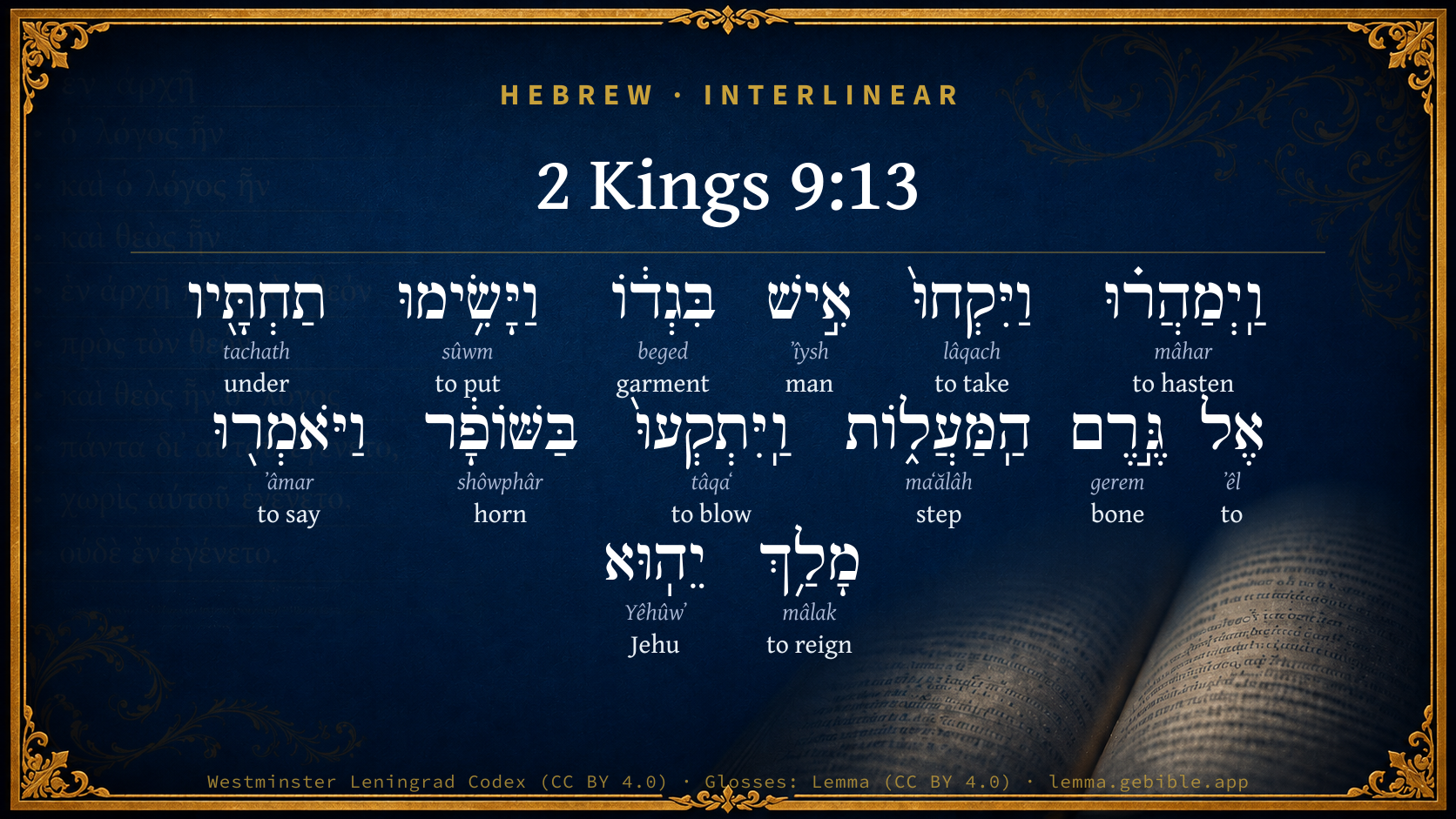
  1. וַֽיְמַהֲר֗וּ mâhar H4116 “and · to hasten” Conjunction + Verb, Piel, Sequential Imperfect, 3rd Person, Masculine, Plural
  2. וַיִּקְחוּ֙ lâqach H3947 “and · to take” Conjunction + Verb, Qal, Sequential Imperfect, 3rd Person, Masculine, Plural
  3. אִ֣ישׁ ʼîysh H376 “man” Noun, Common, Masculine, Singular, Absolute
  4. בִּגְד֔וֹ beged H899 “garment · his” Noun, Common, Masculine, Singular, Construct + Suffix, Personal, 3rd Person, Masculine, Singular
  5. וַיָּשִׂ֥ימוּ sûwm H7760 “and · to put” Conjunction + Verb, Qal, Sequential Imperfect, 3rd Person, Masculine, Plural
  6. תַחְתָּ֖יו tachath H8478 “under · him” Preposition + Suffix, Personal, 3rd Person, Masculine, Singular
  7. אֶל ʼêl H413 “to” Preposition
  8. הַֽמַּעֲל֑וֹת maʻălâh H4609 “the · steps” Particle, Definite Article + Noun, Common, Feminine, Plural, Absolute
  9. וַֽיִּתְקְעוּ֙ tâqaʻ H8628 “and · to blow” Conjunction + Verb, Qal, Sequential Imperfect, 3rd Person, Masculine, Plural
  10. בַּשּׁוֹפָ֔ר shôwphâr H7782 “in/at the · horn” Preposition, Determined + Noun, Common, Masculine, Singular, Absolute
  11. וַיֹּאמְר֖וּ ʼâmar H559 “and · to say” Conjunction + Verb, Qal, Sequential Imperfect, 3rd Person, Masculine, Plural
  12. מָלַ֥ךְ mâlak H4427 “to reign” Verb, Qal, Perfect, 3rd Person, Masculine, Singular
  13. יֵהֽוּא Yêhûwʼ H3058 “Jehu” Noun, Proper

About this verse

These counts appear in no published source. They are computed here, from the morphology-tagged text and Lemma’s own curated glosses. What Lemma adds →

14
words
14
distinct lemmas
Historical
section

Notable vocabulary

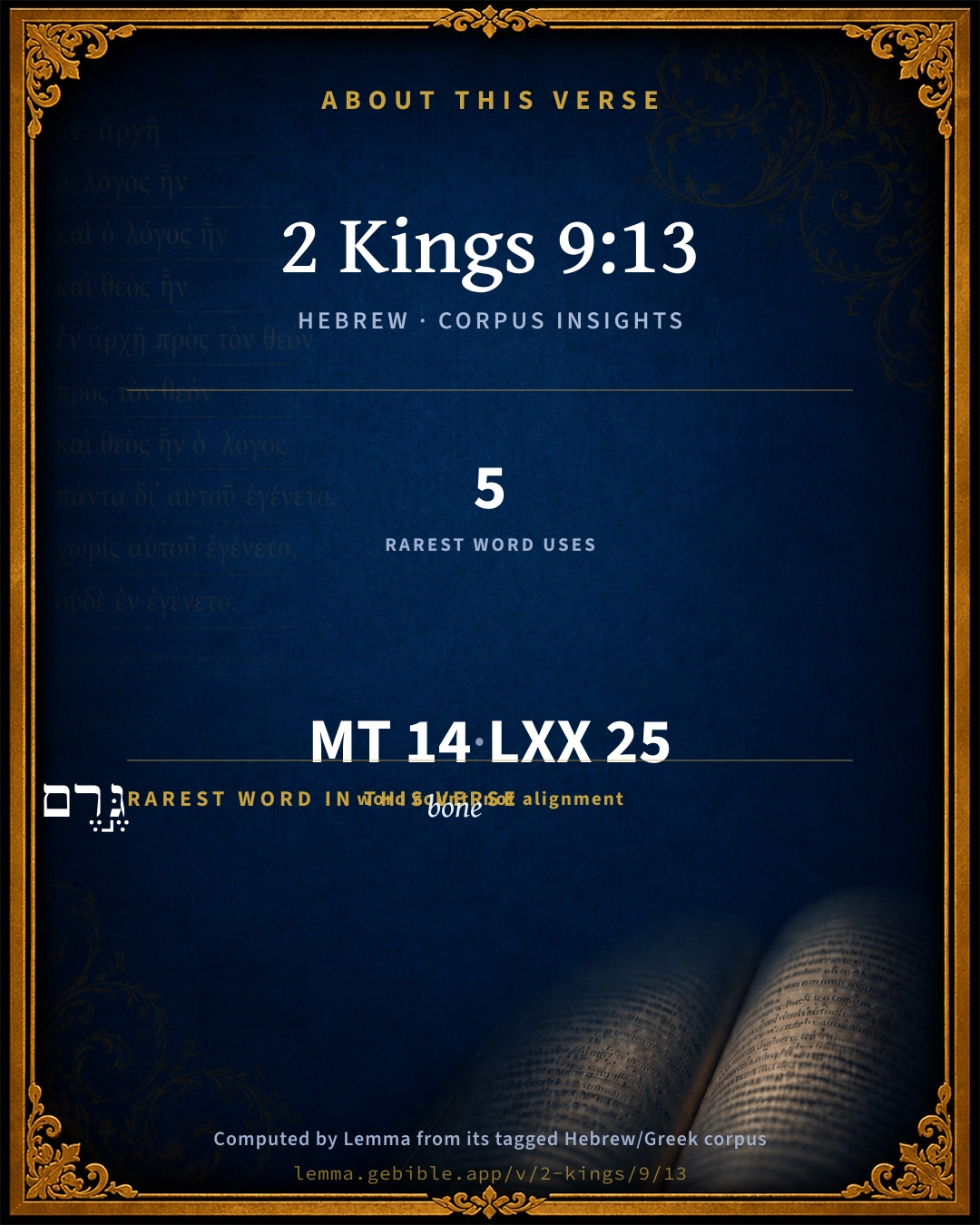
The rarest word here is גֶּ֣רֶם bone H1634 — appearing just 5 times in the whole Hebrew Bible.

Shared distinctive vocabulary

גֶּ֣רֶם bone H1634 occurs in 5 verses of the Hebrew Bible. Also found in:

Grammatical profile

  • 6 verbs
  • 6 nouns
  • 2 prepositions

Verb forms

  • וַֽיְמַהֲר֗וּ Piel · Sequential Imperfect
  • וַיִּקְחוּ֙ Qal · Sequential Imperfect
  • וַיָּשִׂ֥ימוּ Qal · Sequential Imperfect
  • וַֽיִּתְקְעוּ֙ Qal · Sequential Imperfect
  • וַיֹּאמְר֖וּ Qal · Sequential Imperfect
  • מָלַ֥ךְ Qal · Perfect

Hebrew & Septuagint length

In English translation the verse runs 28 words from the Hebrew and 34 from the Septuagint (LXX English) — closely comparable.

A rough comparison of the two English renderings, which tokenize alike — not a word-level alignment.

Word counts can differ between the Hebrew and the Greek without any difference in meaning — e.g. the Hebrew direct-object marker אֵת has no separate Greek word, and Greek often adds the article ὁ.

In the original languages it is 14 Hebrew tokens and 25 Greek tokens — but the two are counted differently (Hebrew bundles its prefixes and suffixes into one token; the Greek is in lemma form), so that isn’t a like-for-like length.

Cross-references

7

Topical passages linked to 2 Kings 9:13 in the Treasury of Scripture Knowledge — connected by theme and wording, ordered by reader-vote popularity; previews shown in the World English Bible.

  • 1 Kings 1:34 and let Zadok the priest and Nathan the prophet anoint him there king over Israel; and blow you the trumpet, and say, [Long] live king Solomon.
  • 1 Kings 1:39 Zadok the priest took the horn of oil out of the Tent, and anointed Solomon. They blew the trumpet; and all the people said, [Long] live king Solomon.
  • Mark 11:7–8 They brought the young donkey to Jesus, and threw their garments on it, and Jesus sat on it.
  • 2 Samuel 15:10 But Absalom sent spies throughout all the tribes of Israel, saying, As soon as you hear the sound of the trumpet, then you shall say, Absalom is king in Hebron.
  • Psalms 47:5–7 God has gone up with a shout, Yahweh with the sound of a trumpet.
  • Psalms 98:6 With trumpets and sound of the ram's horn, Make a joyful noise before the King, Yahweh.
  • Matthew 21:7–8 and brought the donkey and the colt, and laid their clothes on them; and he sat on them.

Cross-references courtesy of OpenBible.info (CC BY 4.0).

Hebrew and Greek witnesses Masoretic Hebrew ↔ Greek Septuagint

The same verse in the two great witnesses to the Old Testament, shown verse-for-verse.

These are two independent witnesses, not word-aligned to each other, and the Septuagint is shown in lemma (dictionary) form.

Hebrew 2 Kings 9:13 Masoretic · Westminster Leningrad Codex

וַֽיְמַהֲר֗וּ וַיִּקְחוּ֙ אִ֣ישׁ בִּגְד֔וֹ וַיָּשִׂ֥ימוּ תַחְתָּ֖יו אֶל גֶּ֣רֶם הַֽמַּעֲל֑וֹת וַֽיִּתְקְעוּ֙ בַּשּׁוֹפָ֔ר וַיֹּאמְר֖וּ מָלַ֥ךְ יֵהֽוּא

Then they hurried, and took every man his garment, and put it under him on the top of the stairs, and blew the trumpet, saying, Jehu is king.

World English Bible · Public Domain

Greek LXX 2 Kings 9:13 Septuagint · lemma form

καί ἀκούω σπεύδω καί λαμβάνω ἕκαστος ὁ ἱμάτιον αὐτός καί τίθημι ὑποκάτω αὐτός ἐπί γαρεμ ὁ ἀναβαθμός καί σαλπίζω ἐν κερατίνη καί εἶπον βασιλεύω ιου

And when they heard it, they hasted, and took every man his garment, and put it under him on the top of the stairs, and blew with the trumpet, and said, Ju is king.

LXX2012 (modern English Septuagint) · Public Domain

On this verse, Ellicott's Commentary for English Readers discusses the Septuagint’s reading. Read the note in Commentary ↓

Hebrew: Westminster Leningrad Codex (CC BY 4.0). Greek: Septuagint (public domain); English from LXX2012 (modern English Septuagint) (Public Domain). How the Septuagint differs from the Hebrew →

Targum (Aramaic paraphrase)

1

The Targum is the ancient Jewish Aramaic paraphrase of the Hebrew Scriptures — an interpretive translation, not the Hebrew text itself. Onkelos (literal) and Pseudo-Jonathan (expansive) render the Torah, and Jonathan the Prophets. Coverage is partial: where no permissively-licensed English translation exists for a verse, only the Aramaic is shown. This is verse-level text, not a word-by-word alignment to the Hebrew.

  1. Targum Jonathan Prophets (Joshua–Malachi)
    וְאוֹחִיאוּ וּנְסִיבוּ גְבַר לְבוּשֵׁיהּ וְשַׁוִיאוּ תְחוֹתוֹהִי לִדְרַג שַׁעֲיָא וּתְקָעוּ בְשׁוֹפָר וַאֲמַרוּ מְלַךְ יֵהוּא:

    (no public-domain English translation for this verse)

    Targum Jonathan — Aramaic: “Mikraot Gedolot” (public domain). English: “Sefaria Community Translation” (CC0 1.0 (public-domain dedication)); “London "Chaldee Paraphrase," 1871” (public domain). Text via Sefaria.

Commentary

Notes on 2 Kings 9:13 from classic Christian and Jewish commentators (each source and its license shown beneath its notes). The classic Christian expositions comment on the surrounding passage and are grouped to its opening verse, so a note may address several verses; the Jewish commentaries on the Tanakh (Rashi and others) are per-verse, so they appear only where the commentator wrote on this verse.

Lemma curates 59 commentaries, every one of them public domain or Creative Commons licensed, each selected and text-cleaned for this edition rather than reprinted as found. About our sources →

Trapp's Complete Commentary

John Trapp

2Ki 9:13 Then they hasted, and took every man his garment, and put [it] under him on the top of the stairs, and blew with trumpets, saying, Jehu is king.

Ver. 13. Then they hasted.] See on 2Ki 9:11.

And took every man his garment, and put it under him.] That is, under Jehu, in token of subjection, and for a ceremony of honour which they used to their new kings, as Mat 21:7-8. The Romans had a like custom, as Plutarch writeth; and the Grecians, as Athenaeus.

On the top of the stairs.] i.e., In suggesto regio, {a} in some high place, which they made use of for a throne.

{a} Jun.

John Trapp, A Commentary or Exposition upon All the Books of the Old and New Testament (1647–1656) — public domain. Text from a community e-Sword module.

Joseph Benson's Commentary

2Ki 9:13. Then they hasted — Being well pleased with the thing; partly from the advantage which hereby they expected; partly from that desire of change which is in the nature of most men; and principally by God’s providence inclining their hearts to Jehu. And took every man his garment, and put it under him — In token of great reverence for his person, that they would not have his feet to touch the ground, and that they put themselves and their concerns under his feet and into his disposal. It was a ceremony used in the eastern countries toward superiors: see Mat 21:7. On the top of the stairs — In some high and eminent place, whence he might be seen and owned by all the soldiers, who were called together on this great occasion. Saying, Jehu is king — They proclaimed him by sound of trumpet to be appointed by God to the kingdom of Israel.

Joseph Benson's Commentary on the Old and New Testaments (1811–1818) — public domain. Text from a community e-Sword module.

Tyndale Open Study Notes

Tyndale Open Resources

9:13 The bare steps of the house served as a throne and the soldiers’ cloaks as a carpet. Spreading out garments in this fashion was a sign of respect (see Matt 21:8).

Tyndale Open Study Notes — © Tyndale Open Resources, licensed CC BY-SA 4.0. Text via the HelloAO Bible API.

Jamieson, Fausset & Brown

Robert Jamieson, A. R. Fausset & David Brown

they hasted, and took every man his garment--the upper cloak which they spread on the ground, as a token of their homage to their distinguished commander (Mat 21:7).

top of the stairs--from the room where the prophet had privately anointed Jehu. That general returned to join his brother officers in the public apartment, who, immediately on learning his destined elevation, conducted him to the top of the stairs leading to the roof. This was the most conspicuous place of an Oriental structure that could be chosen, being at the very top of the gate building, and fully in view of the people and military in the open ground in front of the building [KITTO]. The popularity of Jehu with the army thus favored the designs of Providence in procuring his immediate and enthusiastic proclamation as king, and the top of the stairs was taken as a most convenient substitute for a throne.

Jamieson, Fausset & Brown — Commentary Critical and Explanatory on the Whole Bible (1871) — public domain (CC PDM 1.0). Text via the HelloAO Bible API.

Adam Clarke's Commentary

Verse 13. Took every man his garment] This was a ceremony by which they acknowledged him as king; and it was by such a ceremony that the multitudes acknowledged Jesus Christ for the Messiah and King of Israel, a little before his passion: see Mt 21:7, and the note there. The ceremony was expressive: "As we put our garments under his feet, so we place every thing under his authority, and acknowledge ourselves his servants."

On the top of the stairs] The Chaldee, the rabbins, and several interpreters, understand this of the public sun-dial; which in those ancient times, was formed of steps like stairs, each step serving to indicate, by its shadow, one hour, or such division of time as was commonly used in that country. This dial was, no doubt, in the most public place; and upon the top of it, or on the platform on the top, would be a very proper place to set Jehu, while they blew their trumpets, and proclaimed him king. The Hebrew מעלות maaloth is the same word which is used 2Kg 20:9-11, to signify the dial of Ahaz; and this was probably the very same dial on which that miracle was afterwards wrought: and this dial, מעלות maaloth, from עלה alah, to go up, ascend, was most evidently made of steps; the shadows projected on which, by a gnomon, at the different elevations of the sun, would serve to show the popular divisions of time. 2Kg 20:9, &c., and the diagram at the end of that chapter.

Adam Clarke's Commentary on the Bible (1810–1826) — public domain. Text from a community e-Sword/MySword module.

Ellicott's Commentary for English Readers

(13) Then (and) they hasted.—LXX., “and they heard, and hasted.” This is probably original, the sense being that the moment they heard it, they hastily took up their outer garments, and laid them as a carpet for Jehu to walk upon. (Comp. Luk_19:36.) The instantaneous action of the generals shows that there must have existed a strong feeling against Joram in the army and an enthusiasm for Jehu which only required a word from him to precipitate a revolution.

Put it under him on the top of the stairs.—So Kimchi, “at the uppermost step.” The words are much discussed by commentators. The LXX. has, “and put it underneath him on the garem of the steps” (retaining the Hebrew word gèrem); the Syriac, “and put it under him on a seat of steps;” the Targum, “at the steps of the hours,” i.e., a flight of steps which served as a sundial (comp. 2Ki_20:11); the Vulg., “and each one, taking his cloak, put it under his feet in similitudinem tribunalis,” i.e., in the fashion of a rostrum, or elevated platform; the Arabic, “on the steps of the rise” (or “elevation”).

The word gèrem, rendered “top,” can hardly have that meaning. In Hebrew it rarely occurs (Pro_17:22; Pro_25:15), and means bone, for which in Aramaic it is the usual term (Dan_6:25). In Arabic the word means “body,” and it is usually so explained in one passage of the Bible (Gen_49:14), “Issachar is a strong ass;” literally, an ass of body. As the Aramaic garmâ is used in the sense of “self,” some would render the present phrase, “on the stairs themselves.” But perhaps we may better translate on the analogy of the Arabic word, “They put (their cloaks) under him, on to (‘el) the body of the stairs.” The stairway on the outside of the house, leading to the roof, served as an extemporised throne, or rather platform, for the king. (Comp. 2Ki_11:14.) Some Hebrew MSS. have “upon” for “on to.” (Comp. 2Sa_21:10, “on the rock.”)

A Bible Commentary for English Readers, edited by Charles John Ellicott (1878–1897) — public domain. Text from a community e-Sword module.

The Cambridge Bible for Schools and Colleges

gen. ed. J. J. S. Perowne

13. Then they hasted] The LXX. gives ‘they heard it and hastened’. This action on the part of the generals shews how little they were attached to the house of Ahab.

took every man his garment] The loose Oriental robe which could easily be laid aside, and which they probably had laid aside or allowed to fall off during the consultation.

and put it under him] They made a seat for Jehu by folding their garments, and piling them together. The expression ‘under him’ shews what use was made of all the garments. Some have thought that the robes were used as a carpet, and laid all the way up the stairs from the court where they had been in conference. The stairs were outside the building and went from the courtyard up to the roof. Thus Jehu would have walked in state to the place which they chose for the proclamation. But the conspirators were in too great haste for this sort of parade. They extemporised a cushion with their robes, and set Jehu upon them.

on the top of the stairs] There is some difficulty in explaining the word rendered ‘top’. Primarily it means ‘a bone’. Then something strong and firm. Hence it has been thought to have the sense here of the body of the staircase, and so to signify ‘the stairs themselves’. Thus the translation would be merely ‘on the stairs’. Others clinging to the sense of ‘bone’ have translated ‘on the bare steps’ (R.V. margin). The Vulgate appears to have taken the word as equivalent to ‘in the manner of’ and translates ‘in similitudinem tribunalis’. But without the steps there could be little made by the garments to look like a rostrum or tribune. The LXX. merely transliterates the Hebrew word ἐπὶ τὸ γαρὲμ. The sense ‘top’ is obtained by considering that the prominent part of the staircase is meant by this expression, and that for the purpose here desired, the best possible place was that where Jehu would be set above the people. The generals must have gathered such a company as they could on a short notice, and when Jehu was seated in the best state they could prepare, have made their proclamation while he sat on the extemporized throne.

blew with trumpets] For this cf. the proclamation of Solomon (1Ki_1:34).

The Cambridge Bible for Schools and Colleges (gen. ed. J. J. S. Perowne; Cambridge University Press, 1878–1918) — public domain. Text from a community e-Sword module.

John Gill's Exposition

But King Joram was returned to be healed in Jezreel,.... As is recorded, Kg2 8:29 and here repeated for the reason above given:

and Jehu said, if it be your minds; to engage one and all, and heartily, in this conspiracy, and to make me king:

then let none go forth nor escape out of the city, to go to tell it in Jezreel; that so Joram might be surprised unawares, and have no opportunity either of fleeing or of preparing for his defence.

John Gill's Exposition of the Whole Bible (1746–1763) — public domain (CC PDM 1.0). Text via the HelloAO Bible API.

Albert Barnes' Notes on the Bible

Took every man his garment, and put it under him - The outer cloak of the Jews was a sort of large shawl or blanket, which might well serve for a carpet of state. Such a carpet is commonly represented on the seat of an Assyrian throne in the Nineveh sculptures.

The stairs rose against the walI of the house from the pavement of the court to the level of the upper story, or of the roof. At the top of the stairs would be a flat platform, and this would form a throne, on which the new king could exhibit himself to his subjects.

Blew with trumpets - On this recognized part of the ceremony of a coronation, see 2Ki 11:14; 2Sa 15:10; 1Ki 1:39.

Albert Barnes' Notes on the Bible (1834–1885) — public domain. Text from a community e-Sword/MySword module.

Haydock's Catholic Bible Commentary

Garment, out of respect, as the multitude honoured Jesus Christ, Matthew xxi. 7. The pagans sometimes did the like when they carried their idols in procession. (Plutarch, in Alcib.) The king of Persia walked on carpets in the court of the guards, who were styled immortal. (Atheneus 12.) --- Trumpet, according to custom, 3 Kings i. 40. (Calmet)

George Leo Haydock (1774–1849), Haydock's Catholic Family Bible and Commentary, 1859 edition — public domain. Excludes Psalms (Douay-Rheims chapter numbering differs from Protestant) and Deuterocanonical books (Catholic canon only).

Matthew Poole's English Annotations

Then they hasted; being well-pleased with the thing; partly, from the advantage which hereby they expected; partly, from that desire of change which is in most men’s natures; and principally, by God’s providence inclining their hearts to Jehu.

Took every man his garment, and put it under him; a ceremony used in the eastern parts towards superiors, in token of great reverence to his person, that they would not have his feet to touch the ground, and that they put themselves and their concerns under his feet, and into his disposal. See Poole "Mat 21:7".

On the top of the stairs; in some high and eminent place, whence he might be seen and owned by all the soldiers, who were called together upon this great occasion.

Matthew Poole's English Annotations on the Holy Bible (1683–1685) — public domain. Text from a community e-Sword/MySword module.

Whedon's Commentary on the Bible

Daniel D. Whedon

13. Took every man his garment — This spreading of garments down for sovereigns to tread upon was and is a common custom in the East.

Compare Mat_21:7. It was a public expression of subjection and homage.

On the top of the stairs — Literally, On the bone of the steps, that is, on the very steps, or stairway, leading up to the house wherein these warriors were assembled. In their haste to proclaim Jehu king, they did not stop to go and erect a suitable platform and a throne, but used for this purpose the very steps of the house where they were sitting. “The stairs doubtless ran round the inside of the quadrangle of the house, as they do now, for instance, in the ruin called the house of Zaccheus at Jericho, and Jehu sat where they joined the flat platform which formed the top or roof of the house. Thus he was conspicuous against the sky, while the captains were below him in the quadrangle.” — Stanley.

Blew with trumpets — A common custom when a new king was proclaimed. Compare 1Ki_1:39-40.

Jehu is king — “Their readiness in throwing off their allegiance to Jehoram is something remarkable. But it was known that the house of Ahab was in this generation doomed to destruction. This was a thing people were not likely to forget. It was known that Elisha, who had sent this man, was a commissioned prophet, authorized to declare the will of the Lord. And it is probable that the military were dissatisfied with the rule of a house so completely under the influence of one bad woman, and the errors and crimes of which had, first and last, brought so much discredit upon the nation. Add to this, that in the absence of a fixed succession to a throne which so many successful adventurers had already won, loyalty sits but lightly upon the soldiery; and they are very prone to vote a popular commander into the throne when it becomes vacant, or even to make it vacant for him.” — Kitto.

Daniel D. Whedon (gen. ed.), Commentary on the Old and New Testaments (1874–1909) — public domain. Text from a community e-Sword module.

The Pulpit Commentary

Then they hasted, and took every man his garment, and put it under him on the top of the stairs. Kings were honored by the spreading of garments in their way, that their feet might not touch the dusty ground. (Mat_20:8) The captains of the host, without hesitation, acclaimed Jehu king on the strength of the prophetical announcement, made his cause their own, and joined in his rebellion. It is reasonably conjectured (Bahr) that "a deep dissatisfaction with Joram must have prevailed in the army," though whether the dissatisfaction arose from the idolatry of the house of Ahab, or from Joram"s withdrawal from the war, may be doubted, Jehu, on the ether hand, was evidently highly esteemed. The captains threw themselves with ardor into his cause, and extemporized a sort of enthronement. As often in an Oriental house, an external staircase led from the court to the upper story or to the roof. This they carpeted with their begeds, or outer cloaks, and, seating him on the top stair, saluted him as actual king. The expression, el-gerem ham-ma"aloth, is not literally, "on the top of the stairs," but rather "on the stairs themselves ." Naturally, however, the captains would emplace him upon the topmost stair. And blew with trumpets. This was a recognized part of the ceremonial of a coronation (see 2Sa_15:10; 1Ki_1:39; 2Ki_11:14) Saying, Jehu is king.

The Pulpit Commentary (1880–1919), ed. H.D.M. Spence-Jones & Joseph S. Exell — public domain. Text from a community e-Sword module.

John Wesley's Explanatory Notes

They hasted - God putting it into their hearts thus readily to own him. Under him - Under Jehu. A ceremony used in the eastern parts towards superiors, in token of reverence to his person, that they would not have his feet to touch the ground, and that they put themselves and their concerns under his feet, and into his disposal. The stairs - In some high and eminent place, whence he might be seen and owned by all the soldiers, who were called together upon this great occasion.

John Wesley, Explanatory Notes Upon the Whole Bible (1754–1765) — public domain. Text via the GEBible commentary corpus.

Rashi

Rabbi Shlomo Yitzchaki (Rashi)

On the top step. (Targum) [Yonoson rendered,] עַל דְּרַג שָׁעַיָּא [=on the step of the hours], a type of steps made corresponding to the hours of the day, to know each hour, when the shade descends one hour. גֶּרֶם, ourle, in O.F., an expression of a notch. “הַגְרָמָה,” pertaining to the laws of שְׁחִיטָה [=ritual slaughtering] is from this derivation, that one slaughters in a straight line, and then [cuts] downwards, making an appearance of a mound above.

Rashi on the Tanakh — English translations: “The Judaica Press complete Tanach with Rashi, translated by A. J. Rosenberg” (CC BY 4.0); “Pentateuch with Rashi's commentary by M. Rosenbaum and A.M. Silbermann, 1929-1934” (public domain); “The Metsudah Tanach series, Lakewood, N.J” (CC BY 4.0); and “The Book of Joshua, Metsudah Publications, 1997” (CC BY 4.0). Text via Sefaria.

Lesson kit

Teaching starters — assembled from the data on this page, not authored interpretation. Every prompt links to the verse data it draws on. Edit before teaching.

2 Kings, in the Historical, opens this verse with 14 words (14 distinct Hebrew lemmas). Its most distinctive word is gerem (“bone”). A historical commentator’s framing appears above. Read the whole chapter for the surrounding context.

Discussion questions

  1. How does “bone” (gerem) shape what this verse is saying?
  2. How does Genesis 49:14, which shares the word «bone», read alongside this verse?
  3. These translations render this verse differently; the difference is in the English rendering, not the original. What questions does that raise?
  4. «וַֽיְמַהֲר֗וּ» is a Piel Sequential Imperfect verb. How does that grammatical form shape the action described?
  5. Compare how Trapp's Complete Commentary and Joseph Benson's Commentary read this verse. Where do they agree or differ?

Things to notice

Reading settings

Reading text

Shown beneath each verse's original-language words.

Old Testament
Old Testament edition

Read the OT as the Masoretic Hebrew (MT) or the Greek Septuagint (LXX).

English shown for the Greek Septuagint (in the Hebrew ↔ Greek comparison).

Comparing translations? Open the Compare panel on any verse page to stack up to four side by side.