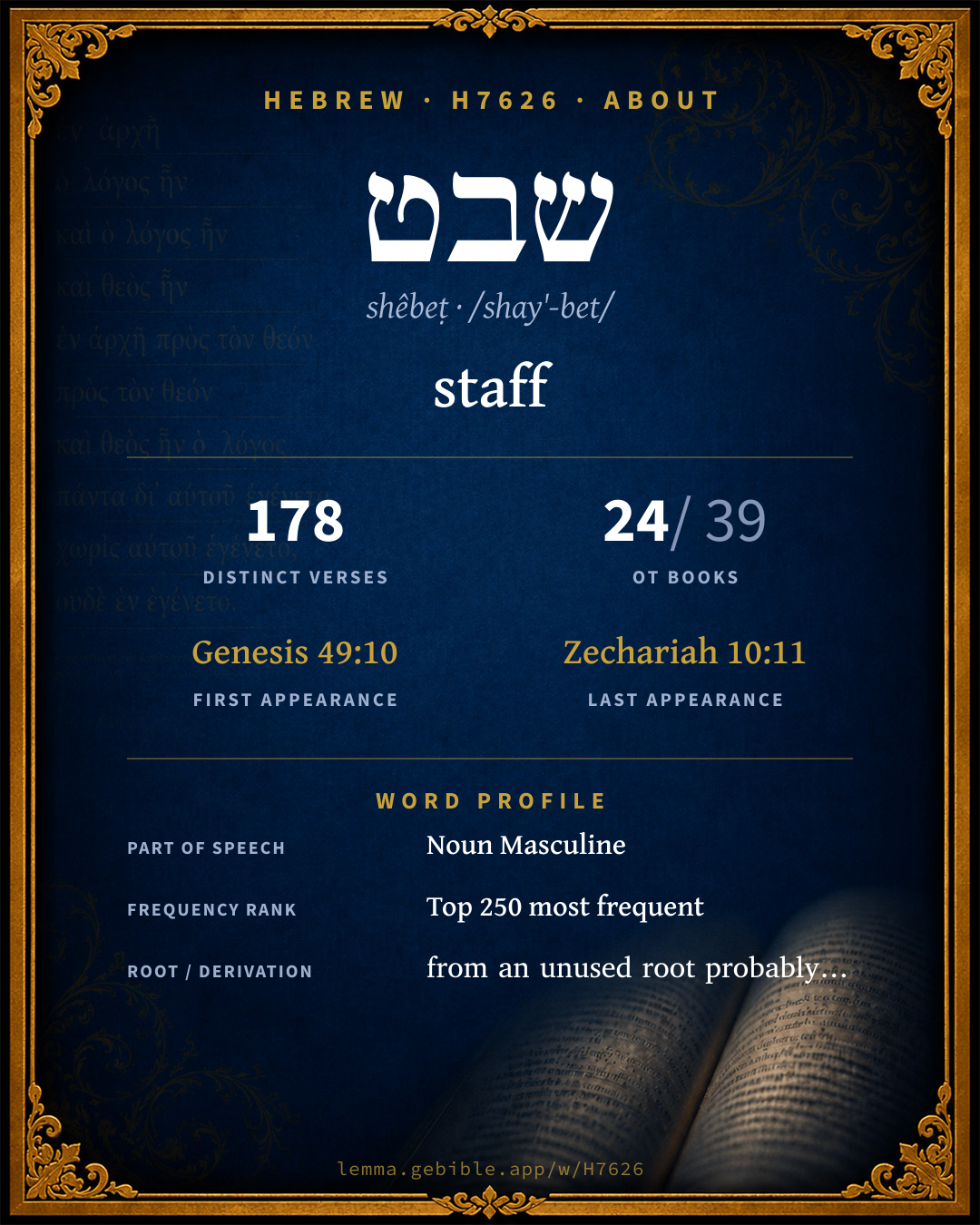
שֵׁ֫בֶט
staff
also: rod, branch, offshoot, club fuller range ↓
Full lexicon entry — Brown-Driver-Briggs (BDB)
From Brown-Driver-Briggs (BDB)
Where this word appears
See every Construct-state word in the Hebrew Bible →
Grammar key — what these labels mean
Part of speech
- Noun
- A naming word — a person, place, thing, or idea.
Noun type
- Common
- A common noun — a general class of person, place, or thing (“king,” “city,” “water”), not a specific name.
State
- Construct
- A noun bound to a following noun in a possessive / “of” relationship (the construct chain).
- Absolute
- The independent form of a noun, not bound to a following word.
Gender
- Masculine
- Grammatically masculine.
Number
- Plural
- More than one (in Hebrew, generally three or more).
- Singular
- One.
Grammatical forms
- Noun, Common, Masculine, Plural, Construct 76 times (40%)
- Noun, Common, Masculine, Singular, Construct 62 times (33%)
- Noun, Common, Masculine, Singular, Absolute 42 times (22%)
- Noun, Common, Masculine, Plural, Absolute 10 times (5%)
Parsed forms decoded from the imported morphology (morphhb / Westminster Leningrad Codex — WLC text public domain, morphhb tagging CC BY 4.0), counted across 190 parsed occurrences — not distinct verses.
Every verse where H7626 appears — 178 distinct verses across 24 books. Click any verse to open its interlinear word-by-word view. Verse text shown in the World English Bible for context — . Each verse’s Hebrew form is shown with its reference; the English is not keyword-highlighted, since the data carries no word-level English alignment. Use “Compare translations” on any verse to read it across multiple English versions. This concordance covers the Hebrew Bible; Septuagint (Greek Old Testament) occurrences are not indexed here.
Genesis 3 verses
- Genesis 49:10 שֵׁ֨בֶט֙ n c ms The scepter will not depart from Judah, Nor the ruler's staff from between his feet, Until he comes to whom it belongs. To him will the obedience of the peoples be.
- Genesis 49:16 שִׁבְטֵ֥י n c mp cs "Dan will judge his people, As one of the tribes of Israel.
- Genesis 49:28 שִׁבְטֵ֥י n c mp cs All these are the twelve tribes of Israel, and this is what their father spoke to them and blessed them. He blessed everyone according to his blessing.
Exodus 4 verses
- Exodus 21:20 בַּ/שֵּׁ֔בֶט prep det + n c ms "If a man strikes his servant or his maid with a rod, and he dies under his hand, he shall surely be punished.
- Exodus 24:4 שִׁבְטֵ֥י n c mp cs Moses wrote all the words of Yahweh, and rose up early in the morning, and built an altar under the mountain, and twelve pillars for the twelve tribes of Israel.
- Exodus 28:21 שָֽׁבֶט n c ms The stones shall be according to the names of the children of Israel, twelve, according to their names; like the engravings of a signet, everyone according to his name, they shall be for the twelve tribes.
- Exodus 39:14 שָֽׁבֶט n c ms The stones were according to the names of the children of Israel, twelve, according to their names; like the engravings of a signet, everyone according to his name, for the twelve tribes.
Leviticus 1 verse
Numbers 6 verses
- Numbers 4:18 שֵׁ֖בֶט n c ms cs "Don't cut off the tribe of the families of the Kohathites from among the Levites;
- Numbers 18:2 שֵׁ֤בֶט n c ms cs Your brothers also, the tribe of Levi, the tribe of your father, bring you near with you, that they may be joined to you, and minister to you: but you and your sons with you shall be before the tent of the testimony.
- Numbers 24:2 לִ/שְׁבָטָ֑י/ו prep + n c mp cs + sfx pers 3ms Balaam lifted up his eyes, and he saw Israel dwelling according to their tribes; and the Spirit of God came on him.
- Numbers 24:17 שֵׁ֨בֶט֙ n c ms I see him, but not now; I see him, but not near: There shall come forth a star out of Jacob, A scepter shall rise out of Israel, Shall strike through the corners of Moab, Break down all the sons of tumult.
- Numbers 32:33 שֵׁ֣בֶט n c ms cs Moses gave to them, even to the children of Gad, and to the children of Reuben, and to the half-tribe of Manasseh the son of Joseph, the kingdom of Sihon king of the Amorites, and the kingdom of Og king of Bashan, the land, according to the cities of it with [their] borders, even the cities of the land round about.
- Numbers 36:3 שִׁבְטֵ֥י n c mp cs If they be married to any of the sons of the [other] tribes of the children of Israel, then will their inheritance be taken away from the inheritance of our fathers, and will be added to the inheritance of the tribe whereunto they shall belong: so will it be taken away from the lot of our inheritance.
Deuteronomy 17 verses
- Deuteronomy 1:13 לְ/שִׁבְטֵי/כֶ֑ם prep + n c mp cs + sfx pers 2mp Take wise men of understanding and well known according to your tribes, and I will make them heads over you.
- Deuteronomy 1:15 שִׁבְטֵי/כֶ֗ם לְ/שִׁבְטֵי/כֶֽם n c mp cs + sfx pers 2mp prep + n c mp cs + sfx pers 2mp So I took the heads of your tribes, wise men, and known, and made them heads over you, captains of thousands, and captains of hundreds, and captains of fifties, and captains of tens, and officers, according to your tribes.
- Deuteronomy 1:23 לַ/שָּֽׁבֶט prep det + n c ms The thing pleased me well; and I took twelve men of you, one man for every tribe:
- Deuteronomy 3:13 שֵׁ֣בֶט n c ms cs and the rest of Gilead, and all Bashan, the kingdom of Og, gave I to the half-tribe of Manasseh; all the region of Argob, even all Bashan. (The same is called the land of Rephaim.
- Deuteronomy 5:23 שִׁבְטֵי/כֶ֖ם n c mp cs + sfx pers 2mp It happened, when you heard the voice out of the midst of the darkness, while the mountain was burning with fire, that you came near to me, even all the heads of your tribes, and your elders;
- Deuteronomy 10:8 שֵׁ֣בֶט n c ms cs At that time Yahweh set apart the tribe of Levi, to bear the ark of the covenant of Yahweh, to stand before Yahweh to minister to him, and to bless in his name, to this day.
- Deuteronomy 12:5 שִׁבְטֵי/כֶ֔ם n c mp cs + sfx pers 2mp But to the place which Yahweh your God shall choose out of all your tribes, to put his name there, even to his habitation shall you seek, and there you shall come;
- Deuteronomy 12:14 שְׁבָטֶ֔י/ךָ n c mp cs + sfx pers 2ms but in the place which Yahweh shall choose in one of your tribes, there you shall offer your burnt offerings, and there you shall do all that I command you.
- Deuteronomy 16:18 לִ/שְׁבָטֶ֑י/ךָ prep + n c mp cs + sfx pers 2ms Judges and officers shall you make you in all your gates, which Yahweh your God gives you, according to your tribes; and they shall judge the people with righteous judgment.
- Deuteronomy 18:1 שֵׁ֧בֶט n c ms cs The priests the Levites, [even] all the tribe of Levi, shall have no portion nor inheritance with Israel: they shall eat the offerings of Yahweh made by fire, and his inheritance.
- Deuteronomy 18:5 שְׁבָטֶ֑י/ךָ n c mp cs + sfx pers 2ms For Yahweh your God has chosen him out of all your tribes, to stand to minister in the name of Yahweh, him and his sons for ever.
- Deuteronomy 29:8 שֵׁ֥בֶט n c ms cs and we took their land, and gave it for an inheritance to the Reubenites, and to the Gadites, and to the half-tribe of the Manassites.
- Deuteronomy 29:10 שִׁבְטֵי/כֶ֗ם n c mp cs + sfx pers 2mp You stand this day all of you before Yahweh your God; your heads, your tribes, your elders, and your officers, even all the men of Israel,
- Deuteronomy 29:18 שֵׁ֗בֶט n c ms lest there should be among you man, or woman, or family, or tribe, whose heart turns away this day from Yahweh our God, to go to serve the gods of those nations; lest there should be among you a root that bears gall and wormwood;
- Deuteronomy 29:21 שִׁבְטֵ֣י n c mp cs Yahweh will set him apart to evil out of all the tribes of Israel, according to all the curses of the covenant that is written in this book of the law.
- Deuteronomy 31:28 שִׁבְטֵי/כֶ֖ם n c mp cs + sfx pers 2mp Assemble to me all the elders of your tribes, and your officers, that I may speak these words in their ears, and call heaven and earth to witness against them.
- Deuteronomy 33:5 שִׁבְטֵ֥י n c mp cs He was king in Jeshurun, When the heads of the people were gathered, All the tribes of Israel together.
Joshua 29 verses
- Joshua 1:12 שֵׁ֣בֶט n c ms cs To the Reubenites, and to the Gadites, and to the half-tribe of Manasseh, spoke Joshua, saying,
- Joshua 3:12 מִ/שִּׁבְטֵ֖י לַ/שָּֽׁבֶט prep + n c mp cs prep det + n c ms Now therefore take twelve men out of the tribes of Israel, for every tribe a man.
- Joshua 4:2 מִ/שָּֽׁבֶט prep + n c ms Take twelve men out of the people, out of every tribe a man,
- Joshua 4:4 מִ/שָּֽׁבֶט prep + n c ms Then Joshua called the twelve men, whom he had prepared of the children of Israel, out of every tribe a man:
- Joshua 4:5 שִׁבְטֵ֥י n c mp cs and Joshua said to them, Pass over before the ark of Yahweh your God into the midst of the Jordan, and take up every man of you a stone on his shoulder, according to the number of the tribes of the children of Israel;
- Joshua 4:8 שִׁבְטֵ֣י n c mp cs The children of Israel did so as Joshua commanded, and took up twelve stones out of the midst of the Jordan, as Yahweh spoke to Joshua, according to the number of the tribes of the children of Israel; and they carried them over with them to the place where they lodged, and laid them down there.
- Joshua 4:12 שֵׁ֤בֶט n c ms cs The children of Reuben, and the children of Gad, and the half-tribe of Manasseh, passed over armed before the children of Israel, as Moses spoke to them:
- Joshua 7:14 לְ/שִׁבְטֵי/כֶ֑ם הַ/שֵּׁבֶט֩ prep + n c mp cs + sfx pers 2mp ptcl def.art + n c ms In the morning therefore you shall be brought near by your tribes: and it shall be, that the tribe which Yahweh takes shall come near by families; and the family which Yahweh shall take shall come near by households; and the household which Yahweh shall take shall come near man by man.
- Joshua 7:16 לִ/שְׁבָטָ֑י/ו שֵׁ֥בֶט prep + n c mp cs + sfx pers 3ms n c ms cs So Joshua rose up early in the morning, and brought Israel near by their tribes; and the tribe of Judah was taken:
- Joshua 11:23 לְ/שִׁבְטֵי/הֶ֑ם prep + n c mp cs + sfx pers 3mp So Joshua took the whole land, according to all that Yahweh spoke to Moses; and Joshua gave it for an inheritance to Israel according to their divisions by their tribes. The land had rest from war.
- Joshua 12:6 שֵׁ֥בֶט n c ms cs Moses the servant of Yahweh and the children of Israel struck them: and Moses the servant of Yahweh gave it for a possession to the Reubenites, and the Gadites, and the half-tribe of Manasseh.
- Joshua 12:7 לְ/שִׁבְטֵ֧י prep + n c mp cs These are the kings of the land whom Joshua and the children of Israel struck beyond the Jordan westward, from Baal Gad in the valley of Lebanon even to Mount Halak, that goes up to Seir; and Joshua gave it to the tribes of Israel for a possession according to their divisions;
- Joshua 13:7 הַ/שְּׁבָטִ֑ים הַ/שֵּׁ֥בֶט ptcl def.art + n c mp ptcl def.art + n c ms Now therefore divide this land for an inheritance to the nine tribes, and the half-tribe of Manasseh.
- Joshua 13:14 לְ/שֵׁ֣בֶט prep + n c ms cs Only to the tribe of Levi he gave no inheritance; the offerings of Yahweh, the God of Israel, made by fire are his inheritance, as he spoke to him.
- Joshua 13:29 שֵׁ֣בֶט n c ms cs Moses gave [inheritance] to the half-tribe of Manasseh: and it was for the half-tribe of the children of Manasseh according to their families.
- Joshua 13:33 וּ/לְ/שֵׁ֨בֶט֙ conj + prep + n c ms cs But to the tribe of Levi Moses gave no inheritance: Yahweh, the God of Israel, is their inheritance, as he spoke to them.
- Joshua 18:2 שְׁבָטִֽים n c mp There remained among the children of Israel seven tribes, which had not yet divided their inheritance.
- Joshua 18:4 לַ/שָּׁ֑בֶט prep det + n c ms Appoint for you three men of each tribe: and I will send them, and they shall arise, and walk through the land, and describe it according to their inheritance; and they shall come to me.
- Joshua 18:7 שֵׁ֨בֶט n c ms cs For the Levites have no portion among you; for the priesthood of Yahweh is their inheritance: and Gad and Reuben and the half-tribe of Manasseh have received their inheritance beyond the Jordan eastward, which Moses the servant of Yahweh gave them.
- Joshua 21:16 הַ/שְּׁבָטִ֖ים ptcl def.art + n c mp and Ain with its suburbs, and Juttah with its suburbs, [and] Beth-shemesh with its suburbs; nine cities out of those two tribes.
- Joshua 22:7 שֵׁ֣בֶט n c ms cs Now to the one half-tribe of Manasseh Moses had given [inheritance] in Bashan; but to the other half gave Joshua among their brothers beyond the Jordan westward; moreover when Joshua sent them away to their tents, he blessed them,
- Joshua 22:9 שֵׁ֣בֶט n c ms cs The children of Reuben and the children of Gad and the half-tribe of Manasseh returned, and departed from the children of Israel out of Shiloh, which is in the land of Canaan, to go to the land of Gilead, to the land of their possession, which they owned, according to the commandment of Yahweh by Moses.
- Joshua 22:10 שֵׁבֶט֩ n c ms cs When they came to the region about the Jordan, that is in the land of Canaan, the children of Reuben and the children of Gad and the half-tribe of Manasseh built there an altar by the Jordan, a great altar to look on.
- Joshua 22:11 שֵׁ֨בֶט n c ms cs The children of Israel heard say, Behold, the children of Reuben and the children of Gad and the half-tribe of Manasseh have built an altar in the forefront of the land of Canaan, in the region about the Jordan, on the side that pertains to the children of Israel.
- Joshua 22:13 שֵֽׁבֶט n c ms cs The children of Israel sent to the children of Reuben, and to the children of Gad, and to the half-tribe of Manasseh, into the land of Gilead, Phinehas the son of Eleazar the priest,
- Joshua 22:15 שֵֽׁבֶט n c ms cs They came to the children of Reuben, and to the children of Gad, and to the half-tribe of Manasseh, to the land of Gilead, and they spoke with them, saying,
- Joshua 22:21 שֵׁ֣בֶט n c ms cs Then the children of Reuben and the children of Gad and the half-tribe of Manasseh answered, and spoke to the heads of the thousands of Israel,
- Joshua 23:4 לְ/שִׁבְטֵי/כֶ֑ם prep + n c mp cs + sfx pers 2mp Behold, I have allotted to you these nations that remain, to be an inheritance for your tribes, from the Jordan, with all the nations that I have cut off, even to the great sea toward the going down of the sun.
- Joshua 24:1 שִׁבְטֵ֥י n c mp cs Joshua gathered all the tribes of Israel to Shechem, and called for the elders of Israel, and for their heads, and for their judges, and for their officers; and they presented themselves before God.
Judges 14 verses
- Judges 5:14 בְּ/שֵׁ֥בֶט prep + n c ms cs Out of Ephraim [came down] they whose root is in Amalek; After you, Benjamin, among your peoples; Out of Machir came down governors, Out of Zebulun those who handle the marshal's staff.
- Judges 18:1 שֵׁ֣בֶט שִׁבְטֵ֥י n c ms cs n c mp cs In those days there was no king in Israel: and in those days the tribe of the Danites sought them an inheritance to dwell in; for to that day [their] inheritance had not fallen to them among the tribes of Israel.
- Judges 18:19 לְ/שֵׁ֥בֶט prep + n c ms They said to him, Hold your peace, lay your hand on your mouth, and go with us, and be to us a father and a priest: is it better for you to be priest to the house of one man, or to be priest to a tribe and a family in Israel?
- Judges 18:30 לְ/שֵׁ֣בֶט prep + n c ms cs The children of Dan set up for themselves the engraved image: and Jonathan, the son of Gershom, the son of Moses, he and his sons were priests to the tribe of the Danites until the day of the captivity of the land.
- Judges 20:2 שִׁבְטֵ֣י n c mp cs The chiefs of all the people, even of all the tribes of Israel, presented themselves in the assembly of the people of God, four hundred thousand footmen who drew sword.
- Judges 20:10 שִׁבְטֵ֣י n c mp cs and we will take ten men of one hundred throughout all the tribes of Israel, and one hundred of one thousand, and a thousand out of ten thousand, to get food for the people, that they may do, when they come to Gibeah of Benjamin, according to all the folly that they have worked in Israel.
- Judges 20:12 שִׁבְטֵ֤י שִׁבְטֵ֥י n c mp cs n c mp cs The tribes of Israel sent men through all the tribe of Benjamin, saying, What wickedness is this that is happen among you?
- Judges 21:3 שֵׁ֥בֶט n c ms They said, Yahweh, the God of Israel, why has this happened in Israel, that there should be today one tribe lacking in Israel?
- Judges 21:5 שִׁבְטֵ֥י n c mp cs The children of Israel said, Who is there among all the tribes of Israel who didn't come up in the assembly to Yahweh? For they had made a great oath concerning him who didn't come up to Yahweh to Mizpah, saying, He shall surely be put to death.
- Judges 21:6 שֵׁ֥בֶט n c ms The children of Israel repented them for Benjamin their brother, and said, There is one tribe cut off from Israel this day.
- Judges 21:8 מִ/שִּׁבְטֵ֣י prep + n c mp cs They said, What one is there of the tribes of Israel who didn't come up to Yahweh to Mizpah? Behold, there came none to the camp from Jabesh Gilead to the assembly.
- Judges 21:15 בְּ/שִׁבְטֵ֥י prep + n c mp cs The people repented them for Benjamin, because that Yahweh had made a breach in the tribes of Israel.
- Judges 21:17 שֵׁ֖בֶט n c ms They said, There must be an inheritance for those who are escaped of Benjamin, that a tribe not be blotted out from Israel.
- Judges 21:24 לְ/שִׁבְט֖/וֹ prep + n c ms cs + sfx pers 3ms The children of Israel departed there at that time, every man to his tribe and to his family, and they went out from there every man to his inheritance.
1 Samuel 6 verses
- 1 Samuel 2:28 שִׁבְטֵ֨י n c mp cs and did I choose him out of all the tribes of Israel to be my priest, to go up to my altar, to burn incense, to wear an ephod before me? and did I give to the house of your father all the offerings of the children of Israel made by fire?
- 1 Samuel 9:21 שִׁבְטֵ֣י שִׁבְטֵ֣י n c mp cs n c mp cs Saul answered, Am I not a Benjamite, of the smallest of the tribes of Israel? and my family the least of all the families of the tribe of Benjamin? why then speak you to me after this manner?
- 1 Samuel 10:19 לְ/שִׁבְטֵי/כֶ֖ם prep + n c mp cs + sfx pers 2mp but you have this day rejected your God, who himself saves you out of all your calamities and your distresses; and you have said to him, [No], but set a king over us. Now therefore present yourselves before Yahweh by your tribes, and by your thousands.
- 1 Samuel 10:20 שִׁבְטֵ֣י שֵׁ֥בֶט n c mp cs n c ms cs So Samuel brought all the tribes of Israel near, and the tribe of Benjamin was taken.
- 1 Samuel 10:21 שֵׁ֤בֶט n c ms cs He brought the tribe of Benjamin near by their families; and the family of the Matrites was taken; and Saul the son of Kish was taken: but when they sought him, he could not be found.
- 1 Samuel 15:17 שִׁבְטֵ֥י n c mp cs Samuel said, "Though you were little in your own sight, weren't you made the head of the tribes of Israel? Yahweh anointed you king over Israel;
2 Samuel 10 verses
- 2 Samuel 5:1 שִׁבְטֵ֧י n c mp cs Then came all the tribes of Israel to David to Hebron, and spoke, saying, Behold, we are your bone and your flesh.
- 2 Samuel 7:7 שִׁבְטֵ֣י n c mp cs In all places in which I have walked with all the children of Israel, spoke I a word with any of the tribes of Israel, whom I commanded to be shepherd of my people Israel, saying, Why have you not built me a house of cedar?
- 2 Samuel 7:14 בְּ/שֵׁ֣בֶט prep + n c ms cs I will be his father, and he shall be my son: if he commit iniquity, I will chasten him with the rod of men, and with the stripes of the children of men;
- 2 Samuel 15:2 שִׁבְטֵֽי n c mp cs Absalom rose up early, and stood beside the way of the gate: and it was so, that when any man had a suit which should come to the king for judgment, then Absalom called to him, and said, Of what city are you? He said, Your servant is of one of the tribes of Israel.
- 2 Samuel 15:10 שִׁבְטֵ֥י n c mp cs But Absalom sent spies throughout all the tribes of Israel, saying, As soon as you hear the sound of the trumpet, then you shall say, Absalom is king in Hebron.
- 2 Samuel 18:14 שְׁבָטִ֜ים n c mp Then said Joab, I may not wait thus with you. He took three darts in his hand, and thrust them through the heart of Absalom, while he was yet alive in the midst of the oak.
- 2 Samuel 19:9 שִׁבְטֵ֥י n c mp cs All the people were at strife throughout all the tribes of Israel, saying, The king delivered us out of the hand of our enemies, and he saved us out of the hand of the Philistines; and now he is fled out of the land from Absalom.
- 2 Samuel 20:14 שִׁבְטֵ֣י n c mp cs He went through all the tribes of Israel to Abel, and to Beth Maacah, and all the Berites: and they were gathered together, and went also after him.
- 2 Samuel 23:21 בַּ/שָּׁ֑בֶט prep det + n c ms He killed an Egyptian, a goodly man: and the Egyptian had a spear in his hand; but he went down to him with a staff, and plucked the spear out of the Egyptian's hand, and killed him with his own spear.
- 2 Samuel 24:2 שִׁבְטֵ֤י n c mp cs The king said to Joab the captain of the host, who was with him, Go now back and forth through all the tribes of Israel, from Dan even to Beersheba, and number you the people, that I may know the sum of the people.
1 Kings 10 verses
- 1 Kings 8:16 שִׁבְטֵ֣י n c mp cs Since the day that I brought forth my people Israel out of Egypt, I chose no city out of all the tribes of Israel to build a house, that my name might be there; but I chose David to be over my people Israel.
- 1 Kings 11:13 שֵׁ֥בֶט n c ms However I will not tear away all the kingdom; but I will give one tribe to your son, for David my servant's sake, and for Jerusalem's sake which I have chosen.
- 1 Kings 11:31 הַ/שְּׁבָטִֽים ptcl def.art + n c mp He said to Jeroboam, Take ten pieces; for thus says Yahweh, the God of Israel, Behold, I will tear the kingdom out of the hand of Solomon, and will give ten tribes to you
- 1 Kings 11:32 וְ/הַ/שֵּׁ֥בֶט שִׁבְטֵ֥י conj + ptcl def.art + n c ms n c mp cs (but he shall have one tribe, for my servant David's sake and for Jerusalem's sake, the city which I have chosen out of all the tribes of Israel);
- 1 Kings 11:35 הַ/שְּׁבָטִֽים ptcl def.art + n c mp but I will take the kingdom out of his son's hand, and will give it to you, even ten tribes.
- 1 Kings 11:36 שֵֽׁבֶט n c ms To his son will I give one tribe, that David my servant may have a lamp always before me in Jerusalem, the city which I have chosen me to put my name there.
- 1 Kings 12:20 שֵֽׁבֶט n c ms cs It happened, when all Israel heard that Jeroboam was returned, that they sent and called him to the congregation, and made him king over all Israel: there was none who followed the house of David, but the tribe of Judah only.
- 1 Kings 12:21 שֵׁ֣בֶט n c ms cs When Rehoboam was come to Jerusalem, he assembled all the house of Judah, and the tribe of Benjamin, a hundred and eighty thousand chosen men, who were warriors, to fight against the house of Israel, to bring the kingdom again to Rehoboam the son of Solomon.
- 1 Kings 14:21 שִׁבְטֵ֣י n c mp cs Rehoboam the son of Solomon reigned in Judah. Rehoboam was forty-one years old when he began to reign, and he reigned seventeen years in Jerusalem, the city which Yahweh had chosen out of all the tribes of Israel, to put his name there: and his mother's name was Naamah the Ammonitess.
- 1 Kings 18:31 שִׁבְטֵ֣י n c mp cs Elijah took twelve stones, according to the number of the tribes of the sons of Jacob, to whom the word of Yahweh came, saying, Israel shall be your name.
2 Kings 2 verses
- 2 Kings 17:18 שֵׁ֥בֶט n c ms cs Therefore Yahweh was very angry with Israel, and removed them out of his sight: there was none left but the tribe of Judah only.
- 2 Kings 21:7 שִׁבְטֵ֣י n c mp cs He set the engraved image of Asherah, that he had made, in the house of which Yahweh said to David and to Solomon his son, In this house, and in Jerusalem, which I have chosen out of all the tribes of Israel, will I put my name forever;
1 Chronicles 12 verses
- 1 Chronicles 5:18 שֵֽׁבֶט n c ms cs The sons of Reuben, and the Gadites, and the half-tribe of Manasseh, of valiant men, men able to bear buckler and sword, and to shoot with bow, and skillful in war, were forty-four thousand seven hundred and sixty, that were able to go forth to war.
- 1 Chronicles 5:23 שֵׁ֣בֶט n c ms cs The children of the half-tribe of Manasseh lived in the land: they increased from Bashan to Baal Hermon and Senir and Mount Hermon.
- 1 Chronicles 5:26 שֵׁ֣בֶט n c ms cs The God of Israel stirred up the spirit of Pul king of Assyria, and the spirit of Tilgath Pilneser king of Assyria, and he carried them away, even the Reubenites, and the Gadites, and the half-tribe of Manasseh, and brought them to Halah, and Habor, and Hara, and to the river of Gozan, to this day.
- 1 Chronicles 11:23 בַּ/שָּׁ֑בֶט prep det + n c ms He killed an Egyptian, a man of great stature, five cubits high; and in the Egyptian's hand was a spear like a weaver's beam; and he went down to him with a staff, and plucked the spear out of the Egyptian's hand, and killed him with his own spear.
- 1 Chronicles 12:37 שֵׁ֣בֶט n c ms cs On the other side of the Jordan, of the Reubenites, and the Gadites, and of the half-tribe of Manasseh, with all manner of instruments of war for the battle, one hundred twenty thousand.
- 1 Chronicles 23:14 שֵׁ֥בֶט n c ms cs But as for Moses the man of God, his sons were named among the tribe of Levi.
- 1 Chronicles 26:32 שֵׁ֣בֶט n c ms cs His brothers, men of valor, were two thousand seven hundred, heads of fathers' [houses], whom king David made overseers over the Reubenites, and the Gadites, and the half-tribe of the Manassites, for every matter pertaining to God, and for the affairs of the king.
- 1 Chronicles 27:16 שִׁבְטֵ֣י n c mp cs Furthermore over the tribes of Israel: of the Reubenites was Eliezer the son of Zichri the ruler: of the Simeonites, Shephatiah the son of Maacah:
- 1 Chronicles 27:20 שֵׁ֣בֶט n c ms cs of the children of Ephraim, Hoshea the son of Azaziah: of the half-tribe of Manasseh, Joel the son of Pedaiah:
- 1 Chronicles 27:22 שִׁבְטֵ֥י n c mp cs of Dan, Azarel the son of Jeroham. These were the captains of the tribes of Israel.
- 1 Chronicles 28:1 הַ/שְּׁבָטִ֣ים ptcl def.art + n c mp David assembled all the princes of Israel, the princes of the tribes, and the captains of the companies who served the king by division, and the captains of thousands, and the captains of hundreds, and the rulers over all the substance and possessions of the king and of his sons, with the officers, and the mighty men, even all the mighty men of valor, to Jerusalem.
- 1 Chronicles 29:6 שִׁבְטֵ֣י n c mp cs Then the princes of the fathers' [houses], and the princes of the tribes of Israel, and the captains of thousands and of hundreds, with the rulers over the king's work, offered willingly;
2 Chronicles 4 verses
- 2 Chronicles 6:5 שִׁבְטֵ֣י n c mp cs Since the day that I brought forth my people out of the land of Egypt, I chose no city out of all the tribes of Israel to build a house in, that my name might be there; neither chose I any man to be prince over my people Israel:
- 2 Chronicles 11:16 שִׁבְטֵ֣י n c mp cs After them, out of all the tribes of Israel, such as set their hearts to seek Yahweh, the God of Israel, came to Jerusalem to sacrifice to Yahweh, the God of their fathers.
- 2 Chronicles 12:13 שִׁבְטֵ֣י n c mp cs So king Rehoboam strengthened himself in Jerusalem, and reigned: for Rehoboam was forty-one years old when he began to reign, and he reigned seventeen years in Jerusalem, the city which Yahweh had chosen out of all the tribes of Israel, to put his name there: and his mother's name was Naamah the Ammonitess.
- 2 Chronicles 33:7 שִׁבְטֵ֣י n c mp cs He set the engraved image of the idol, which he had made, in the house of God, of which God said to David and to Solomon his son, In this house, and in Jerusalem, which I have chosen out of all the tribes of Israel, will I put my name forever:
Job 3 verses
- Job 9:34 שִׁבְט֑/וֹ n c ms cs + sfx pers 3ms Let him take his rod away from me, Let his terror not make me afraid:
- Job 21:9 שֵׁ֖בֶט n c ms cs Their houses are safe from fear, Neither is the rod of God upon them.
- Job 37:13 לְ/שֵׁ֥בֶט prep + n c ms Whether it is for correction, or for his land, Or for loving kindness, that he causes it to come.
Psalms 11 verses
- Psalms 2:9 בְּ/שֵׁ֣בֶט prep + n c ms cs You shall break them with a rod of iron. You shall dash them in pieces like a potter's vessel."
- Psalms 23:4 שִׁבְטְ/ךָ֥ n c ms cs + sfx pers 2ms Even though I walk through the valley of the shadow of death, I will fear no evil, for you are with me. Your rod and your staff, they comfort me.
- Psalms 45:6 שֵׁ֥בֶט שֵׁ֣בֶט n c ms cs n c ms cs Your throne, God, is forever and ever. A scepter of equity is the scepter of your kingdom.
- Psalms 74:2 שֵׁ֣בֶט n c ms cs Remember your congregation, which you purchased of old, Which you have redeemed to be the tribe of your inheritance; Mount Zion, in which you have lived.
- Psalms 78:55 שִׁבְטֵ֥י n c mp cs He also drove out the nations before them, Allotted them for an inheritance by line, And made the tribes of Israel to dwell in their tents.
- Psalms 78:67 וּֽ/בְ/שֵׁ֥בֶט conj + prep + n c ms cs Moreover he rejected the tent of Joseph, And didn't choose the tribe of Ephraim,
- Psalms 78:68 שֵׁ֣בֶט n c ms cs But chose the tribe of Judah, Mount Zion which he loved.
- Psalms 89:32 בְ/שֵׁ֣בֶט prep + n c ms Then I will punish their sin with the rod, And their iniquity with stripes.
- Psalms 105:37 בִּ/שְׁבָטָ֣י/ו prep + n c mp cs + sfx pers 3ms He brought them forth with silver and gold. There was not one feeble person among his tribes.
- Psalms 122:4 שְׁבָטִ֡ים שִׁבְטֵי n c mp n c mp cs Where the tribes go up, even Yah's tribes, According to an ordinance for Israel, To give thanks to the name of Yahweh.
- Psalms 125:3 שֵׁ֤בֶט n c ms cs For the scepter of wickedness won't remain over the allotment of the righteous; So that the righteous won't use their hands to do evil.
Proverbs 8 verses
- Proverbs 10:13 וְ֝/שֵׁ֗בֶט conj + n c ms Wisdom is found on the lips of him who has discernment, But a rod is for the back of him who is void of understanding.
- Proverbs 13:24 שִׁ֭בְט/וֹ n c ms cs + sfx pers 3ms One who spares the rod hates his son, But one who loves him is careful to discipline him.
- Proverbs 22:8 וְ/שֵׁ֖בֶט conj + n c ms cs He who sows wickedness reaps trouble, And the rod of his fury will be destroyed.
- Proverbs 22:15 שֵׁ֥בֶט n c ms cs Folly is bound up in the heart of a child: The rod of discipline drives it far from him.
- Proverbs 23:13 בַ֝/שֵּׁ֗בֶט prep det + n c ms Don't withhold correction from a child. If you punish him with the rod, he will not die.
- Proverbs 23:14 בַּ/שֵּׁ֣בֶט prep det + n c ms Punish him with the rod, And save his soul from Sheol.
- Proverbs 26:3 וְ֝/שֵׁ֗בֶט conj + n c ms A whip for the horse, A bridle for the donkey, And a rod for the back of fools!
- Proverbs 29:15 שֵׁ֣בֶט n c ms The rod of correction gives wisdom, But a child left to himself causes shame to his mother.
Isaiah 12 verses
- Isaiah 9:4 שֵׁ֖בֶט n c ms cs For the yoke of his burden, and the staff of his shoulder, the rod of his oppressor, you have broken as in the day of Midian.
- Isaiah 10:5 שֵׁ֣בֶט n c ms cs Ho Assyrian, the rod of my anger, the staff in whose hand is my indignation!
- Isaiah 10:15 שֵׁ֨בֶט֙ n c ms Shall the axe boast itself against him who hews therewith? Shall the saw magnify itself against him who wields it? as if a rod should wield those who lift it up, [or] as if a staff should lift up [him who is] not wood.
- Isaiah 10:24 בַּ/שֵּׁ֣בֶט prep det + n c ms Therefore thus says the Lord, Yahweh of Hosts, my people who dwell in Zion, don't be afraid of the Assyrian, though he strike you with the rod, and lift up his staff against you, after the manner of Egypt.
- Isaiah 11:4 בְּ/שֵׁ֣בֶט prep + n c ms cs but with righteousness shall he judge the poor, and decide with equity for the humble of the earth; and he shall strike the earth with the rod of his mouth; and with the breath of his lips shall he kill the wicked.
- Isaiah 14:5 שֵׁ֖בֶט n c ms cs Yahweh has broken the staff of the wicked, the scepter of the rulers;
- Isaiah 14:29 שֵׁ֣בֶט n c ms Don't rejoice, O Philistia, all of you, because the rod that struck you is broken; for out of the serpent's root shall come forth an adder, and his fruit shall be a fiery flying serpent.
- Isaiah 19:13 שְׁבָטֶֽי/הָ n c mp cs + sfx pers 3fs The princes of Zoan are become fools, the princes of Memphis are deceived; they have caused Egypt to go astray, who are the corner-stone of her tribes.
- Isaiah 28:27 בַּ/שָּֽׁבֶט prep det + n c ms For the dill are not threshed with a sharp [threshing] instrument, neither is a cart wheel turned about on the cumin; but the dill are beaten out with a staff, and the cumin with a rod.
- Isaiah 30:31 בַּ/שֵּׁ֖בֶט prep det + n c ms For through the voice of Yahweh shall the Assyrian be dismayed; with his rod will he strike [him].
- Isaiah 49:6 שִׁבְטֵ֣י n c mp cs yes, he says, It is too light a thing that you should be my servant to raise up the tribes of Jacob, and to restore the preserved of Israel: I will also give you for a light to the Gentiles, that you may be my salvation to the end of the earth.
- Isaiah 63:17 שִׁבְטֵ֖י n c mp cs O Yahweh, why do you make us to err from your ways, and harden our heart from your fear? Return for your servants' sake, the tribes of your inheritance.
Jeremiah 2 verses
- Jeremiah 10:16 שֵׁ֖בֶט n c ms cs The portion of Jacob is not like these; for he is the former of all things; and Israel is the tribe of his inheritance: Yahweh of Hosts is his name.
- Jeremiah 51:19 וְ/שֵׁ֖בֶט conj + n c ms cs The portion of Jacob is not like these; for he is the former of all things; and [Israel] is the tribe of his inheritance: Yahweh of Hosts is his name.
Lamentations 1 verse
Ezekiel 16 verses
- Ezekiel 19:11 שִׁבְטֵי֙ n c mp cs It had strong rods for the scepters of those who bore rule, and their stature was exalted among the thick boughs, and they were seen in their height with the multitude of their branches.
- Ezekiel 19:14 שֵׁ֣בֶט n c ms Fire is gone out of the rods of its branches, it has devoured its fruit, so that there is in it no strong rod to be a scepter to rule. This is a lamentation, and shall be for a lamentation.
- Ezekiel 20:37 הַ/שָּׁ֑בֶט ptcl def.art + n c ms I will cause you to pass under the rod, and I will bring you into the bond of the covenant;
- Ezekiel 21:10 שֵׁ֥בֶט n c ms cs it is sharpened that it may make a slaughter; it is furbished that it may be as lightning: shall we then make mirth? the rod of my son, it condemns every tree.
- Ezekiel 21:13 שֵׁ֥בֶט n c ms For there is a trial; and what if even the rod that condemns shall be no more? says the Lord Yahweh.
- Ezekiel 37:19 וְ/שִׁבְטֵ֥י conj + n c mp cs tell them, Thus says the Lord Yahweh: Behold, I will take the stick of Joseph, which is in the hand of Ephraim, and the tribes of Israel his companions; and I will put them with it, [even] with the stick of Judah, and make them one stick, and they shall be one in my hand.
- Ezekiel 45:8 לְ/שִׁבְטֵי/הֶֽם prep + n c mp cs + sfx pers 3mp In the land it shall be to him for a possession in Israel: and my princes shall no more oppress my people; but they shall give the land to the house of Israel according to their tribes.
- Ezekiel 47:13 שִׁבְטֵ֣י n c mp cs Thus says the Lord Yahweh: This shall be the border, by which you shall divide the land for inheritance according to the twelve tribes of Israel: Joseph [shall have two] portions.
- Ezekiel 47:21 לְ/שִׁבְטֵ֥י prep + n c mp cs So shall you divide this land to you according to the tribes of Israel.
- Ezekiel 47:22 שִׁבְטֵ֥י n c mp cs It shall happen, that you shall divide it by lot for an inheritance to you and to the strangers who sojourn among you, who shall father children among you; and they shall be to you as the home-born among the children of Israel; they shall have inheritance with you among the tribes of Israel.
- Ezekiel 47:23 בַ/שֵּׁ֔בֶט prep det + n c ms It shall happen, that in what tribe the stranger sojourns, there shall you give him his inheritance, says the Lord Yahweh.
- Ezekiel 48:1 הַ/שְּׁבָטִ֑ים ptcl def.art + n c mp Now these are the names of the tribes: From the north end, beside the way of Hethlon to the entrance of Hamath, Hazar Enan at the border of Damascus, northward beside Hamath, (and they shall have their sides east [and] west), Dan, one [portion].
- Ezekiel 48:19 שִׁבְטֵ֥י n c mp cs Those who labor in the city, out of all the tribes of Israel, shall until it.
- Ezekiel 48:23 הַ/שְּׁבָטִ֑ים ptcl def.art + n c mp As for the rest of the tribes: from the east side to the west side, Benjamin, one [portion].
- Ezekiel 48:29 לְ/שִׁבְטֵ֣י prep + n c mp cs This is the land which you shall divide by lot to the tribes of Israel for inheritance, and these are their several portions, says the Lord Yahweh.
- Ezekiel 48:31 שִׁבְטֵ֣י n c mp cs and the gates of the city shall be after the names of the tribes of Israel, three gates northward: the gate of Reuben, one; the gate of Judah, one; the gate of Levi, one.
Hosea 1 verse
Amos 2 verses
- Amos 1:5 שֵׁ֖בֶט n c ms I will break the bar of Damascus, And cut off the inhabitant from the valley of Aven, And him who holds the scepter from the house of Eden; And the people of Syria shall go into captivity to Kir," says Yahweh.
- Amos 1:8 שֵׁ֖בֶט n c ms I will cut off the inhabitant from Ashdod, And him who holds the scepter from Ashkelon; And I will turn my hand against Ekron; And the remnant of the Philistines will perish," says the Lord Yahweh.
Micah 2 verses
- Micah 5:1 בַּ/שֵּׁ֨בֶט֙ prep det + n c ms Now you shall gather yourself in troops, Daughter of troops. He has laid siege against us; They will strike the judge of Israel with a rod on the cheek.
- Micah 7:14 בְ/שִׁבְטֶ֗/ךָ prep + n c ms cs + sfx pers 2ms Shepherd your people with your staff, The flock of your heritage, Who dwell by themselves in a forest, In the midst of fertile pasture land, let them feed; In Bashan and Gilead, as in the days of old.
Zechariah 2 verses
- Zechariah 9:1 שִׁבְטֵ֥י n c mp cs An oracle. The word of Yahweh is against the land of Hadrach, And will rest upon Damascus; For the eye of man And of all the tribes of Israel is toward Yahweh;
- Zechariah 10:11 וְ/שֵׁ֥בֶט conj + n c ms cs He will pass through the sea of affliction, And will strike the waves in the sea, And all the depths of the Nile will dry up; And the pride of Assyria will be brought down, And the scepter of Egypt will depart.
About this entry
At a glance — auto-summarized from this page’s data, not written by a person. Every figure links to its source below. This summary describes the numbers; it doesn’t interpret them.
שבט — transliterated shêbeṭ — is a Hebrew noun carrying the sense “staff.” Its English rendering has broadened — “tribe” classically, “tribes of” (unfoldingWord Literal Text) in modern versions; see the renderings breakdown. The Hebrew Bible uses it across 178 verses — common. It first appears in Genesis 49:10. It also covers “rod”, “branch”, and “offshoot”, alongside “staff” — see its full sense range. See the sense tree, 178-verse concordance, and the renderings breakdown below.
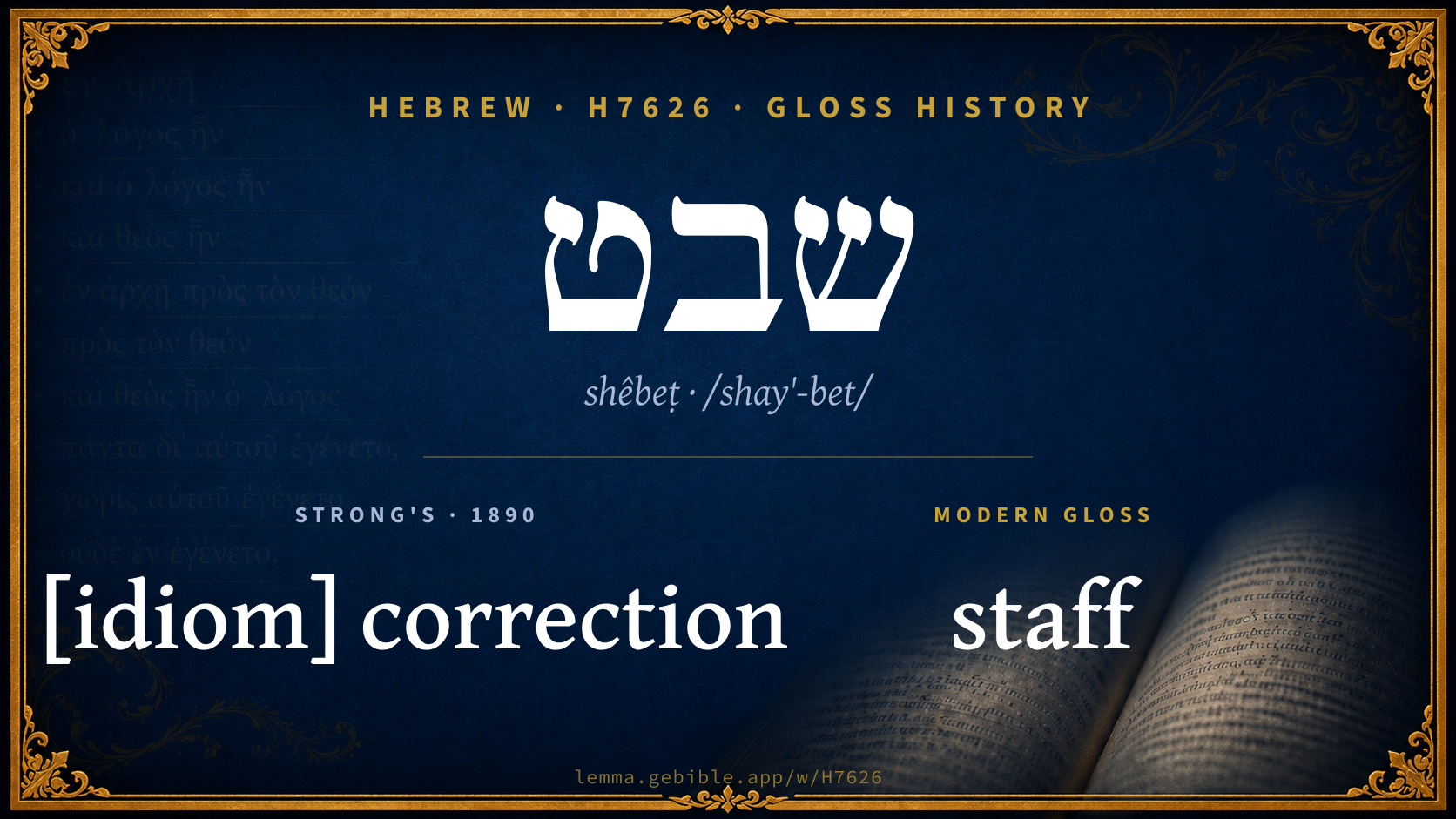
Gloss history
Strong's 1890 vs modern scholarship
About this word
Strong's H7626 catalogs a Hebrew word from the Hebrew Old Testament.
These counts are not copied from any lexicon or concordance. They are computed here, from the morphology-tagged Hebrew Old Testament. What Lemma adds →
- 178
- distinct verses
- The word appears in 178 distinct verses.
- 24 / 39
- OT books
- The word appears in 24 of 39 Old Testament books.
- #245
- by frequency
- Top 250 most frequent Hebrew words (rank 245 of 8,640 Hebrew words by occurrence).
View all 178 occurrences in the concordance →
Most concentrated in
- Joshua 29 verses 16%
- Deuteronomy 17 verses 10%
- Ezekiel 16 verses 9%
By section of the Old Testament
By traditional corpus
Conventional, traditional groupings — biblical authorship is debated, so this is a traditional corpus grouping, not an authorship claim. Each share is this word’s portion of its verses in that division of the Hebrew canon. Each figure is a share of the word’s 178 distinct verses.
- Prophets (Nevi'im) 108 verses · 61%
- Writings (Ketuvim) 39 verses · 22%
- Torah (Pentateuch) 31 verses · 17%
How translations render this word
Counts come from each version’s own published word-to-Strong’s tagging or interlinear alignment — an approximate guide to how each version renders this word, not a word-level alignment the data otherwise carries. Because each total is that version’s own tagged count, the per-version totals vary from one another and need not match the appearance or distinct-verse counts above. These counts may also differ from a printed concordance because Lemma counts each distinctly tagged rendering and does not collapse phrase taggings into a single head-word total. This is a fixed set of word-tagged versions (KJV, ASV, BSB, ULT) and does not change with the reading translation you choose elsewhere. Each version’s license is shown beside its name below (and on Sources).
- King James Version: Tribe 48×, Tribes 45×, Rod 27×
- American Standard Version: Tribes 40×, Tribe 24×, Rod 23×
- Berean Standard Bible: Tribes 66×, Tribe 37×, Rod 20×
- unfoldingWord Literal Text: Tribes of 45×, Tribe of 40×, Tribes 35×
King James Version Public Domain
Renders H7626 across 189 tagged occurrences — most commonly:
Plus 37 renderings that appear only once — usually multi-word phrases or single function words the recovered tagging swept in, not distinct renderings. Not rendered by a distinct English word in 1 further occurrence.
American Standard Version Public Domain
Renders H7626 across 184 tagged occurrences — most commonly:
Plus 45 renderings that appear only once — usually multi-word phrases or single function words the recovered tagging swept in, not distinct renderings.
Berean Standard Bible Public Domain
Renders H7626 across 168 tagged occurrences — most commonly:
Plus 20 renderings that appear only once — usually multi-word phrases or single function words the recovered tagging swept in, not distinct renderings. Not rendered by a distinct English word in 22 further occurrences.
unfoldingWord Literal Text CC BY-SA 4.0
Renders H7626 across 196 tagged occurrences — most commonly:
Plus 15 renderings that appear only once — usually multi-word phrases or single function words the recovered tagging swept in, not distinct renderings.
8 senses and sub-senses in the full BDB
What do BDB’s symbols mean?
BDB uses these scholarly abbreviations:
| Symbol | Meaning |
|---|---|
| 𝔊 | the Septuagint (the ancient Greek translation, LXX) |
| 𝔙 | the Vulgate (the Latin translation) |
| 𝔖 | the Syriac version (the Peshitta) |
| 𝔗 | the Targum (the Aramaic translation) |
| ψ | the Psalms |
| √ | root (the underlying root or stem) |
| ‖ | parallel passage (a synonymous or contrasted parallel) |
| † | the dagger: every passage where the word occurs is cited |
The 8 senses and sub-senses the full Brown-Driver-Briggs lexicon distinguishes for this word, in lexicon order (not ranked by frequency), with BDB’s own verbatim wording and sub-sense lettering. Shown in Hebrew script with BDB’s own scholarly abbreviations. The condensed entry is in the Lexicon Entry tab. See also the Forms in the corpus table below.
- 1.
- a. rod, staff (evidently common article), for smiting (especially הִכָּה בַשּׁ׳) Ex 21:20 (E), Mi 4:14; Is 10:15 (in sim.; ‖ מַטֶּה), Pr 10:13 +; שׁ׳ מוּסָר 22:15, cf. 29:15; for beating (חָבַט) cummin Is 28:27 (‖ מַטֶּה); as (inferior) weapon (opp. חֲנִית 2 S 23:21 = 1 Ch 11:23 (cf. מַקֵּל 1 S 17:40, 43); fig. of י׳’s chastisement: national Is 10:24; 30:31 (both ‖ מַטֶּה), 14:29, שׁ׳ אַפִּי 10:5, שׁ׳ עֶבְרָתוֹ La 3:1; individual Jb 9:34; 21:9 (שׁ׳ אֱלוֹהַּ), 37:13, 2 S 7:14 (שׁ׳ אֲנָשִׁים, i.e. not in-human), ψ 89:33 (both ‖ נְנָעִים). e.g. Exodus 21:20
- b. shaft, i.e. spear, dart, 2 S 18:14, but שְׁלָתִים, 𝔊 βέλη, Th We Kit HPS Bu. e.g. 2 Samuel 18:14
- c. shepherd’s implement, club, ψ 23:4 (‖ מִשְׁעֶנֶת), רֶעֵה בְשׁ׳ Mi 7:14 (both fig. of י׳); used in mustering or counting sheep Ez 20:37 (fig.), Lv 27:32 (cf. Je 33:13), v. MackieHast.DB rod. e.g. Psalms 23:4
- d. truncheon, sceptre, mark of authority, שׁ׳ סֹפֵר Ju 5:14, שׁ׳ מֹשְׁלִים Is 14:5 (‖ מַטֶּה), Gn 49:10 (poem in J; ‖ מְחֹקֵק), Zc 10:11 ψ 45:7(×2) Ez 19:11, 14 (made from a branch, מַטֶּה); a ruler is תּוֹמֵךְ שׁ׳ Am 1:5, 8; as symbol of conquest Nu 24:17 (JE); שׁ׳ בַּרְזֶל ψ 2:9 (of Mess. king); שׁ׳ הָרֶשַׁע 125:3; שׁ׳ עֶבְרָתוֹ Pr 22:8 (si vera l., cf. Frankenb. Toy).—Vid. מַטֶּה, מַקֵּל, מִשְׁעֶנֶת. e.g. Judges 5:14
- 2. tribe (syn. מַטֶּה q.v. 3, p. 641b), especially
- a. of (12) tribes of Israel, Gn 49:16, 28 (poem in J), Dt 33:5 (poem), Ex 24:4 (E), + often [JE 13 times, D 28 times (מַטֶּה not JED), P 9 times (cf. Gray Nu 4:18; מ׳ 150 times + in P); Ju 15 times (never מ׳) S 14 times (never מ׳), K 13 times (מ׳ 2 times), Chr 15 times (מ׳ 23 times), ψψ 7 times (never מ׳), proph. 16 times (מ׳ †Hb 3:9, very dub.)]; Ju 20:12; 1 S 9:21 read שֵׁבֶט (or שִׁבְטִי Ges§ 90 1, We Sta§ 343 e Dr, for שִׁבְטֵי), Vrss (GFM Ju); שִׁבְטֵי־יָהּ ψ 122:4; שִׁבְטֵי נַחֲלָתֶ֑ךָ Is 63:17. e.g. Genesis 49:16
- b. sg. of people (of Judah, late) ψ 74:2, but Je 10:16 = 51:9 del. שׁ׳ נ׳ Gf Gie Du e.g. Psalms 74:2
- c. of subdivision of tribe, שׁ׳ מִשְׁפְּחוֹת וגו׳ Nu 4:18 (P).—2 S 7:7 read שֹׁפְטֵי (cf. v 11, ‖ 1 Ch 17:6, Ew Th We Dr HPS Bu al.). e.g. Numbers 4:18
Senses from the full Brown-Driver-Briggs lexicon (Brown, Driver, Briggs; Oxford 1906 — public domain), digitized via Sefaria, supplemented by the OpenScriptures HebrewLexicon (CC BY 4.0). Full attribution on Sources.
Word origin
n.m. Nu 24:17 (f. Ez 21:15, 18 but corrupt): 1. rod, staff, club, sceptre. 2. tribe;—שׁ׳ abs. Gn 49:10 +, cstr. 1 S 10:20 +; שָׁ֑בֶט Dt 1:23 +; sf. שִׁבְטוֹ Ju 21:24 +, etc.; pl. שְׁבָטִים 1 K 11:31 +, cstr. שִׁבְטֵי Gn 49:16 +, sf. שְׁבָטֶיךָ Dt 12:14 +, etc.;—
— Brown-Driver-Briggs (Oxford 1906, public domain), digitized via Sefaria, supplemented by the OpenScriptures HebrewLexicon (CC BY 4.0). See Sources.
Origin: from an unused root probably meaning to branch off
Jastrow Dictionary
A second Hebrew/Aramaic lexicon for comparison, covering Aramaic and post-biblical (Talmudic, Targumic, Midrashic) usage that the biblical-Hebrew BDB does not. Matched by lemma rather than by Strong’s number, so a lemma may carry more than one Jastrow headword (shown separately below), and the entries cover usage well beyond the Bible.
שָׁבַט
- (denom. of שׁבֶט, cmp. σπαθάω fr. σπάθη) to press the weaving rod, to make the web close (v. Sm. Ant. s. v. Tela). Tosef. Sabb. VIII (IX), 2; Sabb. 75ᵇ; 97ᵇ השׁוֹבֵט, contrad. to דִּקְדֵּק. Y. ib. XII, 13ᶜ bot., a. e., v. קָטַט. Bab. ib. 92ᵇ … שנים … בכרכר ושׁוֹבְטִין if two persons take hold of the shuttle and press; a. e.
שְׁבַט I
- (v. preced.) to strike with the rod, to beat. Targ. Y. I Deut. XXIV, 20.
שֵׁבֶט
- a. deriv.)
- 1. rod, staff. Snh. 5ᵃ (ref. to Gen. XLIX, 10) הכא ש׳ והתם מחוקק here (in Babylonia) the rod (the Resh Galutha’s office), there the legislator (the Nasi); ib. אלו ראשי … בש׳ those are the Resh-Galuthas who chastise Israel with the rod; Hor. 11ᵇ התם ש׳ וכ׳ there (in Babylonia) the rod &c.; a. e.—[Tanḥ. B’midb. 16 הש׳ אינו מספיק, read: השָׂרָף.] e.g. Genesis 49:10
- 2. (cmp. מַטֶּה) tribe. Tanḥ. l. c. למוד הוא הש׳ הזה וכ׳ this tribe (of Levi) is wont to be counted &c. Num. R. s. 5, beg. (ref. to Ps. XXXIII, 18) זה שִׁבְטוֹ של לוי וכ׳ this means the tribe of Levi whose members sit hoping &c.; ib. אלו כ"ד … לש׳ לוי those are the twenty-four gifts assigned to the tribe of Levi. Y. Ter. I, 40ᵈ top מפני גזל הש׳ because it is an injustice to the tribe (of Levi, giving them unnecessary trouble). Pes. 80ᵃ ש׳ אחד איקרי קהל one tribe is called a community, v. קָהָל; ib. אפי׳ ש׳ אחד טמא וכ׳ even if one tribe is unclean (and prevented from offering the Passover sacrifice) &c. Y. ib. VII, 34ᶜ ש׳ אחד גורר וכ׳, v. גָּרַר I; a. v. fr.—Pl. שְׁבָטִים. Gen. R. s. 98; s. 99 end, v. יָחַד. B. Bath. 117ᵇ דילמא לש׳ קאמר לה perhaps the text (Num. XXVI, 55) means a distribution by tribes (as they were on entering the land)? Sabb. 146ᵃ יעקב הוליד י֞ב ש׳ וכ׳ Jacob begat twelve tribes (sons) in whom there was no blemish. Ib. 147ᵇ עשרת הש׳ the ten tribes (the kingdom of Israel). Snh. X, 3 (110ᵇ) עשרת הש׳ אינן וכ׳ the ten tribes (carried into exile) are not destined to return; a. fr. e.g. Psalms 33:18
שְׁבַט
- 1. rod, staff. Targ. Prov. XXII, 8. Ib. X, 13 (Ar. a. Levita שׁוּפְטָא). Ib. XXVI, 3; a. fr.—Y. Shek. IV, 48ᵇ bot., v. כַּרְכָּרָא.
- 2. tribe. Targ. I Chr. XXVI, 32. Targ. Num. I, 4; a. fr.—B. Bath. 115ᵇ גמירי … ש׳ there is a tradition that no tribe shall ever be extinct; a. e.—Pl. שִׁבְטִין, שִׁבְטַיָּא, שִׁי׳. Targ. Num. I, 16. Targ. Gen. XLIX, 28, a. fr.
שְׁבָט
- Assyr. šabaṭu) Shebat, the eleventh month of the Jewish calendar, of thirty days, beginning between the first and the thirtieth of January, and ending between the thirtieth of January and the twenty-eighth of February. Targ. Zech. I, 7; a. e.—R. Hash. I, 1; a. fr.
A Dictionary of the Targumim, the Talmud Babli and Yerushalmi, and the Midrashic Literature (Marcus Jastrow; London, Luzac, 1903) — Public Domain. Digitized via Sefaria. Digitized via Sefaria. Full attribution on Sources.
Forms in the corpus
The 80 distinct written forms H7626 takes in the Hebrew Bible, most frequent first — each parse links to that state’s occurrences in the concordance. Hebrew forms include their vowel points and cantillation, so a single lemma takes many written forms.
The 60 most common forms are shown; 20 rarer forms follow in the full concordance.
Same root — word family
Other BDB entries built from the same root as H7626, grouped by Strong’s listed origin. These share a root / origin per the lexicon — not necessarily a shared meaning. Each links to that word’s own entry.
Derived from this word
Compare all same-root words → They share a root, not necessarily a meaning.
Septuagint verse parallels
This word appears in 172 verses that also exist in the Greek Old Testament (Septuagint), out of the 178 Hebrew verses it occurs in. You can read those verses in Greek by switching the Old Testament edition to the Septuagint.
Read these verses in the Septuagint
- Genesis 49:10
- Exodus 21:20
- Leviticus 27:32
- Numbers 4:18
- Deuteronomy 1:13
- Joshua 1:12
- Judges 5:14
- 1 Samuel 2:28
- 2 Samuel 5:1
- 1 Kings 8:16
- 2 Kings 17:18
- 1 Chronicles 5:18
This is a verse-level parallel only — the same verses exist in both the Hebrew and Greek Old Testaments. No word-level Hebrew↔Greek correspondence is claimed: the data carries no such alignment, so no Greek word is shown as this Hebrew word’s translation. Coverage is not total — the Septuagint omits the deuterocanon and renumbers the Psalms, so some Hebrew verses have no direct Greek parallel.