
Proverbs 26:3

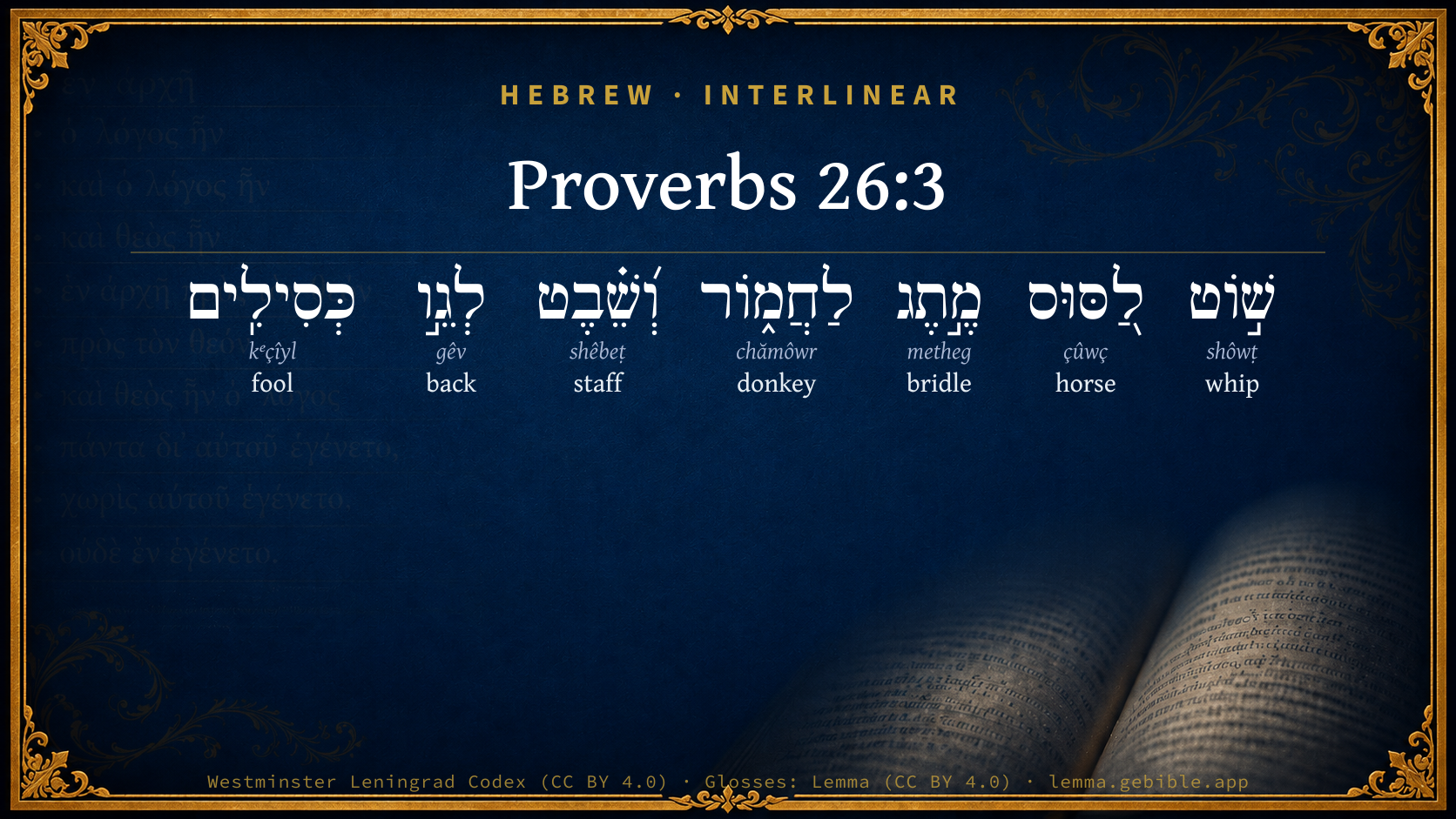
Hebrew (Westminster Leningrad Codex) Proverbs 26:3 appears in the Hebrew Old Testament. The text above is from the Westminster Leningrad Codex. Each word links to its Strong’s number, a concise gloss, and parsing drawn from the Open Scriptures Hebrew Bible morphology. Click any word for its full Brown-Driver-Briggs (BDB) entry.
Download image
Cite this verse

Proverbs 26:3 (World English Bible). Public Domain. Lemma interlinear Bible study tool, https://lemma.gebible.app/v/proverbs/26/3.

Show BibTeX & RIS
BibTeX
RIS
English Translation
A whip for the horse, A bridle for the donkey, And a rod for the back of fools!
World English Bible · Public Domain
Download a study sheet

One document with this verse’s original text, its word-by-word gloss line, the meaning frame, cross-references with their text, attributed commentary, and full source and license credits — printable, and it pastes into notes with its structure intact.

This verse Autodidact and up

Study sheet (.html) Plain text (.txt)

A passage Seminary Student

Up to 50 verses in one chapter. A passage sheet keeps up to 6 commentary sources and 12 cross-references per verse, in the order this page ranks them, and says so on the sheet whenever that leaves anything out. Ask for a single verse and you get the Autodidact verse sheet above.

Everything on this page stays free to read, with no account — the sheet is a download of what is already on screen, not access to it.

Want to remove ads? Support Godless Engineer
Compare translations 3

The same verse in 3 English versions, stacked beneath the original-language interlinear above. Click any original word for its lexicon entry.

Each is an independent rendering of the whole verse — the interlinear is not word-aligned to these translations.

Highlighted words mark where these versions differ — a whole-verse word diff, not a word-by-word alignment.

  • World English Bible Public Domain
    A whip for the horse, A bridle for the donkey, And a rod for the back of fools!
  • King James Version Public Domain
    A whip for the horse, a bridle for the ass, and a rod for the fool's back.
  • unfoldingWord Literal Text CC BY-SA 4.0
    A whip for the horse, a bridle for the donkey, and a rod for the back of stupid ones.

unfoldingWord Literal Text — © unfoldingWord, licensed CC BY-SA 4.0. Word-aligned USFM3 via Door43 (git.door43.org/unfoldingWord/en_ult).

Versions to compare (up to 4)

3 of 4 selected

Show all 18 translations

Every available English version of this verse, each an independent rendering of the whole verse.

  • World English Bible Public Domain
    A whip for the horse, A bridle for the donkey, And a rod for the back of fools!
  • Berean Standard Bible Public Domain
    A whip for the horse, a bridle for the donkey, and a rod for the backs of fools!
  • Majority Standard Bible Public Domain
    A whip for the horse, a bridle for the donkey, and a rod for the backs of fools!
  • King James Version Public Domain
    A whip for the horse, a bridle for the ass, and a rod for the fool's back.
  • American Standard Version (1901) Public Domain
    A whip for the horse, a bridle for the ass, And a rod for the back of fools.
  • Revised Version (1885) Public Domain
    A whip for the horse, a bridle for the ass, and a rod for the back of fools.
  • Geneva Bible (1599) Public Domain
    Vnto the horse belongeth a whip, to the asse a bridle, and a rod to the fooles backe.
  • Douay-Rheims (1899) Public Domain
    A whip for a horse, and a snaffle for an ass, and a rod for the back of fools.
  • Young's Literal Translation Public Domain
    A whip is for a horse, a bridle for an ass, And a rod for the back of fools.
  • Literal Standard Version CC BY-SA 4.0
    A whip is for a horse, a bridle for a donkey, || And a rod for the back of fools.
  • Unlocked Literal Bible CC BY-SA 4.0
    A whip is for the horse, a bridle is for the donkey and a rod is for the back of fools.
  • unfoldingWord Literal Text CC BY-SA 4.0
    A whip for the horse, a bridle for the donkey, and a rod for the back of stupid ones.
  • Darby Bible Public Domain
    A whip for the horse, a bridle for the ass, and a rod for the back of fools.
  • World Messianic Bible Public Domain
    A whip is for the horse, a bridle for the donkey, and a rod for the back of fools!
  • Webster's Bible Public Domain
    A whip for the horse, a bridle for the ass, and a rod for the fool's back.
  • Free Bible Version CC BY-SA 4.0
    Horses need a whip, donkeys need a bridle, and stupid people need a rod on their backs!
  • Bible in Basic English Public Domain
    A whip for the horse, a mouth-bit for the ass, and a rod for the back of the foolish.
  • JPS Tanakh (1917) Public Domain
    A whip for the horse, a bridle for the ass, and a rod for the back of fools.

Literal Standard Version (2020), Covenant Press — licensed CC BY-SA 4.0. Text via the HelloAO Bible API (eBible.org). Unlocked Literal Bible (unfoldingWord) — licensed CC BY-SA 4.0. Text via the HelloAO Bible API (eBible.org). unfoldingWord Literal Text — © unfoldingWord, licensed CC BY-SA 4.0. Word-aligned USFM3 via Door43 (git.door43.org/unfoldingWord/en_ult). Free Bible Version, Dr. Jonathan Gallagher — licensed CC BY-SA 4.0. Text via the HelloAO Bible API (eBible.org).

Word by word

More ways to search: Search by grammar → Find every occurrence → Compare this word →

Practice this passage: Drill this verse → Learn its vocabulary →

About this verse

These counts appear in no published source. They are computed here, from the morphology-tagged text and Lemma’s own curated glosses. What Lemma adds →

7
words
7
distinct lemmas
Wisdom
section

Notable vocabulary

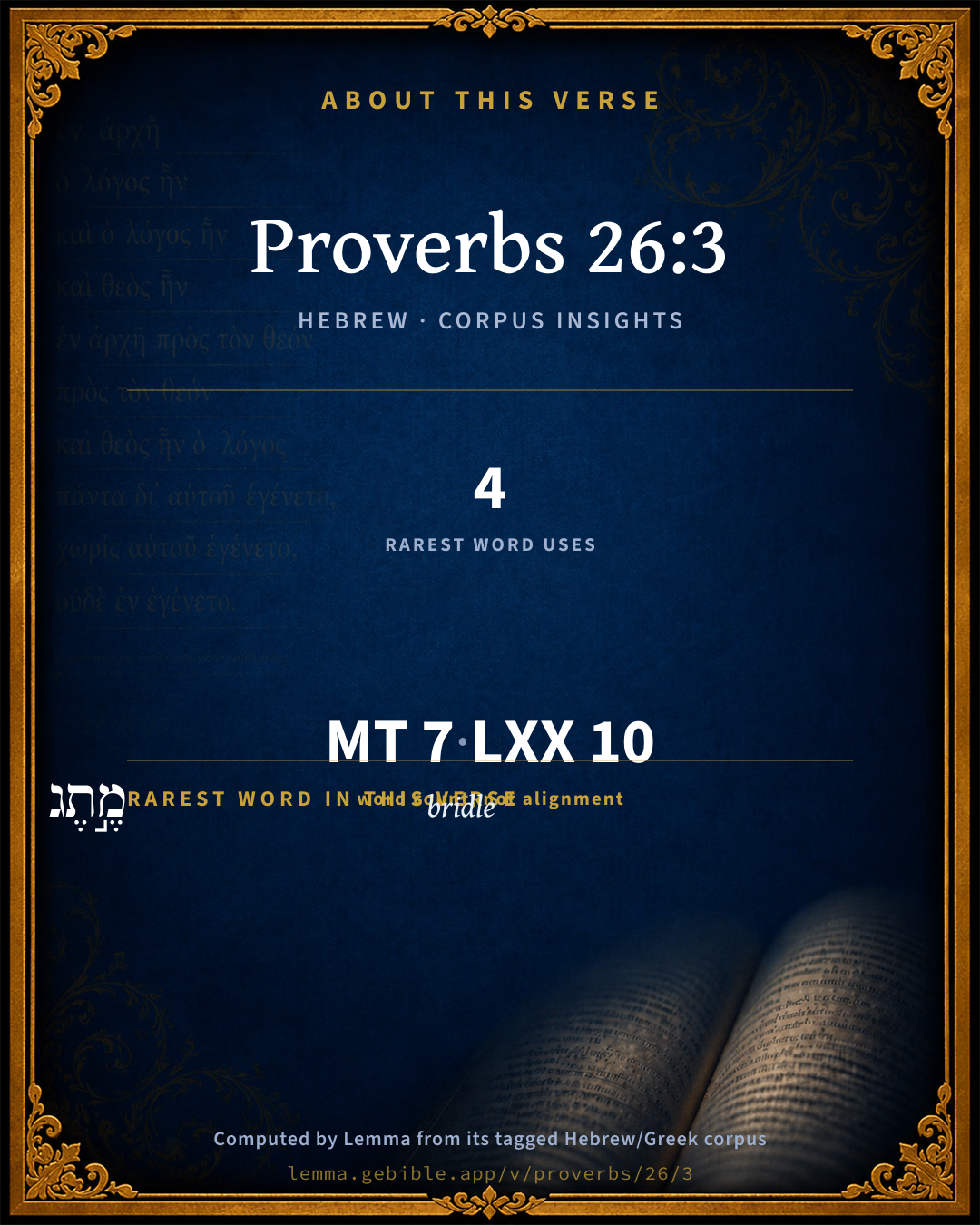
The rarest word here is מֶ֣תֶג bridle H4964 — appearing just 4 times in the whole Hebrew Bible.

Shared distinctive vocabulary

מֶ֣תֶג bridle H4964 occurs in 4 verses of the Hebrew Bible. Also found in:

Grammatical profile

  • 6 nouns
  • 1 adjective

Hebrew & Septuagint length

In English translation the verse runs 18 words from the Hebrew and 20 from the Septuagint (LXX English) — closely comparable.

A rough comparison of the two English renderings, which tokenize alike — not a word-level alignment.

Word counts can differ between the Hebrew and the Greek without any difference in meaning — e.g. the Hebrew direct-object marker אֵת has no separate Greek word, and Greek often adds the article ὁ.

In the original languages it is 7 Hebrew tokens and 10 Greek tokens — but the two are counted differently (Hebrew bundles its prefixes and suffixes into one token; the Greek is in lemma form), so that isn’t a like-for-like length.

Cross-references

10

Topical passages linked to Proverbs 26:3 in the Treasury of Scripture Knowledge — connected by theme and wording, ordered by reader-vote popularity; previews shown in the World English Bible.

  • Proverbs 10:13 Wisdom is found on the lips of him who has discernment, But a rod is for the back of him who is void of understanding.
  • Psalms 32:9 Don't be like the horse, or like the mule, which have no understanding, Who are controlled by bit and bridle, or else they will not come near to you.
  • 1 Corinthians 4:21 What do you want? Shall I come to you with a rod, or in love and a spirit of gentleness?
  • Judges 8:5–7 He said to the men of Succoth, Please give loaves of bread to the people who follow me; for they are faint, and I am pursuing after Zebah and Zalmunna, the kings of Midian.
  • Proverbs 17:10 A rebuke enters deeper into one who has understanding Than a hundred lashes into a fool.
  • Proverbs 19:25 Flog a scoffer, and the simple will learn prudence; Rebuke one who has understanding, and he will gain knowledge.
  • Proverbs 19:29 Penalties are prepared for scoffers, And beatings for the backs of fools.
  • Proverbs 27:22 Though you grind a fool in a mortar with a pestle along with grain, Yet his foolishness will not be removed from him.
  • 2 Corinthians 10:6 and being in readiness to avenge all disobedience, when your obedience will be made full.
  • 2 Corinthians 13:2 I have said beforehand, and I do say beforehand, as when I was present the second time, so now, being absent, I write to those who have sinned before now, and to all the rest, that, if I come again, I will not spare;

Cross-references courtesy of OpenBible.info (CC BY 4.0).

Hebrew and Greek witnesses Masoretic Hebrew ↔ Greek Septuagint

The same verse in the two great witnesses to the Old Testament, shown verse-for-verse.

These are two independent witnesses, not word-aligned to each other, and the Septuagint is shown in lemma (dictionary) form.

Hebrew Proverbs 26:3 Masoretic · Westminster Leningrad Codex

שׁ֣וֹט לַ֭סּוּס מֶ֣תֶג לַחֲמ֑וֹר וְ֝שֵׁ֗בֶט לְגֵ֣ו כְּסִילִֽים

A whip for the horse, A bridle for the donkey, And a rod for the back of fools!

World English Bible · Public Domain

Greek LXX Proverbs 26:3 Septuagint · lemma form

ὥσπερ μάστιξ ἵππος καί κέντρον ὄνος οὕτως ῥάβδος ἔθνος παράνομος

As a whip for a horse, and a goad for an ass, so is a rod for a simple nation.

LXX2012 (modern English Septuagint) · Public Domain

On this verse, The Preacher's Complete Homiletical Commentary discusses the Septuagint’s reading. Read the note in Commentary ↓

Hebrew: Westminster Leningrad Codex (CC BY 4.0). Greek: Septuagint (public domain); English from LXX2012 (modern English Septuagint) (Public Domain). How the Septuagint differs from the Hebrew →

Commentary

Notes on Proverbs 26:3 from classic Christian and Jewish commentators (each source and its license shown beneath its notes). The classic Christian expositions comment on the surrounding passage and are grouped to its opening verse, so a note may address several verses; the Jewish commentaries on the Tanakh (Rashi and others) are per-verse, so they appear only where the commentator wrote on this verse.

Lemma curates 59 commentaries, every one of them public domain or Creative Commons licensed, each selected and text-cleaned for this edition rather than reprinted as found. About our sources →

Trapp's Complete Commentary

John Trapp

Pro 26:3 A whip for the horse, a bridle for the ass, and a rod for the fool’s back.

Ver. 3. A whip for the horse,] viz., To quicken his slow pace. "A bridle for the ass," wherewith to lead him in the right way; for he goes willingly but a foot pace, and would be oft out, but for the bit; and besides, he is very refractory, and must be "held in with bit and bridle." {Psa 32:9}

And a rod for the back of fools.] Tυφθεις δε τε νηπιος εγνω. A fool will be the better for beating. Vexatio dat intellectum. Due punishment may well be to these horses and asses - so the Scripture terms unreasonable and wicked men - both for a whip to incite them to good, and for a bridle to rein them in from evil. God hath rods sticking in every corner of his house for these froward fools; and if a rod serve not turn, he hath a "terrible sword." {Isa 27:1} So must magistrates. Cuncta prius tentanda. If a rod will do, they need not brandish the sword of justice; nor do as Draco did, who punished with death every light offence. This was to kill a fly upon a man’s forehead with a beetle, to the knocking out of his brains.

John Trapp, A Commentary or Exposition upon All the Books of the Old and New Testament (1647–1656) — public domain. Text from a community e-Sword module.

The Biblical Illustrator

Joseph S. Exell

Pro_26:3-11

A whip for the horse, a bridle for the ass, and a rod for the fools back.

Aspects of a fool

Sin is folly. It sacrifices the spiritual for the material, the temporal for the eternal, the pure joys of immortality for the gratification of an hour.

I. He appears here as a servant. A whip for the horse, a bridle for the ass, and a rod for the fools back. This proverb inverts our ideas. We should have said, A bridle for the horse, and a whip for the ass. But the Eastern asses have much of the fire of our blood horses, while the horses are often heavy and dull. Therefore the ass there requires the bridle, and the horse the whip--the one to accelerate, the other to restrain and guide activity. As the horse and the ass, in order to be used as the servants of man, require the application of force, so does the fool. A rod for the fools back. If a stubborn sinner is to be made the servant of society, coercion must be employed. Argument, persuasion, example; these moral appliances will affect him but little.

II. He appears here as a debater. Answer not a fool according to his folly, lest thou be like unto him. Answer a fool according to his folly, lest he be wise in his own conceit. There is an apparent contradiction here, but it is only apparent. The negative means, we are not to debate with him in his style and spirit, and thus become like him. We are not to descend to his level of speech and temper. The positive means, that we are to answer him as his folly deserves. It may be by silence as well as speech. The fool talks; he is often a great debater.

III. He appears here as a messenger. The meaning of this is, He who would trust a fool with a message might as well cut off his feet, for he will have vexation and maybe damage. How careful should we be to entrust important business to trustworthy persons! Solomon himself drank damage, by employing an industrious servant, but a fool in wickedness, who lifted up his hand against the king, and spoiled his son of ten parts of his kingdom (1Ki_11:26-40). Benhadad drank damage by sending a message by the hands of Hazael, who murdered his master when the way was opened for his own selfish purposes (2Ki_8:8-15). Much of the business of life is carried on by messengers or agents. How much a mercantile firm suffers by improper representatives!

IV. He appears here as a teacher. The legs of the lame are not equal, so is a parable in the mouth of fools. It is not very uncommon to find fools sustaining the office and performing the functions of teachers. They have a parable in their mouth. The verses suggest two things concerning them as teachers--

1. That they appear very ridiculous. The legs of the lame are not equal, so is a parable in the hands of fools. The idea seems to be, as the cripple who desires to appear nimble and agile appears ridiculous in his lame efforts to walk, so the fool appears ridiculous in his efforts to teach.

2. As teachers, they are generally very mischievous. As a thorn goeth up into the hand of the drunkard, so is a parable in the mouth of fools. The idea is, that a fool handling the doctrines of wisdom is like a drunken man handling thorns. The besotted inebriate, not knowing what he is about, lays hold of the thorn and perforates his own nerves. The wise sayings in the mouth of a stupid man are self-condemnatory.

V. He appears here as a commissioner. The great God that formed all things both rewardeth the fool and rewardeth transgressors. The word God is not in the original. The margin is the more faithful translation--A great man giveth all, and he hireth the fool; he hireth also transgressors. The idea seems to be, that when worldly princes employ fools for the public service it is a source of anxiety and trouble to all good citizens. The lesson has application from the throne downwards, through all the descriptions of subsidiary trusts. Extensive proprietors, who employ overseers of their tenants, or of those engaged in their manufactories, or mines, or whatever else be the description of their property, should see to the character of these overseers. Their power may be abused, and multitudes of workmen suffer, when the owner--the master--knows nothing of what is going on. But he ought to know. Many complainings and strikes, well or ill-founded, have their origin here.

VI. He appears here as a reprobate. The emblem here is disgusting, but the thing signified is infinitely more so. Peter quotes this proverb (2Pe_2:20-22). The wicked man often sickens at his wickedness, and then returns to it again. Thus Pharaoh returned from his momentary conviction (Exo_8:8-15); Ahab from his pretended repentance (1Ki_21:1-29.); Herod from his partial amendment (Mar_6:20-27). (D. Thomas, D. D.)

The Biblical Illustrator, edited by Joseph S. Exell (c. 1880s–1900s) — public domain. Text from a community e-Sword module.

The Preacher's Complete Homiletical Commentary

Joseph S. Exell (gen. ed.)

CRITICAL NOTES.—

Pro_26:3. To our English ideas, the whip and bridle are assigned respectively to the wrong animals, but it must be remembered that the Eastern ass is often quite as spirited an animal as the horse.

Pro_26:6. Drinketh damage, or “injury.” As in Job_21:20, the verb “drinketh” seems to express suffering in a large measure.

Pro_26:7. Are not equal. The Hebrew word, so rendered, is a very obscure one, and is rendered by Delitzsch, Gesenius, and others, “hang down.” Zöckler and Stuart give the sentence the imperative form, and read, “Take away the legs from the lame, and the proverb in the fool’s mouth.” Parable. This is the common word for proverb—the word that gives the title to the book. On its real meaning, see the Introduction.

Pro_26:8. Sling. Gesenius, Zöckler, and many other commentators, adopt the reading in the margin of the English version, and translate this word, which is very obscure, “a heap of stones.” Stuart, Ewald, Delitzsch, and others, retain the word “sling,” which is the reading of the Septuagint. Stuart thus explains the verse, “It would be absurd to bind a stone in a sling, and then expect it to do execution. Equally so is it to bestow honour on a fool, and expect any good consequences from it.” If the first rendering is adopted, the word stone must be understood to refer to a precious stone.

Pro_26:9. A thorn. This is generally understood to mean a thorny stick or staff, which is a mischievous weapon in the hands of a drunkard.

Pro_26:10. This verse is very difficult and obscure, and has many and entirely different renderings. Luther, Elster, and others, translate the subject of the first clause, “A master, an able man, formeth all aright,—or all himself.” Delitzsch, Umbreit, and Hitzig, read, “Much produceth all.” The French version is in substance the same as our English marginal rendering. Perhaps the greater number of Hebrew critics favour the rendering of Zöckler, Ewald, Stier, etc., who read, “As an archer, who woundeth everything, so is he who hireth fools and vagrants” (or wayfarers). Stuart and Miller translate the first word, “arrow,” and the former thus explains the proverb, “He who employs fools and vagrants to do his work, will injure himself.”

MAIN HOMILETICS OF THE PARAGRAPH.—Pro_26:3-11

A LOW LEVEL

I. A moral fool puts himself on a level with the brute by turning a deaf ear to the voices of reason and conscience. That which above all other characteristics distinguishes man from the lower animals is the possession of a moral sense and a reasoning faculty; these are the great lights which God has given him for his guidance, by the use of which he may ever be rising to a higher moral and intellectual level. But the moral fool does not listen to them, and even after he has tasted the bitterness of disregarding them, and even while he is suffering from the evil effects of his folly, he gives evidence of his moral stupidity by returning to it (Pro_26:11). This is a plain proof that he is “as the horse or the mule, which have no understanding.” (Psa_32:9).

II. Having chosen his position he must be treated accordingly. When men act like men—when their conduct is such as befits responsible and rational creatures—they are open to reason and persuasion, and their fellow-men are bound to use such means in their intercourse with them. They are bound to listen to what they have to say, and to reply to their questions and consider their objections. But to do this with such a person as is here called a fool would be to disobey our Saviour’s injunction, and to “cast our pearls before swine.” It would be letting ourselves down to his level and encouraging him in his self-conceit. This, we think, is the meaning of Pro_26:4. But, on the other hand, we are not always to be silent when the fool is talking. This also might lead him to think that his foolish arguments were unanswerable—that we thought him as wise as he thinks himself to be. He is to receive sometimes the stern rebuke that his folly deserves; the manifestation of our displeasure is to be in proportion to his manifestation of weakness and wickedness. This will also be “answering a fool according to his folly,” as in Pro_26:5. But a fool must be checked by means that will perhaps make more impression upon him than mere words. The rod must be applied—coercion and punishment must come into use where reason and moral persuasion are useless. Having placed himself on a level with the brute, he must be ruled sometimes by brute force—by the whip of compulsion, and by the bridle of restraint. Men have the power of doing this to a certain extent, and it is their duty to use it. But whether they do or do not, God will certainly visit such an offender with the rod of punishment. Whether this is the truth contained in Pro_26:10 or not, revelation and experience affirm it, and we have met with it repeatedly in this book. It is a great offence against Him who called us into being, and who desires His creatures to be worthy of their Creator, when men thus in practice count themselves unworthy of their destiny. The Hebrew nation, in the bygone ages, was called by God to occupy a higher moral level than the surrounding nations, but by its own stubbornness and self-conceit it made the purpose of God of none effect, and was therefore necessarily made to feel the bitterness of being treated like a wild and refractory animal (Jer_31:18). And so is it with men in general. God would treat them as His sons, but their moral foolishness compels Him to make them feel the whip, the bridle, and the rod. One other thought is suggested in Pro_26:7-8—

III. That even the fool will sometimes adopt the speech of the wise. A parable, or wise saying, will sometimes be found on his lips, he will be sometimes heard to utter words of wisdom and give good advice. But precept is of little avail if not backed by a good example; the words and the deeds of such a man are as ill-matched as those of a cripple who has one sound and useful limb, but whose other is shrunken and useless. The gait of such a man is awkward and uncertain, the malformed and the healthy limb do not well balance his body. This is an apt illustration of the incongruity which often exists between the words and actions of a moral fool.

(For Homiletics on Pro_26:6; Pro_26:8 considered separately see on Pro_26:1, page 714, and on chap. Pro_10:26, page 179.)

OUTLINES AND SUGGESTIVE COMMENTS

Pro_26:3. The rod is needful for the fool’s back. Are you the unhappy fathers of foolish children? you must make use of the rod and reproof to give them wisdom. Are you authorised to bear rule in the church? the rod of church discipline must be applied to offenders, that they may be reclaimed, and others warned. Are you magistrates; the rod which God has put into your hands may be a means of preserving young malefactors from the gibbet at a more advanced period of life. Are you wise? beware of turning aside unto folly, that you may never need the rod. Are you fools? learn wisdom, or do not blame those whom duty and charity will oblige to use the rod for your correction.—Lawson.

Pro_26:4-5. Answer a fool, not with any dream that you thoroughly answer him, lest you be like him, and a fool yourself. And yet, by all means answer him. Answer wherever you can, lest he think you can’t; exploding all baseless heresies and mistakes; lest, hardening himself where he might be convinced, and defrauding himself where there is everything to be said, he erect himself against facts where he has not been taught, and become wise in his own eyes.… Answer not a fool, because much mystery does not admit of answer, and you will be a fool yourself. But more. The natural man does not discern the things of the spirit of God. If you answer a natural man with the idea that mere answers can turn him, you must “be like him,” as having no sense yourself of what is purely spiritual. Notice here a grand rebuke of reason in all attempts to convince the sinner. Nevertheless answer a fool, and bow to just as great a rebuke to reason. We use reason far too gingerly. Reason is a Divine creation. It is an instrument. There is a thought as though it were wicked to go too deep. On the contrary, we are to out-think the fool. If we leave science to work her way, she will grow wise in her own conceit. Answer her. Rationalistic infidelity is by no means an infidelity in reason. And the church should make that to be seen. Scripture has been belied in the direction of Paul to the Corinthians (1 Corinthians 2) Nothing is more irrational than rationalism. And one of the first answers to the fool which he shall receive in the judgment will be, that he had all the reason for believing Christ which he had for anything beside, and a host of greater ones peculiar to the gospel.—Miller.

These two sentences may seem at the first blush to be contrary … but this knot will be easily untied if it be observed that there are two sorts of answers, the one in folly, the other unto folly. A fool is not to be answered in his folly, or according unto his folly, that is to say, in such vanity as he useth, or after such a raging manner as he speaketh … A fool is to be answered unto his folly; that is, by reasons to be confuted, and by reproofs that are wise to be bridled.—Muffett.

Generally speaking, it would be better to follow Hezekiah’s command concerning Rabshakeh’s blasphemy—“Answer him not.” Jeremiah thus turned away in silence from the folly of the false prophets. (Jer_28:11.) If however we are constrained to reply—Answer him not according to his folly; not in his own foolish manner; “not rendering railing for railing.” (1Pe_3:9.) Moses offended here. He answered the rebels according to their folly—passion for passion, and thus he became like unto them. David’s answer to Nabal was in the same humiliating spirit. The answerer in this case is like the fool. He appears at the time to be cast in the same mould.—Bridges.

Pro_26:7. Uniformity and ubiquity of obedience are sure signs of sincerity; but as an unequal pulse argues a distempered body, so doth uneven walking a diseased soul. A wise man’s life is all of one colour, like itself, and godliness runs through it, as the woof runs through the warp. But if all the parts of the line of thy life be not straight before God, it is a crooked life. If thy tongue speak by the talent, but thine hands scarce work by the ounce, thou shalt pass for a Pharisee (Mat_23:3). They spake like angels, lived like devils; had heaven commonly at their tongue ends, but the earth continually at their finger ends.—Trapp.

Pro_26:9. When a drunkard carries and brandishes in his hand a sweet briar, he scratches more with it than he allows the roses to be smelled; so a fool with the Scriptures or a judicial maxim oft causes more harm than profit.—Luther.

Proverbs have sometimes been hurtful even in the mouths of wise men, through the imperfection of their wisdom. Job’s friends dealt much in parables, which they had learned by tradition from their wise ancestors, but they misapplied them to the case of Job; and although they meant to plead the cause of God, yet they displeased Him so much by their uncharitable speeches against Job, which they drew by unjust inference from undoubted truths, that He told them they had not spoken the thing that was right concerning Him as His servant Job had done. If Job had not been a strong believer, their management of truth must have sunk him into despondency.—Lawson.

Pro_26:11. The emblem is a loathsome and sickening one. It is meant to be so. It would not have been appropriate, had it been anything else. There are two ideas conveyed by the comparison. The disposition or tendency, on the part of the fool or vicious man, to return to his folly; and the loathsomeness—the vileness—of the thing itself, when it does take place. There are persons of great pretensions to refinement, who affect great disgust at the comparison. They wonder how anybody of ordinary delicacy can utter it. They would think their lips polluted by the very words. It were well for such persons to remember, that there is no comparison so odious as the thing itself which is represented by it. It were well if such persons would transfer their disgust and loathing at the figure to that which the figure represents:—if they would cherish a proper loathing of sin. That is what God holds in abhorrence:—that is what should be abhorred by us. Persons may affect to sicken at the comparison here used, and yet be themselves exemplifying the very conduct it so aptly represents. Folly and sin are incomparably more polluting and debasing to the nature of man, than the vilest and most disgusting practices in the inferior animals.”—Wardlaw.

And is this the picture of man—“made a little lower than the angels” (Psa_8:5)—yea—“made in the likeness of God?” (Gen_1:26.) Who that saw Adam in his universal dominion, sitting as the monarch of creation; summoning all before him; giving to each his name, and receiving in turn his homage (Ib. Pro_2:20)—who would have conceived of his children sunk into such brutish degradation? The tempter’s promise was—“Ye shall be as gods” (Ib. Pro_3:5). The result of this promise was—“Ye shall be as beasts.” … Thus greedily did Pharaoh return from his momentary conviction; Ahab from his feigned repentance; Herod from his partial amendment; the drunkard from his brutish insensibility—all to take a more determinate course of sin; to take their final plunge into ruin.—Bridges.

According to the usual method of the Scriptures, a known thing is here employed to teach an unknown. The taste which inheres in nature is used as an instrument to implant the corresponding spiritual sensibility. The revulsion of the senses from a loathsome object is used as a lever power to press into the soul a dislike of sin.… The lines are strongly drawn, that the lesson may be clear and cutting. There must be a rude hearty blow, for there is a hard searing to be penetrated. Those who go back to suck at sins, which they once repudiated, may see in this terse proverb a picture of their pollution; only the Omniscient perfectly knows and loathes the vile original—Arnot.

The Preacher's Complete Homiletical Commentary (gen. ed. Joseph S. Exell; Funk & Wagnalls, c. 1892) — public domain (pre-1929). A full-Bible homiletical/sermon-outline anthology covering 65 of 66 books (2 John is absent from the source module). Text from a community e-Sword module.

Tyndale Open Study Notes

Tyndale Open Resources

26:3 A fool is like a dumb animal that can only be guided by brute force (see 10:13; 14:3).

Tyndale Open Study Notes — © Tyndale Open Resources, licensed CC BY-SA 4.0. Text via the HelloAO Bible API.

Matthew Henry's Commentary

Here, 1. Wicked men are compared to the horse and the ass, so brutish are they, so unreasonable, so unruly, and not to be governed but by force or fear, so low has sin sunk men, so much below themselves. Man indeed is born like the wild ass's colt, but as some by the grace of God are changed, and become rational, so others by custom in sin are hardened, and become more and more sottish, as the horse and the mule, Psa 32:9. 2. Direction is given to use them accordingly. Princes, instead of giving honour to a fool (Pro 26:1), must put disgrace upon him - instead of putting power into his hand, must exercise power over him. A horse unbroken needs a whip for correction, and an ass a bridle for direction and to check him when he would turn out of the way; so a vicious man, who will not be under the guidance and restraint of religion and reason, ought to be whipped and bridled, to be rebuked severely, and made to smart for what he has done amiss, and to be restrained from offending any more.

Matthew Henry's Commentary on the Whole Bible (1708–1710) — public domain (CC PDM 1.0). Text via the HelloAO Bible API.

Jamieson, Fausset & Brown

Robert Jamieson, A. R. Fausset & David Brown

The rod is as much needed by fools and as well suited to them, as whips and bridles are for beasts.

Jamieson, Fausset & Brown — Commentary Critical and Explanatory on the Whole Bible (1871) — public domain (CC PDM 1.0). Text via the HelloAO Bible API.

Adam Clarke's Commentary

Verse 3. A whip for the horse] Correction is as suitable to a fool, as a whip is for a horse, or a bridle for an ass.

Adam Clarke's Commentary on the Bible (1810–1826) — public domain. Text from a community e-Sword/MySword module.

John Gill's Exposition

A whip for the horse,.... One that is dull of going, or refractory and wants breaking;

a bridle for the ass; not to curb and restrain it from going too fist, asses being generally dull; but to direct its way and turn it when necessary, it being stiffnecked and obstinate; though the Septuagint, Syriac, and Arabic versions, render it a "spear" or "goad", something to prick with, and excite it to motion; and so the Targum; or otherwise one would have thought the whip was fitter for the ass and the bridle for the horse;

and a rod for the fool's back; suggesting that the fool, or wicked man, is like the horse or the mule; though not without understanding of things natural, yet of things divine and moral; and as stupid as the ass, however wise he may conceit himself to be, being born like a wild ass's colt; and instead of honour being given him, stripes should be laid upon him; he should be reproved sharply, and corrected for his wickedness, especially the causeless curser, Pro 19:29.

John Gill's Exposition of the Whole Bible (1746–1763) — public domain (CC PDM 1.0). Text via the HelloAO Bible API.

Haydock's Catholic Bible Commentary

Snaffle. "Bit," or muzzle, (camus) to prevent the animal from biting. (Haydock) --- Septuagint, Arabic, &c., "a goad for an ass." But metheg denotes a bridle. (Montanus; Haydock) asses being there very large, and commonly used for riding, chap. xiii. 13. (Calmet)

George Leo Haydock (1774–1849), Haydock's Catholic Family Bible and Commentary, 1859 edition — public domain. Excludes Psalms (Douay-Rheims chapter numbering differs from Protestant) and Deuterocanonical books (Catholic canon only).

Matthew Poole's English Annotations

A bridle was very proper and usual for an ass, when they rode upon it, (as the Jews most commonly did,) though not to restrain him from running away, which is the principal use of it in horses, yet that the rider might rule and guide him, which was very necessary for that stupid creature. Although the ancient interpreters render it a goad, or spur, or something of the like nature and use.

A rod for the fool’s back; which is most proper and necessary for him. Not words, but blows, must make him better.

Matthew Poole's English Annotations on the Holy Bible (1683–1685) — public domain. Text from a community e-Sword/MySword module.

Whedon's Commentary on the Bible

Daniel D. Whedon

3. Whip… bridle… rod — “According to our English notions, we should rather say a bridle for the horse and a whip for the ass. But from numerous passages in the Old Testament it appears that asses were the beasts on which the people, and even the great men, usually rode. Their asses, therefore, being active and well broken, needed but a bridle to guide them, whereas their horses, being, probably, badly broken and easily frightened, would be less manageable, and frequently require the correction of the whip.” The Seventy, perhaps led by the same train of thought as the above, have translated מתג, (metheg,) bridle, by κεντρον, a goad. There is, however, no example of such use of metheg. Instead of “for the back of a fool,” they also read, “for a simple nation.” Comp. Pro_10:13; Pro_19:29; Psa_32:9.

Daniel D. Whedon (gen. ed.), Commentary on the Old and New Testaments (1874–1909) — public domain. Text from a community e-Sword module.

The Pulpit Commentary

A whip for the horse, a bridle for the ass. We should be inclined to invert the words, and say a bridle for the horse, and a whip for the ass; but it must be remembered that in early times the horse was not ridden, but only driven. The animals used in riding were the ass and mule, and sometimes the camel. The Eastern ass is really a fine animal, larger, more spirited, and more active than the poor creature which we are wont to see. Or the whip and bridle may be intended to apply to both animals, though divided between the two for rhythmical or antithetical reasons. (see Pro_10:1) A rod for the fool"s back. Sharp correction is beth useful and necessary for the fool. (so on Pro_10:13 Pro_19:29) Similar treatment Siracides advises to be employed in the ease of an idle servant (Ecc 30:24-28). Septuagint, "As a whip for a horse and a goad for an ass, so is a rod for a lawless nation."

The Pulpit Commentary (1880–1919), ed. H.D.M. Spence-Jones & Joseph S. Exell — public domain. Text from a community e-Sword module.

Keil & Delitzsch

C. F. Keil & F. Delitzsch

3 A whip for the horse, a bridle for the ass,

And a rod for the back of fools.

J. D. Michaelis supposes that the order should be reversed: a bridle for the horse, a whip for the ass; but Arnoldi has here discovered the figure of speech merismus (cf. Pro 10:1); and Hitzig, in the manner of the division, the rhythmical reason of the combination (cf. שׁם חם ויפת for שׁם יפת וחם): whip and bridle belong to both, for one whips a horse (Neh 3:2) and also bridles him; one bridles an ass (Psa 32:9) and also whips him (Num 22:28.). As whip and bridle are both serviceable and necessary, so also serviceable and necessary is a rod, לגו כּסילים, Pro 10:13; Pro 19:29.

Keil & Delitzsch — Biblical Commentary on the Old Testament (1861–1891) — public domain (CC PDM 1.0). Text via the HelloAO Bible API. (Old Testament only.)

Bridges on Proverbs

Charles Bridges

This proverb inverts our ideas. We should have given the bridle for the horse, and the whip for the ass.†1 But the Eastern asses are a very superior race, both in beauty and spirit, a valuable property to their owners.†2 The bridle is necessary to curb and to guide them; while the horse, perhaps badly broken in, may need a whip; if dull, to accelerate his speed; if fiery, to correct his temper.†3 Every creature subdued for the service of man needs his appropriate discipline. The Lord "guides his children with his eye." But let them cultivate a pliable spirit; "not as the horse and the mule, whose mouth must be held in with bit and bridle." (Psa 32:8-9 .) The fool neither hears the voice, nor sees the directing eye. He will be ruled neither by reason nor persuasion. A rod therefore is for the fool’s back.†4 Pharaoh provoked this severe chastisement at the hands of God;†5 the men of Succoth and Penuel at Gideon’s hands.†6 Many such fools are in the Church, self-willed, full of conceit. They need the rod, and they have it.†7 Discipline is the most probing test. What is its fruit? In the child submission and tenderness;†8 in the fool (except it beat out his folly,†9 which is too often a desperate case†10) hardness and rebellion.†11 Sad indeed is it, that the child sometimes needs the rod intended for the fool’s back. Yet never does his loving Father use it, till gentle means have been tried in vain. Oh my God! use thine own wise means, to save me from my own waywardness, folly, and ruin.

Footnotes:

†1 Michaelis was so positive on this point, that he altered his version accordingly, contrary to the authority of all versions and MSS.

†2 Jdg 10:34; Jdg 12:13-14 . 2Sa 17:23 ; 2Sa 19:26 .

†3 Paxton’s Natural History of Scripture, p. 221, and Parkhurst.

†4 Pro 10:13; Pro 19:29 .

†5 Exo 10:3.

†6 Jdg 8:5-7, Jdg 8:16 .

†7 2Co 10:6-11 ; 2Co 13:2 .

†8 Jer 31:18-20.

†9 2Ch 33:11-13 .

†10 Pro 17:10; Pro 27:22 .

†11 2Ch 28:22 . Isa 1:5 . Jer 5:3 .

Charles Bridges, An Exposition of the Book of Proverbs (1846) — public domain. Text from a community e-Sword module.

unfoldingWord translationNotes

Door43 World Missions Community

A whip is for the horse, a bridle is for the donkey and a rod is for the back of fools

A whip, a bridle, and a rod are things that people use to make the horse, donkey, and fool do what they want.

a bridle is for the donkey

A bridle is made of straps. People put it on a donkey's head and hold one of the straps to make the donkey go the way they want it to go.

a rod is for the back of fools

In the Bible, people would hit their children or their slaves with a wooden rod in order to discipline them.

translationWords

horse

donkey

rod

fool

unfoldingWord translationNotes — © Distant Shores Media and the Door43 World Missions Community, licensed CC BY-SA 4.0. Source: git.door43.org/Door43/en_tn.

Rashi

Rabbi Shlomo Yitzchaki (Rashi)

A whip is for the horse [It] is made for the horse, and also a rod is prepared for the body of fools. Tortures are prepared for the wicked.

Rashi on the Tanakh — English translations: “The Judaica Press complete Tanach with Rashi, translated by A. J. Rosenberg” (CC BY 4.0); “Pentateuch with Rashi's commentary by M. Rosenbaum and A.M. Silbermann, 1929-1934” (public domain); “The Metsudah Tanach series, Lakewood, N.J” (CC BY 4.0); and “The Book of Joshua, Metsudah Publications, 1997” (CC BY 4.0). Text via Sefaria.

Lesson kit

Teaching starters — assembled from the data on this page, not authored interpretation. Every prompt links to the verse data it draws on. Edit before teaching.

Proverbs, in the Wisdom, opens this verse with 7 words (7 distinct Hebrew lemmas). Its most distinctive word is metheg (“bridle”). A historical commentator’s framing appears above. Read the whole chapter for the surrounding context.

Discussion questions

  1. The word metheg carries the sense “bridle.” How does it shape the verse?
  2. 2 Kings 19:28 shares the word «bridle» with this verse. How do the two illuminate each other?
  3. These translations render this verse differently. What is at stake in choosing one wording over another?
  4. Reading how Trapp's Complete Commentary and The Biblical Illustrator read this verse, where do the two commentators agree and where do they part?

Things to notice

Reading settings

Reading text

Shown beneath each verse's original-language words.

Old Testament
Old Testament edition

Read the OT as the Masoretic Hebrew (MT) or the Greek Septuagint (LXX).

English shown for the Greek Septuagint (in the Hebrew ↔ Greek comparison).

Comparing translations? Open the Compare panel on any verse page to stack up to four side by side.