
Ezekiel 47:22

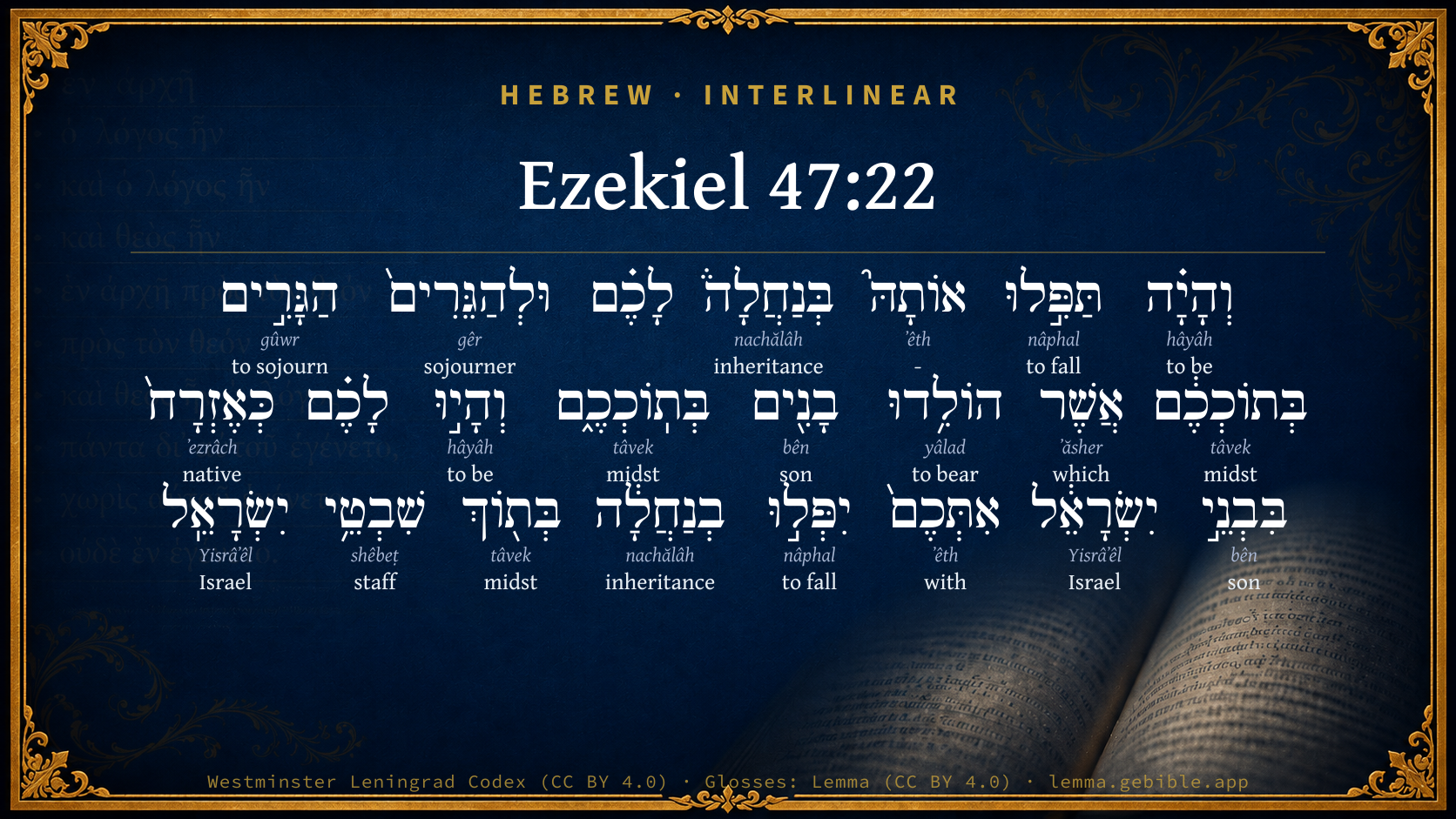
Hebrew (Westminster Leningrad Codex) Ezekiel 47:22 appears in the Hebrew Old Testament. The text above is from the Westminster Leningrad Codex. Each word links to its Strong’s number, a concise gloss, and parsing drawn from the Open Scriptures Hebrew Bible morphology. Click any word for its full Brown-Driver-Briggs (BDB) entry.
Download image
Cite this verse

Ezekiel 47:22 (World English Bible). Public Domain. Lemma interlinear Bible study tool, https://lemma.gebible.app/v/ezekiel/47/22.

Show BibTeX & RIS
BibTeX
RIS
English Translation
It shall happen, that you shall divide it by lot for an inheritance to you and to the strangers who sojourn among you, who shall father children among you; and they shall be to you as the home-born among the children of Israel; they shall have inheritance with you among the tribes of Israel.
World English Bible · Public Domain
Download a study sheet

One document with this verse’s original text, its word-by-word gloss line, the meaning frame, cross-references with their text, attributed commentary, and full source and license credits — printable, and it pastes into notes with its structure intact.

This verse Autodidact and up

Study sheet (.html) Plain text (.txt)

A passage Seminary Student

Up to 50 verses in one chapter. A passage sheet keeps up to 6 commentary sources and 12 cross-references per verse, in the order this page ranks them, and says so on the sheet whenever that leaves anything out. Ask for a single verse and you get the Autodidact verse sheet above.

Everything on this page stays free to read, with no account — the sheet is a download of what is already on screen, not access to it.

Want to remove ads? Support Godless Engineer
Compare translations 3

The same verse in 3 English versions, stacked beneath the original-language interlinear above. Click any original word for its lexicon entry.

Each is an independent rendering of the whole verse — the interlinear is not word-aligned to these translations.

Highlighted words mark where these versions differ — a whole-verse word diff, not a word-by-word alignment.

  • World English Bible Public Domain
    It shall happen, that you shall divide it by lot for an inheritance to you and to the strangers who sojourn among you, who shall father children among you; and they shall be to you as the home-born among the children of Israel; they shall have inheritance with you among the tribes of Israel.
  • King James Version Public Domain
    And it shall come to pass, that ye shall divide it by lot for an inheritance unto you, and to the strangers that sojourn among you, which shall beget children among you: and they shall be unto you as born in the country among the children of Israel; they shall have inheritance with you among the tribes of Israel.
  • unfoldingWord Literal Text CC BY-SA 4.0
    So you will distribute the inheritances for yourselves and for the foreigners in your midst, those who have given birth to children in your midst and who are, with you, like the native born people of Israel. You will cast lots for inheritances among the tribes of Israel.

unfoldingWord Literal Text — © unfoldingWord, licensed CC BY-SA 4.0. Word-aligned USFM3 via Door43 (git.door43.org/unfoldingWord/en_ult).

Versions to compare (up to 4)

3 of 4 selected

Show all 18 translations

Every available English version of this verse, each an independent rendering of the whole verse.

  • World English Bible Public Domain
    It shall happen, that you shall divide it by lot for an inheritance to you and to the strangers who sojourn among you, who shall father children among you; and they shall be to you as the home-born among the children of Israel; they shall have inheritance with you among the tribes of Israel.
  • Berean Standard Bible Public Domain
    You shall allot it as an inheritance for yourselves and for the foreigners who dwell among you and who have children. You are to treat them as native-born Israelites; along with you, they shall be allotted an inheritance among the tribes of Israel.
  • Majority Standard Bible Public Domain
    You shall allot it as an inheritance for yourselves and for the foreigners who dwell among you and who have children. You are to treat them as native-born Israelites; along with you, they shall be allotted an inheritance among the tribes of Israel.
  • King James Version Public Domain
    And it shall come to pass, that ye shall divide it by lot for an inheritance unto you, and to the strangers that sojourn among you, which shall beget children among you: and they shall be unto you as born in the country among the children of Israel; they shall have inheritance with you among the tribes of Israel.
  • American Standard Version (1901) Public Domain
    And it shall come to pass, that ye shall divide it by lot for an inheritance unto you and to the strangers that sojourn among you, who shall beget children among you; and they shall be unto you as the home-born among the children of Israel; they shall have inheritance with you among the tribes of Israel.
  • Revised Version (1885) Public Domain
    And it shall come to pass, that ye shall divide it by lot for an inheritance unto you and to the strangers that sojourn among you, which shall beget children among you; and they shall be unto you as the homeborn among the children of Israel; they shall have inheritance with you among the tribes of Israel.
  • Geneva Bible (1599) Public Domain
    And you shall deuide it by lot for an inheritance vnto you, and to the strangers that dwell among you, which shall beget children among you, and they shall be vnto you, as borne in the countrey among the children of Israel, they shall part inheritance with you in the middes of the tribes of Israel.
  • Douay-Rheims (1899) Public Domain
    And you shall divide it by lot for an inheritance to you, and to the strangers that shall come over to you, that shall beget children among you: and they shall be unto you as men of the same country born among the children of Israel: they shall divide the possession with you in the midst of the tribes of Israel.
  • Young's Literal Translation Public Domain
    and it hath come to pass, ye separate it for an inheritance to yourselves, and to the sojourners who are sojourning in your midst, who have begotten sons in your midst, and they have been to you as native, with the sons of Israel, with you they are separated for an inheritance in the midst of the tribes of Israel.
  • Literal Standard Version CC BY-SA 4.0
    and it has come to pass, you separate it for an inheritance to yourselves, and to the sojourners who are sojourning in your midst, who have begotten sons in your midst, and they have been to you as native, with the sons of Israel; they are separated with you for an inheritance in the midst of the tribes of Israel.
  • Unlocked Literal Bible CC BY-SA 4.0
    So you will distribute the inheritances for yourselves and for the foreigners in your midst, those who have given birth to children in your midst and who are, with you, like the native born people of Israel. You will cast lots for inheritances among the tribes of Israel.
  • unfoldingWord Literal Text CC BY-SA 4.0
    So you will distribute the inheritances for yourselves and for the foreigners in your midst, those who have given birth to children in your midst and who are, with you, like the native born people of Israel. You will cast lots for inheritances among the tribes of Israel.
  • Darby Bible Public Domain
    And it shall come to pass that ye shall divide it by lot for an inheritance unto you, and to the strangers that sojourn among you, who shall beget children among you; and they shall be unto you as the home-born among the children of Israel: with you shall they draw by lot inheritance among the tribes of Israel.
  • World Messianic Bible Public Domain
    You shall divide it by lot for an inheritance to you and to the aliens who live among you, who will father children among you. Then they shall be to you as the native-born among the children of Israel. They shall have inheritance with you among the tribes of Israel.
  • Webster's Bible Public Domain
    And it shall come to pass, that ye shall divide it by lot for an inheritance to you, and to the strangers that sojourn among you, which shall beget children among you: and they shall be to you as born in the country among the children of Israel; they shall have inheritance with you among the tribes of Israel.
  • Free Bible Version CC BY-SA 4.0
    You are to allocate land to own and to pass on as an inheritance for yourselves, and for the foreigners who live among you who have children. You shall treat them in the same way as Israelites born in the country. They are to be given a land allocation to own among the Israelite tribes in the same way as you.
  • Bible in Basic English Public Domain
    And you are to make a distribution of it, by the decision of the Lord, for a heritage to you and to the men from other lands who are living among you and who have children in your land: they will be the same to you as if they were Israelites by birth, they will have their heritage with you among the tribes of Israel.
  • JPS Tanakh (1917) Public Domain
    And it shall come to pass, that ye shall divide it by lot for an inheritance unto you and to the strangers that sojourn among you, who shall beget children among you; and they shall be unto you as the home-born among the children of Israel; they shall have inheritance with you among the tribes of Israel.

Literal Standard Version (2020), Covenant Press — licensed CC BY-SA 4.0. Text via the HelloAO Bible API (eBible.org). Unlocked Literal Bible (unfoldingWord) — licensed CC BY-SA 4.0. Text via the HelloAO Bible API (eBible.org). unfoldingWord Literal Text — © unfoldingWord, licensed CC BY-SA 4.0. Word-aligned USFM3 via Door43 (git.door43.org/unfoldingWord/en_ult). Free Bible Version, Dr. Jonathan Gallagher — licensed CC BY-SA 4.0. Text via the HelloAO Bible API (eBible.org).

Word by word

More ways to search: Search by grammar → Find every occurrence → Compare this word →

Practice this passage: Drill this verse → Learn its vocabulary →

כְּאֶזְרָח֙
ʼezrâch
H249
“like/as · native”
Preposition + Noun, Common, Masculine, Singular, Absolute
Part of Speech
Preposition + Noun
Type
Common
Gender
Masculine
Number
Singular
State
Absolute
Full BDB Definition

Origin: from H2224 (in the sense of springing up)

TWOT: 580b

a native (one rising from the soil) - of man, native Israelites - of tree, native (to Israel)
  1. וְהָיָ֗ה hâyâh H1961 “and · to be” Conjunction + Verb, Qal, Sequential Perfect, 3rd Person, Masculine, Singular
  2. תַּפִּ֣לוּ nâphal H5307 “to fall” Verb, Hiphil, Imperfect, 2nd Person, Masculine, Plural
  3. אוֹתָהּ֮ ʼêth H853 “- · her” Particle, Direct Object + Suffix, Personal, 3rd Person, Feminine, Singular
  4. בְּנַחֲלָה֒ nachălâh H5159 “in/at · inheritance” Preposition + Noun, Common, Feminine, Singular, Absolute
  5. וּלְהַגֵּרִים֙ gêr H1616 “and · to/for · the · sojourners” Conjunction + Preposition + Particle, Definite Article + Noun, Common, Masculine, Plural, Absolute
  6. הַגָּרִ֣ים gûwr H1481 “the · sojourning” Particle, Definite Article + Verb, Qal, Participle Active, Masculine, Plural, Absolute
  7. בְּתוֹכְכֶ֔ם tâvek H8432 “in/at · midst · your” Preposition + Noun, Common, Masculine, Singular, Construct + Suffix, Personal, 2nd Person, Masculine, Plural
  8. אֲשֶׁר ʼăsher H834 “which” Particle, Relative
  9. הוֹלִ֥דוּ yâlad H3205 “to bear” Verb, Hiphil, Perfect, 3rd Person, Common, Plural
  10. בָנִ֖ים bên H1121 “sons” Noun, Common, Masculine, Plural, Absolute
  11. בְּתֽוֹכְכֶ֑ם tâvek H8432 “in/at · midst · your” Preposition + Noun, Common, Masculine, Singular, Construct + Suffix, Personal, 2nd Person, Masculine, Plural
  12. וְהָי֣וּ hâyâh H1961 “and · to be” Conjunction + Verb, Qal, Sequential Perfect, 3rd Person, Common, Plural
  13. בִּבְנֵ֣י bên H1121 “in/at · sons of” Preposition + Noun, Common, Masculine, Plural, Construct
  14. יִשְׂרָאֵ֔ל Yisrâʼêl H3478 “Israel” Noun, Proper
  15. אִתְּכֶם֙ ʼêth H854 “with · you” Preposition + Suffix, Personal, 2nd Person, Masculine, Plural
  16. יִפְּל֣וּ nâphal H5307 “to fall” Verb, Qal, Imperfect, 3rd Person, Masculine, Plural
  17. בְנַחֲלָ֔ה nachălâh H5159 “in/at · inheritance” Preposition + Noun, Common, Feminine, Singular, Absolute
  18. בְּת֖וֹךְ tâvek H8432 “in/at · midst of” Preposition + Noun, Common, Masculine, Singular, Construct
  19. שִׁבְטֵ֥י shêbeṭ H7626 “staffs of” Noun, Common, Masculine, Plural, Construct
  20. יִשְׂרָאֵֽל Yisrâʼêl H3478 “Israel” Noun, Proper

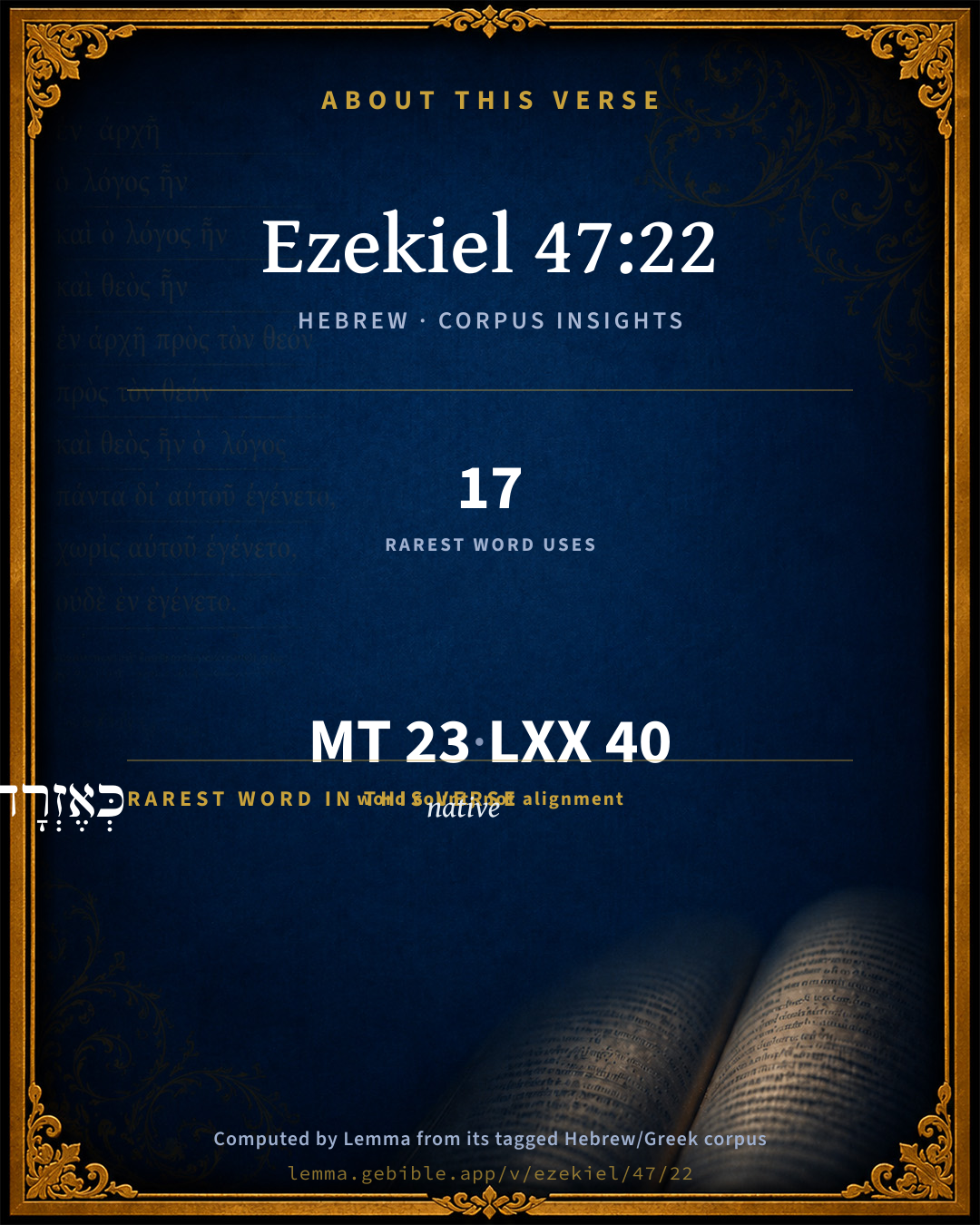
About this verse

These counts appear in no published source. They are computed here, from the morphology-tagged text and Lemma’s own curated glosses. What Lemma adds →

23
words
14
distinct lemmas
Prophets
section

Notable vocabulary

The rarest word here is כְּאֶזְרָח֙ native H249 — appearing just 17 times in the whole Hebrew Bible.

Shared distinctive vocabulary

כְּאֶזְרָח֙ native H249 occurs in 17 verses of the Hebrew Bible. Also found in:

Grammatical profile

  • 6 verbs
  • 12 nouns
  • 3 prepositions
  • 2 particles

Verb forms

  • וְהָיָ֗ה Qal · Sequential Perfect
  • תַּפִּ֣לוּ Hiphil · Imperfect
  • הַגָּרִ֣ים Qal · Participle Active
  • הוֹלִ֥דוּ Hiphil · Perfect
  • וְהָי֣וּ Qal · Sequential Perfect
  • יִפְּל֣וּ Qal · Imperfect

Repetition

Words recur within this verse — often emphatic in Hebrew:

  • בְּתוֹכְכֶ֔ם midst H8432 ×3
  • וְהָיָ֗ה to be H1961 ×2
  • תַּפִּ֣לוּ to fall H5307 ×2
  • בְּנַחֲלָה֒ inheritance H5159 ×2
  • בָנִ֖ים son H1121 ×2
  • יִשְׂרָאֵ֔ל Israel H3478 ×2

Hebrew & Septuagint length

In English translation the verse runs 54 words from the Hebrew and 57 from the Septuagint (LXX English) — closely comparable.

A rough comparison of the two English renderings, which tokenize alike — not a word-level alignment.

Word counts can differ between the Hebrew and the Greek without any difference in meaning — e.g. the Hebrew direct-object marker אֵת has no separate Greek word, and Greek often adds the article ὁ.

In the original languages it is 23 Hebrew tokens and 40 Greek tokens — but the two are counted differently (Hebrew bundles its prefixes and suffixes into one token; the Greek is in lemma form), so that isn’t a like-for-like length.

Cross-references

14

Topical passages linked to Ezekiel 47:22 in the Treasury of Scripture Knowledge — connected by theme and wording, ordered by reader-vote popularity; previews shown in the World English Bible.

  • Ephesians 3:6 that the Gentiles are fellow heirs, and fellow members of the body, and fellow partakers of his promise in Christ Jesus through the Gospel,
  • Colossians 3:11 where there can't be Greek and Jew, circumcision and uncircumcision, barbarian, Scythian, bondservant, freeman; but Christ is all, and in all.
  • Acts 11:18 When they heard these things, they held their peace, and glorified God, saying, "Then God has also granted to the Gentiles repentance to life!"
  • Romans 10:12 For there is no distinction between Jew and Greek; for the same Lord is Lord of all, and is rich to all who call on him.
  • Isaiah 56:6–7 Also the foreigners who join themselves to Yahweh, to minister to him, and to love the name of Yahweh, to be his servants, everyone who keeps the Sabbath from profaning it, and holds fast my covenant;
  • Isaiah 14:1 For Yahweh will have compassion on Jacob, and will yet choose Israel, and set them in their own land: and the foreigner shall join himself with them, and they shall cleave to the house of Jacob.
  • Acts 15:9 He made no distinction between us and them, cleansing their hearts by faith.
  • Ephesians 2:19–22 So then you are no longer strangers and foreigners, but you are fellow citizens with the saints, and of the household of God,
  • Ezekiel 47:13–14 Thus says the Lord Yahweh: This shall be the border, by which you shall divide the land for inheritance according to the twelve tribes of Israel: Joseph [shall have two] portions.
  • Galatians 3:28–29 There is neither Jew nor Greek, there is neither slave nor free man, there is neither male nor female; for you are all one in Christ Jesus.
  • Ephesians 2:12–14 that you were at that time separate from Christ, alienated from the commonwealth of Israel, and strangers from the covenants of the promise, having no hope and without God in the world.
  • Revelation 7:9–10 After these things I looked, and behold, a great multitude, which no man could number, out of every nation and of all tribes, peoples, and languages, standing before the throne and before the Lamb, dressed in white robes, with palm branches in their hands.
  • Numbers 26:55–56 Notwithstanding, the land shall be divided by lot: according to the names of the tribes of their fathers they shall inherit.
  • Acts 2:5–10 Now there were dwelling in Jerusalem Jews, devout men, from every nation under the sky.

Cross-references courtesy of OpenBible.info (CC BY 4.0).

Hebrew and Greek witnesses Masoretic Hebrew ↔ Greek Septuagint

The same verse in the two great witnesses to the Old Testament, shown verse-for-verse.

These are two independent witnesses, not word-aligned to each other, and the Septuagint is shown in lemma (dictionary) form.

Hebrew Ezekiel 47:22 Masoretic · Westminster Leningrad Codex

וְהָיָ֗ה תַּפִּ֣לוּ אוֹתָהּ֮ בְּנַחֲלָה֒ לָכֶ֗ם וּלְהַגֵּרִים֙ הַגָּרִ֣ים בְּתוֹכְכֶ֔ם אֲשֶׁר הוֹלִ֥דוּ בָנִ֖ים בְּתֽוֹכְכֶ֑ם וְהָי֣וּ לָכֶ֗ם כְּאֶזְרָח֙ בִּבְנֵ֣י יִשְׂרָאֵ֔ל אִתְּכֶם֙ יִפְּל֣וּ בְנַחֲלָ֔ה בְּת֖וֹךְ שִׁבְטֵ֥י יִשְׂרָאֵֽל

It shall happen, that you shall divide it by lot for an inheritance to you and to the strangers who sojourn among you, who shall father children among you; and they shall be to you as the home-born among the children of Israel; they shall have inheritance with you among the tribes of Israel.

World English Bible · Public Domain

Greek LXX Ezekiel 47:22 Septuagint · lemma form

βάλλω αὐτός ἐν κλῆρος σύ καί ὁ προσήλυτος ὁ παραοἰκέω ἐν μέσος σύ ὅστις γεννάω υἱός ἐν μέσος σύ καί εἰμί σύ ὡς αὐτόχθων ἐν ὁ υἱός ὁ ἰσραήλ μετά σύ ἐσθίω ἐν κληρονομία ἐν μέσος ὁ φυλή ὁ ἰσραήλ

You⌃ shall cast the lot upon it, for yourselves and the strangers that sojourn in the midst of you, who have begotten children in the midst of you: and they shall be to you as natives among the children of Israel; they shall eat with you in their inheritance in the midst of the tribes of Israel.

LXX2012 (modern English Septuagint) · Public Domain

Hebrew: Westminster Leningrad Codex (CC BY 4.0). Greek: Septuagint (public domain); English from LXX2012 (modern English Septuagint) (Public Domain). How the Septuagint differs from the Hebrew →

Targum (Aramaic paraphrase)

1

The Targum is the ancient Jewish Aramaic paraphrase of the Hebrew Scriptures — an interpretive translation, not the Hebrew text itself. Onkelos (literal) and Pseudo-Jonathan (expansive) render the Torah, and Jonathan the Prophets. Coverage is partial: where no permissively-licensed English translation exists for a verse, only the Aramaic is shown. This is verse-level text, not a word-by-word alignment to the Hebrew.

  1. Targum Jonathan Prophets (Joshua–Malachi)
    וִיהֵי דְתִפְלְגוּן יָתָהּ בְּאַחֲסָנָא לְכוֹן וּלְגִיוֹרָא דִי יִתְגַיְרוּן בֵּינֵיכוֹן דְאוֹלִידוּ בְּנִין בֵּינֵיכוֹן וִיהוֹ לְכוֹן כְּיַצִיבָא בִּבְנֵי יִשְׂרָאֵל עִמְכוֹן יִפְלְגוּן בְּאַחֲסָנָא בְּגוֹ שִׁבְטֵי יִשְׂרָאֵל:

    (no public-domain English translation for this verse)

    Targum Jonathan — Aramaic: “Mikraot Gedolot” (public domain). English: “Sefaria Community Translation” (CC0 1.0 (public-domain dedication)); “London "Chaldee Paraphrase," 1871” (public domain). Text via Sefaria.

Commentary

Notes on Ezekiel 47:22 from classic Christian and Jewish commentators (each source and its license shown beneath its notes). The classic Christian expositions comment on the surrounding passage and are grouped to its opening verse, so a note may address several verses; the Jewish commentaries on the Tanakh (Rashi and others) are per-verse, so they appear only where the commentator wrote on this verse.

Lemma curates 59 commentaries, every one of them public domain or Creative Commons licensed, each selected and text-cleaned for this edition rather than reprinted as found. About our sources →

Trapp's Complete Commentary

John Trapp

Eze 47:22 And it shall come to pass, [that] ye shall divide it by lot for an inheritance unto you, and to the strangers that sojourn among you, which shall beget children among you: and they shall be unto you as born in the country among the children of Israel; they shall have inheritance with you among the tribes of Israel.

Ver. 22. An inheritance unto you, and to the strangers that sojourn among you.] What can the spiteful Jews say to this? who stick not to say, that rather than the bastard Gentiles (so they call Christians) should share with them in their Messiah, they would crucify him a hundred times over and over. Under the Old Testament, though strangers lived with the children of Israel, yet they had no inheritance with them at any time, as now they are appointed to have.

John Trapp, A Commentary or Exposition upon All the Books of the Old and New Testament (1647–1656) — public domain. Text from a community e-Sword module.

Joseph Benson's Commentary

Eze 47:22. Ye shall divide it by lot for an inheritance unto you — See the note on Eze 47:14. And to the strangers that sojourn among you — Foreigners never before had the privilege of purchasing or possessing any inheritance among the Jews; so this mystically denotes the incorporating the Gentiles into the same church with the Jews, making them fellow-heirs, and of the same body with them by the gospel, Eph 3:6. They shall have inheritance with you among the tribes, &c. — In whatsoever tribe they sojourn, as it is expressed in the next verse.

Joseph Benson's Commentary on the Old and New Testaments (1811–1818) — public domain. Text from a community e-Sword module.

Geneva Bible (1599)

Geneva Bible translators

Meaning, that in this spiritual kingdom there should be no difference between Jew nor Gentile, but that all should be partakers of this inheritance in their head Christ.

Geneva Bible (1599) marginal notes — public domain. Text via Bolls.life.

Jamieson, Fausset & Brown

Robert Jamieson, A. R. Fausset & David Brown

to the strangers--It is altogether unprecedented under the old covenant, that "strangers" should have "inheritance" among the tribes. There would not be room locally within Canaan for more than the tribes. The literal sense must therefore be modified, as expressing that Gentiles are not to be excluded from settling among the covenant-people, and that spiritually their privileges are not to be less than those of Israel (Rom 10:12; Gal 3:28; Eph 3:6; Col 3:11; Rev 7:9-10). Still, "sojourneth," in Eze 47:23, implies that in Canaan, the covenant people are regarded as at home, the strangers as settlers.

Next: Ezekiel Chapter 48

Jamieson, Fausset & Brown — Commentary Critical and Explanatory on the Whole Bible (1871) — public domain (CC PDM 1.0). Text via the HelloAO Bible API.

Adam Clarke's Commentary

Verse 22. And to the strangers that sojourn] In former divisions of the land, no place was given to strangers; but in this division, (which seems to have no other reference than to the Gospel, for literally such a division never took place,) the strangers are to have an inheritance; intimating the calling of the Gentiles into the Church of Christ, to an inheritance that is incorruptible, undefiled, and that fadeth not away. Glory be to God for his unspeakable gift! Amen. Amen.

Adam Clarke's Commentary on the Bible (1810–1826) — public domain. Text from a community e-Sword/MySword module.

Ellicott's Commentary for English Readers

(22) By lot.—See Note on Eze_45:1.

To the strangers.—An entirely new feature is here added to the Mosaic law. According to Lev_19:34, strangers were to be treated with kindness, but the entire territory was to be divided among the Israelites, and strangers could therefore acquire no land except in so far as they might purchase a temporary right between the years of Jubilee. Now, however, such of them as “shall beget children among you,” thus showing a disposition to permanent residence, are to receive an inheritance along with the tribes and in the portion of that tribe where they may have chosen to fix their residence. This privilege is absolute, without any condition of receiving circumcision.

A Bible Commentary for English Readers, edited by Charles John Ellicott (1878–1897) — public domain. Text from a community e-Sword module.

John Gill's Exposition

And it shall come to pass,.... In the last days, under the Gospel dispensation:

that ye shall divide it by lot for an inheritance unto you; who were Israelites, both by natural descent, and by the Spirit and grace of God: the Gospel was first preached to Israel after the flesh, and made effectual to the conversion of many of them; and the first churches were made up of them, and they shared all the blessings and privileges thereof; as they also will in the latter day, when converted:

and to the strangers that sojourn among them; not such as were strangers to spiritual and divine things; for this would contradict the rule in Eze 44:9, but converted Gentiles, so called because of their natural descent and civil state, being, with respect to both, aliens from the commonwealth of Israel; yet were to be, as they have been, and will be, taken into the same Gospel church state with the believing Jews:

which shall beget children among you; not only in a natural, but in a spiritual sense; be the means of begetting many souls again to the lively hope of a glorious inheritance:

and they shall be unto you as born in the country among the children of Israel; that is, the children begotten by the Gentiles shall be considered all one as those of the children of Israel, being born again of the same Spirit and grace; and so have an equal right to the same privileges, and to which they shall be admitted:

they shall have inheritance with you among the tribes of Israel; this is a new thing, and what in a literal sense was never granted; for though in the times of Moses and onward, and by his direction from the Lord, such as have been called proselytes of the gate, and proselytes of righteousness, have been admitted to various privileges, by conforming to certain rules, rites, and ceremonies, yet never were allowed to have any inheritance in the land; and, after the captivity, Ezra and Nehemiah drove out the strangers, who by affinity with some had got among them: but this respects Gospel times, and the coalition of Jews and Gentiles in the same church state; where there is no difference, but Christ is all in all; where they are admitted to the same ordinances of baptism and the Lord's supper; partake of the same blessings of grace, and promises of the word, and have an equal right to the heavenly inheritance: Eph 3:6, is the best commentary on this passage; which contains the same mystery the Apostle Paul was acquainted with,

that the Gentiles should be fellow heirs, and of the same body, and partakers of his promise in Christ by the Gospel; See Gill on Eph 3:6. See Eph 2:12.

John Gill's Exposition of the Whole Bible (1746–1763) — public domain (CC PDM 1.0). Text via the HelloAO Bible API.

Albert Barnes' Notes on the Bible

And to the strangers - Here is quite a new feature in the distribution of the land. Not only the Israelites by descent, but those who join themselves to Israel by allegiance to the true God, shall have a right of inheritance. Here are opened out the blessings which were to accrue to the Gentiles through the seed of Abraham. Compare Rom 9:24, following. The difference which existed under the old covenant between Jew and Gentile is now at last done away. But while pagandom thus unites itself with God’s people, Israel is still as ever the chosen people, the center of this union. No new Church is founded side by side with the old. Pagandom is absorbed in Israel - the standard which God has set up for the nations - i. e., in the One True Church, which has subsisted from the beginning, and will subsist in eternity.

Albert Barnes' Notes on the Bible (1834–1885) — public domain. Text from a community e-Sword/MySword module.

Haydock's Catholic Bible Commentary

Strangers. This was never done by the Jews. It signifies that Christ would give an inheritance, in the true land of promise [in heaven], (Calmet) to all nations which should practice his religion, Romans x. 12. (Haydock)

George Leo Haydock (1774–1849), Haydock's Catholic Family Bible and Commentary, 1859 edition — public domain. Excludes Psalms (Douay-Rheims chapter numbering differs from Protestant) and Deuterocanonical books (Catholic canon only).

Matthew Poole's English Annotations

It shall come to pass: this directs what they should do, as well as foretells the event that shall be.

Ye shall divide it by lot; so it was divided before, so it must again, for thus all controversies shall be prevented; thus he will choose their inheritance for them, for the disposition of the lot is of the Lord.

Unto you, that are the natural seed of Abraham.

To the strangers that sojourn among you: foreigners never had such privilege before; though they might dwell and trade among the Jews, yet they were excluded all hereditary right, could not purchase nor possess inheritances. But now the constitution is altered; and by this temporal external incorporating them, a spiritual and heavenly is signified, no doubt; they are put into capacity of inheriting with Israel in both Cananus, in this below, in that above.

Which shall beget children among you; who from their birth should be invested with this right of inheriting.

Among the children of Israel; equally with the children of Israel in point of right, and with that very tribe ill which they sojourn.

Have inheritance; possess and enjoy, as well as you.

With you: this speaks the equal title or privilege.

Among the tribes: this directs where the inheritance of these strangers born among them, or that first came with them when they came out of Babylon, should be assigned them, viz. in that very tribe where they sojourned, which is fully expressed in the next verse.

Matthew Poole's English Annotations on the Holy Bible (1683–1685) — public domain. Text from a community e-Sword/MySword module.

Whedon's Commentary on the Bible

Daniel D. Whedon

22, 23. This land shall be divided “by lot.” Although this word means “by lot,” yet evidently it was here used in the same way as our word “allot;” for the sections in which each tribe shall dwell are stated in the next chapter. A striking difference between Ezekiel’s division of the land as compared with the Levitical code (Lev_25:47-55) is the care with which the rights of “strangers” are guarded. These proselytes who have permanently settled in the land are allowed a perfect equality with the native born in the matter of inheritance. They are to share equally with the members of the tribe in which they live. (Compare note Eze_47:14.)

Daniel D. Whedon (gen. ed.), Commentary on the Old and New Testaments (1874–1909) — public domain. Text from a community e-Sword module.

The Pulpit Commentary

Vers. 22, 23The stranger"s portion.

We do wrong to the ancient Jewish Law and to the character of the Jews themselves when we regard a selfish exclusiveness as the marked feature of Old Testament times. A certain separateness was required to keep the people of God from the idolatry and immorality of their heathen neighbors, and none of the privileges of Israel could be enjoyed excepting on condition of entering into the covenant of Israel the covenant which needed to be accepted and kept by the chosen people themselves in order that they might enjoy their privileges. But the bitter jealousy which was seen in the narrow Judaism of New Testament times is not encouraged by the Law, nor does it seem to have been indulged in by the Old Testament Israelites. It was the revenge of a persecuted sect turned against their powerful oppressors. A freer, happier, more generous spirit prevailed in the earlier Hebrew nation. The people were taught to cultivate national hospitality. Care for the stranger was repeatedly inculcated in their Law. Much more is it incumbent on Christians to manifest a brotherly spirit in welcoming strangers.

I STRANGERS SHOULD RECEIVE A BROTHERLY WELCOME FROM CHRISTIAN PEOPLE. Hospitality is an Eastern habit; it should be a Christian grace.

1. In the church. Care should be taken to make strangers feel at home in our midst. The least aversion to having a stranger sitting by one"s side may cheek the beginning of a new course of life by repelling the seeker after truth from the means of enlightenment. The friendless, the poor, the timid, the penitent, should be received with especial kindness.

2. In the home. Christian people have not sufficiently regarded their Lord"s command to make guests of the poor who can offer no return. (Luk_14:13)

3. In the world. A generous Christian spirit should open the heart to receive strangers. The miserably selfish isolation in which some people immure themselves is quite alien to the brotherly spirit of Jesus Christ.

II STRANGERS ARE WELCOMED BY CHRIST INTO THE KINGDOM OF HEAVEN.

1. Gentiles. Assuredly Christianity is not narrower than Judaism, under which even provision was made for a brotherly reception of proselytes. They who were strangers to the covenant of promise are now brought nigh by the blood of Christ. The wild olive branch is grafted in to the fruitful. (Rom_11:17) Gentiles are freely admitted to the promised blessings of Abraham.

1. Heathen. Strangers to Christendom are invited into the kingdom of Christ. The heathen world is to receive the gospel. From China, from New Guinea, from Central Africa, the strangers press into the privileged kingdom.

2. Sinners. We have not to go to a distant continent to discover strangers to Christ. They may be found in a Christian land even in a Christian Church! Every man who lives in sin is a stranger to Christ. But all sinners are invited to the Savior.

III STRANGERS MUST BECOME TRUE CITIZENS IN ORDER TO ENJOY THE PRIVILEGES OF THE KINGDOM OF HEAVEN. The stranger needed to adopt the Law, to be circumcised, and to become a Jew, if he was to have his portion in the land. People who are spiritually strangers now need a circumcision of heart (Deu_30:6) and a new birth to have the blessings of Christ. All may have the Christian blessedness, but all must first become Christians. There is a portion for every one in Christ"s kingdom; it now only rests with every one to qualify himself for his inheritance by penitence and faith in Jesus Christ.

Vers. 22, 23The inheritance of the strangers.

It was certainly a provision of remarkable interest and liberality that is recorded in these verses. Considering the exclusive and clannish spirit which so largely distinguished the Hebrew people, we cannot but read with wonder as well as with gratification that aliens were permitted to partake with them the possession and enjoyment of the land of promise. Those of other blood, but of the same religion, who during the Captivity had cultivated the soil, were to be suffered to retain their inheritance equally with the returning exiles. Probably there was abundant room for all, for the numbers of the Israelites may well have been diminished during their exile. Strangers thus coalesced with the sons of Israel in the several tribes that went to make up the nation. In the same manner, upon a larger scale, an amalgamation of Jews and Gentiles took place in the constitution of the Israel of God the Church of Christ.

I THE EQUAL INHERITANCE OF ALL CHRIST"S PEOPLE IN CHRISTIAN PRIVILEGES IS NOT OWING TO NATURE, BUT IS THE ARRANGEMENT OF THE GRACE OF GOD.

II THE EQUAL INHERITANCE INVOLVES A SIMILAR SPIRITUAL PREPARATION AND ADAPTATION.

III THE EQUAL INHERITANCE ENTITLES ALL THE MEMBERS OF CHRIST"S CHURCH TO EQUAL PRIVILEGES.

APPLICATION.

1. All distinctions of a hereditary, secular, and educational character are of little importance in the Christian community. Boasting is excluded where all is of grace, and where none has any claim of right.

2. Mutual consideration and forbearance should obtain within the boundaries of the Church. Every Christian has some especial office and gift; perhaps every Christian has some special infirmity and imperfection.

3. It is profitable and delightful to look forward to the perfect fulfillment of the Savior"s purpose and prayer, to anticipate the time when all shall be one one flock under one Shepherd. The inheritance of all God"s people is known only by the common designation: "the inheritance of the saints in light. T.

Vers. 22, 23Jew and Gentile.

The introduction of this passage is an indication of the figurative and spiritual character of the whole prophetic utterance. The ideal community, the kingdom of Christ, was to be one that would attract those that were without and that should welcome all that came; it should be a welcome home to the "stranger;" there the ancient "people of God" should find their inheritance; and thither those who had been his wandering and distant children should resort. Thus we gain the idea of

I THE ATTRACTIVENESS OF THE KINGDOM. As the Gentiles are here imagined as crossing the Jordan to sojourn within the borders of Israel, so we are to expect that men will come from beyond the pale of the Christian Church to find a home within its gates.

1. It ought to be far more attractive than it has been made. The discord, the envy, the strife among its members; the lamentable inconsistencies in the lives of too many of its professors; and the grave unwisdom with which its teachers have propounded their theories as if they were of the essence and substance of its truth; these have been repelling enough.

2. Yet, on the other hand, the gospel of Christ has been a great attractive power.

(1) The repose which it offers to the human mind, presenting to it one Divine and holy Creator and Sustainer of all things and beings;

(2) the rest which it offers to the human heart, tendering to it full and immediate restoration to a Divine Father"s love;

(3) the enlargement which it offers to human life, making it a sacred and noble thing even in obscurity and poverty;

(4) the high and glorious hope it holds out to the human soul, speaking of a heavenly future; all this may well prove, as it does prove, attractive

(a) to those of other faiths which have no such doctrine to preach, no such glad tidings to convey;

(b) to those of no faith at all, and to whom this world proves to be insufficient for lasting joy.

II THE WELCOME ON WHICH ALL COMERS MAY COUNT.

1. Christ welcomes them to his kingdom. There is no doubt at all as to the certainty or the cordiality of that welcome. Even the son that has gone into the very far country and done sad dishonor to the Father"s Name is received back with every manifestation of parental joy. (Lu 15) Jesus Christ is not only the Approachable One, from whom no sincere seeker need shrink; he is the One that seeks, that comes to our own door, that stands and knocks and waits for entrance there. (Rev_3:20)

2. All his true disciples welcome them. There may be found communities bearing the Christian name, whose gates are too narrow to receive many a true follower of Christ; but all those in whom the Spirit of Jesus Christ is dwelling, and who do not misrepresent their Master, will gladly welcome every "stranger" that comes to "sojourn" or to settle in the kingdom; they will encourage him to enter; they will give him the right hand of fellowship, they will find him a post in the vineyard of the Lord; they will make him to know and feel that in entering "Israel" he has come to his true home, that he is "as the home-born. C.

The Pulpit Commentary (1880–1919), ed. H.D.M. Spence-Jones & Joseph S. Exell — public domain. Text from a community e-Sword module.

John Wesley's Explanatory Notes

Children - Who from their birth should be invested with this right of inheriting.

John Wesley, Explanatory Notes Upon the Whole Bible (1754–1765) — public domain. Text via the GEBible commentary corpus.

Lesson kit

Teaching starters — assembled from the data on this page, not authored interpretation. Every prompt links to the verse data it draws on. Edit before teaching.

Ezekiel, in the Prophets, opens this verse with 23 words (14 distinct Hebrew lemmas). Its most distinctive word is ʼezrâch (“native”). A historical commentator’s framing appears above. Read the whole chapter for the surrounding context.

Discussion questions

  1. What does “native” (ʼezrâch) contribute to the verse as a whole?
  2. Exodus 12:19 shares the word «native» with this verse. How do the two illuminate each other?
  3. “midst” occurs 3× in this one verse. What is the effect of the repetition?
  4. These translations render this verse differently; the difference is in the English rendering, not the original. What questions does that raise?
  5. The verb «וְהָיָ֗ה» is Qal Sequential Perfect. How does its form color the action?
  6. Reading how Trapp's Complete Commentary and Joseph Benson's Commentary read this verse, where do the two commentators agree and where do they part?

Things to notice

Reading settings

Reading text

Shown beneath each verse's original-language words.

Old Testament
Old Testament edition

Read the OT as the Masoretic Hebrew (MT) or the Greek Septuagint (LXX).

English shown for the Greek Septuagint (in the Hebrew ↔ Greek comparison).

Comparing translations? Open the Compare panel on any verse page to stack up to four side by side.