
Joshua 4:2

Hebrew (Westminster Leningrad Codex) Joshua 4:2 appears in the Hebrew Old Testament. The text above is from the Westminster Leningrad Codex. Each word links to its Strong’s number, a concise gloss, and parsing drawn from the Open Scriptures Hebrew Bible morphology. Click any word for its full Brown-Driver-Briggs (BDB) entry.
Download image
Cite this verse

Joshua 4:2 (World English Bible). Public Domain. Lemma interlinear Bible study tool, https://lemma.gebible.app/v/joshua/4/2.

Show BibTeX & RIS
BibTeX
RIS
English Translation
Take twelve men out of the people, out of every tribe a man,
World English Bible · Public Domain
Download a study sheet

One document with this verse’s original text, its word-by-word gloss line, the meaning frame, cross-references with their text, attributed commentary, and full source and license credits — printable, and it pastes into notes with its structure intact.

This verse Autodidact and up

Study sheet (.html) Plain text (.txt)

A passage Seminary Student

Up to 50 verses in one chapter. A passage sheet keeps up to 6 commentary sources and 12 cross-references per verse, in the order this page ranks them, and says so on the sheet whenever that leaves anything out. Ask for a single verse and you get the Autodidact verse sheet above.

Everything on this page stays free to read, with no account — the sheet is a download of what is already on screen, not access to it.

Want to remove ads? Support Godless Engineer
Compare translations 3

The same verse in 3 English versions, stacked beneath the original-language interlinear above. Click any original word for its lexicon entry.

Each is an independent rendering of the whole verse — the interlinear is not word-aligned to these translations.

Highlighted words mark where these versions differ — a whole-verse word diff, not a word-by-word alignment.

  • World English Bible Public Domain
    Take twelve men out of the people, out of every tribe a man,
  • King James Version Public Domain
    Take you twelve men out of the people, out of every tribe a man,
  • unfoldingWord Literal Text CC BY-SA 4.0
    “Take 12 men for yourselves from the people, one man, one man from a tribe,

unfoldingWord Literal Text — © unfoldingWord, licensed CC BY-SA 4.0. Word-aligned USFM3 via Door43 (git.door43.org/unfoldingWord/en_ult).

Versions to compare (up to 4)

3 of 4 selected

Show all 18 translations

Every available English version of this verse, each an independent rendering of the whole verse.

  • World English Bible Public Domain
    Take twelve men out of the people, out of every tribe a man,
  • Berean Standard Bible Public Domain
    “Choose twelve men from among the people, one from each tribe,
  • Majority Standard Bible Public Domain
    “Choose twelve men from among the people, one from each tribe,
  • King James Version Public Domain
    Take you twelve men out of the people, out of every tribe a man,
  • American Standard Version (1901) Public Domain
    Take you twelve men out of the people, out of every tribe a man,
  • Revised Version (1885) Public Domain
    Take you twelve men out of the people, out of every tribe a man,
  • Geneva Bible (1599) Public Domain
    Take you twelue me out of the people, out of euery tribe a man,
  • Douay-Rheims (1899) Public Domain
    Choose twelve men, one of every tribe:
  • Young's Literal Translation Public Domain
    `Take for you out of the people twelve men, one man -- one man out of a tribe;
  • Literal Standard Version CC BY-SA 4.0
    “Take for yourselves twelve men out of the people, one man—one man out of a tribe;
  • Unlocked Literal Bible CC BY-SA 4.0
    “Choose twelve men for yourselves from among the people, one man from each tribe.
  • unfoldingWord Literal Text CC BY-SA 4.0
    “Take 12 men for yourselves from the people, one man, one man from a tribe,
  • Darby Bible Public Domain
    Take you twelve men out of the people, one man out of every tribe,
  • World Messianic Bible Public Domain
    “Take twelve men out of the people, a man out of every tribe,
  • Webster's Bible Public Domain
    Take you twelve men from the people, from every tribe a man,
  • Free Bible Version CC BY-SA 4.0
    “Choose twelve men from the people, one per tribe,
  • Bible in Basic English Public Domain
    Take twelve men from the people, a man for every tribe,
  • JPS Tanakh (1917) Public Domain
    'Take you twelve men out of the people, out of every tribe a man,

Literal Standard Version (2020), Covenant Press — licensed CC BY-SA 4.0. Text via the HelloAO Bible API (eBible.org). Unlocked Literal Bible (unfoldingWord) — licensed CC BY-SA 4.0. Text via the HelloAO Bible API (eBible.org). unfoldingWord Literal Text — © unfoldingWord, licensed CC BY-SA 4.0. Word-aligned USFM3 via Door43 (git.door43.org/unfoldingWord/en_ult). Free Bible Version, Dr. Jonathan Gallagher — licensed CC BY-SA 4.0. Text via the HelloAO Bible API (eBible.org).

Word by word

More ways to search: Search by grammar → Find every occurrence → Compare this word →

Practice this passage: Drill this verse → Learn its vocabulary →

מִשָּֽׁבֶט
shêbeṭ
H7626
“from · staff”
Preposition + Noun, Common, Masculine, Singular, Absolute
Part of Speech
Preposition + Noun
Type
Common
Gender
Masculine
Number
Singular
State
Absolute
Full BDB Definition

Origin: from an unused root probably meaning to branch off

TWOT: 2314a

rod, staff, branch, offshoot, club, sceptre, tribe - rod, staff - shaft (of spear, dart) - club (of shepherd's implement) - truncheon, sceptre (mark of authority) - clan, tribe
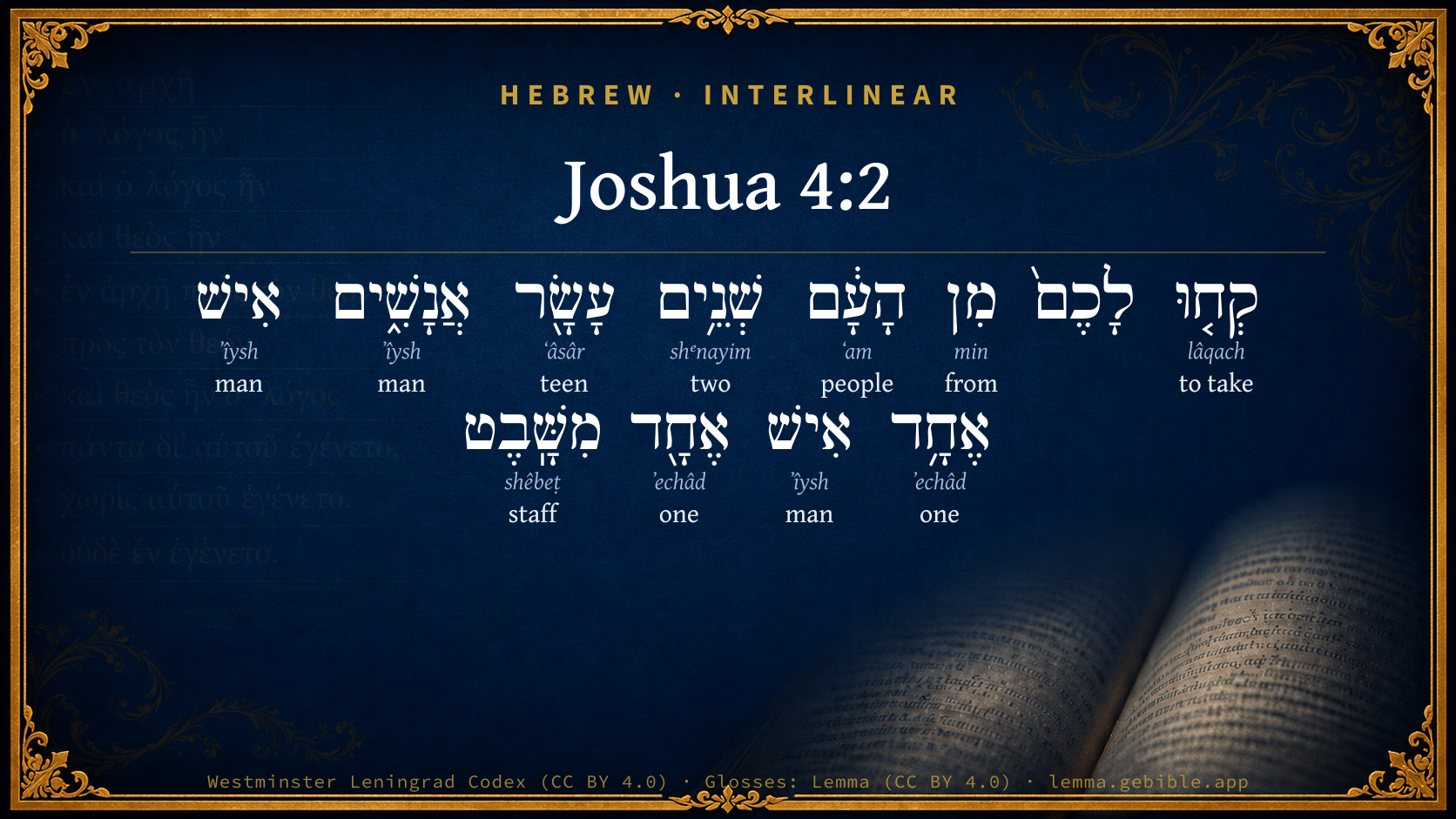
  1. קְח֤וּ lâqach H3947 “take” Verb, Qal, Imperative, 2nd Person, Masculine, Plural
  2. מִן min H4480 “from” Preposition
  3. הָעָ֔ם ʻam H5971 “the · people” Particle, Definite Article + Noun, Common, Masculine, Singular, Absolute
  4. שְׁנֵ֥ים shᵉnayim H8147 “two” Adjective, Cardinal number, Masculine, Dual, Absolute
  5. עָשָׂ֖ר ʻâsâr H6240 “teen” Adjective, Cardinal number, Masculine, Singular, Absolute
  6. אֲנָשִׁ֑ים ʼîysh H376 “men” Noun, Common, Masculine, Plural, Absolute
  7. אִישׁ ʼîysh H376 “man” Noun, Common, Masculine, Singular, Absolute
  8. אֶחָ֥ד ʼechâd H259 “one” Adjective, Cardinal number, Masculine, Singular, Absolute
  9. אִישׁ ʼîysh H376 “man” Noun, Common, Masculine, Singular, Absolute
  10. אֶחָ֖ד ʼechâd H259 “one” Adjective, Cardinal number, Masculine, Singular, Absolute

About this verse

These counts appear in no published source. They are computed here, from the morphology-tagged text and Lemma’s own curated glosses. What Lemma adds →

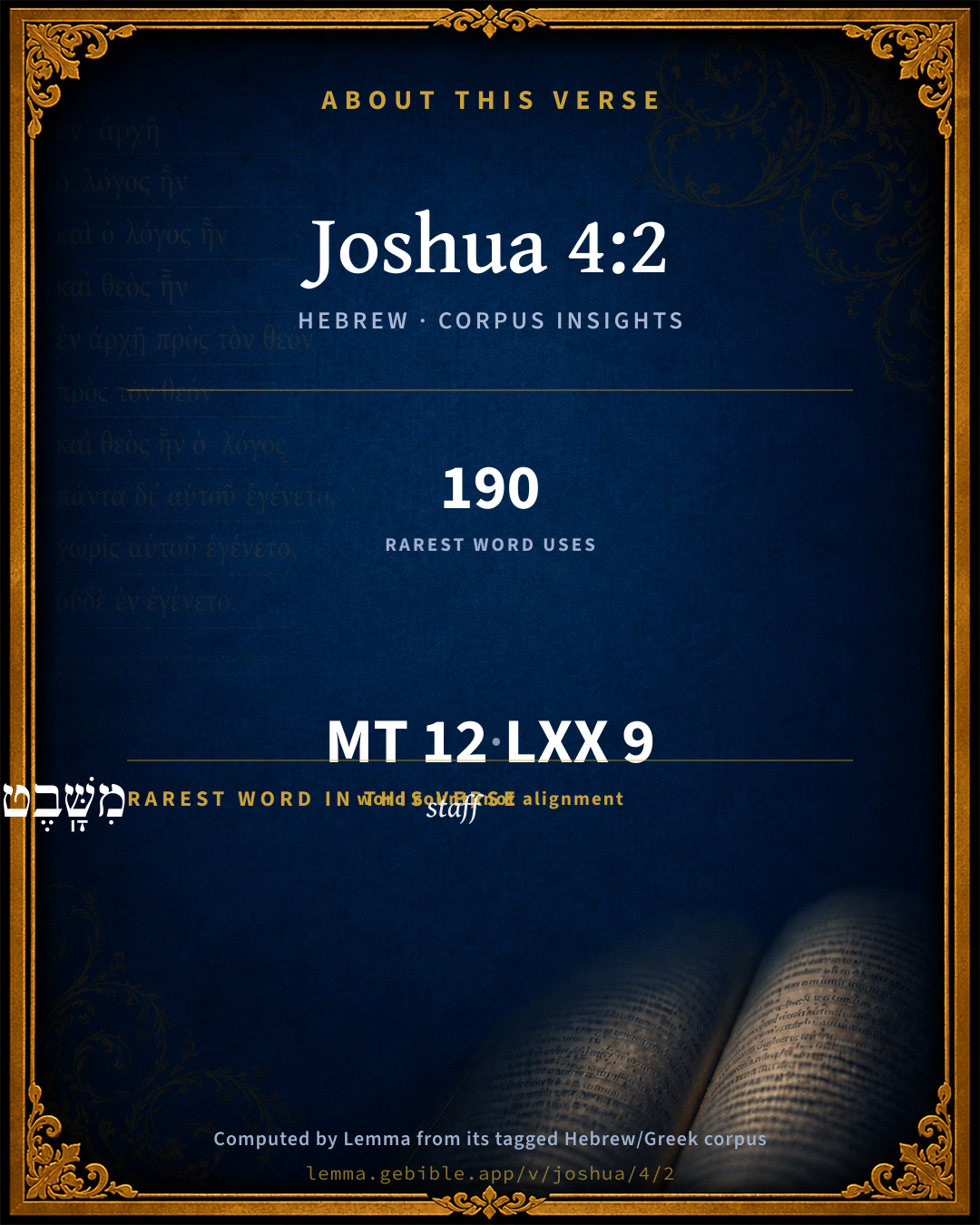
12
words
8
distinct lemmas
Historical
section

Grammatical profile

  • 1 verb
  • 5 nouns
  • 4 adjectives
  • 2 prepositions

Verb forms

  • קְח֤וּ Qal · Imperative

Repetition

Words recur within this verse — often emphatic in Hebrew:

  • אֲנָשִׁ֑ים man H376 ×3
  • אֶחָ֥ד one H259 ×2

Hebrew & Septuagint length

In English translation the verse runs 13 words from the Hebrew and 9 from the Septuagint (LXX English) — the Septuagint runs noticeably shorter here. See the side-by-side →

A rough comparison of the two English renderings, which tokenize alike — not a word-level alignment.

Word counts can differ between the Hebrew and the Greek without any difference in meaning — e.g. the Hebrew direct-object marker אֵת has no separate Greek word, and Greek often adds the article ὁ.

In the original languages it is 12 Hebrew tokens and 9 Greek tokens — but the two are counted differently (Hebrew bundles its prefixes and suffixes into one token; the Greek is in lemma form), so that isn’t a like-for-like length.

Cross-references

7

Topical passages linked to Joshua 4:2 in the Treasury of Scripture Knowledge — connected by theme and wording, ordered by reader-vote popularity; previews shown in the World English Bible.

  • Joshua 3:12 Now therefore take twelve men out of the tribes of Israel, for every tribe a man.
  • Numbers 1:4–15 With you there shall be a man of every tribe; everyone head of his fathers' house.
  • Numbers 13:2 Send you men, that they may spy out the land of Canaan, which I give to the children of Israel: of every tribe of their fathers shall you send a man, everyone a prince among them.
  • Numbers 34:18 You shall take one prince of every tribe, to divide the land for inheritance.
  • Deuteronomy 1:23 The thing pleased me well; and I took twelve men of you, one man for every tribe:
  • 1 Kings 18:31 Elijah took twelve stones, according to the number of the tribes of the sons of Jacob, to whom the word of Yahweh came, saying, Israel shall be your name.
  • Matthew 10:1–5 He called to himself his twelve disciples, and gave them authority over unclean spirits, to cast them out, and to heal every disease and every sickness.

Cross-references courtesy of OpenBible.info (CC BY 4.0).

Hebrew and Greek witnesses Masoretic Hebrew ↔ Greek Septuagint

The same verse in the two great witnesses to the Old Testament, shown verse-for-verse.

Here the Septuagint runs noticeably shorter than the Hebrew — LXX2012 (modern English Septuagint) 9 words vs World English Bible 13. A rough length comparison of the two English translations, not a word-level alignment — read both below.

These are two independent witnesses, not word-aligned to each other, and the Septuagint is shown in lemma (dictionary) form.

Hebrew Joshua 4:2 Masoretic · Westminster Leningrad Codex

קְח֤וּ לָכֶם֙ מִן הָעָ֔ם שְׁנֵ֥ים עָשָׂ֖ר אֲנָשִׁ֑ים אִישׁ אֶחָ֥ד אִישׁ אֶחָ֖ד מִשָּֽׁבֶט

Take twelve men out of the people, out of every tribe a man,

World English Bible · Public Domain

Greek LXX Joshua 4:2 Septuagint · lemma form

παραλαμβάνω ἀνήρ ἀπό ὁ λαός εἷς ἀπό ἕκαστος φυλή

Take men from the people, one of each tribe,

LXX2012 (modern English Septuagint) · Public Domain

Hebrew: Westminster Leningrad Codex (CC BY 4.0). Greek: Septuagint (public domain); English from LXX2012 (modern English Septuagint) (Public Domain). How the Septuagint differs from the Hebrew →

Targum (Aramaic paraphrase)

1

The Targum is the ancient Jewish Aramaic paraphrase of the Hebrew Scriptures — an interpretive translation, not the Hebrew text itself. Onkelos (literal) and Pseudo-Jonathan (expansive) render the Torah, and Jonathan the Prophets. Coverage is partial: where no permissively-licensed English translation exists for a verse, only the Aramaic is shown. This is verse-level text, not a word-by-word alignment to the Hebrew.

  1. Targum Jonathan Prophets (Joshua–Malachi)
    דַבָּרוּ לְכוֹן מִן עַמָא תְּרֵי עֲסַר גַבְרִין גַבְרָא חָד גַבְרָא חָד מִשִׁבְטָא:

    (no public-domain English translation for this verse)

    Targum Jonathan — Aramaic: “Mikraot Gedolot” (public domain). English: “Sefaria Community Translation” (CC0 1.0 (public-domain dedication)); “London "Chaldee Paraphrase," 1871” (public domain). Text via Sefaria.

Commentary

Notes on Joshua 4:2 from classic Christian and Jewish commentators (each source and its license shown beneath its notes). The classic Christian expositions comment on the surrounding passage and are grouped to its opening verse, so a note may address several verses; the Jewish commentaries on the Tanakh (Rashi and others) are per-verse, so they appear only where the commentator wrote on this verse.

Lemma curates 59 commentaries, every one of them public domain or Creative Commons licensed, each selected and text-cleaned for this edition rather than reprinted as found. About our sources →

Trapp's Complete Commentary

John Trapp

Jos 4:2 Take you twelve men out of the people, out of every tribe a man,

Ver. 2. Out of every tribe a man.] For the two tribes and half planted beyond Jordan were also concerned, as being of the same body and way of worship. See Jos 22:30.

John Trapp, A Commentary or Exposition upon All the Books of the Old and New Testament (1647–1656) — public domain. Text from a community e-Sword module.

Joseph Benson's Commentary

Jos 4:2-5. Take you out of every tribe a man — For the greater evidence, and the more effectual spreading the report of this marvellous work among the tribes. Where ye shall lodge this night — That is, in Gilgal, as is expressed, Jos 4:19-20. Whom he had prepared — That is, appointed for that work, and commanded to be ready for it. Pass over before the ark — Or, Pass back again directly unto the ark. These twelve men, it seems, re- entered the channel of Jordan, and, being dispensed from the prohibition to approach the ark, came near the place where the priests stood, and each loaded himself with a stone as large as he could carry, and such as might afterward attest to each several tribe that he had seen the bed of the river dry, and the miracle prolonged till the entire execution of the commands of God.

Joseph Benson's Commentary on the Old and New Testaments (1811–1818) — public domain. Text from a community e-Sword module.

Tyndale Open Study Notes

Tyndale Open Resources

4:2 The twelve men represented Jacob’s twelve sons. The tribe of Levi was not counted because the Levites settled in designated cities among the other tribes (Gen 49:5-7; Num 1:49-52; 18:20). However, the number of tribes remained at twelve because Joseph’s two sons (Ephraim and Manasseh) were accounted as separate tribes (Gen 48:5).

Tyndale Open Study Notes — © Tyndale Open Resources, licensed CC BY-SA 4.0. Text via the HelloAO Bible API.

Adam Clarke's Commentary

Verse 2. Take you twelve men] From Jos 3:12, it appears that the twelve men had been before appointed, one taken out of each of the twelve tribes; and now they are employed for that purpose for which they had been before selected.

Adam Clarke's Commentary on the Bible (1810–1826) — public domain. Text from a community e-Sword/MySword module.

John Gill's Exposition

Take you twelve men out of the people,.... Joshua had before this ordered twelve men to be taken from among them, which seems to have been done of himself; and now he has a direction from God for it, and what to employ them in:

out of every tribe a man; so that what they did was in the name of the several tribes, and as representing them.

John Gill's Exposition of the Whole Bible (1746–1763) — public domain (CC PDM 1.0). Text via the HelloAO Bible API.

Albert Barnes' Notes on the Bible

Take you twelve men - The order is given in the plural, because no doubt the tribes themselves were to choose their own representatives, the choice being approved by Joshua Jos 4:4. These twelve would be left with Joshua on the hither bank of the river, waiting to receive his orders after the rest of the people had made their way across Jos 3:17; Jos 4:1.

Albert Barnes' Notes on the Bible (1834–1885) — public domain. Text from a community e-Sword/MySword module.

Haydock's Catholic Bible Commentary

Choose. Hebrew, "take," as [in] chap. iii. 12. Those twelve men were ordered to attend the ark, and to observe the miracle with care: these are chosen to carry the stones for the monuments. (Salien) --- Calmet supposes that they are the same people, and that the former verse might be translated, "the Lord had said." But this does not agree with the context. Hebrew, "and it came to pass, when all the people were clean passed over the Jordan, that the Lord spake." The former injunction was given before they entered the river. Hebrew, "the ark passeth...Now therefore take," &c. (Haydock) --- One was selected from the tribe of Levi, and one from that of Joseph, so that all the twelve tribes were represented. (Menochius)

George Leo Haydock (1774–1849), Haydock's Catholic Family Bible and Commentary, 1859 edition — public domain. Excludes Psalms (Douay-Rheims chapter numbering differs from Protestant) and Deuterocanonical books (Catholic canon only).

Matthew Poole's English Annotations

For the greater evidence and certainty, and the more effectual spreading of the report of this marvellous work among all the tribes.

Matthew Poole's English Annotations on the Holy Bible (1683–1685) — public domain. Text from a community e-Sword/MySword module.

The Pulpit Commentary

THE MEMORIAL.

Twelve stones. The commemoration of events by the setting up of huge stones was by no means peculiar to the Jews, though it was often used by them, as, for instance, Gen_28:18, Gen_35:14, 1Sa_7:12. Almost every nation has adopted it. The Egyptian obelisks, the stones at Hamath, supposed to be of Hittite origin, the dolmens and other megalithic monuments of the Celts, the Logan or rocking stones, are cases in point. The Scandinavians filled their country with them. Our own Stonehenge and the Avebury stones are supposed by some to be, not temples nor burial places, but memorials of some battle. The command here given to Joshua was regarding what was to be done by the twelve men, who (Jos_5:4; cf. Jos_3:12) were already chosen. The form of the command is merely another instance of the common Hebrew practice of repetition.

The Pulpit Commentary (1880–1919), ed. H.D.M. Spence-Jones & Joseph S. Exell — public domain. Text from a community e-Sword module.

John Wesley's Explanatory Notes

Out of every tribe a man - For the greater evidence, and the more effectual spreading the report of this marvelous work among all the tribes.

John Wesley, Explanatory Notes Upon the Whole Bible (1754–1765) — public domain. Text via the GEBible commentary corpus.

Rashi

Rabbi Shlomo Yitzchaki (Rashi)

Twelve men. These were the men mentioned previously, who were told to be prepared.

Rashi on the Tanakh — English translations: “The Judaica Press complete Tanach with Rashi, translated by A. J. Rosenberg” (CC BY 4.0); “Pentateuch with Rashi's commentary by M. Rosenbaum and A.M. Silbermann, 1929-1934” (public domain); “The Metsudah Tanach series, Lakewood, N.J” (CC BY 4.0); and “The Book of Joshua, Metsudah Publications, 1997” (CC BY 4.0). Text via Sefaria.

Lesson kit

Teaching starters — assembled from the data on this page, not authored interpretation. Every prompt links to the verse data it draws on. Edit before teaching.

Joshua, in the Historical, opens this verse with 12 words (8 distinct Hebrew lemmas). Its most distinctive word is shêbeṭ (“staff”). The Greek Septuagint runs shorter here. A historical commentator’s framing appears above. Read the whole chapter for the surrounding context.

Discussion questions

  1. The word shêbeṭ carries the sense “staff.” How does it shape the verse?
  2. Joshua 3:12 shares this passage’s theme. How do the two illuminate each other?
  3. “man” occurs 3× in this one verse. What is the effect of the repetition?
  4. Compared with the Hebrew, the Septuagint runs shorter here. What questions does that raise?
  5. These translations render this verse differently. What is at stake in choosing one wording over another?
  6. The verb «קְח֤וּ» is Qal Imperative. How does its form color the action?
  7. Reading how Trapp's Complete Commentary and Joseph Benson's Commentary read this verse, where do the two commentators agree and where do they part?

Things to notice

Reading settings

Reading text

Shown beneath each verse's original-language words.

Old Testament
Old Testament edition

Read the OT as the Masoretic Hebrew (MT) or the Greek Septuagint (LXX).

English shown for the Greek Septuagint (in the Hebrew ↔ Greek comparison).

Comparing translations? Open the Compare panel on any verse page to stack up to four side by side.