
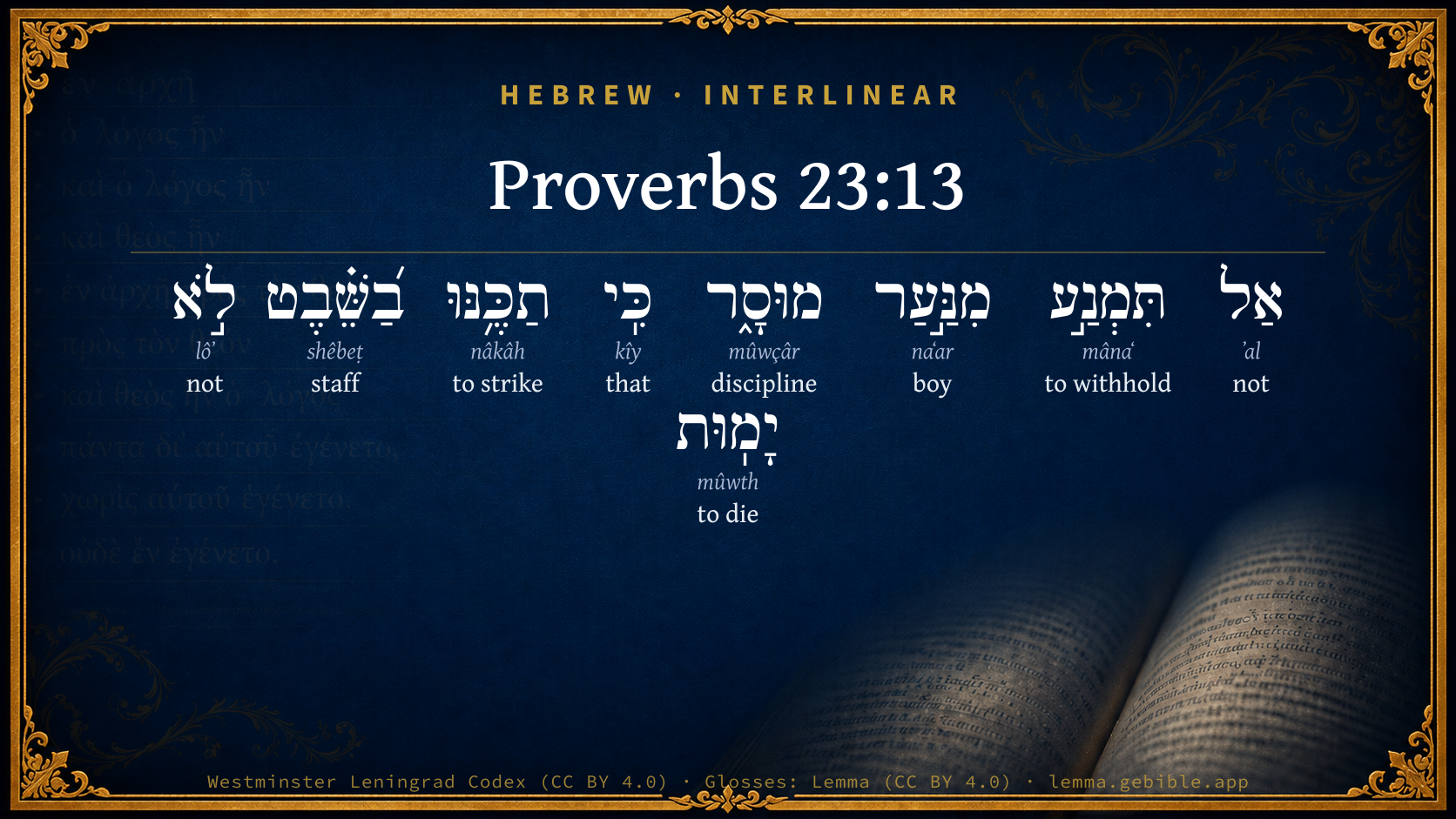
Proverbs 23:13

Hebrew (Westminster Leningrad Codex) Proverbs 23:13 appears in the Hebrew Old Testament. The text above is from the Westminster Leningrad Codex. Each word links to its Strong’s number, a concise gloss, and parsing drawn from the Open Scriptures Hebrew Bible morphology. Click any word for its full Brown-Driver-Briggs (BDB) entry.
Download image
Cite this verse

Proverbs 23:13 (World English Bible). Public Domain. Lemma interlinear Bible study tool, https://lemma.gebible.app/v/proverbs/23/13.

Show BibTeX & RIS
BibTeX
RIS
English Translation
Don't withhold correction from a child. If you punish him with the rod, he will not die.
World English Bible · Public Domain
Download a study sheet

One document with this verse’s original text, its word-by-word gloss line, the meaning frame, cross-references with their text, attributed commentary, and full source and license credits — printable, and it pastes into notes with its structure intact.

This verse Autodidact and up

Study sheet (.html) Plain text (.txt)

A passage Seminary Student

Up to 50 verses in one chapter. A passage sheet keeps up to 6 commentary sources and 12 cross-references per verse, in the order this page ranks them, and says so on the sheet whenever that leaves anything out. Ask for a single verse and you get the Autodidact verse sheet above.

Everything on this page stays free to read, with no account — the sheet is a download of what is already on screen, not access to it.

Want to remove ads? Support Godless Engineer
Compare translations 3

The same verse in 3 English versions, stacked beneath the original-language interlinear above. Click any original word for its lexicon entry.

Each is an independent rendering of the whole verse — the interlinear is not word-aligned to these translations.

Highlighted words mark where these versions differ — a whole-verse word diff, not a word-by-word alignment.

  • World English Bible Public Domain
    Don't withhold correction from a child. If you punish him with the rod, he will not die.
  • King James Version Public Domain
    Withhold not correction from the child: for if thou beatest him with the rod, he shall not die.
  • unfoldingWord Literal Text CC BY-SA 4.0
    Do not withhold discipline from a boy; when you strike him with the rod, he will not die.

unfoldingWord Literal Text — © unfoldingWord, licensed CC BY-SA 4.0. Word-aligned USFM3 via Door43 (git.door43.org/unfoldingWord/en_ult).

Versions to compare (up to 4)

3 of 4 selected

Show all 18 translations

Every available English version of this verse, each an independent rendering of the whole verse.

  • World English Bible Public Domain
    Don't withhold correction from a child. If you punish him with the rod, he will not die.
  • Berean Standard Bible Public Domain
    Do not withhold discipline from a child; although you strike him with a rod, he will not die.
  • Majority Standard Bible Public Domain
    Do not withhold discipline from a child; although you strike him with a rod, he will not die.
  • King James Version Public Domain
    Withhold not correction from the child: for if thou beatest him with the rod, he shall not die.
  • American Standard Version (1901) Public Domain
    Withhold not correction from the child; `For' if thou beat him with the rod, he will not die.
  • Revised Version (1885) Public Domain
    Withhold not correction from the child: for if thou beat him with the rod, he shall not die.
  • Geneva Bible (1599) Public Domain
    Withhold not correction from the childe: if thou smite him with the rodde, he shall not die.
  • Douay-Rheims (1899) Public Domain
    Withhold not correction from a child: for if thou strike him with the rod, he shall not die.
  • Young's Literal Translation Public Domain
    Withhold not from a youth chastisement, When thou smitest him with a rod he dieth not.
  • Literal Standard Version CC BY-SA 4.0
    Do not withhold discipline from a youth, || When you strike him with a rod he does not die.
  • Unlocked Literal Bible CC BY-SA 4.0
    Do not withhold instruction from a child, for if you discipline him, he will not die.
  • unfoldingWord Literal Text CC BY-SA 4.0
    Do not withhold discipline from a boy; when you strike him with the rod, he will not die.
  • Darby Bible Public Domain
    Withhold not correction from the child; for [if] thou beatest him with the rod, he shall not die:
  • World Messianic Bible Public Domain
    Don’t withhold correction from a child. If you punish him with the rod, he will not die.
  • Webster's Bible Public Domain
    Withhold not correction from the child: for if thou beatest him with the rod, he shall not die.
  • Free Bible Version CC BY-SA 4.0
    Don't keep from disciplining your children—a beating won't kill them.
  • Bible in Basic English Public Domain
    Do not keep back training from the child: for even if you give him blows with the rod, it will not be death to him.
  • JPS Tanakh (1917) Public Domain
    Withhold not correction from the child; for though thou beat him with the rod, he will not die.

Literal Standard Version (2020), Covenant Press — licensed CC BY-SA 4.0. Text via the HelloAO Bible API (eBible.org). Unlocked Literal Bible (unfoldingWord) — licensed CC BY-SA 4.0. Text via the HelloAO Bible API (eBible.org). unfoldingWord Literal Text — © unfoldingWord, licensed CC BY-SA 4.0. Word-aligned USFM3 via Door43 (git.door43.org/unfoldingWord/en_ult). Free Bible Version, Dr. Jonathan Gallagher — licensed CC BY-SA 4.0. Text via the HelloAO Bible API (eBible.org).

Word by word

More ways to search: Search by grammar → Find every occurrence → Compare this word →

Practice this passage: Drill this verse → Learn its vocabulary →

About this verse

These counts appear in no published source. They are computed here, from the morphology-tagged text and Lemma’s own curated glosses. What Lemma adds →

9
words
9
distinct lemmas
Wisdom
section

Shared distinctive vocabulary

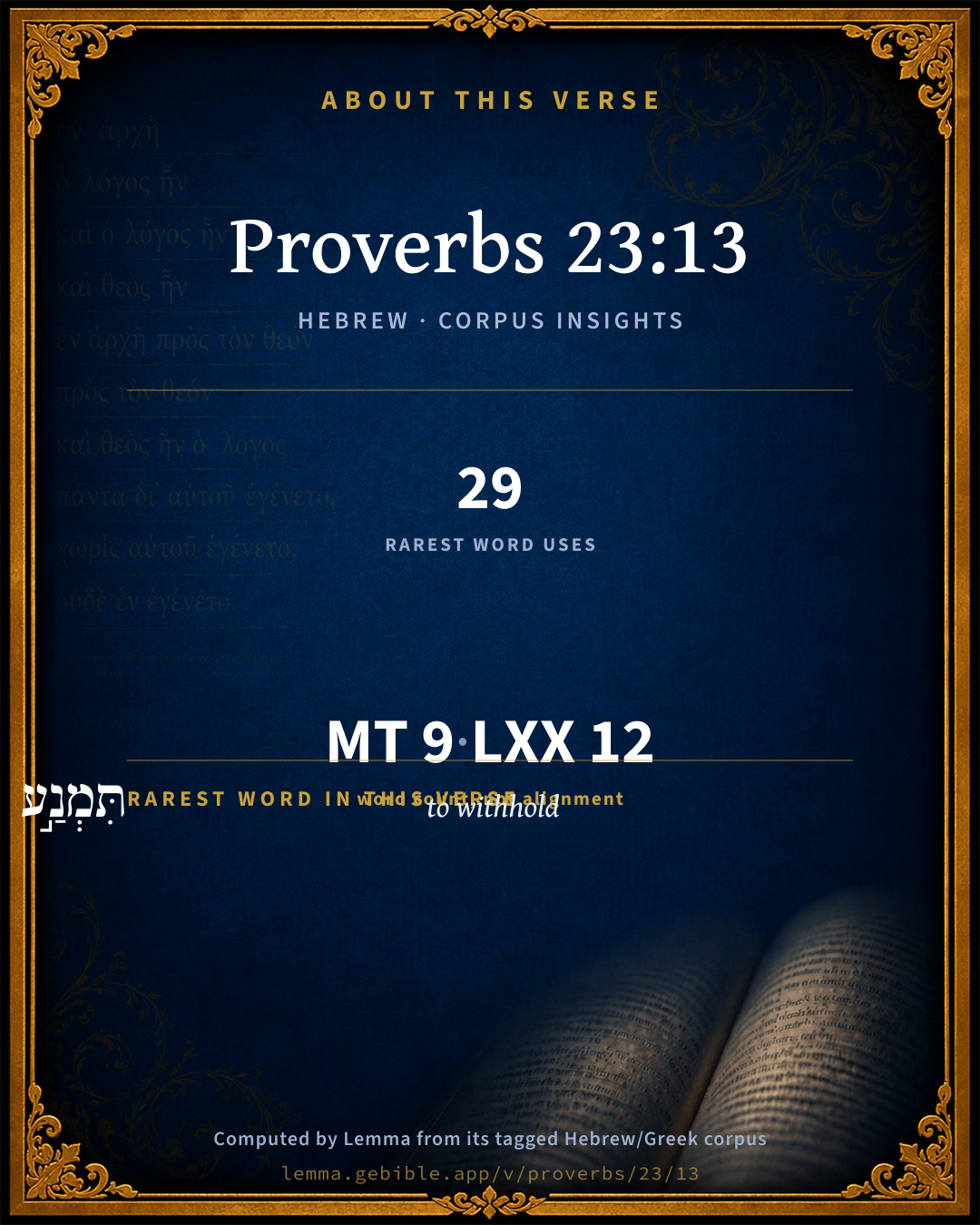
תִּמְנַ֣ע to withhold H4513 occurs in 29 verses of the Hebrew Bible. Also found in:

Grammatical profile

  • 3 verbs
  • 3 nouns
  • 1 conjunction
  • 2 particles

Verb forms

  • תִּמְנַ֣ע Qal · Jussive
  • תַכֶּ֥נּוּ Hiphil · Imperfect
  • יָמֽוּת Qal · Imperfect

Hebrew & Septuagint length

In English translation the verse runs 17 words from the Hebrew and 18 from the Septuagint (LXX English) — closely comparable.

A rough comparison of the two English renderings, which tokenize alike — not a word-level alignment.

Word counts can differ between the Hebrew and the Greek without any difference in meaning — e.g. the Hebrew direct-object marker אֵת has no separate Greek word, and Greek often adds the article ὁ.

In the original languages it is 9 Hebrew tokens and 12 Greek tokens — but the two are counted differently (Hebrew bundles its prefixes and suffixes into one token; the Greek is in lemma form), so that isn’t a like-for-like length.

Cross-references

4

Topical passages linked to Proverbs 23:13 in the Treasury of Scripture Knowledge — connected by theme and wording, ordered by reader-vote popularity; previews shown in the World English Bible.

  • Proverbs 13:24 One who spares the rod hates his son, But one who loves him is careful to discipline him.
  • Proverbs 19:18 Discipline your son, for there is hope; Don't be a willing party to his death.
  • Proverbs 29:15 The rod of correction gives wisdom, But a child left to himself causes shame to his mother.
  • Proverbs 29:17 Correct your son, and he will give you peace; Yes, he will bring delight to your soul.

Cross-references courtesy of OpenBible.info (CC BY 4.0).

Hebrew and Greek witnesses Masoretic Hebrew ↔ Greek Septuagint

The same verse in the two great witnesses to the Old Testament, shown verse-for-verse.

These are two independent witnesses, not word-aligned to each other, and the Septuagint is shown in lemma (dictionary) form.

Hebrew Proverbs 23:13 Masoretic · Westminster Leningrad Codex

אַל תִּמְנַ֣ע מִנַּ֣עַר מוּסָ֑ר כִּֽי תַכֶּ֥נּוּ בַ֝שֵּׁ֗בֶט לֹ֣א יָמֽוּת

Don't withhold correction from a child. If you punish him with the rod, he will not die.

World English Bible · Public Domain

Greek LXX Proverbs 23:13 Septuagint · lemma form

μή ἀποἔχω νήπιος παιδεύω ὅτι ἐάν πατάσσω αὐτός ῥάβδος οὐ μή ἀποθνήσκω

Refrain not from chastening a child; for if you beat him with the rod, he shall not die.

LXX2012 (modern English Septuagint) · Public Domain

Hebrew: Westminster Leningrad Codex (CC BY 4.0). Greek: Septuagint (public domain); English from LXX2012 (modern English Septuagint) (Public Domain). How the Septuagint differs from the Hebrew →

Commentary

Notes on Proverbs 23:13 from classic Christian and Jewish commentators (each source and its license shown beneath its notes). The classic Christian expositions comment on the surrounding passage and are grouped to its opening verse, so a note may address several verses; the Jewish commentaries on the Tanakh (Rashi and others) are per-verse, so they appear only where the commentator wrote on this verse.

Lemma curates 59 commentaries, every one of them public domain or Creative Commons licensed, each selected and text-cleaned for this edition rather than reprinted as found. About our sources →

Trapp's Complete Commentary

John Trapp

Pro 23:13 Withhold not correction from the child: for [if] thou beatest him with the rod, he shall not die.

Ver. 13. Withhold not correction from the child.] {See Trapp on "Pro 13:24"}

He shall not die.] Or if he do, yet not by thy default. Thou hast delivered thine own soul howsoever. If a blackmore enter into the bath, though he become not white by it, yet the bath master hath his pay, saith Keyserspergius. The physician hath his fee whether the patient recover or die.

John Trapp, A Commentary or Exposition upon All the Books of the Old and New Testament (1647–1656) — public domain. Text from a community e-Sword module.

Whedon's Commentary on the Bible

Daniel D. Whedon

13, 14. Withhold not correction — Solomon did not trust wholly to moral suasion in the education of children, but insisted on the rod as necessary for the salvation of the child. Compare Pro_13:24; Pro_19:18; Pro_22:15; Pro_29:15; on Pro_23:13; Pro_3:27. Not that all children need it, but some assuredly do. “By the neglect of early correction the passions obtain the ascendency, the temper becomes irascible, peevish, querulous; pride is nourished, humility destroyed; and by the habit of indulgence the mind is incapacitated to bear with firmness and equanimity the cares and sorrows, the checks and disappointments, to which flesh is heir.” — Holden. Comp. Pro_4:13; Pro_15:24; Pro_7:27, seq. Pro_9:18.

Daniel D. Whedon (gen. ed.), Commentary on the Old and New Testaments (1874–1909) — public domain. Text from a community e-Sword module.

Tyndale Open Study Notes

Tyndale Open Resources

23:13-14 Saying 12: See 19:18; 29:17.

Tyndale Open Study Notes — © Tyndale Open Resources, licensed CC BY-SA 4.0. Text via the HelloAO Bible API.

Jamieson, Fausset & Brown

Robert Jamieson, A. R. Fausset & David Brown

While there is little danger that the use of the "divine ordinance of the rod" will produce bodily harm, there is great hope of spiritual good.

Jamieson, Fausset & Brown — Commentary Critical and Explanatory on the Whole Bible (1871) — public domain (CC PDM 1.0). Text via the HelloAO Bible API.

Ellicott's Commentary for English Readers

(13) He shall not die—i.e., a moderate correction, such as that advised in Pro_19:18 (see note), will not injure him—quite the reverse.

A Bible Commentary for English Readers, edited by Charles John Ellicott (1878–1897) — public domain. Text from a community e-Sword module.

The Cambridge Bible for Schools and Colleges

gen. ed. J. J. S. Perowne

13. if thou beatest him] Or, though, R.V. marg., meaning thou needest not to be afraid that corporal punishment will result in death. It is better, however, to understand death here as the consequence of the sin, into which, if allowed to go uncorrected, he will fall. See Pro_19:18 note. This view is borne out by the next verse here.

Pro_23:15-35. The style of composition changes from separate proverbs or wise maxims to a continuous address, not unlike chaps. 1–9 in character.

The Cambridge Bible for Schools and Colleges (gen. ed. J. J. S. Perowne; Cambridge University Press, 1878–1918) — public domain. Text from a community e-Sword module.

John Gill's Exposition

Withhold not correction from the child,.... When he has committed a fault, and correction is necessary; for to spare it is the ruin of the child, and no proof of true affection in the parent, but the reverse; see Pro 13:24;

for, if thou beatest him with a rod, he shall not die; if he be beaten moderately, there is no danger of his dying under the rod, or with the stripes given him; besides, such moderate and proper corrections may be a means of preserving him from such crimes as would bring him to a shameful and untimely death, and so he shall not die such a death; and by such means, through the grace of God, he may escape the second, or eternal death.

John Gill's Exposition of the Whole Bible (1746–1763) — public domain (CC PDM 1.0). Text via the HelloAO Bible API.

Albert Barnes' Notes on the Bible

i. e., “You will not kill your son by scourging him, you may kill him by with holding the scourge.”

Pro 23:14

Hell - Sheol, the world of the dead.

Albert Barnes' Notes on the Bible (1834–1885) — public domain. Text from a community e-Sword/MySword module.

Matthew Poole's English Annotations

It is a likely mean to prevent their corruption, and the destruction which commonly follows it, as the next verse explains this.

Matthew Poole's English Annotations on the Holy Bible (1683–1685) — public domain. Text from a community e-Sword/MySword module.

The Pulpit Commentary

An injunction to the tutor or parent. (comp. Pro_13:24 Pro_19:18 Pro_22:15 Pro_29:17) For if thou beatest him with the rod, he shall not die. This has been understood in various senses; e.g. "Though than scourge him, that correction will not kill him; ... If thou chastise him, thou wilt save him from the doom of the rebellious son"; (Deu_21:18-21) or, "He shall not die eternally," which rather anticipates the conclusion in the next verse. The expression merely means Do not be weak, thinking that you will injure your child by judicious correction, and in this fear withholding your hand; but punish him firmly when necessary, and, far from harming him, you will be doing him the greatest good.

Vers. 13, 14. See homily on Pro_13:24. C.

The Pulpit Commentary (1880–1919), ed. H.D.M. Spence-Jones & Joseph S. Exell — public domain. Text from a community e-Sword module.

John Wesley's Explanatory Notes

Shall not die - It is a likely way to prevent his destruction.

John Wesley, Explanatory Notes Upon the Whole Bible (1754–1765) — public domain. Text via the GEBible commentary corpus.

Keil & Delitzsch

C. F. Keil & F. Delitzsch

13 Withhold not correction from the child;

For thou will beat him with the rod, and he will not die.

14 Thou beatest him with the rod,

And with it deliverest his soul from hell.

The exhortation, 13a, presupposes that education by word and deed is a duty devolving on the father and the teacher with regard to the child. In 13b, כּי is in any case the relative conjunction. The conclusion does not mean: so will he not fall under death (destruction), as Luther also would have it, after Deu 19:21, for this thought certainly follows Pro 23:14; nor after Pro 19:18 : so may the stroke not be one whereof he dies, for then the author ought to have written אל־תּמיתנּוּ; but: he will not die of it, i.e., only strike if he has deserved it, thou needest not fear; the bitter medicine will be beneficial to him, not deadly. The אתּה standing before the double clause, Pro 23:14, means that he who administers corporal chastisement to the child, saves him spiritually; for שׁאול does not refer to death in general, but to death falling upon a man before his time, and in his sins, vid., Pro 15:24, cf. Pro 8:26.

Keil & Delitzsch — Biblical Commentary on the Old Testament (1861–1891) — public domain (CC PDM 1.0). Text via the HelloAO Bible API. (Old Testament only.)

Bridges on Proverbs

Charles Bridges

Christian parents do not always recognize the Scriptural standard of discipline. "Foolishness is bound in the heart" of the parent, no less than "of the child." "The wild ass’s colt" (Job 11:12 ) must always need its measure of correction. The rule therefore is, notwithstanding all the pleas of pity and fondness — withhold it not. Do the work wisely, firmly, lovingly. Persevere notwithstanding apparently unsuccessful results. Connect it with prayer, faith, and careful instruction.

We admit that it is revolting to give pain, and call forth the tears of those we so tenderly love. But while hearts are what hearts are, it is not to be supposed that we can train without discipline. If it be asked — will not gentle means be more effectual? Had this been God’s judgment, as a God of mercy, he would not have provided a different regimen. Eli tried them, and the sad issue is written for our instruction.†1 ’Must I then be cruel to my child?’ Nay — God charges thee with cruelty, if thou withhold correction from him. He "goes on in his own foolishness."†2 Except he be restrained, he will die in his sin. God has ordained the rod to purge his sins, and so deliver his soul from hell. What parent then, that trembles for the child’s eternal destiny, can withhold correction? Is it not cruel love, that turns away from painful duty? To suffer sin upon a child, no less than upon a brother, is tantamount to "hating him in our heart."†3 Is it not better that the flesh should smart, than that the soul should die? Is it no sin to omit a means of grace, as divinely appointed, as the word and the sacraments? Is there no danger of fomenting the native wickedness, and thus becoming accessory to the child’s eternal destruction? What if he should reproach thee throughout eternity, for the neglect of that timely correction, which might have delivered his soul from hell? Or even if he be "scarcely saved," may he not charge upon thee much of his increasing difficulty in the ways of God?

Yet let it not be used at all times. Let remonstrance be first tried. Our heavenly Father never stirs the rod with his children, if his gentle voice of instruction prevail. Continual finding fault; applying correction to every slip of childish trifling or troublesome thoughtlessness, would soon bring a callous deadness to all sense of shame. Let it be reserved, at least in its more serious forms, for willfulness. It is medicine, not food; the remedy for the occasional diseases of the constitution, not the daily regimen for life and nourishment. And to convert medicine into daily food, gradually destroys its remedial qualities.

Some parents, indeed, use nothing but correction. They indulge their own passions at the expense of their less guilty children. Unlike our Heavenly Father, they "afflict and grieve their children willingly;"†4 to vent their own anger, not to subdue their children’s sins. Self-recollection is of great moment. ’Am I about to correct for my child’s good?’ An intemperate use of this Scriptural ordinance brings discredit upon its efficacy, and sows the seed of much bitter fruit. Children become hardened under an iron rod. Sternness and severity of manner close up their hearts. It is most dangerous to make them afraid of us. A spirit of bondage and concealment is engendered, often leading to a lie; sowing the seed of hypocrisy — nay, sometimes of disgust, and even of hatred, towards their unreasonable parents. ’If parents,’ — said a wise and godly father — ’would not correct their children except in a praying frame, when they can "lift up their hands without wrath," it would neither provoke God nor them.’†5

Other parents freely threaten the rod, yet withhold it. It was only meant to frighten. It soon becomes an empty and powerless sound. This again contravenes our Great Exemplar. His threatenings are not vain words. If his children will not turn, they will find them faithful and true to their cost. This threatening play is solemn trifling with truth; teaching children by example, what they had learnt from the womb (Psa 58:3 ), to "speak lies." Let our words be considerate, but certain. Let our children know, that they must not trifle either with them or with us. The firmness of truthful discipline alone can convey a wholesome influence. Any defect here is a serious injury.

We must learn however not to expect too much from our children; nor to be unduly depressed by their naughtiness. Yet we must not wink at their sinful follies. We must love them not less, but better. And because we love them, we must not withhold, when needed, correction from them. More painful is the work to ourselves, than to them. Most humbling is it. For since the corrupt root produces the poisoned sap in the bud, what else is it but the correction of our own sin? Yet though "no chastening for the present be joyous, but rather grievous" (Heb 12:11 ); when given in prayer, in wisdom, and in faith, the saving blessing will be vouchsafed.†6 ’Lord, do thou be pleased to strike in with every stroke, that the rod of correction may be a rod of instruction.’†7 ’It is a rare soul’ — said good Bishop Hall — ’that can be kept in constant order without smarting remedies. I confess, mine cannot. How wild had I run, if the rod had not been over me! Every man can say, he thanks God for his ease. For me, I bless God for my trouble.’†8

Footnotes:

†1 1Sa 2:23-25 ; 1Sa 3:13 .

†2 Pro 22:15. Sir 11:10 .

†3 Lev 19:17, with Pro 13:24 .

†4 Contrast Lam 3:33 . Heb 12:10 .

†5 Matthew Henry’s Life, chapter 13.

†6 Compare 1Co 5:5 ; 1Co 11:32 . The Heathen Philosopher adverts to the subject of punishments as an instrument of healing produced by means apparently contrary. - Arist. Eth. ii. 3.

†7 Swinnock’s Christian Man’s Calling, ii. 35.

†8 Silent Thoughts, xxi.

Charles Bridges, An Exposition of the Book of Proverbs (1846) — public domain. Text from a community e-Sword module.

Kretzmann's Popular Commentary

Paul E. Kretzmann

v. 13. Withhold not correction from the child; for if thou beatest him with the rod, he shall not die, that is, the punishment may be bitter, even for the parent, but that fact dare not interfere with the plain duty imposed by the Lord.

Paul E. Kretzmann, Popular Commentary of the Bible (1921–1924) — public domain. Text from a community e-Sword module.

unfoldingWord translationNotes

Door43 World Missions Community

General Information:

These verses continue the "thirty sayings" (Proverbs 22:20).

Do not withhold instruction from a child

The abstract noun "instruction" can be translated as a verb. AT: "Do not neglect to instruct a child" or "Do not refuse to instruct a child" (See: Abstract Nouns)

withhold

refuse to give something that one knows another person needs

rod

piece of wood

It is you who must beat him ... and save his soul

"You are the one who must beat him ... and save his soul." No one else will do it. The hearer is responsible to save the child's soul from Sheol, and the way to save him is to beat him.

save his soul from Sheol

If the hearer beats his children with the rod, they will not die young because they have done foolish or evil things. The word "soul" is a metonym for the person. Sheol is the world of the dead; going to the world of the dead is a euphemism for dying. AT: "you will keep him from the world of the dead" or "you will keep him from dying" (See: Metonymy and Euphemism)

translationWords

discipline

die

save

soul

Hades

unfoldingWord translationNotes — © Distant Shores Media and the Door43 World Missions Community, licensed CC BY-SA 4.0. Source: git.door43.org/Door43/en_tn.

Lesson kit

Teaching starters — assembled from the data on this page, not authored interpretation. Every prompt links to the verse data it draws on. Edit before teaching.

Proverbs, in the Wisdom, opens this verse with 9 words (9 distinct Hebrew lemmas). Its most distinctive word is mânaʻ (“to withhold”). A historical commentator’s framing appears above. Read the whole chapter for the surrounding context.

Discussion questions

  1. The word mânaʻ carries the sense “to withhold.” How does it shape the verse?
  2. Genesis 30:2 shares the word «to withhold» with this verse. How do the two illuminate each other?
  3. These translations render this verse differently. What is at stake in choosing one wording over another?
  4. The verb «תִּמְנַ֣ע» is Qal Jussive. How does its form color the action?
  5. Reading how Trapp's Complete Commentary and Whedon's Commentary on the Bible read this verse, where do the two commentators agree and where do they part?

Things to notice

Reading settings

Reading text

Shown beneath each verse's original-language words.

Old Testament
Old Testament edition

Read the OT as the Masoretic Hebrew (MT) or the Greek Septuagint (LXX).

English shown for the Greek Septuagint (in the Hebrew ↔ Greek comparison).

Comparing translations? Open the Compare panel on any verse page to stack up to four side by side.