
Psalms 105:37

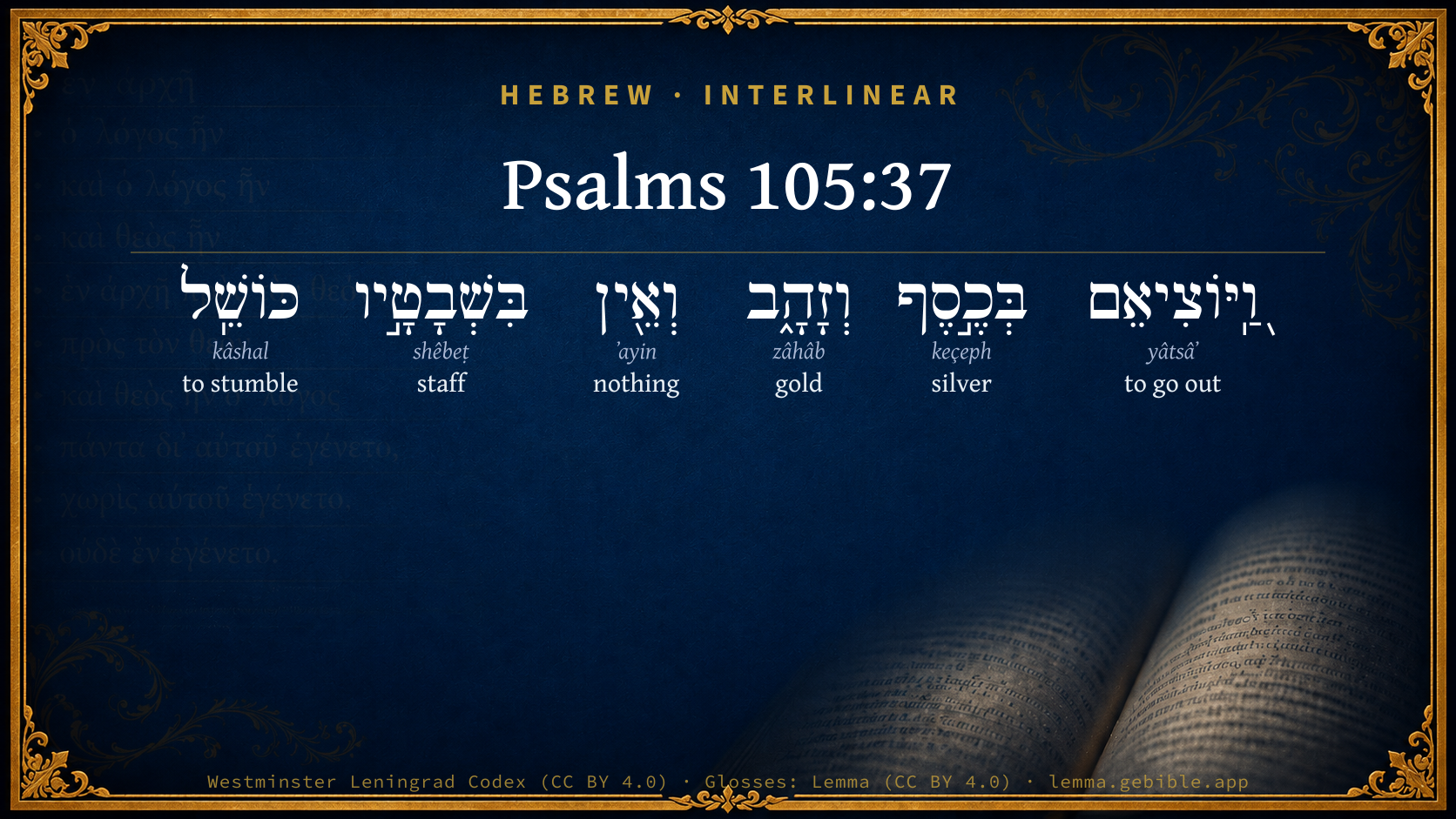
Hebrew (Westminster Leningrad Codex) Psalms 105:37 appears in the Hebrew Old Testament. The text above is from the Westminster Leningrad Codex. Each word links to its Strong’s number, a concise gloss, and parsing drawn from the Open Scriptures Hebrew Bible morphology. Click any word for its full Brown-Driver-Briggs (BDB) entry.
Download image
Cite this verse

Psalms 105:37 (World English Bible). Public Domain. Lemma interlinear Bible study tool, https://lemma.gebible.app/v/psalms/105/37.

Show BibTeX & RIS
BibTeX
RIS
English Translation
He brought them forth with silver and gold. There was not one feeble person among his tribes.
World English Bible · Public Domain
Download a study sheet

One document with this verse’s original text, its word-by-word gloss line, the meaning frame, cross-references with their text, attributed commentary, and full source and license credits — printable, and it pastes into notes with its structure intact.

This verse Autodidact and up

Study sheet (.html) Plain text (.txt)

A passage Seminary Student

Up to 50 verses in one chapter. A passage sheet keeps up to 6 commentary sources and 12 cross-references per verse, in the order this page ranks them, and says so on the sheet whenever that leaves anything out. Ask for a single verse and you get the Autodidact verse sheet above.

Everything on this page stays free to read, with no account — the sheet is a download of what is already on screen, not access to it.

Want to remove ads? Support Godless Engineer
Compare translations 3

The same verse in 3 English versions, stacked beneath the original-language interlinear above. Click any original word for its lexicon entry.

Each is an independent rendering of the whole verse — the interlinear is not word-aligned to these translations.

Highlighted words mark where these versions differ — a whole-verse word diff, not a word-by-word alignment.

  • World English Bible Public Domain
    He brought them forth with silver and gold. There was not one feeble person among his tribes.
  • King James Version Public Domain
    He brought them forth also with silver and gold: and there was not one feeble person among their tribes.
  • unfoldingWord Literal Text CC BY-SA 4.0
    He brought them out with silver and gold; and there was no stumbling among his tribes.

unfoldingWord Literal Text — © unfoldingWord, licensed CC BY-SA 4.0. Word-aligned USFM3 via Door43 (git.door43.org/unfoldingWord/en_ult).

Versions to compare (up to 4)

3 of 4 selected

Show all 18 translations

Every available English version of this verse, each an independent rendering of the whole verse.

  • World English Bible Public Domain
    He brought them forth with silver and gold. There was not one feeble person among his tribes.
  • Berean Standard Bible Public Domain
    He brought Israel out with silver and gold, and none among His tribes stumbled.
  • Majority Standard Bible Public Domain
    He brought Israel out with silver and gold, and none among His tribes stumbled.
  • King James Version Public Domain
    He brought them forth also with silver and gold: and there was not one feeble person among their tribes.
  • American Standard Version (1901) Public Domain
    And he brought them forth with silver and gold; And there was not one feeble person among his tribes.
  • Revised Version (1885) Public Domain
    And he brought them forth with silver and gold: and there was not one feeble person among his tribes.
  • Geneva Bible (1599) Public Domain
    He brought them forth also with siluer and golde, and there was none feeble among their tribes.
  • Douay-Rheims (1899) Public Domain
    And he brought them out with silver and gold: and there was not among their tribes one that was feeble.
  • Young's Literal Translation Public Domain
    And bringeth them out with silver and gold, And there is not in its tribes a feeble one.
  • Literal Standard Version CC BY-SA 4.0
    And brings them out with silver and gold, || And there is not a feeble one in its tribes.
  • Unlocked Literal Bible CC BY-SA 4.0
    He brought the Israelites out with silver and gold; none of his tribes stumbled on the way.
  • unfoldingWord Literal Text CC BY-SA 4.0
    He brought them out with silver and gold; and there was no stumbling among his tribes.
  • Darby Bible Public Domain
    And he brought them forth with silver and gold; and there was not one feeble among their tribes.
  • World Messianic Bible Public Domain
    He brought them out with silver and gold. There was not one feeble person among his tribes.
  • Webster's Bible Public Domain
    He brought them forth also with silver and gold: and there was not one feeble person among their tribes.
  • Free Bible Version CC BY-SA 4.0
    Then he led his people out of Egypt, carrying silver and gold—not one among the tribes was stumbling along.
  • Bible in Basic English Public Domain
    He took his people out with silver and gold: there was not one feeble person among them.
  • JPS Tanakh (1917) Public Domain
    And He brought them forth with silver and gold; and there was none that stumbled among His tribes.

Literal Standard Version (2020), Covenant Press — licensed CC BY-SA 4.0. Text via the HelloAO Bible API (eBible.org). Unlocked Literal Bible (unfoldingWord) — licensed CC BY-SA 4.0. Text via the HelloAO Bible API (eBible.org). unfoldingWord Literal Text — © unfoldingWord, licensed CC BY-SA 4.0. Word-aligned USFM3 via Door43 (git.door43.org/unfoldingWord/en_ult). Free Bible Version, Dr. Jonathan Gallagher — licensed CC BY-SA 4.0. Text via the HelloAO Bible API (eBible.org).

Word by word

More ways to search: Search by grammar → Find every occurrence → Compare this word →

Practice this passage: Drill this verse → Learn its vocabulary →

כּוֹשֵֽׁל
kâshal
H3782
“stumbling”
Verb, Qal, Participle Active, Masculine, Singular, Absolute
Part of Speech
Verb
Stem
Qal
Form
Participle Active
Gender
Masculine
Number
Singular
State
Absolute
Full BDB Definition

Origin: a primitive root

TWOT: 1050

to stumble, stagger, totter - (Qal) - to stumble - to totter - (Niphal) - to stumble - to be tottering, be feeble - (Hiphil) - to cause to stumble, bring injury or ruin to, overthrow - to make feeble, make weak - (Hophal) to be made to stumble - (Piel) bereave
  1. וַֽ֭יּוֹצִיאֵם yâtsâʼ H3318 “and · to go out · them” Conjunction + Verb, Hiphil, Sequential Imperfect, 3rd Person, Masculine, Singular + Suffix, Personal, 3rd Person, Masculine, Plural
  2. בְּכֶ֣סֶף keçeph H3701 “in/at · silver” Preposition + Noun, Common, Masculine, Singular, Absolute
  3. וְזָהָ֑ב zâhâb H2091 “and · gold” Conjunction + Noun, Common, Masculine, Singular, Absolute
  4. וְאֵ֖ין ʼayin H369 “and · nothing” Conjunction + Particle, Negative
  5. בִּשְׁבָטָ֣יו shêbeṭ H7626 “in/at · staffs · his” Preposition + Noun, Common, Masculine, Plural, Construct + Suffix, Personal, 3rd Person, Masculine, Singular

About this verse

These counts appear in no published source. They are computed here, from the morphology-tagged text and Lemma’s own curated glosses. What Lemma adds →

6
words
6
distinct lemmas
Wisdom
section

Grammatical profile

  • 2 verbs
  • 3 nouns
  • 1 particle

Verb forms

  • וַֽ֭יּוֹצִיאֵם Hiphil · Sequential Imperfect
  • כּוֹשֵֽׁל Qal · Participle Active

Hebrew & Septuagint length

In English translation the verse runs 17 words from the Hebrew and 19 from the Septuagint (LXX English) — closely comparable.

A rough comparison of the two English renderings, which tokenize alike — not a word-level alignment.

Word counts can differ between the Hebrew and the Greek without any difference in meaning — e.g. the Hebrew direct-object marker אֵת has no separate Greek word, and Greek often adds the article ὁ.

Cross-references

4

Topical passages linked to Psalms 105:37 in the Treasury of Scripture Knowledge — connected by theme and wording, ordered by reader-vote popularity; previews shown in the World English Bible.

  • Exodus 12:35–36 The children of Israel did according to the word of Moses; and they asked of the Egyptians jewels of silver, and jewels of gold, and clothing.
  • Exodus 3:22 But every woman shall ask of her neighbor, and of her who visits her house, jewels of silver, jewels of gold, and clothing; and you shall put them on your sons, and on your daughters. You shall despoil the Egyptians.
  • Acts 13:17 The God of this people chose our fathers, and exalted the people when they stayed as aliens in the land of Egypt, and with an uplifted arm, he led them out of it.
  • Genesis 15:14 I will also judge that nation, whom they will serve. Afterward they will come out with great substance.

Cross-references courtesy of OpenBible.info (CC BY 4.0).

Hebrew and Greek witnesses Masoretic Hebrew ↔ Greek Septuagint

The same verse in the two great witnesses to the Old Testament, shown verse-for-verse.

You’re reading Greek Psalm 104 (Hebrew Psalm 105). The Septuagint counts the superscription, so verse numbers can differ from the Hebrew — chapter-level alignment, not verse-by-verse. Numbering follows Rahlfs.

These are two independent witnesses, not word-aligned to each other, and the Septuagint is shown in lemma (dictionary) form.

Hebrew Psalms 105:37 Masoretic · Westminster Leningrad Codex

וַֽ֭יּוֹצִיאֵם בְּכֶ֣סֶף וְזָהָ֑ב וְאֵ֖ין בִּשְׁבָטָ֣יו כּוֹשֵֽׁל

He brought them forth with silver and gold. There was not one feeble person among his tribes.

World English Bible · Public Domain

Greek LXX Greek Psalm 104:37 Septuagint · lemma form

καί ἐκἄγω αὐτός ἐν ἀργύριον καί χρυσίον καί οὐ εἰμί ἐν ὁ φυλή αὐτός ἀσθενής

And he brought them out with silver and gold; and there was not a feeble one among their tribes.

LXX2012 (modern English Septuagint) · Public Domain

Hebrew: Westminster Leningrad Codex (CC BY 4.0). Greek: Septuagint (public domain); English from LXX2012 (modern English Septuagint) (Public Domain). How the Septuagint differs from the Hebrew →

Commentary

Notes on Psalms 105:37 from classic Christian and Jewish commentators (each source and its license shown beneath its notes). The classic Christian expositions comment on the surrounding passage and are grouped to its opening verse, so a note may address several verses; the Jewish commentaries on the Tanakh (Rashi and others) are per-verse, so they appear only where the commentator wrote on this verse.

Lemma curates 59 commentaries, every one of them public domain or Creative Commons licensed, each selected and text-cleaned for this edition rather than reprinted as found. About our sources →

Trapp's Complete Commentary

John Trapp

Psa 105:37 He brought them forth also with silver and gold: and [there was] not one feeble [person] among their tribes.

Ver. 37. He brought them forth also with silver and gold] Which they had dearly earned in Egypt, but could not get, till God, the right owner of all, set them in a course, Exo 12:35-36, dispensing with his own law.

There was not one feeble person] But all able and fit for their journey, Viatico et firma valetudine instructi.

John Trapp, A Commentary or Exposition upon All the Books of the Old and New Testament (1647–1656) — public domain. Text from a community e-Sword module.

Joseph Benson's Commentary

Psa 105:37-39. He brought them forth also with silver and gold — Laden with the spoils of their enemies, which God, who is the absolute lord of all property, empowered them to ask and receive of them, and thereby, as a righteous judge, awarded them “the wages due to their great labours, the Egyptians being now willing and ready to furnish them with any thing required in order to dismiss them,” Exo 12:33. There was not one feeble person among them — Diseased or unable for his journey, although it was to be performed on foot; which, in so vast a body, and in a time of such mortality as it had been in Egypt, and among a people which had been so long and so dreadfully oppressed as the Israelites had been, was wonderful. Egypt was glad when they departed — For God had so wonderfully owned them, and pleaded their cause, that the fear of Israel fell upon them, and they owned themselves baffled and overcome. He spread a cloud for a covering — To protect them from the heat of the sun, which, in that hot and open country, would otherwise have been intolerable to them, especially in so long a journey: see on Psa 88:14.

Joseph Benson's Commentary on the Old and New Testaments (1811–1818) — public domain. Text from a community e-Sword module.

J. A. Alexander on Psalms

Joseph Addison Alexander

37. (Psa 105:37) And he brought them out with silver and with gold, and there was not in his tribes a totterer (or stumbler). The first clause relates to the spoiling of the Egyptians, Exo 12:35-36. The last word denotes a person unfit for military service. Compare Isa 5:27.

Joseph Addison Alexander, The Psalms Translated and Explained (1850) — public domain. Text from a community e-Sword module.

Tyndale Open Study Notes

Tyndale Open Resources

105:37-45 The Exodus and the conquest of Canaan fulfilled God’s promise to Abraham, Isaac, and Jacob (105:9-10). Unlike Ps 78, the poet recites the Lord’s goodness without commenting on Israel’s history of rebellion (cp. Ps 106).

105:37 not one . . . stumbled: The Lord protected all of his people (cp. 9:3).

Tyndale Open Study Notes — © Tyndale Open Resources, licensed CC BY-SA 4.0. Text via the HelloAO Bible API.

Geneva Bible (1599)

Geneva Bible translators

When their enemies felt God’s plagues his children by his providence were exempted.

Geneva Bible (1599) marginal notes — public domain. Text via Bolls.life.

John Calvin's Commentaries

37. And he brought them forth with silver and gold The prophet, on the other hand, celebrates the grace of God which preserved the chosen people untouched and safe from all these plagues. If both parties had been indiscriminately afflicted with them, the hand of God would not have been so signally manifest. But now when the Israelites, amidst so many calamities, experienced an entire exemption from harm, this difference exhibits to us, as in a picture, God’s fatherly care about his own people. For this reason, it is stated, Nor was there a feeble person, or one who stumbled; for the verb כשל, kashal, has both these meanings. But I prefer taking it simply in this sense, That whilst Egypt was hastening to destruction, the people of God were vigorous, and free from every malady. When it is said, He brought them forth, and when it is afterwards added, in his tribes, there is a change of the number, which is quite common in the Hebrew language. Some refer the word his to God; but this I am afraid is too forced.

John Calvin's Commentaries (1540-1563) — public domain. Text from the Calvin Translation Society English edition (1840s-50s) via the Christian Classics Ethereal Library (ccel.org). Calvin's coverage is partial (roughly two-thirds of the Bible); uncommented books and verses are honest gaps, never fabricated. The 19th-century editor's footnotes and remarks are omitted so the notes are faithfully Calvin's own voice.

Ellicott's Commentary for English Readers

(37) Feeble person.—Literally, stumbling. (Comp. Isa_5:27 : “None shall be weary or stumble among them,” i.e., none unfit for the march and military duty.)

A Bible Commentary for English Readers, edited by Charles John Ellicott (1878–1897) — public domain. Text from a community e-Sword module.

The Cambridge Bible for Schools and Colleges

gen. ed. J. J. S. Perowne

37. So he brought them forth with silver and gold:

And there was none that stumbled among his tribes.

Israel marched out like a victorious army, with spoils which were virtually the reward of their long compulsory service (Exo_12:35-36); like a host of warriors in which none are faint or weary (Isa_5:27).

his tribes] Jehovah’s tribes (Psa_122:4) rather than Israel’s (Num_24:2).

37–45. The Exodus, the miracles of the wilderness, and the settlement in Canaan.

The Cambridge Bible for Schools and Colleges (gen. ed. J. J. S. Perowne; Cambridge University Press, 1878–1918) — public domain. Text from a community e-Sword module.

John Gill's Exposition

Egypt was glad when they departed,.... The Egyptians, as the Targum; they were glad when the Israelites were gone, for whose sake they had been so much and so long plagued. So wicked men are glad to be rid of the company of good men, which is very disagreeable to them; so the Gergesenes were glad when Christ departed out of their coasts, which they requested he would. So the inhabitants of the earth will rejoice, be merry, and send gifts one to another, when the witnesses are slain, the two prophets that tormented them with their doctrines and religious lives.

For the fear of them fell upon them; their firstborn being slain, they looked upon themselves as dead men; and feared that, if the Israelites stayed, their lives must go next; and therefore being seized with a panic they were urgent upon them to depart; not out of any good will to them, but through fear of them, Exo 12:33.

John Gill's Exposition of the Whole Bible (1746–1763) — public domain (CC PDM 1.0). Text via the HelloAO Bible API.

Albert Barnes' Notes on the Bible

He brought them forth also with silver and gold - Which they had begged of the Egyptians. In Exo 12:35, it is said, in our translation, that they had “borrowed” this gold and silver, together with raiment, of the Egyptians. This is an unhappy translation, as our word “borrow” means to ask anything of another for the purpose of using it for a time, with an implied understanding that it shall be returned, if an article to be used - or that as much money shall be repaid, if it is money that is borrowed - and according to this there would have been dishonesty and fraud on the part of the Israelites in “borrowing” these things of the Egyptians, when not intending (as they evidently did not) to return them. The Hebrew word, however, in Exo 12:35 - שׁאל shâ'al - means merely to ask, “to demand, to require, to request, to perition, to beg.” The idea of an obligation to “return” the things, as in our word “borrow,” is not attached to the Hebrew word.

And there was not one feeble person ... - literally, Not one who was lame; or, who halted, or staggered. This, of course, is not necessarily to be understood literally. It is a general description of the capability of the people for traveling, or for war.

Albert Barnes' Notes on the Bible (1834–1885) — public domain. Text from a community e-Sword/MySword module.

Matthew Poole's English Annotations

Feeble person; diseased or unable for his journey; which in so vast a body, and in a time of such mortality as it had been in Egypt, and in a people which had been so long and so dreadfully oppressed as the Israelites were, was wonderful; but they all journeyed on foot, Exo 12:37.

Matthew Poole's English Annotations on the Holy Bible (1683–1685) — public domain. Text from a community e-Sword/MySword module.

The Treasury of David

Charles H. Spurgeon

Ver. 37. He brought them forth also with silver and gold. This they asked of the Egyptians, perhaps even demanded, and well they might, for they had been robbed and spoiled for many a day, and it was not meet that they should go forth empty handed. Glad were the Egyptians to hand over their jewels to propitiate a people who had such a terrible friend above; they needed no undue pressure, they feared them too much to deny them their requests. The Israelites were compelled to leave their houses and lands behind them, and it was but justice that they should be able to turn these into portable property.

And there was not one feeble person among their tribes a great marvel indeed. The number of their army was very great and yet there was not one in hospital, not one carried in an ambulance, or limping in the rear. Poverty and oppression had not enfeebled them. JEHOVAH ROPHI had healed them; they carried none of the diseases of Egypt with them, and felt none of the exhaustion which sore bondage produces. When God calls his people to a long journey he fits them for it; in the pilgrimage of life our strength shall be equal to our day. See the contrast between Egypt and Israelin Egypt one dead in every house, and among the Israelites not one so much as limping.

Ver. 37. There was not one feeble person among their tribes, when Israel came out of Egypt; there was while dwelling there: so there shall be no feeble saint go to heaven, but they shall be perfect when carried hence by the angels of God, though they complain of feebleness here. "There shall be no more thence an infant of days, nor an old man that hath not filled his days: for the child shall die an hundred years old; "Isa 65:20. As there is in all dying or departed persons a great shooting in their stature observed; so is there in the soul much more. The least infant shoots in the instant of dissolution to such a perfect knowledge of God, and such a measure of grace is not attainable here, that he is "as David; "and the tallest Christian comes to such a height, that he is "as an angel of God, "Zec 7:8. John Sheffield, in "The Rising Sun, "1654.

Ver. 37. There was not one feeble person among their tribes. They came out all in good health, and brought not with them any of the diseases of Egypt. Surely never was the like; that among so many thousands there was not one sick! so false was the representation which the Jews' enemies in after ages gave of the matter, that they were all sick of a leprosy, or some loathsome disease, and therefore the Egyptians thrust them out of their land. Matthew Henry.

Ver. 37. Feeble person. A totterer or stumbler. The word denotes a person unfit for military service. Joseph Addison Alexander.

Ver. 37 (first clause). Wealth found upon us after affliction.

Ver. 37 (second clause). A consummation to be desired. This was the direct result of the divine presence. The circumstances out of which it grew were hard labour, and persecution. It enabled them to leave Egypt, to journey far, to carry burdens, to fight enemies, etc.

Psalms 105:38*

Charles H. Spurgeon's The Treasury of David (1869–1885) — public domain. Psalms only. Text from a community e-Sword/MySword module.

Whedon's Commentary on the Bible

Daniel D. Whedon

37. With silver and gold—God had promised Abraham (Gen_15:14) that his descendants should “come out of Egypt with great substance;” and again to Moses, “When ye go ye shall not go empty.”

Exo_3:21. The words “silver and gold” refer to Exo_11:2; Exo_12:35, where the Hebrew word is not “borrow,” but ask, require; and in Psa_105:36, where the word is rendered lent, the Hiphil form of the verb means, to suffer to ask; literally, to cause to ask, that is, to lend a willing ear to the asker, and to grant his request. “No proof can be brought that the word means to lend, as is commonly supposed. The word occurs again in 1Sa_1:28, and there it means to grant or give.”—Keil and Delitzsch.

Daniel D. Whedon (gen. ed.), Commentary on the Old and New Testaments (1874–1909) — public domain. Text from a community e-Sword module.

The Pulpit Commentary

He brought them forth also with silver and gold. (Exo_12:35, Exo_12:36; comp. Exo_3:21, Exo_3:22) And there was not one feeble person among their tribes; literally, there was not one that stumbled among their tribes, or among his tribes. Probably there were many feeble persons, who were carried on beasts of burden, or in carts, or by their friends. But all those who walked had strength given to them, and did not stumble by the way. (comp. Isa_5:27)

The Pulpit Commentary (1880–1919), ed. H.D.M. Spence-Jones & Joseph S. Exell — public domain. Text from a community e-Sword module.

John Wesley's Explanatory Notes

Feeble - Diseased or unable for his journey: which in so vast a body, and in a people who had been so dreadfully oppressed, was wonderful.

John Wesley, Explanatory Notes Upon the Whole Bible (1754–1765) — public domain. Text via the GEBible commentary corpus.

unfoldingWord translationNotes

Door43 World Missions Community

He brought the Israelites out with silver and gold

When the Israelites left Egypt they took silver and gold with them. AT: "He brought the Isrealites out of Egypt with silver and gold in their possession" (See: Assumed Knowledge and Implicit Information)

none of his tribes stumbled on the way

No one was left behind. This can be stated positively AT: "all of his tribes was able to make the journey" (See: Double Negatives)

Egypt was glad

Here "Egypt" refers to the people who live in Egypt. AT: The people of Egypt were glad (See: Metonymy)

He spread a cloud for a covering

Here the psalmist describes Yahweh placing a cloud in the sky as if he were spreading out a garment. The cloud was a "covering" to protect them from the sun. AT: "He placed a cloud in the sky to protect them from the sun and heat" (See: Metaphor and Assumed Knowledge and Implicit Information)

made a fire to light up the night

Yahweh placed a pillar of fire in the sky to give light during the night. AT: "placed a fire it the sky to light up the night" (See: Assumed Knowledge and Implicit Information)

translationWords

Israel

silver

gold

tribe

Egypt

fear

fire

unfoldingWord translationNotes — © Distant Shores Media and the Door43 World Missions Community, licensed CC BY-SA 4.0. Source: git.door43.org/Door43/en_tn.

Lesson kit

Teaching starters — assembled from the data on this page, not authored interpretation. Every prompt links to the verse data it draws on. Edit before teaching.

Psalms, in the Wisdom, opens this verse with 6 words (6 distinct Hebrew lemmas). Its most distinctive word is kâshal (“to stumble”). A historical commentator’s framing appears above. Read the whole chapter for the surrounding context.

Discussion questions

  1. How does “to stumble” (kâshal) shape what this verse is saying?
  2. Exodus 12:35–36 shares this passage’s theme. How do the two illuminate each other?
  3. These translations render this verse differently; the difference is in the English rendering, not the original. What questions does that raise?
  4. The verb «וַֽ֭יּוֹצִיאֵם» is Hiphil Sequential Imperfect. How does its form color the action?
  5. Reading how Trapp's Complete Commentary and Joseph Benson's Commentary read this verse, where do the two commentators agree and where do they part?

Things to notice

Reading settings

Reading text

Shown beneath each verse's original-language words.

Old Testament
Old Testament edition

Read the OT as the Masoretic Hebrew (MT) or the Greek Septuagint (LXX).

English shown for the Greek Septuagint (in the Hebrew ↔ Greek comparison).

Comparing translations? Open the Compare panel on any verse page to stack up to four side by side.