
1 Kings 11:13

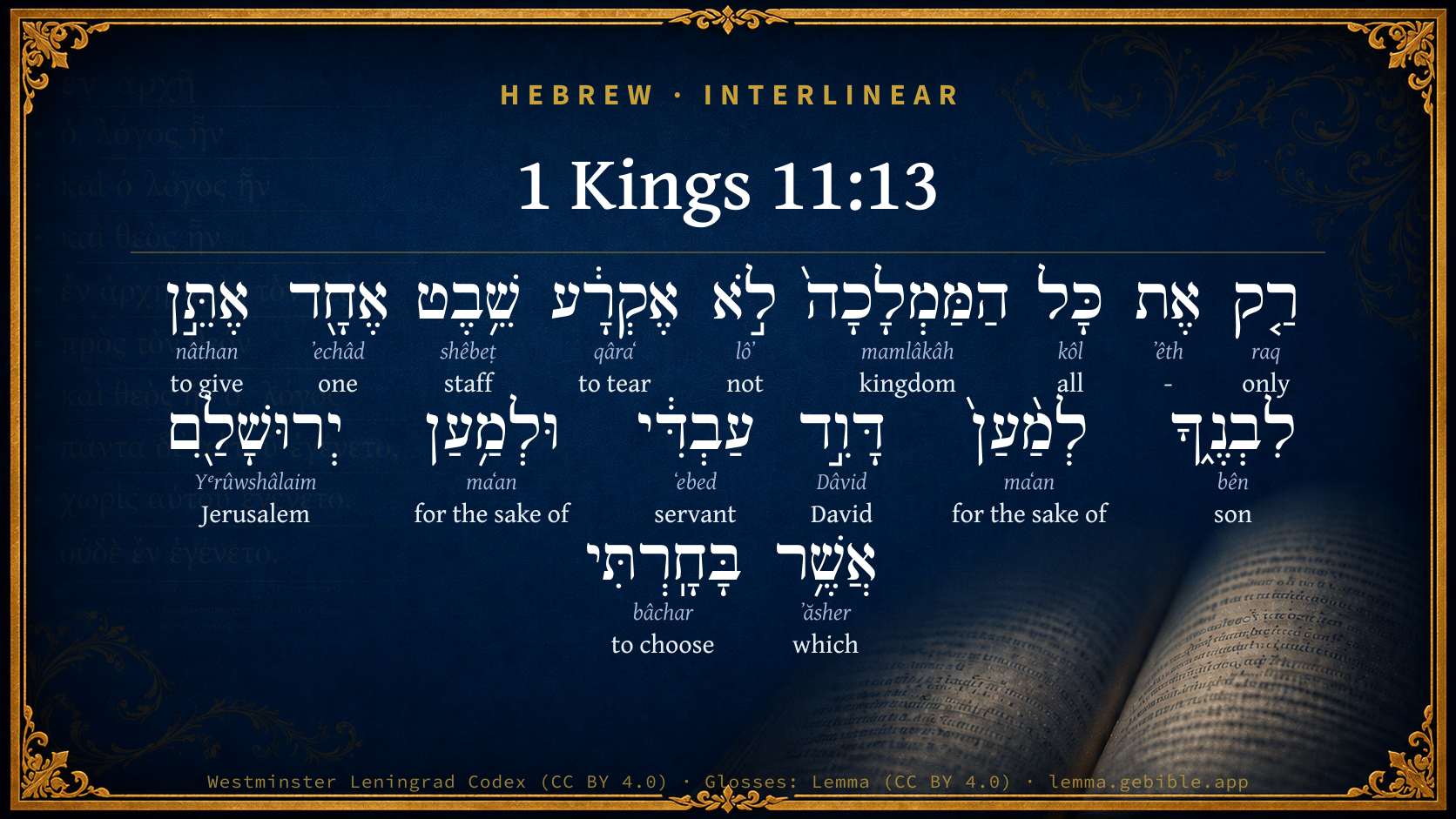
Hebrew (Westminster Leningrad Codex) 1 Kings 11:13 appears in the Hebrew Old Testament. The text above is from the Westminster Leningrad Codex. Each word links to its Strong’s number, a concise gloss, and parsing drawn from the Open Scriptures Hebrew Bible morphology. Click any word for its full Brown-Driver-Briggs (BDB) entry.
Download image
Cite this verse

1 Kings 11:13 (World English Bible). Public Domain. Lemma interlinear Bible study tool, https://lemma.gebible.app/v/1-kings/11/13.

Show BibTeX & RIS
BibTeX
RIS
English Translation
However I will not tear away all the kingdom; but I will give one tribe to your son, for David my servant's sake, and for Jerusalem's sake which I have chosen.
World English Bible · Public Domain
Download a study sheet

One document with this verse’s original text, its word-by-word gloss line, the meaning frame, cross-references with their text, attributed commentary, and full source and license credits — printable, and it pastes into notes with its structure intact.

This verse Autodidact and up

Study sheet (.html) Plain text (.txt)

A passage Seminary Student

Up to 50 verses in one chapter. A passage sheet keeps up to 6 commentary sources and 12 cross-references per verse, in the order this page ranks them, and says so on the sheet whenever that leaves anything out. Ask for a single verse and you get the Autodidact verse sheet above.

Everything on this page stays free to read, with no account — the sheet is a download of what is already on screen, not access to it.

Want to remove ads? Support Godless Engineer
Compare translations 3

The same verse in 3 English versions, stacked beneath the original-language interlinear above. Click any original word for its lexicon entry.

Each is an independent rendering of the whole verse — the interlinear is not word-aligned to these translations.

Highlighted words mark where these versions differ — a whole-verse word diff, not a word-by-word alignment.

  • World English Bible Public Domain
    However I will not tear away all the kingdom; but I will give one tribe to your son, for David my servant's sake, and for Jerusalem's sake which I have chosen.
  • King James Version Public Domain
    Howbeit I will not rend away all the kingdom; but will give one tribe to thy son for David my servant's sake, and for Jerusalem's sake which I have chosen.
  • unfoldingWord Literal Text CC BY-SA 4.0
    Only I will not tear away all of the kingdom. I will give one tribe to your son for the sake of David my servant and for the sake of Jerusalem, which I have chosen.”

unfoldingWord Literal Text — © unfoldingWord, licensed CC BY-SA 4.0. Word-aligned USFM3 via Door43 (git.door43.org/unfoldingWord/en_ult).

Versions to compare (up to 4)

3 of 4 selected

Show all 18 translations

Every available English version of this verse, each an independent rendering of the whole verse.

  • World English Bible Public Domain
    However I will not tear away all the kingdom; but I will give one tribe to your son, for David my servant's sake, and for Jerusalem's sake which I have chosen.
  • Berean Standard Bible Public Domain
    Yet I will not tear the whole kingdom away from him. I will give one tribe to your son for the sake of My servant David and for the sake of Jerusalem, which I have chosen.”
  • Majority Standard Bible Public Domain
    Yet I will not tear the whole kingdom away from him. I will give one tribe to your son for the sake of My servant David and for the sake of Jerusalem, which I have chosen.”
  • King James Version Public Domain
    Howbeit I will not rend away all the kingdom; but will give one tribe to thy son for David my servant's sake, and for Jerusalem's sake which I have chosen.
  • American Standard Version (1901) Public Domain
    Howbeit I will not rend away all the kingdom; but I will give one tribe to thy son, for David my servant's sake, and for Jerusalem's sake which I have chosen.
  • Revised Version (1885) Public Domain
    Howbeit I will not rend away all the kingdom; but I will give one tribe to thy son, for David my servant’s sake, and for Jerusalem’s sake which I have chosen.
  • Geneva Bible (1599) Public Domain
    Howbeit I wil not rent all the Kingdome, but will giue one tribe to thy sonne, because of Dauid my seruant, and because of Ierusalem which I haue chosen.
  • Douay-Rheims (1899) Public Domain
    Neither will I take away the whole kingdom, but I will give one tribe to thy son for the sake of David my servant, and Jerusalem which I have chosen.
  • Young's Literal Translation Public Domain
    only all the kingdom I do not rend away; one tribe I give to thy son, for the sake of David My servant, and for the sake of Jerusalem, that I have chosen.'
  • Literal Standard Version CC BY-SA 4.0
    only, I do not tear away all of the kingdom; I give one tribe to your son, for the sake of My servant David, and for the sake of Jerusalem that I have chosen.”
  • Unlocked Literal Bible CC BY-SA 4.0
    Yet I will not tear away all the kingdom; I will give one tribe to your son for David my servant's sake, and for the sake of Jerusalem, which I have chosen.”
  • unfoldingWord Literal Text CC BY-SA 4.0
    Only I will not tear away all of the kingdom. I will give one tribe to your son for the sake of David my servant and for the sake of Jerusalem, which I have chosen.”
  • Darby Bible Public Domain
    only, I will not rend away all the kingdom: I will give one tribe to thy son, for David my servant's sake, and for Jerusalem's sake which I have chosen.
  • World Messianic Bible Public Domain
    However, I will not tear away all the kingdom; but I will give one tribe to your son, for David my servant’s sake, and for Jerusalem’s sake which I have chosen.”
  • Webster's Bible Public Domain
    Yet, I will not rend away all the kingdom; but will give one tribe to thy son for David my servant's sake, and for Jerusalem's sake which I have chosen.
  • Free Bible Version CC BY-SA 4.0
    Even then I will not take away the whole kingdom. I will leave your son with one tribe for the sake of my servant David, and for the sake of my chosen city Jerusalem.”
  • Bible in Basic English Public Domain
    Still I will not take all the kingdom from him; but I will give one tribe to your son, because of my servant David, and because of Jerusalem, the town of my selection.
  • JPS Tanakh (1917) Public Domain
    Howbeit I will not rend away all the kingdom; but I will give one tribe to thy son; for David My servant's sake, and for Jerusalem's sake which I have chosen.'

Literal Standard Version (2020), Covenant Press — licensed CC BY-SA 4.0. Text via the HelloAO Bible API (eBible.org). Unlocked Literal Bible (unfoldingWord) — licensed CC BY-SA 4.0. Text via the HelloAO Bible API (eBible.org). unfoldingWord Literal Text — © unfoldingWord, licensed CC BY-SA 4.0. Word-aligned USFM3 via Door43 (git.door43.org/unfoldingWord/en_ult). Free Bible Version, Dr. Jonathan Gallagher — licensed CC BY-SA 4.0. Text via the HelloAO Bible API (eBible.org).

Word by word

More ways to search: Search by grammar → Find every occurrence → Compare this word →

Practice this passage: Drill this verse → Learn its vocabulary →

אֶקְרָ֔ע
qâraʻ
H7167
“to tear”
Verb, Qal, Imperfect, 1st Person, Common, Singular
Part of Speech
Verb
Stem
Qal
Form
Imperfect
Person
1st Person
Gender
Common
Number
Singular
Full BDB Definition

Origin: a primitive root

TWOT: 2074

to tear, tear in pieces - (Qal) - to tear, rend - to tear away or out - to tear, rend asunder - to make wide or large (of eyes) - to rend open (of heavens) - to tear, rend (of wild beasts) - (Niphal) to be rent, be split asunder
  1. רַ֤ק raq H7535 “only” Particle, Accusative
  2. אֶת ʼêth H853 “-” Particle, Direct Object
  3. כָּל kôl H3605 “all of” Noun, Common, Masculine, Singular, Construct
  4. הַמַּמְלָכָה֙ mamlâkâh H4467 “the · kingdom” Particle, Definite Article + Noun, Common, Feminine, Singular, Absolute
  5. לֹ֣א lôʼ H3808 “not” Particle, Negative
  6. שֵׁ֥בֶט shêbeṭ H7626 “staff” Noun, Common, Masculine, Singular, Absolute
  7. אֶחָ֖ד ʼechâd H259 “one” Adjective, Cardinal number, Masculine, Singular, Absolute
  8. אֶתֵּ֣ן nâthan H5414 “to give” Verb, Qal, Imperfect, 1st Person, Common, Singular
  9. לִבְנֶ֑ךָ bên H1121 “to/for · son · your” Preposition + Noun, Common, Masculine, Singular, Construct + Suffix, Personal, 2nd Person, Masculine, Singular
  10. לְמַ֨עַן֙ maʻan H4616 “for the sake of” Preposition
  11. דָּוִ֣ד Dâvid H1732 “David” Noun, Proper
  12. עַבְדִּ֔י ʻebed H5650 “servant · my” Noun, Common, Masculine, Singular, Construct + Suffix, Personal, 1st Person, Common, Singular
  13. וּלְמַ֥עַן maʻan H4616 “and · for the sake of” Conjunction + Preposition
  14. יְרוּשָׁלִַ֖ם Yᵉrûwshâlaim H3389 “Jerusalem” Noun, Proper
  15. אֲשֶׁ֥ר ʼăsher H834 “which” Particle, Relative
  16. בָּחָֽרְתִּי bâchar H977 “to choose” Verb, Qal, Perfect, 1st Person, Common, Singular

About this verse

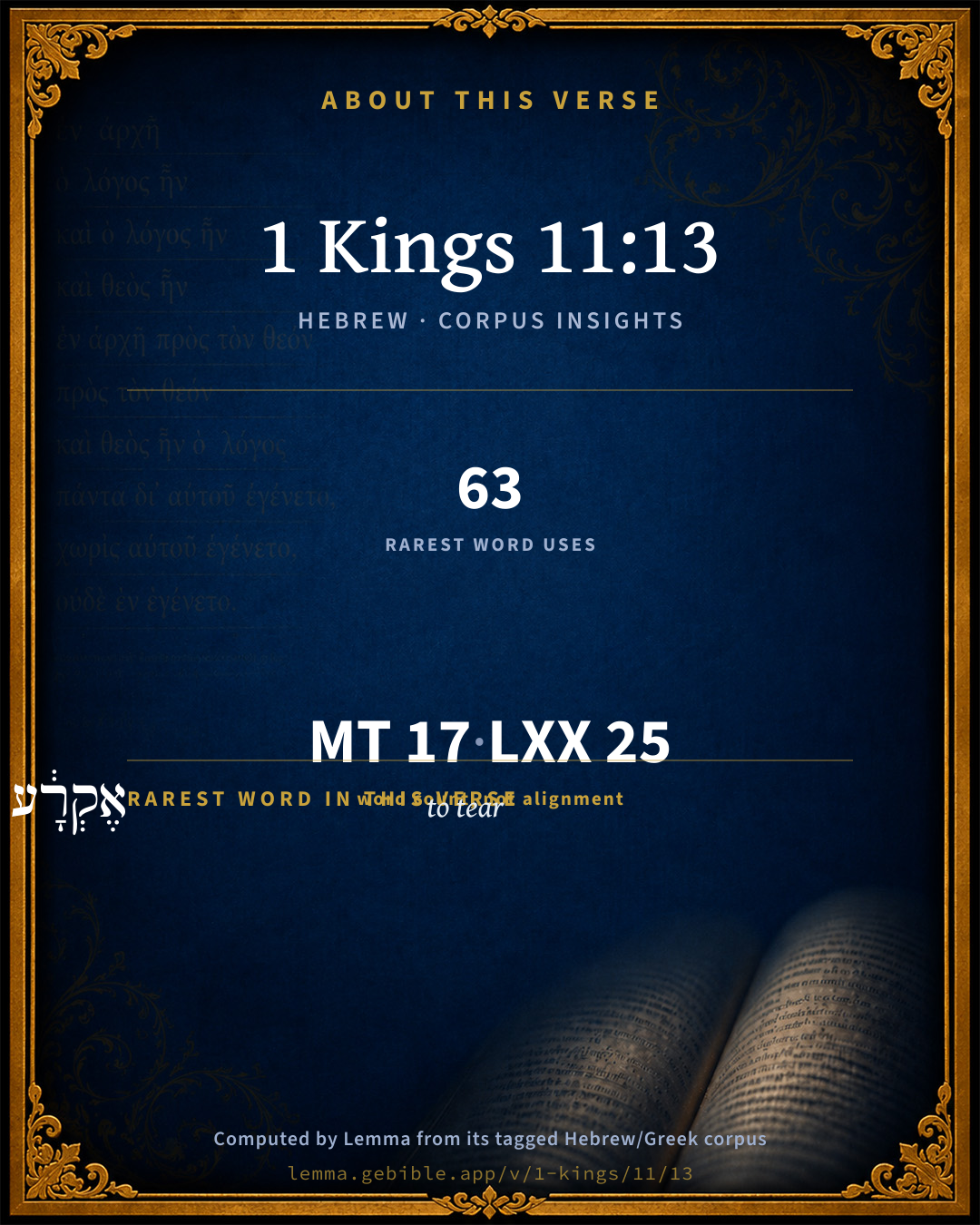
These counts appear in no published source. They are computed here, from the morphology-tagged text and Lemma’s own curated glosses. What Lemma adds →

17
words
16
distinct lemmas
Historical
section

Grammatical profile

  • 3 verbs
  • 7 nouns
  • 1 adjective
  • 2 prepositions
  • 4 particles

Verb forms

  • אֶקְרָ֔ע Qal · Imperfect
  • אֶתֵּ֣ן Qal · Imperfect
  • בָּחָֽרְתִּי Qal · Perfect

Repetition

A word recurs within this verse — often emphatic in Hebrew:

  • לְמַ֨עַן֙ for the sake of H4616 ×2

Hebrew & Septuagint length

In English translation the verse runs 31 words from the Hebrew and 34 from the Septuagint (LXX English) — closely comparable.

A rough comparison of the two English renderings, which tokenize alike — not a word-level alignment.

Word counts can differ between the Hebrew and the Greek without any difference in meaning — e.g. the Hebrew direct-object marker אֵת has no separate Greek word, and Greek often adds the article ὁ.

In the original languages it is 17 Hebrew tokens and 25 Greek tokens — but the two are counted differently (Hebrew bundles its prefixes and suffixes into one token; the Greek is in lemma form), so that isn’t a like-for-like length.

Cross-references

25

Topical passages linked to 1 Kings 11:13 in the Treasury of Scripture Knowledge — connected by theme and wording, ordered by reader-vote popularity; previews shown in the World English Bible.

  • 1 Kings 12:20 It happened, when all Israel heard that Jeroboam was returned, that they sent and called him to the congregation, and made him king over all Israel: there was none who followed the house of David, but the tribe of Judah only.
  • Deuteronomy 12:11 then it shall happen that to the place which Yahweh your God shall choose, to cause his name to dwell there, there shall you bring all that I command you: your burnt offerings, and your sacrifices, your tithes, and the heave-offering of your hand, and all your choice vows which you vow to Yahweh.
  • 1 Kings 11:32 (but he shall have one tribe, for my servant David's sake and for Jerusalem's sake, the city which I have chosen out of all the tribes of Israel);
  • Deuteronomy 12:5 But to the place which Yahweh your God shall choose out of all your tribes, to put his name there, even to his habitation shall you seek, and there you shall come;
  • Psalms 132:13–14 For Yahweh has chosen Zion. He has desired it for his habitation.
  • Luke 1:32–33 He will be great, and will be called the Son of the Most High. The Lord God will give him the throne of his father, David,
  • Isaiah 62:7 and give him no rest, until he establish, and until he make Jerusalem a praise in the earth.
  • Jeremiah 33:15–26 In those days, and at that time, will I cause a Branch of righteousness to grow up to David; and he shall execute justice and righteousness in the land.
  • Deuteronomy 9:5 Not for your righteousness, or for the uprightness of your heart, do you go in to possess their land; but for the wickedness of these nations Yahweh your God does drive them out from before you, and that he may establish the word which Yahweh swore to your fathers, to Abraham, to Isaac, and to Jacob.
  • 2 Samuel 7:15–16 but my loving kindness shall not depart from him, as I took it from Saul, whom I put away before you.
  • 1 Kings 11:11–12 Therefore Yahweh said to Solomon, Because this is done of you, and you have not kept my covenant and my statutes, which I have commanded you, I will surely tear the kingdom from you, and will give it to your servant.
  • 1 Kings 11:35–36 but I will take the kingdom out of his son's hand, and will give it to you, even ten tribes.
  • 1 Kings 11:39 I will for this afflict the seed of David, but not forever.
  • 2 Kings 13:23 But Yahweh was gracious to them, and had compassion on them, and had respect to them, because of his covenant with Abraham, Isaac, and Jacob, and would not destroy them, neither cast he them from his presence as yet.
  • 2 Kings 19:34 For I will defend this city to save it, for my own sake, and for my servant David's sake.
  • 2 Kings 21:4 He built altars in the house of Yahweh, of which Yahweh said, In Jerusalem will I put my name.
  • 2 Kings 23:27 Yahweh said, I will remove Judah also out of my sight, as I have removed Israel, and I will cast off this city which I have chosen, even Jerusalem, and the house of which I said, My name shall be there.
  • 1 Chronicles 17:13–14 I will be his father, and he shall be my son: and I will not take my loving kindness away from him, as I took it from him that was before you;
  • Psalms 89:33–37 But I will not completely take my loving kindness from him, Nor allow my faithfulness to fail.
  • Psalms 89:49 Lord, where are your former loving kindnesses, Which you swore to David in your faithfulness?
  • Psalms 132:1 Yahweh, remember David and all his affliction,
  • Psalms 132:17 There I will make the horn of David to bud. I have ordained a lamp for my anointed.
  • Isaiah 9:7 Of the increase of his government and of peace there shall be no end, on the throne of David, and on his kingdom, to establish it, and to uphold it with justice and with righteousness from henceforth even forever. The zeal of Yahweh of Hosts will perform this.
  • Isaiah 14:32 What then shall one answer the messengers of the nation? That Yahweh has founded Zion, and in her shall the afflicted of his people take refuge.
  • Isaiah 62:1 For Zion's sake will I not hold my peace, and for Jerusalem's sake I will not rest, until her righteousness go forth as brightness, and her salvation as a lamp that burns.

Cross-references courtesy of OpenBible.info (CC BY 4.0).

Hebrew and Greek witnesses Masoretic Hebrew ↔ Greek Septuagint

The same verse in the two great witnesses to the Old Testament, shown verse-for-verse.

These are two independent witnesses, not word-aligned to each other, and the Septuagint is shown in lemma (dictionary) form.

Hebrew 1 Kings 11:13 Masoretic · Westminster Leningrad Codex

רַ֤ק אֶת כָּל הַמַּמְלָכָה֙ לֹ֣א אֶקְרָ֔ע שֵׁ֥בֶט אֶחָ֖ד אֶתֵּ֣ן לִבְנֶ֑ךָ לְמַ֨עַן֙ דָּוִ֣ד עַבְדִּ֔י וּלְמַ֥עַן יְרוּשָׁלִַ֖ם אֲשֶׁ֥ר בָּחָֽרְתִּי

However I will not tear away all the kingdom; but I will give one tribe to your son, for David my servant's sake, and for Jerusalem's sake which I have chosen.

World English Bible · Public Domain

Greek LXX 1 Kings 11:13 Septuagint · lemma form

πλήν ὅλος ὁ βασιλεία οὐ μή λαμβάνω σκῆπτρον εἷς δίδωμι ὁ υἱός σύ διά δαυίδ ὁ δοῦλος ἐγώ καί διά ἰερουσαλήμ ὁ πόλις ὅς ἐκλέγω

Only I will not take away the whole kingdom: I will give one tribe to your son for David my servant's sake, and for the sake of Jerusalem, the city which I have chosen.

LXX2012 (modern English Septuagint) · Public Domain

Hebrew: Westminster Leningrad Codex (CC BY 4.0). Greek: Septuagint (public domain); English from LXX2012 (modern English Septuagint) (Public Domain). How the Septuagint differs from the Hebrew →

Targum (Aramaic paraphrase)

1

The Targum is the ancient Jewish Aramaic paraphrase of the Hebrew Scriptures — an interpretive translation, not the Hebrew text itself. Onkelos (literal) and Pseudo-Jonathan (expansive) render the Torah, and Jonathan the Prophets. Coverage is partial: where no permissively-licensed English translation exists for a verse, only the Aramaic is shown. This is verse-level text, not a word-by-word alignment to the Hebrew.

  1. Targum Jonathan Prophets (Joshua–Malachi)
    לְחוֹד יַת כָּל מַלְכוּתָא לָא אֶעְדֵי שִׁבְטָא חַד אֶתֶּן לִבְרָךְ בְּדִיל דָוִד עַבְדִי וּבְדִיל יְרוּשְׁלֵם קַרְתָּא דְאִתְרְעֵיתִי:

    (no public-domain English translation for this verse)

    Targum Jonathan — Aramaic: “Mikraot Gedolot” (public domain). English: “Sefaria Community Translation” (CC0 1.0 (public-domain dedication)); “London "Chaldee Paraphrase," 1871” (public domain). Text via Sefaria.

Commentary

Notes on 1 Kings 11:13 from classic Christian and Jewish commentators (each source and its license shown beneath its notes). The classic Christian expositions comment on the surrounding passage and are grouped to its opening verse, so a note may address several verses; the Jewish commentaries on the Tanakh (Rashi and others) are per-verse, so they appear only where the commentator wrote on this verse.

Lemma curates 59 commentaries, every one of them public domain or Creative Commons licensed, each selected and text-cleaned for this edition rather than reprinted as found. About our sources →

Trapp's Complete Commentary

John Trapp

1Ki 11:13 Howbeit I will not rend away all the kingdom; [but] will give one tribe to thy son for David my servant’s sake, and for Jerusalem’s sake which I have chosen.

Ver. 13. I will not rend away all.] Here is a second mitigation of the sentence. See 1Ki 11:12. The Lord is gracious and full of compassion: he quickly repenteth him of the evil, and leaveth a blessing behind him.

One tribe.] Benjamin is reckoned as part of Judah, because within him. {Jos 19:1; Jos 19:9}

For David my servant’s sake.] Five times in this chapter is David honoured with this title, and therein God’s dear respects unto him expressed: but all of mere mercy. How this message wrought upon Solomon is uncertain. Some hold that hereupon he repented; others judge otherwise, and that (1.) Because he replied nothing; (2.) Because that after this he sought to slay Jeroboam, to prevent the rending away of his kingdom threatened, as Saul did to slay David.

John Trapp, A Commentary or Exposition upon All the Books of the Old and New Testament (1647–1656) — public domain. Text from a community e-Sword module.

Geneva Bible (1599)

Geneva Bible translators

Because the tribes of Judah and Benjamin had their possessions mixed, they are here taken as one tribe.

Geneva Bible (1599) marginal notes — public domain. Text via Bolls.life.

Jamieson, Fausset & Brown

Robert Jamieson, A. R. Fausset & David Brown

I will give one tribe to thy son--There were left to Rehoboam the tribes of Judah, Benjamin, and Levi (Ch2 11:12-13); and multitudes of Israelites, who, after the schism of the kingdom, established their residence within the territory of Judah to enjoy the privileges of the true religion (Kg1 12:17). These are all reckoned as one tribe.

Jamieson, Fausset & Brown — Commentary Critical and Explanatory on the Whole Bible (1871) — public domain (CC PDM 1.0). Text via the HelloAO Bible API.

Adam Clarke's Commentary

Verse 13. Will give one tribe - for David my servant's sake] The line of the Messiah must be preserved. The prevailing lion must come out of the tribe of Judah: not only the tribe must be preserved, but the regal line and the regal right. All this must be done for the true David's sake: and this was undoubtedly what God had in view by thus miraculously preserving the tribe of Judah and the royal line, in the midst of so general a defection.

And for Jerusalem's sake] As David was a type of the Messiah, so was Jerusalem a type of the true Church: therefore the OLD Jerusalem must be preserved in the hands of the tribe of Judah, till the true David should establish the NEW Jerusalem in the same land, and in the same city. And what a series of providences did it require to do all these things!

Adam Clarke's Commentary on the Bible (1810–1826) — public domain. Text from a community e-Sword/MySword module.

The Cambridge Bible for Schools and Colleges

gen. ed. J. J. S. Perowne

13. but will give one tribe] The reference is to the tribe of Judah from which the southern kingdom took its name. Benjamin which went with Judah was so small as to be hardly worth accounting of, and Simeon was also absorbed in Judah. The same form of words is used below (1Ki_11:32) in the account of Ahijah’s action, though it is expressly said in a previous verse ‘Take thee ten pieces.’ One reason for the close union of Benjamin with Judah was that the territorial division between the two tribes was such as to make the Temple the common property of both. The city of the Jebusite, which David conquered, and all the ground north of the valley of Hinnom was in the tribe of Benjamin.

for Jerusalem’s sake, which I have chosen] In Deu_12:5 it is signified that God will choose some place out of all the tribes ‘to place His name there,’ and in 1Ki_14:21 Jerusalem is expressly called ‘the city which the Lord did choose out of all the tribes of Israel to put His name there.’ Hence the place was an object of Jehovah’s unchanging regard.

The Cambridge Bible for Schools and Colleges (gen. ed. J. J. S. Perowne; Cambridge University Press, 1878–1918) — public domain. Text from a community e-Sword module.

John Gill's Exposition

And the Lord stirred up an adversary unto Solomon, Hadad the Edomite,.... Though he did not take his kingdom from him for his sin, he chastised him with the rod of men, as he said he would; suffering one, and then another, to rise up and disturb his peace in his old age, see Sa2 7:14.

he was of the king's seed in Edom; of the blood royal.

John Gill's Exposition of the Whole Bible (1746–1763) — public domain (CC PDM 1.0). Text via the HelloAO Bible API.

Albert Barnes' Notes on the Bible

One tribe - i. e., (marginal reference) the tribe of Judah. Benjamin was looked upon as absorbed in Judah, so as not to be really a tribe in the same sense as the others. Still, in memory of the fact that the existing tribe of Judah was a double one 1Ki 12:2 l, the prophet Ahijah tore his garment into twelve parts, and kept back two from Jeroboam 1Ki 11:30-31.

Albert Barnes' Notes on the Bible (1834–1885) — public domain. Text from a community e-Sword/MySword module.

Haydock's Catholic Bible Commentary

One tribe. Besides that of Juda, his own native tribe. (Challoner) --- That of Benjamin had been so reduced, that it scarcely deserved the name of a tribe. It was also invariably connected with the adjoining tribe of Juda; as many of the other tribes, after the captivities of Assyria and Babylon, went by the common title of Jews. (Tirinus) --- The Levites, and many of the Israelites, came to inhabit in the land of Juda, for the sake of the true religion, chap. xii. 17., and 2 Paralipomenon xi. 13, 16. Jeroboam banished the tribe of Levi from his dominions, that he might more easily introduce a change of religion among his subjects. The two kingdoms were thus almost equal in strength. (Calmet) --- Chosen for the abode of holiness, and the seat of government. (Salien) --- One tribe....and Jerusalem; which latter may denote the tribe of Benjamin. (Worthington)

George Leo Haydock (1774–1849), Haydock's Catholic Family Bible and Commentary, 1859 edition — public domain. Excludes Psalms (Douay-Rheims chapter numbering differs from Protestant) and Deuterocanonical books (Catholic canon only).

Matthew Poole's English Annotations

How but one tribe, when he had both Judah and Benjamin, 2Ch 11:12?

Answ. Either Benjamin is swallowed up in Judah, because it was comparatively very small, and their habitation much intermixed with that of Judah: or one, to wit, of that kingdom which he here threatens to rend away from him, i.e. of the kingdom of Israel, and that was Benjamin; one beside Judah, which was his own tribe: or but one, because Benjamin was not entirely his, but part of it adhered to Jeroboam, as Beth-el, 1Ki 12:29, and Ephrain, 2Ch 13:19, both which were towns of Benjamin, Jos 18:22. Or if God promised to give one, and gave him two, I suppose that was no great injury to him.

For Jerusalem’s sake; not, surely, for its merits; but because he had chosen it, as it follows, to be the seat of his temple and worship; it being God’s usual method

to give to him that hath, and to continue and multiply favours to them whom he hath begun to favour.

Matthew Poole's English Annotations on the Holy Bible (1683–1685) — public domain. Text from a community e-Sword/MySword module.

Whedon's Commentary on the Bible

Daniel D. Whedon

13. One tribe — The tribe of Judah, to which David belonged, and into which the tribe of Benjamin seems to have been absorbed. 1Ki_12:21.

Daniel D. Whedon (gen. ed.), Commentary on the Old and New Testaments (1874–1909) — public domain. Text from a community e-Sword module.

The Pulpit Commentary

Howbeit I win not rend away all the kingdom; but will give one tribe viz., Judah. (1Ki_12:20, "the tribe of Judah only "Even the reservation of one tribe is called a gift" (Wordsworth) to thy son for David my servant"s sake, and for Jerusalem"s sake which I have chosen. But for this provision, Jerusalem would have ceased to be the religious capital. When the sceptre departed from Judah, we may be sure that the "envy of Ephraim" would have demanded that the city of their solemnities should be placed elsewhere at Shiloh, which for 400 years had been God"s "bright sanctuary," or at Bethel, which from far earlier times had been a holy place. (See on 1Ki_12:29, 1Ki_12:32)

The Pulpit Commentary (1880–1919), ed. H.D.M. Spence-Jones & Joseph S. Exell — public domain. Text from a community e-Sword module.

John Wesley's Explanatory Notes

One tribe - Benjamin was not entirely his, but part of it adhered to Jeroboam, as Bethel, chap. xii, 29, and Hephron, 2 Chron. xiii, 19, both which were towns of Benjamin.

John Wesley, Explanatory Notes Upon the Whole Bible (1754–1765) — public domain. Text via the GEBible commentary corpus.

Lesson kit

Teaching starters — assembled from the data on this page, not authored interpretation. Every prompt links to the verse data it draws on. Edit before teaching.

1 Kings, in the Historical, opens this verse with 17 words (16 distinct Hebrew lemmas). Its most distinctive word is qâraʻ (“to tear”). A historical commentator’s framing appears above. Read the whole chapter for the surrounding context.

Discussion questions

  1. The word qâraʻ carries the sense “to tear.” How does it shape the verse?
  2. How does 1 Kings 12:20, which shares this passage’s theme, read alongside this verse?
  3. What does the repetition of “for the sake of” (2× in this one verse) do in this verse?
  4. These translations render this verse differently. What is at stake in choosing one wording over another?
  5. «אֶקְרָ֔ע» is a Qal Imperfect verb. How does that grammatical form shape the action described?
  6. Compare how Trapp's Complete Commentary and Geneva Bible (1599) read this verse. Where do they agree or differ?

Things to notice

Reading settings

Reading text

Shown beneath each verse's original-language words.

Old Testament
Old Testament edition

Read the OT as the Masoretic Hebrew (MT) or the Greek Septuagint (LXX).

English shown for the Greek Septuagint (in the Hebrew ↔ Greek comparison).

Comparing translations? Open the Compare panel on any verse page to stack up to four side by side.