Joshua 13:14

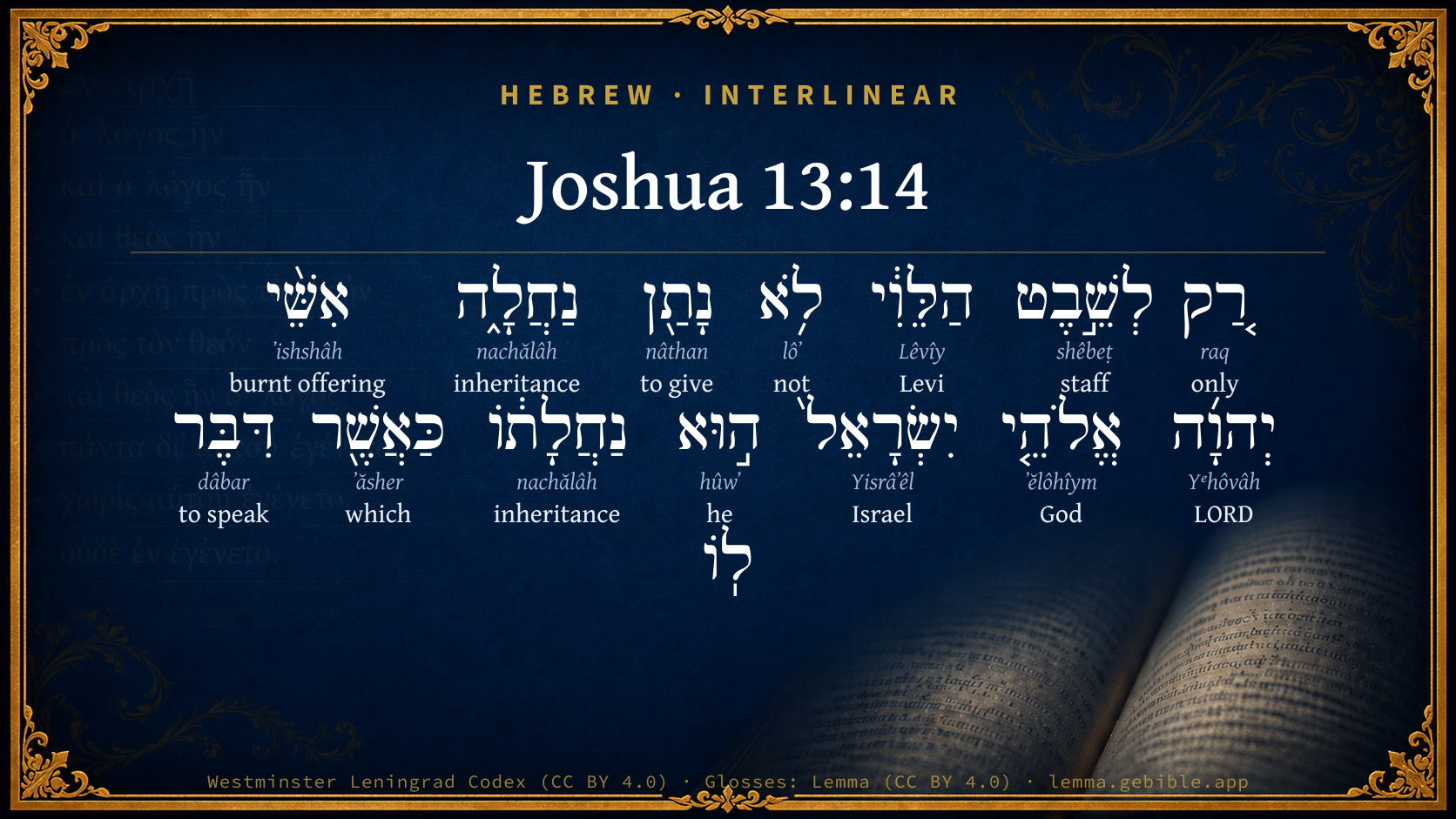
Hebrew (Westminster Leningrad Codex) Joshua 13:14 appears in the Hebrew Old Testament. The text above is from the Westminster Leningrad Codex. Each word links to its Strong’s number, a concise gloss, and parsing drawn from the Open Scriptures Hebrew Bible morphology. Click any word for its full Brown-Driver-Briggs (BDB) entry.
Download image
Cite this verse

Joshua 13:14 (World English Bible). Public Domain. Lemma interlinear Bible study tool, https://lemma.gebible.app/v/joshua/13/14.

Show BibTeX & RIS
BibTeX
RIS
English Translation
Only to the tribe of Levi he gave no inheritance; the offerings of Yahweh, the God of Israel, made by fire are his inheritance, as he spoke to him.
World English Bible · Public Domain
Download a study sheet

One document with this verse’s original text, its word-by-word gloss line, the meaning frame, cross-references with their text, attributed commentary, and full source and license credits — printable, and it pastes into notes with its structure intact.

This verse Autodidact and up

Study sheet (.html) Plain text (.txt)

A passage Seminary Student

Up to 50 verses in one chapter. A passage sheet keeps up to 6 commentary sources and 12 cross-references per verse, in the order this page ranks them, and says so on the sheet whenever that leaves anything out. Ask for a single verse and you get the Autodidact verse sheet above.

Everything on this page stays free to read, with no account — the sheet is a download of what is already on screen, not access to it.

Want to remove ads? Support Godless Engineer
Compare translations 3

The same verse in 3 English versions, stacked beneath the original-language interlinear above. Click any original word for its lexicon entry.

Each is an independent rendering of the whole verse — the interlinear is not word-aligned to these translations.

Highlighted words mark where these versions differ — a whole-verse word diff, not a word-by-word alignment.

  • World English Bible Public Domain
    Only to the tribe of Levi he gave no inheritance; the offerings of Yahweh, the God of Israel, made by fire are his inheritance, as he spoke to him.
  • King James Version Public Domain
    Only unto the tribes of Levi he gave none inheritance; the sacrifices of the LORD God of Israel made by fire are their inheritance, as he said unto them.
  • unfoldingWord Literal Text CC BY-SA 4.0
    Only he did not give an inheritance to the tribe of Levi. The burnt offerings of Yahweh, the God of Israel, they are his inheritance, just as he spoke to him.

unfoldingWord Literal Text — © unfoldingWord, licensed CC BY-SA 4.0. Word-aligned USFM3 via Door43 (git.door43.org/unfoldingWord/en_ult).

Versions to compare (up to 4)

3 of 4 selected

Show all 18 translations

Every available English version of this verse, each an independent rendering of the whole verse.

  • World English Bible Public Domain
    Only to the tribe of Levi he gave no inheritance; the offerings of Yahweh, the God of Israel, made by fire are his inheritance, as he spoke to him.
  • Berean Standard Bible Public Domain
    To the tribe of Levi, however, Moses had given no inheritance. The offerings made by fire to the LORD, the God of Israel, are their inheritance, just as He had promised them.
  • Majority Standard Bible Public Domain
    To the tribe of Levi, however, Moses had given no inheritance. The food offerings to the LORD, the God of Israel, are their inheritance, just as He had promised them.
  • King James Version Public Domain
    Only unto the tribes of Levi he gave none inheritance; the sacrifices of the LORD God of Israel made by fire are their inheritance, as he said unto them.
  • American Standard Version (1901) Public Domain
    Only unto the tribe of Levi he gave no inheritance; the offerings of Jehovah, the God of Israel, made by fire are his inheritance, as he spake unto him.
  • Revised Version (1885) Public Domain
    Only unto the tribe of Levi he gave none inheritance; the offerings of the LORD, the God of Israel, made by fire are his inheritance, as he spake unto him.
  • Geneva Bible (1599) Public Domain
    Onely vnto the tribe of Leui he gaue none inheritance, but the sacrifices of the Lord God of Israel are his inheritance, as he said vnto him.
  • Douay-Rheims (1899) Public Domain
    But to the tribe of Levi he gave no possession: but the sacrifices and victims of the Lord God of Israel, are his inheritance, as he spoke to him.
  • Young's Literal Translation Public Domain
    Only, to the tribe of Levi he hath not given an inheritance; fire-offerings of Jehovah, God of Israel, is its inheritance, as He hath spoken to it.
  • Literal Standard Version CC BY-SA 4.0
    Only, he has not given an inheritance to the tribe of Levi; fire-offerings of YHWH, God of Israel, [are] its inheritance, as He has spoken to it.
  • Unlocked Literal Bible CC BY-SA 4.0
    To the tribe of Levi alone Moses gave no inheritance. The offerings of Yahweh, the God of Israel, made by fire, are their inheritance, as God said to Moses.
  • unfoldingWord Literal Text CC BY-SA 4.0
    Only he did not give an inheritance to the tribe of Levi. The burnt offerings of Yahweh, the God of Israel, they are his inheritance, just as he spoke to him.
  • Darby Bible Public Domain
    Only to the tribe of Levi he gave no inheritance: the offerings by fire of Jehovah the God of Israel are their inheritance, as he said to them.
  • World Messianic Bible Public Domain
    Only he gave no inheritance to the tribe of Levi. The offerings of the LORD, the God of Israel, made by fire are his inheritance, as he spoke to him.
  • Webster's Bible Public Domain
    Only to the tribe of Levi he gave no inheritance; the sacrifices of the LORD God of Israel made by fire are their inheritance, as he said to them.
  • Free Bible Version CC BY-SA 4.0
    Moses did not allocate any land for the Levites to own. Instead they were allotted the offerings made by fire to the Lord, the God of Israel, as the Lord had promised them.
  • Bible in Basic English Public Domain
    Only to the tribe of Levi he gave no heritage; the offerings of the Lord, the God of Israel, made by fire are his heritage, as he said to him.
  • JPS Tanakh (1917) Public Domain
    Only unto the tribe of Levi he gave no inheritance; the offerings of the LORD, the God of Israel, made by fire are his inheritance, as He spoke unto him.

Literal Standard Version (2020), Covenant Press — licensed CC BY-SA 4.0. Text via the HelloAO Bible API (eBible.org). Unlocked Literal Bible (unfoldingWord) — licensed CC BY-SA 4.0. Text via the HelloAO Bible API (eBible.org). unfoldingWord Literal Text — © unfoldingWord, licensed CC BY-SA 4.0. Word-aligned USFM3 via Door43 (git.door43.org/unfoldingWord/en_ult). Free Bible Version, Dr. Jonathan Gallagher — licensed CC BY-SA 4.0. Text via the HelloAO Bible API (eBible.org).

Word by word

More ways to search: Search by grammar → Find every occurrence → Compare this word →

Practice this passage: Drill this verse → Learn its vocabulary →

הַלֵּוִ֔י
Lêvîy
H3878
“the · Levi”
Particle, Definite Article + Noun, Gentilic, Masculine, Singular, Absolute
Part of Speech
Particle + Noun
Type
Gentilic
Gender
Masculine
Number
Singular
State
Absolute
Full BDB Definition

Origin: from H3867

TWOT: 1093

Levi = "joined to" - the 3rd son of Jacob by Leah and progenitor of tribe of Levites
  1. רַ֚ק raq H7535 “only” Particle, Accusative
  2. לְשֵׁ֣בֶט shêbeṭ H7626 “to/for · staff of” Preposition + Noun, Common, Masculine, Singular, Construct
  3. לֹ֥א lôʼ H3808 “not” Particle, Negative
  4. נָתַ֖ן nâthan H5414 “to give” Verb, Qal, Perfect, 3rd Person, Masculine, Singular
  5. נַחֲלָ֑ה nachălâh H5159 “inheritance” Noun, Common, Feminine, Singular, Absolute
  6. אִשֵּׁ֨י ʼishshâh H801 “burnt offerings of” Noun, Common, Masculine, Plural, Construct
  7. יְהוָ֜ה Yᵉhôvâh H3068 “LORD” Noun, Proper
  8. אֱלֹהֵ֤י ʼĕlôhîym H430 “God(s) of” Noun, Common, Masculine, Plural, Construct
  9. יִשְׂרָאֵל֙ Yisrâʼêl H3478 “Israel” Noun, Proper
  10. ה֣וּא hûwʼ H1931 “he” Pronoun, Personal, 3rd Person, Masculine, Singular
  11. נַחֲלָת֔וֹ nachălâh H5159 “inheritance · his” Noun, Common, Feminine, Singular, Construct + Suffix, Personal, 3rd Person, Masculine, Singular
  12. כַּאֲשֶׁ֖ר ʼăsher H834 “like/as · which” Preposition + Particle, Relative
  13. דִּבֶּר dâbar H1696 “to speak” Verb, Piel, Perfect, 3rd Person, Masculine, Singular

About this verse

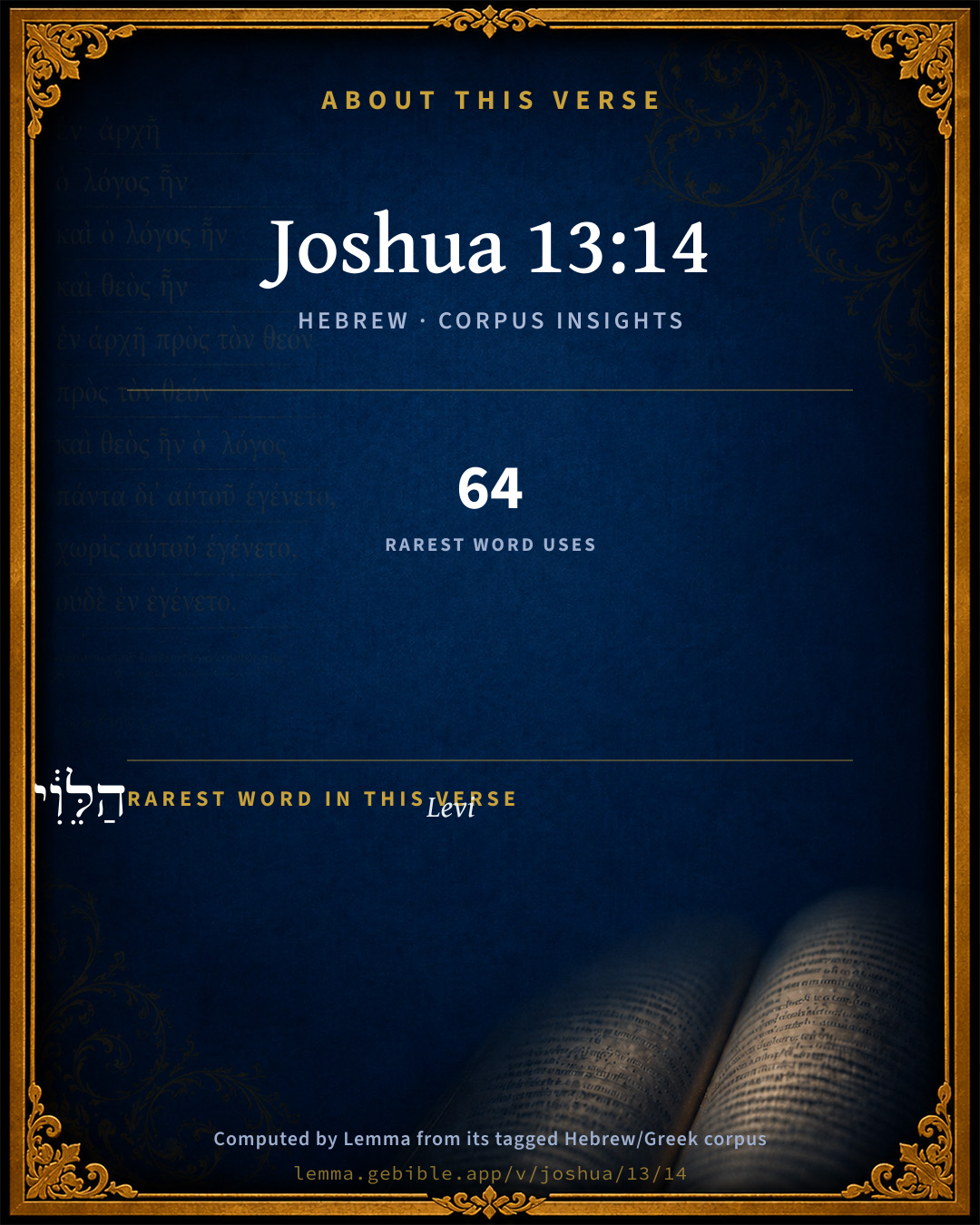
These counts appear in no published source. They are computed here, from the morphology-tagged text and Lemma’s own curated glosses. What Lemma adds →

15
words
13
distinct lemmas
Historical
section

Grammatical profile

  • 2 verbs
  • 8 nouns
  • 1 pronoun
  • 1 preposition
  • 3 particles

Verb forms

  • נָתַ֖ן Qal · Perfect
  • דִּבֶּר Piel · Perfect

Repetition

A word recurs within this verse — often emphatic in Hebrew:

  • נַחֲלָ֑ה inheritance H5159 ×2

Hebrew & Septuagint length

In English translation the verse runs 29 words from the Hebrew and 49 from the Septuagint (LXX English) — the Septuagint runs noticeably longer here. See the side-by-side →

A rough comparison of the two English renderings, which tokenize alike — not a word-level alignment.

Word counts can differ between the Hebrew and the Greek without any difference in meaning — e.g. the Hebrew direct-object marker אֵת has no separate Greek word, and Greek often adds the article ὁ.

Cross-references

6

Topical passages linked to Joshua 13:14 in the Treasury of Scripture Knowledge — connected by theme and wording, ordered by reader-vote popularity; previews shown in the World English Bible.

  • Numbers 18:20–24 Yahweh said to Aaron, You shall have no inheritance in their land, neither shall you have any portion among them: I am your portion and your inheritance among the children of Israel.
  • Joshua 14:3–4 For Moses had given the inheritance of the two tribes and the half-tribe beyond the Jordan: but to the Levites he gave no inheritance among them.
  • Deuteronomy 18:1–2 The priests the Levites, [even] all the tribe of Levi, shall have no portion nor inheritance with Israel: they shall eat the offerings of Yahweh made by fire, and his inheritance.
  • Deuteronomy 10:9 Therefore Levi has no portion nor inheritance with his brothers; Yahweh is his inheritance, according as Yahweh your God spoke to him.)
  • Deuteronomy 12:12 You shall rejoice before Yahweh your God, you, and your sons, and your daughters, and your men-servants, and your maid-servants, and the Levite who is within your gates, because he has no portion nor inheritance with you.
  • Deuteronomy 12:19 Take heed to yourself that you don't forsake the Levite as long as you live in your land.

Cross-references courtesy of OpenBible.info (CC BY 4.0).

Hebrew and Greek witnesses Masoretic Hebrew ↔ Greek Septuagint

The same verse in the two great witnesses to the Old Testament, shown verse-for-verse.

Here the Septuagint runs noticeably longer than the Hebrew — LXX2012 (modern English Septuagint) 49 words vs World English Bible 29. A rough length comparison of the two English translations, not a word-level alignment — read both below.

These are two independent witnesses, not word-aligned to each other, and the Septuagint is shown in lemma (dictionary) form.

Hebrew Joshua 13:14 Masoretic · Westminster Leningrad Codex

רַ֚ק לְשֵׁ֣בֶט הַלֵּוִ֔י לֹ֥א נָתַ֖ן נַחֲלָ֑ה אִשֵּׁ֨י יְהוָ֜ה אֱלֹהֵ֤י יִשְׂרָאֵל֙ ה֣וּא נַחֲלָת֔וֹ כַּאֲשֶׁ֖ר דִּבֶּר לֽוֹ

Only to the tribe of Levi he gave no inheritance; the offerings of Yahweh, the God of Israel, made by fire are his inheritance, as he spoke to him.

World English Bible · Public Domain

Greek LXX Joshua 13:14 Septuagint · lemma form

πλήν ὁ φυλή λευι οὐ δίδωμι κληρονομία κύριος ὁ θεός ἰσραήλ οὗτος αὐτός κληρονομία καθά εἶπον αὐτός κύριος καί οὗτος ὁ καταμερισμός ὅς καταμερίζω μωυσῆς ὁ υἱός ἰσραήλ ἐν ἀραβώθ μωαβ ἐν ὁ πέραν ὁ ἰορδάνης κατά ιεριχω

Only no inheritance was given to the tribe of Levi: the Lord God of Israel, he is their inheritance, as the Lord said to them; and this is the division which Moses made to the children of Israel in Araboth Moab, on the other side of Jordan, by Jericho.

LXX2012 (modern English Septuagint) · Public Domain

Hebrew: Westminster Leningrad Codex (CC BY 4.0). Greek: Septuagint (public domain); English from LXX2012 (modern English Septuagint) (Public Domain). How the Septuagint differs from the Hebrew →

Targum (Aramaic paraphrase)

1

The Targum is the ancient Jewish Aramaic paraphrase of the Hebrew Scriptures — an interpretive translation, not the Hebrew text itself. Onkelos (literal) and Pseudo-Jonathan (expansive) render the Torah, and Jonathan the Prophets. Coverage is partial: where no permissively-licensed English translation exists for a verse, only the Aramaic is shown. This is verse-level text, not a word-by-word alignment to the Hebrew.

  1. Targum Jonathan Prophets (Joshua–Malachi)
    לְחוֹד לְשִׁבְטָא דְלֵוִי לָא יְהַב אַחְסָנָא קוּרְבָּנַיָא דַייָ אֱלָהָא דְיִשְׂרָאֵל אִינוּן אַחֲסַנְתֵּיהּ כְּמָא דְמַלֵל לֵיהּ:

    (no public-domain English translation for this verse)

    Targum Jonathan — Aramaic: “Mikraot Gedolot” (public domain). English: “Sefaria Community Translation” (CC0 1.0 (public-domain dedication)); “London "Chaldee Paraphrase," 1871” (public domain). Text via Sefaria.

Commentary

Notes on Joshua 13:14 from classic Christian and Jewish commentators (each source and its license shown beneath its notes). The classic Christian expositions comment on the surrounding passage and are grouped to its opening verse, so a note may address several verses; the Jewish commentaries on the Tanakh (Rashi and others) are per-verse, so they appear only where the commentator wrote on this verse.

Lemma curates 59 commentaries, every one of them public domain or Creative Commons licensed, each selected and text-cleaned for this edition rather than reprinted as found. About our sources →

Trapp's Complete Commentary

John Trapp

Jos 13:14 Only unto the tribe of Levi he gave none inheritance; the sacrifices of the LORD God of Israel made by fire [are] their inheritance, as he said unto them.

Ver. 14. Only unto the tribe of Levi he gave none inheritance.] Because God was to be their portion: Yεος η προσοδος, as Lucian speaketh of his heathenish priests.

John Trapp, A Commentary or Exposition upon All the Books of the Old and New Testament (1647–1656) — public domain. Text from a community e-Sword module.

Joseph Benson's Commentary

Jos 13:14. To the tribe of Levi he — Namely, Moses; gave none inheritance — That is, none in the land beyond Jordan, where yet a considerable part of the Levites were to have their settled abode. This is mentioned as the reason both why Moses gave all that land to the Reubenites, and Gadites, and Manassites, and why Joshua should divide the land only into nine parts and a half, as was said, Jos 13:7; because Levi was otherwise provided for. Made by fire — Which are here put for all the sacrifices and oblations, including first-fruits and tithes, that were assigned to the Levites, and this passage is repeated to prevent those calumnies and injuries which God foresaw the Levites were likely to meet with, from the malice, envy, and covetousness of their brethren.

Joseph Benson's Commentary on the Old and New Testaments (1811–1818) — public domain. Text from a community e-Sword module.

Tyndale Open Study Notes

Tyndale Open Resources

13:14 The tribe of Levi inherited no tribal land of its own (see Deut 18:1-8). Levitical cities were located in the territories of the other tribes (Josh 21).

Tyndale Open Study Notes — © Tyndale Open Resources, licensed CC BY-SA 4.0. Text via the HelloAO Bible API.

Geneva Bible (1599)

Geneva Bible translators

Levi shall live by the sacrifices, Num. 11:23.

Geneva Bible (1599) marginal notes — public domain. Text via Bolls.life.

John Calvin's Commentaries

14. Only unto the tribe of Levi, etc This exception was also necessary, lest the Levites might allege that they were unjustly disinherited, and thus excite great commotions in regard to their right. He therefore reminds them that Moses was the author of this distinction, and, at the same time, shows that they have no reason to complain of having been in any way defrauded, because an excellent compensation was given them. For although the sacrifices were not equally divided among the Levites, their subsistence was sufficiently provided for by all the first-fruits and the tithes. Moreover, as God allures them by hire to undertake the charge of sacred things, so he exhorts the people in their turn to be faithful in paying the sacred oblations by declaring that their sacrifices are the maintenance of the Levites.

John Calvin's Commentaries (1540-1563) — public domain. Text from the Calvin Translation Society English edition (1840s-50s) via the Christian Classics Ethereal Library (ccel.org). Calvin's coverage is partial (roughly two-thirds of the Bible); uncommented books and verses are honest gaps, never fabricated. The 19th-century editor's footnotes and remarks are omitted so the notes are faithfully Calvin's own voice.

The Cambridge Bible for Schools and Colleges

gen. ed. J. J. S. Perowne

14. Only unto the tribe of Levi] The Levites not being destined for agriculture, but being intended to become the regular teachers of the people, received no inheritance. See Jos_13:33, and ch. Jos_14:3-4.

the sacrifices of the Lord God] “the sacryfices, and the slayn offryngis of the Lord God of Yrael,” Wyclif. The offerings of Jehovah were to be their portion (Num_18:20; Deu_10:9; Deu_18:2).

The Cambridge Bible for Schools and Colleges (gen. ed. J. J. S. Perowne; Cambridge University Press, 1878–1918) — public domain. Text from a community e-Sword module.

John Gill's Exposition

Only unto the tribe of Levi he gave none inheritance,.... Neither the Lord, nor Moses by his order, nor did he appoint any inheritance for them, either beyond Jordan, or on this side it, for the Lord was to be their inheritance, Num 18:20;

the sacrifices of the Lord God of Israel made by fire are their inheritance, as he said unto them; Deu 18:1; and which are put for the whole of what was granted to them for their subsistence, as tithes, firstfruits, &c.

John Gill's Exposition of the Whole Bible (1746–1763) — public domain (CC PDM 1.0). Text via the HelloAO Bible API.

Haydock's Catholic Bible Commentary

Victims. Hebrew, "the sacrifices of the Lord made by fire."

George Leo Haydock (1774–1849), Haydock's Catholic Family Bible and Commentary, 1859 edition — public domain. Excludes Psalms (Douay-Rheims chapter numbering differs from Protestant) and Deuterocanonical books (Catholic canon only).

Matthew Poole's English Annotations

He, i.e. Moses, as is expressed Jos 13:33, gave none inheritance, to wit, in the land beyond Jordan, where yet a considerable part of the Levites were to have their settled abode. This is mentioned as the reason both why Moses gave all that land to the Reubenites, and Gadites, and Manassites; and why Joshua should divide the land only into nine parts and a half, as was said, Jos 13:7, because Levi was otherwise provided for

Sacrifices of the Lord made by fire; which by a synecdoche are here put for all those sacrifices and oblations, including first-fruits and tithes, which were assigned to the Levites; and this passage is so oft repeated and urged, to prevent those calumnies and injuries which God foresaw the Levites were likely to meet with from the malice, envy, and covetousness of their brethren; and to oblige all the other tribes to a cheerful and conscionable giving to the Levites their dues, to which they had as good a right and title as they had to their several possessions.

Matthew Poole's English Annotations on the Holy Bible (1683–1685) — public domain. Text from a community e-Sword/MySword module.

Whedon's Commentary on the Bible

Daniel D. Whedon

14. Only unto the tribe of Levi — Moses did not give any inheritance to the nine and a half tribes, not from lack of purpose, but from lack of opportunity. But the Levites he excluded from a territorial allotment by an express prohibition to Joshua. They received scattered cities with a narrow margin of pasture lands, but no separate share of the land. See chap. 21. Sacrifices is here used, in a broad sense, to include all offerings, even those, like the show bread, which were eaten and not burned. The Vulgate has it sacrificia et victimae. They were to receive a tenth of the fruits of the field, the trees, and the cattle. Twelve tribes received allotments because the two sons of Joseph were each reckoned as a tribe.

Daniel D. Whedon (gen. ed.), Commentary on the Old and New Testaments (1874–1909) — public domain. Text from a community e-Sword module.

The Pulpit Commentary

Only unto the tribe of Levi. See Num_18:20-24, where the original command is recorded. Like the clergy under the Christian dispensation, it was seen that they could not at once perform the duties of the priesthood, and act as instructors of the people, if they were burdened, like the rest, with the duty of carrying on war. Their place was supplied by the division of the tribe of Joseph into two, so that the inheritance of Israel was still divided among twelve tribes. Bahr, in his "Symbolik des Alten Testaments," 2:48, 49, gives other reasons for the dispersion of the Levites throughout the land. If the Levites were to keep the Law and Word of God, to take measures for its being properly kept by the nation in general, to spread abroad a knowledge of the precepts of the religion of Israel, to stir up the tribes to a devout and religious life, it was not merely desirable, but absolutely necessary, that they should be scattered among the tribes. On the other hand, to secure a proper esprit de corps, a mutual sustaining influence, and a common action, too complete a dispersion would have been a mistake. Hence their collection into the Levitical cities, which, however, (see note on Jos_21:11) were not given up wholly to them. The Divine wisdom which dictated the provisions of the Mosaic law is clearly visible here. The instinct of the Christian Church in early times devised a similar provision for the evangelisation of the people in the organisation of the ancient and mediaeval cathedrals. As he said unto them. This quotation of Num_18:20, 24 by a later writer would, under all ordinary circumstances, be regarded as a proof that the Book of Joshua was quoting one of the books of Moses. But the "Elohistic" and "Jehovistic" theory escapes this conclusion in the cumbrous fashion to which reference has been already made. Origen regards this passage as symbolical of the more spiritually earnest among the laity, who" so excel others invirtue of mind and grace of merits, as that the Lord should be called their inheritance." "How very rare," he says, "are those who devote themselves to wisdom and knowledge and preserve their mind clear and pure, and exercise their minds in all excellent virtues, who illuminate the way wherein they walk for simpler souls by the grace of learning, and thus attain to salvation. They are the true priests and Levites, whose inheritance is the Lord, who is wisdom" (Hom. 17 on Joshua). The Sacrifices. The word is derived from vae fire. It does not itself, as Keil asserts, signify fire in any place in Holy Writ, but it is used of the shewbread in Lev_24:7, Lev_24:9. It thus came to mean any sacrifice, whether offered by fire or not. And thus the tenth which (Num_18:21, Num_18:23, Num_18:24) was given to the Levites, as being offered for God"s service, might be reckoned as in some sense a sacrifice. With this passage we may compare various passages in the New Testament, where, in this respect at least, the Christian ministry stands on the same footing. (1Co_9:11, 13 Gal_6:6, Gal_6:7) Thus the maintenance of the Christian ministry is a kind of sacrifice as we find such deeds called, in fact, in Heb_13:16. And an order of men who are set apart to the ministry of souls has a right to claim a sufficient maintenance at the hands of those to whom they minister a point which in these days of affluence and clerical destitution combined ought to be more largely recognised than it is. (see Num_18:20-24) "For the law is entrusted to the priests and Levites, and they devote their energies to this alone, and without any anxiety are able to give their time to the Word of God. But that they may be able to do this, they ought to depend upon the support of the laity. For if the laity do not allow the priests and Levites all the necessaries of life, they would be obliged, to engage themselves in temporal occupations, and would thus have less time for the law of God. And when they had no time to spare for the study of God"s law, it is thou who wouldst be in danger. For the light of knowledge that is in them would grow dim, because thou hast given no oil for the lamp, and through thy fault it would come to pass, what the Lord said, "If the blind lead the blind, shall they not both fall into the ditch? (Orig., Hom. 17 on Joshua). These words are well worthy of attention now, when a multiplicity of worldly business and a weight of worldly cares are devolved upon God"s ministers by a laity which has to too great an extent washed its hands of all cooperation in the work of God"s Church.

HOMILIES BY W.F. ADENEY Vers. 14, 33. The inheritance of Levi.

I THE TRIBE OF LEVI RECEIVED NO INHERITANCE OF LAND.

(1) They who devote themselves to the service of God must be prepared to make earthly sacrifices. We cannot serve God and mammon. If our service of God costs nothing it is worth nothing. (Luk_14:33) Therefore count the cost. (Luk_14:28)

(2) Earthly possessions distract our attention from heavenly service. Therefore it is hard for the rich to enter into the kingdom of heaven. (Luk_18:24)

(3) It is right that they who have the care of souls should be freed from the care of earthly business.

II THE TRIBE OF LEVI HAD ITS TEMPORAL WANTS ADEQUATELY PROVIDED FOR (see verse 14).

(1) They who serve at the altar have a right to live by the altar. (1Co_9:7) This is

(a) just, (1Co_9:11)

(b) necessary for unhindered service, and

(c) not injurious to true devotion so long as the servant of God does not degrade his vocation into a trade by working for money instead of receiving money that he may have means for work.

(2) In contributing to the support of God"s servants we are offering sacrifices to God. The sacrifices were the priests" and Levites" portion. (Deu_18:1) We cannot benefit God by our gifts, but we can give to God through His servants. (Mat_25:40) It is our duty to provide in temporal things for those who minister to us in spiritual things. He who starves the ministers of Christ is as guilty as if he starved their Master. (Mat_25:45)

III THE TRIBE OF LEVI FOUND ITS TRUE INHERITANCE IN GOD. The sacrificial gifts of the people were not its chief inheritance, but only the small necessary earthly portion of what it was to receive. Its true heritage was spiritual.

(1) The Christian minister should not regard the earthly returns which he receives for his service as his main reward. To do so is to commit the sin of simony. His real reward is spiritual.

(2) He who makes any sacrifice for God will be amply compensated in Divine riches. (Mar_10:29, 30)

(3) It is better to have God for our portion than any earthly inheritance. (Psa_73:26) To have God for an inheritance is

(a) to enjoy communion with Him;

(b) to be protected by Him;

(c) to live for His service.

This is the best inheritance, because

(a) it is satisfying to the soul, while the earthly inheritance is full of dissatisfaction, and can never supply our greatest wants;

(b) it is eternal; and

(c) it is pure and lofty.

Note: In the Christian Church, though there is diversity of orders (Rom_12:6-8) there is no distinction of caste. All Christians are called to the altar of sacrifice, (Heb_13:10) all are to serve as priests of the temple, (1Pe_2:9) and all should find their true inheritance in God. W.F.A. (1Pe_1:4)

The Pulpit Commentary (1880–1919), ed. H.D.M. Spence-Jones & Joseph S. Exell — public domain. Text from a community e-Sword module.

John Wesley's Explanatory Notes

He gave - That is, Moses. None inheritance - Namely, in the land beyond Jordan, where yet a considerable part of the Levites were to have their settled abode. This is mentioned as the reason both why Moses gave all that land to the Reubenites and Gadites and Manassites; and why Joshua should divide the land only into nine parts and an half, as was said, ver. 7, because Levi was otherwise provided for. Made by fire - Which are here put for all the sacrifices and oblations, including first-fruits and tithes, that were assigned to the Levites; and this passage is repeated, to prevent those calumnies and injuries which God foresaw the Levites were likely to meet with, from the malice, envy and covetousness of their brethren.

John Wesley, Explanatory Notes Upon the Whole Bible (1754–1765) — public domain. Text via the GEBible commentary corpus.

unfoldingWord translationNotes

Door43 World Missions Community

Moses gave no inheritance

The land that Moses assigned to the tribes of Israel is spoken of as if it were an inheritance that they received as a permanent possession. (See: Metaphor)

The offerings of Yahweh ... are their inheritance

The writer speaks of the great honor that the Levites had by serving Yahweh as priests as if the offerings were something that they would inherit. AT: "The offerings of Yahweh ... are what they will have for their provision" (See: Metaphor)

offerings of Yahweh

"offerings that the people were to bring to Yahweh"

made by fire

This can be stated in active form. AT: "that the priests burned with fire" (See: Active or Passive)

translationWords

tribe

Levi

Moses

inherit

sacrifice

Yahweh

God

Israel

unfoldingWord translationNotes — © Distant Shores Media and the Door43 World Missions Community, licensed CC BY-SA 4.0. Source: git.door43.org/Door43/en_tn.

Lesson kit

Teaching starters — assembled from the data on this page, not authored interpretation. Every prompt links to the verse data it draws on. Edit before teaching.

Joshua, in the Historical, opens this verse with 15 words (13 distinct Hebrew lemmas). Its most distinctive word is Lêvîy (“Levi”). The Greek Septuagint runs longer here. A historical commentator’s framing appears above. Read the whole chapter for the surrounding context.

Discussion questions

  1. The word Lêvîy carries the sense “Levi.” How does it shape the verse?
  2. How does Numbers 18:20–24, which shares this passage’s theme, read alongside this verse?
  3. What does the repetition of “inheritance” (2× in this one verse) do in this verse?
  4. The Septuagint runs longer here than the Hebrew. What might account for the difference?
  5. These translations render this verse differently; the difference is in the English rendering, not the original. What questions does that raise?
  6. «נָתַ֖ן» is a Qal Perfect verb. How does that grammatical form shape the action described?
  7. Compare how Trapp's Complete Commentary and Joseph Benson's Commentary read this verse. Where do they agree or differ?

Things to notice

Reading settings

Reading text

Shown beneath each verse's original-language words.

Old Testament
Old Testament edition

Read the OT as the Masoretic Hebrew (MT) or the Greek Septuagint (LXX).

English shown for the Greek Septuagint (in the Hebrew ↔ Greek comparison).

Comparing translations? Open the Compare panel on any verse page to stack up to four side by side.