
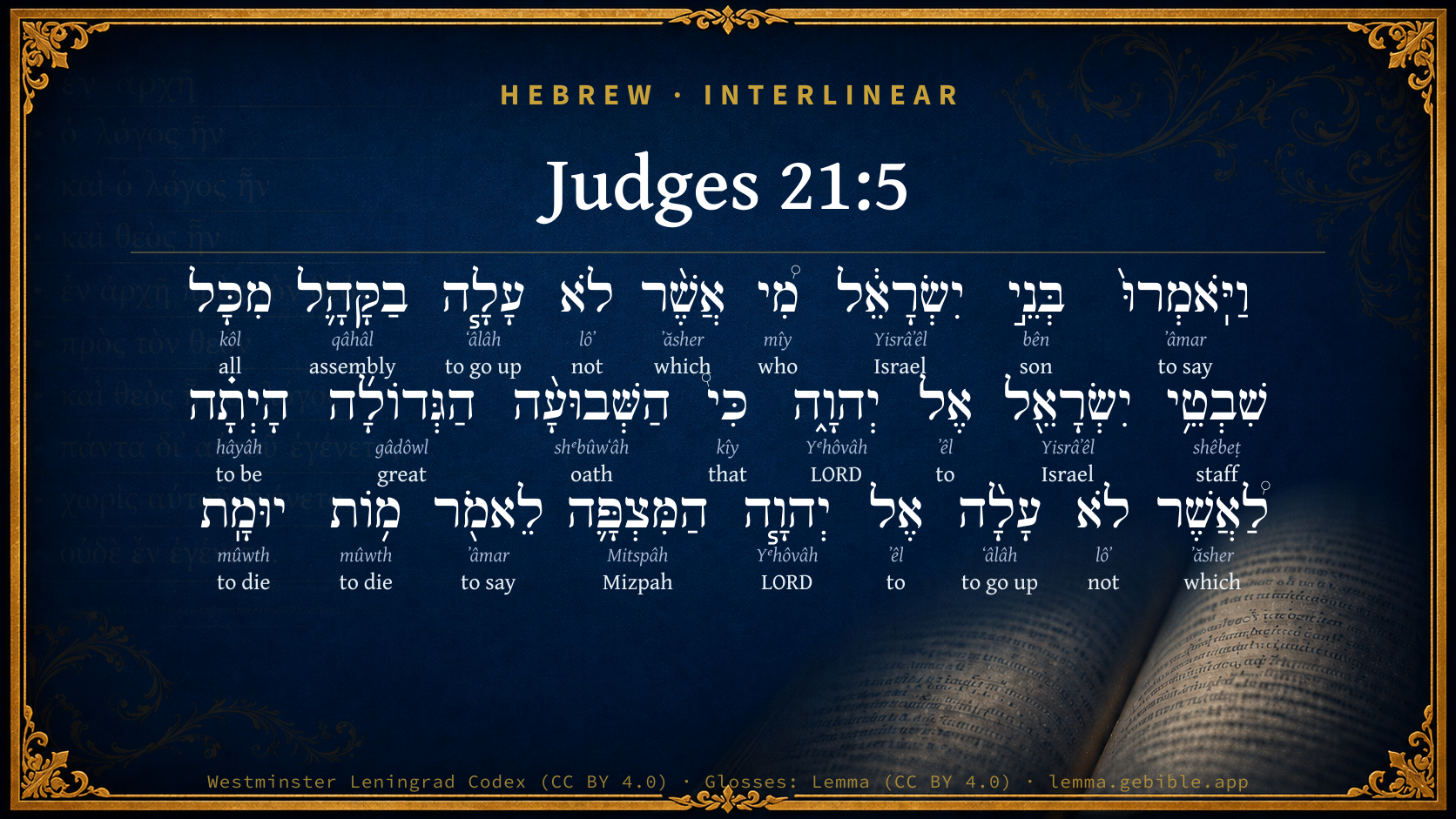
Judges 21:5

Hebrew (Westminster Leningrad Codex) Judges 21:5 appears in the Hebrew Old Testament. The text above is from the Westminster Leningrad Codex. Each word links to its Strong’s number, a concise gloss, and parsing drawn from the Open Scriptures Hebrew Bible morphology. Click any word for its full Brown-Driver-Briggs (BDB) entry.
Download image
Cite this verse

Judges 21:5 (World English Bible). Public Domain. Lemma interlinear Bible study tool, https://lemma.gebible.app/v/judges/21/5.

Show BibTeX & RIS
BibTeX
RIS
English Translation
The children of Israel said, Who is there among all the tribes of Israel who didn't come up in the assembly to Yahweh? For they had made a great oath concerning him who didn't come up to Yahweh to Mizpah, saying, He shall surely be put to death.
World English Bible · Public Domain
Download a study sheet

One document with this verse’s original text, its word-by-word gloss line, the meaning frame, cross-references with their text, attributed commentary, and full source and license credits — printable, and it pastes into notes with its structure intact.

This verse Autodidact and up

Study sheet (.html) Plain text (.txt)

A passage Seminary Student

Up to 50 verses in one chapter. A passage sheet keeps up to 6 commentary sources and 12 cross-references per verse, in the order this page ranks them, and says so on the sheet whenever that leaves anything out. Ask for a single verse and you get the Autodidact verse sheet above.

Everything on this page stays free to read, with no account — the sheet is a download of what is already on screen, not access to it.

Want to remove ads? Support Godless Engineer
Compare translations 3

The same verse in 3 English versions, stacked beneath the original-language interlinear above. Click any original word for its lexicon entry.

Each is an independent rendering of the whole verse — the interlinear is not word-aligned to these translations.

Highlighted words mark where these versions differ — a whole-verse word diff, not a word-by-word alignment.

  • World English Bible Public Domain
    The children of Israel said, Who is there among all the tribes of Israel who didn't come up in the assembly to Yahweh? For they had made a great oath concerning him who didn't come up to Yahweh to Mizpah, saying, He shall surely be put to death.
  • King James Version Public Domain
    And the children of Israel said, Who is there among all the tribes of Israel that came not up with the congregation unto the LORD? For they had made a great oath concerning him that came not up to the LORD to Mizpeh, saying, He shall surely be put to death.
  • unfoldingWord Literal Text CC BY-SA 4.0
    And the sons of Israel said, “Who who did not go up with the assembly from all of the tribes of Israel to Yahweh?” For a great oath had been regarding whoever did not go up to Yahweh Mizpah, saying, “Dying, he shall be caused to die.”

unfoldingWord Literal Text — © unfoldingWord, licensed CC BY-SA 4.0. Word-aligned USFM3 via Door43 (git.door43.org/unfoldingWord/en_ult).

Versions to compare (up to 4)

3 of 4 selected

Show all 18 translations

Every available English version of this verse, each an independent rendering of the whole verse.

  • World English Bible Public Domain
    The children of Israel said, Who is there among all the tribes of Israel who didn't come up in the assembly to Yahweh? For they had made a great oath concerning him who didn't come up to Yahweh to Mizpah, saying, He shall surely be put to death.
  • Berean Standard Bible Public Domain
    The Israelites asked, “Who among all the tribes of Israel did not come to the assembly before the LORD?” For they had taken a solemn oath that anyone who failed to come up before the LORD at Mizpah would surely be put to death.
  • Majority Standard Bible Public Domain
    The Israelites asked, “Who among all the tribes of Israel did not come to the assembly before the LORD?” For they had taken a solemn oath that anyone who failed to come up before the LORD at Mizpah would surely be put to death.
  • King James Version Public Domain
    And the children of Israel said, Who is there among all the tribes of Israel that came not up with the congregation unto the LORD? For they had made a great oath concerning him that came not up to the LORD to Mizpeh, saying, He shall surely be put to death.
  • American Standard Version (1901) Public Domain
    And the children of Israel said, Who is there among all the tribes of Israel that came not up in the assembly unto Jehovah? For they had made a great oath concerning him that came not up unto Jehovah to Mizpah, saying, He shall surely be put to death.
  • Revised Version (1885) Public Domain
    And the children of Israel said, Who is there among all the tribes of Israel that came not up in the assembly unto the LORD? For they had made a great oath concerning him that came not up unto the LORD to Mizpah, saying, He shall surely be put to death.
  • Geneva Bible (1599) Public Domain
    Then the children of Israel said, Who is he among all the tribes of Israel, that came not vp with the Congregation vnto the Lord? for they had made a great othe concerning him that came not vp to the Lord to Mizpeh, saying, Let him die the death.
  • Douay-Rheims (1899) Public Domain
    Who is there among all the tribes of Israel that came not up with the army of the Lord? for they had bound themselves with a great oath, when they were in Maspha, that whosoever were wanting should be slain.
  • Young's Literal Translation Public Domain
    And the sons of Israel say, `Who `is' he that hath not come up in the assembly out of all the tribes of Israel unto Jehovah?' for the great oath hath been concerning him who hath not come up unto Jehovah to Mizpeh, saying, `He is surely put to death.'
  • Literal Standard Version CC BY-SA 4.0
    And the sons of Israel say, “Who [is] he that has not come up in the assembly to YHWH out of all the tribes of Israel?” For the great oath has been concerning him who has not come up to YHWH to Mizpeh, saying, “He is surely put to death.”
  • Unlocked Literal Bible CC BY-SA 4.0
    The people of Israel said, “Which of all the tribes of Israel did not come up in the assembly to Yahweh?” For they had made an important promise concerning anyone who did not come up to Yahweh at Mizpah. They said, “He would certainly be put to death.”
  • unfoldingWord Literal Text CC BY-SA 4.0
    And the sons of Israel said, “Who who did not go up with the assembly from all of the tribes of Israel to Yahweh?” For a great oath had been regarding whoever did not go up to Yahweh Mizpah, saying, “Dying, he shall be caused to die.”
  • Darby Bible Public Domain
    And the people of Israel said, "Which of all the tribes of Israel did not come up in the assembly to the LORD?" For they had taken a great oath concerning him who did not come up to the LORD to Mizpah, saying, "He shall be put to death."
  • World Messianic Bible Public Domain
    The children of Israel said, “Who is there among all the tribes of Israel who didn’t come up in the assembly to the LORD?” For they had made a great oath concerning him who didn’t come up to the LORD to Mizpah, saying, “He shall surely be put to death.”
  • Webster's Bible Public Domain
    And the children of Israel said, Who is there among all the tribes of Israel that came not up with the congregation to the LORD? For they had made a great oath concerning him that came not up to the LORD to Mizpeh, saying, He shall surely be put to death.
  • Free Bible Version CC BY-SA 4.0
    “Which of all the tribes of Israel didn't attend the assembly we held before the Lord?” they asked. For they had sworn a sacred oath that anyone who did not come before the Lord at Mizpah would without exception be executed.
  • Bible in Basic English Public Domain
    And the children of Israel said, Who is there among all the tribes of Israel, who did not come up to the Lord at the meeting of all Israel? For they had taken a great oath that whoever did not come up to Mizpah to the Lord was to be put to death.
  • JPS Tanakh (1917) Public Domain
    And the children of Israel said: 'Who is there among all the tribes of Israel that came not up in the assembly unto the LORD?' For they had made a great oath concerning him that came not up unto the LORD to Mizpah, saying: 'He shall surely be put to death.'

Literal Standard Version (2020), Covenant Press — licensed CC BY-SA 4.0. Text via the HelloAO Bible API (eBible.org). Unlocked Literal Bible (unfoldingWord) — licensed CC BY-SA 4.0. Text via the HelloAO Bible API (eBible.org). unfoldingWord Literal Text — © unfoldingWord, licensed CC BY-SA 4.0. Word-aligned USFM3 via Door43 (git.door43.org/unfoldingWord/en_ult). Free Bible Version, Dr. Jonathan Gallagher — licensed CC BY-SA 4.0. Text via the HelloAO Bible API (eBible.org).

Word by word

More ways to search: Search by grammar → Find every occurrence → Compare this word →

Practice this passage: Drill this verse → Learn its vocabulary →

הַשְּׁבוּעָ֨ה
shᵉbûwʻâh
H7621
“the · oath”
Particle, Definite Article + Noun, Common, Feminine, Singular, Absolute
Part of Speech
Particle + Noun
Type
Common
Gender
Feminine
Number
Singular
State
Absolute
Full BDB Definition

Origin: pass part of H7650

TWOT: 2319a

oath, curse - oath - attesting of innocence - curse - oath (of Jehovah)
  1. וַיֹּֽאמְרוּ֙ ʼâmar H559 “and · to say” Conjunction + Verb, Qal, Sequential Imperfect, 3rd Person, Masculine, Plural
  2. בְּנֵ֣י bên H1121 “sons of” Noun, Common, Masculine, Plural, Construct
  3. יִשְׂרָאֵ֔ל Yisrâʼêl H3478 “Israel” Noun, Proper
  4. מִ֠י mîy H4310 “who” Particle, Interrogative
  5. אֲשֶׁ֨ר ʼăsher H834 “which” Particle, Relative
  6. לֹא lôʼ H3808 “not” Particle, Negative
  7. עָלָ֧ה ʻâlâh H5927 “to go up” Verb, Qal, Perfect, 3rd Person, Masculine, Singular
  8. בַקָּהָ֛ל qâhâl H6951 “in/at the · assembly” Preposition, Determined + Noun, Common, Masculine, Singular, Absolute
  9. מִכָּל kôl H3605 “from · all of” Preposition + Noun, Common, Masculine, Singular, Construct
  10. שִׁבְטֵ֥י shêbeṭ H7626 “staffs of” Noun, Common, Masculine, Plural, Construct
  11. יִשְׂרָאֵ֖ל Yisrâʼêl H3478 “Israel” Noun, Proper
  12. אֶל ʼêl H413 “to” Preposition
  13. יְהוָ֑ה Yᵉhôvâh H3068 “LORD” Noun, Proper
  14. כִּי֩ kîy H3588 “that” Conjunction
  15. הַגְּדוֹלָ֜ה gâdôwl H1419 “the · great” Particle, Definite Article + Adjective, Adjective, Feminine, Singular, Absolute
  16. הָיְתָ֗ה hâyâh H1961 “to be” Verb, Qal, Perfect, 3rd Person, Feminine, Singular
  17. לַ֠אֲשֶׁר ʼăsher H834 “to/for · which” Preposition + Particle, Relative
  18. לֹא lôʼ H3808 “not” Particle, Negative
  19. עָלָ֨ה ʻâlâh H5927 “to go up” Verb, Qal, Perfect, 3rd Person, Masculine, Singular
  20. אֶל ʼêl H413 “to” Preposition
  21. יְהוָ֧ה Yᵉhôvâh H3068 “LORD” Noun, Proper
  22. הַמִּצְפָּ֛ה Mitspâh H4709 “the · Mizpah” Particle, Definite Article + Noun, Proper
  23. לֵאמֹ֖ר ʼâmar H559 “to say” Preposition + Verb, Qal, Infinitive Construct
  24. מ֥וֹת mûwth H4191 “to die” Verb, Qal, Infinitive Absolute
  25. יוּמָֽת mûwth H4191 “to die” Verb, Hophal, Imperfect, 3rd Person, Masculine, Singular

About this verse

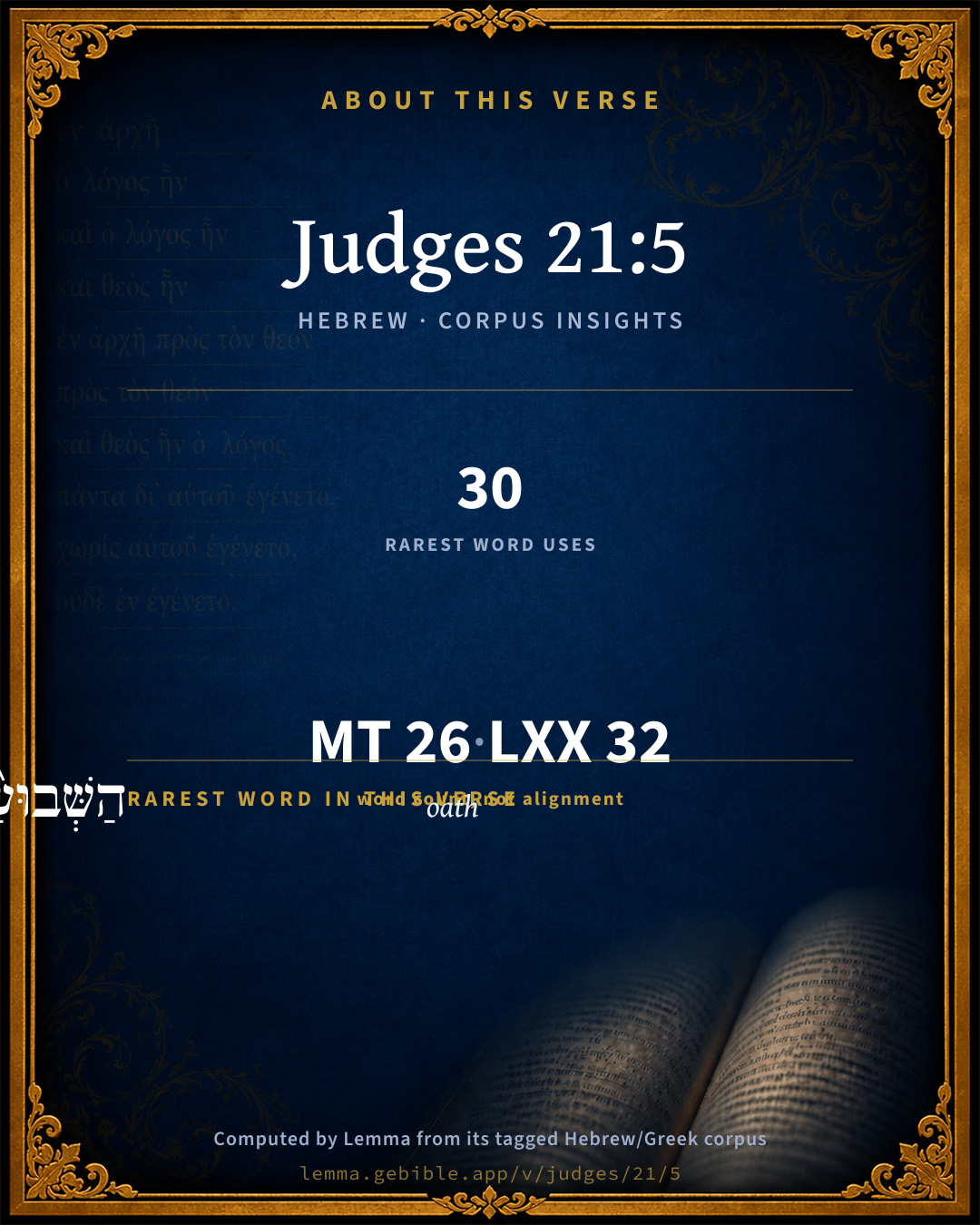
These counts appear in no published source. They are computed here, from the morphology-tagged text and Lemma’s own curated glosses. What Lemma adds →

26
words
18
distinct lemmas
Historical
section

Shared distinctive vocabulary

הַשְּׁבוּעָ֨ה oath H7621 occurs in 29 verses of the Hebrew Bible. Also found in:

Grammatical profile

  • 7 verbs
  • 10 nouns
  • 1 adjective
  • 2 prepositions
  • 1 conjunction
  • 5 particles

Verb forms

  • וַיֹּֽאמְרוּ֙ Qal · Sequential Imperfect
  • עָלָ֧ה Qal · Perfect
  • הָיְתָ֗ה Qal · Perfect
  • עָלָ֨ה Qal · Perfect
  • לֵאמֹ֖ר Qal · Infinitive Construct
  • מ֥וֹת Qal · Infinitive Absolute
  • יוּמָֽת Hophal · Imperfect

Repetition

Words recur within this verse — often emphatic in Hebrew:

  • וַיֹּֽאמְרוּ֙ to say H559 ×2
  • יִשְׂרָאֵ֔ל Israel H3478 ×2
  • עָלָ֧ה to go up H5927 ×2
  • יְהוָ֑ה LORD H3068 ×2
  • מ֥וֹת to die H4191 ×2
  • אֲשֶׁ֨ר which H834 ×2
  • לֹא not H3808 ×2
  • אֶל to H413 ×2

Hebrew & Septuagint length

In English translation the verse runs 48 words from the Hebrew and 47 from the Septuagint (LXX English) — closely comparable.

A rough comparison of the two English renderings, which tokenize alike — not a word-level alignment.

Word counts can differ between the Hebrew and the Greek without any difference in meaning — e.g. the Hebrew direct-object marker אֵת has no separate Greek word, and Greek often adds the article ὁ.

In the original languages it is 26 Hebrew tokens and 32 Greek tokens — but the two are counted differently (Hebrew bundles its prefixes and suffixes into one token; the Greek is in lemma form), so that isn’t a like-for-like length.

Cross-references

6

Topical passages linked to Judges 21:5 in the Treasury of Scripture Knowledge — connected by theme and wording, ordered by reader-vote popularity; previews shown in the World English Bible.

  • Judges 5:23 Curse you Meroz, said the angel of Yahweh. Curse you bitterly the inhabitants of it, Because they didn't come to the help of Yahweh, To the help of Yahweh against the mighty.
  • Jeremiah 48:10 Cursed be he who does the work of Yahweh negligently; and cursed be he who keeps back his sword from blood.
  • Leviticus 27:28–29 "'Notwithstanding, no devoted thing, that a man shall devote to Yahweh of all that he has, whether of man or animal, or of the field of his possession, shall be sold or redeemed: every devoted thing is most holy to Yahweh.
  • Judges 21:1 Now the men of Israel had sworn in Mizpah, saying, There shall not any of us give his daughter to Benjamin as wife.
  • Judges 21:18 However we may not give them wives of our daughters, for the children of Israel had sworn, saying, Cursed be he who gives a wife to Benjamin.
  • 1 Samuel 11:7 He took a yoke of oxen, and cut them in pieces, and sent them throughout all the borders of Israel by the hand of messengers, saying, Whoever doesn't come forth after Saul and after Samuel, so shall it be done to his oxen. The dread of Yahweh fell on the people, and they came out as one man.

Cross-references courtesy of OpenBible.info (CC BY 4.0).

Hebrew and Greek witnesses Masoretic Hebrew ↔ Greek Septuagint

The same verse in the two great witnesses to the Old Testament, shown verse-for-verse.

These are two independent witnesses, not word-aligned to each other, and the Septuagint is shown in lemma (dictionary) form.

Hebrew Judges 21:5 Masoretic · Westminster Leningrad Codex

וַיֹּֽאמְרוּ֙ בְּנֵ֣י יִשְׂרָאֵ֔ל מִ֠י אֲשֶׁ֨ר לֹא עָלָ֧ה בַקָּהָ֛ל מִכָּל שִׁבְטֵ֥י יִשְׂרָאֵ֖ל אֶל יְהוָ֑ה כִּי֩ הַשְּׁבוּעָ֨ה הַגְּדוֹלָ֜ה הָיְתָ֗ה לַ֠אֲשֶׁר לֹא עָלָ֨ה אֶל יְהוָ֧ה הַמִּצְפָּ֛ה לֵאמֹ֖ר מ֥וֹת יוּמָֽת

The children of Israel said, Who is there among all the tribes of Israel who didn't come up in the assembly to Yahweh? For they had made a great oath concerning him who didn't come up to Yahweh to Mizpah, saying, He shall surely be put to death.

World English Bible · Public Domain

Greek LXX Judges 21:5 Septuagint · lemma form

καί εἶπον ὁ υἱός ἰσραήλ τίς οὐ ἀναβαίνω ἐν ὁ ἐκκλησία ἀπό πᾶς φυλή ἰσραήλ πρός κύριος ὅτι ὁ ὅρκος μέγας εἰμί ὁ οὐ ἀναβαίνω πρός κύριος εἰς μασσηφα λέγω θάνατος θανατόω

And the children of Israel said, Who of all the tribes of Israel, went not up in the congregation to the Lord? for there was a great oath concerning those who went not up to the Lord to Massephath, saying, He shall surely be put to death.

LXX2012 (modern English Septuagint) · Public Domain

Hebrew: Westminster Leningrad Codex (CC BY 4.0). Greek: Septuagint (public domain); English from LXX2012 (modern English Septuagint) (Public Domain). How the Septuagint differs from the Hebrew →

Targum (Aramaic paraphrase)

1

The Targum is the ancient Jewish Aramaic paraphrase of the Hebrew Scriptures — an interpretive translation, not the Hebrew text itself. Onkelos (literal) and Pseudo-Jonathan (expansive) render the Torah, and Jonathan the Prophets. Coverage is partial: where no permissively-licensed English translation exists for a verse, only the Aramaic is shown. This is verse-level text, not a word-by-word alignment to the Hebrew.

  1. Targum Jonathan Prophets (Joshua–Malachi)
    וַאֲמַרוּ בְּנֵי יִשְׂרָאֵל מַן דְלָא סְלִיק בִּקְהָלָא מִכָּל שִׁבְטַיָא דְיִשְׂרָאֵל לָקֳדָם יְיָ אֲרֵי שְׁבוּעֲתָא רַבְּתָא הֲוַת לִדְלָא סְלִיק לִקְדָם יְיָ לְמִצְפַּיָא לְמֵימַר אִתְקְטָלָא יִתְקְטֵיל:

    (no public-domain English translation for this verse)

    Targum Jonathan — Aramaic: “Mikraot Gedolot” (public domain). English: “Sefaria Community Translation” (CC0 1.0 (public-domain dedication)); “London "Chaldee Paraphrase," 1871” (public domain). Text via Sefaria.

Commentary

Notes on Judges 21:5 from classic Christian and Jewish commentators (each source and its license shown beneath its notes). The classic Christian expositions comment on the surrounding passage and are grouped to its opening verse, so a note may address several verses; the Jewish commentaries on the Tanakh (Rashi and others) are per-verse, so they appear only where the commentator wrote on this verse.

Lemma curates 59 commentaries, every one of them public domain or Creative Commons licensed, each selected and text-cleaned for this edition rather than reprinted as found. About our sources →

Trapp's Complete Commentary

John Trapp

Jdg 21:5 And the children of Israel said, Who [is there] among all the tribes of Israel that came not up with the congregation unto the LORD? For they had made a great oath concerning him that came not up to the LORD to Mizpeh, saying, He shall surely be put to death.

Ver. 5. Who is there among all the tribes of Israel?] i.e., What city or country is there that did not send in their help? This inquisition was made, likely, by God’s appointment, in answer to that compassionate expostulation and request of theirs, {Jdg 21:3} for the just punishment of those neutrals of Jabeshgilead. Neutrality was banishment by Solon’s laws, death by God’s. {a}

For they had made a great oath.] An oath seconded with a curse, as Jdg 21:18.

{a} Agell., lib. ii., cap. 12.

John Trapp, A Commentary or Exposition upon All the Books of the Old and New Testament (1647–1656) — public domain. Text from a community e-Sword module.

Joseph Benson's Commentary

Jdg 21:5. That came not up with the congregation — When summoned to come together under a great penalty upon those who absented themselves. For they had made a great oath — That is, a solemn oath, joined with some terrible execration against the offenders herein. This oath probably was made by the great assembly of their rulers (called the whole congregation) when they summoned the people to Mizpeh, as the other oath (mentioned Jdg 21:1) was made after the people were come thither, upon the Benjamites’ refusal to do justice. He shall surely be put to death — Because, by refusing to execute the vengeance due to such malefactors, they were presumed to be guilty of the crime, and therefore liable to the same punishment, as was the case of that city that would not deliver up an idolater, dwelling among them, to justice.

Joseph Benson's Commentary on the Old and New Testaments (1811–1818) — public domain. Text from a community e-Sword module.

Ellicott's Commentary for English Readers

(5) Who is there . . .?—This verse is anticipatory of Jdg_21:8.

They had made a great oath.—Another detail which has been omitted up to this point. The spirit of this cherem was exactly the same as that which we find in Jdg_5:23 : “Curse ye Meroz . . . because they came not to the help of the Lord, to the help of the Lord against the mighty.” Now that these victories had been so complete, they probably were sick with slaughter, and would not have inquired after any defaulters but by way of finding an expedient to mollify the meaning of their rash oath. We see once more in this narrative both the force derivable from a vow and the folly and wickedness of fierce vows rashly taken in moments of passion. It is obvious that the direct meaning of the vow, taken in connection with the curse under which they had placed the Benjamites, had been to annihilate the tribe.

A Bible Commentary for English Readers, edited by Charles John Ellicott (1878–1897) — public domain. Text from a community e-Sword module.

The Cambridge Bible for Schools and Colleges

gen. ed. J. J. S. Perowne

5. The first half of the v. anticipates Jdg_21:8; while the second half is awkwardly expressed (lit. ‘the great oath was in respect of him that came not up’ etc.). Like the previous v., this can only be regarded as a later addition; together they interrupt the natural connexion between Jdg_21:3; Jdg_21:6. to Mizpah was no doubt intended to harmonize with Jdg_21:1; the people are at Beth-el according to Jdg_21:2-3.

The Cambridge Bible for Schools and Colleges (gen. ed. J. J. S. Perowne; Cambridge University Press, 1878–1918) — public domain. Text from a community e-Sword module.

John Gill's Exposition

And the children of Israel said,.... One to another, after they had offered their sacrifices, and while they were together in Shiloh:

who is there among all the tribes of Israel, that came not up with the congregation unto the Lord? when they were summoned to come to Mizpeh, to consult together about the affair of the Levite's concubine, as appears by what follows:

for they had made a great oath; in a very awful and solemn manner, with a curse annexed to it, as that about not giving a wife to Benjamin, Jdg 21:18.

concerning him that came not up to the Lord to Mizpeh: not about him who did not go out to battle against Benjamin, nor about every individual that did not come to consult about it; but every city that did not send their proper representatives or quota to assist in that affair:

he shall surely be put to death; this was sent along with the summons, in order to quicken their attention to them.

John Gill's Exposition of the Whole Bible (1746–1763) — public domain (CC PDM 1.0). Text via the HelloAO Bible API.

Haydock's Catholic Bible Commentary

Slain. Why then did they deem it lawful to reserve the virgins? or if they meant only those who were fit for war, why were the married women, &c., involved in the common ruin? The people of Jabes deserved chastisement, for seeming to connive at the wickedness of Gabaa, and by separating themselves from the religious sacrifice of the rest. But it does not appear that they were legally summoned, nor had the majority of the people a right to execute such summary justice upon a few, who perhaps might not have been acquainted with their vows and new made laws. (Haydock)

George Leo Haydock (1774–1849), Haydock's Catholic Family Bible and Commentary, 1859 edition — public domain. Excludes Psalms (Douay-Rheims chapter numbering differs from Protestant) and Deuterocanonical books (Catholic canon only).

Matthew Poole's English Annotations

A great oath. i.e. a solemn oath, joined with some terrible execration against the offenders herein.

He shall surely be put to death; because by refusing to execute the vengeance due to such malefactors, they were justly presumed guilty of the crime, and therefore liable to the same punishment, as was the case of that city that would not deliver up an idolater dwelling among them to justice.

Matthew Poole's English Annotations on the Holy Bible (1683–1685) — public domain. Text from a community e-Sword/MySword module.

Whedon's Commentary on the Bible

Daniel D. Whedon

5. A great oath — Here is the record of another oath, of which nothing was said in the account of the council at Mizpeh given in Jdg_20:1-11. According to Henry, this oath was taken “while the general convention of the states was gathering together, and was waiting for a full house before they would proceed.” But all the tribes felt bound by it. It was an age of fearful oaths and vows, and when such vows were once uttered it was not thought possible or honourable to be released from them. Witness the case of Jephthah.

Daniel D. Whedon (gen. ed.), Commentary on the Old and New Testaments (1874–1909) — public domain. Text from a community e-Sword module.

The Pulpit Commentary

And the children of Israel said. The idea evidently occurred to them that they might supply wives to the 600 Benjamites in the way that actually came to pass, and they asked the question, Who is there among all the tribes , etc., with this view.

The penalty of desertion.

It was quite in accordance with the rude and cruel age of the judges that a whole town should be visited with the death-penalty for deserting the tribes in the assembly of war. The punishment was not so unreasonable as it might appear at first sight, though there are circumstances in the whole transaction which reflect discredit on the Israelites.

I DESERTION IS A GREAT CRIME. In war-time, even among civilised nations, desertion is punished with death.

1. Negative wickedness may be as bad as positive sin. If we know that an equally injurious result will follow inaction, this is equally guilty with an active offence. Thus the refusal of a ship"s master to save a drowning man is morally equal to the guilt of murdering him.

2. We must not measure the value of our actions by their individual effects, but by the effects of the principles they express. One act of desertion may have no perceptible effect. But if one is justifiable, many are, and thus the principle of freedom to desert allows of total desertion resulting in total ruin. Desertion from the cause of Christ is a great sin. To refrain from obeying his call to action is as guilty as to actively disobey him.

3. The crime which is heinous when committed by one man is equally bad when committed by a whole community. We should not think of destroying a town for the crime for which we should execute an individual; but this is because of our horror of wholesale slaughter, etc., and not because evil desert is lessened when it is shared by a number.

II CHARITY IS NO EXCUSE FOR THE NEGLECT OF DUTY, That was a terrible work to which the tribes were summoned the slaughter of the Benjamites. Yet if they felt it to be a necessary act of justice sanctioned by God, as they evidently did feel it to be, they had no right to shrink from it out of feelings of kindliness. It is terrible to be called to such a duty; but it is brave and noble to accept the odium when the necessity is felt, and weak and selfish to avoid it. Charity is not honoured by the sacrifice of justice. It is more charitable to punish wickedness than to let it work its evil unchecked. Charity to the criminal often means cruelty to the victim. There is a danger lest we should become so mild that we should virtually punish the innocent in order to spare the guilty.

III THE PURITY OF JUSTICE IS VIOLATED WHEN PUNISHMENT IS ADMINISTERED WITH INTERESTED MOTIVES. It appears that the great motive of the Israelites in executing the threat of their oath on the people of Jabesh-Gilead was not a regard for strict justice, but a desire to secure wives for the escaped Benjamites. This motive vitiated the character of their action. The difficulty of executing punitive justice lies in the danger of other motives than a simple regard for right entering rote our conduct. We desecrate the temple of justice when we convert it into a house of merchandise. A.

The Pulpit Commentary (1880–1919), ed. H.D.M. Spence-Jones & Joseph S. Exell — public domain. Text from a community e-Sword module.

John Wesley's Explanatory Notes

Great oath - That is a solemn oath joined with some terrible execration against the offenders herein. Put to death - Because by refusing to execute the vengeance due to such malefactors, they were justly presumed guilty of the crime, and therefore liable to the same punishment, as was the case of that city that would not deliver up an Idolater dwelling among them, to justice.

John Wesley, Explanatory Notes Upon the Whole Bible (1754–1765) — public domain. Text via the GEBible commentary corpus.

Lesson kit

Teaching starters — assembled from the data on this page, not authored interpretation. Every prompt links to the verse data it draws on. Edit before teaching.

Judges, in the Historical, opens this verse with 26 words (18 distinct Hebrew lemmas). Its most distinctive word is shᵉbûwʻâh (“oath”). A historical commentator’s framing appears above. Read the whole chapter for the surrounding context.

Discussion questions

  1. How does “oath” (shᵉbûwʻâh) shape what this verse is saying?
  2. Genesis 24:8 shares the word «oath» with this verse. How do the two illuminate each other?
  3. “to say” occurs 2× in this one verse. What is the effect of the repetition?
  4. The translations on this page render this verse differently — a whole-verse word diff, not a word-by-word alignment. What might account for the different wordings?
  5. The verb «וַיֹּֽאמְרוּ֙» is Qal Sequential Imperfect. How does its form color the action?
  6. Reading how Trapp's Complete Commentary and Joseph Benson's Commentary read this verse, where do the two commentators agree and where do they part?

Things to notice

Reading settings

Reading text

Shown beneath each verse's original-language words.

Old Testament
Old Testament edition

Read the OT as the Masoretic Hebrew (MT) or the Greek Septuagint (LXX).

English shown for the Greek Septuagint (in the Hebrew ↔ Greek comparison).

Comparing translations? Open the Compare panel on any verse page to stack up to four side by side.