
Ezekiel 45:8

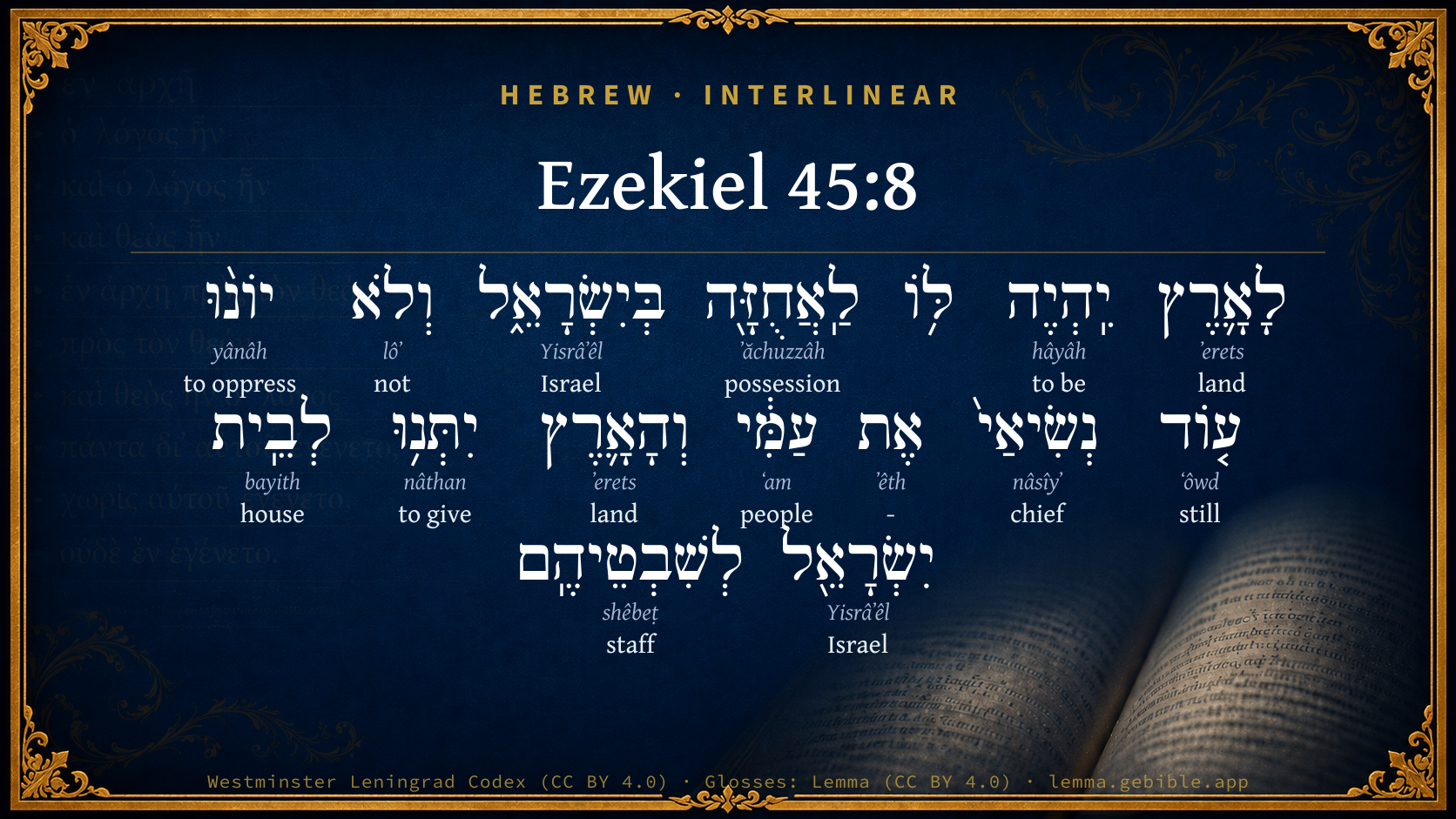
Hebrew (Westminster Leningrad Codex) Ezekiel 45:8 appears in the Hebrew Old Testament. The text above is from the Westminster Leningrad Codex. Each word links to its Strong’s number, a concise gloss, and parsing drawn from the Open Scriptures Hebrew Bible morphology. Click any word for its full Brown-Driver-Briggs (BDB) entry.
Download image
Cite this verse

Ezekiel 45:8 (World English Bible). Public Domain. Lemma interlinear Bible study tool, https://lemma.gebible.app/v/ezekiel/45/8.

Show BibTeX & RIS
BibTeX
RIS
English Translation
In the land it shall be to him for a possession in Israel: and my princes shall no more oppress my people; but they shall give the land to the house of Israel according to their tribes.
World English Bible · Public Domain
Download a study sheet

One document with this verse’s original text, its word-by-word gloss line, the meaning frame, cross-references with their text, attributed commentary, and full source and license credits — printable, and it pastes into notes with its structure intact.

This verse Autodidact and up

Study sheet (.html) Plain text (.txt)

A passage Seminary Student

Up to 50 verses in one chapter. A passage sheet keeps up to 6 commentary sources and 12 cross-references per verse, in the order this page ranks them, and says so on the sheet whenever that leaves anything out. Ask for a single verse and you get the Autodidact verse sheet above.

Everything on this page stays free to read, with no account — the sheet is a download of what is already on screen, not access to it.

Want to remove ads? Support Godless Engineer
Compare translations 3

The same verse in 3 English versions, stacked beneath the original-language interlinear above. Click any original word for its lexicon entry.

Each is an independent rendering of the whole verse — the interlinear is not word-aligned to these translations.

Highlighted words mark where these versions differ — a whole-verse word diff, not a word-by-word alignment.

  • World English Bible Public Domain
    In the land it shall be to him for a possession in Israel: and my princes shall no more oppress my people; but they shall give the land to the house of Israel according to their tribes.
  • King James Version Public Domain
    In the land shall be his possession in Israel: and my princes shall no more oppress my people; and the rest of the land shall they give to the house of Israel according to their tribes.
  • unfoldingWord Literal Text CC BY-SA 4.0
    This land will be property for the prince in Israel. My princes will no longer oppress my people; instead, they will give the land to the house of Israel, for their tribes.

unfoldingWord Literal Text — © unfoldingWord, licensed CC BY-SA 4.0. Word-aligned USFM3 via Door43 (git.door43.org/unfoldingWord/en_ult).

Versions to compare (up to 4)

3 of 4 selected

Show all 18 translations

Every available English version of this verse, each an independent rendering of the whole verse.

  • World English Bible Public Domain
    In the land it shall be to him for a possession in Israel: and my princes shall no more oppress my people; but they shall give the land to the house of Israel according to their tribes.
  • Berean Standard Bible Public Domain
    This land will be his possession in Israel. And My princes will no longer oppress My people, but will give the rest of the land to the house of Israel according to their tribes.
  • Majority Standard Bible Public Domain
    This land will be his possession in Israel. And My princes will no longer oppress My people, but will give the rest of the land to the house of Israel according to their tribes.
  • King James Version Public Domain
    In the land shall be his possession in Israel: and my princes shall no more oppress my people; and the rest of the land shall they give to the house of Israel according to their tribes.
  • American Standard Version (1901) Public Domain
    In the land it shall be to him for a possession in Israel: and my princes shall no more oppress my people; but they shall give the land to the house of Israel according to their tribes.
  • Revised Version (1885) Public Domain
    In the land it shall be to him for a possession in Israel: and my princes shall no more oppress my people; but they shall give the land to the house of Israel according to their tribes.
  • Geneva Bible (1599) Public Domain
    In this lande shalbe his possession in Israel: and my princes shall no more oppresse my people, and the rest of the land shall they giue to ye house of Israel, according to their tribes.
  • Douay-Rheims (1899) Public Domain
    He shall have a portion of the lead in Israel: and the princes shall no more rob my people: but they shall give the land to the house of Israel according to their tribes:
  • Young's Literal Translation Public Domain
    of the land there is to him for a possession in Israel, and My princes do not oppress any more My people, and the land they give to the house of Israel according to their tribes.
  • Literal Standard Version CC BY-SA 4.0
    of the land there is for a possession to him in Israel, and My princes do not oppress My people anymore, and they give the land to the house of Israel according to their tribes.”
  • Unlocked Literal Bible CC BY-SA 4.0
    This land will be property for the prince in Israel. My princes will no longer oppress my people; instead, they will give the land to the house of Israel, for their tribes.
  • unfoldingWord Literal Text CC BY-SA 4.0
    This land will be property for the prince in Israel. My princes will no longer oppress my people; instead, they will give the land to the house of Israel, for their tribes.
  • Darby Bible Public Domain
    As land shall it be his for a possession in Israel; and my princes shall no more oppress my people; but they shall give the land to the house of Israel according to their tribes.
  • World Messianic Bible Public Domain
    In the land it shall be to him for a possession in Israel. My princes shall no more oppress my people, but they shall give the land to the house of Israel according to their tribes.”
  • Webster's Bible Public Domain
    In the land shall be his possession in Israel: and my princes shall no more oppress my people; and the rest of the land shall they give to the house of Israel according to their tribes.
  • Free Bible Version CC BY-SA 4.0
    This territory will be his to own in the country of Israel. My princes won't exploit my people anymore, and will make sure the people of Israel occupy the country according to their tribal allocations.
  • Bible in Basic English Public Domain
    And this will be his heritage in Israel: and my rulers will no longer be cruel masters to my people; but they will give the land as a heritage to the children of Israel by their tribes.
  • JPS Tanakh (1917) Public Domain
    of the land; it shall be to him for a possession in Israel, and My princes shall no more wrong My people; but they shall give the land to the house of Israel according to their tribes.

Literal Standard Version (2020), Covenant Press — licensed CC BY-SA 4.0. Text via the HelloAO Bible API (eBible.org). Unlocked Literal Bible (unfoldingWord) — licensed CC BY-SA 4.0. Text via the HelloAO Bible API (eBible.org). unfoldingWord Literal Text — © unfoldingWord, licensed CC BY-SA 4.0. Word-aligned USFM3 via Door43 (git.door43.org/unfoldingWord/en_ult). Free Bible Version, Dr. Jonathan Gallagher — licensed CC BY-SA 4.0. Text via the HelloAO Bible API (eBible.org).

Word by word

More ways to search: Search by grammar → Find every occurrence → Compare this word →

Practice this passage: Drill this verse → Learn its vocabulary →

יוֹנ֨וּ
yânâh
H3238
“to oppress”
Verb, Hiphil, Imperfect, 3rd Person, Masculine, Plural
Part of Speech
Verb
Stem
Hiphil
Form
Imperfect
Person
3rd Person
Gender
Masculine
Number
Plural
Full BDB Definition

Origin: a primitive root

TWOT: 873

to oppress, suppress, treat violently, maltreat, vex, do wrong - (Qal) to oppress, suppress - (Hiphil) to treat violently, maltreat
  1. לָאָ֛רֶץ ʼerets H776 “to/for the · land” Preposition, Determined + Noun, Common, Both, Singular, Absolute
  2. יִֽהְיֶה hâyâh H1961 “to be” Verb, Qal, Imperfect, 3rd Person, Masculine, Singular
  3. לַֽאֲחֻזָּ֖ה ʼăchuzzâh H272 “to/for · possession” Preposition + Noun, Common, Feminine, Singular, Absolute
  4. בְּיִשְׂרָאֵ֑ל Yisrâʼêl H3478 “in/at · Israel” Preposition + Noun, Proper
  5. וְלֹא lôʼ H3808 “and · not” Conjunction + Particle, Negative
  6. ע֤וֹד ʻôwd H5750 “still” Adverb
  7. נְשִׂיאַי֙ nâsîyʼ H5387 “chiefs · my” Noun, Common, Masculine, Plural, Construct + Suffix, Personal, 1st Person, Common, Singular
  8. אֶת ʼêth H853 “-” Particle, Direct Object
  9. עַמִּ֔י ʻam H5971 “people · my” Noun, Common, Masculine, Singular, Construct + Suffix, Personal, 1st Person, Common, Singular
  10. וְהָאָ֛רֶץ ʼerets H776 “and · the · land” Conjunction + Particle, Definite Article + Noun, Common, Both, Singular, Absolute
  11. יִתְּנ֥וּ nâthan H5414 “to give” Verb, Qal, Imperfect, 3rd Person, Masculine, Plural
  12. לְבֵֽית bayith H1004 “to/for · house of” Preposition + Noun, Common, Masculine, Singular, Construct
  13. יִשְׂרָאֵ֖ל Yisrâʼêl H3478 “Israel” Noun, Proper
  14. לְשִׁבְטֵיהֶֽם shêbeṭ H7626 “to/for · staffs · their” Preposition + Noun, Common, Masculine, Plural, Construct + Suffix, Personal, 3rd Person, Masculine, Plural

About this verse

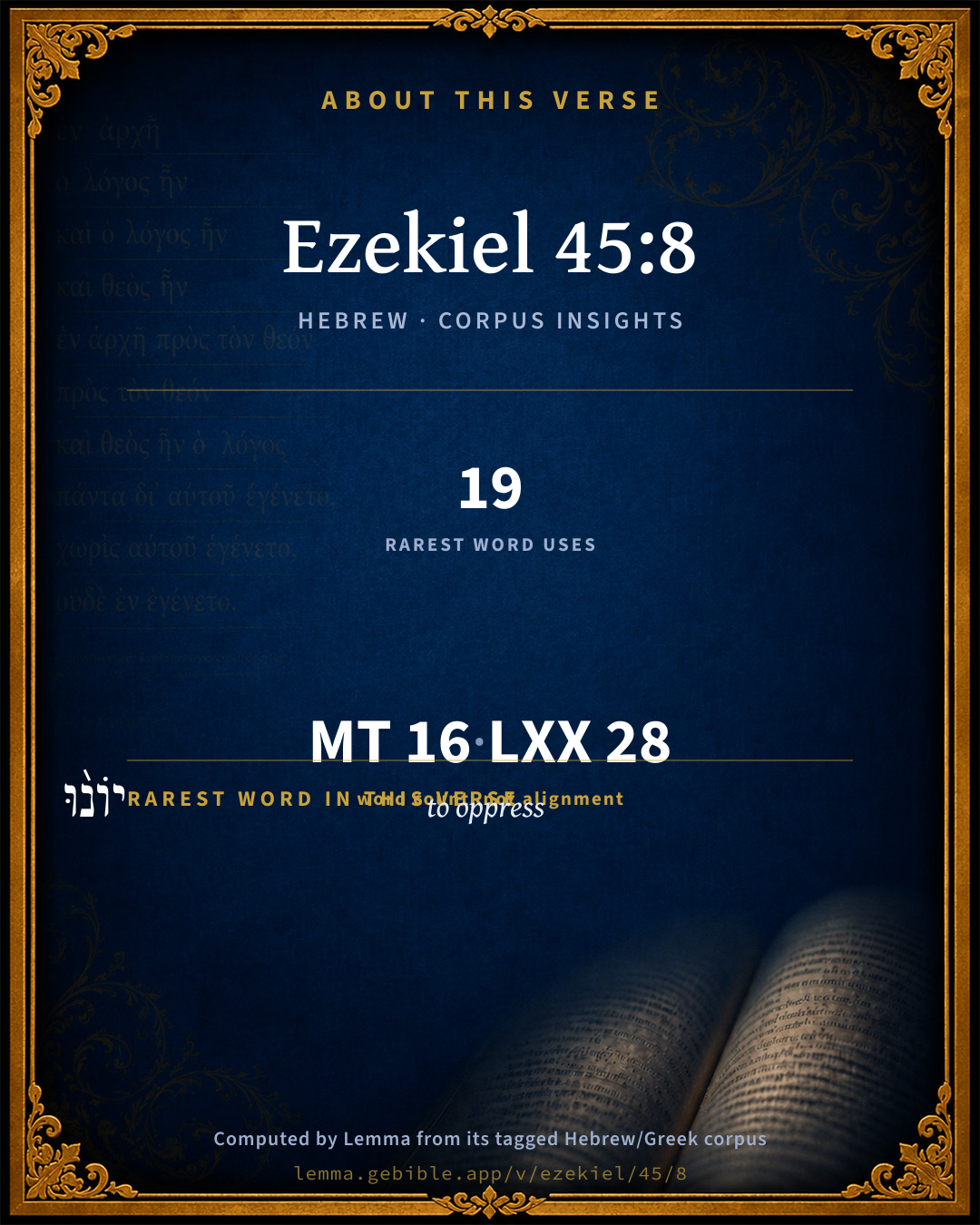
These counts appear in no published source. They are computed here, from the morphology-tagged text and Lemma’s own curated glosses. What Lemma adds →

16
words
13
distinct lemmas
Prophets
section

Notable vocabulary

The rarest word here is יוֹנ֨וּ to oppress H3238 — appearing just 19 times in the whole Hebrew Bible.

Shared distinctive vocabulary

יוֹנ֨וּ to oppress H3238 occurs in 19 verses of the Hebrew Bible. Also found in:

Grammatical profile

  • 3 verbs
  • 9 nouns
  • 1 preposition
  • 1 adverb
  • 2 particles

Verb forms

  • יִֽהְיֶה Qal · Imperfect
  • יוֹנ֨וּ Hiphil · Imperfect
  • יִתְּנ֥וּ Qal · Imperfect

Repetition

Words recur within this verse — often emphatic in Hebrew:

  • לָאָ֛רֶץ land H776 ×2
  • בְּיִשְׂרָאֵ֑ל Israel H3478 ×2

Hebrew & Septuagint length

In English translation the verse runs 37 words from the Hebrew and 34 from the Septuagint (LXX English) — closely comparable.

A rough comparison of the two English renderings, which tokenize alike — not a word-level alignment.

Word counts can differ between the Hebrew and the Greek without any difference in meaning — e.g. the Hebrew direct-object marker אֵת has no separate Greek word, and Greek often adds the article ὁ.

In the original languages it is 16 Hebrew tokens and 28 Greek tokens — but the two are counted differently (Hebrew bundles its prefixes and suffixes into one token; the Greek is in lemma form), so that isn’t a like-for-like length.

Cross-references

16

Topical passages linked to Ezekiel 45:8 in the Treasury of Scripture Knowledge — connected by theme and wording, ordered by reader-vote popularity; previews shown in the World English Bible.

  • Isaiah 11:3–5 His delight shall be in the fear of Yahweh; and he shall not judge after the sight of his eyes, neither decide after the hearing of his ears;
  • Ezekiel 46:18 Moreover the prince shall not take of the people's inheritance, to thrust them out of their possession; he shall give inheritance to his sons out of his own possession, that my people not be scattered every man from his possession.
  • Joshua 11:23 So Joshua took the whole land, according to all that Yahweh spoke to Moses; and Joshua gave it for an inheritance to Israel according to their divisions by their tribes. The land had rest from war.
  • Jeremiah 23:5 Behold, the days come, says Yahweh, that I will raise to David a righteous Branch, and he shall reign as king and deal wisely, and shall execute justice and righteousness in the land.
  • Ezekiel 22:27 Her princes in the midst of it are like wolves ravening the prey, to shed blood, [and] to destroy souls, that they may get dishonest gain.
  • Proverbs 28:16 A tyrannical ruler lacks judgment. One who hates ill-gotten gain will have long days.
  • Isaiah 32:1–2 Behold, a king shall reign in righteousness, and princes shall rule in justice.
  • Isaiah 60:17–18 For brass I will bring gold, and for iron I will bring silver, and for wood brass, and for stones iron. I will also make your officers peace, and righteousness your ruler.
  • Jeremiah 22:17 But your eyes and your heart are not but for your covetousness, and for shedding innocent blood, and for oppression, and for violence, to do it.
  • Ezekiel 19:3 She brought up one of her cubs: he became a young lion, and he learned to catch the prey; he devoured men.
  • Ezekiel 19:7 He knew their palaces, and laid waste their cities; and the land was desolate, and the fullness of it, because of the noise of his roaring.
  • Micah 3:1–4 I said, "Please listen, you heads of Jacob, And rulers of the house of Israel: Isn't it for you to know justice?
  • Zephaniah 3:13 The remnant of Israel will not do iniquity, nor speak lies, neither will a deceitful tongue be found in their mouth, for they will feed and lie down, and no one will make them afraid."
  • James 2:6 But you have dishonored the poor man. Don't the rich oppress you, and personally drag you before the courts?
  • James 5:1–6 Come now, you rich, weep and howl for your miseries that are coming on you.
  • Revelation 19:11–16 I saw the heaven opened, and behold, a white horse, and he who sat on it is called Faithful and True. In righteousness he judges and makes war.

Cross-references courtesy of OpenBible.info (CC BY 4.0).

Hebrew and Greek witnesses Masoretic Hebrew ↔ Greek Septuagint

The same verse in the two great witnesses to the Old Testament, shown verse-for-verse.

These are two independent witnesses, not word-aligned to each other, and the Septuagint is shown in lemma (dictionary) form.

Hebrew Ezekiel 45:8 Masoretic · Westminster Leningrad Codex

לָאָ֛רֶץ יִֽהְיֶה לּ֥וֹ לַֽאֲחֻזָּ֖ה בְּיִשְׂרָאֵ֑ל וְלֹא יוֹנ֨וּ ע֤וֹד נְשִׂיאַי֙ אֶת עַמִּ֔י וְהָאָ֛רֶץ יִתְּנ֥וּ לְבֵֽית יִשְׂרָאֵ֖ל לְשִׁבְטֵיהֶֽם

In the land it shall be to him for a possession in Israel: and my princes shall no more oppress my people; but they shall give the land to the house of Israel according to their tribes.

World English Bible · Public Domain

Greek LXX Ezekiel 45:8 Septuagint · lemma form

καί εἰμί αὐτός εἰς κατάσχεσις ἐν ὁ ἰσραήλ καί οὐ καταδυναστεύω οὐκέτι ὁ ἀποἡγέομαι ὁ ἰσραήλ ὁ λαός ἐγώ καί ὁ γῆ κατακληρονομέω οἶκος ἰσραήλ κατά φυλή αὐτός

And he shall have it for a possession in Israel: and the princes of Israel shall no more oppress my people; but the house of Israel shall inherit the land according to their tribes.

LXX2012 (modern English Septuagint) · Public Domain

On this verse, The Cambridge Bible for Schools and Colleges discusses the Septuagint’s reading. Read the note in Commentary ↓

Hebrew: Westminster Leningrad Codex (CC BY 4.0). Greek: Septuagint (public domain); English from LXX2012 (modern English Septuagint) (Public Domain). How the Septuagint differs from the Hebrew →

Targum (Aramaic paraphrase)

1

The Targum is the ancient Jewish Aramaic paraphrase of the Hebrew Scriptures — an interpretive translation, not the Hebrew text itself. Onkelos (literal) and Pseudo-Jonathan (expansive) render the Torah, and Jonathan the Prophets. Coverage is partial: where no permissively-licensed English translation exists for a verse, only the Aramaic is shown. This is verse-level text, not a word-by-word alignment to the Hebrew.

  1. Targum Jonathan Prophets (Joshua–Malachi)
    דָא אַרְעָא תְּהֵי לְרַבָּא לְאַחְסַנְתָּא בְּיִשְׂרָאֵל וְלָא יֵנִיסוּן עוֹד רַבְרְבֵי יַת עַמִי וְאַרְעָא יִתְּנוּן לְבֵית יִשְׂרָאֵל לְשִׁבְטֵיהוֹן:

    (no public-domain English translation for this verse)

    Targum Jonathan — Aramaic: “Mikraot Gedolot” (public domain). English: “Sefaria Community Translation” (CC0 1.0 (public-domain dedication)); “London "Chaldee Paraphrase," 1871” (public domain). Text via Sefaria.

Commentary

Notes on Ezekiel 45:8 from classic Christian and Jewish commentators (each source and its license shown beneath its notes). The classic Christian expositions comment on the surrounding passage and are grouped to its opening verse, so a note may address several verses; the Jewish commentaries on the Tanakh (Rashi and others) are per-verse, so they appear only where the commentator wrote on this verse.

Lemma curates 59 commentaries, every one of them public domain or Creative Commons licensed, each selected and text-cleaned for this edition rather than reprinted as found. About our sources →

Trapp's Complete Commentary

John Trapp

Eze 45:8 In the land shall be his possession in Israel: and my princes shall no more oppress my people; and [the rest of] the land shall they give to the house of Israel according to their tribes.

Ver. 8. And my princes shall no more oppress my people.] As Samuel foretold they would do, {1Sa 8:11-18} and accordingly they did. But in the Christian commonwealth it should be better, as indeed it was in the days of Constantine the Great, Valentinian, and Theodosius, - which three godly emperors called themselves the vassals of Christ, - and is now, blessed be God, among us at this day.

John Trapp, A Commentary or Exposition upon All the Books of the Old and New Testament (1647–1656) — public domain. Text from a community e-Sword module.

Tyndale Open Study Notes

Tyndale Open Resources

45:8-9 One tangible expression of the Lord’s kingly rule was that he distributed the land to the prince as well as to the people. The prince was assigned a large enough piece of his own land to meet his needs and to allow him to support the ministry of the Temple without having to oppress and rob the people.

Tyndale Open Study Notes — © Tyndale Open Resources, licensed CC BY-SA 4.0. Text via the HelloAO Bible API.

Adam Clarke's Commentary

Verse 8. My princes shall no more oppress my people] By exorbitant taxes to maintain profligate courts, or subsidize other powers to help to keep up a system of tyranny in the earth. The former princes even robbed the temple of God to give subsidies to other states.

Adam Clarke's Commentary on the Bible (1810–1826) — public domain. Text from a community e-Sword/MySword module.

Ellicott's Commentary for English Readers

(8) My princes shall no more oppress.—The use of the plural does not imply that more than one prince should reign at a time, nor is it intended to include the family of the prince; but as everything in the future is described in terms of the past, so the royal authority is conceived of as vested in a succession of rulers, although we have been already told that there shall be but one king over them for ever (Eze_34:23-24; Eze_37:24-25). The declaration that the “princes shall no more oppress my people” follows naturally on the assignment of this portion. Former kings of Israel had no domain given them, and this had tempted them to acquire private property by violence and extortion. The people had been forewarned of this (1Sa_8:14), had often experienced it in their history, and had heard the rebukes of their prophets on account of it (e.g., Jer_22:13-19).

A Bible Commentary for English Readers, edited by Charles John Ellicott (1878–1897) — public domain. Text from a community e-Sword module.

The Cambridge Bible for Schools and Colleges

gen. ed. J. J. S. Perowne

8. In the land … possession] In the land it shall be to him for a possession, lit. in respect of the land. Others: for a domain it shall be …, for a possession. The art. must then be omitted, and the use of “land” in this sense is unnatural.

my princes] The language my is unusual. In Eze_45:9, “princes of Israel,” and so LXX. here. It is possible that Israel was represented in MS. merely by the initial letter, which is the same as the last letter of “princes” (cons.), and that one of the letters fell out.

the rest of the land] Read: oppress my people, but shall give the land to the house. On the oppressions of the princes, cf. Eze_22:25; Jer_22:17.

The Cambridge Bible for Schools and Colleges (gen. ed. J. J. S. Perowne; Cambridge University Press, 1878–1918) — public domain. Text from a community e-Sword module.

John Gill's Exposition

In the land shall be his possession in Israel,.... Or, "as for the land, it shall be his for a possession in Israel" (a); the people of the land shall be a people for possession, as in Pe1 2:9 or a peculiar people of his throughout all Israel; all the spiritual Israel, whether Jew or Gentile, shall be Christ's possession and inheritance:

and my princes shall no more oppress my people; neither ecclesiastical princes, as the Scribes and Pharisees formerly, nor civil magistrates; not the one with false doctrines, carnal rites and ceremonies; nor the other with heavy taxes, and rigorous exactions:

and the rest of the land shall they give to the house of Israel according to their tribes; the spiritual and mystical Israel, Jews and Gentiles, who shall now inherit the earth, and possess all temporal good things, as well as spiritual ones.

(a) "de terra vel quod attinet ad terram, sive terrae (illud), erit in possessionem in Israel", Starckius.

John Gill's Exposition of the Whole Bible (1746–1763) — public domain (CC PDM 1.0). Text via the HelloAO Bible API.

Haydock's Catholic Bible Commentary

Rob. Instead of their right, (1 Kings viii. 11.) the source of continual vexations, a certain revenue is specified, ver. 13.

George Leo Haydock (1774–1849), Haydock's Catholic Family Bible and Commentary, 1859 edition — public domain. Excludes Psalms (Douay-Rheims chapter numbering differs from Protestant) and Deuterocanonical books (Catholic canon only).

Matthew Poole's English Annotations

In the land; either in that portion of land set out for him, or, as it is added, in Israel, i.e. in the land of Israel.

My princes; who own my favour in their advancement, and my law in their government. All princes are in some sort God’s princes, but all do not regard God as sovereign Lord of them and their people; but God did raise up such at the return out of Babylon, who were and did recognise themselves God’s princes.

Shall no more oppress: both Ezekiel and other prophets did reprove the injustices, cruelties, and oppressive methods of the kings of Israel, and yet they took not off the yoke; but it shall be better after the days of Babylonish captivity are ended.

The rest; after God had his portion, which was that the priests and Levites had, after the city and the prince have theirs, the remainder is to be given to the people.

They; the persons that are officers appointed to divide the land.

The house of Israel; two tribes and ten tribes.

According to their tribes, to the number of the tribes, and their right; we must be restored to them, or they compensated with an equal value.

Matthew Poole's English Annotations on the Holy Bible (1683–1685) — public domain. Text from a community e-Sword/MySword module.

The Pulpit Commentary

My princes shall no more oppress my people. That Israel in former times had suffered from the oppressions and exactions of her kings, from Solomon downwards, as Samuel had predicted she would, (1Sa_8:10-18) was matter of history. (see 1Ki_12:4, 1Ki_12:10, 1Ki_12:11; 2Ki_23:35) and was perhaps partly explained, though not justified, by the fact that the kings had no crown lands assigned them for their support. This excuse, however, for regal tyranny should in future cease, as a sufficient portion of land should be allocated to the prince and his successors, who accordingly should give, or leave, the rest of the land to the house of Israel according to their tribes. The use of "princes" does not show, as Hengstenberg asserts, that "under the ideal unity of the prince in Ezekiel, a numerical plurality is included," and that "these who understand by the prince merely the Messiah must here do violence to the text;" but simply, as Kliefoth explains, that Ezekiel was thinking of Israel"s past kings, and contrasting with them the rulers Israel might have in the future, without affirming that these should be many or one. (see on Eze_44:3)

HOMILIES BY J.R. THOMSON Ver. 8. Princes not oppressors.

In the apportionment of the restored and newly occupied territory there was need for a display of a just and equitable spirit. That there was some danger of another and contrary spirit is evident from the admonition here addressed by the prophet in the name of the Lord to those in power and authority.

I THE SPHERE OF OPPRESSION. The oppressor may exercise his might in violation of the principles of righteousness; either

(1) against the personal liberty, or

(2) against the property and possessions, of the oppressed.

II THE MOTIVE TO OPPRESSION. This is almost always selfishness, the desire of personal enrichment, aggrandizement, or power, to attain which the rights of another are treated as of no account.

III THE OPPORTUNITY OF OPPRESSION. It is no merit on the part of the obscure, the impoverished, the friendless, that they abstain from oppression, for the simple reason that it is not in their power; they may be oppressed, but they cannot be oppressors. But those in high station, especially princes, whose power is arbitrary and unchecked, have many opportunities of wronging their subjects and inferiors. In a country like our own, where public rights are secured, and where the monarch acts of necessity within constitutional limits, it is not easy to understand how in other states of society the poor and uninfluential may be at the mercy of the great.

IV THE SIN OF OPPRESSION. This appears from considering the fact that the distinctions obtaining amongst men are to a large extent accidental and artificial. It is for the welfare of society that certain individuals should be entrusted with power; when that power is abused, the very purpose of such distinctions is violated. The law of him who is King of kings, and the principles of whose government are justice and mercy, is opposed to the exercise of political power in an unrighteous and inconsiderate manner.

V THE REMEDY FOR OPPRESSION. This is set forth in a very striking manner in the passage before us: "My princes shall no more oppress my people." The fact that both superior and inferior, both governors and subjects, are the Lord"s, is adduced as the strongest argument against oppression. If both alike are the Lord"s, the unreasonableness is apparent of one class treating the other with harshness and injustice. In fact, religion is here, as elsewhere, the true guide of human conduct, the true corrective of human ills. Let men first consider their obligations to the Giver of all, their responsibility to the Ruler of all, and such considerations will preserve them from wronging those who are, with them, subjects of the same Sovereign and children of the same Father. All alike are his, and there is a community of interest amongst all who acknowledge a common allegiance and a common indebtedness. In such a case, oppression is not only unrighteous, it is unreasonable and monstrous. T.

Human oppression.

princes shall no more oppress my people." God is now upon the throne, (see Eze_43:7) and there is no room for an earthly sovereign. The highest ruler is the "prince;" but that word stands for human authority and power, whatever be the name by which it is indicated. The promise has a reflex significance; it points to the evils which had been in past times. And Israel would have been fortunate indeed if it had escaped the common doom of oppression at the hand of its kings and princes. Many and sad are the sorrows which this poor world of ours has endured at the hand of those who should have lived to bless and not to curse it. The view, or review, is melancholy in the last degree; surely it is only too true that

Man"s inhumanity to man Makes countless ages mourn.

I ITS VARIOUS FORMS. These are:

1. Impressment. The children of Israel were plainly and powerfully forewarned of this evil. (1Sa_8:11-17)

2. Taxation. It was not long before the land groaned beneath the weight of the sovereign"s levies. (2Sa_10:4)

3. Robbery of individual right, and invasion of individual liberty. It needs but to mention the case of David"s sad defection from right, and Ahab"s senseless covetousness and weak yielding to his truculent queen, to be reminded how kings, even of Judah and Israel, defrauded men of their dearest rights. And if we extend the meaning of the word "prince" to any one in authority, or in power, or in possession, we think at once of the terrible oppressions, in this worst form, that have dishonored the lands, darkened the homes, and blighted the lives of men under every sky and in every age of the world.

4. Violence.

II ITS ESSENTIAL INIQUITY AND ENORMITY. For what is it, in truth? It is a shameful abuse of power. It is nothing less than a man taking from the hand of God the power or opportunity which he gave him in order that he might use for the good, the elevation, the happiness of his kind, and turning that power into an instrument of mischief and of sorrow. It is a heartless and shameless exaggeration by a man of his own personal importance, as if his comfort were everything, and an equally heartless and shameless disregard of the wishes and the wants, the joys and the sorrows, the hearts and the homes of other people. It is a guilty perversion of the purpose and debasement of the gift of God.

III THE DEEP DIVINE DISAPPROVAL OF IT. How could the Divine Father of all human spirits see one of his children wronging, oppressing a number of his fellows, weighting them with grievous burdens or robbing them of the essential rights of their manhood or their womanhood, without deep, Divine indignation and sorrow? (see Exo_3:7; 2Ki_13:4; Isa_1:23, 24 49:25; Jer_22:17; Hos_4:18; and Eze_22:27)

IV THE DIVINE PROMISE UNDER THE KINGDOM OF CHRIST. The time shall come when princes and powers "shall no more oppress." When Jesus Christ shall exercise his benignant sway over all nations, when his spirit of righteousness and of love shall fill the hearts and regulate the lives of men, then the hard hand of oppression will be taken off every shoulder; the cruel exactions shall cease; the spirit of the Christian poet will prevail, when he says

I would rather be myself the slave And wear the bonds than fasten them on him;

cruelty shall give place to kindness, and selfishness to considerateness; and instead of men asking How much can I get out of the multitude to fill my purse and serve my purpose? they will ask What can I do to enlighten, to enrich, to elevate, to bless? C.

The Pulpit Commentary (1880–1919), ed. H.D.M. Spence-Jones & Joseph S. Exell — public domain. Text from a community e-Sword module.

unfoldingWord translationNotes

Door43 World Missions Community

General Information:

Yahweh continues giving Ezekiel his message to the house of Israel.

This land will be property for the prince in Israel

"This portion of the land will be the property of the prince among the people of Israel"

translationWords

oppress

people of God

tribe

unfoldingWord translationNotes — © Distant Shores Media and the Door43 World Missions Community, licensed CC BY-SA 4.0. Source: git.door43.org/Door43/en_tn.

Rashi

Rabbi Shlomo Yitzchaki (Rashi)

In the land he shall have it for a possession [Heb. לָאָרֶץ Jonathan renders: This land shall be for the prince as a possession.

shall no longer defraud [Heb. יוֹנוּ,] an expression for monetary fraud; they take away their inheritance forcibly for they rob their inherited property

Rashi on the Tanakh — English translations: “The Judaica Press complete Tanach with Rashi, translated by A. J. Rosenberg” (CC BY 4.0); “Pentateuch with Rashi's commentary by M. Rosenbaum and A.M. Silbermann, 1929-1934” (public domain); “The Metsudah Tanach series, Lakewood, N.J” (CC BY 4.0); and “The Book of Joshua, Metsudah Publications, 1997” (CC BY 4.0). Text via Sefaria.

Lesson kit

Teaching starters — assembled from the data on this page, not authored interpretation. Every prompt links to the verse data it draws on. Edit before teaching.

Ezekiel, in the Prophets, opens this verse with 16 words (13 distinct Hebrew lemmas). Its most distinctive word is yânâh (“to oppress”). A historical commentator’s framing appears above. Read the whole chapter for the surrounding context.

Discussion questions

  1. How does “to oppress” (yânâh) shape what this verse is saying?
  2. Exodus 22:21 shares the word «to oppress» with this verse. How do the two illuminate each other?
  3. “land” occurs 2× in this one verse. What is the effect of the repetition?
  4. These translations render this verse differently; the difference is in the English rendering, not the original. What questions does that raise?
  5. The verb «יִֽהְיֶה» is Qal Imperfect. How does its form color the action?
  6. Reading how Trapp's Complete Commentary and Tyndale Open Study Notes read this verse, where do the two commentators agree and where do they part?

Things to notice

Reading settings

Reading text

Shown beneath each verse's original-language words.

Old Testament
Old Testament edition

Read the OT as the Masoretic Hebrew (MT) or the Greek Septuagint (LXX).

English shown for the Greek Septuagint (in the Hebrew ↔ Greek comparison).

Comparing translations? Open the Compare panel on any verse page to stack up to four side by side.