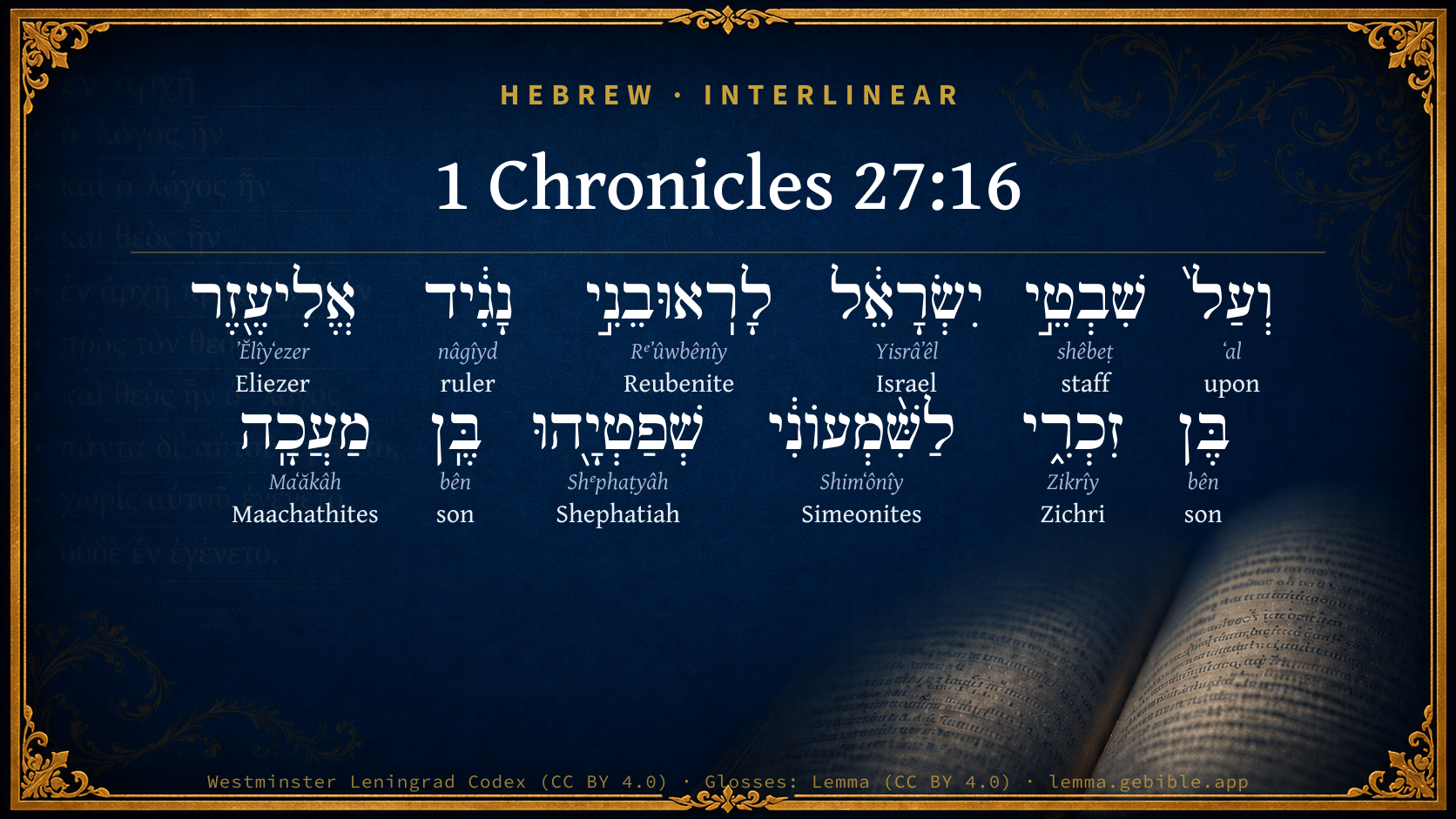
1 Chronicles 27:16

Hebrew (Westminster Leningrad Codex) 1 Chronicles 27:16 appears in the Hebrew Old Testament. The text above is from the Westminster Leningrad Codex. Each word links to its Strong’s number, a concise gloss, and parsing drawn from the Open Scriptures Hebrew Bible morphology. Click any word for its full Brown-Driver-Briggs (BDB) entry.
Download image
Cite this verse

1 Chronicles 27:16 (World English Bible). Public Domain. Lemma interlinear Bible study tool, https://lemma.gebible.app/v/1-chronicles/27/16.

Show BibTeX & RIS
BibTeX
RIS
English Translation
Furthermore over the tribes of Israel: of the Reubenites was Eliezer the son of Zichri the ruler: of the Simeonites, Shephatiah the son of Maacah:
World English Bible · Public Domain
Download a study sheet

One document with this verse’s original text, its word-by-word gloss line, the meaning frame, cross-references with their text, attributed commentary, and full source and license credits — printable, and it pastes into notes with its structure intact.

This verse Autodidact and up

Study sheet (.html) Plain text (.txt)

A passage Seminary Student

Up to 50 verses in one chapter. A passage sheet keeps up to 6 commentary sources and 12 cross-references per verse, in the order this page ranks them, and says so on the sheet whenever that leaves anything out. Ask for a single verse and you get the Autodidact verse sheet above.

Everything on this page stays free to read, with no account — the sheet is a download of what is already on screen, not access to it.

Want to remove ads? Support Godless Engineer
Compare translations 3

The same verse in 3 English versions, stacked beneath the original-language interlinear above. Click any original word for its lexicon entry.

Each is an independent rendering of the whole verse — the interlinear is not word-aligned to these translations.

Highlighted words mark where these versions differ — a whole-verse word diff, not a word-by-word alignment.

  • World English Bible Public Domain
    Furthermore over the tribes of Israel: of the Reubenites was Eliezer the son of Zichri the ruler: of the Simeonites, Shephatiah the son of Maacah:
  • King James Version Public Domain
    Furthermore over the tribes of Israel: the ruler of the Reubenites was Eliezer the son of Zichri: of the Simeonites, Shephatiah the son of Maachah:
  • unfoldingWord Literal Text CC BY-SA 4.0
    And over the tribes of Israel: for the Reubenite, a leader, Eliezer, the son of Zichri; for the Simeonite, Shephatiah, the son of Maacah;

unfoldingWord Literal Text — © unfoldingWord, licensed CC BY-SA 4.0. Word-aligned USFM3 via Door43 (git.door43.org/unfoldingWord/en_ult).

Versions to compare (up to 4)

3 of 4 selected

Show all 18 translations

Every available English version of this verse, each an independent rendering of the whole verse.

  • World English Bible Public Domain
    Furthermore over the tribes of Israel: of the Reubenites was Eliezer the son of Zichri the ruler: of the Simeonites, Shephatiah the son of Maacah:
  • Berean Standard Bible Public Domain
    These officers were in charge of the tribes of Israel: Over the Reubenites was Eliezer son of Zichri; over the Simeonites was Shephatiah son of Maacah;
  • Majority Standard Bible Public Domain
    These officers were in charge of the tribes of Israel: Over the Reubenites was Eliezer son of Zichri; over the Simeonites was Shephatiah son of Maacah;
  • King James Version Public Domain
    Furthermore over the tribes of Israel: the ruler of the Reubenites was Eliezer the son of Zichri: of the Simeonites, Shephatiah the son of Maachah:
  • American Standard Version (1901) Public Domain
    Furthermore over the tribes of Israel: of the Reubenites was Eliezer the son of Zichri the ruler: of the Simeonites, Shephatiah the son of Maacah:
  • Revised Version (1885) Public Domain
    Furthermore over the tribes of Israel: of the Reubenites was Eliezer the son of Zichri the ruler: of the Simeonites, Shephatiah the son of Maacah:
  • Geneva Bible (1599) Public Domain
    Moreouer the rulers ouer the tribes of Israel were these: ouer the Reubenites was ruler, Eliezer the sonne of Zichri: ouer the Shimeonites, Shephatiah the sonne of Maachah:
  • Douay-Rheims (1899) Public Domain
    Now the chiefs over the tribes of Israel were these: over the Rubenites, Eliezer the son of Zechri was ruler: over the Simeonites, Saphatias the son of Maacha:
  • Young's Literal Translation Public Domain
    And over the tribes of Israel: Of the Reubenite, a leader `is' Eliezer son of Zichri; of the Simeonite, Shephatiah son of Maachah;
  • Literal Standard Version CC BY-SA 4.0
    And over the tribes of Israel: the leader of the Reubenite [is] Eliezer son of Zichri; of the Simeonite, Shephatiah son of Maachah;
  • Unlocked Literal Bible CC BY-SA 4.0
    These were the leaders of the tribes of Israel: For the tribe of Reuben, Eliezer son of Zichri was the leader. For the tribe of Simeon, Shephatiah son of Maacah was the leader.
  • unfoldingWord Literal Text CC BY-SA 4.0
    And over the tribes of Israel: for the Reubenite, a leader, Eliezer, the son of Zichri; for the Simeonite, Shephatiah, the son of Maacah;
  • Darby Bible Public Domain
    And over the tribes of Israel were: for the Reubenites Eliezer the son of Zichri was the prince; for the Simeonites, Shephatiah the son of Maachah;
  • World Messianic Bible Public Domain
    Furthermore over the tribes of Israel: of the Reubenites, Eliezer the son of Zichri was the ruler; of the Simeonites, Shephatiah the son of Maacah;
  • Webster's Bible Public Domain
    Furthermore over the tribes of Israel: the ruler of the Reubenites was Eliezer the son of Zichri: of the Simeonites, Shephatiah the son of Maachah:
  • Free Bible Version CC BY-SA 4.0
    This is a list of the leaders for the tribes of Israel: for the Reubenites: Eliezer, son of Zicri; for the Simeonites: Shephatiah, son of Maacah;
  • Bible in Basic English Public Domain
    And over the tribes of Israel: the ruler of the Reubenites was Eliezer, the son of Zichri; of the Simeonites, Shephatiah, the son of Maacah;
  • JPS Tanakh (1917) Public Domain
    Furthermore over the tribes of Israel: of the Reubenites was Eliezer the son of Zichri the ruler; of the Simeonites, Shephatiah the son of Maacah;

Literal Standard Version (2020), Covenant Press — licensed CC BY-SA 4.0. Text via the HelloAO Bible API (eBible.org). Unlocked Literal Bible (unfoldingWord) — licensed CC BY-SA 4.0. Text via the HelloAO Bible API (eBible.org). unfoldingWord Literal Text — © unfoldingWord, licensed CC BY-SA 4.0. Word-aligned USFM3 via Door43 (git.door43.org/unfoldingWord/en_ult). Free Bible Version, Dr. Jonathan Gallagher — licensed CC BY-SA 4.0. Text via the HelloAO Bible API (eBible.org).

Word by word

More ways to search: Search by grammar → Find every occurrence → Compare this word →

Practice this passage: Drill this verse → Learn its vocabulary →

לַשִּׁ֨מְעוֹנִ֔י
Shimʻônîy
H8099
“to/for the · Simeonites”
Preposition, Determined + Noun, Gentilic, Masculine, Singular, Absolute
Part of Speech
Preposition + Noun
Type
Gentilic
Gender
Masculine
Number
Singular
State
Absolute
Full BDB Definition

Origin: patronymically from H8095

TWOT: None

Simeonites = see Simeon " harkening" - descendants of Simeon
  1. וְעַל֙ ʻal H5921 “and · upon” Conjunction + Preposition
  2. שִׁבְטֵ֣י shêbeṭ H7626 “staffs of” Noun, Common, Masculine, Plural, Construct
  3. יִשְׂרָאֵ֔ל Yisrâʼêl H3478 “Israel” Noun, Proper
  4. לָרֽאוּבֵנִ֣י Rᵉʼûwbênîy H7206 “to/for the · Reubenite” Preposition, Determined + Noun, Gentilic, Masculine, Singular, Absolute
  5. נָגִ֔יד nâgîyd H5057 “ruler” Noun, Common, Masculine, Singular, Absolute
  6. אֱלִיעֶ֖זֶר ʼĔlîyʻezer H461 “Eliezer” Noun, Proper
  7. בֶּן bên H1121 “son of” Noun, Common, Masculine, Singular, Construct
  8. זִכְרִ֑י Zikrîy H2147 “Zichri” Noun, Proper
  9. שְׁפַטְיָ֖הוּ Shᵉphaṭyâh H8203 “Shephatiah” Noun, Proper
  10. בֶּֽן bên H1121 “son of” Noun, Common, Masculine, Singular, Construct
  11. מַעֲכָֽה Maʻăkâh H4601 “Maachathites” Noun, Proper

About this verse

These counts appear in no published source. They are computed here, from the morphology-tagged text and Lemma’s own curated glosses. What Lemma adds →

12
words
11
distinct lemmas
Historical
section

Notable vocabulary

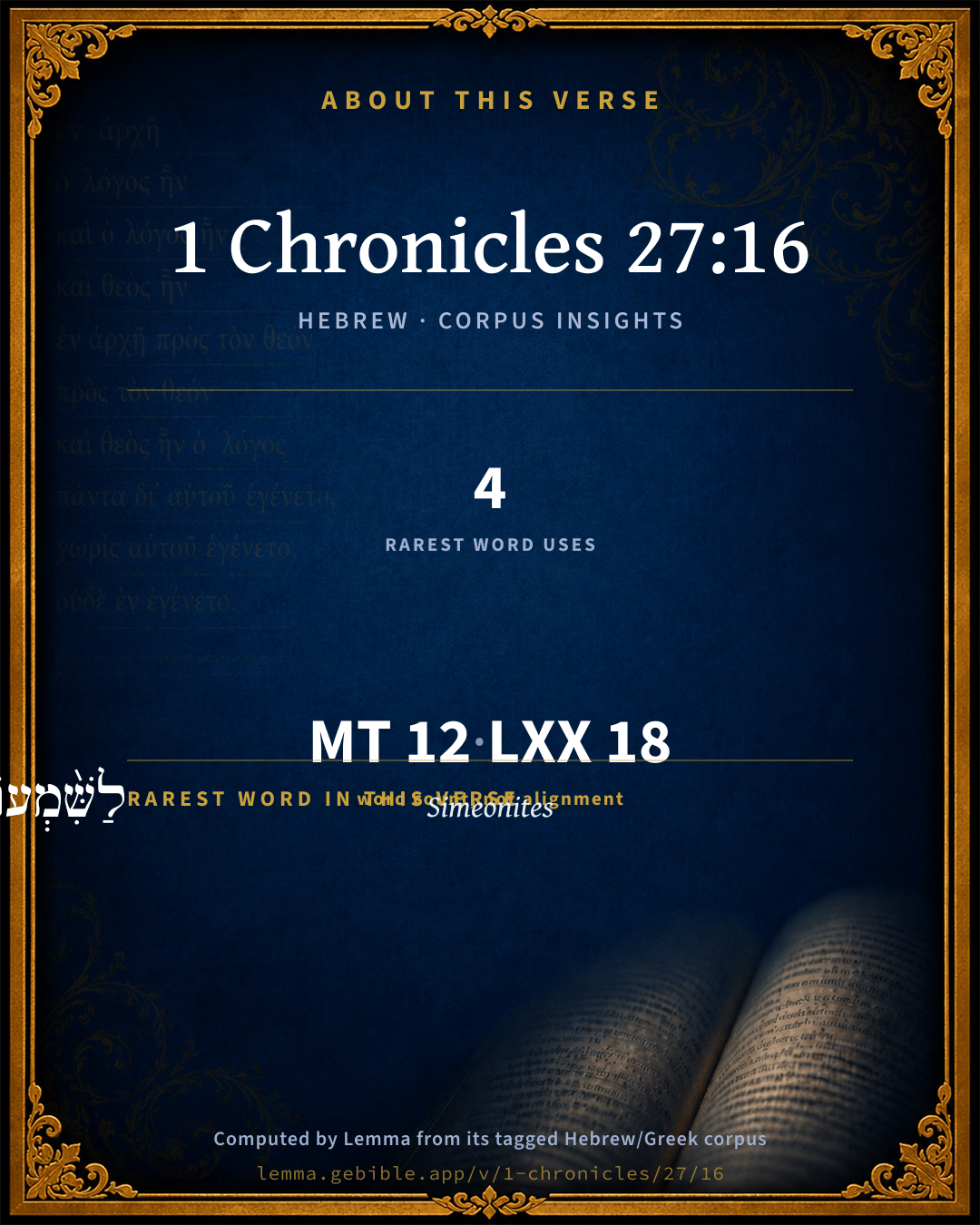
The rarest word here is לַשִּׁ֨מְעוֹנִ֔י Simeonites H8099 — appearing just 4 times in the whole Hebrew Bible.

Shared distinctive vocabulary

לַשִּׁ֨מְעוֹנִ֔י Simeonites H8099 occurs in 4 verses of the Hebrew Bible. Also found in:

Grammatical profile

  • 11 nouns
  • 1 preposition

Repetition

A word recurs within this verse — often emphatic in Hebrew:

Hebrew & Septuagint length

In English translation the verse runs 25 words from the Hebrew and 23 from the Septuagint (LXX English) — closely comparable.

A rough comparison of the two English renderings, which tokenize alike — not a word-level alignment.

Word counts can differ between the Hebrew and the Greek without any difference in meaning — e.g. the Hebrew direct-object marker אֵת has no separate Greek word, and Greek often adds the article ὁ.

In the original languages it is 12 Hebrew tokens and 18 Greek tokens — but the two are counted differently (Hebrew bundles its prefixes and suffixes into one token; the Greek is in lemma form), so that isn’t a like-for-like length.

Hebrew and Greek witnesses Masoretic Hebrew ↔ Greek Septuagint

The same verse in the two great witnesses to the Old Testament, shown verse-for-verse.

These are two independent witnesses, not word-aligned to each other, and the Septuagint is shown in lemma (dictionary) form.

Hebrew 1 Chronicles 27:16 Masoretic · Westminster Leningrad Codex

וְעַל֙ שִׁבְטֵ֣י יִשְׂרָאֵ֔ל לָרֽאוּבֵנִ֣י נָגִ֔יד אֱלִיעֶ֖זֶר בֶּן זִכְרִ֑י לַשִּׁ֨מְעוֹנִ֔י שְׁפַטְיָ֖הוּ בֶּֽן מַעֲכָֽה

Furthermore over the tribes of Israel: of the Reubenites was Eliezer the son of Zichri the ruler: of the Simeonites, Shephatiah the son of Maacah:

World English Bible · Public Domain

Greek LXX 1 Chronicles 27:16 Septuagint · lemma form

καί ἐπί ὁ φυλή ἰσραήλ ὁ ρουβην ἡγέομαι ελιεζερ ὁ ὁ ζεχρι ὁ συμεων σαφατιας ὁ ὁ μααχα

And over the tribes of Israel, the chief for Ruben was Eliezer the son of Zechri: for Symeon, Saphatias the son of Maacha:

LXX2012 (modern English Septuagint) · Public Domain

Hebrew: Westminster Leningrad Codex (CC BY 4.0). Greek: Septuagint (public domain); English from LXX2012 (modern English Septuagint) (Public Domain). How the Septuagint differs from the Hebrew →

Commentary

Notes on 1 Chronicles 27:16 from classic Christian and Jewish commentators (each source and its license shown beneath its notes). The classic Christian expositions comment on the surrounding passage and are grouped to its opening verse, so a note may address several verses; the Jewish commentaries on the Tanakh (Rashi and others) are per-verse, so they appear only where the commentator wrote on this verse.

Lemma curates 59 commentaries, every one of them public domain or Creative Commons licensed, each selected and text-cleaned for this edition rather than reprinted as found. About our sources →

Jamieson, Fausset & Brown

Robert Jamieson, A. R. Fausset & David Brown

PRINCES OF THE TWELVE TRIBES. (Ch1 27:16-24)

over the tribes of Israel: the ruler--This is a list of the hereditary chiefs or rulers of tribes at the time of David's numbering the people. Gad and Asher are not included; for what reason is unknown. The tribe of Levi had a prince (Ch1 27:17), as well as the other tribes; and although it was ecclesiastically subject to the high priest, yet in all civil matters it had a chief or head, possessed of the same authority and power as in the other tribes, only his jurisdiction did not extend to the priests.

Jamieson, Fausset & Brown — Commentary Critical and Explanatory on the Whole Bible (1871) — public domain (CC PDM 1.0). Text via the HelloAO Bible API.

Ellicott's Commentary for English Readers

II. THE PRINCES OR EMIRS OF THE TWELVE TRIBES (1Ch_27:16-24).

(16) Furthermore over the tribes of Israel. Literally, and over the tribes of Israel . . . the Reubenites had as prince (nâgîd) Eliezer, etc.

Eliezer the son of Zichri.—Originally the emir of the tribe was its leader in war, as well as its chief authority in times of peace. David, as appears by the list (1Ch_27:1-15) made the important change of nominating the chief commanders himself. The emirs would still manage the internal affairs of their tribes.

A Bible Commentary for English Readers, edited by Charles John Ellicott (1878–1897) — public domain. Text from a community e-Sword module.

Trapp's Complete Commentary

John Trapp

1Ch 27:16 Furthermore over the tribes of Israel: the ruler of the Reubenites [was] Eliezer the son of Zichri: of the Simeonites, Shephatiah the son of Maachah:

Ver. 16. Furthermore over the several tribes.] Here followeth a list of the rulers of the several tribes. Only Gad and Asher are left out, for reasons unknown.

John Trapp, A Commentary or Exposition upon All the Books of the Old and New Testament (1647–1656) — public domain. Text from a community e-Sword module.

Joseph Benson's Commentary

1Ch 27:16. Over the tribes of Israel: the ruler, &c. — These were the princes of the tribes, the constant rulers of the tribes; who seem to have had a superior power to these twenty-four captains, and therefore are named before them, being probably the king’s chief counsellors and assistants in the great affairs of his kingdom.

Joseph Benson's Commentary on the Old and New Testaments (1811–1818) — public domain. Text from a community e-Sword module.

Tyndale Open Study Notes

Tyndale Open Resources

27:16-22 The order of the tribes roughly follows Num 1:5-15: the six sons of Leah, the two sons of Rachel (the “tribe” of Joseph=Ephraim and Manasseh, followed by Benjamin), followed by the two sons of Bilhah (Dan and Naphtali). Changes from the order of that list are that Naphtali is transferred to his geographical location next to Zebulun, and the tribe of Levi is inserted at the position of Levi’s birth order, with the family of Aaron (the priests) listed separately. Absent from this list are the two sons of Zilpah (Gad and Asher).

Tyndale Open Study Notes — © Tyndale Open Resources, licensed CC BY-SA 4.0. Text via the HelloAO Bible API.

Geneva Bible (1599)

Geneva Bible translators

Meaning, besides these twelve captains.

Geneva Bible (1599) marginal notes — public domain. Text via Bolls.life.

Matthew Henry's Commentary

We have here an account,

I. Of the princes of the tribes. Something of the ancient order instituted by Moses in the wilderness was still kept up, that every tribe should have its prince or chief. It is probable that it was kept up all along, either by election or by succession, in the same family; and those are here named who were found in that office when this account was taken. Elihu, or Eliab, who was prince of Judah, was the eldest son of Jesse, and descended in a right line from Nahshon and Salmon, the princes of this tribe in Moses's time. Whether these princes were of the nature of lord-lieutenants that guided them in their military affairs, or chief-justices that presided in their courts of judgment, does not appear. Their power, we may suppose, was much less now that all the tribes were united under one king than it had been when, for the most part, they acted separately. Our religion obliges us to be subject, not only to the king as supreme, but unto governors under him (Pe1 2:13, Pe1 2:14), the princes that decree justice. Of Benjamin was Jaaziel the son of Abner, Ch1 27:21. Though Abner was David's enemy, and opposed his coming to the throne, yet David would not oppose the preferment of his son, but perhaps nominated him to this post of honour, which teaches us to render good for evil.

II. Of the numbering of the people, Ch1 27:23, Ch1 27:24. It is here said, 1. That when David ordered the people to be numbered he forbade the numbering of those under twenty years old, thinking thereby to save the reflection which what he did might otherwise cast upon the promise that they should be innumerable; yet it was but a poor salvo, for it had never been customary to number those under twenty, and the promise of their numbers chiefly respected the effective men. 2. That the account which David took of the people, in the pride of his heart, turned to no good account; for it was never perfected, nor done with exactness, nor was it ever recorded as an authentic account. Joab was disgusted with it, and did it by halves; David was ashamed of it, and willing it should be forgotten, because there fell wrath for it against Israel. A good man cannot, in the reflection, please himself with that which he knows God is displeased with, cannot make use of that, nor take comfort in that, which is obtained by sin.

III. Of the officers of the court. 1. The rulers of the king's substance (as they are called, Ch1 27:31), such as had the oversight and charge of the king's tillage, his vineyards, his olive-yards, his herds, his camels, his asses, his flocks. Here are no officers for state, none for sport, no master of the wardrobe, no master of the ceremonies, no master of the horse, no master of the hounds, but all for service, agreeable to the simplicity and plainness of those times. David was a great soldier, a great scholar, and a great prince, and yet a great husband of his estate, kept a great deal of ground in his own hand, and stocked it, not for pleasure, but for profit; for the king himself is served of the field, Ecc 5:9. Those magistrates that would have their subjects industrious must themselves be examples of industry and application to business. We find, however, that afterwards the poor of the land were thought good enough to be vine-dressers and husbandmen, Kg2 25:12. Now David put his great men to preside in these employments. 2. The attendants on the king's person. They were such as were eminent for wisdom, being designed for conversation. His uncle, who was a wise man and a scribe, not only well skilled in politics, but well read in the scriptures, was his counsellor, Ch1 27:32. Another, who no doubt excelled in learning and prudence, was tutor to his children. Ahithophel, a very cunning man, was his counsellor: but Hushai, an honest man, was his companion and confidant. It does not appear that he had many counsellors; but those he had were men of great abilities. Much of the wisdom of princes is seen in the choice of their ministry. But David, though he had all these trusty and well-beloved cousins and counsellors about him, preferred his Bible before them all. Psa 119:24, Thy testimonies are my delight and my counsellors.

Matthew Henry's Commentary on the Whole Bible (1708–1710) — public domain (CC PDM 1.0). Text via the HelloAO Bible API.

Adam Clarke's Commentary

Verse 16. Over the tribes of Israel] In this enumeration there is no mention of the tribes of Asher and Gad. Probably the account of these has been lost from this register. These rulers appear to have been all honorary men, without pay, like the lords lieutenants of our counties.

Adam Clarke's Commentary on the Bible (1810–1826) — public domain. Text from a community e-Sword/MySword module.

The Cambridge Bible for Schools and Colleges

gen. ed. J. J. S. Perowne

16–24. The Princes of the Tribes of Israel

Cp. Num_1:2-15 where Moses is enjoined to have with him a representative of each tribe at the numbering of the people; cp. 1Ch_27:23-24 below. In the present list the tribes of Gad and Asher are omitted, probably accidentally.

17. Of the Levites] R.V. of Levi.

Hashabiah] Perhaps the person mentioned in 1Ch_26:30. The name is common among Levites.

of the Aaronites, Zadok] R.V. of Aaron, Zadok. Cp. 1Ch_12:27-28, whence we may conclude that Zadok succeeded Jehoiada as ruler.

The Cambridge Bible for Schools and Colleges (gen. ed. J. J. S. Perowne; Cambridge University Press, 1878–1918) — public domain. Text from a community e-Sword module.

John Gill's Exposition

Furthermore, over the cities of Israel,.... Were the following rulers or princes; the captains over the militia before named were of David's appointment; but these ruled over their respective tribes in their own right, or by the choice of their tribes: the ruler of the tribe of Reuben was Eliezer, the son of Zichri: of the tribe of Simeon, Shephatiah the son of Maachah; whether this was his father's or mother's name is not certain, it being the name both of a man and woman: of the tribe of Levi, Hashabiah the son of Kemuel: of the Aaronites, who were of the same tribe, but, being priests, are thus distinguished from the Levites, Zadok, who was made high priest in the times of Solomon: of the tribe of Judah, Elihu, a brother of David's, the same with Eliab, Sa1 16:6, of the tribe of Issachar, Omri the son of Michael: of the tribe of Zebulun, Ishmaiah the son of Obadiah: of the tribe of Naphtali, Jerimoth the son of Azriel: of the tribe of Ephraim, Hoshea the son of Azaziah: of the half tribe of Manasseh, on this side Jordan westward, Joel the son of Pedaiah: of the half tribe of Manasseh, in Gilead, on the other side Jordan eastward, Iddo the son of Zechariah: of the tribe of Benjamin, Jaasiel the son of Abner, the famous general on the side of Ishbosheth; of the tribe of Dan, Azareel the son of Jeroham:

these were the princes of the tribes of Israel; of all excepting Gad and Asher, who are omitted; perhaps he that was prince of the tribe of Reuben, or else of the half tribe of Manasseh beyond Jordan, was ruler of Gad and Asher; these lying between Zebulun and Naphtali, might be under the prince of one of them.

John Gill's Exposition of the Whole Bible (1746–1763) — public domain (CC PDM 1.0). Text via the HelloAO Bible API.

Albert Barnes' Notes on the Bible

Gad and Asher are omitted from this list of the tribes. Similarly, Dan and Zebulon are omitted from the genealogical survey of the tribes 1 Chr. 4–8. We can only suppose that the lists, as they came down to the writer of Chronicles, were incomplete. The “rulers” or “princes” of the tribes appear to have been the oldest lineal descendants of the patriarchs according to the law of primogeniture.

Albert Barnes' Notes on the Bible (1834–1885) — public domain. Text from a community e-Sword/MySword module.

Haydock's Catholic Bible Commentary

Chiefs, by their birth-right. The former were chosen for merit. (Tirinus) --- The tribes of Aser and of Gad are omitted, either because the list was not in the hands of the author, or it was overlooked by transcribers. (Calmet) --- Rubenites, with whom Em Sa joins the Gadites. (Menochius)

George Leo Haydock (1774–1849), Haydock's Catholic Family Bible and Commentary, 1859 edition — public domain. Excludes Psalms (Douay-Rheims chapter numbering differs from Protestant) and Deuterocanonical books (Catholic canon only).

Matthew Poole's English Annotations

Over the children of Israel, i.e. these were the princes of the tribes as they are called below, 1Ch 27:22, who were the most ancient and constant rulers of the tribes at all times, whether of war or peace; who seem to have had a superior power to these twenty-four captains, and therefore are named before them, 1Ch 28:1, being probably the king’s chief counsellors and assistants in the great affairs of his kingdom.

Matthew Poole's English Annotations on the Holy Bible (1683–1685) — public domain. Text from a community e-Sword/MySword module.

Whedon's Commentary on the Bible

Daniel D. Whedon

THE PRINCES OF THE TRIBES, 16-22.

These princes or rulers were probably the oldest representatives of their several tribes; “the eldest lineal descendants of the patriarchs according to the law of primogeniture.” — Rawlinson. For some reason now unknown the tribes of Gad and Asher are not here mentioned.

Daniel D. Whedon (gen. ed.), Commentary on the Old and New Testaments (1874–1909) — public domain. Text from a community e-Sword module.

The Pulpit Commentary

Vers. 16-22. These verses give the names of the rulers (ver. 16), or princes (ver. 22), of ten out of the twelve tribes of Israel. The tribes not mentioned are Gad and Asher, an omission which reminds of that of the two tribes Dan and Zebulon from the genealogies contained in ch. 4.-7., and equally unexplained. These designations ruler (dygin;) and prince (rc) are the same as are found in the list of vers. 1-15 the former in ver. 4, and translated also as here "ruler;" and the latter in vers. 1, 3, 5, 8, under the Authorized Version word of" captains." This rehearsal of the rulers or captains of the tribes stands evidently in no special relation to the preceding military enumeration, but it forms naturally enough one of four lists in this chapter that purport to set forth David"s complete arrangement of the affairs of the kingdom. So far as the enumeration goes, it appears to aim at fulness and no omission, for the "Aaronites" (ver. 17) are given, and Ephraim and the two halves of Manasseh separately (vers. 20, 21).

The Pulpit Commentary (1880–1919), ed. H.D.M. Spence-Jones & Joseph S. Exell — public domain. Text from a community e-Sword module.

John Wesley's Explanatory Notes

The ruler - These were the princes of the tribes, the constant rulers of the tribes; who seem to have had a superior power to these twenty four captains, and therefore are named before them, being probably the king's chief counsellors and assistants in the great affairs of his kingdom.

John Wesley, Explanatory Notes Upon the Whole Bible (1754–1765) — public domain. Text via the GEBible commentary corpus.

Keil & Delitzsch

C. F. Keil & F. Delitzsch

Furthermore, over the cities of Israel,.... Were the following rulers or princes; the captains over the militia before named were of David's appointment; but these ruled over their respective tribes in their own right, or by the choice of their tribes: the ruler of the tribe of Reuben was Eliezer, the son of Zichri: of the tribe of Simeon, Shephatiah the son of Maachah; whether this was his father's or mother's name is not certain, it being the name both of a man and woman: of the tribe of Levi, Hashabiah the son of Kemuel: of the Aaronites, who were of the same tribe, but, being priests, are thus distinguished from the Levites, Zadok, who was made high priest in the times of Solomon: of the tribe of Judah, Elihu, a brother of David's, the same with Eliab, Sa1 16:6, of the tribe of Issachar, Omri the son of Michael: of the tribe of Zebulun, Ishmaiah the son of Obadiah: of the tribe of Naphtali, Jerimoth the son of Azriel: of the tribe of Ephraim, Hoshea the son of Azaziah: of the half tribe of Manasseh, on this side Jordan westward, Joel the son of Pedaiah: of the half tribe of Manasseh, in Gilead, on the other side Jordan eastward, Iddo the son of Zechariah: of the tribe of Benjamin, Jaasiel the son of Abner, the famous general on the side of Ishbosheth; of the tribe of Dan, Azareel the son of Jeroham:

these were the princes of the tribes of Israel; of all excepting Gad and Asher, who are omitted; perhaps he that was prince of the tribe of Reuben, or else of the half tribe of Manasseh beyond Jordan, was ruler of Gad and Asher; these lying between Zebulun and Naphtali, might be under the prince of one of them.

Keil & Delitzsch — Biblical Commentary on the Old Testament (1861–1891) — public domain (CC PDM 1.0). Text via the HelloAO Bible API. (Old Testament only.)

unfoldingWord translationNotes

Door43 World Missions Community

Eliezer ... Zichri ... Shephatiah ... Maacah ... Hashabiah ... Kemuel ... Omri

These are the names of men. (See: How to Translate Names)

Zadok

See how you translated this man's name in 1 Chronicles 6:8. (See: How to Translate Names)

Elihu

See how you translated this man's name in 1 Chronicles 12:20. (See: How to Translate Names)

Michael

See how you translated this man's name in 1 Chronicles 7:3. (See: How to Translate Names)

translationWords

Israel

Reuben

Simeon

Levi

Aaron

descend

Judah

David

Issachar

unfoldingWord translationNotes — © Distant Shores Media and the Door43 World Missions Community, licensed CC BY-SA 4.0. Source: git.door43.org/Door43/en_tn.

Rashi

Rabbi Shlomo Yitzchaki (Rashi)

And over the tribes of Israel We already stated the chiefs of David’s divisions, and now he tells who the leaders of the tribes of Israel were, the leader of each tribe.

Rashi on the Tanakh — English translations: “The Judaica Press complete Tanach with Rashi, translated by A. J. Rosenberg” (CC BY 4.0); “Pentateuch with Rashi's commentary by M. Rosenbaum and A.M. Silbermann, 1929-1934” (public domain); “The Metsudah Tanach series, Lakewood, N.J” (CC BY 4.0); and “The Book of Joshua, Metsudah Publications, 1997” (CC BY 4.0). Text via Sefaria.

Lesson kit

Teaching starters — assembled from the data on this page, not authored interpretation. Every prompt links to the verse data it draws on. Edit before teaching.

1 Chronicles, in the Historical, opens this verse with 12 words (11 distinct Hebrew lemmas). Its most distinctive word is Shimʻônîy (“Simeonites”). A historical commentator’s framing appears above. Read the whole chapter for the surrounding context.

Discussion questions

  1. The word Shimʻônîy carries the sense “Simeonites.” How does it shape the verse?
  2. How does Numbers 25:14, which shares the word «Simeonites», read alongside this verse?
  3. What does the repetition of “son” (2× in this one verse) do in this verse?
  4. These translations render this verse differently; the difference is in the English rendering, not the original. What questions does that raise?
  5. Compare how Jamieson, Fausset & Brown and Ellicott's Commentary for English Readers read this verse. Where do they agree or differ?

Things to notice

Reading settings

Reading text

Shown beneath each verse's original-language words.

Old Testament
Old Testament edition

Read the OT as the Masoretic Hebrew (MT) or the Greek Septuagint (LXX).

English shown for the Greek Septuagint (in the Hebrew ↔ Greek comparison).

Comparing translations? Open the Compare panel on any verse page to stack up to four side by side.