Joshua 21:16

Hebrew (Westminster Leningrad Codex) Joshua 21:16 appears in the Hebrew Old Testament. The text above is from the Westminster Leningrad Codex. Each word links to its Strong’s number, a concise gloss, and parsing drawn from the Open Scriptures Hebrew Bible morphology. Click any word for its full Brown-Driver-Briggs (BDB) entry.
Download image
Cite this verse

Joshua 21:16 (World English Bible). Public Domain. Lemma interlinear Bible study tool, https://lemma.gebible.app/v/joshua/21/16.

Show BibTeX & RIS
BibTeX
RIS
English Translation
and Ain with its suburbs, and Juttah with its suburbs, [and] Beth-shemesh with its suburbs; nine cities out of those two tribes.
World English Bible · Public Domain
Download a study sheet

One document with this verse’s original text, its word-by-word gloss line, the meaning frame, cross-references with their text, attributed commentary, and full source and license credits — printable, and it pastes into notes with its structure intact.

This verse Autodidact and up

Study sheet (.html) Plain text (.txt)

A passage Seminary Student

Up to 50 verses in one chapter. A passage sheet keeps up to 6 commentary sources and 12 cross-references per verse, in the order this page ranks them, and says so on the sheet whenever that leaves anything out. Ask for a single verse and you get the Autodidact verse sheet above.

Everything on this page stays free to read, with no account — the sheet is a download of what is already on screen, not access to it.

Want to remove ads? Support Godless Engineer
Compare translations 3

The same verse in 3 English versions, stacked beneath the original-language interlinear above. Click any original word for its lexicon entry.

Each is an independent rendering of the whole verse — the interlinear is not word-aligned to these translations.

Highlighted words mark where these versions differ — a whole-verse word diff, not a word-by-word alignment.

  • World English Bible Public Domain
    and Ain with its suburbs, and Juttah with its suburbs, [and] Beth-shemesh with its suburbs; nine cities out of those two tribes.
  • King James Version Public Domain
    And Ain with her suburbs, and Juttah with her suburbs, and Bethshemesh with her suburbs; nine cities out of those two tribes.
  • unfoldingWord Literal Text CC BY-SA 4.0
    and Ain and its pasturelands and Juttah and its pasturelands and Beth Shemesh and its pasturelands: nine cities from the two of these tribes.

unfoldingWord Literal Text — © unfoldingWord, licensed CC BY-SA 4.0. Word-aligned USFM3 via Door43 (git.door43.org/unfoldingWord/en_ult).

Versions to compare (up to 4)

3 of 4 selected

Show all 18 translations

Every available English version of this verse, each an independent rendering of the whole verse.

  • World English Bible Public Domain
    and Ain with its suburbs, and Juttah with its suburbs, [and] Beth-shemesh with its suburbs; nine cities out of those two tribes.
  • Berean Standard Bible Public Domain
    Ain, Juttah, and Beth-shemesh—nine cities from these two tribes, together with their pasturelands.
  • Majority Standard Bible Public Domain
    Ain, Juttah, and Beth-shemesh—nine cities from these two tribes, together with their pasturelands.
  • King James Version Public Domain
    And Ain with her suburbs, and Juttah with her suburbs, and Bethshemesh with her suburbs; nine cities out of those two tribes.
  • American Standard Version (1901) Public Domain
    and Ain with its suburbs, and Juttah with its suburbs, `and' Beth-shemesh with its suburbs; nine cities out of those two tribes.
  • Revised Version (1885) Public Domain
    and Ain with her suburbs, and Juttah with her suburbs, and Beth-shemesh with her suburbs; nine cities out of those two tribes.
  • Geneva Bible (1599) Public Domain
    And Ain with her suburbes, and Iuttah with her suburbes, Beth-shemesh with her suburbes: nine cities out of those two tribes.
  • Douay-Rheims (1899) Public Domain
    And Ain, and Jeta, and Bethsames, with their suburbs: nine cities out of the two tribes, as hath been said.
  • Young's Literal Translation Public Domain
    and Ain and its suburbs, and Juttah and its suburbs, Beth-Shemesh and its suburbs; nine cities out of these two tribes.
  • Literal Standard Version CC BY-SA 4.0
    and Ain and its outskirts, and Juttah and its outskirts, Beth-Shemesh and its outskirts; nine cities out of these two tribes.
  • Unlocked Literal Bible CC BY-SA 4.0
    Ain with its pasturelands, Juttah with its pasturelands, and Beth Shemesh with its pasturelands. There were nine cities that were given from these two tribes.
  • unfoldingWord Literal Text CC BY-SA 4.0
    and Ain and its pasturelands and Juttah and its pasturelands and Beth Shemesh and its pasturelands: nine cities from the two of these tribes.
  • Darby Bible Public Domain
    and Ain and its suburbs, and Juttah and its suburbs, [and] Beth-shemesh and its suburbs: nine cities out of those two tribes;
  • World Messianic Bible Public Domain
    Ain with its pasture lands, Juttah with its pasture lands, and Beth Shemesh with its pasture lands: nine cities out of those two tribes.
  • Webster's Bible Public Domain
    And Ain with its suburbs, and Juttah with its suburbs, and Beth-shemesh with its suburbs; nine cities out of those two tribes.
  • Free Bible Version CC BY-SA 4.0
    Ain, Juttah, and Beth-shemesh—nine towns from these two tribes.
  • Bible in Basic English Public Domain
    And Ain, and Juttah, and Beth-shemesh, with their grass-lands; nine towns from those two tribes.
  • JPS Tanakh (1917) Public Domain
    and Ain with the open land about it, and Juttah with the open land about it, and Beth-shemesh with the open land about it; nine cities out of those two tribes.

Literal Standard Version (2020), Covenant Press — licensed CC BY-SA 4.0. Text via the HelloAO Bible API (eBible.org). Unlocked Literal Bible (unfoldingWord) — licensed CC BY-SA 4.0. Text via the HelloAO Bible API (eBible.org). unfoldingWord Literal Text — © unfoldingWord, licensed CC BY-SA 4.0. Word-aligned USFM3 via Door43 (git.door43.org/unfoldingWord/en_ult). Free Bible Version, Dr. Jonathan Gallagher — licensed CC BY-SA 4.0. Text via the HelloAO Bible API (eBible.org).

Word by word

More ways to search: Search by grammar → Find every occurrence → Compare this word →

Practice this passage: Drill this verse → Learn its vocabulary →

יֻטָּה֙
Yuṭṭâh
H3194
“Juttah”
Noun, Proper
Part of Speech
Noun
Type
Proper
Full BDB Definition

Origin: from H5186

TWOT: None

Juttah = "stretched out" - a town in the mountains of Judah, in the neighbourhood of Maon and Carmel; modern 'Yutta'
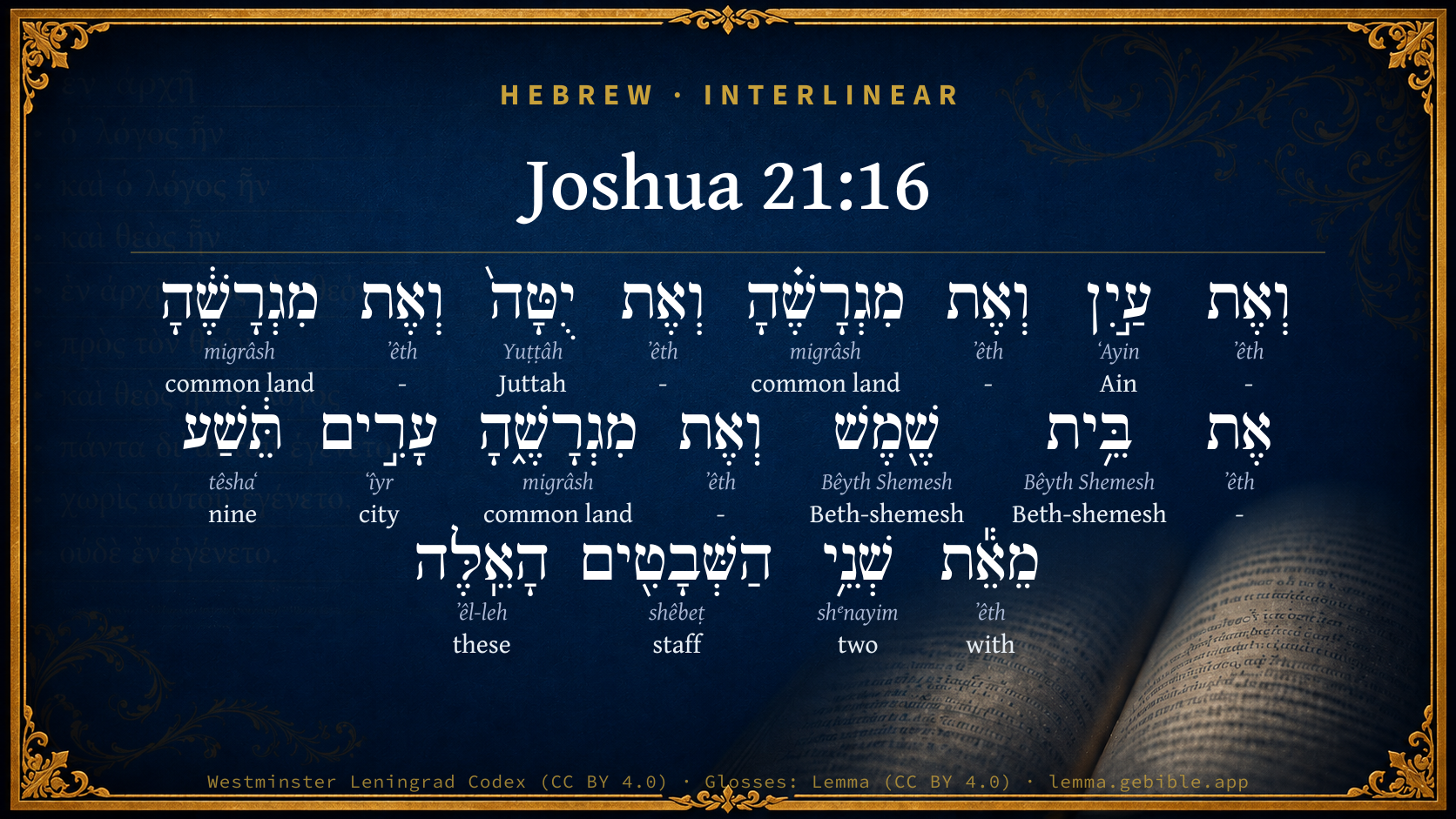
  1. וְאֶת ʼêth H853 “and · -” Conjunction + Particle, Direct Object
  2. עַ֣יִן ʻAyin H5871 “Ain” Noun, Proper
  3. וְאֶת ʼêth H853 “and · -” Conjunction + Particle, Direct Object
  4. מִגְרָשֶׁ֗הָ migrâsh H4054 “common lands · her” Noun, Common, Masculine, Plural, Construct + Suffix, Personal, 3rd Person, Feminine, Singular
  5. וְאֶת ʼêth H853 “and · -” Conjunction + Particle, Direct Object
  6. וְאֶת ʼêth H853 “and · -” Conjunction + Particle, Direct Object
  7. מִגְרָשֶׁ֔הָ migrâsh H4054 “common lands · her” Noun, Common, Masculine, Plural, Construct + Suffix, Personal, 3rd Person, Feminine, Singular
  8. אֶת ʼêth H853 “-” Particle, Direct Object
  9. בֵּ֥ית Bêyth Shemesh H1053 “Beth-shemesh” Noun, Proper
  10. שֶׁ֖מֶשׁ Bêyth Shemesh H1053 “Beth-shemesh” Noun, Proper
  11. וְאֶת ʼêth H853 “and · -” Conjunction + Particle, Direct Object
  12. מִגְרָשֶׁ֑הָ migrâsh H4054 “common lands · her” Noun, Common, Masculine, Plural, Construct + Suffix, Personal, 3rd Person, Feminine, Singular
  13. עָרִ֣ים ʻîyr H5892 “cities” Noun, Common, Feminine, Plural, Absolute
  14. תֵּ֔שַׁע têshaʻ H8672 “nine” Adjective, Cardinal number, Feminine, Singular, Absolute
  15. מֵאֵ֕ת ʼêth H854 “from · with” Preposition + Preposition
  16. שְׁנֵ֥י shᵉnayim H8147 “two” Adjective, Cardinal number, Masculine, Dual, Construct
  17. הַשְּׁבָטִ֖ים shêbeṭ H7626 “the · staffs” Particle, Definite Article + Noun, Common, Masculine, Plural, Absolute
  18. הָאֵֽלֶּה ʼêl-leh H428 “the · these” Particle, Definite Article + Pronoun, Demonstrative, Common, Plural

About this verse

These counts appear in no published source. They are computed here, from the morphology-tagged text and Lemma’s own curated glosses. What Lemma adds →

19
words
11
distinct lemmas
Historical
section

Notable vocabulary

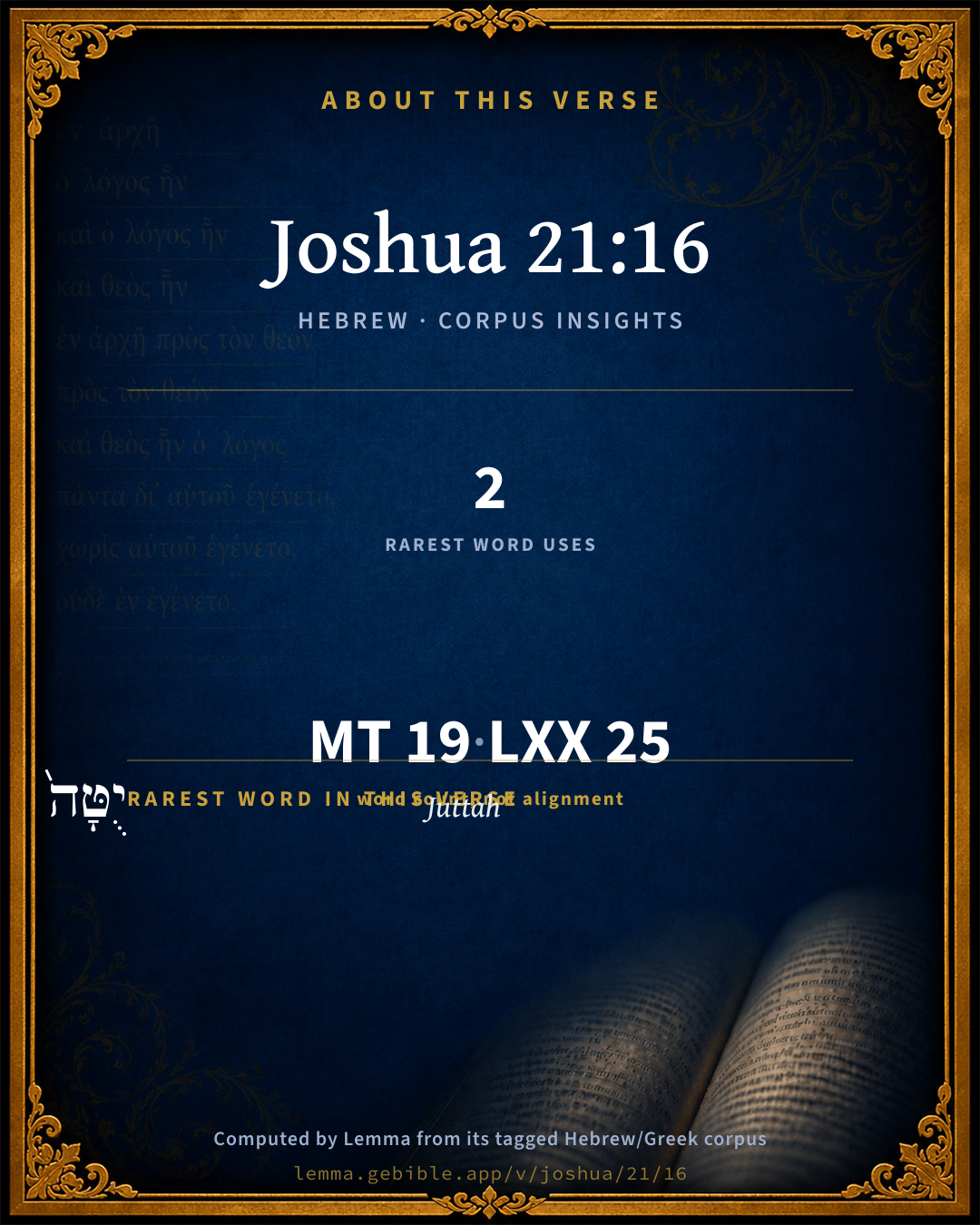
The rarest word here is יֻטָּה֙ Juttah H3194 — appearing just 2 times in the whole Hebrew Bible.

Shared distinctive vocabulary

יֻטָּה֙ Juttah H3194 occurs in 2 verses of the Hebrew Bible. Also found in:

Grammatical profile

  • 9 nouns
  • 2 adjectives
  • 1 pronoun
  • 1 preposition
  • 6 particles

Repetition

Words recur within this verse — often emphatic in Hebrew:

  • מִגְרָשֶׁ֗הָ common land H4054 ×3
  • בֵּ֥ית Beth-shemesh H1053 ×2

Hebrew & Septuagint length

In English translation the verse runs 22 words from the Hebrew and 21 from the Septuagint (LXX English) — closely comparable.

A rough comparison of the two English renderings, which tokenize alike — not a word-level alignment.

Word counts can differ between the Hebrew and the Greek without any difference in meaning — e.g. the Hebrew direct-object marker אֵת has no separate Greek word, and Greek often adds the article ὁ.

In the original languages it is 19 Hebrew tokens and 25 Greek tokens — but the two are counted differently (Hebrew bundles its prefixes and suffixes into one token; the Greek is in lemma form), so that isn’t a like-for-like length.

Cross-references

6

Topical passages linked to Joshua 21:16 in the Treasury of Scripture Knowledge — connected by theme and wording, ordered by reader-vote popularity; previews shown in the World English Bible.

  • Joshua 15:10 and the border turned about from Baalah westward to Mount Seir, and passed along to the side of Mount Jearim on the north (the same is Chesalon), and went down to Beth-shemesh, and passed along by Timnah;
  • Joshua 15:55 Maon, Carmel, and Ziph, and Jutah,
  • 1 Chronicles 6:59 and Ashan with its suburbs, and Beth-shemesh with its suburbs;
  • Joshua 15:42 Libnah, and Ether, and Ashan,
  • 1 Samuel 6:9 Behold; if it goes up by the way of its own border to Beth-shemesh, then he has done us this great evil: but if not, then we shall know that it is not his hand that struck us; it was a chance that happened to us."
  • 1 Samuel 6:12 The cattle took the straight way by the way to Beth-shemesh; they went along the highway, lowing as they went, and didn't turn aside to the right hand or to the left; and the lords of the Philistines went after them to the border of Beth-shemesh.

Cross-references courtesy of OpenBible.info (CC BY 4.0).

Hebrew and Greek witnesses Masoretic Hebrew ↔ Greek Septuagint

The same verse in the two great witnesses to the Old Testament, shown verse-for-verse.

These are two independent witnesses, not word-aligned to each other, and the Septuagint is shown in lemma (dictionary) form.

Hebrew Joshua 21:16 Masoretic · Westminster Leningrad Codex

וְאֶת עַ֣יִן וְאֶת מִגְרָשֶׁ֗הָ וְאֶת יֻטָּה֙ וְאֶת מִגְרָשֶׁ֔הָ אֶת בֵּ֥ית שֶׁ֖מֶשׁ וְאֶת מִגְרָשֶׁ֑הָ עָרִ֣ים תֵּ֔שַׁע מֵאֵ֕ת שְׁנֵ֥י הַשְּׁבָטִ֖ים הָאֵֽלֶּה

and Ain with its suburbs, and Juttah with its suburbs, [and] Beth-shemesh with its suburbs; nine cities out of those two tribes.

World English Bible · Public Domain

Greek LXX Joshua 21:16 Septuagint · lemma form

καί ασα καί ὁ ἀποὁρίζω αὐτός καί τανυ καί ὁ ἀποὁρίζω αὐτός καί βαιθσαμυς καί ὁ ἀποὁρίζω αὐτός πόλις ἐννέα παρά ὁ δύο φυλή οὗτος

and Asa and its suburbs; and Tany and its suburbs; and Baethsamys and its suburbs: nine cities from these two tribes.

LXX2012 (modern English Septuagint) · Public Domain

On this verse, Haydock's Catholic Bible Commentary discusses the Septuagint’s reading. Read the note in Commentary ↓

Hebrew: Westminster Leningrad Codex (CC BY 4.0). Greek: Septuagint (public domain); English from LXX2012 (modern English Septuagint) (Public Domain). How the Septuagint differs from the Hebrew →

Targum (Aramaic paraphrase)

1

The Targum is the ancient Jewish Aramaic paraphrase of the Hebrew Scriptures — an interpretive translation, not the Hebrew text itself. Onkelos (literal) and Pseudo-Jonathan (expansive) render the Torah, and Jonathan the Prophets. Coverage is partial: where no permissively-licensed English translation exists for a verse, only the Aramaic is shown. This is verse-level text, not a word-by-word alignment to the Hebrew.

  1. Targum Jonathan Prophets (Joshua–Malachi)
    וְיַת עַיִן וְיַת רְוָחָהָא וְיַת יֻטָה וְיַת רְוָחָהָא יַת בֵּית שֶׁמֶשׁ וְיַת רְוָחָהָא קִרְוִין תְּשַׁע מִן תְּרֵין שִׁבְטַיָא הָאִלֵין:

    (no public-domain English translation for this verse)

    Targum Jonathan — Aramaic: “Mikraot Gedolot” (public domain). English: “Sefaria Community Translation” (CC0 1.0 (public-domain dedication)); “London "Chaldee Paraphrase," 1871” (public domain). Text via Sefaria.

Commentary

Notes on Joshua 21:16 from classic Christian and Jewish commentators (each source and its license shown beneath its notes). The classic Christian expositions comment on the surrounding passage and are grouped to its opening verse, so a note may address several verses; the Jewish commentaries on the Tanakh (Rashi and others) are per-verse, so they appear only where the commentator wrote on this verse.

Lemma curates 59 commentaries, every one of them public domain or Creative Commons licensed, each selected and text-cleaned for this edition rather than reprinted as found. About our sources →

Joseph Benson's Commentary

Jos 21:16. And Ain — Ain and Gibeon, and some others here named, are not named 1Ch 6:59. Either they were destroyed in some of those invasions wherewith their land was grievously wasted before that time, or they appear there under other names.

Joseph Benson's Commentary on the Old and New Testaments (1811–1818) — public domain. Text from a community e-Sword module.

The Cambridge Bible for Schools and Colleges

gen. ed. J. J. S. Perowne

16. Ain, see Jos_15:32, Jos_19:7; Juttah, Jos_15:55; Beth-shemesh, Jos_15:10.

The Cambridge Bible for Schools and Colleges (gen. ed. J. J. S. Perowne; Cambridge University Press, 1878–1918) — public domain. Text from a community e-Sword module.

John Gill's Exposition

And Ain with her suburbs,.... See Gill on Jos 15:32,

and Juttah with her suburbs; See Gill on Jos 15:55,

and Bethshemesh with her suburbs; which is not mentioned among the cities of Judah, Jos 15:21; only as in the borders of it, Jos 21:10; and perhaps is the same Bethshemesh to which the ark was directed by the Philistines from Ashdod, Sa1 6:9; in it formerly was a temple dedicated to the sun, from whence it had its name:

nine cities out of those two tribes; and they seem all but one, which is Ain, to be of the tribe of Judah, and that originally belonged to it; and as that tribe had the largest number of cities in its lot, the more were given out of it to the Levites, according to a rule prescribed, Num 35:8.

John Gill's Exposition of the Whole Bible (1746–1763) — public domain (CC PDM 1.0). Text via the HelloAO Bible API.

Haydock's Catholic Bible Commentary

Ain and Jeta. Septuagint of Grabe agrees with the Vulgate. But the Vatican copy (Haydock) has, "Asa....and Tanu." In 1 Paralipomenon vi. 59, only Asan and Bethsemes are mentioned. Several other variations may also be observed, which may be attributed either to the changes which were afterwards made when the Chanaanites kept their hold, (Rabbins) or to the different places having two names, or to the mistakes of transcribers, &c. See chap xv. 62. Only eleven cities are specified in the Book of Paralipomenon, though it observes that there were thirteen. (Calmet) --- As hath, &c., words added by St. Jerome, or rather expressing more fully the Hebrew, "those" two tribes. (Haydock)

George Leo Haydock (1774–1849), Haydock's Catholic Family Bible and Commentary, 1859 edition — public domain. Excludes Psalms (Douay-Rheims chapter numbering differs from Protestant) and Deuterocanonical books (Catholic canon only).

Matthew Poole's English Annotations

Ain here, and Gibeon Jos 21:17, and some others here named, are not named 1Ch 6, either because they were destroyed in some of those hostile invasions and wars wherewith their land was grievously harassed and wasted before that time; or they appear there under other names, as was said.

Matthew Poole's English Annotations on the Holy Bible (1683–1685) — public domain. Text from a community e-Sword/MySword module.

The Pulpit Commentary

Ain with her suburbs. We have "Ashan" in 1Ch_6:59. If the view taken above of Ain (see note on Jos_15:32, and Jos_19:7) be correct, Ashen is the true reading here.

The Pulpit Commentary (1880–1919), ed. H.D.M. Spence-Jones & Joseph S. Exell — public domain. Text from a community e-Sword module.

John Wesley's Explanatory Notes

And Ain - Ain and Gibeon, and some others here named are not named, 1 Chron. vi, 59. Either they were destroyed in some of those invasions wherewith their land was grievously wasted before that time; or they appear there under other names.

John Wesley, Explanatory Notes Upon the Whole Bible (1754–1765) — public domain. Text via the GEBible commentary corpus.

Lesson kit

Teaching starters — assembled from the data on this page, not authored interpretation. Every prompt links to the verse data it draws on. Edit before teaching.

Joshua, in the Historical, opens this verse with 19 words (11 distinct Hebrew lemmas). Its most distinctive word is Yuṭṭâh (“Juttah”). A historical commentator’s framing appears above. Read the whole chapter for the surrounding context.

Discussion questions

  1. The word Yuṭṭâh carries the sense “Juttah.” How does it shape the verse?
  2. Joshua 15:55 shares the word «Juttah» with this verse. How do the two illuminate each other?
  3. “common land” occurs 3× in this one verse. What is the effect of the repetition?
  4. These translations render this verse differently. What is at stake in choosing one wording over another?
  5. Reading how Joseph Benson's Commentary and The Cambridge Bible for Schools and Colleges read this verse, where do the two commentators agree and where do they part?

Things to notice

Reading settings

Reading text

Shown beneath each verse's original-language words.

Old Testament
Old Testament edition

Read the OT as the Masoretic Hebrew (MT) or the Greek Septuagint (LXX).

English shown for the Greek Septuagint (in the Hebrew ↔ Greek comparison).

Comparing translations? Open the Compare panel on any verse page to stack up to four side by side.