
Isaiah 49:6

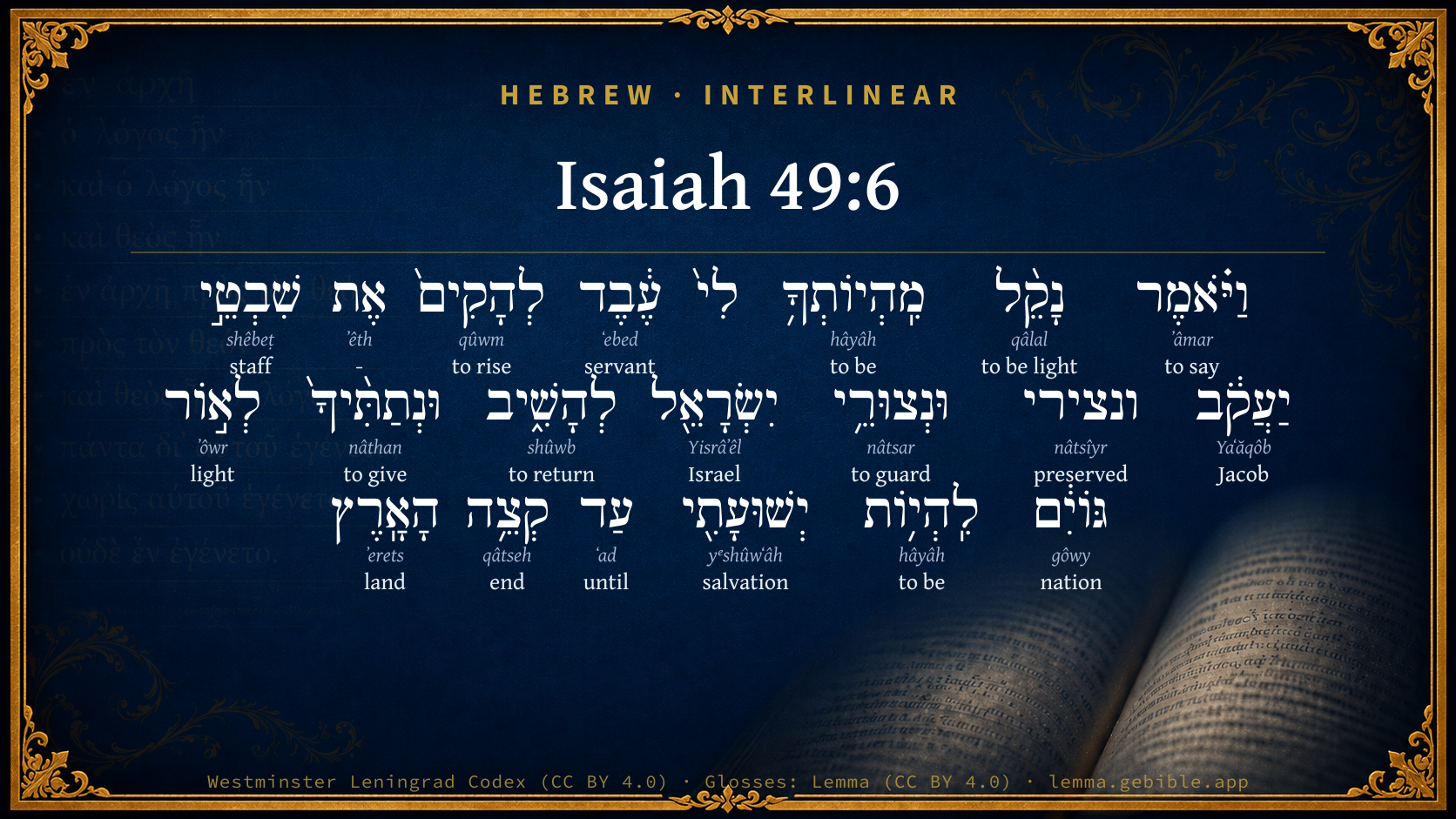
Hebrew (Westminster Leningrad Codex) Isaiah 49:6 appears in the Hebrew Old Testament. The text above is from the Westminster Leningrad Codex. Each word links to its Strong’s number, a concise gloss, and parsing drawn from the Open Scriptures Hebrew Bible morphology. Click any word for its full Brown-Driver-Briggs (BDB) entry.
Download image
Cite this verse

Isaiah 49:6 (World English Bible). Public Domain. Lemma interlinear Bible study tool, https://lemma.gebible.app/v/isaiah/49/6.

Show BibTeX & RIS
BibTeX
RIS
English Translation
yes, he says, It is too light a thing that you should be my servant to raise up the tribes of Jacob, and to restore the preserved of Israel: I will also give you for a light to the Gentiles, that you may be my salvation to the end of the earth.
World English Bible · Public Domain
Highlights
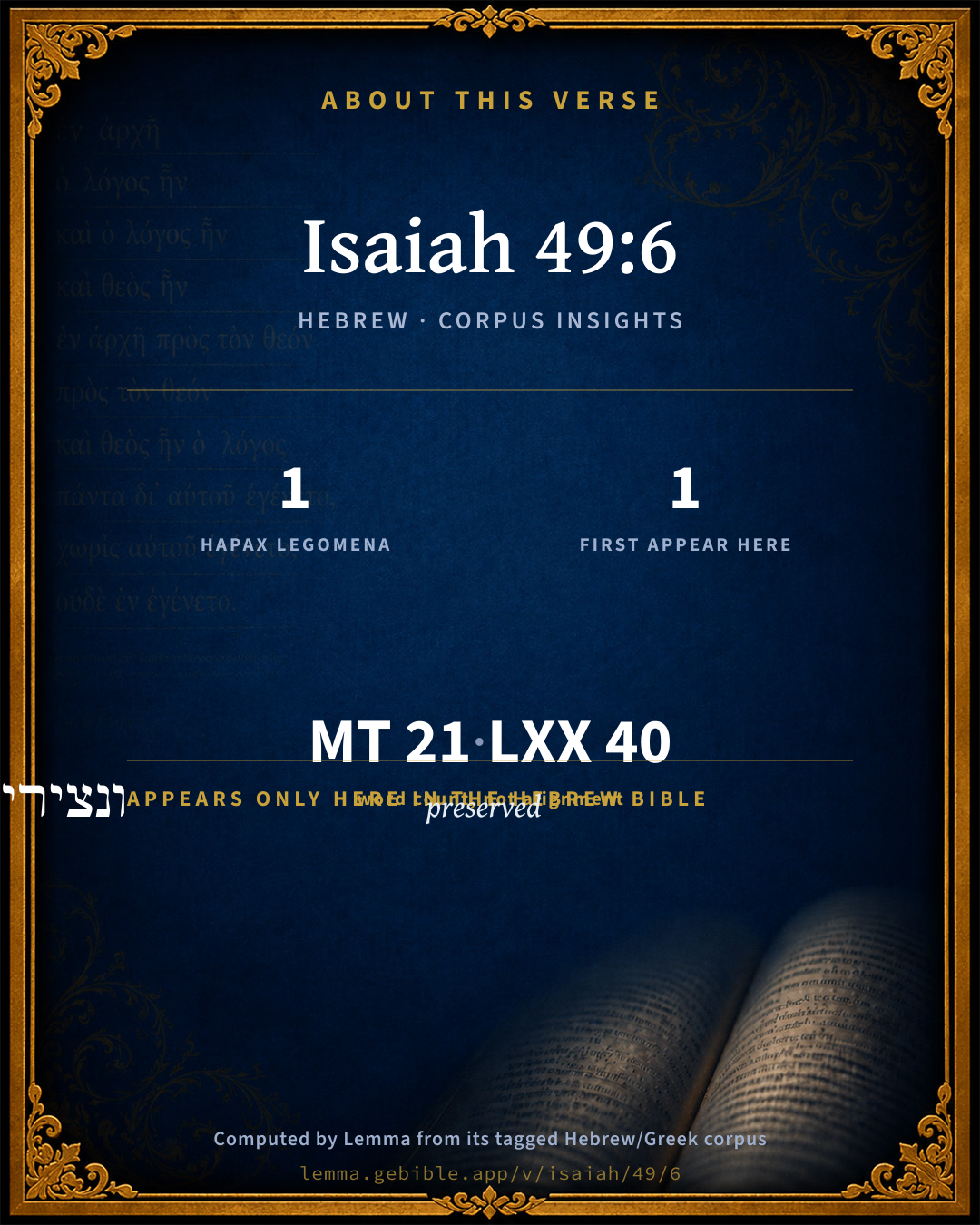
  • 1 hapax legomenon — only here in the Hebrew Bible
  • 1 first appearance in the Hebrew Bible
Full analysis ↓
Download a study sheet

One document with this verse’s original text, its word-by-word gloss line, the meaning frame, cross-references with their text, attributed commentary, and full source and license credits — printable, and it pastes into notes with its structure intact.

This verse Autodidact and up

Study sheet (.html) Plain text (.txt)

A passage Seminary Student

Up to 50 verses in one chapter. A passage sheet keeps up to 6 commentary sources and 12 cross-references per verse, in the order this page ranks them, and says so on the sheet whenever that leaves anything out. Ask for a single verse and you get the Autodidact verse sheet above.

Everything on this page stays free to read, with no account — the sheet is a download of what is already on screen, not access to it.

Want to remove ads? Support Godless Engineer
Compare translations 3

The same verse in 3 English versions, stacked beneath the original-language interlinear above. Click any original word for its lexicon entry.

Each is an independent rendering of the whole verse — the interlinear is not word-aligned to these translations.

Highlighted words mark where these versions differ — a whole-verse word diff, not a word-by-word alignment.

  • World English Bible Public Domain
    yes, he says, It is too light a thing that you should be my servant to raise up the tribes of Jacob, and to restore the preserved of Israel: I will also give you for a light to the Gentiles, that you may be my salvation to the end of the earth.
  • King James Version Public Domain
    And he said, It is a light thing that thou shouldest be my servant to raise up the tribes of Jacob, and to restore the preserved of Israel: I will also give thee for a light to the Gentiles, that thou mayest be my salvation unto the end of the earth.
  • unfoldingWord Literal Text CC BY-SA 4.0
    and he said, “It is too light for you to be a servant to me to raise up the tribes of Jacob and to return the preserved ones of Israel, for I have given you as a light of the nations, that my salvation may be to the end of the earth.” q1

unfoldingWord Literal Text — © unfoldingWord, licensed CC BY-SA 4.0. Word-aligned USFM3 via Door43 (git.door43.org/unfoldingWord/en_ult).

Versions to compare (up to 4)

3 of 4 selected

Show all 18 translations

Every available English version of this verse, each an independent rendering of the whole verse.

  • World English Bible Public Domain
    yes, he says, It is too light a thing that you should be my servant to raise up the tribes of Jacob, and to restore the preserved of Israel: I will also give you for a light to the Gentiles, that you may be my salvation to the end of the earth.
  • Berean Standard Bible Public Domain
    He says: “It is not enough for You to be My Servant, to raise up the tribes of Jacob, and to restore the protected ones of Israel. I will also make You a light for the nations, to bring My salvation to the ends of the earth.”
  • Majority Standard Bible Public Domain
    He says: “It is not enough for You to be My Servant, to raise up the tribes of Jacob, and to restore the protected ones of Israel. I will also make You a light for the nations, to bring My salvation to the ends of the earth.”
  • King James Version Public Domain
    And he said, It is a light thing that thou shouldest be my servant to raise up the tribes of Jacob, and to restore the preserved of Israel: I will also give thee for a light to the Gentiles, that thou mayest be my salvation unto the end of the earth.
  • American Standard Version (1901) Public Domain
    yea, he saith, It is too light a thing that thou shouldest be my servant to raise up the tribes of Jacob, and to restore the preserved of Israel: I will also give thee for a light to the Gentiles, that thou mayest be my salvation unto the end of the earth.
  • Revised Version (1885) Public Domain
    yea, he saith, It is too light a thing that thou shouldest be my servant to raise up the tribes of Jacob, and to restore the preserved of Israel: I will also give thee for a light to the Gentiles, that thou mayest be my salvation unto the end of the earth.
  • Geneva Bible (1599) Public Domain
    And hee sayde, It is a small thing that thou shouldest be my seruaunt, to raise vp the tribes of Iaakob, and to restore the desolations of Israel: I will also giue thee for a light of the Gentiles, that thou maiest bee my saluation vnto the ende of the worlde.
  • Douay-Rheims (1899) Public Domain
    And he said: It is a small thing that thou shouldst be my servant to raise up the tribes of Jacob, and to convert the dregs of Israel. Behold, I have given thee to be the light of the Gentiles, that thou mayst be my salvation even to the farthest part of the earth.
  • Young's Literal Translation Public Domain
    And He saith, `It hath been a light thing That thou art to Me for a servant To raise up the tribes of Jacob, And the preserved of Israel to bring back, And I have given thee for a light of nations, To be My salvation unto the end of the earth.'
  • Literal Standard Version CC BY-SA 4.0
    And He says, “It has been a light thing || That You are My Servant || To raise up the tribes of Jacob, || And to bring back the preserved of Israel, || And I have given You for a light to the nations, || To be My salvation to the end of the earth.”
  • Unlocked Literal Bible CC BY-SA 4.0
    and he says, “It is too small a thing for you to be my servant to reestablish the tribes of Jacob, and to restore the survivors of Israel. I will make you a light to the Gentiles, that you may be my salvation to the ends of the earth.”
  • unfoldingWord Literal Text CC BY-SA 4.0
    and he said, “It is too light for you to be a servant to me to raise up the tribes of Jacob and to return the preserved ones of Israel, for I have given you as a light of the nations, that my salvation may be to the end of the earth.” q1
  • Darby Bible Public Domain
    -- and he saith, It is a small thing that thou shouldest be my servant to raise up the tribes of Jacob, and to restore the preserved of Israel; I have even given thee for a light of the nations, that thou mayest be my salvation unto the end of the earth.
  • World Messianic Bible Public Domain
    Indeed, he says, “It is too light a thing that you should be my servant to raise up the tribes of Jacob, and to restore the preserved of Israel. I will also give you as a light to the nations, that you may be my salvation to the end of the earth.”
  • Webster's Bible Public Domain
    And he said, It is a light thing that thou shouldst be my servant to raise up the tribes of Jacob, and to restore the preserved of Israel: I will also give thee for a light to the Gentiles, that thou mayest be my salvation to the end of the earth.
  • Free Bible Version CC BY-SA 4.0
    He says, “It's nothing much for you to be my servant to bring back the tribes of Jacob, those people of Israel that I've preserved. I'm also going to make you a light for the foreigners so that my salvation may reach everybody.”
  • Bible in Basic English Public Domain
    It is not enough for one who is my servant to put the tribes of Jacob again in their place, and to get back those of Israel who have been sent away: my purpose is to give you as a light to the nations, so that you may be my salvation to the end of the earth.
  • JPS Tanakh (1917) Public Domain
    Yea, He saith: 'It is too light a thing that thou shouldest be My servant to raise up the tribes of Jacob, and to restore the offspring of Israel; I will also give thee for a light of the nations, that My salvation may be unto the end of the earth.'

Literal Standard Version (2020), Covenant Press — licensed CC BY-SA 4.0. Text via the HelloAO Bible API (eBible.org). Unlocked Literal Bible (unfoldingWord) — licensed CC BY-SA 4.0. Text via the HelloAO Bible API (eBible.org). unfoldingWord Literal Text — © unfoldingWord, licensed CC BY-SA 4.0. Word-aligned USFM3 via Door43 (git.door43.org/unfoldingWord/en_ult). Free Bible Version, Dr. Jonathan Gallagher — licensed CC BY-SA 4.0. Text via the HelloAO Bible API (eBible.org).

Word by word

More ways to search: Search by grammar → Find every occurrence → Compare this word →

Practice this passage: Drill this verse → Learn its vocabulary →

ונצירי
nâtsîyr
H5336
“and · preserved of”
Conjunction + Adjective, Adjective, Masculine, Plural, Construct
Part of Speech
Conjunction + Adjective
Type
Adjective
Gender
Masculine
Number
Plural
State
Construct
Full BDB Definition

Origin: from H5341

TWOT: 1407a

preserved
  1. וַיֹּ֗אמֶר ʼâmar H559 “and · to say” Conjunction + Verb, Qal, Sequential Imperfect, 3rd Person, Masculine, Singular
  2. נָקֵ֨ל qâlal H7043 “to be light” Verb, Niphal, Perfect, 3rd Person, Masculine, Singular
  3. מִֽהְיוֹתְךָ֥ hâyâh H1961 “from · to be · you” Preposition + Verb, Qal, Infinitive Construct + Suffix, Personal, 2nd Person, Masculine, Singular
  4. עֶ֔בֶד ʻebed H5650 “servant” Noun, Common, Masculine, Singular, Absolute
  5. לְהָקִים֙ qûwm H6965 “to rise” Preposition + Verb, Hiphil, Infinitive Construct
  6. אֶת ʼêth H853 “-” Particle, Direct Object
  7. שִׁבְטֵ֣י shêbeṭ H7626 “staffs of” Noun, Common, Masculine, Plural, Construct
  8. יַעֲקֹ֔ב Yaʻăqôb H3290 “Jacob” Noun, Proper
  9. וּנְצוּרֵ֥י nâtsar H5341 “and · guarded” Conjunction + Verb, Qal, Participle Passive, Masculine, Plural, Construct
  10. יִשְׂרָאֵ֖ל Yisrâʼêl H3478 “Israel” Noun, Proper
  11. לְהָשִׁ֑יב shûwb H7725 “to return” Preposition + Verb, Hiphil, Infinitive Construct
  12. וּנְתַתִּ֨יךָ֙ nâthan H5414 “and · to give · you” Conjunction + Verb, Qal, Sequential Perfect, 1st Person, Common, Singular + Suffix, Personal, 2nd Person, Masculine, Singular
  13. לְא֣וֹר ʼôwr H216 “to/for · light of” Preposition + Noun, Common, Both, Singular, Construct
  14. גּוֹיִ֔ם gôwy H1471 “nations” Noun, Common, Masculine, Plural, Absolute
  15. לִֽהְי֥וֹת hâyâh H1961 “to be” Preposition + Verb, Qal, Infinitive Construct
  16. יְשׁוּעָתִ֖י yᵉshûwʻâh H3444 “salvation · my” Noun, Common, Feminine, Singular, Construct + Suffix, Personal, 1st Person, Common, Singular
  17. עַד ʻad H5704 “until” Preposition
  18. קְצֵ֥ה qâtseh H7097 “end of” Noun, Common, Both, Singular, Construct
  19. הָאָֽרֶץ ʼerets H776 “the · land” Particle, Definite Article + Noun, Common, Both, Singular, Absolute

About this verse

These counts appear in no published source. They are computed here, from the morphology-tagged text and Lemma’s own curated glosses. What Lemma adds →

21
words
19
distinct lemmas
Prophets
section

Notable vocabulary

1 hapax legomenon — a word that appears only here in the entire Hebrew Bible:

  • ונצירי preserved H5336

First appearance in Scripture

This word makes its first canonical appearance in the Hebrew Bible here:

  • ונצירי preserved H5336

Grammatical profile

  • 8 verbs
  • 9 nouns
  • 1 adjective
  • 2 prepositions
  • 1 particle

Verb forms

  • וַיֹּ֗אמֶר Qal · Sequential Imperfect
  • נָקֵ֨ל Niphal · Perfect
  • מִֽהְיוֹתְךָ֥ Qal · Infinitive Construct
  • לְהָקִים֙ Hiphil · Infinitive Construct
  • וּנְצוּרֵ֥י Qal · Participle Passive
  • לְהָשִׁ֑יב Hiphil · Infinitive Construct
  • וּנְתַתִּ֨יךָ֙ Qal · Sequential Perfect
  • לִֽהְי֥וֹת Qal · Infinitive Construct

Repetition

A word recurs within this verse — often emphatic in Hebrew:

  • מִֽהְיוֹתְךָ֥ to be H1961 ×2

Hebrew & Septuagint length

In English translation the verse runs 52 words from the Hebrew and 59 from the Septuagint (LXX English) — closely comparable.

A rough comparison of the two English renderings, which tokenize alike — not a word-level alignment.

Word counts can differ between the Hebrew and the Greek without any difference in meaning — e.g. the Hebrew direct-object marker אֵת has no separate Greek word, and Greek often adds the article ὁ.

In the original languages it is 21 Hebrew tokens and 40 Greek tokens — but the two are counted differently (Hebrew bundles its prefixes and suffixes into one token; the Greek is in lemma form), so that isn’t a like-for-like length.

Cross-references

12

Topical passages linked to Isaiah 49:6 in the Treasury of Scripture Knowledge — connected by theme and wording, ordered by reader-vote popularity; previews shown in the World English Bible.

  • Acts 13:47 For so has the Lord commanded us, saying, 'I have set you as a light for the Gentiles, That you should bring salvation to the uttermost parts of the earth.'"
  • Isaiah 42:6 I, Yahweh, have called you in righteousness, and will hold your hand, and will keep you, and give you for a covenant of the people, for a light of the Gentiles;
  • Luke 2:32 A light for revelation to the Gentiles, And the glory of your people Israel."
  • Psalms 98:2–3 Yahweh has made known his salvation. He has openly shown his righteousness in the sight of the nations.
  • Isaiah 52:10 Yahweh has made bare his holy arm in the eyes of all the nations; and all the ends of the earth have seen the salvation of our God.
  • Isaiah 60:3 Nations shall come to your light, and kings to the brightness of your rising.
  • Luke 24:46–47 He said to them, "Thus it is written, and thus it was necessary for the Christ to suffer and to rise from the dead the third day,
  • Acts 26:18 to open their eyes, that they may turn from darkness to light and from the power of Satan to God, that they may receive remission of sins and an inheritance among those who are sanctified by faith in me.'
  • Isaiah 11:10 It shall happen in that day, that the root of Jesse, who stands for an ensign of the peoples, to him shall the nations seek; and his resting-place shall be glorious.
  • John 1:4–9 In him was life, and the life was the light of men.
  • Isaiah 46:13 I bring near my righteousness, it shall not be far off, and my salvation shall not wait; and I will place salvation in Zion for Israel my glory.
  • Isaiah 24:14–16 These shall lift up their voice, they shall shout; for the majesty of Yahweh they cry aloud from the sea.

Cross-references courtesy of OpenBible.info (CC BY 4.0).

Hebrew and Greek witnesses Masoretic Hebrew ↔ Greek Septuagint

The same verse in the two great witnesses to the Old Testament, shown verse-for-verse.

These are two independent witnesses, not word-aligned to each other, and the Septuagint is shown in lemma (dictionary) form.

Hebrew Isaiah 49:6 Masoretic · Westminster Leningrad Codex

וַיֹּ֗אמֶר נָקֵ֨ל מִֽהְיוֹתְךָ֥ לִי֙ עֶ֔בֶד לְהָקִים֙ אֶת שִׁבְטֵ֣י יַעֲקֹ֔ב ונצירי וּנְצוּרֵ֥י יִשְׂרָאֵ֖ל לְהָשִׁ֑יב וּנְתַתִּ֨יךָ֙ לְא֣וֹר גּוֹיִ֔ם לִֽהְי֥וֹת יְשׁוּעָתִ֖י עַד קְצֵ֥ה הָאָֽרֶץ

yes, he says, It is too light a thing that you should be my servant to raise up the tribes of Jacob, and to restore the preserved of Israel: I will also give you for a light to the Gentiles, that you may be my salvation to the end of the earth.

World English Bible · Public Domain

Greek LXX Isaiah 49:6 Septuagint · lemma form

καί εἶπον ἐγώ μέγας σύ εἰμί ὁ καλέω σύ παῖς ἐγώ ὁ ἵστημι ὁ φυλή ἰακώβ καί ὁ διασπορά ὁ ἰσραήλ ἐπιστρέφω ἰδού τίθημι σύ εἰς διαθήκη γένος εἰς φῶς ἔθνος ὁ εἰμί σύ εἰς σωτηρία ἕως ἔσχατος ὁ γῆ

And he said to me, It is a great thing for you to be called my servant, to establish the tribes of Jacob, and to recover the dispersion of Israel: behold, I have given you for the covenant of a race, for a light of the Gentiles, that you should be for salvation to the end of the earth.

LXX2012 (modern English Septuagint) · Public Domain

On this verse, John Gill's Exposition discusses the Septuagint’s reading. Read the note in Commentary ↓

Hebrew: Westminster Leningrad Codex (CC BY 4.0). Greek: Septuagint (public domain); English from LXX2012 (modern English Septuagint) (Public Domain). How the Septuagint differs from the Hebrew →

Targum (Aramaic paraphrase)

1

The Targum is the ancient Jewish Aramaic paraphrase of the Hebrew Scriptures — an interpretive translation, not the Hebrew text itself. Onkelos (literal) and Pseudo-Jonathan (expansive) render the Torah, and Jonathan the Prophets. Coverage is partial: where no permissively-licensed English translation exists for a verse, only the Aramaic is shown. This is verse-level text, not a word-by-word alignment to the Hebrew.

  1. Targum Jonathan Prophets (Joshua–Malachi)
    וַאֲמַר הַזְעֵיר לְכוֹן דְאַתּוּן מִתְקְרַן עַבְדַי לַאֲקָמָא יַת שִׁבְטֵי יַעֲקֹב וְגַלְוַת יִשְׂרָאֵל לַאֲתָבָא וְאֶתְּנִינָךְ לְנֵיהוֹר עַמְמִין לְמֶהֱוֵי פּוּרְקָנִי עַד סְיָפֵי אַרְעָא:

    And He said, Is it too little for you that ye should be called my servants, to raise up the tribes of Jacob, and to bring back the captivity of Israel? Yea, I will give thee for a light to the nations, to be my salvation unto the ends of the earth.

    Targum Jonathan — Aramaic: “Mikraot Gedolot” (public domain). English: “Sefaria Community Translation” (CC0 1.0 (public-domain dedication)); “London "Chaldee Paraphrase," 1871” (public domain). Text via Sefaria.

Commentary

Notes on Isaiah 49:6 from classic Christian and Jewish commentators (each source and its license shown beneath its notes). The classic Christian expositions comment on the surrounding passage and are grouped to its opening verse, so a note may address several verses; the Jewish commentaries on the Tanakh (Rashi and others) are per-verse, so they appear only where the commentator wrote on this verse.

Lemma curates 59 commentaries, every one of them public domain or Creative Commons licensed, each selected and text-cleaned for this edition rather than reprinted as found. About our sources →

Trapp's Complete Commentary

John Trapp

Isa 49:6 And he said, It is a light thing that thou shouldest be my servant to raise up the tribes of Jacob, and to restore the preserved of Israel: I will also give thee for a light to the Gentiles, that thou mayest be my salvation unto the end of the earth.

Ver. 6. I will also give thee for a light to the Gentiles.] De vocatione gentium illustre testimonium; and to this purpose it is cited by Paul and Barnabas. {Act 13:47 Joh 12:46 Luk 1:78-79}

That thou mayest be my salvation.] Vide quam Deo cordi et curae sit salus nostra, cum eam vocat suam. {a} See how God mindeth and fancieth our salvation, when he calleth it here "his salvation."

{a} A Lapide.

John Trapp, A Commentary or Exposition upon All the Books of the Old and New Testament (1647–1656) — public domain. Text from a community e-Sword module.

The Biblical Illustrator

Joseph S. Exell

Isa_49:6

And He said, It is a light thing that Thou shouldest be My servant

The evangelical prophet: his wide outlook

In the whole of this prophetical book there is not a single verse in which the character of the evangelical prophet is more conspicuous than it is here.

How must he have been transported beyond himself--how far must he have been raised not merely above the vulgar passions and prejudices, but above the noblest and purest aspirations of his contemporaries--how deeply must he have been permitted to enter not only into the secret purpose, but into the heavenly spirit of the Divine counsels, before he could have given utterance to such words as these! Try to realise in some measure the import, the power, the charm of those names--the names of Jacob, of Israel, in the mind of every faithful Israelite. Think how not only his human affections, but his deepest religious feelings, were centred in the prosperity of Zion and the peace of Jerusalem. Think of the grief and the longing, the prayers and the tears of the exiles in their captivity, when they remembered Zion. What joy could there be to such an one comparable for a moment to the joy of raising up the tribes of Jacob, and bringing back the preserved of Israel? And yet he was called upon by the voice of God to regard this as a light thing, and in comparison with what was it a light thing! What object was so far to transcend that which must have appeared in his eyes as the greatest of all? It was that he should be given as a light to the Gentiles, and that he should be the bearer of Gods salvation unto the ends of the earth. How doubly strange must such a commission have seemed to the prophet who received it! Like every child of Abraham, he had been wont to look down with mingled aversion and contempt on the mightiest and wisest of the nations. He had directed his bitterest sarcasm against their idols; he would have held himself defiled by sitting down at the board even of their nobles and princes. Yet now the honour and welfare of the Gentiles is to be set far above the deliverance and exaltation of the chosen people. He must break the bands of prejudice, and learn a new estimate of life. (Bp. Perowne, D. D.)

Missions to She heathen

I. I venture to say, looking at the diffusion of Divine truth and its attendant blessings which are shadowed forth in the words of the prophet, EVEN OUR NATIONAL GREATNESS AND GLORY IS A LIGHT THING. Consider what m the true test and measure of real glory. I am not now speaking of it as it appears in the sight of Him by whom the nations are counted as the small dust of the balance, and who taketh up the isles as a very little thing. I would have you look at it from a human but still manly and reasonable point of view as it appears in the estimate of strangers, in the eyes of posterity, in the pages of history, in your own sober judgment, when applied to other instances where you are not under the bias of personal feeling or national prejudice. Take the case of an individual. Would you seriously count it a glorious thing for a man to have amassed great wealth, to have risen to a high station, to have acquired extensive authority? Or, do you think it necessary to inquire what use he has made of these advantages, what traces he has left of his passage through the world? It is not a sufficient title to glory that our name, our race, our possessions, our power, our influence have been extended to the end of the earth, and that every quarter of the globe has yielded its tribute to our arms, our industry, and our commerce. There still remains the question, What use have we made of all our gifts and opportunities? What are the things we have carried with us abroad in exchange for those which we have brought home? What are the tokens and monuments of our presence in the land where we have settled and borne rule? The ampler our means, the greater our power, the more commanding our influence, the greater is our responsibility and the stricter the accounts which we must render at the bar both of Divine and of human judgment. It is the proper object of a Christian State to encourage all efforts for the extension of Christs kingdom, to place no obstacles in the way of that extension.

II. But how is it as regards the Church? There can be no question that THE SENDING FORTH OF THE GOSPEL BELONGS TO THE PROPER WORK OF THE CHURCH. It may truly be said, in a certain sense, that all the rest is a light thing in comparison with this. Let us suppose a Church pure, sound, and flourishing in all other respects. But if a Church thus favoured puts forth no expansive energies, if she is content merely with the enjoyment of her internal prosperity, then the fulness of these blessings only renders the deficiency in its outward action the more glaring and reprehensible. Whatever appearance there may be of health or vigour in a motionless Church, all such indications must be hollow and fallacious. Such a Church deceives herself, like that of Laodicea, saying, I am rich, and increased in goods, and have need of nothing; being, in truth, wretched, and miserable, and poor, and blind, and naked. And lukewarmness is the cause, at once, of the misery and the self-delusion. It was such a Church that received the warning, I know thy works, that thou hast a name that thou livest, and art dead. Is that too much to say of a Church which, so far as regards those who are without, is deaf and dumb and blind and palsied?--without an ear for her Lords commission, without a voice to proclaim His message, without an eye for those whom He came to seek and to save, without hand or foot to stir in His service--or rather, to speak more plainly, without faith to trust His Word, without hope to abide His time, without love to spend and to be spent for His cause. (Bp. Perowne, D. D.)

The missionary enterprise

1. To look at the question, even from a comparatively lower plane, is there not something elevating in the whole history of missionary enterprise? Is it not a good thing, an inspiring thing, to have lifted up before our eyes the noble examples of the men who have gone forth sacrificing their earthly prospects and encountering privation and suffering and the martyr death that they might preach among the nations the unsearchable riches of Christ? They have gained no earthly reward; they have looked for none. They have reformed men sunk in the lowest depth of degradation, misery, and crime. They have exhibited the Christian graces of domestic purity and truth and love. They have, indeed, enriched the world; they have been the pioneers in civilisation. The splendid heroism of our missionary martyrs has given us a loftier conception of duty, and made our hearts throb with holier emotions, and put to shame the weakness, the cowardice, the selfishness of our lives. Surely on this ground alone we may say that the work of the Church at home is a light thing compared with the mission work of the Church abroad.

2. This mission work abroad gives us new impulses and new motives, because it is done in simple obedience to the command of our risen Lord, Go ye into all the world, and preach the Gospel to every creature, and a simple trust in His promise, Lo, I am with you.

3. This mission work is a greater work because of the grandeur and far-reaching compass of its conception, as putting no limits beyond those of the habitable globe to its aims; greater, because it is not bounded by the bounds of a parish or Church; greater, because it bears in its bosom the inspiring truth that the kingdom of God is one, and that all work for Christ is essentially one in its range, and power, and objects, however manifold it may be in the forms which it assumes, or in its application to the various phases of society, and the infinite diversity of the needs which it meets.

4. It is greater because, as all experience shows, it breathes a new life into all the work at home. It is a sovereign, antidote to that selfishness which is so often a canker in our work.

5. The missionary work of the Church is a greater work because of its regenerating power m the revival of the whole Church. No one can question this who has watched the development of missions and the relation of that development to the work of the Church at home. It must often have awakened our surprise that at the great Reformation which shattered the fetters of superstition and brought out a nation beloved of God into the glorious liberty of her children, and gave them the Word of life, no attempt was made to carry the precious treasure to the rest of the world. It may be that the work they had to do at home was the work to which God had called them, and that it so absorbed all their thoughts and interest, it left no room for anything else. There is no more striking instance of the reflex action of missionary efforts than this, that it has been made in Gods hand the instrument of a mighty revival in the Church at home. Compare it with that other revival which dates from Oxford some sixty years ago. The earlier Evangelical revival, striking as were its results in the awakening of souls, and turning men from darkness to light, and from the power of Satan unto God, left out of sight the corporate unity of the Church. Its weakness was there. It was mighty in its spiritual intensity, but it forgot that Christ came not to convert individuals only, but to establish a Church. The Oxford Movement on the other hand dwelt too exclusively on this aspect of the truth. Ritual darkened the spiritual life. The work of God the Holy Ghost held a subordinate place in its teaching. The power of the Great Commission has gone forth. The Church is sending forth missions, and it is the reflex action of missions which is not only winning fresh victories for Christ abroad, but is breathing a new life into the Church at home. It does not despise sacraments or ordinances, but it puts them in their proper place. (Bp. Perowne, D. D.)

Redemption, an eternal purpose

A capable artist can find no worthier exercise for the highest order of powers, than in depicting the scene in the cabinet-council of some earthly monarch, at the moment when it is determined to risk the hazard of war, in offence or in defence, to unsheathe the sword, with the consciousness that the earthly fates of many kingdoms may hang upon the issue, and that the sword may not return to its scabbard until it be bathed red, and made drunk in the blood of myriads of slain. But in this august conference, it is not the fate of one or two kingdoms that is at stake, but of the world in all its extent, and in all its generations, and it may be, of far more than this world; for it seems probable, that, whilst Christ, in His coming into this world, laid not hold of the nature of angels to redeem them, all the intelligent creatures of God have had their condition and destiny modified by the incarnation, and life, and sufferings, and death, and resurrection, and ascension of the Lord Jesus Christ. (T. Smith, D. D.)

The Gospel for all

I. THE FIRST CLAUSE DOES NOT SEEM TO US TO DECIDE, ONE WAY OR ANOTHER, THE QUESTIONS THAT HAVE BEEN OFTEN PUT AS TO THE FUTURE DESTINY OF THE JEWS. The acceptance of the Gospel by the Jews as a nation, or by the great body of the people, were comparatively a small matter, if it were placed instead of the diffusion of the Gospel all over the world, and the gathering of the elect out of every people. The two are ever to be viewed as great and important parts of a greater and more important whole, and they are so joined together by the appointment of God, that the one could not be effected were the other neglected. The times of the fulness of the Gentiles are appointed to be the times of Israels gathering.

II. Although it seems to be represented as if God had made the offer of the Gospel to the Gentiles conditional upon its rejection by the Jews, this must certainly be understood as spoken after the manner of men, and NOT AS IF GOD HAD MADE THE EVANGELISATION OF THE WORLD DEPEND UPON A CONTINGENCY.

III. THE TERMS IN WHICH CHRISTS OFFER TO THE GENTILES, AND THE DIFFUSION OF HIS GOSPEL AMONGST THEM, ARE DESCRIBED. He is to be a light and salvation to them. This implies their condition without Christ as one--

1. Of darkness.

2. Of perdition.

IV. THE ADAPTATION OF CHRISTS GOSPEL TO REMEDY THE EVILS, AND SUPPLY THE WANTS OF THE GENTILE WORLD. The perfect catholicity of the Christian system is one of the grandest guarantees of its Divine origin. (T. Smith, D. D.)

Gods salvation a light to the Gentiles

The subject of this chapter is Messiah Gods Light to the ends of the earth (Joh_8:12)., In orderfully to enter into our text, we will illustrate its meaning by St. Paul s own Act_26:18). Comparing both these passages, we find the design of Gods salvation to be that the Gentiles should be fellow-heirs Eph_3:6).

I. THE PURPOSE OF GOD IN THIS SALVATION.

1. To make men to inherit the kingdom of God and home of the Redeemer.

2. To offer this glory to the Gentiles.

II. THE GROUND ON WHICH THIS SALVATION IS OFFERED. My salvation, or, as in Act_26:18, By faith that is in Me.

1. The object of this faith. In Me. Jesus Himself.

2. The nature of this faith. Believing in His life and work; receiving for our own salvation His offer of mercy; trusting Him wholly.

III. THE NATURE OF THE SALVATION THUS OFFERED.

1. To turn them from darkness to light, i.e conversion.

2. Forgiveness of sins. (H. Linton, M. A.)

Israel Gods conduit-pipe

That thou mayest be My salvation, &c. That thou mayest be the conduit-pipe of My salvation to convey it to the end of the earth. (W. Day, M. A.)

The Biblical Illustrator, edited by Joseph S. Exell (c. 1880s–1900s) — public domain. Text from a community e-Sword module.

The Preacher's Complete Homiletical Commentary

Joseph S. Exell (gen. ed.)

THE PURPOSE OF GOD’S GREAT GIFT

Isa_49:6. And He said, It is a light thing, &c.

The chapter refers to gospel days; and the meaning of the text in particular seems to be fixed by good old Simeon, who, when Jesus was presented to the Lord, hailed Him as God’s “light,” and His “salvation” (Luk_2:28-32). We regard this passage, therefore, as an epitome of the scheme of redemption; and recognise in it God’s gift to man, and His intention in that gift.

I. GOD’S GIFT TO MANKIND. “I will give thee,” &c. As this gift is bestowed for moral purposes, the subject is calculated to lead our thoughts to the Giver, as our Supreme Lord and moral Governor. It shows in Him an infinite condescension to interest Himself about us, for, Isa_40:15. Two things here invite our notice—

1. The person given (Mat_12:15-18). His dignity (Joh_1:1; Zec_13:7; Mat_26:31; Joh_14:10-11; 1Jn_5:7). Hence it follows that this is a great, an incomparable gift. He is God’s “only-begotten Son,” &c. (Rom_8:32). Yet this, great as it is, is a free gift; not conceded to the powerful, but granted to the impotent, the needy, the perishing; not conferred on the deserving as a reward of merit, but bestowed on the rebellious; not yielded to importunity, but given to “the evil and unthankful,” unasked and undesired.

2. The office or undertaking to which He is appointed. This office of “servant” may be one of honour, but is always one of subordination (Php_2:6-8).

II. GOD’S INTENTION RESPECTING MANKIND.

1. “To raise up the tribes of Jacob,” which are fallen from their religious honours and pre-eminence, and from national independence into dispersion and disgrace and contempt (Deu_28:37); and to restore “the preserved of Israel”—wherever scattered, or howsoever persecuted, still preserved from extermination, and still preserved a distinct people; to restore them to the favour of God, and to His spiritual service; and perhaps to their country and independence (Luk_1:69-75; Rom_11:26; Isa_49:13-23; Jer_23:5-8).

2. But seeing that the Jews are but a small part of the whole family of man, their restoration “is a light thing,” in comparison with the enlightenment of the Gentiles, and the salvation of the ends of the earth. The Gentile world was enveloped in the darkness of ignorance, error, and superstition, of misery, guilt, and condemnation (Isa_49:9; Luk_1:77-79; Luk_4:18). To them Jesus was, by His doctrine, a light—concerning the invisible world, teaching the unity and perfections of God, &c.; concerning the future world; teaching the immortality of the soul, which even their wise men doubted, and a resurrection of the body, which they reckoned impossible. Besides this He may be considered as affording light on most important subjects, by His holy life, His vicarious death, &c. He enlightens still by His Spirit, &c. (2Co_4:6; Mat_5:14-16; Php_2:15). But further, He is God’s salvation, and therefore, in all respects, a salvation suited to man’s necessities. He finds us guilty, &c., and He saves us by bearing our punishment for us (1Pe_2:24). He finds us enslaved, defiled, and unfit for heaven; and He saves us from thraldom and pollution by His Spirit working in us (Rom_8:2; Tit_3:5; 2Pe_1:4). He finds all men, everywhere, poor and helpless, and He saves to the end of the earth, fully, freely, &c. (Heb_7:25; Rev_22:17).

IMPROVEMENT.—

1. We ought very highly to value our souls: God does. If we lose them, we lose all.

2. We should accept the salvation which God has so kindly sent to us (Isa_55:1).

3. We should love Him who has manifested such love to us, and give proof of our love, by submitting to Him who submitted to shame, &c., in our stead (Joh_14:15; 1Jn_5:3).

4. We may confidently expect “all things necessary for life and godliness” (Rom_8:32, et seq.)

5. We should employ both our example and our influence to open the eyes of our fellow-men to behold God’s light, and their hearts to receive His salvation (Isa_60:1; Isa_62:1).—Zeta: Sketches of 400 Sermons, vol. ii. p. 84–88.

CHRIST OUR LIGHT

Isa_49:6. I will also give Thee for a light to the Gentiles.

Not here only, but elsewhere, in many places, our Lord Jesus is held forth under the notion of a light. Show—

I. WHAT KIND OF A LIGHT JESUS CHRIST IS. There are several kinds of light” There is glow-worm light, &c. But there is one light that is far beyond them all, and that is sun-light, between which and the former there is no comparison; and that light Jesus Christ is—sun-light (Mal_4:2; Psa_84:11; Luk_1:78). Now sunlight hath these properties; it is—

1. Glorious light (1Co_15:41; Mat_13:43; Mat_17:2). And is not Jesus Christ of all others the most glorious? (Son_5:10; Col_1:8). Let this advance your esteem of Him more and more.

2. General light. It shines everywhere (Psa_19:6). One sun serves all the world, &c. There is but one Christ, but that one is a universal Saviour to all the world (1Jn_2:2; Luk_16:15; Rom_10:18; Joh_12:36).

3. Fountain-light. What light the moon and the planets have, they derive it all from the sun. So Jesus Christ is the spring-head and fountain from whence every good and perfect gift comes. Gifts of nature do all flow from Him (Joh_1:2). So also gifts of grace (Joh_1:16; Heb_12:2). And therefore, in all our wants we must have recourse to Him; and in all our receivings we must give Him the praise.

4. Free light. It costs us nothing. What is more free than the light, and what is more free than grace? (Joh_4:10; Rom_5:15; Isa_55:1-2; Rev_22:17). Therefore ye are inexcusable, if you go without it.

5. Enlightening light. The sun hath not its light for itself, but for the world, and it communicates it accordingly. It rises every morning, and dispels the darkness of the night, and shines all day; and very sweet and useful it is. So Christ (Luk_2:32; Rev_3:1). He opens blind eyes (Isa_42:6-7; Mal_4:2; Rev_3:18). Pray as the blind man that came to Christ for eyesight.

6. Increasing light. By degrees, as the sun gets up, mists, &c. vanish, and noonday comes. So it is with the souls that Christ enlightens (Pro_4:18; Isa_30:26).

II. WHAT INFERENCES ARE TO BE DRAWN FROM THIS SUBJECT?

1. What a miserable condition is a sinful Christless condition! Those who are out of Christ are out of the light (2Co_4:6; Joh_3:19-20; Job_24:13; Job_21:14). But wherein lies the misery of a blind and dark condition?

(1.) It is very uncomfortable (Ecc_11:7; Pro_2:10).

(2.) It is very unsafe. Thou hast a journey to go, that will not be gone without light. There are many by-ways, &c. (Joh_12:35.) Thou hast work to do that will not be done without light, nay, not without sun-light (Luk_10:42).

(3.) It is miserable here (Eph_6:12; Isa_42:7; Act_26:18). It will be miserable hereafter. Make the application to yourselves: Is not this my condition? (Joh_9:25; Joh_9:40).

2. What an unspeakable mercy then was the giving of Christ to save us from all this misery; to be a light to lighten the world! What a dungeon were the world without it! Therefore thank God for this unspeakable gift (Eph_5:8; Col_1:12-13).

3. Of what concernment it is to come to Christ to be enlightened by Him! Only by coming can we have the true light (Rev_3:18). Delay no longer; away quickly to the throne of grace, and beg for this eye-salve;—to the means of grace, and seek it there.

4. What is to be done by those on whom this light is risen? As Christ is the light of the world, so ye also are the light of the world (Mat_5:14). Then

(1.) let your light shine before men (Eph_5:8; Rom_12:13; 1Th_5:5-8)

(2.) Let your light be increasing more and more—especially concerning the evil of sin, the weakness of self, the excellency of Christ, &c.—Philip Henry: Christ All in All, pp. 81–90.

The Preacher's Complete Homiletical Commentary (gen. ed. Joseph S. Exell; Funk & Wagnalls, c. 1892) — public domain (pre-1929). A full-Bible homiletical/sermon-outline anthology covering 65 of 66 books (2 John is absent from the source module). Text from a community e-Sword module.

Tyndale Open Study Notes

Tyndale Open Resources

49:6 a light to the Gentiles: As the Messiah, the servant’s mission would have a worldwide reach (see 11:10, 12; 42:6). The apostle Paul explained his apostolic mission to the Gentiles on the basis of this prophecy (Acts 13:47; 26:23).

Tyndale Open Study Notes — © Tyndale Open Resources, licensed CC BY-SA 4.0. Text via the HelloAO Bible API.

Geneva Bible (1599)

Geneva Bible translators

To declare my Gospel, to the Gentiles, Isa. 42:6; Acts 13:47; Luke 2:32.

Geneva Bible (1599) marginal notes — public domain. Text via Bolls.life.

Jamieson, Fausset & Brown

Robert Jamieson, A. R. Fausset & David Brown

It is a light thing--"It is too little that Thou shouldest," [HENGSTENBERG], that is, It is not enough honor to Thee to raise up Jacob and Israel, but I design for Thee more, namely, that Thou shouldest be the means of enlightening the Gentiles (Isa 42:6-7; Isa 60:3).

the preserved--namely, those remaining after the judgments of God on the nation--the elect remnant of Israel reserved for mercy. LOWTH, with a slight but needless change of the Hebrew, translates for "tribes" and "preserved," the "scions"--the "branches."

Jamieson, Fausset & Brown — Commentary Critical and Explanatory on the Whole Bible (1871) — public domain (CC PDM 1.0). Text via the HelloAO Bible API.

Adam Clarke's Commentary

Verse 6. And to restore the preserved of Israel - "And to restore the branches of Israel"] נצירי netsirey, or נצורי netsurey, as the Masoretes correct it in the marginal reading. This word has been matter of great doubt with interpreters: the Syriac renders it the branch, taking it for the same with נצר netser, Isa 11:1. See Michaelis Epim. in Praelect. xix.

Adam Clarke's Commentary on the Bible (1810–1826) — public domain. Text from a community e-Sword/MySword module.

Ellicott's Commentary for English Readers

(6) And he said.—The words are repeated from “saith the Lord” of the preceding verse, where they had been followed by a long parenthesis. The Servant becomes conscious of a higher mission. All national barriers are broken down. He is to be the bearer of a message of peace to the whole race of mankind, and has “other sheep not of this fold” (Joh_10:16).

A Bible Commentary for English Readers, edited by Charles John Ellicott (1878–1897) — public domain. Text from a community e-Sword module.

The Cambridge Bible for Schools and Colleges

gen. ed. J. J. S. Perowne

6. And he said] resuming the sentence begun in Isa_49:5. R.V. “Yea, he saith.”

It is a light thing &c.] Better as R.V. It is too light a thing &c. But the literal translation probably is, “It is too light for thy being a servant to me that thou shouldst raise up” &c., i.e. “To restore Israel is the least part of thy vocation as my servant.” The sense is not affected, and the rendering of R.V. might be defended by the analogy of Eze_8:17. raise up here means “re-establish,” just as “build” frequently means “rebuild” (Psa_122:3 &c.).

the preserved of Israel] those who survive the destruction of the state (Eze_6:12, R.V. marg.).

I will also give thee for a light to the Gentiles] ch. Isa_42:6.

that thou mayest be my salvation &c.] Rather: that my salvation may be &c. Comp. the N.T. application in Act_13:47. The verse evidently describes an enlargement of the Servant’s conception of his vocation. Previously, he had been conscious only of a mission to Israel, and in that mission the significance of the title “Servant of Jehovah” had seemed to be exhausted (Isa_49:5). Now it is revealed to him that the name includes a higher function, that, namely, of being the mediator of salvation to all mankind. And since the greater destiny contains the less, the acceptance of this new commission delivers him from the sense of failure by which he had been oppressed (Isa_49:4). Whatever view be taken of the Servant’s personality, he speaks as the exponent of the religion of revelation; and the fact here represented is the expansion of that religion from being a national to be a universal religion. The ideal was realised only in the New Testament dispensation, so that in this as in many other respects the portrait of the Servant is an indirect prophecy of Christ. Cf. Luk_2:32.

The Cambridge Bible for Schools and Colleges (gen. ed. J. J. S. Perowne; Cambridge University Press, 1878–1918) — public domain. Text from a community e-Sword module.

John Gill's Exposition

And he said,.... Or "even he said"; namely, the Lord his God, that called, appointed, and strengthened him for his service:

it is a light thing that thou shouldest be my servant to raise up the tribes of Jacob, and to restore the preserved of Israel; the tribes of Jacob and the preserved of Israel are the elect of God among the Jews; though the characters agree with all the chosen of God of other nations, who, are distinguished from the rest of the world, and are "preserved in Christ", Jde 1:1, where they are preserved before they are redeemed and called; not from falling in Adam with the rest of mankind, nor from the general corruption of nature, nor from actual sins and transgressions; yet from the condemnation of the law, the damning power of sin, and the second death; the ground of which is, their being in the love of God, in the covenant of grace, and in the hands of Christ: and yet, notwithstanding this, they are in a most miserable condition as the descendants of Adam, and, in a state of nature; they are "fallen" creatures, which is supposed by the "raising them up" by Christ, whose work it is; they fell in Adam, and are fallen from a state of honour, friendship, and communion with God; from the glorious image stamped on man in his creation; from righteousness and holiness into sin and misery, poverty and beggary; into a very low estate indeed, and are not able to raise up themselves, being feeble and without strength, yea, dead in trespasses and sins; they are gone back from God, and out of the good way, and are gone astray like lost sheep, which is supposed by the "restoring" of them: now it is Christ's work to "raise up", "restore", or "return" these; he raises them to a state of justification and acceptance with God, to a better righteousness than they fell from, and to greater riches, honour, and glory; in consequence of redemption by Christ they are raised to a state of grace here, and to glory hereafter; they are brought nigh to God, from whom they were departed, sons to have access unto him and fellowship with him now, and to be with him for evermore. Now to do all this is said to be a "light thing"; it was not so in itself, it was a "great thing", famous and excellent, to be a servant of the Lord, and to be employed in such work as this; and so the Septuagint and Arabic versions render it; but this is to be understood either by way of interrogation, as by the Targum, Kimchi, Ben Melech, and so the Syriac version, "is it a matter of small moment that thou shouldest be my servant?" &c.; surely it is not; or, if it is, I will find thee other work to do: or else it is to be understood comparatively, the elect of God among the Jews being few, in comparison of those among the Gentiles; wherefore it was not work enough, nor honour enough, only to be employed in the redemption of them: and therefore it follows,

I will also give thee for a light to the Gentiles; which supposes the Gentiles to be in a state of darkness, as they were before the coming of Christ, and the ministration of the Gospel to them; they were in the dark about the divine Being, the unity of God, and the persons in the Godhead; about the worship of God; about a future state, and about their own state and condition; and about revelation, the truths, doctrines, and ordinances of it: and this expresses, that Christ should be a "light" to them, as he has been, not only in a way of nature, as he is to every man, but in a way of special grace through the ministry of the word; not in his own person, for he only preached in Judea, but by his apostles, by whom he went and preached peace to them afar off; and particularly he was so to them by his Spirit, as a spirit of illumination; and so they came to have light in divine things, and which is a "gift" of the free grace of God. Simeon has respect to this passage, Luk 2:32 and the Apostle Paul cites it, and applies it to Gospel times, Act 13:47, it follows,

that thou mayest be my salvation unto the end of the earth; Christ was given, that he might be the author of that salvation, which God had chosen and appointed his people to, and provided for them in covenant; and that being the salvation of his own people, he calls it his own salvation; and which should reach to them all everywhere, in the several parts of the world, and the corners and ends of it, east, west, north, and south, wherever they were. Kimchi refers this to the saving of the Gentiles, after the war of Gog and Magog, yet to come; and with it compares Isa 60:3.

John Gill's Exposition of the Whole Bible (1746–1763) — public domain (CC PDM 1.0). Text via the HelloAO Bible API.

Albert Barnes' Notes on the Bible

And he said - That is, Yahweh said in his promise to the Messiah.

It is a light thing - Margin, ‘Art thou lighter than that thou,’ etc. Lowth renders it, ‘It is a small thing.’ Hengstenberg, ‘It is too little that thou shouldest be my servant to raise up the tribes of Jacob.’ The sense is, that God designed to glorify him in an eminent degree, and that it would not be as much honor as be designed to confer on him, to appoint him merely to produce a reformation among the Jews, and to recover them to the spiritual worship of God. He designed him for a far more important work - for the recovery of the Gentile world, and for the spread of the true religion among all nations. The Septuagint renders this, It is a great thing for thee to be called my servant.’ The Chaldee proposes it as a question, ‘Is it a small thing for you that you are called my servant?’

My servant - (See Isa 49:3).

To raise up the tribes of Jacob - Hebrew, (להקים lehâqiym) - ‘To establish,’ or confirm the tribes of Jacob; that is, to establish them in the worship of God, and in prosperity. This is to be understood in a spiritual sense, since it is to be synonymous with the blessings which he would bestow on the pagan. His work in regard to both, was to be substantially the same. In regard to the Jews, it was to confirm them in the worship of the true God; and in regard to the pagan, it was to bring them to the knowledge of the same God.

And to restore - To bring back (להשׁיב lehâshiyb) that is, to recover them from their sin and hypocrisy, and bring them back to the worship of the true and only God. The Chaldee, however, renders this, ‘To bring back the captivity of Israel.’ But it means, doubtless, to recover the alienated Jewish people to the pure and spiritual worship of God.

The preserved of Israel - Lowth renders this, ‘To restore the branches of Israel;’ as if it were נצרי netsârēy in the text, instead of נצוּרי netsûrēy. The word נצר nêtser means “branch” (see the notes at Isa 11:1; Isa 14:9), and Lowth supposes that it means the branches of Israel; that is, the descendants of Israel or Jacob, by a similitude drawn from the branches of a tree which are all derived from the same stem, or root. The Syriac here renders it, ‘The branch of Israel.’ But the word properly means those who are kept, or preserved (from נצר nâtsar, “to keep, preserve”), and may be applied either literally to those who were kept alive, or who survived any battle, captivity, or calamity - as a remnant; or spiritually, to those who are preserved for purposes of mercy and grace out of the common mass that is corrupt and unbelieving. It refers here, I suppose, to the latter, and means those whom it was the purpose of God to preserve out of the common mass of the Jews that were sunk in hypocrisy and sin. These, it was the design of God to restore to himself, and to do this, was the primary object in the appointment of the Messiah.

I will also give thee for a light to the Gentiles - I will appoint thee to the higher office of extending the knowledge of the true religion to the darkened pagan world. The same expression and the same promise occur in Isa 42:6 (see the notes at that verse).

That thou mayest be my salvation unto the end of the earth - (See the note at Isa 42:10). The true religion shall be extended to the pagan nations, and all parts of the world shall see the salvation of God. This great work was to be entrusted to the Redeemer, and it was regarded as a high honor that he should thus be made the means of diffusing light and truth among all nations. We may learn hence, first, that God will raise up the tribes of Jacob; that is, that large numbers of the Jews shall yet be ‘preserved,’ or recovered to himself; secondly, that the gospel shall certainly be extended to the ends of the earth; thirdly, that it is an honor to be made instrumental in extending the true religion. So great is this honor, that it is mentioned as the highest which could be conferred even on the Redeemer in this world. And if he deemed it an honor, shall we not also regard it as a privilege to engage in the work of Christian missions, and to endeavor to save the world from ruin? There is no higher glory for man than to tread in the footsteps of the Son of God; and he who, by self-denial and charity, and personal toil and prayer, does most for the conversion of this whole world to God, is most like the Redeemer, and will have the most elevated seat in the glories of the heavenly world.

Albert Barnes' Notes on the Bible (1834–1885) — public domain. Text from a community e-Sword/MySword module.

Haydock's Catholic Bible Commentary

Earth. St. Paul, explains this of Christ, (Acts xiii.) who said, Go teach all nations, Matthew xxviii. Isaias was one of his first preachers.

George Leo Haydock (1774–1849), Haydock's Catholic Family Bible and Commentary, 1859 edition — public domain. Excludes Psalms (Douay-Rheims chapter numbering differs from Protestant) and Deuterocanonical books (Catholic canon only).

Matthew Poole's English Annotations

He; the Lord, expressed both in the foregoing and following verses.

It is a light thing; this is but a small favour in comparison of what follows.

To raise up the tribes of Jacob; that remnant of them which shall survive all their calamities and desolations.

I will also give thee for a light to the Gentiles, that thou mayest be my salvation; I will make thy labour effectual for the illumination, and conversion, and salvation of the Gentiles in all the parts of the world; which cannot be said of Isaiah with any truth or colour, and therefore must be understood of Christ, by whom this was literally and fully accomplished. By my salvation he means the great instrument and author of that eternal salvation which I will give to the Gentiles.

Matthew Poole's English Annotations on the Holy Bible (1683–1685) — public domain. Text from a community e-Sword/MySword module.

Whedon's Commentary on the Bible

Daniel D. Whedon

6. It is a light thing — Or, too light; great as it was to bring back only Israel in its entirety — as they claimed to be their exclusive right — yet it was a greater thing to bring also the Gentile world, vast numbers of whom were to be ranked by conversion as members of Messiah’s kingdom equally with the preserved of Israel. Isa_11:12; Act_13:46-47; Act_26:16-17. These references in Acts have their application and fulfilment in the facts of St. Paul’s ministry to the Gentiles.

Daniel D. Whedon (gen. ed.), Commentary on the Old and New Testaments (1874–1909) — public domain. Text from a community e-Sword module.

The Pulpit Commentary

It is a light thing. God rewards his servants according to their works. He is supremely just. He was not content that even Nebuchadnezzar should be insufficiently rewarded for the service that he rendered against Tyre, (Eze_29:18) and he therefore gave him Egypt in addition as his recompense. (Eze_29:20) It would have been "a light thing light a thing" (Kay, Cheyne) to have rewarded the labours of Jesus with the conversion of the Jews only. God therefore gave him as his recompense the gathering in of the Gentiles also, and made him a means of salvation even to the uttermost ends of the earth. The preserved of Israel; i.e. the "remnant" that had not perished through previous judgments. I will also give thee for a Light to the Gentiles. (Isa_11:10 Isa_34:1 Isa_42:6 Isa_55:5, etc.) Greeks Ellhnev were brought into contact with our Lord himself shortly before his crucifixion. (Joh_12:20) He wrought a miracle for a Syro-Phoenician woman. (Mar_7:25-30) His apostles, after a little time, understood that the gospel was for the world at large, and declared that in Christ there was no difference between Jew and Greek, nay! between Jew and barbarian. Christ had died for all had come to be a Light to all, would have all come into his Church and obtain salvation through union with him. That thou mayest be my Salvation. Christ is called "Salvation," as the Bearer of salvation he through whom alone can any man be saved. (Act_4:12) So he is called "Peace", (Mic_5:5) as the Giver of peace.

A Light to the Gentiles.

"It is a light thing that thou shouldest be my Servant, etc." How distinctly this prophesies concerning Christ!

I IN RELATION TO THE TRUE GLORY OF HIS KINGDOM. Not to exalt Jacob, or to preserve Israel, but to be a Light to the Gentiles.

II IN RELATION TO THE HISTORY OF HIS MINISTRY. Why did the Jewish nation despise and crucify the Redeemer? It would have been a light thing to serve in such a cause as that which ministered to their glory by restoring their prestige and preeminence; but it was "heavy as the cross" to save the world. W.M.S.

The great commission.

St. Paul uses this verse in his address to the Jews of Antioch in Pisidia. (Act_13:47) "It was necessary that the Word of God should first have been spoken unto you: but seeing ye put it from you, and judge yourselves unworthy of everlasting life, lo, we turn to the Gentiles. For so hath the Lord commanded us, (saying,) I have set thee to be a Light of the Gentiles, that thou shouldest be for salvation unto the ends of the earth." The truth illustrated is that no man can have exclusive privileges; everything he has belongs to the whole race it is the property of everybody. This can be illustrated in prominent cases. Aristotle"s philosophic thoughts belong to the race. Raphael"s paintings are the inspiration of the race. Homer"s poetry is revelation for the race. Handel"s music is song-praise for the race. The truth is true in the smallest things. Whatsoever any one of us has he has for others, he has for all, he has for "whosoever will." Our text declares this to be true of the Jewish race as indeed of all races. Israel seemed to have some peculiar privileges. It had them for others. They could not be exclusive. Through Israel all men were to be saved. Their sound was to go out even to the ends of the earth. There could be no keeping to a limited sphere even the privilege of the Messiah being born into the Jewish race.

Let him but grow to his manhood, and he will say, "Other sheep I have, which are not of this fold: them also I must bring". (Joh_10:16) Getting practical application for this searching truth, we note

I MAN HAS INFLUENCE WITHIN THE RANGE OF HIS OWN PURPOSES. We may make our life-spheres. We may decide what we will do, and where we will do it. We may propose to limit ourselves to a certain number whom we will endeavour to aid and bless. Our energy can do much, and we often speak of men"s influence as limited. And it is so far true that every man has a first circle a sphere immediately round him; and it is well that it should have his best work.

II MAN HAS INFLUENCE BEYOND ANY PURPOSES OF HIS OWN. You may break the scent-bottle to purify a room, but the fragrance will fill the house. Jesus came to the Jews, but his salvation has gone forth to the ends of the earth. We may live for a home, but the glory of gracious character fills a street. We may preach to a congregation, but strangers may hear, and from us carry inspiring words to the distant colonies. Every one of us may truly say, "Humanity is my congregation; the world is my sphere.

III A MAN"S LARGER INFLUENCE DEPENDS ON THE CHARACTER SHOWN IN THE SMALLER SPHERE. Especially on his "individuality." By just that in which a man differs from other men, his sphere of influence is the whole world. R.T.

The Pulpit Commentary (1880–1919), ed. H.D.M. Spence-Jones & Joseph S. Exell — public domain. Text from a community e-Sword module.

John Wesley's Explanatory Notes

He - The Lord. It is - This is but a small favour. The tribes - That remnant of them which shall survive all their calamities. My salvation - The great instrument and author of that eternal salvation which I will give to the Gentiles.

John Wesley, Explanatory Notes Upon the Whole Bible (1754–1765) — public domain. Text via the GEBible commentary corpus.

J. A. Alexander on Isaiah

Joseph Addison Alexander

“And he said.” This does not introduce a new discourse or declaration, but resumes the construction which had been interrupted by the parenthetic clauses of the foregoing verse. “And now saith Jehovah (Who formed me from the womb to be a servant to Himself, to restore Jacob to Him, and yet Israel will not be gathered; and yet I shall be honored in the eyes of Jehovah, and my God, has been my strength) — He said or says as follows. It is a light thing that Thou shouldest be my servant.” The original form of expression is so purely idiomatic, that it cannot be retained in English. According to the usual analogy, the Hebrew words would seem to mean ‘it is lighter than Thy being my servant’; but this can be resolved into ‘it is too light for Thee to be my servant,’ with at least as much ease as a hundred other formulas, the sense of which is obvious, however difficult it may be to account for the expression. The form of expression is anomalous and rare, though not unparalleled, as may be seen by a comparison of this verse with Eze 8:17. The sense, if it were doubtful in itself, would be clear from the context, which requires this to be taken as a declaration that it was not enough for the Messiah (and the people as His representative) to labor for the natural descendants of Abraham, but He and they must have a wider field. “Thy being to me a servant to raise up the tribes of Jacob and the preserved of Israel to restore.” This form of expression shows very clearly that in this and the parallel passages ‘servant’ is not used indefinitely, but in the specific sense of an appointed instrument or agent to perform a certain work. That work is here the raising up of Jacob, a phrase which derives light from the parallel expression, ‘to restore the preserved of Israel’, (i.e., to raise them from a state of degradation, and to restore them from a state of estrangement). A specific reference to restoration from the Babylonish exile would be gratuitous; much more the restriction of the words to that event, which is merely included as a signal instance of deliverance and restoration in the general. “And I have given Thee for a light to the Gentiles (as in Isa 42:6), to be my salvation even to the end of the earth.” This, according to the English idiom, would seem to mean ‘that Thou mayest be my salvation etc.;’ but Hebrew usage equally admits of the interpretation, ‘that my salvation may be (i.e., extend) to the end of the earth,’ which is in fact preferred by most interpreters. The meaning of this verse is not, as some suppose, that the heathen should be given to Him in exchange and compensation for the unbelieving Jews, but that His mission to the latter was, from the beginning, but a small part of His high vocation. The application of this verse by Paul and Barnabas, in their address to the Jews of Antioch in Pisidia (Act 13:47) is very important, as a confirmation of the hypothesis assumed above, that the person here described is not the Messiah exclusively, but that His people are included in the subject of the description. "It was necessary that the word of God should first have been spoken unto you; but seeing ye put it from you, and judge yourselves unworthy of everlasting life, lo, we turn to the Gentiles. FOR SO HATH THE LORD COMMANDED US (saying), I have set thee to be a light to the Gentiles, that thou shouldest be for salvation unto the ends of the earth." Although this is not irreconcilable with the exclusive Messianic explanation of the verse before us, its agreement with the wider explanation is too striking to be deemed fortuitous.

Joseph Addison Alexander, The Prophecies of Isaiah (1846–1847; New York: Scribner, 1870–1878) — public domain. Text from a community e-Sword module.

Scofield Reference Notes

C. I. Scofield

Gentiles

(See Scofield "Isa 42:6")

The Scofield Reference Bible (1917 edition), notes by C. I. Scofield — public domain. Text from a community e-Sword module.

Rashi

Rabbi Shlomo Yitzchaki (Rashi)

And He said, “It is too light for you to be, etc.” In My eyes, it is too small a gift that you should have this alone, that you be My servant to establish Jacob and to bring back to Me the besieged of Israel, and behold I add more to you, “And I will make you a light for the nations,” to prophesy concerning the downfall of Babylon, which will be a joy for the whole world.

and the besieged of Israel Heb. וּנְצוּרֵי. Comp. (Prov. 7:10) “With a heart surrounded by evil thoughts (וּנְצֻרַת),” that their heart is surrounded by the inclination of sinful thoughts, like a city besieged by a bulwark of those who besiege it.

Rashi on the Tanakh — English translations: “The Judaica Press complete Tanach with Rashi, translated by A. J. Rosenberg” (CC BY 4.0); “Pentateuch with Rashi's commentary by M. Rosenbaum and A.M. Silbermann, 1929-1934” (public domain); “The Metsudah Tanach series, Lakewood, N.J” (CC BY 4.0); and “The Book of Joshua, Metsudah Publications, 1997” (CC BY 4.0). Text via Sefaria.

Ibn Ezra

Rabbi Abraham ibn Ezra

It is a slight thing, in mine eyes, that thou shouldst be a servant to bring Israel back to their land by thy word.

ונצורי And the ruins of. Comp. נצורה desolate (1:8).—

Not alone wilt thou bring Israel back, but I will give thee for a light of nations.

להיות ישועתי. That my salvation may be, that is, that my salvation maybe published before it comes, unto the end of the earth

Ibn Ezra on the Tanakh — English translations: “Sefaria Community Translation” (CC0 1.0 (public-domain dedication)); “Yalkut, Sifsei Chachomim Chumash, Metsudah Publications, 2009” (CC BY 4.0); and “Commentary of Ibn Ezra on Isaiah - trans. by M. Friedlander, 1873” (public domain). Text via Sefaria.

Lesson kit

Teaching starters — assembled from the data on this page, not authored interpretation. Every prompt links to the verse data it draws on. Edit before teaching.

Isaiah, in the Prophets, opens this verse with 21 words (19 distinct Hebrew lemmas). Its most distinctive word is nâtsîyr (“preserved”). A historical commentator’s framing appears above. Read the whole chapter for the surrounding context.

Discussion questions

  1. How does “preserved” (nâtsîyr) shape what this verse is saying?
  2. This verse holds 1 word here found nowhere else in the Hebrew Bible. What might the rare word draw attention to?
  3. The word “preserved” first appears here in Scripture. What is being introduced at this debut?
  4. Acts 13:47 shares this passage’s theme. How do the two illuminate each other?
  5. “to be” occurs 2× in this one verse. What is the effect of the repetition?
  6. These translations render this verse differently. What is at stake in choosing one wording over another?
  7. The verb «וַיֹּ֗אמֶר» is Qal Sequential Imperfect. How does its form color the action?
  8. Reading how Trapp's Complete Commentary and The Biblical Illustrator read this verse, where do the two commentators agree and where do they part?

Things to notice

  • 1 word in this verse appears nowhere else in the Hebrew Bible.
  • 1 word makes its first canonical appearance in Scripture here.
  • This verse counts 21 Hebrew ↔ 40 Greek words.
  • These translations choose different wording for 22 words in this verse.
  • “to be” occurs 2× in this single verse.

Reading settings

Reading text

Shown beneath each verse's original-language words.

Old Testament
Old Testament edition

Read the OT as the Masoretic Hebrew (MT) or the Greek Septuagint (LXX).

English shown for the Greek Septuagint (in the Hebrew ↔ Greek comparison).

Comparing translations? Open the Compare panel on any verse page to stack up to four side by side.