
Ezekiel 20:37

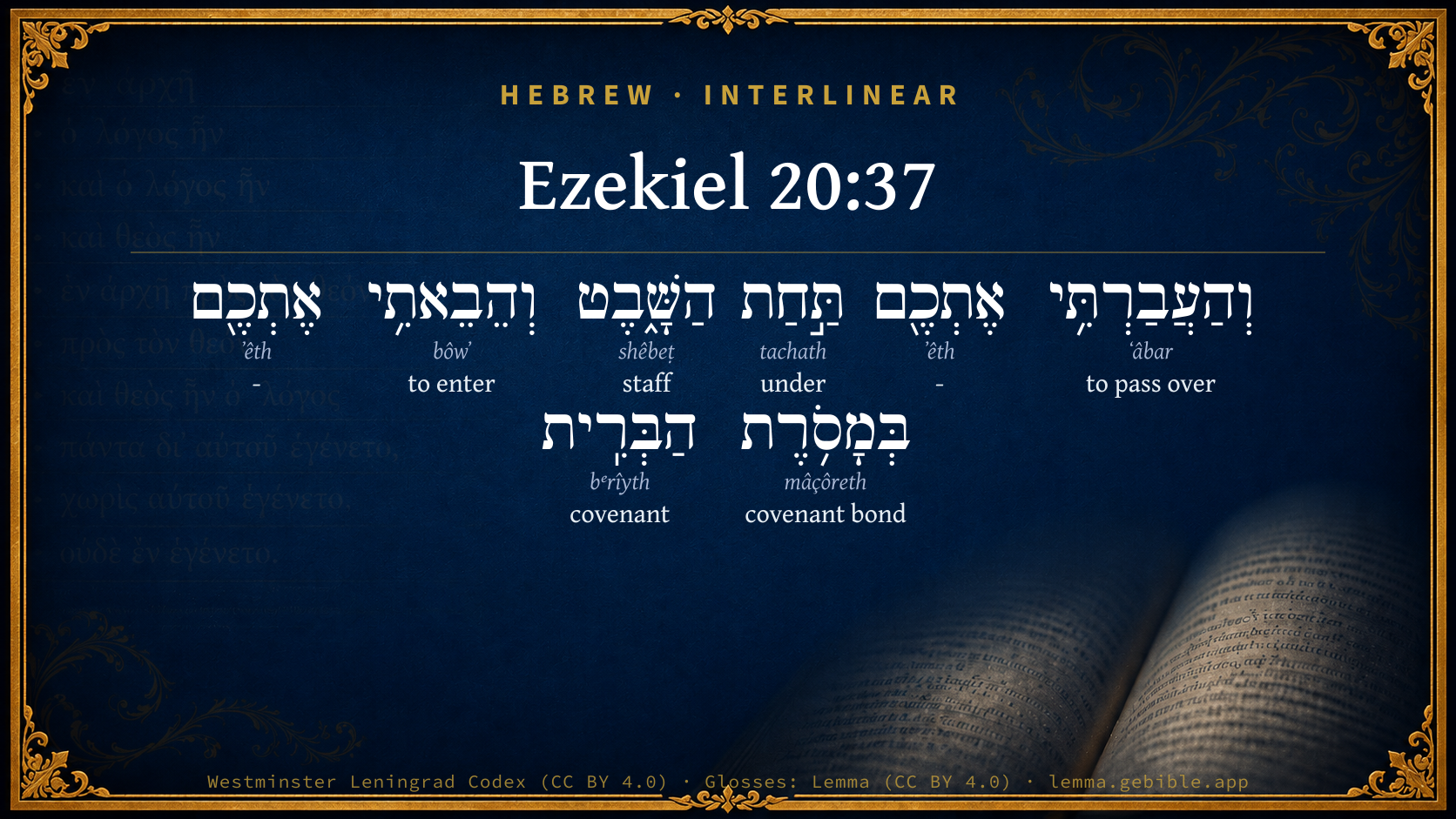
Hebrew (Westminster Leningrad Codex) Ezekiel 20:37 appears in the Hebrew Old Testament. The text above is from the Westminster Leningrad Codex. Each word links to its Strong’s number, a concise gloss, and parsing drawn from the Open Scriptures Hebrew Bible morphology. Click any word for its full Brown-Driver-Briggs (BDB) entry.
Download image
Cite this verse

Ezekiel 20:37 (World English Bible). Public Domain. Lemma interlinear Bible study tool, https://lemma.gebible.app/v/ezekiel/20/37.

Show BibTeX & RIS
BibTeX
RIS
English Translation
I will cause you to pass under the rod, and I will bring you into the bond of the covenant;
World English Bible · Public Domain
Highlights
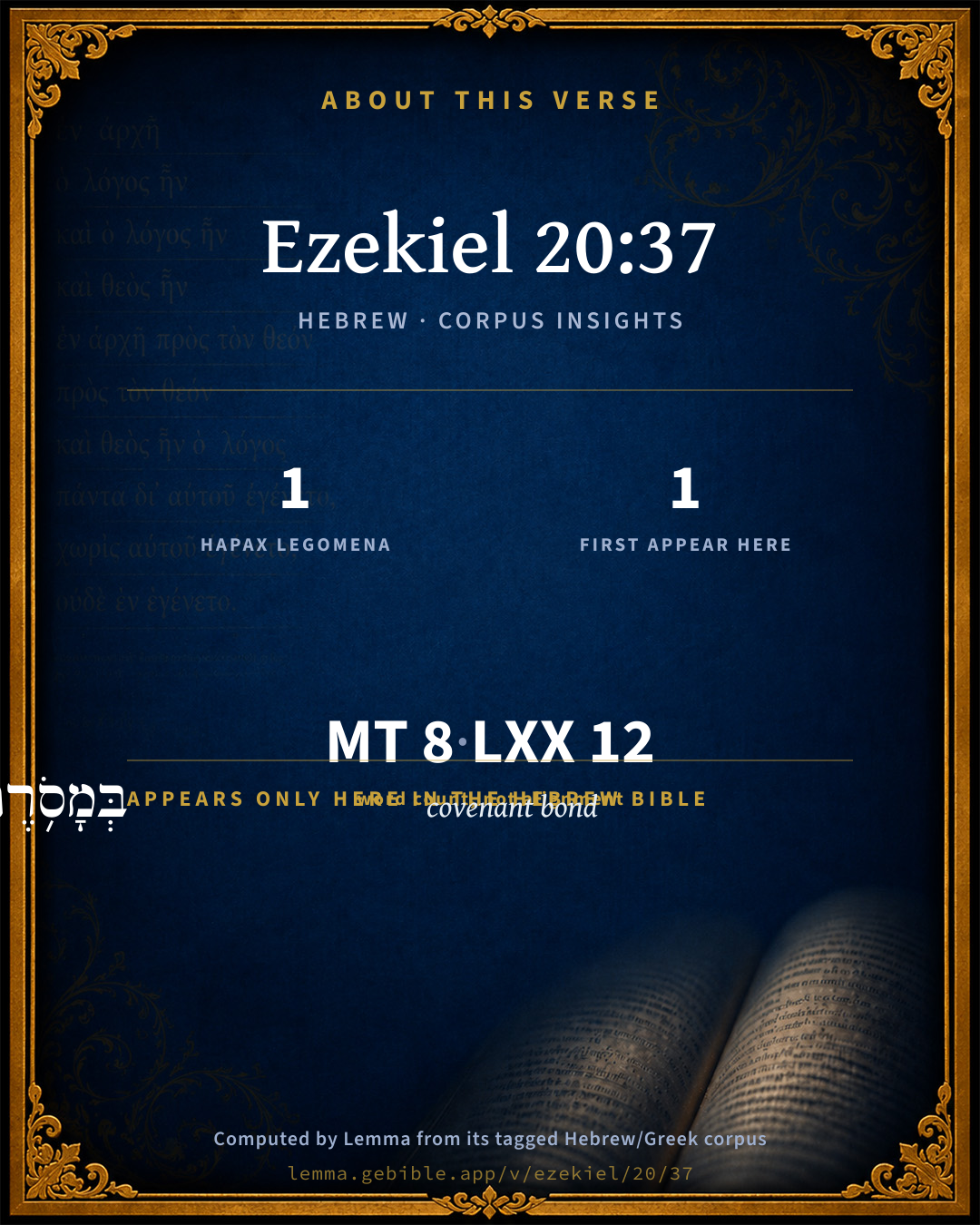
  • 1 hapax legomenon — only here in the Hebrew Bible
  • 1 first appearance in the Hebrew Bible
Full analysis ↓
Download a study sheet

One document with this verse’s original text, its word-by-word gloss line, the meaning frame, cross-references with their text, attributed commentary, and full source and license credits — printable, and it pastes into notes with its structure intact.

This verse Autodidact and up

Study sheet (.html) Plain text (.txt)

A passage Seminary Student

Up to 50 verses in one chapter. A passage sheet keeps up to 6 commentary sources and 12 cross-references per verse, in the order this page ranks them, and says so on the sheet whenever that leaves anything out. Ask for a single verse and you get the Autodidact verse sheet above.

Everything on this page stays free to read, with no account — the sheet is a download of what is already on screen, not access to it.

Want to remove ads? Support Godless Engineer
Compare translations 3

The same verse in 3 English versions, stacked beneath the original-language interlinear above. Click any original word for its lexicon entry.

Each is an independent rendering of the whole verse — the interlinear is not word-aligned to these translations.

Highlighted words mark where these versions differ — a whole-verse word diff, not a word-by-word alignment.

  • World English Bible Public Domain
    I will cause you to pass under the rod, and I will bring you into the bond of the covenant;
  • King James Version Public Domain
    And I will cause you to pass under the rod, and I will bring you into the bond of the covenant:
  • unfoldingWord Literal Text CC BY-SA 4.0
    I will cause you to pass under my rod, and I will make you obey the requirements of the covenant.

unfoldingWord Literal Text — © unfoldingWord, licensed CC BY-SA 4.0. Word-aligned USFM3 via Door43 (git.door43.org/unfoldingWord/en_ult).

Versions to compare (up to 4)

3 of 4 selected

Show all 18 translations

Every available English version of this verse, each an independent rendering of the whole verse.

  • World English Bible Public Domain
    I will cause you to pass under the rod, and I will bring you into the bond of the covenant;
  • Berean Standard Bible Public Domain
    I will make you pass under the rod and will bring you into the bond of the covenant.
  • Majority Standard Bible Public Domain
    I will make you pass under the rod and will bring you into the bond of the covenant.
  • King James Version Public Domain
    And I will cause you to pass under the rod, and I will bring you into the bond of the covenant:
  • American Standard Version (1901) Public Domain
    And I will cause you to pass under the rod, and I will bring you into the bond of the covenant;
  • Revised Version (1885) Public Domain
    And I will cause you to pass under the rod, and I will bring you into the bond of the covenant;
  • Geneva Bible (1599) Public Domain
    And I wil cause you to passe vnder the rod, and wil bring you into the bond of the couenant.
  • Douay-Rheims (1899) Public Domain
    And I will make you subject to my sceptre, and will bring you into the bands of the covenant.
  • Young's Literal Translation Public Domain
    And I have caused you to pass under the rod, And brought you into the bond of the covenant,
  • Literal Standard Version CC BY-SA 4.0
    And I have caused you to pass under the rod, || And brought you into the bond of the covenant,
  • Unlocked Literal Bible CC BY-SA 4.0
    I will cause you to pass under my rod, and I will make you obey the requirements of the covenant.
  • unfoldingWord Literal Text CC BY-SA 4.0
    I will cause you to pass under my rod, and I will make you obey the requirements of the covenant.
  • Darby Bible Public Domain
    And I will cause you to pass under the rod, and I will bring you into the bond of the covenant.
  • World Messianic Bible Public Domain
    “I will cause you to pass under the rod, and I will bring you into the bond of the covenant.
  • Webster's Bible Public Domain
    And I will cause you to pass under the rod, and I will bring you into the bond of the covenant.
  • Free Bible Version CC BY-SA 4.0
    I will decide about you as you pass under the rod and see if you kept our solemn agreement.
  • Bible in Basic English Public Domain
    And I will make you go under the rod and will make you small in number:
  • JPS Tanakh (1917) Public Domain
    And I will cause you to pass under the rod, and I will bring you into the bond of the covenant;

Literal Standard Version (2020), Covenant Press — licensed CC BY-SA 4.0. Text via the HelloAO Bible API (eBible.org). Unlocked Literal Bible (unfoldingWord) — licensed CC BY-SA 4.0. Text via the HelloAO Bible API (eBible.org). unfoldingWord Literal Text — © unfoldingWord, licensed CC BY-SA 4.0. Word-aligned USFM3 via Door43 (git.door43.org/unfoldingWord/en_ult). Free Bible Version, Dr. Jonathan Gallagher — licensed CC BY-SA 4.0. Text via the HelloAO Bible API (eBible.org).

Word by word

More ways to search: Search by grammar → Find every occurrence → Compare this word →

Practice this passage: Drill this verse → Learn its vocabulary →

בְּמָסֹ֥רֶת
mâçôreth
H4562
“in/at · covenant bond of”
Preposition + Noun, Common, Feminine, Singular, Construct
Part of Speech
Preposition + Noun
Type
Common
Gender
Feminine
Number
Singular
State
Construct
Full BDB Definition

Origin: from H631

TWOT: 141e

bond (of the covenant)
  1. וְהַעֲבַרְתִּ֥י ʻâbar H5674 “and · to pass over” Conjunction + Verb, Hiphil, Sequential Perfect, 1st Person, Common, Singular
  2. אֶתְכֶ֖ם ʼêth H853 “- · you” Particle, Direct Object + Suffix, Personal, 2nd Person, Masculine, Plural
  3. תַּ֣חַת tachath H8478 “under” Preposition
  4. הַשָּׁ֑בֶט shêbeṭ H7626 “the · staff” Particle, Definite Article + Noun, Common, Masculine, Singular, Absolute
  5. וְהֵבֵאתִ֥י bôwʼ H935 “and · to enter” Conjunction + Verb, Hiphil, Sequential Perfect, 1st Person, Common, Singular
  6. אֶתְכֶ֖ם ʼêth H853 “- · you” Particle, Direct Object + Suffix, Personal, 2nd Person, Masculine, Plural
  7. הַבְּרִֽית bᵉrîyth H1285 “the · covenant” Particle, Definite Article + Noun, Common, Feminine, Singular, Absolute

About this verse

These counts appear in no published source. They are computed here, from the morphology-tagged text and Lemma’s own curated glosses. What Lemma adds →

8
words
7
distinct lemmas
Prophets
section

Notable vocabulary

1 hapax legomenon — a word that appears only here in the entire Hebrew Bible:

  • בְּמָסֹ֥רֶת covenant bond H4562

First appearance in Scripture

This word makes its first canonical appearance in the Hebrew Bible here:

  • בְּמָסֹ֥רֶת covenant bond H4562

Grammatical profile

  • 2 verbs
  • 3 nouns
  • 1 preposition
  • 2 particles

Verb forms

  • וְהַעֲבַרְתִּ֥י Hiphil · Sequential Perfect
  • וְהֵבֵאתִ֥י Hiphil · Sequential Perfect

Hebrew & Septuagint length

In English translation the verse runs 20 words from the Hebrew and 18 from the Septuagint (LXX English) — closely comparable.

A rough comparison of the two English renderings, which tokenize alike — not a word-level alignment.

Word counts can differ between the Hebrew and the Greek without any difference in meaning — e.g. the Hebrew direct-object marker אֵת has no separate Greek word, and Greek often adds the article ὁ.

In the original languages it is 8 Hebrew tokens and 12 Greek tokens — but the two are counted differently (Hebrew bundles its prefixes and suffixes into one token; the Greek is in lemma form), so that isn’t a like-for-like length.

Cross-references

8

Topical passages linked to Ezekiel 20:37 in the Treasury of Scripture Knowledge — connected by theme and wording, ordered by reader-vote popularity; previews shown in the World English Bible.

  • Leviticus 27:32 All the tithe of the herds or the flocks, whatever passes under the rod, the tenth shall be holy to Yahweh.
  • Jeremiah 33:13 In the cities of the hill-country, in the cities of the lowland, and in the cities of the South, and in the land of Benjamin, and in the places about Jerusalem, and in the cities of Judah, shall the flocks again pass under the hands of him who numbers them, says Yahweh.
  • Matthew 25:32–33 Before him all the nations will be gathered, and he will separate them one from another, as a shepherd separates the sheep from the goats.
  • Psalms 89:30–32 If his children forsake my law, And don't walk in my ordinances;
  • Ezekiel 16:59–60 For thus says the Lord Yahweh: I will also deal with you as you have done, who have despised the oath in breaking the covenant.
  • Leviticus 26:25 I will bring a sword upon you, that will execute the vengeance of the covenant; and you will be gathered together within your cities: and I will send the pestilence among you; and you will be delivered into the hand of the enemy.
  • Amos 3:2 "You only have I chosen of all the families of the earth. Therefore I will punish you for all of your sins."
  • Ezekiel 34:17 As for you, O my flock, thus says the Lord Yahweh: Behold, I judge between sheep and sheep, the rams and the male goats.

Cross-references courtesy of OpenBible.info (CC BY 4.0).

Hebrew and Greek witnesses Masoretic Hebrew ↔ Greek Septuagint

The same verse in the two great witnesses to the Old Testament, shown verse-for-verse.

These are two independent witnesses, not word-aligned to each other, and the Septuagint is shown in lemma (dictionary) form.

Hebrew Ezekiel 20:37 Masoretic · Westminster Leningrad Codex

וְהַעֲבַרְתִּ֥י אֶתְכֶ֖ם תַּ֣חַת הַשָּׁ֑בֶט וְהֵבֵאתִ֥י אֶתְכֶ֖ם בְּמָסֹ֥רֶת הַבְּרִֽית

I will cause you to pass under the rod, and I will bring you into the bond of the covenant;

World English Bible · Public Domain

Greek LXX Ezekiel 20:37 Septuagint · lemma form

καί διαἄγω σύ ὑπό ὁ ῥάβδος ἐγώ καί εἰςἄγω σύ ἐν ἀριθμός

And I will cause you to pass under my rod, and I will bring you in by number.

LXX2012 (modern English Septuagint) · Public Domain

On this verse, The Cambridge Bible for Schools and Colleges discusses the Septuagint’s reading. Read the note in Commentary ↓

Hebrew: Westminster Leningrad Codex (CC BY 4.0). Greek: Septuagint (public domain); English from LXX2012 (modern English Septuagint) (Public Domain). How the Septuagint differs from the Hebrew →

Targum (Aramaic paraphrase)

1

The Targum is the ancient Jewish Aramaic paraphrase of the Hebrew Scriptures — an interpretive translation, not the Hebrew text itself. Onkelos (literal) and Pseudo-Jonathan (expansive) render the Torah, and Jonathan the Prophets. Coverage is partial: where no permissively-licensed English translation exists for a verse, only the Aramaic is shown. This is verse-level text, not a word-by-word alignment to the Hebrew.

  1. Targum Jonathan Prophets (Joshua–Malachi)
    וַאֲנִיחַ עֲלֵיכוֹן גְזֵירַת דִינִי וְאָעֵיל יַתְכוֹן בְּמַסוֹרֶת קַיָמָא:

    (no public-domain English translation for this verse)

    Targum Jonathan — Aramaic: “Mikraot Gedolot” (public domain). English: “Sefaria Community Translation” (CC0 1.0 (public-domain dedication)); “London "Chaldee Paraphrase," 1871” (public domain). Text via Sefaria.

Commentary

Notes on Ezekiel 20:37 from classic Christian and Jewish commentators (each source and its license shown beneath its notes). The classic Christian expositions comment on the surrounding passage and are grouped to its opening verse, so a note may address several verses; the Jewish commentaries on the Tanakh (Rashi and others) are per-verse, so they appear only where the commentator wrote on this verse.

Lemma curates 59 commentaries, every one of them public domain or Creative Commons licensed, each selected and text-cleaned for this edition rather than reprinted as found. About our sources →

Trapp's Complete Commentary

John Trapp

Eze 20:37 And I will cause you to pass under the rod, and I will bring you into the bond of the covenant:

Ver. 37. And I will cause you to pass under the rod, and I will bring you into the bond of the covenant.] Why, then, Feri, Domine, feri, Smite, Lord, smite, so my sins may be pardoned, and my soul saved. Hic seca, hic ure, ut in aeternum serves, Here suffer, here burn that you may protect us in eternity, said an ancient: Do even whatsoever thou wilt with me, so I may come to heaven, though I come to it by weeping cross.

John Trapp, A Commentary or Exposition upon All the Books of the Old and New Testament (1647–1656) — public domain. Text from a community e-Sword module.

The Biblical Illustrator

Joseph S. Exell

Eze_20:37

I will bring you into the bond of the covenant.

The bond of the covenant

This striking utterance was given forth by Ezekiel when Israel, scattered in every country, had begun to forget their nationality. They judged it prudent to disguise their distinctive character, and become like the heathen. Now, God, who chose His people of old, would not have it so, and He interposed with this striking passage. It is a dreadful thing to profess to belong to the people of God: it is a matter of great privilege if it is true, but if it is a lie it is an awful thing, involving sevenfold judgment. God will cause His professing people to be distinguished from other men, and they that come in among them who are not truly of them shall be so dealt with that both the ears of him that heareth thereof shall tingle. Special severities will overtake apostate professors.

I. The meaning of bringing men into the bond of the covenant.

1. If we take the passage as referring to the work of grace, it signifies that they shall know under what covenant they stand. Oh, the blessedness of being under such a sure covenant! This is what is aimed at, that God may bring His own from under the law, and place them under the covenant of grace. Though as yet they care nothing about it, He will bring them to know and realise that they are standing in the covenant of grace, with Christ as their Covenant-Head.

2. They shall be led to see how this covenant binds them to God. O mighty grace, thou dost hold us with the cords of a man from which we never desire to escape. We are the Lords people, and He is our God. He holds us, and we hold to Him.

3. To come under the bond of the covenant means also to come under the discipline of the covenant; for they that are in gracious covenant with God will find that He dealeth with them as with sons, and, inasmuch as He loves them, they shall know the truth of that word--As many as I love I rebuke and chasten.

4. This coming under the bond of the covenant means surely that they yield to its restraint. Can grace ever be a fetter? Oh yes, it is the most blessed of all fetters, for it holds us fast, and yet never violates our liberty. It binds the very heart in willing captivity. This is the bond of the covenant.

5. It means also the security of the covenant. I will bring thee under the bond of the covenant, must mean, I will bind thee to the Lord Jesus, thy Surety and Bondsman, and He shall secure thee forever.

II. The experience of some in coming under the bond of the covenant. These Israelites had gone very far into sin, as Jar as ever they could go: they had been false to their promises, wicked in their lives, and rebellious in heart against their God. With many of this character the Lord deals with a singular severity of love. He strikes them with a sword, for so only can their sins be slain. Of those processes of grace we will speak now.

1. First, He will cause them to come out from their present company. You shall find in your old sins such death and corruption that you shall turn from them as a man turns, from a rotting carcase.

2. Note next, that God said He would bring them into distress and loneliness--And I will bring you into the wilderness of the people. This is, indeed, a terrible wilderness; for you walk in the midst of crowds and yet you are perfectly alone; you mingle with the great congregation, and yet feel that none can enter into your secret, Where now your mirth and giddiness? Where now your comrades in iniquity? The Lord can soon make the gay worldling into the desponding solitary.

3. What does He say next?--And there will I plead with you face to face. When the Lord becomes so realised to the guilty conscience that there seems to be nothing anywhere except God and that poor sinner face to face with one another, then there is a time of fear and trembling indeed.

4. The Lord further declares He will plead with them as He pleaded with their fathers in the wilderness. How did He do that? Why, very terribly indeed. Is God pleading with you in that fashion? Does He bring judgment after judgment upon you? Do His threatenings follow each other like peals of thunder? Has He burned up all your comfort? Has He scorched and withered all your confidence? Are you brought unto the dust of death?

5. What more does God do? Well, it is said, And I will cause you to pass under the rod. I have frequently seen sheep when the shepherd has required to count them: he makes them pass through a half-opened gate, and there he numbers them. They would all come rushing through, but the shepherd blocks the way, and as they come out one by one, he touches them with his staff, and so counts them. The Lord makes His chosen to pass through a narrow place, even a strait gate, where only one can come at a time, and there and then He counts them, and causes them to give an account of themselves individually. Then mark this: as the shepherd by counting his own sheep declares and exercises his right of possession, so the Lord, when He wakens up our minds to feel our personality, causes us to recognise that we are not our own, but are bought with a price. Moreover, we come under the rod of rulership; for a rod in the old time was the usual sceptre of kings. It means, also, the rod of chastisement. Happy is the man whom God correcteth.

III. The ultimate design of all this.

1. The first design is to bind them to God. All the better crop comes in afterlife from having a deep ploughing before the seed is sown.

2. The next design of God is that He may entirely separate His people from the world. When God makes His servants bitterly to know the evil fruit of sin, then they no longer hunger for that forbidden fruit.

3. Furthermore, the Lord chastens His people, that thus He may bring them into their own land of promise, into the rest of His love.

4. The great end of all is that we may know the Lord. When a man has smarted because of his sin, and has been made to feel the burning coals of anguish in his own spirit; when the Lord has set him up as a target, and shot at him with arrows which drink up his life; and when afterwards he has been saved, and the splendour of infinite love has shone upon him, then he knows Jehovah. When God has brought the contrite man into the place of security, comfort, joy, and delight in Christ Jesus, then he knows the Lord. (C. H. Spurgeon.)

The Biblical Illustrator, edited by Joseph S. Exell (c. 1880s–1900s) — public domain. Text from a community e-Sword module.

Joseph Benson's Commentary

Eze 20:37-38. I will cause you to pass under the rod — Of punishment. I will bring you under the chastisement due to you for breaking my covenant. Or there may be an allusion to the custom of numbering flocks and herds, by striking them with a rod: and so the sense will be, “I will take an exact account of you, as a shepherd does of his flock, and will sever between the good and the bad, between the sheep and the goats.” And I will bring you into the bond of the covenant — By these methods I will reduce you to that obedience to which, by my covenant, you are obliged. And I will purge out from among you the rebels — I will separate the righteous from the wicked, in order to destroy the latter, as I did the rebellious Israelites in the wilderness. I will bring them forth out of the country, &c. — I will bring them (namely, the rebels, or wicked ones) forth out of the land of Judea, where they now sojourn, and where they boast that they shall always continue; and they shall not enter into the land of Israel — They shall never return into it again. Bishop Newcome thinks “those are here referred to, who, after the murder of Gedaliah, went into Egypt, called here the land of their sojourning. Some of these were to be carried into Chaldea with the captive Egyptians, Jer 43:11, though the greater part were to be consumed, Jer 44:12. Some of the obstinately rebellious Jews might also sojourn in other neighbouring countries subdued by Nebuchadnezzar, as Edom, Moab, Ammon, Tyre, &c., and might thence be taken into captivity. The small number who returned from Egypt into Judea were righteous men, and not such as are here called rebels and transgressors.”

Joseph Benson's Commentary on the Old and New Testaments (1811–1818) — public domain. Text from a community e-Sword module.

Jamieson, Fausset & Brown

Robert Jamieson, A. R. Fausset & David Brown

pass under the rod--metaphor from a shepherd who makes his sheep pass under his rod in counting them (Lev 27:32; Jer 33:13). Whether you will or not, ye shall be counted as Mine, and so shall be subjected to My chastening discipline (Mic 7:14), with a view to My ultimate saving of the chosen remnant (compare Joh 10:27-29).

bond of . . . covenant--I will constrain you by sore chastisements to submit yourselves to the covenant to which ye are lastingly bound, though now you have cast away God's bond from you. Fulfilled in part, Neh 9:8, Neh 9:26, Neh 9:32-38; Neh. 10:1-39; fully hereafter (Isa 54:10-13; Isa 52:1-2).

Jamieson, Fausset & Brown — Commentary Critical and Explanatory on the Whole Bible (1871) — public domain (CC PDM 1.0). Text via the HelloAO Bible API.

Adam Clarke's Commentary

Verse 37. I will cause you to pass under the rod] This alludes to the custom of tithing the sheep. I take it from the rabbins. The sheep were all penned; and the shepherd stood at the door of the fold, where only one sheep could come out at once. He had in his hand a rod dipped in vermillion; and as they came out, he counted one, two, three, four, five, six, seven, eight, nine; and as the tenth came out, he marked it with the rod, and said, "This is the tenth;" and that was set apart for the Lord.

I will bring you into the bond of the covenant] You shall be placed under the same obligations as before, and acknowledge your selves bound; ye shall feel your obligation, and live according to its nature.

Adam Clarke's Commentary on the Bible (1810–1826) — public domain. Text from a community e-Sword/MySword module.

John Calvin's Commentaries

He follows up the same kind of instruction, that the people were not permitted to perish because they belonged to him, as if he had said that they should be always his, whether they liked it or not. And yet he seems to promise here what was very agreeable, that he would always esteem them as his flock. This is the meaning of to pass under the rod; for שבט, shebet, does not mean a scepter here, nor a staff by which a delinquent is struck, but it means a shepherd’s crook. It is, then, a simile taken from a shepherd who numbers and marks his flock; and this phrase often recurs. It means, because God has once acquired the people as his own, he cannot be rightly deprived of them. The exiles, indeed, had imagined themselves free if they could blot out of their minds and memories the name of the true God, and pollute themselves with the defilement’s of the Gentiles. But God, on the other hand, pronounces, that as a shepherd notices his sheep, and counts their number, and makes them pass under his staff, like a king reviewing his army, so he would reckon up his people, and not suffer any one to snatch them from him, since he claims authority over them all without exception. Now, therefore, we understand the sense of the words: whence we gather again, that abandoned men gain nothing by their obstinacy, but God’s really showing that the dominion which he has once assumed cannot by any means be snatched away from him. So this passage teaches us the kind of reward which awaits all apostates who think themselves emancipated when they brutally indulge in impiety, because God at length will make them pass under the rod, that is, he will call and compel them to render an account, as if their profession of faith was like a brand burnt in to their hearts.

He says, in the bonds of a covenant, but in a different sense from what Hosea denominates a bond of affection. (Hosea 11:4.) He is there treating of reconciliation; but in this passage God pronounces that he will no longer be en-treated by the Israelites. Hence, the bond of the covenant means the constancy of his covenant, as far as he is concerned: and the, simile is suitable, because God had bound his people to himself, on the condition that they should be always surrounded with these bonds. Hence, when they petulantly wandered like untamed beasts, yet God had hidden bonds of his covenant: that is, he persevered in his own covenant, so that he collected them all again to himself, not to rule over them as a father, but to punish their revolt more severely. Here is a tacit comparison between the Israelites and the Gentiles; for the Gentiles, through their never approaching nearer to God, wandered away in their licentiousness without restraint. But the state of the elect people was different, since the end of their covenant was this, that God held them bound to him, even if the whole world should escape from him. It follows —

John Calvin's Commentaries (1540-1563) — public domain. Text from the Calvin Translation Society English edition (1840s-50s) via the Christian Classics Ethereal Library (ccel.org). Calvin's coverage is partial (roughly two-thirds of the Bible); uncommented books and verses are honest gaps, never fabricated. The 19th-century editor's footnotes and remarks are omitted so the notes are faithfully Calvin's own voice.

Ellicott's Commentary for English Readers

(37) To pass under the rod.—A figure taken from the shepherd’s way of counting and examining his flock. (Comp. Lev_27:32; Jer_33:13; Mic_7:14.) By this the people were to be brought “into the land of the covenant,” selected and reconstituted God’s covenant people.

A Bible Commentary for English Readers, edited by Charles John Ellicott (1878–1897) — public domain. Text from a community e-Sword module.

The Cambridge Bible for Schools and Colleges

gen. ed. J. J. S. Perowne

37. to pass under the rod] According to the usage of the language (Lev_27:32, cf. Jer_33:13) the rod or staff here is that of the shepherd, which he uses in counting his flock. “The shepherds carried a staff (Psa_23:4; Mic_7:4; Zec_11:7) and used it in counting when they brought the beasts forth from the place where they were kept or made them go into it. It was customary to count the beasts every day (Jer_33:23), usually at evening when they came home (Theocr. Eze_8:16; Virg. Georg. iv. 436), sometimes twice, morning and evening (Virg. Ecl. iii. 34),” Dillm. on Lev_27:32.

bond of the covenant] The word “bond” is otherwise unknown. LXX. reads: and I will cause you to go in by number, i.e. probably in special or precise tale (Isa_40:26; 1Ch_9:28; Ezr_8:34). This carries on the figure of passing under the staff, and is amplified in Eze_20:38. The word “covenant” is possibly a duplicate of the next word “purge” (Eze_20:38). The expression “by or, in number” hardly of itself means few (cf. ch. Eze_5:3), neither is the idea of fewness suitable here. Cf. Jer_3:14.

The Cambridge Bible for Schools and Colleges (gen. ed. J. J. S. Perowne; Cambridge University Press, 1878–1918) — public domain. Text from a community e-Sword module.

John Gill's Exposition

And I will purge out from among you the rebels, and them that transgress against me,.... All men are enemies, and enmity itself, against God; and every sin is an act of hostility and rebellion against him; every transgression and violation of his law is a casting off of allegiance to him, and a trampling upon and despising his legislative power and authority; wherefore rebels and transgressors of his law are put together; the one being explanative of the other. The people of the Jews were always more or less a rebellious people; so they were in the times of Moses, and all the while that he was with them, and were notoriously so in the times of Ezekiel; and therefore are often so described in this book; but they were not all so; such as were, the Lord here declares that he would single them out, as goats from among his sheep he brought under the rod, and purge them as chaff from the wheat; that sinners in Zion should be no more in the congregation of the righteous:

I will bring them forth out of the country where they sojourn; or "countries"; wherever they have been pilgrims and sojourners, as they now are; wherever they are; it looks as if, a little before or when the remnant of God, according to the election of his grace, shall be converted, that the rest shall be collected together into some one place, and be destroyed as rebels:

and they shall not enter into the land of Israel; when the converted Jews shall; an emblem of carnal Israelites, wicked professors, being not admitted into the New Jerusalem, and being excluded from the kingdom of heaven:

and ye shall know that I am the Lord; that knows all things, can do all things, and will faithfully and punctually perform all that is promised, threatened, or predicted.

John Gill's Exposition of the Whole Bible (1746–1763) — public domain (CC PDM 1.0). Text via the HelloAO Bible API.

Haydock's Catholic Bible Commentary

Covenant of the gospel, by the powerful attractions of grace, Luke xiv. 24., John vi. 69., and vii. 46., and 2 Corinthians x. 4.

George Leo Haydock (1774–1849), Haydock's Catholic Family Bible and Commentary, 1859 edition — public domain. Excludes Psalms (Douay-Rheims chapter numbering differs from Protestant) and Deuterocanonical books (Catholic canon only).

Matthew Poole's English Annotations

I will bring you out by number, yet so as you shall either by a voluntary submission own my sceptre and government, or by a conquered subjection yield to my sword and power.

Under the rod; either referring to the manner of shepherds in that country, which did tell their sheep in and out of the fold; or rather, as a king, whose sceptre protects some, and dasheth others, and maintains his own right. I will difference persons and persons, that I may deal with each suitably to their state and carriage.

Will bring you, i.e. the voluntary and obedient, into covenant with myself.

Matthew Poole's English Annotations on the Holy Bible (1683–1685) — public domain. Text from a community e-Sword/MySword module.

Whedon's Commentary on the Bible

Daniel D. Whedon

37. I will cause you to pass under the rod — Not an Israelite shall be forgotten. As the shepherd with his rod checks the flock at night at the entrance to the sheepfold, and numbers his sheep, and separates them from other flocks and from the goats (Eze_34:17-20; Lev_27:32; Jer_33:13; compare Matthew 25), so will Jehovah count his people and separate his own true followers unto himself. Adam Clarke takes from the rabbins the statement that in giving tithes the shepherd stood at the door of the fold with a rod, dipped in vermilion, with which he marked every tenth sheep as it sprang past him.

I will bring you into the bond of the covenant — The Syriac version has it, “I will bring you into the correction of the covenant;” but probably the best reading is that preserved by the LXX., “I will bring you into the land by number” (Isa_40:26; 1Ch_9:28; Ezr_8:34).

Daniel D. Whedon (gen. ed.), Commentary on the Old and New Testaments (1874–1909) — public domain. Text from a community e-Sword module.

The Pulpit Commentary

I will cause you to pass under the rod. The "rod" (same word as in Psa_23:4) is primarily that of chastisement, but it is also that of the shepherd who gathers in his flock. (Eze_34:11; Lev_27:32; Mic_7:14) Into the bond of the covenant. The word for "bond" (only found here in the Old Testament) is probably cognate with that for "fetter" or "bond". (Isa_52:2; Jer_5:5 Jer_27:2) The chastisement was, for those who accepted it, to do its work by restoring the blessings of the covenant which apostasy had forfeited.

The Pulpit Commentary (1880–1919), ed. H.D.M. Spence-Jones & Joseph S. Exell — public domain. Text from a community e-Sword module.

John Wesley's Explanatory Notes

I will cause - I will bring you out by number, so that you shall either own my scepter, or by a conquered subjection, yield to my sword and power. Under the rod - Referring to the manner of shepherds in that country, who did tell their sheep in, and out of the fold. Bring you - The voluntary and obedient into covenant with myself.

John Wesley, Explanatory Notes Upon the Whole Bible (1754–1765) — public domain. Text via the GEBible commentary corpus.

Scofield Reference Notes

C. I. Scofield

rod

The passage is a prophecy of the future judgment upon Israel, regathered from all nations (see "Israel," Isa 1:24-26 refs. into the old wilderness wanderings. Eze 20:35. The issue of this judgment determines who of Israel in that day shall enter the land for kingdom blessing.; Psa 50:1-7; Eze 20:33-44; Mal 3:2-5; Mal 4:1; Mal 4:2 see other judgments,

(See Scofield "Joh 12:31") See Scofield "1Co 11:31"

(See Scofield "2Co 5:10") See Scofield "Mat 25:32"

(See Scofield "Jud 1:6") See Scofield "Rev 20:12"

The Scofield Reference Bible (1917 edition), notes by C. I. Scofield — public domain. Text from a community e-Sword module.

Rashi

Rabbi Shlomo Yitzchaki (Rashi)

under the rod That you shall be subordinate to Me and to My chastisement.

into the transmission of the covenant The covenant that I transmitted to you.

Rashi on the Tanakh — English translations: “The Judaica Press complete Tanach with Rashi, translated by A. J. Rosenberg” (CC BY 4.0); “Pentateuch with Rashi's commentary by M. Rosenbaum and A.M. Silbermann, 1929-1934” (public domain); “The Metsudah Tanach series, Lakewood, N.J” (CC BY 4.0); and “The Book of Joshua, Metsudah Publications, 1997” (CC BY 4.0). Text via Sefaria.

Lesson kit

Teaching starters — assembled from the data on this page, not authored interpretation. Every prompt links to the verse data it draws on. Edit before teaching.

Ezekiel, in the Prophets, opens this verse with 8 words (7 distinct Hebrew lemmas). Its most distinctive word is mâçôreth (“covenant bond”). A historical commentator’s framing appears above. Read the whole chapter for the surrounding context.

Discussion questions

  1. How does “covenant bond” (mâçôreth) shape what this verse is saying?
  2. 1 word here appears nowhere else in the Hebrew Bible. Why might the author reach for such rare wording?
  3. This is the first place “covenant bond” appears in Scripture (first appears here). What does its debut here establish?
  4. How does Leviticus 27:32, which shares this passage’s theme, read alongside this verse?
  5. These translations render this verse differently; the difference is in the English rendering, not the original. What questions does that raise?
  6. «וְהַעֲבַרְתִּ֥י» is a Hiphil Sequential Perfect verb. How does that grammatical form shape the action described?
  7. Compare how Trapp's Complete Commentary and The Biblical Illustrator read this verse. Where do they agree or differ?

Things to notice

Reading settings

Reading text

Shown beneath each verse's original-language words.

Old Testament
Old Testament edition

Read the OT as the Masoretic Hebrew (MT) or the Greek Septuagint (LXX).

English shown for the Greek Septuagint (in the Hebrew ↔ Greek comparison).

Comparing translations? Open the Compare panel on any verse page to stack up to four side by side.