Judges 21:17

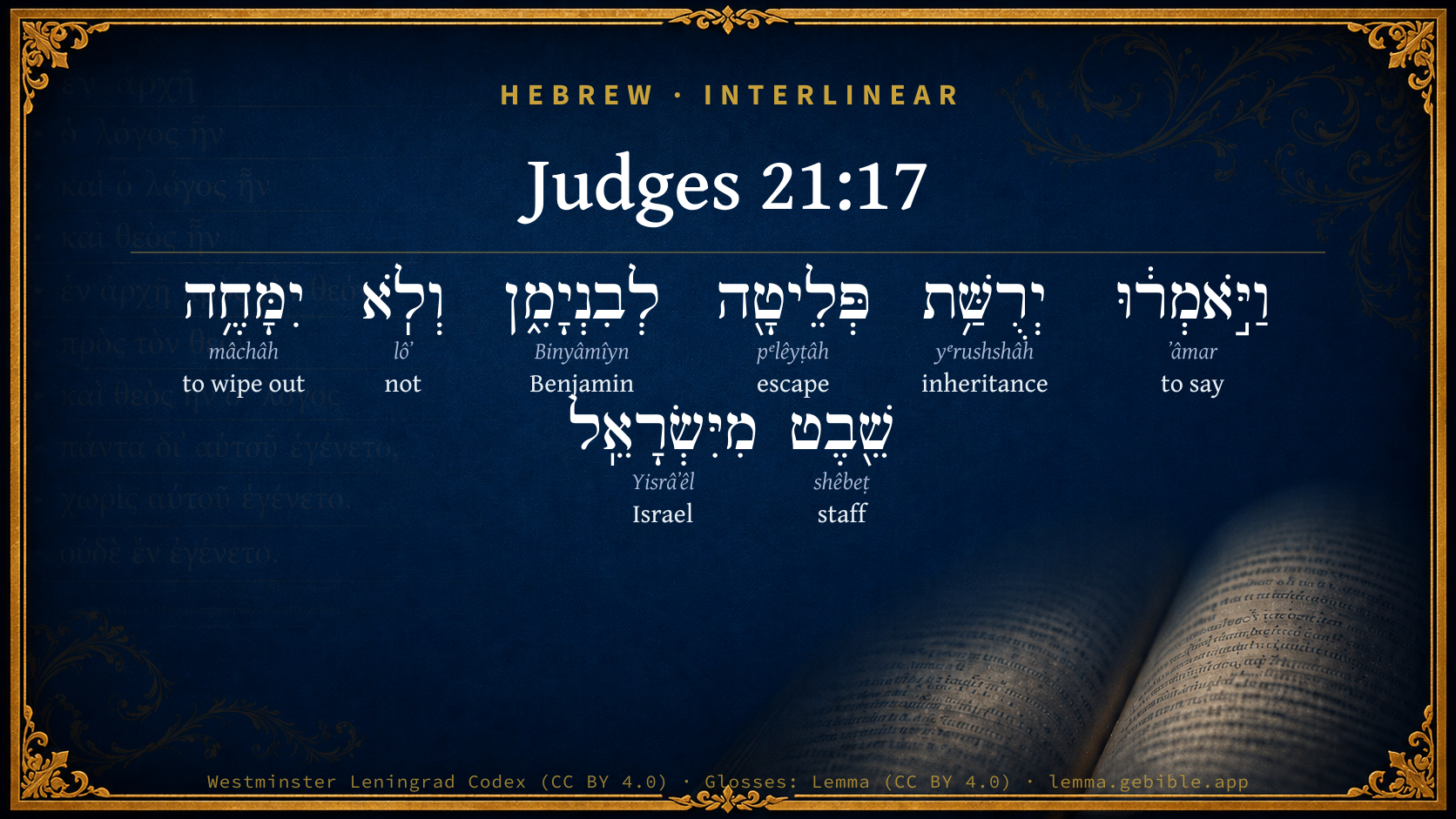
Hebrew (Westminster Leningrad Codex) Judges 21:17 appears in the Hebrew Old Testament. The text above is from the Westminster Leningrad Codex. Each word links to its Strong’s number, a concise gloss, and parsing drawn from the Open Scriptures Hebrew Bible morphology. Click any word for its full Brown-Driver-Briggs (BDB) entry.
Download image
Cite this verse

Judges 21:17 (World English Bible). Public Domain. Lemma interlinear Bible study tool, https://lemma.gebible.app/v/judges/21/17.

Show BibTeX & RIS
BibTeX
RIS
English Translation
They said, There must be an inheritance for those who are escaped of Benjamin, that a tribe not be blotted out from Israel.
World English Bible · Public Domain
Download a study sheet

One document with this verse’s original text, its word-by-word gloss line, the meaning frame, cross-references with their text, attributed commentary, and full source and license credits — printable, and it pastes into notes with its structure intact.

This verse Autodidact and up

Study sheet (.html) Plain text (.txt)

A passage Seminary Student

Up to 50 verses in one chapter. A passage sheet keeps up to 6 commentary sources and 12 cross-references per verse, in the order this page ranks them, and says so on the sheet whenever that leaves anything out. Ask for a single verse and you get the Autodidact verse sheet above.

Everything on this page stays free to read, with no account — the sheet is a download of what is already on screen, not access to it.

Want to remove ads? Support Godless Engineer
Compare translations 3

The same verse in 3 English versions, stacked beneath the original-language interlinear above. Click any original word for its lexicon entry.

Each is an independent rendering of the whole verse — the interlinear is not word-aligned to these translations.

Highlighted words mark where these versions differ — a whole-verse word diff, not a word-by-word alignment.

  • World English Bible Public Domain
    They said, There must be an inheritance for those who are escaped of Benjamin, that a tribe not be blotted out from Israel.
  • King James Version Public Domain
    And they said, There must be an inheritance for them that be escaped of Benjamin, that a tribe be not destroyed out of Israel.
  • unfoldingWord Literal Text CC BY-SA 4.0
    And they said, “A possession of the escapee of Benjamin, so a tribe will not be wiped out from Israel.

unfoldingWord Literal Text — © unfoldingWord, licensed CC BY-SA 4.0. Word-aligned USFM3 via Door43 (git.door43.org/unfoldingWord/en_ult).

Versions to compare (up to 4)

3 of 4 selected

Show all 18 translations

Every available English version of this verse, each an independent rendering of the whole verse.

  • World English Bible Public Domain
    They said, There must be an inheritance for those who are escaped of Benjamin, that a tribe not be blotted out from Israel.
  • Berean Standard Bible Public Domain
    They added, “There must be heirs for the survivors of Benjamin, so that a tribe of Israel will not be wiped out.
  • Majority Standard Bible Public Domain
    They added, “There must be heirs for the survivors of Benjamin, so that a tribe of Israel will not be wiped out.
  • King James Version Public Domain
    And they said, There must be an inheritance for them that be escaped of Benjamin, that a tribe be not destroyed out of Israel.
  • American Standard Version (1901) Public Domain
    And they said, There must be an inheritance for them that are escaped of Benjamin, that a tribe be not blotted out from Israel.
  • Revised Version (1885) Public Domain
    And they said, There must be an inheritance for them that are escaped of Benjamin, that a tribe be not blotted out from Israel.
  • Geneva Bible (1599) Public Domain
    And they saide, there must be an inheritance for them that be escaped of Beniamin, that a tribe be not destroyed out of Israel.
  • Douay-Rheims (1899) Public Domain
    And we must use all care, and provide with great diligence, that one tribe be not destroyed out of Israel.
  • Young's Literal Translation Public Domain
    And they say, `A possession of an escaped party `is' to Benjamin, and a tribe is not blotted out from Israel;
  • Literal Standard Version CC BY-SA 4.0
    And they say, “A possession of an escaped party [is] to Benjamin, and a tribe is not blotted out from Israel;
  • Unlocked Literal Bible CC BY-SA 4.0
    They said, “There must be an inheritance for the survivors of Benjamin, so that a tribe is not destroyed from Israel.
  • unfoldingWord Literal Text CC BY-SA 4.0
    And they said, “A possession of the escapee of Benjamin, so a tribe will not be wiped out from Israel.
  • Darby Bible Public Domain
    And they said, "There must be an inheritance for the survivors of Benjamin, that a tribe be not blotted out from Israel.
  • World Messianic Bible Public Domain
    They said, “There must be an inheritance for those who are escaped of Benjamin, that a tribe not be blotted out from Israel.
  • Webster's Bible Public Domain
    And they said, There must be an inheritance for them that have escaped of Benjamin, that a tribe be not destroyed out of Israel.
  • Free Bible Version CC BY-SA 4.0
    They added, “There have to be heirs for the Benjamite survivors—an Israelite tribe of Israel can't be wiped out.
  • Bible in Basic English Public Domain
    And they said, How is the rest of Benjamin to be given offspring so that one tribe of Israel may not be put out of existence,
  • JPS Tanakh (1917) Public Domain
    And they said: 'They that are escaped must be as an inheritance for Benjamin, that a tribe be not blotted out from Israel.

Literal Standard Version (2020), Covenant Press — licensed CC BY-SA 4.0. Text via the HelloAO Bible API (eBible.org). Unlocked Literal Bible (unfoldingWord) — licensed CC BY-SA 4.0. Text via the HelloAO Bible API (eBible.org). unfoldingWord Literal Text — © unfoldingWord, licensed CC BY-SA 4.0. Word-aligned USFM3 via Door43 (git.door43.org/unfoldingWord/en_ult). Free Bible Version, Dr. Jonathan Gallagher — licensed CC BY-SA 4.0. Text via the HelloAO Bible API (eBible.org).

Word by word

More ways to search: Search by grammar → Find every occurrence → Compare this word →

Practice this passage: Drill this verse → Learn its vocabulary →

About this verse

These counts appear in no published source. They are computed here, from the morphology-tagged text and Lemma’s own curated glosses. What Lemma adds →

8
words
8
distinct lemmas
Historical
section

Notable vocabulary

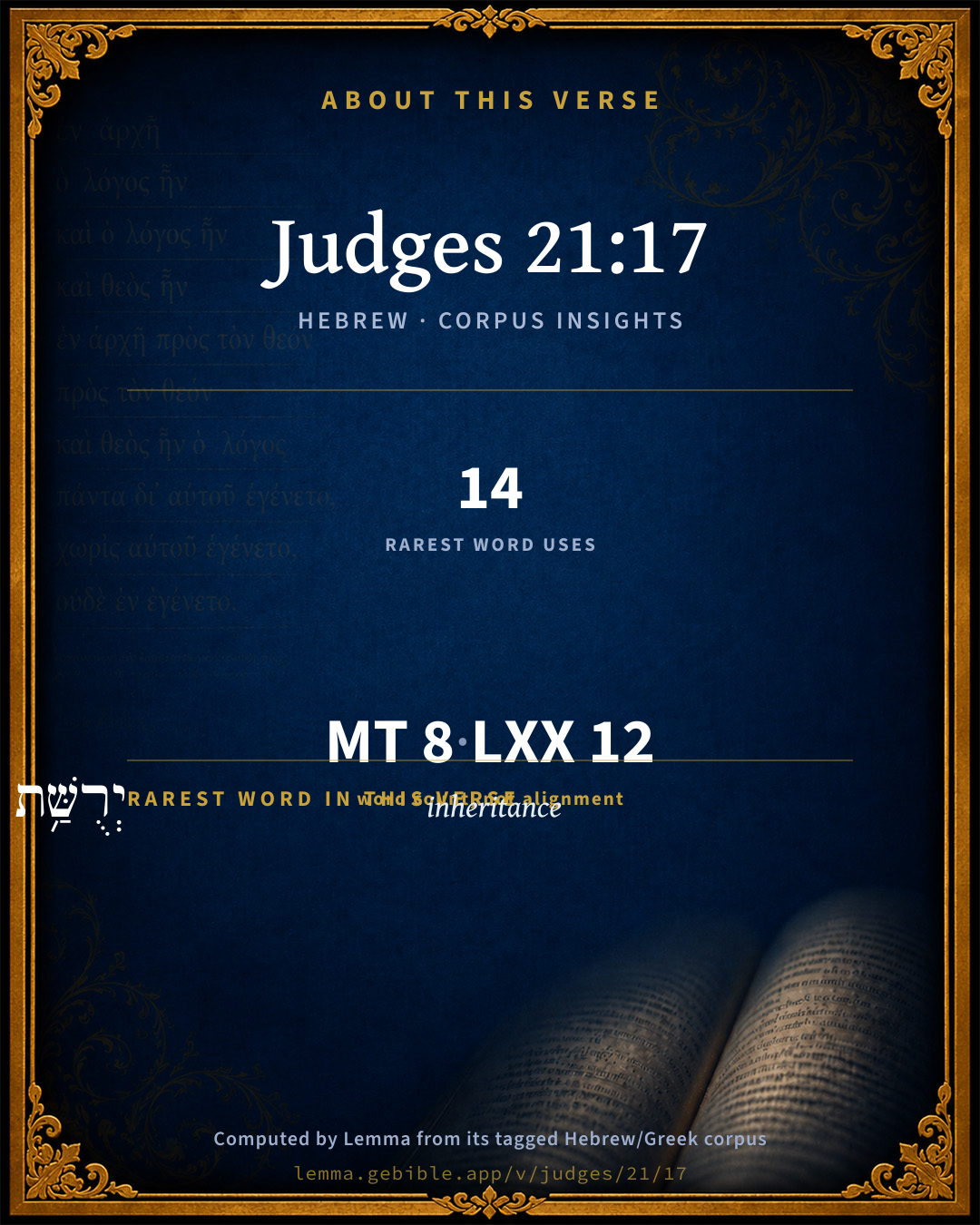
The rarest word here is יְרֻשַּׁ֥ת inheritance H3425 — appearing just 14 times in the whole Hebrew Bible.

Shared distinctive vocabulary

יְרֻשַּׁ֥ת inheritance H3425 occurs in 12 verses of the Hebrew Bible. Also found in:

Grammatical profile

  • 2 verbs
  • 5 nouns
  • 1 particle

Verb forms

  • וַיֹּ֣אמְר֔וּ Qal · Sequential Imperfect
  • יִמָּחֶ֥ה Niphal · Imperfect

Hebrew & Septuagint length

In English translation the verse runs 23 words from the Hebrew and 26 from the Septuagint (LXX English) — closely comparable.

A rough comparison of the two English renderings, which tokenize alike — not a word-level alignment.

Word counts can differ between the Hebrew and the Greek without any difference in meaning — e.g. the Hebrew direct-object marker אֵת has no separate Greek word, and Greek often adds the article ὁ.

In the original languages it is 8 Hebrew tokens and 12 Greek tokens — but the two are counted differently (Hebrew bundles its prefixes and suffixes into one token; the Greek is in lemma form), so that isn’t a like-for-like length.

Cross-references

2

Topical passages linked to Judges 21:17 in the Treasury of Scripture Knowledge — connected by theme and wording, ordered by reader-vote popularity; previews shown in the World English Bible.

  • Numbers 26:55 Notwithstanding, the land shall be divided by lot: according to the names of the tribes of their fathers they shall inherit.
  • Numbers 36:7 So shall no inheritance of the children of Israel remove from tribe to tribe; for the children of Israel shall cleave everyone to the inheritance of the tribe of his fathers.

Cross-references courtesy of OpenBible.info (CC BY 4.0).

Hebrew and Greek witnesses Masoretic Hebrew ↔ Greek Septuagint

The same verse in the two great witnesses to the Old Testament, shown verse-for-verse.

These are two independent witnesses, not word-aligned to each other, and the Septuagint is shown in lemma (dictionary) form.

Hebrew Judges 21:17 Masoretic · Westminster Leningrad Codex

וַיֹּ֣אמְר֔וּ יְרֻשַּׁ֥ת פְּלֵיטָ֖ה לְבִנְיָמִ֑ן וְלֹֽא יִמָּחֶ֥ה שֵׁ֖בֶט מִיִּשְׂרָאֵֽל

They said, There must be an inheritance for those who are escaped of Benjamin, that a tribe not be blotted out from Israel.

World English Bible · Public Domain

Greek LXX Judges 21:17 Septuagint · lemma form

καί εἶπον κληρονομία διασώζω ὁ βενιαμίν καί οὐ ἐκἀλείφω φυλή ἀπό ἰσραήλ

And they said, There must be an inheritance of them that are escaped of Benjamin; and so a tribe shall not be destroyed out of Israel.

LXX2012 (modern English Septuagint) · Public Domain

On this verse, The Cambridge Bible for Schools and Colleges discusses the Septuagint’s reading. Read the note in Commentary ↓

Hebrew: Westminster Leningrad Codex (CC BY 4.0). Greek: Septuagint (public domain); English from LXX2012 (modern English Septuagint) (Public Domain). How the Septuagint differs from the Hebrew →

Targum (Aramaic paraphrase)

1

The Targum is the ancient Jewish Aramaic paraphrase of the Hebrew Scriptures — an interpretive translation, not the Hebrew text itself. Onkelos (literal) and Pseudo-Jonathan (expansive) render the Torah, and Jonathan the Prophets. Coverage is partial: where no permissively-licensed English translation exists for a verse, only the Aramaic is shown. This is verse-level text, not a word-by-word alignment to the Hebrew.

  1. Targum Jonathan Prophets (Joshua–Malachi)
    וַאֲמַרוּ יְרוּתַת שְׁזֵיבְתָּא לִבְנֵי בִנְיָמִן וְלָא יִתְמְחֵי שִׁבְטָא מִיִשְׂרָאֵל:

    (no public-domain English translation for this verse)

    Targum Jonathan — Aramaic: “Mikraot Gedolot” (public domain). English: “Sefaria Community Translation” (CC0 1.0 (public-domain dedication)); “London "Chaldee Paraphrase," 1871” (public domain). Text via Sefaria.

Commentary

Notes on Judges 21:17 from classic Christian and Jewish commentators (each source and its license shown beneath its notes). The classic Christian expositions comment on the surrounding passage and are grouped to its opening verse, so a note may address several verses; the Jewish commentaries on the Tanakh (Rashi and others) are per-verse, so they appear only where the commentator wrote on this verse.

Lemma curates 59 commentaries, every one of them public domain or Creative Commons licensed, each selected and text-cleaned for this edition rather than reprinted as found. About our sources →

Trapp's Complete Commentary

John Trapp

Jdg 21:17 And they said, [There must be] an inheritance for them that be escaped of Benjamin, that a tribe be not destroyed out of Israel.

Ver. 17. There must be an inheritance for them that be escaped.] Else our state will be dismembered. But why was not this thought of before now? Anger is an evil counsellor; and cannot do, but it must over do. Wherefore,

“ Vince animos, iramque tuam. ”

That a tribe be not destroyed.] St Paul and many other good men were afterwards of this tribe. The whole "twelve tribes served God instantly day and night." {Act 26:7}

John Trapp, A Commentary or Exposition upon All the Books of the Old and New Testament (1647–1656) — public domain. Text from a community e-Sword module.

Joseph Benson's Commentary

Jdg 21:17. There must be an inheritance for Benjamin — The words, There must be, are not in the Hebrew, which runs thus: The inheritance of them that are escaped is for Benjamin; that is, the six hundred remaining Benjamites must have that part of the country which was given to the whole tribe by the divine lot for their inheritance; or, the inheritance promised by Jacob and Moses, and given by Joshua to the tribe of Benjamin, doth all of it belong to those few who remain of that tribe, and cannot be possessed by any other tribe; and therefore we are obliged to procure wives for them all, that they may make up this breach, and be capable of possessing and managing all their land; that this tribe and their inheritance may not be confounded with, or swallowed up by, any of the rest.

Joseph Benson's Commentary on the Old and New Testaments (1811–1818) — public domain. Text from a community e-Sword module.

Geneva Bible (1599)

Geneva Bible translators

Benjamin must be reserved to have the twelfth portion in the inheritance of Jacob.

Geneva Bible (1599) marginal notes — public domain. Text via Bolls.life.

Jamieson, Fausset & Brown

Robert Jamieson, A. R. Fausset & David Brown

There must be an inheritance for them that be escaped of Benjamin--As they were the only rightful owners of the territory, provision must be made for transmitting it to their legitimate heirs, and a new act of violence was meditated (Jdg 21:19); the opportunity for which was afforded by the approaching festival--a feast generally supposed to be the feast of tabernacles. This, like the other annual feasts, was held in Shiloh, and its celebration was attended with more social hilarity and holiday rejoicings than the other feasts.

Jamieson, Fausset & Brown — Commentary Critical and Explanatory on the Whole Bible (1871) — public domain (CC PDM 1.0). Text via the HelloAO Bible API.

Ellicott's Commentary for English Readers

(17) There must be an inheritance.—Rather, possession of the remnant shall be for Benjamin—i.e., We will leave untouched their land and possessions. “We give you leave to take the whole land of Benjamin to yourselves” (Jos. Antt. v. 3, § 12).

That a tribe be not destroyed.—Benjamin never quite recovered this crushing blow. Even though it furnished the second judge (Ehud) and the first king (Saul) to Israel, and was advantageously situated, and was often honoured by the residence of Samuel, it became a mere satellite to the more powerful tribe of Judah. Perhaps in the quiescence and permanence derived from the close association with its powerful neighbour we see in part the fulfilment of the blessing in Deu_33:12.

A Bible Commentary for English Readers, edited by Charles John Ellicott (1878–1897) — public domain. Text from a community e-Sword module.

The Cambridge Bible for Schools and Colleges

gen. ed. J. J. S. Perowne

17. There must be an inheritance … of Benjamin] The Hebr. has only An inheritance of the escaped for (or of) Benjamin, which yields no sense, and suggests corruption in the text. The problem is, how to prevent Benjamin from becoming extinct; if the survivors are not to die with no descendants to hand on their race and restore the fortunes of the tribe, wives must be found for them; but since the Israelites have sworn not to give them wives, some way out of the difficulty must be devised. With an inconsiderable change in the Hebr., giving the sentence an interrogative force, it is possible to obtain a meaning which suits the context: How shall a remnant be left over for Benjamin, and a tribe not be blotted out from Israel, (Jdg_21:18) seeing we cannot give them wives of our daughters? The correction is supported by some mss. of the LXX; a remnant here means a number sufficient to carry on the succession; we, i.e. the Israelites, is emphatic.

The Cambridge Bible for Schools and Colleges (gen. ed. J. J. S. Perowne; Cambridge University Press, 1878–1918) — public domain. Text from a community e-Sword module.

John Gill's Exposition

And they said, there must be an inheritance for them that be escaped Benjamin,.... The escaped are the six hundred men in the rock Rimmon; four hundred of them were supplied with wives, the other two wanted; and as there was an inheritance divided by lot to the tribe of Benjamin, to that tribe and to that only it belonged, and they must have it and no other; it now of right devolved on these six hundred men, and them only, and therefore provision must be made to increase their number, that they may occupy the inheritance they have a right to, rebuild their cities, till their land, cultivate their vineyards and oliveyards, and enjoy all the advantages of their possessions:

that a tribe be not destroyed out of Israel; but the full number of the tribes be preserved, and their inheritances belonging to them, according to the predictions of Jacob and Moses, and the assignment of them by lot unto them by Joshua.

John Gill's Exposition of the Whole Bible (1746–1763) — public domain (CC PDM 1.0). Text via the HelloAO Bible API.

Haydock's Catholic Bible Commentary

And we, &c. Hebrew, "and they said: an inheritance for those Benjamites who have escaped, that a tribe," &c. They wished to repair the breach as fast as possible, so that each of the 600 may have a wife.

George Leo Haydock (1774–1849), Haydock's Catholic Family Bible and Commentary, 1859 edition — public domain. Excludes Psalms (Douay-Rheims chapter numbering differs from Protestant) and Deuterocanonical books (Catholic canon only).

Matthew Poole's English Annotations

The inheritance promised by Jacob and Moses, and given by Joshua to the tribe of Benjamin, doth all of it belong to those few which remain of that tribe, and cannot be possessed by any other tribe; and therefore we are obliged to procure wives for them all, that they may make up this breach, and be capable of possessing and managing all their land, that this tribe and their inheritance may not be confounded with or swallowed up by any of the rest. Heb. the inheritance (to wit, belonging to the whole tribe of Benjamin) is or belongs

to them that be escaped of Benjamin.

Matthew Poole's English Annotations on the Holy Bible (1683–1685) — public domain. Text from a community e-Sword/MySword module.

The Pulpit Commentary

There must be an inheritance for them that be escaped of Benjamin. The passage is difficult to construe and to explain. If the words There must be are properly supplied in the A.V, the sense will come out more clearly if we take the word inheritance to mean rather succession, which is the idea contained in the root. There must be a succession for the escaped of Benjamin, i.e. there must be heirs to succeed, and therefore we must find wives for them. The word peleytah without the article can hardly mean the remnant, as has been proposed, but must be defined by being taken with Benjamin.

The Pulpit Commentary (1880–1919), ed. H.D.M. Spence-Jones & Joseph S. Exell — public domain. Text from a community e-Sword module.

John Wesley's Explanatory Notes

An inheritance - The inheritance promised by Jacob and Moses, and given by Joshua to the tribe of Benjamin, doth all of it belong to those few who remain of that tribe, and cannot be possessed by any other tribe; and therefore we are obliged to procure wives for them all, that they may make up this breach, and be capable of possessing and managing all their land: that this tribe, and their inheritance may not be confounded with, or swallowed up by any of the rest.

John Wesley, Explanatory Notes Upon the Whole Bible (1754–1765) — public domain. Text via the GEBible commentary corpus.

Keil & Delitzsch

C. F. Keil & F. Delitzsch

Still Benjamin must be preserved as a tribe. The elders therefore said, "Possession of the saved shall be for Benjamin," i.e., the tribe-land of Benjamin shall remain an independent possession for the Benjaminites who have escaped the massacre, so that a tribe may not be destroyed out of Israel. It was necessary therefore, that they should take steps to help the remaining Benjaminites to wives. The other tribes could not give them their daughters, on account of the oath which has already been mentioned in Jdg 21:1 and Jdg 21:7 and is repeated here (Jdg 21:18). Consequently there was hardly any other course open, than to let the Benjaminites seize upon wives for themselves. And the elders lent them a helping hand by offering them this advice, that at the next yearly festival at Shiloh, at which the daughters of Shiloh carried on dances in the open air (outside the town), they should seize upon wives for themselves from among these daughters, and promising them that when the thing was accomplished they would adjust it peaceably (Jdg 21:19-22). The "feast of Jehovah," which the Israelites kept from year to year, was one of the three great annual festivals, probably one which lasted seven days, either the passover or the feast of tabernacles-most likely the former, as the dances of the daughters of Shiloh were apparently an imitation of the dances of the Israelitish women at the Red Sea under the superintendence of Miriam (Exo 15:20). The minute description of the situation of Shiloh (Jdg 21:19), viz., "to the north of Bethel, on the east of the road which rises from Bethel to Shechem, and on the south of Lebonah" (the present village of Lubban, on the north-west of Seilun: see Rob. Pal. iii. p. 89), serves to throw light upon the scene which follows, i.e., to show how the situation of Shiloh was peculiarly fitted for the carrying out of the advice given to the Benjaminites; since, as soon as they had issued from their hiding-places in the vineyards at Shiloh, and seized upon the dancing virgins, they could easily escape into their own land by the neighbouring high-road which led from Bethel to Shechem, without being arrested by the citizens of Shiloh.

Keil & Delitzsch — Biblical Commentary on the Old Testament (1861–1891) — public domain (CC PDM 1.0). Text via the HelloAO Bible API. (Old Testament only.)

Rashi

Rabbi Shlomo Yitzchaki (Rashi)

The survivors must inherit the ancestral property The tribe's ancestral property remains unclaimed; let us devise a plan whereby they may father children, so that the property will fall into the possession of the remaining survivors, and a tribe will not be obliterated from Yisroel.

Rashi on the Tanakh — English translations: “The Judaica Press complete Tanach with Rashi, translated by A. J. Rosenberg” (CC BY 4.0); “Pentateuch with Rashi's commentary by M. Rosenbaum and A.M. Silbermann, 1929-1934” (public domain); “The Metsudah Tanach series, Lakewood, N.J” (CC BY 4.0); and “The Book of Joshua, Metsudah Publications, 1997” (CC BY 4.0). Text via Sefaria.

Lesson kit

Teaching starters — assembled from the data on this page, not authored interpretation. Every prompt links to the verse data it draws on. Edit before teaching.

Judges, in the Historical, opens this verse with 8 words (8 distinct Hebrew lemmas). Its most distinctive word is yᵉrushshâh (“inheritance”). A historical commentator’s framing appears above. Read the whole chapter for the surrounding context.

Discussion questions

  1. How does “inheritance” (yᵉrushshâh) shape what this verse is saying?
  2. How does Deuteronomy 2:5, which shares the word «inheritance», read alongside this verse?
  3. These translations render this verse differently. What is at stake in choosing one wording over another?
  4. «וַיֹּ֣אמְר֔וּ» is a Qal Sequential Imperfect verb. How does that grammatical form shape the action described?
  5. Compare how Trapp's Complete Commentary and Joseph Benson's Commentary read this verse. Where do they agree or differ?

Things to notice

Reading settings

Reading text

Shown beneath each verse's original-language words.

Old Testament
Old Testament edition

Read the OT as the Masoretic Hebrew (MT) or the Greek Septuagint (LXX).

English shown for the Greek Septuagint (in the Hebrew ↔ Greek comparison).

Comparing translations? Open the Compare panel on any verse page to stack up to four side by side.