Joshua 13:29

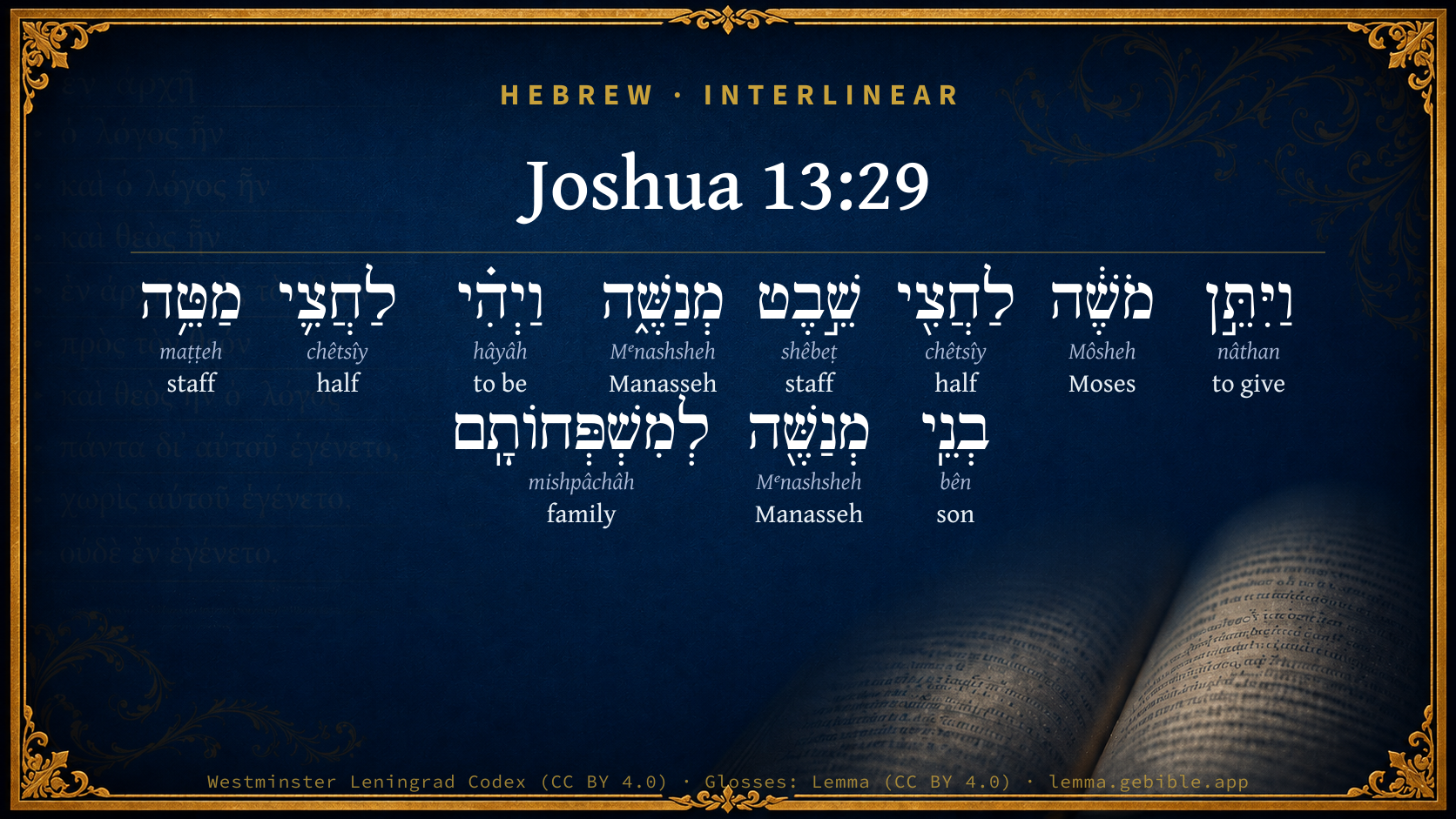
Hebrew (Westminster Leningrad Codex) Joshua 13:29 appears in the Hebrew Old Testament. The text above is from the Westminster Leningrad Codex. Each word links to its Strong’s number, a concise gloss, and parsing drawn from the Open Scriptures Hebrew Bible morphology. Click any word for its full Brown-Driver-Briggs (BDB) entry.
Download image
Cite this verse

Joshua 13:29 (World English Bible). Public Domain. Lemma interlinear Bible study tool, https://lemma.gebible.app/v/joshua/13/29.

Show BibTeX & RIS
BibTeX
RIS
English Translation
Moses gave [inheritance] to the half-tribe of Manasseh: and it was for the half-tribe of the children of Manasseh according to their families.
World English Bible · Public Domain
Download a study sheet

One document with this verse’s original text, its word-by-word gloss line, the meaning frame, cross-references with their text, attributed commentary, and full source and license credits — printable, and it pastes into notes with its structure intact.

This verse Autodidact and up

Study sheet (.html) Plain text (.txt)

A passage Seminary Student

Up to 50 verses in one chapter. A passage sheet keeps up to 6 commentary sources and 12 cross-references per verse, in the order this page ranks them, and says so on the sheet whenever that leaves anything out. Ask for a single verse and you get the Autodidact verse sheet above.

Everything on this page stays free to read, with no account — the sheet is a download of what is already on screen, not access to it.

Want to remove ads? Support Godless Engineer
Compare translations 3

The same verse in 3 English versions, stacked beneath the original-language interlinear above. Click any original word for its lexicon entry.

Each is an independent rendering of the whole verse — the interlinear is not word-aligned to these translations.

Highlighted words mark where these versions differ — a whole-verse word diff, not a word-by-word alignment.

  • World English Bible Public Domain
    Moses gave [inheritance] to the half-tribe of Manasseh: and it was for the half-tribe of the children of Manasseh according to their families.
  • King James Version Public Domain
    And Moses gave inheritance unto the half tribe of Manasseh: and this was the possession of the half tribe of the children of Manasseh by their families.
  • unfoldingWord Literal Text CC BY-SA 4.0
    And Moses gave to half of the tribe of Manasseh, and it was to half of the tribe of the sons of Manasseh according to their clans.

unfoldingWord Literal Text — © unfoldingWord, licensed CC BY-SA 4.0. Word-aligned USFM3 via Door43 (git.door43.org/unfoldingWord/en_ult).

Versions to compare (up to 4)

3 of 4 selected

Show all 18 translations

Every available English version of this verse, each an independent rendering of the whole verse.

  • World English Bible Public Domain
    Moses gave [inheritance] to the half-tribe of Manasseh: and it was for the half-tribe of the children of Manasseh according to their families.
  • Berean Standard Bible Public Domain
    This is what Moses had given to the clans of the half-tribe of Manasseh, that is, to half the tribe of the descendants of Manasseh:
  • Majority Standard Bible Public Domain
    This is what Moses had given to the clans of the half-tribe of Manasseh, that is, to half the tribe of the descendants of Manasseh:
  • King James Version Public Domain
    And Moses gave inheritance unto the half tribe of Manasseh: and this was the possession of the half tribe of the children of Manasseh by their families.
  • American Standard Version (1901) Public Domain
    And Moses gave `inheritance' unto the half-tribe of Manasseh: and it was for the half-tribe of the children of Manasseh according to their families.
  • Revised Version (1885) Public Domain
    And Moses gave inheritance unto the half tribe of Manasseh: and it was for the half tribe of the children of Manasseh according to their families.
  • Geneva Bible (1599) Public Domain
    Also Moses gaue inheritance vnto the halfe tribe of Manasseh: and this belonged to the halfe tribe of the children of Manasseh according to their families.
  • Douay-Rheims (1899) Public Domain
    He gave also to the half tribe of Manasses and his children possession according to their kindreds,
  • Young's Literal Translation Public Domain
    And Moses giveth to the half of the tribe of Manasseh; and it is to the half of the tribe of the sons of Manasseh, for their families.
  • Literal Standard Version CC BY-SA 4.0
    And Moses gives to the half-tribe of Manasseh; and it is to the half-tribe of the sons of Manasseh, for their families.
  • Unlocked Literal Bible CC BY-SA 4.0
    Moses gave an inheritance to the half tribe of Manasseh. It was assigned to the half tribe of the people of Manasseh, clan by clan.
  • unfoldingWord Literal Text CC BY-SA 4.0
    And Moses gave to half of the tribe of Manasseh, and it was to half of the tribe of the sons of Manasseh according to their clans.
  • Darby Bible Public Domain
    And Moses gave [a portion] to half the tribe of Manasseh; and for half the tribe of the children of Manasseh according to their families:
  • World Messianic Bible Public Domain
    Moses gave an inheritance to the half-tribe of Manasseh. It was for the half-tribe of the children of Manasseh according to their families.
  • Webster's Bible Public Domain
    And Moses gave inheritance to the half-tribe of Manasseh: and this was the possession of the half-tribe of the children of Manasseh by their families.
  • Free Bible Version CC BY-SA 4.0
    This was the land that Moses allotted to the half-tribe of Manasseh, that is half of the tribe of the descendants of Manasseh, by families:
  • Bible in Basic English Public Domain
    And Moses gave their heritage to the half-tribe of Manasseh by their families.
  • JPS Tanakh (1917) Public Domain
    And Moses gave inheritance unto the half-tribe of Manasseh; and it was for the half-tribe of the children of Manasseh according to their families.

Literal Standard Version (2020), Covenant Press — licensed CC BY-SA 4.0. Text via the HelloAO Bible API (eBible.org). Unlocked Literal Bible (unfoldingWord) — licensed CC BY-SA 4.0. Text via the HelloAO Bible API (eBible.org). unfoldingWord Literal Text — © unfoldingWord, licensed CC BY-SA 4.0. Word-aligned USFM3 via Door43 (git.door43.org/unfoldingWord/en_ult). Free Bible Version, Dr. Jonathan Gallagher — licensed CC BY-SA 4.0. Text via the HelloAO Bible API (eBible.org).

Word by word

More ways to search: Search by grammar → Find every occurrence → Compare this word →

Practice this passage: Drill this verse → Learn its vocabulary →

לַחֲצִ֖י
chêtsîy
H2677
“to/for · half of”
Preposition + Noun, Common, Masculine, Singular, Construct
Part of Speech
Preposition + Noun
Type
Common
Gender
Masculine
Number
Singular
State
Construct
Full BDB Definition

Origin: from H2673

TWOT: 719b

half - half - middle
  1. וַיִּתֵּ֣ן nâthan H5414 “and · to give” Conjunction + Verb, Qal, Sequential Imperfect, 3rd Person, Masculine, Singular
  2. מֹשֶׁ֔ה Môsheh H4872 “Moses” Noun, Proper
  3. שֵׁ֣בֶט shêbeṭ H7626 “staff of” Noun, Common, Masculine, Singular, Construct
  4. מְנַשֶּׁ֑ה Mᵉnashsheh H4519 “Manasseh” Noun, Proper
  5. וַיְהִ֗י hâyâh H1961 “and · to be” Conjunction + Verb, Qal, Sequential Imperfect, 3rd Person, Masculine, Singular
  6. לַחֲצִ֛י chêtsîy H2677 “to/for · half of” Preposition + Noun, Common, Masculine, Singular, Construct
  7. מַטֵּ֥ה maṭṭeh H4294 “staff of” Noun, Common, Masculine, Singular, Construct
  8. בְנֵֽי bên H1121 “sons of” Noun, Common, Masculine, Plural, Construct
  9. מְנַשֶּׁ֖ה Mᵉnashsheh H4519 “Manasseh” Noun, Proper
  10. לְמִשְׁפְּחוֹתָֽם mishpâchâh H4940 “to/for · families · their” Preposition + Noun, Common, Feminine, Plural, Construct + Suffix, Personal, 3rd Person, Masculine, Plural

About this verse

These counts appear in no published source. They are computed here, from the morphology-tagged text and Lemma’s own curated glosses. What Lemma adds →

11
words
9
distinct lemmas
Historical
section

Grammatical profile

  • 2 verbs
  • 9 nouns

Verb forms

  • וַיִּתֵּ֣ן Qal · Sequential Imperfect
  • וַיְהִ֗י Qal · Sequential Imperfect

Repetition

Words recur within this verse — often emphatic in Hebrew:

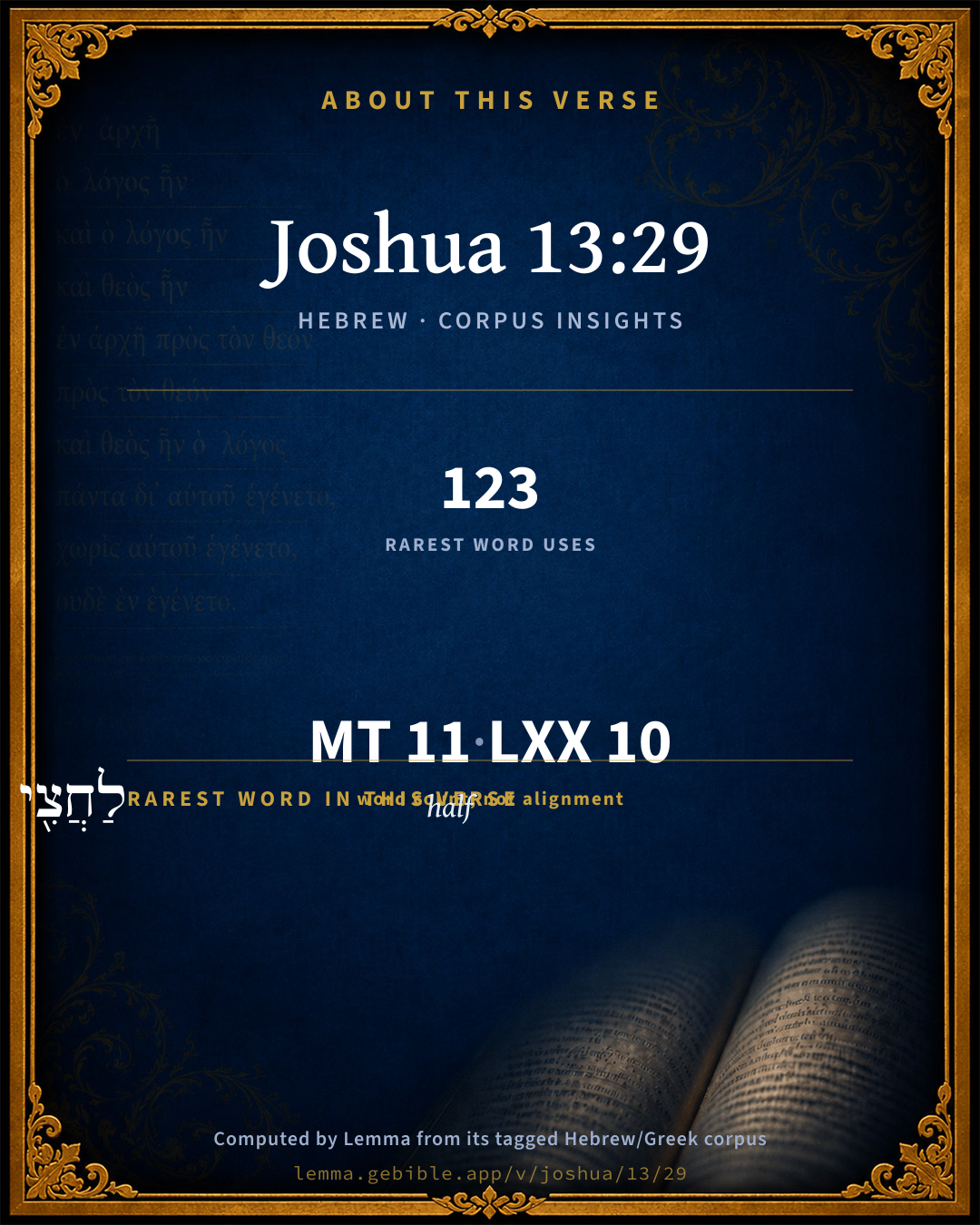
  • לַחֲצִ֖י half H2677 ×2
  • מְנַשֶּׁ֑ה Manasseh H4519 ×2

Hebrew & Septuagint length

In English translation the verse runs 23 words from the Hebrew and 13 from the Septuagint (LXX English) — the Septuagint runs noticeably shorter here. See the side-by-side →

A rough comparison of the two English renderings, which tokenize alike — not a word-level alignment.

Word counts can differ between the Hebrew and the Greek without any difference in meaning — e.g. the Hebrew direct-object marker אֵת has no separate Greek word, and Greek often adds the article ὁ.

In the original languages it is 11 Hebrew tokens and 10 Greek tokens — but the two are counted differently (Hebrew bundles its prefixes and suffixes into one token; the Greek is in lemma form), so that isn’t a like-for-like length.

Hebrew and Greek witnesses Masoretic Hebrew ↔ Greek Septuagint

The same verse in the two great witnesses to the Old Testament, shown verse-for-verse.

Here the Septuagint runs noticeably shorter than the Hebrew — LXX2012 (modern English Septuagint) 13 words vs World English Bible 23. A rough length comparison of the two English translations, not a word-level alignment — read both below.

These are two independent witnesses, not word-aligned to each other, and the Septuagint is shown in lemma (dictionary) form.

Hebrew Joshua 13:29 Masoretic · Westminster Leningrad Codex

וַיִּתֵּ֣ן מֹשֶׁ֔ה לַחֲצִ֖י שֵׁ֣בֶט מְנַשֶּׁ֑ה וַיְהִ֗י לַחֲצִ֛י מַטֵּ֥ה בְנֵֽי מְנַשֶּׁ֖ה לְמִשְׁפְּחוֹתָֽם

Moses gave [inheritance] to the half-tribe of Manasseh: and it was for the half-tribe of the children of Manasseh according to their families.

World English Bible · Public Domain

Greek LXX Joshua 13:29 Septuagint · lemma form

καί δίδωμι μωυσῆς ὁ ἥμισυς φυλή μανασσή κατά δῆμος αὐτός

And Moses gave to half the tribe of Manasse according to their families.

LXX2012 (modern English Septuagint) · Public Domain

Hebrew: Westminster Leningrad Codex (CC BY 4.0). Greek: Septuagint (public domain); English from LXX2012 (modern English Septuagint) (Public Domain). How the Septuagint differs from the Hebrew →

Targum (Aramaic paraphrase)

1

The Targum is the ancient Jewish Aramaic paraphrase of the Hebrew Scriptures — an interpretive translation, not the Hebrew text itself. Onkelos (literal) and Pseudo-Jonathan (expansive) render the Torah, and Jonathan the Prophets. Coverage is partial: where no permissively-licensed English translation exists for a verse, only the Aramaic is shown. This is verse-level text, not a word-by-word alignment to the Hebrew.

  1. Targum Jonathan Prophets (Joshua–Malachi)
    וִיהַב מֹשֶׁה לְפַלְגוּת שִׁבְטַיָא דִמְנַשֶׁה וַהֲוָה לְפַּלְגוּת שִׁבְטַיָא דִבְנֵי מְנַשֶׁה לְזַרְעֲיַתְהוֹן:

    (no public-domain English translation for this verse)

    Targum Jonathan — Aramaic: “Mikraot Gedolot” (public domain). English: “Sefaria Community Translation” (CC0 1.0 (public-domain dedication)); “London "Chaldee Paraphrase," 1871” (public domain). Text via Sefaria.

Commentary

Notes on Joshua 13:29 from classic Christian and Jewish commentators (each source and its license shown beneath its notes). The classic Christian expositions comment on the surrounding passage and are grouped to its opening verse, so a note may address several verses; the Jewish commentaries on the Tanakh (Rashi and others) are per-verse, so they appear only where the commentator wrote on this verse.

Lemma curates 59 commentaries, every one of them public domain or Creative Commons licensed, each selected and text-cleaned for this edition rather than reprinted as found. About our sources →

Trapp's Complete Commentary

John Trapp

Jos 13:29 And Moses gave [inheritance] unto the half tribe of Manasseh: and [this] was [the possession] of the half tribe of the children of Manasseh by their families.

Ver. 29. Unto the half tribe of Manasseh.] Who had formerly won it with their swords. {Num 32:39}

John Trapp, A Commentary or Exposition upon All the Books of the Old and New Testament (1647–1656) — public domain. Text from a community e-Sword module.

Joseph Benson's Commentary

Jos 13:29. Unto the half-tribe of Manasseh — Not that they desired it, as Reuben and Gad did, (Num 32:1,) but partly as a recompense to Machir the Manassite, for his valiant acts against Og, and partly because the country was too large for the two tribes of Reuben and Gad.

Joseph Benson's Commentary on the Old and New Testaments (1811–1818) — public domain. Text from a community e-Sword module.

Whedon's Commentary on the Bible

Daniel D. Whedon

MANASSEH’S (EASTERN) LOT, Jos_13:29-33.

29. The half tribe of Manasseh — The division of a tribe in Israel into two parts is a strange and singular fact. In some respects it seems accidental, in other respects providential. “Machir, Jair, and Nobah, the sons of Manasseh, were no shepherds. They were pure warriors, who had taken the most prominent part in the conquest of those provinces which up to that time had been conquered, and whose deeds are constantly referred to with credit and renown. Num_32:39; Deu_3:13-15. ‘Jair the son of Manasseh took all the tract of Argob… sixty great cities.’ ‘Nobah took Kehath and the daughter towns thereof, and called it after his own name.’ Deu_32:42. ‘Because Machir was a man of war, therefore he had Gilead and Bashan.’ Jos_17:1. The district which these ancient warriors conquered was the most difficult in the whole country. And had they not remained in these wild and inaccessible districts, but had gone forward and taken their lot with the rest, who shall say what changes might not have occurred in the history of their nation through the presence of such energetic and warlike spirits?” — Grove, in Smith’s Dict. But perhaps these very warlike spirits were providentially settled in these eastern hills to save western Palestine from the proximity of dangerous foes that might otherwise have settled there.

The country of Bashan, occupied by these Manassites, was, according to Porter, “the richest in all Palestine. It is to this day the granary of a great part of Syria. Its whole surface is dotted with ruined or deserted towns and villages.”

Daniel D. Whedon (gen. ed.), Commentary on the Old and New Testaments (1874–1909) — public domain. Text from a community e-Sword module.

Tyndale Open Study Notes

Tyndale Open Resources

13:29-33 Manasseh was Joseph’s elder son. Jacob gave Joseph’s sons each a full inheritance, thus giving Joseph a double portion of the birthright (see 14:4).

Tyndale Open Study Notes — © Tyndale Open Resources, licensed CC BY-SA 4.0. Text via the HelloAO Bible API.

Adam Clarke's Commentary

Verse 29. The half tribe of Manasseh] When the tribes of Reuben and Gad requested to have their settlement on the east side of Jordan, it does not appear that any part of the tribe of Manasseh requested to be settled in the same place. But as this tribe was numerous, and had much cattle, Moses thought proper to appoint one half of it to remain on the east of Jordan, and the other to go over and settle on the west side of that river.

Adam Clarke's Commentary on the Bible (1810–1826) — public domain. Text from a community e-Sword/MySword module.

The Cambridge Bible for Schools and Colleges

gen. ed. J. J. S. Perowne

29–32. The Possession of the Half Tribe of Manasseh

29. the half tribe of Manasseh] “The fact that it is always called a half tribe appears curious, especially on comparison with the similar, yet widely different, case of Dan, which sent out to the north an army which surprised the Phœnician town of Laish.” Ewald, 11. 299.

The Cambridge Bible for Schools and Colleges (gen. ed. J. J. S. Perowne; Cambridge University Press, 1878–1918) — public domain. Text from a community e-Sword module.

John Gill's Exposition

And their coast was from Mahanaim,.... A place in the tribe of Gad, Jos 13:26; which was the boundary of the half tribe that way:

all Bashan; so famous for its oxen, and for pasturage for them, and for its oaks, called by Josephus Batanea:

all the kingdom of Og king of Bashan; which, besides Bashan, took in the kingdom of Argob or Trachonitis, half the land of Gilead, all which was possessed by the half tribe of Manasseh: see Deu 3:13,

and all the towns of, Jair which are in Bashan, threescore cities; of Jair, and his relation to Manasseh, and of his taking these cities, and the number of them, see Num 33:41.

John Gill's Exposition of the Whole Bible (1746–1763) — public domain (CC PDM 1.0). Text via the HelloAO Bible API.

Matthew Poole's English Annotations

Unto the half tribe of Manasseh; not that they desired it, as Reuben and Gad did, Num 32:1, but partly as a recompence to Machir the Manessite for his valiant acts against Og; and partly for the better security and defence of the other two tribes, by so considerable an accession to them, which also was without any inconvenience to them, because the country was too large for the two tribes of Reuben and Gad.

Matthew Poole's English Annotations on the Holy Bible (1683–1685) — public domain. Text from a community e-Sword/MySword module.

The Pulpit Commentary

The halftribe of Manasseh. The word used for "tribe" in the first and second half of this verse is not the same. Some German critics have derived an argument for the hypothesis that the historical and geographical portions of the book are not by the same hand, from the supposed fact that the former of these words is used almost exclusively in the first, or historical portion, and the latter in the second, or geographical portion, of the book. The word "almost" would be almost sufficient to overthrow the theory, but this verse is an insuperable objection to it. Is it seriously contended that one half of this verse is taken from one author, and the other from another? Or is it possible that the writer of the book may actually have understood the language he was using, and meant to use the two words in somewhat different senses? Gesenius, it is true, would explain the words as being precisely synonymous. But his own etymological remarks are fatal to his theory. hfm the latter of the two words, is a bough, or shoot (derived from a word signifying to grow), capable of throwing out blossoms. (Eze_7:10) It refers, therefore, to the natural descent of the tribe from Manasseh their father. But fb is allied to fpv; to judge, and the Greek skhptron , and perhaps the English shaft, and signifies a rod as the emblem of authority. Thus it is used in Gen_49:10, of a royal sceptre. So Psa_2:9, an iron sceptre, Psa_45:6. Thus the latter word has reference to the tribe as an organised community, the former to it in reference to its ancestral derivation. This view would seem to be supported by ver. 24, where the hfm of Gad is further explained to mean his sons and their families, as well as by this verse, where the fbv is used absolutely, the hfm in connection with the family.

The Pulpit Commentary (1880–1919), ed. H.D.M. Spence-Jones & Joseph S. Exell — public domain. Text from a community e-Sword module.

John Wesley's Explanatory Notes

Of Manasseh - Not that thou desired it, as Reuben and Gad did, Num. xxxii, 1, but partly as a recompence to Machir the Manassite, for his valiant acts against Og; and partly for the better defense of the other two tribes, by so considerable an accession to them, which also was without any inconvenience to them, because the country was too large for the two tribes of Reuben and Gad.

John Wesley, Explanatory Notes Upon the Whole Bible (1754–1765) — public domain. Text via the GEBible commentary corpus.

Keil & Delitzsch

C. F. Keil & F. Delitzsch

The territory of the half tribe of Manasseh extended from Mahanaim onwards, and embraced all Bashan, with the sixty Jair towns and the (northern) half of Gilead (see the comm. on Deu 3:13-15).

Keil & Delitzsch — Biblical Commentary on the Old Testament (1861–1891) — public domain (CC PDM 1.0). Text via the HelloAO Bible API. (Old Testament only.)

unfoldingWord translationNotes

Door43 World Missions Community

Moses gave an inheritance to the half tribe of Manasseh

The land that Moses assigned to the half tribe of Manasseh is spoken of as if it were an inheritance that he gave to them as a permanent possession. (See: Metaphor)

half tribe of Manasseh

Only half of the tribe received this land because the other half received land on the other side of the Jordan River.

It was assigned

This can be stated in active form. AT: "Moses assigned it" (See: Active or Passive)

Mahanaim ... Jair ... Ashtaroth ... Edrei

These are the names of places. (See: How to Translate Names)

These were assigned

This can be stated in active form. AT: "Moses assigned these" (See: Active or Passive)

Machir

This is a man's name. (See: How to Translate Names)

translationWords

Moses

royal

family

unfoldingWord translationNotes — © Distant Shores Media and the Door43 World Missions Community, licensed CC BY-SA 4.0. Source: git.door43.org/Door43/en_tn.

Lesson kit

Teaching starters — assembled from the data on this page, not authored interpretation. Every prompt links to the verse data it draws on. Edit before teaching.

Joshua, in the Historical, opens this verse with 11 words (9 distinct Hebrew lemmas). Its most distinctive word is chêtsîy (“half”). The Greek Septuagint runs shorter here. A historical commentator’s framing appears above. Read the whole chapter for the surrounding context.

Discussion questions

  1. How does “half” (chêtsîy) shape what this verse is saying?
  2. What does the repetition of “half” (2× in this one verse) do in this verse?
  3. The Septuagint runs shorter here than the Hebrew. What might account for the difference?
  4. These translations render this verse differently. What is at stake in choosing one wording over another?
  5. «וַיִּתֵּ֣ן» is a Qal Sequential Imperfect verb. How does that grammatical form shape the action described?
  6. Compare how Trapp's Complete Commentary and Joseph Benson's Commentary read this verse. Where do they agree or differ?

Things to notice

Reading settings

Reading text

Shown beneath each verse's original-language words.

Old Testament
Old Testament edition

Read the OT as the Masoretic Hebrew (MT) or the Greek Septuagint (LXX).

English shown for the Greek Septuagint (in the Hebrew ↔ Greek comparison).

Comparing translations? Open the Compare panel on any verse page to stack up to four side by side.