Hosea 5:9

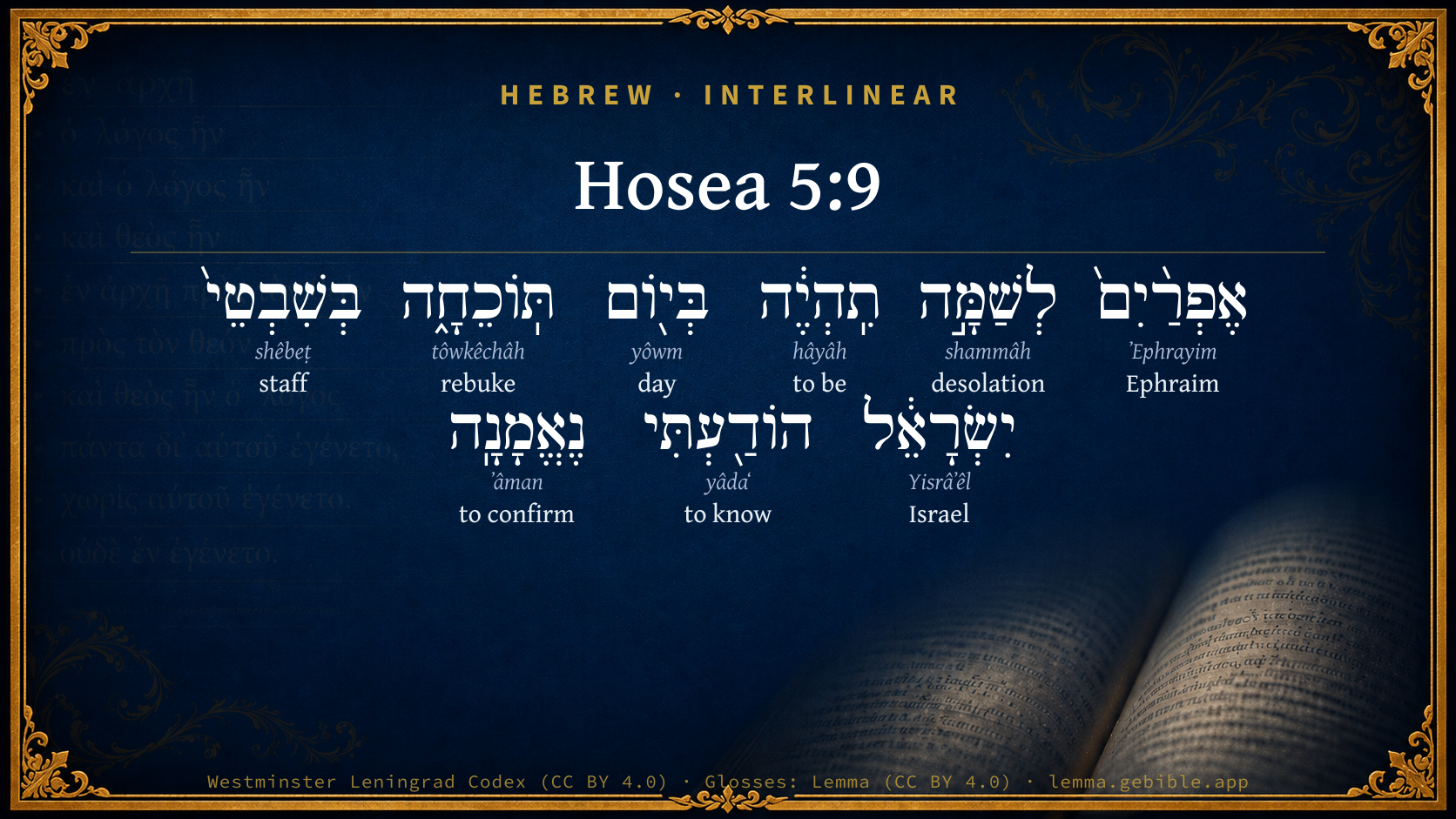
Hebrew (Westminster Leningrad Codex) Hosea 5:9 appears in the Hebrew Old Testament. The text above is from the Westminster Leningrad Codex. Each word links to its Strong’s number, a concise gloss, and parsing drawn from the Open Scriptures Hebrew Bible morphology. Click any word for its full Brown-Driver-Briggs (BDB) entry.
Download image
Cite this verse

Hosea 5:9 (World English Bible). Public Domain. Lemma interlinear Bible study tool, https://lemma.gebible.app/v/hosea/5/9.

Show BibTeX & RIS
BibTeX
RIS
English Translation
Ephraim will become a desolation in the day of rebuke. Among the tribes of Israel, I have made known that which will surely be.
World English Bible · Public Domain
Download a study sheet

One document with this verse’s original text, its word-by-word gloss line, the meaning frame, cross-references with their text, attributed commentary, and full source and license credits — printable, and it pastes into notes with its structure intact.

This verse Autodidact and up

Study sheet (.html) Plain text (.txt)

A passage Seminary Student

Up to 50 verses in one chapter. A passage sheet keeps up to 6 commentary sources and 12 cross-references per verse, in the order this page ranks them, and says so on the sheet whenever that leaves anything out. Ask for a single verse and you get the Autodidact verse sheet above.

Everything on this page stays free to read, with no account — the sheet is a download of what is already on screen, not access to it.

Want to remove ads? Support Godless Engineer
Compare translations 3

The same verse in 3 English versions, stacked beneath the original-language interlinear above. Click any original word for its lexicon entry.

Each is an independent rendering of the whole verse — the interlinear is not word-aligned to these translations.

Highlighted words mark where these versions differ — a whole-verse word diff, not a word-by-word alignment.

  • World English Bible Public Domain
    Ephraim will become a desolation in the day of rebuke. Among the tribes of Israel, I have made known that which will surely be.
  • King James Version Public Domain
    Ephraim shall be desolate in the day of rebuke: among the tribes of Israel have I made known that which shall surely be.
  • unfoldingWord Literal Text CC BY-SA 4.0
    Ephraim will become a desolation in the day of rebuke. Among the tribes of Israel I have made known what is certain.

unfoldingWord Literal Text — © unfoldingWord, licensed CC BY-SA 4.0. Word-aligned USFM3 via Door43 (git.door43.org/unfoldingWord/en_ult).

Versions to compare (up to 4)

3 of 4 selected

Show all 18 translations

Every available English version of this verse, each an independent rendering of the whole verse.

  • World English Bible Public Domain
    Ephraim will become a desolation in the day of rebuke. Among the tribes of Israel, I have made known that which will surely be.
  • Berean Standard Bible Public Domain
    Ephraim will be laid waste on the day of rebuke. Among the tribes of Israel I proclaim what is certain.
  • Majority Standard Bible Public Domain
    Ephraim will be laid waste on the day of rebuke. Among the tribes of Israel I proclaim what is certain.
  • King James Version Public Domain
    Ephraim shall be desolate in the day of rebuke: among the tribes of Israel have I made known that which shall surely be.
  • American Standard Version (1901) Public Domain
    Ephraim shall become a desolation in the day of rebuke: among the tribes of Israel have I made known that which shall surely be.
  • Revised Version (1885) Public Domain
    Ephraim shall become a desolation in the day of rebuke: among the tribes of Israel have I made known that which shall surely be.
  • Geneva Bible (1599) Public Domain
    Ephraim shall be desolate in the day of rebuke: among the tribes of Israel haue I caused to knowe the trueth.
  • Douay-Rheims (1899) Public Domain
    Ephraim shall be in desolation in the day of rebuke: among the tribes of Israel I have shewn that which shall surely be.
  • Young's Literal Translation Public Domain
    Ephraim is for a desolation in a day of reproof, Among the tribes of Israel I have made known a sure thing.
  • Literal Standard Version CC BY-SA 4.0
    Ephraim is for a desolation in a day of reproof, || I have made known a sure thing among the tribes of Israel.
  • Unlocked Literal Bible CC BY-SA 4.0
    Ephraim will become a desolation on the day of punishment. Among the tribes of Israel I have declared what is certain to happen.
  • unfoldingWord Literal Text CC BY-SA 4.0
    Ephraim will become a desolation in the day of rebuke. Among the tribes of Israel I have made known what is certain.
  • Darby Bible Public Domain
    Ephraim shall be a desolation in the day of rebuke: among the tribes of Israel have I made known that which is sure.
  • World Messianic Bible Public Domain
    Ephraim will become a desolation in the day of rebuke. Among the tribes of Israel, I have made known that which will surely be.
  • Webster's Bible Public Domain
    Ephraim shall be desolate in the day of rebuke: among the tribes of Israel have I made known that which shall surely be.
  • Free Bible Version CC BY-SA 4.0
    Ephraim will be left desolate on the day of punishment. Among the tribes of Israel I will reveal what is the real truth.
  • Bible in Basic English Public Domain
    Ephraim will become a waste in the day of punishment; I have given knowledge among the tribes of Israel of what is certain.
  • JPS Tanakh (1917) Public Domain
    Ephraim shall be desolate in the day of rebuke; among the tribes of Israel do I make known that which shall surely be.

Literal Standard Version (2020), Covenant Press — licensed CC BY-SA 4.0. Text via the HelloAO Bible API (eBible.org). Unlocked Literal Bible (unfoldingWord) — licensed CC BY-SA 4.0. Text via the HelloAO Bible API (eBible.org). unfoldingWord Literal Text — © unfoldingWord, licensed CC BY-SA 4.0. Word-aligned USFM3 via Door43 (git.door43.org/unfoldingWord/en_ult). Free Bible Version, Dr. Jonathan Gallagher — licensed CC BY-SA 4.0. Text via the HelloAO Bible API (eBible.org).

Word by word

More ways to search: Search by grammar → Find every occurrence → Compare this word →

Practice this passage: Drill this verse → Learn its vocabulary →

About this verse

These counts appear in no published source. They are computed here, from the morphology-tagged text and Lemma’s own curated glosses. What Lemma adds →

9
words
9
distinct lemmas
Prophets
section

Shared distinctive vocabulary

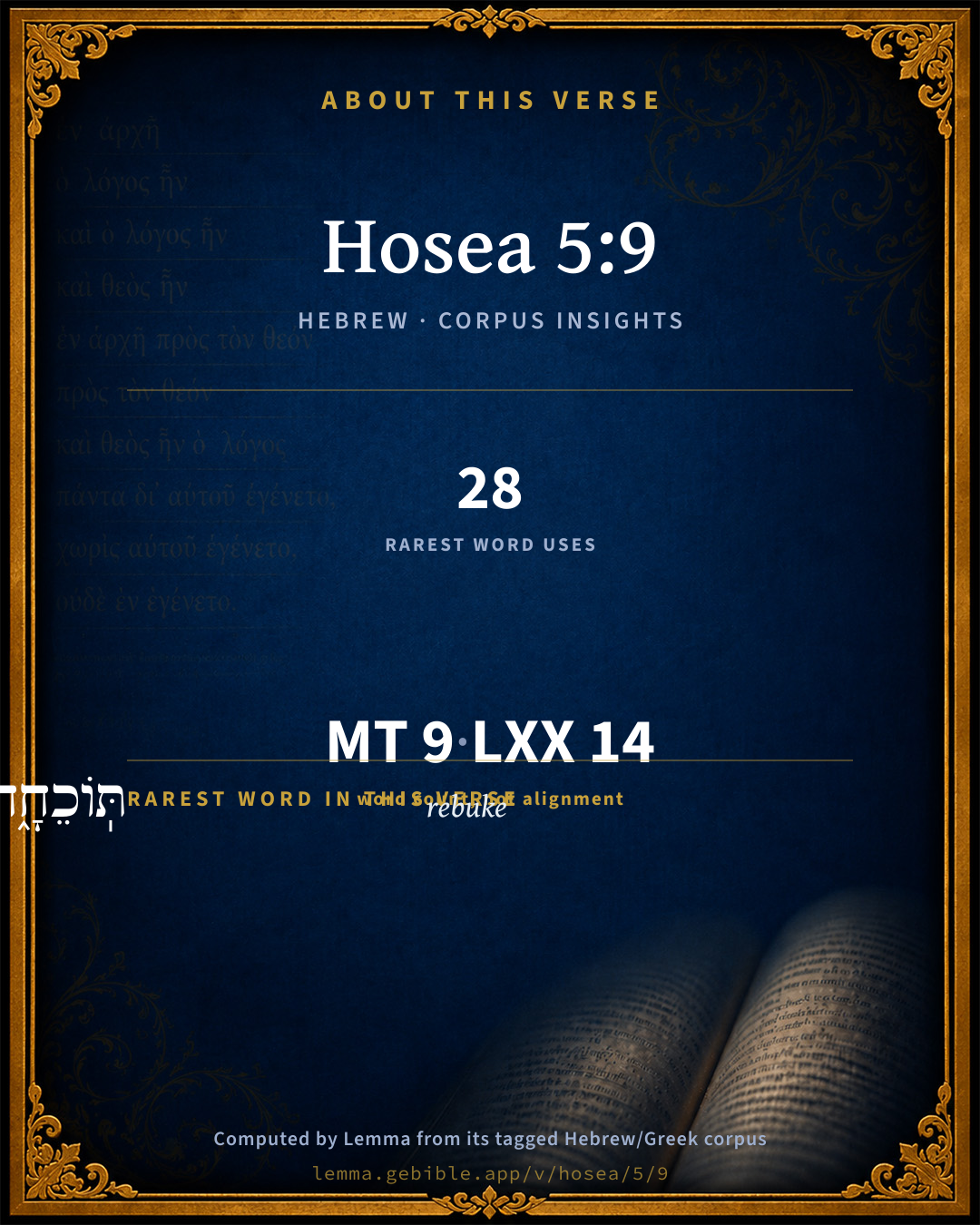
תּֽוֹכֵחָ֑ה rebuke H8433 occurs in 28 verses of the Hebrew Bible. Also found in:

Grammatical profile

  • 3 verbs
  • 6 nouns

Verb forms

  • תִֽהְיֶ֔ה Qal · Imperfect
  • הוֹדַ֖עְתִּי Hiphil · Perfect
  • נֶאֱמָנָֽה Niphal · Participle Active

Hebrew & Septuagint length

In English translation the verse runs 24 words from the Hebrew and 20 from the Septuagint (LXX English) — closely comparable.

A rough comparison of the two English renderings, which tokenize alike — not a word-level alignment.

Word counts can differ between the Hebrew and the Greek without any difference in meaning — e.g. the Hebrew direct-object marker אֵת has no separate Greek word, and Greek often adds the article ὁ.

In the original languages it is 9 Hebrew tokens and 14 Greek tokens — but the two are counted differently (Hebrew bundles its prefixes and suffixes into one token; the Greek is in lemma form), so that isn’t a like-for-like length.

Cross-references

19

Topical passages linked to Hosea 5:9 in the Treasury of Scripture Knowledge — connected by theme and wording, ordered by reader-vote popularity; previews shown in the World English Bible.

  • Isaiah 46:10 declaring the end from the beginning, and from ancient times things that are not [yet] done; saying, My counsel shall stand, and I will do all my pleasure;
  • Hosea 9:11–17 As for Ephraim, their glory will fly away like a bird. There will be no birth, none with child, and no conception.
  • Zechariah 1:6 But my words and my decrees, which I commanded my servants the prophets, didn't they overtake your fathers? "Then they repented and said, 'Just as Yahweh of Hosts determined to do to us, according to our ways, and according to our practices, so he has dealt with us.'"
  • Isaiah 28:1–4 Woe to the crown of pride of the drunkards of Ephraim, and to the fading flower of his glorious beauty, which is on the head of the fat valley of those who are overcome with wine!
  • John 16:4 But I have told you these things, so that when the time comes, you may remember that I told you about them. I didn't tell you these things from the beginning, because I was with you.
  • Job 12:14 Behold, he breaks down, and it can't be built again; He imprisons a man, and there can be no release.
  • Isaiah 37:3 They said to him, Thus says Hezekiah, This day is a day of trouble, and of rebuke, and of rejection; for the children have come to the birth, and there is no strength to bring forth.
  • Isaiah 48:3 I have declared the former things from of old; yes, they went forth out of my mouth, and I shown them: suddenly I did them, and they happened.
  • Isaiah 48:5 therefore I have declared it to you from of old; before it came to pass I shown it you; lest you should say, My idol has done them, and my engraved image, and my molten image, has commanded them.
  • Hosea 5:12 Therefore I am to Ephraim like a moth, And to the house of Judah like rottenness.
  • Hosea 5:14 For I will be to Ephraim like a lion, And like a young lion to the house of Judah. I myself will tear in pieces and go away. I will carry off, and there will be no one to deliver.
  • Hosea 8:8 Israel is swallowed up. Now they are among the nations like a worthless thing.
  • Hosea 11:5–6 "They won't return into the land of Egypt; But the Assyrian will be their king, Because they refused to repent.
  • Hosea 13:1–3 When Ephraim spoke, there was trembling. He exalted himself in Israel, But when he became guilty in Baal, he died.
  • Hosea 13:15–16 Though he is fruitful among his brothers, an east wind will come, The breath of Yahweh coming up from the wilderness; And his spring will become dry, And his fountain will be dried up. He will plunder the storehouse of treasure.
  • Amos 3:7 Surely the Lord Yahweh will do nothing, Unless he reveals his secret to his servants the prophets.
  • Amos 3:14–15 "For in the day that I visit the transgressions of Israel on him, I will also visit the altars of Bethel; And the horns of the altar will be cut off, And fall to the ground.
  • Amos 7:9 The high places of Isaac will be desolate, the sanctuaries of Israel will be laid waste; and I will rise against the house of Jeroboam with the sword."
  • Amos 7:17 Therefore thus says Yahweh: 'Your wife shall be a prostitute in the city, and your sons and your daughters shall fall by the sword, and your land shall be divided by line; and you yourself shall die in a land that is unclean, and Israel shall surely be led away captive out of his land.'"

Cross-references courtesy of OpenBible.info (CC BY 4.0).

Hebrew and Greek witnesses Masoretic Hebrew ↔ Greek Septuagint

The same verse in the two great witnesses to the Old Testament, shown verse-for-verse.

These are two independent witnesses, not word-aligned to each other, and the Septuagint is shown in lemma (dictionary) form.

Hebrew Hosea 5:9 Masoretic · Westminster Leningrad Codex

אֶפְרַ֨יִם֙ לְשַׁמָּ֣ה תִֽהְיֶ֔ה בְּי֖וֹם תּֽוֹכֵחָ֑ה בְּשִׁבְטֵי֙ יִשְׂרָאֵ֔ל הוֹדַ֖עְתִּי נֶאֱמָנָֽה

Ephraim will become a desolation in the day of rebuke. Among the tribes of Israel, I have made known that which will surely be.

World English Bible · Public Domain

Greek LXX Hosea 5:9 Septuagint · lemma form

ἐφράιμ εἰς ἀφανισμός γίγνομαι ἐν ἡμέρα ἔλεγχος ἐν ὁ φυλή ὁ ἰσραήλ δεικνύω πιστός

Ephraim has come to nothing in the days of reproof: in the tribes of Israel I have shown faithful dealings.

LXX2012 (modern English Septuagint) · Public Domain

On this verse, Whedon's Commentary on the Bible discusses the Septuagint’s reading. Read the note in Commentary ↓

Hebrew: Westminster Leningrad Codex (CC BY 4.0). Greek: Septuagint (public domain); English from LXX2012 (modern English Septuagint) (Public Domain). How the Septuagint differs from the Hebrew →

Targum (Aramaic paraphrase)

1

The Targum is the ancient Jewish Aramaic paraphrase of the Hebrew Scriptures — an interpretive translation, not the Hebrew text itself. Onkelos (literal) and Pseudo-Jonathan (expansive) render the Torah, and Jonathan the Prophets. Coverage is partial: where no permissively-licensed English translation exists for a verse, only the Aramaic is shown. This is verse-level text, not a word-by-word alignment to the Hebrew.

  1. Targum Jonathan Prophets (Joshua–Malachi)
    בֵּית אֶפְרַיִם לְצָדוּ תְהֵא בְּיוֹם תּוּשְׁלְמַת חוֹבִין בְּרַם בְּשִׁבְטַיָא דְיִשְׂרָאֵל הוֹדְעֵית אוֹרַיְתָא:

    (no public-domain English translation for this verse)

    Targum Jonathan — Aramaic: “Mikraot Gedolot” (public domain). English: “Sefaria Community Translation” (CC0 1.0 (public-domain dedication)); “London "Chaldee Paraphrase," 1871” (public domain). Text via Sefaria.

Commentary

Notes on Hosea 5:9 from classic Christian and Jewish commentators (each source and its license shown beneath its notes). The classic Christian expositions comment on the surrounding passage and are grouped to its opening verse, so a note may address several verses; the Jewish commentaries on the Tanakh (Rashi and others) are per-verse, so they appear only where the commentator wrote on this verse.

Lemma curates 59 commentaries, every one of them public domain or Creative Commons licensed, each selected and text-cleaned for this edition rather than reprinted as found. About our sources →

Jamieson, Fausset & Brown

Robert Jamieson, A. R. Fausset & David Brown

Israel is referred to in Hos 5:9, Judah in Hos 5:10.

the day of rebuke--the day when I shall chastise him.

among the tribes of Israel have I made known--proving that the scene of Hosea's labor was among the ten tribes.

that which shall surely be--namely, the coming judgment here foretold. It is no longer a conditional decree, leaving a hope of pardon on repentance; it is absolute, for Ephraim is hopelessly impenitent.

Jamieson, Fausset & Brown — Commentary Critical and Explanatory on the Whole Bible (1871) — public domain (CC PDM 1.0). Text via the HelloAO Bible API.

Trapp's Complete Commentary

John Trapp

Hos 5:9 Ephraim shall be desolate in the day of rebuke: among the tribes of Israel have I made known that which shall surely be.

Ver. 9. Ephraim shall be desolate in the day of rebuke] Correptionis, vel Correctionis, ut Pagmnus; " When thou with rebukes dost correct man for iniquity," &c., Psa 39:11. God hath a day for such sharp rebukes, or ahidings by way of conviction or argument (as the word signifieth), wherein he will be sure to carry it, with a great deal of sound reason and evident demonstration; so that Ephraim shall have nothing to say, why he should not be desolated; yea, so desolated as to make the beholders amazed thereat, as the Hebrew word importeth ( לצפה Vastari ita ut videntes obstupescant). God will not now dally with Ephraim, or deal favourably with him as heretofore; he will not shake his rod at him only, but wait it to the very stumps; he shall be utterly destroyed from being a people; the day that now comes is a black day indeed, a day not of instruction, but of destruction, not of correction, but of execution; a very doomsday, wherein God will bring them into the furnace, and there leave them, Eze 22:20. And that none may think this sentence overly severe, or not so sure but that it might be avoided or vacated, see what followeth in the text:

Among the tribes of Israel have I made known that which shall surely be] i.e. either, I have forewarned them sufficiently, but they would take no warning, which is both a just presage and desert for their ruin; or else thus: I am now fully resolved upon their ruin, neither is there cause that any man should deceive himself with a vain hope, as if these evils that I foretell should not befall you. Experience, the mistress of fools, shall teach you, that the sentence I now pronounce is precise and peremptory, not conditional, as heretofore, but absolute, and unchangeable; and this I here assure you of by this solemn contestation.

John Trapp, A Commentary or Exposition upon All the Books of the Old and New Testament (1647–1656) — public domain. Text from a community e-Sword module.

The Biblical Illustrator

Joseph S. Exell

Hos_5:9

Ephraim shall be desolate in the day of rebuke.

The Lords anger

Desolate may be reckoned with energetic adjectives. It was another form of the word that the prophet used; it was a substantive, colder than ice, hollower than the wind: Ephraim shall be a desolation. Here we come from the descriptive word into the concrete term--a desolation; a word which carries its own limitations and qualifications. You cannot amend the word, you cannot enlarge it, you can add nothing to its cheerlessness; desolation admits of no companion term; it must be felt to be understood. There have been times when the house was a desolation; there was no light in the windows; though they stood squarely south, and looked right at the sun at mid-day, yet they caught no light; there was silence in the house; no sound; the fire crackled and spluttered, and spent itself in vain explosions, but there was no poetry in all the way of the flame, there was no picture of home in all the blank shining of the hollow tongues of fire that licked the grate, but said nothing, yet only hinted that the place was empty; bed and cot and favourite fireside, all vacant, and the very grandeur of the house an aggravation of its vacancy. It is a fearful thing to fall into the hands of the living God. Why is God so wrathful? Is this an arbitrary vengeance? Doth He delight to show His omnipotence, and to chastise the insects of a day because He is almighty? Never. There is always a moral reason,--The princes of Judah were like them that remove the bound. God has always been jealous of the landmark. God is honest; would His Church were also honest! God will not live in the house until the false weights and scales be taken out of it; God will not tabernacle with men whilst they are pinching the poor of one little inch of the yard length; He will trouble the house with a great moan of wind, until the balances be right; then He will say, You may now pray. And every sentence will be an answer. From the beginning we have seen that God would have the landmark respected. Here are the princes of Judah, thieves. It must be an awful thing to rob the poor as they were robbed by the great in all ages. It must be an infinitely difficult thing for a prince to be honest; it is an almost impossible thing for a rich man to be really honest. The Lord is the defender of the poor. We cannot understand how, but there is in history, taking it in great breadths, a spirit that reclaims what has been taken unrighteously, that punishes the men who trifle with landmarks and boundaries, and old family fences, God rebukes the rich; God never blesses human greediness. Judge not by appearances, or by narrow instances; take in cycles of time, great spans of history, and see how the slow moving but sure moving spirit of providence readjusts and reclaims, and finally establishes according to the law of honesty and righteousness. (Joseph Parker, D. D.)

The Biblical Illustrator, edited by Joseph S. Exell (c. 1880s–1900s) — public domain. Text from a community e-Sword module.

Geneva Bible (1599)

Geneva Bible translators

By the success they shall know that I have surely determined this.

Geneva Bible (1599) marginal notes — public domain. Text via Bolls.life.

Adam Clarke's Commentary

Verse 9. Among the tribes of Israel have I made known] They have got sufficient warning; it is their own fault that they have not taken it.

Adam Clarke's Commentary on the Bible (1810–1826) — public domain. Text from a community e-Sword/MySword module.

John Calvin's Commentaries

Here the Prophet asserts, without any figure, that their chastisement would not be slight or paternal, but that God would punish the Israelites as they deserved, that he would reduce them to nothing. God, we know, sometimes spares the ungodly, while he chastises them: signs of his wrath daily appear through the whole world; but at the same time they are moderate punishments which God inflicts on men; and he in a manner invites them to repentance, when he thus mercifully chastises their sins. But the Prophet says here, that God would no longer act in this manner; for he would destroy and wholly blot out the whole kingdom of Israel. They had been already often warned, not only in words, but also in deeds and had often felt the wrath of God; but they still persisted in their course. And now, as God saw that they were wholly stupid, he says, Now, in the day of correction, Ephraim shall be for desolation; as though he said, “I will not correct Israel as heretofore, for they have been before in various ways chastised, but have not repented; I will therefore now lay aside those paternal corrections which I have hitherto used, for I have in vain applied such remedies: I will then henceforth so correct Israel, that they shall be entirely destroyed.” We now comprehend the Prophet’s meaning.

But this is a remarkable passage; for men are always slow and dilatory; even when God pricks them, as it were, with goads, they remain slothful in their sins. God adds corrections, one after the other; and when he sees men continuing as it were out of their senses, he then testifies that it is no time for reproof, but that final destruction is at hand. We hence see that every hope is here cut off from the Israelites, that they might not think that they would be punished in the usual way for their sins; for as soon as the Lord would begin to reprehend them, he would destroy and blot out their names: Israel then shall be for desolation in the day of correction

He then adds, through the tribes of Israel I have made known the truth. Some regard this sentence as spoken in the person of God, and refer it to the first covenant which God made with the whole people; and so consider this to be the sense, “I do not now of a sudden proceed to take vengeance on the Israelites; for I have begotten this people, nourished them, brought them up to manhood. Since this is the case, there is now no reason for them to complain, that I am too precipitant in taking vengeance.” This is one meaning: but I rather incline to their opinion, who regard this as spoken in the person of the Prophet; I do not yet follow altogether their opinion, for they suppose that the fault of the people in being unteachable is alone set forth: I have made known the truth through the tribes of Israel, as though the Prophet had said, “This people is unworthy that God should chastise them in a paternal manner, for they have hardened themselves in their wickedness; and though they have been more than sufficiently taught their duty, they have yet openly despised God, and have done this, not through ignorance, but through perverseness: since then the people of Israel have blinded and demented themselves, as it were, willfully, what now remains, but that God will bring them to desolation?” So they expound this place. But it seems to me that a protestation is what suits this passage: I have made known the truth through the tribes of Israel, as though he said, “This is fixed and ratified, which I now declare, and it shall certainly be; let then no one seek any escape for himself, for God threatens not now, as often before, for the purpose of recalling men to repentance, but declares what he will do.”

That this may be better understood, the mode of speaking in familiar use among all the Prophets is to be noticed: they often threaten, and then give hope of pardon, and promise salvation, so that they seem to exhibit some sort of contradiction: for after having fulminated against the people, they come at once to preach grace, they offer salvation, they testify that God will be propitious. At first sight the Prophets seem not to be consistent with themselves. But the solution is easy, for they threatened vengeance to men under condition; afterwards, when they saw some fruit, they then set forth the mercy of God, and began to be heralds of peace, to reconcile men to God, and make an agreement between them. Thus our Prophet often threatened the Israelites; and had they repented, the hope of salvation would not have been cut off from them. But after he had found them to be so obstinate that they would not receive any instruction, he then said, I have announced the truth through the tribes of Israel, that is, God does not now say, “Except ye repent, you are lost;” but he speaks positively; because he sees that the well known doctrine has been despised: this then is the truth. It is the same as if he said, “This is the last denunciation, which shall be fixed and unalterable.”

And Jeremiah also speaks in the same manner: his book is full of various threatenings; and yet they are conditional threatening. But after God had taken the matter in hand, he began to act in a different way: “I now call you no more to repentance, I contend not with you, I do not now set forth God as a judge, that ye may flee to him for mercy; all these things are come to an end; what remains now”, he says, “is the last command, to show that you are now past hope.” This is the true and real meaning of the Prophet here; and whosoever will consider the whole context, will easily perceive that this was the Prophet’s intention. He had said before, “Ephraim shall be for desolation in the day of correction,” that is, “The Lord will no longer reprove Ephraim as heretofore, but will entirely destroy him:” then he adds, I have promulgated or published the truth through the tribes of Israel: “Now,” he says, “know ye that vengeance will come shortly, and that it is ratified before God; know also that I speak authoritatively, as if the hand of God were now stretched forth before your eyes.” Now follows —

John Calvin's Commentaries (1540-1563) — public domain. Text from the Calvin Translation Society English edition (1840s-50s) via the Christian Classics Ethereal Library (ccel.org). Calvin's coverage is partial (roughly two-thirds of the Bible); uncommented books and verses are honest gaps, never fabricated. The 19th-century editor's footnotes and remarks are omitted so the notes are faithfully Calvin's own voice.

The Cambridge Bible for Schools and Colleges

gen. ed. J. J. S. Perowne

9. rebuke] Rather, punishment, as the same word is rendered Psa_149:7 A.V. ‘punishments upon the people(s).’ The root meaning of the word is ‘judicial decision.’

among the tribes of Israel] i.e. Israel in its widest sense is the object of Hosea’s denunciations. The phrase ‘the tribes of Israel’, standing by itself, never means the Ten Tribes only.

have I made known …] Or, do I make known that which is sure (lit. trustworthy).

The Cambridge Bible for Schools and Colleges (gen. ed. J. J. S. Perowne; Cambridge University Press, 1878–1918) — public domain. Text from a community e-Sword module.

John Gill's Exposition

Ephraim shall he desolate in the day of rebuke,.... The country of the ten tribes shall be laid desolate, the inhabitants of them destroyed either by the sword, or famine, or pestilence, and the rest carried captive, as they were by Shalmaneser; and this was the day of the Lord's rebuke and chastisement of them: or of the reward of their sins, as the Targum, when the Lord punished them for them; and this is what the trumpet was to be blown for, in order to give notice of, or to call for mourning on account of it:

among the tribes of Israel have I made known that which shall surely be; this desolation was foretold by the prophets, and published in all the tribes of Israel, as what should certainly come to pass; and therefore they could not plead ignorance of it, or say they had no notice given them, or they would have repented of their sins. The Targum is,

"in the tribes of Israel I have made known the law;''

so Jarchi; which they transgressed, and therefore were made desolate; or the word of truth, as Kimchi; the true and faithful word, that if they walked in his ways, hearkened unto him, it would be well with them; but, if not, he would destroy their land, and carry them captive.

John Gill's Exposition of the Whole Bible (1746–1763) — public domain (CC PDM 1.0). Text via the HelloAO Bible API.

Albert Barnes' Notes on the Bible

Ephraim shall be desolate - It shall not be lightly rebuked, nor even more grievously chastened; it shall not simply be wasted by famine, pestilence, and the sword; it shall be not simply desolate, but a desolation, one waste, in the day of rebuke, when God brings home to it its sin and punishment. Ephraim was not taken away for a time; it was never restored.

I have made known that which shall surely be - o: “Doubt not that this which I say shall come upon thee, for it is a sure saying which I have made known;” literally, one well-grounded, as it was, in the mind, the justice, the holiness, the truth of God. All God’s threatenings or promises are grounded in past experience. So it may also be, as though God said, “Whatever I have hitherto promised or threatened to Israel, has come to pass. In all I have proved Myself true. Let no one then flatter himself, as though this were uncertain, for in this, as in the rest, I shall be found to be God, faithful and true.”

Albert Barnes' Notes on the Bible (1834–1885) — public domain. Text from a community e-Sword/MySword module.

Haydock's Catholic Bible Commentary

That. Literally, "faith," (Haydock) that my word shall come to pass.

George Leo Haydock (1774–1849), Haydock's Catholic Family Bible and Commentary, 1859 edition — public domain. Excludes Psalms (Douay-Rheims chapter numbering differs from Protestant) and Deuterocanonical books (Catholic canon only).

Matthew Poole's English Annotations

Ephraim; the whole kingdom of the ten tribes, all sorts and ranks of men among them.

Shall be desolate; a desolation, i. e. most desolate, utterly cut off.

In the day of rebuke; when Shalmaneser shall come up with his forces, besiege, sack, and captivate all thy cities, and Samaria with the rest; when by these Assyrians I shall rebuke, i.e. punish.

Among the tribes of Israel, to the house of Israel openly, so that all might be informed, have I made known; by my prophets I have foretold what should be, and by some judgments already executed I have further made known to them; they are sufficiently warned, and should have considered in time, and prevented their own calamities.

That which shall surely be; what is irrevocably determined and ratified, and they shall never evade, nor ever overcome.

Matthew Poole's English Annotations on the Holy Bible (1683–1685) — public domain. Text from a community e-Sword/MySword module.

Whedon's Commentary on the Bible

Daniel D. Whedon

9. The alarm may indeed be given, for Ephraim is doomed.

Day of rebuke — Of judgment.

Tribes of Israel — The northern tribes only.

Among — Perhaps better, concerning, or with regard to.

That which shall surely be — Literally, that which is true. There is no escape.

Hos_5:10 is preferably connected with Hos_5:11, the former describing conditions in Judah, the latter those in Israel. In Hos_5:10 the prophet turns to the third class named in Hos_5:1, the “house of the king,” here called princes.

Judah — Following the theory that Hosea nowhere refers to the southern kingdom, some commentators read Israel instead. Like them that remove the bound [“landmark”] — The landmarks were under divine protection (Deu_19:14); a curse is pronounced upon him who removes them (Deu_27:17, frequently in the Assyrian and Babylonian inscriptions). This crime the prophet regards as the limit of transgression, from which the political leaders of Judah do not shrink (Isa_5:8 ff.; Mic_2:2). Such conduct cannot remain unpunished. Jehovah’s wrath will be poured out like water — In abundance and power like a rushing torrent. Ephraim is equally guilty. Oppressed… broken [“crushed”] — The two expressions — passive participles — occur together in Deu_28:33. LXX. reads the active participles.

Ephraim is the one that oppresses and crushes in judgment; and many commentators follow the LXX.; but to change the forms is arbitrary, and passive participles are not used in Hebrew in an active sense, a usage found frequently in Arabic. The common rendering is perfectly suitable.

In Hos_5:10 the sin of Judah is condemned and judgment is announced; in Hos_5:11 the order is reversed, first the announcement of judgment, then a statement of the cause. The participles stand in place of the prophetic perfect.

In judgment — Or, by judgment, the one to be sent by Jehovah. Why?

Because he willingly walked after the commandment — R.V. “he was content to walk after man’s command.” As the italics in R.V. indicate, the original reads simply, “he was content to walk after a command.”

Command — in Hebrew a rare word, occurring again only in Isa_28:10; Isa_28:13 — is interpreted to mean a human statute as opposed to the divine command; here the institution introduced in Israel at the command of Jeroboam I, the worship of the calves at Beth-el and Dan, which was largely responsible for present religious conditions. One would expect a less ambiguous phrase, if this were the thought. LXX. and Peshitto have a different word though similar in sound, vanity, for commandment; the former would be a designation of the Baalim (compare Jer_18:15); Isaiah frequently calls idols “nothings.” He was content might be translated “it pleased him,” or “he desired.” These versions may have preserved the original: “he desired to walk after vanity.” The result of such conduct is the gradual dissolution of the nation, caused by influences from within, which, according to Hos_5:12, are set in motion by Jehovah himself (compare Isa_3:1 ff.).

Therefore will I be — Better, but as for me, I was, that is, in the past.

Moth… rottenness — The second, better, worm eating, the process by which the worm destroys wood and flesh. Both symbolize forces that destroy slowly but surely (Job_13:28). The dissolution of Israel was caused as much by anarchy and corruption within as by invasion from without.

Daniel D. Whedon (gen. ed.), Commentary on the Old and New Testaments (1874–1909) — public domain. Text from a community e-Sword module.

John Wesley's Explanatory Notes

Ephraim - The whole kingdom of the ten tribes. Rebuke - When Salmaneser shall besiege, sack and captivate all thy cities, rebuked for their sins. Of Israel - To the house of Israel openly. Made known - By my prophets.

John Wesley, Explanatory Notes Upon the Whole Bible (1754–1765) — public domain. Text via the GEBible commentary corpus.

Keil & Delitzsch

C. F. Keil & F. Delitzsch

"Ephraim will become a desert in the day of punishment: over the tribes of Israel have I proclaimed that which lasts. Hos 5:10. The princes of Judah have become like boundary-movers; upon them I pour out my wrath like water." The kingdom of Israel will entirely succumb to the punishment. It will become a desert - will be laid waste not only for a time, but permanently. The punishment with which it is threatened will be נאמנה. This word is to be interpreted as in Deu 28:59, where it is applied to lasting plagues, with which God will chastise the obstinate apostasy of His people. By the perfect הודעתּי, what is here proclaimed is represented as a completed event, which will not be altered. Beshibhtē, not in or among the tribes, but according to ענה ב, in Deu 28:5, against or over the tribes (Hitzig). Judah also will not escape the punishment of its sins. The unusual expression massı̄gē gebhūl is formed after, and to be explained from Deu 19:14, "Thou shalt not remove thy neighbour's landmark;" or Deu 27:17, "Cursed be he that removeth his neighbour's landmark." The princes of Judah have become boundary-removers, not by hostile invasions of the kingdom of Israel (Simson); for the boundary-line between Israel and Judah was not so appointed by God, that a violation of it on the part of the princes of Judah could be reckoned a grievous crime, but by removing the boundaries of right which had been determined by God, viz., according to Hos 4:15, by participating in the guilt of Ephraim, i.e., by idolatry, and therefore by the fact that they had removed the boundary between Jehovah and Baal, that is to say, between the one true God and idols. "If he who removes his neighbour's boundary is cursed, how much more he who removes the border of his God!" (Hengstenberg). Upon such men the wrath of God would fall in its fullest measure. כּמּים, like a stream of water, so plentifully. For the figure, compare Psa 69:25; Psa 79:6; Jer 10:25. Severe judgments are thus announced to Judah, viz., those of which the Assyrians under Tiglath-pileser and Sennacherib were the instruments; but no ruin or lasting devastation is predicted, as was the case with the kingdom of Israel, which was destroyed by the Assyrians.

Keil & Delitzsch — Biblical Commentary on the Old Testament (1861–1891) — public domain (CC PDM 1.0). Text via the HelloAO Bible API. (Old Testament only.)

Rashi

Rabbi Shlomo Yitzchaki (Rashi)

shall be bewildered on the day of contention When I come to debate with them, they will be bewildered and will wonder, and they will have no answer in their mouth. Why? Because, among the tribes of Israel I made known a true Torah, and they transgressed it. [Another explanation:]

Ephraim shall be bewildered etc. among the tribes of Israel I made known a true [judgment] Said Rabbi Abahu in the name of Rabbi Yose bar Chanina. On the day that the Holy One, blessed be He, debates with them in judgment, they will not be able to open their mouths, for among their tribes I made known that the judgment is a true judgment. You find that, when the ten tribes were exiled, Benjamin and Judah were not exiled, and the ten tribes were saying, Because they are the dwellers of His palace, He did not exile them. There is favoritism in this matter. God forbid, there is no favoritism, but their measure of sin was not yet full. As soon as they sinned, they were exiled. Then the ten tribes were bewildered, without an answer in their mouths, and they said, “Behold God! Behold the Mighty One! Behold the Just One! For even to those who dwell in His house He shows no favoritism.” This is to fulfill what is stated: Among the tribes of Israel I made known a true judgment. [from Lam. Rabbah, Proem 6]

Rashi on the Tanakh — English translations: “The Judaica Press complete Tanach with Rashi, translated by A. J. Rosenberg” (CC BY 4.0); “Pentateuch with Rashi's commentary by M. Rosenbaum and A.M. Silbermann, 1929-1934” (public domain); “The Metsudah Tanach series, Lakewood, N.J” (CC BY 4.0); and “The Book of Joshua, Metsudah Publications, 1997” (CC BY 4.0). Text via Sefaria.

Lesson kit

Teaching starters — assembled from the data on this page, not authored interpretation. Every prompt links to the verse data it draws on. Edit before teaching.

Hosea, in the Prophets, opens this verse with 9 words (9 distinct Hebrew lemmas). Its most distinctive word is tôwkêchâh (“rebuke”). A historical commentator’s framing appears above. Read the whole chapter for the surrounding context.

Discussion questions

  1. The word tôwkêchâh carries the sense “rebuke.” How does it shape the verse?
  2. 2 Kings 19:3 shares the word «rebuke» with this verse. How do the two illuminate each other?
  3. These translations render this verse differently. What is at stake in choosing one wording over another?
  4. The verb «תִֽהְיֶ֔ה» is Qal Imperfect. How does its form color the action?
  5. Reading how Jamieson, Fausset & Brown and Trapp's Complete Commentary read this verse, where do the two commentators agree and where do they part?

Things to notice

Reading settings

Reading text

Shown beneath each verse's original-language words.

Old Testament
Old Testament edition

Read the OT as the Masoretic Hebrew (MT) or the Greek Septuagint (LXX).

English shown for the Greek Septuagint (in the Hebrew ↔ Greek comparison).

Comparing translations? Open the Compare panel on any verse page to stack up to four side by side.