Psalms 74:2

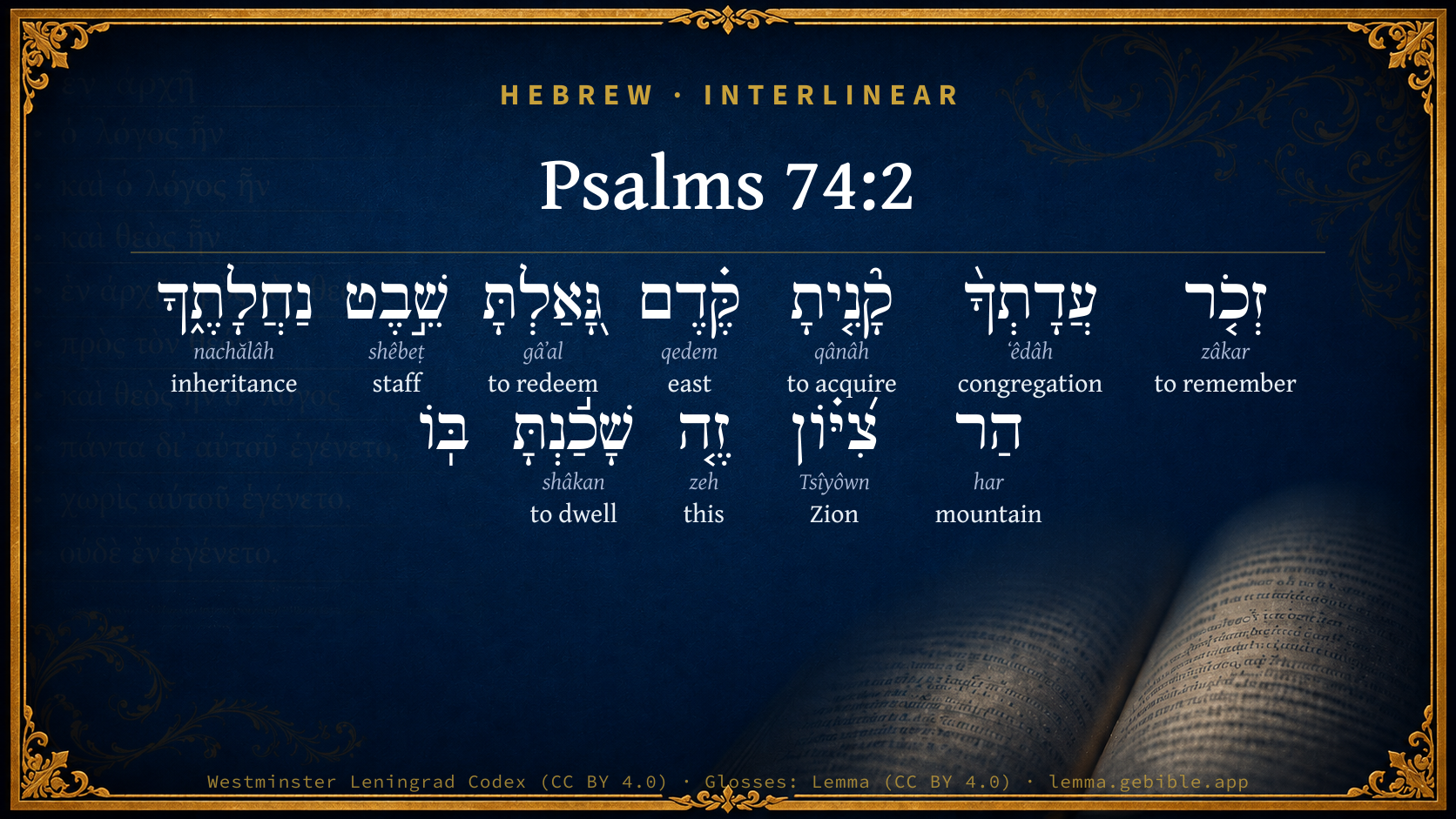
Hebrew (Westminster Leningrad Codex) Psalms 74:2 appears in the Hebrew Old Testament. The text above is from the Westminster Leningrad Codex. Each word links to its Strong’s number, a concise gloss, and parsing drawn from the Open Scriptures Hebrew Bible morphology. Click any word for its full Brown-Driver-Briggs (BDB) entry.
Download image
Cite this verse

Psalms 74:2 (World English Bible). Public Domain. Lemma interlinear Bible study tool, https://lemma.gebible.app/v/psalms/74/2.

Show BibTeX & RIS
BibTeX
RIS
English Translation
Remember your congregation, which you purchased of old, Which you have redeemed to be the tribe of your inheritance; Mount Zion, in which you have lived.
World English Bible · Public Domain
Download a study sheet

One document with this verse’s original text, its word-by-word gloss line, the meaning frame, cross-references with their text, attributed commentary, and full source and license credits — printable, and it pastes into notes with its structure intact.

This verse Autodidact and up

Study sheet (.html) Plain text (.txt)

A passage Seminary Student

Up to 50 verses in one chapter. A passage sheet keeps up to 6 commentary sources and 12 cross-references per verse, in the order this page ranks them, and says so on the sheet whenever that leaves anything out. Ask for a single verse and you get the Autodidact verse sheet above.

Everything on this page stays free to read, with no account — the sheet is a download of what is already on screen, not access to it.

Want to remove ads? Support Godless Engineer
Compare translations 3

The same verse in 3 English versions, stacked beneath the original-language interlinear above. Click any original word for its lexicon entry.

Each is an independent rendering of the whole verse — the interlinear is not word-aligned to these translations.

Highlighted words mark where these versions differ — a whole-verse word diff, not a word-by-word alignment.

  • World English Bible Public Domain
    Remember your congregation, which you purchased of old, Which you have redeemed to be the tribe of your inheritance; Mount Zion, in which you have lived.
  • King James Version Public Domain
    Remember thy congregation, which thou hast purchased of old; the rod of thine inheritance, which thou hast redeemed; this mount Zion, wherein thou hast dwelt.
  • unfoldingWord Literal Text CC BY-SA 4.0
    Remember your congregation you acquired antiquity, you redeemed, the tribe of your inheritance, this Mount Zion on which you have dwelt.

unfoldingWord Literal Text — © unfoldingWord, licensed CC BY-SA 4.0. Word-aligned USFM3 via Door43 (git.door43.org/unfoldingWord/en_ult).

Versions to compare (up to 4)

3 of 4 selected

Show all 18 translations

Every available English version of this verse, each an independent rendering of the whole verse.

  • World English Bible Public Domain
    Remember your congregation, which you purchased of old, Which you have redeemed to be the tribe of your inheritance; Mount Zion, in which you have lived.
  • Berean Standard Bible Public Domain
    Remember Your congregation, which You purchased long ago and redeemed as the tribe of Your inheritance—Mount Zion where You dwell.
  • Majority Standard Bible Public Domain
    Remember Your congregation, which You purchased long ago and redeemed as the tribe of Your inheritance—Mount Zion, where You dwell.
  • King James Version Public Domain
    Remember thy congregation, which thou hast purchased of old; the rod of thine inheritance, which thou hast redeemed; this mount Zion, wherein thou hast dwelt.
  • American Standard Version (1901) Public Domain
    Remember thy congregation, which thou hast gotten of old, Which thou hast redeemed to be the tribe of thine inheritance; `And' mount Zion, wherein thou hast dwelt.
  • Revised Version (1885) Public Domain
    Remember thy congregation, which thou hast purchased of old, which thou hast redeemed to be the tribe of thine inheritance; and mount Zion, wherein thou hast dwelt.
  • Geneva Bible (1599) Public Domain
    Thinke vpon thy Congregation, which thou hast possessed of olde, and on the rod of thine inheritance, which thou hast redeemed, and on this mount Zion, wherein thou hast dwelt.
  • Douay-Rheims (1899) Public Domain
    Remember thy congregation, which thou hast possessed from the beginning. The sceptre of thy inheritance which thou hast redeemed: mount Sion in which thou hast dwelt.
  • Young's Literal Translation Public Domain
    Remember Thy company. Thou didst purchase of old, Thou didst redeem the rod of Thy inheritance, This mount Zion -- Thou didst dwell in it.
  • Literal Standard Version CC BY-SA 4.0
    Remember Your congregation || [That] You purchased of old, || You redeemed the rod of Your inheritance, || This Mount Zion—You dwelt in it.
  • Unlocked Literal Bible CC BY-SA 4.0
    Call to mind your people, whom you purchased in ancient times, the tribe whom you have redeemed to be your own heritage, and Mount Zion, where you live.
  • unfoldingWord Literal Text CC BY-SA 4.0
    Remember your congregation you acquired antiquity, you redeemed, the tribe of your inheritance, this Mount Zion on which you have dwelt.
  • Darby Bible Public Domain
    Remember thine assembly, which thou hast purchased of old, which thou hast redeemed [to be] the portion of thine inheritance, this mount Zion, wherein thou hast dwelt.
  • World Messianic Bible Public Domain
    Remember your congregation, which you purchased of old, which you have redeemed to be the tribe of your inheritance: Mount Zion, in which you have lived.
  • Webster's Bible Public Domain
    Remember thy congregation, which thou hast purchased of old: the rod of thy inheritance, which thou hast redeemed; this mount Zion, in which thou hast dwelt.
  • Free Bible Version CC BY-SA 4.0
    Remember the people you made your own long ago, the tribe you redeemed and made your own. Remember too Mount Zion, the place where you live.
  • Bible in Basic English Public Domain
    Keep in mind your band of worshippers, for whom you gave payment in the days which are past, whom you took for yourself as the people of your heritage; even this mountain of Zion, which has been your resting-place.
  • JPS Tanakh (1917) Public Domain
    Remember Thy congregation, which Thou hast gotten of old, which Thou hast redeemed to be the tribe of Thine inheritance; and mount Zion, wherein Thou hast dwelt.

Literal Standard Version (2020), Covenant Press — licensed CC BY-SA 4.0. Text via the HelloAO Bible API (eBible.org). Unlocked Literal Bible (unfoldingWord) — licensed CC BY-SA 4.0. Text via the HelloAO Bible API (eBible.org). unfoldingWord Literal Text — © unfoldingWord, licensed CC BY-SA 4.0. Word-aligned USFM3 via Door43 (git.door43.org/unfoldingWord/en_ult). Free Bible Version, Dr. Jonathan Gallagher — licensed CC BY-SA 4.0. Text via the HelloAO Bible API (eBible.org).

Word by word

More ways to search: Search by grammar → Find every occurrence → Compare this word →

Practice this passage: Drill this verse → Learn its vocabulary →

קָ֘נִ֤יתָ
qânâh
H7069
“to acquire”
Verb, Qal, Perfect, 2nd Person, Masculine, Singular
Part of Speech
Verb
Stem
Qal
Form
Perfect
Person
2nd Person
Gender
Masculine
Number
Singular
Full BDB Definition

Origin: a primitive root

TWOT: 2039

to get, acquire, create, buy, possess - (Qal) - to get, acquire, obtain - of God originating, creating, redeeming His people - possessor - of Eve acquiring - of acquiring knowledge, wisdom - to buy - (Niphal) to be bought - (Hiphil) to cause to possess
  1. זְכֹ֤ר zâkar H2142 “remember” Verb, Qal, Imperative, 2nd Person, Masculine, Singular
  2. עֲדָתְךָ֨ ʻêdâh H5712 “congregation · your” Noun, Common, Feminine, Singular, Construct + Suffix, Personal, 2nd Person, Masculine, Singular
  3. קֶּ֗דֶם qedem H6924 “east” Noun, Common, Masculine, Singular, Absolute
  4. גָּ֭אַלְתָּ gâʼal H1350 “to redeem” Verb, Qal, Perfect, 2nd Person, Masculine, Singular
  5. שֵׁ֣בֶט shêbeṭ H7626 “staff of” Noun, Common, Masculine, Singular, Construct
  6. נַחֲלָתֶ֑ךָ nachălâh H5159 “inheritance · your” Noun, Common, Feminine, Singular, Construct + Suffix, Personal, 2nd Person, Masculine, Singular
  7. הַר har H2022 “mountain of” Noun, Common, Masculine, Singular, Construct
  8. צִ֝יּ֗וֹן Tsîyôwn H6726 “Zion” Noun, Proper
  9. זֶ֤ה zeh H2088 “this” Pronoun, Demonstrative, Masculine, Singular
  10. שָׁכַ֬נְתָּ shâkan H7931 “to dwell” Verb, Qal, Perfect, 2nd Person, Masculine, Singular

About this verse

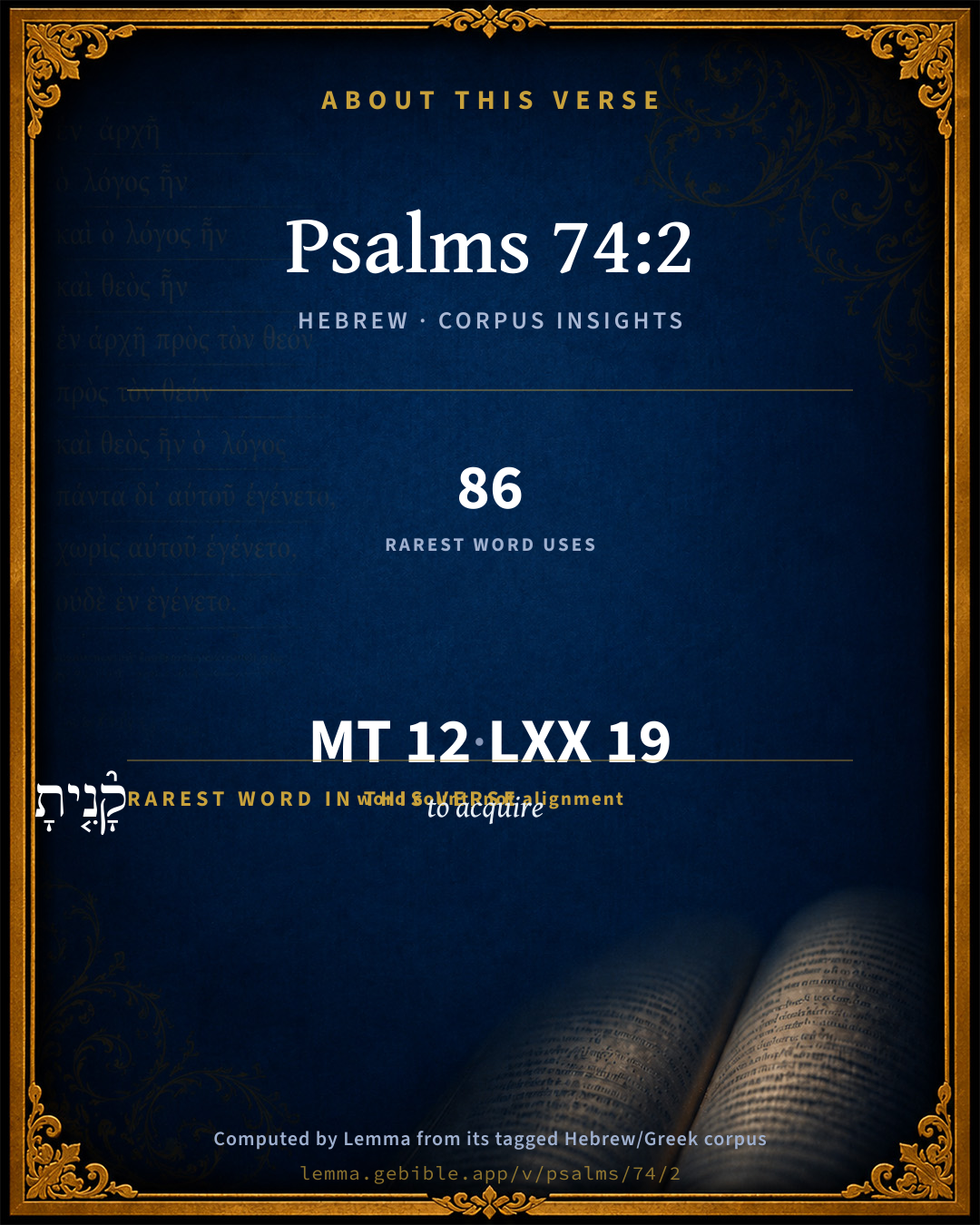
These counts appear in no published source. They are computed here, from the morphology-tagged text and Lemma’s own curated glosses. What Lemma adds →

12
words
11
distinct lemmas
Wisdom
section

Grammatical profile

  • 4 verbs
  • 6 nouns
  • 1 pronoun
  • 1 preposition

Verb forms

  • זְכֹ֤ר Qal · Imperative
  • קָ֘נִ֤יתָ Qal · Perfect
  • גָּ֭אַלְתָּ Qal · Perfect
  • שָׁכַ֬נְתָּ Qal · Perfect

Hebrew & Septuagint length

In English translation the verse runs 26 words from the Hebrew and 25 from the Septuagint (LXX English) — closely comparable.

A rough comparison of the two English renderings, which tokenize alike — not a word-level alignment.

Word counts can differ between the Hebrew and the Greek without any difference in meaning — e.g. the Hebrew direct-object marker אֵת has no separate Greek word, and Greek often adds the article ὁ.

In the original languages it is 12 Hebrew tokens and 19 Greek tokens — but the two are counted differently (Hebrew bundles its prefixes and suffixes into one token; the Greek is in lemma form), so that isn’t a like-for-like length.

Cross-references

23

Topical passages linked to Psalms 74:2 in the Treasury of Scripture Knowledge — connected by theme and wording, ordered by reader-vote popularity; previews shown in the World English Bible.

  • Jeremiah 10:16 The portion of Jacob is not like these; for he is the former of all things; and Israel is the tribe of his inheritance: Yahweh of Hosts is his name.
  • Exodus 15:13 "You, in your loving kindness, have led the people that you have redeemed. You have guided them in your strength to your holy habitation.
  • Exodus 15:16 Terror and dread falls on them. By the greatness of your arm they are as still as a stone; Until your people pass over, Yahweh, Until the people pass over who you have purchased.
  • Deuteronomy 32:9 For Yahweh's portion is his people; Jacob is the lot of his inheritance.
  • Deuteronomy 4:20 But Yahweh has taken you, and brought you forth out of the iron furnace, out of Egypt, to be to him a people of inheritance, as at this day.
  • Psalms 78:68–69 But chose the tribe of Judah, Mount Zion which he loved.
  • Psalms 135:4 For Yah has chosen Jacob for himself; Israel for his own possession.
  • Psalms 132:13–14 For Yahweh has chosen Zion. He has desired it for his habitation.
  • Isaiah 51:11 The ransomed of Yahweh shall return, and come with singing to Zion; and everlasting joy shall be on their heads: they shall obtain gladness and joy; [and] sorrow and sighing shall flee away.
  • Isaiah 62:12 They shall call them The holy people, The redeemed of Yahweh: and you shall be called Sought out, A city not forsaken.
  • Isaiah 63:9 In all their affliction he was afflicted, and the angel of his presence saved them: in his love and in his pity he redeemed them; and he bore them, and carried them all the days of old.
  • Isaiah 63:17 O Yahweh, why do you make us to err from your ways, and harden our heart from your fear? Return for your servants' sake, the tribes of your inheritance.
  • Jeremiah 51:19 The portion of Jacob is not like these; for he is the former of all things; and [Israel] is the tribe of his inheritance: Yahweh of Hosts is his name.
  • Acts 20:28 Take heed, therefore, to yourselves, and to all the flock, in which the Holy Spirit has made you overseers, to shepherd the assembly of the Lord and God which he purchased with his own blood.
  • Titus 2:14 who gave himself for us, that he might redeem us from all iniquity, and purify for himself a people for his own possession, zealous for good works.
  • Revelation 5:9 They sang a new song, saying, "You are worthy to take the book, And to open its seals: For you were killed, And bought us for God with your blood, Out of every tribe, language, people, and nation,
  • Deuteronomy 9:29 Yet they are your people and your inheritance, which you brought out by your great power and by your outstretched arm.
  • Psalms 33:12 Blessed is the nation whose God is Yahweh, The people whom he has chosen for his own inheritance.
  • Psalms 48:1–2 Great is Yahweh, and greatly to be praised, In the city of our God, in his holy mountain.
  • Psalms 68:16 Why do you look in envy, you rugged mountains, At the mountain where God chooses to reign? Yes, Yahweh will dwell there forever.
  • Psalms 77:15 You have redeemed your people with your arm, The sons of Jacob and Joseph. Selah.
  • Psalms 106:40 Therefore Yahweh burned with anger against his people. He abhorred his inheritance.
  • Psalms 9:11 Sing praises to Yahweh, who dwells in Zion, And declare among the people what he has done.

Cross-references courtesy of OpenBible.info (CC BY 4.0).

Hebrew and Greek witnesses Masoretic Hebrew ↔ Greek Septuagint

The same verse in the two great witnesses to the Old Testament, shown verse-for-verse.

You’re reading Greek Psalm 73 (Hebrew Psalm 74). The Septuagint counts the superscription, so verse numbers can differ from the Hebrew — chapter-level alignment, not verse-by-verse. Numbering follows Rahlfs.

These are two independent witnesses, not word-aligned to each other, and the Septuagint is shown in lemma (dictionary) form.

Hebrew Psalms 74:2 Masoretic · Westminster Leningrad Codex

זְכֹ֤ר עֲדָתְךָ֨ קָ֘נִ֤יתָ קֶּ֗דֶם גָּ֭אַלְתָּ שֵׁ֣בֶט נַחֲלָתֶ֑ךָ הַר צִ֝יּ֗וֹן זֶ֤ה שָׁכַ֬נְתָּ בּֽוֹ

Remember your congregation, which you purchased of old, Which you have redeemed to be the tribe of your inheritance; Mount Zion, in which you have lived.

World English Bible · Public Domain

Greek LXX Greek Psalm 73:2 Septuagint · lemma form

μιμνήσκω ὁ συναγωγή σύ ὅς κτάομαι ἀπό ἀρχή λυτρόω ῥάβδος κληρονομία σύ ὄρος σιων οὗτος ὅς κατασκηνόω ἐν αὐτός

Remember your congregation which you have purchased from the beginning; you did ransom the rod of your inheritance; this mount Sion wherein you have lived.

LXX2012 (modern English Septuagint) · Public Domain

On this verse, Ellicott's Commentary for English Readers discusses the Septuagint’s reading. Read the note in Commentary ↓

Hebrew: Westminster Leningrad Codex (CC BY 4.0). Greek: Septuagint (public domain); English from LXX2012 (modern English Septuagint) (Public Domain). How the Septuagint differs from the Hebrew →

Commentary

Notes on Psalms 74:2 from classic Christian and Jewish commentators (each source and its license shown beneath its notes). The classic Christian expositions comment on the surrounding passage and are grouped to its opening verse, so a note may address several verses; the Jewish commentaries on the Tanakh (Rashi and others) are per-verse, so they appear only where the commentator wrote on this verse.

Lemma curates 59 commentaries, every one of them public domain or Creative Commons licensed, each selected and text-cleaned for this edition rather than reprinted as found. About our sources →

Trapp's Complete Commentary

John Trapp

Psa 74:2 Remember thy congregation, [which] thou hast purchased of old; the rod of thine inheritance, [which] thou hast redeemed; this mount Zion, wherein thou hast dwelt.

Ver. 2. Remember thy congregation, which thou hast purchased] His complaints end not in murmuring and grunting against God; but in humble petitions, so intermingled with sighs and groans, as that his speech is not so plain and perfect as at other times. That which he mainly urgeth is the covenant, that hive of heavenly honey, as one calleth it.

The rod of thine inheritance] Inheritances were wont to be measured out by rods and perches. Assyria is the work of God’s hands, but Israel (as a further favour) is his inheritance, Isa 19:25.

John Trapp, A Commentary or Exposition upon All the Books of the Old and New Testament (1647–1656) — public domain. Text from a community e-Sword module.

Joseph Benson's Commentary

Psa 74:2. Remember thy congregation — That is, the Israelites, who are thy church, and whom at the expense of so many miracles, thou didst make thy peculiar people; show by thine actions that thou hast not utterly forgotten and forsaken them; which thou hast purchased — Hebrew, קנית, kanita, rendered bought, Deu 32:6, but which also signifies acquired or procured, though without price, as Rth 4:9-10. Of old — When thou didst bring them out of Egypt, and form them into a commonwealth; gavest them laws, and didst enter into covenant with them at Sinai. The rod of thine inheritance — That people which thou hast measured out, as it were, by rod, to be thy portion: or, the tribe (as the word שׁבשׂ, shebet, here rendered rod, commonly signifies) of thine inheritance, that is, the tribe of Judah, which thou hast, in a special manner, chosen for thine inheritance, and for the seat of thy church and kingdom, and the birth of the Messiah. And thus here is an elegant gradation from the general to particulars: First, the congregation, consisting of all the tribes; then the tribe of Judah; and lastly, mount Zion. Nor is it strange that he mentions this tribe particularly, because the calamity and captivity here lamented principally befell this tribe and Benjamin, which was united with it, and subject to it; and those who returned from the captivity were generally of this tribe. This mount Zion — Which is often put for the temple, or the hill of Moriah, on which it was built.

Joseph Benson's Commentary on the Old and New Testaments (1811–1818) — public domain. Text from a community e-Sword module.

J. A. Alexander on Psalms

Joseph Addison Alexander

Psa 74:2. Remember thy congregation thou hast purchased of old, (and) redeem the rod of thine inheritance, this mount Zion thou hast dwelt in. The ellipsis of the relative in both the clauses of this verse is common to the Hebrew and the English idiom. The word translated congregation is one of those applied in the Old Testament to Israel as an organised body and the people of Jehovah. See above, on Psa 1:5. Purchased, acquired, made thine own. The word translated of old is an noun meaning antiquity, but here used as an adverb of time. The full phrase occurs below in Psa 74:12. The next verb contains a specification of the first, to wit, that he purchased by redeeming them from bondage, with particular reference to the exodus from Egypt. The rod of thine inheritance is a phrase which, to any Hebrew reader, would suggest the twofold idea of a chieftain's staff, the badge of authority in the several tribes, and that of a measuring rod, here put for the portion of land measured. The whole sense conveyed by these associations is that of a definite province, with its population, of which God is the possessor and the sovereign. The last clause applies what had been said of the people and the land still more specifically to the central point of the theocracy. Mount Zion may be understood as a description of the whole of Jerusalem, including the temple upon mount Moriah. This mount Zion, with which the speakers were familiar, and at or near which they are supposed to be speaking. The explanation of this as a relative is gratuitous, nor could the idea (this mount Zion) have been well expressed in any other form of Hebrew words. The grand distinction of mount Zion, in the wide sense just explained, was the inhabitation of Jehovah, which is therefore here expressly mentioned in the closing words.

Joseph Addison Alexander, The Psalms Translated and Explained (1850) — public domain. Text from a community e-Sword module.

Tyndale Open Study Notes

Tyndale Open Resources

74:2 The Lord chose and redeemed Israel from Egypt in the Exodus (cp. Exod 15:13). • your own special possession: This is another expression for “your people” (Pss 28:9; 78:62; 94:14; 106:40).

Tyndale Open Study Notes — © Tyndale Open Resources, licensed CC BY-SA 4.0. Text via the HelloAO Bible API.

Geneva Bible (1599)

Geneva Bible translators

Which inheritance thou hast measured out for thyself as with a line or rod.

Geneva Bible (1599) marginal notes — public domain. Text via Bolls.life.

Adam Clarke's Commentary

Verse 2. Remember thy congregation, which thou hast purchased of old] We are the descendants of that people whom thou didst take unto thyself; the children of Abraham, Isaac, and Jacob. Wilt thou never more be reconciled to us?

Adam Clarke's Commentary on the Bible (1810–1826) — public domain. Text from a community e-Sword/MySword module.

John Calvin's Commentaries

2. Remember thy congregation, which thou hast possessed of old. Here they boast of having been the peculiar people of God, not on account of any merit of their own, but by the grace of adoption. They boast in like manner of their antiquity, — that they are not subjects who have come under the government of God only within a few months ago, but such as had fallen to him by right of inheritance. The longer the period during which he had continued his love towards the seed of Abraham, the more fully was their faith confirmed. They declare, therefore, that they had been God’s people from the beginning, that is, ever since he had entered into an inviolable covenant with Abraham. There is also added the redemption by which the adoption was ratified; for God did not only signify by word, but also showed by deed at the time when this redemption was effected, that he was their King and Protector. These benefits which they had received from God they set before themselves as an encouragement to their trusting in him, and they recount them before him, the benefactor who bestowed them, as an argument with him not to forsake the work of his own hands. Inspired with confidence by the same benefits, they call themselves the rod of his inheritance; that is to say, the heritage which he had measured out for himself. The allusion is to the custom which then prevailed of measuring or marking out the boundaries of grounds with poles as with cords or lines. Some would rather translate the word שבט, shebet, which we have rendered rod, by tribe; but I prefer the other translation, taking the meaning to be, that God separated Israel from the other nations to be his own proper ground, by the secret pre-ordination which originated in his own good pleasure, as by a measuring rod. In the last place, the temple in which God had promised to dwell is mentioned; not that his essence was enclosed in that place, — an observation which has already been frequently made, — but because his people experienced that there he was near at hand, and present with them by his power and grace. We now clearly perceive whence the people derived confidence in prayer; it was from God’s free election and promises, and from the sacred worship which had been set up among them.

John Calvin's Commentaries (1540-1563) — public domain. Text from the Calvin Translation Society English edition (1840s-50s) via the Christian Classics Ethereal Library (ccel.org). Calvin's coverage is partial (roughly two-thirds of the Bible); uncommented books and verses are honest gaps, never fabricated. The 19th-century editor's footnotes and remarks are omitted so the notes are faithfully Calvin's own voice.

Ellicott's Commentary for English Readers

(2) Purchased.—Or, as in LXX., acquired. This word, together with the word “redeemed” in the next clause, and “right hand” in Psa_74:11, show that Exodus 15 was in the writer’s mind. (See especially Psa_74:12-13; Psa_74:16 of that chapter.)

The word “congregation” here, as in the Mosaic books, presents the people in its religious aspect, as the expression “rod (or, tribe) of thine inheritance” presents it in its political character.

The rod of . . .—Better, which thou hast redeemed as the tribe of thine inheritance, i.e., as thine own tribe.

The expression, “rod of thine inheritance,” comes from Jer_10:16; Jer_51:19. (Comp. Isa_63:17.) It refers not to the shepherd’s crook, but to the sceptre, or leading staff, of the prince of a tribe, and so passes into a term for the tribe itself (Exo_28:21; Jdg_20:2).

A Bible Commentary for English Readers, edited by Charles John Ellicott (1878–1897) — public domain. Text from a community e-Sword module.

The Cambridge Bible for Schools and Colleges

gen. ed. J. J. S. Perowne

2. Remember] Cp. Psa_74:18; Psa_74:22; Lam_5:1; Isa_62:6.

purchased … redeemed] Reminiscences of the Song of Moses (Exo_15:13; Exo_15:16). Cp. Psa_77:15; Psa_78:35; Deu_32:6.

the rod &c.] Render with R.V.,

Which thou hast redeemed to be the tribe of thine inheritance.

The nation is called a tribe, as in Amo_3:1 it is called a family. So too in Jer_10:16 (= Psa_51:19); cp. Isa_63:17.

this mount Zion] Omit this: the pronoun here serves for the relative.

dwelt] Cp. Psa_68:16. The verb is that from which later Judaism derived the term Shechinah to denote the abiding Presence of God among His people.

The Cambridge Bible for Schools and Colleges (gen. ed. J. J. S. Perowne; Cambridge University Press, 1878–1918) — public domain. Text from a community e-Sword module.

John Gill's Exposition

Remember thy congregation, which thou hast purchased of old,.... Alluding to the redemption of the congregation of Israel out of Egypt, when they were said to be "purchased", Exo 15:16 and as that people were typical of the people of God, they may be said to be "purchased then", even of old; though the purchase in reality was not made till the blood of Christ was shed, with which he purchased his church, Act 20:28, indeed he was the Lamb, slain from the foundation of the world, in the purpose and promise of God, and in the typical sacrifices so early offered up, Rev 13:8, and besides, the words may be considered as the words of the church of God groaning under antichristian oppression and cruelty, hundreds of years since the death of Christ, and so may be said to be of old purchased; and which is called a "congregation", because a select number, chosen of God, and called out of the world, and brought into one body, and into fellowship with Christ and one another; and though they may not meet together in one place, they are all of one body, and will one day make one general assembly and church of the firstborn, called "the congregation of the righteous", Psa 1:5 now it is desired of the Lord for these, that they might be remembered with his lovingkindness and tender mercies, with his covenant and promises, and be delivered and saved out of the hands of their enemies:

the rod of thine inheritance, which thou hast redeemed; the Targum adds, out of Egypt; but this is to be understood not of the redemption of the people of Israel, but of the redemption of the church of God from sin, Satan, the law, the world, hell, and death; who are chosen by the Lord for his inheritance, his peculiar treasure and portion; and which he highly values and esteems, and is dear unto him as such, as the redemption of them by the blood of Christ shows:

this Mount Sion wherein thou hast dwelt; meaning the church of God, which often goes by this name, both in the Old and in the New Testament, comparable to the mount of Zion for its height, holiness, and immoveableness; where the Lord has promised to dwell, and where he does dwell, and will for evermore. As the reference to Sion literally understood, it is called "this Sion", because well known, and because the psalm might be composed or said in it, as Kimchi observes; and which shows that it was written before the destruction of the city and temple, and while Zion was the seat of religious worship, and therefore a prophecy of future times.

John Gill's Exposition of the Whole Bible (1746–1763) — public domain (CC PDM 1.0). Text via the HelloAO Bible API.

Albert Barnes' Notes on the Bible

Remember thy congregation - The word rendered “congregation” means properly an “assembly,” a “community,” and it is frequently applied to the Israelites, or the Jewish people, considered as a body or a community associated for the service of God. Exo 12:3; Exo 16:1-2, Exo 16:9; Lev 4:15; Num 27:17. The word used by the Septuagint is συναγωγή sunagōgē - synagogue - but refers here to the whole Jewish people, not to a particular synagogue or congregation.

Which thou hast purchased of old - In ancient times; in a former age. That is, Thou hast “purchased” them to thyself, or as thine own, by redeeming them from bondage, thus securing to thyself the right to them, as one does who redeems or purchases a thing. See the notes at Isa 43:3.

The rod of thine inheritance - Margin, as in Hebrew, “tribe.” The Hebrew word - שׁבט shêbet - means properly “a staff,” stick, rod; then, a shepherd’s staff, a crook; then, a scepter; and then it is used to denote a “tribe,” so called from the staff or scepter which the chief of the tribe carried as the symbol of authority. Exo 28:21; Jdg 20:2. The word “inheritance” is frequently applied to the children of Israel considered as belonging to God, as property inherited belongs to him who owns it - perhaps suggesting the idea that the right to them had come down, as inherited property does, from age to age. It was a right over them acquired long before, in the days of the patriarchs.

Which thou hast redeemed - By delivering them out of Egyptian bondage. So the church is now redeemed, and, as such, it belongs to God.

This mount Zion - Jerusalem - the seat of government, and of public worship - the capital of the nation.

Wherein thou last dwelt - By the visible symbol of thy presence and power. - On all these considerations the psalmist prays that God would not forget Jerusalem in the present time of desolation and trouble.

Albert Barnes' Notes on the Bible (1834–1885) — public domain. Text from a community e-Sword/MySword module.

Matthew Poole's English Annotations

Remember; show by thine actions that thou hast not utterly forgotten and forsaken them.

Thy congregation; thy church or people. Purchased; or, redeemed, as it follows; or, bought, as it is Deu 32:6; or, procured, though without price, as this word is used, Rth 4:9,10.

Of old; when thou broughtest them out of Egypt, and formedst them into a commonwealth, and gavest them laws, and didst enter into covenant with them at Sinai.

The rod of thine inheritance; that people which thou hast measured out as it were by rod, to be thy portion or inheritance, as they are called also Deu 32:6 See also Psa 16:5,6; Jer 10:16. Or, the tribe (as this word commonly signifies)

of thine inheritance, i.e. the tribe of Judah, which thou hast in a special manner chosen for thine inheritance, and for the seat of the kingdom, and for the birth of the Messiah. And thus here is an elegant gradation from the general to particulars; first the congregation, consisting of all the tribes; then the tribe of Judah; and lastly,

Mount Zion. Nor is it strange that he mentions this tribe particularly, because the calamity and captivity here remembered did principally befall this tribe and Benjamin, which was united with it and subject to it, and the most that returned were of this tribe; for the generality of the other tubes were long before dispersed into other lands, and continue in their captivity to this day. Mount Zion; which is oft put for the temple, or the hill of Moriah, on which it was built.

Matthew Poole's English Annotations on the Holy Bible (1683–1685) — public domain. Text from a community e-Sword/MySword module.

The Treasury of David

Charles H. Spurgeon

Ver. 2. Remember thy congregation, which thou hast purchased of old. What a mighty plea is redemption. O God, canst thou see the blood mark on thine own sheep, and yet allow grievous wolves to devour them? The church is no new purchase of the Lord; from before the world's foundation the chosen were regarded as redeemed by the Lamb slain; shall ancient love die out, and the eternal purpose become frustrate? The Lord would have his people remember the paschal Lamb, the bloodstained lintel, and the overthrow of Egypt; and will he forget all this himself? Let us put him in remembrance, let us plead together. Can he desert his blood bought and forsake his redeemed? Can election fail and eternal love cease to glow? Impossible. The woes of Calvary, and the covenant of which they are the seal, are the security of the saints.

The rod of thine inheritance, which thou hast redeemed. So sweet a plea deserved to be repeated and enlarged upon. The Lord's portion is his people--will he lose his inheritance? His church is his kingdom, over which he stretches the rod of sovereignty; will he allow his possessions to be torn from him? God's property in us is a fact full of comfort: his value of us, his dominion over us, his connection with us are all so many lights to cheer our darkness. No man will willingly lose his inheritance, and no prince will relinquish his dominions; therefore we believe that the King of kings will hold his own, and maintain his rights against all comers.

This mount Zion, wherein thou hast dwelt. The Lord's having made Zion the especial centre of his worship, and place of his manifestation, is yet another plea for the preservation of Jerusalem. Shall the sacred temple of Jehovah be desecrated by heathen, and the throne of the Great King be defiled by his enemies? Has the Spirit of God dwelt in our hearts, and will he leave them to become a haunt for the devil? Has he sanctified us by his indwelling, and will he, after all, vacate the throne? God forbid. It may be well to note that this Psalm was evidently written with a view to the temple upon Zion, and not to the tabernacle which was there in David's time, and was a mere tent; but the destructions here bewailed were exercised upon the carved work of a substantial structure. Those who had seen the glory of God in Solomon's peerless temple might well mourn in bitterness, when the Lord allowed his enemies to make an utter ruin of that matchless edifice.

Ver. 2. Remember thy congregation. It is not without reason that they do not say, Remember us, but Remember thy congregation, not ours, but thine; nor that because it has now begun to be thine, but which thou hast purchased of old, the rod of thine inheritance which thou hast redeemed: likewise, this Mount Zion; not wherein we, but wherein thou hast dwelt. They had nothing which they could bring before an angry God with greater confidence, than the ancient lovingkindness shown to their fathers in former days. Musculus.

Ver. 2. The rod of thine inheritance. hlxg jbv, the inheritance rod is the staff with which the inheritance is measured; jkv hdmh hgq, the land surveyor's rod (Eze 40:3); and this is used as lrwg, the lot, is for the portion, for the inheritance itself. E. W. Hengstenberg.

Ver. 2. Thine inheritance. It signifies a nation, which through all successions God had a peculiar right and title to. Henry Hammond.

Ver. 2. Thou hast redeemed, i.e., the purchased people, by restoring them when they had been alienated, and had fallen into the hands of others: like a goel, or near kinsman, who ransoms a brother hurried into captivity, and regains an inheritance that has been sold. Hermann Venema.

Ver. 2.

I. The Lord's relation to his people.

1. Election.

2. Redemption.

3. Indwelling. II. The prayer arising from it: Remember.

Psalms 74:3*

Charles H. Spurgeon's The Treasury of David (1869–1885) — public domain. Psalms only. Text from a community e-Sword/MySword module.

Whedon's Commentary on the Bible

Daniel D. Whedon

2. Thy congregation—That is, thy Church. Compare Psa_22:22; Heb_2:12.

Purchased—The language is that of endearment. Deu_9:29; Psa_78:54. Compare Isa_43:3 : “I gave Egypt for thy ransom.”

Rod of thine inheritance— “The inheritance rod is the staff with which the inheritance is measured; the land surveyor’s rod.

Eze_40:3.”—Hengstenberg. See Rev_11:1. The word rendered “rod” in the original often stands for tribe, and also for sceptre, either of which makes a good sense here.

Daniel D. Whedon (gen. ed.), Commentary on the Old and New Testaments (1874–1909) — public domain. Text from a community e-Sword module.

The Pulpit Commentary

Remember thy congregation, which thou hast purchased of old; or, which thou didst purchase of old. The reference is to the redemption out of Egypt. (see Exo_15:16) God is besought, though he has forgotten, once more to remember his people, and urged to do so by the memory of his former mercies (comp. vers. 12-17). The rod of thine inheritance, which thou hast redeemed; rather, which thou didst redeem to be the tribe of thine inheritance; i.e. the people of thine inheritance. "The conventional expression, "the tribes of Israel," was not always used after the fall of the northern kingdom" (Cheyne); comp. Jer_10:16 Jer_51:19. This Mount Zion, wherein thou hast dwelt. (comp. Psa_73:6-8) The expression, "this Mount Zion," implies that the psalm is composed either by one of the exiles before he is removed from the Holy Land, or by one of those who were left behind by the conquerors. (2Ki_25:12, 22 Jer_42:10 Jer_52:16)

The Pulpit Commentary (1880–1919), ed. H.D.M. Spence-Jones & Joseph S. Exell — public domain. Text from a community e-Sword module.

John Wesley's Explanatory Notes

Thy congregation - Thy people. Thine inheritance - The tribe of Judah, which thou hast in a special manner chosen for thine inheritance, and for the birth of the Messiah. Nor is it strange that he mentions this tribe particularly, because the calamity here remembered, did principally befall this tribe, and Benjamin, which was united with it.

John Wesley, Explanatory Notes Upon the Whole Bible (1754–1765) — public domain. Text via the GEBible commentary corpus.

Scofield Reference Notes

C. I. Scofield

redeemed

Heb. "goel," Redemp. (Kinsman type). (See Scofield "Isa 59:20").

The Scofield Reference Bible (1917 edition), notes by C. I. Scofield — public domain. Text from a community e-Sword module.

Rashi

Rabbi Shlomo Yitzchaki (Rashi)

which You acquired from time immemorial Before the creation of the world, as it is said (below 90: 1,2): “You were a dwelling place for us, etc., before mountains were formed.”

on which You dwelt Heb. זה שכנתבו, this upon which You dwelt. This is an improvement of the language, as (Isa. 42: 24): “against whom (זו) we sinned.” It is like אשר שכנתבו, on which You dwelt.

Rashi on the Tanakh — English translations: “The Judaica Press complete Tanach with Rashi, translated by A. J. Rosenberg” (CC BY 4.0); “Pentateuch with Rashi's commentary by M. Rosenbaum and A.M. Silbermann, 1929-1934” (public domain); “The Metsudah Tanach series, Lakewood, N.J” (CC BY 4.0); and “The Book of Joshua, Metsudah Publications, 1997” (CC BY 4.0). Text via Sefaria.

Lesson kit

Teaching starters — assembled from the data on this page, not authored interpretation. Every prompt links to the verse data it draws on. Edit before teaching.

Psalms, in the Wisdom, opens this verse with 12 words (11 distinct Hebrew lemmas). Its most distinctive word is qânâh (“to acquire”). A historical commentator’s framing appears above. Read the whole chapter for the surrounding context.

Discussion questions

  1. What does “to acquire” (qânâh) contribute to the verse as a whole?
  2. How does Jeremiah 10:16, which shares this passage’s theme, read alongside this verse?
  3. These translations render this verse differently; the difference is in the English rendering, not the original. What questions does that raise?
  4. «זְכֹ֤ר» is a Qal Imperative verb. How does that grammatical form shape the action described?
  5. Compare how Trapp's Complete Commentary and Joseph Benson's Commentary read this verse. Where do they agree or differ?

Things to notice

Reading settings

Reading text

Shown beneath each verse's original-language words.

Old Testament
Old Testament edition

Read the OT as the Masoretic Hebrew (MT) or the Greek Septuagint (LXX).

English shown for the Greek Septuagint (in the Hebrew ↔ Greek comparison).

Comparing translations? Open the Compare panel on any verse page to stack up to four side by side.