Psalms 122:4

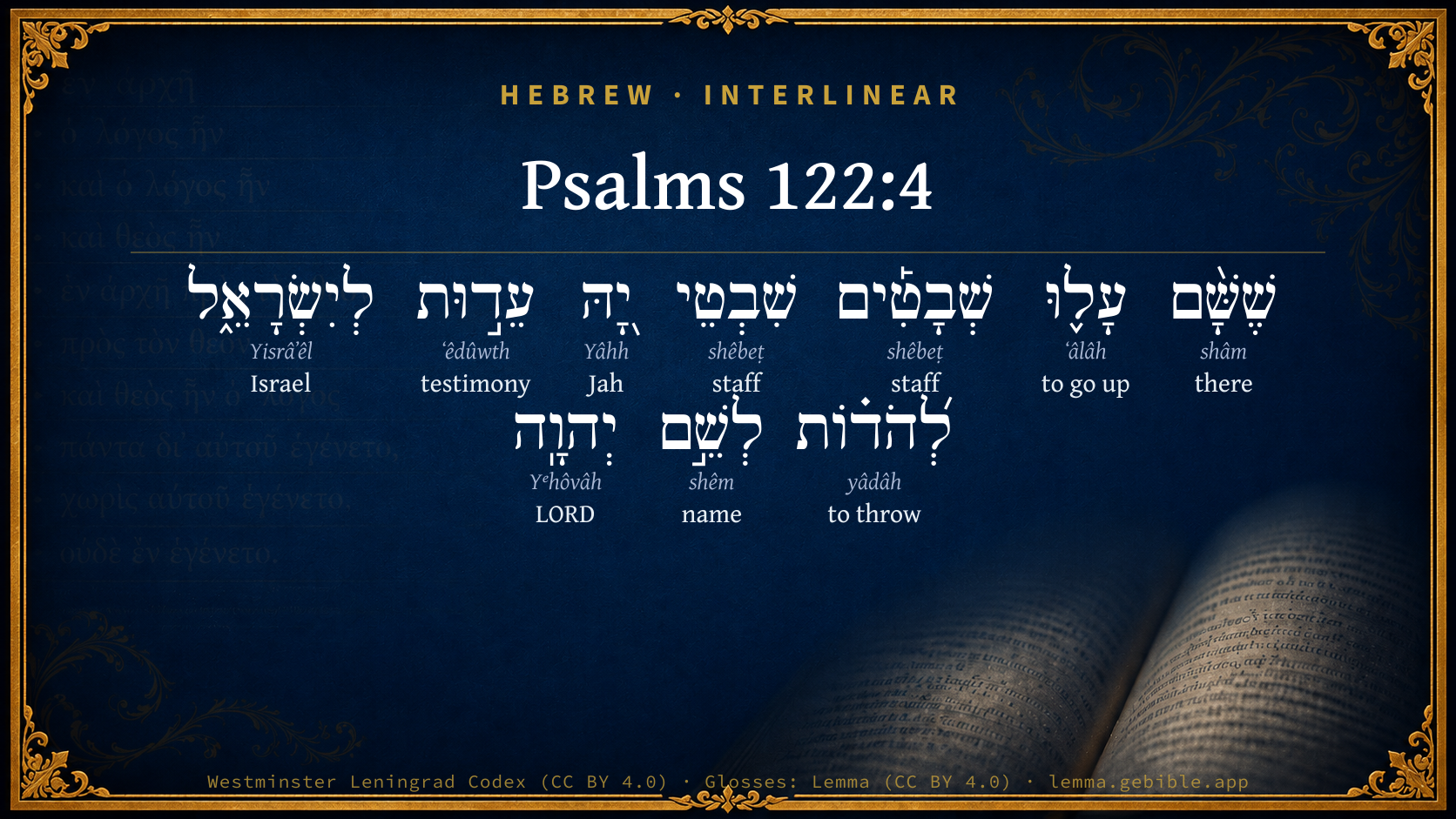
Hebrew (Westminster Leningrad Codex) Psalms 122:4 appears in the Hebrew Old Testament. The text above is from the Westminster Leningrad Codex. Each word links to its Strong’s number, a concise gloss, and parsing drawn from the Open Scriptures Hebrew Bible morphology. Click any word for its full Brown-Driver-Briggs (BDB) entry.
Download image
Cite this verse

Psalms 122:4 (World English Bible). Public Domain. Lemma interlinear Bible study tool, https://lemma.gebible.app/v/psalms/122/4.

Show BibTeX & RIS
BibTeX
RIS
English Translation
Where the tribes go up, even Yah's tribes, According to an ordinance for Israel, To give thanks to the name of Yahweh.
World English Bible · Public Domain
Download a study sheet

One document with this verse’s original text, its word-by-word gloss line, the meaning frame, cross-references with their text, attributed commentary, and full source and license credits — printable, and it pastes into notes with its structure intact.

This verse Autodidact and up

Study sheet (.html) Plain text (.txt)

A passage Seminary Student

Up to 50 verses in one chapter. A passage sheet keeps up to 6 commentary sources and 12 cross-references per verse, in the order this page ranks them, and says so on the sheet whenever that leaves anything out. Ask for a single verse and you get the Autodidact verse sheet above.

Everything on this page stays free to read, with no account — the sheet is a download of what is already on screen, not access to it.

Want to remove ads? Support Godless Engineer
Compare translations 3

The same verse in 3 English versions, stacked beneath the original-language interlinear above. Click any original word for its lexicon entry.

Each is an independent rendering of the whole verse — the interlinear is not word-aligned to these translations.

Highlighted words mark where these versions differ — a whole-verse word diff, not a word-by-word alignment.

  • World English Bible Public Domain
    Where the tribes go up, even Yah's tribes, According to an ordinance for Israel, To give thanks to the name of Yahweh.
  • King James Version Public Domain
    Whither the tribes go up, the tribes of the LORD, unto the testimony of Israel, to give thanks unto the name of the LORD.
  • unfoldingWord Literal Text CC BY-SA 4.0
    Where the tribes go up, the tribes of Yah, a testimony to Israel, to give thanks to the name of Yahweh.

unfoldingWord Literal Text — © unfoldingWord, licensed CC BY-SA 4.0. Word-aligned USFM3 via Door43 (git.door43.org/unfoldingWord/en_ult).

Versions to compare (up to 4)

3 of 4 selected

Show all 18 translations

Every available English version of this verse, each an independent rendering of the whole verse.

  • World English Bible Public Domain
    Where the tribes go up, even Yah's tribes, According to an ordinance for Israel, To give thanks to the name of Yahweh.
  • Berean Standard Bible Public Domain
    where the tribes go up, the tribes of the LORD, as a testimony for Israel, to give thanks to the name of the LORD.
  • Majority Standard Bible Public Domain
    where the tribes go up, the tribes of the LORD, as a testimony for Israel, to give thanks to the name of the LORD.
  • King James Version Public Domain
    Whither the tribes go up, the tribes of the LORD, unto the testimony of Israel, to give thanks unto the name of the LORD.
  • American Standard Version (1901) Public Domain
    Whither the tribes go up, even the tribes of Jehovah, `For' an ordinance for Israel, To give thanks unto the name of Jehovah.
  • Revised Version (1885) Public Domain
    Whither the tribes go up, even the tribes of the LORD for a testimony unto Israel, to give thanks into the name of the LORD.
  • Geneva Bible (1599) Public Domain
    Whereunto the Tribes, euen the Tribes of the Lord go vp according to the testimonie to Israel, to prayse the Name of the Lord.
  • Douay-Rheims (1899) Public Domain
    Behold he shall neither slumber nor sleep, that keepeth Israel.
  • Young's Literal Translation Public Domain
    For thither have tribes gone up, Tribes of Jah, companies of Israel, To give thanks to the name of Jehovah.
  • Literal Standard Version CC BY-SA 4.0
    For there tribes have gone up, || Tribes of YAH, companies of Israel, || To give thanks to the Name of YHWH.
  • Unlocked Literal Bible CC BY-SA 4.0
    The tribes go up to Jerusalem—the tribes of Yahweh— as a testimony for Israel, to give thanks to the name of Yahweh.
  • unfoldingWord Literal Text CC BY-SA 4.0
    Where the tribes go up, the tribes of Yah, a testimony to Israel, to give thanks to the name of Yahweh.
  • Darby Bible Public Domain
    Whither the tribes go up, the tribes of Jah, a testimony to Israel, to give thanks unto the name of Jehovah.
  • World Messianic Bible Public Domain
    where the tribes go up, even the LORD’s tribes, according to an ordinance for Israel, to give thanks to the LORD’s name.
  • Webster's Bible Public Domain
    Whither the tribes go up, the tribes of the LORD, to the testimony of Israel, to give thanks to the name of the LORD.
  • Free Bible Version CC BY-SA 4.0
    All the tribes—the tribes of the Lord—go up there, following the command given to Israel to give thanks to the Lord.
  • Bible in Basic English Public Domain
    To which the tribes went up, even the tribes of the Lord, for a witness to Israel, to give praise to the name of the Lord.
  • JPS Tanakh (1917) Public Domain
    Whither the tribes went up, even the tribes of the LORD, as a testimony unto Israel, to give thanks unto the name of the LORD.

Literal Standard Version (2020), Covenant Press — licensed CC BY-SA 4.0. Text via the HelloAO Bible API (eBible.org). Unlocked Literal Bible (unfoldingWord) — licensed CC BY-SA 4.0. Text via the HelloAO Bible API (eBible.org). unfoldingWord Literal Text — © unfoldingWord, licensed CC BY-SA 4.0. Word-aligned USFM3 via Door43 (git.door43.org/unfoldingWord/en_ult). Free Bible Version, Dr. Jonathan Gallagher — licensed CC BY-SA 4.0. Text via the HelloAO Bible API (eBible.org).

Word by word

More ways to search: Search by grammar → Find every occurrence → Compare this word →

Practice this passage: Drill this verse → Learn its vocabulary →

About this verse

These counts appear in no published source. They are computed here, from the morphology-tagged text and Lemma’s own curated glosses. What Lemma adds →

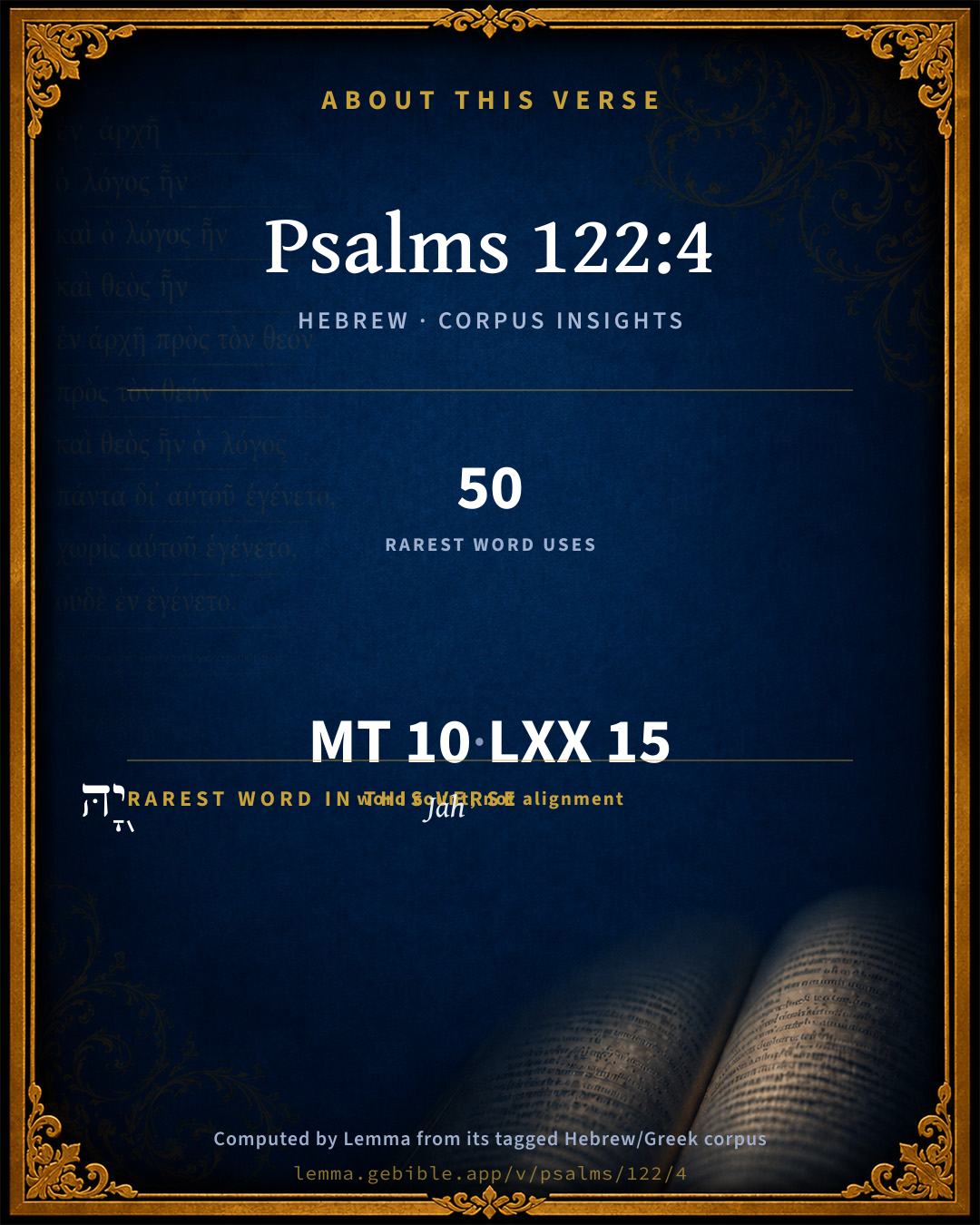
10
words
9
distinct lemmas
Wisdom
section

Shared distinctive vocabulary

יָ֭הּ Jah H3050 occurs in 46 verses of the Hebrew Bible. Also found in:

Grammatical profile

  • 2 verbs
  • 7 nouns
  • 1 adverb

Verb forms

  • עָל֪וּ Qal · Perfect
  • לְ֝הֹד֗וֹת Hiphil · Infinitive Construct

Repetition

A word recurs within this verse — often emphatic in Hebrew:

  • שְׁבָטִ֡ים staff H7626 ×2

Hebrew & Septuagint length

In English translation the verse runs 22 words from the Hebrew and 25 from the Septuagint (LXX English) — closely comparable.

A rough comparison of the two English renderings, which tokenize alike — not a word-level alignment.

Word counts can differ between the Hebrew and the Greek without any difference in meaning — e.g. the Hebrew direct-object marker אֵת has no separate Greek word, and Greek often adds the article ὁ.

In the original languages it is 10 Hebrew tokens and 15 Greek tokens — but the two are counted differently (Hebrew bundles its prefixes and suffixes into one token; the Greek is in lemma form), so that isn’t a like-for-like length.

Cross-references

14

Topical passages linked to Psalms 122:4 in the Treasury of Scripture Knowledge — connected by theme and wording, ordered by reader-vote popularity; previews shown in the World English Bible.

  • Deuteronomy 16:16 Three times in a year shall all your males appear before Yahweh your God in the place which he shall choose: in the feast of unleavened bread, and in the feast of weeks, and in the feast of tents; and they shall not appear before Yahweh empty:
  • Exodus 23:17 Three times in the year all your males shall appear before the Lord Yahweh.
  • Exodus 34:23–24 Three times in the year all your males shall appear before the Lord Yahweh, the God of Israel.
  • Psalms 66:13–16 I will come into your temple with burnt offerings. I will pay my vows to you,
  • Psalms 107:1–3 Give thanks to Yahweh, For he is good, For his loving kindness endures forever.
  • Psalms 118:19 Open to me the gates of righteousness. I will enter into them. I will give thanks to Yah.
  • Psalms 132:13 For Yahweh has chosen Zion. He has desired it for his habitation.
  • Exodus 16:34 As Yahweh commanded Moses, so Aaron laid it up before the Testimony, to be kept.
  • Exodus 26:33–34 You shall hang up the veil under the clasps, and shall bring the ark of the testimony in there within the veil: and the veil shall separate the holy place from the most holy for you.
  • Exodus 32:15 Moses turned, and went down from the mountain, with the two tablets of the testimony in his hand; tablets that were written on both their sides; on the one side and on the other they were written.
  • Deuteronomy 12:5 But to the place which Yahweh your God shall choose out of all your tribes, to put his name there, even to his habitation shall you seek, and there you shall come;
  • Deuteronomy 12:11 then it shall happen that to the place which Yahweh your God shall choose, to cause his name to dwell there, there shall you bring all that I command you: your burnt offerings, and your sacrifices, your tithes, and the heave-offering of your hand, and all your choice vows which you vow to Yahweh.
  • Psalms 78:68 But chose the tribe of Judah, Mount Zion which he loved.
  • Psalms 116:17–19 I will offer to you the sacrifice of thanksgiving, And will call on the name of Yahweh.

Cross-references courtesy of OpenBible.info (CC BY 4.0).

Hebrew and Greek witnesses Masoretic Hebrew ↔ Greek Septuagint

The same verse in the two great witnesses to the Old Testament, shown verse-for-verse.

You’re reading Greek Psalm 121 (Hebrew Psalm 122). The Septuagint counts the superscription, so verse numbers can differ from the Hebrew — chapter-level alignment, not verse-by-verse. Numbering follows Rahlfs.

These are two independent witnesses, not word-aligned to each other, and the Septuagint is shown in lemma (dictionary) form.

Hebrew Psalms 122:4 Masoretic · Westminster Leningrad Codex

שֶׁשָּׁ֨ם עָל֪וּ שְׁבָטִ֡ים שִׁבְטֵי יָ֭הּ עֵד֣וּת לְיִשְׂרָאֵ֑ל לְ֝הֹד֗וֹת לְשֵׁ֣ם יְהוָֽה

Where the tribes go up, even Yah's tribes, According to an ordinance for Israel, To give thanks to the name of Yahweh.

World English Bible · Public Domain

Greek LXX Greek Psalm 121:4 Septuagint · lemma form

ἐκεῖ γάρ ἀναβαίνω ὁ φυλή φυλή κύριος μαρτύριον ὁ ἰσραήλ ὁ ἐκὁμολογέω ὁ ὄνομα κύριος

For there the tribes went up, the tribes of the Lord, as a testimony for Israel, to give thanks to the name of the Lord.

LXX2012 (modern English Septuagint) · Public Domain

Hebrew: Westminster Leningrad Codex (CC BY 4.0). Greek: Septuagint (public domain); English from LXX2012 (modern English Septuagint) (Public Domain). How the Septuagint differs from the Hebrew →

Commentary

Notes on Psalms 122:4 from classic Christian and Jewish commentators (each source and its license shown beneath its notes). The classic Christian expositions comment on the surrounding passage and are grouped to its opening verse, so a note may address several verses; the Jewish commentaries on the Tanakh (Rashi and others) are per-verse, so they appear only where the commentator wrote on this verse.

Lemma curates 59 commentaries, every one of them public domain or Creative Commons licensed, each selected and text-cleaned for this edition rather than reprinted as found. About our sources →

Trapp's Complete Commentary

John Trapp

Psa 122:4 Whither the tribes go up, the tribes of the LORD, unto the testimony of Israel, to give thanks unto the name of the LORD.

Ver. 4. Whither the tribes go up] Thrice a year all the males appeared before the Lord in Sion; the females also, as many as would (as Hannah, the Virgin Mary, &c.), but they were not bound. At which times there was such a general meeting as no city could show the like; a type of that great panegyris, Heb 12:22-23.

Unto the testimony of lsrael] The ark was so called, in regard of the tables of the covenant kept therein, as two letters of contract between God and men, saith Aben Ezra, Exo 15:16; those two tables are called the testimony.

John Trapp, A Commentary or Exposition upon All the Books of the Old and New Testament (1647–1656) — public domain. Text from a community e-Sword module.

The Biblical Illustrator

Joseph S. Exell

Psa_122:4

Whither the tribes go up.

The church the centre of union

The church is still the centre of union. To this sacred place the tribes of God are ever going up, in accordance with the Divine statute, to give thanks unto the name of the Lord. All local peculiarities, all national distinctions, vanish in the house of God. The Asiatic and the Esquimaux, the Red Indian and the Islander of the Southern Ocean, the African and the European, assemble here as one family; and, throwing aside all sectional feuds and rivalries, they worship on the same holy mountain. The great bond of union is Christ, and, joined to Him who is our living Head, we are members of one another. All one in Christ. There is one Father, one Redeemer, one Holy Ghost. There is one condemnation, and there is one redemption; one cross of atonement, one throne of grace, one home in heaven. Whenever believers meet, they can sing the same psalms, and repeat the same prayers. The New Jerusalem, the metropolis of the universe, where the Son of David is seated upon His mediatorial throne, is the eternal centre of worship and of union. To this true Holy of holies the tribes of Israel are always going up, to give thanks unto the name of the Lord. Pleasant it must have been to witness company after company of pilgrims arriving at the earthly Jerusalem, to worship Jehovah at His solemn feasts. But how much more delightful to behold their disembodied spirits, borne upwards on the wings of angels, passing through the pearly gates of the New Jerusalem, and placed in triumph before the jasper throne! They come from the east and the west, from the north and the south. Each day, each night, accessions are made to the number of the redeemed, and new voices added to their jubilant songs. And then, too, the assemblies never break up, and the festivals have no end. There is peace within the walls, and prosperity within the palaces: peace flowing on as a majestic river, unruffled with storms, and unchafed with any impediment: prosperity, ample as the desires of the glorified spirit, and immortal as its nature. (N. McMichael.)

The Biblical Illustrator, edited by Joseph S. Exell (c. 1880s–1900s) — public domain. Text from a community e-Sword module.

Joseph Benson's Commentary

Psa 122:4-5. Whither the tribes go up, &c. — Hebrew, Thither the tribes ascend; the tribes of the Lord — Whom God hath chosen to be his people, and whom he hath invited and required to resort thither. Unto the testimony of Israel — Unto the ark, called the testimony because of the tables of the covenant laid up in it, which are called God’s testimony, and the tables of the testimony. And this is called the testimony of, or to Israel, because it was given by God to them. To give thanks unto the name of the Lord — To worship God; this one eminent part thereof being put for all the rest. For there are set thrones of judgment — The supreme courts of justice for ecclesiastical and civil affairs. The thrones of the house of David — The royal throne, allotted by God to David and to his posterity, and the inferior seats of justice established by and under his authority.

Joseph Benson's Commentary on the Old and New Testaments (1811–1818) — public domain. Text from a community e-Sword module.

J. A. Alexander on Psalms

Joseph Addison Alexander

4. (Psa 122:4) Where the tribes go up, the tribes of Jah, (as) a testimony to Israel, to give thanks to the name of Jehovah. There is obvious reference to the requisition in Exo 23:17; Exo 34:23, Deu 16:16, which is called a testimony, not merely as the law in general is (Psa 93:5), but as a constant memorial of God's goodness to his people. The mention of the tribes seems to point to the period of the undivided monarchy.

Joseph Addison Alexander, The Psalms Translated and Explained (1850) — public domain. Text from a community e-Sword module.

Tyndale Open Study Notes

Tyndale Open Resources

122:4 Each of the people of Israel belonged to one of the tribes, and all of the tribes belonged to the Lord. • To give thanks is to present an offering acceptable to the Lord (50:14, 23; 100:4; 118:19). • as the law requires of Israel: See Exod 23:17; Deut 16:16.

Tyndale Open Study Notes — © Tyndale Open Resources, licensed CC BY-SA 4.0. Text via the HelloAO Bible API.

Geneva Bible (1599)

Geneva Bible translators

All the tribes according to God’s covenant shall come and pray there.

Geneva Bible (1599) marginal notes — public domain. Text via Bolls.life.

Adam Clarke's Commentary

Verse 4. The testimony of Israel] There is the ark, where the presence of God is manifested; there is the holy of holies; and there all the tribes assembled to worship Jehovah. He no doubt alludes to the assembling of the tribes annually at each of the three grand national festivals.

Adam Clarke's Commentary on the Bible (1810–1826) — public domain. Text from a community e-Sword/MySword module.

John Calvin's Commentaries

4. Thither the tribes ascended. David here invests Jerusalem with two titles of honor, calling it the sacred and regularly appointed place for calling upon the name of God; and next, the royal sea, to which the whole people were to have recourse for obtaining justice. All our salvation depends upon these two points; first, that Christ has been given to us to be our priest; and, secondly, that he has been established king to govern us. This God showed to his ancient people under figures. The sanctuary erected on mount Zion was intended to keep their faith fixed upon the spiritual priesthood of Christ; and in like manner, by the kingdom of David, there was presented to their view an image of the kingdom of Christ. The Psalmist, therefore, says in the first place, that the tribes or families of God shall come to Jerusalem; and then he immediately adds, that there the seat of judgment is erected, on which he and his posterity will sit. The reason why it was the will of God that there should be only one temple and one altar was, that the people might not fall away to various superstitions. David therefore here declares that this place was appointed by God’s own mouth, that all the families of God, or the twelve tribes, might there assemble from all quarters. To express more plainly how important it was, for this form of God’s worship to be preserved pure and complete, he says that it was for a testimony The noun employed comes from the verb עוד, ud, which signifies to bear witness, or to covenant. Now by the word in this place is denoted a mutual declaration or agreement between God and the people. When the tribes shall come thither, says the Prophet substantially, it will not be at random, because their fancy thus leads them, but because God by his own mouth invites them. The amount therefore is, that the holy assemblies which shall be kept at Jerusalem will not be vain and unprofitable, since God has made a covenant with his people, determining and appointing that place for his service. Whence we learn, that in judging of the true temple of God, it is necessary to take into account the doctrine taught. With respect to the time in which David lived, as God had adopted the Jewish people, and as it was his will that they should be employed in the external worship of his name, he prescribed to them a rule from which it was unlawful for them to deviate. Thus when the faithful assembled on mount Zion, it was not foolishness or inconsiderate zeal, or the impulse of their own minds, which brought them thither, as if they resembled those men whom we daily see inventing for themselves, out of their own heads, numberless kinds of divine worship; but they were led thither by the command of God, that they might worship him on mount Zion, by which word the Prophet intimates, that all other temples are unholy, and all other religions perverse and corrupt, because they do not correspond with the rule laid down in God’s word. He next subjoins the end of this contract or covenant, which was that the name of God might be praised. And, indeed, as to yield to God the glory of all good things is the end of our adoption, so it is the end of all our actions.

John Calvin's Commentaries (1540-1563) — public domain. Text from the Calvin Translation Society English edition (1840s-50s) via the Christian Classics Ethereal Library (ccel.org). Calvin's coverage is partial (roughly two-thirds of the Bible); uncommented books and verses are honest gaps, never fabricated. The 19th-century editor's footnotes and remarks are omitted so the notes are faithfully Calvin's own voice.

Ellicott's Commentary for English Readers

(4) Unto the testimony.—This is erroneous. The words are parenthetical: “Thither go (or, must and shall go) the tribes, the tribes of Judah (it is an ordinance for Israel) to praise the name of Jehovah.” (See Exo_23:17, Deu_16:16, to this regulation.)

A Bible Commentary for English Readers, edited by Charles John Ellicott (1878–1897) — public domain. Text from a community e-Sword module.

The Cambridge Bible for Schools and Colleges

gen. ed. J. J. S. Perowne

4. Whither the tribes went up, (even) the tribes of Jah,

(As) a testimony for Israel,

To give thanks to the name of Jehovah.

The perfect tense might denote “custom in the past continuing into the present” and so be rendered go up, but it is more natural to take it as referring to the ancient custom of the days before the Exile. The poet idealises the past and forgets the division of the nation. The practice of pilgrimage to the Temple at Jerusalem is called a testimony, i.e. a law or institution which bore witness to Israel’s relation to Jehovah as His people. Cp. Psa_81:4-5; Exo_23:17; Deu_16:16.

The Cambridge Bible for Schools and Colleges (gen. ed. J. J. S. Perowne; Cambridge University Press, 1878–1918) — public domain. Text from a community e-Sword module.

John Gill's Exposition

For there are set thrones of judgment,.... In Jerusalem as the Targum; here were courts of judicature, and thrones for the judges to sit upon, to execute judgment and justice to the people;

the thrones of the house of David; the Targum is,

"thrones in the house of the sanctuary, for the kings of the house of David;''

who might sit there, as the Jews say, when others might not. In the church of Christ, the heavenly Jerusalem, every saint is a king, as well as a priest, and all have thrones and seats there; have a power of judging, not only lesser matters pertaining to this life, but such as regard the spiritual peace and welfare of the church and interest of Christ; having laws and rules given them to go by, in the admission and exclusion of members, and respecting their conduct to each other, and to their Lord and head: and in the New Jerusalem there will be thrones set, not only for the twelve apostles of Christ, and for the martyrs of Jesus, but for all the saints; there will be the thrones of God and of the Lamb, and every overcomer shall sit down on the same; this honour will have all the saints, Mat 19:28.

John Gill's Exposition of the Whole Bible (1746–1763) — public domain (CC PDM 1.0). Text via the HelloAO Bible API.

Albert Barnes' Notes on the Bible

Whither the tribes - The twelve tribes of the children of Israel.

Go up - To the great feasts and festivals of the nation. See Exo 23:17. This language of going up is such as would be used anywhere respecting the capital of a nation - as it is now of London; but it was literally true of Jerusalem, since it was elevated far above most parts of the land.

The tribes of the Lord, unto the testimony of Israel - The “ark of testimony;” the ark within which were the tables of stone, containing the law considered as God’s testimony or witnessing as to justice, right, equity, duty, truth. See Exo 16:34; Exo 25:16, Exo 25:21; Exo 40:3, Exo 40:20; Exo 30:6, Exo 30:36; Exo 31:18.

To give thanks unto the name of the Lord - To worship Yahweh - the name often being put for the Being himself. A main part of Hebrew worship was praise, and hence, this is often put for the whole of worship.

Albert Barnes' Notes on the Bible (1834–1885) — public domain. Text from a community e-Sword/MySword module.

Matthew Poole's English Annotations

The tribes; not some few pious people of each tribe, as in Saul’s time and under the judges, but whole tribes; nor only one or two of the tribes, as it was during the late civil wars, but all the twelve tribes.

The tribes of the Lord; whom God hath chosen to be his people, and whom he hath invited and required to resort thither.

Unto the testimony of Israel; unto the ark, which is oft called the testimony, as Exo 16:34; Lev 16:13; 24:3; Num 17:4, and more fully the ark of the testimony, as Exo 26:33,34, and elsewhere; because of the tables of the covenant laid up in it, which are called God’s testimony, and the tables of the testimony, as Exo 25:16; 31:18, &c. And this may well be called the testimony of or to Israel, because it was given by God to them and for their good. Or, by or according to the testimony of Israel, i.e. God’s command given to Israel, which may be alleged here as the reason which moved them to this journey.

To give thanks unto the name of the Lord; to worship God; this one eminent part and action thereof being put for all the rest.

Matthew Poole's English Annotations on the Holy Bible (1683–1685) — public domain. Text from a community e-Sword/MySword module.

The Treasury of David

Charles H. Spurgeon

Ver. 4. Whither the tribes go up, the tribes of the LORD. When there is unity within there will be gatherings from without: the tribes go up to a compact centre. Note that Israel was one people, but yet it was in a sense divided by the mere surface distinction of tribes; and this may be a lesson to us that all Christendom is essentially one, though from various causes we are divided into tribes. Let us as much as possible sink the tribal individuality in the national unity, so that the church may be many waves, but one sea; many branches, but one tree; many members, but one body. Observe that the tribes were all of them the Lord's; whether Judah or Benjamin, Manasseh or Ephraim, they were all the Lord's. Oh that all the regiments of the Christian army may be all and equally the Lord's own, alike chosen, redeemed, accepted, and upheld by Jehovah.

Unto the testimony of Israel. They went up to the holy city to hear and to bear testimony. Everything in the temple was a testimony unto the Lord, and the annual journeys of the tribes to the hallowed shrine partook of the same testifying character, for these journeys were Israel's open avowal that Jehovah was their God, and that he was the one only living and true God. When we assemble on the Sabbath a large part of our business is giving out and receiving testimony: we are God's witnesses; all the tribes of the one church of Jesus Christ bear witness unto the Lord.

To give thanks unto the name of the LORD. Another part of our delightful duty is to praise the Lord. Sacred praise is a chief design of the assembling of ourselves together. All Israel had been fed by the fruit of the field, and they went up to give thanks unto the name of their great Husbandman: we, too, have countless mercies, and it becomes us unitedly in our solemn gatherings to magnify the name of our loving Lord. Testimony should be mingled with thanks, and thanks with testimony, for in combination they bless both God and man, and tend to spread themselves over the hearts of our companions; who, seeing our joyful gratitude, are the more inclined to hearken to our witness bearing.

Here, then, was part of the cause of the gladness of the pious Israelite when he had an invitation to join the caravan which was going to Zion: he would there meet with representatives of all the clans of his nation, and aid them in the double object of their holy assemblies, namely, testimony and thanksgiving. The very anticipation of such delightful engagements filled him to overflowing with sacred gladness.

Ver. 4. The tribes are "the tribes of the Lord, "as being the keepers of his commandments. H. T. Armfield.

Ver. 4. Unto the testimony of Israel, and to give thanks unto the name of the Lord. These two mean nothing else than that in Jerusalem was the appointed place where the word was to be taught and prayer offered. But these ought to be written in golden letters, because David says nothing about the other services, but only of these two. He does not say that the Temple was divinely appointed, that there the victims should be sacrificed; that there incense should be offered; that oblations and sacrifices should be brought; that each one should by his gifts show his gratitude. He says nothing about these things, although only in the Temple were they commanded to be done. He makes mention only of prayer and of thanksgiving. Martin Luther.

Ver. 4. The testimony of Israel. The object which is represented in the Psalm as having power to attract all hearts, and command the ready attendance of the tribes, is "the testimony of Israel, "the revelation, in other words, which God made to that people of his character, feelings, and purposes, as most holy, yet ready to forgive, a just God and the Saviour. This discovery of the nature of that great Being before whom all must appear, is justly regarded as a ground of joy. Robert Nisbet.

Ver. 4-5. Observe what a goodly sight it was to see the testimony of Israel and the thrones of judgment such near neighbours; and they are good neighbours, which may greatly befriend one another. Let "the testimony of Israel" direct the "thrones of judgment, "and the "thrones of judgment" protect "the testimony of lsrael." Matthew Henry.

Ver. 4.

1. The duty of public worship.

a) In one place: "Whither the tribes go up."

b) In one company, though of many tribes: "Whither the tribes go up."

2. The design.

a) For instruction: "Unto the testimony of Israel."

b) For praise: "To give thanks unto the name of the Lord." G. R.

Psalms 122:5*

Charles H. Spurgeon's The Treasury of David (1869–1885) — public domain. Psalms only. Text from a community e-Sword/MySword module.

Whedon's Commentary on the Bible

Daniel D. Whedon

4. Tribes go up—Tribes have gone up. The past tense indicates a custom established, which even the present implies.

Testimony of Israel—Not “unto the testimony of Israel,” as in our English version. The Hebrew simply reads, A testimony to Israel; that is, it was a testimony, or command to Israel to assemble three times in a year for sacrifice and worship at the place which God should designate, which was now Jerusalem. See Exo_23:14-17; Exo_34:23; Deu_16:16.

To give thanks— As the end or object of their assembling.

Daniel D. Whedon (gen. ed.), Commentary on the Old and New Testaments (1874–1909) — public domain. Text from a community e-Sword module.

The Pulpit Commentary

Whither the tribes go up, the tribes of the Lord. This points to a time before the dispersion of "the tribes," which rendered such regular "going up" impossible. Unto the testimony of Israel; rather, as a testimony unto Israel a witness to the whole nation that all Israelites had covenant privileges at Jerusalem. To give thanks unto the Name of the Lord. The three great feasts whereto Israel was bound to "go up" were all of them seasons of thanksgiving.

The mission of the great feasts.

"The pre-Mosaic festivals were pure nature-festivals. In the changes of the seasons, and of the phenomena of heaven, nature always displays a gracious adaptation to the needs of man, giving him special opportunities and intervals when he may rest for a considerable while from his ordinary toil, and devote himself unreservedly to higher thoughts." The work of Moses in developing, and adapting to a purpose, these nature-festivals needs to be carefully studied. He gave them precisely historical and religious relations and suggestions. The "tribes of Israel" is a phrase belonging to the old times of Israel"s glory. (For the three assemblies, see Exo_23:17 Exo_34:23 Deu_16:16) These annual pilgrimages are spoken of as the subject of a Divine testimony or precept to Israel. Without attempting to discuss elaborately the mission of these feasts, there are four things to which attention may be directed.

I THEY WERE DESIGNED TO PRESERVE THE NATIONAL UNITY. It should be kept in mind that Israel was not so much a tribe as a set of tribes, and there was always the danger of jealousies producing divisions. The times of the judges reveal how easily the national life could be broken up. Something in which the unity of the nation could be publicly recognized was absolutely necessary. This something must be in the nature of a command from the central authority; and it must take a regular and systematic form. Compare pilgrimages to Mecca, and even the country fairs and national holidays, which have their distinctly national uses. Show the moral influence of such blendings of people from different parts of the country; and explain that the preservation of the unity of Israel as a nation bore direct relation to the testimony it made for Jehovah among the nations. Statesmen still make it their supreme aim to secure the essential unity of the composite sections that make up the nations they govern. Their mottoes always are, "United we conquer; divided we fall." "Union is strength." A constantly repeated united national act is an important help to preserving national unity.

II THEY WERE DESIGNED TO PRESERVE THE RELIGIOUS UNITY. Unity is the key-note of the Jewish religion. It expresses the conception of God. "Hear, O Israel, the Lord our God is one Lord." So unity must be the idea everywhere and in everything. The primary idea of the religion must get representation in every conceivable form. A multiplicity of conceptions of God is condemned. A variety of altars is regarded as distinctly mischievous. And even an extension of sacrifice and service beyond Jerusalem was not permissible. The whole nation was required to join in the most solemn acts of worship the Passover, Day of Atonement, etc. Subject to all kinds of disintegrating influences in their tribal associations, the nation was recalled to what may be termed its doctrinal and ecclesiastical unity three times a year. The formal religious unity so jealously preserved for the Jews should not be thought of as requiring our formal imitation. It was the outward and pictorial illustration of that spiritual unity which is the true religious unity, the family unity of those who have one Father.

III THEY WERE DESIGNED TO CONSERVE THE GREAT NATIONAL TRUST. Israel, or the Abrahamic race, was called out from other nations to be the depositories of those primary truths concerning God which were imperiled by man"s being left to his self-development. "To them were committed the oracles of God," which include the threefold conception of God as one, spiritual, holy; and only to be served by righteousness. This was the national trust; and it must be kept ever before the minds of the people. In the most solemn way they were reminded of it at the great feasts.

IV THEY WERE DESIGNED TO SANCTIFY THE NATIONAL HOLIDAY-TIMES. The feasts of heathen religions are times of moral license, only suggested by the drunkenness and immorality of country fairs. Israel must realize that all life and relations are consecrated to God. They must see that the true relations and pleasures of life must be sanctified, must be kept within the holy restraints of religion. Their feast-times were their great holiday-times, and in them joy must blend with self-restraint, and freedom with purity. R.T.

The Pulpit Commentary (1880–1919), ed. H.D.M. Spence-Jones & Joseph S. Exell — public domain. Text from a community e-Sword module.

John Wesley's Explanatory Notes

The tribes - Whom God has chosen to be his people. Unto - Unto the ark, called the testimony, because of the tables of the covenant laid up in it, which are called God's testimony, and the tables of the testimony. And this is called the testimony of, or to Israel, because it was given by God to them. Give thanks - To worship God; this one eminent part thereof being put for all the rest.

John Wesley, Explanatory Notes Upon the Whole Bible (1754–1765) — public domain. Text via the GEBible commentary corpus.

Keil & Delitzsch

C. F. Keil & F. Delitzsch

The imposing character of the impression was still greatly enhanced by the consideration, that this is the city where at all times the twelve tribes of God's nation (which were still distinguished as its elements even after the Exile, Rom 11:1; Luk 2:36; Jam 1:1) came together at the three great feasts. The use of the שׁ twice as equivalent to אשׁר is (as in Canticles) appropriate to the ornamental, happy, miniature-like manner of these Songs of degrees. In שׁשּׁם the שׁם is, as in Ecc 1:7, equivalent to שׁמּה, which on the other hand in Psa 122:5 is no more than an emphatic שׁם (cf. Psa 76:4; Psa 68:7). עלוּ affirms a habit (cf. Job 1:4) of the past, which extends into the present. עדוּת לישׂראל is not an accusative of the definition or destination (Ew. ֗300, c), but an apposition to the previous clause, as e.g., in Lev 23:14, Lev 23:21, Lev 23:31 (Hitzig), referring to the appointing in Exo 23:17; Exo 34:23; Deu 16:16. The custom, which arose thus, is confirmed in Psa 122:5 from the fact, that Jerusalem, the city of the one national sanctuary, was at the same time the city of the Davidic kingship. The phrase ישׁב למשׁפּט is here transferred from the judicial persons (cf. Psa 29:10 with Psa 9:5; Psa 28:6), who sit in judgment, to the seats (thrones) which are set down and stand there fro judgment (cf. Psa 125:1, and θρόνος ἔκειτο, Rev 4:2). The Targum is thinking of seats in the Temple, viz., the raised (in the second Temple resting upon pillars) seat of the king in the court of the Israelitish men near the שׁער העליון, but למשׁפט points to the palace, Kg1 7:7. In the flourishing age of the Davidic kingship this was also the highest court of judgment of the land; the king was the chief judge (Sa2 15:2; Kg1 3:16), and the sons, brothers, or kinsmen of the king were his assessors and advisers. In the time of the poet it is different; but the attractiveness of Jerusalem, not only as the city of Jahve, but also as the city of David, remains the same for all times.

Keil & Delitzsch — Biblical Commentary on the Old Testament (1861–1891) — public domain (CC PDM 1.0). Text via the HelloAO Bible API. (Old Testament only.)

unfoldingWord translationNotes

Door43 World Missions Community

the name of Yahweh

Here "name" refers to Yahweh himself. AT: "Yahweh" (See: Metonymy)

the house of David

Here "house" refers to the descendants of David. AT: "the descendants of David" (See: Metonymy)

translationWords

tribe

Yahweh

Israel

name

throne

judge

house of David

unfoldingWord translationNotes — © Distant Shores Media and the Door43 World Missions Community, licensed CC BY-SA 4.0. Source: git.door43.org/Door43/en_tn.

Rashi

Rabbi Shlomo Yitzchaki (Rashi)

There ascended the tribes For there in Shiloh the tribes ascended when they went up from Egypt, and the Tabernacle was established in its midst.

the tribes of God Heb. יָ-הּ, which is testimony to Israel, for the heathens were talking about them when they left Egypt, and they would say about them that they were the offspring of adulterous unions. If the Egyptians ruled over their own bodies, surely [they ruled] over their wives. Said the Holy One, blessed be He, “I attest that they are the sons of their fathers.” He bestowed His name upon them: the Reubenites (הראובני), the Simeonites (השמעוני) (Num. 26). He added the letters of the name, one on this side and one on that side. The result is that this name יָ-הּ is testimony to Israel.

Rashi on the Tanakh — English translations: “The Judaica Press complete Tanach with Rashi, translated by A. J. Rosenberg” (CC BY 4.0); “Pentateuch with Rashi's commentary by M. Rosenbaum and A.M. Silbermann, 1929-1934” (public domain); “The Metsudah Tanach series, Lakewood, N.J” (CC BY 4.0); and “The Book of Joshua, Metsudah Publications, 1997” (CC BY 4.0). Text via Sefaria.

Lesson kit

Teaching starters — assembled from the data on this page, not authored interpretation. Every prompt links to the verse data it draws on. Edit before teaching.

Psalms, in the Wisdom, opens this verse with 10 words (9 distinct Hebrew lemmas). Its most distinctive word is Yâhh (“Jah”). A historical commentator’s framing appears above. Read the whole chapter for the surrounding context.

Discussion questions

  1. What does “Jah” (Yâhh) contribute to the verse as a whole?
  2. How does Exodus 15:2, which shares the word «Jah», read alongside this verse?
  3. What does the repetition of “staff” (2× in this one verse) do in this verse?
  4. These translations render this verse differently. What is at stake in choosing one wording over another?
  5. «עָל֪וּ» is a Qal Perfect verb. How does that grammatical form shape the action described?
  6. Compare how Trapp's Complete Commentary and The Biblical Illustrator read this verse. Where do they agree or differ?

Things to notice

Reading settings

Reading text

Shown beneath each verse's original-language words.

Old Testament
Old Testament edition

Read the OT as the Masoretic Hebrew (MT) or the Greek Septuagint (LXX).

English shown for the Greek Septuagint (in the Hebrew ↔ Greek comparison).

Comparing translations? Open the Compare panel on any verse page to stack up to four side by side.