
1 Kings 11:36

Hebrew (Westminster Leningrad Codex) 1 Kings 11:36 appears in the Hebrew Old Testament. The text above is from the Westminster Leningrad Codex. Each word links to its Strong’s number, a concise gloss, and parsing drawn from the Open Scriptures Hebrew Bible morphology. Click any word for its full Brown-Driver-Briggs (BDB) entry.
Download image
Cite this verse

1 Kings 11:36 (World English Bible). Public Domain. Lemma interlinear Bible study tool, https://lemma.gebible.app/v/1-kings/11/36.

Show BibTeX & RIS
BibTeX
RIS
English Translation
To his son will I give one tribe, that David my servant may have a lamp always before me in Jerusalem, the city which I have chosen me to put my name there.
World English Bible · Public Domain
Download a study sheet

One document with this verse’s original text, its word-by-word gloss line, the meaning frame, cross-references with their text, attributed commentary, and full source and license credits — printable, and it pastes into notes with its structure intact.

This verse Autodidact and up

Study sheet (.html) Plain text (.txt)

A passage Seminary Student

Up to 50 verses in one chapter. A passage sheet keeps up to 6 commentary sources and 12 cross-references per verse, in the order this page ranks them, and says so on the sheet whenever that leaves anything out. Ask for a single verse and you get the Autodidact verse sheet above.

Everything on this page stays free to read, with no account — the sheet is a download of what is already on screen, not access to it.

Want to remove ads? Support Godless Engineer
Compare translations 3

The same verse in 3 English versions, stacked beneath the original-language interlinear above. Click any original word for its lexicon entry.

Each is an independent rendering of the whole verse — the interlinear is not word-aligned to these translations.

Highlighted words mark where these versions differ — a whole-verse word diff, not a word-by-word alignment.

  • World English Bible Public Domain
    To his son will I give one tribe, that David my servant may have a lamp always before me in Jerusalem, the city which I have chosen me to put my name there.
  • King James Version Public Domain
    And unto his son will I give one tribe, that David my servant may have a light alway before me in Jerusalem, the city which I have chosen me to put my name there.
  • unfoldingWord Literal Text CC BY-SA 4.0
    But to his son I will give one tribe so that there may be a lamp for David my servant all of the days to my face in Jerusalem, the city that I have chosen for myself to put my name there.

unfoldingWord Literal Text — © unfoldingWord, licensed CC BY-SA 4.0. Word-aligned USFM3 via Door43 (git.door43.org/unfoldingWord/en_ult).

Versions to compare (up to 4)

3 of 4 selected

Show all 18 translations

Every available English version of this verse, each an independent rendering of the whole verse.

  • World English Bible Public Domain
    To his son will I give one tribe, that David my servant may have a lamp always before me in Jerusalem, the city which I have chosen me to put my name there.
  • Berean Standard Bible Public Domain
    I will give one tribe to his son, so that My servant David will always have a lamp before Me in Jerusalem, the city where I chose to put My Name.
  • Majority Standard Bible Public Domain
    I will give one tribe to his son, so that My servant David will always have a lamp before Me in Jerusalem, the city where I chose to put My Name.
  • King James Version Public Domain
    And unto his son will I give one tribe, that David my servant may have a light alway before me in Jerusalem, the city which I have chosen me to put my name there.
  • American Standard Version (1901) Public Domain
    And unto his son will I give one tribe, that David my servant may have a lamp alway before me in Jerusalem, the city which I have chosen me to put my name there.
  • Revised Version (1885) Public Domain
    And unto his son will I give one tribe, that David my servant may have a lamp alway before me in Jerusalem, the city which I have chosen me to put my name there.
  • Geneva Bible (1599) Public Domain
    And vnto his sonne will I giue one tribe, that Dauid my seruant may haue a light alway before me in Ierusalem the citie, which I haue chosen me, to put my Name there.
  • Douay-Rheims (1899) Public Domain
    And to his son I will give one tribe, that there may remain a lamp for my servant David before me always in Jerusalem the city which I have chosen, that my name might be there.
  • Young's Literal Translation Public Domain
    and to his son I give one tribe, for there being a lamp to David My servant all the days before Me in Jerusalem, the city that I have chosen to Myself to put My name there.
  • Literal Standard Version CC BY-SA 4.0
    and to his son I give one tribe, for there being a lamp before Me for My servant David in Jerusalem [for] all the days, the city that I have chosen for Myself to put My Name there.
  • Unlocked Literal Bible CC BY-SA 4.0
    I will give one tribe to Solomon's son, so that David my servant may always have a lamp before me in Jerusalem, the city in which I have chosen to put my name.
  • unfoldingWord Literal Text CC BY-SA 4.0
    But to his son I will give one tribe so that there may be a lamp for David my servant all of the days to my face in Jerusalem, the city that I have chosen for myself to put my name there.
  • Darby Bible Public Domain
    And unto his son will I give one tribe, that David my servant may have a lamp always before me in Jerusalem, the city that I have chosen for myself to put my name there.
  • World Messianic Bible Public Domain
    I will give one tribe to his son, that David my servant may have a lamp always before me in Jerusalem, the city which I have chosen for myself to put my name there.
  • Webster's Bible Public Domain
    And to his son will I give one tribe, that David my servant may have a light always before me in Jerusalem, the city which I have chosen for me to put my name there.
  • Free Bible Version CC BY-SA 4.0
    I will give his son one tribe, so that my servant David will always have a descendant like a lamp before me in Jerusalem, the city where I chose to be honored.
  • Bible in Basic English Public Domain
    And one tribe I will give to his son, so that David my servant may have a light for ever burning before me in Jerusalem, the town which I have made mine to put my name there.
  • JPS Tanakh (1917) Public Domain
    And unto his son will I give one tribe, that David My servant may have a lamp alway before Me in Jerusalem, the city which I have chosen Me to put My name there.

Literal Standard Version (2020), Covenant Press — licensed CC BY-SA 4.0. Text via the HelloAO Bible API (eBible.org). Unlocked Literal Bible (unfoldingWord) — licensed CC BY-SA 4.0. Text via the HelloAO Bible API (eBible.org). unfoldingWord Literal Text — © unfoldingWord, licensed CC BY-SA 4.0. Word-aligned USFM3 via Door43 (git.door43.org/unfoldingWord/en_ult). Free Bible Version, Dr. Jonathan Gallagher — licensed CC BY-SA 4.0. Text via the HelloAO Bible API (eBible.org).

Word by word

More ways to search: Search by grammar → Find every occurrence → Compare this word →

Practice this passage: Drill this verse → Learn its vocabulary →

נִ֣יר
nîyr
H5216
“lamp”
Noun, Common, Masculine, Singular, Absolute
Part of Speech
Noun
Type
Common
Gender
Masculine
Number
Singular
State
Absolute
Full BDB Definition

Origin: from a primitive root [see H5214 ; H5135 ] properly, meaning to glisten

TWOT: 1333b

lamp
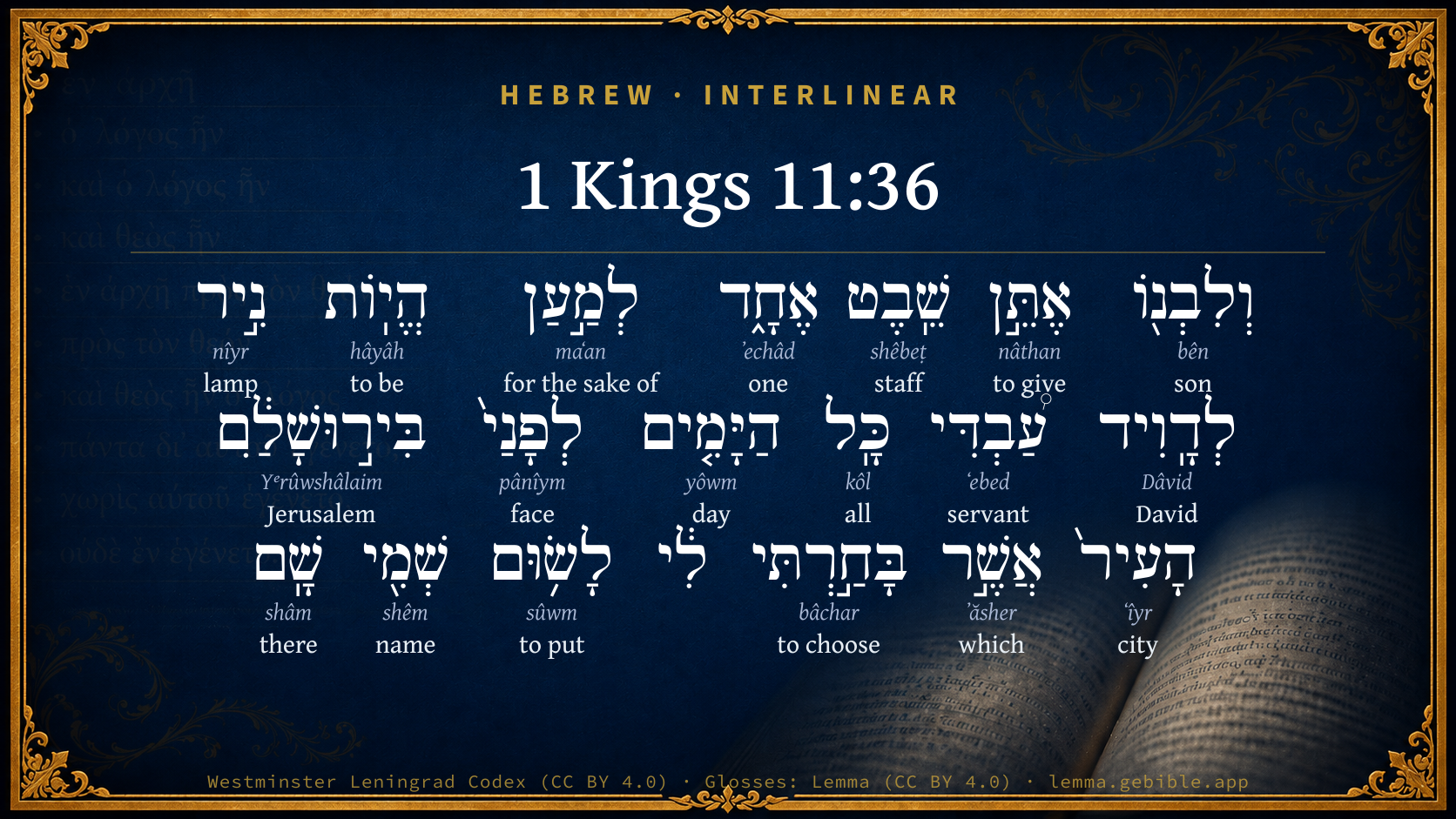
  1. וְלִבְנ֖וֹ bên H1121 “and · to/for · son · his” Conjunction + Preposition + Noun, Common, Masculine, Singular, Construct + Suffix, Personal, 3rd Person, Masculine, Singular
  2. אֶתֵּ֣ן nâthan H5414 “to give” Verb, Qal, Imperfect, 1st Person, Common, Singular
  3. שֵֽׁבֶט shêbeṭ H7626 “staff” Noun, Common, Masculine, Singular, Absolute
  4. אֶחָ֑ד ʼechâd H259 “one” Adjective, Cardinal number, Masculine, Singular, Absolute
  5. לְמַ֣עַן maʻan H4616 “for the sake of” Preposition
  6. הֱיֽוֹת hâyâh H1961 “to be” Verb, Qal, Infinitive Construct
  7. לְדָֽוִיד Dâvid H1732 “to/for · David” Preposition + Noun, Proper
  8. עַ֠בְדִּי ʻebed H5650 “servant · my” Noun, Common, Masculine, Singular, Construct + Suffix, Personal, 1st Person, Common, Singular
  9. כָּֽל kôl H3605 “all of” Noun, Common, Masculine, Singular, Construct
  10. הַיָּמִ֤ים yôwm H3117 “the · days” Particle, Definite Article + Noun, Common, Masculine, Plural, Absolute
  11. לְפָנַי֙ pânîym H6440 “to/for · face(s) · my” Preposition + Noun, Common, Both, Plural, Construct + Suffix, Personal, 1st Person, Common, Singular
  12. בִּיר֣וּשָׁלִַ֔ם Yᵉrûwshâlaim H3389 “in/at · Jerusalem” Preposition + Noun, Proper
  13. הָעִיר֙ ʻîyr H5892 “the · city” Particle, Definite Article + Noun, Common, Feminine, Singular, Absolute
  14. אֲשֶׁ֣ר ʼăsher H834 “which” Particle, Relative
  15. בָּחַ֣רְתִּי bâchar H977 “to choose” Verb, Qal, Perfect, 1st Person, Common, Singular
  16. לָשׂ֥וּם sûwm H7760 “to put” Preposition + Verb, Qal, Infinitive Construct
  17. שְׁמִ֖י shêm H8034 “name · my” Noun, Common, Masculine, Singular, Construct + Suffix, Personal, 1st Person, Common, Singular
  18. שָֽׁם shâm H8033 “there” Adverb

About this verse

These counts appear in no published source. They are computed here, from the morphology-tagged text and Lemma’s own curated glosses. What Lemma adds →

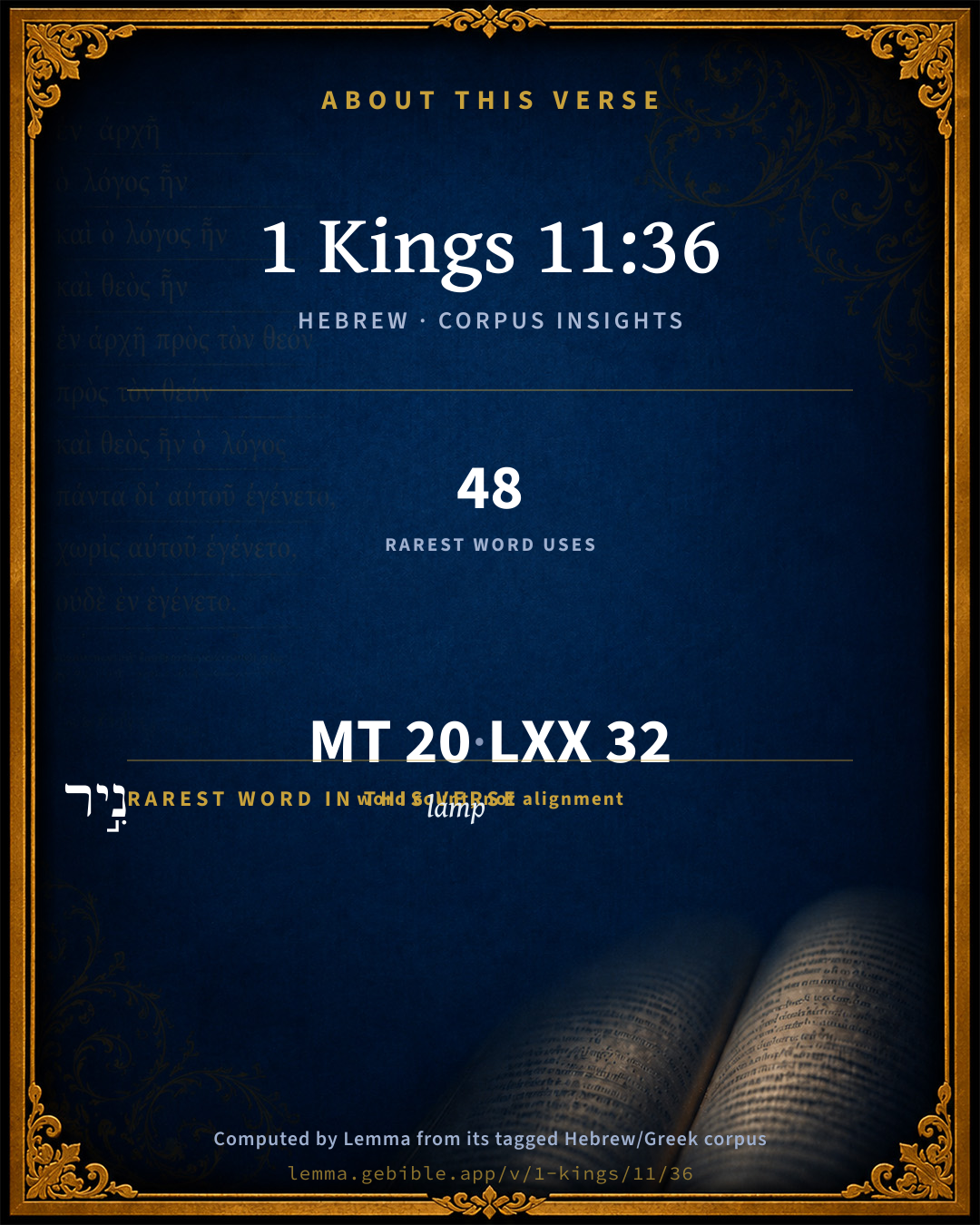
20
words
19
distinct lemmas
Historical
section

Shared distinctive vocabulary

נִ֣יר lamp H5216 occurs in 42 verses of the Hebrew Bible. Also found in:

Grammatical profile

  • 4 verbs
  • 11 nouns
  • 1 adjective
  • 2 prepositions
  • 1 adverb
  • 1 particle

Verb forms

  • אֶתֵּ֣ן Qal · Imperfect
  • הֱיֽוֹת Qal · Infinitive Construct
  • בָּחַ֣רְתִּי Qal · Perfect
  • לָשׂ֥וּם Qal · Infinitive Construct

Hebrew & Septuagint length

In English translation the verse runs 33 words from the Hebrew and 37 from the Septuagint (LXX English) — closely comparable.

A rough comparison of the two English renderings, which tokenize alike — not a word-level alignment.

Word counts can differ between the Hebrew and the Greek without any difference in meaning — e.g. the Hebrew direct-object marker אֵת has no separate Greek word, and Greek often adds the article ὁ.

In the original languages it is 20 Hebrew tokens and 32 Greek tokens — but the two are counted differently (Hebrew bundles its prefixes and suffixes into one token; the Greek is in lemma form), so that isn’t a like-for-like length.

Cross-references

18

Topical passages linked to 1 Kings 11:36 in the Treasury of Scripture Knowledge — connected by theme and wording, ordered by reader-vote popularity; previews shown in the World English Bible.

  • 1 Kings 11:13 However I will not tear away all the kingdom; but I will give one tribe to your son, for David my servant's sake, and for Jerusalem's sake which I have chosen.
  • 1 Kings 15:4 Nevertheless for David's sake did Yahweh his God give him a lamp in Jerusalem, to set up his son after him, and to establish Jerusalem;
  • 2 Kings 8:19 However Yahweh would not destroy Judah, for David his servant's sake, as he promised him to give to him a lamp for his children always.
  • 2 Samuel 21:17 But Abishai the son of Zeruiah helped him, and struck the Philistine, and killed him. Then the men of David swore to him, saying, You shall go no more out with us to battle, that you don't quench the lamp of Israel.
  • 2 Chronicles 21:7 However Yahweh would not destroy the house of David, because of the covenant that he had made with David, and as he promised to give a lamp to him and to his children always.
  • Psalms 132:17 There I will make the horn of David to bud. I have ordained a lamp for my anointed.
  • 2 Samuel 7:16 Your house and your kingdom shall be made sure for ever before you: your throne shall be established forever.
  • 2 Samuel 7:29 now therefore let it please you to bless the house of your servant, that it may continue forever before you; for you, Lord Yahweh, have spoken it: and with your blessing let the house of your servant be blessed forever.
  • 1 Kings 9:3 Yahweh said to him, I have heard your prayer and your supplication, that you have made before me: I have made this house holy, which you have built, to put my name there forever; and my eyes and my heart shall be there perpetually.
  • 1 Kings 11:32 (but he shall have one tribe, for my servant David's sake and for Jerusalem's sake, the city which I have chosen out of all the tribes of Israel);
  • Jeremiah 33:17–21 For thus says Yahweh: David shall never want a man to sit on the throne of the house of Israel;
  • Amos 9:11–12 In that day I will raise up the tent of David who is fallen, and close up its breaches, and I will raise up its ruins, and I will build it as in the days of old;
  • Luke 1:69–70 And has raised up a horn of salvation for us in the house of his servant David
  • Luke 1:78–79 Because of the tender mercy of our God, Whereby the dawn from on high will visit us,
  • Acts 15:16–17 'After these things I will return. I will again build the tent of David, which has fallen. I will again build its ruins. I will set it up,
  • Galatians 4:25–26 For this Hagar is Mount Sinai in Arabia, and answers to the Jerusalem that exists now, for she is in bondage with her children.
  • Hebrews 12:22 But you have come to Mount Zion, and to the city of the living God, the heavenly Jerusalem, and to innumerable hosts of angels,
  • Revelation 21:10 He carried me away in the Spirit to a great and high mountain, and showed me the holy city, Jerusalem, coming down out of heaven from God,

Cross-references courtesy of OpenBible.info (CC BY 4.0).

Hebrew and Greek witnesses Masoretic Hebrew ↔ Greek Septuagint

The same verse in the two great witnesses to the Old Testament, shown verse-for-verse.

These are two independent witnesses, not word-aligned to each other, and the Septuagint is shown in lemma (dictionary) form.

Hebrew 1 Kings 11:36 Masoretic · Westminster Leningrad Codex

וְלִבְנ֖וֹ אֶתֵּ֣ן שֵֽׁבֶט אֶחָ֑ד לְמַ֣עַן הֱיֽוֹת נִ֣יר לְדָֽוִיד עַ֠בְדִּי כָּֽל הַיָּמִ֤ים לְפָנַי֙ בִּיר֣וּשָׁלִַ֔ם הָעִיר֙ אֲשֶׁ֣ר בָּחַ֣רְתִּי לִ֔י לָשׂ֥וּם שְׁמִ֖י שָֽׁם

To his son will I give one tribe, that David my servant may have a lamp always before me in Jerusalem, the city which I have chosen me to put my name there.

World English Bible · Public Domain

Greek LXX 1 Kings 11:36 Septuagint · lemma form

ὁ δέ υἱός αὐτός δίδωμι ὁ δύο σκῆπτρον ὅπως εἰμί θέσις ὁ δοῦλος ἐγώ δαυίδ πᾶς ὁ ἡμέρα ἐνώπιον ἐγώ ἐν ἰερουσαλήμ ὁ πόλις ὅς ἐκλέγω ἐμαυτοῦ ὁ τίθημι ὄνομα ἐγώ ἐκεῖ

But to his son I will give the two remaining tribes, that my servant David may have an establishment continually before me in Jerusalem, the city which I have chosen for myself to put my name there.

LXX2012 (modern English Septuagint) · Public Domain

On this verse, The Cambridge Bible for Schools and Colleges discusses the Septuagint’s reading. Read the note in Commentary ↓

Hebrew: Westminster Leningrad Codex (CC BY 4.0). Greek: Septuagint (public domain); English from LXX2012 (modern English Septuagint) (Public Domain). How the Septuagint differs from the Hebrew →

Targum (Aramaic paraphrase)

1

The Targum is the ancient Jewish Aramaic paraphrase of the Hebrew Scriptures — an interpretive translation, not the Hebrew text itself. Onkelos (literal) and Pseudo-Jonathan (expansive) render the Torah, and Jonathan the Prophets. Coverage is partial: where no permissively-licensed English translation exists for a verse, only the Aramaic is shown. This is verse-level text, not a word-by-word alignment to the Hebrew.

  1. Targum Jonathan Prophets (Joshua–Malachi)
    וְלִבְרֵיהּ אֶתֵּן שִׁבְטָא חַד בְּדִיל לְקַיָמָא מַלְכוּ לְדָוִד עַבְדִי כָּל יוֹמַיָא קֳדָמַי בִּירוּשְׁלֵם קַרְתָּא דְאִתְרְעֵיתִי לְאַשְׁרָאָה שְׁכִנְתִּי תַּמָן:

    (no public-domain English translation for this verse)

    Targum Jonathan — Aramaic: “Mikraot Gedolot” (public domain). English: “Sefaria Community Translation” (CC0 1.0 (public-domain dedication)); “London "Chaldee Paraphrase," 1871” (public domain). Text via Sefaria.

Commentary

Notes on 1 Kings 11:36 from classic Christian and Jewish commentators (each source and its license shown beneath its notes). The classic Christian expositions comment on the surrounding passage and are grouped to its opening verse, so a note may address several verses; the Jewish commentaries on the Tanakh (Rashi and others) are per-verse, so they appear only where the commentator wrote on this verse.

Lemma curates 59 commentaries, every one of them public domain or Creative Commons licensed, each selected and text-cleaned for this edition rather than reprinted as found. About our sources →

Trapp's Complete Commentary

John Trapp

1Ki 11:36 And unto his son will I give one tribe, that David my servant may have a light alway before me in Jerusalem, the city which I have chosen me to put my name there.

Ver. 36. May have a light alway.] This was most properly fulfilled in Christ, who was "a light to lighten the Gentiles, and the glory of his people Israel." {Luk 2:32}

John Trapp, A Commentary or Exposition upon All the Books of the Old and New Testament (1647–1656) — public domain. Text from a community e-Sword module.

Tyndale Open Study Notes

Tyndale Open Resources

11:36 a lamp: David’s successors were to be living representatives of God’s covenant with David, and they were to shine as lights of God’s grace (15:4; 2 Kgs 8:19; 2 Chr 21:7). They pointed to Jesus, the descendant of David, who is the light of the world (John 1:4-5) and who fulfills God’s promises to David (Ezek 34:23-31).

Tyndale Open Study Notes — © Tyndale Open Resources, licensed CC BY-SA 4.0. Text via the HelloAO Bible API.

Geneva Bible (1599)

Geneva Bible translators

He hath respect unto the Messiah, which should be the bright star that should shine through all the world.

Geneva Bible (1599) marginal notes — public domain. Text via Bolls.life.

Adam Clarke's Commentary

Verse 36. That David my servant may have a light alway] That his posterity may never fail, and the regal line never become extinct. This, as we have already seen, was in reference to the Messiah. He was not only David's light, but he was a light to enlighten the Gentiles.

Adam Clarke's Commentary on the Bible (1810–1826) — public domain. Text from a community e-Sword/MySword module.

The Cambridge Bible for Schools and Colleges

gen. ed. J. J. S. Perowne

36. one tribe] Here again, as in 32, the LXX. has ‘two tribes.’

a light] Literally ‘a lamp.’ The idea is quite an Oriental one. In the tent was hung the lamp, for constant lighting, and the permanency of the home is implied in the lamp which is not extinguished. Cf. Psa_132:17. David’s line was to last, though most of the kingdom was taken from his descendants. The LXX. paraphrases by θέσις, i.e. a status, position.

The Cambridge Bible for Schools and Colleges (gen. ed. J. J. S. Perowne; Cambridge University Press, 1878–1918) — public domain. Text from a community e-Sword module.

John Gill's Exposition

And I will for this afflict the seed of David,.... For the idolatry Solomon had been guilty of, and connived at:

but not for ever; for when the ten tribes were carried captive, the kingdom of Judah flourished under Hezekiah, Josiah, &c. and though the tribe of Judah was carried captive, yet it returned after seventy years captivity, and had rulers over it of the seed of David; and especially to the Messiah has God given the throne of his father David, of whose kingdom there will he no end, Luk 1:32, and Jarchi's note on the text is,

"for in the days of the Messiah the kingdom shall return to it,''

the seed of David; and Abarbinel says, of a truth, at the coming of our Messiah, this prophecy will be fulfilled; but the true Messiah is come already, in whom it is fulfilled; see Kimchi and Abendana, who refer to Eze 37:19.

John Gill's Exposition of the Whole Bible (1746–1763) — public domain (CC PDM 1.0). Text via the HelloAO Bible API.

Albert Barnes' Notes on the Bible

That David may have a light - Compare the marginal references. The exact meaning of the expression is doubtful. Perhaps the best explanation is, that “light” here is taken as the essential feature of a continuing “home.”

Albert Barnes' Notes on the Bible (1834–1885) — public domain. Text from a community e-Sword/MySword module.

Haydock's Catholic Bible Commentary

A lamp. Posterity, (2 Kings xxi. 17.) power, and glory, 4 Kings viii. 19.

George Leo Haydock (1774–1849), Haydock's Catholic Family Bible and Commentary, 1859 edition — public domain. Excludes Psalms (Douay-Rheims chapter numbering differs from Protestant) and Deuterocanonical books (Catholic canon only).

Matthew Poole's English Annotations

A light, i.e. a son and successor, to preserve his name and memory, and to give light to the people in his stead. Kings are oft called

lights, partly from their great splendour, and partly for the counsel and comfort which their people have or should have from them. Compare 2Sa 21:17; 1Ki 15:4; Psa 132:17.

Alway before me; in my presence, which is in Jerusalem, and under my favour and protection.

Matthew Poole's English Annotations on the Holy Bible (1683–1685) — public domain. Text from a community e-Sword/MySword module.

Whedon's Commentary on the Bible

Daniel D. Whedon

36. A light alway before me — That is, a son to sit on the throne, and like a lamp or candle shine through the future ages, an evidence of the sure mercies of David, and a typical Messianic prophecy. Compare 2Sa_7:16.

Daniel D. Whedon (gen. ed.), Commentary on the Old and New Testaments (1874–1909) — public domain. Text from a community e-Sword module.

The Pulpit Commentary

And unto his son will I give one tribe cf. ver. 32, note, that David my servant may have a light alway before me The same expression is found in 1Ki_15:4; 2Ki_8:19; 2Ch_21:7; and compare Psa_132:17. Keil would explain it by 2Sa_21:17; but, 2Sa_14:7, "my coal which is left," appears to be a closer parallel. The idea is not that of a home (Rawlinson) but family, issue. We speak of the extinction of a family (Bahr) in Jerusalem, the city which I have chosen me to put my name there.

The Pulpit Commentary (1880–1919), ed. H.D.M. Spence-Jones & Joseph S. Exell — public domain. Text from a community e-Sword module.

Rashi

Rabbi Shlomo Yitzchaki (Rashi)

A lamp. A kingdom. ניר is an expression of a yoke.

Rashi on the Tanakh — English translations: “The Judaica Press complete Tanach with Rashi, translated by A. J. Rosenberg” (CC BY 4.0); “Pentateuch with Rashi's commentary by M. Rosenbaum and A.M. Silbermann, 1929-1934” (public domain); “The Metsudah Tanach series, Lakewood, N.J” (CC BY 4.0); and “The Book of Joshua, Metsudah Publications, 1997” (CC BY 4.0). Text via Sefaria.

Lesson kit

Teaching starters — assembled from the data on this page, not authored interpretation. Every prompt links to the verse data it draws on. Edit before teaching.

1 Kings, in the Historical, opens this verse with 20 words (19 distinct Hebrew lemmas). Its most distinctive word is nîyr (“lamp”). A historical commentator’s framing appears above. Read the whole chapter for the surrounding context.

Discussion questions

  1. What does “lamp” (nîyr) contribute to the verse as a whole?
  2. Exodus 25:37 shares the word «lamp» with this verse. How do the two illuminate each other?
  3. The translations on this page render this verse differently — a whole-verse word diff, not a word-by-word alignment. What might account for the different wordings?
  4. The verb «אֶתֵּ֣ן» is Qal Imperfect. How does its form color the action?
  5. Reading how Trapp's Complete Commentary and Tyndale Open Study Notes read this verse, where do the two commentators agree and where do they part?

Things to notice

Reading settings

Reading text

Shown beneath each verse's original-language words.

Old Testament
Old Testament edition

Read the OT as the Masoretic Hebrew (MT) or the Greek Septuagint (LXX).

English shown for the Greek Septuagint (in the Hebrew ↔ Greek comparison).

Comparing translations? Open the Compare panel on any verse page to stack up to four side by side.