
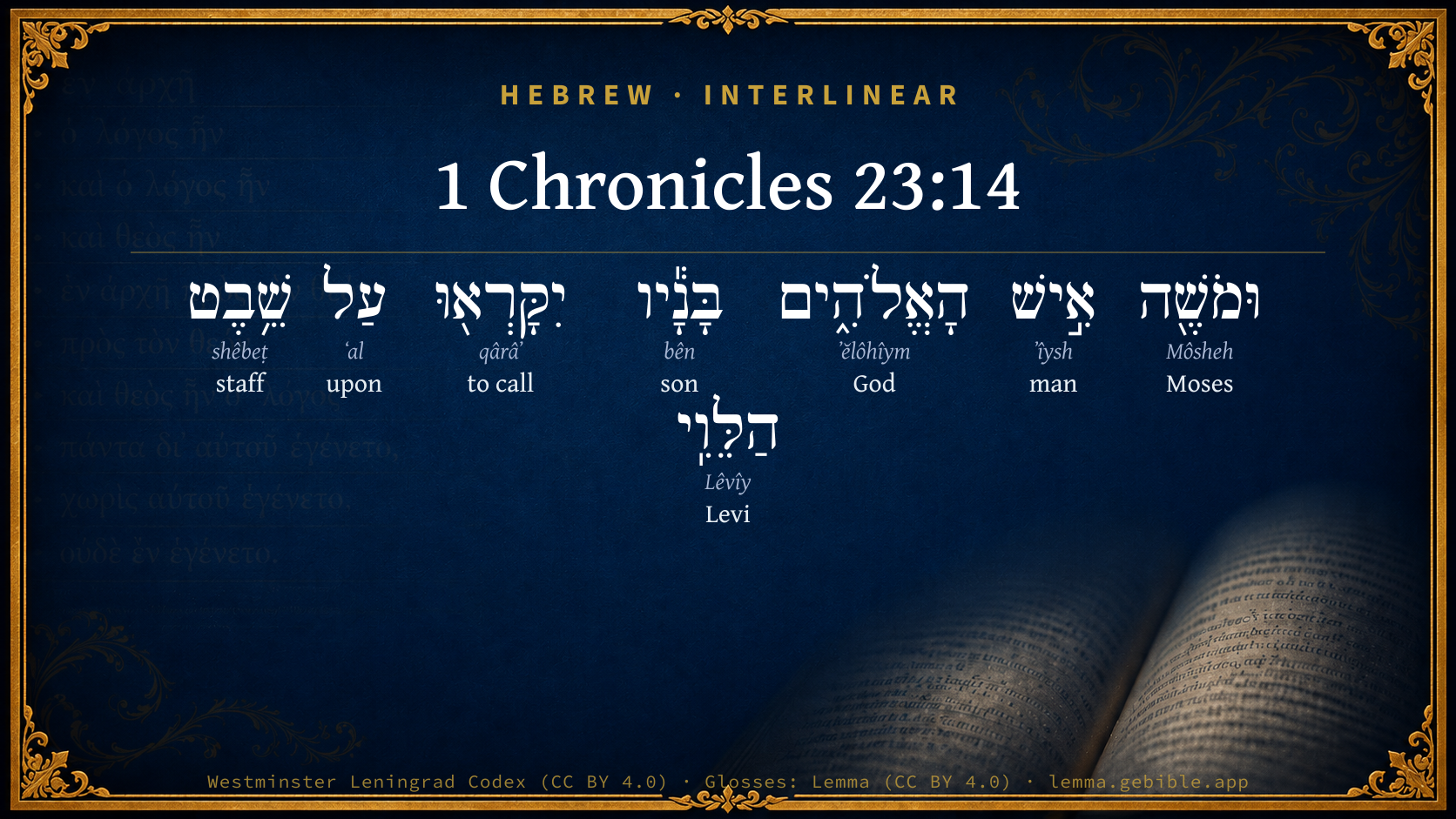
1 Chronicles 23:14

Hebrew (Westminster Leningrad Codex) 1 Chronicles 23:14 appears in the Hebrew Old Testament. The text above is from the Westminster Leningrad Codex. Each word links to its Strong’s number, a concise gloss, and parsing drawn from the Open Scriptures Hebrew Bible morphology. Click any word for its full Brown-Driver-Briggs (BDB) entry.
Download image
Cite this verse

1 Chronicles 23:14 (World English Bible). Public Domain. Lemma interlinear Bible study tool, https://lemma.gebible.app/v/1-chronicles/23/14.

Show BibTeX & RIS
BibTeX
RIS
English Translation
But as for Moses the man of God, his sons were named among the tribe of Levi.
World English Bible · Public Domain
Download a study sheet

One document with this verse’s original text, its word-by-word gloss line, the meaning frame, cross-references with their text, attributed commentary, and full source and license credits — printable, and it pastes into notes with its structure intact.

This verse Autodidact and up

Study sheet (.html) Plain text (.txt)

A passage Seminary Student

Up to 50 verses in one chapter. A passage sheet keeps up to 6 commentary sources and 12 cross-references per verse, in the order this page ranks them, and says so on the sheet whenever that leaves anything out. Ask for a single verse and you get the Autodidact verse sheet above.

Everything on this page stays free to read, with no account — the sheet is a download of what is already on screen, not access to it.

Want to remove ads? Support Godless Engineer
Compare translations 3

The same verse in 3 English versions, stacked beneath the original-language interlinear above. Click any original word for its lexicon entry.

Each is an independent rendering of the whole verse — the interlinear is not word-aligned to these translations.

Highlighted words mark where these versions differ — a whole-verse word diff, not a word-by-word alignment.

  • World English Bible Public Domain
    But as for Moses the man of God, his sons were named among the tribe of Levi.
  • King James Version Public Domain
    Now concerning Moses the man of God, his sons were named of the tribe of Levi.
  • unfoldingWord Literal Text CC BY-SA 4.0
    And Moses, the man of God, his sons were called according to the tribe of Levi.

unfoldingWord Literal Text — © unfoldingWord, licensed CC BY-SA 4.0. Word-aligned USFM3 via Door43 (git.door43.org/unfoldingWord/en_ult).

Versions to compare (up to 4)

3 of 4 selected

Show all 18 translations

Every available English version of this verse, each an independent rendering of the whole verse.

  • World English Bible Public Domain
    But as for Moses the man of God, his sons were named among the tribe of Levi.
  • Berean Standard Bible Public Domain
    As for Moses the man of God, his sons were named among the tribe of Levi.
  • Majority Standard Bible Public Domain
    As for Moses the man of God, his sons were named among the tribe of Levi.
  • King James Version Public Domain
    Now concerning Moses the man of God, his sons were named of the tribe of Levi.
  • American Standard Version (1901) Public Domain
    But as for Moses the man of God, his sons were named among the tribe of Levi.
  • Revised Version (1885) Public Domain
    But as for Moses the man of God, his sons were named among the tribe of Levi.
  • Geneva Bible (1599) Public Domain
    Moses also the man of God, and his children were named with the tribe of Leui.
  • Douay-Rheims (1899) Public Domain
    The sons also of Moses, the man of God, were numbered in the tribe of Levi.
  • Young's Literal Translation Public Domain
    As to Moses, the man of God, his sons are called after the tribe of Levi.
  • Literal Standard Version CC BY-SA 4.0
    As for Moses, the man of God, his sons are called after the tribe of Levi.
  • Unlocked Literal Bible CC BY-SA 4.0
    But as for Moses the man of God, his sons were considered to be Levites.
  • unfoldingWord Literal Text CC BY-SA 4.0
    And Moses, the man of God, his sons were called according to the tribe of Levi.
  • Darby Bible Public Domain
    -- And as to Moses the man of God, his sons were named of the tribe of Levi.
  • World Messianic Bible Public Domain
    But as for Moses the man of God, his sons were named among the tribe of Levi.
  • Webster's Bible Public Domain
    Now concerning Moses the man of God, his sons were named of the tribe of Levi.
  • Free Bible Version CC BY-SA 4.0
    As for Moses, the man of God, his sons were included with the tribe of Levi.
  • Bible in Basic English Public Domain
    And the sons of Moses, the man of God, were put into the list of the tribe of Levi.
  • JPS Tanakh (1917) Public Domain
    But as for Moses the man of God, his sons are named among the tribe of Levi.

Literal Standard Version (2020), Covenant Press — licensed CC BY-SA 4.0. Text via the HelloAO Bible API (eBible.org). Unlocked Literal Bible (unfoldingWord) — licensed CC BY-SA 4.0. Text via the HelloAO Bible API (eBible.org). unfoldingWord Literal Text — © unfoldingWord, licensed CC BY-SA 4.0. Word-aligned USFM3 via Door43 (git.door43.org/unfoldingWord/en_ult). Free Bible Version, Dr. Jonathan Gallagher — licensed CC BY-SA 4.0. Text via the HelloAO Bible API (eBible.org).

Word by word

More ways to search: Search by grammar → Find every occurrence → Compare this word →

Practice this passage: Drill this verse → Learn its vocabulary →

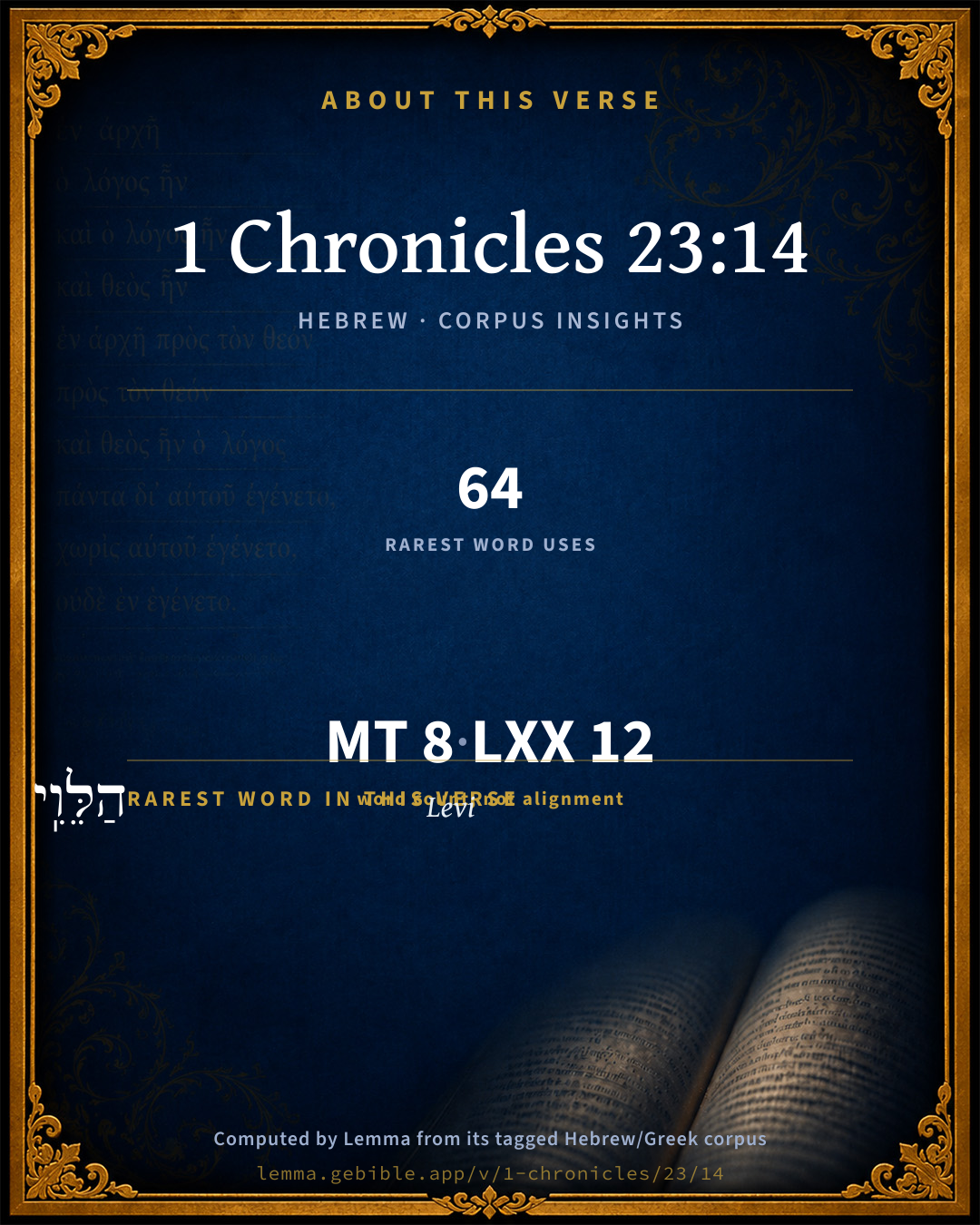
About this verse

These counts appear in no published source. They are computed here, from the morphology-tagged text and Lemma’s own curated glosses. What Lemma adds →

8
words
8
distinct lemmas
Historical
section

Grammatical profile

  • 1 verb
  • 6 nouns
  • 1 preposition

Verb forms

  • יִקָּרְא֖וּ Niphal · Imperfect

Hebrew & Septuagint length

In English translation the verse runs 17 words from the Hebrew and 17 from the Septuagint (LXX English) — the same length.

A rough comparison of the two English renderings, which tokenize alike — not a word-level alignment.

Word counts can differ between the Hebrew and the Greek without any difference in meaning — e.g. the Hebrew direct-object marker אֵת has no separate Greek word, and Greek often adds the article ὁ.

In the original languages it is 8 Hebrew tokens and 12 Greek tokens — but the two are counted differently (Hebrew bundles its prefixes and suffixes into one token; the Greek is in lemma form), so that isn’t a like-for-like length.

Cross-references

3

Topical passages linked to 1 Chronicles 23:14 in the Treasury of Scripture Knowledge — connected by theme and wording, ordered by reader-vote popularity; previews shown in the World English Bible.

  • Deuteronomy 33:1 This is the blessing, with which Moses the man of God blessed the children of Israel before his death.
  • 1 Chronicles 26:23–25 Of the Amramites, of the Izharites, of the Hebronites, of the Uzzielites:
  • Psalms 90:1 Lord, you have been our dwelling place for all generations.

Cross-references courtesy of OpenBible.info (CC BY 4.0).

Hebrew and Greek witnesses Masoretic Hebrew ↔ Greek Septuagint

The same verse in the two great witnesses to the Old Testament, shown verse-for-verse.

These are two independent witnesses, not word-aligned to each other, and the Septuagint is shown in lemma (dictionary) form.

Hebrew 1 Chronicles 23:14 Masoretic · Westminster Leningrad Codex

וּמֹשֶׁ֖ה אִ֣ישׁ הָאֱלֹהִ֑ים בָּנָ֕יו יִקָּרְא֖וּ עַל שֵׁ֥בֶט הַלֵּוִֽי

But as for Moses the man of God, his sons were named among the tribe of Levi.

World English Bible · Public Domain

Greek LXX 1 Chronicles 23:14 Septuagint · lemma form

καί μωυσῆς ἄνθρωπος ὁ θεός υἱός αὐτός καλέω εἰς φυλή ὁ λευί

And as for Moses the man of God, his sons were reckoned to the tribe of Levi.

LXX2012 (modern English Septuagint) · Public Domain

Hebrew: Westminster Leningrad Codex (CC BY 4.0). Greek: Septuagint (public domain); English from LXX2012 (modern English Septuagint) (Public Domain). How the Septuagint differs from the Hebrew →

Commentary

Notes on 1 Chronicles 23:14 from classic Christian and Jewish commentators (each source and its license shown beneath its notes). The classic Christian expositions comment on the surrounding passage and are grouped to its opening verse, so a note may address several verses; the Jewish commentaries on the Tanakh (Rashi and others) are per-verse, so they appear only where the commentator wrote on this verse.

Lemma curates 59 commentaries, every one of them public domain or Creative Commons licensed, each selected and text-cleaned for this edition rather than reprinted as found. About our sources →

Trapp's Complete Commentary

John Trapp

1Ch 23:14 Now [concerning] Moses the man of God, his sons were named of the tribe of Levi.

Ver. 14. Now concerning Moses the man of God.] Who was so familiar with God, and his ambassador to the people. We must think and speak honourably of the saints departed.

His sons were named of the tribe of Levi.] Chief of the Levites, {1Ch 26:23} but below the sons of Aaron, the priests. And here A Lapide hath this good note, Mira fuit Moysis resignatio et humilitas, &c. Wonderful was the self-denial and humility of Moses in submitting to God’s appointment herein, that the principality should be transferred to Joshua, and that his sons should be reckoned not priests, but Levites only, though himself were "king in Jeshurun."

John Trapp, A Commentary or Exposition upon All the Books of the Old and New Testament (1647–1656) — public domain. Text from a community e-Sword module.

The Biblical Illustrator

Joseph S. Exell

1Ch_23:14

Moses the man of God.

The man of God

1. A beautiful description of any man.

2. A possible description of every man.

3. A needful description of each man if he is to abide in his Fathers house for ever.

Some men have attained eminence in godliness. No renown is to be compared with this, no influence is ,equal to that which arises from such recognition. (J. Parker, D. D.)

When is man a man of God?

1. When he believes in Gods existence.

2. When he is assured of Gods providence.

3. When he has sunk his will in the Divine purpose.

4. When he lives and moves and has his being in God. (J. Parker, D. D.)

The Biblical Illustrator, edited by Joseph S. Exell (c. 1880s–1900s) — public domain. Text from a community e-Sword module.

Joseph Benson's Commentary

1Ch 23:14. His sons were named of the tribe of Levi — They were accounted only as common Levites, and were not priests: which is mentioned for the honour of Moses, and the demonstration of his eminent piety and self-denial, who willingly left the government to Joshua, and the priesthood to Aaron, and was content to have his posterity reduced to a private and mean condition.

Joseph Benson's Commentary on the Old and New Testaments (1811–1818) — public domain. Text from a community e-Sword module.

Geneva Bible (1599)

Geneva Bible translators

They were but of the order of the Levites, and not of the Priests as Aaron’s sons.

Geneva Bible (1599) marginal notes — public domain. Text via Bolls.life.

Jamieson, Fausset & Brown

Robert Jamieson, A. R. Fausset & David Brown

concerning Moses--His sons were ranked with the Levites generally, but not introduced into the distinctive portion of the descendants of Levi, who were appointed to the special functions of the priesthood.

Jamieson, Fausset & Brown — Commentary Critical and Explanatory on the Whole Bible (1871) — public domain (CC PDM 1.0). Text via the HelloAO Bible API.

Adam Clarke's Commentary

Verse 14. Moses the man of God] "Moses the prophet of God," - T.

Adam Clarke's Commentary on the Bible (1810–1826) — public domain. Text from a community e-Sword/MySword module.

Ellicott's Commentary for English Readers

(14) Now concerning Moses the man of God.—Rather, Now Moses, the man of God.

His sons were named (or should be named) of the tribe of Levi.—See Gen_48:6 for the phrase “to be called after” (niqrâ’ ‘al). Aaron’s sons were priests; but the sons of Moses, his brother, were reckoned as simple Levites, and therefore their houses are here enumerated (1Ch_23:15-17).

The man of God.—See Deu_33:1; Psalms 90; Jos_14:6. David is so called (2Ch_8:14; Neh_12:24). The meaning of the title is one charged with a Divine mission. Hence the prophets were so called in the times of the kings; and St. Paul applies the title to Timothy (1Ti_6:11).

A Bible Commentary for English Readers, edited by Charles John Ellicott (1878–1897) — public domain. Text from a community e-Sword module.

The Cambridge Bible for Schools and Colleges

gen. ed. J. J. S. Perowne

14. Now concerning Moses] R.V. But as for Moses.

of the tribe of Levi] R.V. among the tribe of Levi. The descendants of Moses as distinguished from those of Aaron had the standing, not of priests but of Levites.

The Cambridge Bible for Schools and Colleges (gen. ed. J. J. S. Perowne; Cambridge University Press, 1878–1918) — public domain. Text from a community e-Sword module.

John Gill's Exposition

The sons of Moses were Gershom and Eliezer. See Exo 18:3.

.

1 Chronicles 23:16

ch1 23:16

ch1 23:16

ch1 23:16Of the sons of Gershom, Shebuel was the chief. Of the posterity of Gershom in the times of David, called Shubael, Ch1 24:20, the Targum makes him to be the same with Jonathan, Jdg 18:30. (l).

(l) So in Hieron. Trad. Heb. in Paralipom. fol. 84. c.

John Gill's Exposition of the Whole Bible (1746–1763) — public domain (CC PDM 1.0). Text via the HelloAO Bible API.

Haydock's Catholic Bible Commentary

Levi, but not among the priests, (Calmet) though their father was an extraordinary priest, appointed by God to anoint Aaron, Psalm xcviii. (Du Hamel)

George Leo Haydock (1774–1849), Haydock's Catholic Family Bible and Commentary, 1859 edition — public domain. Excludes Psalms (Douay-Rheims chapter numbering differs from Protestant) and Deuterocanonical books (Catholic canon only).

Matthew Poole's English Annotations

i.e. They were accounted only as common Levites, and were not priests; which is mentioned partly to secure the priesthood within the bounds to which God had confined it, lest they should presume to invade it upon a confidence in the nobleness of their extraction; and partly for the honour of Moses, and the demonstration of his eminent piety and self-denial, who willingly left the government to Joshua, and the priesthood to Aaron, and was content to have his posterity reduced to a very private and mean condition.

Matthew Poole's English Annotations on the Holy Bible (1683–1685) — public domain. Text from a community e-Sword/MySword module.

Whedon's Commentary on the Bible

Daniel D. Whedon

14. Moses… his sons were named of the tribe of Levi — Unlike his priestly brother Aaron, his sons were numbered with the ordinary Levites.

Daniel D. Whedon (gen. ed.), Commentary on the Old and New Testaments (1874–1909) — public domain. Text from a community e-Sword module.

The Pulpit Commentary

Moses the man of God. This title is distinguished by the presence of the article. The "Speaker"s Commentary" mentions it as occurring only nine times, of which five instances belong to Moses (Deu_33:1; Jos_14:6; 2Ch_30:16; Ezr_3:2; with the present place) three instances show the title applied to David (2Ch_8:14; Neh_12:24, Neh_12:36) and once it is applied to Shemaiah. (1Ki_12:22) Although the sons of Moses belonged, as is here said, to the tribe of Levi, they did not belong to that portion which discharged priestly duties.

HOMILIES BY J.R. THOMSON Ver. 14.

The man of God.

This designation was not peculiar to Moses. In the historical books of the Old Testament, we find prophets sent with a Divine message to their fellow-mortals described as men of God. In the New Testament we meet with the expression in Paul"s Epistles, where the inspired writers of the Hebrew Scriptures are denominated "holy men of God," and where Timothy is addressed in similar language. Moses is designated" the man of God" in the Book of Deuteronomy, is so called by Caleb as we read in the Book of Joshua, and is so denominated in the title prefixed to the ninetieth psalm.

I MOSES WAS THE MAN OF GOD"S SELECTION AND PRESERVATION. A kind Providence watched over him from the beginning of his life. Whilst multitudes were put to death, the child of Divine beauty was spared.

II MOSES WAS THE MAN OF GOD"S EDUCATION AND DISCIPLINE. Trained in the court and the learning of Egypt, and afterwards in the rougher but wholesome school of the Midian desert, this man was fitted by knowledge, by hardship, by society of the most diverse kinds, for the great future before him.

III MOSES WAS THE MAN OF GOD"S VOCATION. When God had trained him for his work, he called him, and made known to him his sacred Name and attributes, that thenceforth he might have the living consciousness of the Divine presence.

IV MOSES WAS THE MAN WHOM GOD ADMITTED TO SPECIAL COMMUNION WITH HIMSELF. By the flaming thorn tree, upon the mountain solitude, at the door of the sacred tent, Jehovah met with his servant, and spake with him as a man with his friend.

V MOSES WAS A MAN TO WHOM GOD COMMUNICATED HIS OWN SPIRIT AND HIS OWN CHARACTER. Again and again did the Lord speak words of confidence and approval with regard to his servant

Moses. His meekness and holiness, his zeal for the glory of God, his patriotic desires for the welfare of his nation, all were indications that he was no unconscious instrument, but a willing and consecrated agent, in the hands of Heaven.

VI MOSES WAS THE MAN WHOM GOD AUTHORIZED TO DECLARE HIS WILL. "The Law was given by Moses." Hence he is called "the lawgiver." Penetrated with the mind of the Supreme, he was empowered to promulgate, for the guidance of Israel, a code of laws altogether superior to those of other nations in ancient times. These laws embraced the moral as well as the civic life of the community, and aimed at the regulation of the heart as well as the life. Not only ordinances for conduct generally, but instructions for religious worship and sacrifice, were communicated by this "mediator" and "servant" and "man" of God.

VII MOSES WAS THE MAN GOD CHOSE TO BRING OUT AND LEAD HIS PEOPLE. He was the shepherd who brought up the flock out of Egypt, and conducted the wanderers through the wilderness, and brought them to the verge of the green pastures of Canaan. God led, by the hand of his servant, the people who were his heritage.

VIII MOSES WAS THE MAN WHOM GOD BURIED AND SO TOOK TO HIMSELF. AS he was often alone with Jehovah in life, so he was alone with him in death.

IX MOSES WAS GOD"S TYPE OF CHRIST. Jesus was the Prophet whom God raised up like unto his servant Moses. "The Law was given by Moses, but grace and truth came by Jesus Christ.

PRACTICAL LESSON. If the children of Israel were bound to hear and obey Moses, the man of God, the servant, how much more are we bound to hear and obey Christ, the Son of God! T.

The Pulpit Commentary (1880–1919), ed. H.D.M. Spence-Jones & Joseph S. Exell — public domain. Text from a community e-Sword module.

John Wesley's Explanatory Notes

Levi - They were accounted only as common Levites, and were not priests: which is mentioned for the honour of Moses, and the demonstration of his eminent piety and self-denial, who willingly left the government to Joshua, and the priesthood to Aaron, and was content to have his posterity reduced to a private and mean condition.

John Wesley, Explanatory Notes Upon the Whole Bible (1754–1765) — public domain. Text via the GEBible commentary corpus.

Keil & Delitzsch

C. F. Keil & F. Delitzsch

The sons of Moses were Gershom and Eliezer. See Exo 18:3.

.

1 Chronicles 23:16

ch1 23:16

ch1 23:16

ch1 23:16Of the sons of Gershom, Shebuel was the chief. Of the posterity of Gershom in the times of David, called Shubael, Ch1 24:20, the Targum makes him to be the same with Jonathan, Jdg 18:30. (l).

(l) So in Hieron. Trad. Heb. in Paralipom. fol. 84. c.

Keil & Delitzsch — Biblical Commentary on the Old Testament (1861–1891) — public domain (CC PDM 1.0). Text via the HelloAO Bible API. (Old Testament only.)

Lesson kit

Teaching starters — assembled from the data on this page, not authored interpretation. Every prompt links to the verse data it draws on. Edit before teaching.

1 Chronicles, in the Historical, opens this verse with 8 words (8 distinct Hebrew lemmas). Its most distinctive word is Lêvîy (“Levi”). A historical commentator’s framing appears above. Read the whole chapter for the surrounding context.

Discussion questions

  1. The word Lêvîy carries the sense “Levi.” How does it shape the verse?
  2. How does Deuteronomy 33:1, which shares this passage’s theme, read alongside this verse?
  3. The translations on this page render this verse differently — a whole-verse word diff, not a word-by-word alignment. What might account for the different wordings?
  4. «יִקָּרְא֖וּ» is a Niphal Imperfect verb. How does that grammatical form shape the action described?
  5. Compare how Trapp's Complete Commentary and The Biblical Illustrator read this verse. Where do they agree or differ?

Things to notice

Reading settings

Reading text

Shown beneath each verse's original-language words.

Old Testament
Old Testament edition

Read the OT as the Masoretic Hebrew (MT) or the Greek Septuagint (LXX).

English shown for the Greek Septuagint (in the Hebrew ↔ Greek comparison).

Comparing translations? Open the Compare panel on any verse page to stack up to four side by side.