
Judges 18:30

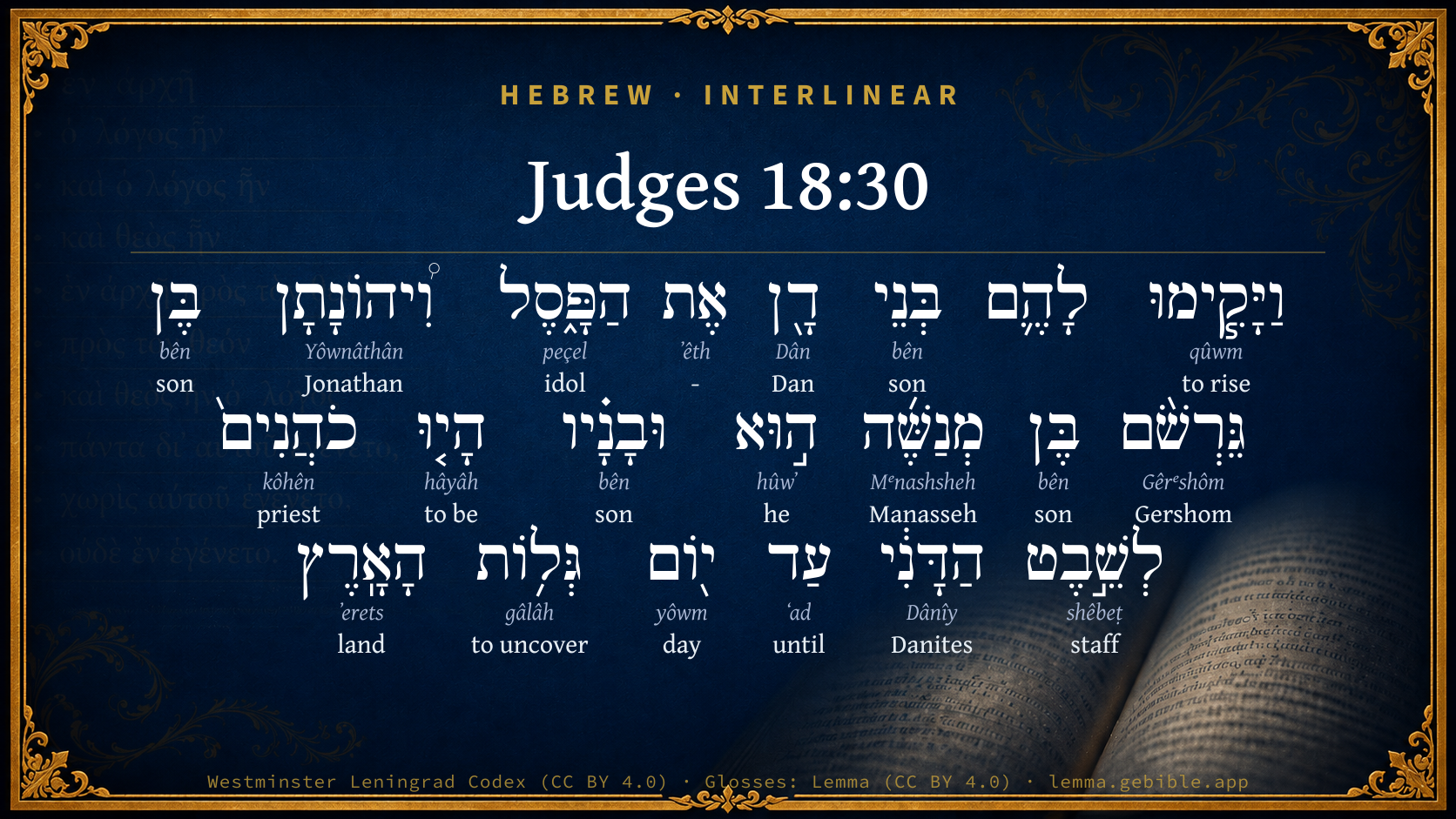
Hebrew (Westminster Leningrad Codex) Judges 18:30 appears in the Hebrew Old Testament. The text above is from the Westminster Leningrad Codex. Each word links to its Strong’s number, a concise gloss, and parsing drawn from the Open Scriptures Hebrew Bible morphology. Click any word for its full Brown-Driver-Briggs (BDB) entry.
Download image
Cite this verse

Judges 18:30 (World English Bible). Public Domain. Lemma interlinear Bible study tool, https://lemma.gebible.app/v/judges/18/30.

Show BibTeX & RIS
BibTeX
RIS
English Translation
The children of Dan set up for themselves the engraved image: and Jonathan, the son of Gershom, the son of Moses, he and his sons were priests to the tribe of the Danites until the day of the captivity of the land.
World English Bible · Public Domain
Highlights
  • 1 first appearance in the Hebrew Bible
Full analysis ↓
Download a study sheet

One document with this verse’s original text, its word-by-word gloss line, the meaning frame, cross-references with their text, attributed commentary, and full source and license credits — printable, and it pastes into notes with its structure intact.

This verse Autodidact and up

Study sheet (.html) Plain text (.txt)

A passage Seminary Student

Up to 50 verses in one chapter. A passage sheet keeps up to 6 commentary sources and 12 cross-references per verse, in the order this page ranks them, and says so on the sheet whenever that leaves anything out. Ask for a single verse and you get the Autodidact verse sheet above.

Everything on this page stays free to read, with no account — the sheet is a download of what is already on screen, not access to it.

Want to remove ads? Support Godless Engineer
Compare translations 3

The same verse in 3 English versions, stacked beneath the original-language interlinear above. Click any original word for its lexicon entry.

Each is an independent rendering of the whole verse — the interlinear is not word-aligned to these translations.

Highlighted words mark where these versions differ — a whole-verse word diff, not a word-by-word alignment.

  • World English Bible Public Domain
    The children of Dan set up for themselves the engraved image: and Jonathan, the son of Gershom, the son of Moses, he and his sons were priests to the tribe of the Danites until the day of the captivity of the land.
  • King James Version Public Domain
    And the children of Dan set up the graven image: and Jonathan, the son of Gershom, the son of Manasseh, he and his sons were priests to the tribe of Dan until the day of the captivity of the land.
  • unfoldingWord Literal Text CC BY-SA 4.0
    And the sons of Dan raised up the idol for themselves. And Jonathan, the son of Gershom, the son of Manasseh, he and his sons were priests for the tribe of the Danite until the day of the exile of the land.

unfoldingWord Literal Text — © unfoldingWord, licensed CC BY-SA 4.0. Word-aligned USFM3 via Door43 (git.door43.org/unfoldingWord/en_ult).

Versions to compare (up to 4)

3 of 4 selected

Show all 18 translations

Every available English version of this verse, each an independent rendering of the whole verse.

  • World English Bible Public Domain
    The children of Dan set up for themselves the engraved image: and Jonathan, the son of Gershom, the son of Moses, he and his sons were priests to the tribe of the Danites until the day of the captivity of the land.
  • Berean Standard Bible Public Domain
    The Danites set up idols for themselves, and Jonathan son of Gershom, the son of Moses, and his sons were priests for the tribe of Dan until the day of the captivity of the land.
  • Majority Standard Bible Public Domain
    The Danites set up idols for themselves, and Jonathan son of Gershom, the son of Moses, and his sons were priests for the tribe of Dan until the day of the captivity of the land.
  • King James Version Public Domain
    And the children of Dan set up the graven image: and Jonathan, the son of Gershom, the son of Manasseh, he and his sons were priests to the tribe of Dan until the day of the captivity of the land.
  • American Standard Version (1901) Public Domain
    And the children of Dan set up for themselves the graven image: and Jonathan, the son of Gershom, the son of Moses, he and his sons were priests to the tribe of the Danites until the day of the captivity of the land.
  • Revised Version (1885) Public Domain
    And the children of Dan set up for themselves the graven image: and Jonathan, the son of Gershom, the son of Moses, he and his sons were priests to the tribe of the Danites until the day of the captivity of the land.
  • Geneva Bible (1599) Public Domain
    Then the children of Dan set them vp the grauen image: and Ionathan the sonne of Gershom, the sonne of Manasseh and his sonnes were the Priestes in the tribe of the Danites vntil the day of the captiuitie of the lande.
  • Douay-Rheims (1899) Public Domain
    And they set up to themselves the graven idol, and Jonathan the son of Gersam the son of Moses, he and his sons were priests in the tribe of Dan, until the day of their captivity.
  • Young's Literal Translation Public Domain
    And the sons of Dan raise up for themselves the graven image, and Jonathan son of Gershom, son of Manasseh, he and his sons have been priests to the tribe of the Danite, till the day of the removal of `the people' of the land.
  • Literal Standard Version CC BY-SA 4.0
    And the sons of Dan raise up the carved image for themselves, and Jonathan son of Gershom, son of Manasseh, he and his sons have been priests for the tribe of the Danite, until the day of the expulsion of [the people] of the land.
  • Unlocked Literal Bible CC BY-SA 4.0
    The people of Dan set up the carved figure for themselves. Jonathan son of Gershom, son of Moses, he and his sons were priests for the tribe of the Danites until the day of the land's captivity.
  • unfoldingWord Literal Text CC BY-SA 4.0
    And the sons of Dan raised up the idol for themselves. And Jonathan, the son of Gershom, the son of Manasseh, he and his sons were priests for the tribe of the Danite until the day of the exile of the land.
  • Darby Bible Public Domain
    And the Danites set up the graven image for themselves; and Jonathan the son of Gershom, son of Moses, and his sons were priests to the tribe of the Danites until the day of the captivity of the land.
  • World Messianic Bible Public Domain
    The children of Dan set up for themselves the engraved image; and Jonathan, the son of Gershom, the son of Moses, and his sons were priests to the tribe of the Danites until the day of the captivity of the land.
  • Webster's Bible Public Domain
    And the children of Dan set up the graven image: and Jonathan, the son of Gershom, the son of Manasseh, he and his sons were priests to the tribe of Dan until the day of the captivity of the land.
  • Free Bible Version CC BY-SA 4.0
    The Danites erected the carved idol to worship, and Jonathan, son of Gershom, son of Moses, and his sons became priests for the tribe of Dan until the time when the people went into captivity from the land.
  • Bible in Basic English Public Domain
    (And the children of Dan put up the pictured image for themselves; and Jonathan, the son of Gershom, the son of Moses, and his sons were priests for the tribe of the Danites till the day when the ark was taken prisoner.)
  • JPS Tanakh (1917) Public Domain
    And the children of Dan set up for themselves the graven image; and Jonathan, the son of Gershom, the son of Manasseh, he and his sons were priests to the tribe of the Danites until the day of the captivity of the land.

Literal Standard Version (2020), Covenant Press — licensed CC BY-SA 4.0. Text via the HelloAO Bible API (eBible.org). Unlocked Literal Bible (unfoldingWord) — licensed CC BY-SA 4.0. Text via the HelloAO Bible API (eBible.org). unfoldingWord Literal Text — © unfoldingWord, licensed CC BY-SA 4.0. Word-aligned USFM3 via Door43 (git.door43.org/unfoldingWord/en_ult). Free Bible Version, Dr. Jonathan Gallagher — licensed CC BY-SA 4.0. Text via the HelloAO Bible API (eBible.org).

Word by word

More ways to search: Search by grammar → Find every occurrence → Compare this word →

Practice this passage: Drill this verse → Learn its vocabulary →

הַדָּנִ֔י
Dânîy
H1839
“the · Danites”
Particle, Definite Article + Noun, Gentilic, Masculine, Singular, Absolute
Part of Speech
Particle + Noun
Type
Gentilic
Gender
Masculine
Number
Singular
State
Absolute
Full BDB Definition

Origin: patronymically from H1835

TWOT: None

Danites = "judge" - descendants of Dan, son of Jacob - inhabitants of the territory of Dan
  1. וַיָּקִ֧ימוּ qûwm H6965 “and · to rise” Conjunction + Verb, Hiphil, Sequential Imperfect, 3rd Person, Masculine, Plural
  2. בְּנֵי bên H1121 “sons of” Noun, Common, Masculine, Plural, Construct
  3. דָ֖ן Dân H1835 “Dan” Noun, Proper
  4. אֶת ʼêth H853 “-” Particle, Direct Object
  5. הַפָּ֑סֶל peçel H6459 “the · idol” Particle, Definite Article + Noun, Common, Masculine, Singular, Absolute
  6. וִ֠יהוֹנָתָן Yôwnâthân H3129 “and · Jonathan” Conjunction + Noun, Proper
  7. בֶּן bên H1121 “son of” Noun, Common, Masculine, Singular, Construct
  8. גֵּרְשֹׁ֨ם Gêrᵉshôm H1647 “Gershom” Noun, Proper
  9. בֶּן bên H1121 “son of” Noun, Common, Masculine, Singular, Construct
  10. מְנַשֶּׁ֜ה Mᵉnashsheh H4519 “Manasseh” Noun, Proper
  11. ה֣וּא hûwʼ H1931 “he” Pronoun, Personal, 3rd Person, Masculine, Singular
  12. וּבָנָ֗יו bên H1121 “and · sons · his” Conjunction + Noun, Common, Masculine, Plural, Construct + Suffix, Personal, 3rd Person, Masculine, Singular
  13. הָי֤וּ hâyâh H1961 “to be” Verb, Qal, Perfect, 3rd Person, Common, Plural
  14. כֹהֲנִים֙ kôhên H3548 “priests” Noun, Common, Masculine, Plural, Absolute
  15. לְשֵׁ֣בֶט shêbeṭ H7626 “to/for · staff of” Preposition + Noun, Common, Masculine, Singular, Construct
  16. עַד ʻad H5704 “until” Preposition
  17. י֖וֹם yôwm H3117 “day of” Noun, Common, Masculine, Singular, Construct
  18. גְּל֥וֹת gâlâh H1540 “to uncover” Verb, Qal, Infinitive Construct
  19. הָאָֽרֶץ ʼerets H776 “the · land” Particle, Definite Article + Noun, Common, Both, Singular, Absolute

About this verse

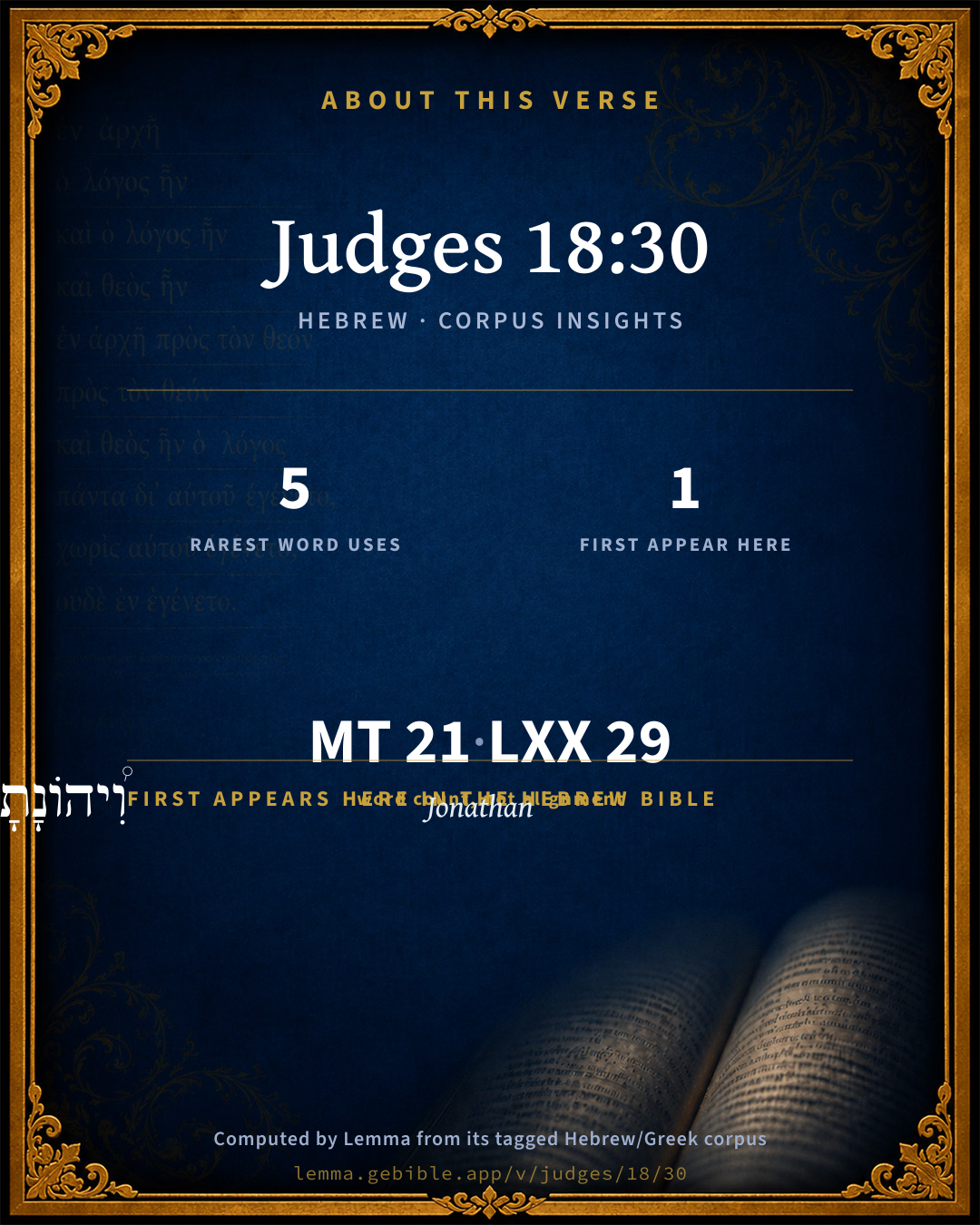
These counts appear in no published source. They are computed here, from the morphology-tagged text and Lemma’s own curated glosses. What Lemma adds →

21
words
17
distinct lemmas
Historical
section

Notable vocabulary

The rarest word here is הַדָּנִ֔י Danites H1839 — appearing just 5 times in the whole Hebrew Bible.

First appearance in Scripture

This word makes its first canonical appearance in the Hebrew Bible here:

  • וִ֠יהוֹנָתָן Jonathan H3129

Shared distinctive vocabulary

הַדָּנִ֔י Danites H1839 occurs in 5 verses of the Hebrew Bible. Also found in:

Grammatical profile

  • 3 verbs
  • 14 nouns
  • 1 pronoun
  • 2 prepositions
  • 1 particle

Verb forms

  • וַיָּקִ֧ימוּ Hiphil · Sequential Imperfect
  • הָי֤וּ Qal · Perfect
  • גְּל֥וֹת Qal · Infinitive Construct

Repetition

A word recurs within this verse — often emphatic in Hebrew:

  • בְּנֵי son H1121 ×4

Hebrew & Septuagint length

In English translation the verse runs 42 words from the Hebrew and 41 from the Septuagint (LXX English) — closely comparable.

A rough comparison of the two English renderings, which tokenize alike — not a word-level alignment.

Word counts can differ between the Hebrew and the Greek without any difference in meaning — e.g. the Hebrew direct-object marker אֵת has no separate Greek word, and Greek often adds the article ὁ.

In the original languages it is 21 Hebrew tokens and 29 Greek tokens — but the two are counted differently (Hebrew bundles its prefixes and suffixes into one token; the Greek is in lemma form), so that isn’t a like-for-like length.

Cross-references

15

Topical passages linked to Judges 18:30 in the Treasury of Scripture Knowledge — connected by theme and wording, ordered by reader-vote popularity; previews shown in the World English Bible.

  • Exodus 2:22 She bore a son, and he named him Gershom, for he said, "I have lived as a foreigner in a foreign land."
  • 1 Samuel 4:10–11 The Philistines fought, and Israel was struck, and they fled every man to his tent: and there was a very great slaughter; for there fell of Israel thirty thousand footmen.
  • Deuteronomy 31:29 For I know that after my death you will utterly corrupt yourselves, and turn aside from the way which I have commanded you; and evil will happen to you in the latter days; because you will do that which is evil in the sight of Yahweh, to provoke him to anger through the work of your hands.
  • Judges 13:1 The children of Israel again did that which was evil in the sight of Yahweh; and Yahweh delivered them into the hand of the Philistines forty years.
  • Judges 17:3 He restored the eleven hundred [pieces] of silver to his mother; and his mother said, I most assuredly dedicate the silver to Yahweh from my hand for my son, to make an engraved image and a molten image: now therefore I will restore it to you.
  • Judges 17:5 The man Micah had a house of gods, and he made an ephod, and teraphim, and consecrated one of his sons, who became his priest.
  • 1 Samuel 4:2–3 The Philistines put themselves in array against Israel: and when they joined battle, Israel was struck before the Philistines; and they killed of the army in the field about four thousand men.
  • Psalms 78:60–62 So that he forsook the tent of Shiloh, The tent which he placed among men;
  • Exodus 18:3 and her two sons. The name of one son was Gershom, for Moses said, "I have lived as a foreigner in a foreign land".
  • Exodus 20:4 "You shall not make for yourselves an idol, nor any image of anything that is in the heavens above, or that is in the earth beneath, or that is in the water under the earth:
  • Leviticus 26:1 "'You shall make for yourselves no idols, neither shall you raise up an engraved image or a pillar, neither shall you place any figured stone in your land, to bow down to it: for I am Yahweh your God.
  • Deuteronomy 17:2–7 If there be found in the midst of you, within any of your gates which Yahweh your God gives you, man or woman, who does that which is evil in the sight of Yahweh your God, in transgressing his covenant,
  • Deuteronomy 27:15 Cursed be the man who makes an engraved or molten image, an abomination to Yahweh, the work of the hands of the craftsman, and sets it up in secret. All the people shall answer and say, Amen.
  • Deuteronomy 31:16 Yahweh said to Moses, Behold, you shall sleep with your fathers; and this people will rise up, and play the prostitute after the strange gods of the land, where they go to be among them, and will forsake me, and break my covenant which I have made with them.
  • Psalms 105:44–45 He gave them the lands of the nations. They took the labor of the peoples in possession,

Cross-references courtesy of OpenBible.info (CC BY 4.0).

Hebrew and Greek witnesses Masoretic Hebrew ↔ Greek Septuagint

The same verse in the two great witnesses to the Old Testament, shown verse-for-verse.

These are two independent witnesses, not word-aligned to each other, and the Septuagint is shown in lemma (dictionary) form.

Hebrew Judges 18:30 Masoretic · Westminster Leningrad Codex

וַיָּקִ֧ימוּ לָהֶ֛ם בְּנֵי דָ֖ן אֶת הַפָּ֑סֶל וִ֠יהוֹנָתָן בֶּן גֵּרְשֹׁ֨ם בֶּן מְנַשֶּׁ֜ה ה֣וּא וּבָנָ֗יו הָי֤וּ כֹהֲנִים֙ לְשֵׁ֣בֶט הַדָּנִ֔י עַד י֖וֹם גְּל֥וֹת הָאָֽרֶץ

The children of Dan set up for themselves the engraved image: and Jonathan, the son of Gershom, the son of Moses, he and his sons were priests to the tribe of the Danites until the day of the captivity of the land.

World English Bible · Public Domain

Greek LXX Judges 18:30 Septuagint · lemma form

καί ἵστημι ἑαυτοῦ ὁ υἱός δαν ὁ γλυπτός καί ιωναθαμ υἱός γηρσομ υἱός μανασσή αὐτός καί ὁ υἱός αὐτός εἰμί ἱερεύς ὁ φυλή δαν ἕως ἡμέρα ἀποικία ὁ γῆ

And the children of Dan set up the graven image for themselves; and Jonathan son of Gerson son of Manasse, he and his sons were priests to the tribe of Dan till the time of the carrying away of the nation.

LXX2012 (modern English Septuagint) · Public Domain

On this verse, The Cambridge Bible for Schools and Colleges discusses the Septuagint’s reading. Read the note in Commentary ↓

Hebrew: Westminster Leningrad Codex (CC BY 4.0). Greek: Septuagint (public domain); English from LXX2012 (modern English Septuagint) (Public Domain). How the Septuagint differs from the Hebrew →

Targum (Aramaic paraphrase)

1

The Targum is the ancient Jewish Aramaic paraphrase of the Hebrew Scriptures — an interpretive translation, not the Hebrew text itself. Onkelos (literal) and Pseudo-Jonathan (expansive) render the Torah, and Jonathan the Prophets. Coverage is partial: where no permissively-licensed English translation exists for a verse, only the Aramaic is shown. This is verse-level text, not a word-by-word alignment to the Hebrew.

  1. Targum Jonathan Prophets (Joshua–Malachi)
    וַאֲקִימוּ לְהוֹן בְּנֵי דָן יַת צַלְמָא וִיהוֹנָתָן בַּר גֵרְשֹׁם בַּר מְנַשֶׁה הוּא וּבְנוֹהִי הֲווֹ כוּמָרִין לְשִׁבְטָא דְבֵית דָן עַד יוֹמָא דִי גְלוֹ יַתְבֵי אַרְעָא:

    (no public-domain English translation for this verse)

    Targum Jonathan — Aramaic: “Mikraot Gedolot” (public domain). English: “Sefaria Community Translation” (CC0 1.0 (public-domain dedication)); “London "Chaldee Paraphrase," 1871” (public domain). Text via Sefaria.

Commentary

Notes on Judges 18:30 from classic Christian and Jewish commentators (each source and its license shown beneath its notes). The classic Christian expositions comment on the surrounding passage and are grouped to its opening verse, so a note may address several verses; the Jewish commentaries on the Tanakh (Rashi and others) are per-verse, so they appear only where the commentator wrote on this verse.

Lemma curates 59 commentaries, every one of them public domain or Creative Commons licensed, each selected and text-cleaned for this edition rather than reprinted as found. About our sources →

Jamieson, Fausset & Brown

Robert Jamieson, A. R. Fausset & David Brown

THEY SET UP IDOLATRY. (Jdg 18:30-31)

the children of Dan set up the graven image--Their distance secluded them from the rest of the Israelites, and doubtless this, which was their apology for not going to Shiloh, was the cause of perpetuating idolatry among them for many generations.

Next: Judges Chapter 19

Jamieson, Fausset & Brown — Commentary Critical and Explanatory on the Whole Bible (1871) — public domain (CC PDM 1.0). Text via the HelloAO Bible API.

The Cambridge Bible for Schools and Colleges

gen. ed. J. J. S. Perowne

30. The object of the whole story has been to trace the origin of the famous sanctuary at Dan. In this and the next verse the setting up of Micah’s image is told twice over, and a double note of time is given. The repetition suggests that we have here the two conclusions of the two narratives which have been woven together in the story. Moore thinks that Jdg_18:30 belongs to the narrative which alludes to the man—the Levite—the priest (Jdg_17:8; Jdg_17:11 a, Jdg_18:12 b, Jdg_18:3 b, Jdg_18:4-6; Jdg_18:18 b etc.), whose name now turns out to have been Jonathan, a grandson of Moses, and that Jdg_18:31 closes the other document, of which a characteristic feature is the young Levite (Jdg_17:7; Jdg_17:11 b, 12a, Jdg_18:3; Jdg_18:15 etc.). This may be so, but no kind of certainty is possible. The name of the Levite comes rather oddly at the end, instead of at the beginning of the story. If the original narrator had wished to mention it, he would have done so at Jdg_17:8; the omission is now supplied, apparently by a later hand. Thus the second half of Jdg_18:30 seems to be an editorial addition.

the graven image] Only one image is mentioned in the sequel; see on Jdg_17:3.

Jonathan … Moses] The Levite and his descendants, the priests of Dan, claimed descent from Moses. The margin notes another reading; in the Hebr. text the letter n is ‘suspended,’ or inserted above the line, thus turning Mosheh (משה) into Manasseh (מנשה). The Jews admit that the text was altered in order to repudiate the Levite’s claim; he acted, not like a son of Moses, but like the impious king Manasseh, to whom the Rabbis apply the principle, ‘every corruption is fastened upon (i.e. is named after) him who started it’; Talm. Bab. Baba Bathra 109b. Possibly the Jewish scribes had another Manasseh in their minds, the renegade priest who first ministered in the Samaritan temple on Mt Gerizim; Josephus, Ant. xi. 8, 2 ff. The LXX reads Manasseh (a group of cursives both Moses and Manasseh); the Vulgate Moysi; the Syr. Manasseh. For Gershom see Exo_2:22; Exo_18:3.

until the day of the captivity of the land] Either the captivity of N. Israel under Tiglath-pileser in 734 b.c., 2Ki_15:29; or the exile after the fall of Samaria in 722 b.c., ib. Jdg_17:6 ff.

The Cambridge Bible for Schools and Colleges (gen. ed. J. J. S. Perowne; Cambridge University Press, 1878–1918) — public domain. Text from a community e-Sword module.

Trapp's Complete Commentary

John Trapp

Jdg 18:30 And the children of Dan set up the graven image: and Jonathan, the son of Gershom, the son of Manasseh, he and his sons were priests to the tribe of Dan until the day of the captivity of the land.

Ver. 30. And the children of Dan set up the graven image.] Animated, doubtless, by their good success against Laish, foretold them by that oracle. See 2Th 2:10. {See Trapp on "2Th 2:10"}

And Jonathan, the son of Gershom, the son of Manasseh.] Of Moses by nature, but of Manasseh that notorious idolater, by imitation: In accuratissimis libris Nun in "Manasseh" suspensum est supra alias literas, saith learned Buxtorf. {a} To save the honour of Moses; lest it should reflect upon so good a man to have so bad a grandson, as would rather have beseemed Manasseh than Moses. Manasseh is written in the Hebrew here with Nun elevated above the other letters, and this mark, o, upon the top, and a note in the margin. {Hebrew Text Note}

Until the day of the captivity of the land,] viz., By the Philistines, when the ark was taken. {1Sa 4:10-11} Compare Psa 78:60-62; Psa 78:66.

{a} In signum eam adesse vel abesse posse ut sit et filius משׁה et מנשׁה, istius prosapia, huius imitatione. - Buxtorf.

John Trapp, A Commentary or Exposition upon All the Books of the Old and New Testament (1647–1656) — public domain. Text from a community e-Sword module.

Joseph Benson's Commentary

Jdg 18:30. The children of Dan set up the graven image — Having succeeded in their expedition, according to the prediction they supposed they had through the image, they had a great veneration for it. And as soon as they had completed their city, they set it up, and chose a minister to officiate for them, probably the Levite who had acted as priest for Micah, and is, at length, named here, Jonathan, the son of Gershom, the son of Manasseh: not of that Manasseh who was the head of the tribe so called, for he had no son named Gershom, but, as is generally thought, of some other Manasseh of the tribe of Levi; Gershom and Manasseh being names common in Israel. Until the day of the captivity — When the whole land of the ten tribes, whereof Dan was one, was conquered, and the people carried captive by the Assyrians, (2Ki 17:6; 2Ki 17:23,) which is called, by way of eminence, the captivity. The Jewish rabbis, however, Kimchi and Ralbeg, argue, that it is altogether unlikely this image should be suffered to continue in the days of David, who was sedulous to destroy idolatry, and advance true religion to the utmost of his power, all the country over from Dan to Beer-sheba, and who is therefore said to be a man after God’s own heart. Hence, they conclude, that by the captivity of the land here is meant the taking of the ark by the Philistines, and carrying it captive into the temple of Dagon. The later Jews, in general, approve of understanding the words in this sense; and “it is surprising,” says Houbigant, “that they have not seen that הארוןhaaron, the ark, should have been read here for הארצ haarets, the land.” But it ought to be observed, that it is not said here, the graven image was there till the captivity of the land, but only that Jonathan’s posterity were priests till that time, to this tribe or family of Dan. This they might be, under all the changes which took place, even till the Assyrian captivity, sometimes more openly, sometimes more secretly, sometimes in one way of idolatry, and sometimes in another. In the mean time, it is only affirmed, that the Danites had the graven image with them while the house of God was in Shiloh, which was removed thence when the ark of God was taken, 1 Samuel 4. So that the captivity of the land, here spoken of, may be that by Shalmaneser, as stated above, and yet David, during his reign, may have destroyed all idols out of the land.

Joseph Benson's Commentary on the Old and New Testaments (1811–1818) — public domain. Text from a community e-Sword module.

Geneva Bible (1599)

Geneva Bible translators

Thus instead of giving glory to God, they attributed the victory to their idols, and honored them therefore.

That is, till the Ark was taken, 1 Sam. 5:1.

Geneva Bible (1599) marginal notes — public domain. Text via Bolls.life.

Adam Clarke's Commentary

Verse 30. The children of Dan set up the graven image] They erected a chapel, or temple, among themselves, as Micah had done before; having the same implements and the same priest.

And Jonathan the son of Gershom] Either this was the name of the young Levite; or they had turned him off, and got this Jonathan in his place.

The son Manasseh] Who this Manasseh was, none can tell; nor does the reading appear to be genuine. He could not be Manasseh the son of Joseph, for he had no son called Gershom nor could it be Manasseh king of Israel, for he lived eight hundred years afterwards.

Instead of מנשה Manasseh, the word should be read משה Mosheh, MOSES, as it is found in some MSS., in the Vulgate, and in the concessions of the most intelligent Jews. The Jews, as R. D. Kimchi acknowledges, have suspended the letter: נ nun, over the word משה, thus,

נ

משה

- which, by the addition of the points, they have changed into MANASSEH, because they think it would be a great reproach to their legislator to have had a grandson who was an idolater. That Gershom the son of Moses is here intended, is very probable. See the arguments urged by Dr. Kennicott, Dissertation I., p. 55, c. and see the Var. Lect. of De Rossi on this place.

Until the day of the captivity of the land.] Calmet observes, "The posterity of this Jonathan executed the office of priest in the city of Dan, all the time that the idol of Micah (the teraphim, ephod, c.) was there. But this was only while the house of the Lord was at Shiloh and, consequently, the sons of Jonathan were priests at Dan only till the time in which the ark was taken by the Philistines, which was the last year of Eli, the high priest; for after that the ark no more returned to Shiloh." This is evident; and on this very ground Houbigant contends that, instead of הארץ haarets, the LAND, we should read הארן haaron, the ARK; for nothing is easier than the ו vau and ן final nun to be mistaken for the ץ final tsade, which is the only difference between the captivity of the LAND and the captivity of the ARK. And this conjecture is the more likely, because the next verse tells us that Micah's graven image, c., continued at Dan all the time that the house of God was at Shiloh which was, till the ark was taken by the Philistines. Those who wish to see more on this subject may consult Calmet, and the writers in Pool's Synopsis. This chapter is an important supplement to the conclusion of the 19th chapter of Joshua, on which it casts considerable light.

THE Danites were properly the first dissenters from the public established worship of the Jews; but they seem to have departed as little as possible from the Jewish forms, their worship being conducted in the same way, but not in the same place. Surely it was better to have had this, allowing it to be unconstitutional worship, than to have been wholly destitute of the ordinances of God.

I think we have not sufficient ground from the text to call these persons idolaters; I believe they worshipped the true God according to their light and circumstances, from a conviction that they could not prosper without his approbation, and that they could not expect that approbation if they did not offer to him a religious worship. They endeavoured to please him, though the means they adopted were not the most proper.

Adam Clarke's Commentary on the Bible (1810–1826) — public domain. Text from a community e-Sword/MySword module.

Ellicott's Commentary for English Readers

(30) Set up the graven image.—If this pesel was in the form of a calf, the tradition of this cult may have given greater facility to the daring innovation of Jeroboam (1Ki_12:30). In any case, it would make the inhabitants more ready to accept a cherubic symbol of Jehovah; for we may fairly assume that the “image” was not dissociated from the worship of God, whether as Elohim or Jehovah. Jonathan and the Danites both acknowledged Him under the name Elohim (Jdg_18:5; Jdg_18:10), and Micah, in spite of his images, acknowledged God as Jehovah (Jdg_17:2; Jdg_17:13; Jdg_18:6), to whom, indeed, the very name of Jonathan (“gift of Jehovah”) bore witness. Whether this, or rather the smallness of Dan, is the reason for its exclusion from Rev_7:4 must remain uncertain. The Fathers thought, for this reason, that Antichrist would spring from the tribe of Dan.

Jonathan, the son of Gershom, the son of Manasseh.—The extreme reluctance to admit this fact—the disgrace involved against the memory of Moses by this rapid and total degeneracy of his grandson—is probably the reason why up to this point in the narrative the name has been withheld. There can, however, be no doubt that Jonathan was the young Levite who has all along been spoken of. The reading of MANASSEH for MOSES is by the confession of the Jews themselves due to the same cause. Moses is in Hebrew מֹשֶׁה‎, Manasseh is מְנַשֶּׁה. It will thus be seen that (without the points) the names only differ by the letter n (נ). But in what is called the Masoretic text—i.e., the text edited by the Jewish scribes—the נ is not boldly inserted, but is timidly and furtively suspended—thus MSSH—and is called nun thaîûyah (n suspended). This was done to conceal from the uninitiated the painful fact. It was known to St. Jerome, and accordingly the Vulg. reads “son of Moses,” which is also found in some MSS. of the LXX. Theodoret has “son of Manasseh, son of Gershom, son of Moses.” The Jews distinguish between the “text” (Kethib “written”) and the margin (Keri “read”), and Rabbi Tanchum admits that here “Moses” is written, though “Manasseh” is read. The Talmud says that he was grandson of Moses; but “because he did the deeds of Manasseh” (the idolatrous king, 2 Kings 21), “the Scripture assigns him to the family of Manasseh” (Babha Bathra, f. 109, 2); and on this a later Rabbi remarks that “the prophet”—i.e., the sacred author—“studiously avoided calling Gershom the son of Moses, because it would have been ignominious to Moses to have had an ungodly son; but he calls him the son of Manasseh, suspending the n above the line to show that he was the son of Manasseh (in a metaphorical sense) by imitating his impiety, though a son of Moses by descent.” The Talmudists account for the distasteful tact by saying that the degeneracy was due to the wife

of Moses, who was a Midianite, so that there was a taint in the blood of the family. It is not, however, the sacred author who is guilty of this “pious fraud,” but the Masoretic editors. The rarity of the name Gershom (which means “a stranger there,” Exo_2:22) would alone be sufficient to betray the secret. The extravagant and superstitious letter-worship of the scribes did not suffice to prevent them from tampering with the letter, any more than it prevented the Rabbis from entirely explaining away the obvious spirit of the Law which they professed to adore. The only uncertainty in the matter is whether this wandering Levite, this young Jonathan who for less than thirty shillings a year becomes the priest of an idolatrous worship, was the actual grandson, or only a later descendant of Moses, since the Jews often omit steps in their genealogies. There is, however, no reason why he should not have been the actual grandson, since he is contemporary with Phinehas (Jdg_20:28), who was, without any question, the actual grandson of Aaron. This rapid degeneracy may perhaps account for the obscuration of the family of Moses, which never seems to have subsequently risen into any importance, and of which no more names are preserved. Jonathan’s name is excluded, perhaps deliberately, from 1Ch_23:15-16. Or is he indeed Shebuel, as St. Jerome avers, probably from Jewish tradition?—and has his name been purposely altered? It is probably from a similar dislike to reveal the disgrace which thus fell on the family of the great law-giver that Josephus entirely omits the story. It is impossible that he should not have been perfectly acquainted with it. The identity of Jonathan with Shebuel in 1Ch_23:16 is asserted in the Targum, which says that “Shebuel, that is, Jonathan, the son of Gershom, the son of Moses, returned to the fear of Jehovah, and when David saw that he was skilful in money matters, he appointed him chief over the treasures.”

Until the day of the captivity of the land.—(1) If the expression meant “the captivity,” as ordinarily understood, the meaning could only be that these descendants of Moses continued also to be priests of the calf-worship for nearly two centuries, until the ten tribes were carried captive by Shalmaneser and Tiglath-pileser. (Comp. 1Ch_5:22.) If so, there would be a strong additional reason for identifying this worship with the calf-worship, and the fact might then be supposed to account for there being no mention of non-Levitic priests at Dan, but only at Bethel (1Ki_12:33). (2) Some suppose that we should read “ark” (aron) for “land” (arets). (See 1Sa_4:21-22.) But this conjecture of Houbigant is not supported by a single MS. or version. (3) It is far from impossible that “the captivity” may mean the Philistine captivity, which resulted from their terrible sack of Shiloh after the battle of Aphek (1Sa_4:11; 1Sa_4:22). It is called “a captivity” in the passage which so graphically describes the scene in Ps. 88:58-61. Otherwise we may suppose (4) that “the land” has here a circumscribed sense, and that “the captivity” alluded to is one inflicted on the Danites by the kings of Zobah. or some other Syrian invasion (1Sa_14:47). The third explanation is, however, rendered almost certain by the following verse.

A Bible Commentary for English Readers, edited by Charles John Ellicott (1878–1897) — public domain. Text from a community e-Sword module.

John Gill's Exposition

And the children of Dan set up the graven image,.... In their new city Dan, and very probably had a house built for it, peculiar to it, in the same place where Jeroboam, in later times, set up one of his golden calves. The Danites having succeeded, according to the oracle in Micah's house, they had a very great veneration for the images they brought away with them from thence, and set them up for religious worship in a proper place; for though only mention is made of the graven image, yet no doubt the molten image, and the teraphim, with the ephod, were all placed together for devotion and consultation:

and Jonathan the son of Gershom, the son of Manasseh, he and his sons were priests to the tribe of Dan: not to the whole tribe, but to that part of it which resided in this city, called Dan; and this Jonathan seems to be no other than the Levite Micah took into his house, and made a priest of; and whom the Danites took with them to Laish, to be their priest, who is said to be the son of Gershom, the son of Manasseh: now Gershom was the son of Moses, and this man is thought by some to be a grandson of his; and with this agrees the time in which he lived, for as Phinehas the grandson of Aaron was now living, Jdg 20:28 so might a grandson of Moses; and though he is called a young man, he might be a younger son of Gershom's; nor is his being a Levite any objection, since it is a clear case that Moses made no provision for his family, so disinterested was he, which may be observed against the deists: and it is remarkable that the "nun", or "N" in Manasseh, is suspended over the other letters in our printed copies of the Hebrew Bible, and so without it may be read, Moses; and the Jews (c) have a notion, that this was done for the honour of Moses, and to observe that he was more like a son of Manasseh than of Moses; though rather this being the first letter of "to forget", may suggest, as Alting (d) observes, that he had forgot the virtues of his grandfather; and the Vulgate Latin version reads, the son of Moses; and some (e) are of opinion that this is the true reading of the text; though it may be that another Gershom than the son of Moses, and another Manasseh we know nothing of, are here intended, so Marcus Marinus (f): however, this man, and his sons in succession after him, were priests in Dan:

until the day of the captivity of the land; not till the captivity of Sennacherib or Salmaneser, when Dan, with the rest of the ten tribes, were carried captives, as Jarchi; for this idolatry, and these idolatrous priests, can hardly be thought to be continued here through the times of Samuel, David, and Solomon: nor is it to be understood of the captivity of Israel by Jabin king of Canaan, as Ben Gersom; for as the other is too long a time, this is too short, since it is clear, by the next verse, that this idolatry continued all the time the house of God was at Shiloh; and which directs us to the captivity here spoken of, when the ark was carried captive by the Philistines, and the house of Shiloh was forsaken; which is the sense of Kimchi, R. Isaiah, and Abarbinel; and may be illustrated and confirmed by some passages in Psa 78:58.

(c) T. Bab. Bava Bathra, fol. 109. 2. (d) Shiloh, l. 4. c. 28. p. 334. (e) See Dr. Kennicott's Dissertation 2. p. 51, &c. (f) Apud Glassium in Philolog. Sacr. l. 1. tract. 1. sect. 2.

John Gill's Exposition of the Whole Bible (1746–1763) — public domain (CC PDM 1.0). Text via the HelloAO Bible API.

Albert Barnes' Notes on the Bible

In the Hebrew text the name here rendered Manasseh is written MN)- SH. Without the “N” (nun) suspended over the line, the word may be read: Moses, whose son was Gershom Exo 2:22, whose son or descendant Jonathan clearly was. The Masoretes, probably grieved that a descendant of Moses should have been implicated in idolatrous worship, adopted this expedient for disguising the fact without absolutely falsifying the text. The Vulgate has “Moses”, the Septuagint “Manasses”.

These verses seem to tell us that Jonathan’s descendants were priests to the tribe of Dan until the captivity 2Ki 15:29; 2Ki 17:6; and that the graven image was in their custody until David’s time, by whose order, perhaps, it was destroyed, though the idolatrous worship continued, or was revived, at Dan.

Albert Barnes' Notes on the Bible (1834–1885) — public domain. Text from a community e-Sword/MySword module.

Haydock's Catholic Bible Commentary

Idol. Hebrew pasel. (Worthington) --- Grabe’s Septuagint, "the graven thing of Michas, and Jonathan the son of Gersam, of the son of Manasses." The Roman copy omits "of Michas," but retains Manasses, as the present Hebrew reads, instead of Moses. (Haydock) --- It is suspected that the Jews have inserted an n over the word Mose[Moses?], that it might not be known that a grandson of their lawgiver had been guilty of such impiety. They have not dared, however, to place the letter in the same rank as the others, but have suspended it, (Calmet) as if it were suspected, says Michaelis. Abendana relates, that by (or on) the authority of the ancients, this nun was added from the honour of Moses, lest his granson might appear to be the first little sacrificing priest of an idol. The Latin Vulgate reads the name of Moses; and I am convinced that Moses, and not Manasses, ought to be understood: for how could a Levite have Manasses for his ancestor? (Grotius, Comm. 1753.) The Jews pretend that this relationship to the idolatrous king of Juda was not real, but figurative, in as much as Jonathan acted like him. But thus the reproach would fall on Gersam, who is said to be the son of Manasses, while the idolatrous priest is only placed as the son of Gersam. It is surely very absurd to say that he was the son of Manasses, because Manasses acted like him 800 years afterwards; and Sol. Jarchi honestly confesses that, "for the honour of Moses nun was written, on purpose to change the name, and it was written suspended, to indicate that it was not Manasses, but Moses." See Talmud Bava. fol. 109. The letter has, however, sometimes been suspended half way, and sometimes uniformly inserted, so that it has at last supplanted the genuine word. Some copies of the Septuagint agree with the Vulgate. (Brug.) --- Theodoret reads, "Jonathan, the son of Manasses, of the son (Greek: uiou) of Gersam, of the son of Moses," retaining both words, in order to be sure the right one, as the copies varied. (Kennicott, Dis. 2., see Deuteronomy xxvii. 4.) Here we have a plain proof of the liberties which the Jews have taken with their text. But the providence of God has left us means to detect their fraud, by the Vulgate, &c. In other difficulties of a like nature, the collation of ancient manuscripts and versions will generally remove the uncertainty, and we may pronounce that the word of God has not been adulterated, though perhaps no one copy may now represent it in all its genuine beauty and integrity. See Prœlog. in SS. Mariana, C. xxiii. T. iii.; Menochius, &c. Protestants here follow the corrupted Hebrew, "Manasseh." (Haydock) --- Captivity, under the Philistines, when many of their brethren were taken prisoners, (Psalm lxxvii. 61.; Tirinus) and when Samuel obliged all Israel to renounce idolatry, 1 Kings vii. 4. (Estius) --- Serarius, (q. 7.) or the sacred penman, speaks of a captivity, the particulars of which are not recorded. Salien understands it of the captivity of Nephthali, 35 years before the rest of the kingdom of Israel was destroyed: (4 Kings xv. 29.; Haydock) though Lyranus and Bonfrere explain it of the latter event, under Salmanaser, 4 Kings xvii. (Menochius) --- We may allow that some interruptions took place under Samuel, David, &c. (Salien) --- In effect, Jonathan and his posterity might serve the idol of Michas till it was destroyed, at the same time as the ark was removed from Silo; (ver. 31.) and afterwards they might relapse into their wonted impiety, and act in the character of priests to the golden calves of Jeroboam; who, no doubt, would prefer such of the tribe of Levi as would come over to him, (Ezechiel xliv. 10.) though he was generally forced to select his priests from the dregs of the people, 3 Kings xii. In this sense they might be priests in Dan, till Salmanaser led them captives. But substituting galoth or geloth, we might translate, "till the deliverance of the land," which was effected by Samuel; (Calmet) who not only repressed the Philistines, (1 Kings vii. 13.) but also persuaded all Israel to renounce the service of idols, 1 Kings vii. 4. (Haydock)

George Leo Haydock (1774–1849), Haydock's Catholic Family Bible and Commentary, 1859 edition — public domain. Excludes Psalms (Douay-Rheims chapter numbering differs from Protestant) and Deuterocanonical books (Catholic canon only).

Matthew Poole's English Annotations

Having succeeded in their expedition according to the prediction which, as they supposed, they had from this image, they had a great veneration for it.

Until the day of the captivity of the land; either,

1. When the ark and the Israelites were taken captives by the Philistines, 1Sa 4:10,11; though there is no mention of any who were then taken captives, or that the Philistines did pursue the victory, and conquer the land at that time, for their victory was quickly damped, and turned to mourning, 1Sa 5. Or,

2. After that time, when the Philistines slew Saul and Jonathan, and discomfited the whole host of Israel, and made the rest of the people flee out of their cities, and took possession of their cities and land. Or,

3. When the whole land of the ten tribes, whereof Dan was one, was conquered, and the people carried captive by the Assyrian, 2Ki 17:6,23. which is called by way of eminency the captivity, 1Ch 5:22. But against this it is objected, that it is not probable that this idolatry should continue so long in such a public place and manner; or that David and Solomon would suffer it.

Answ. It is not said that the graven image was there so long, for that is restrained to a shorter date, even to the continuance of the ark in Shiloh, Jdg 18:31, which was removed thence, 1Sa 4; but only that Jonathan’s posterity were priests to this tribe or family of Dan, which they might be under all the changes, even till the Assyrian captivity, sometimes more openly and allowedly, sometimes more cunningly, sometimes more secretly, sometimes in one way of superstition or idolatry, and sometimes in another; and in and after Jeroboam’s time, in the worship of the calves, for which service, though he did make priests of the meanest of the people, 1Ki 12:31, yet that was not by choice, but out of necessity, because the priests and Levites generally forsook him, 2Ch 11:13,14; and therefore when he could engage any of the priests or Levites in that service, he was doubtless very glad of them to gain reputation to his impious and absurd device.

Matthew Poole's English Annotations on the Holy Bible (1683–1685) — public domain. Text from a community e-Sword/MySword module.

Whedon's Commentary on the Bible

Daniel D. Whedon

30. Jonathan, the son of Gershom — Here, at length, comes out the name of the Levite of whom already we have heard so much.

Son of Manasseh — But Gershom was the son of Moses, (Exo_2:22; Exo_18:3; 1Ch_23:15,) not of Manasseh; and son of Moses is the reading of some Hebrews MSS. of the Vulgate, and of some codices of the Septuagint. The Masoretic text has מנשׂה with a hanging נ, and one of the Rabbins says: “The prophet studiously avoided calling Gershom the son of Moses, because it would have been ignominious to Moses to have had an ungodly son; but he calls him the son of Manasseh, raising the nun, however, above the line, to show that it might either be inserted or omitted, and that he was the son of Manasseh through imitating his impiety, (2Ki_21:1-16,) of Moses by descent.” Here, then, has doubtless been a wilful corruption of the sacred text, made with the pious design of shielding the venerable name and character of Moses. Jewish zeal thought it detrimental to Moses to have a near descendant so far gone aside from the Law as this Levite was, and therefore attempted to substitute the hated name of Manasseh, the idolatrous son of Hezekiah. As the Levite was a young man, (Jdg_18:3-15,) it is probable that he was not strictly the grandson of Moses, but a near descendant, probably a great-grandson, for the word בן, son, is often used in this sense. Such a near descendant of Moses would very naturally be widely known in Israel, and hence his recognition by the Danites. Jdg_18:3. But such was the looseness of the age, and the want of a powerful central government, that this descendant of the great Lawgiver was a homeless wanderer, and became one of the first ministers of an illegal sanctuary service.

The day of the captivity of the land — That Philistine captivity which reached its darkest night of horror when the ark was captured, (1Sa_4:11,) and Jehovah “forsook the tabernacle of Shiloh, and delivered his strength into captivity, and his glory into the enemies’ hand.” Psa_78:61. Houbigant and others propose to read הארון, the ark, instead of הארצ, the land; but this is unnecessary, for we may well believe that the terrible calamity of the nation in the loss of the ark was regarded by the sacred writer as a most wretched captivity of the whole land. See note on 1Sa_2:32. Many interpreters have thought that the reference here was to the Assyrian captivity under Tiglath-pileser. 2Ki_15:29. But it is hardly credible that the image worship and illegal service of these Danites were tolerated all through the reigns of David and Solomon, especially after the latter built the temple, and gathered all the tribes to Jerusalem to witness its dedication as the central seat of the national worship. Nor would Jeroboam have been likely to set up one of his golden calves at Dan (1Ki_12:29) had this illegal worship been still existing there.

Daniel D. Whedon (gen. ed.), Commentary on the Old and New Testaments (1874–1909) — public domain. Text from a community e-Sword module.

The Pulpit Commentary

Vers. 30, 31. And the children of Dan, etc. It was probably the long existence of this semi-idolatrous worship of the graven image at Dan that induced King Jeroboam to set up one of his golden calves at Dan, as we 1Ki_12:28-30. And Jonathan, the son of Gershom, the son of Manasseh. The Hebrew text really has the son of Moses. But a little n is written above the line between the M and the S of Moses (Mosheh), so as to be read Manasseh , as thus: MSH; so that they avoided the pain of reading aloud that the grandson or descendant of Moses was an idolatrous priest, without actually altering the written text. It is indeed most sad that it should have been so, though like examples are not wanting, as, e.g. , the sons of Eli and of Samuel. For Gershom the son of Moses see Exo_2:22 Exo_18:3 1Ch_23:14-16. It does not follow that Jonathan, the priest of the Danites, was literally the son of Gershom. It may merely mean that he was of the family of which Gershom was the head. Until the day of the captivity of the land. There is great diversity of opinion as to the meaning of this phrase. Many understand it, as is the obvious meaning of the words, of the Assyrian captivity. (2Ki_15:29 2Ki_17:6) But some of the best commentators, as Kimchi among the Jews, and many moderns, think it refers to the taking captive of the ark by the Philistines in the days of Eli, because this is the time indicated in the next verse by the mention of the house of God in Shiloh. The ark of God never returned to Shiloh after it was taken thence (1Sa_4:3, 1Sa_4:4) and captured by the Philistines (ibid. ver. 11). It is also noticed that the expression, The ark of God is gone into captivity (is taken, A.V), occurs in 1Sa_4:21, 1Sa_4:22. It certainly would be strange that one verse (30) should speak of the worship of the graven image lasting till the Assyrian conquest of the land, and the next verse (31) limit it to the time that the house of God was in Shiloh, some 300 years earlier. At the same time it should be noticed that ver. 30 speaks of the time that Jonathan"s sons were priests to the tribe of Dan, and ver. 31 of the worship of Micah"s image. It is quite possible that the descendants of Jonathan may have been appointed priests at Dan to Jeroboam"s golden-calf worship, though the original graven image of Micah may have been destroyed by Saul or David; and in the interval between such destruction of Micah"s image and the setting up of Jeroboam"s calves they may have been the priests of an irregular worship on a high place at Tell-el-Kady. And this would enable us to give what is certainly its natural meaning to the words, "the captivity of the land." But no certainty can be arrived at without more actual knowledge. Many commentators adopt Houbigant"s conjecture to read ark for land at the end of ver. 30 (aron for aretz). Others think that some deportation of the Danites by the Syrians or other neighbouring people not recorded in history is here spoken of. All the time the house of God, etc. This must have been written not earlier than the time of Samuel, and possibly much later. The house of God, i.e. the tabernacle, was in Shiloh from the days of Joshua (Jos_18:1) till the days of Eli, (1Sa_1:3) after which we have no account of where the house of God was till the ark was brought up to Jerusalem by King David from the house of Obed-edom the Gittite, (2Sa_6:12) and placed in the tabernacle that David had pitched for it; (2Sa_6:17) but whether this was the tabernacle that had been pitched at Shiloh or a new one does not appear. It is not improbable that Samuel may have moved the tabernacle from Shiloh to. (1Sa_7:17) The ark had rested in the house of Abinadab at Baaleh or Kirjath-jearim for twenty years (1Sa_7:2) previous to its removal by David.

The Pulpit Commentary (1880–1919), ed. H.D.M. Spence-Jones & Joseph S. Exell — public domain. Text from a community e-Sword module.

John Wesley's Explanatory Notes

Image - Having succeeded in their expedition according to the prediction which, as they supposed, they had from this image, they had a great veneration for it. The captivity - When the whole land of the ten tribes, whereof Daniel was one, was conquered, and the people carried captive by the Assyrian, 2 Kings xvii, 6, 23, which is called by way of eminency, the captivity. It is not said, that the graven image was there so long, for that is restrained to a shorter date, even to the continuance of the ark in Shiloh, ver. 31, which was removed thence, 1 Sam. iv, 3-5. But only that Jonathan's posterity, (so his name is at last mentioned) were priests to this tribe or family of Daniel, which they might be under all the changes, even 'till the Assyrian captivity, sometimes more openly, sometimes more secretly, sometimes in one way of idolatry, and sometimes in another.

John Wesley, Explanatory Notes Upon the Whole Bible (1754–1765) — public domain. Text via the GEBible commentary corpus.

Keil & Delitzsch

C. F. Keil & F. Delitzsch

Establishment of the Image-worship in Dan. - After the rebuilding of Laish under the name of Dan, the Danites set up the pesel or image of Jehovah, which they had taken with them out of Micah's house of God. "And Jehonathan, the son of Gershom, the son of Moses, he and his sons were priests to the tribe of the Danites till the day of the captivity of the land." As the Danites had taken the Levite whom Micah had engaged for his private worship with them to Dan, and had promised him the priesthood (Jdg 18:19 and Jdg 18:27), Jehonathan can hardly be any other than this Levite. He was a son of Gershom, the son of Moses (Exo 2:22; Exo 18:3; Ch1 23:14-15). Instead of בּן־משׁה, our Masoretic text has בּן־מנשּׁה with a hanging נ. With regard to this reading, the Talmud (Baba bathr.f. 109b) observes: "Was he a son of Gershom, or was he not rather a son of Moses? as it is written, the sons of Moses were Gershom and Eliezer (Ch1 23:14), but because he did the deeds of Manasseh (the idolatrous son of Hezekiah, 2 Kings 21) the Scripture assigns him to the family of Manasseh." On this Rabbabar bar Channa observes, that "the prophet (i.e., the author of our book) studiously avoided calling Gershom the son of Moses, because it would have been ignominious to Moses to have had an ungodly son; but he calls him the son of Manasseh, raising the n, however, above the line, to show that it might either be inserted or omitted, and that he was the son of either מנשּׁה (Manasseh) or משׁה (Moses), - of Manasseh through imitating his impiety, of Moses by descent" (cf. Buxtorfi Tiber. p. 171). Later Rabbins say just the same. R. Tanchum calls the writing Menasseh, with a hanging nun, a סופרים תקּוּן, and speaks of ben Mosheh as Kethibh, and ben Menasseh as Keri. Ben Mosheh is therefore unquestionably the original reading, although the other reading ben Menasseh is also very old, as it is to be found in the Targums and the Syriac and Sept. versions, although some Codd. of the lxx have the reading uhiou' Moou'see' (vid., Kennic. dissert. gener. in V. T. 21).

(Note: These two readings of the lxx seem to be fused together in the text given by Theodoret (quaest. xxvi.): Ἰωνάθαν γάρ φησίν υἱὸς Μανασσῆ, υἱοῦ Γερσὼμ υἱοῦ Μωσῆ)

Jerome also has filii Moysi. At the same time, it does not follow with certainty from the reading ben Gershom that Jehonathan was actually a son of Gershom, as ben frequently denotes a grandson in such genealogical accounts, unknown fathers being passed over in the genealogies. There is very little probability of his having been a son, for the simple reason, that if Jehonathan was the same person as Micah's high priest - and there is no ground for doubting this - he is described as נער in Jdg 17:7; Jdg 18:3, Jdg 18:15, and therefore was at any rate a young man, whereas the son of Gershom and grandson of Moses would certainly have passed the age of youth by a few years after the death of Joshua. This Jehonathan and his sons performed the duties of the priesthood at Dan הארץ גּלות עד־יום. This statement is obscure. הארץ .eru גּלות can hardly mean anything else than the carrying away of the people of the land into exile, that is to say, of the inhabitants of Dan and the neighbourhood at least, since גּלה is the standing expression for this. Most of the commentators suppose the allusion to be to the Assyrian captivity, or primarily to the carrying away by Tiglath-Pileser of the northern tribes of Israel, viz., the population of Gilead, Galilee, and the tribe of Naphtali, in the midst of which Laish-Dan was situated (Kg2 15:29). But the statement in Jdg 18:31, "And they set them up Micah's graven image, which he made, all the time that the house of God was in Shiloh," is by no means reconcilable with such a conclusion. We find the house of God, i.e., the Mosaic tabernacle, which the congregation had erected at Shiloh in the days of Joshua (Jos 18:1), still standing there in the time of Eli and Samuel (Sa1 1:3., Jdg 3:21; Jdg 4:3); but in the time of Saul it was at Nob (Sa1 21:1-15), and during the reign of David at Gibeon (Ch1 16:39; Ch1 21:29). Consequently "the house of God" only stood in Shiloh till the reign of Saul, and was never taken there again. If therefore Micah's image, which the Danites set up in Dan, remained there as long as the house of God was at Shiloh, Jonathan's sons can only have been there till Saul's time at the longest, and certainly cannot have been priests at this sanctuary in Dan till the time of the Assyrian captivity.

(Note: The impossibility of reconciling the statement as to time in Jdg 18:31 with the idea that "the captivity of the land" refers to the Assyrian captivity, is admitted even by Bleek (Einl. p. 349), who adopts Houbigant's conjecture, viz., הארון גּלות, "the carrying away of the ark.")

There are also other historical facts to be considered, which render the continuance of this Danite image-worship until the Assyrian captivity extremely improbable, or rather preclude it altogether. Even if we should not lay any stress upon the fact that the Israelites under Samuel put away the Baalim and Astartes in consequence of his appeal to them to turn to the Lord (Sa1 7:4), it is hardly credible that in the time of David the image-worship should have continued at Dan by the side of the lawful worship of Jehovah which he restored and organized, and should not have been observed and suppressed by this king, who carried on repeated wars in the northern part of his kingdom. Still more incredible would the continuance of this image-worship appear after the erection of Solomon's temple, when all the men of Israel, and all the elders and heads of tribes, came to Jerusalem, at the summons of Solomon, to celebrate the consecration of this splendid national sanctuary (1 Kings 5-7). Lastly, the supposition that the image-worship established by the Danites at Dan still continued to exist, is thoroughly irreconcilable with the fact, that when Jeroboam established the kingdom of the ten tribes he had two golden calves made as images of Jehovah for the subjects of his kingdom, and set up one of them at Dan, and appointed priests out of the whole nation who were not of the sons of Levi. If an image-worship of Jehovah had been still in existence in Dan, and conducted by Levitical priests. Jeroboam would certainly not have established a second worship of the same kind under priests who were not Levitical. All these difficulties preclude our explaining the expression, "the day of the captivity of the land," as referring to either the Assyrian or Babylonian captivity. It can only refer to some event which took place in the last years of Samuel, or the first part of the reign of Saul. David Kimchi and many others have interpreted the expression as relating to the carrying away of the ark by the Philistines, for which the words מיּשׂראל כבוד גּלה are used in Sa1 4:21-22 (e.g., Hengstenberg, Beitr. vol. ii. pp. 153ff.; Hvernick, Einl. ii. 1, p. 109; O. v. Gerlach, and others). With the carrying away of the ark of the covenant, the tabernacle lost its significance as a sanctuary of Jehovah. We learn from Psa 78:59-64 how the godly in Israel regarded that event. They not only looked upon it as a casting away of the dwelling-lace of God at Shiloh; but in the fact that Jehovah gave up His might and glory (i.e., the ark) into captivity, they discerned a surrender of the nation into the full power of its foes which resembled a carrying away into captivity. For, apart altogether form the description in Psa 78:62-64, we may infer with certainty from the account of the tyranny which these foes still exercised over the Israelites in the time of Saul (Sa1 13:19-23), that, after this victory, the Philistines may have completely subjugated the Israelites, and treated them as their prisoners. We may therefore affirm with Hengstenberg, that "the author looked upon the whole land as carried away into captivity in its sanctuary, which formed as it were its kernel and essence." If, however, this figurative explanation of הארץ גּלות should not be accepted, there is no valid objection to our concluding that the words refer to some event with which we have no further acquaintance, in which the city of Dan was conquered by the neighbouring Syrians, and the inhabitants carried away into captivity. For it is evident enough from the fact of the kings of Zoba being mentioned, in Sa1 14:47, among the different enemies of Israel against whom Saul carried on war, that the Syrians also invaded Israel in the tie of the Philistine supremacy, and carried Israelites away out of the conquered towns and districts. The Danite image-worship, however, was probably suppressed and abolished when Samuel purified the land and people from idolatry, after the ark had been brought back by the Philistines (1 Sam. 2 ff.).

Keil & Delitzsch — Biblical Commentary on the Old Testament (1861–1891) — public domain (CC PDM 1.0). Text via the HelloAO Bible API. (Old Testament only.)

unfoldingWord translationNotes

Door43 World Missions Community

Jonathan son of Gershom, son of Moses

This is the name of the young Levite who used to serve as priest for Micah. This can be made explicit. AT: "The young Levite's name was Jonathan the son of Gershom, son of Moses" (See: Assumed Knowledge and Implicit Information and How to Translate Names)

until the day of the land's captivity

This refers to a time later on when the people of Dan would be captured by their enemies. Here the land being conquered is spoken of as if it were a prisoner taken captive by an enemy. AT: "until the day that their enemies conquered their land" or "until the day that their enemies took them captive" (See: Metaphor)

that he made

Micah did not make his gods, rather the craftsman made them for him. AT: "that had been made for him" or "that his craftsman made for him" (See: Metonymy)

translationWords

people group

Dan

Jonathan

son

Moses

priest

tribe

captive

worship

house of God

Shiloh

unfoldingWord translationNotes — © Distant Shores Media and the Door43 World Missions Community, licensed CC BY-SA 4.0. Source: git.door43.org/Door43/en_tn.

Rashi

Rabbi Shlomo Yitzchaki (Rashi)

Ben Menasheh. In deference to Moshe, the letter "nun" was included, thus altering the name. It is scripturally suspended to indicate that he was actually not Menasheh, but Moshe.

Until the day of the exile from the land. During the time of Sancheriv, at the first exile.

Rashi on the Tanakh — English translations: “The Judaica Press complete Tanach with Rashi, translated by A. J. Rosenberg” (CC BY 4.0); “Pentateuch with Rashi's commentary by M. Rosenbaum and A.M. Silbermann, 1929-1934” (public domain); “The Metsudah Tanach series, Lakewood, N.J” (CC BY 4.0); and “The Book of Joshua, Metsudah Publications, 1997” (CC BY 4.0). Text via Sefaria.

Lesson kit

Teaching starters — assembled from the data on this page, not authored interpretation. Every prompt links to the verse data it draws on. Edit before teaching.

Judges, in the Historical, opens this verse with 21 words (17 distinct Hebrew lemmas). Its most distinctive word is Dânîy (“Danites”). A historical commentator’s framing appears above. Read the whole chapter for the surrounding context.

Discussion questions

  1. What does “Danites” (Dânîy) contribute to the verse as a whole?
  2. The word “Jonathan” first appears here in Scripture. What is being introduced at this debut?
  3. Judges 13:2 shares the word «Danites» with this verse. How do the two illuminate each other?
  4. “son” occurs 4× in this one verse. What is the effect of the repetition?
  5. These translations render this verse differently; the difference is in the English rendering, not the original. What questions does that raise?
  6. The verb «וַיָּקִ֧ימוּ» is Hiphil Sequential Imperfect. How does its form color the action?
  7. Reading how Jamieson, Fausset & Brown and The Cambridge Bible for Schools and Colleges read this verse, where do the two commentators agree and where do they part?

Things to notice

Reading settings

Reading text

Shown beneath each verse's original-language words.

Old Testament
Old Testament edition

Read the OT as the Masoretic Hebrew (MT) or the Greek Septuagint (LXX).

English shown for the Greek Septuagint (in the Hebrew ↔ Greek comparison).

Comparing translations? Open the Compare panel on any verse page to stack up to four side by side.