
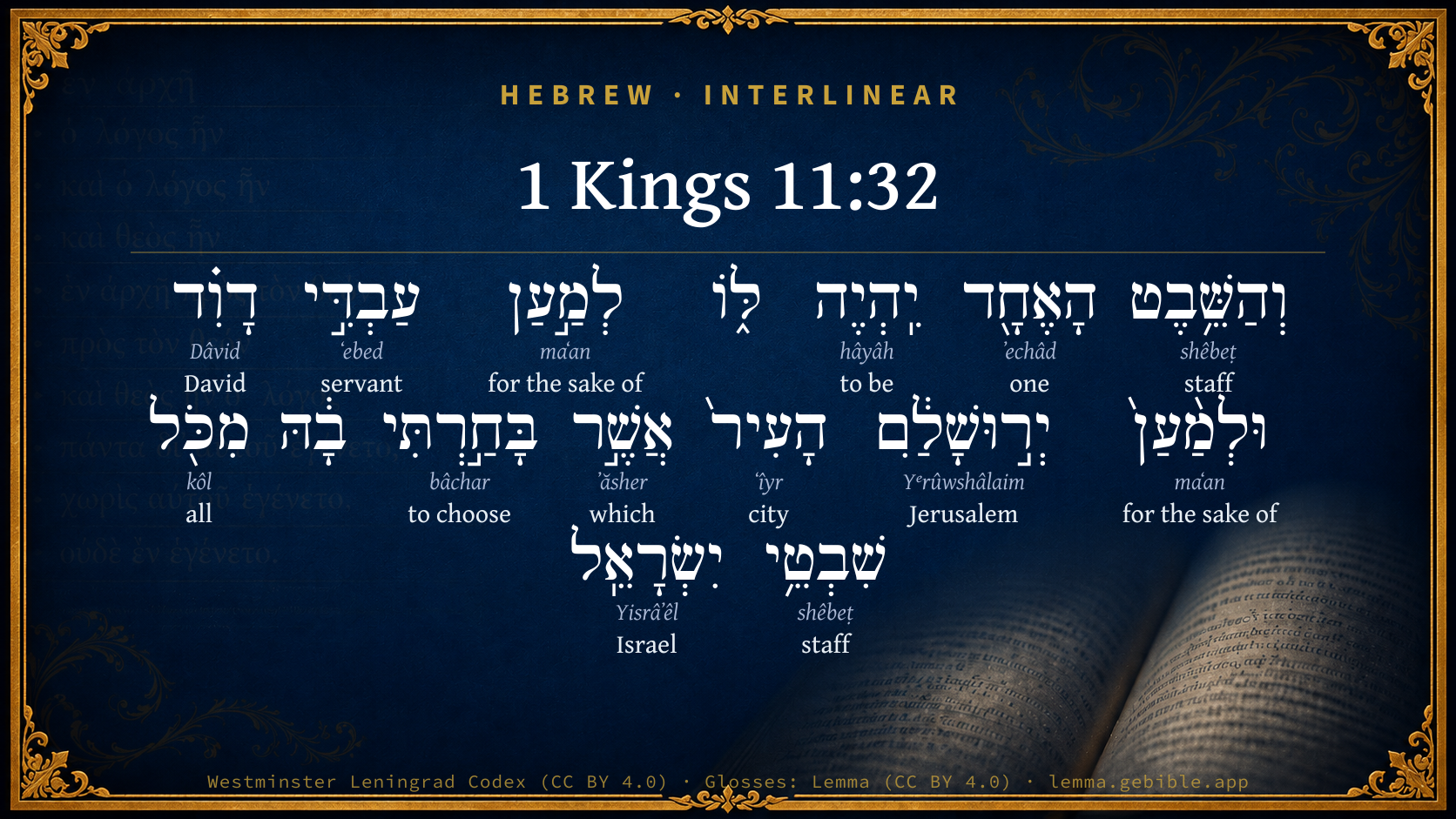
1 Kings 11:32

Hebrew (Westminster Leningrad Codex) 1 Kings 11:32 appears in the Hebrew Old Testament. The text above is from the Westminster Leningrad Codex. Each word links to its Strong’s number, a concise gloss, and parsing drawn from the Open Scriptures Hebrew Bible morphology. Click any word for its full Brown-Driver-Briggs (BDB) entry.
Download image
Cite this verse

1 Kings 11:32 (World English Bible). Public Domain. Lemma interlinear Bible study tool, https://lemma.gebible.app/v/1-kings/11/32.

Show BibTeX & RIS
BibTeX
RIS
English Translation
(but he shall have one tribe, for my servant David's sake and for Jerusalem's sake, the city which I have chosen out of all the tribes of Israel);
World English Bible · Public Domain
Download a study sheet

One document with this verse’s original text, its word-by-word gloss line, the meaning frame, cross-references with their text, attributed commentary, and full source and license credits — printable, and it pastes into notes with its structure intact.

This verse Autodidact and up

Study sheet (.html) Plain text (.txt)

A passage Seminary Student

Up to 50 verses in one chapter. A passage sheet keeps up to 6 commentary sources and 12 cross-references per verse, in the order this page ranks them, and says so on the sheet whenever that leaves anything out. Ask for a single verse and you get the Autodidact verse sheet above.

Everything on this page stays free to read, with no account — the sheet is a download of what is already on screen, not access to it.

Want to remove ads? Support Godless Engineer
Compare translations 3

The same verse in 3 English versions, stacked beneath the original-language interlinear above. Click any original word for its lexicon entry.

Each is an independent rendering of the whole verse — the interlinear is not word-aligned to these translations.

Highlighted words mark where these versions differ — a whole-verse word diff, not a word-by-word alignment.

  • World English Bible Public Domain
    (but he shall have one tribe, for my servant David's sake and for Jerusalem's sake, the city which I have chosen out of all the tribes of Israel);
  • King James Version Public Domain
    (But he shall have one tribe for my servant David's sake, and for Jerusalem's sake, the city which I have chosen out of all the tribes of Israel:)
  • unfoldingWord Literal Text CC BY-SA 4.0
    But one tribe will be to him for the sake of my servant David and for the sake of Jerusalem, the city upon which I have chosen from all of the tribes of Israel.

unfoldingWord Literal Text — © unfoldingWord, licensed CC BY-SA 4.0. Word-aligned USFM3 via Door43 (git.door43.org/unfoldingWord/en_ult).

Versions to compare (up to 4)

3 of 4 selected

Show all 18 translations

Every available English version of this verse, each an independent rendering of the whole verse.

  • World English Bible Public Domain
    (but he shall have one tribe, for my servant David's sake and for Jerusalem's sake, the city which I have chosen out of all the tribes of Israel);
  • Berean Standard Bible Public Domain
    But one tribe will remain for the sake of My servant David and for the sake of Jerusalem, the city I have chosen out of all the tribes of Israel.
  • Majority Standard Bible Public Domain
    But one tribe will remain for the sake of My servant David and for the sake of Jerusalem, the city I have chosen out of all the tribes of Israel.
  • King James Version Public Domain
    (But he shall have one tribe for my servant David's sake, and for Jerusalem's sake, the city which I have chosen out of all the tribes of Israel:)
  • American Standard Version (1901) Public Domain
    (but he shall have one tribe, for my servant David's sake and for Jerusalem's sake, the city which I have chosen out of all the tribes of Israel);
  • Revised Version (1885) Public Domain
    (but he shall have one tribe, for my servant David’s sake, and for Jerusalem’s sake, the city which I have chosen out of all the tribes of Israel:)
  • Geneva Bible (1599) Public Domain
    But he shall haue one tribe for my seruant Dauids sake, and for Ierusalem the citie, which I haue chosen out of all the tribes of Israel,
  • Douay-Rheims (1899) Public Domain
    But one tribe shall remain to him for the sake of my servant David, and Jerusalem the city, which I have chosen out of all the tribes of Israel:
  • Young's Literal Translation Public Domain
    and the one tribe he hath for My servant David's sake, and for Jerusalem's sake, the city which I have fixed on, out of all the tribes of Israel.
  • Literal Standard Version CC BY-SA 4.0
    but he has the one tribe for My servant David’s sake, and for Jerusalem’s sake, the city which I have fixed on, out of all the tribes of Israel,
  • Unlocked Literal Bible CC BY-SA 4.0
    (but Solomon will have one tribe, for my servant David's sake and for Jerusalem's sake—the city that I have chosen out of all the tribes of Israel),
  • unfoldingWord Literal Text CC BY-SA 4.0
    But one tribe will be to him for the sake of my servant David and for the sake of Jerusalem, the city upon which I have chosen from all of the tribes of Israel.
  • Darby Bible Public Domain
    but one tribe shall he have for my servant David's sake, and for Jerusalem's sake, the city which I have chosen out of all the tribes of Israel:
  • World Messianic Bible Public Domain
    (but he shall have one tribe, for my servant David’s sake and for Jerusalem’s sake, the city which I have chosen out of all the tribes of Israel),
  • Webster's Bible Public Domain
    (But he shall have one tribe for my servant David's sake, and for Jerusalem's sake, the city which I have chosen out of all the tribes of Israel:)
  • Free Bible Version CC BY-SA 4.0
    One tribe will be left for the sake of my servant David and for the sake of Jerusalem, the city I chose from among all the tribes of Israel.
  • Bible in Basic English Public Domain
    (But one tribe will be his, because of my servant David, and because of Jerusalem, the town which, out of all the tribes of Israel, I have made mine,)
  • JPS Tanakh (1917) Public Domain
    but he shall have one tribe, for My servant David's sake, and for Jerusalem's sake, the city which I have chosen out of all the tribes of Israel —

Literal Standard Version (2020), Covenant Press — licensed CC BY-SA 4.0. Text via the HelloAO Bible API (eBible.org). Unlocked Literal Bible (unfoldingWord) — licensed CC BY-SA 4.0. Text via the HelloAO Bible API (eBible.org). unfoldingWord Literal Text — © unfoldingWord, licensed CC BY-SA 4.0. Word-aligned USFM3 via Door43 (git.door43.org/unfoldingWord/en_ult). Free Bible Version, Dr. Jonathan Gallagher — licensed CC BY-SA 4.0. Text via the HelloAO Bible API (eBible.org).

Word by word

More ways to search: Search by grammar → Find every occurrence → Compare this word →

Practice this passage: Drill this verse → Learn its vocabulary →

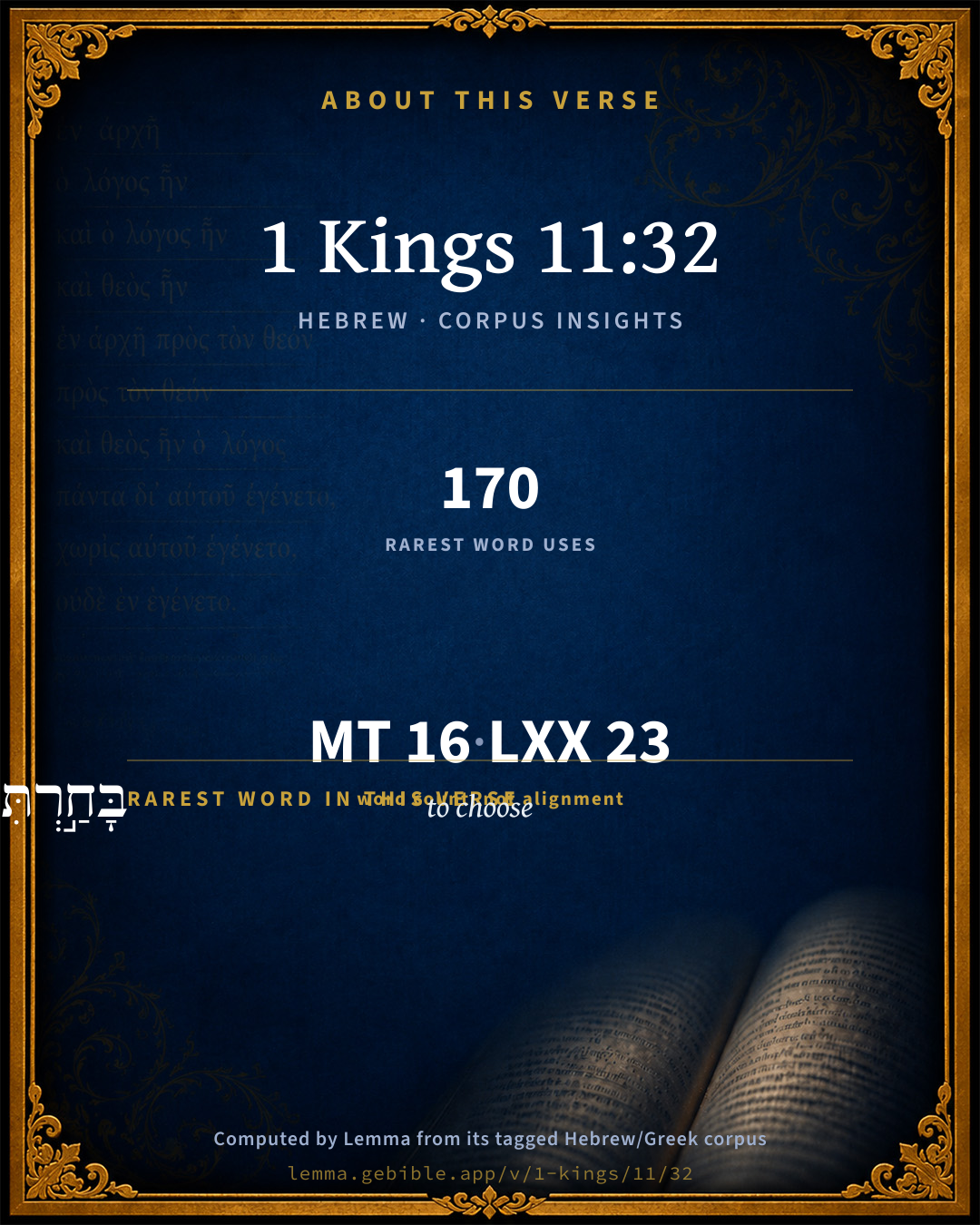
בָּחַ֣רְתִּי
bâchar
H977
“to choose”
Verb, Qal, Perfect, 1st Person, Common, Singular
Part of Speech
Verb
Stem
Qal
Form
Perfect
Person
1st Person
Gender
Common
Number
Singular
Full BDB Definition

Origin: a primitive root

TWOT: 231

to choose, elect, decide for - (Qal) to choose - (Niphal) to be chosen - (Pual) to be chosen, selected
  1. וְהַשֵּׁ֥בֶט shêbeṭ H7626 “and · the · staff” Conjunction + Particle, Definite Article + Noun, Common, Masculine, Singular, Absolute
  2. הָאֶחָ֖ד ʼechâd H259 “the · one” Particle, Definite Article + Adjective, Cardinal number, Masculine, Singular, Absolute
  3. יִֽהְיֶה hâyâh H1961 “to be” Verb, Qal, Imperfect, 3rd Person, Masculine, Singular
  4. לְמַ֣עַן maʻan H4616 “for the sake of” Preposition
  5. עַבְדִּ֣י ʻebed H5650 “servant · my” Noun, Common, Masculine, Singular, Construct + Suffix, Personal, 1st Person, Common, Singular
  6. דָוִ֗ד Dâvid H1732 “David” Noun, Proper
  7. וּלְמַ֨עַן֙ maʻan H4616 “and · for the sake of” Conjunction + Preposition
  8. יְר֣וּשָׁלִַ֔ם Yᵉrûwshâlaim H3389 “Jerusalem” Noun, Proper
  9. הָעִיר֙ ʻîyr H5892 “the · city” Particle, Definite Article + Noun, Common, Feminine, Singular, Absolute
  10. אֲשֶׁ֣ר ʼăsher H834 “which” Particle, Relative
  11. מִכֹּ֖ל kôl H3605 “from · all of” Preposition + Noun, Common, Masculine, Singular, Construct
  12. שִׁבְטֵ֥י shêbeṭ H7626 “staffs of” Noun, Common, Masculine, Plural, Construct
  13. יִשְׂרָאֵֽל Yisrâʼêl H3478 “Israel” Noun, Proper

About this verse

These counts appear in no published source. They are computed here, from the morphology-tagged text and Lemma’s own curated glosses. What Lemma adds →

16
words
12
distinct lemmas
Historical
section

Grammatical profile

  • 2 verbs
  • 8 nouns
  • 1 adjective
  • 4 prepositions
  • 1 particle

Verb forms

  • יִֽהְיֶה Qal · Imperfect
  • בָּחַ֣רְתִּי Qal · Perfect

Repetition

Words recur within this verse — often emphatic in Hebrew:

  • וְהַשֵּׁ֥בֶט staff H7626 ×2
  • לְמַ֣עַן for the sake of H4616 ×2

Hebrew & Septuagint length

In English translation the verse runs 28 words from the Hebrew and 30 from the Septuagint (LXX English) — closely comparable.

A rough comparison of the two English renderings, which tokenize alike — not a word-level alignment.

Word counts can differ between the Hebrew and the Greek without any difference in meaning — e.g. the Hebrew direct-object marker אֵת has no separate Greek word, and Greek often adds the article ὁ.

In the original languages it is 16 Hebrew tokens and 23 Greek tokens — but the two are counted differently (Hebrew bundles its prefixes and suffixes into one token; the Greek is in lemma form), so that isn’t a like-for-like length.

Cross-references

3

Topical passages linked to 1 Kings 11:32 in the Treasury of Scripture Knowledge — connected by theme and wording, ordered by reader-vote popularity; previews shown in the World English Bible.

  • 1 Kings 11:13 However I will not tear away all the kingdom; but I will give one tribe to your son, for David my servant's sake, and for Jerusalem's sake which I have chosen.
  • 1 Kings 12:20–21 It happened, when all Israel heard that Jeroboam was returned, that they sent and called him to the congregation, and made him king over all Israel: there was none who followed the house of David, but the tribe of Judah only.
  • 1 Kings 14:21 Rehoboam the son of Solomon reigned in Judah. Rehoboam was forty-one years old when he began to reign, and he reigned seventeen years in Jerusalem, the city which Yahweh had chosen out of all the tribes of Israel, to put his name there: and his mother's name was Naamah the Ammonitess.

Cross-references courtesy of OpenBible.info (CC BY 4.0).

Hebrew and Greek witnesses Masoretic Hebrew ↔ Greek Septuagint

The same verse in the two great witnesses to the Old Testament, shown verse-for-verse.

These are two independent witnesses, not word-aligned to each other, and the Septuagint is shown in lemma (dictionary) form.

Hebrew 1 Kings 11:32 Masoretic · Westminster Leningrad Codex

וְהַשֵּׁ֥בֶט הָאֶחָ֖ד יִֽהְיֶה לּ֑וֹ לְמַ֣עַן עַבְדִּ֣י דָוִ֗ד וּלְמַ֨עַן֙ יְר֣וּשָׁלִַ֔ם הָעִיר֙ אֲשֶׁ֣ר בָּחַ֣רְתִּי בָ֔הּ מִכֹּ֖ל שִׁבְטֵ֥י יִשְׂרָאֵֽל

(but he shall have one tribe, for my servant David's sake and for Jerusalem's sake, the city which I have chosen out of all the tribes of Israel);

World English Bible · Public Domain

Greek LXX 1 Kings 11:32 Septuagint · lemma form

καί δύο σκῆπτρον εἰμί αὐτός διά ὁ δοῦλος ἐγώ δαυίδ καί διά ἰερουσαλήμ ὁ πόλις ὅς ἐκλέγω ἐν αὐτός ἐκ πᾶς φυλή ἰσραήλ

Yet he shall have two tribes, for my servant David's sake, and for the sake of Jerusalem, the city which I have chosen out of all the tribes of Israel.

LXX2012 (modern English Septuagint) · Public Domain

On this verse, The Cambridge Bible for Schools and Colleges discusses the Septuagint’s reading. Read the note in Commentary ↓

Hebrew: Westminster Leningrad Codex (CC BY 4.0). Greek: Septuagint (public domain); English from LXX2012 (modern English Septuagint) (Public Domain). How the Septuagint differs from the Hebrew →

Targum (Aramaic paraphrase)

1

The Targum is the ancient Jewish Aramaic paraphrase of the Hebrew Scriptures — an interpretive translation, not the Hebrew text itself. Onkelos (literal) and Pseudo-Jonathan (expansive) render the Torah, and Jonathan the Prophets. Coverage is partial: where no permissively-licensed English translation exists for a verse, only the Aramaic is shown. This is verse-level text, not a word-by-word alignment to the Hebrew.

  1. Targum Jonathan Prophets (Joshua–Malachi)
    וְשִׁבְטָא חָד יְהֵי לֵיהּ בְּדִיל דָוִד עַבְדִי וּבְדִיל יְרוּשְׁלֵם קַרְתָּא דְאִתְרְעֵיתִי בָהּ מִכֹּל שִׁבְטַיָא דְיִשְׂרָאֵל:

    (no public-domain English translation for this verse)

    Targum Jonathan — Aramaic: “Mikraot Gedolot” (public domain). English: “Sefaria Community Translation” (CC0 1.0 (public-domain dedication)); “London "Chaldee Paraphrase," 1871” (public domain). Text via Sefaria.

Commentary

Notes on 1 Kings 11:32 from classic Christian and Jewish commentators (each source and its license shown beneath its notes). The classic Christian expositions comment on the surrounding passage and are grouped to its opening verse, so a note may address several verses; the Jewish commentaries on the Tanakh (Rashi and others) are per-verse, so they appear only where the commentator wrote on this verse.

Lemma curates 59 commentaries, every one of them public domain or Creative Commons licensed, each selected and text-cleaned for this edition rather than reprinted as found. About our sources →

Trapp's Complete Commentary

John Trapp

1Ki 11:32 (But he shall have one tribe for my servant David’s sake, and for Jerusalem’s sake, the city which I have chosen out of all the tribes of Israel:)

Ver. 32. For my servant David’s sake.] See on 1Ki 11:13.

John Trapp, A Commentary or Exposition upon All the Books of the Old and New Testament (1647–1656) — public domain. Text from a community e-Sword module.

The Cambridge Bible for Schools and Colleges

gen. ed. J. J. S. Perowne

32. he shall have one tribe] Benjamin was so small a tribe as scarcely to be worth counting. Judah was to give name to the southern part of the divided kingdom. The LXX. says “two tribes,” which seems to be a correction introduced by the translators. See above on 1Ki_11:13. All the other versions speak of ‘one tribe’, and so does the LXX. in 1Ki_11:13.

The Cambridge Bible for Schools and Colleges (gen. ed. J. J. S. Perowne; Cambridge University Press, 1878–1918) — public domain. Text from a community e-Sword module.

John Gill's Exposition

Howbeit, I will not take the kingdom out of his hand,.... Not any part of it, Kg1 11:12,

but I will make him prince all the days of his life; that is, he shall continue to hold the government of all the tribes so long as he lives:

for David my servant's sake, whom I chose, because he kept my commandments and my statutes; see Kg1 11:12, or was well pleased with, as the Targum; for keeping the commands of God from right principles, and with right views, is well pleasing to him.

John Gill's Exposition of the Whole Bible (1746–1763) — public domain (CC PDM 1.0). Text via the HelloAO Bible API.

Matthew Poole's English Annotations

See Poole "1Ki 11:13"

Matthew Poole's English Annotations on the Holy Bible (1683–1685) — public domain. Text from a community e-Sword/MySword module.

The Pulpit Commentary

But he shall have one tribe LXX duo skhptra. Some would understand "one tribe, in addition to Judah," but compare 1Ki_12:20, "tribe of Judah only," and see note on ver. 13. Possibly neither Judah nor Benjamin is here to be thought of separately. In 1Ki_12:21, and, 2Ch_11:3, 2Ch_11:23, they are both reckoned to Rehoboam. They might be regarded as in some sense one, inasmuch as they enclosed the Holy City (Seb. Schmidt) the line of division passing right through the temple platform. But it is perhaps safer, in view of 1Ki_12:20, to understand the term of Judah, compared with which large and influential tribe "little Benjamin" was hardly deserving of separate mention for my servant David"s sake, and for Jerusalem"s sake see on vers. 12, 13, the city which I have chosen out of all the tribes of Israel.

The Pulpit Commentary (1880–1919), ed. H.D.M. Spence-Jones & Joseph S. Exell — public domain. Text from a community e-Sword module.

Lesson kit

Teaching starters — assembled from the data on this page, not authored interpretation. Every prompt links to the verse data it draws on. Edit before teaching.

1 Kings, in the Historical, opens this verse with 16 words (12 distinct Hebrew lemmas). Its most distinctive word is bâchar (“to choose”). A historical commentator’s framing appears above. Read the whole chapter for the surrounding context.

Discussion questions

  1. How does “to choose” (bâchar) shape what this verse is saying?
  2. 1 Kings 11:13 shares this passage’s theme. How do the two illuminate each other?
  3. “staff” occurs 2× in this one verse. What is the effect of the repetition?
  4. These translations render this verse differently. What is at stake in choosing one wording over another?
  5. The verb «יִֽהְיֶה» is Qal Imperfect. How does its form color the action?
  6. Reading how Trapp's Complete Commentary and The Cambridge Bible for Schools and Colleges read this verse, where do the two commentators agree and where do they part?

Things to notice

Reading settings

Reading text

Shown beneath each verse's original-language words.

Old Testament
Old Testament edition

Read the OT as the Masoretic Hebrew (MT) or the Greek Septuagint (LXX).

English shown for the Greek Septuagint (in the Hebrew ↔ Greek comparison).

Comparing translations? Open the Compare panel on any verse page to stack up to four side by side.