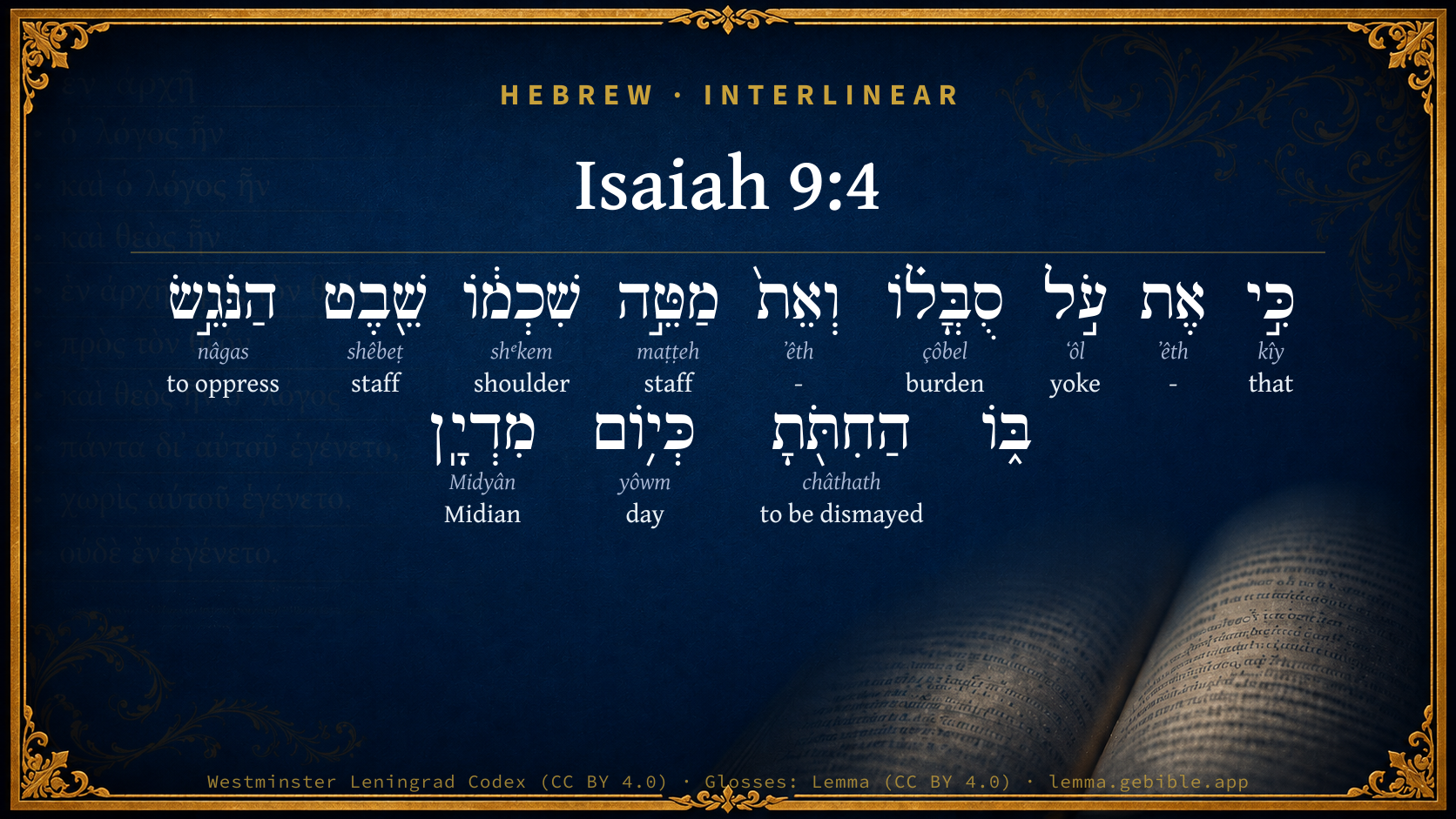
Isaiah 9:4

Hebrew (Westminster Leningrad Codex) Isaiah 9:4 appears in the Hebrew Old Testament. The text above is from the Westminster Leningrad Codex. Each word links to its Strong’s number, a concise gloss, and parsing drawn from the Open Scriptures Hebrew Bible morphology. Click any word for its full Brown-Driver-Briggs (BDB) entry.
Download image
Cite this verse

Isaiah 9:4 (World English Bible). Public Domain. Lemma interlinear Bible study tool, https://lemma.gebible.app/v/isaiah/9/4.

Show BibTeX & RIS
BibTeX
RIS
English Translation
For the yoke of his burden, and the staff of his shoulder, the rod of his oppressor, you have broken as in the day of Midian.
World English Bible · Public Domain
Highlights
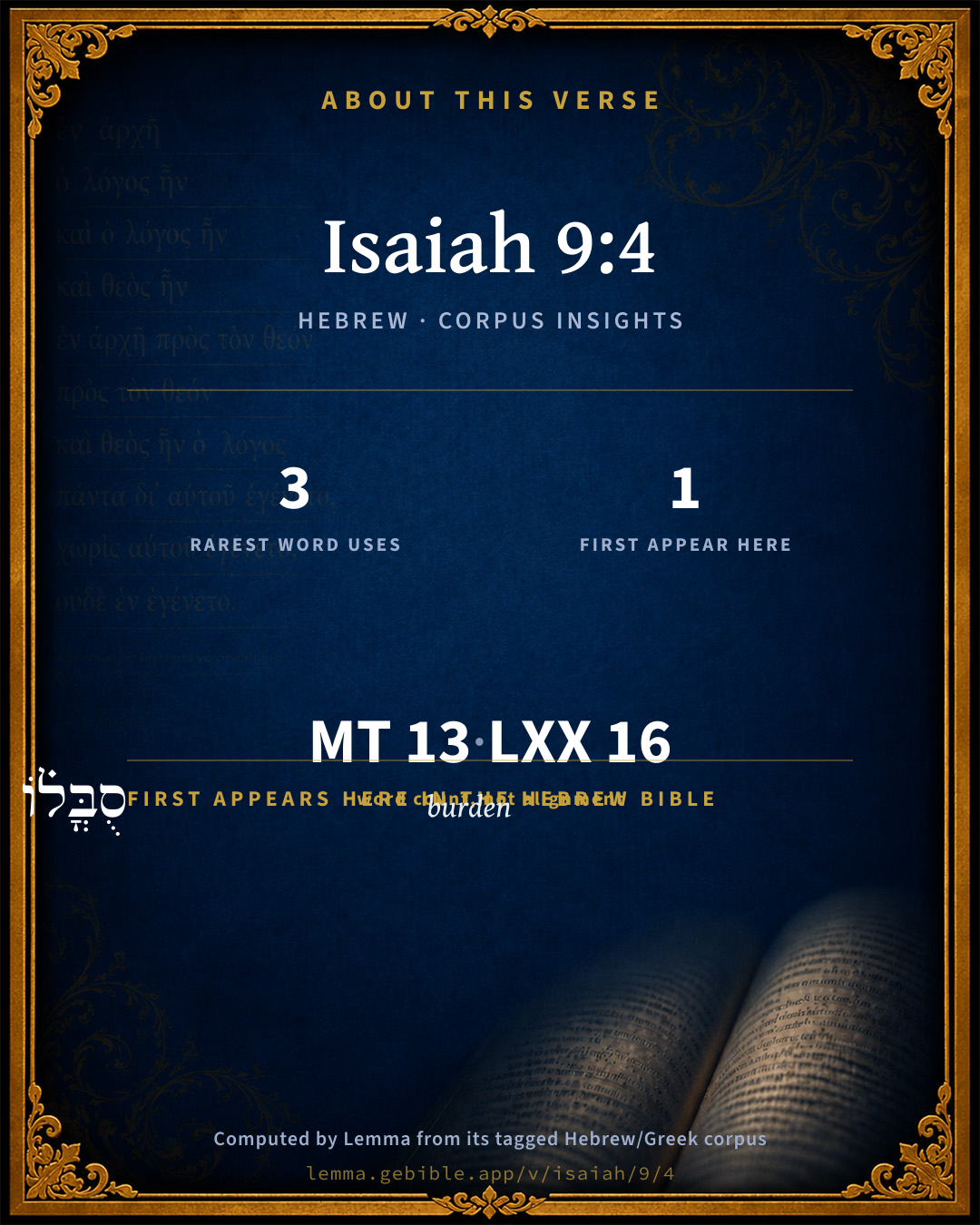
  • 1 first appearance in the Hebrew Bible
Full analysis ↓
Download a study sheet

One document with this verse’s original text, its word-by-word gloss line, the meaning frame, cross-references with their text, attributed commentary, and full source and license credits — printable, and it pastes into notes with its structure intact.

This verse Autodidact and up

Study sheet (.html) Plain text (.txt)

A passage Seminary Student

Up to 50 verses in one chapter. A passage sheet keeps up to 6 commentary sources and 12 cross-references per verse, in the order this page ranks them, and says so on the sheet whenever that leaves anything out. Ask for a single verse and you get the Autodidact verse sheet above.

Everything on this page stays free to read, with no account — the sheet is a download of what is already on screen, not access to it.

Want to remove ads? Support Godless Engineer
Compare translations 3

The same verse in 3 English versions, stacked beneath the original-language interlinear above. Click any original word for its lexicon entry.

Each is an independent rendering of the whole verse — the interlinear is not word-aligned to these translations.

Highlighted words mark where these versions differ — a whole-verse word diff, not a word-by-word alignment.

  • World English Bible Public Domain
    For the yoke of his burden, and the staff of his shoulder, the rod of his oppressor, you have broken as in the day of Midian.
  • King James Version Public Domain
    For thou hast broken the yoke of his burden, and the staff of his shoulder, the rod of his oppressor, as in the day of Midian.
  • unfoldingWord Literal Text CC BY-SA 4.0
    For the yoke of his burden and the staff of his shoulder, the rod of the one oppressing him, you will shatter as the day of Midian.

unfoldingWord Literal Text — © unfoldingWord, licensed CC BY-SA 4.0. Word-aligned USFM3 via Door43 (git.door43.org/unfoldingWord/en_ult).

Versions to compare (up to 4)

3 of 4 selected

Show all 18 translations

Every available English version of this verse, each an independent rendering of the whole verse.

  • World English Bible Public Domain
    For the yoke of his burden, and the staff of his shoulder, the rod of his oppressor, you have broken as in the day of Midian.
  • Berean Standard Bible Public Domain
    For as in the day of Midian You have shattered the yoke of their burden, the bar across their shoulders, and the rod of their oppressor.
  • Majority Standard Bible Public Domain
    For as in the day of Midian You have shattered the yoke of their burden, the bar across their shoulders, and the rod of their oppressor.
  • King James Version Public Domain
    For thou hast broken the yoke of his burden, and the staff of his shoulder, the rod of his oppressor, as in the day of Midian.
  • American Standard Version (1901) Public Domain
    For the yoke of his burden, and the staff of his shoulder, the rod of his oppressor, thou hast broken as in the day of Midian.
  • Revised Version (1885) Public Domain
    For the yoke of his burden, and the staff of his shoulder, the rod of his oppressor, thou hast broken as in the day of Midian.
  • Geneva Bible (1599) Public Domain
    For the yoke of their burthen, and the staffe of their shoulder and the rod of their oppressour hast thou broken as in the day of Midian.
  • Douay-Rheims (1899) Public Domain
    For the yoke of their burden, and the rod of their shoulder, and the sceptre of their oppressor thou best overcome, as in the day of Median.
  • Young's Literal Translation Public Domain
    Because the yoke of its burden, And the staff of its shoulder, the rod of its exactor, Thou hast broken as `in' the day of Midian.
  • Literal Standard Version CC BY-SA 4.0
    Because the yoke of its burden, || And the staff of its shoulder, the rod of its exactor, || You have broken as [in] the day of Midian.
  • Unlocked Literal Bible CC BY-SA 4.0
    For the yoke of his burden, the beam across his shoulder, the rod of his oppressor, you have shattered as on the day of Midian.
  • unfoldingWord Literal Text CC BY-SA 4.0
    For the yoke of his burden and the staff of his shoulder, the rod of the one oppressing him, you will shatter as the day of Midian.
  • Darby Bible Public Domain
    For thou hast broken the yoke of his burden and the staff of his shoulder, the rod of his oppressor, as in the day of Midian.
  • World Messianic Bible Public Domain
    For the yoke of his burden, and the staff of his shoulder, the rod of his oppressor, you have broken as in the day of Midian.
  • Webster's Bible Public Domain
    For thou hast broken the yoke of his burden, and the staff of his shoulder, the rod of his oppressor, as in the day of Midian.
  • Free Bible Version CC BY-SA 4.0
    For you will smash the yoke that burdens them down, the bar across their shoulders, and the oppressors' rod used to beat them just as you did when you defeated the Midianite army.
  • Bible in Basic English Public Domain
    For by your hand the yoke on his neck and the rod on his back, even the rod of his cruel master, have been broken, as in the day of Midian.
  • JPS Tanakh (1917) Public Domain
    (9-3) For the yoke of his burden, and the staff of his shoulder, the rod of his oppressor, Thou hast broken as in the day of Midian.

Literal Standard Version (2020), Covenant Press — licensed CC BY-SA 4.0. Text via the HelloAO Bible API (eBible.org). Unlocked Literal Bible (unfoldingWord) — licensed CC BY-SA 4.0. Text via the HelloAO Bible API (eBible.org). unfoldingWord Literal Text — © unfoldingWord, licensed CC BY-SA 4.0. Word-aligned USFM3 via Door43 (git.door43.org/unfoldingWord/en_ult). Free Bible Version, Dr. Jonathan Gallagher — licensed CC BY-SA 4.0. Text via the HelloAO Bible API (eBible.org).

Word by word

More ways to search: Search by grammar → Find every occurrence → Compare this word →

Practice this passage: Drill this verse → Learn its vocabulary →

סֻבֳּל֗וֹ
çôbel
H5448
“burden · his”
Noun, Common, Masculine, Singular, Construct + Suffix, Personal, 3rd Person, Masculine, Singular
Part of Speech
Noun
Type
Common
Gender
Masculine
Number
Singular
State
Construct
Full BDB Definition

Origin: from H5445

TWOT: 1458a

burden, load
  1. כִּ֣י kîy H3588 “that” Conjunction
  2. אֶת ʼêth H853 “-” Particle, Direct Object
  3. עֹ֣ל ʻôl H5923 “yoke of” Noun, Common, Masculine, Singular, Construct
  4. וְאֵת֙ ʼêth H853 “and · -” Conjunction + Particle, Direct Object
  5. מַטֵּ֣ה maṭṭeh H4294 “staff of” Noun, Common, Masculine, Singular, Construct
  6. שִׁכְמ֔וֹ shᵉkem H7926 “shoulder · his” Noun, Common, Masculine, Singular, Construct + Suffix, Personal, 3rd Person, Masculine, Singular
  7. שֵׁ֖בֶט shêbeṭ H7626 “staff of” Noun, Common, Masculine, Singular, Construct
  8. הַנֹּגֵ֣שׂ nâgas H5065 “the · oppressing” Particle, Definite Article + Verb, Qal, Participle Active, Masculine, Singular, Absolute
  9. הַחִתֹּ֖תָ châthath H2865 “to be dismayed” Verb, Hiphil, Perfect, 2nd Person, Masculine, Singular
  10. כְּי֥וֹם yôwm H3117 “like/as · day of” Preposition + Noun, Common, Masculine, Singular, Construct
  11. מִדְיָֽן Midyân H4080 “Midian” Noun, Proper

About this verse

These counts appear in no published source. They are computed here, from the morphology-tagged text and Lemma’s own curated glosses. What Lemma adds →

13
words
11
distinct lemmas
Prophets
section

Notable vocabulary

The rarest word here is סֻבֳּל֗וֹ burden H5448 — appearing just 3 times in the whole Hebrew Bible.

First appearance in Scripture

This word makes its first canonical appearance in the Hebrew Bible here:

  • סֻבֳּל֗וֹ burden H5448

Shared distinctive vocabulary

סֻבֳּל֗וֹ burden H5448 occurs in 3 verses of the Hebrew Bible. Also found in:

Grammatical profile

  • 2 verbs
  • 7 nouns
  • 1 preposition
  • 1 conjunction
  • 2 particles

Verb forms

  • הַנֹּגֵ֣שׂ Qal · Participle Active
  • הַחִתֹּ֖תָ Hiphil · Perfect

Hebrew & Septuagint length

In English translation the verse runs 26 words from the Hebrew and 35 from the Septuagint (LXX English) — closely comparable.

A rough comparison of the two English renderings, which tokenize alike — not a word-level alignment.

Word counts can differ between the Hebrew and the Greek without any difference in meaning — e.g. the Hebrew direct-object marker אֵת has no separate Greek word, and Greek often adds the article ὁ.

In the original languages it is 13 Hebrew tokens and 16 Greek tokens — but the two are counted differently (Hebrew bundles its prefixes and suffixes into one token; the Greek is in lemma form), so that isn’t a like-for-like length.

Cross-references

18

Topical passages linked to Isaiah 9:4 in the Treasury of Scripture Knowledge — connected by theme and wording, ordered by reader-vote popularity; previews shown in the World English Bible.

  • Isaiah 14:25 that I will break the Assyrian in my land, and on my mountains tread him under foot: then shall his yoke depart from off them, and his burden depart from off their shoulder.
  • Jeremiah 30:8 It shall come to pass in that day, says Yahweh of Hosts, that I will break his yoke from off your neck, and will burst your bonds; and strangers shall no more make him their bondservant;
  • Isaiah 10:26–27 Yahweh of Hosts will stir up against him a scourge, as in the slaughter of Midian at the rock of Oreb: and his rod will be over the sea, and he will lift it up after the manner of Egypt.
  • Nahum 1:13 Now will I break his yoke from off you, and will burst your bonds apart."
  • Isaiah 54:14 In righteousness shall you be established: you shall be far from oppression, for you shall not be afraid; and from terror, for it shall not come near you.
  • Isaiah 49:26 I will feed those who oppress you with their own flesh; and they shall be drunken with their own blood, as with sweet wine: and all flesh shall know that I, Yahweh, am your Savior, and your Redeemer, the Mighty One of Jacob.
  • Isaiah 14:3–5 It shall happen in the day that Yahweh shall give you rest from your sorrow, and from your trouble, and from the hard service in which you were made to serve,
  • Genesis 27:40 By your sword will you live, and you will serve your brother. It will happen, when you will break loose, That you shall shake his yoke from off your neck."
  • Leviticus 26:13 I am Yahweh your God, who brought you forth out of the land of Egypt, that you should not be their slaves; and I have broken the bars of your yoke, and made you go upright.
  • Isaiah 30:31–32 For through the voice of Yahweh shall the Assyrian be dismayed; with his rod will he strike [him].
  • Judges 6:1–6 The children of Israel did that which was evil in the sight of Yahweh: and Yahweh delivered them into the hand of Midian seven years.
  • Judges 7:22–25 They blew the three hundred trumpets, and Yahweh set every man's sword against his fellow, and against all the host; and the host fled as far as Beth-shittah toward Zererah, as far as the border of Abel Meholah, by Tabbath.
  • Judges 8:10–12 Now Zebah and Zalmunna were in Karkor, and their hosts with them, about fifteen thousand men, all who were left of all the host of the children of the east; for there fell one hundred twenty thousand men who drew sword.
  • Psalms 83:9–11 Do to them as you did to Midian, As to Sisera, as to Jabin, at the river Kishon;
  • Psalms 125:3 For the scepter of wickedness won't remain over the allotment of the righteous; So that the righteous won't use their hands to do evil.
  • Isaiah 10:5 Ho Assyrian, the rod of my anger, the staff in whose hand is my indignation!
  • Isaiah 47:6 I was angry with my people, I profaned my inheritance, and gave them into your hand: you did show them no mercy; on the aged have you very heavily laid your yoke.
  • Isaiah 51:13 and have forgotten Yahweh your Maker, who stretched forth the heavens, and laid the foundations of the earth; and fear continually all the day because of the fury of the oppressor, when he makes ready to destroy? and where is the fury of the oppressor?

Cross-references courtesy of OpenBible.info (CC BY 4.0).

Hebrew and Greek witnesses Masoretic Hebrew ↔ Greek Septuagint

The same verse in the two great witnesses to the Old Testament, shown verse-for-verse.

These are two independent witnesses, not word-aligned to each other, and the Septuagint is shown in lemma (dictionary) form.

Hebrew Isaiah 9:4 Masoretic · Westminster Leningrad Codex

כִּ֣י אֶת עֹ֣ל סֻבֳּל֗וֹ וְאֵת֙ מַטֵּ֣ה שִׁכְמ֔וֹ שֵׁ֖בֶט הַנֹּגֵ֣שׂ בּ֑וֹ הַחִתֹּ֖תָ כְּי֥וֹם מִדְיָֽן

For the yoke of his burden, and the staff of his shoulder, the rod of his oppressor, you have broken as in the day of Midian.

World English Bible · Public Domain

Greek LXX Isaiah 9:4 Septuagint · lemma form

ὅτι πᾶς στολή ἐπι συνἄγω δόλος καί ἱμάτιον μετά καταλλαγή ἀποτίνω καί θέλω εἰ γίγνομαι πυρίκαυστος

Because the yoke that was laid upon them has been taken away, and the rod that was on their neck: for he has broken the rod of the exactors, as in the day of Madiam.

LXX2012 (modern English Septuagint) · Public Domain

Hebrew: Westminster Leningrad Codex (CC BY 4.0). Greek: Septuagint (public domain); English from LXX2012 (modern English Septuagint) (Public Domain). How the Septuagint differs from the Hebrew →

Targum (Aramaic paraphrase)

1

The Targum is the ancient Jewish Aramaic paraphrase of the Hebrew Scriptures — an interpretive translation, not the Hebrew text itself. Onkelos (literal) and Pseudo-Jonathan (expansive) render the Torah, and Jonathan the Prophets. Coverage is partial: where no permissively-licensed English translation exists for a verse, only the Aramaic is shown. This is verse-level text, not a word-by-word alignment to the Hebrew.

  1. Targum Jonathan Prophets (Joshua–Malachi)
    אֲרֵי כָל מְסַבְהוֹן וּמִתַּנְהוֹן בִּרְשַׁע אִתְגְעָלוּ בְּחוֹבִין הָא כִכְסוּ דִמְלוּשָׁא בְדַם דְלָא דָכָן רִשְׁמֵי כִתְמָא מִנָהּ כֵּן כְּמָא דְלֵית בֵּיהּ צְרוֹךְ אֱלָהֵין לְאִתּוֹקָדָא בְנוּרָא כֵּן יִתֵּן עֲלֵיהוֹן עַמְמַיָא דְתַקִיפִין כְּאֶשְׁתָּא וְיִקְטְלוּנוּן:

    All their transactions are in wickedness; they are polluted with sins, as a garment dipped in blood, the marks of its filth cannot be purified; thus it is like something, in which there is no use, but to be burned in fire: thus He shall bring forth against them nations, who are mighty as fire, and they shall slay them.

    Targum Jonathan — Aramaic: “Mikraot Gedolot” (public domain). English: “Sefaria Community Translation” (CC0 1.0 (public-domain dedication)); “London "Chaldee Paraphrase," 1871” (public domain). Text via Sefaria.

Commentary

Notes on Isaiah 9:4 from classic Christian and Jewish commentators (each source and its license shown beneath its notes). The classic Christian expositions comment on the surrounding passage and are grouped to its opening verse, so a note may address several verses; the Jewish commentaries on the Tanakh (Rashi and others) are per-verse, so they appear only where the commentator wrote on this verse.

Lemma curates 59 commentaries, every one of them public domain or Creative Commons licensed, each selected and text-cleaned for this edition rather than reprinted as found. About our sources →

Trapp's Complete Commentary

John Trapp

Isa 9:4 For thou hast broken the yoke of his burden, and the staff of his shoulder, the rod of his oppressor, as in the day of Midian.

Ver. 4. For thou hast broken the yoke of his burden,] i.e., Thou hast disenthralled and delivered thy people from the burdenous yokes of their enemies, both corporal and spiritual; that taking thine easy yoke, thy light burden upon them, they might "serve thee without fear in holiness and righteousness before thee all the days of their lives." {Luk 1:74} The Jewish doctors expound all this of Sennacherib’s tyranny, and their deliverance therefrom. But the prophet intendeth a further matter {Isa 9:6-7}

And the staff of his shoulder.] Wherewith he was beaten and bastinadoed. {thrashed} See Isa 14:5.

The rod of his oppressor.] Metaphora ab agasonibus, a metaphor from horse drivers, who lay on without mercy. Whipping among the Turks hath been usually inflicted even upon the greatest bashaws of the court upon the least displeasure of the tyrant, especially if they be not natural Turks born. {a} The poor captives met with hard measure this way at Babylon; but Satan’s slaves with much harder. Christ fitly noteth here that the rod wherewith the devil whippeth sinners is their own lusts and passions; yea, herewith they punish themselves, by his instigation, as the lion beateth himself with his own tail.

As in the day of Midian.] Beaten by Gideon. {Jdg 7:21} So "the day of Gibeah." {Hos 9:9} "The day of Jerusalem." {Psa 137:7} The battle of Agincourt, the Sicilian vespers, &c. Gideon, by the sound of trumpet and shining of lamps out of earthen broken vessels, overcame those Midianites; so by the trumpet of his Word and light of the gospel, carried through the world by weak instruments, hath Christ confounded his adversaries, {1Jn 2:14} as one fitly maketh the comparison. See it largely prosecuted in sixteen particulars in Cornelius A Lapide upon the text.

{a} Turkish History, 361.

John Trapp, A Commentary or Exposition upon All the Books of the Old and New Testament (1647–1656) — public domain. Text from a community e-Sword module.

The Biblical Illustrator

Joseph S. Exell

Isa_9:4

For Thou hast broken the yoke of his burden

Deliverance from the burden of sin

I.

SIN IS A BURDEN (Psa_38:4). Sinners are heavy laden with this insupportable load, which detains them from God, who alone can relieve them; enfeebles their minds; and harasses them with perplexing fears, and the most uneasy reflections. A proper sense of its powerful influence, its polluting nature and dreadful guilt, like a crushing weight, depresses the spirit, becomes irksome and grievous, and if not happily removed, will prove the means of irremediable ruin.

II. THE CEREMONIAL LAW IS THE YOKE OF THIS BURDEN (Act_15:10).

III. IMMANUEL HAS BROKEN THE YOKE (Col_2:14). (R. Macculloch.)

The Gospel a liberating power

1. The design of the Gospel, and the grace of it, is to break the yoke of sin and Satan, to remove the burthen of guilt and corruption, and to free us from the rod of those oppressors, that we might be brought into the glorious liberty of the children of God.

2. This is done by the Spirit working like fire (Isa_9:5). It is done as in the day of Midian, by a work of God upon the hearts of men. Christ is our Gideon. (M. Henry.)

Encouragement from the past

If God makes former deliverances His patterns in working for us, we ought to make them our encouragements to hope in Him.

The Biblical Illustrator, edited by Joseph S. Exell (c. 1880s–1900s) — public domain. Text from a community e-Sword module.

Joseph Benson's Commentary

Isa 9:4. For thou hast broken, &c. — Bishop Lowth translates this verse, For the yoke of his burden, the staff laid on his shoulder, the rod of his oppressor hast thou broken, as in the day of Midian. The Jews had been under the yoke repeatedly, to one hostile people or another, and had been sorely oppressed by them; formerly by the Philistines, Moabites, Ammonites, and Midianites, and, in after times, by the Assyrians, Chaldeans, Persians, and Macedonians; and many and successive deliverances from their oppressors had God granted them. Now, as the yokes which they had been under were emblematical of those of Satan, sin, and death, the spiritual enemies of God’s people, so their deliverances were figures of the spiritual deliverance which believers, whether Jews or Gentiles, receive through Christ. And of this spiritual deliverance and salvation, as the context shows, this verse is to be understood. For the preceding verses foretel the diffusion of gospel light, and those that follow attest the birth of the Messiah, unfold his characters and offices, and set forth the blessings of his peaceful and righteous reign. See Jer 23:6; Luk 1:70-74, where Zacharias, full of the Holy Ghost, seems most admirably to expound this passage of the prophet. As in the day of Midian — When God destroyed the Midianites in so admirable a manner, and by such unlikely and contemptible means, which was an eminent type of Christ’s conquering the powers of darkness, and all his enemies, by dying on the cross, and by the preaching of a few unlearned, and poor, despised men.

Joseph Benson's Commentary on the Old and New Testaments (1811–1818) — public domain. Text from a community e-Sword module.

Tyndale Open Study Notes

Tyndale Open Resources

9:4 The people experienced the rule of other nations as a yoke of . . . slavery and a heavy burden (Jer 30:8). • oppressor’s rod: In Isa 10:5, the Assyrians are called “the rod of [the Lord’s] anger.” Just as God’s anger will cease, so will Assyria’s oppression of Judah (14:5). • The Lord had destroyed the army of Midian through Gideon (see Judg 6:35; 7:22-25).

Tyndale Open Study Notes — © Tyndale Open Resources, licensed CC BY-SA 4.0. Text via the HelloAO Bible API.

Geneva Bible (1599)

Geneva Bible translators

Thou gavest them perfect joy by delivering them, and by destroying the tyrants, that had kept them in cruel bondage, as thou didst deliver them by Gideon from the Midianites, Judg. 7:21.

Geneva Bible (1599) marginal notes — public domain. Text via Bolls.life.

Jamieson, Fausset & Brown

Robert Jamieson, A. R. Fausset & David Brown

The occasion of the "joy," the deliverance not only of Ahaz and Judah from the Assyrian tribute (Kg2 16:8), and of Israel's ten tribes from the oppressor (Kg2 15:19), but of the Jewish Christian Church from its last great enemy.

hast--the past time for the future, in prophetic vision; it expresses the certainty of the event.

yoke of his burden--the yoke with which he was burdened.

staff of . . . shoulder--the staff which strikes his shoulder [MAURER]; or the wood, like a yoke, on the neck of slaves, the badge of servitude [ROSENMULLER].

day of Midian-- (Jdg 7:8-22). As Gideon with a handful of men conquered the hosts of Midian, so Messiah the "child" (Isa 9:6) shall prove to be the "Prince of peace," and the small Israel under Him shall overcome the mighty hosts of Antichrist (compare Mic 5:2-5), containing the same contrast, and alluding also to "the Assyrian," the then enemy of the Church, as here in Isaiah, the type of the last great enemy. For further analogies between Gideon's victory and the Gospel, compare Co2 4:7, with Jdg 7:22. As the "dividing of the spoil" (Isa 9:3) was followed by that which was "not joy," the making of the idolatrous ephod (Jdg 8:24-27), so the gospel victory was soon followed by apostasy at the first, and shall be so again after the millennial overthrow of Antichrist (Rev 20:3, Rev 20:7-9), previous to Satan's last doom (Rev 20:10).

Jamieson, Fausset & Brown — Commentary Critical and Explanatory on the Whole Bible (1871) — public domain (CC PDM 1.0). Text via the HelloAO Bible API.

Ellicott's Commentary for English Readers

(4) For thou hast broken the yoke of his burden . . .—The text comes in the Hebrew with all the emphasis of position. The yoke of his burden . . . thou hast broken. The phrase suggests a bondage like that of Egypt, where the “task-masters” (the same word as that here rendered “oppressors”) drove the people to their labours with their rods.

As in the day of Midian.—The historical allusion was probably suggested by the division of spoil that had been in the prophet’s thoughts. Of all victories in the history of Israel, that of Gideon over the Midianites had been most conspicuous for this feature (Jdg_8:24-27). In Psa_83:9-11 (which the mention of Assur shows to have been nearly contemporary with Isaiah) we find a reference to the same battle. Men remembered “the day of Midian” centuries after its date, as we remember Poitiers and Agincourt.

A Bible Commentary for English Readers, edited by Charles John Ellicott (1878–1897) — public domain. Text from a community e-Sword module.

The Cambridge Bible for Schools and Colleges

gen. ed. J. J. S. Perowne

4. Change the order as in R.V. For the yoke of his burden, &c.… thou hast broken.

the staff of his shoulder] (better back) means the staff with which his back was beaten; the pronouns refer to Israel.

rod of his oppressor] task-master, as in Exo_5:6.

in the day of Midian] when the dominion of the Midianites was for ever broken (Judges 7; cf. Isa_10:26). “Day” here means “day of battle,” as often in Arabic. The Arabs speak of the hero of many fights as dhu-l’ ayyâmîn, “master of days.”

4, 5. The destruction of the oppressor.

The Cambridge Bible for Schools and Colleges (gen. ed. J. J. S. Perowne; Cambridge University Press, 1878–1918) — public domain. Text from a community e-Sword module.

John Gill's Exposition

For thou hast broken the yoke of his burden,.... Of Galilee, of the nation multiplied, of the spiritual inhabitants of it, whose joy was increased; and this is one reason of it, because they were delivered by the Lord from the burdensome yoke of the ceremonial law, which was broken off and abolished by Christ; and from the tyranny of Satan, the god of this world, out of whose hands they were ransomed and delivered; and from the dominion of sin, under the power of which they had been in bondage.

And the staff of his shoulder, the rod of his oppressor; different phrases, expressive of the same thing; the bondage and slavery of the law, sin, and Satan:

as in the day of Midian; when Gideon got an entire victory over the Midianites, with a few unarmed men, by the sound of trumpets, and breaking of pitchers, Jdg 7:16 and may denote the easy manner in which Christ obtained a conquest over all his and our enemies; and the means by which it is made known unto us, and we are freed from bondage to spiritual enemies; namely, by the ministration of the Gospel, compared to the blowing of trumpets; and which is a treasure put into earthen vessels, frail and weak men.

John Gill's Exposition of the Whole Bible (1746–1763) — public domain (CC PDM 1.0). Text via the HelloAO Bible API.

Albert Barnes' Notes on the Bible

For thou hast broken - This verse, and the following, show the way in which the occasion of the joy had been furnished. The expression ‘thou hast’ does not necessarily refer to the past, but is a form of expression derived from the nature of the prophetic visions, where that is described as past which is seen to pass before the eyes of the prophet; see the Introduction, section 7.

The yoke - This word is often used to denote oppression, or tyranny; Lev 26:13; Deu 28:48 - where oppression is described as ‘an iron yoke;’ compare 1Ki 12:4; Isa 47:6; Isa 58:6.

The staff of his shoulder - The word rendered staff here may mean a bough, a branch, a staff, stick, or rod. Gesenius supposes that the expression here means the rod by which punishment is inflicted, and that the, phrase ‘rod of, or for the shoulder,’ denotes oppression and servitude. Rosenmuller thinks, that it refers rather to the custom among the ancients of placing a piece of wood, not unlike a yoke, on the necks and shoulders of slaves, as a mark of servitude. Hengstenberg understands it, ‘the staff which strikes the neck or back.’

The rod of his oppressor - This, doubtless, refers to the chastisement which was inflicted on those in bondage, and is a phrase denoting oppression and servitude. The word ‘his’ here refers to Israel.

As in the day of Midian - This refers to the deliverance that was accomplished under Gideon against the Midianites; see Judg. 7; 8. That deliverance was a remarkable interposition of God. It was accomplished not by human strength; but was a signal manifestation of the power of God in delivering the nation from the long oppression of the Midianites. So the prophet says here, that the deliverance will be as signal a proof of the presence and power of God as is was in that day. Herder (Hebrew Poetry, vol. ii. p. 296) says, ‘At that period, in the north part of the country, a great deliverance was wrought. Then, in the obscure forests of Naphtali and Zebulun, the light of freedom went forth over all the land. So now, also, in this northern press of nations, in the way along the sea of Galilee, where now the hostile Syrians are exercising their oppressions, the light of freedom is going forth, and there shall be joy and jubilee, like that of the song of Deborah.’

Albert Barnes' Notes on the Bible (1834–1885) — public domain. Text from a community e-Sword/MySword module.

Haydock's Catholic Bible Commentary

Oppressor. Who levied taxes for Assyria, 4 Kings xviii. 7. Sennacherib made war, because Ezechias refused to pay them any longer, and his troops fell upon each other, (Calmet) as the Madianites had done, Judges vii. (Haydock)

George Leo Haydock (1774–1849), Haydock's Catholic Family Bible and Commentary, 1859 edition — public domain. Excludes Psalms (Douay-Rheims chapter numbering differs from Protestant) and Deuterocanonical books (Catholic canon only).

Matthew Poole's English Annotations

Thou hast broken: this notes the matter and occasion of the foregoing joy.

The yoke of his burden; his burdensome and heavy yoke, as the throne of holiness is put for the holy throne, Psa 47:8.

The staff of his shoulder; either the staff wherewith his shoulders were smitten, or the staff or staves by which he was forced to carry burdens upon his shoulders.

The rod, wherewith he beat him. Or, the sceptre; the power and tyranny which he exercised over him.

Of his oppressor; of all his oppressors, but especially of sin and of the devil.

As in the day of Midian; when God destroyed the Midianites in so admirable a manner, and by such unlikely and contemptible means, by three hundred men, and they not fighting, but only holding lamps in their hands, and sounding their trumpets; which was an eminent type of Christ’s conquering the devil, and all his enemies, by dying upon the cross, and by the preaching of a few unlearned and despicable persons, &c.

Matthew Poole's English Annotations on the Holy Bible (1683–1685) — public domain. Text from a community e-Sword/MySword module.

Whedon's Commentary on the Bible

Daniel D. Whedon

4. Thou hast broken — In speaking of Messianic times the prophet sees things prospective as though past: but facts of those times he sees in a group, and all in the present tense, as in verse six.

Yoke of his burden — “His” refers to Judah. From the Assyrian tributary burden upon him, the thought here rises to the complete unburdening of the future true Israel.

Staff — Or, stick, for the yoke Oriental is merely such — a pole across the neck of oxen.

Rod — The symbol of the oppressor’s power, as the ox-goad (as the word may be interpreted) is the implement with which the driver asserts his power. All are broken together. The ground idea is, that of complete deliverance from the Assyrian rule for the time being. But the antitypical idea of the Messianic deliverance is that which mostly fills the prophet’s vision. This deliverance is to be the counterpart of the Egyptian, in which the whole of Israel was redeemed, though here spoken of the “remnant” only. But the result shall be as in the day of Midian. See Judges 7. In a worldly view, the delivering force is small, but it is God’s force, as it was in the days of Gideon. But who is Gideon’s antitype, through whom all this is to occur? It is not stated. But the reason for the cessation of Assyria’s oppression is given in the next verse.

Daniel D. Whedon (gen. ed.), Commentary on the Old and New Testaments (1874–1909) — public domain. Text from a community e-Sword module.

The Pulpit Commentary

Thou hast broken the yoke of his burden, etc. The coming of the Messiah sets the Israelites free, removes the yoke from off their neck, breaks the rod wherewith their shoulders were beaten, delivers them from bondage into the "glorious liberty of the children of God." Not, however, in an earthly sense, since the Messiah"s kingdom was not of this world. The "yoke" is that of sin, the "oppressor" is that prince of darkness, who had well-nigh brought all mankind under his dominion when Christ came. His oppressor; literally, his task-master the same word which is used of the Egyptian taskmasters in Exo_5:6. As in the day of Midian. The "day of Midian" is probably the time of Israel"s deliverance from the Midianite oppression by Gideon. (Jud 7:19-25) The special characteristic of the deliverance was, as Dr. Kay well observes, "that it was accomplished without military prowess by a small body of men selected out of Israel, selected expressly in order that Israel might not vaunt itself against the Lord, saying, My own hand hath saved me." (Jud_1:7:2)

Oracles concerning Samaria.

I CONCERNING ITS INFATUATED PRIDE. (Vers. 8-12.) The word of menace is to fall like a heavy weight upon the nation, a "burden" especially to be felt by the kingdom of the ten tribes. (cf. Zec_9:1) It has been made tributary to the Assyrians, yet imagines it will recover its former power by violence and predatory raids. In their bravado they exclaim, "Though the bricks fall down, we will build with freestone; and though sycamores are felled, we will make cedars spring up instead!" To punish this insolence, Jehovah has armed its smaller enemies against it Syrians in the north-east, Philistines in the south-west; and severer judgments are to follow. The cup is not yet full; the avenging hand is still stretched out. The strophe gives us a picture of infatuation, leading to obstinate resistance and incurring accumulation of punishment. We may be reminded of that fine picture in Homer of Ate, the spirit of error or bewilderment, who with soft feet walks above men"s heads, and who would lead all astray to their ruin ("Iliad," 19:91, sqq.). Yet neither the nation nor the individual falls a prey to such temptations without guilt, though where the guilt begins it may be difficult to trace. The temper of insolence and bravado is a symptom of this aberration creeping on. What need have we to pray that the "eyes of our mind may be opened," that we may never have the light of discernment between the "spirit of truth and the spirit of error" put out in our bosom!

II CONCERNING ITS OBSTINATE IMPENITENCE. The nation "turns not to him that smote it." It hears not the rod and who hath appointed it. Suffering either changes the disposition and bends the will upon new objects, or it rouses the temper to determined perseverance in the evil course. Men must know the time to retreat and turn back no less than to go forward in a given course. For, as patient continuance in well-doing is blessed with highest promises, the harshness of the impenitent heart treasures up against itself a store of wrath. In this case a visible destruction has come upon Israel. A day of battle has taken place; "hexad and tail, palm and rush," officers and privates in the army alike, have been cut off. For the leaders of Israel have proved misleaders, and their blind followers have perished. And the prophet represents Jehovah as looking sternly on, neither rejoicing in the youth of the nation, nor pitying its disasters. Suffering unrelieved by pity, woes over which Heaven frowns rather than expands with infinite smiles of hope, such things follow impenitence and willfulness.

III CONCERNING ITS FLAGRANT INIQUITIES. We say flagrant, and this word exactly fits the prophet"s description: "Wrong burning like fire, devouring thorn and thistle, and kindling the thickets of the forest, so that they curl up in columns of smoke." Covetousness devours and ravages like a famine or a pest. Every one begins to devour his own arm in insatiate greed; that is, one tribe its brother-tribe. Not content with mutual rapacity, Manasseh against Ephraim, and Ephraim against Manasseh, the two turn against Judah. And so again and again the deep warning reverberates: "His anger is not turned away; his hand is stretched out still.

IV CONCERNING JUDICIAL WICKEDNESS AND THE FINAL ISSUE. Here the prophet seems to turn to Judah. As one of Jehovah"s noblest attributes is that of Father of the fatherless, and as justice is his delight, so nothing can more darkly designate offense against him than the spoliation of the widow and the orphan. Here, then, the climax of denunciation is reached. And the prophet has now only to hint the future judgment and overthrow. What will they do in the day of visitation? What refuge will be open? What retreat in which a false glory may be hidden? They will cringe as prisoners, and as slain they will fall Better to have the troubled heart, which nevertheless finds its refuge in God, than the reckless self-confidence which invites his anger. Poverty of spirit against this no prophetic doom is hurled; and adversity with honesty is no real adversity, for the hand of Jehovah is here stretched out, not to smite, but to help. J.

The Pulpit Commentary (1880–1919), ed. H.D.M. Spence-Jones & Joseph S. Exell — public domain. Text from a community e-Sword module.

John Wesley's Explanatory Notes

The yoke - His burdensome yoke. The staff - The staff or staves by which he was forced to carry burdens upon his shoulders. The rod - Wherewith he beat him. Oppressor - Of all his oppressors, but especially of sin and the devil. As - When God destroyed the Midianites in so admirable a manner by three hundred men.

John Wesley, Explanatory Notes Upon the Whole Bible (1754–1765) — public domain. Text via the GEBible commentary corpus.

Keil & Delitzsch

C. F. Keil & F. Delitzsch

"For the yoke of its burden and the stick of its neck, the stick of its oppressor, Thou hast broken to splinters, as in the day of Midian." The suffixes refer to the people (hâēâm). Instead of soblō, from sōbel, we have intentionally the more musical form סבּלו (with dagesh dirimens and chateph kametz under the influence of the previous u instead of the simple sheva). The rhythm of the v. of anapaestic. "Its burden" (subbolo) and "its oppressor" (nogēs bō) both recall to mind the Egyptian bondage (Exo 2:11; Exo 5:6). The future deliverance, which the prophet here celebrates, would be the counterpart of the Egyptian. But as the whole of the great nation of Israel was then redeemed, whereas only a small remnant would participate in the final redemption, he compares it to the day of Midian, when Gideon broke the seven years' dominion of Midian, not with a great army, but with a handful of resolute warriors, strong in the Lord (Judg 7). The question suggests itself here, Who is the hero, Gideon's antitype, through whom all this is to occur? The prophet does not say; but building up one clause upon another with כּי, he gives first of all the reason for the cessation of the oppressive dominion of the imperial power - namely, the destruction of all the military stores of the enemy.

Keil & Delitzsch — Biblical Commentary on the Old Testament (1861–1891) — public domain (CC PDM 1.0). Text via the HelloAO Bible API. (Old Testament only.)

J. A. Alexander on Isaiah

Joseph Addison Alexander

The destruction of the oppressing power shall be followed by profound and universal peace. To express this idea, the Prophet describes the equipments of the soldier as consumed with fire. “For all the armor of the armed man (or the man-at arms, who mingles) in the tumult (of battle), and the garment rolled in blood, shall be for burning (and for) food (or fuel) of fire.” In other words, the usual accompaniments of battle shall be utterly destroyed, and by implication, war itself shall cease. It is not the weapons of the enemy alone, but all weapons of war, that are to be consumed; not merely because they have been used for a bad purpose, but because they are hereafter to be useless. It is not so much a prophecy of conquest as of peace; a peace however which is not to be expected till the enemies of God are overcome; and therefore the prediction may be said to include both events, the final overthrow of all opposing powers and the subsequent prevalence of universal peace. This last is uniformly spoken of in Scripture as characteristic of Messiah’s reign, both internal and external, in society at large and in the hearts of his people. With respect to the latter, the prediction has been verified with more or less distinctness, in every case of true conversion. With respect to the former, its fulfillment is inchoate, but will one day be complete, when the lion and the lamb shall lie down together, and He who is the Prince of Peace shall have dominion from sea to sea, and from the river to the ends of the earth.

An allusion to this promise and its final consummation may be found in the words of the heavenly host who celebrated the Savior’s birth (Lu 2:14), ‘Glory to God in the highest, and on earth PEACE, good will to men.’ Fire is mentioned simply as a powerful consuming agent, to express the abolition of the implements of war, and, as a necessary consequence, of war itself.

Joseph Addison Alexander, The Prophecies of Isaiah (1846–1847; New York: Scribner, 1870–1878) — public domain. Text from a community e-Sword module.

unfoldingWord translationNotes

Door43 World Missions Community

General Information:

Isaiah continues to describe the time when God will save the people of Israel. Although these events will happen in the future (Isaiah 9:1-2), Isaiah describes them as if they have already happened. This emphasizes that they certainly will happen. (See: Predictive Past)

For the yoke of his burden ... you have shattered as on the day of Midian

Isaiah speaks of the Israelites, who are the Assyrians' slaves, as if they were an ox wearing a yoke. This will happen in the future, but he speaks as if it has already happened. AT: "For as on the day of Midian you will set the people of Israel free from being slaves to their oppressors like a person removes a yoke from the shoulders of an animal" (See: Metaphor and Predictive Past)

For the yoke of his burden ... his shoulder ... his oppressor

Isaiah speaks of the people of Israel as if they were one man. AT: "For the yoke of their burden ... their shoulders ... their oppressor" (See: Metaphor)

the beam across his shoulder

The beam is the part of the yoke that goes over the shoulders of the ox.

beam

Another possible meaning is "staff," a long piece of wood that a person uses to beat the oxen so they will work and a symbol of one person's power to rule other people.

the rod of his oppressor

Isaiah speaks of the power the oppressor has over the people of Judah as if it were the piece of wood used by a person to beat oxen so they will work. (See: Metaphor)

as on the day of Midian

The word "day" is an idiom that can refer to an event that takes more than one day to happen. AT: "as when you defeated the Midianites" (See: Idiom)

every boot treading in the tumult and the garments rolled in blood will be burned

This can be stated in active form. AT: "you will burn the boots of the soldiers and their clothes, which are covered with blood" (See: Active or Passive)

burned, fuel for the fire

This can be made more explicit by translating it as a new sentence. AT: "burned. You will make the boots and the garments fuel for the fire" (See: Assumed Knowledge and Implicit Information)

translationWords

yoke

burden

rod

oppress

Midian

blood

fire

unfoldingWord translationNotes — © Distant Shores Media and the Door43 World Missions Community, licensed CC BY-SA 4.0. Source: git.door43.org/Door43/en_tn.

Rashi

Rabbi Shlomo Yitzchaki (Rashi)

For, every victory shout sounds with clamor Heb. כִּי כָל-סְאוֹן סֹאֵן בְרַעַשׁ. Some (Machbereth Menachem, p. 125, who claims that the root is סא interpret this as an expression of a ‘seah’ and a measure, as our Rabbis expounded it (Sotah 8b, Tosefta 3:1, Mid. Psalms 91:2, [where the Rabbis interpret this passage to mean that a person is rewarded with the same measure he metes out to others]), but, according to the simple interpretation of the language of the Scriptures, it is impossible to explain it as an expression [of a ‘seah,’] since the ‘vav’ and the ‘nun’ are not radicals but like שָׁאוֹן from שׁוֹאֶה, and הָמוֹן from הוֹמֶה, and חָרוֹן from חָרָה, this root will not assume a verb form with a ‘nun’ to say סוֹאֵן, but סוֹאֶה, just as from הָמוֹן, we say הוֹמֶה, and from שָׁאוֹן, שׁוֹאֶה, but one does not say: שׁוֹאֵן, הוֹמֵן, חוֹרֵן. I [therefore,] say that its interpretation is according to the context, and that it is hapax legomenon in Scripture. Its interpretation is an expression of a shout of victory in battle. [We, therefore, explain the words: כִּי כָל-סְאוֹן סֹאֵן בְרַעַשׁ as follows:] The sound of [var. every] victory of any victor in war, is with clamor; it is the galloping of horses and the striking of shields against each other. And the garments of those killed in battle wallowing in blood. But in this victory there is no clamor, and there is no blood.

but this shall be burnt He shall be burnt, consumed by fire.

Rashi on the Tanakh — English translations: “The Judaica Press complete Tanach with Rashi, translated by A. J. Rosenberg” (CC BY 4.0); “Pentateuch with Rashi's commentary by M. Rosenbaum and A.M. Silbermann, 1929-1934” (public domain); “The Metsudah Tanach series, Lakewood, N.J” (CC BY 4.0); and “The Book of Joshua, Metsudah Publications, 1997” (CC BY 4.0). Text via Sefaria.

Ibn Ezra

Rabbi Abraham ibn Ezra

סאון. According to some, this word is related to סאה measure, and the meaning of the whole phrase is, God gave to Assyria the full measure according to her deeds. Some say, that by metathesis סאון is said for אסון mishap; comp. כשב ═ כבש lamb; more correctly it may be said that this word is a hapax legomenon, and from the succeeding סואן, which is a verb (participle Kal), we see that נ is radical; the meaning of סאן is to cry loudly.

ושמלה מגוללה בדמים And garments rolled in blood. Every one lies slain in his blood. Or the garment which rolled in the blood of murdered people, etc. לשרפה והיתה It was burned. This refers to the destruction of the host of Sennacherib, which was burnt by the angel (37:36)

Ibn Ezra on the Tanakh — English translations: “Sefaria Community Translation” (CC0 1.0 (public-domain dedication)); “Yalkut, Sifsei Chachomim Chumash, Metsudah Publications, 2009” (CC BY 4.0); and “Commentary of Ibn Ezra on Isaiah - trans. by M. Friedlander, 1873” (public domain). Text via Sefaria.

Lesson kit

Teaching starters — assembled from the data on this page, not authored interpretation. Every prompt links to the verse data it draws on. Edit before teaching.

Isaiah, in the Prophets, opens this verse with 13 words (11 distinct Hebrew lemmas). Its most distinctive word is çôbel (“burden”). A historical commentator’s framing appears above. Read the whole chapter for the surrounding context.

Discussion questions

  1. The word çôbel carries the sense “burden.” How does it shape the verse?
  2. The word “burden” first appears here in Scripture. What is being introduced at this debut?
  3. Isaiah 10:27 shares the word «burden» with this verse. How do the two illuminate each other?
  4. These translations render this verse differently; the difference is in the English rendering, not the original. What questions does that raise?
  5. The verb «הַנֹּגֵ֣שׂ» is Qal Participle Active. How does its form color the action?
  6. Reading how Trapp's Complete Commentary and The Biblical Illustrator read this verse, where do the two commentators agree and where do they part?

Things to notice

Reading settings

Reading text

Shown beneath each verse's original-language words.

Old Testament
Old Testament edition

Read the OT as the Masoretic Hebrew (MT) or the Greek Septuagint (LXX).

English shown for the Greek Septuagint (in the Hebrew ↔ Greek comparison).

Comparing translations? Open the Compare panel on any verse page to stack up to four side by side.