
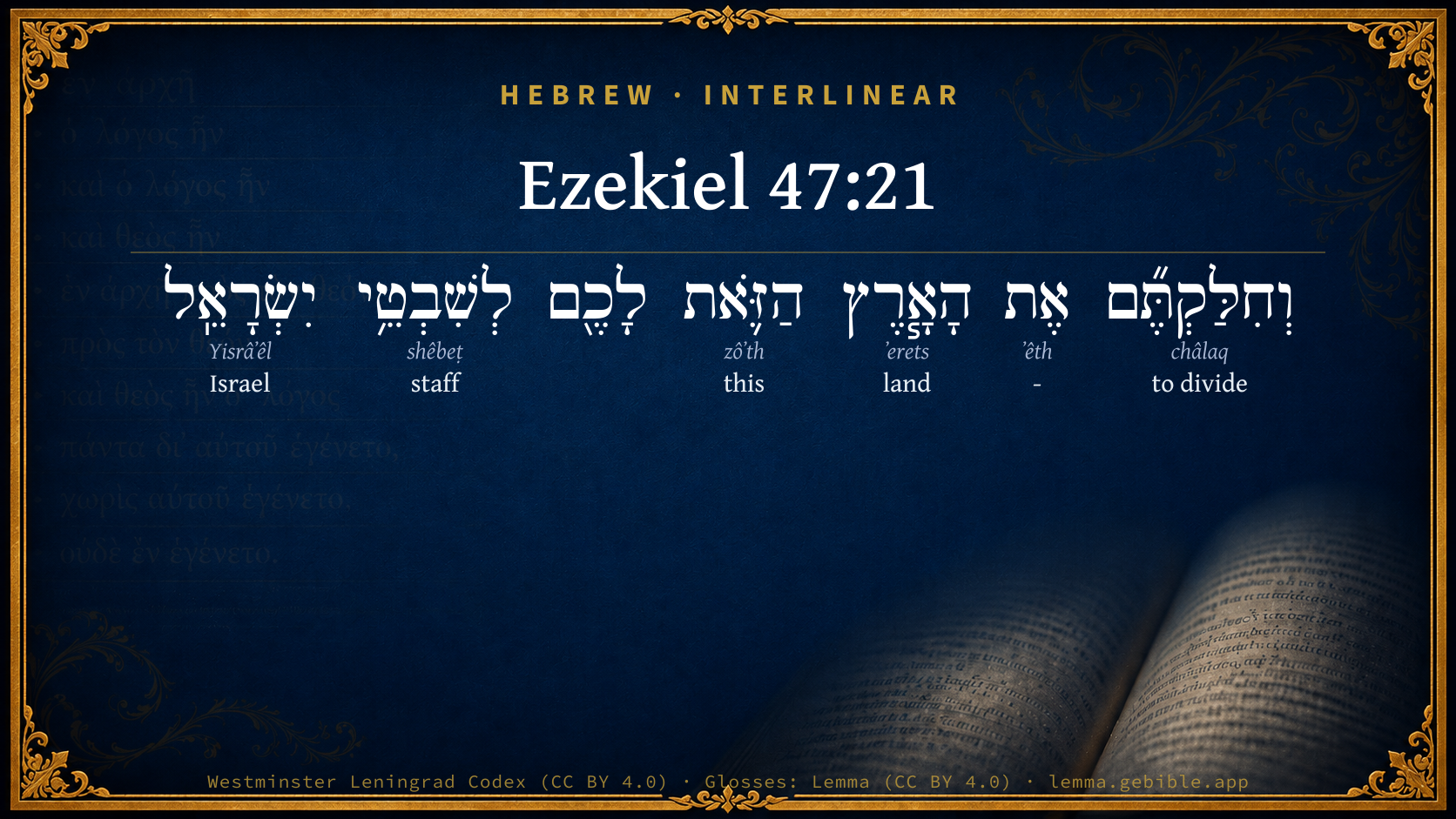
Ezekiel 47:21

Hebrew (Westminster Leningrad Codex) Ezekiel 47:21 appears in the Hebrew Old Testament. The text above is from the Westminster Leningrad Codex. Each word links to its Strong’s number, a concise gloss, and parsing drawn from the Open Scriptures Hebrew Bible morphology. Click any word for its full Brown-Driver-Briggs (BDB) entry.
Download image
Cite this verse

Ezekiel 47:21 (World English Bible). Public Domain. Lemma interlinear Bible study tool, https://lemma.gebible.app/v/ezekiel/47/21.

Show BibTeX & RIS
BibTeX
RIS
English Translation
So shall you divide this land to you according to the tribes of Israel.
World English Bible · Public Domain
Download a study sheet

One document with this verse’s original text, its word-by-word gloss line, the meaning frame, cross-references with their text, attributed commentary, and full source and license credits — printable, and it pastes into notes with its structure intact.

This verse Autodidact and up

Study sheet (.html) Plain text (.txt)

A passage Seminary Student

Up to 50 verses in one chapter. A passage sheet keeps up to 6 commentary sources and 12 cross-references per verse, in the order this page ranks them, and says so on the sheet whenever that leaves anything out. Ask for a single verse and you get the Autodidact verse sheet above.

Everything on this page stays free to read, with no account — the sheet is a download of what is already on screen, not access to it.

Want to remove ads? Support Godless Engineer
Compare translations 3

The same verse in 3 English versions, stacked beneath the original-language interlinear above. Click any original word for its lexicon entry.

Each is an independent rendering of the whole verse — the interlinear is not word-aligned to these translations.

Highlighted words mark where these versions differ — a whole-verse word diff, not a word-by-word alignment.

  • World English Bible Public Domain
    So shall you divide this land to you according to the tribes of Israel.
  • King James Version Public Domain
    So shall ye divide this land unto you according to the tribes of Israel.
  • unfoldingWord Literal Text CC BY-SA 4.0
    In this way you will divide this land for yourselves, for the tribes of Israel.

unfoldingWord Literal Text — © unfoldingWord, licensed CC BY-SA 4.0. Word-aligned USFM3 via Door43 (git.door43.org/unfoldingWord/en_ult).

Versions to compare (up to 4)

3 of 4 selected

Show all 18 translations

Every available English version of this verse, each an independent rendering of the whole verse.

  • World English Bible Public Domain
    So shall you divide this land to you according to the tribes of Israel.
  • Berean Standard Bible Public Domain
    You are to divide this land among yourselves according to the tribes of Israel.
  • Majority Standard Bible Public Domain
    You are to divide this land among yourselves according to the tribes of Israel.
  • King James Version Public Domain
    So shall ye divide this land unto you according to the tribes of Israel.
  • American Standard Version (1901) Public Domain
    So shall ye divide this land unto you according to the tribes of Israel.
  • Revised Version (1885) Public Domain
    So shall ye divide this land unto you according to the tribes of Israel.
  • Geneva Bible (1599) Public Domain
    So shall ye deuide this lande vnto you, according to the tribes of Israel.
  • Douay-Rheims (1899) Public Domain
    And you shall divide this land unto you by the tribes of Israel:
  • Young's Literal Translation Public Domain
    `And ye have divided this land to you, according to the tribes of Israel;
  • Literal Standard Version CC BY-SA 4.0
    And you have divided this land to yourselves, according to the tribes of Israel;
  • Unlocked Literal Bible CC BY-SA 4.0
    In this way you will divide this land for yourselves, for the tribes of Israel.
  • unfoldingWord Literal Text CC BY-SA 4.0
    In this way you will divide this land for yourselves, for the tribes of Israel.
  • Darby Bible Public Domain
    And ye shall divide this land unto you according to the tribes of Israel.
  • World Messianic Bible Public Domain
    “So you shall divide this land to yourselves according to the tribes of Israel.
  • Webster's Bible Public Domain
    So shall ye divide this land to you according to the tribes of Israel.
  • Free Bible Version CC BY-SA 4.0
    You are to allocate this land for you to own according to the tribes of Israel.
  • Bible in Basic English Public Domain
    You will make a division of the land among you, tribe by tribe.
  • JPS Tanakh (1917) Public Domain
    So shall ye divide this land unto you according to the tribes of Israel.

Literal Standard Version (2020), Covenant Press — licensed CC BY-SA 4.0. Text via the HelloAO Bible API (eBible.org). Unlocked Literal Bible (unfoldingWord) — licensed CC BY-SA 4.0. Text via the HelloAO Bible API (eBible.org). unfoldingWord Literal Text — © unfoldingWord, licensed CC BY-SA 4.0. Word-aligned USFM3 via Door43 (git.door43.org/unfoldingWord/en_ult). Free Bible Version, Dr. Jonathan Gallagher — licensed CC BY-SA 4.0. Text via the HelloAO Bible API (eBible.org).

Word by word

More ways to search: Search by grammar → Find every occurrence → Compare this word →

Practice this passage: Drill this verse → Learn its vocabulary →

וְחִלַּקְתֶּ֞ם
châlaq
H2505
“and · to divide”
Conjunction + Verb, Piel, Sequential Perfect, 2nd Person, Masculine, Plural
Part of Speech
Conjunction + Verb
Stem
Piel
Form
Sequential Perfect
Person
2nd Person
Gender
Masculine
Number
Plural
Full BDB Definition

Origin: a primitive root

TWOT: 669

to divide, share, plunder, allot, apportion, assign - (Qal) - to divide, apportion - to assign, distribute - to assign, impart - to share - to divide up, plunder - (Niphal) - to divide oneself - to be divided - to assign, distribute - (Piel) - to divide, apportion - to assign, distribute - to scatter - (Pual) to be divided - (Hiphil) to receive a portion or part - (Hithpael) to divide among themselves - to be smooth, slippery, deceitful - (Qal) to be smooth, slippery - (Hiphil) - to be smooth - to flatter
  1. אֶת ʼêth H853 “-” Particle, Direct Object
  2. הָאָ֧רֶץ ʼerets H776 “the · land” Particle, Definite Article + Noun, Common, Both, Singular, Absolute
  3. הַזֹּ֛את zôʼth H2063 “the · this” Particle, Definite Article + Pronoun, Demonstrative, Feminine, Singular
  4. לְשִׁבְטֵ֥י shêbeṭ H7626 “to/for · staffs of” Preposition + Noun, Common, Masculine, Plural, Construct
  5. יִשְׂרָאֵֽל Yisrâʼêl H3478 “Israel” Noun, Proper

About this verse

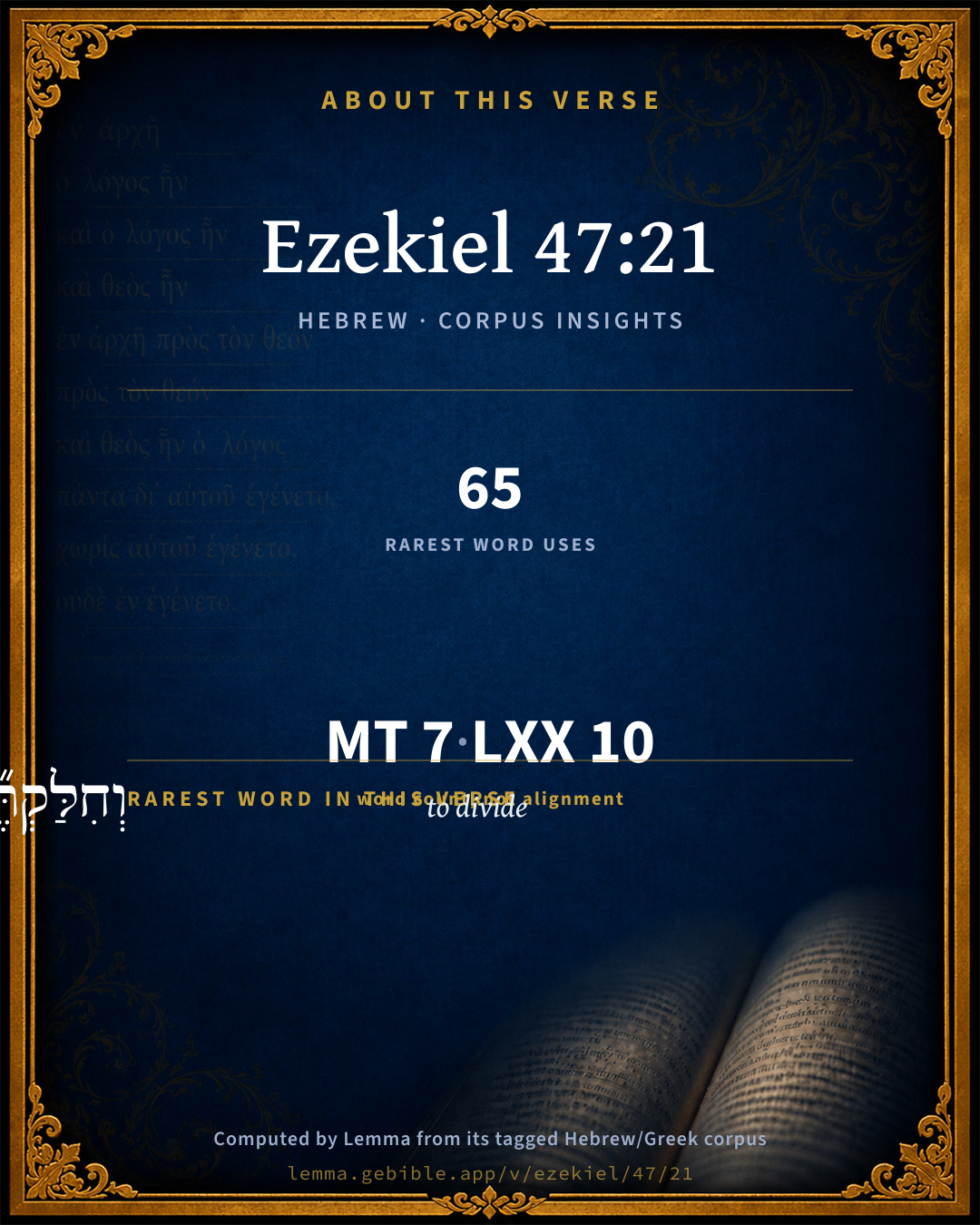
These counts appear in no published source. They are computed here, from the morphology-tagged text and Lemma’s own curated glosses. What Lemma adds →

7
words
6
distinct lemmas
Prophets
section

Grammatical profile

  • 1 verb
  • 3 nouns
  • 1 pronoun
  • 1 preposition
  • 1 particle

Verb forms

  • וְחִלַּקְתֶּ֞ם Piel · Sequential Perfect

Hebrew & Septuagint length

In English translation the verse runs 14 words from the Hebrew and 14 from the Septuagint (LXX English) — the same length.

A rough comparison of the two English renderings, which tokenize alike — not a word-level alignment.

Word counts can differ between the Hebrew and the Greek without any difference in meaning — e.g. the Hebrew direct-object marker אֵת has no separate Greek word, and Greek often adds the article ὁ.

In the original languages it is 7 Hebrew tokens and 10 Greek tokens — but the two are counted differently (Hebrew bundles its prefixes and suffixes into one token; the Greek is in lemma form), so that isn’t a like-for-like length.

Hebrew and Greek witnesses Masoretic Hebrew ↔ Greek Septuagint

The same verse in the two great witnesses to the Old Testament, shown verse-for-verse.

These are two independent witnesses, not word-aligned to each other, and the Septuagint is shown in lemma (dictionary) form.

Hebrew Ezekiel 47:21 Masoretic · Westminster Leningrad Codex

וְחִלַּקְתֶּ֞ם אֶת הָאָ֧רֶץ הַזֹּ֛את לָכֶ֖ם לְשִׁבְטֵ֥י יִשְׂרָאֵֽל

So shall you divide this land to you according to the tribes of Israel.

World English Bible · Public Domain

Greek LXX Ezekiel 47:21 Septuagint · lemma form

καί διαμερίζω ὁ γῆ οὗτος αὐτός ὁ φυλή ὁ ἰσραήλ

So you⌃ shall divide this land to them, even to the tribes of Israel.

LXX2012 (modern English Septuagint) · Public Domain

Hebrew: Westminster Leningrad Codex (CC BY 4.0). Greek: Septuagint (public domain); English from LXX2012 (modern English Septuagint) (Public Domain). How the Septuagint differs from the Hebrew →

Targum (Aramaic paraphrase)

1

The Targum is the ancient Jewish Aramaic paraphrase of the Hebrew Scriptures — an interpretive translation, not the Hebrew text itself. Onkelos (literal) and Pseudo-Jonathan (expansive) render the Torah, and Jonathan the Prophets. Coverage is partial: where no permissively-licensed English translation exists for a verse, only the Aramaic is shown. This is verse-level text, not a word-by-word alignment to the Hebrew.

  1. Targum Jonathan Prophets (Joshua–Malachi)
    וּתְפַלְגוּן יַת אַרְעָא הָדָא לְכוֹן לְשִׁבְטַיָא דְיִשְׂרָאֵל:

    (no public-domain English translation for this verse)

    Targum Jonathan — Aramaic: “Mikraot Gedolot” (public domain). English: “Sefaria Community Translation” (CC0 1.0 (public-domain dedication)); “London "Chaldee Paraphrase," 1871” (public domain). Text via Sefaria.

Commentary

Notes on Ezekiel 47:21 from classic Christian and Jewish commentators (each source and its license shown beneath its notes). The classic Christian expositions comment on the surrounding passage and are grouped to its opening verse, so a note may address several verses; the Jewish commentaries on the Tanakh (Rashi and others) are per-verse, so they appear only where the commentator wrote on this verse.

Lemma curates 59 commentaries, every one of them public domain or Creative Commons licensed, each selected and text-cleaned for this edition rather than reprinted as found. About our sources →

Trapp's Complete Commentary

John Trapp

Eze 47:21 So shall ye divide this land unto you according to the tribes of Israel.

Ver. 21. So shall ye divide.] Epilogus est. There is one and the same "inheritance of the saints in light."

John Trapp, A Commentary or Exposition upon All the Books of the Old and New Testament (1647–1656) — public domain. Text from a community e-Sword module.

Tyndale Open Study Notes

Tyndale Open Resources

47:21-23 The land within these boundaries was to be divided among the tribes of Israel. Instead of the divided preexilic kingdoms, the future would see a single kingdom formed from the diverse unity of the twelve tribes and incorporating even resident foreigners and their families, provided that they had joined Israel as converts. These people were to receive an allotment, just like the native-born Israelites, and they could pass this inheritance on to their children. In view of the significance of the land to Ezekiel, this was a high privilege.

Tyndale Open Study Notes — © Tyndale Open Resources, licensed CC BY-SA 4.0. Text via the HelloAO Bible API.

The Cambridge Bible for Schools and Colleges

gen. ed. J. J. S. Perowne

21–23. The land so bounded shall be divided equally among the tribes; and strangers sojourning in Israel shall inherit just as those born in the land. The stranger shall have his inheritance among the members of the tribe in which he sojourns.

The Cambridge Bible for Schools and Colleges (gen. ed. J. J. S. Perowne; Cambridge University Press, 1878–1918) — public domain. Text from a community e-Sword module.

John Gill's Exposition

So shall ye divide this land unto you,.... As thus bounded, east, west, north, and south:

according to the tribes of Israel; See Gill on Eze 47:13.

John Gill's Exposition of the Whole Bible (1746–1763) — public domain (CC PDM 1.0). Text via the HelloAO Bible API.

Matthew Poole's English Annotations

This land, now bounded.

According to the tribes of Israel; into twelve parts or tribes, to which all, but what is allotted to prince, priests, Levites, and the city. This, as holy, must be reserved; and when reserved, a very fair portion is left to the twelve tribes, if you measure the holy portion by cubits, and not by reeds.

Matthew Poole's English Annotations on the Holy Bible (1683–1685) — public domain. Text from a community e-Sword/MySword module.

The Pulpit Commentary

Vers. 21-23 The geographical boundaries of the land having been indicated, general directions are furnished as to the manner of its distribution.

(1) It should be partitioned among the tribes as tribes rather than among the families of Israel (see on ver. 13).

(2) The division of the territory should be made by lot. This is pointed to by the use of qlj (from qlje "a smooth stone"), which signifies "to divide by lot.

(3) The strangers who should sojourn amongst the tribes and beget children amongst them should inherit equally with Israelites who should be born in the country.

(4) The inheritance of the stranger should be assigned him in the tribe where he sojourned. Of these regulations the last two were an advance on the earlier Mosaic legislation with regard to "strangers," or who were to be treated with affectionate kindness (Exo_22:21 Exo_23:9; Lev_19:34; Deu_1:16 Deu_24:14) admitted to offer sacrifice, (Lev_17:8, Lev_17:10, Lev_17:13) and even allowed to partake of the Passover on submitting to circumcision, (Exo_12:48) but on no account permitted to hold property in land. (Lev_25:47-55) But if the priest-code was later than Ezekiel, why should it have receded from the freer and more liberal spirit of Ezekiel? If progressive development can determine the relative ages of two documents, then Ezekiel, which accords equal rights to Jew and Gentile in the new Israel, and thus anticipates that breaking down of the middle wall of partition which has taken place under the gospel (Joh_10:16; Rom_2:10, 11 9:24; Gal_3:8-14, Gal_3:28; Eph_2:14-16) should be posterior to the priest-code, which shows itself to be not yet emancipated from the trammels of Jewish exclusivism. At the same time, Ezekiel"s Torah does not grant equal rights with native-born Israelites to "strangers" indiscriminately, or only to those of them who should have families, as Hitzig suggests, in reward for their increasing the population, but to such of them as should permanently settle in the midst of Israel, and show this by begetting children, and in this manner "building houses" for themselves. Kliefoth justly cautions against concluding from the prophet"s statement that the time in which the prophet"s vision realizes itself will necessarily be one in which marrying and begetting children will take place; and with equal justice points out that the number of Israel, especially when swelled up by an influx of Gentiles, will be so great (comp. ver. 10) as to render their settlement within the narrow boundaries of the land an impossibility in this circumstance finding another indication that the prophet"s language was intended to be symbolically, not literally, interpreted.

NOTE. On the boundaries of the land. Smend thinks

(1) that in respect of the north boundary, Ezekiel and the priest-code contradict the older source of the Pentateuch, which does not permit the territory of Asher to extend so far north as Hamath. (see Jos_19:24-31; and comp.; Jud 1:31)

(2) that never at any time did Israelites dwell so far north as at the entering in of Hamath;

(3) that this extension of the land northwards was intended as a compensation for the withdrawment of the territory east of the Jordan; and

(4) that in dividing among tribes rather than among families Ezekiel deviates from both the Jehovistic tradition and the priest-code.

But

(1) if the above-cited passages do not extend Asher"s territory beyond Gen_15:18, which critics assign to the Elohist, one of the authors of J.E., the so-called prophetical narrative of the Hexateuch, and Exo_23:31, which, according to the same authorities, formed part of the commonly styled book of the covenant, expressly mention the great river Euphrates as the north boundary of the land, while the same is recognized by the Deuteronomist. (Deu_11:24; Deu_19:8 1Ki_4:24 1Ki_8:65; and 2Ki_14:25 comp. 2Ch_7:8 2Ch_8:3, 2Ch_8:4) show that in the time of Solomon the boundaries of the land reached as far north as Hamath.

(3) As it was not originally contemplated by the Mosaic distribution to take immediate possession of the east Jordan land, (Num_34:10-12) and this was only granted to Reuben, Gad, and half Manasseh on their entreaty, (Num_32:33-42) no ground existed why its withdrawal should be compensated for.

(4) If Ezekiers division of the land according to tribes rather than families shows that it existed prior to the priest-code, then the same argument should demonstrate its prior existence to J.E., which throughout as-stones the principle of division according to families.

(5) If Ezekiel preceded the priest-code, it will require some explanation to understand, first, why the author of the latter should have followed the comparatively uncertain Jehovistic tradition rather than the definite arrangements made by a prophet whom he regarded as practically the originator of his faith; and secondly, why he should have so materially altered that prophet"s land-boundaries and tribe-dispositions.

The division of the land.

I THE DIVISION WAS INTO SEPARATE ALLOTMENTS. The land of Israel was not held in common by the whole people. Certain dues were attached to it, and certain regulations governed the treatment of it by its owners. Thus it was forbidden for any one to make an absolute sale of his estate. On these conditions each family held its own land, like the peasant-proprietors of France and Belgium, God divides our lives out severally. Each must live his own separate life and discharge his individual duty while he receives his personal grace, we are to live in the community and for its benefit, bearing one another"s burdens and so fulfilling the law of Christ, but still each taking his own particular part in the common life of the whole.

II THE DIVISION WAS CLEAR AND DEFINITE. There were exact confines, and it was a criminal offence for any one to remove his neighbor"s landmark. (Deu_19:14) We ought to have no doubt as to our portion in life. Occasionally we may see a desolate, ruinous house part of an estate in chancery, the ownership of which is disputed; on the other hand, we hear of claimants to estates who find it difficult to obtain what they urge is their own property. But in the region of personal religion each should see what is his portion and mission for the world.

III THE DIVISION INCLUDED A PORTION FOR EVERY ISRAELITE. It was so carefully made that the most insignificant family should not be overlooked. There should be a share for every one in the produce of our great fruitful earth. Centers of population may be overcrowded, but the earth is not yet full. Folly and sin, tyranny, injustice, and robbery, keep many out of their fights. If all did their duty and had their dues there would be enough for all. This holds good also in the spiritual world. There is room in the kingdom of heaven for all. No one need fear that others will go in first and take the blessing, and so leave him behind too late to get any benefit from the Divine bounty like the impotent man at the pool of Bethesda. (Joh_5:7) There is a portion inChrist"s redemption for every soul of man. It only remains for all to receive their inheritance, accepting it by faith and entering it with obedience to the Lord who is supreme over the whole.

IV THE DIVISION WAS BY LOT. This expedient prevented all complaints of supposed injustice. The owner of a bit of bare hillside had no right to envy the fortunate possessor of a rich plot in the valley. But there was more than this object in view in the use of the lot, which was taken as part of the method of Divine government. "The lot is cast into the lap; but the whole disposing thereof is of the Lord". (Pro_16:33) The people were thus to feel that God was to determine where each should settle, and to say, "He shall choose our inheritance for us". (Psa_47:4) We talk of the "lottery of life," but we should remember that Providence obliterates chance. God orders our circumstances, and whether the lines have fallen to us in pleasant places and we have a goodly heritage, or we are left to poverty and hardship, our Father"s choice must be good.

The Pulpit Commentary (1880–1919), ed. H.D.M. Spence-Jones & Joseph S. Exell — public domain. Text from a community e-Sword module.

unfoldingWord translationNotes

Door43 World Missions Community

Then it will happen that

See how you translated this in Ezekiel 21:7.

this is the Lord Yahweh's declaration

Yahweh speaks of himself by name to express the certainty of what he is declaring. See how you translated this in Ezekiel 5:11. AT: "this is what the Lord Yahweh has declared" or "this is what I, the Lord Yahweh, have declared" (See: First, Second, or Third Person)

translationWords

twelve tribes of Israel

lots

alien

Lord Yahweh

declare

unfoldingWord translationNotes — © Distant Shores Media and the Door43 World Missions Community, licensed CC BY-SA 4.0. Source: git.door43.org/Door43/en_tn.

Lesson kit

Teaching starters — assembled from the data on this page, not authored interpretation. Every prompt links to the verse data it draws on. Edit before teaching.

Ezekiel, in the Prophets, opens this verse with 7 words (6 distinct Hebrew lemmas). Its most distinctive word is châlaq (“to divide”). A historical commentator’s framing appears above. Read the whole chapter for the surrounding context.

Discussion questions

  1. The word châlaq carries the sense “to divide.” How does it shape the verse?
  2. These translations render this verse differently; the difference is in the English rendering, not the original. What questions does that raise?
  3. «וְחִלַּקְתֶּ֞ם» is a Piel Sequential Perfect verb. How does that grammatical form shape the action described?
  4. Compare how Trapp's Complete Commentary and Tyndale Open Study Notes read this verse. Where do they agree or differ?

Things to notice

Reading settings

Reading text

Shown beneath each verse's original-language words.

Old Testament
Old Testament edition

Read the OT as the Masoretic Hebrew (MT) or the Greek Septuagint (LXX).

English shown for the Greek Septuagint (in the Hebrew ↔ Greek comparison).

Comparing translations? Open the Compare panel on any verse page to stack up to four side by side.