

Job 37:13

Hebrew (Westminster Leningrad Codex) Job 37:13 appears in the Hebrew Old Testament. The text above is from the Westminster Leningrad Codex. Each word links to its Strong’s number, a concise gloss, and parsing drawn from the Open Scriptures Hebrew Bible morphology. Click any word for its full Brown-Driver-Briggs (BDB) entry.
Download image
Cite this verse

Job 37:13 (World English Bible). Public Domain. Lemma interlinear Bible study tool, https://lemma.gebible.app/v/job/37/13.

Show BibTeX & RIS
BibTeX
RIS
English Translation
Whether it is for correction, or for his land, Or for loving kindness, that he causes it to come.
World English Bible · Public Domain
Download a study sheet

One document with this verse’s original text, its word-by-word gloss line, the meaning frame, cross-references with their text, attributed commentary, and full source and license credits — printable, and it pastes into notes with its structure intact.

This verse Autodidact and up

Study sheet (.html) Plain text (.txt)

A passage Seminary Student

Up to 50 verses in one chapter. A passage sheet keeps up to 6 commentary sources and 12 cross-references per verse, in the order this page ranks them, and says so on the sheet whenever that leaves anything out. Ask for a single verse and you get the Autodidact verse sheet above.

Everything on this page stays free to read, with no account — the sheet is a download of what is already on screen, not access to it.

Want to remove ads? Support Godless Engineer
Compare translations 3

The same verse in 3 English versions, stacked beneath the original-language interlinear above. Click any original word for its lexicon entry.

Each is an independent rendering of the whole verse — the interlinear is not word-aligned to these translations.

Highlighted words mark where these versions differ — a whole-verse word diff, not a word-by-word alignment.

  • World English Bible Public Domain
    Whether it is for correction, or for his land, Or for loving kindness, that he causes it to come.
  • King James Version Public Domain
    He causeth it to come, whether for correction, or for his land, or for mercy.
  • unfoldingWord Literal Text CC BY-SA 4.0
    If to the rod, if to his earth, if to kindness, he causes it to find it.

unfoldingWord Literal Text — © unfoldingWord, licensed CC BY-SA 4.0. Word-aligned USFM3 via Door43 (git.door43.org/unfoldingWord/en_ult).

Versions to compare (up to 4)

3 of 4 selected

Show all 18 translations

Every available English version of this verse, each an independent rendering of the whole verse.

  • World English Bible Public Domain
    Whether it is for correction, or for his land, Or for loving kindness, that he causes it to come.
  • Berean Standard Bible Public Domain
    Whether for punishment or for His land, He accomplishes this in His loving devotion.
  • Majority Standard Bible Public Domain
    Whether for punishment or for His land, He accomplishes this in His loving devotion.
  • King James Version Public Domain
    He causeth it to come, whether for correction, or for his land, or for mercy.
  • American Standard Version (1901) Public Domain
    Whether it be for correction, or for his land, Or for lovingkindness, that he cause it to come.
  • Revised Version (1885) Public Domain
    Whether it be for correction, or for his land, or for mercy, that he cause it to come.
  • Geneva Bible (1599) Public Domain
    Whether it be for punishment, or for his lande, or of mercie, he causeth it to come.
  • Douay-Rheims (1899) Public Domain
    Whether in one tribe, or in his own land, or in what place soever of his mercy he shall command them to be found.
  • Young's Literal Translation Public Domain
    Whether for a rod, or for His land, Or for kindness -- He doth cause it to come.
  • Literal Standard Version CC BY-SA 4.0
    Whether for a rod, or for His land, || Or for kindness—He causes it to come.
  • Unlocked Literal Bible CC BY-SA 4.0
    He makes all of this happen; sometimes it happens for correction, sometimes for his land, and sometimes as acts of covenant faithfulness.
  • unfoldingWord Literal Text CC BY-SA 4.0
    If to the rod, if to his earth, if to kindness, he causes it to find it.
  • Darby Bible Public Domain
    Whether he cause it to come as a rod, or for his land, or in mercy.
  • World Messianic Bible Public Domain
    whether it is for correction, or for his land, or for loving kindness, that he causes it to come.
  • Webster's Bible Public Domain
    He causeth it to come, whether for correction, or for his land, or for mercy.
  • Free Bible Version CC BY-SA 4.0
    He does this to accomplish his will, either to discipline or to show his goodness.
  • Bible in Basic English Public Domain
    For a rod, or for a curse, or for mercy, causing it to come on the mark.
  • JPS Tanakh (1917) Public Domain
    Whether it be for correction, or for His earth, or for mercy, that He cause it to come.

Literal Standard Version (2020), Covenant Press — licensed CC BY-SA 4.0. Text via the HelloAO Bible API (eBible.org). Unlocked Literal Bible (unfoldingWord) — licensed CC BY-SA 4.0. Text via the HelloAO Bible API (eBible.org). unfoldingWord Literal Text — © unfoldingWord, licensed CC BY-SA 4.0. Word-aligned USFM3 via Door43 (git.door43.org/unfoldingWord/en_ult). Free Bible Version, Dr. Jonathan Gallagher — licensed CC BY-SA 4.0. Text via the HelloAO Bible API (eBible.org).

Word by word

More ways to search: Search by grammar → Find every occurrence → Compare this word →

Practice this passage: Drill this verse → Learn its vocabulary →

About this verse

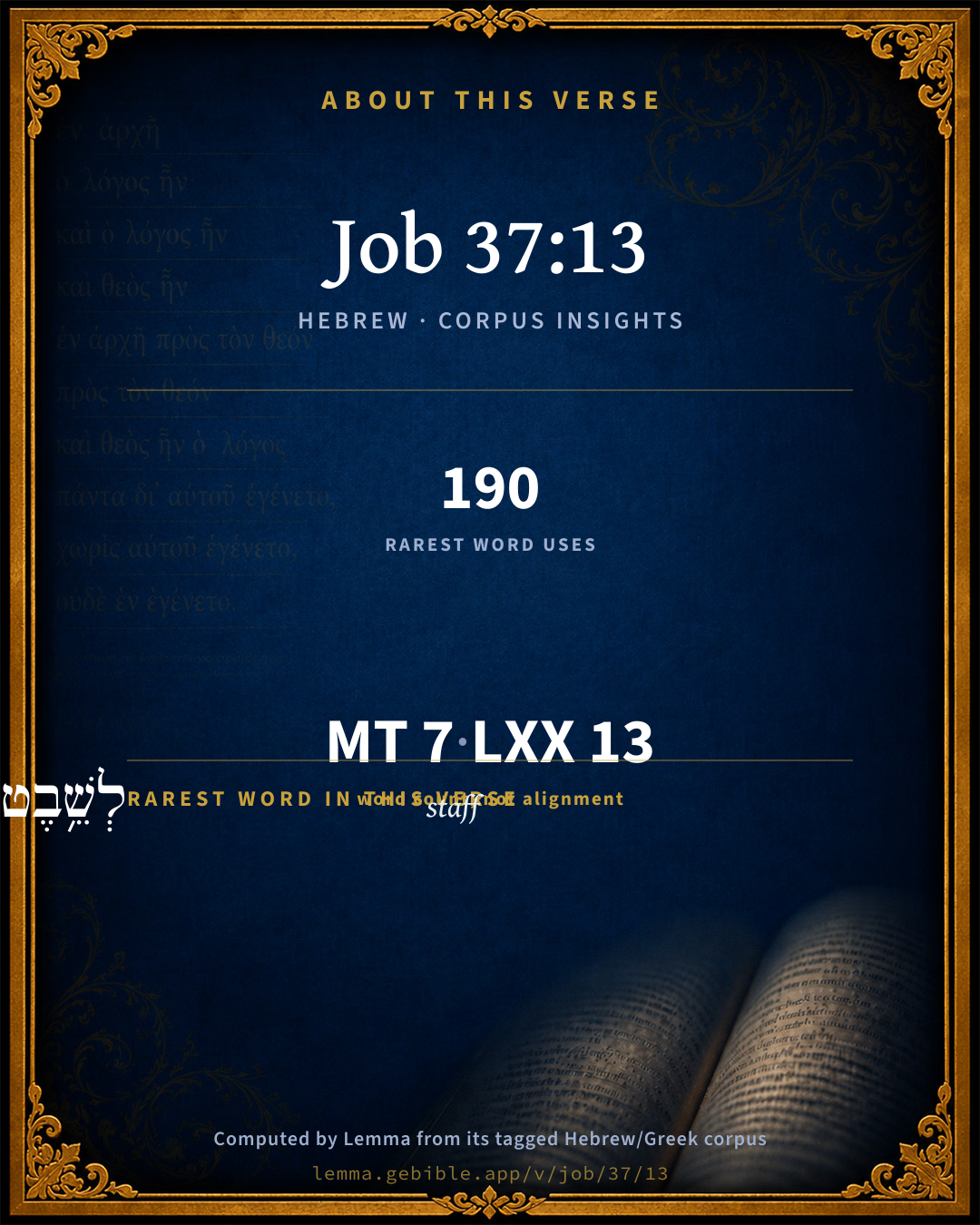
These counts appear in no published source. They are computed here, from the morphology-tagged text and Lemma’s own curated glosses. What Lemma adds →

7
words
5
distinct lemmas
Wisdom
section

Grammatical profile

  • 1 verb
  • 3 nouns
  • 3 conjunctions

Verb forms

  • יַמְצִאֵֽהוּ Hiphil · Imperfect

Repetition

A word recurs within this verse — often emphatic in Hebrew:

  • אִם if H518 ×3

Hebrew & Septuagint length

In English translation the verse runs 19 words from the Hebrew and 26 from the Septuagint (LXX English) — closely comparable.

A rough comparison of the two English renderings, which tokenize alike — not a word-level alignment.

Word counts can differ between the Hebrew and the Greek without any difference in meaning — e.g. the Hebrew direct-object marker אֵת has no separate Greek word, and Greek often adds the article ὁ.

In the original languages it is 7 Hebrew tokens and 13 Greek tokens — but the two are counted differently (Hebrew bundles its prefixes and suffixes into one token; the Greek is in lemma form), so that isn’t a like-for-like length.

Cross-references

11

Topical passages linked to Job 37:13 in the Treasury of Scripture Knowledge — connected by theme and wording, ordered by reader-vote popularity; previews shown in the World English Bible.

  • 1 Kings 18:45 It happened in a little while, that the sky grew black with clouds and wind, and there was a great rain. Ahab rode, and went to Jezreel:
  • 1 Samuel 12:18–19 So Samuel called to Yahweh; and Yahweh sent thunder and rain that day: and all the people greatly feared Yahweh and Samuel.
  • Job 38:26–27 To cause it to rain on a land where no man is; On the wilderness, in which there is no man;
  • Job 36:31 For by these he judges the people. He gives food in abundance.
  • Exodus 9:18–25 Behold, tomorrow about this time I will cause it to rain a very grievous hail, such as has not been in Egypt since the day it was founded even until now.
  • 2 Samuel 21:10 Rizpah the daughter of Aiah took sackcloth, and spread it for her on the rock, from the beginning of harvest until water was poured on them from the sky; and she allowed neither the birds of the sky to rest on them by day, nor the animals of the field by night.
  • Ezra 10:9 Then all the men of Judah and Benjamin gathered themselves together to Jerusalem within the three days; it was the ninth month, on the twentieth [day] of the month: and all the people sat in the broad place before the house of God, trembling because of this matter, and for the great rain.
  • Job 37:6 For he says to the snow, 'Fall on the earth;' Likewise to the shower of rain, And to the showers of his mighty rain.
  • Job 38:37–38 Who can number the clouds by wisdom? Or who can pour out the bottles of the sky,
  • 2 Samuel 21:14 They buried the bones of Saul and Jonathan his son in the country of Benjamin in Zela, in the tomb of Kish his father: and they performed all that the king commanded. After that God was entreated for the land.
  • Joel 2:23 "Be glad then, you children of Zion, And rejoice in Yahweh, your God; For he gives you the former rain in just measure, And he causes the rain to come down for you, The former rain and the latter rain, As before.

Cross-references courtesy of OpenBible.info (CC BY 4.0).

Hebrew and Greek witnesses Masoretic Hebrew ↔ Greek Septuagint

The same verse in the two great witnesses to the Old Testament, shown verse-for-verse.

These are two independent witnesses, not word-aligned to each other, and the Septuagint is shown in lemma (dictionary) form.

Hebrew Job 37:13 Masoretic · Westminster Leningrad Codex

אִם לְשֵׁ֥בֶט אִם לְאַרְצ֑וֹ אִם לְ֝חֶ֗סֶד יַמְצִאֵֽהוּ

Whether it is for correction, or for his land, Or for loving kindness, that he causes it to come.

World English Bible · Public Domain

Greek LXX Job 37:13 Septuagint · lemma form

ἐάν εἰς παιδεία ἐάν εἰς ὁ γῆ αὐτός ἐάν εἰς ἔλεος εὑρίσκω αὐτός

this has been appointed by him on the earth, whether for correction, or for his land, or if he shall find him an object for mercy.

LXX2012 (modern English Septuagint) · Public Domain

Hebrew: Westminster Leningrad Codex (CC BY 4.0). Greek: Septuagint (public domain); English from LXX2012 (modern English Septuagint) (Public Domain). How the Septuagint differs from the Hebrew →

Commentary

Notes on Job 37:13 from classic Christian and Jewish commentators (each source and its license shown beneath its notes). The classic Christian expositions comment on the surrounding passage and are grouped to its opening verse, so a note may address several verses; the Jewish commentaries on the Tanakh (Rashi and others) are per-verse, so they appear only where the commentator wrote on this verse.

Lemma curates 59 commentaries, every one of them public domain or Creative Commons licensed, each selected and text-cleaned for this edition rather than reprinted as found. About our sources →

Trapp's Complete Commentary

John Trapp

Job 37:13 He causeth it to come, whether for correction, or for his land, or for mercy.

Ver. 13. He causeth it to come, whether for correction] Heb. For a rod, εις παιδειαν (Sept.). God hath his rods sticking up in every corner of his house for chastisement of his children, and they shall take it for a favour too, Heb 12:7 1Co 11:32. Sinite virgam corripientem, ne sentiatis malleum conterentem, saith Bernard. Be content with the rod of correction, that ye feel not the maul of confusion. Better suffer immoderate rains and lightnings, than that terrible tempest, Job 27:21, and the black flashes of hell fire, that πυριφλεγεθων, as Plato calleth it; the fiery lake, as the Scripture.

Or of his land] i.e. His Church, Hos 9:3. A land that he watereth and watcheth over from one end of the year to the other, Deu 28:12. His vineyard cared for, and kept to himself night and day, Isa 27:3. Or, the earth at large, which is God’s great field, Psa 24:1 (as the Church is his fold, Psa 100:3), and especially that part of it which is desert and uninhabited. There also God causeth his sun to shine, and his rain to fall, Mat 5:45 Job 38:26-27, that the wild beasts also may have food.

Or for mercy] Some singular and extraordinary mercy, as 2Sa 21:10 1Ki 18:45. Sive ad faciendum beneflcentiam; or to bestow his bounty, and to bestow a largess; as princes sometimes make a scatter of monies among the multitude. Clouds are God’s storehouses, which he soon opens to our profit, Deu 28:12; by them he maketh them a scatter of riches upon the earth, which good men gather, and bad men scramble for.

John Trapp, A Commentary or Exposition upon All the Books of the Old and New Testament (1647–1656) — public domain. Text from a community e-Sword module.

Joseph Benson's Commentary

Job 37:13. Whether for correction — Hebrew, אם לשׁבשׂ, im leshebet, whether for a rod, to scourge or correct men by immoderate showers. The word, however, also means, a tribe, for a certain portion of land, which God intends particularly to favour or punish, in that way. Or for his land — Hebrew, לארצוle-artzo, for his earth; the whole earth, which is said to be the Lord’s, Psa 24:1; Psa 50:12; and so this may denote a general judgment by excessive rains inflicted upon the whole earth, and all its inhabitants, namely, the universal deluge, which came, in a great measure, out of the clouds, and was, in a manner, then fresh in the memories of men. And thus these first two members of the sentence speak of correction, and the last of relief and comfort. Or for mercy — For the benefit of mankind, by cooling and cleansing the air, and refreshing and improving all the fruits of the earth. “It seems not improbable to me,” says Bishop Sherlock, “that these reflections arose from the methods made use of by providence (not worn out of memory in the time of the writer of this book) in punishing the old world, in consequence of the curse laid upon the ground. Such methods they are by which the ground may, at any time, be cursed, and the toil and labour of men increased to what degree God thinks fit.”

Joseph Benson's Commentary on the Old and New Testaments (1811–1818) — public domain. Text from a community e-Sword module.

Tyndale Open Study Notes

Tyndale Open Resources

37:13 The same act by God can serve more than one function, such as storms that both destroy enemies and give God’s people victory (Josh 10; Judg 4; 1 Sam 7:10-11; Pss 18:7-15; 105:32-33).

Tyndale Open Study Notes — © Tyndale Open Resources, licensed CC BY-SA 4.0. Text via the HelloAO Bible API.

Geneva Bible (1599)

Geneva Bible translators

Rain, cold, heat, tempests and such like are sent of God, either to punish man, or to profit the earth, or to declare his favor toward man, as Job 36:31.

Geneva Bible (1599) marginal notes — public domain. Text via Bolls.life.

Jamieson, Fausset & Brown

Robert Jamieson, A. R. Fausset & David Brown

Literally, "He maketh it (the rain-cloud) find place," whether for correction, if (it be destined) for His land (that is, for the part inhabited by man, with whom God deals, as opposed to the parts uninhabited, on which rain is at other times appointed to fall, Job 38:26-27) or for mercy. "If it be destined for His land" is a parenthetical supposition [MAURER]. In English Version, this clause spoils the even balance of the antithesis between the "rod" (Margin) and "mercy" (Psa 68:9; Gen. 7:1-24).

Jamieson, Fausset & Brown — Commentary Critical and Explanatory on the Whole Bible (1871) — public domain (CC PDM 1.0). Text via the HelloAO Bible API.

Adam Clarke's Commentary

Verse 13. He causeth it to come] The Vulgate translates the text thus: Sive in una tribu, sine in terra sua, sive in quocunque loco misericordiae suae eas jusserit inveniri. "Whether in one tribe, or whether in his own land, or in whatsoever place of his mercy he has commanded them to come." In the preceding verse it is said that God conducts the clouds according to the orders of his counsels, whithersoever he pleases: and here it is added that, when he designs to heap favours upon any land, he commands the clouds to go thither, and pour out on it their fertilizing showers. See Calmet.

The Vulgate certainly gives a good sense, and our common version is also clear and intelligble; but there are doubts whether the Hebrew will bear this meaning. Here it is stated that God sends the rain either for correction, לשבט leshebet, which signifies rod, staff, tribe, and is here taken as the symbol of correction, he sends rain sometimes as a judgment, inundating certain lands, and sweeping away their produce by irresistible floods: or for his land, לארצו leartso, his own land, Palestine, the place of his favoured people: or for mercy, לחסד lechesed; when a particular district has been devoured by locusts, or cursed with drought, God, in his mercy, sends fertilizing rains to such places to restore the ears which the caterpillars have eaten, and to make the desert blossom like the garden of the Lord. Some think that Job refers to the curse brought upon the old world by the waters of the deluge. Now although God has promised that there shall no more be a flood of waters to destroy the whole earth; yet we know he can, very consistently with his promise, inundate any particular district; or, by a superabundance of rain, render the toil of the husbandman in any place vain. Therefore, still his rain may come for judgment, for mercy, or for the especial help of his people or Church.

Adam Clarke's Commentary on the Bible (1810–1826) — public domain. Text from a community e-Sword/MySword module.

The Cambridge Bible for Schools and Colleges

gen. ed. J. J. S. Perowne

13. This is the natural rendering of the Heb. If right the words “correction” (rod, ch. Job_21:9) and “mercy” must refer to God’s purposes in regard to men, while the words “for his earth” refer more to the inanimate world, as God “causeth it to rain on the earth, where no man is,” ch. Job_38:26. Many have felt, however, that the balance of the verse requires only two objects to be stated, namely “correction” and “mercy,” and would render the first line, whether it be for correction, when due to his earth.

The Cambridge Bible for Schools and Colleges (gen. ed. J. J. S. Perowne; Cambridge University Press, 1878–1918) — public domain. Text from a community e-Sword module.

John Gill's Exposition

He causeth it to come,.... The cloud, and rain by it;

whether for correction; for the reproof and chastisement of men for their sins, by suffering such quantities to fall as wash away, or corrupt and destroy, the fruits of the earth: or "for a tribe" (t), as the word sometimes signifies; the rain is sent, and comes only to a particular part or spot of ground, to one city and not to another, Amo 4:7;

or for his land; some particular land he has a favour for, as the land of Canaan he cared for from one end of the year to another, and therefore sent on it rain in due season, though as yet it did not appear to be the object of his peculiar regard; or for the whole earth, which is his; and wherever rain comes seasonably and in proper quantity, it is for the benefit of it; though some think the land which no man has a property in but the Lord is meant, even the wilderness where no man is, Job 38:26;

or for mercy; to some particular spot, and to some particular persons; and indeed it is a kindness and benefit both to good and bad men; hereby the earth is watered and made fertile and fruitful, to bring forth seed to the sower and bread to the eater, see Mat 5:45; the word of God is for the correction of some, and for the comfort of others, Ti2 3:16; yea, the savour of death unto death to some, and the savour of life unto life to others, Co2 2:16. The Targum paraphrases the words,

"either a rain of vengeance on the seas and deserts, or an impetuous rain on the trees of the mountains and hills, or a still rain of mercy on the fruitful fields and vineyards.''

(t) "in una tribu", V. L. "uni tribui", Tigurine version.

John Gill's Exposition of the Whole Bible (1746–1763) — public domain (CC PDM 1.0). Text via the HelloAO Bible API.

Albert Barnes' Notes on the Bible

He causeth it to come - That is, the rain, or the storm. It is entirely under the hand of God, like the lightning Job 36:30, and designed to accomplish his purposes of mercy and of justice.

Whether for correction - Margin, as in Hebrew “a rod.” The rod is often used as an emblem of punishment. The idea is, that God, when he pleases, can send the rain upon the earth for the purpose of executing punishment. So he did on the old world Gen 7:11-12, and so the overflowing flood is often now sent to sweep away the works of man, to lay waste his fields, and to cut off the wicked.

Or for his land - When necessary to render the land productive. He waters it by timely rains. It is called “his land,” meaning that the earth belongs to the Lord, and that he cultivates it as his own; Psa 24:1.

Or for mercy - In kindness and benignity to the world. But for this, the earth would become baked and parched, and all vegetation would expire. The idea is, that the rains are entirely under the control of God, and that he can make use of them to accomplish his various purposes - to execute his judgments, or to express his benignity and love. These various uses to which the lightning, the storm, and the rain could be made subservient under the divine direction. seem to have been one of the main ideas in the mind of Elihu, showing the supremacy and the majesty of God.

Albert Barnes' Notes on the Bible (1834–1885) — public domain. Text from a community e-Sword/MySword module.

Haydock's Catholic Bible Commentary

Tribe. Hebrew also, "for correction." (Haydock) (Amos iv. 7.) --- Land of promise, Psalm lxvii. 10.

George Leo Haydock (1774–1849), Haydock's Catholic Family Bible and Commentary, 1859 edition — public domain. Excludes Psalms (Douay-Rheims chapter numbering differs from Protestant) and Deuterocanonical books (Catholic canon only).

Matthew Poole's English Annotations

He causeth it to come, Heb. he maketh it (to wit, the cloud, or clouds, and the rain which is in it) to find, to wit, a path, or to find out the persons or place to which God intends either good or hurt by it.

For correction, Heb. for a rod, to scourge or correct men by immoderate showers. Or, for a tribe, or certain portion of land, which God intends particularly to punish in that kind.

For his land, i.e. for God’s land, whereby he understands either,

1. The land which he favoureth, and where his servants live, such as Canaan was, which for that reason God blessed with rain, as is noted, Deu 11:12; Psa 68:9,10. But in Job’s time God’s people were not in Canaan, but in Egypt, where little or no rain fell. Or,

2. The uninhabited or desert parts of the world, which may be called God’s land peculiarly, because it is immediately and only under God’s care, as being not regarded nor possessed by any man. For it is noted as a special act of God’s providence, that he causeth rain to fall upon such places, Job 38:26,27. Or,

3. His earth, as it may be rendered, to wit, the whole earth, which is said to be the Lord’s, Psa 24; 50:12, and which may be here opposed to a tribe, or little part of the earth. And so this may note a general judgment by excessive rains inflicted upon the whole earth, and all its inhabitants, even the universal deluge, which then was in a manner of fresh memory, which came in a great measure out of the clouds. And thus these two first members speak of correction, and the last of mercy.

For mercy; for the comfort and benefit of mankind, by cooling and cleansing the air, and refreshing and improving all the fruits of the earth, and other ways.

Matthew Poole's English Annotations on the Holy Bible (1683–1685) — public domain. Text from a community e-Sword/MySword module.

Whedon's Commentary on the Bible

Daniel D. Whedon

13. Or for his land — Some, not so well, read this expression parenthetically, (when for his land.) It stands rather as a divine providence between the dearth that brings correction and sorrow and the abundance which means mercy, but which is too oft perverted into channels of spiritual blight and apostasy: “so tempered.” says Warburton, “in a long-continued course as to produce that fertility of soil which was to make one of the blessings of the Promised Land, a providence as distinct from the other two of correction and mercy as the genus is from the species.” — Divine Legation, vi, sec. 2. In chastisement the world is no less the care of God than when under the more constant regime of mercy. The very clouds, “the most elevating part of nature,” whose design is one of mercy, ever tempering the sun’s intolerable glare — frail and evanescent purveyors of heaven’s wondrous gift of rain — may by the sins of men be converted into a scourge and blight to the world.

Daniel D. Whedon (gen. ed.), Commentary on the Old and New Testaments (1874–1909) — public domain. Text from a community e-Sword module.

The Pulpit Commentary

He causeth it to come, whether for correction, or for his land, or for mercy. God has different purposes in directing the rain hither or thither. Sometimes his object is to punish by violent or excessive rainfall: sometimes it is to fertilize his own special land; sometimes it is out of kindness to men generally.

The Pulpit Commentary (1880–1919), ed. H.D.M. Spence-Jones & Joseph S. Exell — public domain. Text from a community e-Sword module.

John Wesley's Explanatory Notes

Correction - To scourge or correct men by immoderate showers. Earth - The whole earth, which is said to be the Lord's, Psalm xxiv, 1; l, 12, and so this may denote a general judgment by excessive rains inflicted upon the earth, and all its inhabitants, even the universal deluge, which came in great measure out of the clouds. Mercy - For the benefit of mankind and for the cooling of the air and improving the fruits of the earth.

John Wesley, Explanatory Notes Upon the Whole Bible (1754–1765) — public domain. Text via the GEBible commentary corpus.

Rashi

Rabbi Shlomo Yitzchaki (Rashi)

Whether for the rod Whether for the punishment of men, He lets them fall on mountains and hills, which are not places for sowing.

whether for His land To let them fall as originally decreed, neither for the rod nor within the boundary of justice [i.e., for more benefit than strict justice warrants], but midway between [these two extremes].

or for kindness If the generation became more righteous than they were on Rosh Hashanah, then the rain which was decreed to fall in an average manner, shall be turned about by the guidance of their circuits to fall, with kindness, in their season and upon the land that requires them, so that not a drop of them should go to waste.

that He cause it to come The rain, in one of these ways.

Rashi on the Tanakh — English translations: “The Judaica Press complete Tanach with Rashi, translated by A. J. Rosenberg” (CC BY 4.0); “Pentateuch with Rashi's commentary by M. Rosenbaum and A.M. Silbermann, 1929-1934” (public domain); “The Metsudah Tanach series, Lakewood, N.J” (CC BY 4.0); and “The Book of Joshua, Metsudah Publications, 1997” (CC BY 4.0). Text via Sefaria.

Lesson kit

Teaching starters — assembled from the data on this page, not authored interpretation. Every prompt links to the verse data it draws on. Edit before teaching.

Job, in the Wisdom, opens this verse with 7 words (5 distinct Hebrew lemmas). Its most distinctive word is shêbeṭ (“staff”). A historical commentator’s framing appears above. Read the whole chapter for the surrounding context.

Discussion questions

  1. What does “staff” (shêbeṭ) contribute to the verse as a whole?
  2. How does 1 Kings 18:45, which shares this passage’s theme, read alongside this verse?
  3. What does the repetition of “if” (3× in this one verse) do in this verse?
  4. These translations render this verse differently; the difference is in the English rendering, not the original. What questions does that raise?
  5. «יַמְצִאֵֽהוּ» is a Hiphil Imperfect verb. How does that grammatical form shape the action described?
  6. Compare how Trapp's Complete Commentary and Joseph Benson's Commentary read this verse. Where do they agree or differ?

Things to notice

Reading settings

Reading text

Shown beneath each verse's original-language words.

Old Testament
Old Testament edition

Read the OT as the Masoretic Hebrew (MT) or the Greek Septuagint (LXX).

English shown for the Greek Septuagint (in the Hebrew ↔ Greek comparison).

Comparing translations? Open the Compare panel on any verse page to stack up to four side by side.