
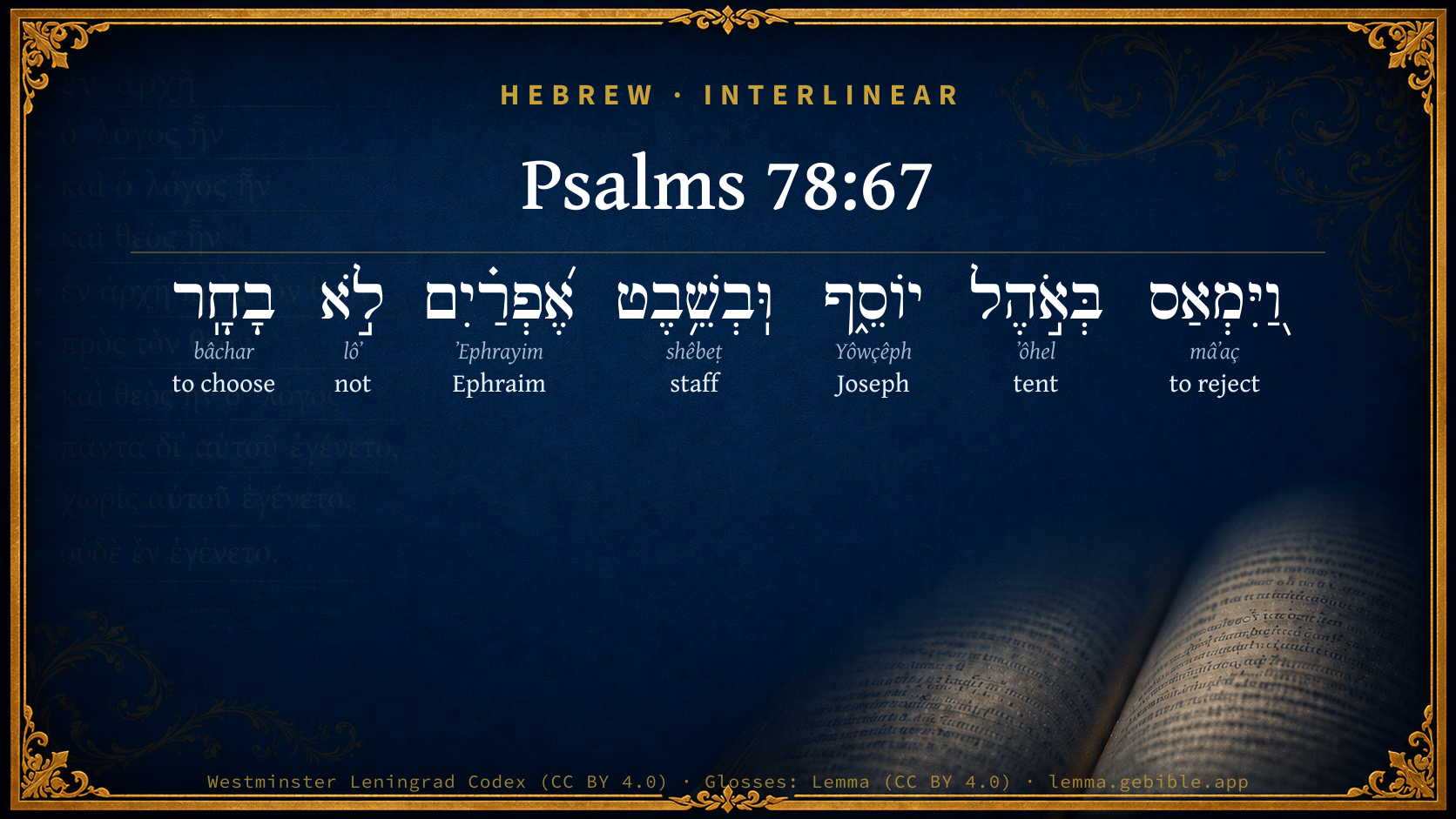
Psalms 78:67

Hebrew (Westminster Leningrad Codex) Psalms 78:67 appears in the Hebrew Old Testament. The text above is from the Westminster Leningrad Codex. Each word links to its Strong’s number, a concise gloss, and parsing drawn from the Open Scriptures Hebrew Bible morphology. Click any word for its full Brown-Driver-Briggs (BDB) entry.
Download image
Cite this verse

Psalms 78:67 (World English Bible). Public Domain. Lemma interlinear Bible study tool, https://lemma.gebible.app/v/psalms/78/67.

Show BibTeX & RIS
BibTeX
RIS
English Translation
Moreover he rejected the tent of Joseph, And didn't choose the tribe of Ephraim,
World English Bible · Public Domain
Download a study sheet

One document with this verse’s original text, its word-by-word gloss line, the meaning frame, cross-references with their text, attributed commentary, and full source and license credits — printable, and it pastes into notes with its structure intact.

This verse Autodidact and up

Study sheet (.html) Plain text (.txt)

A passage Seminary Student

Up to 50 verses in one chapter. A passage sheet keeps up to 6 commentary sources and 12 cross-references per verse, in the order this page ranks them, and says so on the sheet whenever that leaves anything out. Ask for a single verse and you get the Autodidact verse sheet above.

Everything on this page stays free to read, with no account — the sheet is a download of what is already on screen, not access to it.

Want to remove ads? Support Godless Engineer
Compare translations 3

The same verse in 3 English versions, stacked beneath the original-language interlinear above. Click any original word for its lexicon entry.

Each is an independent rendering of the whole verse — the interlinear is not word-aligned to these translations.

Highlighted words mark where these versions differ — a whole-verse word diff, not a word-by-word alignment.

  • World English Bible Public Domain
    Moreover he rejected the tent of Joseph, And didn't choose the tribe of Ephraim,
  • King James Version Public Domain
    Moreover he refused the tabernacle of Joseph, and chose not the tribe of Ephraim:
  • unfoldingWord Literal Text CC BY-SA 4.0
    And he rejected the tent of Joseph, and he did not choose the tribe of Ephraim.

unfoldingWord Literal Text — © unfoldingWord, licensed CC BY-SA 4.0. Word-aligned USFM3 via Door43 (git.door43.org/unfoldingWord/en_ult).

Versions to compare (up to 4)

3 of 4 selected

Show all 18 translations

Every available English version of this verse, each an independent rendering of the whole verse.

  • World English Bible Public Domain
    Moreover he rejected the tent of Joseph, And didn't choose the tribe of Ephraim,
  • Berean Standard Bible Public Domain
    He rejected the tent of Joseph and refused the tribe of Ephraim.
  • Majority Standard Bible Public Domain
    He rejected the tent of Joseph and refused the tribe of Ephraim.
  • King James Version Public Domain
    Moreover he refused the tabernacle of Joseph, and chose not the tribe of Ephraim:
  • American Standard Version (1901) Public Domain
    Moreover he refused the tent of Joseph, And chose not the tribe of Ephraim,
  • Revised Version (1885) Public Domain
    Moreover he refused the tent of Joseph, and chose not the tribe of Ephraim;
  • Geneva Bible (1599) Public Domain
    Yet he refused the tabernacle of Ioseph, and chose not the tribe of Ephraim:
  • Douay-Rheims (1899) Public Domain
    And he rejected the tabernacle of Joseph: and chose not the tribe of Ephraim:
  • Young's Literal Translation Public Domain
    And He kicketh against the tent of Joseph, And on the tribe of Ephraim hath not fixed.
  • Literal Standard Version CC BY-SA 4.0
    And He kicks against the tent of Joseph, || And has not fixed on the tribe of Ephraim.
  • Unlocked Literal Bible CC BY-SA 4.0
    He rejected the tent of Joseph, and he did not chose the tribe of Ephraim.
  • unfoldingWord Literal Text CC BY-SA 4.0
    And he rejected the tent of Joseph, and he did not choose the tribe of Ephraim.
  • Darby Bible Public Domain
    And he rejected the tent of Joseph, and chose not the tribe of Ephraim,
  • World Messianic Bible Public Domain
    Moreover he rejected the tent of Joseph, and didn’t choose the tribe of Ephraim,
  • Webster's Bible Public Domain
    Moreover he refused the tabernacle of Joseph, and chose not the tribe of Ephraim:
  • Free Bible Version CC BY-SA 4.0
    He rejected the descendants of Joseph, and did not choose the tribe of Ephraim.
  • Bible in Basic English Public Domain
    And he put the tent of Joseph on one side, and took not the tribe of Ephraim;
  • JPS Tanakh (1917) Public Domain
    Moreover He abhorred the tent of Joseph, and chose not the tribe of Ephraim;

Literal Standard Version (2020), Covenant Press — licensed CC BY-SA 4.0. Text via the HelloAO Bible API (eBible.org). Unlocked Literal Bible (unfoldingWord) — licensed CC BY-SA 4.0. Text via the HelloAO Bible API (eBible.org). unfoldingWord Literal Text — © unfoldingWord, licensed CC BY-SA 4.0. Word-aligned USFM3 via Door43 (git.door43.org/unfoldingWord/en_ult). Free Bible Version, Dr. Jonathan Gallagher — licensed CC BY-SA 4.0. Text via the HelloAO Bible API (eBible.org).

Word by word

More ways to search: Search by grammar → Find every occurrence → Compare this word →

Practice this passage: Drill this verse → Learn its vocabulary →

About this verse

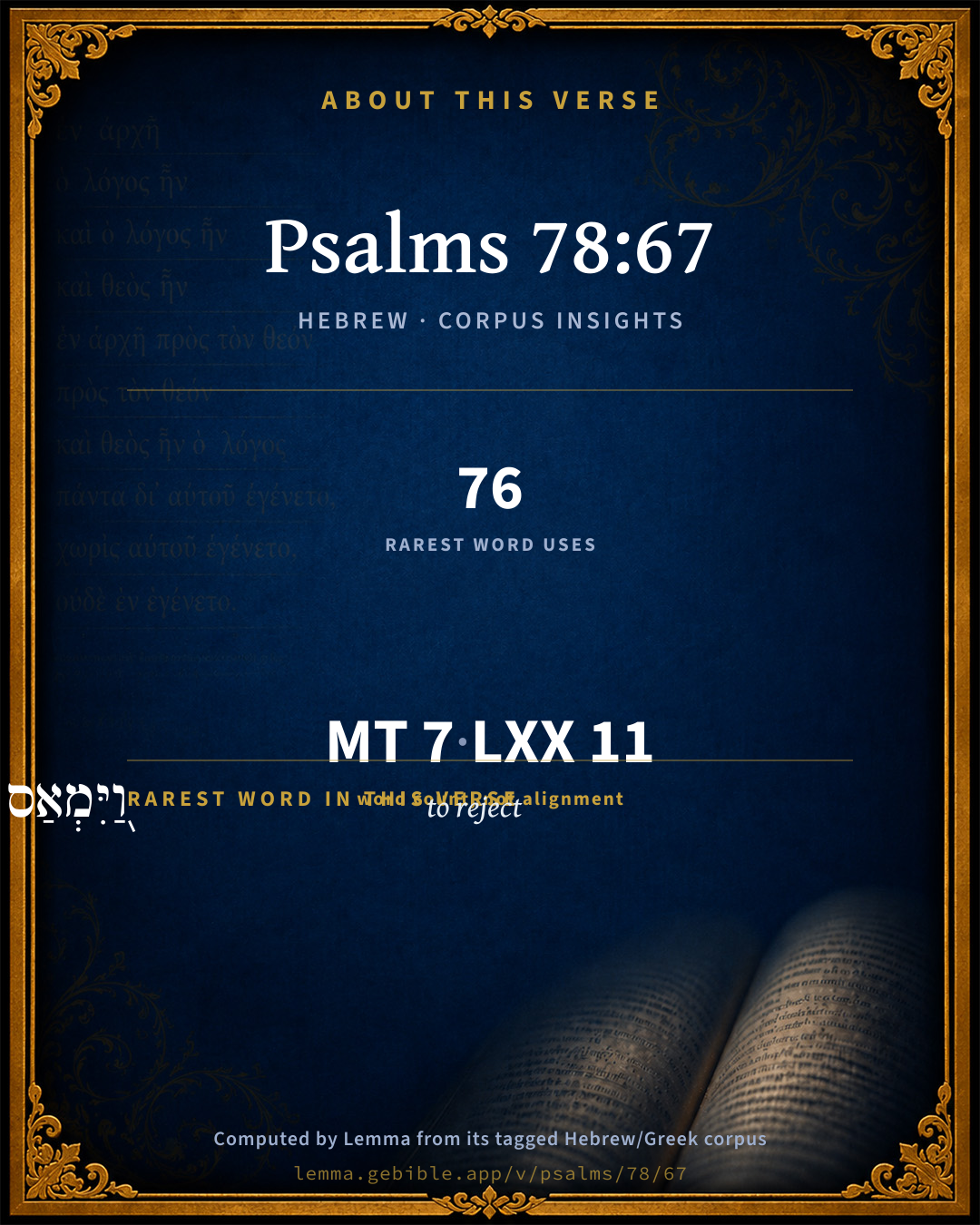
These counts appear in no published source. They are computed here, from the morphology-tagged text and Lemma’s own curated glosses. What Lemma adds →

7
words
7
distinct lemmas
Wisdom
section

Grammatical profile

  • 2 verbs
  • 4 nouns
  • 1 particle

Verb forms

  • וַ֭יִּמְאַס Qal · Sequential Imperfect
  • בָחָֽר Qal · Perfect

Hebrew & Septuagint length

In English translation the verse runs 14 words from the Hebrew and 14 from the Septuagint (LXX English) — the same length.

A rough comparison of the two English renderings, which tokenize alike — not a word-level alignment.

Word counts can differ between the Hebrew and the Greek without any difference in meaning — e.g. the Hebrew direct-object marker אֵת has no separate Greek word, and Greek often adds the article ὁ.

In the original languages it is 7 Hebrew tokens and 11 Greek tokens — but the two are counted differently (Hebrew bundles its prefixes and suffixes into one token; the Greek is in lemma form), so that isn’t a like-for-like length.

Cross-references

3

Topical passages linked to Psalms 78:67 in the Treasury of Scripture Knowledge — connected by theme and wording, ordered by reader-vote popularity; previews shown in the World English Bible.

  • 1 Samuel 6:21–7:1 They sent messengers to the inhabitants of Kiriath Jearim, saying, The Philistines have brought back the ark of Yahweh; come you down, and bring it up to you.
  • 2 Samuel 6:2 David arose, and went with all the people who were with him, from Baale Judah, to bring up from there the ark of God, which is called by the Name, even the name of Yahweh of Hosts who sits [above] the cherubim.
  • 2 Samuel 6:17 They brought in the ark of Yahweh, and set it in its place, in the midst of the tent that David had pitched for it; and David offered burnt offerings and peace-offerings before Yahweh.

Cross-references courtesy of OpenBible.info (CC BY 4.0).

Hebrew and Greek witnesses Masoretic Hebrew ↔ Greek Septuagint

The same verse in the two great witnesses to the Old Testament, shown verse-for-verse.

You’re reading Greek Psalm 77 (Hebrew Psalm 78). The Septuagint counts the superscription, so verse numbers can differ from the Hebrew — chapter-level alignment, not verse-by-verse. Numbering follows Rahlfs.

These are two independent witnesses, not word-aligned to each other, and the Septuagint is shown in lemma (dictionary) form.

Hebrew Psalms 78:67 Masoretic · Westminster Leningrad Codex

וַ֭יִּמְאַס בְּאֹ֣הֶל יוֹסֵ֑ף וּֽבְשֵׁ֥בֶט אֶ֝פְרַ֗יִם לֹ֣א בָחָֽר

Moreover he rejected the tent of Joseph, And didn't choose the tribe of Ephraim,

World English Bible · Public Domain

Greek LXX Greek Psalm 77:67 Septuagint · lemma form

καί ἀποὠθέω ὁ σκήνωμα ιωσηφ καί ὁ φυλή εφράιμ οὐ ἐκλέγω

And he rejected the tabernacle of Joseph, and chose not the tribe of Ephraim;

LXX2012 (modern English Septuagint) · Public Domain

Hebrew: Westminster Leningrad Codex (CC BY 4.0). Greek: Septuagint (public domain); English from LXX2012 (modern English Septuagint) (Public Domain). How the Septuagint differs from the Hebrew →

Commentary

Notes on Psalms 78:67 from classic Christian and Jewish commentators (each source and its license shown beneath its notes). The classic Christian expositions comment on the surrounding passage and are grouped to its opening verse, so a note may address several verses; the Jewish commentaries on the Tanakh (Rashi and others) are per-verse, so they appear only where the commentator wrote on this verse.

Lemma curates 59 commentaries, every one of them public domain or Creative Commons licensed, each selected and text-cleaned for this edition rather than reprinted as found. About our sources →

Trapp's Complete Commentary

John Trapp

Psa 78:67 Moreover he refused the tabernacle of Joseph, and chose not the tribe of Ephraim:

Ver. 67. Moreover he refused, &c.] He would dwell no longer at Shiloh, which was in the tribe of Ephraim.

John Trapp, A Commentary or Exposition upon All the Books of the Old and New Testament (1647–1656) — public domain. Text from a community e-Sword module.

The Treasury of David

Charles H. Spurgeon

Ver. 67. Moreover he refused the tabernacle of Joseph. God had honoured Ephraim, for to that tribe belonged Joshua the great conqueror, and Gideon the great judge, and within its borders was Shiloh the place of the ark and the sanctuary; but now the Lord would change all this and set up other rulers. He would no longer leave matters to the leadership of Ephraim, since that tribe had been tried and found wanting.

And chose not the tribe of Ephraim. Sin had been found in them, folly and instability, and therefore they were set aside as unfit to lead.

Ver. 67. The moving of the ark is not the removing of it; Shiloh has lost it, but Israel has not. God will have a church in the world, and a kingdom among men, though this or that place may have its candlestick removed; nay, the rejection of Shiloh is the election of Sion. Matthew Henry.

Ver. 67-68. Refused. Chose not. Chose. As God's love is set out to us, as not independently pitched, but as having all the persons in his eye and having them all in view; so by this also, that he hath not pitched it upon everybody. This is distinct from the former; for an indefinite is not knowing whom he pitched it upon. Now, as he knew whom he pitched upon, so he hath pitched but upon some, not on every one...If God would love, it was fit he should be free. It is a strange thing that you will not allow God that which kings and princes have the prerogative of, and you will allow it them. They will have favourites whom they will love, and will not love others; and yet men will not allow God that liberty, but he must either love all mankind, or he must be cruel and unjust. The specialness of his love, increases it, endears it to us. You shall find almost all along the Bible, that when God would express his love, he doth it with a speciality to his own elect, which he illustrates by the contrary done to others...And you shall find frequently in the Scripture, when he mentions his choice of some persons, he holdeth up likewise on purpose his refusing of others...When he speaks of an election out of the tribes, he contents not himself to say he chose Judah, but he puts in the rejection, the preterition at least, of Joseph. He refused the tabernacle of Joseph, and chose not the tribe of Ephraim: But chose the tribe of Judah, the mount Zion which he loved....He speaks of the times of the judges. The rejection of the ten tribes began to show itself soon; he says, he refused the tabernacle of Ephraim, but he chose Judah. After Solomon's time, they fell to worshipping of calves (let me tell you, it is the declining of election that undoes a nation, when election grows low, and ceases in an age), till at last the ten tribes were cast off, as they are at this day; but the tribe of Judah had election among them...

Though at the first, and for a long time, both were alike his people, yet at last election began to pass a discontinuation. Ephraim, or the ten tribes, had at first the advantage of Judah in spirituals; for the ark, the token of God's presence, was committed unto their keeping at Shiloh; the seal of God's worship and ordinances was entrusted to them, and Judah must come up thither, if they would seek the Lord. But Ephraim, for their sinning against that worship, forfeited and lost it, and should therefore have the keeping of it no longer, no, not for ever any more; but Judah had it at Bethlehem, till at last it was fixedly seated in Sion, as "the earth is established" Ps 78:69; and this for no other reason than that he had loved them, and out of love had chosen them Ps 78:67-69. For otherwise Judah was, as well as Ephraim, alike involved in the same guilt of sin which had forfeited it, as Ps 78:56-60 of the Psalm plainly show. "Yet they tempted and provoked the most high God, and kept not his testimonies, "etc. He speaks it of the whole in those verses, and yet takes the occasion against Ephraim to remove it for ever. Thus, the first are last, and the last first; and those whom God's presence is with for a while, upon some eminent sin God begins to withdraw from them, and by degrees as he did by that people of the ten tribes, till at last he cast them off from being a people; but dealt not so with Judah, though these made a forfeiture of their temple, and worship, and nation, in the captivity of Babylon, yet God restored all again to greater glory at last. The ground was that in Ps 78:68, Zion which he loved. Thomas Goodwin.

Ver. 67-68. Refused. Chose not. Chose. See Psalms on "Ps 78:67" for further information.

Charles H. Spurgeon's The Treasury of David (1869–1885) — public domain. Psalms only. Text from a community e-Sword/MySword module.

Joseph Benson's Commentary

Psa 78:67-68. Moreover — And as he smote his enemies for their sins, so he punished his own people for the same cause. He refused the tabernacle of Joseph — He did not suffer his ark to return to Shiloh, which was in the tribe of Ephraim, the son of Joseph, but to go to Kirjath-jearim, which was in the tribe of Benjamin; from thence to the house of Obed-edom, and so to Zion, in the tribe of Judah, as it follows; but chose the tribe of Judah —

For the seat of the ark, and of God’s worship. For he did not wholly take away the glory from Israel. Shiloh lost the ark, but Israel retained it. God will have a church in the world, and a kingdom among men; though this or that place may have its candlestick removed. Nay, the rejection of Shiloh is the election of Zion; as, long after, the fall of the Jews was the riches of the Gentiles, Rom 11:12. The divine presence, with the ark, its emblem, removed at this time from the tribe of Ephraim, although Joshua, the temporal saviour of Israel, was of that tribe, to the tribe of Judah, because out of this tribe, after the rejection of Saul, was to arise the great representative, as well as progenitor, of King Messiah, the spiritual and eternal Saviour of God’s people of every kindred, and tongue, and nation.

Joseph Benson's Commentary on the Old and New Testaments (1811–1818) — public domain. Text from a community e-Sword module.

J. A. Alexander on Psalms

Joseph Addison Alexander

67. (Psa 78:67) And rejected the tent of Joseph, and the tribe of Ephraim did not choose. This is the completion and specification of the statement in Psa 78:60. Even after the punishment of Israel, as a whole, had ceased, Ephraim, though still a member of the chosen people, was deprived of the ascendancy, of which he had proved himself unworthy, and by means of which he had betrayed the whole race into grievous sin. The tent or house of Joseph (the progenitor of Ephraim) is particularly mentioned, because the honour taken from that family was the honour of God's dwelling in the midst of them. The last clause might be rendered, and the tribe of Ephraim no (longer) chose. But the original contains a simple negative without qualification; and according to the scriptural account, Ephraim never was the chosen tribe, but only allowed to act as such, for a particular purpose, just as the experimental reign of Saul afterwards preceded the commencement of the true theocratical monarchy in David.

Joseph Addison Alexander, The Psalms Translated and Explained (1850) — public domain. Text from a community e-Sword module.

Tyndale Open Study Notes

Tyndale Open Resources

78:67 The tribe of Ephraim was not completely rejected, but God favored Judah (78:68).

Tyndale Open Study Notes — © Tyndale Open Resources, licensed CC BY-SA 4.0. Text via the HelloAO Bible API.

Geneva Bible (1599)

Geneva Bible translators

Showing that he spared not altogether the Israelites, though he punished their enemies.

Geneva Bible (1599) marginal notes — public domain. Text via Bolls.life.

Adam Clarke's Commentary

Verse 67. He refused the tabernacle of Joseph] See Clarke on Ps 78:60.

Adam Clarke's Commentary on the Bible (1810–1826) — public domain. Text from a community e-Sword/MySword module.

John Calvin's Commentaries

67. And he rejected the tabernacle of Joseph. Those who suppose that the word enemies, in the 66th verse, applies to the Israelites, connect these verses with the preceding, and suppose the meaning to be, that the wound which God had inflicted upon them was incurable. But, preferring the other opinion, which regards the Philistines as spoken of, and the scope to be, that God, in punishing them so severely, evidently showed that the covenant which he had made with his people was not disannulled, since he had avenged himself in such an awful manner upon their enemies, the explanation which I would rather give is, that this is added by way of correction, as if it had been said, That God was not yet fully reconciled towards his people who had wickedly revolted from him, and that, as an evidence of this, there remained among them some traces of the punishment with which he had visited them. The meaning of the text, therefore, is, that when the ark was taken by the Philistines, God was, so to speak, asleep, having been made drunk by the sins of his people, so that he could no longer keep watch for their defense as he had been accustomed to do; and yet, that he did not continue long sunk in sleep, but that, whenever he saw the ungodly Philistines treating with mockery the glory of his majesty, this heinous insult awoke and provoked him, just as if a giant, having well supped, had awoke from his first sleep before he had recovered from the exciting effects of his wine; and that, at the same time, his anger had not been so provoked against this heathen and uncircumcised nation as to prevent him from exhibiting some signs of the chastisement which he had inflicted upon the wicked and ungrateful Israelites even to the end. The rejection spoken of amounts to this, that when God permitted his ark to be carried away to another place, the Israelites were thereby deprived of the honor with which, by special privilege, they had been previously distinguished.

There are two principal points which should here be particularly attended to; in the first place, when the Philistines were smitten with unseemly ulcers, the plainest evidence was afforded that when the Israelites were conquered by them, this happened solely because God willed it to be so. He did not recover new strength, or gather together a new army for the purpose of invading, some short time after, the Philistines who had been victorious, nor did he have recourse, in doing this, to foreign aid. The other point is, that although God stretched forth his hand against the Philistines, to show that he had still some remembrance of his covenant, and some care of the people whom he had chosen, yet in restoring the Israelites in some measure to their former state, he made the rejection of Shiloh a perpetual monument of his wrath. He, therefore, rejected the tribe of Ephraim; not that he cast them off for ever, or completely severed them from the rest of the body of the Church, but he would not have the ark of his covenant to reside any longer within the boundaries of that tribe. To the tribe of Ephraim is here opposed the tribe of Judah, in which God afterwards chose for himself a dwelling-place.

Thus the prophet proceeds to show, that when the ark of the covenant had a resting-place assigned to it on mount Zion, the people were in a manner renewed; and this symbol of reconciliation being restored to them, they were recovered to the favor of God from which they had fallen. As God had, so to speak, been banished from the kingdom, and his strength led into captivity through the sins of the Israelites, they had need to be taught, by this memorial, that God had been so highly displeased with their wickedness, that he could not bear to look upon the place in which he had formerly dwelt. After this separation, although to teach the people to be more on their guard in time to come, there was not a full and perfect restitution, yet God again chose a fixed residence for his ark, which was a manifestation of wonderful goodness and mercy on his part. The ark, after its return, was carried from one place to another, as to Gath, Ekron, and other places, until mount Zion was pointed out by an oracle as its fixed abode; but this intervening period is not taken notice of by the prophet, because his design went no farther than to impress upon the memory, both the example of the punishment, and the grace of God, which was greater than any could have ventured to hope for. That which is often repeated by Moses should also be remembered:

“But unto the place which the Lord your God shall choose out of all your tribes to put his name there, even unto his habitation shall ye seek, and thither thou shalt come,” etc., (Deuteronomy 12:5.)

Shiloh having acquired this renown, because the ark had dwelt there for a long time, when the ark was carried away into the country of the enemies of Israel, the minds of men were strangely perplexed, until they knew the place which God had chosen for its future residence. The ten tribes were not at that time rejected, and they had an equal interest in the kingdom and the priesthood with the tribe of Judah; but in process of time their own rebellion cut them off. This is the reason why the prophet says, in scorn, that the tribe of Ephraim was rejected, and that the tribe of Joseph, from whom it sprung, was not chosen.

John Calvin's Commentaries (1540-1563) — public domain. Text from the Calvin Translation Society English edition (1840s-50s) via the Christian Classics Ethereal Library (ccel.org). Calvin's coverage is partial (roughly two-thirds of the Bible); uncommented books and verses are honest gaps, never fabricated. The 19th-century editor's footnotes and remarks are omitted so the notes are faithfully Calvin's own voice.

The Cambridge Bible for Schools and Colleges

gen. ed. J. J. S. Perowne

67. Moreover &c.] And he rejected the tent of Joseph, i.e. Shiloh in the tribe of Ephraim. The Ark was never brought back there, and if Shiloh was not actually destroyed by the Philistines, it ceased to be the sanctuary of the nation. Jeremiah points to the fall of Shiloh as a warning to his incredulous contemporaries, who refused to believe that Jehovah could possibly desert Jerusalem and allow His Temple to be destroyed (Jer_7:12; Jer_7:14; Jer_26:6; Jer_26:9). Stanley observes that the first division of the history of the Chosen People ended with the overthrow of the first sanctuary, as the second division terminated in the fall of the second sanctuary, and the third by the still vaster destruction of the last Temple of Jerusalem. The Jewish Church, Lect. vii.

67–69. The choice of Zion.

The Cambridge Bible for Schools and Colleges (gen. ed. J. J. S. Perowne; Cambridge University Press, 1878–1918) — public domain. Text from a community e-Sword module.

John Gill's Exposition

But chose the tribe of Judah,.... Both to be the seat of kingly power and government, and of religious worship; the latter is chiefly designed. Jerusalem was, at least part of it, in the tribe of Judah: here David, who was of that tribe, dwelt, and Solomon his son, and all the kings of Judah afterwards; here the temple was built, into which the ark of the covenant was put, and whither the tribes went up to worship

the mount Zion, which he loved; where was the city of David; into which the ark was brought when removed from Gibeah, and on part of which the temple was built: the choice of this place, for such a purpose, was from love, Psa 87:2, it was typical of the church, the choice of which also arises from the everlasting and unchangeable love of God to it.

John Gill's Exposition of the Whole Bible (1746–1763) — public domain (CC PDM 1.0). Text via the HelloAO Bible API.

Albert Barnes' Notes on the Bible

Moreover, he refused the tabernacle of Joseph - As a place where his worship should be celebrated. This is the completion of the statement in Psa 78:60. The design is to show that there had been a transfer of the preeminence from the tribe of Ephraim to the tribe of Judah, and from Shiloh to Zion. Joseph is mentioned here as the father of Ephraim, from whom one of the tribes - (one of the most influential and numerous) - was named. Jacob had twelve sons, from whom the twelve tribes in general took their name. As the tribe of Levi, however, being devoted to the sacerdotal work, was not reckoned as one of the, twelve, the number was made up by giving to the descendants of the two sons of Joseph - Ephraim and Manasseh Gen 48:5 - a place among the tribes; and, on this account, the name Joseph does not appear as one of the twelve tribes. Yet Joseph is mentioned here, as the ancestor of one of them - that of Ephraim, from whom the priority and supremacy were withdrawn in favor of the tribe of Judah.

And chose not the tribe of Ephraim - To be the tribe within whose limits the tabernacle should be permanently set up; or within whose limits the place of public worship was finally to be established.

Albert Barnes' Notes on the Bible (1834–1885) — public domain. Text from a community e-Sword/MySword module.

Matthew Poole's English Annotations

Moreover; and as he smote his enemies for their sins, so he punished his own people for the same cause.

He refused the tabernacle of Joseph; either,

1. He rejected the kingdom of the ten tribes, whereof Ephraim was the head. But this Psalm reacheth not so far as the erection of that kingdom. Or rather,

2. He would not have his ark to abide longer in the tabernacle of Shiloh, which was in the tribe of Joseph or Ephraim: see 1Sa 6:12; 7:1,2; Jer 7:12,14; 26:6,9.

And chose not the tribe of Ephraim; the same thing repeated in other words, after the manner.

Matthew Poole's English Annotations on the Holy Bible (1683–1685) — public domain. Text from a community e-Sword/MySword module.

Whedon's Commentary on the Bible

Daniel D. Whedon

67. Joseph—A patronymic for Ephraim. Genesis 48. The tabernacle of Joseph is the tabernacle as consigned to the care of the tribe of Ephraim, to which God now refuses for ever this honour.

Daniel D. Whedon (gen. ed.), Commentary on the Old and New Testaments (1874–1909) — public domain. Text from a community e-Sword module.

The Pulpit Commentary

Moreover he refused the tabernacle of Joseph. The "tabernacle of Joseph" is the sanctuary at Shiloh, which was north of Bethel, and thus within the limits of the tribe of Ephraim. When a permanent site was to be assigned to the tabernacle and the ark, God did not choose for them the position of Shiloh, but that of Jerusalem. And chose not the tribe of Ephraim. Ephraim had enjoyed the pre-eminency from the time of the death of Moses (see the comment on ver. 9). By the course of events between Samuel"s death and the establishment of the kingdom of David, the pre-eminency had been transferred to Judah, according to the design of the Almighty from the first. (see Gen_49:8-10)

Vers. 67-72. God"s chosen ones.

These verses show that they whom God chooses are

I OFTEN NOT FOUND AMONGST THE GREAT. (Ver. 67) Ephraim was the lordly tribe, the aristocracy of Israel. They had a long roll call of illustrious names. But God "refused the tabernacle of Joseph". (cf. 1Co 1)

II BUT, NEVERTHELESS, THEY MAY BE. (Ver. 68) For the tribe of Judah was but little less exalted than Ephraim. God puts no ban upon any rank, or people, or tribe. How stern are the utterances of our Lord about the rich! And yet there have been many saints of God who have been rich.

III ARE FOUND GENERALLY AMONGST THE LOWLY. (Vers. 70, 71) "Blessed are ye poor," said our Lord. From amongst them the pioneers of the kingdom of God have nearly all come and ignorant men," poor, but rich in faith.

IV AND WHERE NO APPARENT FITNESS EXISTS for the work that has to be done. David, a rustic shepherd lad, and yet, etc. (ver. 71).

V BUT GOD"S CHOICE IS ALWAYS JUSTIFIED. (Ver. 72) Of what great servant of God could it have been foretold that he would be what he came to be?

VI OUR LORD JESUS CHRIST IS THE SUPREME EXAMPLE OF THIS. Despised of men. My soul, what is he to thee? S.C.

The Pulpit Commentary (1880–1919), ed. H.D.M. Spence-Jones & Joseph S. Exell — public domain. Text from a community e-Sword module.

John Wesley's Explanatory Notes

Refused - He would not have his ark to abide any longer in the tabernacle of Shiloh, which was in the tribe of Joseph or Ephraim.

John Wesley, Explanatory Notes Upon the Whole Bible (1754–1765) — public domain. Text via the GEBible commentary corpus.

unfoldingWord translationNotes

Door43 World Missions Community

General Information:

The writer continues to describe what God did for the people of Israel.

the tent of Joseph

Here the word "tent" is a metonym for a family. In this phrase it refers to the descendants of Joseph. AT: "the descendants of Joseph" (See: Metonymy)

Joseph ... Ephraim

Ephraim was Joseph's son.

Judah ... Mount Zion

Mount Zion was in the land where the tribe of Judah lived.

He built his sanctuary like the heavens

Possible meanings for this simile are 1) Yahweh has made his sanctuary as high as the heavens. AT: "He built his sanctuary high, like the heavens" or 2) Yahweh has made his sanctuary as permanent as the heavens. AT: "He built his sanctuary to last permanently, like the heavens last forever" (See: Simile)

like the earth

The verb may be supplied from the previous line. The writer compares the permanence of Yahweh's sanctuary to the permanence of the earth. AT: "He built his sanctuary to last permanently, like the earth lasts permanently" (See: Ellipsis and Simile)

translationWords

reject

Joseph (OT)

chosen one

tribe

Ephraim

Judah

Zion

love

sanctuary

heaven

earth

eternity

unfoldingWord translationNotes — © Distant Shores Media and the Door43 World Missions Community, licensed CC BY-SA 4.0. Source: git.door43.org/Door43/en_tn.

Rashi

Rabbi Shlomo Yitzchaki (Rashi)

He rejected the tent of Joseph That is Shiloh, which is in Joseph’s territory.

Rashi on the Tanakh — English translations: “The Judaica Press complete Tanach with Rashi, translated by A. J. Rosenberg” (CC BY 4.0); “Pentateuch with Rashi's commentary by M. Rosenbaum and A.M. Silbermann, 1929-1934” (public domain); “The Metsudah Tanach series, Lakewood, N.J” (CC BY 4.0); and “The Book of Joshua, Metsudah Publications, 1997” (CC BY 4.0). Text via Sefaria.

Lesson kit

Teaching starters — assembled from the data on this page, not authored interpretation. Every prompt links to the verse data it draws on. Edit before teaching.

Psalms, in the Wisdom, opens this verse with 7 words (7 distinct Hebrew lemmas). Its most distinctive word is mâʼaç (“to reject”). A historical commentator’s framing appears above. Read the whole chapter for the surrounding context.

Discussion questions

  1. How does “to reject” (mâʼaç) shape what this verse is saying?
  2. 1 Samuel 6:21–7:1 shares this passage’s theme. How do the two illuminate each other?
  3. These translations render this verse differently; the difference is in the English rendering, not the original. What questions does that raise?
  4. The verb «וַ֭יִּמְאַס» is Qal Sequential Imperfect. How does its form color the action?
  5. Reading how Trapp's Complete Commentary and The Treasury of David read this verse, where do the two commentators agree and where do they part?

Things to notice

Reading settings

Reading text

Shown beneath each verse's original-language words.

Old Testament
Old Testament edition

Read the OT as the Masoretic Hebrew (MT) or the Greek Septuagint (LXX).

English shown for the Greek Septuagint (in the Hebrew ↔ Greek comparison).

Comparing translations? Open the Compare panel on any verse page to stack up to four side by side.