
Joshua 22:13

Hebrew (Westminster Leningrad Codex) Joshua 22:13 appears in the Hebrew Old Testament. The text above is from the Westminster Leningrad Codex. Each word links to its Strong’s number, a concise gloss, and parsing drawn from the Open Scriptures Hebrew Bible morphology. Click any word for its full Brown-Driver-Briggs (BDB) entry.
Download image
Cite this verse

Joshua 22:13 (World English Bible). Public Domain. Lemma interlinear Bible study tool, https://lemma.gebible.app/v/joshua/22/13.

Show BibTeX & RIS
BibTeX
RIS
English Translation
The children of Israel sent to the children of Reuben, and to the children of Gad, and to the half-tribe of Manasseh, into the land of Gilead, Phinehas the son of Eleazar the priest,
World English Bible · Public Domain
Download a study sheet

One document with this verse’s original text, its word-by-word gloss line, the meaning frame, cross-references with their text, attributed commentary, and full source and license credits — printable, and it pastes into notes with its structure intact.

This verse Autodidact and up

Study sheet (.html) Plain text (.txt)

A passage Seminary Student

Up to 50 verses in one chapter. A passage sheet keeps up to 6 commentary sources and 12 cross-references per verse, in the order this page ranks them, and says so on the sheet whenever that leaves anything out. Ask for a single verse and you get the Autodidact verse sheet above.

Everything on this page stays free to read, with no account — the sheet is a download of what is already on screen, not access to it.

Want to remove ads? Support Godless Engineer
Compare translations 3

The same verse in 3 English versions, stacked beneath the original-language interlinear above. Click any original word for its lexicon entry.

Each is an independent rendering of the whole verse — the interlinear is not word-aligned to these translations.

Highlighted words mark where these versions differ — a whole-verse word diff, not a word-by-word alignment.

  • World English Bible Public Domain
    The children of Israel sent to the children of Reuben, and to the children of Gad, and to the half-tribe of Manasseh, into the land of Gilead, Phinehas the son of Eleazar the priest,
  • King James Version Public Domain
    And the children of Israel sent unto the children of Reuben, and to the children of Gad, and to the half tribe of Manasseh, into the land of Gilead, Phinehas the son of Eleazar the priest,
  • unfoldingWord Literal Text CC BY-SA 4.0
    And the sons of Israel sent Phinehas, the son of Eleazar, the priest, into the land of the Gilead to the sons of Reuben and to the sons of Gad and to half of the tribe of Manasseh.

unfoldingWord Literal Text — © unfoldingWord, licensed CC BY-SA 4.0. Word-aligned USFM3 via Door43 (git.door43.org/unfoldingWord/en_ult).

Versions to compare (up to 4)

3 of 4 selected

Show all 18 translations

Every available English version of this verse, each an independent rendering of the whole verse.

  • World English Bible Public Domain
    The children of Israel sent to the children of Reuben, and to the children of Gad, and to the half-tribe of Manasseh, into the land of Gilead, Phinehas the son of Eleazar the priest,
  • Berean Standard Bible Public Domain
    The Israelites sent Phinehas son of Eleazar the priest to the land of Gilead, to the Reubenites, the Gadites, and the half-tribe of Manasseh.
  • Majority Standard Bible Public Domain
    The Israelites sent Phinehas son of Eleazar the priest to the land of Gilead, to the Reubenites, the Gadites, and the half-tribe of Manasseh.
  • King James Version Public Domain
    And the children of Israel sent unto the children of Reuben, and to the children of Gad, and to the half tribe of Manasseh, into the land of Gilead, Phinehas the son of Eleazar the priest,
  • American Standard Version (1901) Public Domain
    And the children of Israel sent unto the children of Reuben, and to the children of Gad, and to the half-tribe of Manasseh, into the land of Gilead, Phinehas the son of Eleazar the priest,
  • Revised Version (1885) Public Domain
    And the children of Israel sent unto the children of Reuben, and to the children of Gad, and to the half tribe of Manasseh, into the land of Gilead, Phinehas the son of Eleazar the priest;
  • Geneva Bible (1599) Public Domain
    Then the children of Israel sent vnto the children of Reuben, and to the children of Gad, and to ye halfe tribe of Manasseh into the land of Gilead, Phinehas the sonne of Eleazar the Priest,
  • Douay-Rheims (1899) Public Domain
    And in the mean time they sent to them into the land of Galaad, Phinees the son of Eleazar the priest,
  • Young's Literal Translation Public Domain
    and the sons of Israel send unto the sons of Reuben, and unto the sons of Gad, and unto the half of the tribe of Manasseh -- unto the land of Gilead -- Phinehas son of Eleazar the priest,
  • Literal Standard Version CC BY-SA 4.0
    and the sons of Israel send to the sons of Reuben, and to the sons of Gad, and to the half-tribe of Manasseh—to the land of Gilead—Phinehas son of Eleazar the priest,
  • Unlocked Literal Bible CC BY-SA 4.0
    Then the people of Israel sent messengers to the Reubenites, the Gadites, and the half tribe of Manasseh, in the land of Gilead. They also sent Phinehas son of Eleazar, the priest,
  • unfoldingWord Literal Text CC BY-SA 4.0
    And the sons of Israel sent Phinehas, the son of Eleazar, the priest, into the land of the Gilead to the sons of Reuben and to the sons of Gad and to half of the tribe of Manasseh.
  • Darby Bible Public Domain
    And the children of Israel sent to the children of Reuben, and to the children of Gad, and to the half tribe of Manasseh, into the land of Gilead, Phinehas the son of Eleazar the priest,
  • World Messianic Bible Public Domain
    The children of Israel sent to the children of Reuben, and to the children of Gad, and to the half-tribe of Manasseh, into the land of Gilead, Phinehas the son of Eleazar the priest.
  • Webster's Bible Public Domain
    And the children of Israel sent to the children of Reuben, and to the children of Gad, and to the half-tribe of Manasseh into the land of Gilead, Phinehas the son of Eleazar the priest,
  • Free Bible Version CC BY-SA 4.0
    Before they did so, they sent Phinehas, the son of Eleazar the priest to the tribes of Reuben and Gad, and the half-tribe of Manasseh in the land of Gilead.
  • Bible in Basic English Public Domain
    And the children of Israel sent Phinehas, the son of Eleazar the priest, to the children of Reuben and the children of Gad and the half-tribe of Manasseh, to the land of Gilead,
  • JPS Tanakh (1917) Public Domain
    And the children of Israel sent unto the children of Reuben, and to the children of Gad, and to the half-tribe of Manasseh, into the land of Gilead, Phinehas the son of Eleazar the priest;

Literal Standard Version (2020), Covenant Press — licensed CC BY-SA 4.0. Text via the HelloAO Bible API (eBible.org). Unlocked Literal Bible (unfoldingWord) — licensed CC BY-SA 4.0. Text via the HelloAO Bible API (eBible.org). unfoldingWord Literal Text — © unfoldingWord, licensed CC BY-SA 4.0. Word-aligned USFM3 via Door43 (git.door43.org/unfoldingWord/en_ult). Free Bible Version, Dr. Jonathan Gallagher — licensed CC BY-SA 4.0. Text via the HelloAO Bible API (eBible.org).

Word by word

More ways to search: Search by grammar → Find every occurrence → Compare this word →

Practice this passage: Drill this verse → Learn its vocabulary →

פִּינְחָ֖ס
Pîynᵉchâç
H6372
“Phinehas”
Noun, Proper
Part of Speech
Noun
Type
Proper
Full BDB Definition

Origin: apparently from H6310 and a variation of H5175

TWOT: None

Phinehas = "mouth of brass" - son of Eleazar and grandson of Aaron; his zealousness for the Lord averted a plague on Israel and gained him the promise of the Lord of an everlasting priesthood in his family - a priest and the son of the priest Eli - the father of a helper of Ezra
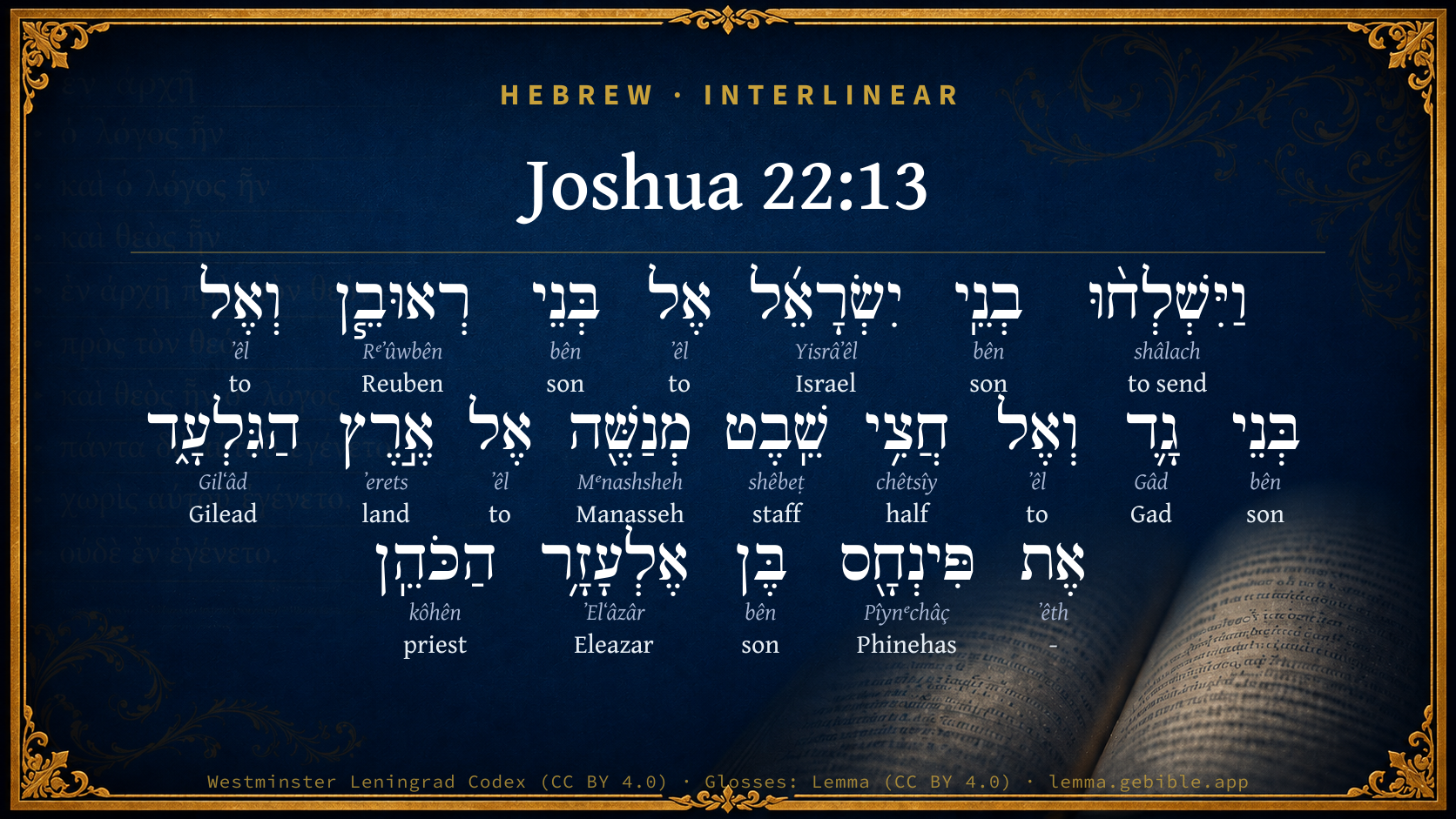
  1. וַיִּשְׁלְח֨וּ shâlach H7971 “and · to send” Conjunction + Verb, Qal, Sequential Imperfect, 3rd Person, Masculine, Plural
  2. בְנֵֽי bên H1121 “sons of” Noun, Common, Masculine, Plural, Construct
  3. יִשְׂרָאֵ֜ל Yisrâʼêl H3478 “Israel” Noun, Proper
  4. אֶל ʼêl H413 “to” Preposition
  5. בְּנֵי bên H1121 “sons of” Noun, Common, Masculine, Plural, Construct
  6. רְאוּבֵ֧ן Rᵉʼûwbên H7205 “Reuben” Noun, Proper
  7. וְאֶל ʼêl H413 “and · to” Conjunction + Preposition
  8. בְּנֵי bên H1121 “sons of” Noun, Common, Masculine, Plural, Construct
  9. גָ֛ד Gâd H1410 “Gad” Noun, Proper
  10. וְאֶל ʼêl H413 “and · to” Conjunction + Preposition
  11. חֲצִ֥י chêtsîy H2677 “half of” Noun, Common, Masculine, Singular, Construct
  12. שֵֽׁבֶט shêbeṭ H7626 “staff of” Noun, Common, Masculine, Singular, Construct
  13. מְנַשֶּׁ֖ה Mᵉnashsheh H4519 “Manasseh” Noun, Proper
  14. אֶל ʼêl H413 “to” Preposition
  15. אֶ֣רֶץ ʼerets H776 “land of” Noun, Common, Both, Singular, Construct
  16. הַגִּלְעָ֑ד Gilʻâd H1568 “the · Gilead” Particle, Definite Article + Noun, Proper
  17. אֶת ʼêth H853 “-” Particle, Direct Object
  18. בֶּן bên H1121 “son of” Noun, Common, Masculine, Singular, Construct
  19. אֶלְעָזָ֥ר ʼElʻâzâr H499 “Eleazar” Noun, Proper
  20. הַכֹּהֵֽן kôhên H3548 “the · priest” Particle, Definite Article + Noun, Common, Masculine, Singular, Absolute

About this verse

These counts appear in no published source. They are computed here, from the morphology-tagged text and Lemma’s own curated glosses. What Lemma adds →

21
words
15
distinct lemmas
Historical
section

Notable vocabulary

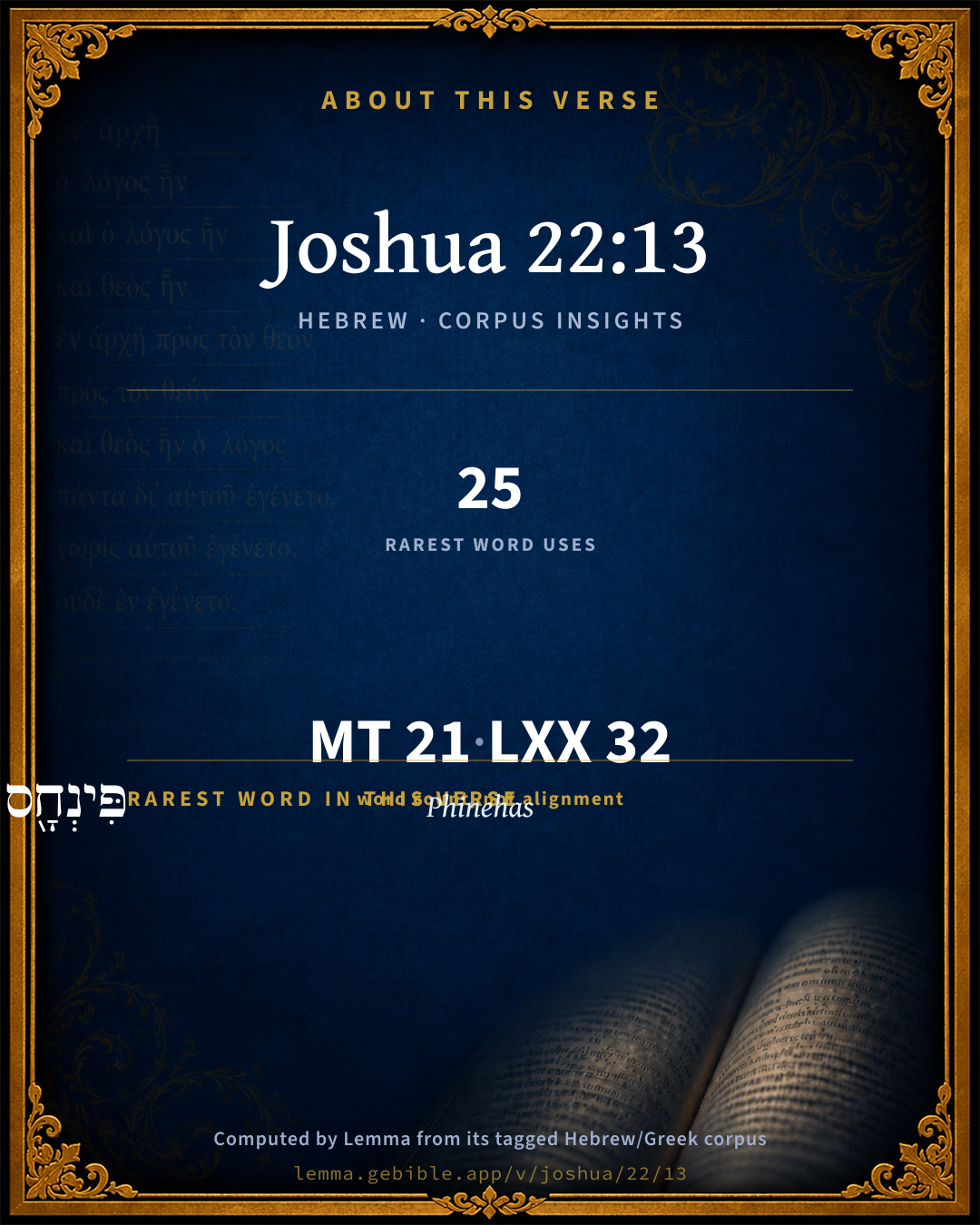
The rarest word here is פִּינְחָ֖ס Phinehas H6372 — appearing just 25 times in the whole Hebrew Bible.

Shared distinctive vocabulary

פִּינְחָ֖ס Phinehas H6372 occurs in 24 verses of the Hebrew Bible. Also found in:

Grammatical profile

  • 1 verb
  • 15 nouns
  • 4 prepositions
  • 1 particle

Verb forms

  • וַיִּשְׁלְח֨וּ Qal · Sequential Imperfect

Repetition

Words recur within this verse — often emphatic in Hebrew:

  • בְנֵֽי son H1121 ×4
  • אֶל to H413 ×4

Hebrew & Septuagint length

In English translation the verse runs 34 words from the Hebrew and 43 from the Septuagint (LXX English) — closely comparable.

A rough comparison of the two English renderings, which tokenize alike — not a word-level alignment.

Word counts can differ between the Hebrew and the Greek without any difference in meaning — e.g. the Hebrew direct-object marker אֵת has no separate Greek word, and Greek often adds the article ὁ.

In the original languages it is 21 Hebrew tokens and 32 Greek tokens — but the two are counted differently (Hebrew bundles its prefixes and suffixes into one token; the Greek is in lemma form), so that isn’t a like-for-like length.

Cross-references

10

Topical passages linked to Joshua 22:13 in the Treasury of Scripture Knowledge — connected by theme and wording, ordered by reader-vote popularity; previews shown in the World English Bible.

  • Numbers 25:7 When Phinehas, the son of Eleazar, the son of Aaron the priest, saw it, he rose up from the midst of the congregation, and took a spear in his hand;
  • Exodus 6:25 Eleazar Aaron's son took one of the daughters of Putiel as his wife; and she bore him Phinehas. These are the heads of the fathers' houses of the Levites according to their families.
  • Judges 20:28 and Phinehas, the son of Eleazar, the son of Aaron, stood before it in those days), saying, Shall I yet again go out to battle against the children of Benjamin my brother, or shall I cease? Yahweh said, Go up; for tomorrow I will deliver him into your hand.
  • Psalms 106:30–31 Then Phinehas stood up, and executed judgment, So the plague was stopped.
  • Numbers 25:11–13 Phinehas, the son of Eleazar, the son of Aaron the priest, has turned my wrath away from the children of Israel, in that he was jealous with my jealousy among them, so that I didn't consume the children of Israel in my jealousy.
  • Deuteronomy 13:14 then shall you inquire, and make search, and ask diligently; and, behold, if it be truth, and the thing certain, that such abomination is done in the midst of you,
  • Judges 20:12 The tribes of Israel sent men through all the tribe of Benjamin, saying, What wickedness is this that is happen among you?
  • Proverbs 20:18 Plans are established by advice; By wise guidance you wage war!
  • Proverbs 25:9–13 Debate your case with your neighbor, And don't betray the confidence of another;
  • Matthew 18:15 "If your brother sins against you, go, show him his fault between you and him alone. If he listens to you, you have gained back your brother.

Cross-references courtesy of OpenBible.info (CC BY 4.0).

Hebrew and Greek witnesses Masoretic Hebrew ↔ Greek Septuagint

The same verse in the two great witnesses to the Old Testament, shown verse-for-verse.

These are two independent witnesses, not word-aligned to each other, and the Septuagint is shown in lemma (dictionary) form.

Hebrew Joshua 22:13 Masoretic · Westminster Leningrad Codex

וַיִּשְׁלְח֨וּ בְנֵֽי יִשְׂרָאֵ֜ל אֶל בְּנֵי רְאוּבֵ֧ן וְאֶל בְּנֵי גָ֛ד וְאֶל חֲצִ֥י שֵֽׁבֶט מְנַשֶּׁ֖ה אֶל אֶ֣רֶץ הַגִּלְעָ֑ד אֶת פִּינְחָ֖ס בֶּן אֶלְעָזָ֥ר הַכֹּהֵֽן

The children of Israel sent to the children of Reuben, and to the children of Gad, and to the half-tribe of Manasseh, into the land of Gilead, Phinehas the son of Eleazar the priest,

World English Bible · Public Domain

Greek LXX Joshua 22:13 Septuagint · lemma form

καί ἀποστέλλω ὁ υἱός ἰσραήλ πρός ὁ υἱός ρουβην καί πρός ὁ υἱός γαδ καί πρός ὁ ἥμισυς φυλή μανασσή εἰς γῆ γαλαάδ ὁ τε φινεες υἱός ελεαζαρ υἱός ἀαρών ὁ ἀρχιερεύς

And the children of Israel sent to the sons of Ruben, and the sons of Gad, and to the sons of the half tribe of Manasse into the land of Galaad, both Phinees the son of Eleazar the son of Aaron the priest,

LXX2012 (modern English Septuagint) · Public Domain

Hebrew: Westminster Leningrad Codex (CC BY 4.0). Greek: Septuagint (public domain); English from LXX2012 (modern English Septuagint) (Public Domain). How the Septuagint differs from the Hebrew →

Targum (Aramaic paraphrase)

1

The Targum is the ancient Jewish Aramaic paraphrase of the Hebrew Scriptures — an interpretive translation, not the Hebrew text itself. Onkelos (literal) and Pseudo-Jonathan (expansive) render the Torah, and Jonathan the Prophets. Coverage is partial: where no permissively-licensed English translation exists for a verse, only the Aramaic is shown. This is verse-level text, not a word-by-word alignment to the Hebrew.

  1. Targum Jonathan Prophets (Joshua–Malachi)
    וּשְׁלָחוּ בְּנֵי יִשְׂרָאֵל לְוַת בְּנֵי רְאוּבֵן וּלְוַת בְּנֵי גָד וּלְוַת פַּלְגוּת שִׁבְטָא דִמְנַשֶׁה לְאַרְעָא גִלְעָד יַת פִּנְחָס בַּר אֶלְעָזָר כַּהֲנָא:

    (no public-domain English translation for this verse)

    Targum Jonathan — Aramaic: “Mikraot Gedolot” (public domain). English: “Sefaria Community Translation” (CC0 1.0 (public-domain dedication)); “London "Chaldee Paraphrase," 1871” (public domain). Text via Sefaria.

Commentary

Notes on Joshua 22:13 from classic Christian and Jewish commentators (each source and its license shown beneath its notes). The classic Christian expositions comment on the surrounding passage and are grouped to its opening verse, so a note may address several verses; the Jewish commentaries on the Tanakh (Rashi and others) are per-verse, so they appear only where the commentator wrote on this verse.

Lemma curates 59 commentaries, every one of them public domain or Creative Commons licensed, each selected and text-cleaned for this edition rather than reprinted as found. About our sources →

Trapp's Complete Commentary

John Trapp

Jos 22:13 And the children of Israel sent unto the children of Reuben, and to the children of Gad, and to the half tribe of Manasseh, into the land of Gilead, Phinehas the son of Eleazar the priest,

Ver. 13. And the children of Israel sent.] As they had good reason, considering the mischief of civil war, which ever is utrinque triste: and if victory be gotten, yet no triumph, because it is like a golden fish hook, which lost or broken cannot be paid for with that it taketh. Plutarch observeth that the state of the Roman empire flourished so long as Romulus’s spear kept green and sappy; but decayed when it dried, which was about the beginning of the civil wars.

Phinehas the son of Eleazar.] Who was one of a thousand; famous for his zeal, and no less eminent for his knowledge and wisdom, wherewith zeal must be tempered, or else all will be out of order: as the ancient philosophers supposed of the Primum Mobile, that if the motion thereof were not finely cooled and allayed by the Caelum Chrystallinum next to it, it would set all the orbs on fire.

John Trapp, A Commentary or Exposition upon All the Books of the Old and New Testament (1647–1656) — public domain. Text from a community e-Sword module.

Tyndale Open Study Notes

Tyndale Open Resources

22:13-14 delegation: See Deut 13:14. • The ten tribes west of the Jordan included Ephraim and the western half of Manasseh but not the tribe of Levi.

Tyndale Open Study Notes — © Tyndale Open Resources, licensed CC BY-SA 4.0. Text via the HelloAO Bible API.

Ellicott's Commentary for English Readers

(13) Phinehas . . . and (14) ten princes.—According to the constitution established by Moses, a government by priests and judges. Phinehas in particular was well suited to the office of “defender of the faith” (see Numbers 25).

A Bible Commentary for English Readers, edited by Charles John Ellicott (1878–1897) — public domain. Text from a community e-Sword module.

The Cambridge Bible for Schools and Colleges

gen. ed. J. J. S. Perowne

13. And the children of Israel sent] The holy jealousy which inspired them did not induce them to proceed hastily, or without proper enquiry. They resolved to send a deputation to ascertain the meaning of what had been done.

Phinehas] In Hebrew Pinchas, in the Apocryphal Books Phinees, was the son of Eleazar and grandson of Aaron (Exo_6:25). While yet a youth he had been memorable for his zeal and energy at the critical moment of the sin of Peor at Shittim, and appeased the Divine wrath and put a stop to the plague which was destroying the nation (Num_25:7). For this he received the special approbation of Jehovah, and the promise that the priesthood should remain in his family for ever (Num_25:10-13). This seems to have raised him to a very high position in the nation, and he figures rather than his father as the leading member of the hierarchy;—(a) In the conflict with Midian (Num_31:6), (b) in this dispute with the Reubenites, (c) in the war with the Benjamites (Jdg_20:28) he is the chief oracle and adviser. The memory of the zealous priest was very dear to the Jews. He is specially commemorated in one of the Psalms (Psa_106:30-31), and the priests who returned from the captivity are enrolled in the official lists as the sons of Phinehas (Ezr_8:2; 1Es_5:5). In his Egyptian name he bore the last trace of the sojourn of the nation in “the land of Ham.” His tomb, a place of great resort to Jews and Samaritans, is shewn at Awertah, 4 miles south-east of Nablus.

The Cambridge Bible for Schools and Colleges (gen. ed. J. J. S. Perowne; Cambridge University Press, 1878–1918) — public domain. Text from a community e-Sword module.

John Gill's Exposition

And with him ten princes, of each chief house a prince,

throughout all the tribes of Israel,.... The nine tribes and a half, so that the half tribe of Manasseh sent a prince, as well as the whole tribes:

and each one was an head of the house of their fathers among the thousands of Israel; that is, among the rulers of the thousands of Israel; and so the Greek version calls them Chiliarchs, rulers of thousands; for the people were divided into tens, fifties, hundreds, and thousands, over whom there were distinct rulers, Exo 18:25. Now these were among the chief of them, of the highest rank and authority; they were the chief princes, heads of several tribes; a very honourable deputation this! the son of the high priest, and ten princes, the heads of the tribes; these were chosen and sent, partly in honour to their brethren beyond Jordan, and partly that they might carry the greater authority with them, and prevail upon them to hearken to them.

John Gill's Exposition of the Whole Bible (1746–1763) — public domain (CC PDM 1.0). Text via the HelloAO Bible API.

Whedon's Commentary on the Bible

Daniel D. Whedon

13. Phinehas — Probably his father, Eleazar, was too aged for this service. Phinehas, the grandson of Aaron, had signalized himself while quite a youth by his zeal and energy against licentiousness at Shittim.

Num_25:7. Subsequently he was chaplain of the expedition which destroyed the Midianites. Num_31:6. After his father’s death he became the third high priest.

Daniel D. Whedon (gen. ed.), Commentary on the Old and New Testaments (1874–1909) — public domain. Text from a community e-Sword module.

The Pulpit Commentary

Phinehas the son of Eleazar the priest. Their messenger was well chosen. He was the representative of the high priest, whose duty it was to call attention to all infringements of the law. He had proved his own fiery zeal for the purity of Israelitish faith and life by his conduct at a critical moment of his countrymen"s history, when Balaam"s miserable intrigues had brought the Israelites to the brink of destruction. (Num_25:7) Such an envoy, if the trans-Jordanic tribes had indeed disobeyed God"s command, was well qualified to bring them to a sense of their sin. Once again we find him in his proper position, at the head of the children of Israel, (Jud_1:20:28) and that was when they were once more assembled to avenge the atrocious crime of the men of Gibeah.

The Pulpit Commentary (1880–1919), ed. H.D.M. Spence-Jones & Joseph S. Exell — public domain. Text from a community e-Sword module.

Keil & Delitzsch

C. F. Keil & F. Delitzsch

The congregation therefore sent Phinehas, the son of the high priest and his presumptive successor in this office, with ten princes, one from each tribe (not the tribe-princes, but a head of the fathers' houses of the families of Israel), to Gilead, to the two tribes and a half, to call them to account for building the altar.

Keil & Delitzsch — Biblical Commentary on the Old Testament (1861–1891) — public domain (CC PDM 1.0). Text via the HelloAO Bible API. (Old Testament only.)

unfoldingWord translationNotes

Door43 World Missions Community

Eleazar

name of man (See: How to Translate Names)

translationWords

messenger

Gilead

Phinehas

priest

family

clan

unfoldingWord translationNotes — © Distant Shores Media and the Door43 World Missions Community, licensed CC BY-SA 4.0. Source: git.door43.org/Door43/en_tn.

Lesson kit

Teaching starters — assembled from the data on this page, not authored interpretation. Every prompt links to the verse data it draws on. Edit before teaching.

Joshua, in the Historical, opens this verse with 21 words (15 distinct Hebrew lemmas). Its most distinctive word is Pîynᵉchâç (“Phinehas”). A historical commentator’s framing appears above. Read the whole chapter for the surrounding context.

Discussion questions

  1. How does “Phinehas” (Pîynᵉchâç) shape what this verse is saying?
  2. Exodus 6:25 shares the word «Phinehas» with this verse. How do the two illuminate each other?
  3. “son” occurs 4× in this one verse. What is the effect of the repetition?
  4. These translations render this verse differently. What is at stake in choosing one wording over another?
  5. The verb «וַיִּשְׁלְח֨וּ» is Qal Sequential Imperfect. How does its form color the action?
  6. Reading how Trapp's Complete Commentary and Tyndale Open Study Notes read this verse, where do the two commentators agree and where do they part?

Things to notice

Reading settings

Reading text

Shown beneath each verse's original-language words.

Old Testament
Old Testament edition

Read the OT as the Masoretic Hebrew (MT) or the Greek Septuagint (LXX).

English shown for the Greek Septuagint (in the Hebrew ↔ Greek comparison).

Comparing translations? Open the Compare panel on any verse page to stack up to four side by side.