
Judges 21:8

Hebrew (Westminster Leningrad Codex) Judges 21:8 appears in the Hebrew Old Testament. The text above is from the Westminster Leningrad Codex. Each word links to its Strong’s number, a concise gloss, and parsing drawn from the Open Scriptures Hebrew Bible morphology. Click any word for its full Brown-Driver-Briggs (BDB) entry.
Download image
Cite this verse

Judges 21:8 (World English Bible). Public Domain. Lemma interlinear Bible study tool, https://lemma.gebible.app/v/judges/21/8.

Show BibTeX & RIS
BibTeX
RIS
English Translation
They said, What one is there of the tribes of Israel who didn't come up to Yahweh to Mizpah? Behold, there came none to the camp from Jabesh Gilead to the assembly.
World English Bible · Public Domain
Highlights
  • 1 first appearance in the Hebrew Bible
Full analysis ↓
Download a study sheet

One document with this verse’s original text, its word-by-word gloss line, the meaning frame, cross-references with their text, attributed commentary, and full source and license credits — printable, and it pastes into notes with its structure intact.

This verse Autodidact and up

Study sheet (.html) Plain text (.txt)

A passage Seminary Student

Up to 50 verses in one chapter. A passage sheet keeps up to 6 commentary sources and 12 cross-references per verse, in the order this page ranks them, and says so on the sheet whenever that leaves anything out. Ask for a single verse and you get the Autodidact verse sheet above.

Everything on this page stays free to read, with no account — the sheet is a download of what is already on screen, not access to it.

Want to remove ads? Support Godless Engineer
Compare translations 3

The same verse in 3 English versions, stacked beneath the original-language interlinear above. Click any original word for its lexicon entry.

Each is an independent rendering of the whole verse — the interlinear is not word-aligned to these translations.

Highlighted words mark where these versions differ — a whole-verse word diff, not a word-by-word alignment.

  • World English Bible Public Domain
    They said, What one is there of the tribes of Israel who didn't come up to Yahweh to Mizpah? Behold, there came none to the camp from Jabesh Gilead to the assembly.
  • King James Version Public Domain
    And they said, What one is there of the tribes of Israel that came not up to Mizpeh to the LORD? And, behold, there came none to the camp from Jabeshgilead to the assembly.
  • unfoldingWord Literal Text CC BY-SA 4.0
    And they said, “Who the one from the tribes of Israel who did not go up to Yahweh Mizpah?” And behold, a man had not come to the camp from Jabesh Gilead for the assembly.

unfoldingWord Literal Text — © unfoldingWord, licensed CC BY-SA 4.0. Word-aligned USFM3 via Door43 (git.door43.org/unfoldingWord/en_ult).

Versions to compare (up to 4)

3 of 4 selected

Show all 18 translations

Every available English version of this verse, each an independent rendering of the whole verse.

  • World English Bible Public Domain
    They said, What one is there of the tribes of Israel who didn't come up to Yahweh to Mizpah? Behold, there came none to the camp from Jabesh Gilead to the assembly.
  • Berean Standard Bible Public Domain
    So they asked, “Which one of the tribes of Israel failed to come up before the LORD at Mizpah?” And, in fact, no one from Jabesh-gilead had come to the camp for the assembly.
  • Majority Standard Bible Public Domain
    So they asked, “Which one of the tribes of Israel failed to come up before the LORD at Mizpah?” And, in fact, no one from Jabesh-gilead had come to the camp for the assembly.
  • King James Version Public Domain
    And they said, What one is there of the tribes of Israel that came not up to Mizpeh to the LORD? And, behold, there came none to the camp from Jabeshgilead to the assembly.
  • American Standard Version (1901) Public Domain
    And they said, What one is there of the tribes of Israel that came not up unto Jehovah to Mizpah? And, behold, there came none to the camp from Jabesh-gilead to the assembly.
  • Revised Version (1885) Public Domain
    And they said, What one is there of the tribes of Israel that came not up unto the LORD to Mizpah? And, behold, there came none to the camp from Jabesh-gilead to the assembly.
  • Geneva Bible (1599) Public Domain
    Also they saide, Is there any of the tribes of Israel that came not vp to Mizpeh to the Lord? and beholde, there came none of Iabesh Gilead vnto the hoste and to the Congregation.
  • Douay-Rheims (1899) Public Domain
    Therefore they said: Who is thereof all the tribes of Israel, that came not up to the Lord to Maspha. And behold the inhabitants of Jabes Galaad were found not to have been in that army.
  • Young's Literal Translation Public Domain
    And they say, `Who is `that' one out of the tribes of Israel who hath not come up unto Jehovah to Mizpeh?' and lo, none hath come in unto the camp from Jabesh-Gilead -- unto the assembly.
  • Literal Standard Version CC BY-SA 4.0
    And they say, “Who is [that] one out of the tribes of Israel who has not come up to YHWH to Mizpeh?” And behold, none has come to the camp from Jabesh-Gilead—to the assembly.
  • Unlocked Literal Bible CC BY-SA 4.0
    They said, “Which of the tribes of Israel did not come up to Yahweh at Mizpah?” It was found that no one had come to the assembly from Jabesh Gilead.
  • unfoldingWord Literal Text CC BY-SA 4.0
    And they said, “Who the one from the tribes of Israel who did not go up to Yahweh Mizpah?” And behold, a man had not come to the camp from Jabesh Gilead for the assembly.
  • Darby Bible Public Domain
    And they said, "What one is there of the tribes of Israel that did not come up to the LORD to Mizpah?" And behold, no one had come to the camp from Ja'besh-gil'ead, to the assembly.
  • World Messianic Bible Public Domain
    They said, “What one is there of the tribes of Israel who didn’t come up to the LORD to Mizpah?” Behold, no one came from Jabesh Gilead to the camp to the assembly.
  • Webster's Bible Public Domain
    And they said, What one is there of the tribes of Israel that came not up to Mizpeh to the LORD? and behold, there came none to the camp from Jabesh-gilead to the assembly.
  • Free Bible Version CC BY-SA 4.0
    Then they asked, “Which one of all the tribes of Israel didn't attend the assembly we held before the Lord at Mizpah?” They found out that no one from Jabesh-gilead had come to the camp for the assembly,
  • Bible in Basic English Public Domain
    And they said, Which one of the tribes of Israel did not come up to Mizpah to the Lord? And it was seen that no one had come from Jabesh-gilead to the meeting.
  • JPS Tanakh (1917) Public Domain
    And they said: 'What one is there of the tribes of Israel that came not up unto the LORD to Mizpah?' And, behold, there came none to the camp from Jabesh-gilead to the assembly.

Literal Standard Version (2020), Covenant Press — licensed CC BY-SA 4.0. Text via the HelloAO Bible API (eBible.org). Unlocked Literal Bible (unfoldingWord) — licensed CC BY-SA 4.0. Text via the HelloAO Bible API (eBible.org). unfoldingWord Literal Text — © unfoldingWord, licensed CC BY-SA 4.0. Word-aligned USFM3 via Door43 (git.door43.org/unfoldingWord/en_ult). Free Bible Version, Dr. Jonathan Gallagher — licensed CC BY-SA 4.0. Text via the HelloAO Bible API (eBible.org).

Word by word

More ways to search: Search by grammar → Find every occurrence → Compare this word →

Practice this passage: Drill this verse → Learn its vocabulary →

מִיָּבֵ֥ישׁ
Yâbêsh
H3003
“from · Jabesh”
Preposition + Noun, Proper
Part of Speech
Preposition + Noun
Type
Proper
Full BDB Definition

Origin: the same as H3002 (also Yabeysh yaw-bashe')

TWOT: None

Jabesh = "dry" - a town in the territory of Gilead; according to Eusebius, it is beyond the Jordan, 6 miles (10 kilometers) from Pella, on the mountain road to Gerasa; site unknown but may be modern 'Wadi Yabes' (noun proper locative) - father of Shallum, the 15th king of the northern kingdom (noun proper masculine)
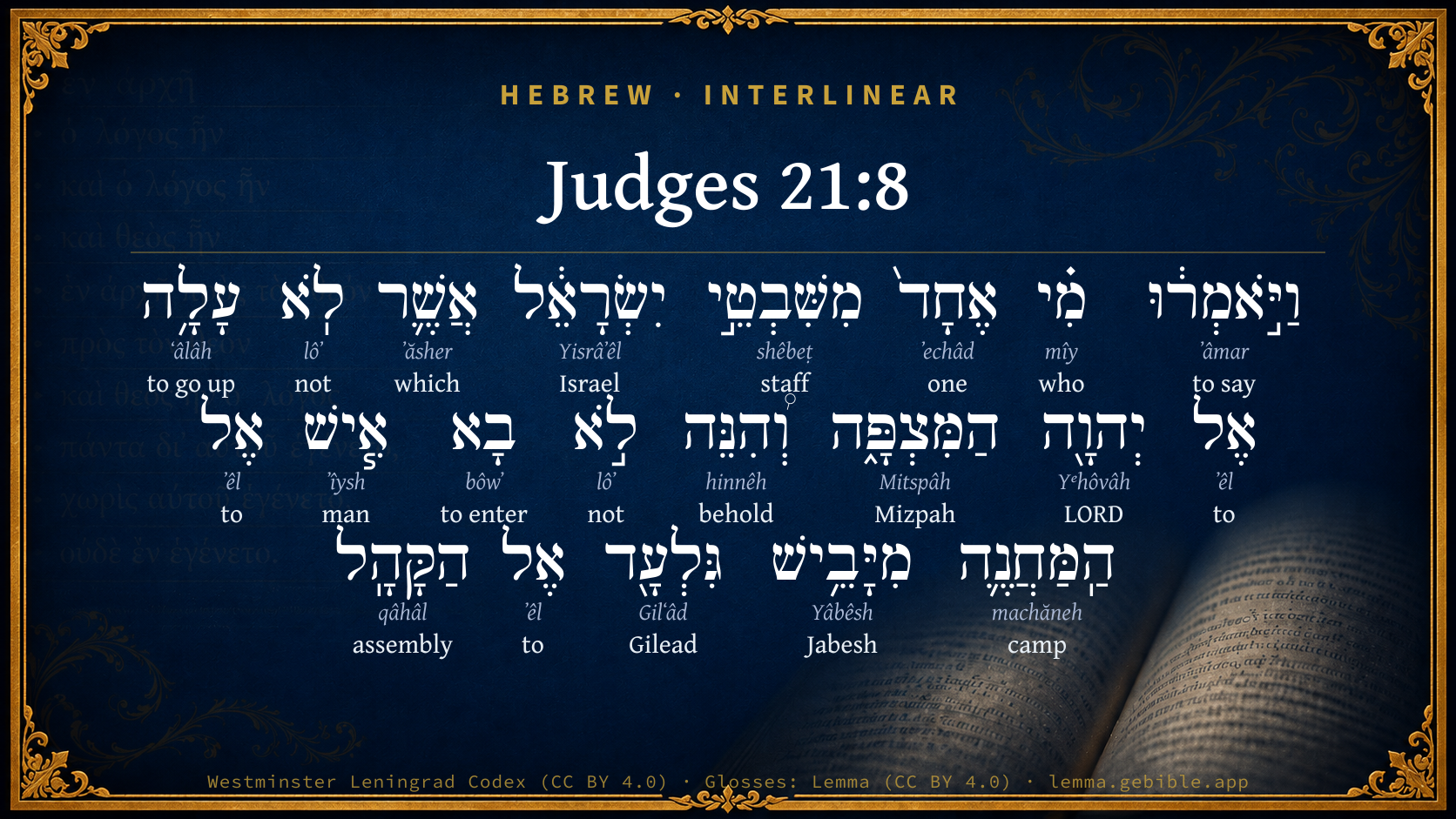
  1. וַיֹּ֣אמְר֔וּ ʼâmar H559 “and · to say” Conjunction + Verb, Qal, Sequential Imperfect, 3rd Person, Masculine, Plural
  2. מִ֗י mîy H4310 “who” Particle, Interrogative
  3. אֶחָד֙ ʼechâd H259 “one” Adjective, Cardinal number, Masculine, Singular, Absolute
  4. מִשִּׁבְטֵ֣י shêbeṭ H7626 “from · staffs of” Preposition + Noun, Common, Masculine, Plural, Construct
  5. יִשְׂרָאֵ֔ל Yisrâʼêl H3478 “Israel” Noun, Proper
  6. אֲשֶׁ֛ר ʼăsher H834 “which” Particle, Relative
  7. לֹֽא lôʼ H3808 “not” Particle, Negative
  8. עָלָ֥ה ʻâlâh H5927 “to go up” Verb, Qal, Perfect, 3rd Person, Masculine, Singular
  9. אֶל ʼêl H413 “to” Preposition
  10. יְהוָ֖ה Yᵉhôvâh H3068 “LORD” Noun, Proper
  11. הַמִּצְפָּ֑ה Mitspâh H4709 “the · Mizpah” Particle, Definite Article + Noun, Proper
  12. וְ֠הִנֵּה hinnêh H2009 “and · behold” Conjunction + Particle, Demonstrative
  13. לֹ֣א lôʼ H3808 “not” Particle, Negative
  14. בָא bôwʼ H935 “to enter” Verb, Qal, Perfect, 3rd Person, Masculine, Singular
  15. אִ֧ישׁ ʼîysh H376 “man” Noun, Common, Masculine, Singular, Absolute
  16. אֶל ʼêl H413 “to” Preposition
  17. הַֽמַּחֲנֶ֛ה machăneh H4264 “the · camp” Particle, Definite Article + Noun, Common, Both, Singular, Absolute
  18. גִּלְעָ֖ד Gilʻâd H1568 “Gilead” Noun, Proper
  19. אֶל ʼêl H413 “to” Preposition
  20. הַקָּהָֽל qâhâl H6951 “the · assembly” Particle, Definite Article + Noun, Common, Masculine, Singular, Absolute

About this verse

These counts appear in no published source. They are computed here, from the morphology-tagged text and Lemma’s own curated glosses. What Lemma adds →

21
words
18
distinct lemmas
Historical
section

Notable vocabulary

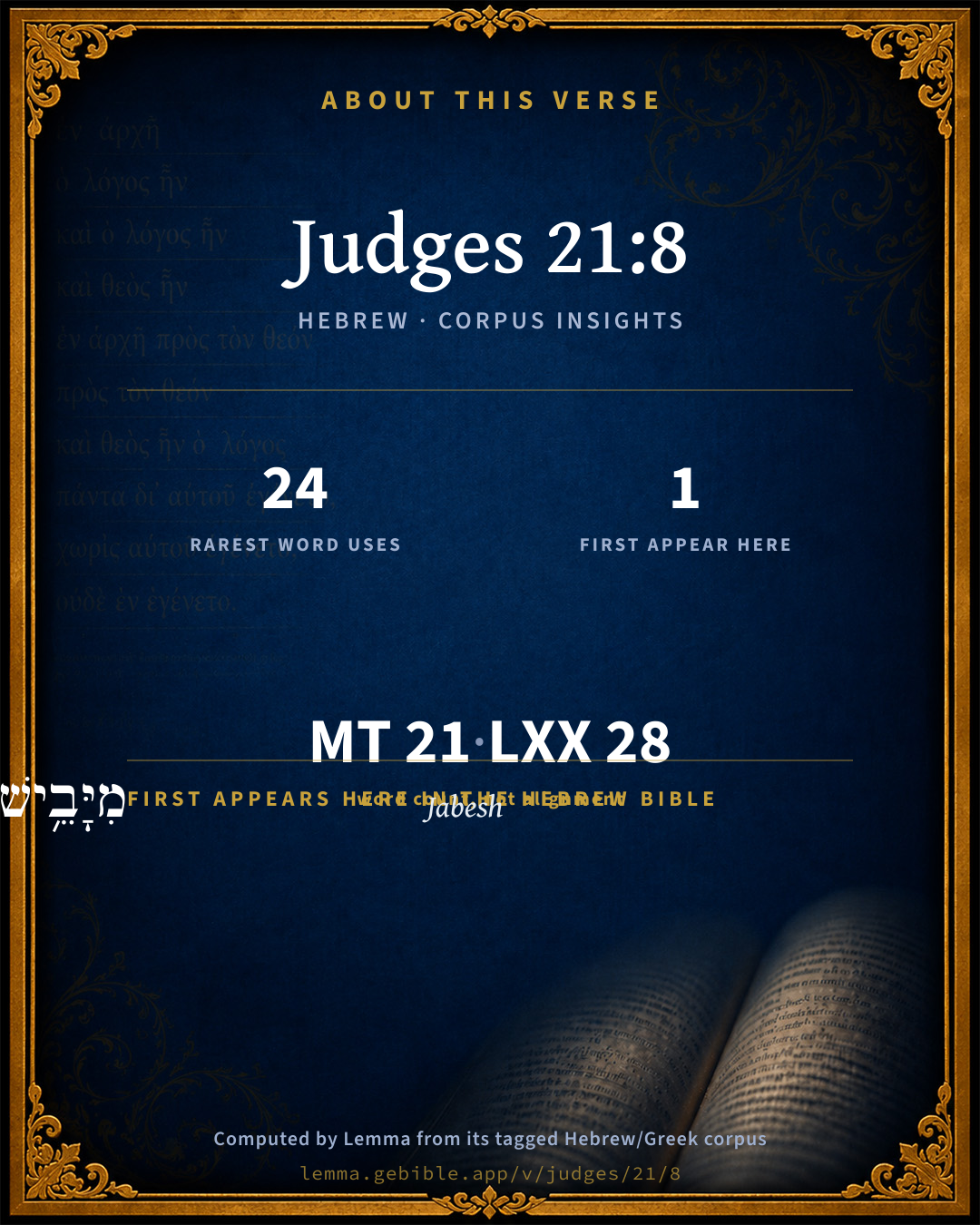
The rarest word here is מִיָּבֵ֥ישׁ Jabesh H3003 — appearing just 24 times in the whole Hebrew Bible.

First appearance in Scripture

This word makes its first canonical appearance in the Hebrew Bible here:

  • מִיָּבֵ֥ישׁ Jabesh H3003

Shared distinctive vocabulary

מִיָּבֵ֥ישׁ Jabesh H3003 occurs in 21 verses of the Hebrew Bible. Also found in:

Grammatical profile

  • 3 verbs
  • 9 nouns
  • 1 adjective
  • 3 prepositions
  • 5 particles

Verb forms

  • וַיֹּ֣אמְר֔וּ Qal · Sequential Imperfect
  • עָלָ֥ה Qal · Perfect
  • בָא Qal · Perfect

Repetition

Words recur within this verse — often emphatic in Hebrew:

Hebrew & Septuagint length

In English translation the verse runs 32 words from the Hebrew and 36 from the Septuagint (LXX English) — closely comparable.

A rough comparison of the two English renderings, which tokenize alike — not a word-level alignment.

Word counts can differ between the Hebrew and the Greek without any difference in meaning — e.g. the Hebrew direct-object marker אֵת has no separate Greek word, and Greek often adds the article ὁ.

In the original languages it is 21 Hebrew tokens and 28 Greek tokens — but the two are counted differently (Hebrew bundles its prefixes and suffixes into one token; the Greek is in lemma form), so that isn’t a like-for-like length.

Cross-references

3

Topical passages linked to Judges 21:8 in the Treasury of Scripture Knowledge — connected by theme and wording, ordered by reader-vote popularity; previews shown in the World English Bible.

  • 1 Samuel 31:11–13 When the inhabitants of Jabesh Gilead heard concerning him that which the Philistines had done to Saul,
  • 1 Samuel 11:1–3 Then Nahash the Ammonite came up, and encamped against Jabesh Gilead: and all the men of Jabesh said to Nahash, Make a covenant with us, and we will serve you.
  • 2 Samuel 2:5–6 David sent messengers to the men of Jabesh Gilead, and said to them, Blessed be you of Yahweh, that you have shown this kindness to your lord, even to Saul, and have buried him.

Cross-references courtesy of OpenBible.info (CC BY 4.0).

Hebrew and Greek witnesses Masoretic Hebrew ↔ Greek Septuagint

The same verse in the two great witnesses to the Old Testament, shown verse-for-verse.

These are two independent witnesses, not word-aligned to each other, and the Septuagint is shown in lemma (dictionary) form.

Hebrew Judges 21:8 Masoretic · Westminster Leningrad Codex

וַיֹּ֣אמְר֔וּ מִ֗י אֶחָד֙ מִשִּׁבְטֵ֣י יִשְׂרָאֵ֔ל אֲשֶׁ֛ר לֹֽא עָלָ֥ה אֶל יְהוָ֖ה הַמִּצְפָּ֑ה וְ֠הִנֵּה לֹ֣א בָא אִ֧ישׁ אֶל הַֽמַּחֲנֶ֛ה מִיָּבֵ֥ישׁ גִּלְעָ֖ד אֶל הַקָּהָֽל

They said, What one is there of the tribes of Israel who didn't come up to Yahweh to Mizpah? Behold, there came none to the camp from Jabesh Gilead to the assembly.

World English Bible · Public Domain

Greek LXX Judges 21:8 Septuagint · lemma form

καί εἶπον τίς εἷς ἀπό φυλή ἰσραήλ ὅς οὐ ἀναβαίνω πρός κύριος εἰς μασσηφα καί ἰδού οὐ ἔρχομαι ἀνήρ εἰς ὁ παρεμβολή ἀπό ιαβις γαλαάδ εἰς ὁ ἐκκλησία

And they said, What one man is there of the tribes of Israel, who went not up to the Lord to Massephath? and, behold, no man came to the camp from Jabis Galaad to the assembly.

LXX2012 (modern English Septuagint) · Public Domain

Hebrew: Westminster Leningrad Codex (CC BY 4.0). Greek: Septuagint (public domain); English from LXX2012 (modern English Septuagint) (Public Domain). How the Septuagint differs from the Hebrew →

Targum (Aramaic paraphrase)

1

The Targum is the ancient Jewish Aramaic paraphrase of the Hebrew Scriptures — an interpretive translation, not the Hebrew text itself. Onkelos (literal) and Pseudo-Jonathan (expansive) render the Torah, and Jonathan the Prophets. Coverage is partial: where no permissively-licensed English translation exists for a verse, only the Aramaic is shown. This is verse-level text, not a word-by-word alignment to the Hebrew.

  1. Targum Jonathan Prophets (Joshua–Malachi)
    וַאֲמַרוּ מַן חַד מִשִׁבְטַיָא דְיִשְׂרָאֵל דְלָא סְלִיק לָקֳדָם יְיָ לְמִצְפַּיָא וְהָא לָא אֲתָא אֲנַשׁ לְמַשְׁרִיתָא מֵיָבֵשׁ גִלְעָד לִקְהָלָא:

    (no public-domain English translation for this verse)

    Targum Jonathan — Aramaic: “Mikraot Gedolot” (public domain). English: “Sefaria Community Translation” (CC0 1.0 (public-domain dedication)); “London "Chaldee Paraphrase," 1871” (public domain). Text via Sefaria.

Commentary

Notes on Judges 21:8 from classic Christian and Jewish commentators (each source and its license shown beneath its notes). The classic Christian expositions comment on the surrounding passage and are grouped to its opening verse, so a note may address several verses; the Jewish commentaries on the Tanakh (Rashi and others) are per-verse, so they appear only where the commentator wrote on this verse.

Lemma curates 59 commentaries, every one of them public domain or Creative Commons licensed, each selected and text-cleaned for this edition rather than reprinted as found. About our sources →

Trapp's Complete Commentary

John Trapp

Jdg 21:8 And they said, What one [is there] of the tribes of Israel that came not up to Mizpeh to the LORD? And, behold, there came none to the camp from Jabeshgilead to the assembly.

Ver. 8. There came none to the camp from Jabeshgilead.] They came not up to help the Lord, as Jdg 5:23; they contributed nothing toward the just punishment of those sons of Belial, and therefore seemed to like well of their wickedness. These inhabitants of Jabeshgilead lay far out beyond Jordan, toward the Lake of Gennesaret, and therefore, haply, held themselves less concerned. There is none so wise as the sluggard, {Pro 26:16} for self-love teacheth him a great many excuses, which he thinks will go for wisdom, because by them he thinks to sleep in a whole skin. But in fine his cunning deceiveth him, and he smoketh for it.

John Trapp, A Commentary or Exposition upon All the Books of the Old and New Testament (1647–1656) — public domain. Text from a community e-Sword module.

Geneva Bible (1599)

Geneva Bible translators

Condemning them to be favors of vice, which would not put their hand to punish it.

Geneva Bible (1599) marginal notes — public domain. Text via Bolls.life.

Jamieson, Fausset & Brown

Robert Jamieson, A. R. Fausset & David Brown

there came none to the camp from Jabesh-gilead to the assembly--This city lay within the territory of eastern Manasseh, about fifteen miles east of the Jordan, and was, according to JOSEPHUS, the capital of Gilead. The ban which the assembled tribes had pronounced at Mizpeh seemed to impose on them the necessity of punishing its inhabitants for not joining the crusade against Benjamin; and thus, with a view of repairing the consequences of one rash proceeding, they hurriedly rushed to the perpetration of another, though a smaller tragedy. But it appears (Jdg 21:11) that, besides acting in fulfilment of their oath, the Israelites had the additional object by this raid of supplying wives to the Benjamite remnant. This shows the intemperate fury of the Israelites in the indiscriminate slaughter of the women and children.

Jamieson, Fausset & Brown — Commentary Critical and Explanatory on the Whole Bible (1871) — public domain (CC PDM 1.0). Text via the HelloAO Bible API.

Adam Clarke's Commentary

Verse 8. There came none to the camp from Jabesh-gilead] As they had sworn to destroy those who would not assist in this war, Jdg 21:5, they determined to destroy the men of Jabesh, and to leave none alive except the virgins, and to give these to the six hundred Benjamites that had escaped to the rock Rimmon. So twelve thousand men went, smote the city, and killed all the males and all the married women. The whole account is dreadful; and none could have been guilty of all these enormities but those who were abandoned of God. The crime of the men of Gibeah was of the deepest die; the punishment, involving both the guilty and innocent, was extended to the most criminal excess; and their mode or redressing the evil which they had occasioned was equally abominable.

Adam Clarke's Commentary on the Bible (1810–1826) — public domain. Text from a community e-Sword/MySword module.

Ellicott's Commentary for English Readers

(8) There came none to the camp from Jabesh-gilead.—Jabesh-Gilead, which Josephus calls the metropolis of Gilead (Antt. vi. 5, § 1), is probably to be identified with the ruins now called El-Deir in the Wady Yabes (Robinson, 3:319). It was six miles from Pella, on the top of a hill which lies on the road from Pella to Gerasa. For some reason with which we are unacquainted, there seems to have been a bond of intense sympathy between the inhabitants of this town and Benjamin. If their abstinence from the assembly of vengeance was not due to this, we must suppose that the sort of companionship in misery caused by these wild events itself created a sense of union between these communities, for it is the peril of Jabesh which first arouses King Saul to action (1 Samuel 11). and in memory of the deliverance which he effected the men of Jabesh alone save the bodies of Saul and Jonathan from the indignity of rotting on the wall of Bethshan (1Sa_31:11), which gained them the blessing of David (2Sa_2:5-6). We see from these later incidents that Jabesh recovered from the extermination now inflicted on its inhabitants.

A Bible Commentary for English Readers, edited by Charles John Ellicott (1878–1897) — public domain. Text from a community e-Sword module.

The Cambridge Bible for Schools and Colleges

gen. ed. J. J. S. Perowne

8. Jabesh-gilead] This ancient city, Jabesh of G., is only mentioned again in connexion with the history of Saul, 1Sa_11:1 ff; 1Sa_31:11 ff., 2Sa_2:5 f., Jdg_21:12 f. The name survives in the Wâdi el-Jâbis, about half way between the Yarmuk and the W. Zerḳâ (Jabbok); the city probably lay in the upper part of the valley where it reaches the highlands of Gilead, a nights march from Beth-shean (= Bçsân) across the Jordan, 1Sa_31:12. It has been suggested that this narrative of the war against Jabesh was dictated by Judaean animosity against Saul1[64]; but it is clear that the narrative dates from a period later than that of the kingdom of Judah. At the same time we cannot deny that the writer, in singling out Jabesh for punishment, may have remembered its ancient loyalty to Saul (so Moore).

[64] So recently, Kittel, Gesch. des Volkes Israel2 (1909), p. 23.

The Cambridge Bible for Schools and Colleges (gen. ed. J. J. S. Perowne; Cambridge University Press, 1878–1918) — public domain. Text from a community e-Sword module.

John Gill's Exposition

And they said, what one is there of the tribes of Israel that came not up to Mizpeh to the Lord?.... This is asked not only to bring them to justice, and put them to death, according to their oath, who should be found guilty, Jdg 21:5 but as an expedient to find wives for the surviving Benjaminites; since these, as they came not to Mizpeh, so consequently swore not that they would not give their daughters to Benjaminites; wherefore from among them wives might be given to them, without the violation of an oath:

and, behold, there came none to the camp from Jabeshgilead to the assembly; this was observed by some upon the question put, which caused an inquiry to be made as after related. This city was in the land of Gilead, from whence it had its name, on the other side Jordan, and is placed by Adrichomius (a) in the half tribe of Manasseh; and Jerom (b) says it was a village in his time six miles from the city Pella, upon a mountain, as you go to Gerasa.

(a) Theatrum Terrae S. p. 90. (b) De loc. Heb. fol. 88. K. & fol. 93. L.

John Gill's Exposition of the Whole Bible (1746–1763) — public domain (CC PDM 1.0). Text via the HelloAO Bible API.

Albert Barnes' Notes on the Bible

Jabesh-Galead - Is here mentioned for the first time. (See marginal references.) The name of Jabesh survives only in the Wady Yabes (running down to the east bank of the Jordan), near the head of which are situated the ruins called Ed-Deir, which are identified with Jabesh-Gilead.

Albert Barnes' Notes on the Bible (1834–1885) — public domain. Text from a community e-Sword/MySword module.

Haydock's Catholic Bible Commentary

Jabes was between Pella and Gerasa, upon a mountain, east of the Jordan. It was after its destruction rebuilt, (Calmet) and became very famous, (1 Kings xi.; Menochius) if it was indeed ever demolished. We know not what prevented the inhabitants from joining in common cause. (Haydock)

George Leo Haydock (1774–1849), Haydock's Catholic Family Bible and Commentary, 1859 edition — public domain. Excludes Psalms (Douay-Rheims chapter numbering differs from Protestant) and Deuterocanonical books (Catholic canon only).

Matthew Poole's English Annotations

A city in Gilead, and in the tribe of Manasseh; of which see 1Sa 11:1,3,9, &c.; 1Sa 31:11, &c.

Matthew Poole's English Annotations on the Holy Bible (1683–1685) — public domain. Text from a community e-Sword/MySword module.

Whedon's Commentary on the Bible

Daniel D. Whedon

8. Came none… from Jabesh-gilead — This was the chief city of the mountainous land of Gilead on the east of the Jordan, and its name is still preserved in the valley in which it was situated — Wady Yabis. Its exact site has not been positively ascertained, but there remains hardly a doubt that it was identical with the modern ruin ed-Deir, which lies on a hill on the south side of the wady Yabis, some six or seven miles east of the Jordan. “The name ed-Deir,” says Dr. Robinson. “is often given to ruins of which the Arabs can make nothing else; while the existence of columns, and the position upon the road from Beisan to Jerash, are circumstances of great weight. The distance too, of six miles from Pella, as specified by Eusebius and Jerome, seems entirely applicable to ed-Deir.” The fact that none came from this city to fight against Benjamin has led some writers, with reason, to suspect that a secret alliance existed between this city and Benjamin.

Daniel D. Whedon (gen. ed.), Commentary on the Old and New Testaments (1874–1909) — public domain. Text from a community e-Sword module.

unfoldingWord translationNotes

Door43 World Missions Community

Jabesh Gilead

This is the name of a city. (See: How to Translate Names)

people were set out in an orderly manner

"people that were assembled at Mizpah were accounted for"

none of the inhabitants of Jabesh Gilead were there

This refers back to the earlier assembly at Mizpah. The full meaning of this statement can be made clear. AT: "none of the inhabitants of Jabesh Gilead had been present at Mizpah" (See: Assumed Knowledge and Implicit Information)

twelve thousand

"12,000" (See: Numbers)

strike the inhabitants of Jabesh Gilead with the edge of the sword, including the women and children

The next verse will add an exception to this general instruction.

strike ... with the edge of the sword

"kill ... with their swords"

translationWords

tribe

Israel

Yahweh

Mizpah

Gilead

assembly

unfoldingWord translationNotes — © Distant Shores Media and the Door43 World Missions Community, licensed CC BY-SA 4.0. Source: git.door43.org/Door43/en_tn.

Lesson kit

Teaching starters — assembled from the data on this page, not authored interpretation. Every prompt links to the verse data it draws on. Edit before teaching.

Judges, in the Historical, opens this verse with 21 words (18 distinct Hebrew lemmas). Its most distinctive word is Yâbêsh (“Jabesh”). A historical commentator’s framing appears above. Read the whole chapter for the surrounding context.

Discussion questions

  1. The word Yâbêsh carries the sense “Jabesh.” How does it shape the verse?
  2. This is the first place “Jabesh” appears in Scripture (first appears here). What does its debut here establish?
  3. How does Judges 21:9, which shares the word «Jabesh», read alongside this verse?
  4. What does the repetition of “to” (3× in this one verse) do in this verse?
  5. The translations on this page render this verse differently — a whole-verse word diff, not a word-by-word alignment. What might account for the different wordings?
  6. «וַיֹּ֣אמְר֔וּ» is a Qal Sequential Imperfect verb. How does that grammatical form shape the action described?
  7. Compare how Trapp's Complete Commentary and Geneva Bible (1599) read this verse. Where do they agree or differ?

Things to notice

Reading settings

Reading text

Shown beneath each verse's original-language words.

Old Testament
Old Testament edition

Read the OT as the Masoretic Hebrew (MT) or the Greek Septuagint (LXX).

English shown for the Greek Septuagint (in the Hebrew ↔ Greek comparison).

Comparing translations? Open the Compare panel on any verse page to stack up to four side by side.