
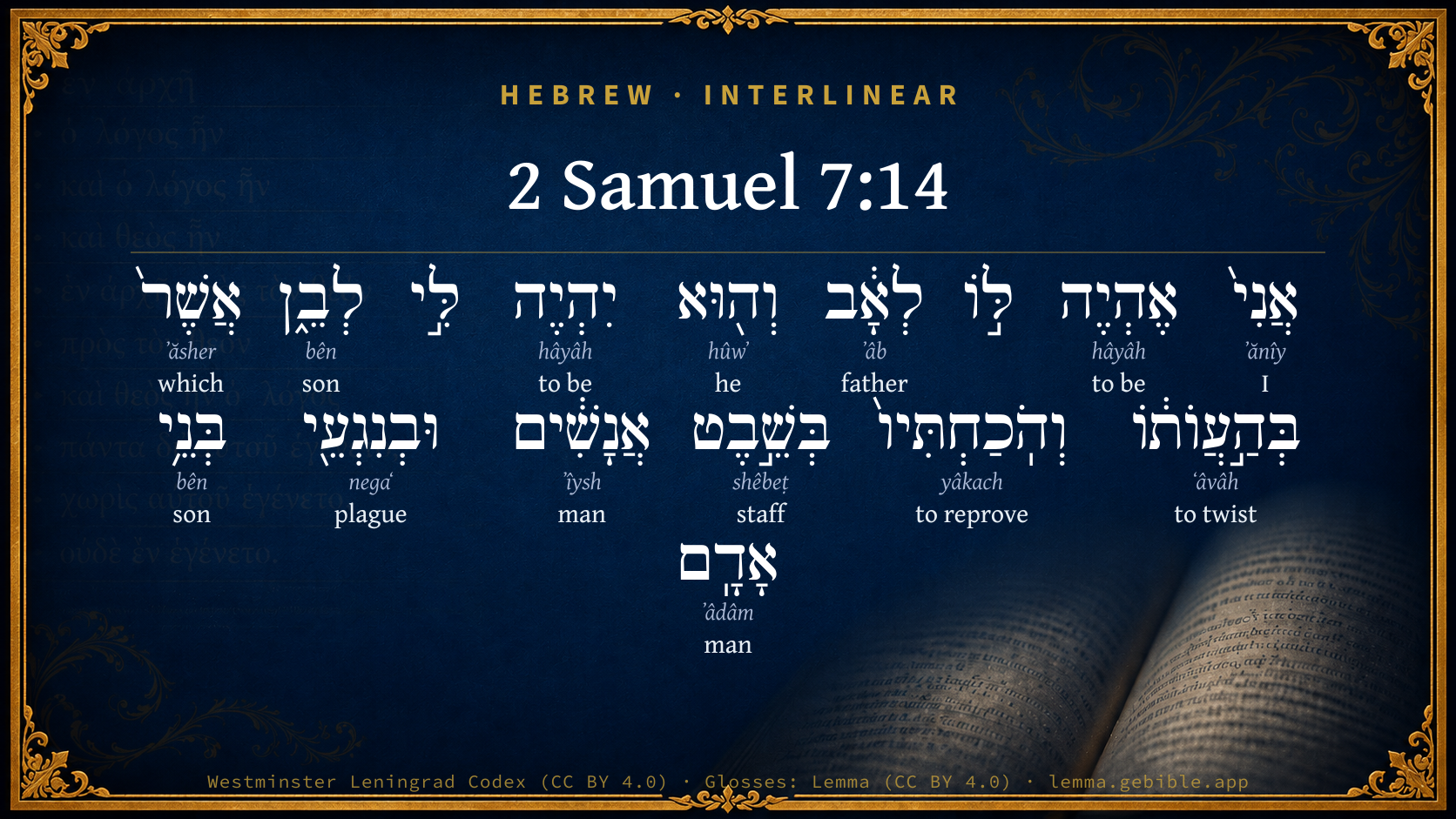
2 Samuel 7:14

Hebrew (Westminster Leningrad Codex) 2 Samuel 7:14 appears in the Hebrew Old Testament. The text above is from the Westminster Leningrad Codex. Each word links to its Strong’s number, a concise gloss, and parsing drawn from the Open Scriptures Hebrew Bible morphology. Click any word for its full Brown-Driver-Briggs (BDB) entry.
Download image
Cite this verse

2 Samuel 7:14 (World English Bible). Public Domain. Lemma interlinear Bible study tool, https://lemma.gebible.app/v/2-samuel/7/14.

Show BibTeX & RIS
BibTeX
RIS
English Translation
I will be his father, and he shall be my son: if he commit iniquity, I will chasten him with the rod of men, and with the stripes of the children of men;
World English Bible · Public Domain
Download a study sheet

One document with this verse’s original text, its word-by-word gloss line, the meaning frame, cross-references with their text, attributed commentary, and full source and license credits — printable, and it pastes into notes with its structure intact.

This verse Autodidact and up

Study sheet (.html) Plain text (.txt)

A passage Seminary Student

Up to 50 verses in one chapter. A passage sheet keeps up to 6 commentary sources and 12 cross-references per verse, in the order this page ranks them, and says so on the sheet whenever that leaves anything out. Ask for a single verse and you get the Autodidact verse sheet above.

Everything on this page stays free to read, with no account — the sheet is a download of what is already on screen, not access to it.

Want to remove ads? Support Godless Engineer
Compare translations 3

The same verse in 3 English versions, stacked beneath the original-language interlinear above. Click any original word for its lexicon entry.

Each is an independent rendering of the whole verse — the interlinear is not word-aligned to these translations.

Highlighted words mark where these versions differ — a whole-verse word diff, not a word-by-word alignment.

  • World English Bible Public Domain
    I will be his father, and he shall be my son: if he commit iniquity, I will chasten him with the rod of men, and with the stripes of the children of men;
  • King James Version Public Domain
    I will be his father, and he shall be my son. If he commit iniquity, I will chasten him with the rod of men, and with the stripes of the children of men:
  • unfoldingWord Literal Text CC BY-SA 4.0
    I, I will be a father to him, and he, he will be a son to me, that when he sins, then I will correct him with the rod of men and with the blows of the sons of man.

unfoldingWord Literal Text — © unfoldingWord, licensed CC BY-SA 4.0. Word-aligned USFM3 via Door43 (git.door43.org/unfoldingWord/en_ult).

Versions to compare (up to 4)

3 of 4 selected

Show all 18 translations

Every available English version of this verse, each an independent rendering of the whole verse.

  • World English Bible Public Domain
    I will be his father, and he shall be my son: if he commit iniquity, I will chasten him with the rod of men, and with the stripes of the children of men;
  • Berean Standard Bible Public Domain
    I will be his Father, and he will be My son. When he does wrong, I will discipline him with the rod of men and with the blows of the sons of men.
  • Majority Standard Bible Public Domain
    I will be his Father, and he will be My son. When he does wrong, I will discipline him with the rod of men and with the blows of the sons of men.
  • King James Version Public Domain
    I will be his father, and he shall be my son. If he commit iniquity, I will chasten him with the rod of men, and with the stripes of the children of men:
  • American Standard Version (1901) Public Domain
    I will be his father, and he shall be my son: if he commit iniquity, I will chasten him with the rod of men, and with the stripes of the children of men;
  • Revised Version (1885) Public Domain
    I will be his father, and he shall be my son: if he commit iniquity, I will chasten him with the rod of men, and with the stripes of the children of men;
  • Geneva Bible (1599) Public Domain
    I will be his father, and hee shall bee my sonne: and if he sinne, I will chasten him with the rod of men, and with the plagues of the children of men.
  • Douay-Rheims (1899) Public Domain
    I will be to him a father, and he shall be to me a son: and if he commit any iniquity, I will correct him with the rod of men, and with the stripes of the children of men.
  • Young's Literal Translation Public Domain
    I am to him for a father, and he is to Me for a son; whom in his dealings perversely I have even reproved with a rod of men, and with strokes of the sons of Adam,
  • Literal Standard Version CC BY-SA 4.0
    I am to him for a father, and he is to Me for a son; whom in his dealing perversely I have even reproved with a rod of men, and with strokes of the sons of Adam,
  • Unlocked Literal Bible CC BY-SA 4.0
    I will be a father to him, and he will be my son. When he sins, I will discipline him with the rod of men and with the whipping of the sons of men.
  • unfoldingWord Literal Text CC BY-SA 4.0
    I, I will be a father to him, and he, he will be a son to me, that when he sins, then I will correct him with the rod of men and with the blows of the sons of man.
  • Darby Bible Public Domain
    I will be his father, and he shall be my son. If he commit iniquity, I will chasten him with the rod of men and with the stripes of the sons of men;
  • World Messianic Bible Public Domain
    I will be his father, and he will be my son. If he commits iniquity, I will chasten him with the rod of men and with the stripes of the children of men;
  • Webster's Bible Public Domain
    I will be his father, and he shall be my son. If he shall commit iniquity, I will chasten him with the rod of men, and with the stripes of the children of men:
  • Free Bible Version CC BY-SA 4.0
    I will be a father to him, and he will be a son to me. If he does wrong, I will discipline him with the rod like people do, like a parent punishing a child.
  • Bible in Basic English Public Domain
    I will be to him a father and he will be to me a son: if he does wrong, I will give him punishment with the rod of men and with the blows of the children of men;
  • JPS Tanakh (1917) Public Domain
    I will be to him for a father, and he shall be to Me for a son; if he commit iniquity, I will chasten him with the rod of men, and with the stripes of the children of men;

Literal Standard Version (2020), Covenant Press — licensed CC BY-SA 4.0. Text via the HelloAO Bible API (eBible.org). Unlocked Literal Bible (unfoldingWord) — licensed CC BY-SA 4.0. Text via the HelloAO Bible API (eBible.org). unfoldingWord Literal Text — © unfoldingWord, licensed CC BY-SA 4.0. Word-aligned USFM3 via Door43 (git.door43.org/unfoldingWord/en_ult). Free Bible Version, Dr. Jonathan Gallagher — licensed CC BY-SA 4.0. Text via the HelloAO Bible API (eBible.org).

Word by word

More ways to search: Search by grammar → Find every occurrence → Compare this word →

Practice this passage: Drill this verse → Learn its vocabulary →

בְּהַ֣עֲוֺת֔וֹ
ʻâvâh
H5753
“in/at · to twist · him”
Preposition + Verb, Hiphil, Infinitive Construct + Suffix, Personal, 3rd Person, Masculine, Singular
Part of Speech
Preposition + Verb
Stem
Hiphil
Form
Infinitive Construct
Full BDB Definition

Origin: a primitive root

TWOT: 1577

to bend, twist, distort - (Niphal) to be bent, be bowed down, be twisted, be perverted - (Piel) to twist, distort - (Hiphil) to do perversely - to commit iniquity, do wrong, pervert - (Qal) to do wrong, commit iniquity - (Hiphil) to commit iniquity
  1. אֲנִי֙ ʼănîy H589 “I” Pronoun, Personal, 1st Person, Common, Singular
  2. אֶהְיֶה hâyâh H1961 “to be” Verb, Qal, Imperfect, 1st Person, Common, Singular
  3. לְאָ֔ב ʼâb H1 “to/for · father” Preposition + Noun, Common, Masculine, Singular, Absolute
  4. וְה֖וּא hûwʼ H1931 “and · he” Conjunction + Pronoun, Personal, 3rd Person, Masculine, Singular
  5. יִהְיֶה hâyâh H1961 “to be” Verb, Qal, Imperfect, 3rd Person, Masculine, Singular
  6. לְבֵ֑ן bên H1121 “to/for · son” Preposition + Noun, Common, Masculine, Singular, Absolute
  7. אֲשֶׁר֙ ʼăsher H834 “which” Particle, Relative
  8. וְהֹֽכַחְתִּיו֙ yâkach H3198 “and · to reprove · him” Conjunction + Verb, Hiphil, Sequential Perfect, 1st Person, Common, Singular + Suffix, Personal, 3rd Person, Masculine, Singular
  9. בְּשֵׁ֣בֶט shêbeṭ H7626 “in/at · staff of” Preposition + Noun, Common, Masculine, Singular, Construct
  10. אֲנָשִׁ֔ים ʼîysh H376 “men” Noun, Common, Masculine, Plural, Absolute
  11. וּבְנִגְעֵ֖י negaʻ H5061 “and · in/at · plagues of” Conjunction + Preposition + Noun, Common, Masculine, Plural, Construct
  12. בְּנֵ֥י bên H1121 “sons of” Noun, Common, Masculine, Plural, Construct
  13. אָדָֽם ʼâdâm H120 “man” Noun, Common, Masculine, Singular, Absolute

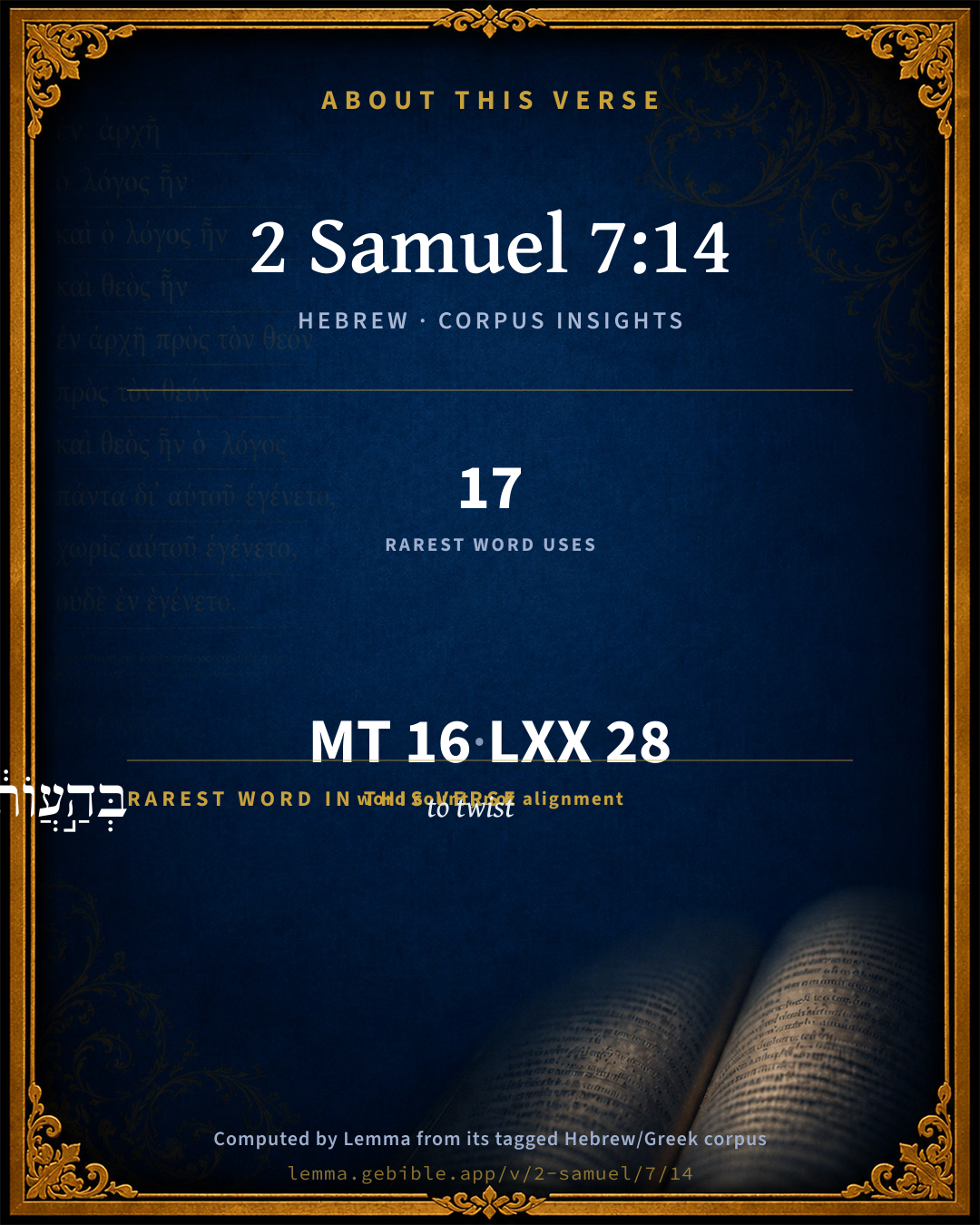
About this verse

These counts appear in no published source. They are computed here, from the morphology-tagged text and Lemma’s own curated glosses. What Lemma adds →

16
words
12
distinct lemmas
Historical
section

Notable vocabulary

The rarest word here is בְּהַ֣עֲוֺת֔וֹ to twist H5753 — appearing just 17 times in the whole Hebrew Bible.

Shared distinctive vocabulary

בְּהַ֣עֲוֺת֔וֹ to twist H5753 occurs in 17 verses of the Hebrew Bible. Also found in:

Grammatical profile

  • 4 verbs
  • 7 nouns
  • 2 pronouns
  • 2 prepositions
  • 1 particle

Verb forms

  • אֶהְיֶה Qal · Imperfect
  • יִהְיֶה Qal · Imperfect
  • בְּהַ֣עֲוֺת֔וֹ Hiphil · Infinitive Construct
  • וְהֹֽכַחְתִּיו֙ Hiphil · Sequential Perfect

Repetition

Words recur within this verse — often emphatic in Hebrew:

  • אֶהְיֶה to be H1961 ×2
  • לְבֵ֑ן son H1121 ×2

Hebrew & Septuagint length

In English translation the verse runs 33 words from the Hebrew and 40 from the Septuagint (LXX English) — closely comparable.

A rough comparison of the two English renderings, which tokenize alike — not a word-level alignment.

Word counts can differ between the Hebrew and the Greek without any difference in meaning — e.g. the Hebrew direct-object marker אֵת has no separate Greek word, and Greek often adds the article ὁ.

In the original languages it is 16 Hebrew tokens and 28 Greek tokens — but the two are counted differently (Hebrew bundles its prefixes and suffixes into one token; the Greek is in lemma form), so that isn’t a like-for-like length.

Cross-references

13

Topical passages linked to 2 Samuel 7:14 in the Treasury of Scripture Knowledge — connected by theme and wording, ordered by reader-vote popularity; previews shown in the World English Bible.

  • Hebrews 1:5 For to which of the angels did he say at any time, "You are my Son, Today have I become your father?" and again, "I will be to him a Father, And he will be to me a Son?"
  • Revelation 3:19 As many as I love, I reprove and chasten. Be zealous therefore, and repent.
  • 1 Chronicles 17:13 I will be his father, and he shall be my son: and I will not take my loving kindness away from him, as I took it from him that was before you;
  • 1 Chronicles 28:6 He said to me, Solomon your son, he shall build my house and my courts; for I have chosen him to be my son, and I will be his father.
  • Deuteronomy 8:5 You shall consider in your heart that as a man chastens his son, so Yahweh your God chastens you.
  • 1 Corinthians 11:32 But when we are judged, we are punished by the Lord, that we may not be condemned with the world.
  • Psalms 89:20–37 I have found David, my servant. I have anointed him with my holy oil,
  • Psalms 94:12–13 Blessed is the man whom you discipline, Yah, And teach out of your law;
  • Jeremiah 30:11 For I am with you, says Yahweh, to save you: for I will make a full end of all the nations where I have scattered you, but I will not make a full end of you; but I will correct you in measure, and will in no way leave you unpunished.
  • Hebrews 12:5–11 and you have forgotten the exhortation which reasons with you as with children, "My son, don't take lightly the chastening of the Lord, Nor faint when you are reproved by him;
  • Proverbs 3:11–12 My son, don't despise Yahweh's discipline, Neither be weary of his reproof:
  • Matthew 3:17 Behold, a voice out of the heavens said, "This is my beloved Son, with whom I am well pleased."
  • Job 5:17 "Behold, happy is the man whom God corrects: Therefore do not despise the chastening of the Almighty.

Cross-references courtesy of OpenBible.info (CC BY 4.0).

Hebrew and Greek witnesses Masoretic Hebrew ↔ Greek Septuagint

The same verse in the two great witnesses to the Old Testament, shown verse-for-verse.

These are two independent witnesses, not word-aligned to each other, and the Septuagint is shown in lemma (dictionary) form.

Hebrew 2 Samuel 7:14 Masoretic · Westminster Leningrad Codex

אֲנִי֙ אֶהְיֶה לּ֣וֹ לְאָ֔ב וְה֖וּא יִהְיֶה לִּ֣י לְבֵ֑ן אֲשֶׁר֙ בְּהַ֣עֲוֺת֔וֹ וְהֹֽכַחְתִּיו֙ בְּשֵׁ֣בֶט אֲנָשִׁ֔ים וּבְנִגְעֵ֖י בְּנֵ֥י אָדָֽם

I will be his father, and he shall be my son: if he commit iniquity, I will chasten him with the rod of men, and with the stripes of the children of men;

World English Bible · Public Domain

Greek LXX 2 Samuel 7:14 Septuagint · lemma form

ἐγώ εἰμί αὐτός εἰς πατήρ καί αὐτός εἰμί ἐγώ εἰς υἱός καί ἐάν ἔρχομαι ὁ ἀδικία αὐτός καί ἐλέγχω αὐτός ἐν ῥάβδος ἀνήρ καί ἐν ἁφή υἱός ἄνθρωπος

I will be to him a father, and he shall be to me a son. And when he happens to transgress, then will I chasten him with the rod of men, and with the stripes of the sons of men.

LXX2012 (modern English Septuagint) · Public Domain

Hebrew: Westminster Leningrad Codex (CC BY 4.0). Greek: Septuagint (public domain); English from LXX2012 (modern English Septuagint) (Public Domain). How the Septuagint differs from the Hebrew →

Targum (Aramaic paraphrase)

1

The Targum is the ancient Jewish Aramaic paraphrase of the Hebrew Scriptures — an interpretive translation, not the Hebrew text itself. Onkelos (literal) and Pseudo-Jonathan (expansive) render the Torah, and Jonathan the Prophets. Coverage is partial: where no permissively-licensed English translation exists for a verse, only the Aramaic is shown. This is verse-level text, not a word-by-word alignment to the Hebrew.

  1. Targum Jonathan Prophets (Joshua–Malachi)
    אֲנָא אֱהֵי לֵיהּ כְּאָב וְהוּא יְהֵי לִי דָמֵי כְּבַר דְאִם יִסְרַח וְאַלְקִינֵיהּ בְּמַלְקוּת גַבְרִין וּבְמַרְדוּת בְנֵי אֱנָשָׁא:

    (no public-domain English translation for this verse)

    Targum Jonathan — Aramaic: “Mikraot Gedolot” (public domain). English: “Sefaria Community Translation” (CC0 1.0 (public-domain dedication)); “London "Chaldee Paraphrase," 1871” (public domain). Text via Sefaria.

Commentary

Notes on 2 Samuel 7:14 from classic Christian and Jewish commentators (each source and its license shown beneath its notes). The classic Christian expositions comment on the surrounding passage and are grouped to its opening verse, so a note may address several verses; the Jewish commentaries on the Tanakh (Rashi and others) are per-verse, so they appear only where the commentator wrote on this verse.

Lemma curates 59 commentaries, every one of them public domain or Creative Commons licensed, each selected and text-cleaned for this edition rather than reprinted as found. About our sources →

Trapp's Complete Commentary

John Trapp

2Sa 7:14 I will be his father, and he shall be my son. If he commit iniquity, I will chasten him with the rod of men, and with the stripes of the children of men:

Ver. 14. I will be his father.] Solomon’s, by adoption and regeneration. See 2Co 6:18. Christ’s, by eternal generation and personal union. {Heb 1:5 Psa 2:7}

If he commit iniquity.] As Solomon did, but Christ could not. One Augustinus de Roma was censured in the Council of Basil for affirming that Christ was the greatest of sinners. It may be he meant that Christ was so by imputation, as Isa 53:6 2Co 5:20. Otherwise it was blasphemy in the highest degree.

I will chasten him with the rod of men,] i.e., Gently and favourably, as parents do their children; thereby to break their stomachs, but not their bones. I will not lay the weight of my mighty hand upon him, to crush him to pieces, or grind him to powder; I will not scourge him with scorpions, but chasten him with the rods of men, of old, or weak, sickly men - as the Hebrew word signifieth {a} - who cannot strike hard, or do any great hurt with their ictus imbelles, and vanae sine viribus irae.

{a} Virga senum vel hominum debilium.

John Trapp, A Commentary or Exposition upon All the Books of the Old and New Testament (1647–1656) — public domain. Text from a community e-Sword module.

The Biblical Illustrator

Joseph S. Exell

2Sa_7:14.

I will be his Father, and he shall be my son.

Divine relationship

I. Jehovahs relationship. God has written in His Word, saying, I will be his Father, and he shall be my son. Here I commence with a fundamental principle, and that because fundamental principles, in our day, are become almost obsolete; and, in hundreds and thousands of instances, are cast aside. The fundamental principle I mean is the original adoption of His sons. This seems to be the very spirit of the promise of my text, I will be his Father. It is not left to after-date to be fixed, but it is accomplished in after-date manifestly, to prove that Jehovah had before ordained that it should be so.

II. The open manifestation of the sonship. He shall be my son.

1. He shall be my son, manifestly, for the family likeness shall be put upon him. He once bore the image of the earthly; and earthy enough God knows he was, before regeneration work made the change in him. He bore the image of the earthy, the image of the fallen Adam, the image of ruin, the image of the curse. But though he has borne the image of the earthly, he shall bear the image of the heavenly; and this family likeness expresses and exhibits, before all the world, the distinction between the children of God and the children of the world.

2. Gods sons are privileged to wear the family robes. You recollect a passage in the Book of Samuel pointing to this, With such robes were the kings daughters that were virgins, apparelled; and all His sons too.

3. That when Jehovah determines openly to display the character of His sons, it is by affording them the spirit of adoption. The privilege of adoption is one thing, and the spirit of adoption is another. In the privilege of adoption, all that pertains to the family of God is made over to the sons, and secured to them for ever; but in the spirit of adoption, the poor sinner born from above, the poor sinner regenerated by grace Divine, is brought to know his relationship, as the apostle has it. As soon as this spirit of adoption is sent forth into his heart, he cries out, Father. Abba is the word given--Father.

4. Let me add here, the sons of God are very tenacious about the maintaining of truth and holiness; and they are the only persons in the world that are anxious to maintain them. In this sense also they differ from all people, from all nations under heaven.

5. But go on just to mark, that the sons of God, especially as they grow up a little above their boyhood, and begin to be young men in Christ and fathers in Christ, will be very tenacious to understand all the truth, and to hold the truth and nothing but the truth, to compare one truth with another, and to refuse to give up an iota of it, and unfurl a banner with this inscription upon it, Buy the truth and sell it not.

III. But there is something in my text that may not be quite so welcome to my hearers, If he commit iniquity, i will chasten him with the rod of men and with the stripes of the children of men, but my mercy shall not depart away from him.

1. You know, if the father uses his rod, he holds it tightly in his hand; he does not throw it at the child, and let the chances be as they may be--he holds it firmly in his hand. Now, whatever trials you may pass through, bear in mind two things; there is something wrong, and you should say with Job, Show me wherefore thou contendest with me? and then in the next place remember that the rod is in the hand of your Father, and He will not make a sword of it.

2. But there is one other phrase: My mercy shall not depart away from him. Hear the record of Divine faithfulness, My mercy shall not depart away from him. The verse closes with an awful contrast, which marks the difference between His sons and His enemies; As I took it from Saul, whom I put away before thee. But He will never do this with His sons. Why so? because they are in union with Christ. (J. Irons.)

Consciousness of sonship

Correggio stood before a grand painting, enraptured; and as he gazed, grasping the sublime conception, amazed at the wondrous execution and colouring of the picture, exclaimed, Thank God! I, too, am a painter. So, when a Christian looks steadily at what it is to be children of our Father, with sublime thrills of joy he can say, Thank God! I, too, am a child of the Lord God Almighty. (G. C. Baldwin.)

The confidences of father and son

A young man was taking leave of a well-beloved father, who said to him, My son, if you are in any trouble or need anything, write to me; you know I am always ready to do all I can for you. Yes, I know it, dear father, said the son, and will you keep safely for me this box containing the most precious things I own? After a time the young man became ill, and the expected aid from his father was delayed. A chance acquaintance said, Your father may have forgotten his promise. The young mans eyes flashed as he said with emotion, My father never failed me yet. I love him and he loves me. I know whom I can trust, and I am as sure of his help as if the money were in my hand! The mail may miscarry, but my fathers promise is sure. Never suggest to me again that my father is not faithful to his promise. (Weekly Pulpit.)

The Biblical Illustrator, edited by Joseph S. Exell (c. 1880s–1900s) — public domain. Text from a community e-Sword module.

Joseph Benson's Commentary

2Sa 7:14. I will be his father — I will carry myself toward him as a father, with all affection, and I will own him as my son. This is intended both of Solomon, as a type of Christ, and of Christ himself, as is evident from Heb 1:5. If he commit iniquity — This agrees only to Solomon and some others of David’s posterity, but not to Christ, who never committed iniquity, as Solomon did; who therein was no type of Christ, and therefore this branch of the text is terminated in Solomon; whereas, in those things wherein Solomon was a type of Christ, the sense passes through Solomon to Christ. With the rod of men — With such rods as are gentle and moderate, and suited to man’s weakness. This implies that God would punish that seed of David, in whom his kingdom was to be established, with such correction as parents give their children, in case he should fall away and commit iniquity; and not punish him with that exact severity which his sins might deserve, nor entirely cut him and his posterity off from the kingdom, as he had done Saul. And God accordingly performed this for some ages, till the time arrived when it was proper and beneficial to make a change, not only in regard to the family of David, but to the whole Hebrew nation, which was to produce a greater good, not only to them, but to the whole human race, namely, the establishment of Christ’s kingdom. Thus does God work to produce a greater and still greater good to mankind, and gives far better things than he has promised.

Joseph Benson's Commentary on the Old and New Testaments (1811–1818) — public domain. Text from a community e-Sword module.

Tyndale Open Study Notes

Tyndale Open Resources

7:14 I will be his father, and he will be my son: Kings in David’s line would enjoy a special covenant relationship with God, as the whole nation of Israel did (cp. Exod 6:7; Lev 26:12). Jesus later became the ultimate fulfillment of this prophecy (see Heb 1:5). Paul quotes this phrase in 2 Cor 6:18 and applies it to all believers. • If he sins, I will correct and discipline him: God would steer David’s offspring, the future kings of Israel, back onto the right track whenever they sinned. Cp. the experience of Jesus, who never sinned, yet endured God’s discipline (see Heb 4:15; 5:8; 12:1-11).

Tyndale Open Study Notes — © Tyndale Open Resources, licensed CC BY-SA 4.0. Text via the HelloAO Bible API.

Geneva Bible (1599)

Geneva Bible translators

That is, gently, as fathers used to chastise their children.

Geneva Bible (1599) marginal notes — public domain. Text via Bolls.life.

Adam Clarke's Commentary

Verse 14. If he commit iniquity] Depart from the holy commandment delivered to him; I will chasten him with the rod of men-he shall have affliction, but his government shall not be utterly subverted. But this has a higher meaning. See the observations at the end. 2Sa 7:25.

Adam Clarke's Commentary on the Bible (1810–1826) — public domain. Text from a community e-Sword/MySword module.

Ellicott's Commentary for English Readers

(14) If he commit iniquity.—The promise has plainly in view a human successor or successors of David upon his throne; and yet it also promises the establishment of David’s kingdom FOREVER by an emphatic threefold repetition (2Sa_7:13; 2Sa_7:16), which can only be fulfilled, and has always been understood as to be fulfilled, in the Messiah. There is a similar promise of a prophet, human and yet more than human, in Deu_18:15-22, and the explanation in both cases is the same. The Divine word looks forward to a long succession of human prophets or heads of the theocracy who should for the time being, and as far as might be, fill the place of the true Prophet and King, all culminating at last in Him who should fully make known the Father’s will and reign over His people, of “whose kingdom there shall be no end.” (Luk_1:32-33).

A Bible Commentary for English Readers, edited by Charles John Ellicott (1878–1897) — public domain. Text from a community e-Sword module.

The Cambridge Bible for Schools and Colleges

gen. ed. J. J. S. Perowne

14. I will be his father and he shall be my son] The nation of Israel is honoured with the lofty title of “Jehovah’s son” (Exo_4:22; Deu_14:1; Hos_11:1); and the king, as the representative of the nation, enjoys the same distinction. This relationship implies, on the part of God, the watchful care and love of a parent; on the part of the king, the duty of loyal trust and willing obedience. Cp. Psa_89:26-27, where similar expressions are applied to David; Psa_2:7; and 1Ch_22:9-10; 1Ch_28:6, where David quotes this promise in reference to Solomon. It finds its highest fulfilment in the mysterious eternal relationship between God the Father and Christ the Son, with reference to which these words are quoted in Heb_1:5. See Introd. p. 43.

If he commit, &c.] A warning that this high dignity will not exempt him from the danger of sin nor from its punishment. He will be chastised, if need be, as men chastise their children to correct and reclaim them. Cp. Psa_89:30-33, and 1Ki_11:34-36; 1Ki_11:39.

The Cambridge Bible for Schools and Colleges (gen. ed. J. J. S. Perowne; Cambridge University Press, 1878–1918) — public domain. Text from a community e-Sword module.

John Gill's Exposition

I will be his father, and he shall be my son,.... That is, I will be as kind unto him, and careful of him, as a father of a son; or he shall be, and appear to be my son, by adopting grace, as no doubt Solomon was, notwithstanding all his failings. This is applied to Christ, the antitypical Solomon, who was, in an higher sense, the Son of God, even by natural and eternal generation; see Heb 1:5,

if he commit iniquity; which cannot be supposed of Christ; for though he was made sin by imputation, he neither knew nor did any, but may be supposed of his spiritual offspring, whom he represented as an head and surety, as of Solomon, who committed many sins and transgressions:

I will chasten him with the rod of men, and with the stripes of the children of men; either with men themselves, as Hadad the Edomite, Rezon the son of Eliadah, and Jeroboam the son of Nebat, by all whom he was afflicted and distressed, after he felt into idolatry, Kg1 11:14; or with such rods and stripes as men correct their children with, not to destroy them, but to chastise them for their good; and so the phrases denote humane, kind, gentle, moderate corrections given in love, and which answer some good purposes.

John Gill's Exposition of the Whole Bible (1746–1763) — public domain (CC PDM 1.0). Text via the HelloAO Bible API.

Albert Barnes' Notes on the Bible

I will be his father ... - In marginal reference the equivalent expressions are applied to David. In Heb 1:5, this text is applied to Christ. But in 1Ch 17:13; 1Ch 22:9-10; 1Ch 28:6, it is expressly appropriated to Solomon.

With the rod of men ... - i. e. such a chastisement as men inflict upon their children, to correct and reclaim them, not to destroy them. The whole clause is omitted in 1Ch 17:13.

Albert Barnes' Notes on the Bible (1834–1885) — public domain. Text from a community e-Sword/MySword module.

Haydock's Catholic Bible Commentary

Men, who are not to be entirely destroyed, like the Chanaanites. (Calmet) --- This is not unlike the human temptation of which St. Paul speaks, 1 Corinthians x. 13. See Psalm lxxii. 5., and lxxxviii. 33. (Haydock) --- The rod of men denotes war, and stripes signify those punishments which God inflicts. (St. Jerome, Trad.) --- Some parts of this declaration regard Christ; others Solomon, Hebrews i. 5. (Du Hamel)

George Leo Haydock (1774–1849), Haydock's Catholic Family Bible and Commentary, 1859 edition — public domain. Excludes Psalms (Douay-Rheims chapter numbering differs from Protestant) and Deuterocanonical books (Catholic canon only).

Matthew Poole's English Annotations

I will carry myself towards him as becomes a father, with all affection and tenderness, and I will own him its my son. This is intended both of Solomon, as a type of Christ; and of Christ himself, as is evident from Heb 1:5.

If he commit iniquity: this agrees only to Solomon and some others of David’s posterity; but not to Christ, who never committed iniquity, as Solomon did, who therein was no type of Christ and therefore this branch is terminated in Solomon; whereas in those things wherein Solomon was a type of Christ, the sense passeth through Solomon unto Christ.

With the rod of men; either, first. With such rods as men use to correct their sons, or to beat other men; which are here opposed to the rods or strokes which an angry God inflicts. See, Job 23:6; Psa 39:11; Isa 47:3; Rom 9:22; Heb 10:31; 12:29. Or, secondly, With such rods as are gentle and moderate, and suited to man’s weakness; as a tolerable and resistible temptation is called human, or common to men, 1Co 10:13.

Matthew Poole's English Annotations on the Holy Bible (1683–1685) — public domain. Text from a community e-Sword/MySword module.

Whedon's Commentary on the Bible

Daniel D. Whedon

14. I will be his father, and he… my son — Referred (Heb_1:5) immediately to Christ. This was true of Solomon, whom God made greater than all the other kings of Israel and of the earth; but it was true in a deeper sense of Him on whom at Jordan the opened heavens shone, and of whom the Father said, “This is my beloved Son, in whom I am well pleased.”

If he commit iniquity — This is supposed only of Solomon and others of the royal seed who should succeed David on the throne. Clarke regards העותas in the Niphal, and translates, “Even in his sufferings for iniquity I will chasten him,” etc., thus making this verse a prophecy of the suffering Saviour. But the Hebrew verb is in the Hiphil form, and in every other passage where it occurs in this form means to commit iniquity or act perversely. This whole prophecy, as far as it refers to the promised seed, was fulfilled primarily in Solomon, and that is, therefore, a strained interpretation which tries to apply it all pre-eminently to Christ.

The rod of men — That rod and those stripes of chastisement which scourge other men when they sin. The king’s son is not to be exempted from the punishments common to all men who act perversely. In this matter God is no respecter of persons. Accordingly, when Solomon forsook the law of the Lord, he was threatened with bitter and humiliating judgments. 1Ki_11:9-40.

Daniel D. Whedon (gen. ed.), Commentary on the Old and New Testaments (1874–1909) — public domain. Text from a community e-Sword module.

The Pulpit Commentary

I will be his Father, and he shall be my son. Between father and son there is not only love, but oneness. Whatsoever the father hath, that belongs also to the son by natural right. But this sonship is magnified in the Psalms beyond the measure of Solomon or any natural limits. The Son there is "the Firstborn," which Solomon was not, "higher than the kings of the earth"; (Psa_89:27) and he must have "the nations for his inheritance, and the uttermost parts of the earth for his possession". (Psa_2:8) Psalms like the second and seventy-second belong, not to Solomon personally, but to him as the type of the prince of Peace; and they help to show us what is the true meaning and fulfilment of the words here. The rod of men; that is, such punishment as men fitly receive for their faults. David"s natural posterity was to be exempt neither from human depravity, nor from punishment, nor from the changes and chances of mortal life. With them, as with men generally, there would be a tangled skein, of virtue and sin, of folly and wisdom, of terrible fall and penitent recovery. But there was to be no blotting out of David"s lineage. Great earthly houses, in the long course of events, one after another become extinct, and even the tabernacle of David was to fall, (Amo_9:11) but not forever. God would "raise up its ruins" in Christ, and "build it as in the days of old." So in Isa_9:1 there is the same thought of the complete down-hewing of David"s earthly lineage, yet only to rise again to nobler life and vigour, in the Branch, or Sucker, that was to spring from the fallen trunk.

The Pulpit Commentary (1880–1919), ed. H.D.M. Spence-Jones & Joseph S. Exell — public domain. Text from a community e-Sword module.

Rashi

Rabbi Shlomo Yitzchaki (Rashi)

With the rod of men. This refers to Haddad and Rozon, the son of Elyodoh.

And with the afflictions of people. This refers to Ashmedoy who dethroned him. The demons are the children of Odom Horishon because the entire one hundred and thirty years that Odom [stayed] separated from his wife after Hevel's death, the spirits would become heated [pregnant] and give birth from him.

Rashi on the Tanakh — English translations: “The Judaica Press complete Tanach with Rashi, translated by A. J. Rosenberg” (CC BY 4.0); “Pentateuch with Rashi's commentary by M. Rosenbaum and A.M. Silbermann, 1929-1934” (public domain); “The Metsudah Tanach series, Lakewood, N.J” (CC BY 4.0); and “The Book of Joshua, Metsudah Publications, 1997” (CC BY 4.0). Text via Sefaria.

Lesson kit

Teaching starters — assembled from the data on this page, not authored interpretation. Every prompt links to the verse data it draws on. Edit before teaching.

2 Samuel, in the Historical, opens this verse with 16 words (12 distinct Hebrew lemmas). Its most distinctive word is ʻâvâh (“to twist”). A historical commentator’s framing appears above. Read the whole chapter for the surrounding context.

Discussion questions

  1. The word ʻâvâh carries the sense “to twist.” How does it shape the verse?
  2. How does 1 Samuel 20:30, which shares the word «to twist», read alongside this verse?
  3. What does the repetition of “to be” (2× in this one verse) do in this verse?
  4. These translations render this verse differently. What is at stake in choosing one wording over another?
  5. «אֶהְיֶה» is a Qal Imperfect verb. How does that grammatical form shape the action described?
  6. Compare how Trapp's Complete Commentary and The Biblical Illustrator read this verse. Where do they agree or differ?

Things to notice

Reading settings

Reading text

Shown beneath each verse's original-language words.

Old Testament
Old Testament edition

Read the OT as the Masoretic Hebrew (MT) or the Greek Septuagint (LXX).

English shown for the Greek Septuagint (in the Hebrew ↔ Greek comparison).

Comparing translations? Open the Compare panel on any verse page to stack up to four side by side.