
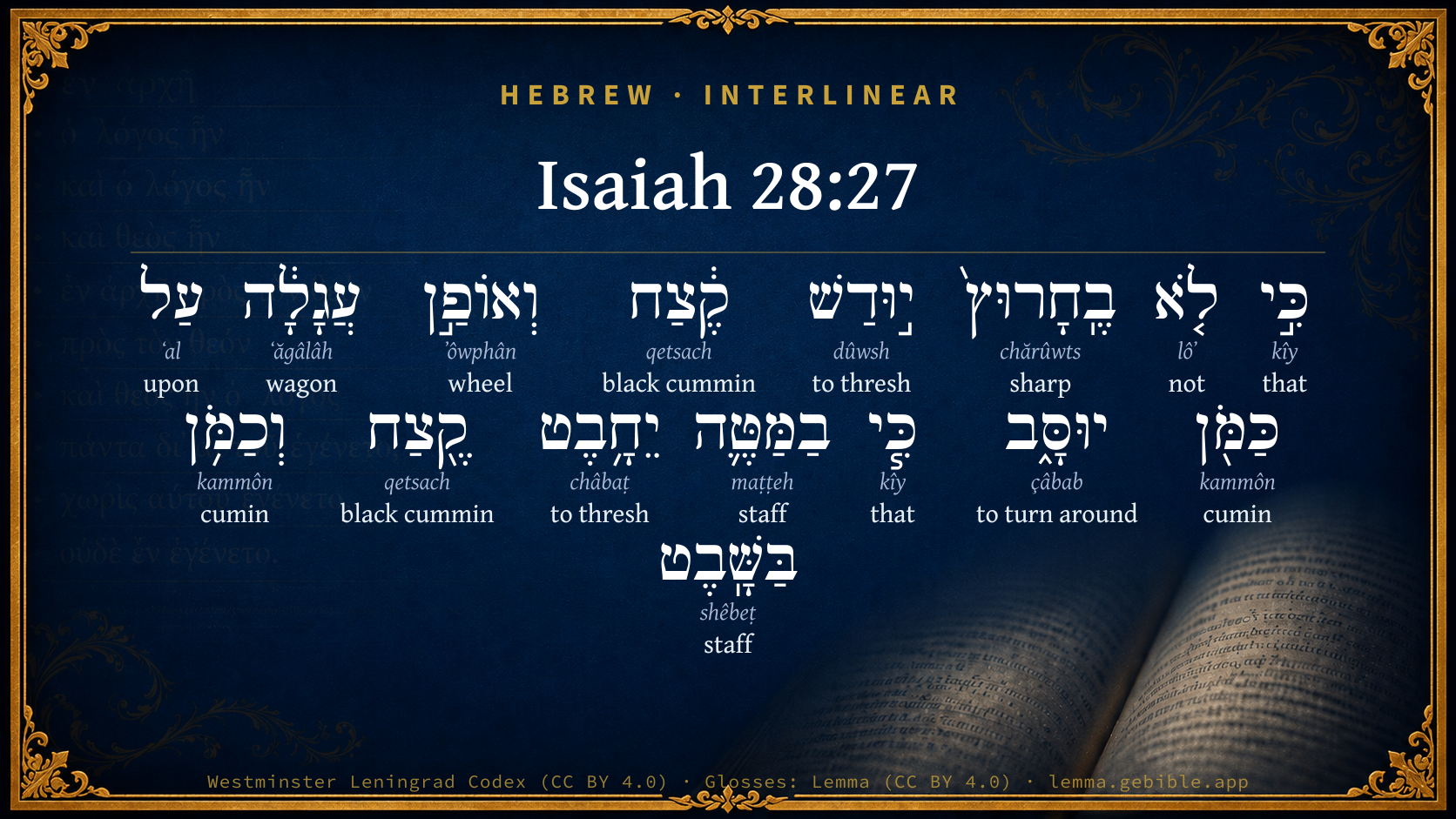
Isaiah 28:27

Hebrew (Westminster Leningrad Codex) Isaiah 28:27 appears in the Hebrew Old Testament. The text above is from the Westminster Leningrad Codex. Each word links to its Strong’s number, a concise gloss, and parsing drawn from the Open Scriptures Hebrew Bible morphology. Click any word for its full Brown-Driver-Briggs (BDB) entry.
Download image
Cite this verse

Isaiah 28:27 (World English Bible). Public Domain. Lemma interlinear Bible study tool, https://lemma.gebible.app/v/isaiah/28/27.

Show BibTeX & RIS
BibTeX
RIS
English Translation
For the dill are not threshed with a sharp [threshing] instrument, neither is a cart wheel turned about on the cumin; but the dill are beaten out with a staff, and the cumin with a rod.
World English Bible · Public Domain
Download a study sheet

One document with this verse’s original text, its word-by-word gloss line, the meaning frame, cross-references with their text, attributed commentary, and full source and license credits — printable, and it pastes into notes with its structure intact.

This verse Autodidact and up

Study sheet (.html) Plain text (.txt)

A passage Seminary Student

Up to 50 verses in one chapter. A passage sheet keeps up to 6 commentary sources and 12 cross-references per verse, in the order this page ranks them, and says so on the sheet whenever that leaves anything out. Ask for a single verse and you get the Autodidact verse sheet above.

Everything on this page stays free to read, with no account — the sheet is a download of what is already on screen, not access to it.

Want to remove ads? Support Godless Engineer
Compare translations 3

The same verse in 3 English versions, stacked beneath the original-language interlinear above. Click any original word for its lexicon entry.

Each is an independent rendering of the whole verse — the interlinear is not word-aligned to these translations.

Highlighted words mark where these versions differ — a whole-verse word diff, not a word-by-word alignment.

  • World English Bible Public Domain
    For the dill are not threshed with a sharp [threshing] instrument, neither is a cart wheel turned about on the cumin; but the dill are beaten out with a staff, and the cumin with a rod.
  • King James Version Public Domain
    For the fitches are not threshed with a threshing instrument, neither is a cart wheel turned about upon the cummin; but the fitches are beaten out with a staff, and the cummin with a rod.
  • unfoldingWord Literal Text CC BY-SA 4.0
    For black cumin is not threshed with a sledge, nor is the wheel of a cart rolled over cumin, but black cumin is beaten with a stick, and cumin with a rod.

unfoldingWord Literal Text — © unfoldingWord, licensed CC BY-SA 4.0. Word-aligned USFM3 via Door43 (git.door43.org/unfoldingWord/en_ult).

Versions to compare (up to 4)

3 of 4 selected

Show all 18 translations

Every available English version of this verse, each an independent rendering of the whole verse.

  • World English Bible Public Domain
    For the dill are not threshed with a sharp [threshing] instrument, neither is a cart wheel turned about on the cumin; but the dill are beaten out with a staff, and the cumin with a rod.
  • Berean Standard Bible Public Domain
    Surely caraway is not threshed with a sledge, and the wheel of a cart is not rolled over the cumin. But caraway is beaten out with a stick, and cumin with a rod.
  • Majority Standard Bible Public Domain
    Surely caraway is not threshed with a sledge, and the wheel of a cart is not rolled over the cumin. But caraway is beaten out with a stick, and cumin with a rod.
  • King James Version Public Domain
    For the fitches are not threshed with a threshing instrument, neither is a cart wheel turned about upon the cummin; but the fitches are beaten out with a staff, and the cummin with a rod.
  • American Standard Version (1901) Public Domain
    For the fitches are not threshed with a sharp `threshing' instrument, neither is a cart wheel turned about upon the cummin; but the fitches are beaten out with a staff, and the cummin with a rod.
  • Revised Version (1885) Public Domain
    For the fitches are not threshed with a sharp threshing instrument, neither is a cart wheel turned about upon the cummin; but the fitches are beaten out with a staff, and the cummin with a rod.
  • Geneva Bible (1599) Public Domain
    For fitches shall not be threshed with a threshing instrument, neither shall a cart wheele be turned about vpon the cummin: but ye fitches are beaten out with a staffe, and cummin with a rod.
  • Douay-Rheims (1899) Public Domain
    For gith shall not be thrashed with saws, neither shall the cart wheel turn about upon cummin: but gith shall be beaten out with a rod, and cummin with a staff.
  • Young's Literal Translation Public Domain
    For not with a sharp-pointed thing threshed are fitches, And the wheel of a cart on cummin turned round, For with a staff beaten out are fitches, And cummin with a rod.
  • Literal Standard Version CC BY-SA 4.0
    For fitches are not threshed with a sharp-pointed thing, || And the wheel of a cart turned around on cumin, || For fitches are beaten out with a staff, || And cumin with a rod.
  • Unlocked Literal Bible CC BY-SA 4.0
    Moreover, the caraway seed is not threshed with a sledge, nor is a cartwheel rolled over the cumin; but caraway is beaten with a stick, and cumin with a rod.
  • unfoldingWord Literal Text CC BY-SA 4.0
    For black cumin is not threshed with a sledge, nor is the wheel of a cart rolled over cumin, but black cumin is beaten with a stick, and cumin with a rod.
  • Darby Bible Public Domain
    For the dill is not threshed with a threshing instrument, neither is a cart-wheel turned about upon the cummin; but dill is beaten out with a staff, and cummin with a rod.
  • World Messianic Bible Public Domain
    For the dill isn’t threshed with a sharp instrument, neither is a cart wheel turned over the cumin; but the dill is beaten out with a stick, and the cumin with a rod.
  • Webster's Bible Public Domain
    For the vetches are not threshed with a threshing instrument, neither is a cart-wheel turned about upon the cummin; but the vetches are beaten out with a staff, and the cummin with a rod.
  • Free Bible Version CC BY-SA 4.0
    You don't use a heavy tool to thresh dill! You don't use the wheel of a cart to thresh cumin! Instead you use a stick to beat out the dill, and a rod to beat out the cumin.
  • Bible in Basic English Public Domain
    For the fitches are not crushed with a sharp instrument, and a cart-wheel is not rolled over the cummin; but the grain of the fitches is hammered out with a stick, and of the cummin with a rod.
  • JPS Tanakh (1917) Public Domain
    For the black cummin is not threshed with a threshing-sledge, neither is a cart-wheel turned about upon the cummin; but the black cummin is beaten out with a staff, and the cummin with a rod.

Literal Standard Version (2020), Covenant Press — licensed CC BY-SA 4.0. Text via the HelloAO Bible API (eBible.org). Unlocked Literal Bible (unfoldingWord) — licensed CC BY-SA 4.0. Text via the HelloAO Bible API (eBible.org). unfoldingWord Literal Text — © unfoldingWord, licensed CC BY-SA 4.0. Word-aligned USFM3 via Door43 (git.door43.org/unfoldingWord/en_ult). Free Bible Version, Dr. Jonathan Gallagher — licensed CC BY-SA 4.0. Text via the HelloAO Bible API (eBible.org).

Word by word

More ways to search: Search by grammar → Find every occurrence → Compare this word →

Practice this passage: Drill this verse → Learn its vocabulary →

קֶ֔צַח
qetsach
H7100
“black cummin”
Noun, Common, Masculine, Singular, Absolute
Part of Speech
Noun
Type
Common
Gender
Masculine
Number
Singular
State
Absolute
Full BDB Definition

Origin: from an unused root apparently meaning to incise

TWOT: 2055a

black cummin - a plant with small black acrid seeds used as a condiment
  1. כִּ֣י kîy H3588 “that” Conjunction
  2. לֹ֤א lôʼ H3808 “not” Particle, Negative
  3. בֶֽחָרוּץ֙ chărûwts H2742 “in/at the · sharp” Preposition, Determined + Adjective, Adjective, Masculine, Singular, Absolute
  4. י֣וּדַשׁ dûwsh H1758 “to thresh” Verb, Hophal, Imperfect, 3rd Person, Masculine, Singular
  5. וְאוֹפַ֣ן ʼôwphân H212 “and · wheel of” Conjunction + Noun, Common, Masculine, Singular, Construct
  6. עֲגָלָ֔ה ʻăgâlâh H5699 “wagon” Noun, Common, Feminine, Singular, Absolute
  7. עַל ʻal H5921 “upon” Preposition
  8. כַּמֹּ֖ן kammôn H3646 “cumin” Noun, Common, Masculine, Singular, Absolute
  9. יוּסָּ֑ב çâbab H5437 “to turn around” Verb, Hophal, Imperfect, 3rd Person, Masculine, Singular
  10. כִּ֧י kîy H3588 “that” Conjunction
  11. בַמַּטֶּ֛ה maṭṭeh H4294 “in/at the · staff” Preposition, Determined + Noun, Common, Masculine, Singular, Absolute
  12. יֵחָ֥בֶט châbaṭ H2251 “to thresh” Verb, Niphal, Imperfect, 3rd Person, Masculine, Singular
  13. קֶ֖צַח qetsach H7100 “black cummin” Noun, Common, Masculine, Singular, Absolute
  14. וְכַמֹּ֥ן kammôn H3646 “and · cumin” Conjunction + Noun, Common, Masculine, Singular, Absolute
  15. בַּשָּֽׁבֶט shêbeṭ H7626 “in/at the · staff” Preposition, Determined + Noun, Common, Masculine, Singular, Absolute

About this verse

These counts appear in no published source. They are computed here, from the morphology-tagged text and Lemma’s own curated glosses. What Lemma adds →

16
words
13
distinct lemmas
Prophets
section

Notable vocabulary

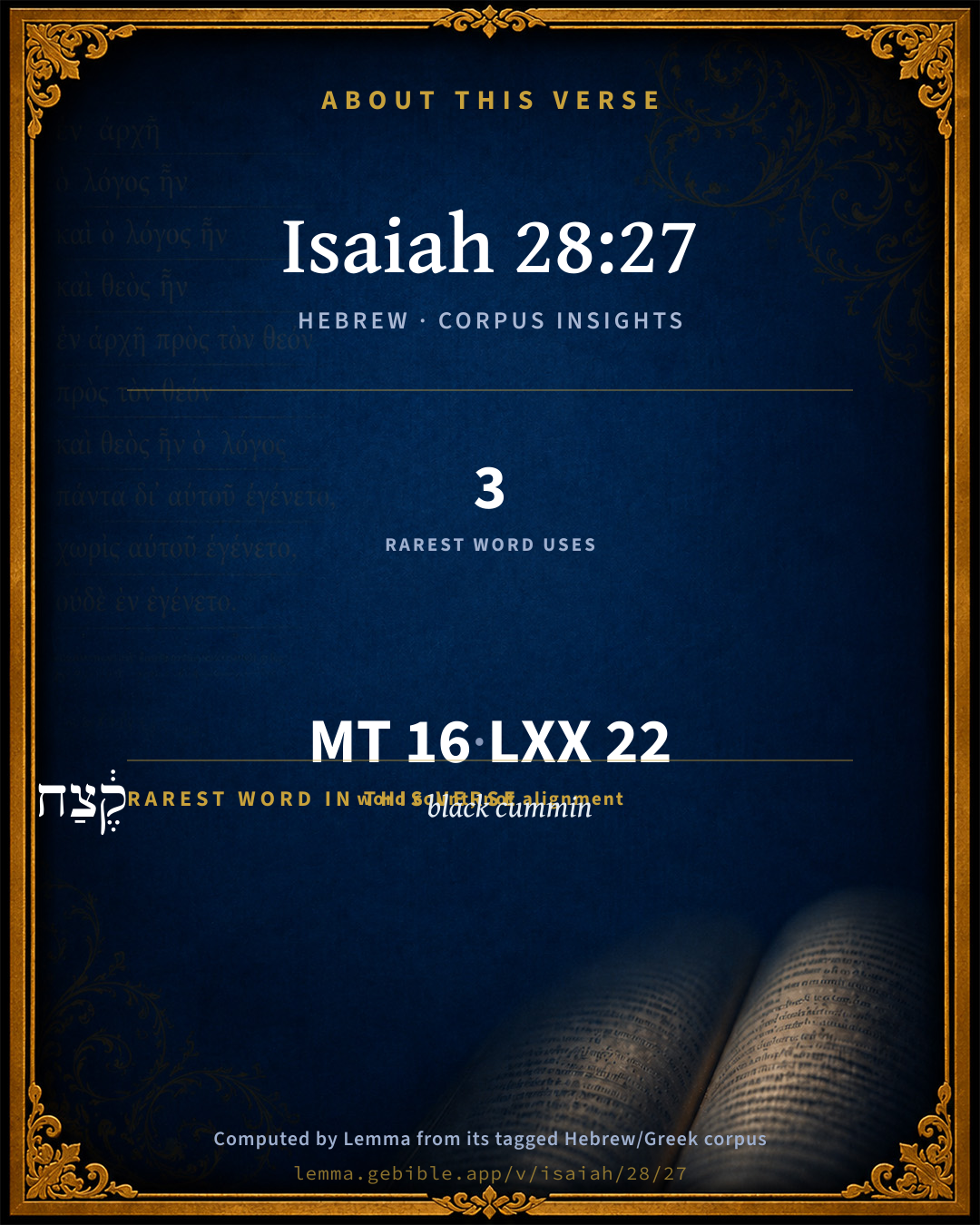
The rarest word here is קֶ֔צַח black cummin H7100 — appearing just 3 times in the whole Hebrew Bible.

Shared distinctive vocabulary

קֶ֔צַח black cummin H7100 occurs in 2 verses of the Hebrew Bible. Also found in:

Grammatical profile

  • 3 verbs
  • 8 nouns
  • 1 adjective
  • 1 preposition
  • 2 conjunctions
  • 1 particle

Verb forms

  • י֣וּדַשׁ Hophal · Imperfect
  • יוּסָּ֑ב Hophal · Imperfect
  • יֵחָ֥בֶט Niphal · Imperfect

Repetition

Words recur within this verse — often emphatic in Hebrew:

  • קֶ֔צַח black cummin H7100 ×2
  • כַּמֹּ֖ן cumin H3646 ×2
  • כִּ֣י that H3588 ×2

Hebrew & Septuagint length

In English translation the verse runs 36 words from the Hebrew and 35 from the Septuagint (LXX English) — closely comparable.

A rough comparison of the two English renderings, which tokenize alike — not a word-level alignment.

Word counts can differ between the Hebrew and the Greek without any difference in meaning — e.g. the Hebrew direct-object marker אֵת has no separate Greek word, and Greek often adds the article ὁ.

In the original languages it is 16 Hebrew tokens and 22 Greek tokens — but the two are counted differently (Hebrew bundles its prefixes and suffixes into one token; the Greek is in lemma form), so that isn’t a like-for-like length.

Cross-references

6

Topical passages linked to Isaiah 28:27 in the Treasury of Scripture Knowledge — connected by theme and wording, ordered by reader-vote popularity; previews shown in the World English Bible.

  • Isaiah 41:15 Behold, I have made you [to be] a new sharp threshing instrument having teeth; you shall thresh the mountains, and beat them small, and shall make the hills as chaff.
  • 2 Kings 13:7 For he didn't leave to Jehoahaz of the people save fifty horsemen, and ten chariots, and ten thousand footmen; for the king of Syria destroyed them, and made them like the dust in threshing.
  • Isaiah 27:7–8 Has he struck them as he struck those who struck them? or are they slain according to the slaughter of those who were slain by them?
  • Jeremiah 10:24 Yahweh, correct me, but in measure: not in your anger, lest you bring me to nothing.
  • Jeremiah 46:28 Don't be afraid you, O Jacob my servant, says Yahweh; for I am with you: for I will make a full end of all the nations where I have driven you; but I will not make a full end of you, but I will correct you in measure, and will in no way leave you unpunished.
  • Amos 1:3 Thus says Yahweh: "For three transgressions of Damascus, yes, for four, I will not turn away its punishment; Because they have threshed Gilead with threshing instruments of iron;

Cross-references courtesy of OpenBible.info (CC BY 4.0).

Hebrew and Greek witnesses Masoretic Hebrew ↔ Greek Septuagint

The same verse in the two great witnesses to the Old Testament, shown verse-for-verse.

These are two independent witnesses, not word-aligned to each other, and the Septuagint is shown in lemma (dictionary) form.

Hebrew Isaiah 28:27 Masoretic · Westminster Leningrad Codex

כִּ֣י לֹ֤א בֶֽחָרוּץ֙ י֣וּדַשׁ קֶ֔צַח וְאוֹפַ֣ן עֲגָלָ֔ה עַל כַּמֹּ֖ן יוּסָּ֑ב כִּ֧י בַמַּטֶּ֛ה יֵחָ֥בֶט קֶ֖צַח וְכַמֹּ֥ן בַּשָּֽׁבֶט

For the dill are not threshed with a sharp [threshing] instrument, neither is a cart wheel turned about on the cumin; but the dill are beaten out with a staff, and the cumin with a rod.

World English Bible · Public Domain

Greek LXX Isaiah 28:27 Septuagint · lemma form

οὐ γάρ μετά σκληρότης κατααἴρω ὁ μελάνθιον οὐδέ τροχός ἅμαξα περιἄγω ἐπί ὁ κύμινον ἀλλά ῥάβδος ἑκτινάσσω ὁ μελάνθιον ὁ δέ κύμινον

For the black poppy is not cleansed with harsh treatment, nor will a wagon-wheel pass over the cumin; but the black poppy is threshed with a rod, and the cumin shall be eaten with bread;

LXX2012 (modern English Septuagint) · Public Domain

Hebrew: Westminster Leningrad Codex (CC BY 4.0). Greek: Septuagint (public domain); English from LXX2012 (modern English Septuagint) (Public Domain). How the Septuagint differs from the Hebrew →

Targum (Aramaic paraphrase)

1

The Targum is the ancient Jewish Aramaic paraphrase of the Hebrew Scriptures — an interpretive translation, not the Hebrew text itself. Onkelos (literal) and Pseudo-Jonathan (expansive) render the Torah, and Jonathan the Prophets. Coverage is partial: where no permissively-licensed English translation exists for a verse, only the Aramaic is shown. This is verse-level text, not a word-by-word alignment to the Hebrew.

  1. Targum Jonathan Prophets (Joshua–Malachi)
    אֲרֵי לָא בְמוֹרִיגֵי בַּרְזְלָא מַדְרְכִין קִצְחָא וְגַלְגַלֵי עֶגְלָא עַל כַּמוֹנָא מְחַזְרִין אֲרֵי בְחוּטְרָא חָבְטִין קִצְחָא וְכַמוֹנָא בְמַחֲבוֹטָא:

    For they do not tread out the fitches with an iron threshing instrument, nor do they turn the wheels of a cart upon the cumin; but they beat out the fitches with a staff, and the cumin with a rod.

    Targum Jonathan — Aramaic: “Mikraot Gedolot” (public domain). English: “Sefaria Community Translation” (CC0 1.0 (public-domain dedication)); “London "Chaldee Paraphrase," 1871” (public domain). Text via Sefaria.

Commentary

Notes on Isaiah 28:27 from classic Christian and Jewish commentators (each source and its license shown beneath its notes). The classic Christian expositions comment on the surrounding passage and are grouped to its opening verse, so a note may address several verses; the Jewish commentaries on the Tanakh (Rashi and others) are per-verse, so they appear only where the commentator wrote on this verse.

Lemma curates 59 commentaries, every one of them public domain or Creative Commons licensed, each selected and text-cleaned for this edition rather than reprinted as found. About our sources →

The Cambridge Bible for Schools and Colleges

gen. ed. J. J. S. Perowne

27. with a threshing instrument] the sledge (ḥârûç). a cart wheel] the wheel of a threshing wagon (‘ǎgâlâh).

27–29. Threshing is not bruising. Three methods of threshing are alluded to. (a) Beating with a rod or flail (cf. Jdg_6:11; Rth_2:17). (b) Treading with the feet of cattle (Deu_25:4; Mic_4:13; but see on Isa_28:28). (c) Drawing a heavy wooden sledge, with sharp stones or iron spikes fixed in its under surface (ḥârûç) or a wagon (‘ǎgâlâh) with a great number of sharp-edged wheels, over the grain. The point of the illustration is that the method suitable to one kind of grain would be ruinous to another (Isa_28:27); and that even the rougher methods are applied with moderation (Isa_28:28).

The Cambridge Bible for Schools and Colleges (gen. ed. J. J. S. Perowne; Cambridge University Press, 1878–1918) — public domain. Text from a community e-Sword module.

Trapp's Complete Commentary

John Trapp

Isa 28:27 For the fitches are not threshed with a threshing instrument, neither is a cart wheel turned about upon the cummin; but the fitches are beaten out with a staff, and the cummin with a rod.

Ver. 27. For the fitches are not threshed out, &c.] So are God’s visitations diversely dispensed. He proportioneth the burden to the back, and the stroke to the strength of him that beareth it, sparing his afflicted as a man spareth his son that serveth him. Thus "Epaphroditus was sick nigh unto death," but not unto death; and why? See Php 2:27. Some of the sweet smelling Smyrnians were in prison "ten days," and no more. {Rev 2:10}

John Trapp, A Commentary or Exposition upon All the Books of the Old and New Testament (1647–1656) — public domain. Text from a community e-Sword module.

Joseph Benson's Commentary

Isa 28:27-29. “Four methods of thrashing are here mentioned, by different instruments: the flail, the drag, the wain, and the treading of cattle. The staff, or flail, was used for the grain that was too tender to be treated in the other methods. The drag consisted of a sort of frame of strong planks, made rough at the bottom, with hard stones or iron: it was drawn by horses or oxen over the corn-sheaves spread on the floor, the driver sitting upon it. The wain was much like the former, but had wheels with iron teeth, or edges, like a saw. This not only forced out the grain, but cut the straw in pieces for fodder for the cattle; for in the eastern countries they have no hay. The last method is well known from the law of Moses, which forbids the ox to be muzzled when he treadeth out the corn, Deu 25:4.” — Bishop Lowth. This also cometh from the Lord of hosts, &c. — This part of the husbandman’s discretion expressed in these verses, as well as that expressed in Isa 28:24-25. These words contain the application of the similitude. The husbandman manages his affairs with common discretion; but God governs the world and his church with wonderful wisdom: he is great and marvellous, both in the contrivance of things, and in the execution of them.

Joseph Benson's Commentary on the Old and New Testaments (1811–1818) — public domain. Text from a community e-Sword module.

Tyndale Open Study Notes

Tyndale Open Resources

28:27-28 The Lord has a variety of means (a heavy sledge . . . a light stick) for accomplishing his purposes. There are degrees of judgment.

Tyndale Open Study Notes — © Tyndale Open Resources, licensed CC BY-SA 4.0. Text via the HelloAO Bible API.

Jamieson, Fausset & Brown

Robert Jamieson, A. R. Fausset & David Brown

The husbandman uses the same discretion in threshing. The dill ("fitches") and cummin, leguminous and tender grains, are beaten out, not as wheat, &c., with the heavy corn-drag ("threshing instrument"), but with "a staff"; heavy instruments would crush and injure the seed.

cart wheel--two iron wheels armed with iron teeth, like a saw, joined together by a wooden axle. The "corn-drag" was made of three or four wooden cylinders, armed with iron teeth or flint stones fixed underneath, and joined like a sledge. Both instruments cut the straw for fodder as well as separated the corn.

staff--used also where they had but a small quantity of corn; the flail (Rut 2:17).

Jamieson, Fausset & Brown — Commentary Critical and Explanatory on the Whole Bible (1871) — public domain (CC PDM 1.0). Text via the HelloAO Bible API.

Adam Clarke's Commentary

Verse 27. - 28. Four methods of threshing are here mentioned, by different instruments; the flail, the drag, the wain, and the treading of the cattle. The staff or flail was used for the infirmiora semina, says Jerome, the grain that was too tender to be treated in the other methods. The drag consisted of a sort of strong planks, made rough at the bottom, with hard stones or iron; it was drawn by horses or oxen over the corn sheaves spread on the floor, the driver sitting upon it. Kempfer has given a print representing the manner of using this instrument, Amaen. Exot. p. 682, fig. 3. The wain was much like the former; but had wheels with iron teeth, or edges like a saw: Ferrata carpenta rotis per medium in serrarum modum se volventibus. Hieron. in loc. From this it would seem that the axle was armed with iron teeth or serrated wheels throughout. See a description and print of such a machine used at present in Egypt for the same purpose in Niebuhr's Voyage en Arabie, Tab. xvii. p. 123; it moves upon three rollers armed with iron teeth or wheels to cut the straw. In Syria they make use of the drag, constructed in the very same manner as above described; Niebuhr, Description de l'Arabie, p. 140. This not only forced out the grain, but cut the straw in pieces for fodder for the cattle; for in the eastern countries they have no hay. See Harmer's Observ. I. p. 425. The last method is well known from the law of Moses, which "forbids the ox to be muzzled, when he treadeth out the corn;" De 25:4.

Adam Clarke's Commentary on the Bible (1810–1826) — public domain. Text from a community e-Sword/MySword module.

Ellicott's Commentary for English Readers

(27) For the fitches are not threshed . . .—Better, fennel seed, as before. The eye of the prophet passes from the beginning to the end of the husbandman’s work. He finds there also the varying methods of a like discrimination. A man would be thought mad who threshed his fennel seed and cummin with the same instrument that he uses for his barley and his wheat. It is enough to beat or tap them with the “rod,” or “staff,” which was, in fact, used in each case. Interpreting this parable, we may see in the fennel and the cummin the little ones of the earth, with whom God deals more gently than with the strong. “Tribulation,” as the etymology of the word (tribulum, a threshing instrument) tells us, is a threshing process. The lesson of the parable is that it comes to nations and individuals in season and in measure. The main idea is familiar enough in the language of the prophets (Mic_4:13; Hab_3:12). The novelty of Isaiah’s treatment of it consists in his bringing in the minute details, and drawing this lesson from them.

A Bible Commentary for English Readers, edited by Charles John Ellicott (1878–1897) — public domain. Text from a community e-Sword module.

John Gill's Exposition

Bread corn is bruised,.... The corn which bread is made of is bruised and ground in a mill:

because he will not always be threshing it; for there is another way of bringing it to flour, that so it may be made bread, namely, by grinding it in a mill; and therefore the husbandman uses his discretion in threshing it; he will not thresh it too much, nor too long, no more than what is necessary to get out the grain, but will take care that he does not bruise and break it; as follows:

nor break it with the wheel of his cart, nor bruise it with his horsemen; though he makes use of the above threshing instrument, drawn upon wheels by horses, or oxen, for the threshing out of wheat, barley, or rye, corn of which bread is made; yet he takes care that it is not crushed and spoiled by the wheels of the cart, or the feet of the horses, or oxen, going too often over it; by all which may be signified the tender regard of God in afflicting his own people; he will not always be chiding, striving, and contending with them, or be always angry, and ever afflicting, and, when he does afflict, it is in a tender and careful manner, Psa 103:9.

John Gill's Exposition of the Whole Bible (1746–1763) — public domain (CC PDM 1.0). Text via the HelloAO Bible API.

Albert Barnes' Notes on the Bible

For the fitches are not threshed with a threshing instrument - The word used here (חרוּץ chârûts) denotes properly that which is pointed or sharp, and is joined with מורג môrag in Isa 41:15 - meaning there the threshing dray or sledge; a plank with iron or sharp stones that was drawn by oxen over the grain (compare 2Sa 24:22; 1Ch 21:23). In the passage before us, several methods of threshing are mentioned as adapted to different kinds of grain, all of which are at the present time common in the East. Those which are mentioned under the name of the ‘threshing instrument,’ and ‘a cart wheel,’ refer to instruments which are still in use in the East. Niebuhr, in his “Travels in Arabia,” says, (p. 299,) ‘In threshing their grain, the Arabians lay the sheaves down in a certain order, and then lead over them two oxen dragging a large stone.’ ‘They use oxen, as the ancients did, to beat out their grain, by trampling on the sheaves, and dragging after them a clumsy machine.

This machine is not a stone cylinder; nor a plank with sharp stones, as in Syria; but a sort of sledge consisting of three rollers, fitted with irons, which turn upon axles. A farmer chooses out a level spot in his fields, and has his grain carried thither in sheaves, upon donkeys or dromedaries. Two oxen are then yoked in a sledge; a driver then gets upon it, and drives them backward and forward upon the sheaves; and fresh oxen succeed in the yoke from time to time. By this operation the chaff is very much cut down; it is then winnowed, and the grain thus separated.’ ‘This machine,’ Niebuhr adds, ‘is called Nauridj. It bas three rollers which turn on three axles; and each of them is furnished with some irons which are round and flat. Two oxen were made to draw over the grain again and again the sledge above mentioned, and this was done with the greatest convenience to the driver; for he was seated in a chair fixed on a sledge.’ See the illustration in the book to get an idea of this mode of threshing, and of the instruments that were employed.

Neither is a cart wheel - This instrument of threshing is described by Boehart (Hieraz. i. 2. 32. 311), as consisting of a cart or wagon fitted with wheels adapted to crush or thresh the grain. This, he says, was used by the Carthagenians who came from the vicinity of Canaan. It appears to have been made with serrated wheels, perhaps almost in the form of circular saws, by which the straw was cut fine at the same time that the grain was separated from the chaff.

But the fitches are beaten out with a staff - With a stick, or flail. That is, pulse in general, beans, pease, dill, cummin, etc., are easily beaten out with a stick or flail. This mode of threshing is common everywhere. It was also practiced, as with us, in regard to barley and other grain, where there was a small quantity, or where there was need of special haste (see Rth 2:17; Jdg 6:11).

Albert Barnes' Notes on the Bible (1834–1885) — public domain. Text from a community e-Sword/MySword module.

Haydock's Catholic Bible Commentary

Saws, or heavy instruments. It would be thus crushed too much. (Calmet)

George Leo Haydock (1774–1849), Haydock's Catholic Family Bible and Commentary, 1859 edition — public domain. Excludes Psalms (Douay-Rheims chapter numbering differs from Protestant) and Deuterocanonical books (Catholic canon only).

Matthew Poole's English Annotations

A threshing instrument; which then and there was made like a sled shod with iron, which was drawn by men or beasts over the sheafs of corn, to bruise them, and beat the grain out of them.

A cart wheel; a lesser and lower wheel than a cart wheel, but of the same form, upon which possibly the threshing instrument was drawn.

The fitches are beaten out with a staff, and the cummin with a rod, as being unable to bear harder usage.

Matthew Poole's English Annotations on the Holy Bible (1683–1685) — public domain. Text from a community e-Sword/MySword module.

Whedon's Commentary on the Bible

Daniel D. Whedon

27, 28. So in the harvest. The harvester treats the different crops raised in the same common-sense way. He carefully beats with a stick, or rod, the smaller, finer seeds; over these he does not foolishly send the threshing wain. Nor over the larger grains does he drive the cart, or the oxen, or the rolling rough thresher, interminably. He uses these till their proper work is done, and then ceases. Now, Israel is God’s field and God’s threshing floor. But all are not alike roughly threshed. God discriminates the kind of seed to be planted and harvested. He adapts his method of separation to each. So right methods are employed in the distribution of discipline and punishment. If this treatment fails of its purpose, the responsibility is placed where it belongs. He strikes some with a rod; others, who need it, he threshes roughly with the wain; but, unless deserved, he does neither interminably.

Daniel D. Whedon (gen. ed.), Commentary on the Old and New Testaments (1874–1909) — public domain. Text from a community e-Sword module.

The Pulpit Commentary

For the fitches are not threshed with a threshing-instrument. The Nigella sativa is too lender a plant to be subjected to the rude treatment of a threshing-instrument, or "threshing-sledge." Such instruments are of the coarsest and clumsiest character in the East, and quite inapplicable to plants of a delicate fabric. Karsten Niebuhr thus describes the Arabian and Syrian practices: "Quand le grain dolt etre battu, les Arabes de Yemen posent le bled par terre en deux tangles, epis center epis, apres quoi ils font trainer par-dessus une grosse pierre tiree par deux boeufs. La machine dent on se sert en Syrie consiste en quelques planches garnies par-dessous d"une quantite de pierres a fusil" ("Description de l"Arabie," p. 140). Neither is a cart wheel turned about upon the cummin. The allusion is to aim the coarse mode of threshing practiced in Palestine and elsewhere, by driving a cart with broad wheels over the grain.

But the fitches are beaten out with a staff, and the cummin with a rod. Canon Tristram says, "While the cummin can easily be separated from its case by a slender rod, the harder pod of the Nigella requires to be beaten by a stout staff" ("Natural History of the Bible," p. 445).

God in material things illustrates God in moral things.

The precise purpose for which this illustration from agricultural customs is introduced by the prophet is ranch disputed. We note that Isaiah declares the skill which the farmer shows in choosing his times and adapting his methods, comes directly from God; and this suggests two points for treatment.

I MAN PLAINLY WANTS GOD FOR THE GETTING OF HIS DAILY BREAD.

II HOW MUCH MORE, THEN, DOES HE WANT GOD FOR THAT BREAD WHICH SHALL FEED THE SOUL UNTO EVERLASTING LIFE! R.T.

The Pulpit Commentary (1880–1919), ed. H.D.M. Spence-Jones & Joseph S. Exell — public domain. Text from a community e-Sword module.

John Wesley's Explanatory Notes

A threshing instrument - This then was made like a sledge shod with iron, which was drawn by men or beasts, over the sheafs of corn, to bruise them, and tear the grain out of them. A wheel - A lower wheel than a cart wheel, but of the same form, upon which possibly the threshing instrument was drawn.

John Wesley, Explanatory Notes Upon the Whole Bible (1754–1765) — public domain. Text via the GEBible commentary corpus.

Keil & Delitzsch

C. F. Keil & F. Delitzsch

Again, the labour of the husbandman is just as manifold after the reaping has been done. "For the black poppy is not threshed with a threshing sledge, nor is a cart wheel rolled over cummin; but black poppy is knocked out with a stick, and cummin with a staff. Is bread corn crushed? No; he does not go on threshing it for ever, and drive the wheel of his cart and his horses over it: he does not crush it. This also, it goeth forth from Jehovah of hosts: He gives wonderful intelligence, high understanding." Ki (for) introduces another proof that the husbandman is instructed by God, from what he still further does. He does not use the threshing machine (chârūts, syn. mōrag, Ar. naureg, nōreg), or the threshing cart (agâlâh: see Winer's Real-Wrterbuch, art. Dreschen), which would entirely destroy the more tender kinds of fruit, but knocks them out with a staff (baculo excutit: see at Isa 27:12). The sentence lechem yūdâq is to be accentuated as an interrogative: Is bread corn crushed? Oh no, he does not crush it. This would be the case if he were to cause the wheel (i.e., the wheels, gilgal, constr. to galgal) of the threshing cart with the horses harnessed in front to rattle over it with all their might (hâmam, to set in noisy violent motion). Lechem, like the Greek sitos, is corn from which bread is made (Isa 30:23; Psa 104:14). אדושׁ is metaplastic (as if from אדשׁ) for דושׁ (see Ewald, 312, b). Instead of וּפרשׁיו, the pointing ought to be וּפרשׁיו (from פרשׁ with kametz before the tone = Arab. faras, as distinguished from פרשׁ with a fixed kametz, equivalent to farras, a rider): "his horses," here the threshing horses, which were preferred to asses and oxen.Even in this treatment of the fruit when reaped, there is an evidence of the wonderful intelligence (הפלא), as written הפלא) and exalted understanding (on תּוּשׁהיה, from ושׁי, see at Job 26:3) imparted by God. The expression is one of such grandeur, that we perceive at once that the prophet has in his mind the wisdom of God in a higher sphere. The wise, divinely inspired course adopted by the husbandman in the treatment of the field and fruit, is a type of the wise course adopted by the divine Teacher Himself in the treatment of His nation. Israel is Jehovah's field. The punishments and chastisements of Jehovah are the ploughshare and harrow, with which He forcibly breaks up, turns over, and furrows this field. But this does not last for ever. When the field has been thus loosened, smoothed, and rendered fertile once more, the painful process of ploughing is followed by a beneficent sowing and planting in a multiform and wisely ordered fulness of grace. Again, Israel is Jehovah's child of the threshing-floor (see Isa 21:10). He threshes it; but He does not thresh it only: He also knocks; and when He threshes, He does not continue threshing for ever, i.e., as Caspari has well explained it, "He does not punish all the members of the nation with the same severity; and those whom He punishes with greater severity than others He does not punish incessantly, but as soon as His end is attained, and the husks of sin are separated from those that have been punished, and the punishment ceases, and only the worst in the nation, who are nothing but husks, and the husks on the nation itself, are swept away by the punishments" (compare Isa 1:25; Isa 29:20-21). This is the solemn lesson and affectionate consolation hidden behind the veil of the parable. Jehovah punishes, but it is in order that He may be able to bless. He sifts, but He does not destroy. He does not thresh His own people, but He knocks them; and even when He threshes, they may console themselves in the face of the approaching period of judgment, that they are never crushed or injured.

Keil & Delitzsch — Biblical Commentary on the Old Testament (1861–1891) — public domain (CC PDM 1.0). Text via the HelloAO Bible API. (Old Testament only.)

J. A. Alexander on Isaiah

Joseph Addison Alexander

“For not with the sledge must dill be threshed, or the cart-wheel turned upon cummin; for with the stick must dill be beaten, and cummin with the rod.” Having drawn an illustration from the husbandman’s regard to times and seasons, he now derives another from his different modes of threshing out the different kinds of grain. The semina infirmiora are not to be separated by the use of the ponderous sledge or wagon, both of which are common in the east, but by that of the flail or switch, as better suited to their nature. The minute description of the oriental threshing-machines belongs more properly to books of archaeology, especially as nothing more is necessary here to the correct understanding of the verse than a just view of the contrast intended between heavy and light threshing.

Joseph Addison Alexander, The Prophecies of Isaiah (1846–1847; New York: Scribner, 1870–1878) — public domain. Text from a community e-Sword module.

unfoldingWord translationNotes

Door43 World Missions Community

General Information:

Isaiah continues telling a parable to the people of Jerusalem. (See: Parables)

the caraway seed is not threshed with a sledge

This can be stated in active form. AT: "the farmer does not separate the caraway seed from the plant with a heavy club" (See: Active or Passive)

caraway

See how you translated this in Isaiah 28:25.

nor is a cartwheel rolled over the cumin

This can be stated in active form. AT: "nor does he roll a heavy wheel over the cumin seed" (See: Active or Passive)

cumin

See how you translated this in Isaiah 28:25.

but caraway is beaten with a stick, and cumin with a rod

Isaiah describes the correct way for a farmer to separate the seed from the plant. This can be stated in active form. AT: "but he beats the caraway with a stick, and he beats cumin with a rod" (See: Active or Passive)

Grain is ground for bread but not too finely

This can be stated in active form. AT: "The farmer grinds the grain for bread but not so that it is too small" (See: Active or Passive)

translationWords

thresh

rod

grain

bread

horse

unfoldingWord translationNotes — © Distant Shores Media and the Door43 World Missions Community, licensed CC BY-SA 4.0. Source: git.door43.org/Door43/en_tn.

Rashi

Rabbi Shlomo Yitzchaki (Rashi)

with a grooved [implement] That is a wooden implement, made with grooves, and its name is מוֹרַג, a threshing-board, and one cuts the straw with it to be straw fodder.

For not with a grooved [implement] do they thresh the black cumin, for its seed is easily extracted from within its straw, and, likewise, on cumin they do not turn the wheel of a wagon to thresh it, because the black cumin is easily beaten with a staff and the cumin with a rod.

Rashi on the Tanakh — English translations: “The Judaica Press complete Tanach with Rashi, translated by A. J. Rosenberg” (CC BY 4.0); “Pentateuch with Rashi's commentary by M. Rosenbaum and A.M. Silbermann, 1929-1934” (public domain); “The Metsudah Tanach series, Lakewood, N.J” (CC BY 4.0); and “The Book of Joshua, Metsudah Publications, 1997” (CC BY 4.0). Text via Sefaria.

Ibn Ezra

Rabbi Abraham ibn Ezra

בחרוץ With a threshing instrument. Comp. 41:15.

יסב Neither is turned about. Repeat לא, the negation of the first part of the verse, before יוסב

Ibn Ezra on the Tanakh — English translations: “Sefaria Community Translation” (CC0 1.0 (public-domain dedication)); “Yalkut, Sifsei Chachomim Chumash, Metsudah Publications, 2009” (CC BY 4.0); and “Commentary of Ibn Ezra on Isaiah - trans. by M. Friedlander, 1873” (public domain). Text via Sefaria.

Lesson kit

Teaching starters — assembled from the data on this page, not authored interpretation. Every prompt links to the verse data it draws on. Edit before teaching.

Isaiah, in the Prophets, opens this verse with 16 words (13 distinct Hebrew lemmas). Its most distinctive word is qetsach (“black cummin”). A historical commentator’s framing appears above. Read the whole chapter for the surrounding context.

Discussion questions

  1. What does “black cummin” (qetsach) contribute to the verse as a whole?
  2. Isaiah 28:25 shares the word «black cummin» with this verse. How do the two illuminate each other?
  3. “black cummin” occurs 2× in this one verse. What is the effect of the repetition?
  4. These translations render this verse differently; the difference is in the English rendering, not the original. What questions does that raise?
  5. The verb «י֣וּדַשׁ» is Hophal Imperfect. How does its form color the action?
  6. Reading how The Cambridge Bible for Schools and Colleges and Trapp's Complete Commentary read this verse, where do the two commentators agree and where do they part?

Things to notice

Reading settings

Reading text

Shown beneath each verse's original-language words.

Old Testament
Old Testament edition

Read the OT as the Masoretic Hebrew (MT) or the Greek Septuagint (LXX).

English shown for the Greek Septuagint (in the Hebrew ↔ Greek comparison).

Comparing translations? Open the Compare panel on any verse page to stack up to four side by side.