Judges 21:6

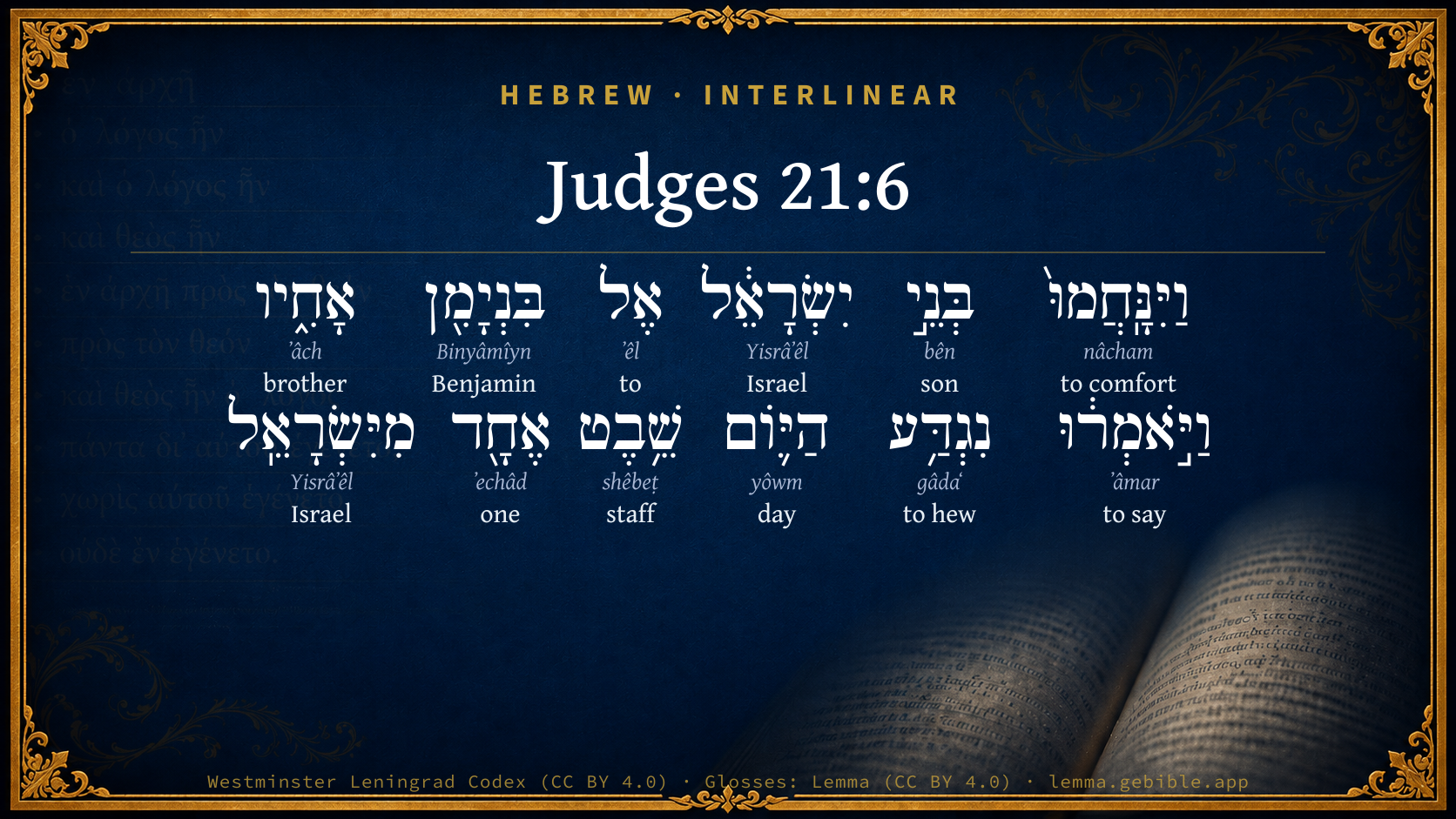
Hebrew (Westminster Leningrad Codex) Judges 21:6 appears in the Hebrew Old Testament. The text above is from the Westminster Leningrad Codex. Each word links to its Strong’s number, a concise gloss, and parsing drawn from the Open Scriptures Hebrew Bible morphology. Click any word for its full Brown-Driver-Briggs (BDB) entry.
Download image
Cite this verse

Judges 21:6 (World English Bible). Public Domain. Lemma interlinear Bible study tool, https://lemma.gebible.app/v/judges/21/6.

Show BibTeX & RIS
BibTeX
RIS
English Translation
The children of Israel repented them for Benjamin their brother, and said, There is one tribe cut off from Israel this day.
World English Bible · Public Domain
Download a study sheet

One document with this verse’s original text, its word-by-word gloss line, the meaning frame, cross-references with their text, attributed commentary, and full source and license credits — printable, and it pastes into notes with its structure intact.

This verse Autodidact and up

Study sheet (.html) Plain text (.txt)

A passage Seminary Student

Up to 50 verses in one chapter. A passage sheet keeps up to 6 commentary sources and 12 cross-references per verse, in the order this page ranks them, and says so on the sheet whenever that leaves anything out. Ask for a single verse and you get the Autodidact verse sheet above.

Everything on this page stays free to read, with no account — the sheet is a download of what is already on screen, not access to it.

Want to remove ads? Support Godless Engineer
Compare translations 3

The same verse in 3 English versions, stacked beneath the original-language interlinear above. Click any original word for its lexicon entry.

Each is an independent rendering of the whole verse — the interlinear is not word-aligned to these translations.

Highlighted words mark where these versions differ — a whole-verse word diff, not a word-by-word alignment.

  • World English Bible Public Domain
    The children of Israel repented them for Benjamin their brother, and said, There is one tribe cut off from Israel this day.
  • King James Version Public Domain
    And the children of Israel repented them for Benjamin their brother, and said, There is one tribe cut off from Israel this day.
  • unfoldingWord Literal Text CC BY-SA 4.0
    And the sons of Israel repented themselves toward Benjamin, his brother. And they said, “Today one tribe has been hewn from Israel.

unfoldingWord Literal Text — © unfoldingWord, licensed CC BY-SA 4.0. Word-aligned USFM3 via Door43 (git.door43.org/unfoldingWord/en_ult).

Versions to compare (up to 4)

3 of 4 selected

Show all 18 translations

Every available English version of this verse, each an independent rendering of the whole verse.

  • World English Bible Public Domain
    The children of Israel repented them for Benjamin their brother, and said, There is one tribe cut off from Israel this day.
  • Berean Standard Bible Public Domain
    And the Israelites grieved for their brothers, the Benjamites, and said, “Today a tribe is cut off from Israel.
  • Majority Standard Bible Public Domain
    And the Israelites grieved for their brothers, the Benjamites, and said, “Today a tribe is cut off from Israel.
  • King James Version Public Domain
    And the children of Israel repented them for Benjamin their brother, and said, There is one tribe cut off from Israel this day.
  • American Standard Version (1901) Public Domain
    And the children of Israel repented them for Benjamin their brother, and said, There is one tribe cut off from Israel this day.
  • Revised Version (1885) Public Domain
    And the children of Israel repented them for Benjamin their brother, and said, There is one tribe cut off from Israel this day.
  • Geneva Bible (1599) Public Domain
    And the children of Israel were sory for Beniamin their brother, and said, There is one tribe cut off from Israel this day.
  • Douay-Rheims (1899) Public Domain
    And the children of Israel being moved with repentance for their brother Benjamin, began to say: One tribe is taken away from Israel.
  • Young's Literal Translation Public Domain
    And the sons of Israel repent concerning Benjamin their brother, and say, `There hath been to-day cut off one tribe from Israel,
  • Literal Standard Version CC BY-SA 4.0
    And the sons of Israel sigh concerning their brother Benjamin, and say, “Today there has been one tribe cut off from Israel,
  • Unlocked Literal Bible CC BY-SA 4.0
    The people of Israel had compassion for their brother Benjamin. They said, “Today one tribe has been cut off from Israel.
  • unfoldingWord Literal Text CC BY-SA 4.0
    And the sons of Israel repented themselves toward Benjamin, his brother. And they said, “Today one tribe has been hewn from Israel.
  • Darby Bible Public Domain
    And the people of Israel had compassion for Benjamin their brother, and said, "One tribe is cut off from Israel this day.
  • World Messianic Bible Public Domain
    The children of Israel grieved for Benjamin their brother, and said, “There is one tribe cut off from Israel today.
  • Webster's Bible Public Domain
    And the children of Israel repented for Benjamin their brother, and said, There is one tribe cut off from Israel this day.
  • Free Bible Version CC BY-SA 4.0
    The Israelites felt sorry for their brother Benjamin, saying, “Today one tribe has been hacked off from Israel!
  • Bible in Basic English Public Domain
    And the children of Israel were moved with pity for Benjamin their brother, saying, Today one tribe has been cut off from Israel.
  • JPS Tanakh (1917) Public Domain
    And the children of Israel repented them for Benjamin their brother, and said: 'There is one tribe cut off from Israel this day.

Literal Standard Version (2020), Covenant Press — licensed CC BY-SA 4.0. Text via the HelloAO Bible API (eBible.org). Unlocked Literal Bible (unfoldingWord) — licensed CC BY-SA 4.0. Text via the HelloAO Bible API (eBible.org). unfoldingWord Literal Text — © unfoldingWord, licensed CC BY-SA 4.0. Word-aligned USFM3 via Door43 (git.door43.org/unfoldingWord/en_ult). Free Bible Version, Dr. Jonathan Gallagher — licensed CC BY-SA 4.0. Text via the HelloAO Bible API (eBible.org).

Word by word

More ways to search: Search by grammar → Find every occurrence → Compare this word →

Practice this passage: Drill this verse → Learn its vocabulary →

נִגְדַּ֥ע
gâdaʻ
H1438
“to hew”
Verb, Niphal, Perfect, 3rd Person, Masculine, Singular
Part of Speech
Verb
Stem
Niphal
Form
Perfect
Person
3rd Person
Gender
Masculine
Number
Singular
Full BDB Definition

Origin: a primitive root

TWOT: 316

to cut, hew, chop, cut down, hew down, hew off, cut off, cut in two, shave off - (Qal) to hew, chop in two - (Niphal) to be chopped off, be hewn off - (Piel) to cut off or down in two, hew off or down in two - (Pual) to chop down, hew down
  1. וַיִּנָּֽחֲמוּ֙ nâcham H5162 “and · to comfort” Conjunction + Verb, Niphal, Sequential Imperfect, 3rd Person, Masculine, Plural
  2. בְּנֵ֣י bên H1121 “sons of” Noun, Common, Masculine, Plural, Construct
  3. יִשְׂרָאֵ֔ל Yisrâʼêl H3478 “Israel” Noun, Proper
  4. אֶל ʼêl H413 “to” Preposition
  5. בִּנְיָמִ֖ן Binyâmîyn H1144 “Benjamin” Noun, Proper
  6. אָחִ֑יו ʼâch H251 “brother · his” Noun, Common, Masculine, Singular, Construct + Suffix, Personal, 3rd Person, Masculine, Singular
  7. וַיֹּ֣אמְר֔וּ ʼâmar H559 “and · to say” Conjunction + Verb, Qal, Sequential Imperfect, 3rd Person, Masculine, Plural
  8. הַיּ֛וֹם yôwm H3117 “the · day” Particle, Definite Article + Noun, Common, Masculine, Singular, Absolute
  9. שֵׁ֥בֶט shêbeṭ H7626 “staff” Noun, Common, Masculine, Singular, Absolute
  10. אֶחָ֖ד ʼechâd H259 “one” Adjective, Cardinal number, Masculine, Singular, Absolute
  11. מִיִּשְׂרָאֵֽל Yisrâʼêl H3478 “from · Israel” Preposition + Noun, Proper

About this verse

These counts appear in no published source. They are computed here, from the morphology-tagged text and Lemma’s own curated glosses. What Lemma adds →

12
words
11
distinct lemmas
Historical
section

Notable vocabulary

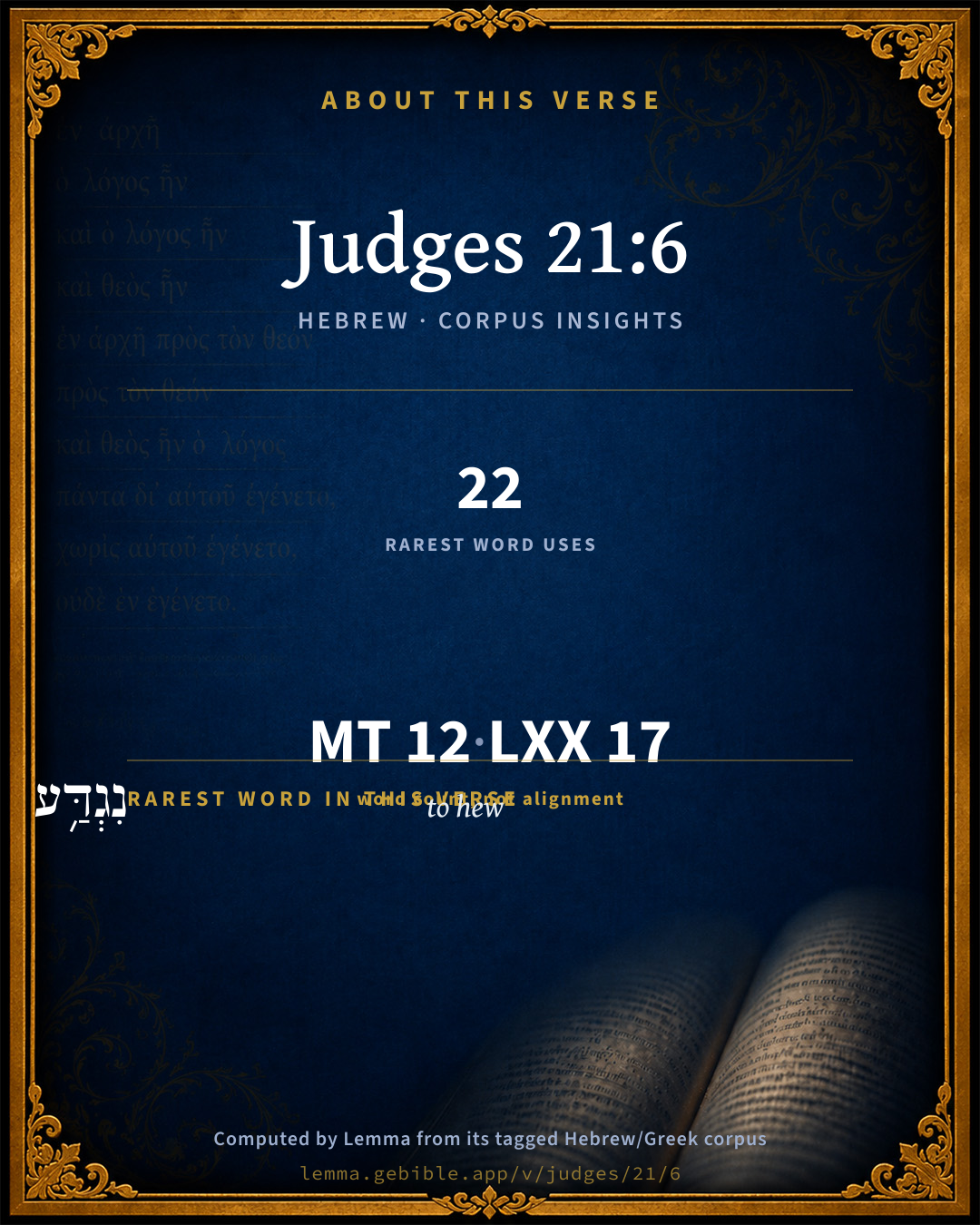
The rarest word here is נִגְדַּ֥ע to hew H1438 — appearing just 22 times in the whole Hebrew Bible.

Shared distinctive vocabulary

נִגְדַּ֥ע to hew H1438 occurs in 22 verses of the Hebrew Bible. Also found in:

Grammatical profile

  • 3 verbs
  • 7 nouns
  • 1 adjective
  • 1 preposition

Verb forms

  • וַיִּנָּֽחֲמוּ֙ Niphal · Sequential Imperfect
  • וַיֹּ֣אמְר֔וּ Qal · Sequential Imperfect
  • נִגְדַּ֥ע Niphal · Perfect

Repetition

A word recurs within this verse — often emphatic in Hebrew:

  • יִשְׂרָאֵ֔ל Israel H3478 ×2

Hebrew & Septuagint length

In English translation the verse runs 22 words from the Hebrew and 20 from the Septuagint (LXX English) — closely comparable.

A rough comparison of the two English renderings, which tokenize alike — not a word-level alignment.

Word counts can differ between the Hebrew and the Greek without any difference in meaning — e.g. the Hebrew direct-object marker אֵת has no separate Greek word, and Greek often adds the article ὁ.

In the original languages it is 12 Hebrew tokens and 17 Greek tokens — but the two are counted differently (Hebrew bundles its prefixes and suffixes into one token; the Greek is in lemma form), so that isn’t a like-for-like length.

Cross-references

6

Topical passages linked to Judges 21:6 in the Treasury of Scripture Knowledge — connected by theme and wording, ordered by reader-vote popularity; previews shown in the World English Bible.

  • Judges 21:15 The people repented them for Benjamin, because that Yahweh had made a breach in the tribes of Israel.
  • Judges 11:35 It happened, when he saw her, that he tore his clothes, and said, Alas, my daughter! you have brought me very low, and you are one of those who trouble me; for I have opened my mouth to Yahweh, and I can't go back.
  • Judges 20:23 The children of Israel went up and wept before Yahweh until even; and they asked of Yahweh, saying, Shall I again draw near to battle against the children of Benjamin my brother? Yahweh said, Go up against him.
  • 2 Samuel 2:26 Then Abner called to Joab, and said, "Shall the sword devour forever? Don't you know that it will be bitterness in the latter end? How long shall it be then, before you bid the people return from following their brothers?"
  • Hosea 11:8 "How can I give you up, Ephraim? How can I hand you over, Israel? How can I make you like Admah? How can I make you like Zeboiim? My heart is turned within me, My compassion is aroused.
  • Luke 19:41–42 When he drew near, he saw the city and wept over it,

Cross-references courtesy of OpenBible.info (CC BY 4.0).

Hebrew and Greek witnesses Masoretic Hebrew ↔ Greek Septuagint

The same verse in the two great witnesses to the Old Testament, shown verse-for-verse.

These are two independent witnesses, not word-aligned to each other, and the Septuagint is shown in lemma (dictionary) form.

Hebrew Judges 21:6 Masoretic · Westminster Leningrad Codex

וַיִּנָּֽחֲמוּ֙ בְּנֵ֣י יִשְׂרָאֵ֔ל אֶל בִּנְיָמִ֖ן אָחִ֑יו וַיֹּ֣אמְר֔וּ נִגְדַּ֥ע הַיּ֛וֹם שֵׁ֥בֶט אֶחָ֖ד מִיִּשְׂרָאֵֽל

The children of Israel repented them for Benjamin their brother, and said, There is one tribe cut off from Israel this day.

World English Bible · Public Domain

Greek LXX Judges 21:6 Septuagint · lemma form

καί παρακαλέω ὁ υἱός ἰσραήλ πρός βενιαμίν ἀδελφός αὐτός καί εἶπον ἐκκόπτω σήμερον φυλή εἷς ἀπό ἰσραήλ

And the children of Israel relented toward Benjamin their brother, and said, To-day one tribe is cut off from Israel.

LXX2012 (modern English Septuagint) · Public Domain

Hebrew: Westminster Leningrad Codex (CC BY 4.0). Greek: Septuagint (public domain); English from LXX2012 (modern English Septuagint) (Public Domain). How the Septuagint differs from the Hebrew →

Targum (Aramaic paraphrase)

1

The Targum is the ancient Jewish Aramaic paraphrase of the Hebrew Scriptures — an interpretive translation, not the Hebrew text itself. Onkelos (literal) and Pseudo-Jonathan (expansive) render the Torah, and Jonathan the Prophets. Coverage is partial: where no permissively-licensed English translation exists for a verse, only the Aramaic is shown. This is verse-level text, not a word-by-word alignment to the Hebrew.

  1. Targum Jonathan Prophets (Joshua–Malachi)
    וְאִתְנְחָמוּ בְּנֵי יִשְׂרָאֵל עַל דְבֵית בִּנְיָמִין אֲחוּהוֹן וַאֲמַרוּ אִתְמְנַע יוֹמָא דֵין שִׁבְטָא חַד מִיִשְׂרָאֵל:

    (no public-domain English translation for this verse)

    Targum Jonathan — Aramaic: “Mikraot Gedolot” (public domain). English: “Sefaria Community Translation” (CC0 1.0 (public-domain dedication)); “London "Chaldee Paraphrase," 1871” (public domain). Text via Sefaria.

Commentary

Notes on Judges 21:6 from classic Christian and Jewish commentators (each source and its license shown beneath its notes). The classic Christian expositions comment on the surrounding passage and are grouped to its opening verse, so a note may address several verses; the Jewish commentaries on the Tanakh (Rashi and others) are per-verse, so they appear only where the commentator wrote on this verse.

Lemma curates 59 commentaries, every one of them public domain or Creative Commons licensed, each selected and text-cleaned for this edition rather than reprinted as found. About our sources →

Trapp's Complete Commentary

John Trapp

Jdg 21:6 And the children of Israel repented them for Benjamin their brother, and said, There is one tribe cut off from Israel this day.

Ver. 6. And the children of Israel repented them for Benjamin.] But why did they not repent of their unlawful oath, which now they might as lawfully have broken? Howsoever, it was well done of them to put off their arms and their anger against Benjamin together. Claudian saith in commendation of Theodosius,

“ Post acies odiis idem qui terminus armis. ”

John Trapp, A Commentary or Exposition upon All the Books of the Old and New Testament (1647–1656) — public domain. Text from a community e-Sword module.

Geneva Bible (1599)

Geneva Bible translators

Or, repented that they had destroyed their brethren, as appeareth verse 15.

Geneva Bible (1599) marginal notes — public domain. Text via Bolls.life.

Jamieson, Fausset & Brown

Robert Jamieson, A. R. Fausset & David Brown

There is one tribe cut off from Israel this day--that is, in danger of becoming extinct; for, as it appears from Jdg 21:7, they had massacred all the women and children of Benjamin, and six hundred men alone survived of the whole tribe. The prospect of such a blank in the catalogue of the twelve tribes, such a gap in the national arrangements, was too painful to contemplate, and immediate measures must be taken to prevent this great catastrophe.

Jamieson, Fausset & Brown — Commentary Critical and Explanatory on the Whole Bible (1871) — public domain (CC PDM 1.0). Text via the HelloAO Bible API.

The Cambridge Bible for Schools and Colleges

gen. ed. J. J. S. Perowne

6. cut off] cut down; the figure is that of hewing down trees, cf. Isa_10:33; Isa_14:12.

The Cambridge Bible for Schools and Colleges (gen. ed. J. J. S. Perowne; Cambridge University Press, 1878–1918) — public domain. Text from a community e-Sword module.

John Gill's Exposition

And the children of Israel repented them for Benjamin their brother,.... Not that they went to war with them, as if their cause was not good; but for the severity they had exercised towards them, especially in destroying their women and children, and for the fatal consequences like to follow here after, particularly the dissolution of the whole tribe:

and said, there is one tribe cut off from Israel this day; that is, there is a likelihood or great danger of it.

John Gill's Exposition of the Whole Bible (1746–1763) — public domain (CC PDM 1.0). Text via the HelloAO Bible API.

Haydock's Catholic Bible Commentary

Say. Governors should use great discretion, and correct with justice and mercy. (St. Gregory 1. ep. 24.) (Worthington)

George Leo Haydock (1774–1849), Haydock's Catholic Family Bible and Commentary, 1859 edition — public domain. Excludes Psalms (Douay-Rheims chapter numbering differs from Protestant) and Deuterocanonical books (Catholic canon only).

Matthew Poole's English Annotations

Children of Israel repented them; not for the war, which was just, and necessary, and good; but for their immoderate severity in the execution of it, and for thee dreadful consequences of it.

Matthew Poole's English Annotations on the Holy Bible (1683–1685) — public domain. Text from a community e-Sword/MySword module.

The Pulpit Commentary

Vers. 6-9. And the children of Israel, etc. This verse goes back a little to explain why the children of Israel asked the question, viz., because they repented them for Benjamin, and wished to repair the mischief resulting from their rash oath not to give their daughters to a Benjamite; therefore they said (repeating ver. 5), What one is there that came not up to Mizpeh? (ver. 8) and on numbering the people it was found that no one had come up from Jabesh-gilead. This is the first time that Jabesh-gilead is mentioned in Scripture. It comes up twice afterwards. First in 1Sa 11, on occasion of its being besieged by the Ammonites and rescued by Saul; and secondly in 1Sa_31:11-13, when the inhabitants of Jabesh-gilead took down the bodies of Saul and his sons from the wall of Beth-shah, and buried them at Jabesh, for which brave and pious act David thanked them. (2Sa_2:5) The name of Jabesh is only preserved in the Wady Yabis, which debouches on the eastern bank of the Jordan about lat. 32"24. Robinson thinks the ruins called ed Deir in this valley are the remains of Jabesh, which agrees exactly with the situation assigned to it by Eusebius in the, Onomasticon."

The Pulpit Commentary (1880–1919), ed. H.D.M. Spence-Jones & Joseph S. Exell — public domain. Text from a community e-Sword module.

John Wesley's Explanatory Notes

Repented - Not for the war, which was just and necessary, but for their immoderate severity in the execution of it. That is no good divinity which swallows up humanity. Even necessary justice is to be done with compassion.

John Wesley, Explanatory Notes Upon the Whole Bible (1754–1765) — public domain. Text via the GEBible commentary corpus.

Scofield Reference Notes

C. I. Scofield

repented

(See Scofield "Zec 8:14") .

The Scofield Reference Bible (1917 edition), notes by C. I. Scofield — public domain. Text from a community e-Sword module.

unfoldingWord translationNotes

Door43 World Missions Community

their brother Benjamin

This speaks of the tribe of Benjamin as if it were Israel's brother to show their closeness to the tribe. AT: "the surviving Benjamites" (See: Metaphor)

one tribe has been cut off from Israel

The destruction of the tribe of Benjamin is spoken of as if it had been cut off from Israel by a knife. This was an exaggeration because 600 men were still left. However, the women of Benjamin had been killed, so the future of the tribe was in question. AT: "one tribe has been removed" (See: Metaphor and Hyperbole and Generalization)

Who will provide wives for those who are left, since we have made a promise to Yahweh that we will not let any of them marry our daughters?

The Israelites wanted to provide wives for the few surviving Benjamites, but their promise at Mizpah prevented them from doing that.

translationWords

Israel

compassion

brother

Benjamin

tribe

cut off

promise

Yahweh

unfoldingWord translationNotes — © Distant Shores Media and the Door43 World Missions Community, licensed CC BY-SA 4.0. Source: git.door43.org/Door43/en_tn.

Rashi

Rabbi Shlomo Yitzchaki (Rashi)

Were regretful They reversed themselves, and contemplated escape for them.

Rashi on the Tanakh — English translations: “The Judaica Press complete Tanach with Rashi, translated by A. J. Rosenberg” (CC BY 4.0); “Pentateuch with Rashi's commentary by M. Rosenbaum and A.M. Silbermann, 1929-1934” (public domain); “The Metsudah Tanach series, Lakewood, N.J” (CC BY 4.0); and “The Book of Joshua, Metsudah Publications, 1997” (CC BY 4.0). Text via Sefaria.

Lesson kit

Teaching starters — assembled from the data on this page, not authored interpretation. Every prompt links to the verse data it draws on. Edit before teaching.

Judges, in the Historical, opens this verse with 12 words (11 distinct Hebrew lemmas). Its most distinctive word is gâdaʻ (“to hew”). A historical commentator’s framing appears above. Read the whole chapter for the surrounding context.

Discussion questions

  1. What does “to hew” (gâdaʻ) contribute to the verse as a whole?
  2. How does Deuteronomy 7:5, which shares the word «to hew», read alongside this verse?
  3. What does the repetition of “Israel” (2× in this one verse) do in this verse?
  4. These translations render this verse differently. What is at stake in choosing one wording over another?
  5. «וַיִּנָּֽחֲמוּ֙» is a Niphal Sequential Imperfect verb. How does that grammatical form shape the action described?
  6. Compare how Trapp's Complete Commentary and Geneva Bible (1599) read this verse. Where do they agree or differ?

Things to notice

Reading settings

Reading text

Shown beneath each verse's original-language words.

Old Testament
Old Testament edition

Read the OT as the Masoretic Hebrew (MT) or the Greek Septuagint (LXX).

English shown for the Greek Septuagint (in the Hebrew ↔ Greek comparison).

Comparing translations? Open the Compare panel on any verse page to stack up to four side by side.