

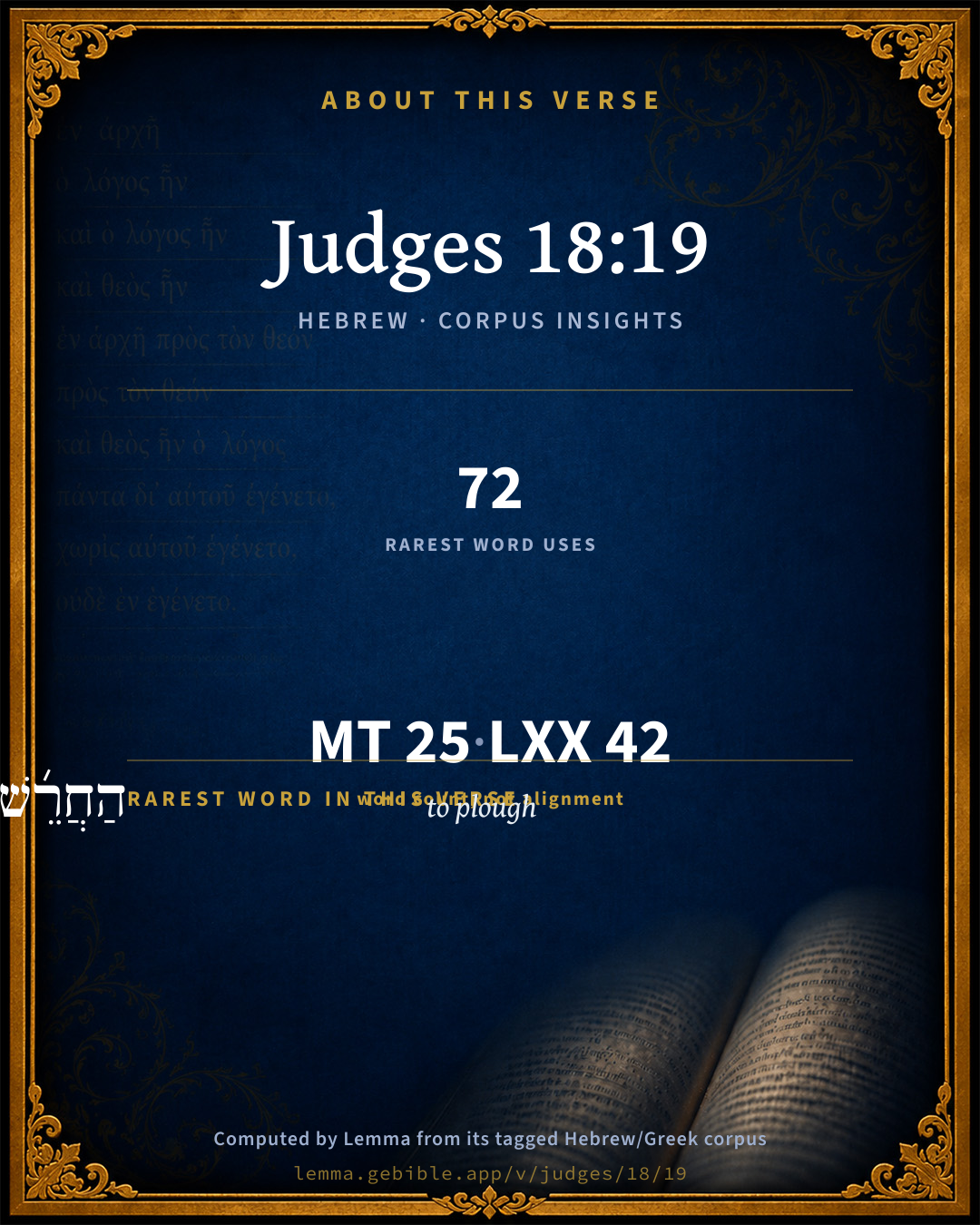
Judges 18:19

Hebrew (Westminster Leningrad Codex) Judges 18:19 appears in the Hebrew Old Testament. The text above is from the Westminster Leningrad Codex. Each word links to its Strong’s number, a concise gloss, and parsing drawn from the Open Scriptures Hebrew Bible morphology. Click any word for its full Brown-Driver-Briggs (BDB) entry.
Download image
Cite this verse

Judges 18:19 (World English Bible). Public Domain. Lemma interlinear Bible study tool, https://lemma.gebible.app/v/judges/18/19.

Show BibTeX & RIS
BibTeX
RIS
English Translation
They said to him, Hold your peace, lay your hand on your mouth, and go with us, and be to us a father and a priest: is it better for you to be priest to the house of one man, or to be priest to a tribe and a family in Israel?
World English Bible · Public Domain
Download a study sheet

One document with this verse’s original text, its word-by-word gloss line, the meaning frame, cross-references with their text, attributed commentary, and full source and license credits — printable, and it pastes into notes with its structure intact.

This verse Autodidact and up

Study sheet (.html) Plain text (.txt)

A passage Seminary Student

Up to 50 verses in one chapter. A passage sheet keeps up to 6 commentary sources and 12 cross-references per verse, in the order this page ranks them, and says so on the sheet whenever that leaves anything out. Ask for a single verse and you get the Autodidact verse sheet above.

Everything on this page stays free to read, with no account — the sheet is a download of what is already on screen, not access to it.

Want to remove ads? Support Godless Engineer
Compare translations 3

The same verse in 3 English versions, stacked beneath the original-language interlinear above. Click any original word for its lexicon entry.

Each is an independent rendering of the whole verse — the interlinear is not word-aligned to these translations.

Highlighted words mark where these versions differ — a whole-verse word diff, not a word-by-word alignment.

  • World English Bible Public Domain
    They said to him, Hold your peace, lay your hand on your mouth, and go with us, and be to us a father and a priest: is it better for you to be priest to the house of one man, or to be priest to a tribe and a family in Israel?
  • King James Version Public Domain
    And they said unto him, Hold thy peace, lay thine hand upon thy mouth, and go with us, and be to us a father and a priest: is it better for thee to be a priest unto the house of one man, or that thou be a priest unto a tribe and a family in Israel?
  • unfoldingWord Literal Text CC BY-SA 4.0
    And they said to him, “Be quiet! Put your hand over your mouth and come with us and be to us for a father and for a priest. the good your being a priest for the house of one man or your being a priest for a tribe and for a clan in Israel?”

unfoldingWord Literal Text — © unfoldingWord, licensed CC BY-SA 4.0. Word-aligned USFM3 via Door43 (git.door43.org/unfoldingWord/en_ult).

Versions to compare (up to 4)

3 of 4 selected

Show all 18 translations

Every available English version of this verse, each an independent rendering of the whole verse.

  • World English Bible Public Domain
    They said to him, Hold your peace, lay your hand on your mouth, and go with us, and be to us a father and a priest: is it better for you to be priest to the house of one man, or to be priest to a tribe and a family in Israel?
  • Berean Standard Bible Public Domain
    “Be quiet,” they told him. “Put your hand over your mouth and come with us and be a father and a priest to us. Is it better for you to be a priest for the house of one person or a priest for a tribe and family in Israel?”
  • Majority Standard Bible Public Domain
    “Be quiet,” they told him. “Put your hand over your mouth and come with us and be a father and a priest to us. Is it better for you to be a priest for the house of one person or a priest for a tribe and family in Israel?”
  • King James Version Public Domain
    And they said unto him, Hold thy peace, lay thine hand upon thy mouth, and go with us, and be to us a father and a priest: is it better for thee to be a priest unto the house of one man, or that thou be a priest unto a tribe and a family in Israel?
  • American Standard Version (1901) Public Domain
    And they said unto him, Hold thy peace, lay thy hand upon thy mouth, and go with us, and be to us a father and a priest: is it better for thee to be priest unto the house of one man, or to be priest unto a tribe and a family in Israel?
  • Revised Version (1885) Public Domain
    And they said unto him, Hold thy peace, lay thine hand upon thy mouth, and go with us, and be to us a father and a priest: is it better for thee to be priest unto the house of one man, or to be priest unto a tribe and a family in Israel?
  • Geneva Bible (1599) Public Domain
    And they answered him, Holde thy peace: lay thine hande vpon thy mouth, and come with vs to be our father and Priest. Whether is it better that thou shouldest be a Priest vnto ye house of one man, or that thou shouldest be a Priest vnto a tribe and to a familie in Israel?
  • Douay-Rheims (1899) Public Domain
    And they said to him: Hold thy peace and put thy finger on thy mouth and come with us, that we may have thee for a father, and a priest. Whether is better for thee, to be a priest in the house of one man, or in a tribe and family in Israel?
  • Young's Literal Translation Public Domain
    and they say to him, `Keep silent, lay thy hand on thy mouth, and go with us, and be to us for a father and for a priest: is it better thy being a priest to the house of one man, or thy being priest to a tribe and to a family in Israel?'
  • Literal Standard Version CC BY-SA 4.0
    And they say to him, “Keep silent, lay your hand on your mouth, and go with us, and be for a father and for a priest to us: is it better your being a priest for the house of one man, or your being priest for a tribe and for a family in Israel?”
  • Unlocked Literal Bible CC BY-SA 4.0
    They said to him, “Be quiet! Put your hand on your mouth and come with us, and be to us a father and a priest. Is it better for you to be priest for the house of one man, or to be priest for a tribe and a clan in Israel?”
  • unfoldingWord Literal Text CC BY-SA 4.0
    And they said to him, “Be quiet! Put your hand over your mouth and come with us and be to us for a father and for a priest. the good your being a priest for the house of one man or your being a priest for a tribe and for a clan in Israel?”
  • Darby Bible Public Domain
    And they said to him, "Keep quiet, put your hand upon your mouth, and come with us, and be to us a father and a priest. Is it better for you to be priest to the house of one man, or to be priest to a tribe and family in Israel?"
  • World Messianic Bible Public Domain
    They said to him, “Hold your peace, put your hand on your mouth, and go with us. Be a father and a priest to us. Is it better for you to be priest to the house of one man, or to be priest to a tribe and a family in Israel?”
  • Webster's Bible Public Domain
    And they said to him, Hold thy peace, lay thy hand upon thy mouth, and go with us, and be to us a father and a priest: Is it better for thee to be a priest to the house of one man, or that thou shouldst be a priest to a tribe and a family in Israel?
  • Free Bible Version CC BY-SA 4.0
    “Be quiet! Don't say anything! Come with us, and you can be our ‘father’ and priest. Wouldn't it be better for you if instead of being a priest for just one man's household that you were the priest of an Israelite tribe and family?”
  • Bible in Basic English Public Domain
    And they said to him, Be quiet; say nothing, and come with us and be our father and priest; is it better for you to be priest to one man's house or to be priest to a tribe and a family in Israel?
  • JPS Tanakh (1917) Public Domain
    And they said unto him: 'Hold thy peace, lay thy hand upon thy mouth, and go with us, and be to us a father and a priest; is it better for thee to be priest unto the house of one man, or to be priest unto a tribe and a family in Israel?'

Literal Standard Version (2020), Covenant Press — licensed CC BY-SA 4.0. Text via the HelloAO Bible API (eBible.org). Unlocked Literal Bible (unfoldingWord) — licensed CC BY-SA 4.0. Text via the HelloAO Bible API (eBible.org). unfoldingWord Literal Text — © unfoldingWord, licensed CC BY-SA 4.0. Word-aligned USFM3 via Door43 (git.door43.org/unfoldingWord/en_ult). Free Bible Version, Dr. Jonathan Gallagher — licensed CC BY-SA 4.0. Text via the HelloAO Bible API (eBible.org).

Word by word

More ways to search: Search by grammar → Find every occurrence → Compare this word →

Practice this passage: Drill this verse → Learn its vocabulary →

הַחֲרֵ֜שׁ
chârash
H2790
“plough”
Verb, Hiphil, Imperative, 2nd Person, Masculine, Singular
Part of Speech
Verb
Stem
Hiphil
Form
Imperative
Person
2nd Person
Gender
Masculine
Number
Singular
Full BDB Definition

Origin: a primitive root

TWOT: 760 , 761

to cut in, plough, engrave, devise - (Qal) - to cut in, engrave - to plough - to devise - (Niphal) to be ploughed - (Hiphil) to plot evil - to be silent, be dumb, be speechless, be deaf - (Qal) - to be silent - to be deaf - (Hiphil) - to be silent, keep quiet - to make silent - to be deaf, show deafness - (Hithpael) to remain silent
  1. וַיֹּאמְרוּ֩ ʼâmar H559 “and · to say” Conjunction + Verb, Qal, Sequential Imperfect, 3rd Person, Masculine, Plural
  2. שִֽׂים sûwm H7760 “put” Verb, Qal, Imperative, 2nd Person, Masculine, Singular
  3. יָדְךָ֤ yâd H3027 “hand · your” Noun, Common, Both, Singular, Construct + Suffix, Personal, 2nd Person, Masculine, Singular
  4. עַל ʻal H5921 “upon” Preposition
  5. פִּ֨יךָ֙ peh H6310 “mouth · your” Noun, Common, Masculine, Singular, Construct + Suffix, Personal, 2nd Person, Masculine, Singular
  6. וְלֵ֣ךְ yâlak H3212 “and · walk” Conjunction + Verb, Qal, Imperative, 2nd Person, Masculine, Singular
  7. עִמָּ֔נוּ ʻim H5973 “with · us” Preposition + Suffix, Personal, 1st Person, Common, Plural
  8. וֶֽהְיֵה hâyâh H1961 “and · be” Conjunction + Verb, Qal, Imperative, 2nd Person, Masculine, Singular
  9. לְאָ֣ב ʼâb H1 “to/for · father” Preposition + Noun, Common, Masculine, Singular, Absolute
  10. וּלְכֹהֵ֑ן kôhên H3548 “and · to/for · priest” Conjunction + Preposition + Noun, Common, Masculine, Singular, Absolute
  11. הֲט֣וֹב ṭôwb H2896 “good” Particle, Interrogative + Adjective, Adjective, Masculine, Singular, Absolute
  12. הֱיוֹתְךָ֣ hâyâh H1961 “to be · you” Verb, Qal, Infinitive Construct + Suffix, Personal, 2nd Person, Masculine, Singular
  13. כֹהֵ֗ן kôhên H3548 “priest” Noun, Common, Masculine, Singular, Absolute
  14. לְבֵית֙ bayith H1004 “to/for · house of” Preposition + Noun, Common, Masculine, Singular, Construct
  15. אִ֣ישׁ ʼîysh H376 “man” Noun, Common, Masculine, Singular, Absolute
  16. אֶחָ֔ד ʼechâd H259 “one” Adjective, Cardinal number, Masculine, Singular, Absolute
  17. א֚וֹ ʼôw H176 “or” Conjunction
  18. הֱיוֹתְךָ֣ hâyâh H1961 “to be · you” Verb, Qal, Infinitive Construct + Suffix, Personal, 2nd Person, Masculine, Singular
  19. כֹהֵ֔ן kôhên H3548 “priest” Noun, Common, Masculine, Singular, Absolute
  20. לְשֵׁ֥בֶט shêbeṭ H7626 “to/for · staff” Preposition + Noun, Common, Masculine, Singular, Absolute
  21. וּלְמִשְׁפָּחָ֖ה mishpâchâh H4940 “and · to/for · family” Conjunction + Preposition + Noun, Common, Feminine, Singular, Absolute
  22. בְּיִשְׂרָאֵֽל Yisrâʼêl H3478 “in/at · Israel” Preposition + Noun, Proper

About this verse

These counts appear in no published source. They are computed here, from the morphology-tagged text and Lemma’s own curated glosses. What Lemma adds →

25
words
19
distinct lemmas
Historical
section

Grammatical profile

  • 7 verbs
  • 11 nouns
  • 2 adjectives
  • 4 prepositions
  • 1 conjunction

Verb forms

  • וַיֹּאמְרוּ֩ Qal · Sequential Imperfect
  • הַחֲרֵ֜שׁ Hiphil · Imperative
  • שִֽׂים Qal · Imperative
  • וְלֵ֣ךְ Qal · Imperative
  • וֶֽהְיֵה Qal · Imperative
  • הֱיוֹתְךָ֣ Qal · Infinitive Construct
  • הֱיוֹתְךָ֣ Qal · Infinitive Construct

Repetition

Words recur within this verse — often emphatic in Hebrew:

  • וֶֽהְיֵה to be H1961 ×3
  • וּלְכֹהֵ֑ן priest H3548 ×3

Hebrew & Septuagint length

In English translation the verse runs 52 words from the Hebrew and 56 from the Septuagint (LXX English) — closely comparable.

A rough comparison of the two English renderings, which tokenize alike — not a word-level alignment.

Word counts can differ between the Hebrew and the Greek without any difference in meaning — e.g. the Hebrew direct-object marker אֵת has no separate Greek word, and Greek often adds the article ὁ.

In the original languages it is 25 Hebrew tokens and 42 Greek tokens — but the two are counted differently (Hebrew bundles its prefixes and suffixes into one token; the Greek is in lemma form), so that isn’t a like-for-like length.

Cross-references

10

Topical passages linked to Judges 18:19 in the Treasury of Scripture Knowledge — connected by theme and wording, ordered by reader-vote popularity; previews shown in the World English Bible.

  • Judges 17:10 Micah said to him, Dwell with me, and be to me a father and a priest, and I will give you ten [pieces] of silver by the year, and a suit of clothing, and your food. So the Levite went in.
  • Job 21:5 Look at me, and be astonished. Lay your hand on your mouth.
  • Job 29:9 The princes refrained from talking, And laid their hand on their mouth;
  • Proverbs 30:32 "If you have done foolishly in lifting up yourself, Or if you have thought evil, Put your hand over your mouth.
  • Micah 7:16 The nations will see and be ashamed of all their might. They will lay their hand on their mouth. Their ears will be deaf.
  • 2 Kings 6:21 The king of Israel said to Elisha, when he saw them, My father, shall I strike them? shall I strike them?
  • 2 Kings 8:8–9 The king said to Hazael, Take a present in your hand, and go, meet the man of God, and inquire of Yahweh by him, saying, Shall I recover of this sickness?
  • 2 Kings 13:14 Now Elisha was fallen sick of his sickness of which he died: and Joash the king of Israel came down to him, and wept over him, and said, My father, my father, the chariots of Israel and the horsemen of it!
  • Job 40:4–5 "Behold, I am of small account. What shall I answer you? I lay my hand on my mouth.
  • Matthew 23:9 Call no man on the earth your father, for one is your Father, he who is in heaven.

Cross-references courtesy of OpenBible.info (CC BY 4.0).

Hebrew and Greek witnesses Masoretic Hebrew ↔ Greek Septuagint

The same verse in the two great witnesses to the Old Testament, shown verse-for-verse.

These are two independent witnesses, not word-aligned to each other, and the Septuagint is shown in lemma (dictionary) form.

Hebrew Judges 18:19 Masoretic · Westminster Leningrad Codex

וַיֹּאמְרוּ֩ ל֨וֹ הַחֲרֵ֜שׁ שִֽׂים יָדְךָ֤ עַל פִּ֨יךָ֙ וְלֵ֣ךְ עִמָּ֔נוּ וֶֽהְיֵה לָ֖נוּ לְאָ֣ב וּלְכֹהֵ֑ן הֲט֣וֹב הֱיוֹתְךָ֣ כֹהֵ֗ן לְבֵית֙ אִ֣ישׁ אֶחָ֔ד א֚וֹ הֱיוֹתְךָ֣ כֹהֵ֔ן לְשֵׁ֥בֶט וּלְמִשְׁפָּחָ֖ה בְּיִשְׂרָאֵֽל

They said to him, Hold your peace, lay your hand on your mouth, and go with us, and be to us a father and a priest: is it better for you to be priest to the house of one man, or to be priest to a tribe and a family in Israel?

World English Bible · Public Domain

Greek LXX Judges 18:19 Septuagint · lemma form

καί εἶπον αὐτός κωφεύω ἐπιτίθημι ὁ χείρ σύ ἐπί ὁ στόμα σύ καί δεῦρο μετά ἐγώ καί γίγνομαι ἐγώ εἰς πατήρ καί εἰς ἱερεύς μή ἀγαθός εἰμί σύ ἱερεύς οἶκος ἀνήρ εἷς ἤ γίγνομαι σύ ἱερεύς φυλή καί οἶκος εἰς δῆμος ἰσραήλ

And they said to him, Be silent, lay your hand upon your mouth, and come with us, and be to us a father and a priest: is it better for you to be the priest of the house of one man, or to be the priest of a tribe and house for a family of Israel?

LXX2012 (modern English Septuagint) · Public Domain

Hebrew: Westminster Leningrad Codex (CC BY 4.0). Greek: Septuagint (public domain); English from LXX2012 (modern English Septuagint) (Public Domain). How the Septuagint differs from the Hebrew →

Targum (Aramaic paraphrase)

1

The Targum is the ancient Jewish Aramaic paraphrase of the Hebrew Scriptures — an interpretive translation, not the Hebrew text itself. Onkelos (literal) and Pseudo-Jonathan (expansive) render the Torah, and Jonathan the Prophets. Coverage is partial: where no permissively-licensed English translation exists for a verse, only the Aramaic is shown. This is verse-level text, not a word-by-word alignment to the Hebrew.

  1. Targum Jonathan Prophets (Joshua–Malachi)
    וַאֲמַרוּ לֵיהּ שְׁתוֹק שַׁוֵי יְדָךְ עַל פּוּמָךְ וֶאֱזֵיל עִמָּנָא וֶהֱוֵי לָנָא לְאָב וּלְכַהֲנָא הֲטַב דִתְהֵי כָהִין לְבֵית גַבְרָא חָד אוֹ דִתְהֵי כָהִין לְשִׁבְטָא וּלְזַרְעִית בְּיִשְׂרָאֵל:

    (no public-domain English translation for this verse)

    Targum Jonathan — Aramaic: “Mikraot Gedolot” (public domain). English: “Sefaria Community Translation” (CC0 1.0 (public-domain dedication)); “London "Chaldee Paraphrase," 1871” (public domain). Text via Sefaria.

Commentary

Notes on Judges 18:19 from classic Christian and Jewish commentators (each source and its license shown beneath its notes). The classic Christian expositions comment on the surrounding passage and are grouped to its opening verse, so a note may address several verses; the Jewish commentaries on the Tanakh (Rashi and others) are per-verse, so they appear only where the commentator wrote on this verse.

Lemma curates 59 commentaries, every one of them public domain or Creative Commons licensed, each selected and text-cleaned for this edition rather than reprinted as found. About our sources →

Trapp's Complete Commentary

John Trapp

Jdg 18:19 And they said unto him, Hold thy peace, lay thine hand upon thy mouth, and go with us, and be to us a father and a priest: [is it] better for thee to be a priest unto the house of one man, or that thou be a priest unto a tribe and a family in Israel?

Ver. 19. Lay thine hand upon thy mouth.] Digito compesce labellum. See Job 21:5; Job 29:9.

Or that thou be a priest unto a tribe.] Thus the Papists offered Luther a cardinalship to be quiet: they sent unto him Vergerius, to put him in mind of the example of Aeneas Sylvius, who following his own opinions, with much slavery and labour, could get no further preferment than to be canon of Trent, but being changed to the better, became bishop, cardinal, and finally Pope Pius II. He called to his memory also Bessarion of Nice, who by complying with the Church of Rome, wanted not much of being Pope. But he answered, I care neither for Rome’s favour nor fury. {a}

{a} Hist. of Counc. of Trent, 73.

John Trapp, A Commentary or Exposition upon All the Books of the Old and New Testament (1647–1656) — public domain. Text from a community e-Sword module.

Adam Clarke's Commentary

Verse 19. Lay thine hand upon thy mouth] This was the token of silence. The god of silence, Harpocrates, is represented on ancient statues with his finger pressed on his lips.

Adam Clarke's Commentary on the Bible (1810–1826) — public domain. Text from a community e-Sword/MySword module.

Ellicott's Commentary for English Readers

(19) Hold thy peace, lay thine hand upon thy mouth.—Comp. Job_21:5; Job_29:9; Pro_30:32. The laying of the finger on the lip is one of the most universal of gestures. It is the attitude of Horus, the Egyptian god of silence. (See Apul. Metamorph. 1: at ille digitum, a pollice proximum ori suo admovens . . . tace. tace, inquit.)

A father and a priest.—Jdg_17:10.

Unto a tribe and a family.—Both to a shebet and a mishpecah. (See Note on Jdg_18:1.)

A Bible Commentary for English Readers, edited by Charles John Ellicott (1878–1897) — public domain. Text from a community e-Sword module.

The Cambridge Bible for Schools and Colleges

gen. ed. J. J. S. Perowne

19. lay thine hand upon thy mouth] Cf. Mic_7:16, Job_21:5; Job_29:9 etc.

a father and a priest] See Jdg_17:10 n.

The Cambridge Bible for Schools and Colleges (gen. ed. J. J. S. Perowne; Cambridge University Press, 1878–1918) — public domain. Text from a community e-Sword module.

John Gill's Exposition

And they said unto him, hold thy peace,.... Be silent, make no disturbance, be quiet and easy:

lay thy hand upon thy mouth; as a token of silence; so the Egyptians used to paint Harpocrates, the god of silence, with his fingers pressing his lips:

and go with us; for they wanted him as well as his gods, not knowing well how to make use of them without him:

and be to us a father and a priest; to direct them, instruct them, perform acts of devotion for them, and ask counsel on their account; it seems as if it was common in those days to call a priest a father, see Jdg 17:10.

is it better for thee to be a priest unto the house of one man, or that thou be a priest unto a tribe and a family in Israel? suggesting, that it must be much more honourable for him, and more to his advantage, to officiate as a priest to a body of people, that might be called a tribe, or to a family consisting of various houses, than in the house of a private person; this they left him to consider and judge of.

John Gill's Exposition of the Whole Bible (1746–1763) — public domain (CC PDM 1.0). Text via the HelloAO Bible API.

Haydock's Catholic Bible Commentary

Mouth; to signify that silence must be observed, Job xxix. 9., and Ecclesiasticus v. 12.[14?] Angerona, among the Romans, and Harpocrates, in Egypt, were represented in this posture; digitoque silentia suadet. (Ovid, Met. ix.)

George Leo Haydock (1774–1849), Haydock's Catholic Family Bible and Commentary, 1859 edition — public domain. Excludes Psalms (Douay-Rheims chapter numbering differs from Protestant) and Deuterocanonical books (Catholic canon only).

Matthew Poole's English Annotations

Lay thy hand upon thy mouth, i.e. be silent, as this phrase is used, Job 21:5; 29:9; 40:4; Pro 30:32. The same thing repeated in other words.

A father and a priest: see Poole on "Jdg 17:10".

A family in Israel, to wit, a tribe that is (and being oft put for that is) a family. For it is certain this was not an expedition of the whole tribe, which numbered 64,000 men, Num 26:43, but only of one family, which it seems were more vexed with the Philistines or Amorites, and therefore resolved to seek new habitations at a great distance from them. And after this time we find the body of the Danites in their old and proper portions in Samson’s time, which, though placed before this, was long after it.

Matthew Poole's English Annotations on the Holy Bible (1683–1685) — public domain. Text from a community e-Sword/MySword module.

Whedon's Commentary on the Bible

Daniel D. Whedon

19. Lay thine hand upon thy mouth — A proverbial expression for maintaining utter silence.

Better for thee — “Almost in the same words was the like bribe offered by one of the greatest religious houses of England to the monk who guarded the shrine of one of the most sacred relics in the ancient cathedral of Canterbury: ‘Give us the portion of St. Thomas’ skull which is in thy custody and thou shalt be Abbot of St. Augustine’s.’ As Roger accepted the bait in the twelfth century after the Christian era, so did the Levite in the fifteenth century before it.” — Stanley.

Daniel D. Whedon (gen. ed.), Commentary on the Old and New Testaments (1874–1909) — public domain. Text from a community e-Sword module.

The Pulpit Commentary

Lay thine hand upon thy mouth. Cf. Job_21:5 Job_29:9 Job_40:4. A father and a priest. See Jud_1:17:10, note.

Vers. 19, 20The mercenary priest.

Greed and ambition are the besetting sins of depraved priests. Both of these evil characteristics are apparent in Micah"s Levite.

I THE PRIESTLY OFFICE IS DEGRADED BY MERCENARY GREED. Micah had adopted the Levite when he was homeless and destitute, and had treated him with the kindness of a father to his son; yet as soon as he discovers a chance of better pay, the miserable man deserts and robs his patron. No man can serve God truly if the money wages of his service are the chief consideration with him. Though he may take such just payment as is given to him if he is God"s faithful servant, he will, like the faithful Levites, feel that his real portion is the Eternal. (Jos_13:33) Such a man should also consider himself bound by ties of affection and friendly obligation to the people among whom he ministers. If he seeks promotion simply for the sake of pecuniary advantage, and irrespective of the loss which may be sustained in his present sphere, and of his possible unfitness for a larger sphere, he is guilty of gross worldliness and wicked selfishness.

II THE PRIESTLY OFFICE IS DEGRADED BY SELFISH AMBITION. The Levite is tempted by the prospect of exercising his functions in a larger way as the priest of a tribe. Such an offer would only be possible in Israel under circumstances of religions decline and social disorder. Even then the Levite must have known that he was no priest at all according to the law of God, for he did not belong to the family of Aaron. But ambition tramples on law for its own advancement. Of course there are occasions when a man may naturally endeavour to rise in the world, and if he can be sure that he will extend his usefulness, it is his duty to do so. But

1. The opportunity of enlarged service elsewhere is no justification for unfaithfulness to our present service. Plainly the Levite was treating his benefactor with unpardonable ingratitude and treachery in deserting him for the service of the Danites.

2. It is only a culpable ambition which will lead a man to seek a higher position simply for his own honour and profit, and not for the good of those who are intrusted to his care. The priest exists for the people, not the people for the priest. But the latter condition has been only too apparent in the course of the corruptions of Christendom. Office has been sought solely for the satisfaction of the greed and ambition of the aspirant. How contrary to the teaching of Christ, who said, "Whosoever will be great among you, let him be your servant"! A. (Mat_20:27)

The Pulpit Commentary (1880–1919), ed. H.D.M. Spence-Jones & Joseph S. Exell — public domain. Text from a community e-Sword module.

John Wesley's Explanatory Notes

Lay thy hand - That is, be silent. A family - Namely, a tribe, that is, a family.

John Wesley, Explanatory Notes Upon the Whole Bible (1754–1765) — public domain. Text via the GEBible commentary corpus.

unfoldingWord translationNotes

Door43 World Missions Community

Is it better for you to be priest for the house of one man ... a clan in Israel?

They ask this as a rhetorical question to imply that it is true. This question can be written as a statement. AT: "It is better for you to be priest for a tribe and a clan in Israel than for just the house of one man." (See: Rhetorical Question)

The priest's heart was glad

Here the priest is referred to by his "heart" to emphasize his emotions. AT: "The priest was glad" (See: Synecdoche)

translationWords

priest

tribe

clan

Israel

heart

ephod

household

false god

unfoldingWord translationNotes — © Distant Shores Media and the Door43 World Missions Community, licensed CC BY-SA 4.0. Source: git.door43.org/Door43/en_tn.

Lesson kit

Teaching starters — assembled from the data on this page, not authored interpretation. Every prompt links to the verse data it draws on. Edit before teaching.

Judges, in the Historical, opens this verse with 25 words (19 distinct Hebrew lemmas). Its most distinctive word is chârash (“to plough”). A historical commentator’s framing appears above. Read the whole chapter for the surrounding context.

Discussion questions

  1. How does “to plough” (chârash) shape what this verse is saying?
  2. How does Judges 17:10, which shares this passage’s theme, read alongside this verse?
  3. What does the repetition of “to be” (3× in this one verse) do in this verse?
  4. The translations on this page render this verse differently — a whole-verse word diff, not a word-by-word alignment. What might account for the different wordings?
  5. «וַיֹּאמְרוּ֩» is a Qal Sequential Imperfect verb. How does that grammatical form shape the action described?
  6. Compare how Trapp's Complete Commentary and Adam Clarke's Commentary read this verse. Where do they agree or differ?

Things to notice

Reading settings

Reading text

Shown beneath each verse's original-language words.

Old Testament
Old Testament edition

Read the OT as the Masoretic Hebrew (MT) or the Greek Septuagint (LXX).

English shown for the Greek Septuagint (in the Hebrew ↔ Greek comparison).

Comparing translations? Open the Compare panel on any verse page to stack up to four side by side.