
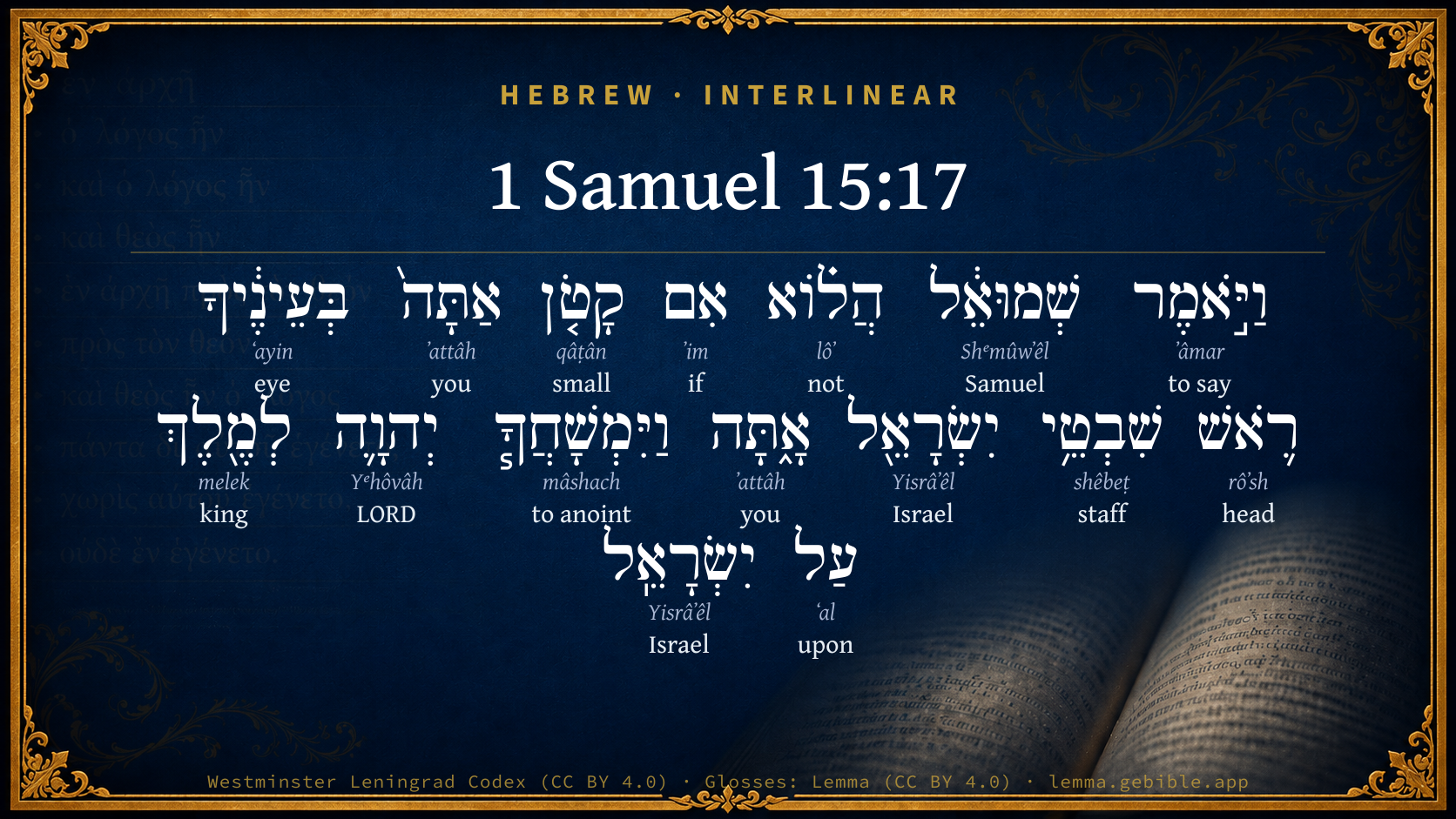
1 Samuel 15:17

Hebrew (Westminster Leningrad Codex) 1 Samuel 15:17 appears in the Hebrew Old Testament. The text above is from the Westminster Leningrad Codex. Each word links to its Strong’s number, a concise gloss, and parsing drawn from the Open Scriptures Hebrew Bible morphology. Click any word for its full Brown-Driver-Briggs (BDB) entry.
Download image
Cite this verse

1 Samuel 15:17 (World English Bible). Public Domain. Lemma interlinear Bible study tool, https://lemma.gebible.app/v/1-samuel/15/17.

Show BibTeX & RIS
BibTeX
RIS
English Translation
Samuel said, "Though you were little in your own sight, weren't you made the head of the tribes of Israel? Yahweh anointed you king over Israel;
World English Bible · Public Domain
Download a study sheet

One document with this verse’s original text, its word-by-word gloss line, the meaning frame, cross-references with their text, attributed commentary, and full source and license credits — printable, and it pastes into notes with its structure intact.

This verse Autodidact and up

Study sheet (.html) Plain text (.txt)

A passage Seminary Student

Up to 50 verses in one chapter. A passage sheet keeps up to 6 commentary sources and 12 cross-references per verse, in the order this page ranks them, and says so on the sheet whenever that leaves anything out. Ask for a single verse and you get the Autodidact verse sheet above.

Everything on this page stays free to read, with no account — the sheet is a download of what is already on screen, not access to it.

Want to remove ads? Support Godless Engineer
Compare translations 3

The same verse in 3 English versions, stacked beneath the original-language interlinear above. Click any original word for its lexicon entry.

Each is an independent rendering of the whole verse — the interlinear is not word-aligned to these translations.

Highlighted words mark where these versions differ — a whole-verse word diff, not a word-by-word alignment.

  • World English Bible Public Domain
    Samuel said, "Though you were little in your own sight, weren't you made the head of the tribes of Israel? Yahweh anointed you king over Israel;
  • King James Version Public Domain
    And Samuel said, When thou wast little in thine own sight, wast thou not made the head of the tribes of Israel, and the LORD anointed thee king over Israel?
  • unfoldingWord Literal Text CC BY-SA 4.0
    And Samuel said, “ not, if you small in your eyes, you the head of the tribes of Israel? For Yahweh has anointed you as king over Israel.

unfoldingWord Literal Text — © unfoldingWord, licensed CC BY-SA 4.0. Word-aligned USFM3 via Door43 (git.door43.org/unfoldingWord/en_ult).

Versions to compare (up to 4)

3 of 4 selected

Show all 18 translations

Every available English version of this verse, each an independent rendering of the whole verse.

  • World English Bible Public Domain
    Samuel said, "Though you were little in your own sight, weren't you made the head of the tribes of Israel? Yahweh anointed you king over Israel;
  • Berean Standard Bible Public Domain
    And Samuel said, “Although you were once small in your own eyes, have you not become the head of the tribes of Israel? The LORD anointed you king over Israel
  • Majority Standard Bible Public Domain
    And Samuel said, “Although you were once small in your own eyes, have you not become the head of the tribes of Israel? The LORD anointed you king over Israel
  • King James Version Public Domain
    And Samuel said, When thou wast little in thine own sight, wast thou not made the head of the tribes of Israel, and the LORD anointed thee king over Israel?
  • American Standard Version (1901) Public Domain
    And Samuel said, Though thou wast little in thine own sight, wast thou not made the head of the tribes of Israel? And Jehovah anointed thee king over Israel;
  • Revised Version (1885) Public Domain
    And Samuel said, Though thou wast little in thine own sight, wast thou not made the head of the tribes of Israel? And the LORD anointed thee king over Israel;
  • Geneva Bible (1599) Public Domain
    Then Samuel saide, When thou wast litle in thine owne sight, wast thou not made the head of the tribes of Israel? for the Lord anointed thee King ouer Israel.
  • Douay-Rheims (1899) Public Domain
    And Samuel said: When thou wast a little one in thy own eyes, wast thou not made the head of the tribes of Israel? And the Lord anointed thee to be king over Israel.
  • Young's Literal Translation Public Domain
    And Samuel saith, `Art not thou, if thou `art' little in thine own eyes, head of the tribes of Israel? and Jehovah doth anoint thee for king over Israel,
  • Literal Standard Version CC BY-SA 4.0
    And Samuel says, “Are you not, if you [are] little in your own eyes, head of the tribes of Israel? And YHWH anoints you for king over Israel,
  • Unlocked Literal Bible CC BY-SA 4.0
    Samuel said, “Though you are little in your own sight, were you not made the head of the tribes of Israel? Then Yahweh anointed you king over Israel,
  • unfoldingWord Literal Text CC BY-SA 4.0
    And Samuel said, “ not, if you small in your eyes, you the head of the tribes of Israel? For Yahweh has anointed you as king over Israel.
  • Darby Bible Public Domain
    And Samuel said, Was it not when thou wast little in thine eyes that thou [becamest] the head of the tribes of Israel, and Jehovah anointed thee king over Israel?
  • World Messianic Bible Public Domain
    Samuel said, “Though you were little in your own sight, weren’t you made the head of the tribes of Israel? The LORD anointed you king over Israel;
  • Webster's Bible Public Domain
    And Samuel said, When thou wast little in thy own sight, wast thou not made the head of the tribes of Israel, and the LORD anointed thee king over Israel?
  • Free Bible Version CC BY-SA 4.0
    “Once you didn't use to think much of yourself, but haven't you become the leader of the tribes of Israel?” Samuel asked. “The Lord anointed you king of Israel.
  • Bible in Basic English Public Domain
    And Samuel said, Though you may seem little to yourself, are you not head of the tribes of Israel? for the Lord with the holy oil made you king over Israel,
  • JPS Tanakh (1917) Public Domain
    And Samuel said: 'Though thou be little in thine own sight, art thou not head of the tribes of Israel? And the LORD anointed thee king over Israel;

Literal Standard Version (2020), Covenant Press — licensed CC BY-SA 4.0. Text via the HelloAO Bible API (eBible.org). Unlocked Literal Bible (unfoldingWord) — licensed CC BY-SA 4.0. Text via the HelloAO Bible API (eBible.org). unfoldingWord Literal Text — © unfoldingWord, licensed CC BY-SA 4.0. Word-aligned USFM3 via Door43 (git.door43.org/unfoldingWord/en_ult). Free Bible Version, Dr. Jonathan Gallagher — licensed CC BY-SA 4.0. Text via the HelloAO Bible API (eBible.org).

Word by word

More ways to search: Search by grammar → Find every occurrence → Compare this word →

Practice this passage: Drill this verse → Learn its vocabulary →

וַיִּמְשָׁחֲךָ֧
mâshach
H4886
“and · to anoint · you”
Conjunction + Verb, Qal, Sequential Imperfect, 3rd Person, Masculine, Singular + Suffix, Personal, 2nd Person, Masculine, Singular
Part of Speech
Conjunction + Verb
Stem
Qal
Form
Sequential Imperfect
Person
3rd Person
Gender
Masculine
Number
Singular
Full BDB Definition

Origin: a primitive root

TWOT: 1255

to smear, anoint, spread a liquid - (Qal) - to smear - to anoint (as consecration) - to anoint, consecrate - (Niphal) to be anointed
  1. וַיֹּ֣אמֶר ʼâmar H559 “and · to say” Conjunction + Verb, Qal, Sequential Imperfect, 3rd Person, Masculine, Singular
  2. שְׁמוּאֵ֔ל Shᵉmûwʼêl H8050 “Samuel” Noun, Proper
  3. הֲל֗וֹא lôʼ H3808 “not” Particle, Interrogative + Particle, Negative
  4. אִם ʼim H518 “if” Conjunction
  5. קָטֹ֤ן qâṭân H6996 “small” Adjective, Adjective, Masculine, Singular, Absolute
  6. אַתָּה֙ ʼattâh H859 “you” Pronoun, Personal, 2nd Person, Masculine, Singular
  7. בְּעֵינֶ֔יךָ ʻayin H5869 “in/at · eyes · your” Preposition + Noun, Common, Both, Dual, Construct + Suffix, Personal, 2nd Person, Masculine, Singular
  8. רֹ֛אשׁ rôʼsh H7218 “head of” Noun, Common, Masculine, Singular, Construct
  9. שִׁבְטֵ֥י shêbeṭ H7626 “staffs of” Noun, Common, Masculine, Plural, Construct
  10. יִשְׂרָאֵ֖ל Yisrâʼêl H3478 “Israel” Noun, Proper
  11. אָ֑תָּה ʼattâh H859 “you” Pronoun, Personal, 2nd Person, Masculine, Singular
  12. יְהוָ֛ה Yᵉhôvâh H3068 “LORD” Noun, Proper
  13. לְמֶ֖לֶךְ melek H4428 “to/for · king” Preposition + Noun, Common, Masculine, Singular, Absolute
  14. עַל ʻal H5921 “upon” Preposition
  15. יִשְׂרָאֵֽל Yisrâʼêl H3478 “Israel” Noun, Proper

About this verse

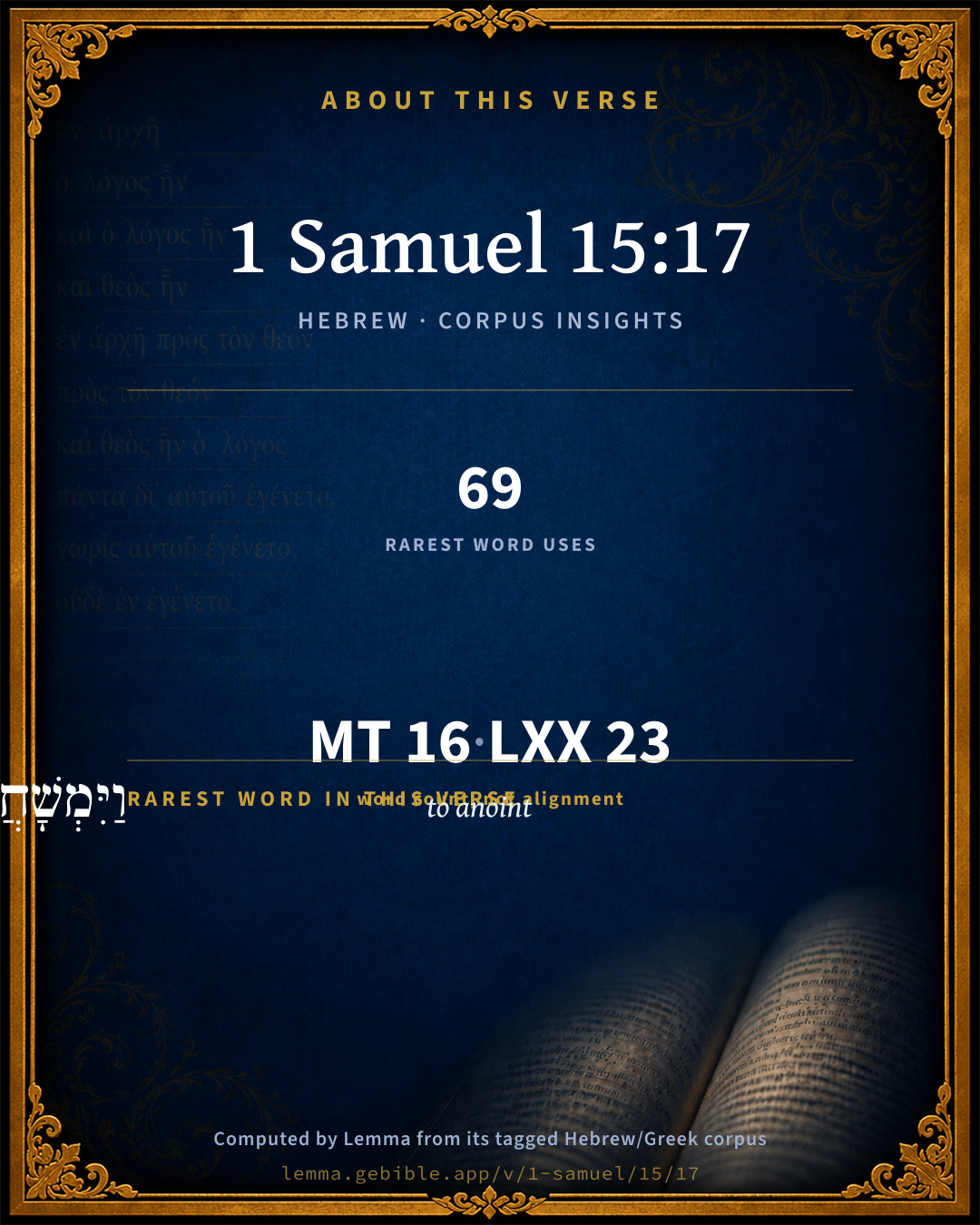
These counts appear in no published source. They are computed here, from the morphology-tagged text and Lemma’s own curated glosses. What Lemma adds →

16
words
14
distinct lemmas
Historical
section

Grammatical profile

  • 2 verbs
  • 8 nouns
  • 1 adjective
  • 2 pronouns
  • 1 preposition
  • 1 conjunction
  • 1 particle

Verb forms

  • וַיֹּ֣אמֶר Qal · Sequential Imperfect
  • וַיִּמְשָׁחֲךָ֧ Qal · Sequential Imperfect

Repetition

Words recur within this verse — often emphatic in Hebrew:

  • יִשְׂרָאֵ֖ל Israel H3478 ×2
  • אַתָּה֙ you H859 ×2

Hebrew & Septuagint length

In English translation the verse runs 26 words from the Hebrew and 33 from the Septuagint (LXX English) — closely comparable.

A rough comparison of the two English renderings, which tokenize alike — not a word-level alignment.

Word counts can differ between the Hebrew and the Greek without any difference in meaning — e.g. the Hebrew direct-object marker אֵת has no separate Greek word, and Greek often adds the article ὁ.

In the original languages it is 16 Hebrew tokens and 23 Greek tokens — but the two are counted differently (Hebrew bundles its prefixes and suffixes into one token; the Greek is in lemma form), so that isn’t a like-for-like length.

Cross-references

7

Topical passages linked to 1 Samuel 15:17 in the Treasury of Scripture Knowledge — connected by theme and wording, ordered by reader-vote popularity; previews shown in the World English Bible.

  • 1 Samuel 9:21 Saul answered, Am I not a Benjamite, of the smallest of the tribes of Israel? and my family the least of all the families of the tribe of Benjamin? why then speak you to me after this manner?
  • 1 Samuel 10:22 Therefore they asked of Yahweh further, Is there yet a man to come here? Yahweh answered, Behold, he has hid himself among the baggage.
  • 1 Samuel 15:1–3 Samuel said to Saul, Yahweh sent me to anoint you to be king over his people, over Israel: now therefore listen you to the voice of the words of Yahweh.
  • 1 Samuel 10:1 Then Samuel took the vial of oil, and poured it on his head, and kissed him, and said, Isn't it that Yahweh has anointed you to be prince over his inheritance?
  • Judges 6:15 He said to him, Oh, Lord, with which shall I save Israel? behold, my family is the poorest in Manasseh, and I am the least in my father's house.
  • Matthew 18:4 Whoever therefore humbles himself as this little child, the same is the greatest in the Kingdom of Heaven.
  • Hosea 13:1 When Ephraim spoke, there was trembling. He exalted himself in Israel, But when he became guilty in Baal, he died.

Cross-references courtesy of OpenBible.info (CC BY 4.0).

Hebrew and Greek witnesses Masoretic Hebrew ↔ Greek Septuagint

The same verse in the two great witnesses to the Old Testament, shown verse-for-verse.

These are two independent witnesses, not word-aligned to each other, and the Septuagint is shown in lemma (dictionary) form.

Hebrew 1 Samuel 15:17 Masoretic · Westminster Leningrad Codex

וַיֹּ֣אמֶר שְׁמוּאֵ֔ל הֲל֗וֹא אִם קָטֹ֤ן אַתָּה֙ בְּעֵינֶ֔יךָ רֹ֛אשׁ שִׁבְטֵ֥י יִשְׂרָאֵ֖ל אָ֑תָּה וַיִּמְשָׁחֲךָ֧ יְהוָ֛ה לְמֶ֖לֶךְ עַל יִשְׂרָאֵֽל

Samuel said, "Though you were little in your own sight, weren't you made the head of the tribes of Israel? Yahweh anointed you king over Israel;

World English Bible · Public Domain

Greek LXX 1 Samuel 15:17 Septuagint · lemma form

καί εἶπον σαμουηλ πρός σαούλ οὐ μικρός σύ εἰμί ἐνώπιον αὐτός ἡγέομαι σκῆπτρον φυλή ἰσραήλ καί χρίω σύ κύριος εἰς βασιλεύς ἐπί ἰσραήλ

And Samuel said to Saul, Are you not little in his eyes, though a leader of one of the tribes of Israel? and yet the Lord anointed you to be king over Israel.

LXX2012 (modern English Septuagint) · Public Domain

Hebrew: Westminster Leningrad Codex (CC BY 4.0). Greek: Septuagint (public domain); English from LXX2012 (modern English Septuagint) (Public Domain). How the Septuagint differs from the Hebrew →

Targum (Aramaic paraphrase)

1

The Targum is the ancient Jewish Aramaic paraphrase of the Hebrew Scriptures — an interpretive translation, not the Hebrew text itself. Onkelos (literal) and Pseudo-Jonathan (expansive) render the Torah, and Jonathan the Prophets. Coverage is partial: where no permissively-licensed English translation exists for a verse, only the Aramaic is shown. This is verse-level text, not a word-by-word alignment to the Hebrew.

  1. Targum Jonathan Prophets (Joshua–Malachi)
    וַאֲמַר שְׁמוּאֵל הֲלָא מִן שַׁרְיוּתָךְ הֲוֵיתָא שַׁיִט וְחַלָשׁ בְּעֵינֵי נַפְשָׁךְ בְּרַם זְכוּת שִׁבְטָא דְבִנְיָמִין אֲבוּךְ גָרְמָא לָךְ דִי בְעוֹ לְמֶעְבַּר בְּיַמָא קֳדָם בְּנֵי יִשְׂרָאֵל בְּדִיל כֵּן רַבְיָךְ יְיָ לְמֶהֱוֵי מַלְכָּא עַל יִשְׂרָאֵל:

    (no public-domain English translation for this verse)

    Targum Jonathan — Aramaic: “Mikraot Gedolot” (public domain). English: “Sefaria Community Translation” (CC0 1.0 (public-domain dedication)); “London "Chaldee Paraphrase," 1871” (public domain). Text via Sefaria.

Commentary

Notes on 1 Samuel 15:17 from classic Christian and Jewish commentators (each source and its license shown beneath its notes). The classic Christian expositions comment on the surrounding passage and are grouped to its opening verse, so a note may address several verses; the Jewish commentaries on the Tanakh (Rashi and others) are per-verse, so they appear only where the commentator wrote on this verse.

Lemma curates 59 commentaries, every one of them public domain or Creative Commons licensed, each selected and text-cleaned for this edition rather than reprinted as found. About our sources →

Trapp's Complete Commentary

John Trapp

1Sa 15:17 And Samuel said, When thou [wast] little in thine own sight, [wast] thou not [made] the head of the tribes of Israel, and the LORD anointed thee king over Israel?

Ver. 17. When thou wast little in thine own sight.] There is an ingratitude in every sin, and that is to be considered. Good turns aggravate unkindnesses: and our offences are increased by our obligations.

John Trapp, A Commentary or Exposition upon All the Books of the Old and New Testament (1647–1656) — public domain. Text from a community e-Sword module.

Tyndale Open Study Notes

Tyndale Open Resources

15:17 As the anointed . . . king of Israel, Saul bore the responsibility for disobeying God, which neither false humility nor making excuses could diminish.

Tyndale Open Study Notes — © Tyndale Open Resources, licensed CC BY-SA 4.0. Text via the HelloAO Bible API.

Geneva Bible (1599)

Geneva Bible translators

Meaning, of base condition, as 1 Sam. 9:21.

Geneva Bible (1599) marginal notes — public domain. Text via Bolls.life.

Adam Clarke's Commentary

Verse 17. Little in thine own sight] Who can bear prosperity? Is it not of the Lord's great goodness that the majority of the inhabitants of the earth are in comparative poverty?

Adam Clarke's Commentary on the Bible (1810–1826) — public domain. Text from a community e-Sword/MySword module.

Ellicott's Commentary for English Readers

(17) When thou wast little in thine own sight.—Kimchi’s rendering of the Hebrew here is singular: “Though thou seemest to thyself too little and weak to curb the people, yet wast thou the head, and shouldest have done thy duty;” but this, as Lange observes, would imply that Samuel had accepted Saul’s excuse that it was the people’s will to reserve the choicest spoil. The prophet’s words, however, were simply to remind Saul that the Lord, whose clearly expressed will he had disregarded, had raised him in bygone days from a comparatively humble station to the proud position he was then occupying as chief of Israel. The old counsellor reminds the king that there had been a time when he judged himself unequal to this great work to which his God summoned him; but now, how strange the contrast! Flushed with success, he was trusting alone in his unaided strength, and openly disobeying the Divine commands.

A Bible Commentary for English Readers, edited by Charles John Ellicott (1878–1897) — public domain. Text from a community e-Sword module.

The Cambridge Bible for Schools and Colleges

gen. ed. J. J. S. Perowne

17. When thou wast little] Is it not the case that though thou wast little in thine own eyes, thou hast been made head of the tribes of Israel? There is a reference to Saul’s own words of astonishment that he should be chosen as king (1Sa_9:21). The prophet desires to remind him that as his elevation came solely from God, obedience was due to God. There is a curious tradition preserved in the Targum, that Saul’s elevation was a reward for the courage of the tribe of Benjamin at the passage of the Red Sea, when they sought to pass over first.

The Cambridge Bible for Schools and Colleges (gen. ed. J. J. S. Perowne; Cambridge University Press, 1878–1918) — public domain. Text from a community e-Sword module.

John Gill's Exposition

And Samuel said, when thou wast little in thine own sight,.... Humble and lowly, and had a mean opinion of himself, his family and tribe, and judged himself unworthy of the kingdom; see Sa1 9:21 suggesting, that now he was proud and haughty, and would have his own will and way:

wast thou not made the head of the tribes of Israel; not of his own tribe only, which was the least, but of all the tribes, and so they were all subject to him, and at his command:

and the Lord anointed thee king over Israel; all which is observed, partly to point out unto him the high honour he was raised unto, from a low estate, which laid him under obligation to serve the Lord, and obey him; and partly as an answer to him, excusing himself, and laying the blame upon the people; whereas seeing he was made king over them, his business was to rule and govern them, guide and direct them in the right way, and restrain them from that which was evil; and since he was anointed by the Lord, and not by the people, he ought to have obeyed him, and not regarded the pleasure of them.

John Gill's Exposition of the Whole Bible (1746–1763) — public domain (CC PDM 1.0). Text via the HelloAO Bible API.

Haydock's Catholic Bible Commentary

Eyes. God rejects the proud, and gives his grace to the humble. See Luke i. 52. (Haydock)

George Leo Haydock (1774–1849), Haydock's Catholic Family Bible and Commentary, 1859 edition — public domain. Excludes Psalms (Douay-Rheims chapter numbering differs from Protestant) and Deuterocanonical books (Catholic canon only).

Matthew Poole's English Annotations

Little in thine own sight, i.e. modest, humble, and submissive, as 1Sa 9:21; 10:22; whereby he implies that now he was grown proud, and stubborn, and impudent, both to commit sin and justify it.

Matthew Poole's English Annotations on the Holy Bible (1683–1685) — public domain. Text from a community e-Sword/MySword module.

Whedon's Commentary on the Bible

Daniel D. Whedon

17. Little in thine own sight — As was manifested in his modest response to Samuel’s first salutation. 1Sa_9:21.

Daniel D. Whedon (gen. ed.), Commentary on the Old and New Testaments (1874–1909) — public domain. Text from a community e-Sword module.

The Pulpit Commentary

When rather, Thoughthou wast little in thine own sight. Before his elevation to the royal dignity Saul had deemed himself altogether unequal to so heavy a task; (1Sa_9:21) now, after great military successes, he is filled with arrogance, and will rule in open defiance of the conditions upon which Jehovah had appointed him to the office

The Pulpit Commentary (1880–1919), ed. H.D.M. Spence-Jones & Joseph S. Exell — public domain. Text from a community e-Sword module.

unfoldingWord translationNotes

Door43 World Missions Community

in your own sight

Here sight represents judgment or evaluation. AT: "in your own opinion" or "in your judgment" (See: Metaphor)

were you not made the head of the tribes of Israel?

Samuel uses this question to remind Saul of now much God had given him. This question can be translated as a statement. AT: "Yahweh made you the ruler of the tribes of Israel!" (See: Rhetorical Question)

Why did you not obey ... Yahweh?

Samuel asks this question to rebuke Saul for disobeying Yahweh. This question can be translated as a statement. AT: "You should have obeyed ... Yahweh!" (See: Rhetorical Question)

the voice of Yahweh

Here "voice" refers to the commands that Yahweh spoke. AT: "the things that Yahweh commanded" (See: Metonymy)

but instead you seized the booty

Samuel is accusing Saul of direct disobedience. Yahweh commanded Saul to completely destroy everything belonging to the Amalekites, and not to bring anything back to camp.

the booty

"the plunder" or "the possessions you took from the enemy"

what was evil in the sight of Yahweh

Here "sight" refers to Yahweh's thoughts or opinion. AT: "what Yahweh considers to be evil" or "what is evil in Yahweh's judgement" (See: Metaphor)

translationWords

head

tribe

sin

obey

voice

evil

unfoldingWord translationNotes — © Distant Shores Media and the Door43 World Missions Community, licensed CC BY-SA 4.0. Source: git.door43.org/Door43/en_tn.

Rashi

Rabbi Shlomo Yitzchaki (Rashi)

You are the head of the tribes of Yisroel. Targum Yonoson renders, 'the tribe of Binyomin crossed the [Reed] Sea ahead of all the people, as it is said, 'Binyomin, the youngest, rules them.'

Rashi on the Tanakh — English translations: “The Judaica Press complete Tanach with Rashi, translated by A. J. Rosenberg” (CC BY 4.0); “Pentateuch with Rashi's commentary by M. Rosenbaum and A.M. Silbermann, 1929-1934” (public domain); “The Metsudah Tanach series, Lakewood, N.J” (CC BY 4.0); and “The Book of Joshua, Metsudah Publications, 1997” (CC BY 4.0). Text via Sefaria.

Lesson kit

Teaching starters — assembled from the data on this page, not authored interpretation. Every prompt links to the verse data it draws on. Edit before teaching.

1 Samuel, in the Historical, opens this verse with 16 words (14 distinct Hebrew lemmas). Its most distinctive word is mâshach (“to anoint”). A historical commentator’s framing appears above. Read the whole chapter for the surrounding context.

Discussion questions

  1. How does “to anoint” (mâshach) shape what this verse is saying?
  2. 1 Samuel 9:21 shares this passage’s theme. How do the two illuminate each other?
  3. “Israel” occurs 2× in this one verse. What is the effect of the repetition?
  4. These translations render this verse differently. What is at stake in choosing one wording over another?
  5. The verb «וַיֹּ֣אמֶר» is Qal Sequential Imperfect. How does its form color the action?
  6. Reading how Trapp's Complete Commentary and Tyndale Open Study Notes read this verse, where do the two commentators agree and where do they part?

Things to notice

Reading settings

Reading text

Shown beneath each verse's original-language words.

Old Testament
Old Testament edition

Read the OT as the Masoretic Hebrew (MT) or the Greek Septuagint (LXX).

English shown for the Greek Septuagint (in the Hebrew ↔ Greek comparison).

Comparing translations? Open the Compare panel on any verse page to stack up to four side by side.