
Psalms 33:18

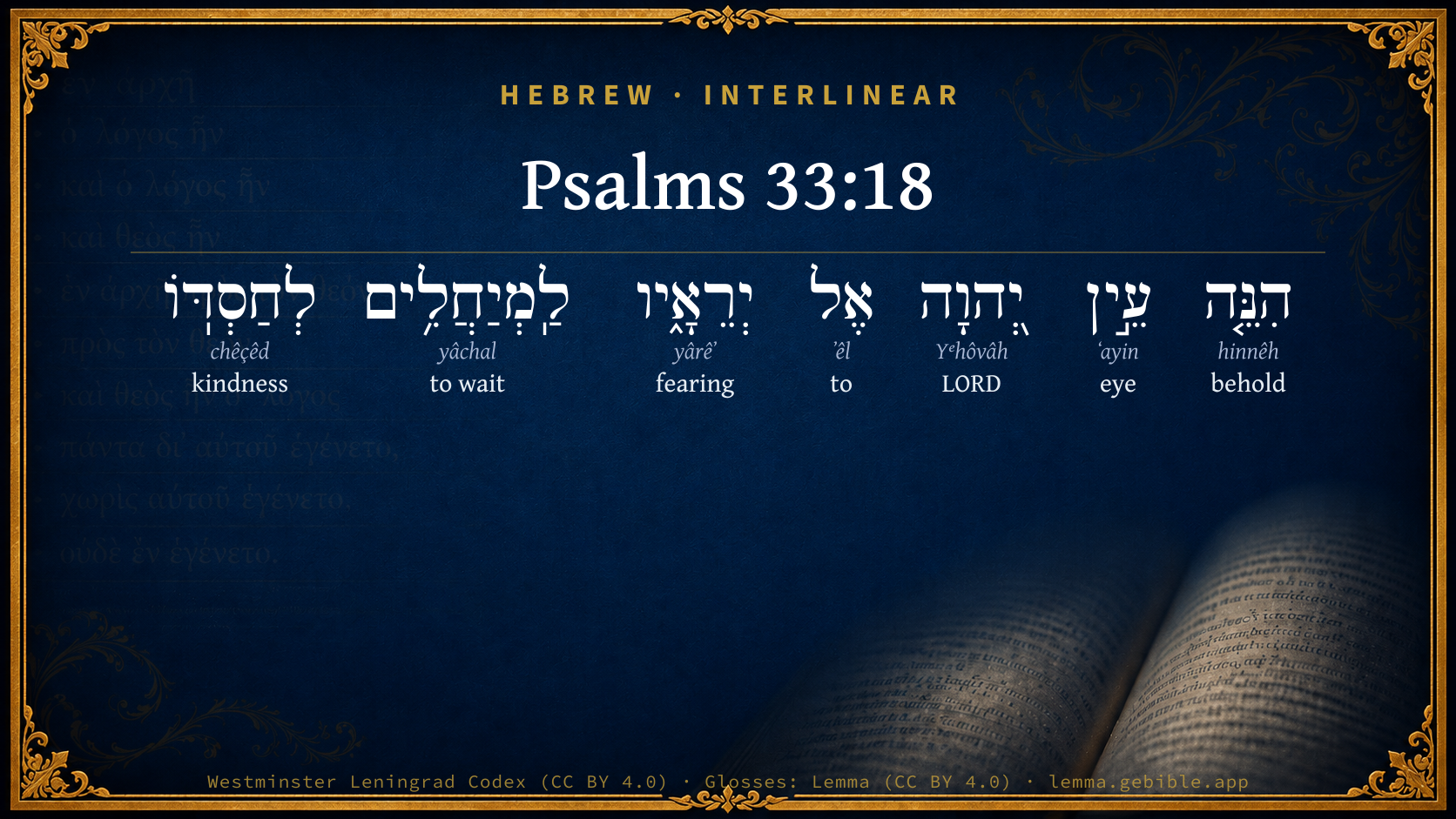
Hebrew (Westminster Leningrad Codex) Psalms 33:18 appears in the Hebrew Old Testament. The text above is from the Westminster Leningrad Codex. Each word links to its Strong’s number, a concise gloss, and parsing drawn from the Open Scriptures Hebrew Bible morphology. Click any word for its full Brown-Driver-Briggs (BDB) entry.
Download image
Cite this verse

Psalms 33:18 (World English Bible). Public Domain. Lemma interlinear Bible study tool, https://lemma.gebible.app/v/psalms/33/18.

Show BibTeX & RIS
BibTeX
RIS
English Translation
Behold, Yahweh's eye is on those who fear him, On those who hope in his loving kindness;
World English Bible · Public Domain
Download a study sheet

One document with this verse’s original text, its word-by-word gloss line, the meaning frame, cross-references with their text, attributed commentary, and full source and license credits — printable, and it pastes into notes with its structure intact.

This verse Autodidact and up

Study sheet (.html) Plain text (.txt)

A passage Seminary Student

Up to 50 verses in one chapter. A passage sheet keeps up to 6 commentary sources and 12 cross-references per verse, in the order this page ranks them, and says so on the sheet whenever that leaves anything out. Ask for a single verse and you get the Autodidact verse sheet above.

Everything on this page stays free to read, with no account — the sheet is a download of what is already on screen, not access to it.

Want to remove ads? Support Godless Engineer
Compare translations 3

The same verse in 3 English versions, stacked beneath the original-language interlinear above. Click any original word for its lexicon entry.

Each is an independent rendering of the whole verse — the interlinear is not word-aligned to these translations.

Highlighted words mark where these versions differ — a whole-verse word diff, not a word-by-word alignment.

  • World English Bible Public Domain
    Behold, Yahweh's eye is on those who fear him, On those who hope in his loving kindness;
  • King James Version Public Domain
    Behold, the eye of the LORD is upon them that fear him, upon them that hope in his mercy;
  • unfoldingWord Literal Text CC BY-SA 4.0
    Behold, the eye of Yahweh toward the fearers of him, toward those hoping for his covenant faithfulness,

unfoldingWord Literal Text — © unfoldingWord, licensed CC BY-SA 4.0. Word-aligned USFM3 via Door43 (git.door43.org/unfoldingWord/en_ult).

Versions to compare (up to 4)

3 of 4 selected

Show all 18 translations

Every available English version of this verse, each an independent rendering of the whole verse.

  • World English Bible Public Domain
    Behold, Yahweh's eye is on those who fear him, On those who hope in his loving kindness;
  • Berean Standard Bible Public Domain
    Surely the eyes of the LORD are on those who fear Him, on those whose hope is in His loving devotion
  • Majority Standard Bible Public Domain
    Surely the eyes of the LORD are on those who fear Him, on those whose hope is in His loving devotion
  • King James Version Public Domain
    Behold, the eye of the LORD is upon them that fear him, upon them that hope in his mercy;
  • American Standard Version (1901) Public Domain
    Behold, the eye of Jehovah is upon them that fear him, Upon them that hope in his lovingkindness;
  • Revised Version (1885) Public Domain
    Behold, the eye of the LORD is upon them that fear him, upon them that hope in his mercy;
  • Geneva Bible (1599) Public Domain
    Beholde, the eye of the Lord is vpon them that feare him, and vpon them, that trust in his mercie,
  • Douay-Rheims (1899) Public Domain
    Behold the eyes of the Lord are on them that fear him: and on them that hope in his mercy.
  • Young's Literal Translation Public Domain
    Lo, the eye of Jehovah `is' to those fearing Him, To those waiting for His kindness,
  • Literal Standard Version CC BY-SA 4.0
    Behold, the eye of YHWH [is] to those fearing Him, || To those waiting for His kindness,
  • Unlocked Literal Bible CC BY-SA 4.0
    See, Yahweh's eye is on those who fear him, on those who hope in his covenant faithfulness
  • unfoldingWord Literal Text CC BY-SA 4.0
    Behold, the eye of Yahweh toward the fearers of him, toward those hoping for his covenant faithfulness,
  • Darby Bible Public Domain
    Behold, the eye of Jehovah is upon them that fear him, upon them that hope in his loving-kindness,
  • World Messianic Bible Public Domain
    Behold, the LORD’s eye is on those who fear him, on those who hope in his loving kindness,
  • Webster's Bible Public Domain
    Behold, the eye of the LORD is upon them that fear him, upon them that hope in his mercy;
  • Free Bible Version CC BY-SA 4.0
    The Lord watches over those who reverently follow him, those who place their hope in his trustworthy love
  • Bible in Basic English Public Domain
    See, the eye of the Lord is on those in whose hearts is the fear of him, on those whose hope is in his mercy;
  • JPS Tanakh (1917) Public Domain
    Behold, the eye of the LORD is toward them that fear Him, toward them that wait for His mercy;

Literal Standard Version (2020), Covenant Press — licensed CC BY-SA 4.0. Text via the HelloAO Bible API (eBible.org). Unlocked Literal Bible (unfoldingWord) — licensed CC BY-SA 4.0. Text via the HelloAO Bible API (eBible.org). unfoldingWord Literal Text — © unfoldingWord, licensed CC BY-SA 4.0. Word-aligned USFM3 via Door43 (git.door43.org/unfoldingWord/en_ult). Free Bible Version, Dr. Jonathan Gallagher — licensed CC BY-SA 4.0. Text via the HelloAO Bible API (eBible.org).

Word by word

More ways to search: Search by grammar → Find every occurrence → Compare this word →

Practice this passage: Drill this verse → Learn its vocabulary →

About this verse

These counts appear in no published source. They are computed here, from the morphology-tagged text and Lemma’s own curated glosses. What Lemma adds →

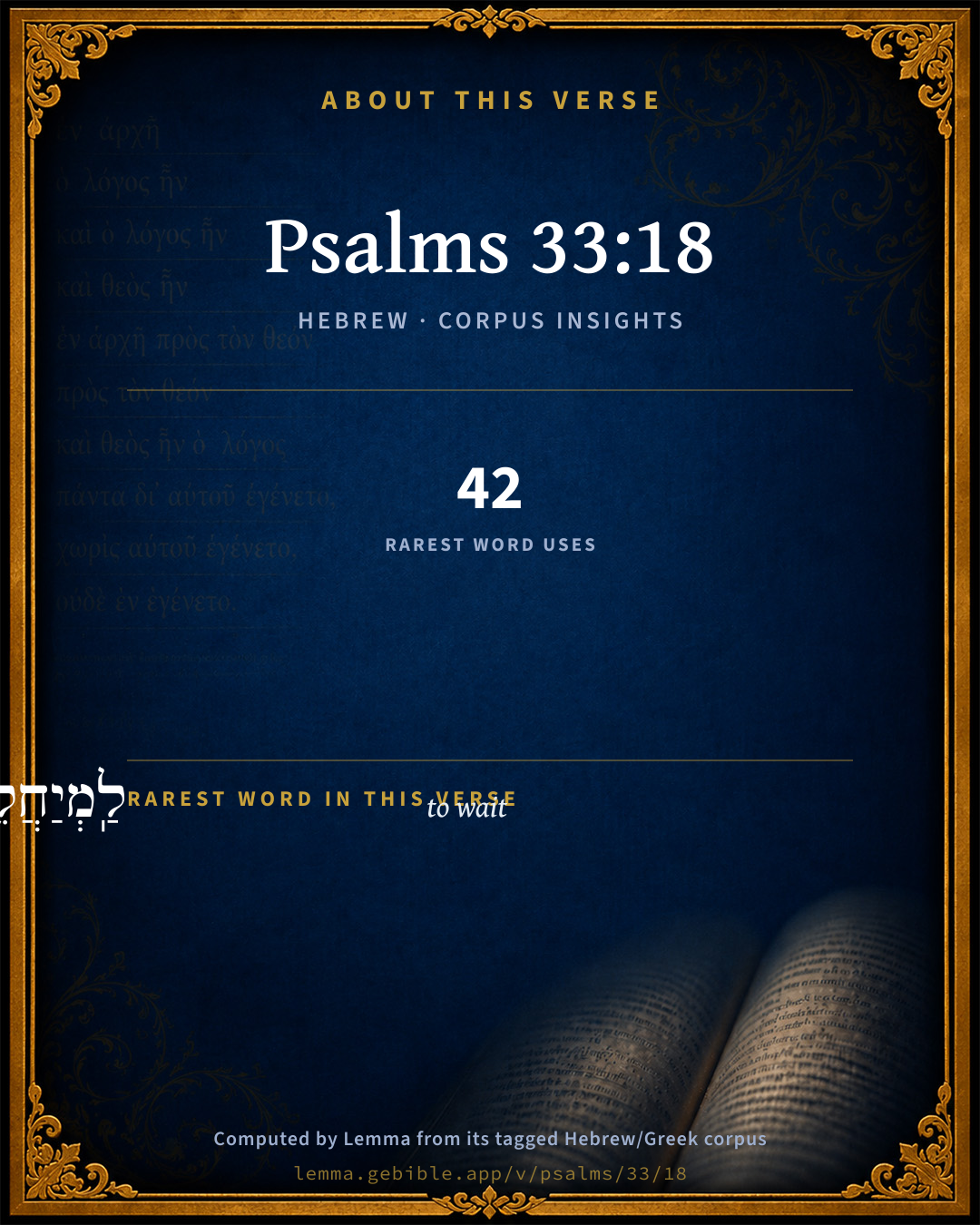
7
words
7
distinct lemmas
Wisdom
section

Shared distinctive vocabulary

לַֽמְיַחֲלִ֥ים to wait H3176 occurs in 41 verses of the Hebrew Bible. Also found in:

Grammatical profile

  • 1 verb
  • 3 nouns
  • 1 adjective
  • 1 preposition
  • 1 particle

Verb forms

  • לַֽמְיַחֲלִ֥ים Piel · Participle Active

Hebrew & Septuagint length

In English translation the verse runs 17 words from the Hebrew and 18 from the Septuagint (LXX English) — closely comparable.

A rough comparison of the two English renderings, which tokenize alike — not a word-level alignment.

Word counts can differ between the Hebrew and the Greek without any difference in meaning — e.g. the Hebrew direct-object marker אֵת has no separate Greek word, and Greek often adds the article ὁ.

Cross-references

8

Topical passages linked to Psalms 33:18 in the Treasury of Scripture Knowledge — connected by theme and wording, ordered by reader-vote popularity; previews shown in the World English Bible.

  • 1 Peter 3:12 For the eyes of the Lord are on the righteous, And his ears open to their prayer; But the face of the Lord is against those who do evil."
  • Psalms 147:11 Yahweh takes pleasure in those who fear him, In those who hope in his loving kindness.
  • Job 36:7 He doesn't withdraw his eyes from the righteous, But with kings on the throne, He sets them forever, and they are exalted.
  • Psalms 34:15–20 Yahweh's eyes are toward the righteous. His ears listen to their cry.
  • Hebrews 6:18 that by two immutable things, in which it is impossible for God to lie, we may have a strong encouragement, who have fled for refuge to take hold of the hope set before us.
  • Psalms 13:5 But I trust in your loving kindness. My heart rejoices in your salvation.
  • Psalms 52:8 But as for me, I am like a green olive tree in God's house. I trust in God's loving kindness forever and ever.
  • Romans 4:4–8 Now to him who works, the reward is not counted as grace, but as debt.

Cross-references courtesy of OpenBible.info (CC BY 4.0).

Hebrew and Greek witnesses Masoretic Hebrew ↔ Greek Septuagint

The same verse in the two great witnesses to the Old Testament, shown verse-for-verse.

You’re reading Greek Psalm 32 (Hebrew Psalm 33). The Septuagint counts the superscription, so verse numbers can differ from the Hebrew — chapter-level alignment, not verse-by-verse. Numbering follows Rahlfs.

These are two independent witnesses, not word-aligned to each other, and the Septuagint is shown in lemma (dictionary) form.

Hebrew Psalms 33:18 Masoretic · Westminster Leningrad Codex

הִנֵּ֤ה עֵ֣ין יְ֭הוָה אֶל יְרֵאָ֑יו לַֽמְיַחֲלִ֥ים לְחַסְדּֽוֹ

Behold, Yahweh's eye is on those who fear him, On those who hope in his loving kindness;

World English Bible · Public Domain

Greek LXX Greek Psalm 32:18 Septuagint · lemma form

ἰδού ὁ ὀφθαλμός κύριος ἐπί ὁ φοβέω αὐτός ὁ ἐλπίζω ἐπί ὁ ἔλεος αὐτός

Behold, the eyes of the Lord are on them that fear him, those that hope in his mercy;

LXX2012 (modern English Septuagint) · Public Domain

Hebrew: Westminster Leningrad Codex (CC BY 4.0). Greek: Septuagint (public domain); English from LXX2012 (modern English Septuagint) (Public Domain). How the Septuagint differs from the Hebrew →

Commentary

Notes on Psalms 33:18 from classic Christian and Jewish commentators (each source and its license shown beneath its notes). The classic Christian expositions comment on the surrounding passage and are grouped to its opening verse, so a note may address several verses; the Jewish commentaries on the Tanakh (Rashi and others) are per-verse, so they appear only where the commentator wrote on this verse.

Lemma curates 59 commentaries, every one of them public domain or Creative Commons licensed, each selected and text-cleaned for this edition rather than reprinted as found. About our sources →

Trapp's Complete Commentary

John Trapp

Psa 33:18 Behold, the eye of the LORD [is] upon them that fear him, upon them that hope in his mercy;

Ver. 18. Behold, the eye of the Lord is on them that fear him] He looketh upon such with singular delight; not without sweet intimations of his singular kindness and care of their good.

Upon them that hope in his mercy] Here we have a description of that true Church which God will never forsake; sc. It is a company of such as truly serve God, and boast not of their merits; but, possessing their souls in hope and silence, wait for his mercy.

John Trapp, A Commentary or Exposition upon All the Books of the Old and New Testament (1647–1656) — public domain. Text from a community e-Sword module.

The Biblical Illustrator

Joseph S. Exell

Psa_33:18-20

Behold! the eye of the Lord is upon them that fear Him, upon them that hope in His mercy.

The eye of the Lord

Behold! It is a marked word in Scripture! Isaiah typifying the Christ that was to come, opens the glorious secret thus--Behold My servant, whom I uphold; Mine Elect, in whom My soul delighteth: I will put My spirit upon Him; He shall bring forth judgment unto the Gentiles. And, when that despicable creature Pilate brought forth the glorious, the insulted, and the suffering Jesus, his word was--Behold! the man. And so the Holy Ghost adopts this striking, telling word--Behold[ to captivate the heart with that which follows; giving a faithful description of She church in her chequered state of exercise and trial in all ages.

I. the character spoken of in the text--them that fear Him. Do you fear God? Another character is, them that hope in his mercy. Observe that word--them that hope in His mercy. That is enough! That is Christianity! But hope set up in a broken heart!

II. Upon all such is the eye of the Lord. Is that eye on you?

III. why the eye of the Lord is upon them--to deliver their soul from death and to keep, etc.

IV. the personal experience of the text. (J. J. West, M. A.)

Special pleading with the specially feeble

See the opposite in the text--fear and hope. They seem to be contradictions, but yet here they are together. That is a blessed state in which fear keeps the door and hope spreads the table; fear the watch-dog without and hope the lamp within. Then that hope in the Lords mercy may be the very least of His people, but they are His people, for His eye is upon them. Now, to those whose sole hope is hope in Gods mercy, we would say--

I. this hope is one, and only one. Let me ask--

1. Have you any hope in your own character? At once he replies, None at all. Now this is well, humbling as the admission is. O, self-truster, you are a living insult to the Cross of Christ.

2. Have you any hope in external ordinances?

3. Have you any trust in the priesthood of man?

4. In scientific discoveries? Now, to all these questions the answer is clear and explicit. He has no trust in them at all, but in Christ only. Then--

II. that this hope in Christ has good foundations. I rejoice in your sense of sin, but I lament your doubts of pardon; for consider--

1. The merciful character of God. His very name is love. And--

2. There is a gospel. There is forgiveness for the greatest sin. The very word gospel is full of the greatest hope for man.

3. Think of the life of the Lord Jesus hero on earth. Did He ever reject any who came to Him?

4. And of the Holy Spirit. He is provided to meet all your difficulties. And--

5. We may pray. It would be a wicked hoax if a man invited poor people to his house to receive charity, and then, when they came there, denied them relief, God does not deal with us so.

6. And how many have come to Christ and been moved by Him? I am one of them. I do not think that you are any worse than I was.

III. this hope may be yours. Let me try to chase away objections. Oh, say you, I have been guilty of the worst of sins. In the case of certain of you I do not believe it. You have enough to answer for without blackening yourself needlessly. But worse sinners than you have come to Christ. And may there not be a spice of rebellion against God in your humility, a little sullenness in it? Dont put away Christ from you out of a proud despair. Accept His mercy as a commonplace sinner. And what good do you think your death, if He leaves you to perish, as you think He will, will do Him? And suppose, after all, you are one of His chosen, and that He has loved you all along, is it not sad that you should not love and trust him. (C. H. Spurgeon.)

The Biblical Illustrator, edited by Joseph S. Exell (c. 1880s–1900s) — public domain. Text from a community e-Sword module.

The Treasury of David

Charles H. Spurgeon

Ver. 18. Behold. For this is a greater wonder than hosts and horses, a surer confidence than chariots or shields. The eye of the Lord is upon them that fear him. That eye of peculiar care is their glory and defence. None can take them at unawares, for the celestial watcher foresees the designs of their enemies, and provides against them. They who fear God need not fear anything else; let them fix their eye of faith on him, and his eye of love will always rest upon them. Upon them that hope in his mercy. This one would think to be a small evidence of grace, and yet it is a valid one. Humble hope shall have its share as well as courageous faith. Say, my soul, is not this an encouragement to thee? Dost thou not hope in the mercy of God in Christ Jesus? Then the Father's eye is as much upon thee as upon the elder born of the family. These gentle words, like soft bread, are meant for babes in grace, who need infant's food.

Ver. 18. Behold, etc. Hitherto he had given a proof of God's providence towards all men, but now he descends to a particular proof of it, by his care over his church, which he wonderfully guides, defends, and protects in all dangers and assaults; and that notice may be taken of it, he begins with, "Behold!" Adam Clarke.

Ver. 18. The eye of the Lord is upon. Look upon the sun, how it casts light and heat upon the whole world in its general course, how it shineth upon the good and the bad with an equal influence; but let its beams be but concentrated in a burning glass, then it sets fire on the object only, and passeth by all others: and thus God in the creation looketh upon all his works with a general love, erant omnia valde bona, they pleased him very well. Oh! but when he is pleased to cast the beams of his love, and cause them to shine upon his elect through Christ, then it is that their hearts burn within them, then it is that their affections are inflamed; whereas others are but as it were a little warmed, have a little shine of common graces cast upon them. Richard Holdsworth, 1651.

Ver. 18. Behold, the eye of the Lord is upon them that fear him, upon them that hope in his mercy. This is a very encouraging character. They who cannot claim the higher distinctions of religion, may surely know that they "fear God, and hope in his mercy." Some may wonder at the combination; and suppose that the qualities are incompatible with each other. But the first Christians "walked in the fear of the Lord, and in the comforts of the Holy Ghost." They may think that the fear will injure the hope, or the hope the fear. But these are even mutually helpful; and they are, not only never so beautiful, but never so influential as when they are blended. The fear promotes hope by the evidence it affords; and by keeping us from loose and careless walking, which must always affect our peace and pleasure. And hope no less befriends this fear. For never is God seen so glorious, so worthy of all our devotedness to him as when we hope in his mercy; and even the more assured we are of his regard, the more we shall enquire, Lord, what wilt thou have ne to do? The more we shall tremble at the thought of offending and grieving him, the more we shall continue upon our knees praying, "Let the words of my mouth, and the meditation of my heart, be acceptable in thy sight, O Lord, my Strength and my Redeemer." It is called "a lively hope:" and Christians know, by experience, that upon all their principles and duties it has the same influence as Spring has upon the fields and the gardens. William Jay.

Ver. 18. Who hope in his mercy. When thou canst not get assurance, make as much improvement of the grounds upon which thou mayest build hopes of salvation. The probable grounds thou hast, thou wouldst not part with for all the world. If thy heart is not full of joy through sense of God's love, yet thine eyes are full of tears, and thy soul full of sorrow, through the sense of thy sin: wouldst thou change thy condition with any hypocrite whatsoever, with the richest man that hath no grace? I would not have thee rest satisfied with a probability, but yet bless God for a probability of salvation. Is it nothing that one that hath deserved hell most certainly, should have a probability that he should escape it? Would not this be a little ease to the torments of the damned, if they had but a strong probability that they should be saved? but no hope makes it heavy. When thou art sick, thou enquirest of the physician, Sir, what do you think of me? Shall I live, or shall I die? If he reply it is not certain, but there is good hopes, it is probable you will live and do well; this is some support unto thee in thy sickness. Thomas Doolittle, M.A. (1630-1707), in "Morning Exercises."

Ver. 18. The weakest believer, the least of saints, hath ground to hope. The gospel is so ordered, the covenant so methodised, God hath made such ample provision, that every one may "have good hope through grace" 1Th 2:16; and all that bear this character are allowed, encouraged, nay, commanded to hope: their hoping is as mighty a pleasure to God, as it is a comfort to themselves. Samuel Doolittle's "Righteous Man's Hope in Death, "1693.

Ver. 18-19. During the siege of Rochelle, which was endured with unexampled bravery for nearly fifteenth months, the inhabitants were reduced by famine to the misery of being obliged to have recourse to the flesh of horses, asses, mules, dogs, cats, rats, and mice; and a single peck of corn is said to have been sold for a sum equivalent to about twenty-five pounds sterling of our money in the present day. There were numerous examples of great and liberal generosity among the inhabitants. Some dispensed their charity so secretly that their names were never discovered. Among the rest, the following example is narrated: --"The Sieur de la Goute, an honorary king's advocate, had a sister, the widow of a merchant named Prosni, who, being a very religious and benevolent woman, at the time when the famine became more severe than it had been, freely assisted the poor with her present surplus. Her sister-in-law, the wife of her brother, De la Goute, being differently inclined, reproved her for her conduct, asking her in anger, `What she would do when all should be expended?' Her reply was, `My sister, the Lord will provide for me.' The siege was continued, and the famine increased its fearful ravages; and poor widow Prosni, who had four children, found herself in a great strait--all her store of provisions being exhausted. She applied to her sister for relief, who, in the stead of comforting, reproached her for her improvidence; tauntingly adding that, as she had done mighty well to be so reduced under all her great faith and fine words, that `the Lord will provide for her.'so in good time he might provide for her. Wounded to the heart by these words, poor widow Prosni returned to her house in sad distress; resolving nevertheless to meet death patiently. On reaching her home, her children met her with gladdened hearts and joyous faces, and told her that a man, to them an entire stranger, had knocked at the door, it being late; and, on its being opened, he threw in a sack of about two bushels of wheat; and then, without saying a word, suddenly departed. The widow Prosni, scarcely able to believe her own eyes, with an overflowing, grateful heart towards her gracious benefactor, immediately ran to her sister-in-law as quickly as her famished condition would allow; and upon seeing her, exclaimed aloud, `My sister, the Lord HATH provided for me; 'and, saying no more, returned home again. By means of this unexpected relief, conveyed to her so opportunely, she was enabled to support herself and family until the end of the siege, and she never knew to whom she was instrumentally indebted for this timely and merciful assistance." The Biblical Treasury, Vol. 4

Ver. 18. Hoping in the mercy of God--false and true forms distinguished.

Ver. 18.

1. The eyes of God's knowledge are upon them.

2. The eyes of his affection are upon them.

3. The eyes of his providence are upon them.

William Jay.

Psalms 33:19*

Ver. 18-19. See Psalms on "Ps 33:18" for further information.

Charles H. Spurgeon's The Treasury of David (1869–1885) — public domain. Psalms only. Text from a community e-Sword/MySword module.

Joseph Benson's Commentary

Psa 33:18-19. Behold the eye of the Lord, &c. — Whosoever therefore would have safety must expect it only from the watchful eye and almighty hand of God. Is upon them that fear him — These are the chief objects of his care and favour. Upon them that hope in his mercy — That place their hope, and trust, and happiness, not in any creature, but only in God and in his mercy and blessings. To deliver their soul from death — That is, their life, when he sees it to be expedient for them: for sometimes it is better for them to die than to live, as both good and bad men have declared; and when it is so, it is known to God, but not to us. And therefore the constant accomplishment of this and the like promises, in a literal sense, is not to be expected nor simply desired, except with submission to God’s wise and gracious will.

Joseph Benson's Commentary on the Old and New Testaments (1811–1818) — public domain. Text from a community e-Sword module.

J. A. Alexander on Psalms

Joseph Addison Alexander

18. (Psa 33:18) Lo, the eye of Jehovah (is) towards his fearers, to those waiting for his mercy. While the material strength of other men fails to secure them, those who fear the Lord, and hope in his mercy, are secure beneath his vigilant inspection. That this is intended for their good, is more distinctly stated in the next verse.

Joseph Addison Alexander, The Psalms Translated and Explained (1850) — public domain. Text from a community e-Sword module.

Tyndale Open Study Notes

Tyndale Open Resources

33:18 God watches over all who live by his counsel (32:8). He protects, rescues, and remains close to them (34:15-22).

Tyndale Open Study Notes — © Tyndale Open Resources, licensed CC BY-SA 4.0. Text via the HelloAO Bible API.

Geneva Bible (1599)

Geneva Bible translators

God showeth that toward his of his mercy, which man by no means is able to compass.

Geneva Bible (1599) marginal notes — public domain. Text via Bolls.life.

Jamieson, Fausset & Brown

Robert Jamieson, A. R. Fausset & David Brown

Contrasted is God's guidance and power to save from the greatest earthly evil and its most painful precursor, and hence from all.

Jamieson, Fausset & Brown — Commentary Critical and Explanatory on the Whole Bible (1871) — public domain (CC PDM 1.0). Text via the HelloAO Bible API.

Adam Clarke's Commentary

Verse 18. Behold, the eye of the Lord] Though all the above are unavailing, yet here is one thing that can never fail; "the eye of the Lord"-the watchful providence of the Most High, "is upon them that fear him, upon them that hope in his mercy."

Adam Clarke's Commentary on the Bible (1810–1826) — public domain. Text from a community e-Sword/MySword module.

John Calvin's Commentaries

18. Behold, the eye of Jehovah is upon them that fear him. Having shown that what men account their best defences often profit them nothing, or rather are utterly worthless, when men depend upon them; the Psalmist now shows, on the other hand, that believers, although they are neither men of great power nor of great wealth, are nevertheless sufficiently protected by God’s favor alone, and shall be safe for ever. His meaning is not a little illustrated by this comparison, that kings and giants derive no aid from their invincible strength, while God supports the life of the saints in famine and dearth, as really as if he were to restore life to them when dead. We consequently understand better why the prophet lays low all the strength of the world; not, surely, that men should lie prostrate, or be so heart-broken as to pine away in despair; but that, laying aside their pride, they should fix their thoughts on God alone, and persuade themselves that their life depends on his protection. Moreover, in saying that the eye of God is bent upon them that fear him to save them, he expresses more than if he had said that his hand and power were sufficient to preserve them. A doubt might creep into the minds of the weak, whether God would extend this protection to every individual; but when the Psalmist introduces him as keeping watch and ward, as it were, over the safety of the faithful, there is no reason why any one of them should tremble, or hesitate with himself a moment longer, since it is certain that God is present with him to assist him, provided he remain quietly under his providence. From this, also, it appears still more clearly how truly he had said a little before, that the people are blessed whose God is Jehovah, because, without him, all the strength and riches which we may possess will be vain, deceitful, and perishing; whereas, with a single look he can defend his people, supply their wants, feed them in a time of famine, and preserve them alive when they are appointed to death. The whole human race, no doubt, are maintained by the providence of God; but we know that his fatherly care is specially vouchsafed to none but his own children, that they may feel that their necessities are truly regarded by him.

John Calvin's Commentaries (1540-1563) — public domain. Text from the Calvin Translation Society English edition (1840s-50s) via the Christian Classics Ethereal Library (ccel.org). Calvin's coverage is partial (roughly two-thirds of the Bible); uncommented books and verses are honest gaps, never fabricated. The 19th-century editor's footnotes and remarks are omitted so the notes are faithfully Calvin's own voice.

The Cambridge Bible for Schools and Colleges

gen. ed. J. J. S. Perowne

18. the eye of the Lord] Cp. Psa_32:8, note; Psa_34:15; Ezr_5:5; Job_36:7; 1Pe_3:12.

that hope in his mercy] Or, that wait for his lovingkindness (Psa_31:24).

The Cambridge Bible for Schools and Colleges (gen. ed. J. J. S. Perowne; Cambridge University Press, 1878–1918) — public domain. Text from a community e-Sword module.

John Gill's Exposition

Behold, the eye of the Lord is upon them that fear him,.... Not with dread of his wrath, or distrust of his grace, or for sinister ends and selfish views, but with a godly fear; by which men hate evil, depart from it, are careful not to offend God by it, but to serve and worship him; on such is not only his eye of Providence to protect from danger, to supply with the necessaries of life, but of love and grace; he looks upon them with delight and pleasure; his eye is upon them to watch over them for good, to guard them from every enemy, and from all evil, and to communicate to them every needful measure of grace;

upon them that hope in his mercy; not his absolute mercy, but his special mercy in Christ; which appears in the provision of him as a Saviour, in the mission of him into this world, and redemption by him; and is displayed in regeneration, the pardon of sin, and eternal life: and such that hope in it are they that see themselves miserable creatures, and in need of it; and who are encouraged to hope in it from the plenty and abundance of it in the heart of God; and from the many instances of it among men, and even some the chief of sinners; and they do hope in it for the forgiveness of their sins, and for salvation and eternal glory; and on these the eye of the Lord is, as before,

John Gill's Exposition of the Whole Bible (1746–1763) — public domain (CC PDM 1.0). Text via the HelloAO Bible API.

Albert Barnes' Notes on the Bible

Behold, the eye of the Lord is upon them that fear him - He watches over them, and “he” guards them from danger. His eye is, in fact, upon all men; but it is directed with special attention to those who fear him and trust in him. Their security is in the fact that the eye of God is upon them; that he knows their wants; that he sees their dangers; that he has ample ability to deliver and save them.

Upon them that hope in his mercy - Upon the pious; upon his friends. The expression is a very beautiful one. It describes the true state of a pious heart; it in fact characterizes the whole of religion, for we imply all that there is in religion on earth when we say of a man, that - conscious of his weakness and sinfulness - “he hopes in the mercy of God.”

Albert Barnes' Notes on the Bible (1834–1885) — public domain. Text from a community e-Sword/MySword module.

Matthew Poole's English Annotations

Whosoever therefore would have safety and deliverance, must seek and expect it only from the watchful eye and almighty hand and mercy of God.

Them that fear him; these are the chief objects of his care and favour.

Them that hope in his mercies; that place their hope, and trust, and happiness not in any creature, but only in God, and in his mercy and blessings. The conjunction and order of these two qualifications of the person whom God careth for is observable here, they must be such as fear God, and so make conscience of keeping his commands, Ecc 12:13, and then they may and must hope in or rely upon his mercy for their safety and happiness.

Matthew Poole's English Annotations on the Holy Bible (1683–1685) — public domain. Text from a community e-Sword/MySword module.

Whedon's Commentary on the Bible

Daniel D. Whedon

18, 19. If no enlargement or concentration of human forces can be trusted for victory and safety, yet there is one resource unfailing—the God of hosts, the God of battles, Jehovah, the covenant God.

The eye of the Lord—Denoting his perfect knowledge and personal care of those who trust him.

Death… famine—The connexion would suggest “death,” here, as the effect of war, and this, with “famine,” have been the dreaded scourges of the nations in all ages.

Daniel D. Whedon (gen. ed.), Commentary on the Old and New Testaments (1874–1909) — public domain. Text from a community e-Sword module.

The Pulpit Commentary

Behold, the eye of the Lord is upon them that fear him; upon them that hope in his mercy. The eye of the Lord is in a certain sense upon all (vers. 13, 14), but it rests especially upon the righteous. He notes how all men act, but carefully watches over the safety and prosperity of his faithful ones.

The Pulpit Commentary (1880–1919), ed. H.D.M. Spence-Jones & Joseph S. Exell — public domain. Text from a community e-Sword module.

John Wesley's Explanatory Notes

The eye - Whosoever therefore would have safety, must expect it only from the watchful eye, and almighty hand of God. That fear - These are the chief objects of his care and favour. Hope - That place their hope and trust, and happiness, not in any creature, but only in God, and in his mercy and blessings.

John Wesley, Explanatory Notes Upon the Whole Bible (1754–1765) — public domain. Text via the GEBible commentary corpus.

Scofield Reference Notes

C. I. Scofield

fear

(See Scofield "Psa 19:9")

The Scofield Reference Bible (1917 edition), notes by C. I. Scofield — public domain. Text from a community e-Sword module.

unfoldingWord translationNotes

Door43 World Missions Community

See

This word shows that a new theme begins in this Psalm. AT: "Look" or "Listen" or "Pay attention to what I am about to tell you"

Yahweh's eye

Here "eye" refers to Yahweh's attention. AT: "Yahweh's attention" (See: Metonymy)

those who hope in his covenant faithfulness

The idiom to "count on" means to "wait for" or to "expect." The abstract noun "faithfulness" can be translated as an adverb. AT: "those who expect him to act faithfully because of his covenant" or "those who wait for him to act because he is faithful to his covenant" (See: Idiom and Abstract Nouns)

to deliver their lives from death

Here "their lives" refers to the people. AT: "to keep them from dying" (See: Synecdoche)

translationWords

fear

covenant faithfulness

die

life

famine

unfoldingWord translationNotes — © Distant Shores Media and the Door43 World Missions Community, licensed CC BY-SA 4.0. Source: git.door43.org/Door43/en_tn.

Lesson kit

Teaching starters — assembled from the data on this page, not authored interpretation. Every prompt links to the verse data it draws on. Edit before teaching.

Psalms, in the Wisdom, opens this verse with 7 words (7 distinct Hebrew lemmas). Its most distinctive word is yâchal (“to wait”). A historical commentator’s framing appears above. Read the whole chapter for the surrounding context.

Discussion questions

  1. The word yâchal carries the sense “to wait.” How does it shape the verse?
  2. How does Genesis 8:12, which shares the word «to wait», read alongside this verse?
  3. These translations render this verse differently; the difference is in the English rendering, not the original. What questions does that raise?
  4. «לַֽמְיַחֲלִ֥ים» is a Piel Participle Active verb. How does that grammatical form shape the action described?
  5. Compare how Trapp's Complete Commentary and The Biblical Illustrator read this verse. Where do they agree or differ?

Things to notice

Reading settings

Reading text

Shown beneath each verse's original-language words.

Old Testament
Old Testament edition

Read the OT as the Masoretic Hebrew (MT) or the Greek Septuagint (LXX).

English shown for the Greek Septuagint (in the Hebrew ↔ Greek comparison).

Comparing translations? Open the Compare panel on any verse page to stack up to four side by side.