
Ezekiel 37:19

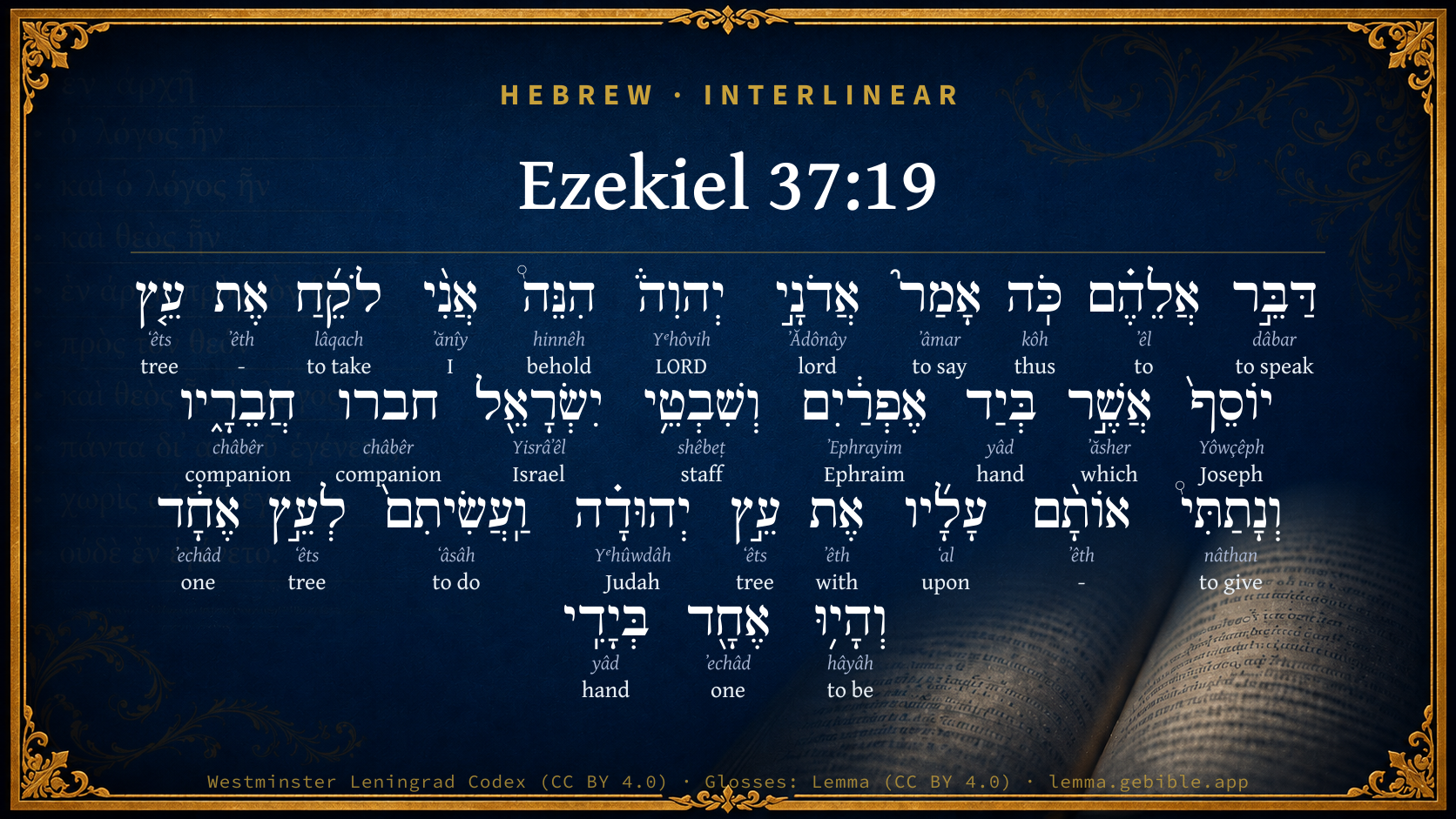
Hebrew (Westminster Leningrad Codex) Ezekiel 37:19 appears in the Hebrew Old Testament. The text above is from the Westminster Leningrad Codex. Each word links to its Strong’s number, a concise gloss, and parsing drawn from the Open Scriptures Hebrew Bible morphology. Click any word for its full Brown-Driver-Briggs (BDB) entry.
Download image
Cite this verse

Ezekiel 37:19 (World English Bible). Public Domain. Lemma interlinear Bible study tool, https://lemma.gebible.app/v/ezekiel/37/19.

Show BibTeX & RIS
BibTeX
RIS
English Translation
tell them, Thus says the Lord Yahweh: Behold, I will take the stick of Joseph, which is in the hand of Ephraim, and the tribes of Israel his companions; and I will put them with it, [even] with the stick of Judah, and make them one stick, and they shall be one in my hand.
World English Bible · Public Domain
Download a study sheet

One document with this verse’s original text, its word-by-word gloss line, the meaning frame, cross-references with their text, attributed commentary, and full source and license credits — printable, and it pastes into notes with its structure intact.

This verse Autodidact and up

Study sheet (.html) Plain text (.txt)

A passage Seminary Student

Up to 50 verses in one chapter. A passage sheet keeps up to 6 commentary sources and 12 cross-references per verse, in the order this page ranks them, and says so on the sheet whenever that leaves anything out. Ask for a single verse and you get the Autodidact verse sheet above.

Everything on this page stays free to read, with no account — the sheet is a download of what is already on screen, not access to it.

Want to remove ads? Support Godless Engineer
Compare translations 3

The same verse in 3 English versions, stacked beneath the original-language interlinear above. Click any original word for its lexicon entry.

Each is an independent rendering of the whole verse — the interlinear is not word-aligned to these translations.

Highlighted words mark where these versions differ — a whole-verse word diff, not a word-by-word alignment.

  • World English Bible Public Domain
    tell them, Thus says the Lord Yahweh: Behold, I will take the stick of Joseph, which is in the hand of Ephraim, and the tribes of Israel his companions; and I will put them with it, [even] with the stick of Judah, and make them one stick, and they shall be one in my hand.
  • King James Version Public Domain
    Say unto them, Thus saith the Lord GOD; Behold, I will take the stick of Joseph, which is in the hand of Ephraim, and the tribes of Israel his fellows, and will put them with him, even with the stick of Judah, and make them one stick, and they shall be one in mine hand.
  • unfoldingWord Literal Text CC BY-SA 4.0
    then say to them, ‘The Lord Yahweh says this: Behold! I am taking the branch of Joseph that is in the hand of Ephraim and the tribes of Israel his companions and joining it to the branch of Judah, so that they will make one branch, and they will become one in my hand.’

unfoldingWord Literal Text — © unfoldingWord, licensed CC BY-SA 4.0. Word-aligned USFM3 via Door43 (git.door43.org/unfoldingWord/en_ult).

Versions to compare (up to 4)

3 of 4 selected

Show all 18 translations

Every available English version of this verse, each an independent rendering of the whole verse.

  • World English Bible Public Domain
    tell them, Thus says the Lord Yahweh: Behold, I will take the stick of Joseph, which is in the hand of Ephraim, and the tribes of Israel his companions; and I will put them with it, [even] with the stick of Judah, and make them one stick, and they shall be one in my hand.
  • Berean Standard Bible Public Domain
    you are to tell them that this is what the Lord GOD says: ‘I will take the stick of Joseph, which is in the hand of Ephraim, and the tribes of Israel associated with him, and I will put them together with the stick of Judah. I will make them into a single stick, and they will become one in My hand.’
  • Majority Standard Bible Public Domain
    you are to tell them that this is what the Lord GOD says: ‘I will take the stick of Joseph, which is in the hand of Ephraim, and the tribes of Israel associated with him, and I will put them together with the stick of Judah. I will make them into a single stick, and they will become one in My hand.’
  • King James Version Public Domain
    Say unto them, Thus saith the Lord GOD; Behold, I will take the stick of Joseph, which is in the hand of Ephraim, and the tribes of Israel his fellows, and will put them with him, even with the stick of Judah, and make them one stick, and they shall be one in mine hand.
  • American Standard Version (1901) Public Domain
    say unto them, Thus saith the Lord Jehovah: Behold, I will take the stick of Joseph, which is in the hand of Ephraim, and the tribes of Israel his companions; and I will put them with it, `even' with the stick of Judah, and make them one stick, and they shall be one in my hand.
  • Revised Version (1885) Public Domain
    say unto them, Thus saith the Lord GOD: Behold, I will take the stick of Joseph, which is in the hand of Ephraim, and the tribes of Israel his companions; and I will put them with it, even with the stick of Judah, and make them one stick, and they shall be one in mine hand.
  • Geneva Bible (1599) Public Domain
    Thou shalt answere them, Thus sayeth the Lord God, Behold, I wil take the tree of Ioseph, which is in the hande of Ephraim, and the tribes of Israel his fellowes, and will put them with him, euen with the tree of Iudah, and make them one tree, and they shalbe one in mine hand.
  • Douay-Rheims (1899) Public Domain
    Say to them: Thus saith the Lord God: Behold, I will take the stick of Joseph, which is in the hand of Ephraim, and the tribes of Israel that are associated with him, and I will put them together with the stick of Juda, and will make them one stick: and they shall be one in his hand.
  • Young's Literal Translation Public Domain
    Speak unto them, Thus said the Lord Jehovah: Lo, I am taking the stick of Joseph, that `is' in the hand of Ephraim, and the tribes of Israel his companions, and have given them unto him, with the stick of Judah, and have made them become one stick, and they have been one in My hand.
  • Literal Standard Version CC BY-SA 4.0
    Speak to them, Thus said Lord YHWH: Behold, I am taking the stick of Joseph, that [is] in the hand of Ephraim, and the tribes of Israel his companions, and have given them to him, with the stick of Judah, and have made them become one stick, and they have been one in My hand.
  • Unlocked Literal Bible CC BY-SA 4.0
    then say to them, 'The Lord Yahweh says this: Behold! I am taking the branch of Joseph that is in the hand of Ephraim and the tribes of Israel his companions and joining it to the branch of Judah, so that they will make one branch, and they will become one in my hand.'
  • unfoldingWord Literal Text CC BY-SA 4.0
    then say to them, ‘The Lord Yahweh says this: Behold! I am taking the branch of Joseph that is in the hand of Ephraim and the tribes of Israel his companions and joining it to the branch of Judah, so that they will make one branch, and they will become one in my hand.’
  • Darby Bible Public Domain
    say unto them, Thus saith the Lord Jehovah: Behold, I will take the stick of Joseph, which is in the hand of Ephraim, and the tribes of Israel his companions, and will put them with this, with the stick of Judah, and make them one stick, and they shall be one in my hand.
  • World Messianic Bible Public Domain
    tell them, ‘The Lord GOD says: “Behold, I will take the stick of Joseph, which is in the hand of Ephraim, and the tribes of Israel his companions; and I will put them with it, with the stick of Judah, and make them one stick, and they will be one in my hand.
  • Webster's Bible Public Domain
    Say to them, Thus saith the Lord GOD; Behold, I will take the stick of Joseph, which is in the hand of Ephraim, and the tribes of Israel his fellows, and will put them with him, even with the stick of Judah, and make them one stick, and they shall be one in my hand.
  • Free Bible Version CC BY-SA 4.0
    tell them that this is what the Lord God says: I'm going to take Joseph's piece of wood, which Ephraim is holding, along with the Israelite tribes allied with them, and I'll join them with Judah's piece of wood. I will make them into a single piece of wood, and they will be as one in my hand.
  • Bible in Basic English Public Domain
    Then say to them, This is what the Lord has said: See, I am taking the stick of Joseph, which is in the hand of Ephraim, and the tribes of Israel who are in his company; and I will put it on the stick of Judah and make them one stick, and they will be one in my hand.
  • JPS Tanakh (1917) Public Domain
    say into them: Thus saith the Lord GOD: Behold, I will take the stick of Joseph, which is in the hand of Ephraim, and the tribes of Israel his companions; and I will put them unto him together with the stick of Judah, and make them one stick, and they shall be one in My hand.

Literal Standard Version (2020), Covenant Press — licensed CC BY-SA 4.0. Text via the HelloAO Bible API (eBible.org). Unlocked Literal Bible (unfoldingWord) — licensed CC BY-SA 4.0. Text via the HelloAO Bible API (eBible.org). unfoldingWord Literal Text — © unfoldingWord, licensed CC BY-SA 4.0. Word-aligned USFM3 via Door43 (git.door43.org/unfoldingWord/en_ult). Free Bible Version, Dr. Jonathan Gallagher — licensed CC BY-SA 4.0. Text via the HelloAO Bible API (eBible.org).

Word by word

More ways to search: Search by grammar → Find every occurrence → Compare this word →

Practice this passage: Drill this verse → Learn its vocabulary →

חברו
châbêr
H2270
“companion · his”
Noun, Common, Masculine, Singular, Construct + Suffix, Personal, 3rd Person, Masculine, Singular
Part of Speech
Noun
Type
Common
Gender
Masculine
Number
Singular
State
Construct
Full BDB Definition

Origin: from H2266

TWOT: 598c

united (adjective) - associate, fellow, worshippers (noun masculine) - companion (noun masculine)
  1. דַּבֵּ֣ר dâbar H1696 “speak” Verb, Piel, Imperative, 2nd Person, Masculine, Singular
  2. אֲלֵהֶ֗ם ʼêl H413 “to · them” Preposition + Suffix, Personal, 3rd Person, Masculine, Plural
  3. כֹּֽה kôh H3541 “thus” Adverb
  4. אָמַר֮ ʼâmar H559 “to say” Verb, Qal, Perfect, 3rd Person, Masculine, Singular
  5. אֲדֹנָ֣י ʼĂdônây H136 “Lord · my” Noun, Common, Masculine, Plural, Construct + Suffix, Personal, 1st Person, Common, Singular
  6. יְהוִה֒ Yᵉhôvih H3069 “LORD” Noun, Proper
  7. הִנֵּה֩ hinnêh H2009 “behold” Particle, Demonstrative
  8. אֲנִ֨י ʼănîy H589 “I” Pronoun, Personal, 1st Person, Common, Singular
  9. לֹקֵ֜חַ lâqach H3947 “taking” Verb, Qal, Participle Active, Masculine, Singular, Absolute
  10. אֶת ʼêth H853 “-” Particle, Direct Object
  11. עֵ֤ץ ʻêts H6086 “tree of” Noun, Common, Masculine, Singular, Construct
  12. יוֹסֵף֙ Yôwçêph H3130 “Joseph” Noun, Proper
  13. אֲשֶׁ֣ר ʼăsher H834 “which” Particle, Relative
  14. בְּיַד yâd H3027 “in/at · hand of” Preposition + Noun, Common, Both, Singular, Construct
  15. אֶפְרַ֔יִם ʼEphrayim H669 “Ephraim” Noun, Proper
  16. וְשִׁבְטֵ֥י shêbeṭ H7626 “and · staffs of” Conjunction + Noun, Common, Masculine, Plural, Construct
  17. יִשְׂרָאֵ֖ל Yisrâʼêl H3478 “Israel” Noun, Proper
  18. חֲבֵרָ֑יו châbêr H2270 “companions · his” Noun, Common, Masculine, Plural, Construct + Suffix, Personal, 3rd Person, Masculine, Singular
  19. וְנָתַתִּי֩ nâthan H5414 “and · to give” Conjunction + Verb, Qal, Sequential Perfect, 1st Person, Common, Singular
  20. אוֹתָ֨ם ʼêth H853 “- · them” Particle, Direct Object + Suffix, Personal, 3rd Person, Masculine, Plural
  21. עָלָ֜יו ʻal H5921 “upon · him” Preposition + Suffix, Personal, 3rd Person, Masculine, Singular
  22. אֶת ʼêth H854 “with” Preposition
  23. עֵ֣ץ ʻêts H6086 “tree of” Noun, Common, Masculine, Singular, Construct
  24. יְהוּדָ֗ה Yᵉhûwdâh H3063 “Judah” Noun, Proper
  25. וַֽעֲשִׂיתִם֙ ʻâsâh H6213 “and · to do · them” Conjunction + Verb, Qal, Sequential Perfect, 1st Person, Common, Singular + Suffix, Personal, 3rd Person, Masculine, Plural
  26. לְעֵ֣ץ ʻêts H6086 “to/for · tree” Preposition + Noun, Common, Masculine, Singular, Absolute
  27. אֶחָ֔ד ʼechâd H259 “one” Adjective, Cardinal number, Masculine, Singular, Absolute
  28. וְהָי֥וּ hâyâh H1961 “and · to be” Conjunction + Verb, Qal, Sequential Perfect, 3rd Person, Common, Plural
  29. אֶחָ֖ד ʼechâd H259 “one” Adjective, Cardinal number, Masculine, Singular, Absolute
  30. בְּיָדִֽי yâd H3027 “in/at · hand · my” Preposition + Noun, Common, Both, Singular, Construct + Suffix, Personal, 1st Person, Common, Singular

About this verse

These counts appear in no published source. They are computed here, from the morphology-tagged text and Lemma’s own curated glosses. What Lemma adds →

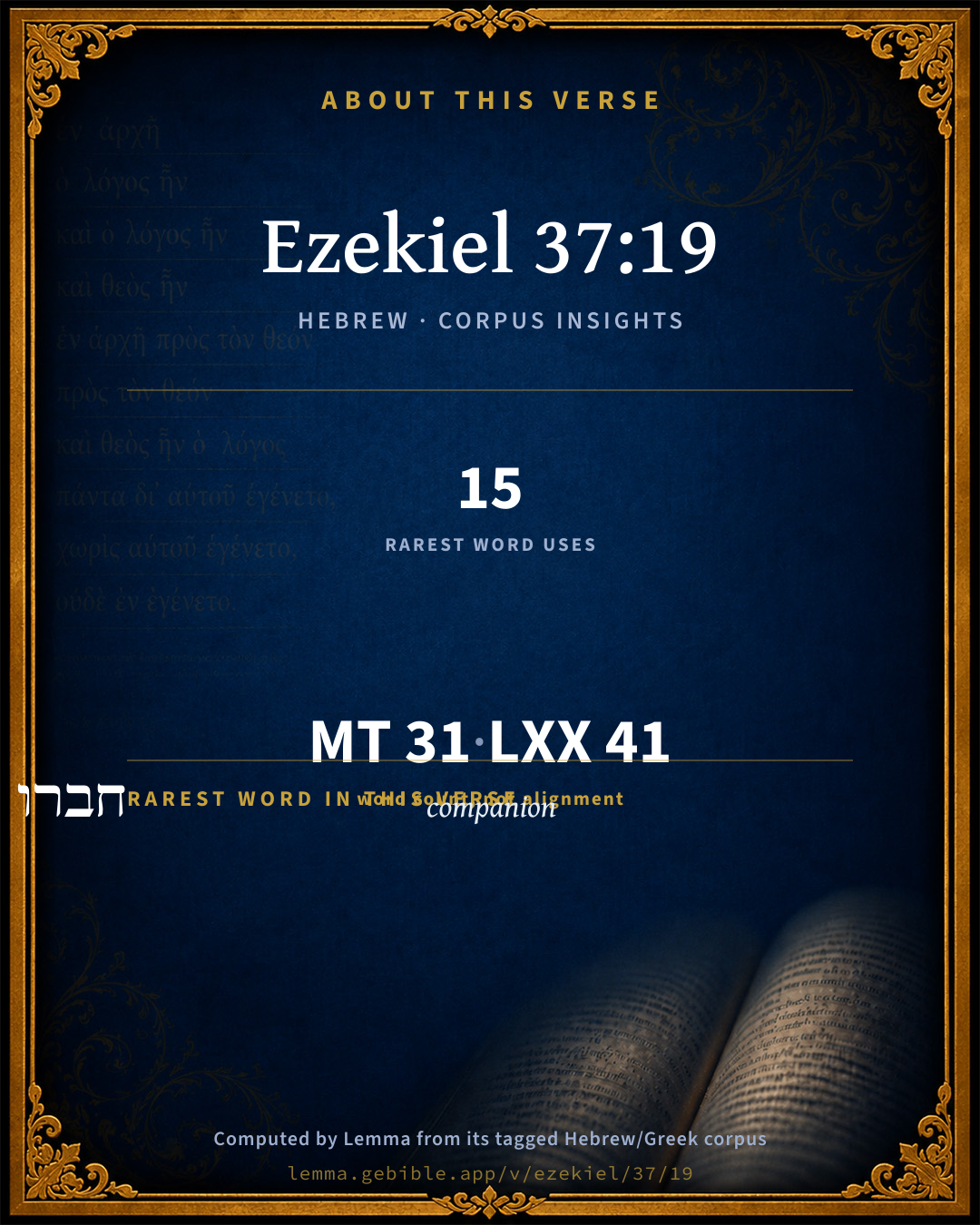
31
words
25
distinct lemmas
Prophets
section

Notable vocabulary

The rarest word here is חברו companion H2270 — appearing just 15 times in the whole Hebrew Bible.

Shared distinctive vocabulary

חברו companion H2270 occurs in 11 verses of the Hebrew Bible. Also found in:

Grammatical profile

  • 6 verbs
  • 14 nouns
  • 2 adjectives
  • 1 pronoun
  • 3 prepositions
  • 1 adverb
  • 4 particles

Verb forms

  • דַּבֵּ֣ר Piel · Imperative
  • אָמַר֮ Qal · Perfect
  • לֹקֵ֜חַ Qal · Participle Active
  • וְנָתַתִּי֩ Qal · Sequential Perfect
  • וַֽעֲשִׂיתִם֙ Qal · Sequential Perfect
  • וְהָי֥וּ Qal · Sequential Perfect

Repetition

Words recur within this verse — often emphatic in Hebrew:

  • עֵ֤ץ tree H6086 ×3
  • בְּיַד hand H3027 ×2
  • חברו companion H2270 ×2
  • אֶחָ֔ד one H259 ×2

Hebrew & Septuagint length

In English translation the verse runs 55 words from the Hebrew and 55 from the Septuagint (LXX English) — the same length.

A rough comparison of the two English renderings, which tokenize alike — not a word-level alignment.

Word counts can differ between the Hebrew and the Greek without any difference in meaning — e.g. the Hebrew direct-object marker אֵת has no separate Greek word, and Greek often adds the article ὁ.

In the original languages it is 31 Hebrew tokens and 41 Greek tokens — but the two are counted differently (Hebrew bundles its prefixes and suffixes into one token; the Greek is in lemma form), so that isn’t a like-for-like length.

Cross-references

5

Topical passages linked to Ezekiel 37:19 in the Treasury of Scripture Knowledge — connected by theme and wording, ordered by reader-vote popularity; previews shown in the World English Bible.

  • Zechariah 10:6 "I will strengthen the house of Judah, And I will save the house of Joseph, And I will bring them back; For I have mercy on them; And they will be as though I had not cast them off: For I am Yahweh their God, and I will hear them.
  • Ephesians 2:13–14 But now in Christ Jesus you who once were far off are made near in the blood of Christ.
  • Colossians 3:11 where there can't be Greek and Jew, circumcision and uncircumcision, barbarian, Scythian, bondservant, freeman; but Christ is all, and in all.
  • Ezekiel 37:16–17 You, son of man, take one stick, and write on it, For Judah, and for the children of Israel his companions: then take another stick, and write on it, For Joseph, the stick of Ephraim, and [for] all the house of Israel his companions:
  • 1 Chronicles 9:1–3 So all Israel were reckoned by genealogies; and, behold, they are written in the book of the kings of Israel: and Judah was carried away captive to Babylon for their disobedience.

Cross-references courtesy of OpenBible.info (CC BY 4.0).

Hebrew and Greek witnesses Masoretic Hebrew ↔ Greek Septuagint

The same verse in the two great witnesses to the Old Testament, shown verse-for-verse.

These are two independent witnesses, not word-aligned to each other, and the Septuagint is shown in lemma (dictionary) form.

Hebrew Ezekiel 37:19 Masoretic · Westminster Leningrad Codex

דַּבֵּ֣ר אֲלֵהֶ֗ם כֹּֽה אָמַר֮ אֲדֹנָ֣י יְהוִה֒ הִנֵּה֩ אֲנִ֨י לֹקֵ֜חַ אֶת עֵ֤ץ יוֹסֵף֙ אֲשֶׁ֣ר בְּיַד אֶפְרַ֔יִם וְשִׁבְטֵ֥י יִשְׂרָאֵ֖ל חברו חֲבֵרָ֑יו וְנָתַתִּי֩ אוֹתָ֨ם עָלָ֜יו אֶת עֵ֣ץ יְהוּדָ֗ה וַֽעֲשִׂיתִם֙ לְעֵ֣ץ אֶחָ֔ד וְהָי֥וּ אֶחָ֖ד בְּיָדִֽי

tell them, Thus says the Lord Yahweh: Behold, I will take the stick of Joseph, which is in the hand of Ephraim, and the tribes of Israel his companions; and I will put them with it, [even] with the stick of Judah, and make them one stick, and they shall be one in my hand.

World English Bible · Public Domain

Greek LXX Ezekiel 37:19 Septuagint · lemma form

καί εἶπον πρός αὐτός ὅδε λέγω κύριος ἰδού ἐγώ λαμβάνω ὁ φυλή ιωσηφ ὁ διά χείρ ἐφράιμ καί ὁ φυλή ἰσραήλ ὁ προςκεῖμαι πρός αὐτός καί δίδωμι αὐτός ἐπί ὁ φυλή ιουδα καί εἰμί εἰς ῥάβδος εἷς ἐν ὁ χείρ ιουδα

Then shall you say to them, Thus says the Lord; behold, I will take the tribe of Joseph, which is in the hand of Ephraim, and the tribes of Israel that belong to him, and I will add them to the tribe of Juda, and they shall become one rod in the hand of Juda.

LXX2012 (modern English Septuagint) · Public Domain

On this verse, The Cambridge Bible for Schools and Colleges discusses the Septuagint’s reading. Read the note in Commentary ↓

Hebrew: Westminster Leningrad Codex (CC BY 4.0). Greek: Septuagint (public domain); English from LXX2012 (modern English Septuagint) (Public Domain). How the Septuagint differs from the Hebrew →

Targum (Aramaic paraphrase)

1

The Targum is the ancient Jewish Aramaic paraphrase of the Hebrew Scriptures — an interpretive translation, not the Hebrew text itself. Onkelos (literal) and Pseudo-Jonathan (expansive) render the Torah, and Jonathan the Prophets. Coverage is partial: where no permissively-licensed English translation exists for a verse, only the Aramaic is shown. This is verse-level text, not a word-by-word alignment to the Hebrew.

  1. Targum Jonathan Prophets (Joshua–Malachi)
    אִתְנַבֵּי לְהוֹן כִּדְנַן אֲמַר יְיָ אֱלֹהִים הָא אֲנָא מְקָרִיב יַת שִׁבְטָא דְיוֹסֵף דִי הוּא שִׁבְטָא דְאֶפְרַיִם וְשִׁבְטֵי יִשְׂרָאֵל אֲחֵיהוֹן וַאֲחַבֵּיר יַתְהוֹן עֲלוֹהִי יַת שִׁבְטָא דִיהוּדָה וְאַעְבְּדִינוּן לְעַמָא חַד וִיהוֹן חַד קֳדָמָי:

    (no public-domain English translation for this verse)

    Targum Jonathan — Aramaic: “Mikraot Gedolot” (public domain). English: “Sefaria Community Translation” (CC0 1.0 (public-domain dedication)); “London "Chaldee Paraphrase," 1871” (public domain). Text via Sefaria.

Commentary

Notes on Ezekiel 37:19 from classic Christian and Jewish commentators (each source and its license shown beneath its notes). The classic Christian expositions comment on the surrounding passage and are grouped to its opening verse, so a note may address several verses; the Jewish commentaries on the Tanakh (Rashi and others) are per-verse, so they appear only where the commentator wrote on this verse.

Lemma curates 59 commentaries, every one of them public domain or Creative Commons licensed, each selected and text-cleaned for this edition rather than reprinted as found. About our sources →

Trapp's Complete Commentary

John Trapp

Eze 37:19 Say unto them, Thus saith the Lord GOD; Behold, I will take the stick of Joseph, which [is] in the hand of Ephraim, and the tribes of Israel his fellows, and will put them with him, [even] with the stick of Judah, and make them one stick, and they shall be one in mine hand.

Ver. 19. And make them one stick.] Taking away the deadly feud that hath so long time been between them, breaking down the partition wall, &c. I will once more bring them all under one king, and make them of one mind. Religion is the only best bond of affection. The very heathens honoured the primitive Christians for their unanimity. See Son 6:9. {See Trapp on "Son 6:9"}

John Trapp, A Commentary or Exposition upon All the Books of the Old and New Testament (1647–1656) — public domain. Text from a community e-Sword module.

Tyndale Open Study Notes

Tyndale Open Resources

37:19 The sovereign Lord would accomplish the reunification of Israel by his own hand.

Tyndale Open Study Notes — © Tyndale Open Resources, licensed CC BY-SA 4.0. Text via the HelloAO Bible API.

Geneva Bible (1599)

Geneva Bible translators

That is, the house of Israel.

Geneva Bible (1599) marginal notes — public domain. Text via Bolls.life.

Jamieson, Fausset & Brown

Robert Jamieson, A. R. Fausset & David Brown

The union effected at the restoration from Babylon embraced but comparatively few of Israel; a future complete fulfilment must therefore be looked for.

stick of Joseph . . . in the hand of Ephraim--Ephraim, of the descendants of Joseph, had exercised the rule among the ten tribes: that rule, symbolized by the "stick," was now to be withdrawn from him, and to be made one with the other, Judah's rule, in God's hand.

them--the "stick of Joseph," would strictly require "it"; but Ezekiel expresses the sense, namely, the ten tribes who were subject to it.

with him--that is, Judah; or "it," that is, the stick of Judah.

Jamieson, Fausset & Brown — Commentary Critical and Explanatory on the Whole Bible (1871) — public domain (CC PDM 1.0). Text via the HelloAO Bible API.

Adam Clarke's Commentary

Verse 19. The stick of Joseph, which is in the hand of Ephraim] Jeroboam, the first king of the ten tribes, was an Ephraimite. Joseph represents the ten tribes in general; they were in the hand of Ephraim, that is, under the government of Jeroboam.

Adam Clarke's Commentary on the Bible (1810–1826) — public domain. Text from a community e-Sword/MySword module.

Ellicott's Commentary for English Readers

(19) Which is in the hand of Ephraim.—Again Joseph is put for the whole ten tribes, and again it is indicated that the control of these was chiefly with Ephraim. The human power, which led to and perpetuated the division, is in contrast with the “mine hand,” where all shall be re-united under Divine rule.

Will put them.—Grammatically the plural pronoun “them” refers to the piece of wood, which is in the singular; but the construction is according to the sense, the wood representing the ten tribes.

A Bible Commentary for English Readers, edited by Charles John Ellicott (1878–1897) — public domain. Text from a community e-Sword module.

The Cambridge Bible for Schools and Colleges

gen. ed. J. J. S. Perowne

19. Explanation of the symbolical action.

put them with him] lit. join them unto it, even unto the stick of Judah. The construction is rather unnatural (for eth, cf. Eze_14:22, Eze_43:17, others would read el).

in mine hand] Vulg. reads in his hand (so Ew.), i.e. Judah’s, and LXX. actually in the hand of Judah. LXX. either read his hand and interpreted it of Judah, or took the final y of my hand as an abbreviation for Yehudah. On the one hand the united staff or sceptre might be given into the hand of Judah as the ruler of the one kingdom was to be David (Amo_9:11; Hos_3:5). On the other hand there is no trace in the passage of any preeminence of Judah over Israel of the north.

The Cambridge Bible for Schools and Colleges (gen. ed. J. J. S. Perowne; Cambridge University Press, 1878–1918) — public domain. Text from a community e-Sword module.

John Gill's Exposition

Say unto them, thus saith the Lord God,.... Here follows the explanation of the sign or emblem:

behold, I will take the stick of Joseph, which is in the hand of Ephraim, and the tribes of Israel his fellows: that is, the kingdom of Israel, consisting of the ten tribes, of which Ephraim was the chief:

and will put them with him, even with the stick of Judah; with the kingdom of Judah:

and make them one stick; these two kingdoms one kingdom:

and they shall be one in my hand: in Christ, the hand and arm of the Lord; one under his care, government, and protection, as after explained: this had in part, and as a shadow of what was to come, its fulfilment upon the Jews' return from Babylon; when many of the ten tribes, as well as the two tribes of Judah and Benjamin, came from thence, and became one nation and kingdom under one prince, until the coming of Christ; and it had a further accomplishment in the union of converted Jews and Gentiles in one body: but this is chiefly designed as an emblem of the union of the Jews one to another, when they shall be converted in the latter day; when they shall join together in seeking the Lord, and David, their King, the Messiah; who shall be the one King over them, as is afterwards said; and when all animosities shall cease, both among them, and among all the spiritual Israel of God in general; see

John Gill's Exposition of the Whole Bible (1746–1763) — public domain (CC PDM 1.0). Text via the HelloAO Bible API.

Matthew Poole's English Annotations

The stick of Joseph; on which Joseph’s name is written, and which represents Joseph.

Which is in the hand of Ephraim; which was under the government of Ephraim; or thus, which is the tribe of Ephraim, the latter explaining the former.

His fellows: Eze 37:16.

Put them with him; Judah and his companions. One stick; one kingdom, one people, whereas these have been divided and enemies a great while.

They shall be one; real, cordial in their union.

In mine hand; under my government, care, and blessing. This is the meaning, God will make the two divided kingdoms one in his hand, as I make these two sticks one in my hand.

Matthew Poole's English Annotations on the Holy Bible (1683–1685) — public domain. Text from a community e-Sword/MySword module.

John Wesley's Explanatory Notes

In mine hand - Under my government, care, and blessing. God will make the two kingdoms one in his hand, as I make these two sticks one in my hand.

John Wesley, Explanatory Notes Upon the Whole Bible (1754–1765) — public domain. Text via the GEBible commentary corpus.

Rashi

Rabbi Shlomo Yitzchaki (Rashi)

Behold I will take the stick, etc. that they shall no longer be two kingdoms.

Rashi on the Tanakh — English translations: “The Judaica Press complete Tanach with Rashi, translated by A. J. Rosenberg” (CC BY 4.0); “Pentateuch with Rashi's commentary by M. Rosenbaum and A.M. Silbermann, 1929-1934” (public domain); “The Metsudah Tanach series, Lakewood, N.J” (CC BY 4.0); and “The Book of Joshua, Metsudah Publications, 1997” (CC BY 4.0). Text via Sefaria.

Lesson kit

Teaching starters — assembled from the data on this page, not authored interpretation. Every prompt links to the verse data it draws on. Edit before teaching.

Ezekiel, in the Prophets, opens this verse with 31 words (25 distinct Hebrew lemmas). Its most distinctive word is châbêr (“companion”). A historical commentator’s framing appears above. Read the whole chapter for the surrounding context.

Discussion questions

  1. What does “companion” (châbêr) contribute to the verse as a whole?
  2. How does Judges 20:11, which shares the word «companion», read alongside this verse?
  3. What does the repetition of “tree” (3× in this one verse) do in this verse?
  4. These translations render this verse differently; the difference is in the English rendering, not the original. What questions does that raise?
  5. «דַּבֵּ֣ר» is a Piel Imperative verb. How does that grammatical form shape the action described?
  6. Compare how Trapp's Complete Commentary and Tyndale Open Study Notes read this verse. Where do they agree or differ?

Things to notice

Reading settings

Reading text

Shown beneath each verse's original-language words.

Old Testament
Old Testament edition

Read the OT as the Masoretic Hebrew (MT) or the Greek Septuagint (LXX).

English shown for the Greek Septuagint (in the Hebrew ↔ Greek comparison).

Comparing translations? Open the Compare panel on any verse page to stack up to four side by side.