

Isaiah 14:29

Hebrew (Westminster Leningrad Codex) Isaiah 14:29 appears in the Hebrew Old Testament. The text above is from the Westminster Leningrad Codex. Each word links to its Strong’s number, a concise gloss, and parsing drawn from the Open Scriptures Hebrew Bible morphology. Click any word for its full Brown-Driver-Briggs (BDB) entry.
Download image
Cite this verse

Isaiah 14:29 (World English Bible). Public Domain. Lemma interlinear Bible study tool, https://lemma.gebible.app/v/isaiah/14/29.

Show BibTeX & RIS
BibTeX
RIS
English Translation
Don't rejoice, O Philistia, all of you, because the rod that struck you is broken; for out of the serpent's root shall come forth an adder, and his fruit shall be a fiery flying serpent.
World English Bible · Public Domain
Download a study sheet

One document with this verse’s original text, its word-by-word gloss line, the meaning frame, cross-references with their text, attributed commentary, and full source and license credits — printable, and it pastes into notes with its structure intact.

This verse Autodidact and up

Study sheet (.html) Plain text (.txt)

A passage Seminary Student

Up to 50 verses in one chapter. A passage sheet keeps up to 6 commentary sources and 12 cross-references per verse, in the order this page ranks them, and says so on the sheet whenever that leaves anything out. Ask for a single verse and you get the Autodidact verse sheet above.

Everything on this page stays free to read, with no account — the sheet is a download of what is already on screen, not access to it.

Want to remove ads? Support Godless Engineer
Compare translations 3

The same verse in 3 English versions, stacked beneath the original-language interlinear above. Click any original word for its lexicon entry.

Each is an independent rendering of the whole verse — the interlinear is not word-aligned to these translations.

Highlighted words mark where these versions differ — a whole-verse word diff, not a word-by-word alignment.

  • World English Bible Public Domain
    Don't rejoice, O Philistia, all of you, because the rod that struck you is broken; for out of the serpent's root shall come forth an adder, and his fruit shall be a fiery flying serpent.
  • King James Version Public Domain
    Rejoice not thou, whole Palestina, because the rod of him that smote thee is broken: for out of the serpent's root shall come forth a cockatrice, and his fruit shall be a fiery flying serpent.
  • unfoldingWord Literal Text CC BY-SA 4.0
    May you not rejoice, Philistia, all of you, that the rod of the one striking you is broken, for from the root of the serpent, a viper will come out, and its fruit a flying serpent.

unfoldingWord Literal Text — © unfoldingWord, licensed CC BY-SA 4.0. Word-aligned USFM3 via Door43 (git.door43.org/unfoldingWord/en_ult).

Versions to compare (up to 4)

3 of 4 selected

Show all 18 translations

Every available English version of this verse, each an independent rendering of the whole verse.

  • World English Bible Public Domain
    Don't rejoice, O Philistia, all of you, because the rod that struck you is broken; for out of the serpent's root shall come forth an adder, and his fruit shall be a fiery flying serpent.
  • Berean Standard Bible Public Domain
    Do not rejoice, all you Philistines, that the rod that struck you is broken. For a viper will spring from the root of the snake, and a flying serpent from its egg.
  • Majority Standard Bible Public Domain
    Do not rejoice, all you Philistines, that the rod that struck you is broken. For a viper will spring from the root of the snake, and a flying serpent from its egg.
  • King James Version Public Domain
    Rejoice not thou, whole Palestina, because the rod of him that smote thee is broken: for out of the serpent's root shall come forth a cockatrice, and his fruit shall be a fiery flying serpent.
  • American Standard Version (1901) Public Domain
    Rejoice not, O Philistia, all of thee, because the rod that smote thee is broken; for out of the serpent's root shall come forth an adder, and his fruit shall be a fiery flying serpent.
  • Revised Version (1885) Public Domain
    Rejoice not, O Philistia, all of thee, because the rod that smote thee is broken: for out of the serpent’s root shall come forth a basilisk, and his fruit shall be a fiery flying serpent.
  • Geneva Bible (1599) Public Domain
    Reioyce not, (thou whole Palestina) because the rod of him that did beat thee, is broken for out of the serpents roote shall come forth a cockatrise, and the fruit therof shalbe a firy flying serpent.
  • Douay-Rheims (1899) Public Domain
    Rejoice not thou, whole Philistia, that the rod of him that struck thee is broken in pieces: for out of the root of the serpent shall come forth a basilisk, and his seed shall swallow the bird.
  • Young's Literal Translation Public Domain
    Rejoice not thou, Philistia, all of thee, That broken hath been the rod of thy smiter, For from the root of a serpent cometh out a viper, And its fruit `is' a flying saraph.
  • Literal Standard Version CC BY-SA 4.0
    “Do not rejoice, Philistia, all of you, || That the rod of your striker has been broken, || For from the root of a serpent comes out a viper, || And its fruit [is] a flying, burning serpent.
  • Unlocked Literal Bible CC BY-SA 4.0
    Do not rejoice, all you Philistines, that the rod that struck you is broken. For out of the serpent's root will grow out an adder, and his offspring will be a fiery flying serpent.
  • unfoldingWord Literal Text CC BY-SA 4.0
    May you not rejoice, Philistia, all of you, that the rod of the one striking you is broken, for from the root of the serpent, a viper will come out, and its fruit a flying serpent.
  • Darby Bible Public Domain
    Rejoice not thou, Philistia, all of thee, because the rod that smote thee is broken; for out of the serpent's root shall come forth a viper, and his fruit shall be a fiery flying serpent.
  • World Messianic Bible Public Domain
    Don’t rejoice, O Philistia, all of you, because the rod that struck you is broken; for out of the serpent’s root an adder will emerge, and his fruit will be a fiery flying serpent.
  • Webster's Bible Public Domain
    Rejoice not thou, all Palestina, because the rod of him that smote thee is broken: for out of the serpent's root shall come forth a basilisk, and his fruit shall be a fiery flying serpent.
  • Free Bible Version CC BY-SA 4.0
    All you Philistines, don't celebrate the fact that the rod that was hitting you is broken, because from the root of that snake will grow up a viper, its fruit will be a flying serpent.
  • Bible in Basic English Public Domain
    Be not glad, O Philistia, all of you, because the rod which was on you is broken: for out of the snake's root will come a poison-snake, and its fruit will be a winged poison-snake.
  • JPS Tanakh (1917) Public Domain
    Rejoice not, O Philistia, all of thee, because the rod that smote thee is broken: for out of the serpent's root shall come forth a basilisk, and his fruit shall be a flying serpent.

Literal Standard Version (2020), Covenant Press — licensed CC BY-SA 4.0. Text via the HelloAO Bible API (eBible.org). Unlocked Literal Bible (unfoldingWord) — licensed CC BY-SA 4.0. Text via the HelloAO Bible API (eBible.org). unfoldingWord Literal Text — © unfoldingWord, licensed CC BY-SA 4.0. Word-aligned USFM3 via Door43 (git.door43.org/unfoldingWord/en_ult). Free Bible Version, Dr. Jonathan Gallagher — licensed CC BY-SA 4.0. Text via the HelloAO Bible API (eBible.org).

Word by word

More ways to search: Search by grammar → Find every occurrence → Compare this word →

Practice this passage: Drill this verse → Learn its vocabulary →

צֶ֔פַע
tsephaʻ
H6848
“viper”
Noun, Common, Masculine, Singular, Absolute
Part of Speech
Noun
Type
Common
Gender
Masculine
Number
Singular
State
Absolute
Full BDB Definition

Origin: from an unused root meaning to extrude

TWOT: 1954a , 1954b

poisonous serpent - a viper snake or adder
  1. אַֽל ʼal H408 “not” Particle, Negative
  2. תִּשְׂמְחִ֤י sâmach H8055 “to rejoice” Verb, Qal, Jussive, 2nd Person, Feminine, Singular
  3. פְלֶ֨שֶׁת֙ Pᵉlesheth H6429 “Philistia” Noun, Proper
  4. כֻּלֵּ֔ךְ kôl H3605 “all · your” Noun, Common, Masculine, Singular, Construct + Suffix, Personal, 2nd Person, Feminine, Singular
  5. כִּ֥י kîy H3588 “that” Conjunction
  6. נִשְׁבַּ֖ר shâbar H7665 “to break” Verb, Niphal, Perfect, 3rd Person, Masculine, Singular
  7. שֵׁ֣בֶט shêbeṭ H7626 “staff” Noun, Common, Masculine, Singular, Absolute
  8. מַכֵּ֑ךְ nâkâh H5221 “striking · you” Verb, Hiphil, Participle Active, Masculine, Singular, Construct + Suffix, Personal, 2nd Person, Feminine, Singular
  9. כִּֽי kîy H3588 “that” Conjunction
  10. מִשֹּׁ֤רֶשׁ sheresh H8328 “from · root of” Preposition + Noun, Common, Masculine, Singular, Construct
  11. נָחָשׁ֙ nâchâsh H5175 “serpent” Noun, Common, Masculine, Singular, Absolute
  12. יֵ֣צֵא yâtsâʼ H3318 “to go out” Verb, Qal, Imperfect, 3rd Person, Masculine, Singular
  13. וּפִרְי֖וֹ pᵉrîy H6529 “and · fruit · his” Conjunction + Noun, Common, Masculine, Singular, Construct + Suffix, Personal, 3rd Person, Masculine, Singular
  14. שָׂרָ֥ף sârâph H8314 “seraphim” Noun, Common, Masculine, Singular, Absolute
  15. מְעוֹפֵֽף ʻûwph H5774 “flying” Verb, Polel, Participle Active, Masculine, Singular, Absolute

About this verse

These counts appear in no published source. They are computed here, from the morphology-tagged text and Lemma’s own curated glosses. What Lemma adds →

16
words
15
distinct lemmas
Prophets
section

Notable vocabulary

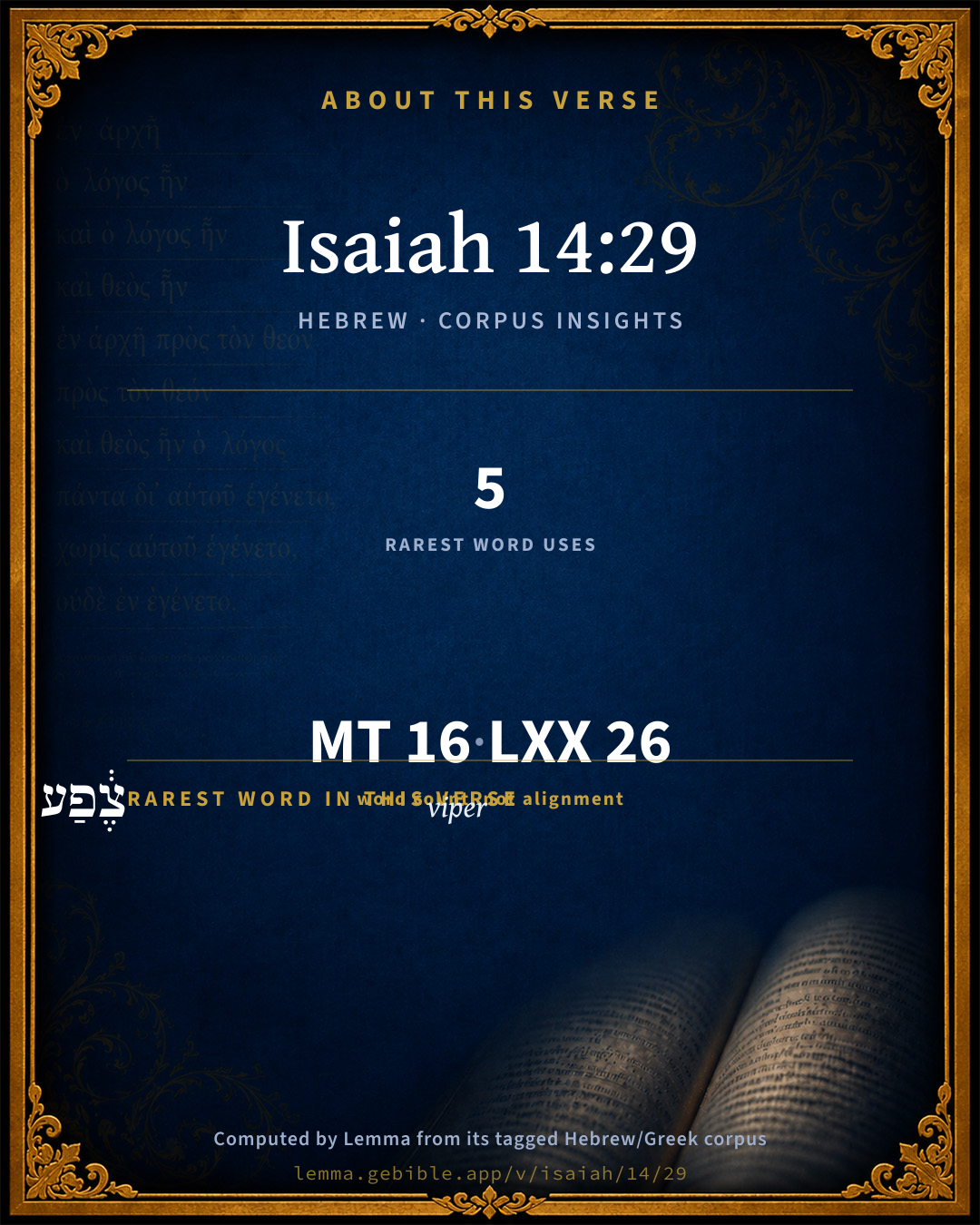
The rarest word here is צֶ֔פַע viper H6848 — appearing just 5 times in the whole Hebrew Bible.

Shared distinctive vocabulary

צֶ֔פַע viper H6848 occurs in 5 verses of the Hebrew Bible. Also found in:

Grammatical profile

  • 5 verbs
  • 8 nouns
  • 2 conjunctions
  • 1 particle

Verb forms

  • תִּשְׂמְחִ֤י Qal · Jussive
  • נִשְׁבַּ֖ר Niphal · Perfect
  • מַכֵּ֑ךְ Hiphil · Participle Active
  • יֵ֣צֵא Qal · Imperfect
  • מְעוֹפֵֽף Polel · Participle Active

Repetition

A word recurs within this verse — often emphatic in Hebrew:

  • כִּ֥י that H3588 ×2

Hebrew & Septuagint length

In English translation the verse runs 35 words from the Hebrew and 37 from the Septuagint (LXX English) — closely comparable.

A rough comparison of the two English renderings, which tokenize alike — not a word-level alignment.

Word counts can differ between the Hebrew and the Greek without any difference in meaning — e.g. the Hebrew direct-object marker אֵת has no separate Greek word, and Greek often adds the article ὁ.

In the original languages it is 16 Hebrew tokens and 26 Greek tokens — but the two are counted differently (Hebrew bundles its prefixes and suffixes into one token; the Greek is in lemma form), so that isn’t a like-for-like length.

Cross-references

14

Topical passages linked to Isaiah 14:29 in the Treasury of Scripture Knowledge — connected by theme and wording, ordered by reader-vote popularity; previews shown in the World English Bible.

  • 2 Chronicles 26:6 He went forth and warred against the Philistines, and broke down the wall of Gath, and the wall of Jabneh, and the wall of Ashdod; and he built cities in [the country of] Ashdod, and among the Philistines.
  • Isaiah 11:8 The sucking child shall play on the hole of the asp, and the weaned child shall put his hand on the adder's den.
  • Isaiah 30:6 The burden of the animals of the South. Through the land of trouble and anguish, from whence come the lioness and the lion, the viper and fiery flying serpent, they carry their riches on the shoulders of young donkeys, and their treasures on the humps of camels, to a people that shall not profit [them].
  • Joshua 13:3 from the Shihor, which is before Egypt, even to the border of Ekron northward, [which] is reckoned to the Canaanites; the five lords of the Philistines; the Gazites, and the Ashdodites, the Ashkelonites, the Gittites, and the Ekronites; also the Avvim,
  • 2 Kings 18:8 He struck the Philistines to Gaza and the borders of it, from the tower of the watchmen to the fortified city.
  • 2 Chronicles 28:18 The Philistines also had invaded the cities of the lowland, and of the South of Judah, and had taken Beth-shemesh, and Aijalon, and Gederoth, and Soco with the towns of it, and Timnah with the towns of it, Gimzo also and the towns of it: and they lived there.
  • Proverbs 24:17 Don't rejoice when your enemy falls. Don't let your heart be glad when he is overthrown;
  • Ezekiel 26:2 Son of man, because Tyre has said against Jerusalem, Aha, she is broken: the gate of the peoples; she is turned to me; I shall be replenished, now that she is laid waste:
  • Ezekiel 35:15 As you did rejoice over the inheritance of the house of Israel, because it was desolate, so will I do to you: you shall be desolate, Mount Seir, and all Edom, even all of it; and they shall know that I am Yahweh.
  • Hosea 9:1 Don't rejoice, Israel, to jubilation like the nations; For you were unfaithful to your God. You love the wages of a prostitute at every grain threshing floor.
  • Obadiah 1:12 But don't look down on your brother in the day of his disaster, and don't rejoice over the children of Judah in the day of their destruction. Don't speak proudly in the day of distress.
  • Micah 7:8 Don't rejoice against me, my enemy. When I fall, I will arise. When I sit in darkness, Yahweh will be a light to me.
  • Zephaniah 3:11 In that day you will not be disappointed for all your doings, in which you have transgressed against me; for then I will take away out of the midst of you your proudly exulting ones, and you will no more be haughty in my holy mountain.
  • 1 Samuel 6:17–18 These are the golden tumors which the Philistines returned for a trespass-offering to Yahweh: for Ashdod one, for Gaza one, for Ashkelon one, for Gath one, for Ekron one;

Cross-references courtesy of OpenBible.info (CC BY 4.0).

Hebrew and Greek witnesses Masoretic Hebrew ↔ Greek Septuagint

The same verse in the two great witnesses to the Old Testament, shown verse-for-verse.

These are two independent witnesses, not word-aligned to each other, and the Septuagint is shown in lemma (dictionary) form.

Hebrew Isaiah 14:29 Masoretic · Westminster Leningrad Codex

אַֽל תִּשְׂמְחִ֤י פְלֶ֨שֶׁת֙ כֻּלֵּ֔ךְ כִּ֥י נִשְׁבַּ֖ר שֵׁ֣בֶט מַכֵּ֑ךְ כִּֽי מִשֹּׁ֤רֶשׁ נָחָשׁ֙ יֵ֣צֵא צֶ֔פַע וּפִרְי֖וֹ שָׂרָ֥ף מְעוֹפֵֽף

Don't rejoice, O Philistia, all of you, because the rod that struck you is broken; for out of the serpent's root shall come forth an adder, and his fruit shall be a fiery flying serpent.

World English Bible · Public Domain

Greek LXX Isaiah 14:29 Septuagint · lemma form

μή εὐφραίνω πᾶς ὁ ἀλλόφυλος συντρίβω γάρ ὁ ζυγός ὁ παίω σύ ἐκ γάρ σπέρμα ὄφις ἐκἔρχομαι ἔκγονος ἀσπίς καί ὁ ἔκγονος αὐτός ἐκἔρχομαι ὄφις πέτομαι

Rejoice not, all you⌃ Philistines, because the yoke of him that struck you is broken: for out of the seed of the serpent shall come forth the young asps, and their young shall come forth flying serpents,

LXX2012 (modern English Septuagint) · Public Domain

On this verse, Albert Barnes' Notes on the Bible discusses the Septuagint’s reading. Read the note in Commentary ↓

Hebrew: Westminster Leningrad Codex (CC BY 4.0). Greek: Septuagint (public domain); English from LXX2012 (modern English Septuagint) (Public Domain). How the Septuagint differs from the Hebrew →

Targum (Aramaic paraphrase)

1

The Targum is the ancient Jewish Aramaic paraphrase of the Hebrew Scriptures — an interpretive translation, not the Hebrew text itself. Onkelos (literal) and Pseudo-Jonathan (expansive) render the Torah, and Jonathan the Prophets. Coverage is partial: where no permissively-licensed English translation exists for a verse, only the Aramaic is shown. This is verse-level text, not a word-by-word alignment to the Hebrew.

  1. Targum Jonathan Prophets (Joshua–Malachi)
    לָא תֵיחְדוּן פְּלִשְׁתָּאֵי כּוּלְכוֹן אֲרֵי אִתְּבַּר שׁוּלְטַן דַהֲוָה מַפְלַח בְּכוֹן אֲרֵי מִבְּנֵי בְנוֹהִי דְיִשָׁי יִפּוֹק מְשִׁיחָא וִיהוֹן עוֹבָדוֹהִי בְּכוֹן כְּחֵיוֵי מַפְרִיחַ:

    Rejoice not, 0 Philistia, all of ye, because the government that hath made you servile is broken; because from the children of Jesse shall come forth the Messiah, and his works among you shall be as a flying serpent.

    Targum Jonathan — Aramaic: “Mikraot Gedolot” (public domain). English: “Sefaria Community Translation” (CC0 1.0 (public-domain dedication)); “London "Chaldee Paraphrase," 1871” (public domain). Text via Sefaria.

Commentary

Notes on Isaiah 14:29 from classic Christian and Jewish commentators (each source and its license shown beneath its notes). The classic Christian expositions comment on the surrounding passage and are grouped to its opening verse, so a note may address several verses; the Jewish commentaries on the Tanakh (Rashi and others) are per-verse, so they appear only where the commentator wrote on this verse.

Lemma curates 59 commentaries, every one of them public domain or Creative Commons licensed, each selected and text-cleaned for this edition rather than reprinted as found. About our sources →

Trapp's Complete Commentary

John Trapp

Isa 14:29 Rejoice not thou, whole Palestina, because the rod of him that smote thee is broken: for out of the serpent’s root shall come forth a cockatrice, and his fruit [shall be] a fiery flying serpent.

Ver. 29. Rejoice not thou, whole Palestine.] That is, the Philistines, quos Iudaei animis armisque sibi infestissimos habuere. These were as bad neighbours to the Jews as the Dunkirkers now are to us. Uzziah had subdued them, {2Ch 26:6} but Ahaz had been much damnified and despoiled by them, {2Ch 28:18} and in the beginning of Hezekiah’s reign they thought to have overrun all the country. Here therefore God’s decree concerning them is published, for the comfort of his poor people, and it is this: Philistaeis non iabilandum sed eiulandum. Philistines must not be overjoyed, but rather "weep and howl for the miseries that are coming upon them."

Because the rod of him that smote thee is broken.] Because Uzziah is dead, and Ahaz hath had ill success against you through his own sinfulness and sluggishness; do not you thereupon take boldness to set up your crest, and think all is your own.

For out of the serpent’s root.] Out of Uzziah’s issue,

Shall come forth a cockatrice.] Or, Basilisk, which is said to kill with his looks only; and hereby is meant Hezekiah, as also by the "fiery flying serpent," for thus he is called both for his fierceness and for his swiftness, two very commendable properties of a commander. Julius Caesar was in omnia praeceps, in all head first, very fierce, and with it notably nimble, witness his Veni, vidi, vici, I no sooner came, but overcame. The Hebrews from this text have a proverb, "Out of the serpent’s root shall come forth a cockatrice," {a} i.e., one woe is passed, but behold a worse at hand.

{a} De radice colubri egredietur regulus, i.e., Afflictissimi, inter pauperes praecipui ac primi, atque adeo tolerandis calamitatibus nati.

John Trapp, A Commentary or Exposition upon All the Books of the Old and New Testament (1647–1656) — public domain. Text from a community e-Sword module.

The Biblical Illustrator

Joseph S. Exell

Isa_14:29-32

Rejoice not thou, whole Palestina

Philistia

Philistia was the southwest coast of the land of Canaan, to the whole of which it afterwards gave its name in the Greek form of Palestine, and was nominally included in the tribe of Judah.

It was originally inhabited by the Avites, who were expelled by the Caphtorim, a race of Egyptian origin, but supposed to have come immediately from Crete or Cyprus, and who, under the name of Philistines, continued as a distinct, and for the most part independent nation, in spite of the efforts of Israel to subdue them. (Sir E. Strachey, Bart.)

The Philistines

The Philistines were very formidable enemies to Israel in the days of Samuel and of Saul. The strong kings, David, Solomon, and Jehoshaphat, kept them in subjection, but in the days of Jehoram they invaded Judah 2Sa_5:17-25; 2Sa_21:15; 2Ch_17:11; 2Ch_21:16-17). Uzziah again repressed them, and crippled their power, dismantling their walled cities, and building fortresses of his own to command them (2Ch_26:6-7); and no doubt they continued tributary during the still vigorous government of his successor Jotham. But during the weak reign of Ahaz, they invaded the cities of the low country, and of the south of Judah; and not only invaded, but settled themselves in them and their neighbouring villages (2Ch_28:18): and to this state of things Isaiah addresses himself in this prophecy. (Sir E. Strachey, Bart.)

The rod of the taskmaster

The rod of the taskmaster is Isaiahs frequent image for the control of a dependent and tributary nation: all Philistia had rejoiced when the rod of David and of Uzziah fell broken from the hands of Ahaz, and expressed their joy by wasting or taking possession of their former masters lands; but Isaiah warns them that the old root of Israel, which from the days of Samson had sent forth many a rod with a serpents life like the rod of Moses, would soon again produce a basilisk with its royal crest, its inevitable spring, and its mortal bite, to take vengeance on his enemies. (Sir E. Strachey, Bart.)

Hezekiah and the Messiah

The basilisk is Hezekiah, and the flying dragon is the Messiah (such is the explanation of the Targum); or, what is the same thing, the former is the Davidic kingdom of the immediate future, and the latter the Davidic kingdom of the ultimate future. The figure may appear inappropriate, because the serpent is a symbol of evil; but it is not a symbol merely of creaturely evil, but also of the Divine curse; the curse, however, is the energy of penal justice, and as the executor of this justice as a judgment of God on Philistia, the Davidic king is here called a serpent in a climax rising through three stages. Perhaps the choice of the figure was suggested by Gen_49:17; for the saying concerning Dan was fulfilled in Samson the Danite, the sworn enemy of the Philistines. (F. Delitzsch.)

The law of conquests and exterminations

If the spread of civilisation, knowledge, justice, virtue, religion, and whatever else distinguishes men from beasts, is a good and not an evil, then it is good for men to use all the means which are really necessary to effect that end, even though some of them be never so rough and unpleasing; and it is not less base in public than in private morals to shrink from the responsibility of ourselves doing that which we know it is good to have done. If a weak, effeminate, degenerate nation can be improved by subjection to a stronger, manlier, more virtuous nation, then it is not only the right but the duty of the latter to bring it into subjection, whenever the indications of Gods providence, be they of peace or war, show that the time has come. And if the nation is not merely degenerate but hopelessly corrupt, then it is not only the right but the duty of some worthier nation to destroy it, and rid the world of its abominations. (Sir E. Strachey, Bart.)

The Gospel a means of national salvation

The Gospel has given to us, in modem Christendom, means of reclaiming nations who would have been irreclaimable by any measures which Greeks or Romans or even Jews could apply; and we are bound to act with corresponding gentleness and forbearance. (Sir E. Strachey, Bart.)

The first born of the poor

(Isa_14:30) seems to be a Hebrew idiom for the really, eminently poor, like that of Son of Man to express the man. Or the prophet may mean that the first of the next generation, the children of the present depressed Israelites, shall he delivered from the miseries which the Philistines are now inflicting on their fathers. (Sir E. Strachey, Bart.)

The Biblical Illustrator, edited by Joseph S. Exell (c. 1880s–1900s) — public domain. Text from a community e-Sword module.

Tyndale Open Study Notes

Tyndale Open Resources

14:29 The king who attacked Philistia was probably Ahaz (14:28). • a more poisonous snake: This probably refers to one of the later Assyrian kings, either Sennacherib (701 BC), Esarhaddon (680 BC), or Ashurbanipal (668 BC).

Tyndale Open Study Notes — © Tyndale Open Resources, licensed CC BY-SA 4.0. Text via the HelloAO Bible API.

Geneva Bible (1599)

Geneva Bible translators

He willeth the Philistines not to rejoice because the Jews are diminished in their power, for their strength shall be greater than ever it was.

Geneva Bible (1599) marginal notes — public domain. Text via Bolls.life.

Jamieson, Fausset & Brown

Robert Jamieson, A. R. Fausset & David Brown

Palestina--literally, "the land of sojourners."

rod . . . broken--The yoke imposed by Uzziah (Ch2 26:6) was thrown off under Ahaz (Ch2 28:18).

serpent's root--the stock of Jesse (Isa 11:1). Uzziah was doubtless regarded by the Philistines as a biting "serpent." But though the effects of his bite have been got rid of, a more deadly viper, or "cockatrice" (literally, "viper's offspring," as Philistia would regard him), namely, Hezekiah awaits you (Kg2 18:8).

Jamieson, Fausset & Brown — Commentary Critical and Explanatory on the Whole Bible (1871) — public domain (CC PDM 1.0). Text via the HelloAO Bible API.

Ellicott's Commentary for English Readers

(29) Rejoice not thou, whole Palestina.—Better, Rejoice not thou, Philistia, all of thee; i.e., give not thyself wholly to rejoicing. Here, as in Exo_15:14, “Palestina” is used, not in the wider meaning with which we are familiar, but specifically as the country of the Philistines. The historical circumstances connected with the “oracle” before us are found in 2Ch_18:18. The Philistines had invaded the low country (Shetphçlah), and the district known as the Negeb, or “south” of Judah, in the reign of Ahaz. He had called in the help of Tiglath-pileser, the Assyrian king, to assist him as against Rezin and Pekah (Isaiah 7), so probably against these new invaders. Sargon (who succeeded Tiglath-pileser, B.C. 723) invaded Ashdod in B.C. 710 (Isa_20:1; Records of the Past, vii. 40). Sennacherib records a like attack on Ashkelon and (according to Rawlinson’s interpretation) Ekron (Records of the Past, vii. 61). With these data we are able to enter on the interpretation of Isaiah’s prediction.

Because the rod of him that smote thee is broken.—The “rod,” as in Isa_10:24, is the power of Tiglath-pileser. The Philistines were exulting in his death, or in that of Ahaz as his ally, as though their peril was past. They are told that their exultation was premature.

Out of the serpent’s root.—The three forms of serpent life (we need not be careful about their identification from the zoologist’s point of view) may represent the three Assyrian kings named above, from whose invasions the Philistines were to suffer. Each form was more terrible than the preceding. The fiery flying serpent (Isa_30:6; Num_21:6), which represented Sennacherib, was the most formidable of the three. So in Isa_27:1, the “piercing serpent,” the “crooked serpent,” and the “dragon” are symbols of the Assyrian power. Some critics, however, led chiefly by the first words of the next verse, find in the three serpents—(1) Ahaz, (2) Hezekiah, (3) the ideal king of Isa_11:1-9.

A Bible Commentary for English Readers, edited by Charles John Ellicott (1878–1897) — public domain. Text from a community e-Sword module.

The Cambridge Bible for Schools and Colleges

gen. ed. J. J. S. Perowne

29. whole Palestina] R.V. Philistia, all of thee. On the history of the name “Palestine” see G. A. Smith, Historical Geography, p. 4. “All Philistia” is addressed because the country was broken up into a number of cantons, which might not always be united in political sentiment, as they are at this time.

the rod of him that smote thee] Or simply the rod that smote thee, as in R.V. On the reference see introductory note above.

a cockatrice] a basilisk (Heb. çepha‘). See on Isa_11:8.

fiery flying serpent] flying saraph. See on ch. Isa_6:2 and cf. Isa_30:6. It is probably a creation of the popular imagination, here used poetically. The sense of the metaphors is obvious: the power from which the Philistines had suffered seems at present to have received a fatal blow, but it will recover itself and assume a more deadly form than ever.

The Cambridge Bible for Schools and Colleges (gen. ed. J. J. S. Perowne; Cambridge University Press, 1878–1918) — public domain. Text from a community e-Sword module.

John Gill's Exposition

And the firstborn of the poor shall feed,.... That is, the Jews, who were brought very low in the times of Ahaz, reduced to the greatest straits and difficulties; for so the word "firstborn" may signify the chief, or those who were of all the poorest, and in the greatest distress; these, in the times of Hezekiah, shall enjoy abundance of good things, and under his gentle government shall feed like a flock of sheep in good pastures; this signifying, that though he should be like a serpent, harmful to his enemies, yet should be kind and tender unto, and take great care of his own subjects, and under whom they should have great plenty and prosperity:

and the needy shall lie down in safety; like a flock of sheep, secure from beasts of prey, under the care of a faithful and vigilant shepherd; this shows that the Jews should not only have plenty of good things, but should live in the greatest security, without fear of any enemy, or danger from them:

and I will kill thy root with famine; this is said to Palestine, compared to a tree, whose root is dried up for want of moisture, and so dies; and the meaning is, that a sore famine should rage in their country, and utterly destroy them:

and he shall slay thy remnant: that is, Hezekiah should slay with the sword those that were left of the famine.

John Gill's Exposition of the Whole Bible (1746–1763) — public domain (CC PDM 1.0). Text via the HelloAO Bible API.

Albert Barnes' Notes on the Bible

Rejoice not thou - Rejoice not at the death of Ahaz, king of Judah. It shall be no advantage to thee. It shall not be the means of making an invasion on Judah more practicable.

Whole Palestina - We apply the name “Palestine” to the whole land of Canaan. Formerly, the name referred only to Philistia, from which we have derived the name Palestine. The word פלשׁת peleshet means properly the land of sojourners or strangers, from פלשׁ pālash, “to rove about, to wander, to migrate.” The Septuagint renders it, Ἀλλοφυλοι Allophuloi - ‘strangers,’ or ‘foreigners,’ and Γῆ ἀλλοφύλων Gē allophulōn - ‘land of strangers.’ Philistia was situated on the southwestern side of the land of Canaan, extending along the Mediterranean Sea from Gaza on the south, to Lydda on the north. The Philistines were a powerful people, and had often been engaged in wars with Judah. They had made a successful attack on it in the time of Ahaz; and amidst the feebleness and distractions which they supposed might succeed on the change of the government of Judah, and the administration of an inexperienced prince like Hezekiah, they hoped to be still more successful, and would naturally rejoice at the death of Ahaz. When the prophet says ‘” whole” Palestina,’ he means to say that no part of Philistia would have occasion to rejoice at the succession of Hezekiah (see Isa 14:31).

Because the rod of him that smote thee is broken - It was not true that they had been smitten during the reign of Ahaz, but it had been done by his predecessor Uzziah. Perhaps the prophet refers to that prince, and to his death. He had smitten and subdued them. At his death they would rejoice; and their joy had been continued during the reigns of Jotham and Ahaz. They would now rejoice the more that a young and inexperienced prince was to ascend the throne. Their joy had been that “Uzziah” had died, and that joy had been augmenting since his death. But the prophet now tells them that they will have no further occasion for such joy.

For out of the serpent’s root - That is, there shall spring forth from the serpent, or shall succeed the serpent, as a shoot or sprout springs from the root of a decayed tree (see the note at Isa 11:1). By the serpent here, is undoutedly intended king Uzziah, who had so severely chastised the Philistines. The word ‘serpent’ נחשׁ nāchâsh denotes a serpent of any kind, and usually one far less venomous than that which is meant by the word translated cockatrice. Probably the prophet does not give this name “serpent” to Uzziah or to Ahaz, or the name “cockatrice” to Hezekiah, because he regarded the names as properly descriptive of their character, but because they were so regarded by the Philistines. They were as odious and offensive to them, and as destructive of their plans, as venomous reptiles would be.

Shall come forth a cockatrice - (see the note at Isa 59:5). A basilisk, or adder, a serpent of most venomous nature (see the note at Isa 11:8). That is, though Uzziah is dead, yet there shall spring up from him one far more destructive to you than he was; one who shall carry the desolations of war much further, and who shall more effectually subdue you. Most commentators have concurred in supposing that Hezekiah is here referred to, who ‘smote the Philistines even unto Gaza and the borders thereof, from the tower of the watchmen to the fenced city’ 2Ki 18:8. This is, doubtless, the correct interpretation. The Chaldee renders it, however, ‘Because there shall proceed from the descendants of Jesse the Messiah, and his works shall be among you as a flying serpent.’ This interpretation Rosenmuller supposes is correct; but it is evidently foreign to the scope of the passage.

Albert Barnes' Notes on the Bible (1834–1885) — public domain. Text from a community e-Sword/MySword module.

Haydock's Catholic Bible Commentary

Rod. Achaz. --- Bird. Ezechias will openly attack thee, 4 Kings xviii. 8. (Calmet) --- Protestants, "shall be a fiery flying serpent," (Haydock) like that erected by Moses, Numbers xxi. 9. Sennacherib and Assaraddon shall lay waste Philistia, ver. 31., and chap. xx. 1. (Calmet) --- Though Achaz be dead, Ezechias and Ozias will destroy more of that nation, 4 Kings xviii. 8., and 2 Paralipomenon xxvi. (Worthington)

George Leo Haydock (1774–1849), Haydock's Catholic Family Bible and Commentary, 1859 edition — public domain. Excludes Psalms (Douay-Rheims chapter numbering differs from Protestant) and Deuterocanonical books (Catholic canon only).

Matthew Poole's English Annotations

Of him that smote thee: most understand this of Uzziah, who did them much mischief, 2Ch 26:6; but he was dead thirty-two years before this time, and therefore their joy for his death was long since past. Others understand it of Ahaz; but he was so far from smiting them, that he was smitten by them, as was noted on Isa 14:28. It seems better to understand it more generally of the royal race or foregoing kings of Judah, who had been a terrible scourge to them, whose rod might be said to be broken, because that sceptre was come into the hands of slothful and degenerate princes, such as Ahaz was, who had been lately broken by the Philistines, and who probably was alive when this prophecy was delivered, because he here speaks of Hezekiah not as a present, but as a future king. It is said indeed that this burden was in the year that Ahaz died; but so it might be, though it was before his death.

His fruit shall be a fiery flying serpent; from the root and race of David shall come Hezekiah, who, like a serpent, shall sting thee to death, as he did, 2Ki 18:8.

Matthew Poole's English Annotations on the Holy Bible (1683–1685) — public domain. Text from a community e-Sword/MySword module.

Whedon's Commentary on the Bible

Daniel D. Whedon

29. Rejoice not… whole Palestina — Rather, Philistia, a territory in the southwest of Judah, and which the Philistines, a people from Caphtor in the Mediterranean, though of Egyptian origin, had long occupied, and from which they were never dislodged, though much of the time kept in subjection.

Because the rod… that smote thee is broken — “The rod” is a symbol for dominion; and probably refers here to the former Jewish power. Some commentators, however, refer it to the Assyrian oppressers.

Serpent’s root — This is argued to be Uzziah, the grandfather of Ahaz, who had subjected Philistia, but from which subjection she had recovered under Ahaz.

Cockatrice — Hezekiah, who again subjected Philistia. The “root” was of the ordinary serpent, not over venomous; but its offspring, the basilisk, was very venomous.

And his fruit… a fiery flying serpent — Poetically intensive of the basilisk. The warning is to Philistia not to exult because of denounced Assyria; she has yet to drink of a bitter cup from the hands of a lesser enemy — Hezekiah.

Daniel D. Whedon (gen. ed.), Commentary on the Old and New Testaments (1874–1909) — public domain. Text from a community e-Sword module.

The Pulpit Commentary

Whole Palestina. The Greeks called Philistia thnhn Surian , or "Syria of the Philistines," whence the Latin "Palestina" and our "Palestine." Isaiah addresses the country as "whole Palestine," because, while it was made up of a number of principalities 1Sa_6:18), his message concerned it in its entirety. The rod of him that smote thee is broken. This can scarcely refer to the death of Ahaz, since Ahaz did not smite the Philistines, but was smitten by them. (2Ch_28:18) It may, however, refer to the death of Tiglath-Pileser, which took place only a year or two previously. Out of the serpent"s root shall come forth a cockatrice; i.e. a more poisonous serpent. (see note on Isa_11:8) Shal-maneser can scarcely be meant, since he does not, appear to have attacked the Philistines. Probably Sargon is intended, who "took Ashdod", (Isa_20:1) made Khanun, King of Gaza, prisoner ("Records of the Past," vol. 9. p. 5), and reduced Philtstia generally to subjection. And his fruit shall be a fiery flying serpent. The fruit of the cockatrice will be even more terrible and venomous. He will resemble the "fiery flying serpent" of the wilderness. (Num_21:6) Sennacherib is, perhaps, this "fruit." He con quered Ascalon ("Ancient Monarchies," vol. 2. p. 432) and Ekron (ibid., p. 433), and had the kings of Gaze and Ashdod among his tributaries (ibid., p. 438, note 11).

Vers. 29-32. A truth, a test, and a solution.

We have here

I A TRUTH RESPECTING AN INDIVIDUAL DEATH; viz. that we may hope or may fear too much from the death of one man. Philistia was evidently inclined to hope too much from the death of a Jewish king; another was arising (Hezekiah) who would be to his predecessor what a cockatrice was to a serpent a still more formidable enemy. (2Ki_18:8) The wicked nation, or the unprincipled party, or the unscrupulous man that indulges a feeling of security because some strong opponent is dead may, probably will, find itself (himself) miserably disappointed. The resources of a righteous providence are not exhausted, though a very pillar of justice be fallen. Or, on the other hand, the righteous may fear too much from the death of a powerful friend. Will not the good cause perish now that the tongue of its most able advocate is silent in death? Christianity did not perish with the departure of Christ or with the death of the apostles. The Father of spirits will not let righteousness expire for want of righteous men, whom he can create and endow and send forth into the world.

II A TEST FOR THE COMMUNITY. IS the nation, is the Church, doing its work, fulfilling its Master"s will concerning it? One good, if not faultless, test is found in the answer to the questionIs it carting for its humblest members? If nothing better can be said for the nation than that its monarch is living in magnificence, or that its rulers or nobles are possessed of great wealth and rejoicing in splendid luxury, then is that nation rapidly descending to ruin. If nothing better can be said for the Church than that its hierarchy is powerful or its ministers well sustained, then is that Church a long way from its Lord"s ideal. It is when it can be said of the one that "the firstborn (the poorest) of the poor feed, and the needy lie down in safety" (ver. 30), and of the other that "the poor of the people trust in it," or "betake themselves unto it" (ver. 32), it is then that the end of their existence is answered. The "community" exists for "the common people," and especially the Church exists for the "little ones," the poor, the needy, the unbefriended, the young, the dependent.

III THE SOLUTION OF PROSPERITY. What should be the answer given to the "messengers of the nation" inquiring about the deliverance of Jerusalem? This: "The Lord hath founded Zion" (ver. 32). This is the best account we can give to others, as it is the best we can give to ourselves, of any deliverance or of any prosperity we may be enjoying. To refer it to good fortune is shallow and irreverent. To ascribe it to our own ability or energy, or to that of our friends, is insufficient and, it may be: spiritually harmful. We are safe and wise in attributing it to God. (Psa_87:7 Psa_89:17 Psa_115:1 1Co_4:7) Our faculties, our resources, our opportunities, are all of him; and from him come the energizing force and the overruling power without which all our efforts must be in vain. The reverent and religious spirit

(1) gladly dedicates to the cause of Christ and of his Church all that it can yield, and

(2) thankfully refers all prosperity enjoyed to his guiding finger, his protecting power, his life-giving Spirit. C.

The Pulpit Commentary (1880–1919), ed. H.D.M. Spence-Jones & Joseph S. Exell — public domain. Text from a community e-Sword module.

John Wesley's Explanatory Notes

Of him - Most understand this of Uzziah, who did then much mischief, 2 Chron. xxvi, 3, 6. But he was dead thirty-two years before this time, and therefore their joy for his death was long since past. Others understand it of Ahaz: but he was so far from smiting them, that he was smitten by them. We may understand this of the royal race of Judah, who had been a terrible scourge to them, whose rod might be said to be broken, because that scepter was come into the hands of slothful princes. A serpent - From the root of David shall come Hezekiah, who, like a serpent, shall sting thee to death, as he did, 2 Kings xviii, 8.

John Wesley, Explanatory Notes Upon the Whole Bible (1754–1765) — public domain. Text via the GEBible commentary corpus.

Keil & Delitzsch

C. F. Keil & F. Delitzsch

It was therefore in a most eventful and decisive year that Isaiah began to prophesy as follows. "Rejoice not so fully, O Philistia, that the rod which smote thee is broken to pieces; for out of the serpent's root comes forth a basilisk, and its fruit is a flying dragon." Shēbet maccēk, "the rod which smote thee" (not "of him that smote thee," which is not so appropriate), is the Davidic sceptre, which had formerly kept the Philistines in subjection under David and Solomon, and again in more recent times since the reign of Uzziah. This sceptre was now broken to pieces, for the Davidic kingdom had been brought down by the Syro-Ephraimitish war, and had not been able to recover itself; and so far as its power over the surrounding nations was concerned, it had completely fallen to pieces. Philistia was thoroughly filled with joy in consequence, but this joy was all over now. The power from which Philistia had escaped was a common snake (nâchâsh), which had been either cut to pieces, or had died out down to the very roots. But out of this root, i.e., out of the house of David, which had been reduced to the humble condition of its tribal house, there was coming forth a zepha‛, a basilisk (regulus, as Jerome and other early translators render it: see at Isa 11:8); and this basilisk, which is dangerous and even fatal in itself, as soon as it had reached maturity, would bring forth a winged dragon as its fruit. The basilisk is Hezekiah, and the flying dragon is the Messiah (this is the explanation given by the Targum); or, what is the same thing, the former is the Davidic government of the immediate future, the latter the Davidic government of the ultimate future. The figure may appear an inappropriate one, because the serpent is a symbol of evil; but it is not a symbol of evil only, but of a curse also, and a curse is the energetic expression of the penal justice of God. And it is as the executor of such a curse in the form of a judgment of God upon Philistia that the Davidic king is here described in a threefold climax as a snake or serpent. The selection of this figure may possibly have also been suggested by Gen 49:17; for the saying of Jacob concerning Dan was fulfilled in Samson, the sworn foe of the Philistines.

Keil & Delitzsch — Biblical Commentary on the Old Testament (1861–1891) — public domain (CC PDM 1.0). Text via the HelloAO Bible API. (Old Testament only.)

J. A. Alexander on Isaiah

Joseph Addison Alexander

“Rejoice not, O Philistia, all of thee (or all Philistia), because the rod that smote thee is broken, for out of the root of the serpent shall come forth a basilisk, and its root a flying fiery serpent.” The name Philistia is applied in Hebrew to the southwestern part of Canaan on the Mediterranean coast, nominally belonging to the tribe of Judah, but for ages occupied by the Philistines, a race of Egyptian origin who came to Canaan from Caphtor, (i.e., according to the ancients Cappadocia), but according to the moderns either Cyprus or Crete, most probably the latter. The name is now traced to an Ethiopic root meaning to wander, and probably denotes wanderers or emigrants. Hence it is commonly rendered in the Septuagint allophulon.

The Philistines are spoken of above in Isa 9:11; Isa 11:14, and throughout the historical books of the Old Testament, as the hereditary enemies of Israel. They were subdued by David (2Sa 5:17-25; 2Sa 21:15) and still paid tribute in the reign of Jehoshaphat (2Ch 17:11), but rebelled against Jehoram (2Ch 21:16-17) were again subdued by Uzziah (2Ch 26:6), and again shook off the yoke in the reign of Ahaz (2Ch 28:18). The Greek modification of the Hebrew name is applied by Josephus and other ancient writers to the whole land of Israel, from which comes our Palestine, employed in the same manner.

The expression ‘all (or the whole) of thee’, may have reference to Philistia as a union of several principalities. All interpreters agree that the Philistines are here spoken of as having recently escaped from the ascendancy of some superior power, but at the same time threatened with a more complete subjection. The first of these ideas is expressed by the figure of a broken rod or staff, for the meaning of which see above, ad v. 5. The other is expressed by the very different figure of an ordinary serpent producing or succeeded by other varieties more venomous and deadly. Whatever be the particular species intended, the essential idea is the same, and has never been disputed. Some indeed suppose a gradation or climax in the third term also, the fiery flying serpent being assumed to be more deadly than the basilisk, as this is more so than the ordinary serpent. But most writers regard the other two names as correlative or parallel. The transition in the last clause from the figure of an animal to that of a plant may serve the double purpose of reminding us that what we read is figurative, and of showing how unsafe it is to tamper with the text on the ground of mere rhetorical punctilios. As to the application of the figures, there are different opinions, but their essential meaning is obvious enough.

Joseph Addison Alexander, The Prophecies of Isaiah (1846–1847; New York: Scribner, 1870–1878) — public domain. Text from a community e-Sword module.

Scofield Reference Notes

C. I. Scofield

come forth

The descendants of Ahaz.

The Scofield Reference Bible (1917 edition), notes by C. I. Scofield — public domain. Text from a community e-Sword module.

Rashi

Rabbi Shlomo Yitzchaki (Rashi)

Rejoice not, Philistia, all of you for you have lifted your head during the days of Ahaz, who was wicked, whose wickedness brought about that he was delivered into your hands, as the matter is stated in II Chron. 28:18: “And the Philistines raided the cities of the lowlands...”

that the rod that smote you has been broken that the kingdom of the House of David, which was wont to smite you, has been weakened and humbled, as we find concerning David, and so, concerning Uzziah, king of Judah, who smote you, as the matter is stated (II Chron. 26:6): “And he went out and fought against the Philistines and breached the wall of Gath.”

for, from the root of a snake From the root of that snake, shall emanate a venomous serpent, which is more formidable than a snake. Now who was this? This was Hezekiah, concerning whom it is stated (II Kings 18:8): “He slew the Philistines up to Gaza and its boundaries, from watchtower to fortified city.”

and his offspring is a fiery flying serpent Jonathan renders: And his deeds against you will be like flying snakes.

Rashi on the Tanakh — English translations: “The Judaica Press complete Tanach with Rashi, translated by A. J. Rosenberg” (CC BY 4.0); “Pentateuch with Rashi's commentary by M. Rosenbaum and A.M. Silbermann, 1929-1934” (public domain); “The Metsudah Tanach series, Lakewood, N.J” (CC BY 4.0); and “The Book of Joshua, Metsudah Publications, 1997” (CC BY 4.0). Text via Sefaria.

Ibn Ezra

Rabbi Abraham ibn Ezra

צפע Cockatrice. It is the same as צפעני (11:8); it is more dangerous than the serpent.—Hezekiah shall be mightier than his father, and more dangerous to the Philistines (comp. 2 Kings 18:8).

And his fruit. The fruit that he will bring forth, will be שרף מעופף a fiery flying serpent; the flying one is the most dangerous of the fiery serpents.

Ibn Ezra on the Tanakh — English translations: “Sefaria Community Translation” (CC0 1.0 (public-domain dedication)); “Yalkut, Sifsei Chachomim Chumash, Metsudah Publications, 2009” (CC BY 4.0); and “Commentary of Ibn Ezra on Isaiah - trans. by M. Friedlander, 1873” (public domain). Text via Sefaria.

Lesson kit

Teaching starters — assembled from the data on this page, not authored interpretation. Every prompt links to the verse data it draws on. Edit before teaching.

Isaiah, in the Prophets, opens this verse with 16 words (15 distinct Hebrew lemmas). Its most distinctive word is tsephaʻ (“viper”). A historical commentator’s framing appears above. Read the whole chapter for the surrounding context.

Discussion questions

  1. How does “viper” (tsephaʻ) shape what this verse is saying?
  2. How does Proverbs 23:32, which shares the word «viper», read alongside this verse?
  3. What does the repetition of “that” (2× in this one verse) do in this verse?
  4. These translations render this verse differently; the difference is in the English rendering, not the original. What questions does that raise?
  5. «תִּשְׂמְחִ֤י» is a Qal Jussive verb. How does that grammatical form shape the action described?
  6. Compare how Trapp's Complete Commentary and The Biblical Illustrator read this verse. Where do they agree or differ?

Things to notice

Reading settings

Reading text

Shown beneath each verse's original-language words.

Old Testament
Old Testament edition

Read the OT as the Masoretic Hebrew (MT) or the Greek Septuagint (LXX).

English shown for the Greek Septuagint (in the Hebrew ↔ Greek comparison).

Comparing translations? Open the Compare panel on any verse page to stack up to four side by side.