Judges 21:3

Hebrew (Westminster Leningrad Codex) Judges 21:3 appears in the Hebrew Old Testament. The text above is from the Westminster Leningrad Codex. Each word links to its Strong’s number, a concise gloss, and parsing drawn from the Open Scriptures Hebrew Bible morphology. Click any word for its full Brown-Driver-Briggs (BDB) entry.
Download image
Cite this verse

Judges 21:3 (World English Bible). Public Domain. Lemma interlinear Bible study tool, https://lemma.gebible.app/v/judges/21/3.

Show BibTeX & RIS
BibTeX
RIS
English Translation
They said, Yahweh, the God of Israel, why has this happened in Israel, that there should be today one tribe lacking in Israel?
World English Bible · Public Domain
Download a study sheet

One document with this verse’s original text, its word-by-word gloss line, the meaning frame, cross-references with their text, attributed commentary, and full source and license credits — printable, and it pastes into notes with its structure intact.

This verse Autodidact and up

Study sheet (.html) Plain text (.txt)

A passage Seminary Student

Up to 50 verses in one chapter. A passage sheet keeps up to 6 commentary sources and 12 cross-references per verse, in the order this page ranks them, and says so on the sheet whenever that leaves anything out. Ask for a single verse and you get the Autodidact verse sheet above.

Everything on this page stays free to read, with no account — the sheet is a download of what is already on screen, not access to it.

Want to remove ads? Support Godless Engineer
Compare translations 3

The same verse in 3 English versions, stacked beneath the original-language interlinear above. Click any original word for its lexicon entry.

Each is an independent rendering of the whole verse — the interlinear is not word-aligned to these translations.

Highlighted words mark where these versions differ — a whole-verse word diff, not a word-by-word alignment.

  • World English Bible Public Domain
    They said, Yahweh, the God of Israel, why has this happened in Israel, that there should be today one tribe lacking in Israel?
  • King James Version Public Domain
    And said, O LORD God of Israel, why is this come to pass in Israel, that there should be to day one tribe lacking in Israel?
  • unfoldingWord Literal Text CC BY-SA 4.0
    And they said, “Why, Yahweh, God of Israel, should this be in Israel, to be missing today one tribe from Israel?”

unfoldingWord Literal Text — © unfoldingWord, licensed CC BY-SA 4.0. Word-aligned USFM3 via Door43 (git.door43.org/unfoldingWord/en_ult).

Versions to compare (up to 4)

3 of 4 selected

Show all 18 translations

Every available English version of this verse, each an independent rendering of the whole verse.

  • World English Bible Public Domain
    They said, Yahweh, the God of Israel, why has this happened in Israel, that there should be today one tribe lacking in Israel?
  • Berean Standard Bible Public Domain
    “Why, O LORD God of Israel,” they cried out, “has this happened in Israel? Today in Israel one tribe is missing!”
  • Majority Standard Bible Public Domain
    “Why, O LORD God of Israel,” they cried out, “has this happened in Israel? Today in Israel one tribe is missing!”
  • King James Version Public Domain
    And said, O LORD God of Israel, why is this come to pass in Israel, that there should be to day one tribe lacking in Israel?
  • American Standard Version (1901) Public Domain
    And they said, O Jehovah, the God of Israel, why is this come to pass in Israel, that there should be to-day one tribe lacking in Israel?
  • Revised Version (1885) Public Domain
    And they said, O LORD, the God of Israel, why is this come to pass in Israel, that there should be today one tribe lacking in Israel?
  • Geneva Bible (1599) Public Domain
    And sayde, O Lord God of Israel, why is this come to passe in Israel, that this day one tribe of Israel should want?
  • Douay-Rheims (1899) Public Domain
    O Lord God of Israel, why is so great an evil come to pass in thy people, that this day one tribe should be taken away from among us?
  • Young's Literal Translation Public Domain
    and say, `Why, O Jehovah, God of Israel, hath this been in Israel -- to be lacking to-day, from Israel, one tribe?'
  • Literal Standard Version CC BY-SA 4.0
    and say, “Why, O YHWH, God of Israel, has this been in Israel—to be lacking one tribe from Israel today?”
  • Unlocked Literal Bible CC BY-SA 4.0
    They called out, “Why, Yahweh, God of Israel, has this happened to Israel, that one of our tribes should be missing today?”
  • unfoldingWord Literal Text CC BY-SA 4.0
    And they said, “Why, Yahweh, God of Israel, should this be in Israel, to be missing today one tribe from Israel?”
  • Darby Bible Public Domain
    And they said, "O LORD, the God of Israel, why has this come to pass in Israel, that there should be today one tribe lacking in Israel?"
  • World Messianic Bible Public Domain
    They said, “The LORD, the God of Israel, why has this happened in Israel, that there should be one tribe lacking in Israel today?”
  • Webster's Bible Public Domain
    And said, O LORD God of Israel, why is this come to pass in Israel, that there should be to-day one tribe lacking in Israel?
  • Free Bible Version CC BY-SA 4.0
    “Lord, God of Israel, why has this happened to Israel?” they asked. “Today one of our tribes is missing from Israel.”
  • Bible in Basic English Public Domain
    And they said, O Lord, the God of Israel, why has this fate come on Israel, that today one tribe has been cut off from Israel?
  • JPS Tanakh (1917) Public Domain
    And they said: 'O LORD, the God of Israel, why is this come to pass in Israel, that there should be to-day one tribe lacking in Israel?'

Literal Standard Version (2020), Covenant Press — licensed CC BY-SA 4.0. Text via the HelloAO Bible API (eBible.org). Unlocked Literal Bible (unfoldingWord) — licensed CC BY-SA 4.0. Text via the HelloAO Bible API (eBible.org). unfoldingWord Literal Text — © unfoldingWord, licensed CC BY-SA 4.0. Word-aligned USFM3 via Door43 (git.door43.org/unfoldingWord/en_ult). Free Bible Version, Dr. Jonathan Gallagher — licensed CC BY-SA 4.0. Text via the HelloAO Bible API (eBible.org).

Word by word

More ways to search: Search by grammar → Find every occurrence → Compare this word →

Practice this passage: Drill this verse → Learn its vocabulary →

שֵׁ֥בֶט
shêbeṭ
H7626
“staff”
Noun, Common, Masculine, Singular, Absolute
Part of Speech
Noun
Type
Common
Gender
Masculine
Number
Singular
State
Absolute
Full BDB Definition

Origin: from an unused root probably meaning to branch off

TWOT: 2314a

rod, staff, branch, offshoot, club, sceptre, tribe - rod, staff - shaft (of spear, dart) - club (of shepherd's implement) - truncheon, sceptre (mark of authority) - clan, tribe
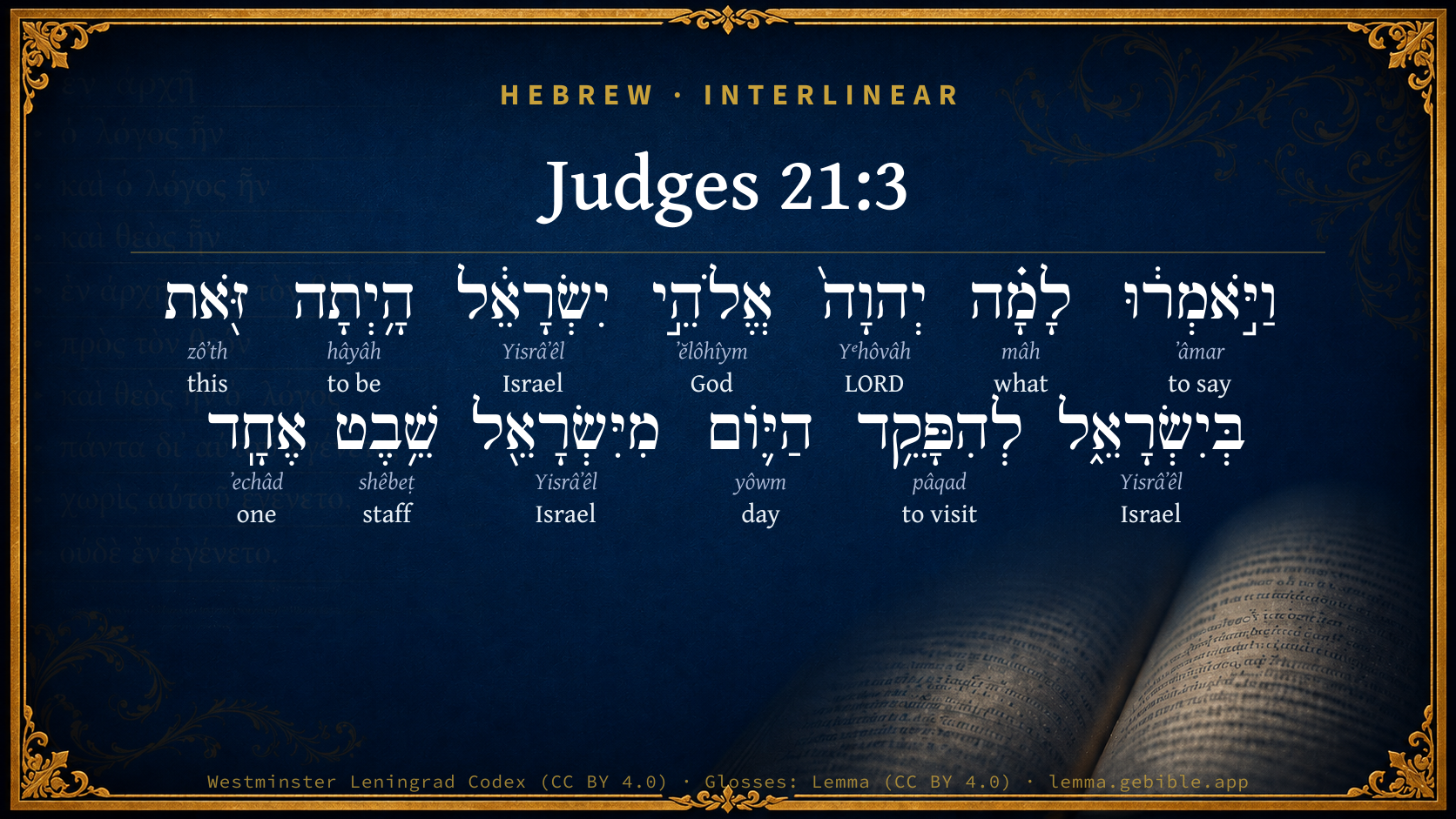
  1. וַיֹּ֣אמְר֔וּ ʼâmar H559 “and · to say” Conjunction + Verb, Qal, Sequential Imperfect, 3rd Person, Masculine, Plural
  2. לָמָ֗ה mâh H4100 “to/for · what” Preposition + Particle, Interrogative
  3. יְהוָה֙ Yᵉhôvâh H3068 “LORD” Noun, Proper
  4. אֱלֹהֵ֣י ʼĕlôhîym H430 “God(s) of” Noun, Common, Masculine, Plural, Construct
  5. יִשְׂרָאֵ֔ל Yisrâʼêl H3478 “Israel” Noun, Proper
  6. הָ֥יְתָה hâyâh H1961 “to be” Verb, Qal, Perfect, 3rd Person, Feminine, Singular
  7. זֹּ֖את zôʼth H2063 “this” Pronoun, Demonstrative, Feminine, Singular
  8. בְּיִשְׂרָאֵ֑ל Yisrâʼêl H3478 “in/at · Israel” Preposition + Noun, Proper
  9. לְהִפָּקֵ֥ד pâqad H6485 “to visit” Preposition + Verb, Niphal, Infinitive Construct
  10. הַיּ֛וֹם yôwm H3117 “the · day” Particle, Definite Article + Noun, Common, Masculine, Singular, Absolute
  11. מִיִּשְׂרָאֵ֖ל Yisrâʼêl H3478 “from · Israel” Preposition + Noun, Proper
  12. אֶחָֽד ʼechâd H259 “one” Adjective, Cardinal number, Masculine, Singular, Absolute

About this verse

These counts appear in no published source. They are computed here, from the morphology-tagged text and Lemma’s own curated glosses. What Lemma adds →

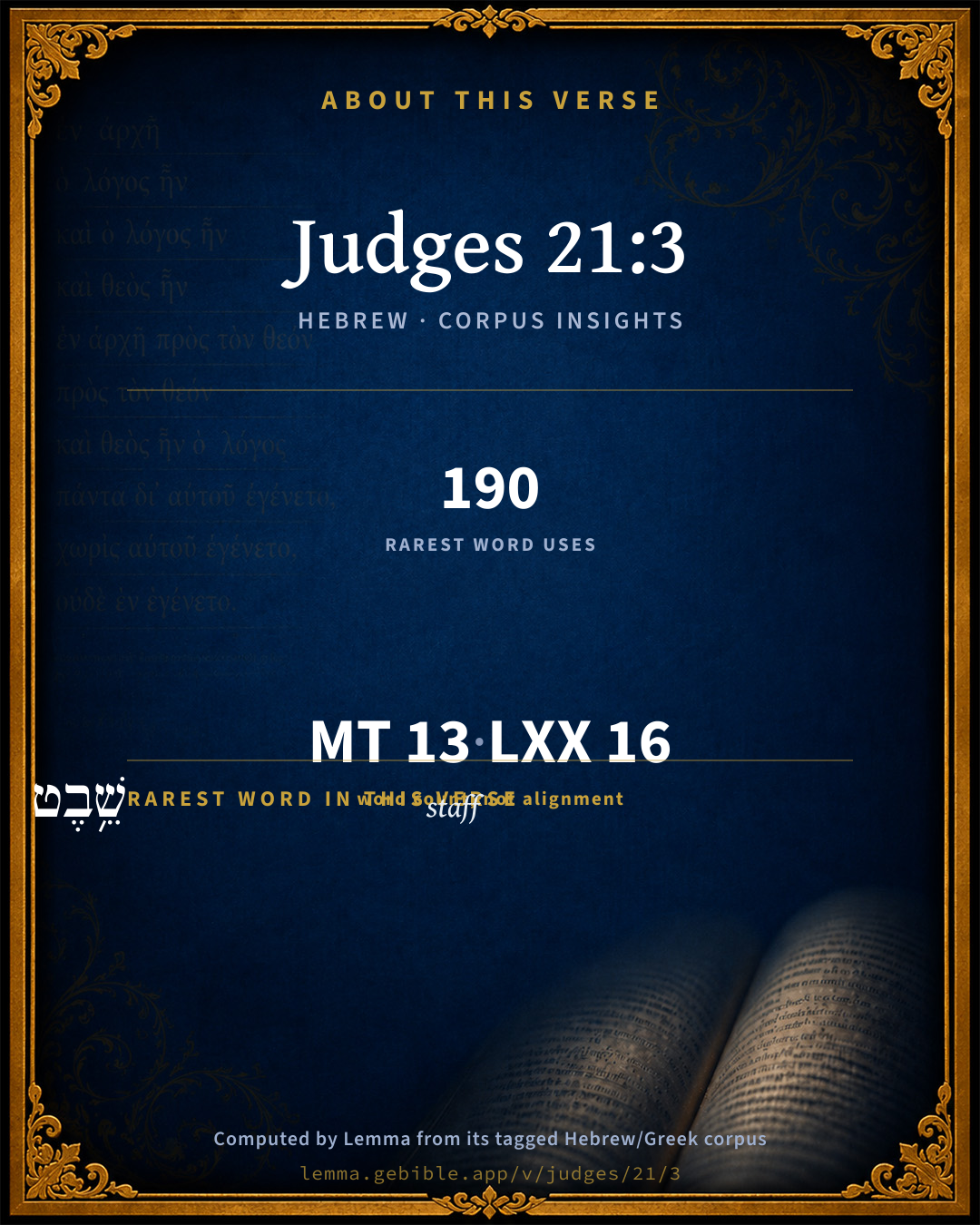
13
words
11
distinct lemmas
Historical
section

Grammatical profile

  • 3 verbs
  • 7 nouns
  • 1 adjective
  • 1 pronoun
  • 1 particle

Verb forms

  • וַיֹּ֣אמְר֔וּ Qal · Sequential Imperfect
  • הָ֥יְתָה Qal · Perfect
  • לְהִפָּקֵ֥ד Niphal · Infinitive Construct

Repetition

A word recurs within this verse — often emphatic in Hebrew:

  • יִשְׂרָאֵ֔ל Israel H3478 ×3

Hebrew & Septuagint length

In English translation the verse runs 23 words from the Hebrew and 24 from the Septuagint (LXX English) — closely comparable.

A rough comparison of the two English renderings, which tokenize alike — not a word-level alignment.

Word counts can differ between the Hebrew and the Greek without any difference in meaning — e.g. the Hebrew direct-object marker אֵת has no separate Greek word, and Greek often adds the article ὁ.

In the original languages it is 13 Hebrew tokens and 16 Greek tokens — but the two are counted differently (Hebrew bundles its prefixes and suffixes into one token; the Greek is in lemma form), so that isn’t a like-for-like length.

Cross-references

7

Topical passages linked to Judges 21:3 in the Treasury of Scripture Knowledge — connected by theme and wording, ordered by reader-vote popularity; previews shown in the World English Bible.

  • Psalms 80:12 Why have you broken down its walls, So that all those who pass by the way pluck it?
  • Jeremiah 12:1 Righteous are you, Yahweh, when I contend with you; yet would I reason the cause with you: why does the way of the wicked prosper? why are all they at ease who deal very treacherously?
  • Deuteronomy 29:24 even all the nations shall say, Why has Yahweh done thus to this land? what means the heat of this great anger?
  • Joshua 7:7–9 Joshua said, Alas, Lord Yahweh, why have you at all brought this people over the Jordan, to deliver us into the hand of the Amorites, to cause us to perish? would that we had been content and lived beyond the Jordan!
  • Psalms 74:1 God, why have you rejected us forever? Why does your anger smolder against the sheep of your pasture?
  • Proverbs 19:3 The foolishness of man subverts his way; His heart rages against Yahweh.
  • Isaiah 63:17 O Yahweh, why do you make us to err from your ways, and harden our heart from your fear? Return for your servants' sake, the tribes of your inheritance.

Cross-references courtesy of OpenBible.info (CC BY 4.0).

Hebrew and Greek witnesses Masoretic Hebrew ↔ Greek Septuagint

The same verse in the two great witnesses to the Old Testament, shown verse-for-verse.

These are two independent witnesses, not word-aligned to each other, and the Septuagint is shown in lemma (dictionary) form.

Hebrew Judges 21:3 Masoretic · Westminster Leningrad Codex

וַיֹּ֣אמְר֔וּ לָמָ֗ה יְהוָה֙ אֱלֹהֵ֣י יִשְׂרָאֵ֔ל הָ֥יְתָה זֹּ֖את בְּיִשְׂרָאֵ֑ל לְהִפָּקֵ֥ד הַיּ֛וֹם מִיִּשְׂרָאֵ֖ל שֵׁ֥בֶט אֶחָֽד

They said, Yahweh, the God of Israel, why has this happened in Israel, that there should be today one tribe lacking in Israel?

World English Bible · Public Domain

Greek LXX Judges 21:3 Septuagint · lemma form

καί εἶπον εἰς τίς κύριος θεός ἰσραήλ γίγνομαι οὗτος ὁ ἐπισκέπτομαι σήμερον ἀπό ἰσραήλ φυλή εἷς

and said, Therefore, O Lord God of Israel, has this come to pass, that today one tribe should be counted as missing from Israel?

LXX2012 (modern English Septuagint) · Public Domain

On this verse, Haydock's Catholic Bible Commentary discusses the Septuagint’s reading. Read the note in Commentary ↓

Hebrew: Westminster Leningrad Codex (CC BY 4.0). Greek: Septuagint (public domain); English from LXX2012 (modern English Septuagint) (Public Domain). How the Septuagint differs from the Hebrew →

Targum (Aramaic paraphrase)

1

The Targum is the ancient Jewish Aramaic paraphrase of the Hebrew Scriptures — an interpretive translation, not the Hebrew text itself. Onkelos (literal) and Pseudo-Jonathan (expansive) render the Torah, and Jonathan the Prophets. Coverage is partial: where no permissively-licensed English translation exists for a verse, only the Aramaic is shown. This is verse-level text, not a word-by-word alignment to the Hebrew.

  1. Targum Jonathan Prophets (Joshua–Malachi)
    וַאֲמֵרוּ לְמָא יְיָ אֱלָהָא דְיִשְׂרָאֵל הֲוַת דָא בְּיִשְׂרָאֵל לְמִשְׁגֵי יוֹמָא דֵין מִיִשְׂרָאֵל שִׁבְטָא חָד:

    (no public-domain English translation for this verse)

    Targum Jonathan — Aramaic: “Mikraot Gedolot” (public domain). English: “Sefaria Community Translation” (CC0 1.0 (public-domain dedication)); “London "Chaldee Paraphrase," 1871” (public domain). Text via Sefaria.

Commentary

Notes on Judges 21:3 from classic Christian and Jewish commentators (each source and its license shown beneath its notes). The classic Christian expositions comment on the surrounding passage and are grouped to its opening verse, so a note may address several verses; the Jewish commentaries on the Tanakh (Rashi and others) are per-verse, so they appear only where the commentator wrote on this verse.

Lemma curates 59 commentaries, every one of them public domain or Creative Commons licensed, each selected and text-cleaned for this edition rather than reprinted as found. About our sources →

Trapp's Complete Commentary

John Trapp

Jdg 21:3 And said, O LORD God of Israel, why is this come to pass in Israel, that there should be to day one tribe lacking in Israel?

Ver. 3. Why is this come to pass in Israel?] q.d., Alas, Lord, that it should be so! Oh, show us some expedient for prevention of such a mischief. Oh, the sad effects of our rage and rashness, which now in cold blood we repent us off, but know not which way to remedy!

John Trapp, A Commentary or Exposition upon All the Books of the Old and New Testament (1647–1656) — public domain. Text from a community e-Sword module.

Joseph Benson's Commentary

Jdg 21:3. Why is this come to pass? — They had no reason to ask the cause, or by what means it came to pass, which they knew too well; but this is a common expression of grief or complaint. Strange! when they uttered this for the loss of the tribe which they imagined must be extinct, because there were no women left to match with the six hundred men who had saved themselves in the rock Rimmon, that they did not pour forth the deepest expressions of sorrow and contrition for their own wickedness, in having been guilty of such inhumanity toward the innocent among the Benjamites, particularly the women and children, who could not be culpable in any degree. Alas! what crimes is human nature capable of! and what need is there of the divine grace to renew and influence the heart of man!

Joseph Benson's Commentary on the Old and New Testaments (1811–1818) — public domain. Text from a community e-Sword module.

Adam Clarke's Commentary

Verse 3. Why is this come to pass] This was a very impertinent question. They knew well enough how it came to pass. It was right that the men of Gibeah should be punished, and it was right that they who vindicated them should share in that punishment; but they carried their revenge too far, they endeavoured to exterminate both man and beast, Jdg 20:48.

Adam Clarke's Commentary on the Bible (1810–1826) — public domain. Text from a community e-Sword/MySword module.

Ellicott's Commentary for English Readers

(3) Why is this come to pass . . .?—This is not so much an inquiry into the cause, which was indeed too patent, but a wail of regret, implying a prayer to be enlightened as to the best means of averting the calamity. The repetition of the name “Israel” three times shows that the nation had not yet lost its sense of corporate unity, often as that unity had been rent asunder by their civil dissensions. Their wild justice is mingled with a still wilder mercy.

One tribe lacking.—The number twelve had an almost mystic significance, and is always preserved in reckoning up the tribes, whether Levi is included or excluded.

A Bible Commentary for English Readers, edited by Charles John Ellicott (1878–1897) — public domain. Text from a community e-Sword module.

The Cambridge Bible for Schools and Colleges

gen. ed. J. J. S. Perowne

3. one tribe lacking] of the sacred number twelve. Contrast the expression of the similar sentiment in the older narrative, Jdg_21:15.

The Cambridge Bible for Schools and Colleges (gen. ed. J. J. S. Perowne; Cambridge University Press, 1878–1918) — public domain. Text from a community e-Sword module.

John Gill's Exposition

And said, O Lord God of Israel,.... Jehovah, the only living and true God, the Being of beings, eternal, immutable, omnipotent and omnipresent, the God of all Israel, of the twelve tribes of Israel, their covenant God and Father; who had shown favour to them in such a peculiar and gracious manner, as he had not to other nations, and therefore hoped he would still have a kind regard unto them, and suffer them to expostulate with him in the following manner:

why is this come to pass in Israel; expressing, as Abarbinel thinks, a concern for the 40,000 men of Israel which fell in the two first battles; but it manifestly refers to the case in the next words:

that there should be today one tribe lacking in Israel; meaning the tribe of Benjamin, which was all destroyed, excepting six hundred men, and these had no wives to propagate the tribe; and therefore, unless some provision could be made for that, it must in a short time be totally extinct; for which they express great concern, it not being their intention when they made the above oath to extirpate them; but such were now the circumstances of things in Providence, that it must perish unless some way could be found to relieve it, and which their oath seemed to preclude; and this threw them into great perplexity.

John Gill's Exposition of the Whole Bible (1746–1763) — public domain (CC PDM 1.0). Text via the HelloAO Bible API.

Albert Barnes' Notes on the Bible

The repetition of the name of Israel is very striking in connection with the title of Yahweh as “God of Israel.” It contains a very forcible pleading of the covenant, and memorial of the promises. The very name “Israel” comprehended all the twelve tribes; with one of them blotted out, the remnant would not be Israel.

Albert Barnes' Notes on the Bible (1834–1885) — public domain. Text from a community e-Sword/MySword module.

Haydock's Catholic Bible Commentary

Evil. Thus they style their own cruelty, in destroying the women and children, and in taking an oath to prevent the remaining Benjamites from having any posterity, unless they married with strangers, which the law forbade, (Calmet) though it would hardly bind in cases of such necessity. (Haydock) --- Hence the sons of Noemi are excused from entering into such marriages, Ruth i. 4. (Tirinus) --- Hebrew and Septuagint do not mention, so great an evil, but only this. The context however shews, that the people considered the extermination of a whole tribe, as a dreadful misfortune; and, as it was going to take place in consequence of their oath, unless some expedient could be discovered to prevent it, without the guilt of perjury, they were moved with repentance, and endeavoured to appease God’s wrath by a multiplicity of victims. How much better would it have been not to have made a vow, than after making it, to strive to render it ineffectual! (Ecclesiastes v. 3, 4.) It does not appear that God gave them any answer in all this affair; and the concluding verse seems to indicate, that their conduct was displeasing to him. Perhaps he punished this, as well as the other faults of his people, by delivering them over to Chusan for eight years, as Salien and Usher place the first year of servitude immediately after the close of this unfortunate war, which would enable the Chanaanites to gain fresh strength, and to rejoice at the civil broils of Israel, chap. iii. 8. Aod, who slew Eglon, about 94 years afterwards, was not yet born. (Haydock)

George Leo Haydock (1774–1849), Haydock's Catholic Family Bible and Commentary, 1859 edition — public domain. Excludes Psalms (Douay-Rheims chapter numbering differs from Protestant) and Deuterocanonical books (Catholic canon only).

Matthew Poole's English Annotations

Why hast thou given them up to such wickedness, and us to such rage, that the whole tribe should be in a manner lost? Hence it appears that they did not swear to root them all out, as is further manifest from the different matter and words of this oath, Jdg 21:1, which only denied them their daughters in marriage; and that concerning the people of other tribes who joined not with them in this business, which was, that they should be put to death, Jdg 21:5. And their sparing of those six hundred men in the rock Rimmon, Jdg 21:13,14, plainly shows that they were not obliged by any oath or vow to extirpate them.

Matthew Poole's English Annotations on the Holy Bible (1683–1685) — public domain. Text from a community e-Sword/MySword module.

Whedon's Commentary on the Bible

Daniel D. Whedon

3. One tribe lacking in Israel — A fearful thought thus came over them after the hour of bitterness and passion had gone, and calm reflection returned, “God had taken care of every tribe,” remarks Henry; “their number twelve was that which they were known by; every tribe had his station appointed in the camp, and his stone in the high priest’s breastplate; every tribe had his blessing, both from Jacob and Moses, and it would be an intolerable reproach to them if they should drop any out of this illustrious jury, and lose one out of twelve; especially Benjamin, the youngest, who was particularly dear to Jacob, their common ancestor. Benjamin is not; what then will become of Jacob? Benjamin become a Benoni! the son of the right hand — a son of sorrow!” Gen_35:18.

Daniel D. Whedon (gen. ed.), Commentary on the Old and New Testaments (1874–1909) — public domain. Text from a community e-Sword module.

The Pulpit Commentary

And said. Better, And they said. One tribe lacking. The existence of the twelve tribes was an essential part of their covenant existence as the people of God. (Gen_35:22 Gen_49:28 Num_1:5-15 Jos_4:3, Jos_4:4, etc.; Mat_19:28 Jam_1:1 Rev_7:4, etc.) With one tribe missing Israel would be no longer Israel.

The Pulpit Commentary (1880–1919), ed. H.D.M. Spence-Jones & Joseph S. Exell — public domain. Text from a community e-Sword module.

Scofield Reference Notes

C. I. Scofield

tribe

There is here no mourning for sin, no humbling because of national transgression, no return to Jehovah. Accordingly, no word from Jehovah comes to them. They act wholly in self-will (Jdg 21:10). CF.; 21:10; Dan 9:3-13.

The Scofield Reference Bible (1917 edition), notes by C. I. Scofield — public domain. Text from a community e-Sword module.

Rashi

Rabbi Shlomo Yitzchaki (Rashi)

Will be eliminated Removed.

Rashi on the Tanakh — English translations: “The Judaica Press complete Tanach with Rashi, translated by A. J. Rosenberg” (CC BY 4.0); “Pentateuch with Rashi's commentary by M. Rosenbaum and A.M. Silbermann, 1929-1934” (public domain); “The Metsudah Tanach series, Lakewood, N.J” (CC BY 4.0); and “The Book of Joshua, Metsudah Publications, 1997” (CC BY 4.0). Text via Sefaria.

Lesson kit

Teaching starters — assembled from the data on this page, not authored interpretation. Every prompt links to the verse data it draws on. Edit before teaching.

Judges, in the Historical, opens this verse with 13 words (11 distinct Hebrew lemmas). Its most distinctive word is shêbeṭ (“staff”). A historical commentator’s framing appears above. Read the whole chapter for the surrounding context.

Discussion questions

  1. What does “staff” (shêbeṭ) contribute to the verse as a whole?
  2. Psalms 80:12 shares this passage’s theme. How do the two illuminate each other?
  3. “Israel” occurs 3× in this one verse. What is the effect of the repetition?
  4. The translations on this page render this verse differently — a whole-verse word diff, not a word-by-word alignment. What might account for the different wordings?
  5. The verb «וַיֹּ֣אמְר֔וּ» is Qal Sequential Imperfect. How does its form color the action?
  6. Reading how Trapp's Complete Commentary and Joseph Benson's Commentary read this verse, where do the two commentators agree and where do they part?

Things to notice

Reading settings

Reading text

Shown beneath each verse's original-language words.

Old Testament
Old Testament edition

Read the OT as the Masoretic Hebrew (MT) or the Greek Septuagint (LXX).

English shown for the Greek Septuagint (in the Hebrew ↔ Greek comparison).

Comparing translations? Open the Compare panel on any verse page to stack up to four side by side.