
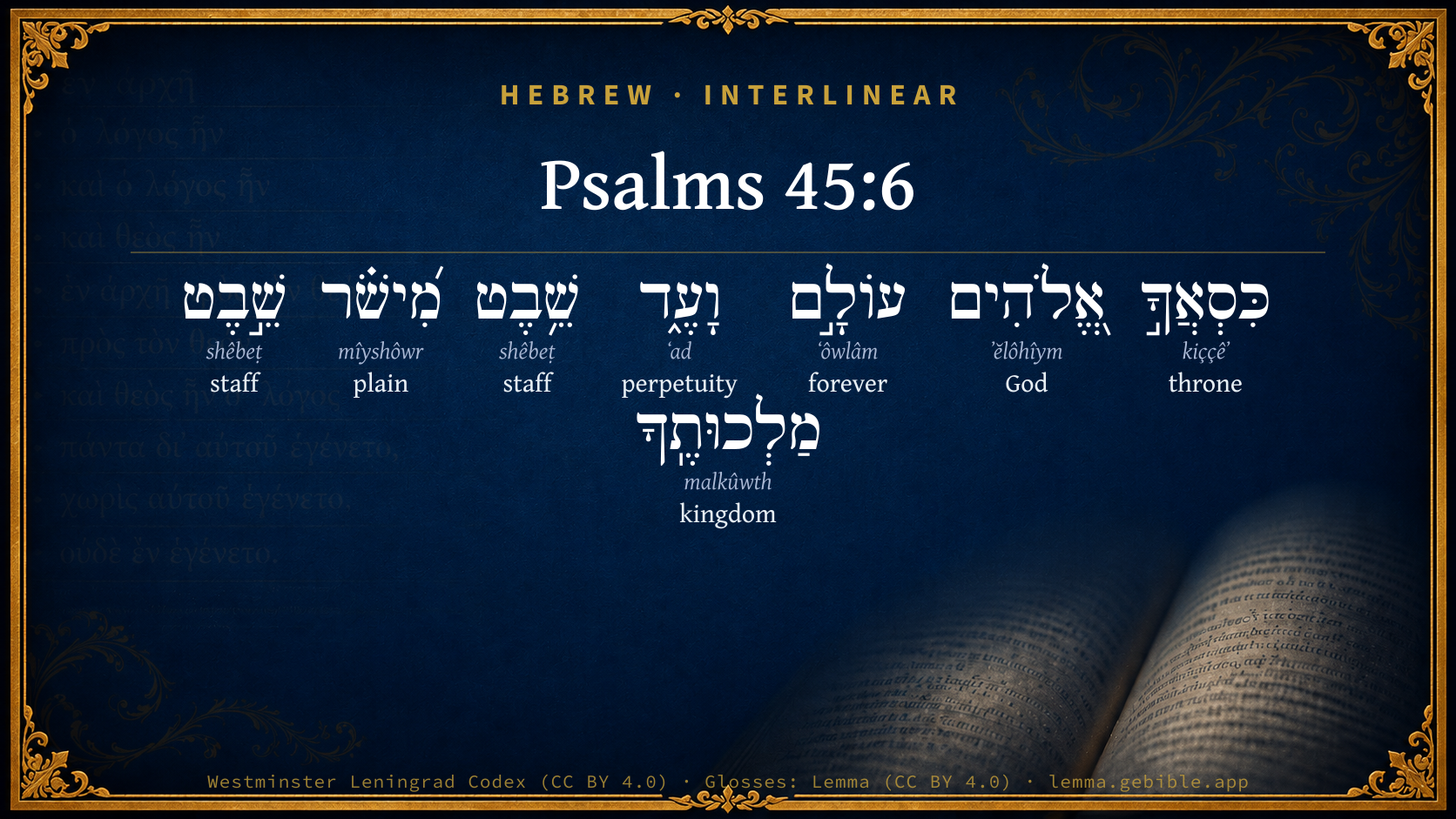
Psalms 45:6

Hebrew (Westminster Leningrad Codex) Psalms 45:6 appears in the Hebrew Old Testament. The text above is from the Westminster Leningrad Codex. Each word links to its Strong’s number, a concise gloss, and parsing drawn from the Open Scriptures Hebrew Bible morphology. Click any word for its full Brown-Driver-Briggs (BDB) entry.
Download image
Cite this verse

Psalms 45:6 (World English Bible). Public Domain. Lemma interlinear Bible study tool, https://lemma.gebible.app/v/psalms/45/6.

Show BibTeX & RIS
BibTeX
RIS
English Translation
Your throne, God, is forever and ever. A scepter of equity is the scepter of your kingdom.
World English Bible · Public Domain
Download a study sheet

One document with this verse’s original text, its word-by-word gloss line, the meaning frame, cross-references with their text, attributed commentary, and full source and license credits — printable, and it pastes into notes with its structure intact.

This verse Autodidact and up

Study sheet (.html) Plain text (.txt)

A passage Seminary Student

Up to 50 verses in one chapter. A passage sheet keeps up to 6 commentary sources and 12 cross-references per verse, in the order this page ranks them, and says so on the sheet whenever that leaves anything out. Ask for a single verse and you get the Autodidact verse sheet above.

Everything on this page stays free to read, with no account — the sheet is a download of what is already on screen, not access to it.

Want to remove ads? Support Godless Engineer
Compare translations 3

The same verse in 3 English versions, stacked beneath the original-language interlinear above. Click any original word for its lexicon entry.

Each is an independent rendering of the whole verse — the interlinear is not word-aligned to these translations.

Highlighted words mark where these versions differ — a whole-verse word diff, not a word-by-word alignment.

  • World English Bible Public Domain
    Your throne, God, is forever and ever. A scepter of equity is the scepter of your kingdom.
  • King James Version Public Domain
    Thy throne, O God, is for ever and ever: the sceptre of thy kingdom is a right sceptre.
  • unfoldingWord Literal Text CC BY-SA 4.0
    Your throne, God, forever and ever. A scepter of justice the scepter of your kingdom.

unfoldingWord Literal Text — © unfoldingWord, licensed CC BY-SA 4.0. Word-aligned USFM3 via Door43 (git.door43.org/unfoldingWord/en_ult).

Versions to compare (up to 4)

3 of 4 selected

Show all 18 translations

Every available English version of this verse, each an independent rendering of the whole verse.

  • World English Bible Public Domain
    Your throne, God, is forever and ever. A scepter of equity is the scepter of your kingdom.
  • Berean Standard Bible Public Domain
    Your throne, O God, endures forever and ever, and justice is the scepter of Your kingdom.
  • Majority Standard Bible Public Domain
    Your throne, O God, endures forever and ever, and justice is the scepter of Your kingdom.
  • King James Version Public Domain
    Thy throne, O God, is for ever and ever: the sceptre of thy kingdom is a right sceptre.
  • American Standard Version (1901) Public Domain
    Thy throne, O God, is for ever and ever: A sceptre of equity is the sceptre of thy kingdom.
  • Revised Version (1885) Public Domain
    Thy throne, O God, is for ever and ever: a sceptre of equity is the sceptre of thy kingdom.
  • Geneva Bible (1599) Public Domain
    Thy throne, O God, is for euer and euer: the scepter of thy kingdome is a scepter of righteousnesse.
  • Douay-Rheims (1899) Public Domain
    Thy arrows are sharp: under thee shall people fall, into the hearts of the king's enemies.
  • Young's Literal Translation Public Domain
    Thy throne, O God, `is' age-during, and for ever, A sceptre of uprightness `Is' the sceptre of Thy kingdom.
  • Literal Standard Version CC BY-SA 4.0
    Your throne, O God, [is for] all time and forever, || A scepter of uprightness || [Is] the scepter of Your kingdom.
  • Unlocked Literal Bible CC BY-SA 4.0
    Your throne, God, is forever and ever; a scepter of justice is the scepter of your kingdom.
  • unfoldingWord Literal Text CC BY-SA 4.0
    Your throne, God, forever and ever. A scepter of justice the scepter of your kingdom.
  • Darby Bible Public Domain
    Thy throne, O God, is for ever and ever; a sceptre of uprightness is the sceptre of thy kingdom:
  • World Messianic Bible Public Domain
    Your throne, God, is forever and ever. A scepter of equity is the scepter of your kingdom.
  • Webster's Bible Public Domain
    \\45:5\\Thy arrows are sharp in the heart of the king's enemies; by which the people fall under thee.
  • Free Bible Version CC BY-SA 4.0
    Your throne comes from God, and lasts forever and ever. The scepter with which you rule is a scepter of fairness.
  • Bible in Basic English Public Domain
    Your seat of power, O God, is for ever and ever; the rod of your kingdom is a rod of honour.
  • JPS Tanakh (1917) Public Domain
    (45-7) Thy throne given of God is for ever and ever; a sceptre of equity is the sceptre of thy kingdom.

Literal Standard Version (2020), Covenant Press — licensed CC BY-SA 4.0. Text via the HelloAO Bible API (eBible.org). Unlocked Literal Bible (unfoldingWord) — licensed CC BY-SA 4.0. Text via the HelloAO Bible API (eBible.org). unfoldingWord Literal Text — © unfoldingWord, licensed CC BY-SA 4.0. Word-aligned USFM3 via Door43 (git.door43.org/unfoldingWord/en_ult). Free Bible Version, Dr. Jonathan Gallagher — licensed CC BY-SA 4.0. Text via the HelloAO Bible API (eBible.org).

Word by word

More ways to search: Search by grammar → Find every occurrence → Compare this word →

Practice this passage: Drill this verse → Learn its vocabulary →

About this verse

These counts appear in no published source. They are computed here, from the morphology-tagged text and Lemma’s own curated glosses. What Lemma adds →

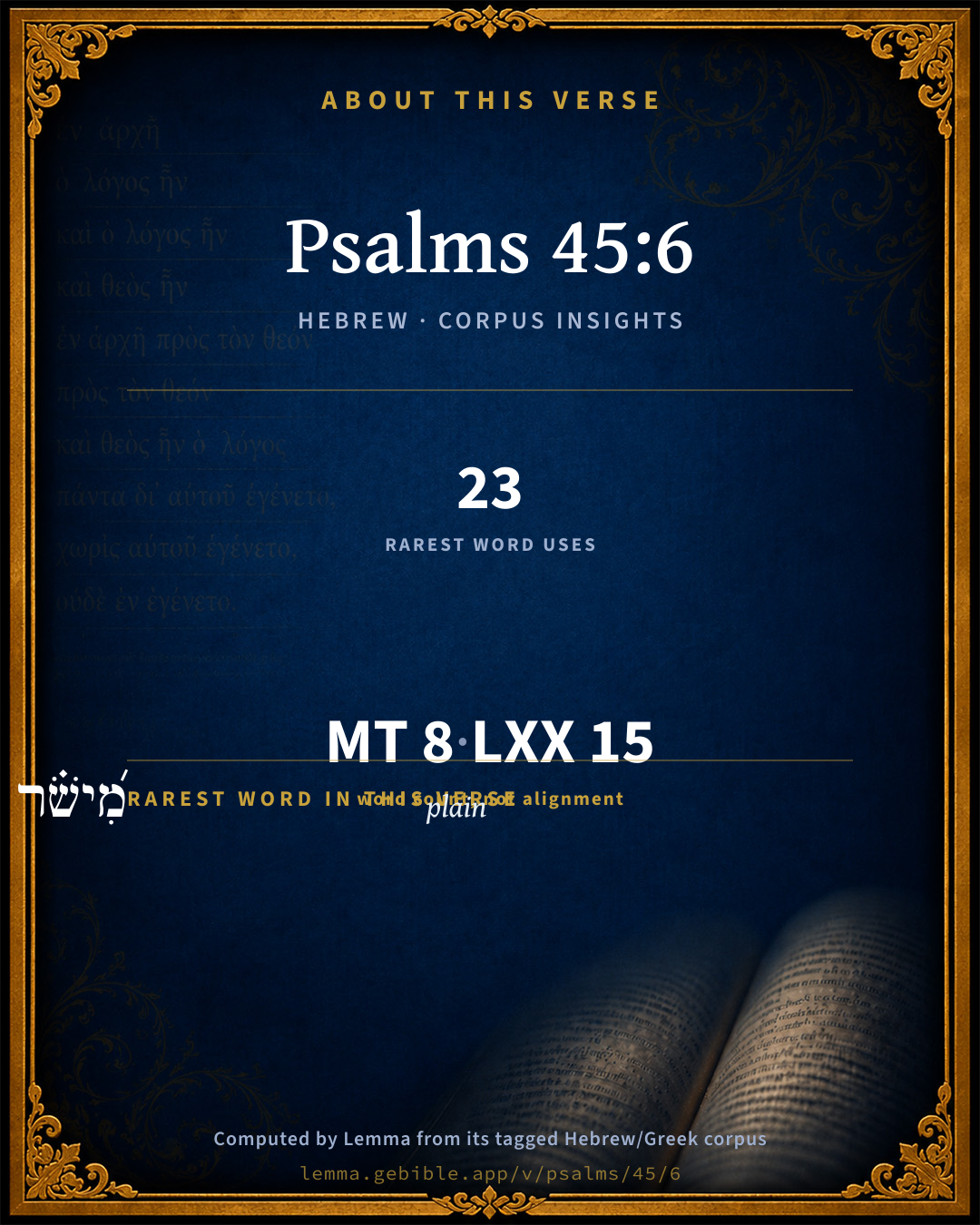
8
words
7
distinct lemmas
Wisdom
section

Notable vocabulary

The rarest word here is מִ֝ישֹׁ֗ר plain H4334 — appearing just 23 times in the whole Hebrew Bible.

Shared distinctive vocabulary

מִ֝ישֹׁ֗ר plain H4334 occurs in 23 verses of the Hebrew Bible. Also found in:

Grammatical profile

  • 8 nouns

Repetition

A word recurs within this verse — often emphatic in Hebrew:

  • שֵׁ֥בֶט staff H7626 ×2

Hebrew & Septuagint length

In English translation the verse runs 17 words from the Hebrew and 19 from the Septuagint (LXX English) — closely comparable.

A rough comparison of the two English renderings, which tokenize alike — not a word-level alignment.

Word counts can differ between the Hebrew and the Greek without any difference in meaning — e.g. the Hebrew direct-object marker אֵת has no separate Greek word, and Greek often adds the article ὁ.

In the original languages it is 8 Hebrew tokens and 15 Greek tokens — but the two are counted differently (Hebrew bundles its prefixes and suffixes into one token; the Greek is in lemma form), so that isn’t a like-for-like length.

Cross-references

16

Topical passages linked to Psalms 45:6 in the Treasury of Scripture Knowledge — connected by theme and wording, ordered by reader-vote popularity; previews shown in the World English Bible.

  • Hebrews 1:8–9 but of the Son he says, "Your throne, O God, is forever and ever; The scepter of uprightness is the scepter of your Kingdom.
  • Psalms 93:2 Your throne is established from long ago. You are from everlasting.
  • John 1:1 In the beginning was the Word, and the Word was with God, and the Word was God.
  • Isaiah 9:6–7 For to us a child is born, to us a son is given; and the government shall be on his shoulder: and his name shall be called Wonderful, Counselor, Mighty God, Everlasting Father, Prince of Peace.
  • Jeremiah 23:5–6 Behold, the days come, says Yahweh, that I will raise to David a righteous Branch, and he shall reign as king and deal wisely, and shall execute justice and righteousness in the land.
  • Jeremiah 33:15–16 In those days, and at that time, will I cause a Branch of righteousness to grow up to David; and he shall execute justice and righteousness in the land.
  • Psalms 145:13 Your kingdom is an everlasting kingdom. Your dominion endures throughout all generations.
  • Psalms 89:29 I will also make his seed endure forever, And his throne as the days of heaven.
  • Psalms 89:36–37 His seed will endure forever, His throne like the sun before me.
  • Daniel 2:44 In the days of those kings shall the God of heaven set up a kingdom which shall never be destroyed, nor shall the sovereignty of it be left to another people; but it shall break in pieces and consume all these kingdoms, and it shall stand forever.
  • Luke 1:32–33 He will be great, and will be called the Son of the Most High. The Lord God will give him the throne of his father, David,
  • 1 Timothy 3:16 Without controversy, the mystery of godliness is great: God was revealed in the flesh, Justified in the spirit, Seen by angels, Preached among the nations, Believed on in the world, And received up in glory.
  • Psalms 72:1–20 God, give the king your justice; Your righteousness to the royal son.
  • Revelation 19:11 I saw the heaven opened, and behold, a white horse, and he who sat on it is called Faithful and True. In righteousness he judges and makes war.
  • 2 Samuel 23:4 [He shall be] as the light of the morning, when the sun rises, A morning without clouds, [When] the tender grass [springs] out of the earth, Through clear shining after rain.
  • Psalms 98:9 Let them sing before Yahweh, For he comes to judge the earth. He will judge the world with righteousness, And the peoples with equity.

Cross-references courtesy of OpenBible.info (CC BY 4.0).

Hebrew and Greek witnesses Masoretic Hebrew ↔ Greek Septuagint

The same verse in the two great witnesses to the Old Testament, shown verse-for-verse.

You’re reading Greek Psalm 44 (Hebrew Psalm 45). The Septuagint counts the superscription, so verse numbers can differ from the Hebrew — chapter-level alignment, not verse-by-verse. Numbering follows Rahlfs.

These are two independent witnesses, not word-aligned to each other, and the Septuagint is shown in lemma (dictionary) form.

Hebrew Psalms 45:6 Masoretic · Westminster Leningrad Codex

כִּסְאֲךָ֣ אֱ֭לֹהִים עוֹלָ֣ם וָעֶ֑ד שֵׁ֥בֶט מִ֝ישֹׁ֗ר שֵׁ֣בֶט מַלְכוּתֶֽךָ

Your throne, God, is forever and ever. A scepter of equity is the scepter of your kingdom.

World English Bible · Public Domain

Greek LXX Greek Psalm 44:6 Septuagint · lemma form

ὁ βέλος σύ ἀκονάω δυνατός λαός ὑποκάτω σύ πίπτω ἐν καρδία ὁ ἐχθρός ὁ βασιλεύς

Your throne, O God, is for ever and ever: the sceptre of your kingdom is a sceptre of righteousness.

LXX2012 (modern English Septuagint) · Public Domain

On this verse, Keil & Delitzsch discusses the Septuagint’s reading. Read the note in Commentary ↓

Hebrew: Westminster Leningrad Codex (CC BY 4.0). Greek: Septuagint (public domain); English from LXX2012 (modern English Septuagint) (Public Domain). How the Septuagint differs from the Hebrew →

Commentary

Notes on Psalms 45:6 from classic Christian and Jewish commentators (each source and its license shown beneath its notes). The classic Christian expositions comment on the surrounding passage and are grouped to its opening verse, so a note may address several verses; the Jewish commentaries on the Tanakh (Rashi and others) are per-verse, so they appear only where the commentator wrote on this verse.

Lemma curates 59 commentaries, every one of them public domain or Creative Commons licensed, each selected and text-cleaned for this edition rather than reprinted as found. About our sources →

The Cambridge Bible for Schools and Colleges

gen. ed. J. J. S. Perowne

6. Thy throne, O God, is for ever and ever] (1) This appears to be the sense given by all the Ancient Versions, for though it has been argued that ὁ θεὸς in the LX X is not the vocative (Thy throne O God) but the predicate (Thy throne is God), the words do not appear to have been so understood by any of the ancient commentators, and the construction is certainly not an obvious one. But this rendering involves serious difficulties, whether it is taken as an address to the king or to God. (a) Can the king who is the subject of the Ps. be addressed as Elohim, ‘God’? The older expositors, who regarded the Psalm as directly Messianic, of course felt no difficulty, and saw in the words a recognition of the Deity of Christ. But the tone and contents of the Psalm make it clear that it is addressed to some actual king. Could such a king be so addressed? It is argued that judges were called gods (Exo_21:6; Exo_22:8-9; Exo_22:28(?); 1Sa_2:25); that the theocratic king as the representative of God was said to sit “on the throne of Jehovah” (1Ch_28:5; 1Ch_29:23); that a prophet can predict that the house of David should be as God (Zec_12:8); that Elohim is applied to men in the sense of divine or supernatural (Exo_7:1; 1Sa_28:13); that Isaiah speaks of the Messianic king as El gibbôr, ‘mighty God’; and that the words of the next verse (where doubtless Jehovah thy God originally stood) preclude the possibility of misunderstanding. But it is doubtful whether judges are actually called gods (see R.V. of the passage quoted): certainly they are only so called as the mouthpieces of God, Who is regarded as the fountain of judgement: and after all that has been urged in favour of this interpretation it seems hardly possible to suppose that the king is directly addressed as Elohim.

(b) The Targum regards the words as addressed to Jehovah, ‘The throne of Thy majesty, O Jehovah, abideth for ever and ever.’ Jehovah’s throne may mean His heavenly throne (Psa_145:13; Lam_5:19), or the throne which He has established on earth as its counterpart and representative. But this interpretation seems to be excluded by the context. The king is addressed in the preceding and following verses, and it seems hardly possible to suppose that in this verse alone Jehovah is abruptly addressed.

(2) In view of these difficulties it is necessary to consider whether the words are correctly translated. Various other renderings have been proposed, taking Elohim as the subject or predicate of the clause instead of as a vocative. (a) God is thy throne: i.e. thy kingdom is founded upon God. In support of this are quoted such phrases as “Jehovah is my refuge and my fortress” (Psa_91:2), or, “The eternal God is thy dwelling-place” (Deu_33:27). But the expression, to say the least, would be a strange one. (b) Thy throne is God, i.e. divine. But though Hebrew uses substantives as predicates in a way which our idiom does not allow, this particular instance seems scarcely admissible. (c) Thy throne [is the throne of] God (R.V. marg.). It is a disputed point whether this rendering is grammatically legitimate; but good authorities decide in the affirmative. It gives an excellent sense, and if the text is to be retained is the most satisfactory explanation of it. The theocratic king occupied the earthly throne of Jehovah as His representative (1Ch_28:5; 1Ch_29:23), ruling by His power (1Ki_3:28), and in His Name; and the justice of this king’s government (6 b, 7) stamps him as a worthy representative of Jehovah.

(3) Various emendations have been suggested, for the most part introducing a verb to give the sense, God hath established thy throne. The most ingenious is that of Bruston, who supposes that the Elohistic editor misread YHVH, Jehovah, for YHYH, shall be, and according to his usual custom substituted Elohim. Thy throne shall be for ever and ever would be an echo of the promise in 2Sa_7:16 b.

Whatever may be the precise rendering, there can be little doubt that the words contain a reference to the promise of eternal dominion to the house of David, which was fulfilled in Christ. See 2Sa_7:13; 2Sa_7:16; Psalms 89; cp. Psa_21:4; Psa_72:5.

Psa_45:6-7 are quoted in Heb_1:8-9. “It is commonly supposed that the force of the quotation lies in the Divine title (ὁ θεός) which, as it is held, is applied to the Son. It seems however from the whole form of the argument to lie rather in the description which is given of the Son’s office and endowment. The angels are subject to constant change, He has a dominion for ever and ever; they work through material powers, He—the Incarnate Son—fulfils a moral sovereignty and is crowned with unique joy. Nor could the reader forget the later teaching of the Psalm on the Royal Bride and the Royal Race. In whatever way then ὁ θεός be taken, the quotation establishes the conclusion which the writer wishes to draw as to the essential difference of the Son and the angels.” Bp. Westcott in loc.

the sceptre &c.] R.V. rightly, A sceptre of equity is the sceptre of thy kingdom. The sceptre is the symbol of royal authority; and the authority of the true king, like that of Jehovah, is exercised in righteousness and equity. Cp. Psa_67:4; Psa_89:14 with Isa_9:7; Isa_11:4 ff; Psa_72:2 ff, Psa_72:12 ff, and numerous passages in which righteousness is named as a fundamental attribute of God and an indispensable characteristic of His true representative on earth.

The Cambridge Bible for Schools and Colleges (gen. ed. J. J. S. Perowne; Cambridge University Press, 1878–1918) — public domain. Text from a community e-Sword module.

Trapp's Complete Commentary

John Trapp

Psa 45:6 Thy throne, O God, [is] for ever and ever: the sceptre of thy kingdom [is] a right sceptre.

Ver. 6. Thy throne, O God] Here the prophet directeth his speech not to Solomon (who never took upon him the name of God, as did Sesostris, king of Egypt, Antiochus Yεος, Caligula, and some other proud princes), but to Christ, Heb 1:8, who is God, blessed for ever, αυτοθεος, not so called by an excellence only, as the angels are, Psa 8:5 Heb 2:1-9, nor by office and title only, as magistrates are gods, Psa 82:6, nor catachrestically and ironically so called, as the heathen gods, nor a diminutive god, inferior to the Father, as Arius held, but God by nature, every way co-essential, co-eternal, and co-equal with the Father and the Holy Ghost, Joh 1:1 Php 2:6 1Jn 5:20. Hold this fast; for it is the rock, Mat 16:16; it is of the very foundation; so that if we believe it not there is no heaven to be had, 1Jn 5:20. As for his kingly office here described, it belongeth to him as Mediator, and what is here spoken of him is to be understood of his whole person; for so is he Head of the Church, and King of Israel, for ever.

The sceptre of thy kingdom, &c.] Thy government is not with rigour, but with righteousness; thou camest rightly by it, casting out Satan the usurper, Mat 12:29 Heb 2:14; and dost most righteously administer it, Deu 4:8.

John Trapp, A Commentary or Exposition upon All the Books of the Old and New Testament (1647–1656) — public domain. Text from a community e-Sword module.

The Biblical Illustrator

Joseph S. Exell

Psa_45:6-7

Thy throne, O God, is for ever and ever.

The kingdom of Christ, an everlasting kingdom, and ruled with perfect justice and equity

I. Show that Zions king is God.

1. He is expressly called God in Scripture (Isa_9:6; Rom_9:5).

2. Such attributes are ascribed to Him in Scripture as are competent to God only.

(1) Eternity (Mic_5:2).

(2) Immutability (Heb_1:10).

(3) Omniscience (Joh_21:15; Joh_2:24-25).

(4) Omnipresence (Joh_3:13).

3. Divine worship, which is due to God only, is to be performed unto Him (Heb_1:6; Psa_2:12; Psa_45:11; Joh_5:22-23).

4. Works are done by Him which none but an infinitely powerful agent can perform (Col_1:16; Joh_11:25).

II. The lasting and permanent nature of the kingdom of Christ.

1. General observations.

(1) Our Lord Jesus has an essential kingdom, which is that absolute supreme power and authority which He exercises over all creatures in heaven, earth and hell (Psa_103:19).

(2) He has a kingdom and throne of grace (Eph_1:22).

(3) The kingdom of grace or the Church of Christ may be considered either as set up and administered in the world, or as set up in the hearts of men.

(4) He has a throne and kingdom of glory.

2. This kingdom is to endure for ever.

(1) Observe some things more generally concerning the perpetuity of the Church. The kingdom of our Lord Jesus was from everlasting in design; the King Himself is from everlasting, an eternal and mutable King; yea, He was chosen King of Zion from everlasting (Psa_89:19). It will continue through all succeeding ages and generations. Though the kingdom of Christ, considered as to its present form of administration in the world, consisting in the preaching of the Word, the dispensation of the sacraments, will come to an end; these ordinances being no further necessary, once that the saints are perfected; yet, substantially considered, it shall be for ever and ever (Psa_89:35; Psa_89:37).

(2) Show in some particulars that the Church is for ever and ever. As the King is for ever and ever, so are the subjects of His kingdom (Rom_5:17). They are all united to Him, and death cannot dissolve that union. When they have served their generations in this world according to His will, He will make them fixed pillars in His Fathers house above (Rev_3:12). The laws of the kingdom are for ever and ever. The treasures of the kingdom are for ever and ever. These are the unsearchable riches of Christ (Eph_3:8). The revenue of the kingdom is for ever and ever. The united praises of the saints is the revenue of the kingdom (Psa_146:2). The charter of the kingdom is for ever and ever (Isa_54:10; Tit_1:2; Rev_4:3).

III. Show that the kingdom of our Lord Jesus is ruled in the most just and equitable manner.

1. There is a righteous Prince upon the throne. He came to the throne in a just and righteous manner; it was by the appointment of God the Father (Psa_2:6).

2. The laws of the kingdom are right.

3. Our Lord Jesus effectually promotes and advances the spiritual welfare and advantage of His true subjects by all His dispensations toward the Church.

4. The sceptre of the kingdom must be right; for the King loves righteousness, and hates iniquity with a most perfect hatred; and elsewhere the psalmist saith, The righteous Lord loveth righteousness.

5. The sceptre of Immanuels kingdom will appear to be a right sceptre when it is considered that the King not only loves righteousness, but is perfectly in case to act according to the desire of His heart.

IV. USE--

1. Of information.

(1) We may see what a weighty and important work it was to redeem the Church, gather her from among the world lying in wickedness, wrest her out of the hand of Satan, rule and defend her from all her enemies, when none but an infinite Person was equal to the undertaking.

(2) We may see the dignity, safety and happiness of all the true subjects of Christ. It is their highest dignity to have Him for their King. Their life and safety lies in their union with, and relation to Him.

(3) See how absurd and impious it is to oppose the kingdom and interests of Christ, and molest His true subjects. The sceptre of His kingdom is a right sceptre, and therefore to oppose His rule and government is in the highest degree both sinful and dangerous.

(4) Is the sceptre of Christ a sceptre that is right? then we may see how unbecoming His subjects it is to quarrel with, fret and repine at any of His dispensations, either toward the Church in general, or themselves in particular.

(5) We may see that those who are determined by grace to give up themselves to Christ, to be saved by Him, and serve Him, are not such fools as the world takes them to be. He is managing all things in His kingdom for the advancement of His own glory, and the real good of His subjects, whether for the time they see him to be doing so or not.

(6) Hence, see the need we have of faith to believe that Zions King is doing all things well, even when His way is in the sea and His paths in the deep waters.

(7) Is the sceptre of Immanuels kingdom a right sceptre? then see how much it concerns all the subjects of His kingdom, to endeavour to imitate their King in acting a faithful, just and righteous part in their places and stations toward Him, one another, and all with whom they have occasion to be conversant.

(8) We should be constantly upon our guard against judging rashly about any part of Christs management in His kingdom that may for the time appear unaccountable to us (Act_1:7).

2. Of trial and examination. It concerns you, therefore, to try whether you be among the true subjects of Christ or not; and if you are really so, Zions King has the throne of your hearts; He possesses the highest room there, and Satan is dethroned (Luk_11:21). You are in some measure acquainted with spiritual light and liberty.

3. Of exhortation.

(1) We exhort you who are the true subjects of Zions King to be thankful to God for erecting a kingdom of grace in the world, and particularly that He has set it up in the Gentile world (Isa_24:16).

(2) We exhort all who are yet enemies to Zions King, young and old, poor and rich, to consider the sinfulness and danger of continuing in that condition. (T. Bennet.)

The Biblical Illustrator, edited by Joseph S. Exell (c. 1880s–1900s) — public domain. Text from a community e-Sword module.

Joseph Benson's Commentary

Psa 45:6. Thy throne, O God, &c. — It is evident that the speech is still continued to the same person whom he calls king, Psa 45:1; Psa 45:11; and here God, to assure us that he doth not speak of Solomon, but of a far greater king, who is not only a man, but the mighty God, Isa 9:6. For though the name Elohim, or God, be sometimes given in Scripture to some creatures, yet, in those cases, it is always clogged with some diminishing expression, signifying that they are only made, or called gods, and that only for a certain time and purpose; (see Exo 4:16; Exo 7:1; Psa 82:6; and it is nowhere put simply and absolutely for any person but him, who is God, blessed for ever, Rom 9:5. Is for ever and ever — Namely, properly, and in thine own person, in which, as he lives for ever, so he must necessarily reign for ever; whereas David, whose throne was said to be established for ever, 2Sa 7:16, was a mortal man, and therefore that promise was not intended of, nor could be fulfilled in, his person, without including his seed, and especially the Messiah. And, as he here gives to the Messiah the name of God, which was never given to David nor Solomon, so he ascribes an everlasting kingdom to him, in such a sense as was never given to them. So Dan 2:44; Dan 7:14. The sceptre of thy kingdom is a right sceptre — The sceptres of earthly princes are often swayed with great injustice and manifold iniquities, which lay the foundation of their overthrow; but thou rulest with exact righteousness and equity, and therefore thy throne is established, Pro 16:12.

Joseph Benson's Commentary on the Old and New Testaments (1811–1818) — public domain. Text from a community e-Sword module.

Keil & Delitzsch

C. F. Keil & F. Delitzsch

(Heb.: 45:7-8) In order to avoid the addressing of the king with the word Elohim, Psa 45:6 has been interpreted, (1) "Thy throne of God is for ever and ever,", - a rendering which is grammatically possible, and, if it were intended to be expressed, must have been expressed thus (Nagelsbach, 64, g); (2) "Thy throne is God (= divine) for ever and ever;" but it cannot possibly be so expressed after the analogy of "the altar of wood = wooden" (cf. Psa 45:9), or "the time is showers of rain = rainy" (Ezr 10:13), since God is neither the substance of the throne, nor can the throne itself be regarded as a representation or figure of God: in this case the predicative Elohim would require to be taken as a genitive for אלהים כּסּא, which, however, cannot possibly be supported in Hebrew by any syntax, not even by Kg2 23:17, cf. Ges. 110, 2, b. Accordingly one might adopt the first mode of interpretation, which is also commended by the fact that the earthly throne of the theocratic king is actually called יהוה כסא in Ch1 29:23. But the sentence "thy throne of God is an everlasting one" sounds tautological, inasmuch as that which the predicate asserts is already implied in the subject; and we have still first of all to try whether אלהים cannot, with the lxx ὁ θρόνος σου, ὁ Θεὸς, εἰς αἰῶνα αἰῶνος, be taken as a vocative. Now, since before everything else God's throne is eternal (Psa 10:16; Lam 5:19), and a love of righteousness and a hatred of evil is also found elsewhere as a description of divine holiness (Psa 5:5; Psa 61:8), אלהים would be obliged to be regarded as addressed to God, if language addressed to the king did not follow with על־כּן. But might אלהים by any possibility be even addressed to the king who is here celebrated? It is certainly true that the custom with the Elohim-Psalms of using Elohim as of equal dignity with Jahve is not favourable to this supposition; but the following surpassing of the אלהים by אלהים אלהיך renders it possible. And since elsewhere earthly authorities are also called אלהים, Exo 21:6; Exo 22:7., Psa 82:1-8, cf. Psa 138:1, because they are God's representatives and the bearers of His image upon earth, so the king who is celebrated in this Psalm may be all the more readily styled Elohim, when in his heavenly beauty, his irresistible doxa or glory, and his divine holiness, he seems to the psalmist to be the perfected realization of the close relationship in which God has set David and his seed to Himself. He calls him אלהים, just as Isaiah calls the exalted royal child whom he exultingly salutes in Psa 9:1-6, אל־גּבּור. He gives him this name, because in the transparent exterior of his fair humanity he sees the glory and holiness of God as having attained a salutary of merciful conspicuousness among men. At the same time, however, he guards this calling of the king by the name Elohim against being misapprehended by immediately distinguishing the God, who stands above him, from the divine king by the words "Elohim, thy God," which, in the Korahitic Psalms, and in the Elohimic Psalms in general, is equivalent to Jahve, thy God" (Psa 43:4; 48:15; Psa 50:7); and the two words are accordingly united by Munach.

(Note: The view that the Munach is here vicarius Tiphchae anterioris (Dachselt in his Biblia Accentuata) is erroneous, vid., Accentuationssystem, xviii. 4. It is the conjunctive to אלהיך, which, in Heidenheim and Baer, on the authority of the Codices, has Tiphcha anterior, not Athnach as in the editions heretofore published. The proper place for the Athnach would at first be by שׁשׁון; but according to Accentuationssystem, xix. 6, it cannot stand there.)

Because the king's sceptre is a "sceptre of uprightness" (cf. Isa 11:4), because he loves righteousness and consequently (fut. consec.) hates iniquity, therefore God, his God, has anointed him with the oil of joy (Isa 61:3; cf. on the construction Amo 6:6) above his fellows. What is intended is not the anointing to his office (cf. Psa 89:21 with Act 10:38) as a dedication to a happy and prosperous reign, but that God has poured forth upon him, more especially on this his nuptial day, a superabundant joy, both outwardly and in his spirit, such as He has bestowed upon no other king upon the face of the earth. That he rises high above all those round about him is self-evident; but even among his fellows of royal station, kings like himself, he has no equal. It is a matter of question whether the writer of the Epistle to the Hebrews (Heb 1:8) has taken the first ὁ Θεὸς of the expression ὁ Θεὸς ὁ Θεὸς σου as a vocative. Apollinaris does not seem so to have understood him; for he renders it τοὔνεκά σοι Θεὸς αὐτὸς ἑὴν περίχηευεν ἀλοιφήν χηρίσας τερπωλῆς μετόχηοις παρὰ πάντας ἐλαίῳ, and the Greek expositors also take ὁ Θεὸς here as a nominative.

Keil & Delitzsch — Biblical Commentary on the Old Testament (1861–1891) — public domain (CC PDM 1.0). Text via the HelloAO Bible API. (Old Testament only.)

J. A. Alexander on Psalms

Joseph Addison Alexander

7. (Psa 45:6). Thy throne, (O) God, (is) for ever and ever; a sceptre of rectitude (is) the sceptre of thy kingdom. To avoid the obvious ascription of divinity contained in the first clause, two very forced constructions have been proposed. 1. Thy throne (is the throne of) God for ever and ever. 2. Thy God-throne (or divine throne) is for ever. But even admitting, what is very doubtful, that a few examples of this syntax occur elsewhere, the sense thus obtained is unsatisfactory and obscure, and this is still more true of that afforded by the only obvious or natural construction besides the one first given, namely, thy throne is God for ever and ever. The explanation of God as a vocative is not only the most obvious, and sustained by the analogy of Psa 43:1; Psa 44:5 (4), Psa 48:10-11 (9, 10), etc., but is found in all the ancient versions and adopted in the New Testament (Hebrews 8), and was admitted even by the anti-Messianic interpreters, until they were obliged to abandon the position that Elohim might be taken in a lower sense. For ever and ever, literally eternity and perpetuity. See above, on Psa 5:12 (11),Psa 9:6 (5). The same perpetuity is asserted of Jehovah's reign in Psa 10:16. It is also promised to the royal line of David, ending and eternised in Messiah. See the original promise in 2Sa 7:13; 2Sa 7:16, and its varied repetition in Psa 21:5 (4), Psa 72:5; Psa 89:5; Psa 89:37-38 (4, 36, 37), Psa 110:4; Psa 132:12 (11), Isa 9:6 (7). A sceptre, properly a staff or rod, particularly as a badge of office and especially of royal dignity. See above, on Psa 23:4. Rectitude, in a moral or figurative sense, derived from the physical and proper one of straightness, whether linear or superficial. See below, Psa 67:5 (4), and compare Isa 11:4. Kingdom, or as an abstract, royalty, in which sense it may qualify the noun before it, so that the whole phrase will express the idea royal sceptre.

Joseph Addison Alexander, The Psalms Translated and Explained (1850) — public domain. Text from a community e-Sword module.

Tyndale Open Study Notes

Tyndale Open Resources

45:6-9 The king is like a god among humans; he is anointed by God, he has received a mighty throne, and he dispenses justice as he rules forever. • The writer to the Hebrews applies 45:6-7 to Jesus as he argues that the Son is greater than the angels (Heb 1:8-9).

45:6 Justice characterizes God’s rule, as it should characterize the king’s administration.

Tyndale Open Study Notes — © Tyndale Open Resources, licensed CC BY-SA 4.0. Text via the HelloAO Bible API.

Geneva Bible (1599)

Geneva Bible translators

Under this figure of this kingdom of justice is set forth the everlasting kingdom of Christ.

Geneva Bible (1599) marginal notes — public domain. Text via Bolls.life.

Matthew Henry's Commentary

We have here the royal bridegroom filling his throne with judgment and keeping his court with splendour.

I. He here fills his throne with judgment. It is God the Father that says to the Son here, Thy throne, O God! is forever and ever, as appears Heb 1:8, Heb 1:9, where this is quoted to prove that he is God and has a more excellent name than the angels. The Mediator is God, else he neither would have been able to do the Mediator's work nor fit to wear the Mediator's crown. Concerning his government observe, 1. The eternity of it; it is for ever and ever. It shall continue on earth throughout all the ages of time, in despite of all the opposition of the gates of hell; and in the blessed fruits and consequences of it it shall last as long as the days of heaven, and run parallel with the line of eternity itself. Perhaps even then the glory of the Redeemer, and the blessedness of the redeemed, shall be in a continual infinite progression; for it is promised that not only of his government, but of the increase of his government and peace, there shall be no end (Isa 9:7); even when the kingdom shall be delivered up to God even the Father (Co1 15:24) the throne of the Redeemer will continue. 2. The equity of it: The sceptre of thy kingdom, the administration of thy government, is right, exactly according to the eternal counsel and will of God, which is the eternal rule and reason of good and evil. Whatever Christ does he does none of his subjects any wrong, but gives redress to those that do suffer wrong: He loves righteousness, and hates wickedness, Psa 45:7. He himself loves to do righteousness, and hates to do wickedness; and he loves those that do righteousness, and hates those that do wickedness. By the holiness of his life, the merit of his death, and the great design of his gospel, he has made it to appear that he loves righteousness (for by his example, his satisfaction, and his precepts, he has brought in an everlasting righteousness), and that he hates wickedness, for never did God's hatred of sin appear so conspicuously as it did in the sufferings of Christ. 3. The establishment and elevation of it: Therefore God, even thy God (Christ, as Mediator, called God his God, Joh 20:17, as commissioned by him, and the head of those that are taken into covenant with him), has anointed thee with the oil of gladness. Therefore, that is, (1.) "In order to this righteous government of thine, God has given thee his Spirit, that divine unction, to qualify thee for thy undertaking," Isa 61:1. 1. The Spirit of the Lord God is upon me, because he has anointed me. What God called him to he fitted him for, Isa 11:2. The Spirit is called the oil of gladness because of the delight wherewith Christ was filled in carrying on his undertaking. He was anointed with the Spirit above all his fellows, above all those that were anointed, whether priests or kings. (2.) "In recompence of what thou has done and suffered for the advancement of righteousness and the destruction of sin God has anointed thee with the oil of gladness, has brought thee to all the honours and all the joys of thy exalted state." Because he humbled himself, God has highly exalted him, Phi 2:8, Phi 2:9. His anointing him denotes the power and glory to which he is exalted; he is invested in all the dignities and authorities of the Messiah. And his anointing him with the oil of gladness denotes the joy that was set before him (so his exaltation is expressed, Heb 12:2) both in the light of his Father's countenance (Act 2:28) and in the success of his undertaking, which he shall see, and be satisfied, Isa 53:11. This he is anointed with above all his fellows, above all believers, who are his brethren, and who partake of the anointing - they by measure, he without measure. But the apostle brings it to prove his pre-eminence above the angels, Heb 1:4, Heb 1:9. The salvation of sinners is the joy of angels (Luk 15:10), but much more of the Son.

II. He keeps his court with splendour and magnificence. 1. His robes of state, wherein he appears, are taken notice of, not for their pomp, which might strike an awe upon the spectator, but their pleasantness and the gratefulness of the odours with which they were perfumed (Psa 45:8): They smell of myrrh, aloes, and cassia (the oil of gladness with which he and his garments were anointed): these were some of the ingredients of the holy anointing oil which God appointed, the like to which was not to be made up for any common use (Exo 30:23, Exo 30:24), which was typical of the unction of the Spirit which Christ, the great high priest of our profession, received, and to which therefore there seems here to be a reference. It is the savour of these good ointments, his graces and comforts, that draws souls to him (Sol 1:3, Sol 1:4) and makes him precious to believers, Pe1 2:7. 2. His royal palaces are said to be ivory ones, such as were then reckoned most magnificent. We read of an ivory house that Ahab made, Kg1 22:39. The mansions of light above are the ivory palaces, whence all the joys both of Christ and believers come, and where they will be for ever in perfection; for by them he is made glad, and all that are his with him; for they shall enter into the joy of their Lord. 3. The beauties of his court shine very brightly. In public appearances at court, when the pomp of it is shown, nothing is supposed to contribute so much to it as the splendour of the ladies, which is alluded to here, Psa 45:9. (1.) Particular believers are here compared to the ladies at court, richly dressed in honour of the sovereign: Kings' daughters are among thy honourable women, whose looks, and mien, and ornaments, we may suppose, from the height of their extraction, to excel all others. All true believers are born from above; they are the children of the King of kings. These attend the throne of the Lord Jesus daily with their prayers and praises, which is really their honour, and he is pleased to reckon it his. The numbering of kings' daughters among his honourable women, or maids of honour, intimates that the kings whose daughters they were should be tributaries to him and dependents on him, and would therefore think it a preferment to their daughters to attend him. (2.) The church in general, constituted of these particular believers, is here compared to the queen herself - the queen-consort, whom, by an everlasting covenant, he hath betrothed to himself. She stands at his right hand, near to him, and receives honour from him, in the richest array, in gold of Ophir, in robes woven with golden thread or with a gold chain and other ornaments of gold. This is the bride, the Lamb's wife, whose graces, which are her ornaments, are compared to fine linen, clean and white (Rev 19:8), for their purity, here to gold of Ophir, for their costliness; for, as we owe our redemption, so we owe our adorning, not to corruptible things, but to the precious blood of the Son of God.

Matthew Henry's Commentary on the Whole Bible (1708–1710) — public domain (CC PDM 1.0). Text via the HelloAO Bible API.

Jamieson, Fausset & Brown

Robert Jamieson, A. R. Fausset & David Brown

No lawful construction can be devised to change the sense here given and sustained by the ancient versions, and above all by Paul (Heb 1:8). Of the perpetuity of this government, compare Sa2 7:13; Psa 10:16; Psa 72:5; Psa 89:4; Psa 110:4; Isa 9:7.

Jamieson, Fausset & Brown — Commentary Critical and Explanatory on the Whole Bible (1871) — public domain (CC PDM 1.0). Text via the HelloAO Bible API.

Adam Clarke's Commentary

Verse 6. Thy throne, O God, is for ever] כסאך אלהים עולם ועד kisacha Elohim olam vaed. "O God, thy throne is for ever, and eternal!" The word Elohim here is the very first term or name by which the Supreme God has made himself known to the children of men. See Ge 1:1; and this very verse the apostle, Heb 1:8, has applied to Jesus Christ. On this I shall make a very short remark, but it shall be conclusive: If the apostle did not believe Jesus Christ to be the true and eternal God, he has utterly misapplied this Scripture.

The translation in the old Psalter, and the paraphrase will, on this controverted text, be considered of some importance: Thi settil God in werld of werlde: wande of ryghtyng wande of thi kyngedome. Here he loues [celebrates] God Crist ----- of dome. Thi settil of demyng and of kynges pouste. God es werld of werld for al that he demes es noght chaunged and that byfalles the, for the wande that es ceptre and the governyng of thi kyngdom es wande of ryghtyng, that ryghtes croked men this es the wand of goddes evenes that ay es ryght and never croked that reules ryghtwis men and smytes wiked men. The reader will observe a blank space between the word Crist and of dome: it is the same in the original. A word has been so carefully erased with the scalpel in the above place, that not a vestige of a letter is left. From the following words I should suspect it to have been kynge or lard. Here he praises God, Christ, king of judgment. However this may be, it is evident that this ancient commentator understood the word God to be applied to Christ. I have given the sentence as it is pointed in the original.

Adam Clarke's Commentary on the Bible (1810–1826) — public domain. Text from a community e-Sword/MySword module.

John Calvin's Commentaries

6. Thy throne, O God! is for ever and ever. In this verse the Psalmist commends other princely virtues in Solomon, namely, the eternal duration of his throne, and then the justice and rectitude of his mode of government. The Jews, indeed, explain this passage as if the discourse were addressed to God, but such an interpretation is frivolous and impertinent. Others of them read the word אלהים, Elohim, in the genitive case, and translate it of God, thus: The throne of thy God But for this there is no foundation, and it only betrays their presumption in not hesitating to wrest the Scriptures so shamefully, that they may not be constrained to acknowledge the divinity of the Messiah. The simple and natural sense is, that Solomon reigns not tyrannically, as the most of kings do, but by just and equal laws, and that, therefore, his throne shall be established for ever. Although he is called God, because God has imprinted some mark of his glory in the person of kings, yet this title cannot well be applied to a mortal man; for we nowhere read in Scripture that man or angel has been distinguished by this title without some qualification. It is true, indeed, that angels as well as judges are called collectively אלהים, Elohim, gods; but not individually, and no one man is called by this name without some word added by way of restriction, as when Moses was appointed to be a god to Pharaoh, (Exodus 7:1.) From this we may naturally infer, that this psalm relates, as we shall soon see, to a higher than any earthly kingdom.

In the next verse there is set before us a fuller statement of the righteousness for which this monarch is distinguished; for we are told that he is no less strict in, the punishment of iniquity than in maintaining justice. We know how many and great evils are engendered by impunity and license in doing evil, when kings are negligent and slack in punishing crimes. Hence the old proverb, That it is better to live under a prince who gives no allowance, than under one who imposes no restraint. To the same purpose also is the well-known sentiment of Solomon,

“He that justifieth the wicked, and he that condemneth the just, even they both are abomination to the Lord.” — (Proverbs 17:15)

Just and rightful government, therefore, consists of these two parts: first, That they who rule should carefully restrain wickedness; and, secondly, That they should vigorously maintain righteousness; even as Plato has well and wisely said, that civil government consists of two parts — rewards and punishments. When the Psalmist adds, that the king was anointed above his fellows, this is not to be understood as the effect or fruit of his righteousness, but rather as the cause of it: for the love of uprightness and equity by which Solomon was actuated arose from the fact, that he was divinely appointed to the kingdom. In ordaining him to the honor of authority and empire, Jehovah, at the same time, furnished him with the necessary endowments. The particle על-כם al-ken, therefore, as in the former instance, is to be understood here in the sense of because; as if it had been said, It is no wonder that Solomon is so illustrious for his love of justice, since, from the number of all his brethren, he was chosen to be consecrated king by holy anointing. Even before he was born, he was solemnly named by a divine oracle, as successor to the kingdom, and when he was elevated to the throne, he was also adorned with princely virtues. From this it follows, that anointing in respect of order preceded righteousness, and that, therefore, righteousness cannot be accounted the cause of the anointing. The royal dignity is called the oil of gladness, because of the effect of it; for the felicity and welfare of the Church depended upon the kingdom promised to the house of David.

Hitherto, I have explained the text in the literal sense. But it is necessary that I should now proceed to illustrate somewhat more largely the comparison of Solomon with Christ, which I have only cursorily noticed. It would be quite sufficient for the pious and humble simply to state what is obvious, from the usual tenor of Scripture, that the posterity of David typically represented Christ to the ancient people of God; but as the Jews and other ungodly men refuse to submit cordially to the force of truth, it is of importance to show briefly from the context itself, the principal reasons from which it appears that some of the things here spoken are not applicable fully and perfectly to Solomon. As I intimated at the outset, the design of the prophet who composed this psalm was to confirm the hearts of the faithful, and to guard them against the terror and alarm with which the melancholy change that happened soon after might fill their minds. An everlasting duration, it might be said, had been promised to this kingdom, and it fell into decay after the death of one man. To this objection, therefore, the prophet replies, that although Rehoboam, who was the first successor of that glorious and powerful king, had his sovereignty reduced within narrow limits, so that a great part of the people were cut off and placed beyond the bounds of his dominion, yet that was no reason why the faith of the Church should fail; for in the kingdom of Solomon God had exhibited a type or figure of that everlasting kingdom which was still to be looked for and expected. In the first place, the name of king is ascribed to Solomon, simply by way of eminence, to teach us, that what is here said is not spoken of any common or ordinary king, but of that illustrious sovereign, whose throne God had promised should endure as long as the sun and moon continued to shine in the heavens, (Psalm 72:5.) David certainly was king, and so were those who succeeded Solomon. It is necessary then to observe, that there is in this term some special significance, as if the Holy Spirit had selected this one man from all others, to distinguish him by the highest mark of sovereignty. Besides, how inconsistent would it be to commend very highly warlike valor in Solomon, who was a man of a meek and quiet disposition, and who having ascended the throne when the kingdom enjoyed tranquillity and peace, devoted himself only to the cultivation of those things that are suitable to a time of peace, and never distinguished himself by any action in battle? But, above all, no clearer testimony could be adduced of the application of this psalm to Christ, than what is here said of the eternal duration of the kingdom. There can be no doubt, that allusion is here made to the holy oracle of which I have already made mention, That as long as the sun and moon shall endure in the heavens the throne of David shall endure. Even the Jews themselves are constrained to refer this to the Messiah. Accordingly, although the prophet commenced his discourse concerning the son of David, there can be no doubt, that, guided by the Holy Spirit to a higher strain, he comprehended the kingdom of the true and everlasting Messiah. Besides, there is the name אלהים, Elohim, which it is proper to notice. It is no doubt also applied both to angels and men, but it cannot be applied to a mere man without qualification. And, therefore, the divine majesty of Christ, beyond all question, is expressly denoted here.

I now proceed to notice the several parts, which however I shall only refer to briefly in passing. We have said that while this song is called a love song, or wedding song, stilldivine instruction is made to hold the most prominent place in it, lest our imaginations should lead us to regard it as referring to some lascivious and carnal amours. We know also, that in the same sense Christ is called “the perfection of beauty;” not that there was any striking display of it in his countenance, as some men grossly imagine, but because he was distinguished by the possession of singular gifts and graces, in which he far excelled all others. Nor is it an unusual style of speaking, that what is spiritual in Christ should be described under the form of earthly figures. The kingdom of Christ, it is said, shall be opulent; and in addition to this it is said, that it shall attain to a state of great glory, such as we see where there is great prosperity and vast power. In this description there is included also abundance of pleasures. Now, there is nothing of all this that applies literally to the kingdom of Christ, which is separated from the pomps of this world. But as it was the design of the prophets to adapt their instruction to the capacity of God’s ancient people, so in describing the kingdom of Christ, and the worship of God which ought to be observed in it, they employ figures taken from the ceremonies of the Law. If we bear in mind this mode of statement, in accordance with which such descriptions are made, there will no longer be any obscurity in this passage. It is also deserving of our notice, that, after the Psalmist has commended this heavenly king for his eloquence, he also describes him as armed with his sword. As, on the one hand, he governs by the influence of persuasion, those who willingly submit to his authority, and manifest docility of disposition; so, on the other hand, as there have been in all ages, and will continue to be, many who are rebellious and disobedient, it is necessary that the unbelieving should be made to feel in their own destruction that Christ has not come unarmed. While, therefore, he, is alluring us with meekness and kindness to himself, let us promptly and submissively yield to his authority, lest he should fall upon us, armed as he is with his sword and with deadly arrows. It is said, indeed, with much propriety, that grace is poured into his lips; for the Gospel, in its very nature, breathes the odour of life: but if we are stubborn and rebellious, this grace will become a ground of terror, and Christ himself will convert the very doctrine of his salvation into a sword and arrows against us. From this also there arises no small consolation to us, that the multitude and insolence of the adversaries of Christ may not discourage us. We know well with what arrogance the Papists reject Jesus Christ, whom, nevertheless, they boast to be their King; we know also with what profane contempt the greater part of the world deride him, and how frowardly the Turks and Jews reproach him. In the midst of such disorder, let us remember this prophecy, That Christ has no want of a sword and arrows to overthrow and destroy his enemies. Here I will again briefly repeat what I have noticed above, namely, that however much the Jews endeavor by their cavillings to pervert the sense of this verse, Thy throne, O God! is for ever and ever, yet it is sufficient of itself to establish the eternal divinity of Christ: for when the name אלהים, Elohim is ascribed either to angels or men, some other mark is at the same time usually added, to distinguish between them and the only true God; but here it is applied to Christ, simply and without any qualification. It is of importance, however, to notice, that Christ is here spoken of as he is

“God manifested in the flesh,” — (1 Timothy 3:16.)

He is also called God, as he is the Word, begotten of the Father before all worlds; but he is here set forth in the character of Mediator, and on this account also mention is made of him a little after, as being subject to God. And, indeed, if you limit to his divine nature what is here said of the everlasting duration of his kingdom, we shall be deprived of the inestimable benefit which redounds to us from this doctrine, when we learn that, as he is the head of the Church, the author and protector of our welfare, he reigns not merely for a time, but possesses an endless sovereignty; for from this we derive our greatest confidence both in life and in death. From the following verse also it clearly appears, that Christ is here exhibited to us in the character of Mediator; for he is said to have been anointed of God, yea, even above his fellows, (Isaiah 42:1; Hebrews 2:17.) This, however, cannot apply to the eternal Word of God, but to Christ in the flesh, and in this character he is both the servant of God and our brother.

John Calvin's Commentaries (1540-1563) — public domain. Text from the Calvin Translation Society English edition (1840s-50s) via the Christian Classics Ethereal Library (ccel.org). Calvin's coverage is partial (roughly two-thirds of the Bible); uncommented books and verses are honest gaps, never fabricated. The 19th-century editor's footnotes and remarks are omitted so the notes are faithfully Calvin's own voice.

Ellicott's Commentary for English Readers

(6) Thy throne, O God, is for ever and ever.—This is the rendering of the LXX., Vulg., and of the versions generally. But whether they supposed the words to be addressed to the Divine Being, or that the theocratic king is thus styled, is uncertain. The Christian use of the verse as applied to the Messiah (Heb_1:8, Note, New Testament Commentary) does not help us to explain how the monarch, who is the poet’s theme here, could be addressed as God. The use of Elohîm in Psa_82:6; Psa_97:7, Exo_22:28, hardly offers a satisfactory parallel, and even 1Sa_28:13 (where we should render, “I saw a god, &c) hardly prepares us to find such an emphatic ascription to an earthly king, especially in an Elohistic psalm. Two alternative renderings present themselves—(1) Thy throne of God is for ever . . . i.e., thy divine throne. (Comp. Psa_31:2, “thy refuge of strength.”) (2) Thy throne is of God for ever, which is grammatically preferable, and with which may be compared 1Ch_29:23, “the throne of the Lord.”

A Bible Commentary for English Readers, edited by Charles John Ellicott (1878–1897) — public domain. Text from a community e-Sword module.

John Gill's Exposition

Thy throne, O God, is for ever and ever,.... This verse and Psa 45:7 are cited in Heb 1:8; and applied to the Son of God, the second Person in the Trinity; and therefore are not an apostrophe to the Father, as some have said; nor will they bear to be rendered, "thy throne is the throne of God", or "thy throne is God"; or be supplied thus, "God shall establish thy throne". But they are spoken of the Son of God, who is truly and properly God, the true God and eternal life; as appears by the names by which he is called, as Jehovah, and the like; by his having all divine perfections in him; by the works which he has wrought, and by the worship which is given unto him; and to whom dominion is ascribed, of which the throne is an emblem, Gen 41:40. And this his government is either general, over angels, good and bad, and over men, even wicked men, and over the greatest among men, the kings of the earth; or special, over his own church and people, and which is exercised by his Spirit and grace in them; by his word and ordinances among them; and which will be in a glorious manner in the latter day; and in heaven, though not in the same manner as now, and that to all eternity: for to this government duration for ever and ever is attributed; Christ will have no successor, he will die no more; nor can his government be subverted or taken out of his hands, or he be removed from his throne by any of his enemies, or by all of them; and though his kingdom will be delivered up to the Father, it will not cease, it is an everlasting one;

the sceptre of thy kingdom is a right sceptre; meaning either the Gospel, which is the golden sceptre of mercy and grace, stretched out and held forth for the encouragement of sensible sinners; and is a sceptre of righteousness, as it directs to the righteousness of Christ for justification, and encourages works of righteousness to be done by men: or rather the righteous administration of Christ's government is meant, the sceptre being an emblem of dominion and government, Gen 49:10.

John Gill's Exposition of the Whole Bible (1746–1763) — public domain (CC PDM 1.0). Text via the HelloAO Bible API.

Albert Barnes' Notes on the Bible

Thy throne, O God, is forever and ever - This passage is quoted by the author of the Epistle to the Hebrews in proof that the Messiah is exalted above the angels, and it is, beyond all question, adduced by him as having original reference to the Messiah. See the passage explained at length in the notes at Heb 1:8. I do not perceive, after an interval of nearly twenty years since those notes were written, that it is necessary to alter or to add anything to what is there said in explanation of the passage. It is undoubtedly an address to the “king” here referred to as God - as one to whom the name “God” - אלהים 'Elohiym - may be properly applied; and, as applied to the Messiah by the author of the Epistle to the Hebrews, it clearly proves that Christ is Divine.

Albert Barnes' Notes on the Bible (1834–1885) — public domain. Text from a community e-Sword/MySword module.

Matthew Poole's English Annotations

O God: it is most evident that the speech is still continued to the same person, whom he calls King, Psa 45:1,11, and here

God; which change of the title was very expedient, and in some sort necessary, to give us a true understanding of this Psalm, and to assure us that he doth not speak of Solomon, (to whom neither these, nor the foregoing, nor the following words agree, because his reign was peaceable and short, and stained with many and great iniquities,) but a far greater King, even of the Messias, who is not only a man, but also the mighty God, as he is called, Isa 9:6, and as the apostle solidly proves from this place, Heb 1:8. For though the name of Elohim, or God, be sometimes given in Scripture to some creatures, yet in those cases it is always clogged with some diminishing expression, signifying that they are only made or called gods, and that only for a certain time and purpose, as is manifest from Exo 4:16; 7:1; Psa 82:6; and it is no where put simply and absolutely for any person, but him, who is God blessed for ever, Rom 9:5. Is for ever and ever, to wit, properly and in thine own person, in which as he lives for ever, so he must necessarily reign for ever; whereas David, whose throne is said to be established for ever, 2Sa 7:16, was a mortal man, and therefore that promise was not intended of, nor could be fulfilled in, his person, without including his posterity. And as he here gives to the Messias the name of God, which was never given to David nor Solomon, so he ascribes an everlasting kingdom to him in such a sense as it was never given to them. So Dan 2:44; 7:14.

The sceptre of thy kingdom is a right sceptre; it is not strange that thy throne is not liable to the same uncertainties and casualties with the thrones of earthly princes, because their sceptres are commonly managed with great injustice and manifold iniquities, which lay the foundation of their overthrow; whereas thou rulest with exact righteousness and equity, whereby thy throne is established, Pro 16:12.

Matthew Poole's English Annotations on the Holy Bible (1683–1685) — public domain. Text from a community e-Sword/MySword module.

The Treasury of David

Charles H. Spurgeon

Ver. 6. Thy throne, O God, is for ever and ever. To whom can this be spoken but our Lord? The psalmist cannot restrain his adoration. His enlightened eye sees in the royal Husband of the church, God, God to be adored, God reigning, God reigning everlastingly. Blessed sight! Blind are the eyes that cannot see God in Christ Jesus! We never appreciate the tender condescension of our King in becoming one flesh with his church, and placing her at his right hand, until we have fully rejoiced in his essential glory and deity. What a mercy for us that our Saviour is God, for who but a God could execute the work of salvation? What a glad thing it is that he reigns on a throne which will never pass away, for we need both sovereign grace and eternal love to secure our happiness. Could Jesus cease to reign we should cease to be blessed, and were he not God, and therefore eternal, this must be the case. No throne can endure for ever, but that on which God himself sitteth. The sceptre of thy kingdom is a right sceptre. He is the lawful monarch of all things that be. His rule is founded in right, its law is right, its result is right. Our King is no usurper and no oppressor. Even when he shall break his enemies with a rod of iron, he will do no man wrong; his vengeance and his grace are both in conformity with justice. Hence we trust him without suspicion; he cannot err; no affliction is too severe, for he sends it; no judgment too harsh, for he ordains it. O blessed hands of Jesus! the reigning power is safe with you. All the just rejoice in the government of the King who reigns in righteousness.

Ver. 6. Thy throne, O God. The original word is, probably vocative, both in the Greek and in the Hebrew; and is so taken by modern Unitarians, who seek their refuge by explaining away yeos. Henry Alford, D.D., on Heb 1:8.

Ver. 6. The God, the King, his throne, its duration, his sceptre. Let us worship, obey, trust, acquiesce, rejoice.

Ver. 6-7. Empire, Eternity, Equity, Establishment, Exultation.

Psalms 45:7*

Ver. 6-7. Empire, Eternity, Equity, Establishment, Exultation.

Charles H. Spurgeon's The Treasury of David (1869–1885) — public domain. Psalms only. Text from a community e-Sword/MySword module.

Whedon's Commentary on the Bible

Daniel D. Whedon

6, 7. From the king in war, (Psa_45:3-5,) the poet now turns to the king in peace—his rank and the quality and perpetuity of his government.

Thy throne, O God—The title “God,” אלהים, could apply to Solomon only in the theocratic sense, as the representative of God, or, as Calvin says, “because God hath imprinted some mark of his glory in kings,” and thus the same title is sometimes used. Exo_7:1; Psa_81:1; Psa_81:6, compare Joh_10:34. But the historic view falls far into the background, and the language passes clearly into the typically prophetic, as quoted in Heb_1:8, where see note. Messiah, not Solomon, is now the theme.

God, thy God—This, as Perowne says, makes a distinct personality of this theocratic king from God himself. The pronoun refers to Messiah, the perpetuity of whose throne is for ever and ever, or to eternity and eternity, applying to David’s throne only as a type, 2Sa_7:16, Psa_89:36, and as it merges and reappears in Christ.

Act_2:30. The terms right, righteousness, hatest wickedness, are characteristic of the king and government, and are a pledge that sin will be punished and obedience lovingly rewarded—two elements of all perfect government and of the gospel kingdom. Joh_3:35-36; 2Th_1:7-10.

Anointed thee with the oil of gladness—Not as a coronation ceremony, but as a token of joy and the reward of a righteous administration, as the therefore, stating the reason of this anointing, and the past tense of the verbs, indicate.

Fellows—Thy companions, associates. See this fulfilled in Solomon, 1Ki_3:12; 1Ki_4:30-31; and in Christ, Eph_1:20-22; Php_2:9

Daniel D. Whedon (gen. ed.), Commentary on the Old and New Testaments (1874–1909) — public domain. Text from a community e-Sword module.

The Pulpit Commentary

Thy throne, O God. So the LXX, the Epistle to the Hebrews, (Heb_1:8) the Chaldee paraphrase, and, among critics, Rosenmuller, Hengstenberg, Kay, Professor Alexander, and Canon Cook. The renderings proposed by Gesenius, Ewald, and the anti-Messianic school generally are wholly untenable, as Hengstenberg has clearly shown. The psalmist"s intention is to address the King, whom he has already declared to be more than man (ver. 2), as "God." Is for ever and ever. A dominion to which there will never be any end. This is never said, and could not be truly said, of any earthly kingdom. When perpetuity is promised to the throne of David, (2Sa_7:13-16 Psa_89:4, Psa_89:36, Psa_89:37) it is to that throne as continued in the reign of David"s Son, Messiah. The sceptre of thy kingdom is a right sceptre; literally, a sceptre of rectitude. (comp. Psa_67:4 Psa_96:10)

The Pulpit Commentary (1880–1919), ed. H.D.M. Spence-Jones & Joseph S. Exell — public domain. Text from a community e-Sword module.

John Wesley's Explanatory Notes

O God - It is evident, that the speech is still continued to the same person whom he calls king, ver. 1, 11, and here God, to assure us that he doth not speak of Solomon, but a far greater king, who is not only a man, but the mighty God, Isaiah ix, 6. A right scepter - Thou rulest with exact righteousness and equity.

John Wesley, Explanatory Notes Upon the Whole Bible (1754–1765) — public domain. Text via the GEBible commentary corpus.

Kretzmann's Popular Commentary

Paul E. Kretzmann

From the description of the King’s majesty the writer now turns to a hymn of praise and worship.

v. 6. Thy throne, O God, is forever and ever, the Messiah, true man, at the same time eternal God, Heb 1:8; the scepter of Thy kingdom is a right scepter, His dominion is one of rightness, of righteousness and justice.

v. 7. Thou lovest righteousness and hatest wickedness, the King Himself, coequal with God, hates the evil and loves the good, He causes righteousness to be applied in the government of His kingdom by mercifully giving to all its citizens, through His Word, the merciful gift of His righteousness, which, in turn, causes them to eschew evil and love the truly good; therefore God, Thy God, hath anointed Thee with the oil of gladness above Thy fellows. The King, the Messiah, is here clearly addressed as God, worshiped as God. God has anointed Him who is Himself God. There is only one God, and yet a distinction is here made between God and God, between the Messiah and His God and Father. His God has anointed Christ with oil of gladness, with the Holy Ghost, who imparts joy in the Redeemer through the Word, Heb 2:11-12; Isa 61:1-3. Above His companions the Messiah is anointed, above all ordinary, merely human kings, priests, and prophets. He is anointed with the Holy Ghost without measure and therefore freely gives of this Spirit, filling the hearts of the poor and afflicted with glorious comfort, with the assurance of the forgiveness of their sins.

v. 8. All Thy garments smell of myrrh and aloes and cassia, being perfumed with the most costly ointments and spices; out of the ivory palaces, whereby they have made Thee glad, rather, from the palaces of ivory the stringed instruments have gladdened Thee. The ivory palaces are the habitations in Messiah’s kingdom. They are white, the color of innocence, purity, holiness, and the songs performed on the stringed instruments are the praises sung in honor of the King by the citizens of His kingdom, hymns of thanksgiving to His grace.

v. 9. King’s daughters were among Thy honorable women, precious and valued are the bridal virgins, the maidens of the bridal procession, the believers, who are also followers of the King; upon Thy right hand did stand the queen in gold of Ophir, the Bride, or Wife, of the King appearing in the midst of the bridal virgins chosen by His grace, and identified with them for the purposes of the lesson here conveyed. The gold of Ophir decorating the queen is a picture of the rich gifts of mercy which the Messiah has bestowed upon His Church. The paragraph thus treats of Christ, true God and man, King and Bridegroom, from whom the gifts of mercy, righteousness, and joy in the Holy Ghost go forth and are bestowed upon the members of His Church, but who also lets His enemies feel the power of His majesty.

Paul E. Kretzmann, Popular Commentary of the Bible (1921–1924) — public domain. Text from a community e-Sword module.

Rashi

Rabbi Shlomo Yitzchaki (Rashi)

Your arrows are sharpened, etc., in the heart of the king’s enemies Heb. שְּׁנוּנִים, is aiguises in French, sharpened. This is a transposed verse. We find that the disciples are called arrows, as it is stated (above 127:4): “As arrows in the hand of a mighty man, so are the children of youth.” And Torah scholars who argue with each other about halachah are called enemies to each other for the time, as it is stated: “they will not be ashamed when they speak with the enemies in the gate.”

nations shall fall under you As a reward for Torah, nations shall fall under Israel.

Rashi on the Tanakh — English translations: “The Judaica Press complete Tanach with Rashi, translated by A. J. Rosenberg” (CC BY 4.0); “Pentateuch with Rashi's commentary by M. Rosenbaum and A.M. Silbermann, 1929-1934” (public domain); “The Metsudah Tanach series, Lakewood, N.J” (CC BY 4.0); and “The Book of Joshua, Metsudah Publications, 1997” (CC BY 4.0). Text via Sefaria.

Lesson kit

Teaching starters — assembled from the data on this page, not authored interpretation. Every prompt links to the verse data it draws on. Edit before teaching.

Psalms, in the Wisdom, opens this verse with 8 words (7 distinct Hebrew lemmas). Its most distinctive word is mîyshôwr (“plain”). A historical commentator’s framing appears above. Read the whole chapter for the surrounding context.

Discussion questions

  1. How does “plain” (mîyshôwr) shape what this verse is saying?
  2. How does Deuteronomy 3:10, which shares the word «plain», read alongside this verse?
  3. What does the repetition of “staff” (2× in this one verse) do in this verse?
  4. The translations on this page render this verse differently — a whole-verse word diff, not a word-by-word alignment. What might account for the different wordings?
  5. Compare how The Cambridge Bible for Schools and Colleges and Trapp's Complete Commentary read this verse. Where do they agree or differ?

Things to notice

Reading settings

Reading text

Shown beneath each verse's original-language words.

Old Testament
Old Testament edition

Read the OT as the Masoretic Hebrew (MT) or the Greek Septuagint (LXX).

English shown for the Greek Septuagint (in the Hebrew ↔ Greek comparison).

Comparing translations? Open the Compare panel on any verse page to stack up to four side by side.