
Joshua 12:6

Hebrew (Westminster Leningrad Codex) Joshua 12:6 appears in the Hebrew Old Testament. The text above is from the Westminster Leningrad Codex. Each word links to its Strong’s number, a concise gloss, and parsing drawn from the Open Scriptures Hebrew Bible morphology. Click any word for its full Brown-Driver-Briggs (BDB) entry.
Download image
Cite this verse

Joshua 12:6 (World English Bible). Public Domain. Lemma interlinear Bible study tool, https://lemma.gebible.app/v/joshua/12/6.

Show BibTeX & RIS
BibTeX
RIS
English Translation
Moses the servant of Yahweh and the children of Israel struck them: and Moses the servant of Yahweh gave it for a possession to the Reubenites, and the Gadites, and the half-tribe of Manasseh.
World English Bible · Public Domain
Download a study sheet

One document with this verse’s original text, its word-by-word gloss line, the meaning frame, cross-references with their text, attributed commentary, and full source and license credits — printable, and it pastes into notes with its structure intact.

This verse Autodidact and up

Study sheet (.html) Plain text (.txt)

A passage Seminary Student

Up to 50 verses in one chapter. A passage sheet keeps up to 6 commentary sources and 12 cross-references per verse, in the order this page ranks them, and says so on the sheet whenever that leaves anything out. Ask for a single verse and you get the Autodidact verse sheet above.

Everything on this page stays free to read, with no account — the sheet is a download of what is already on screen, not access to it.

Want to remove ads? Support Godless Engineer
Compare translations 3

The same verse in 3 English versions, stacked beneath the original-language interlinear above. Click any original word for its lexicon entry.

Each is an independent rendering of the whole verse — the interlinear is not word-aligned to these translations.

Highlighted words mark where these versions differ — a whole-verse word diff, not a word-by-word alignment.

  • World English Bible Public Domain
    Moses the servant of Yahweh and the children of Israel struck them: and Moses the servant of Yahweh gave it for a possession to the Reubenites, and the Gadites, and the half-tribe of Manasseh.
  • King James Version Public Domain
    Them did Moses the servant of the LORD and the children of Israel smite: and Moses the servant of the LORD gave it for a possession unto the Reubenites, and the Gadites, and the half tribe of Manasseh.
  • unfoldingWord Literal Text CC BY-SA 4.0
    Moses, the servant of Yahweh, and the sons of Israel had struck them, and Moses the servant of Yahweh had given it a possession to the Reubenite and to the Gadite and to half of the tribe of Manasseh.

unfoldingWord Literal Text — © unfoldingWord, licensed CC BY-SA 4.0. Word-aligned USFM3 via Door43 (git.door43.org/unfoldingWord/en_ult).

Versions to compare (up to 4)

3 of 4 selected

Show all 18 translations

Every available English version of this verse, each an independent rendering of the whole verse.

  • World English Bible Public Domain
    Moses the servant of Yahweh and the children of Israel struck them: and Moses the servant of Yahweh gave it for a possession to the Reubenites, and the Gadites, and the half-tribe of Manasseh.
  • Berean Standard Bible Public Domain
    Moses, the servant of the LORD, and the Israelites had struck them down and given their land as an inheritance to the Reubenites, the Gadites, and the half-tribe of Manasseh.
  • Majority Standard Bible Public Domain
    Moses, the servant of the LORD, and the Israelites had struck them down and given their land as an inheritance to the Reubenites, the Gadites, and the half-tribe of Manasseh.
  • King James Version Public Domain
    Them did Moses the servant of the LORD and the children of Israel smite: and Moses the servant of the LORD gave it for a possession unto the Reubenites, and the Gadites, and the half tribe of Manasseh.
  • American Standard Version (1901) Public Domain
    Moses the servant of Jehovah and the children of Israel smote them: and Moses the servant of Jehovah gave it for a possession unto the Reubenites, and the Gadites, and the half-tribe of Manasseh.
  • Revised Version (1885) Public Domain
    Moses the servant of the LORD and the children of Israel smote them: and Moses the servant of the LORD gave it for a possession unto the Reubenites, and the Gadites, and the half tribe of Manasseh.
  • Geneva Bible (1599) Public Domain
    Moses the seruant of the Lord, and the children of Israel smote them: Moses also the seruant of the Lord gaue their land for a possession vnto the Reubenites, and vnto the Gadites, and to halfe the tribe of Manasseh.
  • Douay-Rheims (1899) Public Domain
    Moses the servant of the Lord, and the children of Israel slew them, and Moses delivered their land in possession to the Rubenites, and Gadites, and the half tribe of Manasses.
  • Young's Literal Translation Public Domain
    Moses, servant of Jehovah, and the sons of Israel have smitten them, and Moses, servant of Jehovah, giveth it -- a possession to the Reubenite, and to the Gadite, and to the half of the tribe of Manasseh.
  • Literal Standard Version CC BY-SA 4.0
    Moses, servant of YHWH, and the sons of Israel have struck them, and Moses, servant of YHWH, gives it—a possession to the Reubenite, and to the Gadite, and to the half of the tribe of Manasseh.
  • Unlocked Literal Bible CC BY-SA 4.0
    Moses the servant of Yahweh, and the people of Israel had defeated them, and Moses the servant of Yahweh, gave the land as a possession to the Reubenites, the Gadites, and the half tribe of Manasseh.
  • unfoldingWord Literal Text CC BY-SA 4.0
    Moses, the servant of Yahweh, and the sons of Israel had struck them, and Moses the servant of Yahweh had given it a possession to the Reubenite and to the Gadite and to half of the tribe of Manasseh.
  • Darby Bible Public Domain
    Moses the servant of Jehovah and the children of Israel smote them, and Moses the servant of Jehovah gave it for a possession to the Reubenites, and to the Gadites, and to half the tribe of Manasseh.
  • World Messianic Bible Public Domain
    Moses the servant of the LORD and the children of Israel struck them. Moses the servant of the LORD gave it for a possession to the Reubenites, and the Gadites, and the half-tribe of Manasseh.
  • Webster's Bible Public Domain
    Them did Moses the servant of the LORD, and the children of Israel smite: and Moses the servant of the LORD gave it for a possession to the Reubenites, and the Gadites, and the half-tribe of Manasseh.
  • Free Bible Version CC BY-SA 4.0
    Moses, the servant of the Lord, and the Israelites had defeated them, and Moses had allotted the land to the tribes of Reuben, Gad, and the half-tribe of Manasseh.
  • Bible in Basic English Public Domain
    Moses, the servant of the Lord, and the children of Israel overcame them; and Moses, the servant of the Lord, gave their land for a heritage to the Reubenites, and the Gadites, and the half-tribe of Manasseh.
  • JPS Tanakh (1917) Public Domain
    Moses the servant of the LORD and the children of Israel smote them; and Moses the servant of the LORD gave it for a possession unto the Reubenites, and the Gadites, and the half-tribe of Manasseh.

Literal Standard Version (2020), Covenant Press — licensed CC BY-SA 4.0. Text via the HelloAO Bible API (eBible.org). Unlocked Literal Bible (unfoldingWord) — licensed CC BY-SA 4.0. Text via the HelloAO Bible API (eBible.org). unfoldingWord Literal Text — © unfoldingWord, licensed CC BY-SA 4.0. Word-aligned USFM3 via Door43 (git.door43.org/unfoldingWord/en_ult). Free Bible Version, Dr. Jonathan Gallagher — licensed CC BY-SA 4.0. Text via the HelloAO Bible API (eBible.org).

Word by word

More ways to search: Search by grammar → Find every occurrence → Compare this word →

Practice this passage: Drill this verse → Learn its vocabulary →

יְרֻשָּׁ֗ה
yᵉrushshâh
H3425
“inheritance”
Noun, Common, Feminine, Singular, Absolute
Part of Speech
Noun
Type
Common
Gender
Feminine
Number
Singular
State
Absolute
Full BDB Definition

Origin: from H3423

TWOT: 920b

possession, inheritance
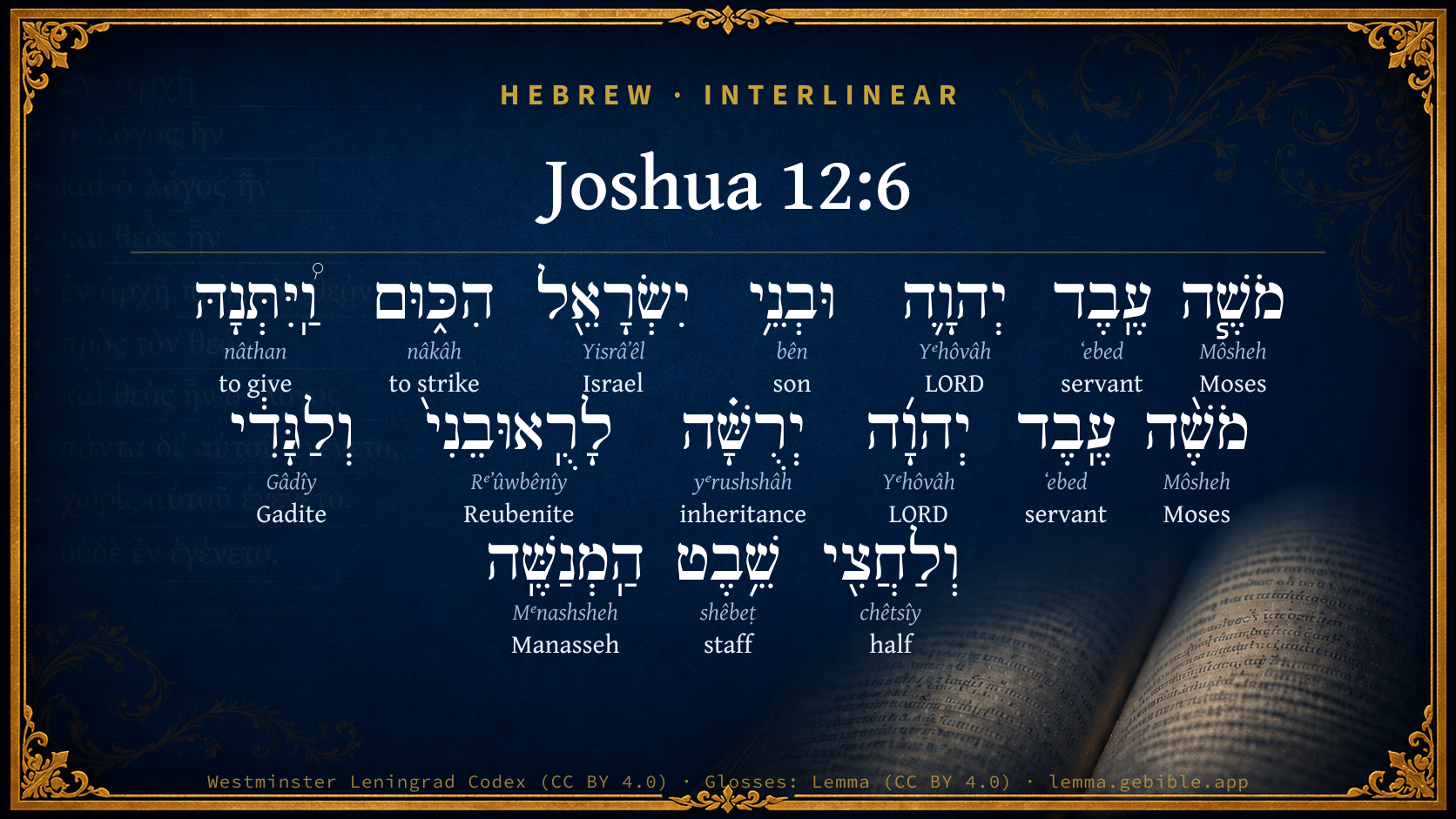
  1. מֹשֶׁ֧ה Môsheh H4872 “Moses” Noun, Proper
  2. עֶֽבֶד ʻebed H5650 “servant of” Noun, Common, Masculine, Singular, Construct
  3. יְהוָ֛ה Yᵉhôvâh H3068 “LORD” Noun, Proper
  4. וּבְנֵ֥י bên H1121 “and · sons of” Conjunction + Noun, Common, Masculine, Plural, Construct
  5. יִשְׂרָאֵ֖ל Yisrâʼêl H3478 “Israel” Noun, Proper
  6. הִכּ֑וּם nâkâh H5221 “to strike · them” Verb, Hiphil, Perfect, 3rd Person, Common, Plural + Suffix, Personal, 3rd Person, Masculine, Plural
  7. וַֽ֠יִּתְּנָהּ nâthan H5414 “and · to give · her” Conjunction + Verb, Qal, Sequential Imperfect, 3rd Person, Masculine, Singular + Suffix, Personal, 3rd Person, Feminine, Singular
  8. מֹשֶׁ֨ה Môsheh H4872 “Moses” Noun, Proper
  9. עֶֽבֶד ʻebed H5650 “servant of” Noun, Common, Masculine, Singular, Construct
  10. יְהוָ֜ה Yᵉhôvâh H3068 “LORD” Noun, Proper
  11. לָרֻֽאוּבֵנִי֙ Rᵉʼûwbênîy H7206 “to/for the · Reubenite” Preposition, Determined + Noun, Gentilic, Masculine, Singular, Absolute
  12. וְלַגָּדִ֔י Gâdîy H1425 “and · to/for the · Gadite” Conjunction + Preposition, Determined + Noun, Gentilic, Masculine, Singular, Absolute
  13. וְלַחֲצִ֖י chêtsîy H2677 “and · to/for · half of” Conjunction + Preposition + Noun, Common, Masculine, Singular, Construct
  14. שֵׁ֥בֶט shêbeṭ H7626 “staff of” Noun, Common, Masculine, Singular, Construct
  15. הַֽמְנַשֶּֽׁה Mᵉnashsheh H4519 “the · Manasseh” Particle, Definite Article + Noun, Proper

About this verse

These counts appear in no published source. They are computed here, from the morphology-tagged text and Lemma’s own curated glosses. What Lemma adds →

16
words
13
distinct lemmas
Historical
section

Notable vocabulary

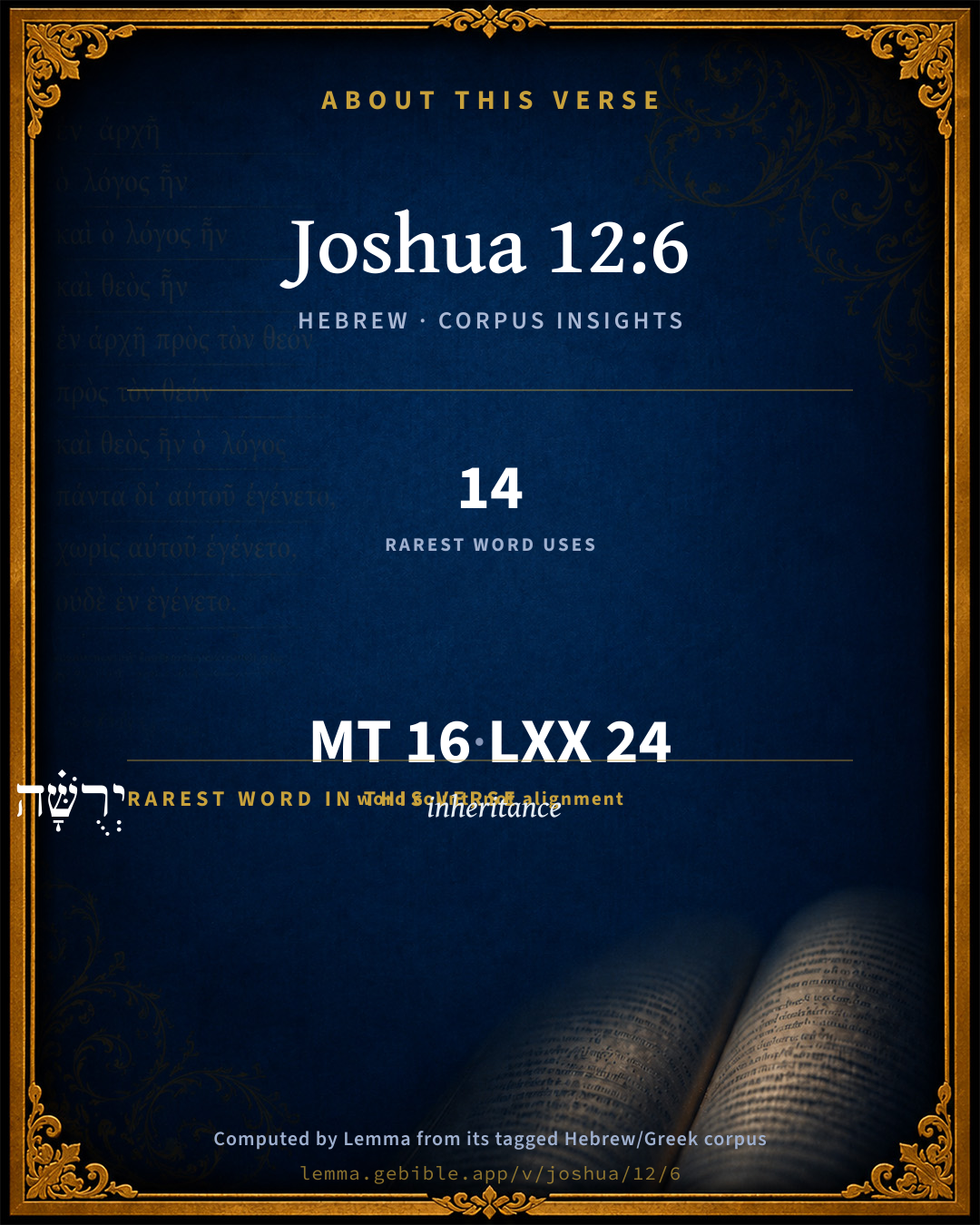
The rarest word here is יְרֻשָּׁ֗ה inheritance H3425 — appearing just 14 times in the whole Hebrew Bible.

Shared distinctive vocabulary

יְרֻשָּׁ֗ה inheritance H3425 occurs in 12 verses of the Hebrew Bible. Also found in:

Grammatical profile

  • 2 verbs
  • 14 nouns

Verb forms

  • הִכּ֑וּם Hiphil · Perfect
  • וַֽ֠יִּתְּנָהּ Qal · Sequential Imperfect

Repetition

Words recur within this verse — often emphatic in Hebrew:

  • מֹשֶׁ֧ה Moses H4872 ×2
  • עֶֽבֶד servant H5650 ×2
  • יְהוָ֛ה LORD H3068 ×2

Hebrew & Septuagint length

In English translation the verse runs 34 words from the Hebrew and 32 from the Septuagint (LXX English) — closely comparable.

A rough comparison of the two English renderings, which tokenize alike — not a word-level alignment.

Word counts can differ between the Hebrew and the Greek without any difference in meaning — e.g. the Hebrew direct-object marker אֵת has no separate Greek word, and Greek often adds the article ὁ.

In the original languages it is 16 Hebrew tokens and 24 Greek tokens — but the two are counted differently (Hebrew bundles its prefixes and suffixes into one token; the Greek is in lemma form), so that isn’t a like-for-like length.

Cross-references

6

Topical passages linked to Joshua 12:6 in the Treasury of Scripture Knowledge — connected by theme and wording, ordered by reader-vote popularity; previews shown in the World English Bible.

  • Numbers 32:33 Moses gave to them, even to the children of Gad, and to the children of Reuben, and to the half-tribe of Manasseh the son of Joseph, the kingdom of Sihon king of the Amorites, and the kingdom of Og king of Bashan, the land, according to the cities of it with [their] borders, even the cities of the land round about.
  • Numbers 21:24–35 Israel struck him with the edge of the sword, and possessed his land from the Arnon to the Jabbok, even to the children of Ammon; for the border of the children of Ammon was strong.
  • Numbers 32:29 Moses said to them, If the children of Gad and the children of Reuben will pass with you over the Jordan, every man who is armed to battle, before Yahweh, and the land shall be subdued before you; then you shall give them the land of Gilead for a possession:
  • Deuteronomy 3:11–17 (For only Og king of Bashan remained of the remnant of the Rephaim; behold, his bedstead was a bedstead of iron; isn't it in Rabbah of the children of Ammon? nine cubits was the length of it, and four cubits the breadth of it, after the cubit of a man.)
  • Luke 22:29–42 I confer on you a kingdom, even as my Father conferred on me,
  • Joshua 13:8–32 With him the Reubenites and the Gadites received their inheritance, which Moses gave them, beyond the Jordan eastward, even as Moses the servant of Yahweh gave them:

Cross-references courtesy of OpenBible.info (CC BY 4.0).

Hebrew and Greek witnesses Masoretic Hebrew ↔ Greek Septuagint

The same verse in the two great witnesses to the Old Testament, shown verse-for-verse.

These are two independent witnesses, not word-aligned to each other, and the Septuagint is shown in lemma (dictionary) form.

Hebrew Joshua 12:6 Masoretic · Westminster Leningrad Codex

מֹשֶׁ֧ה עֶֽבֶד יְהוָ֛ה וּבְנֵ֥י יִשְׂרָאֵ֖ל הִכּ֑וּם וַֽ֠יִּתְּנָהּ מֹשֶׁ֨ה עֶֽבֶד יְהוָ֜ה יְרֻשָּׁ֗ה לָרֻֽאוּבֵנִי֙ וְלַגָּדִ֔י וְלַחֲצִ֖י שֵׁ֥בֶט הַֽמְנַשֶּֽׁה

Moses the servant of Yahweh and the children of Israel struck them: and Moses the servant of Yahweh gave it for a possession to the Reubenites, and the Gadites, and the half-tribe of Manasseh.

World English Bible · Public Domain

Greek LXX Joshua 12:6 Septuagint · lemma form

μωυσῆς ὁ παῖς κύριος καί ὁ υἱός ἰσραήλ πατάσσω αὐτός καί δίδωμι αὐτός μωυσῆς ἐν κληρονομία ρουβην καί γαδ καί ὁ ἥμισυς φυλή μανασσή

Moses the servant of the Lord and the children of Israel struck them; and Moses gave them by way of inheritance to Ruben, and Gad, and to the half tribe of Manasse.

LXX2012 (modern English Septuagint) · Public Domain

Hebrew: Westminster Leningrad Codex (CC BY 4.0). Greek: Septuagint (public domain); English from LXX2012 (modern English Septuagint) (Public Domain). How the Septuagint differs from the Hebrew →

Targum (Aramaic paraphrase)

1

The Targum is the ancient Jewish Aramaic paraphrase of the Hebrew Scriptures — an interpretive translation, not the Hebrew text itself. Onkelos (literal) and Pseudo-Jonathan (expansive) render the Torah, and Jonathan the Prophets. Coverage is partial: where no permissively-licensed English translation exists for a verse, only the Aramaic is shown. This is verse-level text, not a word-by-word alignment to the Hebrew.

  1. Targum Jonathan Prophets (Joshua–Malachi)
    מֹשֶׁה עַבְדָא דַייָ וּבְנֵי יִשְׂרָאֵל מְחוּנוּן וְיַהְבָהּ מֹשֶׁה עַבְדָא דַייָ יְרוּתָא לְשִׁבְטָא דִרְאוּבֵן וּלְשִׁבְטָא דְגָד וּלְפַלְגוּת שִׁבְטָא דִמְנַשֶׁה:

    (no public-domain English translation for this verse)

    Targum Jonathan — Aramaic: “Mikraot Gedolot” (public domain). English: “Sefaria Community Translation” (CC0 1.0 (public-domain dedication)); “London "Chaldee Paraphrase," 1871” (public domain). Text via Sefaria.

Commentary

Notes on Joshua 12:6 from classic Christian and Jewish commentators (each source and its license shown beneath its notes). The classic Christian expositions comment on the surrounding passage and are grouped to its opening verse, so a note may address several verses; the Jewish commentaries on the Tanakh (Rashi and others) are per-verse, so they appear only where the commentator wrote on this verse.

Lemma curates 59 commentaries, every one of them public domain or Creative Commons licensed, each selected and text-cleaned for this edition rather than reprinted as found. About our sources →

Trapp's Complete Commentary

John Trapp

Jos 12:6 Them did Moses the servant of the LORD and the children of Israel smite: and Moses the servant of the LORD gave it [for] a possession unto the Reubenites, and the Gadites, and the half tribe of Manasseh.

Ver. 6. Moses the servant of the Lord.] See Jos 1:1.

John Trapp, A Commentary or Exposition upon All the Books of the Old and New Testament (1647–1656) — public domain. Text from a community e-Sword module.

Joseph Benson's Commentary

Jos 12:6. Them did Moses and the children of Israel smite — Fresh mercies must not drown the remembrance of former mercies: nor must the glory of the present instruments of good to the church, diminish the just honour of those that went before them. Joshua’s services were confessedly great. But let not those under Moses be forgotten. Both together proclaim God to be the Alpha and Omega of his people’s salvation.

Joseph Benson's Commentary on the Old and New Testaments (1811–1818) — public domain. Text from a community e-Sword module.

Tyndale Open Study Notes

Tyndale Open Resources

12:6 Reuben, Gad, and the half-tribe of Manasseh: See Num 32. The author of Joshua reminded the Israelites that their kin who lived east of the Jordan also belonged to Israel.

Tyndale Open Study Notes — © Tyndale Open Resources, licensed CC BY-SA 4.0. Text via the HelloAO Bible API.

John Gill's Exposition

Them did Moses the servant of the Lord, and the children of Israel, smite,.... That is, the inhabitants of those kingdoms they smote with the edge of the sword, and took possession of them, the history of which see in Num 21:1,

and Moses the servant of the Lord gave it; the whole dominion of the two kings before mentioned:

for a possession unto the Reubenites, and the Gadites, and the half tribe of Manasseh: of which grant, and the conditions of it, see Num 32:1.

John Gill's Exposition of the Whole Bible (1746–1763) — public domain (CC PDM 1.0). Text via the HelloAO Bible API.

The Pulpit Commentary

Moses, the servant of the Lord, gave. Theodoret makes the tribes which received their inheritance through Moses the types of the believing Jews, and those who received it through Jesus (Joshua) the types of the believing Gentiles. Reuben, Gad, and Manasseh were the first born of their respective mothers, and were thus types of the Jews, who were God"s firstborn. As they passed over armed before their brethren, so we received the good tidings of salvation from the lips of Jews. This is a characteristic specimen of the allegorical interpretation of the early fathers. But it will be observed that the children of Bilhah, who might have been selected more naturally than those of Zilpah, are entirely omitted.

The Pulpit Commentary (1880–1919), ed. H.D.M. Spence-Jones & Joseph S. Exell — public domain. Text from a community e-Sword module.

John Wesley's Explanatory Notes

Smile - Fresh mercies must not drown the remembrance of former mercies: nor must the glory of the present instruments of good to the church, diminish the just honour of those that went before them. Joshua's services were confessedly great. But let not those under Moses be forgotten. Both together proclaim God to be the Alpha and Omega of his peoples salvation.

John Wesley, Explanatory Notes Upon the Whole Bible (1754–1765) — public domain. Text via the GEBible commentary corpus.

unfoldingWord translationNotes

Door43 World Missions Community

Reubenites

These are the descendants of Reuben.

Gadites

These are the descendants of Gad.

half tribe of Manasseh

They are called a half tribe because the other half of the tribe received an inheritance in the land of Canaan.

translationWords

Moses

servant

Yahweh

Israel

possess

unfoldingWord translationNotes — © Distant Shores Media and the Door43 World Missions Community, licensed CC BY-SA 4.0. Source: git.door43.org/Door43/en_tn.

Lesson kit

Teaching starters — assembled from the data on this page, not authored interpretation. Every prompt links to the verse data it draws on. Edit before teaching.

Joshua, in the Historical, opens this verse with 16 words (13 distinct Hebrew lemmas). Its most distinctive word is yᵉrushshâh (“inheritance”). A historical commentator’s framing appears above. Read the whole chapter for the surrounding context.

Discussion questions

  1. How does “inheritance” (yᵉrushshâh) shape what this verse is saying?
  2. How does Deuteronomy 2:5, which shares the word «inheritance», read alongside this verse?
  3. What does the repetition of “Moses” (2× in this one verse) do in this verse?
  4. These translations render this verse differently; the difference is in the English rendering, not the original. What questions does that raise?
  5. «הִכּ֑וּם» is a Hiphil Perfect verb. How does that grammatical form shape the action described?
  6. Compare how Trapp's Complete Commentary and Joseph Benson's Commentary read this verse. Where do they agree or differ?

Things to notice

Reading settings

Reading text

Shown beneath each verse's original-language words.

Old Testament
Old Testament edition

Read the OT as the Masoretic Hebrew (MT) or the Greek Septuagint (LXX).

English shown for the Greek Septuagint (in the Hebrew ↔ Greek comparison).

Comparing translations? Open the Compare panel on any verse page to stack up to four side by side.