
Joshua 4:12

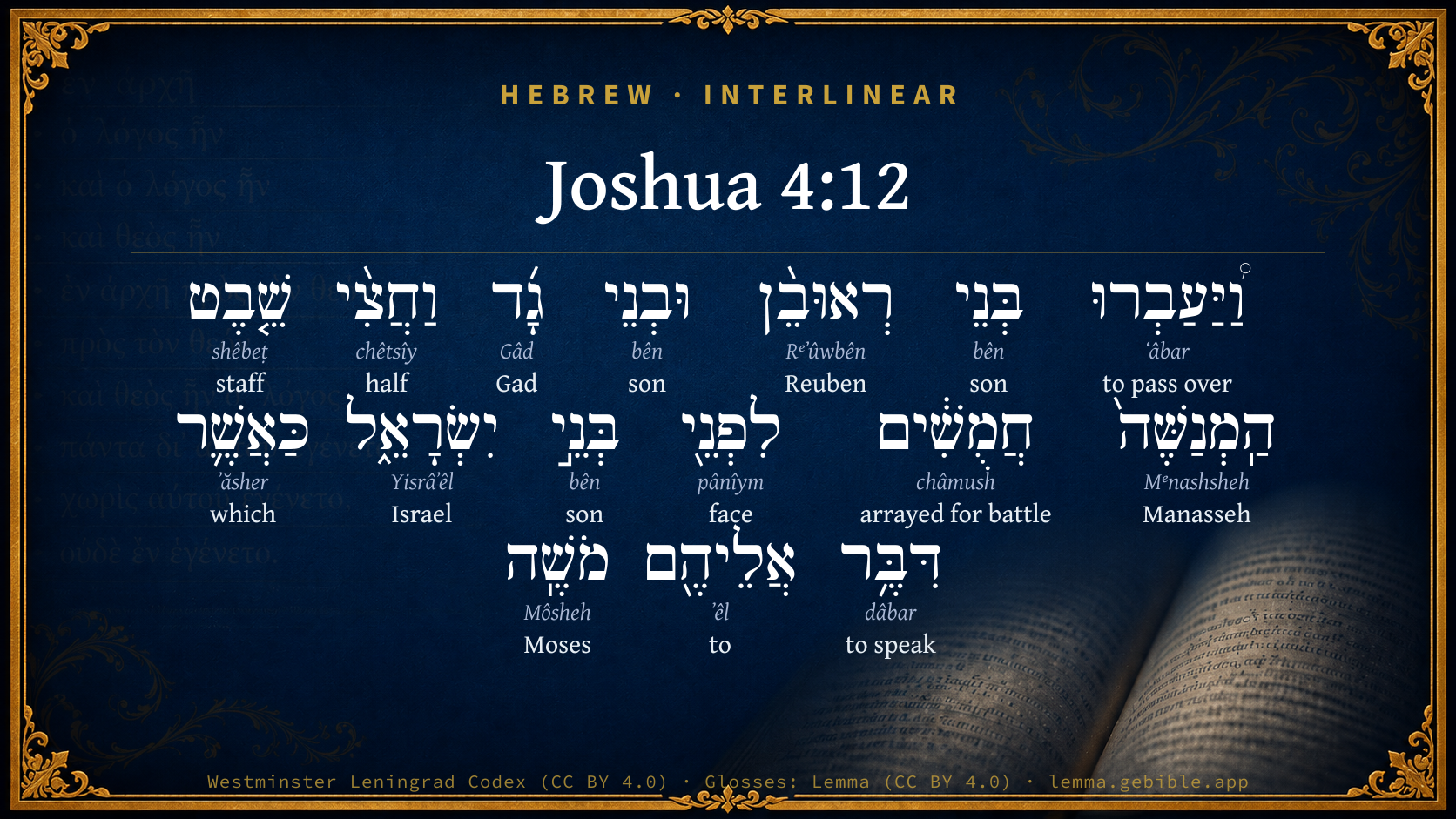
Hebrew (Westminster Leningrad Codex) Joshua 4:12 appears in the Hebrew Old Testament. The text above is from the Westminster Leningrad Codex. Each word links to its Strong’s number, a concise gloss, and parsing drawn from the Open Scriptures Hebrew Bible morphology. Click any word for its full Brown-Driver-Briggs (BDB) entry.
Download image
Cite this verse

Joshua 4:12 (World English Bible). Public Domain. Lemma interlinear Bible study tool, https://lemma.gebible.app/v/joshua/4/12.

Show BibTeX & RIS
BibTeX
RIS
English Translation
The children of Reuben, and the children of Gad, and the half-tribe of Manasseh, passed over armed before the children of Israel, as Moses spoke to them:
World English Bible · Public Domain
Download a study sheet

One document with this verse’s original text, its word-by-word gloss line, the meaning frame, cross-references with their text, attributed commentary, and full source and license credits — printable, and it pastes into notes with its structure intact.

This verse Autodidact and up

Study sheet (.html) Plain text (.txt)

A passage Seminary Student

Up to 50 verses in one chapter. A passage sheet keeps up to 6 commentary sources and 12 cross-references per verse, in the order this page ranks them, and says so on the sheet whenever that leaves anything out. Ask for a single verse and you get the Autodidact verse sheet above.

Everything on this page stays free to read, with no account — the sheet is a download of what is already on screen, not access to it.

Want to remove ads? Support Godless Engineer
Compare translations 3

The same verse in 3 English versions, stacked beneath the original-language interlinear above. Click any original word for its lexicon entry.

Each is an independent rendering of the whole verse — the interlinear is not word-aligned to these translations.

Highlighted words mark where these versions differ — a whole-verse word diff, not a word-by-word alignment.

  • World English Bible Public Domain
    The children of Reuben, and the children of Gad, and the half-tribe of Manasseh, passed over armed before the children of Israel, as Moses spoke to them:
  • King James Version Public Domain
    And the children of Reuben, and the children of Gad, and half the tribe of Manasseh, passed over armed before the children of Israel, as Moses spake unto them:
  • unfoldingWord Literal Text CC BY-SA 4.0
    And the sons of Reuben, and the sons of Gad, and the half of the tribe of Manasseh crossed over armed to the face of the sons of Israel, just as Moses had spoken to them.

unfoldingWord Literal Text — © unfoldingWord, licensed CC BY-SA 4.0. Word-aligned USFM3 via Door43 (git.door43.org/unfoldingWord/en_ult).

Versions to compare (up to 4)

3 of 4 selected

Show all 18 translations

Every available English version of this verse, each an independent rendering of the whole verse.

  • World English Bible Public Domain
    The children of Reuben, and the children of Gad, and the half-tribe of Manasseh, passed over armed before the children of Israel, as Moses spoke to them:
  • Berean Standard Bible Public Domain
    The Reubenites, the Gadites, and the half-tribe of Manasseh crossed over before the Israelites, armed for battle as Moses had instructed them.
  • Majority Standard Bible Public Domain
    The Reubenites, the Gadites, and the half-tribe of Manasseh crossed over before the Israelites, armed for battle as Moses had instructed them.
  • King James Version Public Domain
    And the children of Reuben, and the children of Gad, and half the tribe of Manasseh, passed over armed before the children of Israel, as Moses spake unto them:
  • American Standard Version (1901) Public Domain
    And the children of Reuben, and the children of Gad, and the half-tribe of Manasseh, passed over armed before the children of Israel, as Moses spake unto them:
  • Revised Version (1885) Public Domain
    And the children of Reuben, and the children of Gad, and the half tribe of Manasseh, passed over armed before the children of Israel, as Moses spake unto them:
  • Geneva Bible (1599) Public Domain
    And the sonnes of Reuben, and the sonnes of Gad, and halfe the tribe of Manasseh went ouer before the children of Israel armed, as Moses had charged them.
  • Douay-Rheims (1899) Public Domain
    The children of Ruben also and Gad, and half the tribe of Manasses, went armed before the children of Israel as Moses had commanded them.
  • Young's Literal Translation Public Domain
    and the sons of Reuben, and the sons of Gad, and the half of the tribe of Manasseh, pass over, by fifties, before the sons of Israel, as Moses had spoken unto them;
  • Literal Standard Version CC BY-SA 4.0
    and the sons of Reuben, and the sons of Gad, and the half of the tribe of Manasseh, pass over, by fifties, before the sons of Israel, as Moses had spoken to them;
  • Unlocked Literal Bible CC BY-SA 4.0
    The tribe of Reuben, the tribe of Gad, and the half tribe of Manasseh passed before the people of Israel formed up as an army, just as Moses said to them.
  • unfoldingWord Literal Text CC BY-SA 4.0
    And the sons of Reuben, and the sons of Gad, and the half of the tribe of Manasseh crossed over armed to the face of the sons of Israel, just as Moses had spoken to them.
  • Darby Bible Public Domain
    And the children of Reuben, and the children of Gad, and the half tribe of Manasseh, went over in array before the children of Israel, as Moses had spoken to them.
  • World Messianic Bible Public Domain
    The children of Reuben, and the children of Gad, and the half-tribe of Manasseh crossed over armed before the children of Israel, as Moses spoke to them.
  • Webster's Bible Public Domain
    And the children of Reuben, and the children of Gad, and half the tribe of Manasseh, passed over armed before the children of Israel, as Moses directed them:
  • Free Bible Version CC BY-SA 4.0
    The armed men from the tribes of Reuben and Gad, and the half tribe of Manasseh crossed at the head of the people of Israel, as Moses had stipulated.
  • Bible in Basic English Public Domain
    And the children of Reuben and the children of Gad and the half-tribe of Manasseh went over armed before the children of Israel as Moses had said to them:
  • JPS Tanakh (1917) Public Domain
    And the children of Reuben, and the children of Gad, and the half-tribe of Manasseh, passed on armed before the children of Israel, as Moses spoke unto them;

Literal Standard Version (2020), Covenant Press — licensed CC BY-SA 4.0. Text via the HelloAO Bible API (eBible.org). Unlocked Literal Bible (unfoldingWord) — licensed CC BY-SA 4.0. Text via the HelloAO Bible API (eBible.org). unfoldingWord Literal Text — © unfoldingWord, licensed CC BY-SA 4.0. Word-aligned USFM3 via Door43 (git.door43.org/unfoldingWord/en_ult). Free Bible Version, Dr. Jonathan Gallagher — licensed CC BY-SA 4.0. Text via the HelloAO Bible API (eBible.org).

Word by word

More ways to search: Search by grammar → Find every occurrence → Compare this word →

Practice this passage: Drill this verse → Learn its vocabulary →

חֲמֻשִׁ֔ים
châmush
H2571
“arrayed for battle”
Verb, Qal, Participle Passive, Masculine, Plural, Absolute
Part of Speech
Verb
Stem
Qal
Form
Participle Passive
Gender
Masculine
Number
Plural
State
Absolute
Full BDB Definition

Origin: pass. participle of the same as H2570

TWOT: TWOT- 688a

in battle array, arrayed for battle by fives, armed
  1. וַ֠יַּעַבְרוּ ʻâbar H5674 “and · to pass over” Conjunction + Verb, Qal, Sequential Imperfect, 3rd Person, Masculine, Plural
  2. בְּנֵי bên H1121 “sons of” Noun, Common, Masculine, Plural, Construct
  3. רְאוּבֵ֨ן Rᵉʼûwbên H7205 “Reuben” Noun, Proper
  4. וּבְנֵי bên H1121 “and · sons of” Conjunction + Noun, Common, Masculine, Plural, Construct
  5. גָ֜ד Gâd H1410 “Gad” Noun, Proper
  6. וַחֲצִ֨י chêtsîy H2677 “and · half of” Conjunction + Noun, Common, Masculine, Singular, Construct
  7. שֵׁ֤בֶט shêbeṭ H7626 “staff of” Noun, Common, Masculine, Singular, Construct
  8. הַֽמְנַשֶּׁה֙ Mᵉnashsheh H4519 “the · Manasseh” Particle, Definite Article + Noun, Proper
  9. לִפְנֵ֖י pânîym H6440 “to/for · face(s) of” Preposition + Noun, Common, Both, Plural, Construct
  10. בְּנֵ֣י bên H1121 “sons of” Noun, Common, Masculine, Plural, Construct
  11. יִשְׂרָאֵ֑ל Yisrâʼêl H3478 “Israel” Noun, Proper
  12. כַּאֲשֶׁ֛ר ʼăsher H834 “like/as · which” Preposition + Particle, Relative
  13. דִּבֶּ֥ר dâbar H1696 “to speak” Verb, Piel, Perfect, 3rd Person, Masculine, Singular
  14. אֲלֵיהֶ֖ם ʼêl H413 “to · them” Preposition + Suffix, Personal, 3rd Person, Masculine, Plural
  15. מֹשֶֽׁה Môsheh H4872 “Moses” Noun, Proper

About this verse

These counts appear in no published source. They are computed here, from the morphology-tagged text and Lemma’s own curated glosses. What Lemma adds →

16
words
14
distinct lemmas
Historical
section

Notable vocabulary

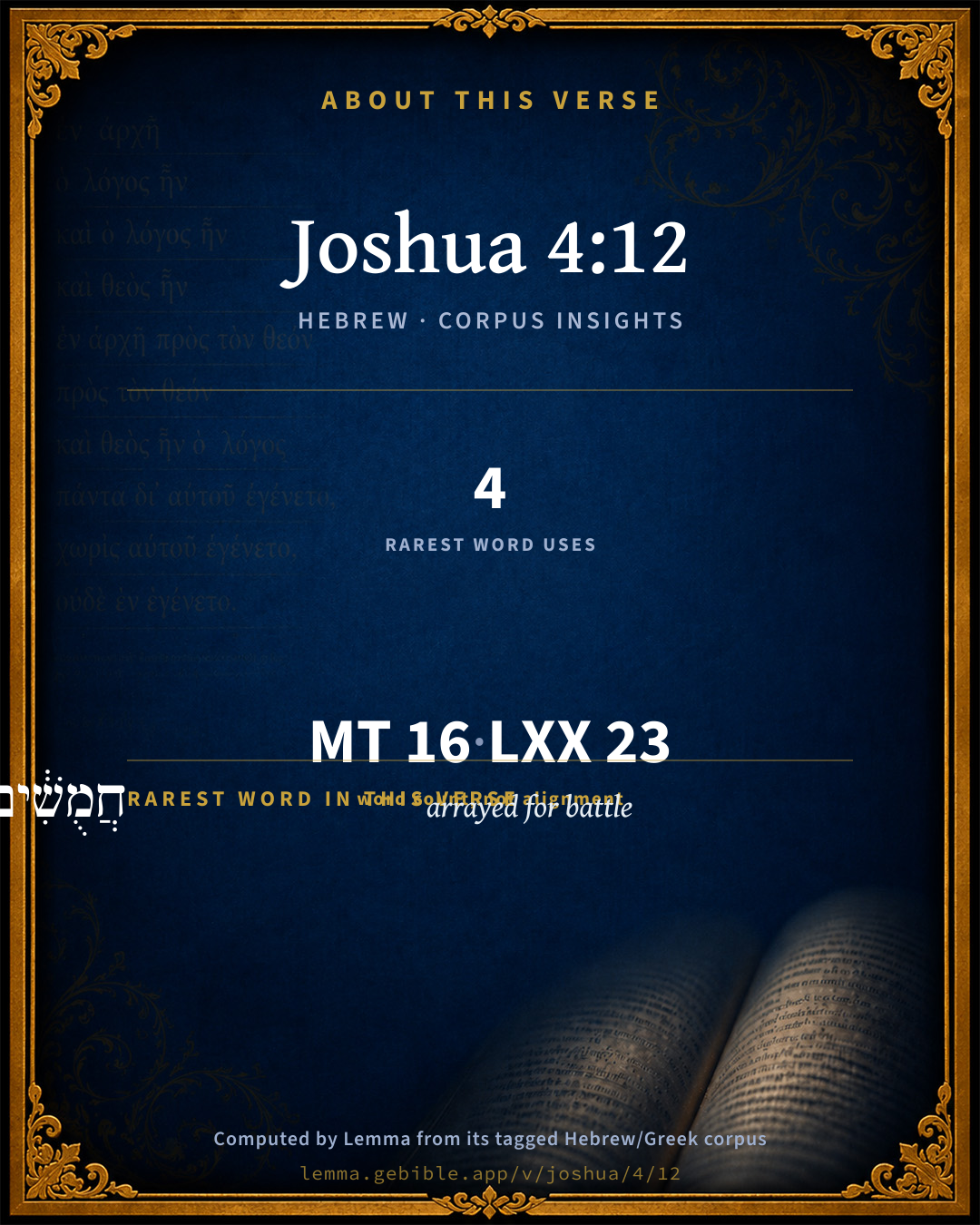
The rarest word here is חֲמֻשִׁ֔ים arrayed for battle H2571 — appearing just 4 times in the whole Hebrew Bible.

Shared distinctive vocabulary

חֲמֻשִׁ֔ים arrayed for battle H2571 occurs in 4 verses of the Hebrew Bible. Also found in:

Grammatical profile

  • 3 verbs
  • 11 nouns
  • 1 preposition
  • 1 particle

Verb forms

  • וַ֠יַּעַבְרוּ Qal · Sequential Imperfect
  • חֲמֻשִׁ֔ים Qal · Participle Passive
  • דִּבֶּ֥ר Piel · Perfect

Repetition

A word recurs within this verse — often emphatic in Hebrew:

  • בְּנֵי son H1121 ×3

Hebrew & Septuagint length

In English translation the verse runs 27 words from the Hebrew and 28 from the Septuagint (LXX English) — closely comparable.

A rough comparison of the two English renderings, which tokenize alike — not a word-level alignment.

Word counts can differ between the Hebrew and the Greek without any difference in meaning — e.g. the Hebrew direct-object marker אֵת has no separate Greek word, and Greek often adds the article ὁ.

In the original languages it is 16 Hebrew tokens and 23 Greek tokens — but the two are counted differently (Hebrew bundles its prefixes and suffixes into one token; the Greek is in lemma form), so that isn’t a like-for-like length.

Cross-references

2

Topical passages linked to Joshua 4:12 in the Treasury of Scripture Knowledge — connected by theme and wording, ordered by reader-vote popularity; previews shown in the World English Bible.

  • Numbers 32:20–32 Moses said to them, If you will do this thing, if you will arm yourselves to go before Yahweh to the war,
  • Joshua 1:14 Your wives, your little ones, and your cattle, shall abide in the land which Moses gave you beyond the Jordan; but you shall pass over before your brothers armed, all the mighty men of valor, and shall help them;

Cross-references courtesy of OpenBible.info (CC BY 4.0).

Hebrew and Greek witnesses Masoretic Hebrew ↔ Greek Septuagint

The same verse in the two great witnesses to the Old Testament, shown verse-for-verse.

These are two independent witnesses, not word-aligned to each other, and the Septuagint is shown in lemma (dictionary) form.

Hebrew Joshua 4:12 Masoretic · Westminster Leningrad Codex

וַ֠יַּעַבְרוּ בְּנֵי רְאוּבֵ֨ן וּבְנֵי גָ֜ד וַחֲצִ֨י שֵׁ֤בֶט הַֽמְנַשֶּׁה֙ חֲמֻשִׁ֔ים לִפְנֵ֖י בְּנֵ֣י יִשְׂרָאֵ֑ל כַּאֲשֶׁ֛ר דִּבֶּ֥ר אֲלֵיהֶ֖ם מֹשֶֽׁה

The children of Reuben, and the children of Gad, and the half-tribe of Manasseh, passed over armed before the children of Israel, as Moses spoke to them:

World English Bible · Public Domain

Greek LXX Joshua 4:12 Septuagint · lemma form

καί διαβαίνω ὁ υἱός ρουβην καί ὁ υἱός γαδ καί ὁ ἥμισυς φυλή μανασσή διασκευάζω ἔμπροσθεν ὁ υἱός ἰσραήλ καθάπερ ἐντέλλομαι αὐτός μωυσῆς

And the sons of Ruben, and the sons of Gad, and the half tribe of Manasse passed over armed before the children of Israel, as Moses commanded them.

LXX2012 (modern English Septuagint) · Public Domain

Hebrew: Westminster Leningrad Codex (CC BY 4.0). Greek: Septuagint (public domain); English from LXX2012 (modern English Septuagint) (Public Domain). How the Septuagint differs from the Hebrew →

Targum (Aramaic paraphrase)

1

The Targum is the ancient Jewish Aramaic paraphrase of the Hebrew Scriptures — an interpretive translation, not the Hebrew text itself. Onkelos (literal) and Pseudo-Jonathan (expansive) render the Torah, and Jonathan the Prophets. Coverage is partial: where no permissively-licensed English translation exists for a verse, only the Aramaic is shown. This is verse-level text, not a word-by-word alignment to the Hebrew.

  1. Targum Jonathan Prophets (Joshua–Malachi)
    וַעֲבָרוּ בְּנֵי רְאוּבֵן וּבְנֵי גָד וּפַּלְגוּת שִׁבְטָא דִמְנַשֶׁה מְזָרְזִין קֳדָם בְּנֵי יִשְׂרָאֵל כְּמָא דְמַלֵיל עִמְהוֹן מֹשֶׁה:

    (no public-domain English translation for this verse)

    Targum Jonathan — Aramaic: “Mikraot Gedolot” (public domain). English: “Sefaria Community Translation” (CC0 1.0 (public-domain dedication)); “London "Chaldee Paraphrase," 1871” (public domain). Text via Sefaria.

Commentary

Notes on Joshua 4:12 from classic Christian and Jewish commentators (each source and its license shown beneath its notes). The classic Christian expositions comment on the surrounding passage and are grouped to its opening verse, so a note may address several verses; the Jewish commentaries on the Tanakh (Rashi and others) are per-verse, so they appear only where the commentator wrote on this verse.

Lemma curates 59 commentaries, every one of them public domain or Creative Commons licensed, each selected and text-cleaned for this edition rather than reprinted as found. About our sources →

Trapp's Complete Commentary

John Trapp

Jos 4:12 And the children of Reuben, and the children of Gad, and half the tribe of Manasseh, passed over armed before the children of Israel, as Moses spake unto them:

Ver. 12. As Moses spake unto them.] Indented with them. {Num 32:20; Num 32:27} Dilexi hominem: I loved the man, said Ambrose concerning Theodosius, because he was no less solicitous of the Church’s welfare after his decease than whilst he lived.

John Trapp, A Commentary or Exposition upon All the Books of the Old and New Testament (1647–1656) — public domain. Text from a community e-Sword module.

Joseph Benson's Commentary

Jos 4:12-13. The children of Reuben passed over armed — As they had engaged to do, Num 32:20-27, and Jos 1:13. About forty thousand prepared for war — It is likely that Joshua drew out this number only of chosen men; and left all the rest to take care of their families and flocks. Passed over before the Lord — Having passed over the river, they stood in battle array before the ark, at the distance, probably, of two thousand cubits; or, in the presence of the Lord, as the expression, before the Lord, may mean, who observed whether they would keep their covenant with their brethren or not.

Joseph Benson's Commentary on the Old and New Testaments (1811–1818) — public domain. Text from a community e-Sword module.

Jamieson, Fausset & Brown

Robert Jamieson, A. R. Fausset & David Brown

the children of Reuben . . . passed over armed before the children of Israel--There is no precedency to the other tribes indicated here; for there is no reason to suppose that the usual order of march was departed from; but these are honorably mentioned to show that, in pursuance of their promise (Jos 1:16-18), they had sent a complement of fighting men to accompany their brethren in the war of invasion.

Jamieson, Fausset & Brown — Commentary Critical and Explanatory on the Whole Bible (1871) — public domain (CC PDM 1.0). Text via the HelloAO Bible API.

Adam Clarke's Commentary

Verse 12. The children of Reuben, and - Gad] Concerning the numbers of these tribes that stayed behind to take care of the women, children, and cattle, and which amounted to 70,580 men, See Clarke on Nu 32:17.

Passed over armed] See Clarke on Jos 1:14.

Adam Clarke's Commentary on the Bible (1810–1826) — public domain. Text from a community e-Sword/MySword module.

John Calvin's Commentaries

12. And the children of Reuben, etc He makes mention of the expedition of the two tribes and half tribe, as they did not set out to engage in warfare on their own private account, but to assist their brethren, by whose valor their own possession had been obtained in seizing the land of Canaan. Moses had laid them under this obligation, and they had bound themselves by oath that they would accompany the rest of the people till all should have obtained a quiet settlement.

They again made the same promise when the camp was about to be moved as we saw in Joshua 1. But from the narrative here we gather that only a part was selected, for the number amounts only to forty thousand, that is, a third, or about a third of the number ascertained by the census taken shortly before. Now, as they are everywhere said to have performed their promise, it may be probably conjectured that it was not the intention of Moses strictly to insist that all who had assented should leave their wives and children, and do military service in the land of Canaan till it was wholly subdued. And certainly it would have been harsh and cruel to leave an unwarlike multitude unprotected in the midst of many hostile nations. Nor would the remains of the enemy, assisted by neighboring nations, have long failed to take advantage of such an opportunity to avenge themselves by massacring the women and children. It was necessary, therefore, in a country not yet sufficiently pacified, permanently to retain a force sufficient to prevent incursions. Moses was not of so stern a nature as not to consult for the helpless. Nay, his prudence and equity would never have allowed him to leave a territory lately seized by arms unoccupied by a body of troops.

We may add, that such an immense concourse would have impeded rather than assisted the acquisition of the land of Canaan. All which Moses required, therefore, was simply that the Reubenites and Gadites should not, while their brethren were engaged in carrying on the war, remain indolently at home and eat their food at ease without giving any assistance to those to whom they were indebted for having obtained the inheritance. And the good faith of the forty thousand was approved by their not declining the burdens, toils, and perils of warfare, while the remainder of their own tribes were enjoying quiet. They might readily have alleged that they were as well entitled as the others to exemption, but in proceeding with alacrity after the levy was made, to obey the orders given them, without envying the immunity given to their brethren, they show that they were voluntarily and heartily disposed to do their duty. At the same time, it is not doubtful that by accepting the flower of their tribes, the handle for complaint and quarrel was cut off. For it could not justly have been maintained that not even the aged and worn out, or the young and feeble, were to be spared. Some, perhaps, may be inclined to conjecture that the army was raised not by choice but by lot, though it rather seems to me that all who were most robust and best able to bear fatigue were enrolled.

John Calvin's Commentaries (1540-1563) — public domain. Text from the Calvin Translation Society English edition (1840s-50s) via the Christian Classics Ethereal Library (ccel.org). Calvin's coverage is partial (roughly two-thirds of the Bible); uncommented books and verses are honest gaps, never fabricated. The 19th-century editor's footnotes and remarks are omitted so the notes are faithfully Calvin's own voice.

The Cambridge Bible for Schools and Colleges

gen. ed. J. J. S. Perowne

12. passed over armed before the children of Israel] Contrary to the usual order (Num_32:20), as if to secure that they should fulfil their vow.

The Cambridge Bible for Schools and Colleges (gen. ed. J. J. S. Perowne; Cambridge University Press, 1878–1918) — public domain. Text from a community e-Sword module.

John Gill's Exposition

And the children of Reuben, and the children of Gad, and half the tribe of Manasseh,.... Who were settled on the other side Jordan, in the countries taken from Sihon and Og:

passed over armed before the children of Israel; the rest of the tribes:

as Moses spake unto them; or ordered them, and as they promised they would, Num 32:17.

John Gill's Exposition of the Whole Bible (1746–1763) — public domain (CC PDM 1.0). Text via the HelloAO Bible API.

Haydock's Catholic Bible Commentary

Them. (Chap. i. 14., and Numbers xxxii. 28.) Forty thousand were only chosen. (Haydock)

George Leo Haydock (1774–1849), Haydock's Catholic Family Bible and Commentary, 1859 edition — public domain. Excludes Psalms (Douay-Rheims chapter numbering differs from Protestant) and Deuterocanonical books (Catholic canon only).

Whedon's Commentary on the Bible

Daniel D. Whedon

12. And the children of Reuben — The conjunction and does not indicate the order of events, but the historian wishes by repetition to give emphasis to the statement that the eastern tribes had already passed over to assist their brethren in the conquest of the land.

Armed — See Jos_1:14, note.

Before — That is, in sight of. They were, perhaps, placed in the van to ensure the fulfilling of their promise, or because they were unencumbered with their families and flocks, which they had left on the eastern side of the river.

Daniel D. Whedon (gen. ed.), Commentary on the Old and New Testaments (1874–1909) — public domain. Text from a community e-Sword module.

The Pulpit Commentary

Armed. (see Jos_1:14) Before the children of Israel. Not necessarily "in front of," but "in the sight of," as in Num_8:22. The Israelites were witnesses of the fulfilment of the pledge given them by their brethren. But the usual place of these tribes was not with the vanguard. See last verse, whine the same words are translated "in the presence of."

The Pulpit Commentary (1880–1919), ed. H.D.M. Spence-Jones & Joseph S. Exell — public domain. Text from a community e-Sword module.

unfoldingWord translationNotes

Door43 World Missions Community

The tribe of Reuben, the tribe of Gad, and the half tribe of Manasseh passed before the people of Israel formed up as an army

These were the soldiers of the 3 tribes that were fulfilling their obligation to lead the Israelites into battle for settling on the East side of the Jordan River. (See: Assumed Knowledge and Implicit Information)

just as they

The word "they" refers to the people of Israel.

they honored Moses

This refers to not just honor but submission to his commands and to treat him as the commander of their army as they had followed Moses. (See: Assumed Knowledge and Implicit Information)

translationWords

Reuben

Gad

Manasseh

Israel

Yahweh

Jericho

unfoldingWord translationNotes — © Distant Shores Media and the Door43 World Missions Community, licensed CC BY-SA 4.0. Source: git.door43.org/Door43/en_tn.

Lesson kit

Teaching starters — assembled from the data on this page, not authored interpretation. Every prompt links to the verse data it draws on. Edit before teaching.

Joshua, in the Historical, opens this verse with 16 words (14 distinct Hebrew lemmas). Its most distinctive word is châmush (“arrayed for battle”). A historical commentator’s framing appears above. Read the whole chapter for the surrounding context.

Discussion questions

  1. How does “arrayed for battle” (châmush) shape what this verse is saying?
  2. How does Exodus 13:18, which shares the word «arrayed for battle», read alongside this verse?
  3. What does the repetition of “son” (3× in this one verse) do in this verse?
  4. The translations on this page render this verse differently — a whole-verse word diff, not a word-by-word alignment. What might account for the different wordings?
  5. «וַ֠יַּעַבְרוּ» is a Qal Sequential Imperfect verb. How does that grammatical form shape the action described?
  6. Compare how Trapp's Complete Commentary and Joseph Benson's Commentary read this verse. Where do they agree or differ?

Things to notice

Reading settings

Reading text

Shown beneath each verse's original-language words.

Old Testament
Old Testament edition

Read the OT as the Masoretic Hebrew (MT) or the Greek Septuagint (LXX).

English shown for the Greek Septuagint (in the Hebrew ↔ Greek comparison).

Comparing translations? Open the Compare panel on any verse page to stack up to four side by side.