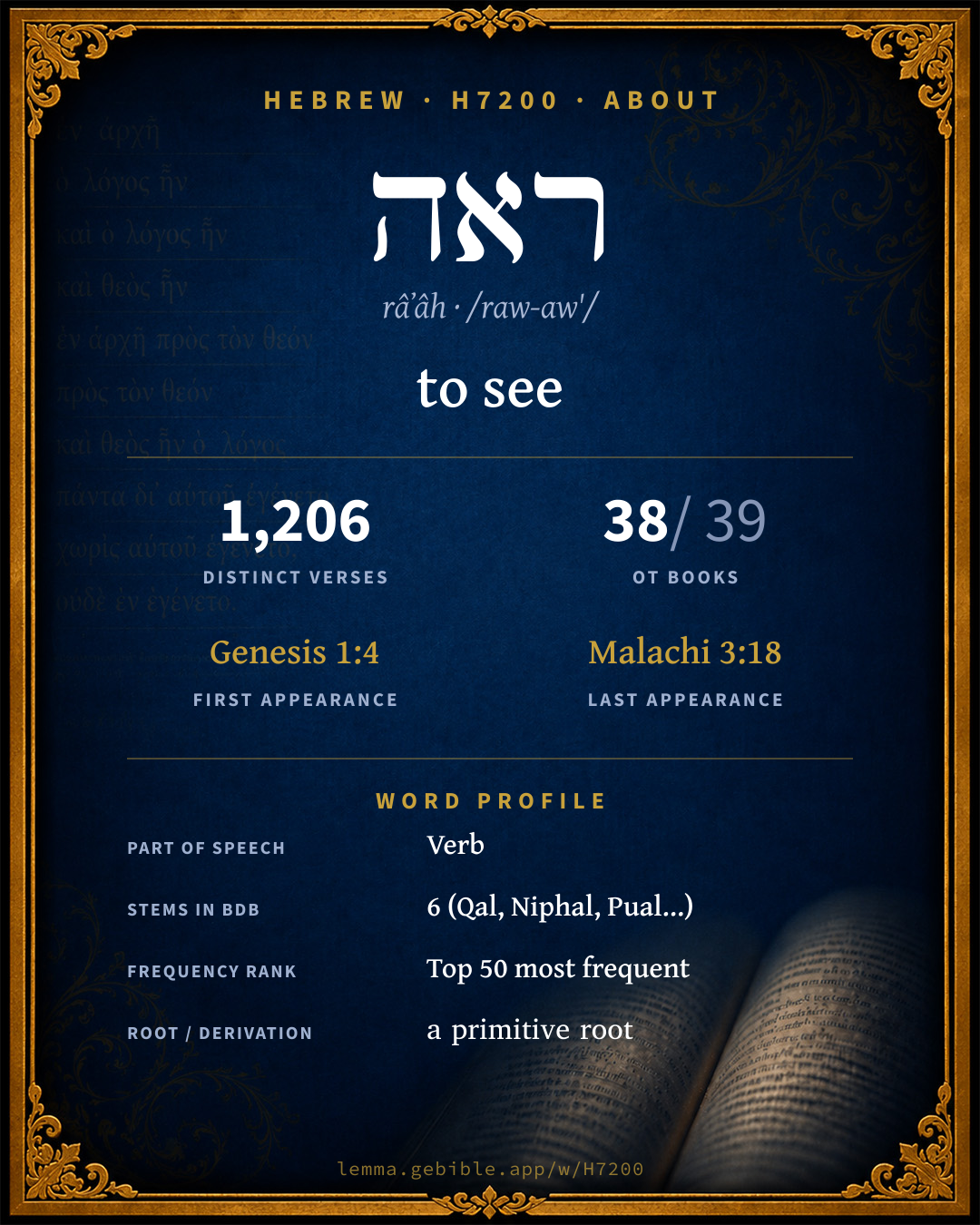
רָאָה
to see
also: look at, inspect, perceive, consider fuller range ↓
Full lexicon entry — Brown-Driver-Briggs (BDB)
From Brown-Driver-Briggs (BDB)
Where this word appears
See every Qal verb in the Hebrew Bible →
Grammar key — what these labels mean
Part of speech
- Verb
- An action or state-of-being word.
Noun type
- Common
- A common noun — a general class of person, place, or thing (“king,” “city,” “water”), not a specific name.
Stem
- Qal
- The basic, simple active stem — the plain form of the verb (“he wrote”). Here: ‘see’
- Niphal
- Usually the simple passive or reflexive of the Qal (“he was written”). Here: ‘appear’
- Hiphil
- The causative active stem (“he caused / brought about”). Here: ‘cause one to see something’
- Hithpael
- The reflexive or reciprocal stem (the subject acts on itself). Here: ‘recipr. look at each other’
- Hophal
- The passive counterpart of the Hiphil (“he was caused to…”). Here: ‘be caused to see’
- Qal Passive
- An archaic passive of the Qal, preserved in a few forms.
Form
- Sequential Imperfect
- An imperfect with prefixed waw — the standard past-narrative form (waw-consecutive imperfect).
- Perfect
- A completed action or state — Hebrew marks aspect (completeness) more than strict tense (“he wrote”).
- Infinitive Construct
- A bound verbal noun, frequently with prepositions (“to write / in writing”).
- Imperative
- A direct command (“write!”).
- Imperfect
- An incomplete, ongoing, or future action (“he will / would write”).
- Participle Active
- A verbal adjective expressing ongoing or characteristic action (“writing / one who writes”).
- Sequential Perfect
- A perfect with prefixed waw continuing a preceding imperfect or command (waw-consecutive perfect).
- Infinitive Absolute
- An unbound verbal noun, often intensifying or standing in for a finite verb.
- Cohortative
- A first-person volitional form expressing wish or resolve (“let me / let us write”).
- Jussive
- A third- or second-person volitional form expressing wish or command (“let him write”).
- Participle Passive
- A verbal adjective expressing action received (“written”).
State
- Absolute
- The independent form of a noun, not bound to a following word.
- Construct
- A noun bound to a following noun in a possessive / “of” relationship (the construct chain).
Person
- 3rd Person
- The one spoken about (“he / she / it / they”).
- 1st Person
- The speaker (“I / we”).
- 2nd Person
- The one addressed (“you”).
Gender
- Masculine
- Grammatically masculine.
- Common
- Either gender — not distinguished for this form.
- Feminine
- Grammatically feminine.
Number
- Singular
- One.
- Plural
- More than one (in Hebrew, generally three or more).
61 verses where H7200 appears in the Qal stem in the Book of Jeremiah. Filtered view — show all forms. Click any verse to open its interlinear word-by-word view. Verse text shown in the World English Bible for context — . Each verse’s Hebrew form is shown with its reference; the English is not keyword-highlighted, since the data carries no word-level English alignment. Use “Compare translations” on any verse to read it across multiple English versions. This concordance covers the Hebrew Bible; Septuagint (Greek Old Testament) occurrences are not indexed here.
Jeremiah
- Jeremiah 1:10 רְאֵ֞ה Qal impv 2ms behold, I have this day set you over the nations and over the kingdoms, to pluck up and to break down and to destroy and to overthrow, to build and to plant.
- Jeremiah 1:11 רֹאֶ֖ה רֹאֶֽה Qal ptcp.act ms Qal ptcp.act ms Moreover the word of Yahweh came to me, saying, Jeremiah, what see you? I said, I see a rod of an almond tree.
- Jeremiah 1:12 לִ/רְא֑וֹת prep + Qal inf.cs Then said Yahweh to me, You have well seen: for I watch over my word to perform it.
- Jeremiah 1:13 רֹאֶ֑ה רֹאֶ֔ה Qal ptcp.act ms Qal ptcp.act ms The word of Yahweh came to me the second time, saying, What see you? I said, I see a boiling caldron; and the face of it is from the north.
- Jeremiah 2:10 וּ/רְא֔וּ וּ/רְא֕וּ conj + Qal impv 2mp conj + Qal impv 2mp For pass over to the isles of Kittim, and see; and send to Kedar, and consider diligently; and see if there has been such a thing.
- Jeremiah 2:19 וּ/רְאִי֙ conj + Qal impv 2fs Your own wickedness shall correct you, and your backsliding shall reprove you: know therefore and see that it is an evil thing and a bitter, that you have forsaken Yahweh your God, and that my fear is not in you, says the Lord, Yahweh of Hosts.
- Jeremiah 2:23 רְאִ֤י Qal impv 2fs How can you say, I am not defiled, I have not gone after the Baals? see your way in the valley, know what you have done: [you are] a swift dromedary traversing her ways;
- Jeremiah 2:31 רְא֣וּ Qal impv 2mp Generation, see the word of Yahweh. Have I been a wilderness to Israel? or a land of thick darkness? why say my people, We are broken loose; we will come no more to you?
- Jeremiah 3:2 וּ/רְאִ֗י conj + Qal impv 2fs Lift up your eyes to the bare heights, and see; where have you not been lain with? By the ways have you sat for them, as an Arabian in the wilderness; and you have polluted the land with your prostitution and with your wickedness.
- Jeremiah 3:6 הֲֽ/רָאִ֔יתָ ptcl inter + Qal pf 2ms Moreover Yahweh said to me in the days of Josiah the king, Have you seen that which backsliding Israel has done? she is gone up on every high mountain and under every green tree, and there has played the prostitute.
- Jeremiah 3:7 ו/תראה וַ/תֵּ֛רֶא conj + Qal wimpf 3fs conj + Qal wimpf 3fs I said after she had done all these things, She will return to me; but she didn't return: and her treacherous sister Judah saw it.
- Jeremiah 3:8 וָ/אֵ֗רֶא conj + Qal wimpf 1cs I saw, when, for this very cause that backsliding Israel had committed adultery, I had put her away and given her a bill of divorce, yet treacherous Judah, her sister, didn't fear; but she also went and played the prostitute.
- Jeremiah 4:21 אֶרְאֶה Qal impf 1cs How long shall I see the standard, and hear the sound of the trumpet?
- Jeremiah 4:23 רָאִ֨יתִי֙ Qal pf 1cs I saw the earth, and, behold, it was waste and void; and the heavens, and they had no light.
- Jeremiah 4:24 רָאִ֨יתִי֙ Qal pf 1cs I saw the mountains, and, behold, they trembled, and all the hills moved back and forth.
- Jeremiah 4:25 רָאִ֕יתִי Qal pf 1cs I saw, and, behold, there was no man, and all the birds of the sky were fled.
- Jeremiah 4:26 רָאִ֕יתִי Qal pf 1cs I saw, and, behold, the fruitful field was a wilderness, and all the cities of it were broken down at the presence of Yahweh, [and] before his fierce anger.
- Jeremiah 5:1 וּ/רְאוּ conj + Qal impv 2mp Run you back and forth through the streets of Jerusalem, and see now, and know, and seek in the broad places of it, if you can find a man, if there are any who does justly, who seeks truth; and I will pardon her.
- Jeremiah 5:12 נִרְאֶֽה Qal impf 1cp They have denied Yahweh, and said, It is not he; neither shall evil come on us; neither shall we see sword nor famine:
- Jeremiah 5:21 יִרְא֔וּ Qal impf 3mp Hear now this, foolish people, and without understanding; who have eyes, and don't see; who have ears, and don't hear:
- Jeremiah 6:16 וּ/רְא֜וּ conj + Qal impv 2mp Thus says Yahweh, Stand you in the ways and see, and ask for the old paths, where is the good way; and walk therein, and you shall find rest for your souls: but they said, We will not walk [therein].
- Jeremiah 7:11 רָאִ֖יתִי Qal pf 1cs Is this house, which is called by my name, become a den of robbers in your eyes? Behold, I, even I, have seen it, says Yahweh.
- Jeremiah 7:12 וּ/רְאוּ֙ conj + Qal impv 2mp But go you now to my place which was in Shiloh, where I caused my name to dwell at the first, and see what I did to it for the wickedness of my people Israel.
- Jeremiah 7:17 רֹאֶ֔ה Qal ptcp.act ms Don't you see what they do in the cities of Judah and in the streets of Jerusalem?
- Jeremiah 11:20 אֶרְאֶ֤ה Qal impf 1cs But, Yahweh of Hosts, who judge righteously, who try the heart and the mind, I shall see your vengeance on them; for to you have I revealed my cause.
- Jeremiah 12:3 תִּרְאֵ֕/נִי Qal impf 2ms + sfx pers 1cs But you, Yahweh, know me; you see me, and try my heart toward you: pull them out like sheep for the slaughter, and prepare them for the day of slaughter.
- Jeremiah 12:4 יִרְאֶ֖ה Qal impf 3ms How long shall the land mourn, and the herbs of the whole country wither? for the wickedness of those who dwell therein, the animals are consumed, and the birds; because they said, He shall not see our latter end.
- Jeremiah 13:20 ו/ראי וּ/רְא֔וּ conj + Qal impv 2fs conj + Qal impv 2mp Lift up your eyes, and see those who come from the north: where is the flock that was given you, your beautiful flock?
- Jeremiah 13:27 רָאִ֖יתִי Qal pf 1cs I have seen your abominations, even your adulteries, and your neighing, the lewdness of your prostitution, on the hills in the field. Woe to you, Jerusalem! you will not be made clean; how long shall it yet be?
- Jeremiah 14:13 תִרְא֣וּ Qal impf 2mp Then said I, Ah, Lord Yahweh! behold, the prophets tell them, You shall not see the sword, neither shall you have famine; but I will give you assured peace in this place.
- Jeremiah 17:6 יִרְאֶ֖ה Qal impf 3ms For he shall be like the heath in the desert, and shall not see when good comes, but shall inhabit the parched places in the wilderness, a salt land and not inhabited.
- Jeremiah 17:8 יִרְאֶה֙ Qal impf 3ms For he shall be as a tree planted by the waters, who spreads out its roots by the river, and shall not fear when heat comes, but its leaf shall be green; and shall not be careful in the year of drought, neither shall cease from yielding fruit.
- Jeremiah 18:17 אֶרְאֵ֖/ם Qal impf 1cs + sfx pers 3mp I will scatter them as with an east wind before the enemy; I will show them the back, and not the face, in the day of their calamity.
- Jeremiah 20:4 רֹא֑וֹת Qal ptcp.act fp For thus says Yahweh, Behold, I will make you a terror to yourself, and to all your friends; and they shall fall by the sword of their enemies, and your eyes shall see it; and I will give all Judah into the hand of the king of Babylon, and he shall carry them captive to Babylon, and shall kill them with the sword.
- Jeremiah 20:12 רֹאֶ֥ה אֶרְאֶ֤ה Qal ptcp.act ms Qal coh 1cs But, Yahweh of Hosts, who tests the righteous, who sees the heart and the mind, let me see your vengeance on them; for to you have I revealed my cause.
- Jeremiah 20:18 לִ/רְא֥וֹת prep + Qal inf.cs Why came I forth out of the womb to see labor and sorrow, that my days should be consumed with shame?
- Jeremiah 22:10 וְ/רָאָ֖ה conj + Qal wpf 3ms Don't you weep for the dead, neither bemoan him; but weep sore for him who goes away; for he shall return no more, nor see his native country.
- Jeremiah 22:12 יִרְאֶ֥ה Qal impf 3ms But in the place where they have led him captive, there shall he die, and he shall see this land no more.
- Jeremiah 23:13 רָאִ֣יתִי Qal pf 1cs I have seen folly in the prophets of Samaria; they prophesied by Baal, and caused my people Israel to err.
- Jeremiah 23:14 רָאִ֣יתִי Qal pf 1cs In the prophets of Jerusalem also I have seen a horrible thing: they commit adultery, and walk in lies; and they strengthen the hands of evil-doers, so that none does return from his wickedness: they are all of them become to me as Sodom, and the inhabitants of it as Gomorrah.
- Jeremiah 23:18 וְ/יֵ֖רֶא conj + Qal juss 3ms For who has stood in the council of Yahweh, that he should perceive and hear his word? who has marked my word, and heard it?
- Jeremiah 23:24 אֶרְאֶ֖/נּוּ Qal impf 1cs + sfx pers 3ms Can any hide himself in secret places so that I shall not see him? says Yahweh. Don't I fill heaven and earth? says Yahweh.
- Jeremiah 24:3 רֹאֶה֙ Qal ptcp.act ms Then said Yahweh to me, What see you, Jeremiah? I said, Figs; the good figs, very good; and the bad, very bad, that can't be eaten, they are so bad.
- Jeremiah 29:32 יִרְאֶ֥ה Qal impf 3ms therefore thus says Yahweh, Behold, I will punish Shemaiah the Nehelamite, and his seed; he shall not have a man to dwell among this people, neither shall he see the good that I will do to my people, says Yahweh, because he has spoken rebellion against Yahweh.
- Jeremiah 30:6 וּ/רְא֔וּ רָאִ֨יתִי conj + Qal impv 2mp Qal pf 1cs Ask now, and see whether a man does travail with child: why do I see every man with his hands on his loins, as a woman in travail, and all faces are turned into paleness?
- Jeremiah 31:26 וָ/אֶרְאֶ֑ה conj + Qal wimpf 1cs On this I awakened, and saw; and my sleep was sweet to me.
- Jeremiah 32:4 תִּרְאֶֽינָה Qal impf 3fp and Zedekiah king of Judah shall not escape out of the hand of the Chaldeans, but shall surely be delivered into the hand of the king of Babylon, and shall speak with him mouth to mouth, and his eyes shall see his eyes;
- Jeremiah 32:24 רֹאֶֽה Qal ptcp.act ms Behold, the mounds, they are come to the city to take it; and the city is given into the hand of the Chaldeans who fight against it, because of the sword, and of the famine, and of the pestilence; and what you have spoken has happened; and, behold, you see it.
- Jeremiah 33:24 רָאִ֗יתָ Qal pf 2ms Don't you consider what this people has spoken, saying, The two families which Yahweh did choose, he has cast them off? thus do they despise my people, that they should be no more a nation before them.
- Jeremiah 34:3 תִּרְאֶ֗ינָה Qal impf 3fp and you shall not escape out of his hand, but shall surely be taken, and delivered into his hand; and your eyes shall see the eyes of the king of Babylon, and he shall speak with you mouth to mouth, and you shall go to Babylon.
- Jeremiah 39:4 רָ֠אָ/ם Qal pf 3ms + sfx pers 3mp It happened that, when Zedekiah the king of Judah and all the men of war saw them, then they fled, and went forth out of the city by night, by the way of the king's garden, through the gate between the two walls; and he went out toward the Arabah.
- Jeremiah 40:4 רְאֵה֙ Qal impv 2ms Now, behold, I loose you this day from the chains which are on your hand. If it seem good to you to come with me into Babylon, come, and I will look well to you; but if it seem ill to you to come with me into Babylon, forbear: behold, all the land is before you; where it seems good and right to you to go, there go.
- Jeremiah 41:13 כִּ/רְא֤וֹת prep + Qal inf.cs Now it happened that, when all the people who were with Ishmael saw Johanan the son of Kareah, and all the captains of the forces who were with him, then they were glad.
- Jeremiah 42:2 רֹא֥וֹת Qal ptcp.act fp and said to Jeremiah the prophet, Let, we pray you, our supplication be presented before you, and pray for us to Yahweh your God, even for all this remnant; for we are left but a few of many, as your eyes do see us:
- Jeremiah 42:14 נִרְאֶה֙ Qal impf 1cp saying, No; but we will go into the land of Egypt, where we shall see no war, nor hear the sound of the trumpet, nor have hunger of bread; and there will we dwell:
- Jeremiah 42:18 תִרְא֣וּ Qal impf 2mp For thus says Yahweh of Hosts, the God of Israel: As my anger and my wrath has been poured forth on the inhabitants of Jerusalem, so shall my wrath be poured forth on you, when you shall enter into Egypt; and you shall be an object of horror, and an astonishment, and a curse, and a reproach; and you shall see this place no more.
- Jeremiah 44:2 רְאִיתֶ֗ם Qal pf 2mp Thus says Yahweh of Hosts, the God of Israel: You have seen all the evil that I have brought on Jerusalem, and on all the cities of Judah; and, behold, this day they are a desolation, and no man dwells therein,
- Jeremiah 44:17 רָאִֽינוּ Qal pf 1cp But we will certainly perform every word that is gone forth out of our mouth, to burn incense to the queen of the sky, and to pour out drink-offerings to her, as we have done, we and our fathers, our kings and our princes, in the cities of Judah, and in the streets of Jerusalem; for then had we plenty of food, and were well, and saw no evil.
- Jeremiah 46:5 רָאִ֗יתִי Qal pf 1cs Why have I seen it? they are dismayed and are turned backward; and their mighty ones are beaten down, and have fled apace, and don't look back: terror is on every side, says Yahweh.
- Jeremiah 51:61 וְֽ/רָאִ֔יתָ conj + Qal wpf 2ms Jeremiah said to Seraiah, When you come to Babylon, then see that you read all these words,
- Jeremiah 52:25 מֵ/רֹאֵ֤י prep + Qal ptcp.act mp cs and out of the city he took an officer who was set over the men of war; and seven men of those who saw the king's face, who were found in the city; and the scribe of the captain of the host, who mustered the people of the land; and sixty men of the people of the land, who were found in the midst of the city.
About this entry
At a glance — auto-summarized from this page’s data, not written by a person. Every figure links to its source below. This summary describes the numbers; it doesn’t interpret them.
ראה (râʼâh) is a Hebrew verb most often rendered “to see.” Read the stem: it spans 6 stems, including Qal and Niphal. Spanning 1,206 verses in 38 books, it ranks among the most common words of the Hebrew Bible. It first appears in Genesis 1:4. Related forms include מראה, מראה and ראה. The sections below give every sense, occurrence, and version rendering.
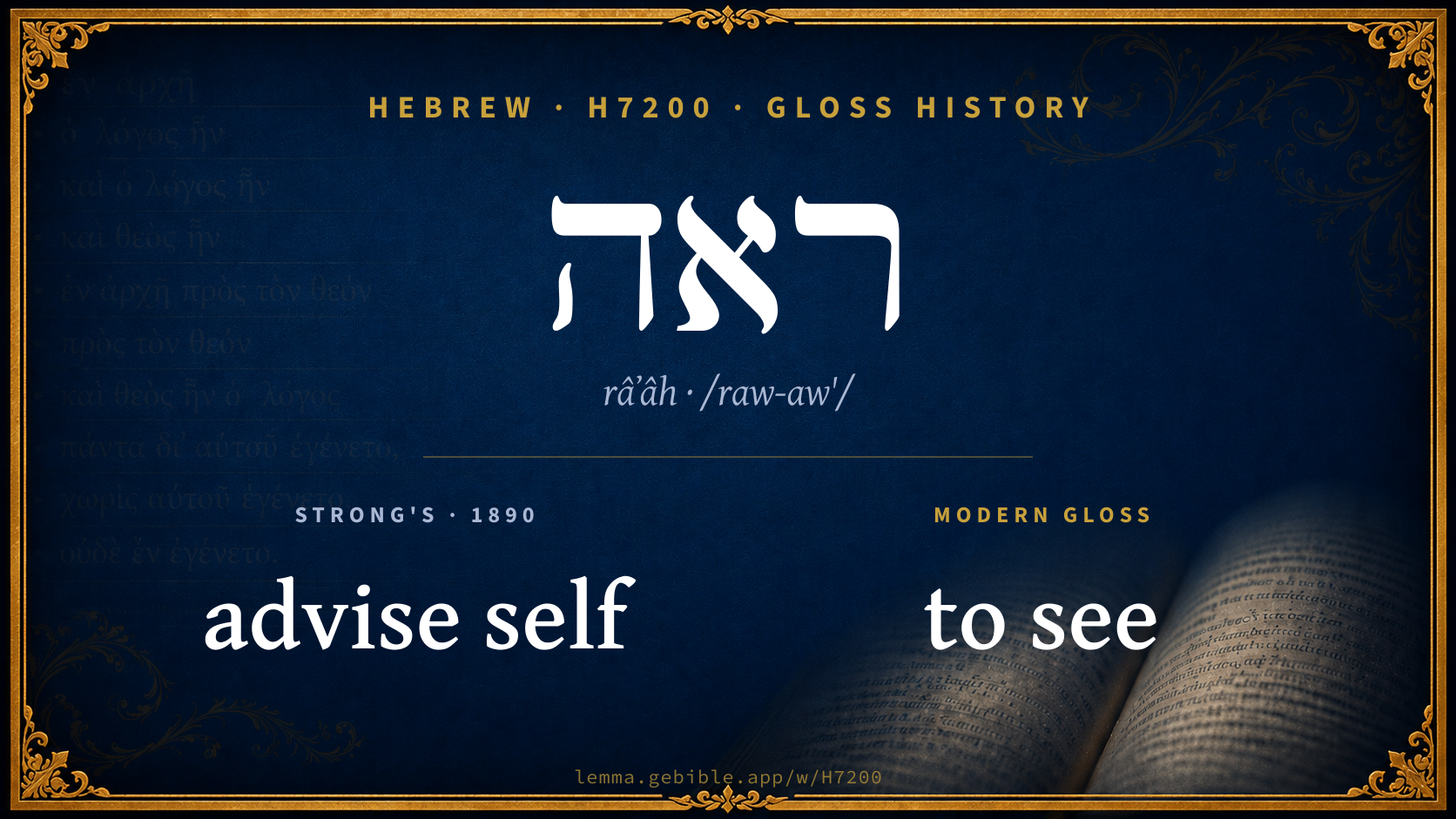
Gloss history
Strong's 1890 vs modern scholarship
About this word
Strong's H7200 catalogs a Hebrew word from the Hebrew Old Testament.
These counts are not copied from any lexicon or concordance. They are computed here, from the morphology-tagged Hebrew Old Testament. What Lemma adds →
- 1,206
- distinct verses
- The word appears in 1,206 distinct verses.
- 38 / 39
- OT books
- The word appears in 38 of 39 Old Testament books.
- #27
- by frequency
- Top 50 most frequent Hebrew words (rank 27 of 8,640 Hebrew words by occurrence).
View all 1,206 occurrences in the concordance →
By section of the Old Testament
By traditional corpus
Conventional, traditional groupings — biblical authorship is debated, so this is a traditional corpus grouping, not an authorship claim. Each share is this word’s portion of its verses in that division of the Hebrew canon. Each figure is a share of the word’s 1,206 distinct verses.
- Prophets (Nevi'im) 517 verses · 43%
- Torah (Pentateuch) 366 verses · 30%
- Writings (Ketuvim) 323 verses · 27%
How translations render this word
Counts come from each version’s own published word-to-Strong’s tagging or interlinear alignment — an approximate guide to how each version renders this word, not a word-level alignment the data otherwise carries. Because each total is that version’s own tagged count, the per-version totals vary from one another and need not match the appearance or distinct-verse counts above. These counts may also differ from a printed concordance because Lemma counts each distinctly tagged rendering and does not collapse phrase taggings into a single head-word total. This is a fixed set of word-tagged versions (KJV, ASV, BSB, ULT) and does not change with the reading translation you choose elsewhere. Each version’s license is shown beside its name below (and on Sources).
BDB lists this Strong’s number as 4 distinct words (homographs). Each count above pools all of them and is not split by sense — see the Senses section below. A low-frequency rendering may belong to a different one of those words, not the primary meaning.
- King James Version†: Saw 183×, See 141×, I saw 43×
- American Standard Version†: Saw 184×, See 122×, I saw 41×
- Berean Standard Bible†: See 188×, Saw 166×, I saw 34×
- unfoldingWord Literal Text†: See 265×, Saw 165×, And 152×
King James Version Public Domain
Renders H7200 across 1,312† tagged occurrences — most commonly:
Plus other, less common renderings. Plus 283 renderings that appear only once — usually multi-word phrases or single function words the recovered tagging swept in, not distinct renderings. Not rendered by a distinct English word in 2 further occurrences.
American Standard Version Public Domain
Renders H7200 across 1,316† tagged occurrences — most commonly:
Plus other, less common renderings. Plus 358 renderings that appear only once — usually multi-word phrases or single function words the recovered tagging swept in, not distinct renderings.
Berean Standard Bible Public Domain
Renders H7200 across 1,266† tagged occurrences — most commonly:
Plus other, less common renderings. Plus 294 renderings that appear only once — usually multi-word phrases or single function words the recovered tagging swept in, not distinct renderings. Not rendered by a distinct English word in 31 further occurrences.
unfoldingWord Literal Text CC BY-SA 4.0
Renders H7200 across 1,632† tagged occurrences — most commonly:
Plus other, less common renderings. Plus 194 renderings that appear only once — usually multi-word phrases or single function words the recovered tagging swept in, not distinct renderings.
49 senses and sub-senses in the full BDB
Hebrew verbs can shift meaning by stem (binyan): Qal is the basic action, Niphal is often passive or reflexive, Piel often intensifies or makes it factitive, and Hiphil is typically causative. The senses below are grouped under the stem BDB assigns to each. This entry also uses Pual (the passive of Piel), Hithpael (reflexive or reciprocal), and Hophal (the passive of Hiphil).
What do BDB’s symbols mean?
BDB uses these scholarly abbreviations:
| Symbol | Meaning |
|---|---|
| 𝔊 | the Septuagint (the ancient Greek translation, LXX) |
| 𝔙 | the Vulgate (the Latin translation) |
| 𝔖 | the Syriac version (the Peshitta) |
| 𝔗 | the Targum (the Aramaic translation) |
| ψ | the Psalms |
| √ | root (the underlying root or stem) |
| ‖ | parallel passage (a synonymous or contrasted parallel) |
| † | the dagger: every passage where the word occurs is cited |
The 49 senses and sub-senses the full Brown-Driver-Briggs lexicon distinguishes for this word, in lexicon order (not ranked by frequency), with BDB’s own verbatim wording and sub-sense lettering. Shown in Hebrew script with BDB’s own scholarly abbreviations. The condensed entry is in the Lexicon Entry tab. See also the Forms in the corpus table below.
ראה I
Qal
- Pf. 3 ms. ר׳ Gn 29:10 +, sf. וְרָֽאֲךָ consec. Ex 4:14, רָאָהוּ 2 K 2:12 +; 3 fs. רָֽאֲתָה Gn 38:14, sf. רָאָֽתְךָ Jb 42:5; 2 ms. רָאִיתָ Gn 20:10 +, etc.; Impf. 3 ms. יִרְאֶה 22:8 +, juss. יֵרֵא Gn 41:33 (Baer Gi, Ges§ 75 p, hh Köi.561; van d. H. יֵרֶא), יֵ֫רֶא Ex 5:21 +, וַיַּרְא Gn 18:2 + (1 S 19:20 read pl. 𝔊 Comm., i.e. וַיִּרְאֻ DrSm lxiii), sf. יִרְאַנִי Ex 33:20, וַיִּרְאֵ֑נִי 2 S 1:7; 3 fs. תִּרְאֶה Lv 20:17; Jb 33:28, juss. תֵּרֵא Mi 7:10; Zc 9:5 (Baer Gi, cf. Ges Kö supr.; van d. H. תֵּרֶא), וַתֵּ֫רֶא Gn 3:6 +; i s. אֶרְאֶה 21:16 +, וָאֵרֶא 31:10 +, etc.; Imv. רְאֵה 27:27 +, etc.; Inf. abs. רָאֹה Ex 3:7 +, רָאוֹ Gn 26:28; Is 6:9; cstr. רְאֹה Gn 48:11, רְאוֹת Ex 10:28 +, רַאֲוָה Ez 28:17, etc.; Pt. act. רֹאֶה Gn 13:15 +, etc.; pass. רְאֻיוֹת (Baer Gi; van d. H. רְאֻיּוֹת):— e.g. Genesis 29:10
- 1.
- a. see, subj. עַיִן, עֵינַיִם, c. acc. pers. Is 6:5; 30:20; Je 42:2 + 5 times Jb Pr; subj. pers., c. acc. pers. Gn 12:12, 15 + (מִי רָאָהוּ 1 S 23:22, read הַמְּהֵרָה 𝔊 Th We al. [not HPS]); רֹאִי 16:13 (pt. sf., cf.בְּאֵר לַחַי רֹאִי v 14, p. 91 supr.); acc. of God 32:31 (פָּנִים אֶל־פָּנִים); acc. pers. om. 18:2; 19:1 +; c. acc. פְּנֵי 31:2; 46:30; 48:11; Ex 33:20, opp. אֶת־אֲחֹרָ֑י v 23; c. acc. פְּנֵי specif. of having access to man of rank Gn 43:3, 5 + (v. [פָּנֶה] 2 b). e.g. Isaiah 6:5
- b. see, c. acc. rei: subj. עַיִן, עֵינַיִם Jos 24:7 (E) 1 S 24:11 (van d. H. Baer; v 10 Gi), Dt 3:21 + 5 times Dt, +; וְעֵינָיו אֶת־עֵינָיו תִּרְאֶינָה Je 32:4, cf. 34:3; acc. om. 2 S 24:3 Dt 21:7 + 9 times (לִרְאוֹת 1 S 6:13 read לִקְרָאתוֹ 𝔊 We Dr Kit Bu HPS Now); subj. pers. Gn 13:15; 31:12 + very often; c. acc. cogn. מַרְאֶה Ex 3:3 + 7 times, מַרְאָה Dn 10:7(×2), 8, חָזוֹן 8:15, חֶזְיֹנוֹת Jo 3:1; hence see abs. = receive revelation, Is 30:10 (‖ חזה), cf.Ez 13:3 and v. 1. רֹאֶה; c.acc. עֶרְוָה, v. ע׳, p. 788 f.; see war, i.e. see it impending Ex 13:17 (E); ר׳ אֶת־הַקּוֹלֹת וְאֶת־הַלַּפִּידִים 20:18 (Gi v 15); רֹאֵי הַשֶּׁמֶשׁ Ec 7:11 those who see the sun = living men; acc. rei om. Ex 22:9;2 S 13:5 +, וָאֶרְאֶה בֶּחָזוֹן Dn 8:2(×2) (abs.); לֹא יֵדעוּ רְלֹא יִרְאוּ Ne 4:5; עֵינֵי רֹאִים Is 32:3, מְקוֹם רֹאִים Jb 34:26; c. adv. or adv. phr. instead of acc. rei: כָּהֵנָּה Gn 41:19 cf. Is 66:8; Ez 1:27(×2), כַּאֲשֶׁר 2 K 2:19; 2 Ch 29:8; 30:7; Jb 4:8; Ez 16:50; Dn 1:13, כֵּן ψ 48:9. e.g. Joshua 24:7
- 2. see, sq. acc. + cl. or phr. of closer design.: (1) + epex. cl. c. כִּי, acc. pers. Gn 6:2 saw them that they were fair, 12:14 (both J), Ex 2:2; 32:25 (both E), 1 K 11:28, acc. of face + id. Gn 31:5 (E), Ex 34:25 (P); acc. rei Gn 49:15 (poem), Is 22:9; Gn 1:4 (P), Ec 2:24; 4:4 and prob. 2 K 14:26 (reading כִּי מַר הוּא); (2) ר׳ כָּל־הַבָּא עָלָיו וְעָמָ֑ד 2 S 20:12; (3) + adj. (incl. pt.), acc. pers. Gn 7:1 (J), Am 9:1; 2 S 18:10 + 39 times (Je 46:5 del. ר׳ 𝔊 Gie), + acc. אֲשֶׁר Ex 14:13(×2) (J); acc. rei, †Ex 23:5; 33:10 (both E), Dt 22:4; Ez 33:3, 6; Dn 1:10; 8:4, 6, 7; †(4) + מָה, acc. rei Nu 13:18 (JE), Hg 2:3; †(5) + prep. phr., acc. pers. Ex 5:19 (J), Zc 4:10; Ec 10:7; Est 5:9; acc. rei + בִּכְבוֹדוֹ Hg 2:3, + ב pers. Je 23:13, 14, + כ pers. Ju 9:36, כ rei 2 S 18:27; (6) acc. pers. + adv. acc. + כ pers. Je 30:6. e.g. Genesis 6:2
- 3. see, so as to learn to know: c. acc. pers. Dt 33:9 (‖ הִכִּיר, יַדַע);c. acc. rei Dt 1:19, 31; 11:2; Jb 11:11 (‖ יַדַע), ψ 16:10; 49:10; = have experience of, Je 5:12; 14:13; 20:18; 42:14; Zp 3:15; ψ 89:49; Ec 5:17, שֵׁנָה בְּעֵינָיו אֵינֶנּוּ רֹאֶה Ec 8:16; מָה ראית Gn 20:10 i.e. what hast thou encountered, that …? BacherZAW xix (1899), 345 ff.; Terminol. 177 f. e.g. Deuteronomy 33:9
- 4. abs. see, have (power of) vision, Gn 27:1 (J), 48:10 (E), 1 S 3:2; 4:15; 1 K 14:4, miraculous 2 K 6:17(×2), 20(×2); denied of idols Dt 4:28 ψ 115:5; 135:16; fig. of spiritual vision Is 6:10; 29:18; 42:18; 44:18; Je 5:21; Dt 29:3; Ez 12:2(×2) ψ 40:13; 69:24; עַיִן רֹאָה Pr 20:12.—1 S 14:27 read Qr v. אור. e.g. Genesis 27:1
- 5. see = perceive:
- a. sq. cl. c. כִּי, Ex 3:4; 8:11; Gn 1:10, 12 + often (1 S 23:15 read וַיִּרָא and he feared We Dr Kit Bu HPS Now); om. כִּי (late) †La 1:10 ψ 49:11 Ec 3:16; sq. מָה of indirect question Gn 2:19 (J), 37:20 (E), Ju 9:48; Dt 32:20; Je 7:17; 33:24; Ez 8:6; Jon 4:5 +; בַּמָּה Ju 16:5 cf. 1 S 14:38, כַּמָּה Zc 2:6 ψ 35:17; sq. מִי of indirect question 1 S 14:17; Is 40:26; La 2:20 (+ הַבִּיטָה); sq. אֵי 1 S 26:16, אֵיכֹה 2 K 6:13, אֵיפֹה Je 3:2; sq. cl. c. הֲ whether, Gn 8:8; 18:21; Nu 11:23 (all J), Ex 4:18 (E), ψ 14:2; 53:3 Ct 6:11 b Est 3:4, אִם whether Je 30:6; La 1:12 ψ 139:24 Ct 7:13, אֲשֶׁר that or how 1 S 18:15, אֵי Ec 2:3, שֶׁ that v 13, שְׁ 3:18. e.g. Exodus 3:4
- b. c. acc. צָרַת נַפִשׁוֹ Gn 42:21 (i.e. saw it by out-ward signs), cf. Ho 5:13. [Note, under 5 (rarely in other cases, and only S K Je), †Imv. + ידע Imv.: דַּע וּרְאֵה 1 S 24:12; 2 S 24:13; 1 K 20:22; דְּעִי וּרְאִי 1 S 25:17; Je 2:19; דְּעוּ וּרְאוּ 1 S 12:17; 14:38; 23:22; 1 K 20:7; 2 K 5:7; in reverse order, רְאוּ וּדְעוּ 1 S 23:23; Je 5:1.]. e.g. Genesis 42:21
- 6. look at, see, by direct volition:
- a. subj. men, c. acc. rei, Gn 9:22, 23 (J), 42:9, 12 (E), Lv 13:3, 15 +; c. acc. of land = reconnoitre Jos 2:1; look at sun, etc., for worship †Dt 4:19; Jb 31:26; = inspect 1 K 9:12; Lv 14:36(×2); c. acc. pers. Nu 24:20, 21 (JE), Ex 2:25; Lv 13:3, 5 (all P), 1 S 9:16 +, (1 S 19:15 HPS proposes אֶל־בֵּית for לִרְאוֹת); c. prep. ר׳ אַחֲרִי רֹאִי Gn 16:13 (J) I have looked after one seeing me (interpr. v. Di). e.g. Genesis 9:22
- b. subj. God, c. acc. rei Gn 9:16 (P); = inspect 11:5 (J); look at with favour, acc. pers. Jb 37:24 ψ 138:6; so perhaps fig., subj. man, regard, c. acc. אָוֶן ψ 66:18 (Hup-Now; Che Bae Dr al. intend); look with pleasure (acc. om., + מִן by reason of, as a fruit of) Is 53:11 (si vera l.; ins. acc. אוֹר 𝔊 Houb Klo Du CheHpt Kit [perhaps], with Hiph. יַרְאֵה 𝔊 Du CheHpt, rescues from travail his soul, makes it see light). e.g. Genesis 9:16
- c. without acc., look, take a look, etc. (of man and God; often + וְהִנֵּה), Gn 8:13; 18:2;Ex 3:2; Lv 13:8; La 3:50 (מִן loc.), Gn 13:14 (מִן loc. + ה loc.), Dt 3:27; Ez 40:4; 44:5 (all בְּעֵינֶיךָ), + often; peculiarly, מִמֶּנִּי תִרְאוּ וְכֵן תַּעֲשׂוּ Ju 7:17 (cf. GFM). e.g. Genesis 8:13
- d. look after, see after, learn about, c. acc. rei Gn 37:14 (J), c. acc. pers. = visit (go to see) 1 S 15:35; 20:29; 2 S 13:5, 6; 2 K 8:29 = 2 Ch 22:6; 2 K 9:16, cf. Ez 20:28, עֵין רֹאִי Jb 7:8 (Di Bu al.). e.g. Genesis 37:14
- e. observe, watch, abs. 1 S 6:9, 16; 17:28; Ec 8:16 (‖ ידע). e.g. 1 Samuel 6:9
- f. look upon = endure to see, c. acc. rei Hb 1:13 (‖ הִבִּיט). e.g. Habakkuk 1:13
- g. look out, find out, acc. pers. 2 K 9:2; Gn 41:33 (E), + ל pers. 1 S 16:17; select, acc. pers. + מִן from among 2 K 10:3, + ב among + ל pers. 1 S 16:1; provide, furnish, c. acc. rei Dt 33:21 (poem), + ל pers. Gn 22:8 (E), cf. abs. י׳ יִרְאֶה as n.pr.loc. = י׳ seeth v 14 a (E;? read יֵרָאֶה, cf. v b, Niph. and Di); רְאֻיוֹת Est 2:9 looked out = suitable (as often NH). e.g. 2 Kings 9:2
- h. look at = concern oneself about, acc. rei (+ בְּיָדוֹ) Gn 39:23 (J). e.g. Genesis 39:23
- 7. of mental observation:
- a. Imv. see! observe! consider! exclam. (nearly = הִנֵּה), sq. cl.: Gn 27:27; 31:50 see! God is witness 39:14; 41:41; Ex 4:21; Dt 1:8 +; sq. nom. independ. 2 S 24:22 (‖ 1 Ch 21:23 sq. cl.). e.g. Genesis 27:27
- b. look at, i.e. inquire into, a matter, acc. rei om., of י׳, 1 S 24:16 (Gi v 15). e.g. 1 Samuel 24:16
- c. give attention to, acc. rei, Je 2:31, abs. give attention! 2 S 13:28; 2 K 6:32; Ex 25:40 ψ 45:11; take heed to, acc. rei, 1 K 12:16 = 2 Ch 10:16; abs. take heed! Ex 10:10, + פֶּן 2 K 10:23. e.g. Jeremiah 2:31
- d. discern, לִבִּי ר׳ חָכְמָה Ec 1:16, ר׳ טוֹב 3:13. e.g. Ecclesiastes 1:16
- e. distinguish, c. בֵּין … לְ of pers. Mal 3:18; e.g. Malachi 3:18
- f. consider, reflect, Ec 7:14 (sq. cl orat. rect.). e.g. Ecclesiastes 7:14
- 8.
- a. c. ב, lit., look into, hence look at with interest (Germ. ‘sich vertiefen in’): (1) gaze at 1 S 6:19 (on context v. We Dr HPS), so as to become acquainted with Gn 34:1 (P); so as to find out Ec 3:22; inspect liver (for omens) Ez 21:26; somewhat weakened = behold Jb 3:9; 2 Ch 7:3 ψ 64:9. (2) look at with kindness, helpfulness, of י׳, בָּעֳנִי Gn 29:32; 1 S 1:11 (+ inf. abs.), 2 S 16:12, בַּצַּר ψ 106:44. (3) upon a spectacle causing anger Ex 2:11 (E), grief Gn 21:16; (E), 44:34; Nu 11:15 (both J), 2 K 22:20 (subj. עֵינַיִם) = 2 Ch 34:28; Est 8:6(×2), abhorrence Is 66:24. (4) gaze at with apprehension Ec 11:4. (5) with joy, pleasure, 2 K 10:16; Mi 7:9; Je 29:32; Is 52:8 (עַיִן בְּעַיִן, cf. Niph. Nu 14:14); Jb 20:17; 33:28 ψ 54:9; 106:5; 128:5; Ct 3:11; 6:11 a Ec 2:1. (6) especially with exultation, triumph = feast eyes upon, sometimes gloat over enemies (cf. MI7) Ju 16:27; Mi 7:10; Ez 28:17 Ob 12, 13 ψ 22:18; 54:9; 112:8; 118:7. e.g. 1 Samuel 6:19
- b. c. אֶל Je 4:23. Is 17:7 (subj. עֵינַיִם; ‖ שָׁעָה עַל); עַל pers. Ex 5:21 (J); ר׳ עַל־הָאָבְנָ֑יִם Ex 1:16 v. [אֹבֶן] and Comm., also SpiegelbZA xiv (June 1900), 269 ff.. e.g. Jeremiah 4:23
- c. c. ל, הָאָדָם יִר׳ לַעֵינַיִם וְיהוה יִר׳ לַלֵּבָב 1 S 16:7, מִי יִרְאֶה־לָּ֑מוֹ ψ 64:6.—Corrupt is וּרְאִתַנִי כְתוֹר הָאָדָם 1 Ch 17:17 (and ‖ וְזֹאת תּוֹרַת הָאָדָם 2 S 7:19), read וַתַּרְאֵנִי (with other changes) We Dr Kau Bu HPS Now; Ez 12:12; read prob. Niph. 𝔊 Hi Co Krae; Mi 6:9; read prob. יִרְאָה cf. Now GASm. e.g. 1 Samuel 16:7
Niphal
- Pf. 3 ms. נִרְאָה Gn 48:3 +, etc.; Impf. 3 ms. יֵרָאֶה Gn 22:14 +, juss. יֵרָא Ex 34:3; Lv 9:6, וַיֵּרָא Gn 12:7 +; 1 s. וָאֵרָא Ex 6:3; etc.; Imv. ms. הֵרָאֵה 1 K 18:1; Inf. cstr. לְהֵרָאוֹת 1 S 17:17 +, לֵרָאוֹת Is 1:12 + 2 times, הֵרָאֹה Ju 13:21; 1 S 3:21; etc.;— e.g. Genesis 48:3
- 1. appear, especially
- a. of י׳ (God): c. אֶל pers. Gn 12:7(×2) + 6 times J, Gn 35:1 (E), v 9 48:3; Ex 6:3; (בְּאֵל שַׁדַּי, ב essent.), Lv 9:4 (all P), 1 K 3:5; 9:2(×2) = 2 Ch 7:12; 1 K 11:9; c. ל pers. Je 31:3; 2 Ch 1:7; 3:1 (ins. י׳ 𝔊 Kau Kit); abs. Gn 22:14 in the mt. where י׳ appeareth (prob., Di Sta G i. 450 DrHast. DB ii. 563; E), Nu 14:14; (JE; עַיִן בְּעַיִן, v Is 52:8 Qal 8 a (5)), Lv 16:2 (P; ב loc. + עַל), 1 S 3:21 (ב loc.), 2 S 22:11 (עַל־כַּנְפֵי־רוּחַ; וַיֵּדֶא ‖ ψ 18:11), + 5 times; of מַלְאַךְ י׳, c. אֶל pers. Ex 3:2 (E), Ju 13:21; of כְּבוֹד י׳; c. אֶל pers. Lv 9:6, 23; Nu 14:10 (ב loc.), 16:19; 20:6 (all P), Ju 6:12; 13:3; עַל pers. Is 60:2; abs. Ex 16:10 (ב loc.), Nu 17:7 (both P). e.g. Genesis 12:7
- b. appear, of man, = present oneself: c. אֶל pers. Gn 46:29 (J), Ju 13:10; 1 K 18:1, 2, 15; Lv 13:7(×2), 19, אֶל of God ψ 84:8 (ב loc.), אֶל־פְּנֵי הָאָדֹן Ex 23:17 (E); abs. Is 16:12 (del. as dittogr. Lo Du CheHpt Marti al.); especially (Mass.) sq. אֶת־פְּנֵי) of י׳, rendered appear before י׳: so וְנִרְאָה 1 S 1:22, יֵרָאֶה Ex 34:23 (JE), Dt 16:16, וְאֵרָאֶה ψ 42:3, יֵרָאוּ Ex 23:15 (E), 34:20 (JE), Dt 16:16, לֵרָאוֹת Ex 34:24 (JE), Dt 31:11; Is 1:12; read prob. in all Qal (v. [פָּנֶה] II. 2). e.g. Genesis 46:29
- c. appear, of things: late (Hex only P), abs. Gn 1:9; 8:5, c. ב loc. 9:14; Lv 13:14, 57; elsewhere poet. ψ 18:16 = 2 S 22:16, ψ 90:16 Pr 27:25 (of דֶּשֶׁא), Ct 2:12 (ב loc.; of blossoms); subj. מַרְאֵיהֶם Dn 1:15 (+ adj. pred.), v 13 (+ לְפָנֶיךָ); subj. חָזוֹן, c. אֶל pers. Dn 8:1(×2); subj. כְּנֶגַע Lv 14:35 (c. ל pers.). e.g. Genesis 1:9
- 2. be seen:
- a. subj. rei, 1 K 10:12 = 2 Ch 9:11 (where כָּהֶם subj.) Ez 19:11, of sins 21:29 (‖ חִגָּלוֹת), subj. כָּזֹאת Ju 19:30, כְּאֶבֶן etc. Ez 10:1. e.g. 1 Kings 10:12
- b. subj. pers. 2 S 17:17 (+ לָבוֹא) be seen to come. e.g. 2 Samuel 17:17
- c. be seen = occur 2 K 23:24 (ב loc.); = exist, + ל pers. Ex 13:7(×2) (JE), Dt 16:4, cf. Ez 10:8; = be present, + ב loc. Ju 5:8 Ex 34:3 (JE). e.g. 2 Kings 23:24
- 3. be visible, Ex 33:23 (JE; subj. י׳’s face), אֵין אֶבֶן נִרְאָה 1 K 6:18, 8:8(×2) = 2 Ch 5:9(×2), Je 13:26 Is 47:3. e.g. Exodus 33:23
Pual
- Pf. 3 pl. עַצְמֹתָיו לֹא רֻאוּ Jb 33:21 (Baer Gi; d. f. Ki Köi. 41, 563, Mappik\ Ges§ 14 d; van d. H. רֻאוּ), appar. his bones are not seen, detected; De which were (formerly) not seen; Di are insignificant (‘unscheinbar’), so Bae; prob. corrupt, Bu נָאווּ, Du del. as doublet. e.g. Job 33:21
Hithpael
- recipr. look at each other: Impf. 2 mpl. לָ֫מָּה תִּתְרָאוּ Gn 42:1 (E); techn. 3 mpl. וַיִּתְרָאוּ פָנִים 2 K 14:11 = 2 Ch 25:21 and they looked each other in the face, i.e. met in combat, so i pl. נִתְרָאֶה פ׳ 2 K 14:8 = 2 Ch 25:17, cf. (perhaps) 2 K 23:29, where Wkl Benz conj. כְּהִתְרָאוֹת אִתּוֹ (or Niph. כְּהֵרָאוֹת אִתּוֹ) for MT כִּרְאֹתוֹ אֹתוֹ. e.g. Genesis 42:1
Hiphil
- Pf. 3 ms. הֶרְאָה Gn 41:28 +, sf. הִרְאַנִי Am 7:1 +, הֶרְאָ֑נִי Ez 11:25, הֶרְאָנוּ Dt 5:21; Ju 13:23, הֶרְאֲךָ Dt 4:36; i s. וְהַרְאֵיתִ֫י Na 3:5 (Ges§ 53 p), sf. הֶרְאִיתִיךָ Dt 34:4, הִרְאִיתִים Is 39:4 cf. ‖ 2 K 20:15, etc.; Impf. 3 ms. יַרְאֶה Is 30:30, וַיַּרְא 2 K 11:4, sf. יַרְאֵנִי Nu 23:3 ψ 59:11; i s. sf. אַרְאֶךָּ Gn 12:1 +, etc.; Imv. ms. sf. הַרְאֵנִי Ex 33:18, etc.; Inf. cstr. הַרְאוֹת Dt 3:24 +, sf. הַרְאוֹתְכָה Ez 40:4, לַרְאֹתְכֶם Dt 1:33, etc.; Pt. מַרְאֶה Ex 25:9 Ez 40:4;— e.g. Genesis 41:28
- 1.
- a. cause one to see something, shew: (1) subj. man, c. acc. pers. + rei, Nu 13:26 b (JE), Ju 1:24, 25; 2 K 20:13(×2), 15 = Is 39:2(×2), 4 + 4 times, acc. rei om. Ez 40:4; Est 4:8, acc. refl. נַפְשׁוֹ + acc. rei Ec 2:24; מִי יַרְאֵנוּ טוֹב ψ 4:7, acc. pers. om., = exhibit Est 1:4; c. 2 acc. pers. Ju 4:22; 2 K 11:4. (2) especially subj. י׳ (God), c. acc. pers. + rei, Gn 12:1; Ex 9:16 (both J), Gn 41:28; 48:11 (both E), Ex 33:18; Dt 34; 1 b (both JE), Dt 3:24; 4:36; 5:21; Jos 5:6 (D), Ex 25:9 (P), Ju 13:23 + 5 times + (of revelation to prophets) Nu 23:3 (JE), Je 38:21; Ez 11:25, also, c. acc. rei cogn., Nu 8:4 (P), acc. rei om. Dt 34:4 (JE), acc. pers. om. = exhibit, Is 30:30; of visions, י׳ subj., c. acc. pers. + כֹּה Am 7:1, 4, 7; 8:1, + כַּאֲשֶׁר Ex 27:8 (P), c. acc. pers. only = cause to see [a vision] Je 24:1; c. 2 acc. pers. + appos. 2 K 8:13, acc. pers. + cl. c. כִּי v 10. (3) subj. angel, acc. pers. + rei, of revelation to prophet Zc 2:3; 3:1; acc. pers. + cl. c. מָה Zc 1:9. e.g. Numbers 13:26
- b. cause to experience something, c. acc. pers. + rei, subj. י׳, Hb 1:3 ψ 60:5; 71:20; 85:8. e.g. Habakkuk 1:3
- 2. cause to look intently at, to behold, c. acc. pers. + ב rei (cf. Qal 8), subj. י׳:
- a. cause to gaze at, with joy ψ 50:23; 91:16. e.g. Psalms 50:23
- b. in exultation, cause to feast one’s eyes upon, fallen enemies ψ 59:11 (cf. MI4). e.g. Psalms 59:11
- c. in weakened sense, cause to behold Dt 1:33 (cf. Dr). e.g. Deuteronomy 1:33
Hophal
- 1. be caused to see, be shewn: Pf. 2 ms. הָרְאֵיתָ, subj. man, acc. rei, Ex 26:30 (P; ב loc.); so Pt. מָרְאֶה 25:40 (P; ב loc.); sq. inf. אַתָּה הָרְאֵתָ לָדַעַת כִּי Dt 4:35. e.g. Exodus 26:30
- 2. be exhibited to, subj. rei, acc. pers., Pf. 3 ms. consec. וְהָרְאָה אֶת־הַכֹּהֵן Lv 13:49 (P). e.g. Leviticus 13:49
ראה II seeing, assumed by Thes al. to explain cstr. וּרְאֵה עָנְיִי Jb 10
ראה III look
Senses from the full Brown-Driver-Briggs lexicon (Brown, Driver, Briggs; Oxford 1906 — public domain), digitized via Sefaria, supplemented by the OpenScriptures HebrewLexicon (CC BY 4.0). Full attribution on Sources.
Word origin
I. Dt 14:13 textual error; v. דָּאָה.
II. vb. see (NH id.; וארא MI4, הראני l7, cf. רית spectacle l12; Sab. ראי see, expect, DHM ZMG xxix (1875), 596, 599; Arabic رَأَى see, so Ethiopic ርእየ: 𝔗 רֵו, רֵיוָא human appearance, features, etc. (cf. Heb. רֳאִי 2));—
I. adj. seeing, assumed by Thes al. to explain cstr. וּרְאֵה עָנְיִי Jb 10:15, but improb.; Mass. appar. intended Imv. (unsuitable); Ew al. וְרֹאֵה; Di Bu Du (After Lag Gei) רְוֵה עֹ֑נִי drenched (i.e. sated) with affliction.
I. n.f. look;—cstr. רְאוּת עֵינָיו Ec 5:10 Qr (Kt ראית).
— Brown-Driver-Briggs (Oxford 1906, public domain), digitized via Sefaria, supplemented by the OpenScriptures HebrewLexicon (CC BY 4.0). See Sources.
Origin: a primitive root
Jastrow Dictionary
A second Hebrew/Aramaic lexicon for comparison, covering Aramaic and post-biblical (Talmudic, Targumic, Midrashic) usage that the biblical-Hebrew BDB does not. Matched by lemma rather than by Strong’s number, so a lemma may carry more than one Jastrow headword (shown separately below), and the entries cover usage well beyond the Bible.
רָאָה I
- , v. ראי
רָאָה II
- (b. h.) raah, name of an unclean bird. Ḥull. 63ᵇ דאה ור׳ וכ׳, v. דָּאָה II. Ib. ר׳ זו איה … ר׳ שרואה ביותר raah is the same as ayah, and it is called raah, because its sight is exceedingly acute (ref. to Job XXVIII, 7). e.g. Job 28:7
A Dictionary of the Targumim, the Talmud Babli and Yerushalmi, and the Midrashic Literature (Marcus Jastrow; London, Luzac, 1903) — Public Domain. Digitized via Sefaria. Digitized via Sefaria. Full attribution on Sources.
Forms in the corpus
The 652 distinct written forms H7200 takes in the Hebrew Bible, most frequent first — each parse links to that stem’s occurrences in the concordance. Hebrew forms include their vowel points and cantillation, so a single lemma takes many written forms.
The 60 most common forms are shown; 592 rarer forms follow in the full concordance.
Same root — word family
Other BDB entries built from the same root as H7200, grouped by Strong’s listed origin. These share a root / origin per the lexicon — not necessarily a shared meaning. Each links to that word’s own entry.
Derived from this word
- מראה marʼeh H4758 sight
- מראה murʼâh H4760 crop
- ראה râʼâh H7201 bird of prey
- ראה râʼeh H7202 seeing
- ראה rôʼeh H7203 seer
- ראוה raʼăvâh H7207 beholding
- ראי rᵉʼîy H7209 mirror
- ראי rŏʼîy H7210 appearance
- ראית rᵉʼîyth H7212 beholding
- רו rêv H7299 appearance
Proper names from this root
People and places named from this root — a name, not an additional meaning of the word.
Compare all same-root words → Showing 4 of 14 — not the complete family. 3 of the same-root words are proper names (people or places). They share a root, not necessarily a meaning.
Septuagint verse parallels
This word appears in 1,149 verses that also exist in the Greek Old Testament (Septuagint), out of the 1,206 Hebrew verses it occurs in. You can read those verses in Greek by switching the Old Testament edition to the Septuagint.
Read these verses in the Septuagint
- Genesis 1:4
- Exodus 1:16
- Leviticus 5:1
- Numbers 4:20
- Deuteronomy 1:8
- Joshua 2:1
- Judges 1:24
- Ruth 1:18
- 1 Samuel 1:11
- 2 Samuel 1:7
- 1 Kings 1:48
- 2 Kings 2:10
This is a verse-level parallel only — the same verses exist in both the Hebrew and Greek Old Testaments. No word-level Hebrew↔Greek correspondence is claimed: the data carries no such alignment, so no Greek word is shown as this Hebrew word’s translation. Coverage is not total — the Septuagint omits the deuterocanon and renumbers the Psalms, so some Hebrew verses have no direct Greek parallel.