
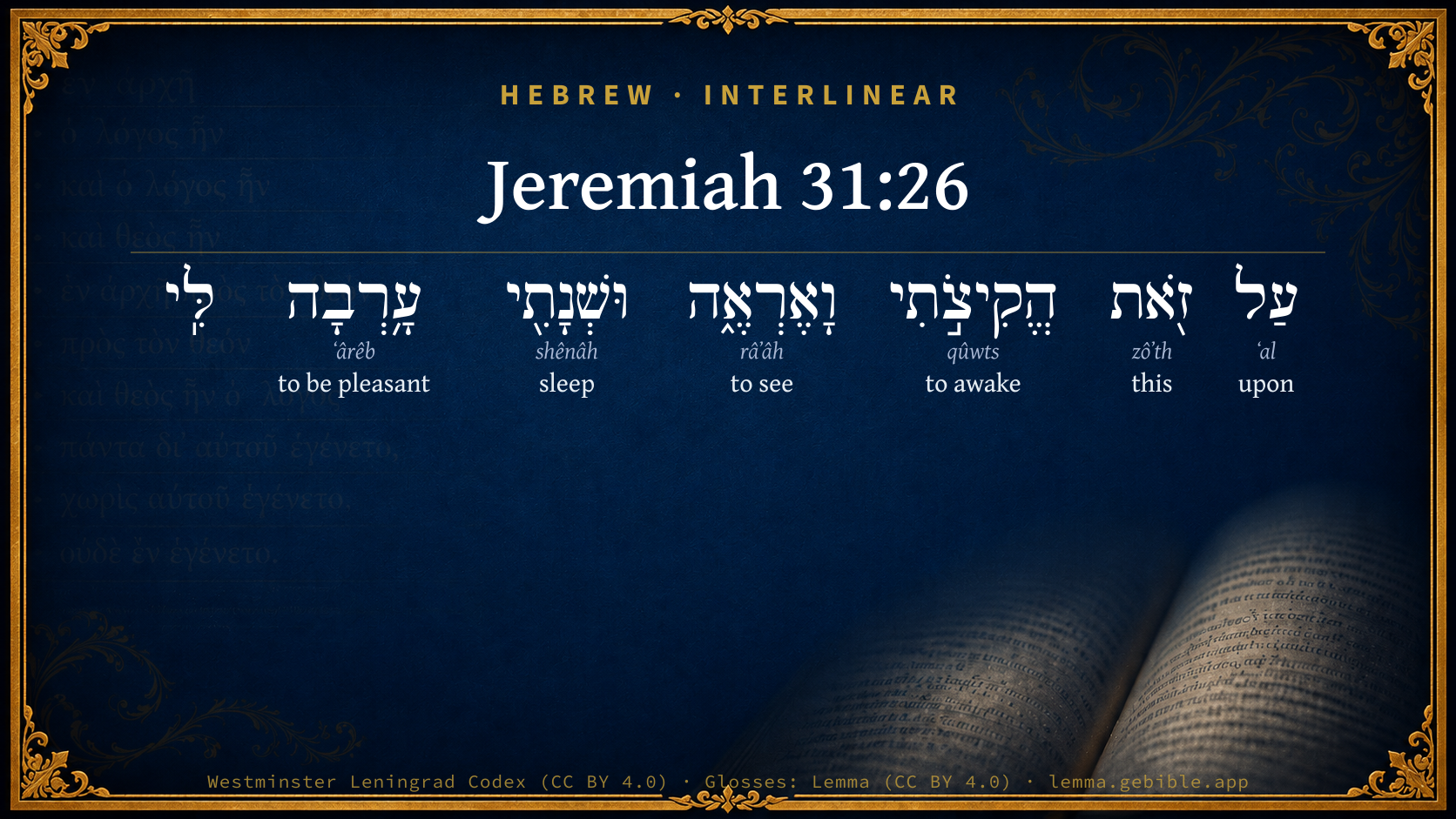
Jeremiah 31:26

Hebrew (Westminster Leningrad Codex) Jeremiah 31:26 appears in the Hebrew Old Testament. The text above is from the Westminster Leningrad Codex. Each word links to its Strong’s number, a concise gloss, and parsing drawn from the Open Scriptures Hebrew Bible morphology. Click any word for its full Brown-Driver-Briggs (BDB) entry.
Download image
Cite this verse

Jeremiah 31:26 (World English Bible). Public Domain. Lemma interlinear Bible study tool, https://lemma.gebible.app/v/jeremiah/31/26.

Show BibTeX & RIS
BibTeX
RIS
English Translation
On this I awakened, and saw; and my sleep was sweet to me.
World English Bible · Public Domain
Download a study sheet

One document with this verse’s original text, its word-by-word gloss line, the meaning frame, cross-references with their text, attributed commentary, and full source and license credits — printable, and it pastes into notes with its structure intact.

This verse Autodidact and up

Study sheet (.html) Plain text (.txt)

A passage Seminary Student

Up to 50 verses in one chapter. A passage sheet keeps up to 6 commentary sources and 12 cross-references per verse, in the order this page ranks them, and says so on the sheet whenever that leaves anything out. Ask for a single verse and you get the Autodidact verse sheet above.

Everything on this page stays free to read, with no account — the sheet is a download of what is already on screen, not access to it.

Want to remove ads? Support Godless Engineer
Compare translations 3

The same verse in 3 English versions, stacked beneath the original-language interlinear above. Click any original word for its lexicon entry.

Each is an independent rendering of the whole verse — the interlinear is not word-aligned to these translations.

Highlighted words mark where these versions differ — a whole-verse word diff, not a word-by-word alignment.

  • World English Bible Public Domain
    On this I awakened, and saw; and my sleep was sweet to me.
  • King James Version Public Domain
    Upon this I awaked, and beheld; and my sleep was sweet unto me.
  • unfoldingWord Literal Text CC BY-SA 4.0
    After this I awoke, and I realized that my sleep had been refreshing.

unfoldingWord Literal Text — © unfoldingWord, licensed CC BY-SA 4.0. Word-aligned USFM3 via Door43 (git.door43.org/unfoldingWord/en_ult).

Versions to compare (up to 4)

3 of 4 selected

Show all 18 translations

Every available English version of this verse, each an independent rendering of the whole verse.

  • World English Bible Public Domain
    On this I awakened, and saw; and my sleep was sweet to me.
  • Berean Standard Bible Public Domain
    At this I awoke and looked around. My sleep had been most pleasant to me.
  • Majority Standard Bible Public Domain
    At this I awoke and looked around. My sleep had been most pleasant to me.
  • King James Version Public Domain
    Upon this I awaked, and beheld; and my sleep was sweet unto me.
  • American Standard Version (1901) Public Domain
    Upon this I awaked, and beheld; and my sleep was sweet unto me.
  • Revised Version (1885) Public Domain
    Upon this I awaked, and beheld; and my sleep was sweet unto me.
  • Geneva Bible (1599) Public Domain
    Therefore I awaked and behelde, and my sleepe was sweete vnto me.
  • Douay-Rheims (1899) Public Domain
    Upon this I was as it were awaked out of a sleep, and I saw, and my sleep was sweet to me.
  • Young's Literal Translation Public Domain
    On this I have awaked, and I behold, and my sleep hath been sweet to me.
  • Literal Standard Version CC BY-SA 4.0
    On this I have awoken, and I behold, and my sleep has been sweet to me.
  • Unlocked Literal Bible CC BY-SA 4.0
    After this I awoke, and I realized that my sleep had been refreshing.
  • unfoldingWord Literal Text CC BY-SA 4.0
    After this I awoke, and I realized that my sleep had been refreshing.
  • Darby Bible Public Domain
    -- Upon this I awaked, and beheld; and my sleep was sweet unto me.
  • World Messianic Bible Public Domain
    On this I awakened, and saw; and my sleep was sweet to me.
  • Webster's Bible Public Domain
    Upon this I awaked, and beheld; and my sleep was sweet to me.
  • Free Bible Version CC BY-SA 4.0
    At this I woke up and looked around. I'd had a very pleasant sleep.
  • Bible in Basic English Public Domain
    At this, awaking from my sleep, I saw; and my sleep was sweet to me.
  • JPS Tanakh (1917) Public Domain
    Upon this I awaked, and beheld; and my sleep was sweet unto me.

Literal Standard Version (2020), Covenant Press — licensed CC BY-SA 4.0. Text via the HelloAO Bible API (eBible.org). Unlocked Literal Bible (unfoldingWord) — licensed CC BY-SA 4.0. Text via the HelloAO Bible API (eBible.org). unfoldingWord Literal Text — © unfoldingWord, licensed CC BY-SA 4.0. Word-aligned USFM3 via Door43 (git.door43.org/unfoldingWord/en_ult). Free Bible Version, Dr. Jonathan Gallagher — licensed CC BY-SA 4.0. Text via the HelloAO Bible API (eBible.org).

Word by word

More ways to search: Search by grammar → Find every occurrence → Compare this word →

Practice this passage: Drill this verse → Learn its vocabulary →

About this verse

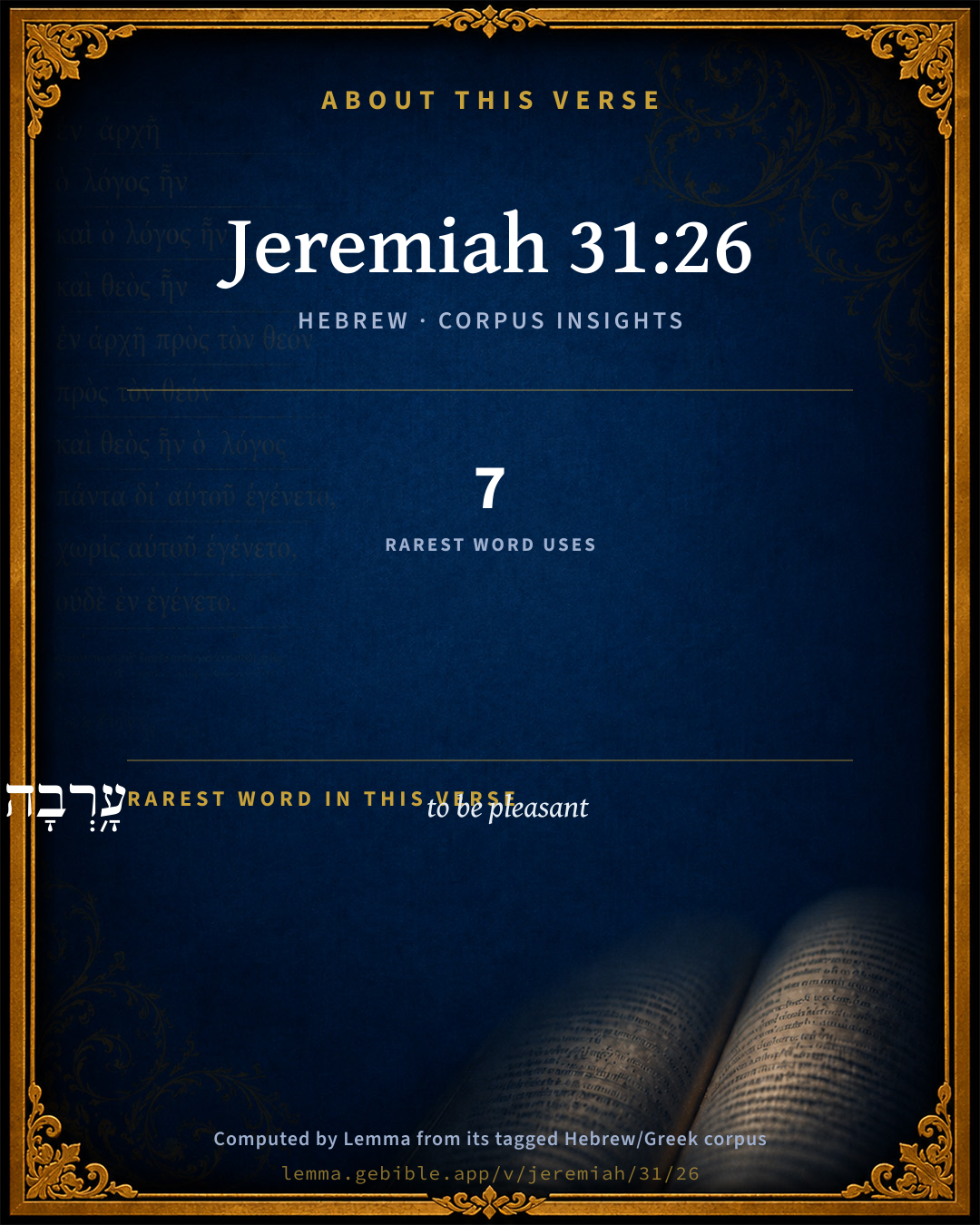
These counts appear in no published source. They are computed here, from the morphology-tagged text and Lemma’s own curated glosses. What Lemma adds →

7
words
6
distinct lemmas
Prophets
section

Notable vocabulary

The rarest word here is עָ֥רְבָה to be pleasant H6149 — appearing just 7 times in the whole Hebrew Bible.

Shared distinctive vocabulary

עָ֥רְבָה to be pleasant H6149 occurs in 7 verses of the Hebrew Bible. Also found in:

Grammatical profile

  • 3 verbs
  • 1 noun
  • 1 pronoun
  • 2 prepositions

Verb forms

  • הֱקִיצֹ֣תִי Hiphil · Perfect
  • וָאֶרְאֶ֑ה Qal · Sequential Imperfect
  • עָ֥רְבָה Qal · Perfect

Cross-references

2

Topical passages linked to Jeremiah 31:26 in the Treasury of Scripture Knowledge — connected by theme and wording, ordered by reader-vote popularity; previews shown in the World English Bible.

  • Psalms 127:2 It is vain for you to rise up early, To stay up late, Eating the bread of toil; For he gives sleep to his loved ones.
  • Zechariah 4:1–2 The angel who talked with me came again, and wakened me, as a man who is wakened out of his sleep.

Cross-references courtesy of OpenBible.info (CC BY 4.0).

Hebrew and Greek witnesses Masoretic Hebrew ↔ Greek Septuagint

The same verse in the two great witnesses to the Old Testament, shown verse-for-verse.

These are two independent witnesses, not word-aligned to each other, and the Septuagint is shown in lemma (dictionary) form.

Hebrew Jeremiah 31:26 Masoretic · Westminster Leningrad Codex

עַל זֹ֖את הֱקִיצֹ֣תִי וָאֶרְאֶ֑ה וּשְׁנָתִ֖י עָ֥רְבָה לִּֽי

On this I awakened, and saw; and my sleep was sweet to me.

World English Bible · Public Domain

Greek LXX Structure differs

In the Septuagint, Jeremiah is about an eighth shorter than the Hebrew and arranges its material differently — the Oracles Against the Nations (Hebrew chapters 46–51) appear in the middle of the Greek book, after 25:13. Because the chapter and verse boundaries do not line up, a verse-for-verse comparison with the Hebrew is not shown.

A verse-for-verse comparison isn’t shown here because the chapters and verses don’t line up. Switch to the LXX edition with the MT / LXX toggle above to read the Greek directly.

On this verse, Keil & Delitzsch discusses the Septuagint’s reading. Read the note in Commentary ↓

Hebrew: Westminster Leningrad Codex (CC BY 4.0). Greek: Septuagint (public domain); English from a public-domain English Septuagint. How the Septuagint differs from the Hebrew →

Targum (Aramaic paraphrase)

1

The Targum is the ancient Jewish Aramaic paraphrase of the Hebrew Scriptures — an interpretive translation, not the Hebrew text itself. Onkelos (literal) and Pseudo-Jonathan (expansive) render the Torah, and Jonathan the Prophets. Coverage is partial: where no permissively-licensed English translation exists for a verse, only the Aramaic is shown. This is verse-level text, not a word-by-word alignment to the Hebrew.

  1. Targum Jonathan Prophets (Joshua–Malachi)
    אֲמַר נְבִיָא עַל דָא בְּשׂוֹרְתָא דְיוֹמֵי נֶחָמָתָא דַעֲתִידִין לְמֵיתֵי אִתְעְרֵית וַחֲזֵית תָּבֵית דְמָכֵית וְשִׁנְתִי הֲנָאַתְנִי:

    The prophet said this good news about the days of comfort that would come: I was awakened and saw, and my sleep was sweet to me.

    Targum Jonathan — Aramaic: “Mikraot Gedolot” (public domain). English: “Sefaria Community Translation” (CC0 1.0 (public-domain dedication)); “London "Chaldee Paraphrase," 1871” (public domain). Text via Sefaria.

Commentary

Notes on Jeremiah 31:26 from classic Christian and Jewish commentators (each source and its license shown beneath its notes). The classic Christian expositions comment on the surrounding passage and are grouped to its opening verse, so a note may address several verses; the Jewish commentaries on the Tanakh (Rashi and others) are per-verse, so they appear only where the commentator wrote on this verse.

Lemma curates 59 commentaries, every one of them public domain or Creative Commons licensed, each selected and text-cleaned for this edition rather than reprinted as found. About our sources →

Trapp's Complete Commentary

John Trapp

Jer 31:26 Upon this I awaked, and beheld; and my sleep was sweet unto me.

Ver. 26. Upon this I awaked.] Out of my prophetic dream.

And my sleep was sweet unto me,] i.e., The promises (Christ in the promises) were sweet unto me, and I was as much refreshed therewith, as with sound sleep after hard toil or travel.

John Trapp, A Commentary or Exposition upon All the Books of the Old and New Testament (1647–1656) — public domain. Text from a community e-Sword module.

Joseph Benson's Commentary

Jer 31:26. Upon this I awaked, &c. — These words afford a plain proof that the preceding revelations had been made to the prophet in a dream, or vision. And my sleep was sweet unto me — The vision which I had seen was so agreeable to me that it gave me as great satisfaction and comfort as men usually feel when they have been refreshed with an undisturbed and sweet sleep.

Joseph Benson's Commentary on the Old and New Testaments (1811–1818) — public domain. Text from a community e-Sword module.

Tyndale Open Study Notes

Tyndale Open Resources

31:26 Evidently, either Jeremiah or his scribe had fallen asleep and was awakened with a start. His sleep was very sweet, like the rest and joy promised by the Lord (31:25).

Tyndale Open Study Notes — © Tyndale Open Resources, licensed CC BY-SA 4.0. Text via the HelloAO Bible API.

Geneva Bible (1599)

Geneva Bible translators

Having understood this vision of the Messiah to come, in whom the two houses of Israel and Judah should be joined, I rejoiced.

Geneva Bible (1599) marginal notes — public domain. Text via Bolls.life.

Jamieson, Fausset & Brown

Robert Jamieson, A. R. Fausset & David Brown

The words of Jeremiah: Upon this (or, By reason of this) announcement of a happy restoration, "I awaked" from the prophetic dream vouchsafed to me (Jer 23:25) with the "sweet" impression thereof remaining on my mind. "Sleep" here means dream, as in Psa 90:5.

Jamieson, Fausset & Brown — Commentary Critical and Explanatory on the Whole Bible (1871) — public domain (CC PDM 1.0). Text via the HelloAO Bible API.

Adam Clarke's Commentary

Verse 26. Upon this I awaked] It appears that the prophecy, commencing with Jer 30:2 and ending with Jer 31:25 of this chapter, was delivered to the prophet in a dream. Dahler supposes it to be a wish; that the prophet, though he could not hope to live to that time, might be permitted to awake up from his tomb; and, having seen this prosperity, would be content to return to his grave.

Adam Clarke's Commentary on the Bible (1810–1826) — public domain. Text from a community e-Sword/MySword module.

John Calvin's Commentaries

Here the Prophet comes forth, and by his own example encourages the faithful to be confident, even to recumb on God’s promise, as though they really enjoyed already what was as yet hid from them, nay, as it has been said, incredible. He then says, that he awoke and saw. This metaphor ought to be applied to a feeling contrary to that by which the Prophet had been, as it were, astonished. For though the Jews were not yet led into exile, yet the ten tribes were in that miserable bondage, — their kingdom had fallen and perished, and final ruin was nigh the kingdom of Judah. While then the Prophet was considering these dreadful vengeances of God, he was, as it were, overwhelmed with sleep. He now says that he awoke. As in darkness men lose the rigor of their minds, and sleep also prevails, so that they cannot distinguish between black and white; so also the Prophet confesses that he was for a time, as it were, lifeless; he then says, that he awoke, that is, when God’s favor shone forth, not by its own effect, but in this prophecy.

We then see that he knew as through a mirror what was yet far distant; for the term of seventy years had not as yet commenced: but faith, as it is well known, is the seeing of things hid, and the substance of things absent; for except the word of God obtains in our hearts this assurance, we betray our unbelief. The Prophet gave a proof of his faith, for he fully acknowledged that all that had been by God predicted, though far distant, would yet be accomplished in due time. We now understand why he says, that he awoke.

And he adds, And my sleep was pleasant to me After having said that he saw the work of God, which yet could not be seen by the human eye, he now adds that his sleep had been pleasant to him, while yet he had been sorrowful and full of fear; for the best alleviator of all sorrow is hope.

But we have said that the sorrow by which the mind of the Prophet had been for a time overwhelmed, is compared to a sleep. He now adds, —

John Calvin's Commentaries (1540-1563) — public domain. Text from the Calvin Translation Society English edition (1840s-50s) via the Christian Classics Ethereal Library (ccel.org). Calvin's coverage is partial (roughly two-thirds of the Bible); uncommented books and verses are honest gaps, never fabricated. The 19th-century editor's footnotes and remarks are omitted so the notes are faithfully Calvin's own voice.

Ellicott's Commentary for English Readers

(26) Upon this I awaked . . .—The words that follow have been very differently interpreted. By some writers (Rosenmüller) they have been referred to Jehovah under the figure of the husband who has dreamt of his wife’s return. Others (Ewald) have seen in them a quotation from some well-known psalm or hymn, like Psa_17:15, indicating that in the golden days to which Jeremiah looked forward there should be freedom even from the evil and dark dreams of a time of peril, so that every man should be able to give thanks for the “sweet” gift of sleep (Psa_127:2). It is, however, far more natural to take them as the prophet’s own words. The vision of a restored Israel, such as he paints it in the preceding verses, had come to him in his sleep. (See Jer_23:28; Joe_2:28, as to this mode of revelation.) And when he woke up there was no sense of bitter disappointment like that of the dreamer described in Isa_29:8. The promise that came to him when he woke was as distinct and blessed as the dream had been. The “sweet sleep” has its parallel in Pro_3:24.

A Bible Commentary for English Readers, edited by Charles John Ellicott (1878–1897) — public domain. Text from a community e-Sword module.

The Cambridge Bible for Schools and Colleges

gen. ed. J. J. S. Perowne

26. Words put in the mouth of the prophet himself, as they are not suitable either to God or to the exiles. The ecstatic state is here called “sleep,” and as the prophecy had been of so unusually cheering a character, that sleep might well be called sweet.

The Cambridge Bible for Schools and Colleges (gen. ed. J. J. S. Perowne; Cambridge University Press, 1878–1918) — public domain. Text from a community e-Sword module.

John Gill's Exposition

Upon this I awakened, and beheld,.... When or after he beheld or had seen the vision and prophecy concerning the incarnation of Christ, and the glory and happiness of his church and people in the latter day, he awoke; for it seems the prophecy contained in this and the preceding chapter was delivered to Jeremiah in a dream; who, when he had seen the vision, and upon the last words being spoken to him, awoke out of it:

and my sleep was sweet unto me; as it must needs be, to have so many gracious promises, and glorious prophecies, delivered to him in it. Some understand the words, that when he awoke out of sleep, he saw and considered with pleasure what had been made known to him; and then fell into a sweet sleep again, which was not usual with him. To which the Targum inclines,

"the prophet said, because of this good news of the days of consolation (that is, the days of the Messiah) that should come, I was raised up, and saw; again I slept, and my sleep was profitable to me.''

So Kimchi. Some interpret the words of Christ, and of his sleep in the grave.

John Gill's Exposition of the Whole Bible (1746–1763) — public domain (CC PDM 1.0). Text via the HelloAO Bible API.

Albert Barnes' Notes on the Bible

The prophet, seeming to himself to awake and look up in the midst of his sleep (whether ecstatic or not we cannot tell), rejoiced in a revelation so entirely consolatory, and unlike his usual message of woe.

Albert Barnes' Notes on the Bible (1834–1885) — public domain. Text from a community e-Sword/MySword module.

Haydock's Catholic Bible Commentary

To me. Thus Jeremias concludes his prediction with joy. (Calmet)

George Leo Haydock (1774–1849), Haydock's Catholic Family Bible and Commentary, 1859 edition — public domain. Excludes Psalms (Douay-Rheims chapter numbering differs from Protestant) and Deuterocanonical books (Catholic canon only).

Matthew Poole's English Annotations

Either this revelation was made to Jeremiah in a dream, from whence he awaking, looked about him; and he was very well pleased with his sleep at that time, because of the gracious promises concerning Judah which the Lord had in that dream revealed to them. Or else in a vision, upon the sight and hearing of which he was as well pleased as a man that had slept quietly, and had had no ill and unpleasing, but sweet and delightful, dreams while he slept.

Matthew Poole's English Annotations on the Holy Bible (1683–1685) — public domain. Text from a community e-Sword/MySword module.

Whedon's Commentary on the Bible

Daniel D. Whedon

26. I awaked — The prophet awoke from his sleep of prophetic ecstasy, and its revelations were satisfying and refreshing.

Daniel D. Whedon (gen. ed.), Commentary on the Old and New Testaments (1874–1909) — public domain. Text from a community e-Sword module.

The Pulpit Commentary

Upon this I awaked, etc. Who the speaker is here has been much debated. That Jehovah is meant is not an admissible view. A weak believer may say complainingly, "Why sleepest thou?" but God himself cannot be represented under the image of a sleeper. There seems, however, to be no reason why the prophet should not have used this language. The doubt is whether a real, physical sleep is meant, or merely an ecstatic condition resembling sleep. Hengstenberg decides for the latter. But there is no parallel for sleep in the sense of ecstasy, and, on the other hand, there is evidence enough for dreams as the channels of Divine revelation. (Gen_31:10, 11 1Ki_3:5 1Ki 9:2Jo 1Ki_2:28) As Naegelsbach points out, this is the only unqualifiedly comforting prophecy in the whole book, and may well have left a sweet savour in the prophet"s memory. Stern, indeed, was the reality which the moment of his waking brought back to him.

Sweet sleep.

Assuming that Jeremiah is here the speaker, what a suggestion there is of restless, unrefreshing nights on other occasions! And little wonder. It may have been the case that many of his prophecies came to him at night, and if so, considering the elements of those prophecies, his nights must often have been very troubled ones. But if we look attentively at the contents of ch. 30 and 31, we find very sufficient causes for the sweetness of the prophet"s sleep. Jehovah makes one long announcement of favour, restoration, and comfort. Hitherto when the prophet has had to listen to Jehovah, if there have been consolatory utterances, they have been mingled with denunciation and words of the most melancholy import. But now there is one unbroken stream of good tidings, and the effect is shown even in sleep. And if in sleep, how much more in waking hours! The whole round of the day becomes different when God looks favourably on the life. Sweetness of sleeping hours must come from all being right in waking hours. Now, with Jeremiah, as to his own personal life, all was right in waking, hours, but with his nation all was wrong; and so through the day he went about seeing sin and foreseeing suffering, and at night his vivid imagination must often have kept him awake or peopled what broken sleep he got with the most terrible dreams. Bad men may sleep better than good ones, so long as there is nothing to awaken their selfish fears and good men spend restless nights over the troubles of those in whom they are interested. Yet the restlessness must come from the failing to see the abiding goodness of God. Here, for a little, God drove every cloud from the sky of his servant, and showed him how heavenly brightness was a thing entirely above earthly confusions; and then his servant could get sweet sleep. And God will give to all that wait upon him that quiet calm of the heart which is to our higher life what sweet sleep is to the body. It is God"s will that our present life, with all its varied needs, should have all the refreshment he can give. Y.

The Pulpit Commentary (1880–1919), ed. H.D.M. Spence-Jones & Joseph S. Exell — public domain. Text from a community e-Sword module.

John Wesley's Explanatory Notes

Upon this I awaked - Probably this Revelation was made to Jeremiah, in a dream.

John Wesley, Explanatory Notes Upon the Whole Bible (1754–1765) — public domain. Text via the GEBible commentary corpus.

Keil & Delitzsch

C. F. Keil & F. Delitzsch

Thereupon the prophet awoke from his ecstatic sleep, and said, "My sleep was pleasant" (cf. Pro 3:24). Very many expositors, including Rosenmller, Umbreit, and Neumann among the moderns, understand the words, "therefore (or, because of this) I awoke," etc., as referring to God, because in what precedes and follows Jahveh speaks, and because God is sometimes, in the Psalms, called on to awake, e.g., Psa 7:7; Psa 35:23; Psa 44:24, etc. But it has been properly objected to this, that the words, "my sleep was sweet" (pleasant), are inappropriate as utterances of God, inasmuch as He does not sleep; nowhere in Scripture is sleep attributed to God, and the summons to awake merely implies the non-interference on the part of God in the affairs of His people. Moreover, we would need to refer the sleeping of God, mentioned in this verse, to His dealing towards Israel during the exile, in such a way that His conduct as a powerful judge would be compared to a sweet sleep - which is inconceivable. As little can the verse be supposed to contain words of the people languishing in exile, as Jerome has taken them. For the people could not possibly compare the time of oppression during the exile to a pleasant sleep. There is thus nothing left for us but to take this verse, as the Targum, Raschi, Kimchi, Venema, Dahler, Hitzig, Hengstenberg, and others have done, as a remark by the prophet regarding his feelings when he received this revelation; and we must accept something like the paraphrase of Tholuck (die Propheten, S. 68): "Because of such glorious promises I awoke to reflect on them, and my ecstatic sleep delighted me." This view is not rendered less tenable by the objection that Jeremiah nowhere says God had revealed Himself to him in a dream, and that, in what precedes, there is not to be found any intimation that what he sets forth appeared to him as a vision. For neither is there any intimation, throughout the whole prophecy, that he received it while in a waking state. The command of God, given Jer 30:2 at the first, to write in a book the words which Jahveh spoke to him, implies that the prophecy was not intended, in the first instance, to be publicly read before the people; moreover, it agrees with the assumption that he received the prophecy in a dream. But against the objection that Jeremiah never states, in any other place, in what bodily condition he was when he received his revelations from God, and that we cannot see why he should make such an intimation here - we may reply, with Ngelsbach, that this prophecy is the only one in the whole book which contains unmixed comfort, and that it is thus easy to explain why he could never forget that moment when, awaking after he had received it, he found he had experienced a sweet sleep. Still less weight is there in the objection of Graf, that one cannot comprehend why this remark stands here, because the description is evidently continued in what follows, while the dream must have ended here, when the prophet awoke. For this is against the assumption that the hand of the Lord immediately touched him again, and put him back into the ecstatic state. One might rather urge the consideration that the use of the word שׁנה, "sleep," does not certainly prove that the prophet was in the ecstatic state, from the fact that the lxx render תּר, in Gen 2:21 and Gen 15:2, by ἔκστασις. But wherever divine revelations were made in dreams, these of course presuppose sleep; so that the ecstatic state might also be properly called "sleep." Jeremiah adds, "And I looked," to signify that he had been thoroughly awakened, and, in complete self-consciousness, perceived that his sleep had been pleasant.

Keil & Delitzsch — Biblical Commentary on the Old Testament (1861–1891) — public domain (CC PDM 1.0). Text via the HelloAO Bible API. (Old Testament only.)

Rashi

Rabbi Shlomo Yitzchaki (Rashi)

Thereupon, I awoke So said Jeremiah, “All this time I was sleeping deeply while perceiving the prophecy of retribution, but with this prophecy I awoke from my deep sleep.”

was pleasant Heb. עָרְבָה.

Rashi on the Tanakh — English translations: “The Judaica Press complete Tanach with Rashi, translated by A. J. Rosenberg” (CC BY 4.0); “Pentateuch with Rashi's commentary by M. Rosenbaum and A.M. Silbermann, 1929-1934” (public domain); “The Metsudah Tanach series, Lakewood, N.J” (CC BY 4.0); and “The Book of Joshua, Metsudah Publications, 1997” (CC BY 4.0). Text via Sefaria.

Lesson kit

Teaching starters — assembled from the data on this page, not authored interpretation. Every prompt links to the verse data it draws on. Edit before teaching.

Jeremiah, in the Prophets, opens this verse with 7 words (6 distinct Hebrew lemmas). Its most distinctive word is ʻârêb (“to be pleasant”). A historical commentator’s framing appears above. Read the whole chapter for the surrounding context.

Discussion questions

  1. The word ʻârêb carries the sense “to be pleasant.” How does it shape the verse?
  2. How does Psalms 104:34, which shares the word «to be pleasant», read alongside this verse?
  3. The translations on this page render this verse differently — a whole-verse word diff, not a word-by-word alignment. What might account for the different wordings?
  4. «הֱקִיצֹ֣תִי» is a Hiphil Perfect verb. How does that grammatical form shape the action described?
  5. Compare how Trapp's Complete Commentary and Joseph Benson's Commentary read this verse. Where do they agree or differ?

Things to notice

Reading settings

Reading text

Shown beneath each verse's original-language words.

Old Testament
Old Testament edition

Read the OT as the Masoretic Hebrew (MT) or the Greek Septuagint (LXX).

English shown for the Greek Septuagint (in the Hebrew ↔ Greek comparison).

Comparing translations? Open the Compare panel on any verse page to stack up to four side by side.