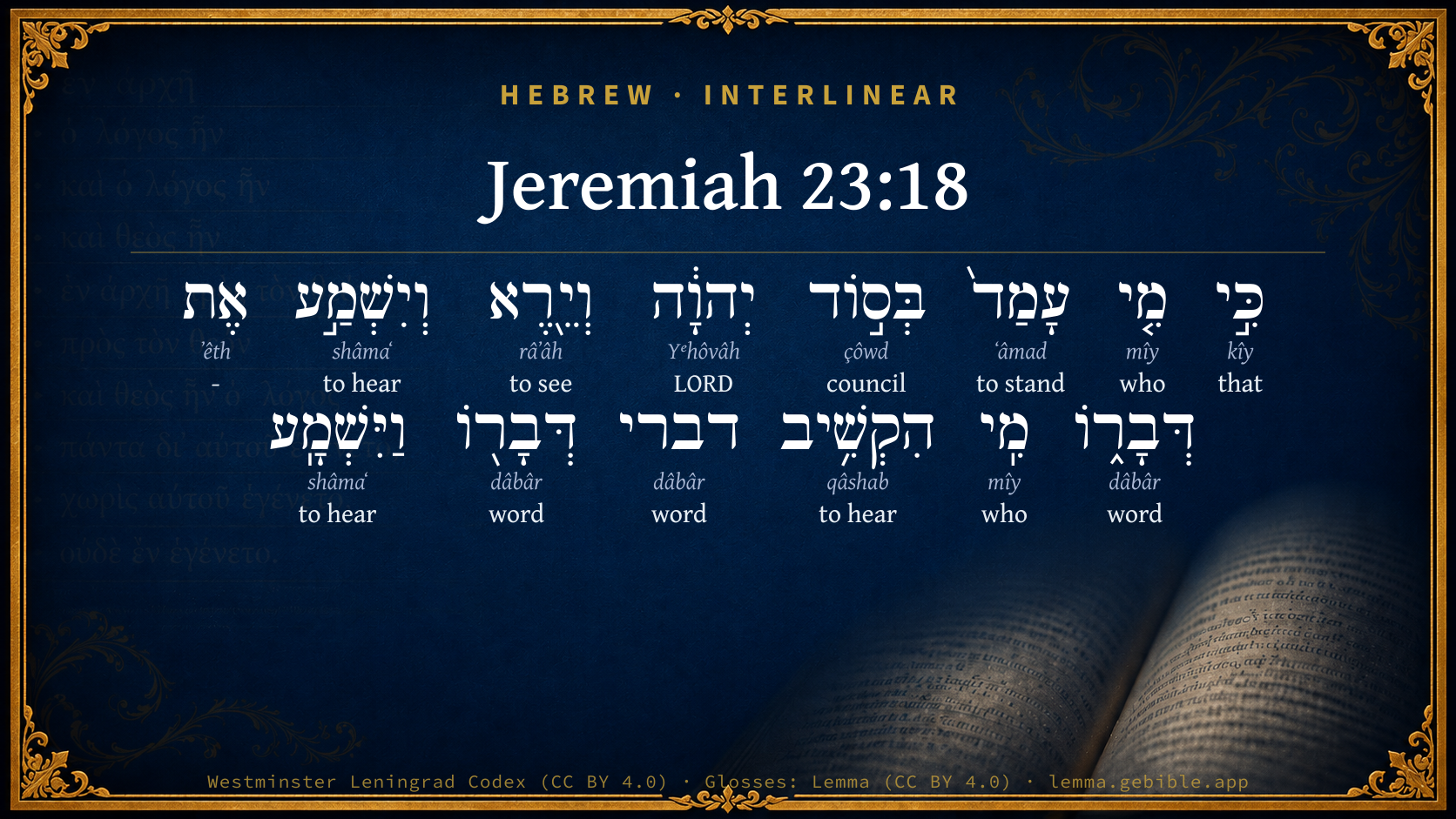
Jeremiah 23:18

Hebrew (Westminster Leningrad Codex) Jeremiah 23:18 appears in the Hebrew Old Testament. The text above is from the Westminster Leningrad Codex. Each word links to its Strong’s number, a concise gloss, and parsing drawn from the Open Scriptures Hebrew Bible morphology. Click any word for its full Brown-Driver-Briggs (BDB) entry.
Download image
Cite this verse

Jeremiah 23:18 (World English Bible). Public Domain. Lemma interlinear Bible study tool, https://lemma.gebible.app/v/jeremiah/23/18.

Show BibTeX & RIS
BibTeX
RIS
English Translation
For who has stood in the council of Yahweh, that he should perceive and hear his word? who has marked my word, and heard it?
World English Bible · Public Domain
Download a study sheet

One document with this verse’s original text, its word-by-word gloss line, the meaning frame, cross-references with their text, attributed commentary, and full source and license credits — printable, and it pastes into notes with its structure intact.

This verse Autodidact and up

Study sheet (.html) Plain text (.txt)

A passage Seminary Student

Up to 50 verses in one chapter. A passage sheet keeps up to 6 commentary sources and 12 cross-references per verse, in the order this page ranks them, and says so on the sheet whenever that leaves anything out. Ask for a single verse and you get the Autodidact verse sheet above.

Everything on this page stays free to read, with no account — the sheet is a download of what is already on screen, not access to it.

Want to remove ads? Support Godless Engineer
Compare translations 3

The same verse in 3 English versions, stacked beneath the original-language interlinear above. Click any original word for its lexicon entry.

Each is an independent rendering of the whole verse — the interlinear is not word-aligned to these translations.

Highlighted words mark where these versions differ — a whole-verse word diff, not a word-by-word alignment.

  • World English Bible Public Domain
    For who has stood in the council of Yahweh, that he should perceive and hear his word? who has marked my word, and heard it?
  • King James Version Public Domain
    For who hath stood in the counsel of the LORD, and hath perceived and heard his word? who hath marked his word, and heard it?
  • unfoldingWord Literal Text CC BY-SA 4.0
    For who has stood in the counsel of Yahweh and seen and heard his word? Who has paid attention to his word and listened?

unfoldingWord Literal Text — © unfoldingWord, licensed CC BY-SA 4.0. Word-aligned USFM3 via Door43 (git.door43.org/unfoldingWord/en_ult).

Versions to compare (up to 4)

3 of 4 selected

Show all 18 translations

Every available English version of this verse, each an independent rendering of the whole verse.

  • World English Bible Public Domain
    For who has stood in the council of Yahweh, that he should perceive and hear his word? who has marked my word, and heard it?
  • Berean Standard Bible Public Domain
    But which of them has stood in the council of the LORD to see and hear His word? Who has given heed to His word and obeyed it?
  • Majority Standard Bible Public Domain
    But which of them has stood in the council of the LORD to see and hear His word? Who has given heed to His word and obeyed it?
  • King James Version Public Domain
    For who hath stood in the counsel of the LORD, and hath perceived and heard his word? who hath marked his word, and heard it?
  • American Standard Version (1901) Public Domain
    For who hath stood in the council of Jehovah, that he should perceive and hear his word? who hath marked my word, and heard it?
  • Revised Version (1885) Public Domain
    For who hath stood in the council of the LORD, that he should perceive and hear his word? who hath marked my word, and heard it?
  • Geneva Bible (1599) Public Domain
    For who hath stand in the counsel of the Lord that he hath perceiued and heard his word? Who hath marked his worde and heard it?
  • Douay-Rheims (1899) Public Domain
    For who hath stood in the counsel of the Lord, and hath seen and heard his word? Who hath considered his word and heard it?
  • Young's Literal Translation Public Domain
    For who hath stood in the counsel of Jehovah, And seeth and heareth His word? Who hath regarded My word, and hearkeneth?
  • Literal Standard Version CC BY-SA 4.0
    For who has stood in the counsel of YHWH, || And sees and hears His word? Who has regarded My word, and listens?
  • Unlocked Literal Bible CC BY-SA 4.0
    Yet who has stood in Yahweh's council meeting? Who sees and hears his word? Who pays attention to his word and listens?
  • unfoldingWord Literal Text CC BY-SA 4.0
    For who has stood in the counsel of Yahweh and seen and heard his word? Who has paid attention to his word and listened?
  • Darby Bible Public Domain
    For who hath stood in the council of Jehovah, so that he hath perceived and heard his word? who hath hearkened to his word and listened?
  • World Messianic Bible Public Domain
    For who has stood in the council of the LORD, that he should perceive and hear his word? Who has listened to my word, and heard it?
  • Webster's Bible Public Domain
    For who hath stood in the counsel of the LORD, and hath perceived and heard his word? who hath marked his word, and heard it?
  • Free Bible Version CC BY-SA 4.0
    But who of them has attended the Lord's council to hear and understand what he's saying? Who has paid attention to his instructions and followed them?
  • Bible in Basic English Public Domain
    For which of them has knowledge of the secret of the Lord, and has seen him, and given ear to his word? which of them has taken note of his word and given attention to it?
  • JPS Tanakh (1917) Public Domain
    For who hath stood in the council of the LORD, that he should perceive and hear His word? Who hath attended to His word, and heard it?

Literal Standard Version (2020), Covenant Press — licensed CC BY-SA 4.0. Text via the HelloAO Bible API (eBible.org). Unlocked Literal Bible (unfoldingWord) — licensed CC BY-SA 4.0. Text via the HelloAO Bible API (eBible.org). unfoldingWord Literal Text — © unfoldingWord, licensed CC BY-SA 4.0. Word-aligned USFM3 via Door43 (git.door43.org/unfoldingWord/en_ult). Free Bible Version, Dr. Jonathan Gallagher — licensed CC BY-SA 4.0. Text via the HelloAO Bible API (eBible.org).

Word by word

More ways to search: Search by grammar → Find every occurrence → Compare this word →

Practice this passage: Drill this verse → Learn its vocabulary →

בְּס֣וֹד
çôwd
H5475
“in/at · council of”
Preposition + Noun, Common, Masculine, Singular, Construct
Part of Speech
Preposition + Noun
Type
Common
Gender
Masculine
Number
Singular
State
Construct
Full BDB Definition

Origin: from H3245

TWOT: 1471a

council, counsel, assembly - council (of familiar conversation) - divan, circle (of familiar friends) - assembly, company - counsel - counsel (itself) - secret counsel - familiar converse, intimacy (with God)
  1. כִּ֣י kîy H3588 “that” Conjunction
  2. מִ֤י mîy H4310 “who” Particle, Interrogative
  3. עָמַד֙ ʻâmad H5975 “to stand” Verb, Qal, Perfect, 3rd Person, Masculine, Singular
  4. יְהוָ֔ה Yᵉhôvâh H3068 “LORD” Noun, Proper
  5. וְיֵ֖רֶא râʼâh H7200 “and · to see” Conjunction + Verb, Qal, Jussive, 3rd Person, Masculine, Singular
  6. וְיִשְׁמַ֣ע shâmaʻ H8085 “and · to hear” Conjunction + Verb, Qal, Jussive, 3rd Person, Masculine, Singular
  7. אֶת ʼêth H853 “-” Particle, Direct Object
  8. דְּבָר֑וֹ dâbâr H1697 “word · his” Noun, Common, Masculine, Singular, Construct + Suffix, Personal, 3rd Person, Masculine, Singular
  9. מִֽי mîy H4310 “who” Particle, Interrogative
  10. הִקְשִׁ֥יב qâshab H7181 “to hear” Verb, Hiphil, Perfect, 3rd Person, Masculine, Singular
  11. דברי dâbâr H1697 “word” Conjunction + Verb, Qal, Sequential Imperfect, 3rd Person, Masculine, Singular
  12. דְּבָר֖וֹ dâbâr H1697 “word” Conjunction + Verb, Qal, Sequential Imperfect, 3rd Person, Masculine, Singular
  13. וַיִּשְׁמָֽע shâmaʻ H8085 “and · to hear” Conjunction + Verb, Qal, Sequential Imperfect, 3rd Person, Masculine, Singular

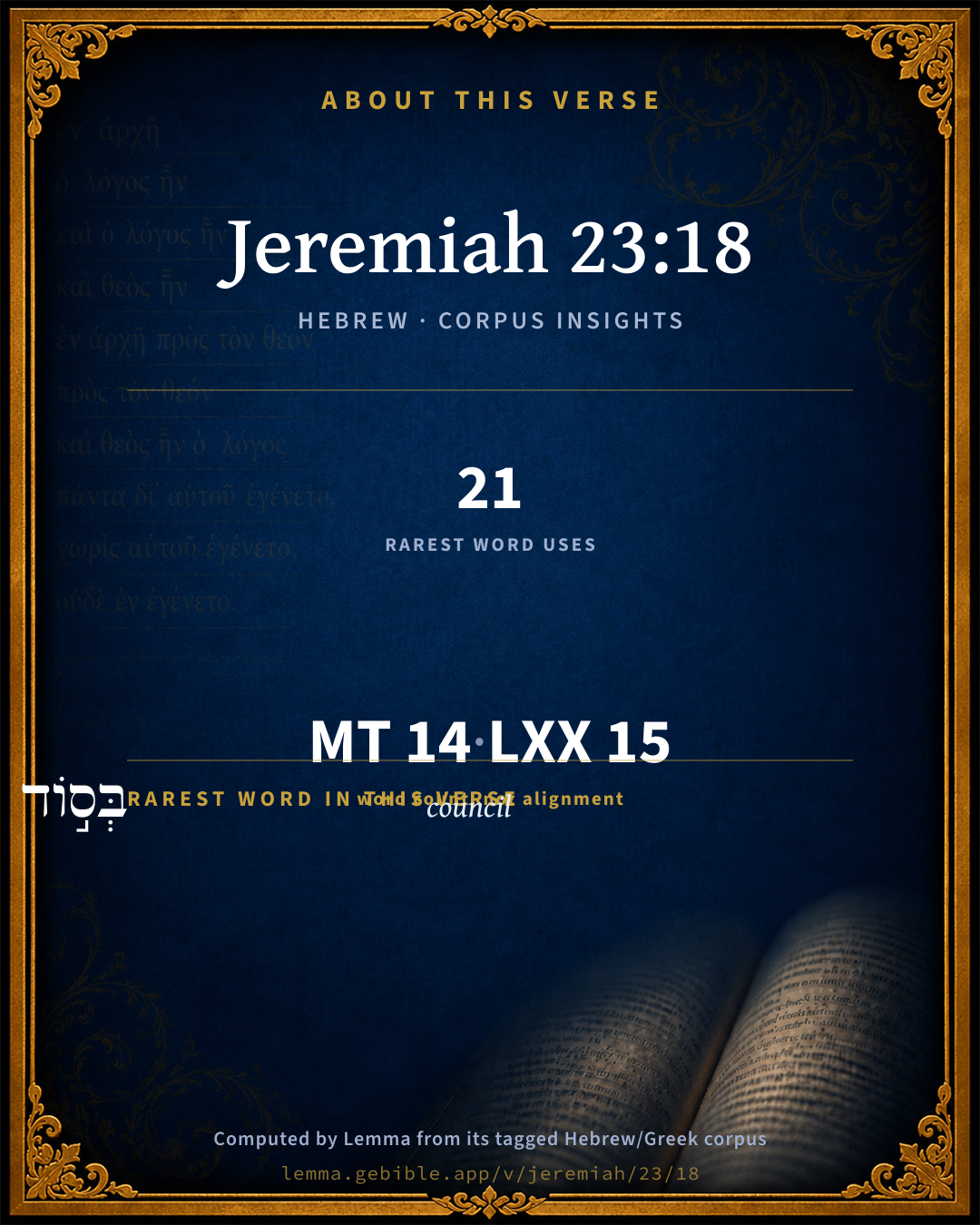
About this verse

These counts appear in no published source. They are computed here, from the morphology-tagged text and Lemma’s own curated glosses. What Lemma adds →

14
words
10
distinct lemmas
Prophets
section

Notable vocabulary

The rarest word here is בְּס֣וֹד council H5475 — appearing just 21 times in the whole Hebrew Bible.

Shared distinctive vocabulary

בְּס֣וֹד council H5475 occurs in 21 verses of the Hebrew Bible. Also found in:

Grammatical profile

  • 7 verbs
  • 3 nouns
  • 1 conjunction
  • 3 particles

Verb forms

  • עָמַד֙ Qal · Perfect
  • וְיֵ֖רֶא Qal · Jussive
  • וְיִשְׁמַ֣ע Qal · Jussive
  • הִקְשִׁ֥יב Hiphil · Perfect
  • דברי Qal · Sequential Imperfect
  • דְּבָר֖וֹ Qal · Sequential Imperfect
  • וַיִּשְׁמָֽע Qal · Sequential Imperfect

Repetition

Words recur within this verse — often emphatic in Hebrew:

  • דְּבָר֑וֹ word H1697 ×3
  • וְיִשְׁמַ֣ע to hear H8085 ×2
  • מִ֤י who H4310 ×2

Hebrew & Septuagint length

In the original languages it is 14 Hebrew tokens and 15 Greek tokens — but the two are counted differently (Hebrew bundles its prefixes and suffixes into one token; the Greek is in lemma form), so that isn’t a like-for-like length.

Cross-references

9

Topical passages linked to Jeremiah 23:18 in the Treasury of Scripture Knowledge — connected by theme and wording, ordered by reader-vote popularity; previews shown in the World English Bible.

  • Jeremiah 23:22 But if they had stood in my council, then had they caused my people to hear my words, and had turned them from their evil way, and from the evil of their doings.
  • Isaiah 40:13–14 Who has directed the Spirit of Yahweh, or being his counselor has taught him?
  • Amos 3:7 Surely the Lord Yahweh will do nothing, Unless he reveals his secret to his servants the prophets.
  • 1 Corinthians 2:16 "For who has known the mind of the Lord, that he should instruct him?" But we have Christ's mind.
  • 1 Kings 22:24 Then Zedekiah the son of Chenaanah came near, and struck Micaiah on the cheek, and said, Which way went the Spirit of Yahweh from me to speak to you?
  • 2 Chronicles 18:23 Then Zedekiah the son of Chenaanah came near, and struck Micaiah on the cheek, and said, Which way went the Spirit of Yahweh from me to speak to you?
  • Job 15:8–10 Have you heard the secret counsel of God? Do you limit wisdom to yourself?
  • Psalms 25:14 The friendship of Yahweh is with those who fear him. He will show them his covenant.
  • John 15:15 No longer do I call you servants, for the servant doesn't know what his lord does. But I have called you friends, for everything that I heard from my Father, I have made known to you.

Cross-references courtesy of OpenBible.info (CC BY 4.0).

Hebrew and Greek witnesses Masoretic Hebrew ↔ Greek Septuagint

The same verse in the two great witnesses to the Old Testament, shown verse-for-verse.

These are two independent witnesses, not word-aligned to each other, and the Septuagint is shown in lemma (dictionary) form.

Hebrew Jeremiah 23:18 Masoretic · Westminster Leningrad Codex

כִּ֣י מִ֤י עָמַד֙ בְּס֣וֹד יְהוָ֔ה וְיֵ֖רֶא וְיִשְׁמַ֣ע אֶת דְּבָר֑וֹ מִֽי הִקְשִׁ֥יב דברי דְּבָר֖וֹ וַיִּשְׁמָֽע

For who has stood in the council of Yahweh, that he should perceive and hear his word? who has marked my word, and heard it?

World English Bible · Public Domain

Greek LXX Structure differs

In the Septuagint, Jeremiah is about an eighth shorter than the Hebrew and arranges its material differently — the Oracles Against the Nations (Hebrew chapters 46–51) appear in the middle of the Greek book, after 25:13. Because the chapter and verse boundaries do not line up, a verse-for-verse comparison with the Hebrew is not shown.

A verse-for-verse comparison isn’t shown here because the chapters and verses don’t line up. Switch to the LXX edition with the MT / LXX toggle above to read the Greek directly.

Hebrew: Westminster Leningrad Codex (CC BY 4.0). Greek: Septuagint (public domain); English from a public-domain English Septuagint. How the Septuagint differs from the Hebrew →

Targum (Aramaic paraphrase)

1

The Targum is the ancient Jewish Aramaic paraphrase of the Hebrew Scriptures — an interpretive translation, not the Hebrew text itself. Onkelos (literal) and Pseudo-Jonathan (expansive) render the Torah, and Jonathan the Prophets. Coverage is partial: where no permissively-licensed English translation exists for a verse, only the Aramaic is shown. This is verse-level text, not a word-by-word alignment to the Hebrew.

  1. Targum Jonathan Prophets (Joshua–Malachi)
    אֲרֵי לָא קָמוּ וְאִתְגְלֵי לְהוֹן רָז מִן קֳדָם יְיָ וְלָא חֲזוֹ וְלָא שְׁמָעוֹ יַת פִּתְגָמוֹהִי וְלָא אֲצִיתוּ לְמֵימְרֵהּ וְלָא קַבִּילוּ:

    (no public-domain English translation for this verse)

    Targum Jonathan — Aramaic: “Mikraot Gedolot” (public domain). English: “Sefaria Community Translation” (CC0 1.0 (public-domain dedication)); “London "Chaldee Paraphrase," 1871” (public domain). Text via Sefaria.

Commentary

Notes on Jeremiah 23:18 from classic Christian and Jewish commentators (each source and its license shown beneath its notes). The classic Christian expositions comment on the surrounding passage and are grouped to its opening verse, so a note may address several verses; the Jewish commentaries on the Tanakh (Rashi and others) are per-verse, so they appear only where the commentator wrote on this verse.

Lemma curates 59 commentaries, every one of them public domain or Creative Commons licensed, each selected and text-cleaned for this edition rather than reprinted as found. About our sources →

Trapp's Complete Commentary

John Trapp

Jer 23:18 For who hath stood in the counsel of the LORD, and hath perceived and heard his word? who hath marked his word, and heard [it]?

Ver. 18. For who hath stood in the counsel of the Lord?] Quis praeter nos? so Piscator. Who hath, if we have not? say those false prophets, as if they were so many angels newly dropped from heaven.

John Trapp, A Commentary or Exposition upon All the Books of the Old and New Testament (1647–1656) — public domain. Text from a community e-Sword module.

Joseph Benson's Commentary

Jer 23:18. For who hath stood in the counsel of the Lord? — These are either the words of God expressing that none of these pretended prophets knew any thing of his designs, as he had not revealed them unto them, and they could not otherwise know them; or else they are to be understood as the words of these false prophets, who, among other things, told the people, that God’s counsels were not to be absolutely known; and that therefore neither Jeremiah, nor the rest of the prophets, who foretold the destruction of Jerusalem, were informed more than others of what God intended to do.

Joseph Benson's Commentary on the Old and New Testaments (1811–1818) — public domain. Text from a community e-Sword module.

Tyndale Open Study Notes

Tyndale Open Resources

23:18-19 These prophets invented their messages (23:16); they had never been in the Lord’s presence, and none of them cared enough to listen to God’s instruction.

Tyndale Open Study Notes — © Tyndale Open Resources, licensed CC BY-SA 4.0. Text via the HelloAO Bible API.

Geneva Bible (1599)

Geneva Bible translators

Thus they did deride Jeremiah, as though the word of God were not revealed unto him: so also spake Zedekiah to Micaiah, 1 Kings 22:24.

Geneva Bible (1599) marginal notes — public domain. Text via Bolls.life.

Jamieson, Fausset & Brown

Robert Jamieson, A. R. Fausset & David Brown

A reason is given why the false prophets should not be heeded: They have not stood in the counsels of Jehovah (an image from ministers present in a standing posture at councils of Eastern kings) (compare Jer 23:22; Job 15:8). The spiritual man alone has the privilege (Gen 18:17; Psa 25:14; Amo 3:7; Joh 15:15; Co1 2:16).

Jamieson, Fausset & Brown — Commentary Critical and Explanatory on the Whole Bible (1871) — public domain (CC PDM 1.0). Text via the HelloAO Bible API.

Adam Clarke's Commentary

Verse 18. Who hath stood in the counsel of the Lord] Who of them has ever received a word of prophecy from me? My word is not in them.

Adam Clarke's Commentary on the Bible (1810–1826) — public domain. Text from a community e-Sword/MySword module.

John Calvin's Commentaries

The verse which follows is usually thus explained, Jeremiah condemns the false teachers for their carelessness, because they attended not to the word of God, and regarded as nothing what the Law contained. But interpreters seem to me to have been certainly much mistaken in this view; for Jeremiah here shews throughout, he passage how insolently and arrogantly the false teachers conducted themselves in audaciously opposing the true and faithful servants of God, Who has stood in the counsel of Jehovah? They no doubt spoke thus tauntingly of the true prophets, “What! These announce to you pestilence, war, famine, as though they were angels sent by God from heaven; have they stood in the counsel of God?” Thus I connect this verse with the former, for I am fully persuaded that he refers here to the arrogance which the false teachers manifested towards the true teachers.

Examples of this in our time give a plain exposition to this passage. For when the Papists feel themselves driven to an extremity, when they prevail nothing by clamor and falsehood, they run to this sort of evasion, “He! if we must determine everything in religion by the Law, the Prophets, and the Gospel, what certainty can be found? The Scripture is like a nose of wax, for it can be turned to anything, and no meaning can with certainty be elicited; thus all things will remain perplexed and doubtful, if authority belongs to the Scripture alone.” We then see that the enemies of truth at this day, when they cannot otherwise cover their filthiness, labor to throw all things into confusion, and to discredit God’s word, and to introduce such darkness, that white cannot be distinguished from black, that light becomes mixed with darkness.

Similar to this was the perverse wickedness of the false teachers. For Jeremiah and his associates, when they came forth, declared that God’s vengeance could no longer be deferred, for the people continued to provoke it; and they announced themselves as the heralds of God and witnesses to his hidden purpose; but these unprincipled men, that they might lull to sleep, yea, and stupify the consciences of men, said, “Eh! who has stood in the counsel of Jehovah? who has heard? who has attended? who has seen? all these things are uncertain; and though these severely threaten you with pestilence, war, and famine, yet there is no reason why ye ought to fear. Be then easy, and quietly and cheerfully enjoy yourselves, for they do not understand the purpose of God.” And this meaning we shall presently see confirmed by what is said in verse 22, ואםעמדו בסודי, veam omdu besudi, “And if they had stood in my counsel.” There is then no doubt but that he turns against them what they perversely boasted. But it now follows, —

John Calvin's Commentaries (1540-1563) — public domain. Text from the Calvin Translation Society English edition (1840s-50s) via the Christian Classics Ethereal Library (ccel.org). Calvin's coverage is partial (roughly two-thirds of the Bible); uncommented books and verses are honest gaps, never fabricated. The 19th-century editor's footnotes and remarks are omitted so the notes are faithfully Calvin's own voice.

Ellicott's Commentary for English Readers

(18) The counsel.—Better, perhaps, the council, the “assembly” of chosen friends with whom a man shares his secret plans. So in Jer_6:11; Jer_15:17; Psa_89:7, “assembly.” Could any of the false prophets say that they had thus been called as into the privy council of Jehovah? (Comp. Amo_3:7; 1Ki_22:19-23.)

A Bible Commentary for English Readers, edited by Charles John Ellicott (1878–1897) — public domain. Text from a community e-Sword module.

The Cambridge Bible for Schools and Colleges

gen. ed. J. J. S. Perowne

18. who hath stood, etc.] not meaning that Jeremiah himself had not been admitted to the council of Jehovah, but, as the context sufficiently shews, that this had been denied to the false prophets. Cp. Jer_23:16. Duhm, making the whole passage (see above) to be a 2nd cent. b.c. insertion, holds the writer to be a sober-minded person of that date rebuking those who describe in their writings apocalyptic visions, as beheld by them, “giving themselves out to be as Enoch” of old. But even if that date could be upheld, no writer would then have used words condemning the accepted and the false prophets alike.

council] a conclave or gathering of His familiar friends. To this, Jeremiah says, true prophets have access. See on Amo_3:7 (Driver) in C.B.

my word] less well, his word, as suggested in mg.

The Cambridge Bible for Schools and Colleges (gen. ed. J. J. S. Perowne; Cambridge University Press, 1878–1918) — public domain. Text from a community e-Sword module.

John Gill's Exposition

For who hath stood in the counsel of the Lord,.... These are either the words of the Prophet Jeremiah; signifying that none of the false prophets were of God's privy council, or were acquainted with his secrets, that they could tell the people they should have peace, and no evil come upon them; this they said, not from divine revelation, but from the imagination of their own hearts; for though the Lord does nothing but he reveals it to his servants, the prophets; yet not to men of such bad principles and wicked lives as they were: or rather these are the words of the false prophets; either taking this to themselves, that they were of God's privy council, and knew his secrets, and ask who were besides themselves; or else insulting the prophets of the Lord, as though they took too much upon them to threaten the people with captivity and destruction, as if they were in the secret of the most High, and his privy counsellors; but that they thought themselves in such a situation seems to be the sense, from Jer 23:22;

and hath perceived and heard his word? or, "hath seen and heard his word?" (a) seen a vision from him, and "heard" the word from his mouth, declaring the above things? or "seen" what was in his heart, what he purposed and designed to do; and "heard" what he said he would do?

who hath marked his word, and heard it? listened and attended to it, and obeyed it? not the false prophets, but the true ones; as the Targum of the whole is,

"for they stood not (or rose not up) that the secret from before the Lord might be revealed to them; and they saw not, nor heard his words; nor did they hearken to his word, nor receive;''

or obey; understanding this of the false prophets.

(a) "et vidit", Pagninus, Montanus, Junius & Tremellius, Piscator; "qui videat", Schmidt.

John Gill's Exposition of the Whole Bible (1746–1763) — public domain (CC PDM 1.0). Text via the HelloAO Bible API.

Albert Barnes' Notes on the Bible

The prophet now applies this test to the circumstances of the times. A whirlwind has already gone forth Jer 23:19. Had these false prophets stood in God’s secret “Council” (so in Jer 23:22), they like Jeremiah would have labored to avert the danger by turning men from their evil way.

Albert Barnes' Notes on the Bible (1834–1885) — public domain. Text from a community e-Sword/MySword module.

Haydock's Catholic Bible Commentary

Counsel. Hebrew, "secret." Which of you is acquainted with his designs? I will inform you, that your perdition is at hand, ver. 20. (Calmet)

George Leo Haydock (1774–1849), Haydock's Catholic Family Bible and Commentary, 1859 edition — public domain. Excludes Psalms (Douay-Rheims chapter numbering differs from Protestant) and Deuterocanonical books (Catholic canon only).

Matthew Poole's English Annotations

Who besides us hath known

the counsel of the Lord? arrogating to themselves a fellowship and acquaintance with the mind and will of God. Or, (which I should rather judge the sense,) Which of those prophets, that prophesy such terrible things against this city, is a privy-counsellor to God? The words seem rather to be the words of the false prophets, either arrogating to themselves a peculiar acquaintance with God and fellowship with him, from whence they knew his mind, or mocking at Jeremiah, and other true prophets, as arrogating to themselves such a knowledge of the mind and counsels of God as indeed they had not, than (as some think) the words of Jeremiah denying them to have stood in God’s counsels, or to have known his mind and will. This in all ages hath been the practice of corrupt prophets and ministers, to charge those servants of God who have faithfully published the will of God against sinners as making too bold with God’s secret counsels, though they publish nothing but God’s revealed will.

Matthew Poole's English Annotations on the Holy Bible (1683–1685) — public domain. Text from a community e-Sword/MySword module.

Whedon's Commentary on the Bible

Daniel D. Whedon

18. His word — Should be, my word; the Masoretes having changed the person because of the apparent grammatical difficulty.

Daniel D. Whedon (gen. ed.), Commentary on the Old and New Testaments (1874–1909) — public domain. Text from a community e-Sword module.

The Pulpit Commentary

For who hath stood in the counsel of the Lord; rather, in the council. This verse is connected with ver. 16; it gives the reason why the false prophets were not to be listened to. None of them had been admitted to the secret council of the Lord; the interrogation is here a form of denial. "To stand in the council" is not the same as "to sit"; (Psa_1:1) the latter phrase implies taking an active part in the consultations. It is specially applicable to the true prophets, according to ver. 22, and this, as we gather from other passages, m a twofold sense. Sometimes the prophets had visions, in which their inner eye was granted a sight of Jehovah in consultation with his trusted servants; (Isa_6:1, 8 1Ki_22:19) and the words of Eliphaz, "Left thou listening in the council of, (Job_15:8) appear to be descriptive of a similar experience. But the phrase may also be used in a wider sense of entirely unecstatic revelations. Amos says, (Amo_3:7) "Surely the Lord Jehovah will do nothing, but he revealeth his secret counsel unto his servants the prophets;" and a psalmist extends the term "secret counsel" to the communion which God grants to the pious in general. (Psa_25:14; comp. Pro_3:32) Thus there is no hard and-fast line between the experiences of the prophets and those of humbler believers. In so far as the latter are "disciples of Jehovah", (Isa_54:13) they too may be truly said to "stand," at least in the doorway, "in the council of Jehovah;" just as a well-known collect inherited from the Latin Church beseeches that "by God"s holy inspiration we may think those things that he good." Who hath marked his word? A Jewish tradition, represented by the marginal notes in the Hebrew Bible, has taken offence at this variation in the expression, and would correct the reading to "my word." But such changes of person are of frequent occurrence, and we know that the prophets were thoroughly assured that the word which they spoke was not theirs, but that of him who sent them.

The Pulpit Commentary (1880–1919), ed. H.D.M. Spence-Jones & Joseph S. Exell — public domain. Text from a community e-Sword module.

John Wesley's Explanatory Notes

For who - Which of those prophets, that prophesy such terrible things against this city is a privy-counsellor to God? The words seem to be the words of the false prophets.

John Wesley, Explanatory Notes Upon the Whole Bible (1754–1765) — public domain. Text via the GEBible commentary corpus.

Rashi

Rabbi Shlomo Yitzchaki (Rashi)

For who stood in the council of the Lord and will hear what is decreed by Him? He who hearkened to the word of His Torah and listened to His commandments, but not these wicked men. The first expression of ֹשְמִיעָה in the verse is actual hearing; the latter expression of ֹשְמִיעָה is an expression of acceptance.

Rashi on the Tanakh — English translations: “The Judaica Press complete Tanach with Rashi, translated by A. J. Rosenberg” (CC BY 4.0); “Pentateuch with Rashi's commentary by M. Rosenbaum and A.M. Silbermann, 1929-1934” (public domain); “The Metsudah Tanach series, Lakewood, N.J” (CC BY 4.0); and “The Book of Joshua, Metsudah Publications, 1997” (CC BY 4.0). Text via Sefaria.

Lesson kit

Teaching starters — assembled from the data on this page, not authored interpretation. Every prompt links to the verse data it draws on. Edit before teaching.

Jeremiah, in the Prophets, opens this verse with 14 words (10 distinct Hebrew lemmas). Its most distinctive word is çôwd (“council”). A historical commentator’s framing appears above. Read the whole chapter for the surrounding context.

Discussion questions

  1. What does “council” (çôwd) contribute to the verse as a whole?
  2. How does Genesis 49:6, which shares the word «council», read alongside this verse?
  3. What does the repetition of “word” (3× in this one verse) do in this verse?
  4. These translations render this verse differently; the difference is in the English rendering, not the original. What questions does that raise?
  5. «עָמַד֙» is a Qal Perfect verb. How does that grammatical form shape the action described?
  6. Compare how Trapp's Complete Commentary and Joseph Benson's Commentary read this verse. Where do they agree or differ?

Things to notice

Reading settings

Reading text

Shown beneath each verse's original-language words.

Old Testament
Old Testament edition

Read the OT as the Masoretic Hebrew (MT) or the Greek Septuagint (LXX).

English shown for the Greek Septuagint (in the Hebrew ↔ Greek comparison).

Comparing translations? Open the Compare panel on any verse page to stack up to four side by side.