
Jeremiah 1:10

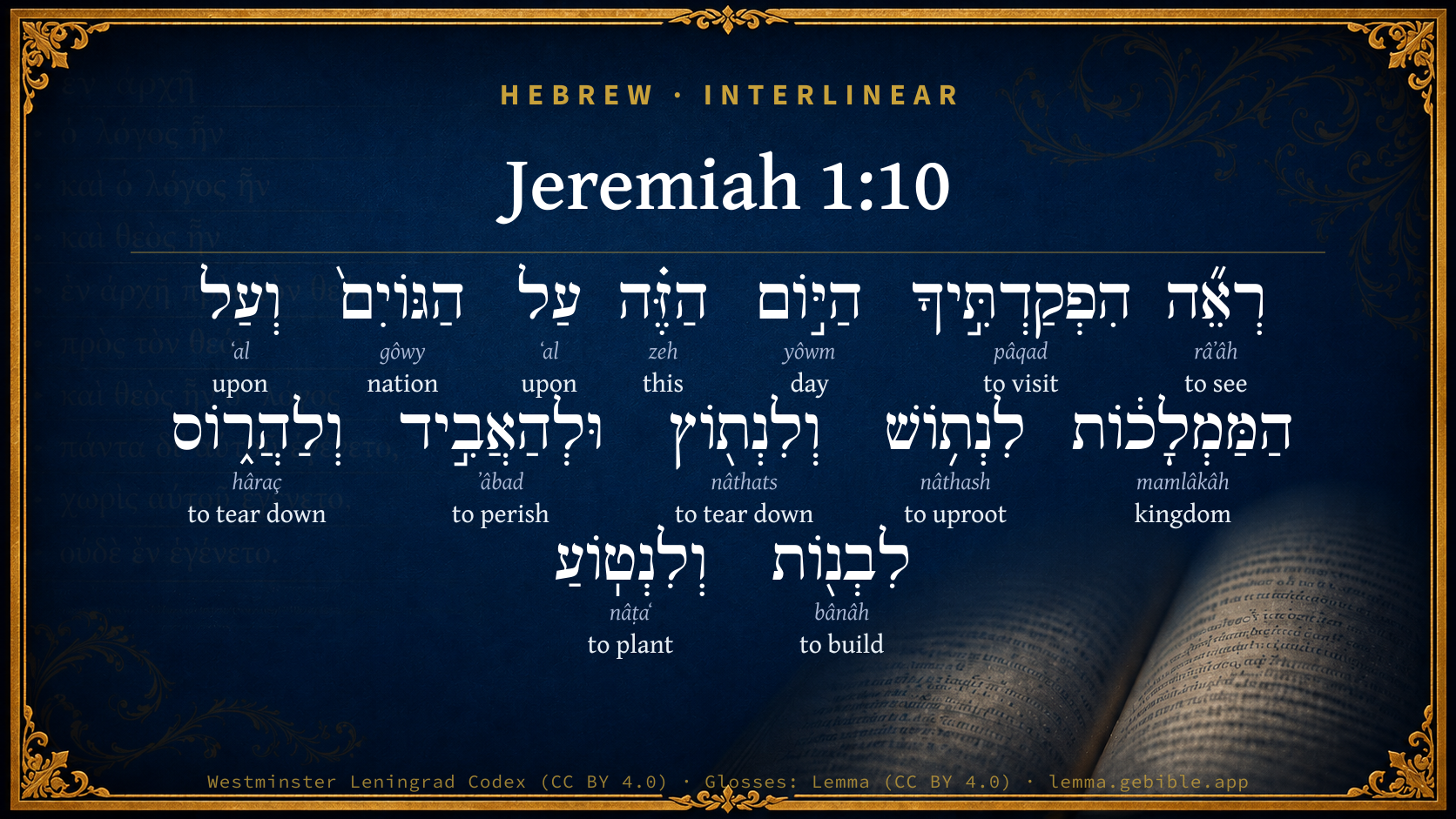
Hebrew (Westminster Leningrad Codex) Jeremiah 1:10 appears in the Hebrew Old Testament. The text above is from the Westminster Leningrad Codex. Each word links to its Strong’s number, a concise gloss, and parsing drawn from the Open Scriptures Hebrew Bible morphology. Click any word for its full Brown-Driver-Briggs (BDB) entry.
Download image
Cite this verse

Jeremiah 1:10 (World English Bible). Public Domain. Lemma interlinear Bible study tool, https://lemma.gebible.app/v/jeremiah/1/10.

Show BibTeX & RIS
BibTeX
RIS
English Translation
behold, I have this day set you over the nations and over the kingdoms, to pluck up and to break down and to destroy and to overthrow, to build and to plant.
World English Bible · Public Domain
Download a study sheet

One document with this verse’s original text, its word-by-word gloss line, the meaning frame, cross-references with their text, attributed commentary, and full source and license credits — printable, and it pastes into notes with its structure intact.

This verse Autodidact and up

Study sheet (.html) Plain text (.txt)

A passage Seminary Student

Up to 50 verses in one chapter. A passage sheet keeps up to 6 commentary sources and 12 cross-references per verse, in the order this page ranks them, and says so on the sheet whenever that leaves anything out. Ask for a single verse and you get the Autodidact verse sheet above.

Everything on this page stays free to read, with no account — the sheet is a download of what is already on screen, not access to it.

Want to remove ads? Support Godless Engineer
Compare translations 3

The same verse in 3 English versions, stacked beneath the original-language interlinear above. Click any original word for its lexicon entry.

Each is an independent rendering of the whole verse — the interlinear is not word-aligned to these translations.

Highlighted words mark where these versions differ — a whole-verse word diff, not a word-by-word alignment.

  • World English Bible Public Domain
    behold, I have this day set you over the nations and over the kingdoms, to pluck up and to break down and to destroy and to overthrow, to build and to plant.
  • King James Version Public Domain
    See, I have this day set thee over the nations and over the kingdoms, to root out, and to pull down, and to destroy, and to throw down, to build, and to plant.
  • unfoldingWord Literal Text CC BY-SA 4.0
    Look, I am appointing you this day over the nations and over the kingdoms, to uproot and to pull down and to destroy and to throw down, to build and to plant.”

unfoldingWord Literal Text — © unfoldingWord, licensed CC BY-SA 4.0. Word-aligned USFM3 via Door43 (git.door43.org/unfoldingWord/en_ult).

Versions to compare (up to 4)

3 of 4 selected

Show all 18 translations

Every available English version of this verse, each an independent rendering of the whole verse.

  • World English Bible Public Domain
    behold, I have this day set you over the nations and over the kingdoms, to pluck up and to break down and to destroy and to overthrow, to build and to plant.
  • Berean Standard Bible Public Domain
    See, I have appointed you today over nations and kingdoms to uproot and tear down, to destroy and overthrow, to build and plant.”
  • Majority Standard Bible Public Domain
    See, I have appointed you today over nations and kingdoms to uproot and tear down, to destroy and overthrow, to build and plant.”
  • King James Version Public Domain
    See, I have this day set thee over the nations and over the kingdoms, to root out, and to pull down, and to destroy, and to throw down, to build, and to plant.
  • American Standard Version (1901) Public Domain
    see, I have this day set thee over the nations and over the kingdoms, to pluck up and to break down and to destroy and to overthrow, to build and to plant.
  • Revised Version (1885) Public Domain
    see, I have this day set thee over the nations and over the kingdoms, to pluck up and to break down, and to destroy and to overthrow; to build, and to plant.
  • Geneva Bible (1599) Public Domain
    Beholde, this day haue I set thee ouer the nations and ouer the kingdomes to plucke vp, and to roote out, and to destroye and throwe downe, to builde, and to plant.
  • Douay-Rheims (1899) Public Domain
    Lo, I have set thee this day over the nations, and over the kingdoms, to root up, and pull down, and to waste, and to destroy, and to build, and to plant.
  • Young's Literal Translation Public Domain
    See, I have charged thee this day concerning the nations, and concerning the kingdoms, to pluck up, and to break down, and to destroy, and to throw down, to build, and to plant.'
  • Literal Standard Version CC BY-SA 4.0
    See, I have charged you this day concerning the nations, and concerning the kingdoms, to pluck up, and to break down, and to destroy, and to throw down, to build, and to plant.”
  • Unlocked Literal Bible CC BY-SA 4.0
    I am appointing you today over nations and over kingdoms, to uproot and break down, to destroy and overthrow, to build and plant.”
  • unfoldingWord Literal Text CC BY-SA 4.0
    Look, I am appointing you this day over the nations and over the kingdoms, to uproot and to pull down and to destroy and to throw down, to build and to plant.”
  • Darby Bible Public Domain
    See, I have this day set thee over the nations and over the kingdoms, to pluck up, and to break down, and to destroy, and to overthrow, to build and to plant.
  • World Messianic Bible Public Domain
    Behold, I have today set you over the nations and over the kingdoms, to uproot and to tear down, to destroy and to overthrow, to build and to plant.”
  • Webster's Bible Public Domain
    See, I have this day set thee over the nations and over the kingdoms, to root out, and to pull down, and to destroy, and to throw down, to build, and to plant.
  • Free Bible Version CC BY-SA 4.0
    Today I've placed you over nations and kingdoms to pull up and tear down, to destroy and demolish, to build and plant.”
  • Bible in Basic English Public Domain
    See, this day I have put you over the nations and over the kingdoms, for uprooting and smashing down, for destruction and overturning, for building up and planting.
  • JPS Tanakh (1917) Public Domain
    See, I have this day set thee over the nations and over the kingdoms, to root out and to pull down, and to destroy and to overthrow; to build, and to plant.

Literal Standard Version (2020), Covenant Press — licensed CC BY-SA 4.0. Text via the HelloAO Bible API (eBible.org). Unlocked Literal Bible (unfoldingWord) — licensed CC BY-SA 4.0. Text via the HelloAO Bible API (eBible.org). unfoldingWord Literal Text — © unfoldingWord, licensed CC BY-SA 4.0. Word-aligned USFM3 via Door43 (git.door43.org/unfoldingWord/en_ult). Free Bible Version, Dr. Jonathan Gallagher — licensed CC BY-SA 4.0. Text via the HelloAO Bible API (eBible.org).

Word by word

More ways to search: Search by grammar → Find every occurrence → Compare this word →

Practice this passage: Drill this verse → Learn its vocabulary →

לִנְת֥וֹשׁ
nâthash
H5428
“to uproot”
Preposition + Verb, Qal, Infinitive Construct
Part of Speech
Preposition + Verb
Stem
Qal
Form
Infinitive Construct
Full BDB Definition

Origin: a primitive root

TWOT: 1451

to pull up, expel, root out, pluck up - (Qal) to pull or pluck up - (Niphal) to be plucked up - (Hophal) to be plucked up
  1. רְאֵ֞ה râʼâh H7200 “see” Verb, Qal, Imperative, 2nd Person, Masculine, Singular
  2. הִפְקַדְתִּ֣יךָ pâqad H6485 “to visit · you” Verb, Hiphil, Perfect, 1st Person, Common, Singular + Suffix, Personal, 2nd Person, Masculine, Singular
  3. הַיּ֣וֹם yôwm H3117 “the · day” Particle, Definite Article + Noun, Common, Masculine, Singular, Absolute
  4. הַזֶּ֗ה zeh H2088 “the · this” Particle, Definite Article + Pronoun, Demonstrative, Masculine, Singular
  5. עַל ʻal H5921 “upon” Preposition
  6. הַגּוֹיִם֙ gôwy H1471 “the · nations” Particle, Definite Article + Noun, Common, Masculine, Plural, Absolute
  7. וְעַל ʻal H5921 “and · upon” Conjunction + Preposition
  8. הַמַּמְלָכ֔וֹת mamlâkâh H4467 “the · kingdoms” Particle, Definite Article + Noun, Common, Feminine, Plural, Absolute
  9. וְלִנְת֖וֹץ nâthats H5422 “and · to tear down” Conjunction + Preposition + Verb, Qal, Infinitive Construct
  10. וּלְהַאֲבִ֣יד ʼâbad H6 “and · to perish” Conjunction + Preposition + Verb, Hiphil, Infinitive Construct
  11. וְלַהֲר֑וֹס hâraç H2040 “and · to tear down” Conjunction + Preposition + Verb, Qal, Infinitive Construct
  12. לִבְנ֖וֹת bânâh H1129 “to build” Preposition + Verb, Qal, Infinitive Construct
  13. וְלִנְטֽוֹעַ nâṭaʻ H5193 “and · to plant” Conjunction + Preposition + Verb, Qal, Infinitive Construct

About this verse

These counts appear in no published source. They are computed here, from the morphology-tagged text and Lemma’s own curated glosses. What Lemma adds →

14
words
13
distinct lemmas
Prophets
section

Notable vocabulary

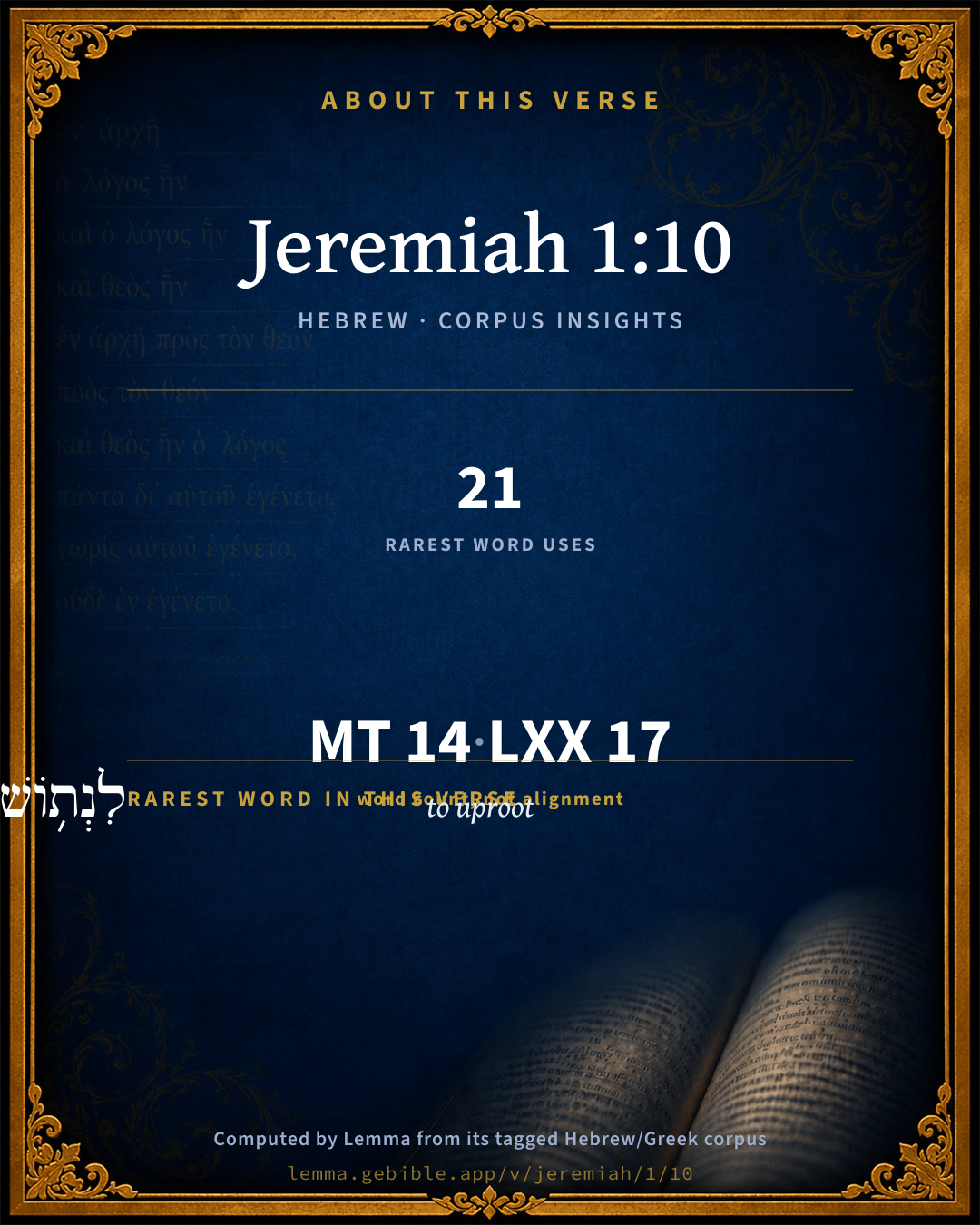
The rarest word here is לִנְת֥וֹשׁ to uproot H5428 — appearing just 21 times in the whole Hebrew Bible.

Shared distinctive vocabulary

לִנְת֥וֹשׁ to uproot H5428 occurs in 19 verses of the Hebrew Bible. Also found in:

Grammatical profile

  • 8 verbs
  • 3 nouns
  • 1 pronoun
  • 2 prepositions

Verb forms

  • רְאֵ֞ה Qal · Imperative
  • הִפְקַדְתִּ֣יךָ Hiphil · Perfect
  • לִנְת֥וֹשׁ Qal · Infinitive Construct
  • וְלִנְת֖וֹץ Qal · Infinitive Construct
  • וּלְהַאֲבִ֣יד Hiphil · Infinitive Construct
  • וְלַהֲר֑וֹס Qal · Infinitive Construct
  • לִבְנ֖וֹת Qal · Infinitive Construct
  • וְלִנְטֽוֹעַ Qal · Infinitive Construct

Repetition

A word recurs within this verse — often emphatic in Hebrew:

Hebrew & Septuagint length

In the original languages it is 14 Hebrew tokens and 17 Greek tokens — but the two are counted differently (Hebrew bundles its prefixes and suffixes into one token; the Greek is in lemma form), so that isn’t a like-for-like length.

Cross-references

19

Topical passages linked to Jeremiah 1:10 in the Treasury of Scripture Knowledge — connected by theme and wording, ordered by reader-vote popularity; previews shown in the World English Bible.

  • Jeremiah 31:28 It shall happen that, like as I have watched over them to pluck up and to break down and to overthrow and to destroy and to afflict, so will I watch over them to build and to plant, says Yahweh.
  • 2 Corinthians 10:4–5 for the weapons of our warfare are not of the flesh, but mighty before God to the throwing down of strongholds,
  • Isaiah 44:26–28 who confirms the word of his servant, and performs the counsel of his messengers; who says of Jerusalem, She shall be inhabited; and of the cities of Judah, They shall be built, and I will raise up the waste places of it;
  • Jeremiah 31:4–5 Again will I build you, and you shall be built, O virgin of Israel: again shall you be adorned with your tambourines, and shall go forth in the dances of those who make merry.
  • Jeremiah 24:6 For I will set my eyes on them for good, and I will bring them again to this land: and I will build them, and not pull them down; and I will plant them, and not pluck them up.
  • Ezekiel 36:36 Then the nations that are left round about you shall know that I, Yahweh, have built the ruined places, and planted that which was desolate: I, Yahweh, have spoken it, and I will do it.
  • Amos 9:11 In that day I will raise up the tent of David who is fallen, and close up its breaches, and I will raise up its ruins, and I will build it as in the days of old;
  • Revelation 11:3–6 I will give power to my two witnesses, and they will prophesy one thousand two hundred sixty days, clothed in sackcloth."
  • Amos 3:7 Surely the Lord Yahweh will do nothing, Unless he reveals his secret to his servants the prophets.
  • Zechariah 1:6 But my words and my decrees, which I commanded my servants the prophets, didn't they overtake your fathers? "Then they repented and said, 'Just as Yahweh of Hosts determined to do to us, according to our ways, and according to our practices, so he has dealt with us.'"
  • Ezekiel 32:18 Son of man, wail for the multitude of Egypt, and cast them down, even her, and the daughters of the famous nations, to the lower parts of the earth, with those who go down into the pit.
  • Jeremiah 27:2–7 Thus says Yahweh to me: Make you bonds and bars, and put them on your neck;
  • Revelation 19:19–21 I saw the beast, and the kings of the earth, and their armies, gathered together to make war against him who sat on the horse, and against his army.
  • Jeremiah 18:7–10 At what instant I shall speak concerning a nation, and concerning a kingdom, to pluck up and to break down and to destroy it;
  • Jeremiah 25:15–27 For thus says Yahweh, the God of Israel, to me: take this cup of the wine of wrath at my hand, and cause all the nations, to whom I send you, to drink it.
  • Ezekiel 43:3 It was according to the appearance of the vision which I saw, even according to the vision that I saw when I came to destroy the city; and the visions were like the vision that I saw by the river Chebar; and I fell on my face.
  • 1 Kings 19:17 It shall happen, that he who escapes from the sword of Hazael shall Jehu kill; and he who escapes from the sword of Jehu shall Elisha kill.
  • Jeremiah 46:1–28 The word of Yahweh which came to Jeremiah the prophet concerning the nations.
  • 1 Kings 17:1 Elijah the Tishbite, who was of the foreigners of Gilead, said to Ahab, As Yahweh, the God of Israel, lives, before whom I stand, there shall not be dew nor rain these years, but according to my word.

Cross-references courtesy of OpenBible.info (CC BY 4.0).

Hebrew and Greek witnesses Masoretic Hebrew ↔ Greek Septuagint

The same verse in the two great witnesses to the Old Testament, shown verse-for-verse.

These are two independent witnesses, not word-aligned to each other, and the Septuagint is shown in lemma (dictionary) form.

Hebrew Jeremiah 1:10 Masoretic · Westminster Leningrad Codex

רְאֵ֞ה הִפְקַדְתִּ֣יךָ הַיּ֣וֹם הַזֶּ֗ה עַל הַגּוֹיִם֙ וְעַל הַמַּמְלָכ֔וֹת לִנְת֥וֹשׁ וְלִנְת֖וֹץ וּלְהַאֲבִ֣יד וְלַהֲר֑וֹס לִבְנ֖וֹת וְלִנְטֽוֹעַ

behold, I have this day set you over the nations and over the kingdoms, to pluck up and to break down and to destroy and to overthrow, to build and to plant.

World English Bible · Public Domain

Greek LXX Structure differs

In the Septuagint, Jeremiah is about an eighth shorter than the Hebrew and arranges its material differently — the Oracles Against the Nations (Hebrew chapters 46–51) appear in the middle of the Greek book, after 25:13. Because the chapter and verse boundaries do not line up, a verse-for-verse comparison with the Hebrew is not shown.

A verse-for-verse comparison isn’t shown here because the chapters and verses don’t line up. Switch to the LXX edition with the MT / LXX toggle above to read the Greek directly.

Hebrew: Westminster Leningrad Codex (CC BY 4.0). Greek: Septuagint (public domain); English from a public-domain English Septuagint. How the Septuagint differs from the Hebrew →

Targum (Aramaic paraphrase)

1

The Targum is the ancient Jewish Aramaic paraphrase of the Hebrew Scriptures — an interpretive translation, not the Hebrew text itself. Onkelos (literal) and Pseudo-Jonathan (expansive) render the Torah, and Jonathan the Prophets. Coverage is partial: where no permissively-licensed English translation exists for a verse, only the Aramaic is shown. This is verse-level text, not a word-by-word alignment to the Hebrew.

  1. Targum Jonathan Prophets (Joshua–Malachi)
    חֲזֵי דְמִנִיתָךְ יוֹמָא הָדֵין עַל עַמְמַיָא וְעַל מַלְכְּוָתָא לְמֶעֱקַר וּלְתַרָעָא וּלְאַבָּדָא וּלְפַּגְרָא וְעַל בֵּית יִשְׂרָאֵל וּלְמִבְנֵי וּלְקַיָמָא:

    (no public-domain English translation for this verse)

    Targum Jonathan — Aramaic: “Mikraot Gedolot” (public domain). English: “Sefaria Community Translation” (CC0 1.0 (public-domain dedication)); “London "Chaldee Paraphrase," 1871” (public domain). Text via Sefaria.

Commentary

Notes on Jeremiah 1:10 from classic Christian and Jewish commentators (each source and its license shown beneath its notes). The classic Christian expositions comment on the surrounding passage and are grouped to its opening verse, so a note may address several verses; the Jewish commentaries on the Tanakh (Rashi and others) are per-verse, so they appear only where the commentator wrote on this verse.

Lemma curates 59 commentaries, every one of them public domain or Creative Commons licensed, each selected and text-cleaned for this edition rather than reprinted as found. About our sources →

Trapp's Complete Commentary

John Trapp

Jer 1:10 See, I have this day set thee over the nations and over the kingdoms, to root out, and to pull down, and to destroy, and to throw down, to build, and to plant.

Ver. 10. See, I have this day set thee over nations,] scil., With authority to use the same liberty in reproving their sins that they take in committing them. Fear not the highest (for I have set thee over them), but look upon them as so many mice; for what are they more in comparison of me and of thee, who hast from me thy mission and commission? zeal in well doing showeth a man to be right, like as such are living fish as swim against the stream.

To root out, and to pull down,] i.e., To denounce destruction to evildoers, and then I will effect it. Elisha hath his sword, as well as Hazael or Jehu, {1Ki 19:17} and vengeance for the disobedient is every whit as ready in God’s hands as in his minister’s mouth. {2Co 10:6} See Hos 6:5. {See Trapp on "Hos 6:5"} Joh 20:23. But what a mercy of God to the Church was it that the same day that Pelagius, that arch-heretic, was born in Britain, Augustine, the great confuter of that heretic, should be born in Africa - Providence so disposing that the poison and the antidote should come into world together. {a}

To build, and to plant.] As a co-worker with God for the good of souls, by preaching Christ unto them, as this prophet doth notably in a most divine and stately strain, setting him forth in his coming, covenant, offices, benefits, &c., as the only foundation and lively root of hope.

{a} Dempster, Hist. Scot.

John Trapp, A Commentary or Exposition upon All the Books of the Old and New Testament (1647–1656) — public domain. Text from a community e-Sword module.

Geneva Bible (1599)

Geneva Bible translators

He showeth what is the authority of God’s true ministers, which by his word have power to bear down whatsoever lifteth itself up against God: and to plant and assure the humble, and such as give themselves to the obedience of God’s word, 2 Cor. 10:4, 5; Heb. 4:12, and these are the keys which Christ hath left to loose, and bind, Matt. 18:18.

Geneva Bible (1599) marginal notes — public domain. Text via Bolls.life.

Jamieson, Fausset & Brown

Robert Jamieson, A. R. Fausset & David Brown

set thee over--literally, "appointed thee to the oversight." He was to have his eye upon the nations, and to predict their destruction, or restoration, according as their conduct was bad or good. Prophets are said to do that which they foretell shall be done; for their word is God's word; and His word is His instrument whereby He doeth all things (Gen 1:3; Psa 33:6, Psa 33:9). Word and deed are one thing with Him. What His prophet saith is as certain as if it were done. The prophet's own consciousness was absorbed into that of God; so closely united to God did he feel himself, that Jehovah's words and deeds are described as his. In Jer 31:28, God is said to do what Jeremiah here is represented as doing (compare Jer 18:7; Kg1 19:17; Eze 43:3).

root out-- (Mat 15:13).

pull down--change of metaphor to architecture (Co2 10:4). There is a play on the similar sounds, lintbosh, linthotz, in the Hebrew for "root out . . . pull down."

build . . . plant--restore upon their repenting. His predictions were to be chiefly, and in the first instance, denunciatory; therefore the destruction of the nations is put first, and with a greater variety of terms than their restoration.

Jamieson, Fausset & Brown — Commentary Critical and Explanatory on the Whole Bible (1871) — public domain (CC PDM 1.0). Text via the HelloAO Bible API.

Adam Clarke's Commentary

Verse 10. I have - set thee over the nations] God represents his messengers the prophets as doing what he commanded them to declare should be done. In this sense they rooted up, pulled down, and destroyed - declared God's judgments, they builded up and planted - declared the promises of his mercy. Thus God says to Isaiah, Isa 6:10: "Make the heart of this people fat - and shut their eyes." Show them that they are stupid and blind; and that, because they have shut their eyes and hardened their hearts, God will in his judgments leave them to their hardness and darkness.

Adam Clarke's Commentary on the Bible (1810–1826) — public domain. Text from a community e-Sword/MySword module.

John Calvin's Commentaries

God having now shewn that Jeremiah’s mouth was consecrated to himself, and separated from common and profane use, proceeds to invest him with power: See, he says, I have set thee this day over nations and over kingdoms By these words God shews how reverently he would have his word received, even when conveyed by frail mortals. There is no one who pretends not, that he desires to obey God, but yet hardly one in a hundred really receives his word. For as soon as he speaks, almost all raise a clamor; or if they dare not furiously, and in a hostile manner, oppose it, we yet see how some evade it, and others secretly oppose it. The authority, then, which God ascribes to his own word, ought to be noticed by us: Behold, I have set thee over nations and kingdoms

Farther, by saying, See, I have set thee, he encourages the Prophet to be magnanimous in spirit. He was to remember his calling, and not timidly or servilely to flatter men, or to shew indulgence to their lusts and passions: See, he says. We may hence perceive, that teachers cannot firmly execute their office except they have the majesty of God before their eyes, so that in comparison with him they may disregard whatever splendor, pomp, or power there may be in men. Experience indeed teaches us, that the sight of men, whatever dignity they may possess, be it the least, brings fear with it. Why are prophets and teachers sent? That they may reduce the world to order: they are not to spare their hearers, but freely reprove them whenever there may be need; they are also to use threatenings when they find men perverse. But when there is any dignity connected with men, the teacher dares not to offend; he is afraid of those who are invested with power, or who possess wealth, or a high character for prudence, or who are endued with great honors. In such cases there is no remedy, except teachers set God before their eyes, and regard him to be himself the speaker. They may thus with courageous and elevated minds look down on whatever height and pre — eminence there may be among mortals. This, then, is the object of what God says here, See, I have set thee over nations and kingdoms; for he shews that there is so much authority in his word, that whatever is high and exalted on earth is made subject to it; even kings are not excepted.

But what God has joined together let no man separate. (Matthew 19:6; Mark 10:9) God indeed extols here his Prophets above the whole world, and even above kings; but he has previously said, Behold, I have put my words, in thy mouth; so that whosoever claims such a power, must necessarily bring forth the word of God, and really prove that he is a prophet, and that he introduces no fictions of his own. And hence we see how fatuitous is the boasting of the Pope, and of his filthy clergy, when they wickedly dare to appropriate to themselves what is here said. “We are, “they say, “above both kings and nations.” By what right? “God hath thus spoken by the Prophet Jeremiah.” But these two things are to be joined together — I have put my words in thy mouth, and, I have set thee over nations and kingdoms Now let the Pope shew that he is furnished with the word of God, that he claims for himself nothing that is his own, of apart from God; in a word, that he introduces nothing of his own devices, and we shall willingly allow that he is pre — eminent above the whole world. For God is not to be separated from his word: as his majesty shines eminently above the whole world, yea, and above all the angels of heaven; so there is the same dignity belonging to his word. But as these swine and dogs are empty of all true doctrine and piety, what effrontery it is, yea, what stupidity, to boast that they have authority over kings and nations! We, in short, see from the context, that men are not here so much extolled, though they be true ministers of celestial truth, as the truth itself; for God ascribes here the highest authority to his own word, though its ministers were men of no repute, poor and despised, and having nothing splendid connected with them. The purpose for which this was said I have already explained; it was, that true prophets and teachers may take courage, and thus boldly set themselves against kings and nations, when armed with the power of celestial truth.

He then adds, To root up, to destroy, to pull down, to lay waste God seems here to have designedly rendered odious his own word and the ministry of the Prophet; for the word of God in the mouth of Jeremiah could not have been acceptable to the Jews, except they perceived that it was for their safety and welfare: but God speaks here of ruin and destruction, of cutting down and desolation. But he subjoins, to build and to plant God then ascribes two effects to his word, that on the one hand it destroys, pulls down, lays waste, cuts off; and that on the other it plants and builds

But it may, however, be rightly asked, why does God at first speak of ruin and extermination? The order would have seemed better had he said first, I set thee to build and to plant, according to what is said by Paul, who declares that vengeance was prepared by him and the other teachers against all despisers, and against all the height of the world, when your obedience, he says, shall be completed. (2 Corinthians 10:5, 6.) Paul then intimates that the doctrine of the gospel is properly, and in the first place, designed for this end — to call men to the service of God. But Jeremiah here puts ruin and destruction before building and planting. It then seems, as I have said, that he acts inconsistently. But we must ever bear in mind what the state of the people was: for impiety, perverseness, and hardened iniquity had for so long a time prevailed, that it was necessary to begin with ruin and eradication; for Jeremiah could not have planted or have built the temple of God, except he had first destroyed, pulled down, laid waste, and cut off. How so? Because the Devil had erected there his palace; for as true religion had been for many years despised, the Devil was there placed, as it were, on his high throne, and reigned uncontrolled at Jerusalem, and through the whole land of Judea. How, then, could he have built there a temple for God, in which he might be purely worshipped, except ruin and destruction had preceded? for the Devil had corrupted the whole land. We indeed know that all kinds of wickedness then prevailed everywhere, as though the land had been filled with thorns and briers. Jeremiah then could not have planted or sown his heavenly doctrine until the land had been cleansed from so many vices and pollutions. This is no doubt the reason why in the first place he speaks of cutting off and ruin, of exterminating and eradicating, and afterwards adds planting and building.

The heap of words employed shews how deep impiety and the contempt of God had fixed their roots. God might have said only, I have set thee to pull down and to destroy; he might have been content with two words, as in the latter instance — to plant and to build. But as the Jews had been obstinate in their wickedness, as their insolence had been so great, they could not be corrected immediately, nor in one day, nor by a slight effort. Hence God accumulated words, and thus encouraged his Prophet to proceed with unwearied zeal in the work of clearing away the filth which had polluted the whole land. We now then understand what is here said, and the purpose of using so many words.

But he speaks again of kingdoms and nations; for though Jeremiah was given as a Prophet especially to his own nation, yet he was also a Prophet to heathen nations, as they say, by accident, according to what we shall hereafter see: and it seems that, God designedly mentioned nations and kingdoms, in order to humble the pride of that people who thought themselves exempt from all reproof. Hence he says, that he gave authority to his servant, not only over Judea, but also over the whole world; as though he had said, “Ye are but a small portion of mankind; raise not then your horns against my servant, as ye shall do this without effect; for he shall exercise power not only over Judea, but also over all nations, and even over kings, as the doctrine which I have deposited with him is of such force and power that it will stand eminent above all mortals, much more above one single nation.”

We at the same time see that though the treachery of men constrains God to use severity, yet he never forgets his own nature, and kindly invites to repentance those who are not wholly past remedy, and offers to them the hope of pardon and of salvation; and this is what celestial truth ever includes. For though it be the odour of death unto death to those who perish, it is yet the odor of life unto life to the elect of God. It indeed often happens that the greater part turn the doctrine of salvation to their ruin; yet God never suffers all to perish. He therefore makes the truth the incorruptible seed of life to his elect, and builds them up as his temples. This is what we must bear in mind. And so there is no reason why the truth of God should be disliked by us, though it be the occasion of perdition to many; for it always brings salvation to the elect: it so plants them, that they strike roots into the hope of a blessed immortality, and then it builds them for holy temples unto God. It now follows —

John Calvin's Commentaries (1540-1563) — public domain. Text from the Calvin Translation Society English edition (1840s-50s) via the Christian Classics Ethereal Library (ccel.org). Calvin's coverage is partial (roughly two-thirds of the Bible); uncommented books and verses are honest gaps, never fabricated. The 19th-century editor's footnotes and remarks are omitted so the notes are faithfully Calvin's own voice.

Ellicott's Commentary for English Readers

(10) I have this day set thee . . .—With the gift, and therefore the consciousness, of a new power, there comes what would at first have been too much for the mortal vessel of the truth to bear—a prospective view of the greatness of the work before him. He is at once set (literally, made the “deputy,” or representative, of God, as in Jdg_9:28 and 2Ch_24:11, the “officer,” or in Jer_20:1, “chief governor”) over the nations, i.e., as before, the nations external to Israel, and the “kingdoms” including it. The work at first seems one simply of destruction—to root out and ruin (so we may represent the alliterative assonance of the Hebrew), to destroy and rend asunder. But beyond that there is the hope of a work of construction. He is to “build up” the fallen ruins of Israel, to “plant” in the land that had been made desolate. The whole sequel of the book is a comment on these words. It passes through terror and darkness to the glory and the blessing of the New Covenant (Jer_31:31).

A Bible Commentary for English Readers, edited by Charles John Ellicott (1878–1897) — public domain. Text from a community e-Sword module.

The Cambridge Bible for Schools and Colleges

gen. ed. J. J. S. Perowne

10. set thee] given thee authority to speak as My representative. It is the same word as that rendered “made governor” in Jer_40:5; Jer_40:7, and “made overseer” in Gen_39:4-5.

over the nations] So Amos (Jer_1:3 to Jer_2:3) had prophesied concerning non-Jewish kingdoms.

to pluck up, etc.] The prophet is said to do in his own person that which he announces as about to be done by God. Cp. Jer_15:1; Isa_6:10; Eze_43:3, where the prophet speaks of the vision that he saw when he “came to destroy the city.” So in profane literature we find prophets spoken of as though they had a share in influencing the course of the future, which it was theirs only to predict. Thus Aeneas to the Sibyl:

“And thou, O sacred maid, inspired to see

The event of things in dark futurity,

Give me what heaven has promised to my fate

To conquer and command the Latian state.”

Dryden’s Vergil, VI. 100–103.

The predominant portion of the prophet’s task was to consist in rebuke and in threatening; while nevertheless out of the ruins a better and more hopeful state of things should arise for Israel.

The Cambridge Bible for Schools and Colleges (gen. ed. J. J. S. Perowne; Cambridge University Press, 1878–1918) — public domain. Text from a community e-Sword module.

John Gill's Exposition

See, I have this day set thee over the nations, and over the kingdoms,.... Not as a prince, but as a prophet over them, to prophesy things concerning them, whether good or evil, which should certainly come to pass as he predicted:

to root out, and to pull down, and to destroy, and to throw down; that is, to foretell that such a kingdom and nation should be rooted out, as a tree or plant that is plucked up by the roots; and that such an one should be pulled, and thrown down, and destroyed, as a building is. The whole may be understood of the destruction of the Jews by Nebuchadnezzar, of their temple, city, and nation; though the Targum and Jarchi interpret all this of the Gentiles only, and the following,

to build, and to plant, of the house of Israel; which may be applied to the building of the temple, and the planting of the Jews in their own land, after their return from captivity, which Jeremiah prophesied of. These last words are not in the Arabic version.

John Gill's Exposition of the Whole Bible (1746–1763) — public domain (CC PDM 1.0). Text via the HelloAO Bible API.

Albert Barnes' Notes on the Bible

I have ... set thee over - literally, I have made thee Pakeed, i. e., deputy. This title is given only to these invested with high authority (e. g. Gen 41:34; 2Ch 24:11; Jer 20:1; Jer 29:26). From God’s side, the prophet is a mere messenger, speaking what he is told, doing what he is commanded. From man’s side, he is God’s vicegerent, with power “to root out, and to pull down.”

Root out ... pull down - In the Hebrew, the verbs present an instance of the alliteration so common in the prophets, and agreeable to oriental taste. The former signifies the destruction of anything planted, the latter refers to buildings.

To throw down - More exactly, to tear in pieces. There are four words of destruction, and but two words of restoration, as if the message were chiefly of evil. And such was Jeremiah’s message to his contemporaries. Yet are all God’s dealings finally for the good of His people. The Babylonian exile was, for the moment, a time of chastisement; it also became a time of national repentance (see Jer 24:5-7).

Albert Barnes' Notes on the Bible (1834–1885) — public domain. Text from a community e-Sword/MySword module.

Haydock's Catholic Bible Commentary

Root up, to announce the fall and restoration of many nations, Ezechiel iv. 2. (Calmet) --- Jeremias spoke of the Gentiles, as well as of the Jews. (Worthington)

George Leo Haydock (1774–1849), Haydock's Catholic Family Bible and Commentary, 1859 edition — public domain. Excludes Psalms (Douay-Rheims chapter numbering differs from Protestant) and Deuterocanonical books (Catholic canon only).

Matthew Poole's English Annotations

I have this day set thee over the nations and over the kingdoms: having now received his commission, he is directed to whom he is to go, viz. to the greatest, not only single persons, but whole nations, as the Babylonians, Persians, and Egyptians, and exhorted to greatness of mind, as being sent as an ambassador from God, to deliver his messages without flattery or cowardice; and that he might make that proud people sensible of their folly, that looked upon themselves as above reproof, he gives unto his prophet this large authority.

To pull down, i.e. to prophesy that I will pull down; which I will as certainly effect as if thou hadst done it thyself; for, according to Scripture usage, the prophets are said to do that which they foretell shall come to pass, Gen 49:7; Eze 43:3, i.e. to pronounce destruction; hence God is said to slay them by the words of his mouth, Hos 6:5; and so are all the following expressions to be understood.

To build and to plant; metaphors taken from architects and gardeners. Either the former words relate to the enemies of God, and the latter to his friends; or rather, to both conditionally. If they repent, he will build them up, i.e. he will increase their families, and plant them, viz. settle them in the land, Jer 24:6. If they do not, he will root them up, and pull them down, &c. He will do the contrary. Compare this with Jer 42:10, and Jer 45:4. The reason why God useth so many words to the same purpose seems to be, partly to show how deeply all kind of wickedness and contempt of God had taken root; which possibly may be one reason why he placeth pulling down and rooting up before building and planting, to show what a deal of rubbish there was to be removed before he could reform and repair his church and state; or rather, because the prophet was to begin with these in his prophecy, as appears by his second visions, Jer 1:11,13; and partly to quicken the prophet’s zeal against them.

Matthew Poole's English Annotations on the Holy Bible (1683–1685) — public domain. Text from a community e-Sword/MySword module.

Whedon's Commentary on the Bible

Daniel D. Whedon

10. To root out, and to pull down, etc. — A fearful commission! More unwelcome than that of Jonah! Yet his work was not executive but declarative. He was said to do what he has the commission to declare that God will do. So Christ gave to Peter the declaratory power of binding and loosing, (Mat_16:19,) that is, the gospel commission of declaring the terms of salvation. And so Jeremiah is to pull down, and to destroy, because he is to be a prophet of evil to his own countrymen. True, this work of demolition was not to be unto ultimate destruction, but for reconstruction; and yet it was to extend to much that was enshrined in the national pride and dear to the national heart. The prophet’s work was to be in some sense the very counterpart of that of Moses. He led the people into political independency; in Jeremiah’s time this independent national life was to terminate. From being a nation they were henceforth to be only a people. The institutions which for many centuries had been the matrix of spiritual ideas in process of unfolding, were now to be cast down and overthrown in order that these same truths might have freedom for further development. And so his mission was also to build, and to plant. The political life of the nation was to terminate for the sake of its religious life. The work of demolition and extirpation was preparatory to planting and building. It was one stage of that violence by which a way was opened for the bringing in of a better hope.

It is worthy of note, that while we have here four terms to set forth the negative aspect of the prophet’s work, there are but two to represent its positive aspect. This indicates the moral condition of the times, and foreshadows the character of the book. Israel was to be humbled and afflicted that the theocracy might be strengthened and elevated. Israel was to go into captivity that the truth of God might be free.

Daniel D. Whedon (gen. ed.), Commentary on the Old and New Testaments (1874–1909) — public domain. Text from a community e-Sword module.

The Pulpit Commentary

I have set thee; literally, I have made thee an overseer, or vicegerent. (comp. Gen_41:34 Jud_1:9:28, where the Authorized Version renders the cognate noun "officer To root out... to plant, viz. by pronouncing that Divine judgment which fulfils itself. (comp. Jer_5:14 Num_23:25 Isa_9:8, 9 55:11) As there is so much more threatening than promise in Jeremiah"s writings, the destructive side of his activity is expressed by four verbs, the constructive only by two.

The power of prophecy.

I THERE IS A POWER IN PROPHECY. Prophecy is not simply a light, a revelation of truth; it is also a voice of authority, a means of active influence, a power. The Divine word in the prophet is like the Divine word in nature-an energizing word. God speaks, and it is done. The New Testament references to prophecy are made in obedience to this thought. The fulfillment of prophecy is there quoted not so much, as in modern evidential literature, as a proof of supernatural foresight, but rather as the effect of a Divine power which has realized the purpose of the ancient Word of God. This or that is said to be done "that it might be fulfilled which was spoken by the prophet." God"s Word is always a power. (Heb_4:12) The Bible is not simply a revelation; it is a means of influence. The preacher should see that he is clothed with power. His mission is to influence as well as to teach.

II THE SOURCES OF THE POWER OF PROPHECY ARE SPIRITUAL. The authority conferred on Jeremiah is not that of the secular arm. He is to exert his influence by no material force. HIS power is different in kind from that of a political government. The claim of the papal authority founded on this verse is unwarranted, since this does not confer the power of the sword but direct spiritual influence. Neither is the power of prophecy in the least allied to magic or sorcery. It is not a miraculous material force.

1. It is the power of truth. Truth is strong; knowledge is power. The prophet sees the deep principles of God"s government, and in the discernment of them lies the force of his utterances.

2. It is the rower of right. The prophet takes his stand on the side of justice, purity, goodness. In the end the might must go with the right.

3. It is the power of God. The prophet is nothing in himself; he is God"s servant: the authority he wields is God s. So the power of the preacher is not to be sought in reason, in eloquence, nor in official authority, but in the truth of his message, in the righteousness of his cause, and in his fidelity to the will of God.

III THE RANGE OF THE POWER OF PROPHECY IS WORLDWIDE. Jeremiah was a Jew.

Yet he was "set over the nations and over the kingdoms.

1. God is the King of king and his authority concerns kingdoms as well as individuals. Political questions are amenable to the influence of Divine truth and righteousness.

2. God"s truth does not only concern the Church. It is for the world if the world will obey, for its blessedness; if it will not heed, for a judgment upon it.

IV THE EFFECTS OF THE POWER OF PROPHECY ARE REVOLUTIONARY. It is no wild and transient influence, but a great stirring energy. Translated into modern language, this means that truth, right, and the will of God are powerful factors in history, disarranging human schemes and bringing higher designs into effect.

1. This power is destructive. Jeremiah is to "root out," etc. Evil is not a mere negation simple darkness. It must be fought and east out. Christ sent "a sword". (Mat_10:34) The era of the Reformation was a destructive age. It is the duty of the preacher to protest against evil, to denounce it, to seek its overthrow, and not to shrink for fear of consequent disturbances. Warfare is better than guilty peace.

2. This power is ultimately constructive. Jeremiah is "to build and to plant." The destructive agencies of God are simply intended to clear off obstructions, and make the way for a new and better order. The disintegrating power of criticism should be regarded as only preparatory to the creative influence of living truth. The gospel is chiefly a constructive power, making men new creatures, building up the kingdom of God in our midst, brining about a new heaven and a new earth.

The ministry for a corrupt age.

I MUST BE RAISED UP BY GOD. Such an age will have its ministers, but they will be prophets who will prophesy only smooth things. But a true ministry for such an age will not be produced by it, but be given to it from God. "See, I have set thee," etc.

II WILL BE ENDUED WITH DIVINE POWER. "I have set thee over the nations...to root out," etc. None who contemplate the marvelous effects of such a ministry and compare them with the natural powers of him who exercises it, but must see that the ascendancy he has gained and the spiritual power he wields are of God and not of man.

III WILL MAKE NO COMPROMISE WITH SIN. See the number and force of the words used to indicate the ruthless antagonism which the prophet would manifest toward the wickedness of his day. Nothing less than its complete overthrow would fulfill the ministry entrusted to him.

IV WILL DEMAND ON THE PART OF THE PROPHET, AND WILL GAIN FROM THE GRACE OF GOD, A FEARLESS AND AN UNCONQUERABLE COURAGE. (Vers. 17, 18)

V ITS END AND RESULT BLESSED. "To build and to plant" (ver. 10). The encumbered ground had first to be cleared and cleansed, but that done, the fabric of a true life should be up reared, and principles pure, holy, and blessed should have root in the hearts of all. C.

The vast compass of the prophet"s work.

I THE WIDE EXTENT THE PROPHECIES COVER. Primarily they had to do with Jerusalem and Judah and all the families of the house of Israel. But this was only the beginning. They went on to affect in the most intimate way all the nations and the kingdoms. The principles of righteousness and truth and Divine authority concern all. They can no more be-kept within certain geographical bounds than can the clouds and rains of heaven. On this day, when the Great I AM came to the youthful Jeremiah, he set him over the nations and over the kingdoms, and here is the reason why these prophecies, with their grand ethical deliverances, have still such a firm hold upon Christendom, upon the Gentile just as much as the Jew. Wherever there still remains the worshipper of stocks and stones, wherever the oppressor is found, and the man who confides in the arm of flesh, and the man who is utterly indifferent to the glory of God, then in that same place there is occasion to insist most strenuously upon the continued application of Jeremiah"s words. The prophets were more than indignant patriots; they were and are still witnesses to an ideal of humanity, nowhere regarded as it ought to be, and only too often neglected, if not contemptuously denied. He who came forth to condemn his own people for lapsing into idolatry did thereby equally condemn other nations for not departing from it. The gospel for every creature is preceded by a body of prophecy, which is shown also to concern every creature, not by laborious inference, but by such explicit words as we find in this verse.

II THE DEPTH OF THE WORK TO WHICH THESE PROPHECIES POINT. The work is not only wide; it is deep as it is wide. The ultimate aim is set forth in two figures:

1. Building.

2. Planting.

On these two figures Paul dwells very suggestively in writing to the Corinthians. The constructive work of God in the human soul needs more than one figure sufficiently to illustrate it. But all true building must be on a sufficient foundation; all Divine planting, if it is to come to anything, must be in a suitable soil. Hence there goes beforehand an unsparing work, to destroy things already in existence. Buildings already erected must be pulled down; plants already growing must be uprooted and put beyond the chance of further growth. We have done things which ought to have been left undone; and the word to Jeremiah is that they must be undone, in order that the things which ought to be clone may be fully done. The terms indicating destruction are multiplied to emphasize the need, and prevent escape into ruinous compromise. There must be no tacking on of a new building to certain humanly cherished parts of the old. Constructions after the will of God must not be liable to a description such as that of the image which Nebuchadnezzar saw in his dream; all must be strong, pure, and beautiful from basement to summit. In the garden of the Lord there can be no mixing of heavenly and earthly plants. A clean sweep such is necessitated for the glory of God and the blessedness of man. Thus at the very first is given a hint of the hostility which Jeremiah would provoke. Pulling down means the expulsion of self from its fortress, and its bereavement of all that it valued. Every brick detached, every plant uprooted, intensified the enmity one degree more. "Destroy," "overthrow," are the only words that can be spoken as long as anything remains in which human pride and selfishness take delight. But at the same time, the prophet goes forth to build and to plant. He takes nothing away but what he leaves something infinitely better behind. When God sends a messenger to us, his great first word is "thorough;" and even though he has to make his way through human pains, tears, murmurings, and semi-rebellions, he keeps to the word. Remember, then, that he who pulls down also builds; he who uproots also plants; and he builds and plants for eternity. Y.

The Pulpit Commentary (1880–1919), ed. H.D.M. Spence-Jones & Joseph S. Exell — public domain. Text from a community e-Sword module.

John Wesley's Explanatory Notes

The kingdoms - Having now received his commission, he is directed to whom he is to go; to the greatest, not only single persons, but whole nations, as the Babylonians, Persians, and Egyptians. To pull down - That is, to prophecy that I will pull down; which I will as certainly effect, as if thou hadst done it thyself: for, according to scripture-usage, the prophets are said to do that which they foretell shall come to pass. To plant - Metaphors taken from architects and gardeners: either the former words relate to the enemies of God, and the latter to his friends; or rather to both conditionally: if they repent, he will build them up, he will increase their families, and settle them in the land; if they do not, he will root them up, and pull them down.

John Wesley, Explanatory Notes Upon the Whole Bible (1754–1765) — public domain. Text via the GEBible commentary corpus.

Rashi

Rabbi Shlomo Yitzchaki (Rashi)

I have appointed you I have appointed you over the heathens.

to uproot and to crush (depayser in French, to uproot) and over Israel to build and to plant if they heed. So did Jonathan paraphrase it.

Rashi on the Tanakh — English translations: “The Judaica Press complete Tanach with Rashi, translated by A. J. Rosenberg” (CC BY 4.0); “Pentateuch with Rashi's commentary by M. Rosenbaum and A.M. Silbermann, 1929-1934” (public domain); “The Metsudah Tanach series, Lakewood, N.J” (CC BY 4.0); and “The Book of Joshua, Metsudah Publications, 1997” (CC BY 4.0). Text via Sefaria.

Lesson kit

Teaching starters — assembled from the data on this page, not authored interpretation. Every prompt links to the verse data it draws on. Edit before teaching.

Jeremiah, in the Prophets, opens this verse with 14 words (13 distinct Hebrew lemmas). Its most distinctive word is nâthash (“to uproot”). A historical commentator’s framing appears above. Read the whole chapter for the surrounding context.

Discussion questions

  1. The word nâthash carries the sense “to uproot.” How does it shape the verse?
  2. How does Deuteronomy 29:28, which shares the word «to uproot», read alongside this verse?
  3. What does the repetition of “upon” (2× in this one verse) do in this verse?
  4. The translations on this page render this verse differently — a whole-verse word diff, not a word-by-word alignment. What might account for the different wordings?
  5. «רְאֵ֞ה» is a Qal Imperative verb. How does that grammatical form shape the action described?
  6. Compare how Trapp's Complete Commentary and Geneva Bible (1599) read this verse. Where do they agree or differ?

Things to notice

Reading settings

Reading text

Shown beneath each verse's original-language words.

Old Testament
Old Testament edition

Read the OT as the Masoretic Hebrew (MT) or the Greek Septuagint (LXX).

English shown for the Greek Septuagint (in the Hebrew ↔ Greek comparison).

Comparing translations? Open the Compare panel on any verse page to stack up to four side by side.