
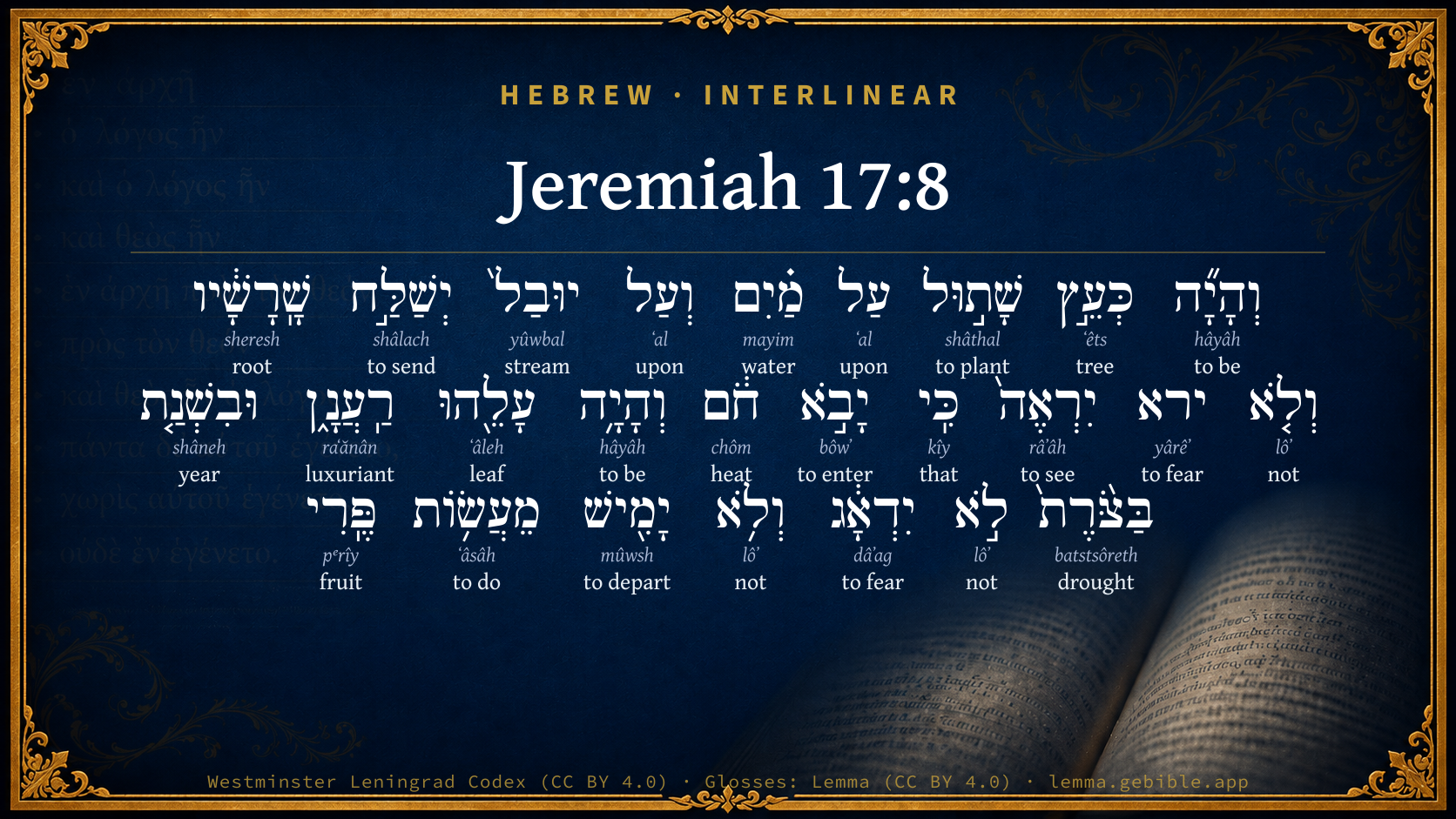
Jeremiah 17:8

Hebrew (Westminster Leningrad Codex) Jeremiah 17:8 appears in the Hebrew Old Testament. The text above is from the Westminster Leningrad Codex. Each word links to its Strong’s number, a concise gloss, and parsing drawn from the Open Scriptures Hebrew Bible morphology. Click any word for its full Brown-Driver-Briggs (BDB) entry.
Download image
Cite this verse

Jeremiah 17:8 (World English Bible). Public Domain. Lemma interlinear Bible study tool, https://lemma.gebible.app/v/jeremiah/17/8.

Show BibTeX & RIS
BibTeX
RIS
English Translation
For he shall be as a tree planted by the waters, who spreads out its roots by the river, and shall not fear when heat comes, but its leaf shall be green; and shall not be careful in the year of drought, neither shall cease from yielding fruit.
World English Bible · Public Domain
Highlights
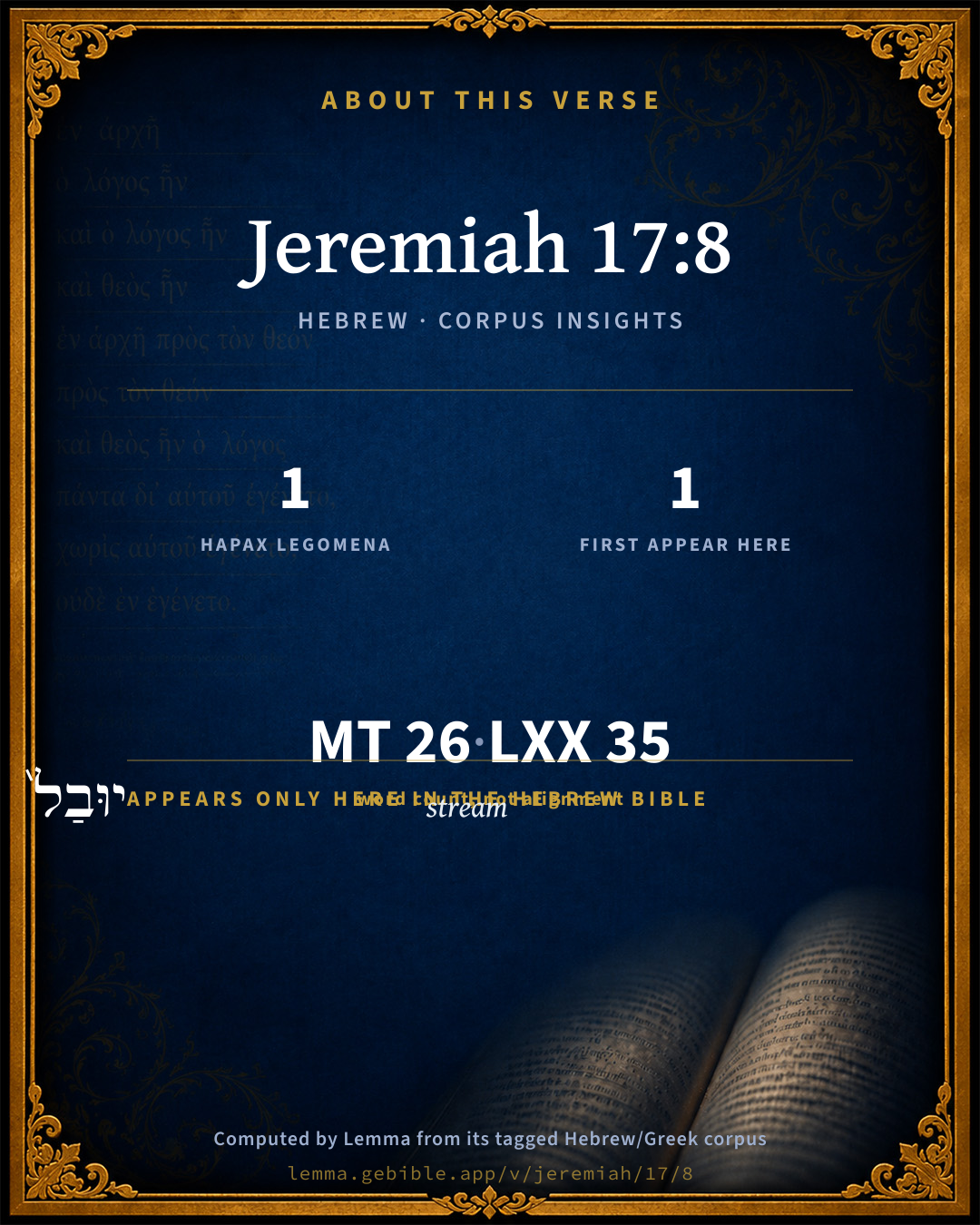
  • 1 hapax legomenon — only here in the Hebrew Bible
  • 1 first appearance in the Hebrew Bible
Full analysis ↓
Download a study sheet

One document with this verse’s original text, its word-by-word gloss line, the meaning frame, cross-references with their text, attributed commentary, and full source and license credits — printable, and it pastes into notes with its structure intact.

This verse Autodidact and up

Study sheet (.html) Plain text (.txt)

A passage Seminary Student

Up to 50 verses in one chapter. A passage sheet keeps up to 6 commentary sources and 12 cross-references per verse, in the order this page ranks them, and says so on the sheet whenever that leaves anything out. Ask for a single verse and you get the Autodidact verse sheet above.

Everything on this page stays free to read, with no account — the sheet is a download of what is already on screen, not access to it.

Want to remove ads? Support Godless Engineer
Compare translations 3

The same verse in 3 English versions, stacked beneath the original-language interlinear above. Click any original word for its lexicon entry.

Each is an independent rendering of the whole verse — the interlinear is not word-aligned to these translations.

Highlighted words mark where these versions differ — a whole-verse word diff, not a word-by-word alignment.

  • World English Bible Public Domain
    For he shall be as a tree planted by the waters, who spreads out its roots by the river, and shall not fear when heat comes, but its leaf shall be green; and shall not be careful in the year of drought, neither shall cease from yielding fruit.
  • King James Version Public Domain
    For he shall be as a tree planted by the waters, and that spreadeth out her roots by the river, and shall not see when heat cometh, but her leaf shall be green; and shall not be careful in the year of drought, neither shall cease from yielding fruit.
  • unfoldingWord Literal Text CC BY-SA 4.0
    For he shall be like a tree which is planted by waters, and by the river, which sends out its roots, and he does not fear when heat comes, for its leaf will be green, and in the year of drought he will not anxious, nor will he cease from producing fruit.

unfoldingWord Literal Text — © unfoldingWord, licensed CC BY-SA 4.0. Word-aligned USFM3 via Door43 (git.door43.org/unfoldingWord/en_ult).

Versions to compare (up to 4)

3 of 4 selected

Show all 18 translations

Every available English version of this verse, each an independent rendering of the whole verse.

  • World English Bible Public Domain
    For he shall be as a tree planted by the waters, who spreads out its roots by the river, and shall not fear when heat comes, but its leaf shall be green; and shall not be careful in the year of drought, neither shall cease from yielding fruit.
  • Berean Standard Bible Public Domain
    He is like a tree planted by the waters that sends out its roots toward the stream. It does not fear when the heat comes, and its leaves are always green. It does not worry in a year of drought, nor does it cease to produce fruit.
  • Majority Standard Bible Public Domain
    He is like a tree planted by the waters that sends out its roots toward the stream. It does not fear when the heat comes, and its leaves are always green. It does not worry in a year of drought, nor does it cease to produce fruit.
  • King James Version Public Domain
    For he shall be as a tree planted by the waters, and that spreadeth out her roots by the river, and shall not see when heat cometh, but her leaf shall be green; and shall not be careful in the year of drought, neither shall cease from yielding fruit.
  • American Standard Version (1901) Public Domain
    For he shall be as a tree planted by the waters, that spreadeth out its roots by the river, and shall not fear when heat cometh, but its leaf shall be green; and shall not be careful in the year of drought, neither shall cease from yielding fruit.
  • Revised Version (1885) Public Domain
    For he shall be as a tree planted by the waters, and that spreadeth out his roots by the river, and shall not fear when heat cometh, but his leaf shall be green; and shall not be careful in the year of drought, neither shall cease from yielding fruit.
  • Geneva Bible (1599) Public Domain
    For he shall be as a tree that is planted by the water, which spreadeth out her rootes by the riuer, and shall not feele when the heate commeth, but her leafe shall be greene, and shall not care for the yeere of drought, neyther shall cease from yeelding fruit.
  • Douay-Rheims (1899) Public Domain
    And he shall be as a tree that is planted by the waters, that spreadeth out its roots towards moisture: and it shall not fear when the heat cometh. And the leaf thereof shall be green, and in the time of drought it shall not be solicitous, neither shall it cease at any time to bring forth fruit.
  • Young's Literal Translation Public Domain
    And hath been as a tree planted by waters, And by a rivulet he sendeth forth his roots, And he doth not see when heat cometh, And his leaf hath been green, And in a year of dearth he is not sorrowful, Nor doth he cease from making fruit.
  • Literal Standard Version CC BY-SA 4.0
    And has been as a tree planted by waters, || And he sends forth his roots by a stream, || And he does not see when heat comes, || And his leaf has been green, || And he is not sorrowful in a year of scarcity, || Nor does he cease from making fruit.
  • Unlocked Literal Bible CC BY-SA 4.0
    For he will be like a tree planted by water, its roots will spread out by the stream. It will not fear the heat when it comes, for its leaves are always green. It is not anxious in a year of drought, and it will not stop producing fruit.
  • unfoldingWord Literal Text CC BY-SA 4.0
    For he shall be like a tree which is planted by waters, and by the river, which sends out its roots, and he does not fear when heat comes, for its leaf will be green, and in the year of drought he will not anxious, nor will he cease from producing fruit.
  • Darby Bible Public Domain
    For he shall be like a tree planted by the waters, and that spreadeth out its roots by the stream, and he shall not see when heat cometh, but his leaf shall be green; and in the year of drought he shall not be careful, neither shall he cease to yield fruit.
  • World Messianic Bible Public Domain
    For he will be as a tree planted by the waters, who spreads out its roots by the river, and will not fear when heat comes, but its leaf will be green, and will not be concerned in the year of drought. It won’t cease from yielding fruit.
  • Webster's Bible Public Domain
    For he shall be as a tree planted by the waters, and that spreadeth out her roots by the river, and shall not see when heat cometh, but her leaf shall be green; and shall not be anxious in the year of drouth, neither shall cease from yielding fruit.
  • Free Bible Version CC BY-SA 4.0
    They are like trees planted by water, sending out roots toward the stream. They don't panic when it gets hot; their leaves are always green. They don't worry during a time of drought—they go on producing fruit.
  • Bible in Basic English Public Domain
    For he will be like a tree planted by the waters, pushing out its roots by the stream; he will have no fear when the heat comes, but his leaf will be green; in a dry year he will have no care, and will go on giving fruit.
  • JPS Tanakh (1917) Public Domain
    For he shall be as a tree planted by the waters, and that spreadeth out its roots by the river, and shall not see when heat cometh, but its foliage shall be luxuriant; and shall not be anxious in the year of drought, neither shall cease from yielding fruit.

Literal Standard Version (2020), Covenant Press — licensed CC BY-SA 4.0. Text via the HelloAO Bible API (eBible.org). Unlocked Literal Bible (unfoldingWord) — licensed CC BY-SA 4.0. Text via the HelloAO Bible API (eBible.org). unfoldingWord Literal Text — © unfoldingWord, licensed CC BY-SA 4.0. Word-aligned USFM3 via Door43 (git.door43.org/unfoldingWord/en_ult). Free Bible Version, Dr. Jonathan Gallagher — licensed CC BY-SA 4.0. Text via the HelloAO Bible API (eBible.org).

Word by word

More ways to search: Search by grammar → Find every occurrence → Compare this word →

Practice this passage: Drill this verse → Learn its vocabulary →

יוּבַל֙
yûwbal
H3105
“stream”
Noun, Common, Masculine, Singular, Absolute
Part of Speech
Noun
Type
Common
Gender
Masculine
Number
Singular
State
Absolute
Full BDB Definition

Origin: from H2986

TWOT: 835b

stream
  1. וְהָיָ֞ה hâyâh H1961 “and · to be” Conjunction + Verb, Qal, Sequential Perfect, 3rd Person, Masculine, Singular
  2. כְּעֵ֣ץ ʻêts H6086 “like/as · tree” Preposition + Noun, Common, Masculine, Singular, Absolute
  3. שָׁת֣וּל shâthal H8362 “planted” Verb, Qal, Participle Passive, Masculine, Singular, Absolute
  4. עַל ʻal H5921 “upon” Preposition
  5. מַ֗יִם mayim H4325 “water(s)” Noun, Common, Masculine, Plural, Absolute
  6. וְעַל ʻal H5921 “and · upon” Conjunction + Preposition
  7. יְשַׁלַּ֣ח shâlach H7971 “to send” Verb, Piel, Imperfect, 3rd Person, Masculine, Singular
  8. שָֽׁרָשָׁ֔יו sheresh H8328 “roots · his” Noun, Common, Masculine, Plural, Construct + Suffix, Personal, 3rd Person, Masculine, Singular
  9. וְלֹ֤א lôʼ H3808 “and · not” Conjunction + Particle, Negative
  10. ירא yârêʼ H3372 “to fear” Verb, Qal, Imperfect, 3rd Person, Masculine, Singular
  11. יִרְאֶה֙ râʼâh H7200 “to see” Verb, Qal, Imperfect, 3rd Person, Masculine, Singular
  12. כִּֽי kîy H3588 “that” Conjunction
  13. יָבֹ֣א bôwʼ H935 “to enter” Verb, Qal, Imperfect, 3rd Person, Masculine, Singular
  14. חֹ֔ם chôm H2527 “heat” Noun, Common, Masculine, Singular, Absolute
  15. וְהָיָ֥ה hâyâh H1961 “and · to be” Conjunction + Verb, Qal, Sequential Perfect, 3rd Person, Masculine, Singular
  16. עָלֵ֖הוּ ʻâleh H5929 “leaf · his” Noun, Common, Masculine, Singular, Construct + Suffix, Personal, 3rd Person, Masculine, Singular
  17. רַֽעֲנָ֑ן raʻănân H7488 “luxuriant” Adjective, Adjective, Masculine, Singular, Absolute
  18. וּבִשְׁנַ֤ת shâneh H8141 “and · in/at · year of” Conjunction + Preposition + Noun, Common, Feminine, Singular, Construct
  19. בַּצֹּ֨רֶת֙ batstsôreth H1226 “drought” Noun, Common, Feminine, Singular, Absolute
  20. לֹ֣א lôʼ H3808 “not” Particle, Negative
  21. יִדְאָ֔ג dâʼag H1672 “to fear” Verb, Qal, Imperfect, 3rd Person, Masculine, Singular
  22. וְלֹ֥א lôʼ H3808 “and · not” Conjunction + Particle, Negative
  23. יָמִ֖ישׁ mûwsh H4185 “to depart” Verb, Qal, Imperfect, 3rd Person, Masculine, Singular
  24. מֵעֲשׂ֥וֹת ʻâsâh H6213 “from · to do” Preposition + Verb, Qal, Infinitive Construct
  25. פֶּֽרִי pᵉrîy H6529 “fruit” Noun, Common, Masculine, Singular, Absolute

About this verse

These counts appear in no published source. They are computed here, from the morphology-tagged text and Lemma’s own curated glosses. What Lemma adds →

26
words
22
distinct lemmas
Prophets
section

Notable vocabulary

1 hapax legomenon — a word that appears only here in the entire Hebrew Bible:

  • יוּבַל֙ stream H3105

First appearance in Scripture

This word makes its first canonical appearance in the Hebrew Bible here:

  • יוּבַל֙ stream H3105

Shared distinctive vocabulary

בַּצֹּ֨רֶת֙ drought H1226 occurs in 2 verses of the Hebrew Bible. Also found in:

Grammatical profile

  • 10 verbs
  • 9 nouns
  • 1 adjective
  • 2 prepositions
  • 1 conjunction
  • 3 particles

Verb forms

  • וְהָיָ֞ה Qal · Sequential Perfect
  • שָׁת֣וּל Qal · Participle Passive
  • יְשַׁלַּ֣ח Piel · Imperfect
  • ירא Qal · Imperfect
  • יִרְאֶה֙ Qal · Imperfect
  • יָבֹ֣א Qal · Imperfect
  • וְהָיָ֥ה Qal · Sequential Perfect
  • יִדְאָ֔ג Qal · Imperfect
  • יָמִ֖ישׁ Qal · Imperfect
  • מֵעֲשׂ֥וֹת Qal · Infinitive Construct

Repetition

Words recur within this verse — often emphatic in Hebrew:

  • וְהָיָ֞ה to be H1961 ×2
  • עַל upon H5921 ×2
  • וְלֹ֤א not H3808 ×3

Hebrew & Septuagint length

In the original languages it is 26 Hebrew tokens and 35 Greek tokens — but the two are counted differently (Hebrew bundles its prefixes and suffixes into one token; the Greek is in lemma form), so that isn’t a like-for-like length.

Cross-references

7

Topical passages linked to Jeremiah 17:8 in the Treasury of Scripture Knowledge — connected by theme and wording, ordered by reader-vote popularity; previews shown in the World English Bible.

  • Psalms 1:3 He will be like a tree planted by the streams of water, That brings forth its fruit in its season, Whose leaf also does not wither. Whatever he does shall prosper.
  • Isaiah 58:11 and Yahweh will guide you continually, and satisfy your soul in dry places, and make strong your bones; and you shall be like a watered garden, and like a spring of water, whose waters don't fail.
  • Ezekiel 47:12 By the river on the bank of it, on this side and on that side, shall grow every tree for food, whose leaf shall not wither, neither shall the fruit of it fail: it shall bring forth new fruit every month, because the waters of it issue out of the sanctuary; and the fruit of it shall be for food, and the leaf of it for healing.
  • Ezekiel 31:4–10 The waters nourished it, the deep made it to grow: the rivers of it ran round about its plantation; and it sent out its channels to all the trees of the field.
  • Psalms 92:10–15 But you have exalted my horn like that of the wild ox. I am anointed with fresh oil.
  • Job 8:16 He is green before the sun, His shoots go forth over his garden.
  • Jeremiah 14:1–6 The word of Yahweh that came to Jeremiah concerning the drought.

Cross-references courtesy of OpenBible.info (CC BY 4.0).

Hebrew and Greek witnesses Masoretic Hebrew ↔ Greek Septuagint

The same verse in the two great witnesses to the Old Testament, shown verse-for-verse.

These are two independent witnesses, not word-aligned to each other, and the Septuagint is shown in lemma (dictionary) form.

Hebrew Jeremiah 17:8 Masoretic · Westminster Leningrad Codex

וְהָיָ֞ה כְּעֵ֣ץ שָׁת֣וּל עַל מַ֗יִם וְעַל יוּבַל֙ יְשַׁלַּ֣ח שָֽׁרָשָׁ֔יו וְלֹ֤א ירא יִרְאֶה֙ כִּֽי יָבֹ֣א חֹ֔ם וְהָיָ֥ה עָלֵ֖הוּ רַֽעֲנָ֑ן וּבִשְׁנַ֤ת בַּצֹּ֨רֶת֙ לֹ֣א יִדְאָ֔ג וְלֹ֥א יָמִ֖ישׁ מֵעֲשׂ֥וֹת פֶּֽרִי

For he shall be as a tree planted by the waters, who spreads out its roots by the river, and shall not fear when heat comes, but its leaf shall be green; and shall not be careful in the year of drought, neither shall cease from yielding fruit.

World English Bible · Public Domain

Greek LXX Structure differs

In the Septuagint, Jeremiah is about an eighth shorter than the Hebrew and arranges its material differently — the Oracles Against the Nations (Hebrew chapters 46–51) appear in the middle of the Greek book, after 25:13. Because the chapter and verse boundaries do not line up, a verse-for-verse comparison with the Hebrew is not shown.

A verse-for-verse comparison isn’t shown here because the chapters and verses don’t line up. Switch to the LXX edition with the MT / LXX toggle above to read the Greek directly.

On this verse, Ellicott's Commentary for English Readers discusses the Septuagint’s reading. Read the note in Commentary ↓

Hebrew: Westminster Leningrad Codex (CC BY 4.0). Greek: Septuagint (public domain); English from a public-domain English Septuagint. How the Septuagint differs from the Hebrew →

Targum (Aramaic paraphrase)

1

The Targum is the ancient Jewish Aramaic paraphrase of the Hebrew Scriptures — an interpretive translation, not the Hebrew text itself. Onkelos (literal) and Pseudo-Jonathan (expansive) render the Torah, and Jonathan the Prophets. Coverage is partial: where no permissively-licensed English translation exists for a verse, only the Aramaic is shown. This is verse-level text, not a word-by-word alignment to the Hebrew.

  1. Targum Jonathan Prophets (Joshua–Malachi)
    וִיהֵי כְּאִילַן דִשְׁתִיל עַל מַבּוּעַ דְמַיִן וְעַל נִגְרִין יִשְׁלַח שׁוּרְשׁוֹהִי וְלָא יֶחֱזֵי אֲרֵי יֵיתֵי חוֹמָא וִיהוֹן טְרָפוֹהִי עַבּוּף וּבִשְׁנַת בְּצוּרְתָא לָא יִתַּר וְלָא יִפְסוֹק מִלְמֶעְבַּד פֵּרִין:

    (no public-domain English translation for this verse)

    Targum Jonathan — Aramaic: “Mikraot Gedolot” (public domain). English: “Sefaria Community Translation” (CC0 1.0 (public-domain dedication)); “London "Chaldee Paraphrase," 1871” (public domain). Text via Sefaria.

Commentary

Notes on Jeremiah 17:8 from classic Christian and Jewish commentators (each source and its license shown beneath its notes). The classic Christian expositions comment on the surrounding passage and are grouped to its opening verse, so a note may address several verses; the Jewish commentaries on the Tanakh (Rashi and others) are per-verse, so they appear only where the commentator wrote on this verse.

Lemma curates 59 commentaries, every one of them public domain or Creative Commons licensed, each selected and text-cleaned for this edition rather than reprinted as found. About our sources →

Trapp's Complete Commentary

John Trapp

Jer 17:8 For he shall be as a tree planted by the waters, and [that] spreadeth out her roots by the river, and shall not see when heat cometh, but her leaf shall be green; and shall not be careful in the year of drought, neither shall cease from yielding fruit.

Ver. 8. For he shall be as a tree planted.] It is plain that he here alludeth to Psa 1:3; see the notes there. The laurel, saith Pliny, is never thunderstruck. Sure it is that he who trusteth in God taketh no hurt; his heart is fixed and unmovable {Psa 112:7-8} to endure things almost incredible. {Psa 27:3 Isa 14:32 cf. Isa 26:4-5} True trust will certainly triumph at length, as that which leaneth on the Lord and the power of his might, the surest support.

By the river.] The Hebrew here is jubal; and the jubilee, saith one, had its name from this word, which signifieth a stream or watercourse, as carrying us to Christ, who is the truth of this type. {Luk 18:19}

But his leaf shall be green.] Neither falling nor fading.

And shall not be careful in the year of drought.] A metaphor, setting forth the full assurance of faith that is in some good men, such as was that holy martyr, {a} who said, I will henceforth be careless, according to my name.

“ Si fractus illabatur orbis,

Impavidum ferient ruinae. ”

Neither shall cease from yielding fruit.] As they say the lemon tree doth not, but ever and anon sendeth forth new lemons as soon as the former are fallen down with ripeness. {b}

{a} John Careless, Acts and Mon., fol. 1743.

{b} Theoph., Plin.

John Trapp, A Commentary or Exposition upon All the Books of the Old and New Testament (1647–1656) — public domain. Text from a community e-Sword module.

The Biblical Illustrator

Joseph S. Exell

Jer_17:8

Shall not see when heat cometh, but her leaf shall be green.

Verdure in the midst of desolation

I. The fact itself. Meets us everywhere in the natural world. So also in the kingdom of grace. Spiritual health depends not only or mainly on our circumstances, but on the temper and state of our souls. In cottage, in palace; in want, in affluence; in retirement, on busy Exchange; in youth, in age; in health, in disease and sickness, Gods Enochs have walked with God. Look, then, within for source of weakness, decay, low spiritual state.

II. The explanation.

1. He lives in constant believing communion with God.

2. He improves what advantages he possesses.

3. He retains the good he receives.

4. He sedulously improves and turns to account the grace he has. (Islay Burns.)

The continuousness of true progress

True religion takes such a thorough hold upon all the deeply seated principles of our nature--so fastens itself upon the entire soul, that the high probability is, that where it has once commenced it will continue.

I. The principle of inquiry is an influential force in human nature and true religion is suited to maintain a master hold upon that. Does religion proscribe any field of thought? Does it bolt any of the golden gates of science? No; it throws open the whole domain of truth, and spreads it forth, not only in all its amplitude to the mind, but in lights and colours of special fascination and charm. The mere speculative theist looks through nature up to natures God; but the truly religious thinker feels that God is both philosophically and emotionally nearer to him than nature, and he looks through God down upon natures mighty realms, and thus increases the charms of nature a thousandfold. Does not the picture appear in new beauties, after love for the artist has risen in the heart of the spectator? And does not the universe burst into new glories upon the vision of that man in whose heart supreme love for the Creator has been produced? But it may be said, granting that religion lays open all the realms of science, and heightens, incomparably, its charms; may it not be, that in the course of time the intellect may become so conversant with all truth, as to have neither need nor motive for future inquiry, and thereby religion would lose this master hold upon man? We think not. Who shall count the number of Gods works, or describe the vastness of His universe?

II. The principle of love is a mighty power in human nature and true religion is suited to maintain a master hold upon that. Love is the spring and spirit of the universe. And, thank God, it is, notwithstanding our depravity, the strongest force in our nature still. Now, religion calls out this powerful element in our nature in its two most powerful forms, namely, gratitude and admiration. How powerfully does gratitude bind us to our benefactors. The language of the heart to such is, entreat me not to leave thee, nor to return from following after thee. Kindness is might of the highest order; by it we can take hold of mens strength grasp their very souls and bind them to us by indissoluble bonds Nor is love, in the form of admiration, a weaker force. When it is directed to artistic beauty, it is powerful; when it is directed to natural beauty, it is more powerful still; but when it is directed to moral beauty, it is most powerful of all. Beauty carries captive the soul. The fine painting is attractive; the magnificent landscape more attractive still; the true hero, the embodiment of the highest moral qualities, is most attractive of all. So long, therefore, as the supreme love of gratitude and admiration are directed to God, the soul must, from its very nature, be vitally allied to Him. And is not this love, where it has once been awakened, likely to continue?

III. The principle of rightness is a powerful force in human nature and true religion is suited to maintain a master hold upon that. Men under the influence of conscience have voluntarily braved the greatest perils, endured the greatest sufferings, and made the greatest sacrifices. Looking at the power and history of this element of our nature, there is a high probability that those attachments and enterprises will be lasting which secure its entire sympathy and sanction. And are not such preeminently the attachments and enterprises of a truly religious life? Does not conscience, this monarch energy of the soul, not only sanction supreme love to God, and entire consecration to His service, but imperiously demand it?

IV. The principle of hope is a strong force in human nature and true religion is suited to maintain a master hold upon that. The best and choicest blessings are ever in the region of hope--a region all flowers and fruit, and sunshine; across whose beauteous landscapes there never sweeps the withering blight or the furious storm, and whose suns and stars are never dimmed by cloud nor mist. Now, the probability of a mans continuance in any enterprise, depends greatly upon its connection with hope. Half the working world toil on in their respective lines of action, not for the sake of present results, but for the sake of what hope has promised them in the future What connection has the religious life with this hope? Does the religious enterprise hold out any bright prospect? If in connection with religion there should ever come a time when there was nothing more to expect, religion would lose much of its power over man, and there would be a strong probability of a relapse. But if the prospect widened and brightened as the man advanced, would not the chances of a retrogression decrease with every successive step? This is just the fact in a religious life; the more actually attained, the more prospectively appears.

V. The principle of habit is a powerful force in human nature and true religion is suited to maintain a master hold upon that. The power of this principle is universally acknowledged, and in some eases is felt invincible. In the history of sin its force is the most striking. All the crimes in the long black narrative of human guilt you may trace, in a great measure, to habit. Every sinful act is another cord woven into that mighty cable of habit, which binds the spirit to the throne of darkness--a fresh momentum added to the falling soul. Now, if habit is so powerful in binding to sin, our position is, that it becomes more powerful in binding to holiness.

1. Because, in the one case, the mans conscience--the very root of his spiritual nature.

is in favour of his present course, and against change; in the other case, the whole force of his conscience perpetually against the present mode of life, and is demanding reformation.

2. Because, in the one case, Divine influence is ever present to stimulate and to cheer the spirit on; but in the other, the whole tide of this influence rolls in powerful opposition.

3. Because, in the one case, there are no unquestionable instances of change; in the other, instances abound on every hand; every conversion to God is an example. (Homilist.)

The triumph of trust

The laurel, saith King, is never thunderstruck. Sure it is that he who trusteth in God taketh no hurt; his heart is fixed and immovable to endure things almost incredible. True trust will certainly triumph at length. (John Trapp.)

Fruit expected from the Church

A church is like a great tree in the desert which holds out the promise of fruit, and towards which all the spiritually hungry turn. There can be few sadder things in this world than a church, promising by its very name, by its spire pointing to heaven, by its open doors, by its songs and services, by its bells of invitation, to give food to the hungry, refreshment to the weary, comfort to the sorrowing, and then failing to keep its promises to the souls that come expecting. (J. H. Miller.)

The Biblical Illustrator, edited by Joseph S. Exell (c. 1880s–1900s) — public domain. Text from a community e-Sword module.

MacLaren's Expositions of Holy Scripture

Alexander MacLaren

Jeremiah

THE HEATH IN THE DESERT AND THE TREE BY THE RIVER

Jer 17:6, Jer 17:8.

The prophet here puts before us two highly finished pictures. In the one, the hot desert stretches on all sides. The fierce ‘sunbeams like swords’ slay every green thing. The salt particles in the soil glitter in the light. No living creature breaks the melancholy solitude. It is a ‘waste land where no one came, or hath come since the making of the world.’ Here and there a stunted, grey, prickly shrub struggles to live, and just manages not to die. But it has no grace of leaf, nor profitableness of fruit; and it only serves to make the desolation more desolate.

The other carries us to some brimming river, where everything lives because water has come. The pictures are coloured by Eastern experience. For in those lands more than beneath our humid skies and weaker sunshine, the presence or absence of running water makes the difference between barrenness and fertility. Dipping their boughs in the sparkling current, and driving their roots through the moist soil, the bordering trees lift aloft their pride of foliage and bear fruits in their season.

So, says Jeremiah, the two pictures represent two sets of men; the one, he who diverts from their true object his heart-capacities of love and trust, and clings to creatures and to men, ‘making flesh his arm and departing from the living God’; the other, he who leans the whole weight of his needs and cares and sins and sorrows upon God. We can make choice of which shall be the object of our trust, and according as we choose the one or the other, the experience of these vivid pictures will be ours.

Let me briefly, then, draw out the points of contrast in these two companion sketches.

I. The one is in the desert, the other by the river.

Underneath the pictures there lies this thought, that the direction of a man’s trust determines the whole cast of his life, because it determines, as it were, the soil in which he grows. We can alter our habitat. The plant is fixed; but ‘I saw men as trees-yes! but as ‘trees walking.’ We can walk, and can settle where we shall be rooted and whence we shall draw our inspiration, our confidence, our security. The man that chooses-for it is a matter of choice-to trust in any creature thereby wills, though he does not know it, that he shall dwell in a ‘salt land and not inhabited.’ The man that chooses to cast his whole self into the arms of God, and in a paroxysm of self-distrust to realise the divine helpfulness and presence, that man will soon know that he is ‘planted by the river.’

Now, the poor, little dusty shrub in the desert, whose very leaves have been modified into prickles, is fit for the desert, and is as much at home there as are the willows by the water-courses with their lush vegetation in their moist bed. But if a man makes that fatal choice which so-many of us are making, of shutting out God from his confidence and his love, and squandering these upon earth and upon creatures, he is as fatally out of harmony with the place which he has chosen for himself, and as much away from his natural soil, as a tropical plant would be amongst the snows of Arctic glaciers, or a water-lily in the Sahara.

Considering all that I am and need, what and where is my true home and the soil in which I can grow securely, and fear no evil? Brethren, there is only one answer to that question. The very make of a man’s spirit points to God, and to God alone, as the natural place for him to root and grow in. You, I, the poorest and humblest of men, will never be right, never feel that we are in our native soil, and compassed with the appropriate surroundings, until we have laid our hearts and our hands on the breast of God, and rested ourselves on Him. Not more surely do gills and fins proclaim that the creature that has them is meant to roam through the boundless ocean, nor the anatomy and wings of the bird witness more plainly to its destination to soar in the open heavens than the make of your spirits testifies that God, and none less or lower, is your portion. We are built for God, and unless we recognise and act upon that conviction, we are like the prickly shrub in the desert, whatever good may be around us; and if we do recognise and act upon it, whatever parched ground may seem to stretch on all sides, there will be soil moist enough for us to draw refreshment and vitality from it.

If that be so, brethren, what insanity the lives of multitudes of us are! As well might bees try to suck honey from a vase of wax flowers as we to draw what we need from creatures, from ourselves, from visible and material things.

What would you business men think of some one who went and sold out all his stock of Government or other sound securities, and then flung the proceeds down a hole in South Africa, out of which no gold will ever come? He would be about as wise as are the people who fancy that these hearts of theirs will ever be at home except they find a home in God.

Where else will you find love that will never fail, nor change, nor die? Where else will you find an object for the intellect that will yield inexhaustible material of contemplation and delight? Where else infallible direction for the will? Where else shall weakness find unfailing strength, or sorrow, adequate consolation, or hope, certain fulfilment, or fear, a safe hiding-place? Nowhere besides. Oh! then, brethren, do, I beseech you, turn away your heart’s confidence and love from earth and creatures; for until the roots of your life go down into God, and you draw your life from Him, you are not in your right soil.

II. The one can take in no real good; the other can fear no evil.

One verse of our text says, ‘He shall not see when good cometh’; the other one, according to our Authorised Version, ‘He shall not see when heat cometh.’ But a very slight alteration of one word in the original gives a better reading, which is adopted in the Revised Version, where we have, ‘and shall not fear when heat cometh.’ That alteration is obviously correct, because there follows immediately a parallel clause, ‘and shall not be careful’-or anxious-’in the year of drought.’ In both these clauses the metaphor of the tree is a little let go; and the man who is signified by it comes rather more to the front than in the remainder of the picture. But that is quite natural.

So look at these two simple thoughts for a moment. He whose trust is set upon creatures is thereby disabled from recognising what is his highest good. His judgment is perverted. There is the explanation of the fact that men are contented with the partial and evanescent blessedness that may be drawn from human loves and companionship and material things. It is because they have gone blind, and the false direction of their confidence, has put out their eyes. And if any of my hearers are living careless about God, and all that comes from Him, and perfectly contented with that which they find in this visible, diurnal sphere, that is not because they have the good which they need, but because they do not know that good when they see it, and have lost the power of discerning what is really for their benefit and blessedness.

There is nothing sadder in this world than the conspiracy into which men seem to have entered to ignore the highest good, and to profess themselves contented with the lowest. I remember a rough parable of Luther’s-the roughness of which may be pardoned for the force and vividness of it-which bears on this matter. He tells how a company of swine were offered all manner of dainty and refined foods, and how, with a unanimous swinish grunt, they answered that they preferred the warm, reeking ‘grains’ from the mash-tub. The illustration is coarse, but it is not an unfair representation of the choice that some of us are making.

‘He cannot see when good cometh.’ God comes, and I would rather have some more money. God comes, and I prefer some woman’s love. God comes, and I would rather have a prosperous business. God comes, and I prefer beer. So I might go the whole round. The man that cannot see good when it is there before his face, because the false direction of his confidence has blinded his eyes, cannot open his heart to it. It comes, but it does not come in. It surrounds him, but it does not enter into him. You are plunged, as it were, in a sea of possible felicity, which will be yours if your heart’s direction is towards God, and the surrounding ocean of blessedness has as little power to fill your heart as the sea has to enter some hermetically sealed flask, dropped into the middle of the Atlantic. ‘He cannot see when good cometh.’ Blind, blind, blind! are multitudes of us.

Turn to the other side. ‘He shall not fear when heat cometh,’ which is evil in those Eastern lands, ‘and shall not be careful in the year of drought.’ The tree, that sends its roots towards a river that never fails, does not suffer when all the land is parched. The man who has driven his roots into God, and is drawing from that deep source what is needful for his life and fertility, has no occasion to dread any evil, nor to gnaw his heart with anxiety as to what he is to do in parched days. Troubles may come, but they do not go deeper than the surface. It may be all cracked and caked and dry, ‘a thirsty land where no water is,’ and yet deep down there may be moisture and coolness.

Faith, which is trust, and fear are opposite poles. If a man has the one, he can scarcely have the other in vigorous operation. He that has his trust set upon God does not need to dread anything except the weakening or the paralysing of that trust; for so long as it lasts it is a talisman which changes evil into good, the true philosopher’s stone which transmutes the baser metals into gold; and, so long as it lasts, God’s shield is round him and no evil can befall him.

Brethren, if our trust is in God, it is unworthy of it and of us to fear, for all things are His, and there is no evil in evil as men call it, so long as it does not draw away our hearts from our Father and our Hope. Therefore, he that fears let him trust; he that trusts let him not be afraid. He that sets his heart and anchors his hopes of safety on any except God, let him be afraid, for he is in a very stern world, and if he is not fearful he is a fool.

So the direction of our trust, if it is right, shuts all real evil out from us, and if it is wrong, shuts us out from all real good.

III. The one is bare, the other clothed with the beauty of foliage.

The word which is translated ‘heat’ has a close connection with, if it does not literally mean, ‘naked’ or ‘bare.’ Probably, as I have said, it designates some inconspicuously leaved desert shrub, the particular species not being ascertainable or a matter of any consequence. Leaves, in Scripture, have a recognised symbolical meaning. ‘Nothing but leaves’ in the story of the fig-tree meant only beautiful outward appearance, with no corresponding outcome of goodness of heart, in the shape of fruit. So I may venture here to draw a distinction between leafage and fruit, and say that the one points rather to a man’s character and conduct as lovely in appearance, and in the other as morally good and profitable.

This is the lesson of these two clauses-misdirected confidence in creatures strips a man of much beauty of character, and true faith in God adorns a soul with a leafy vesture of loveliness. Now, I have no doubt that there start up in your minds at once two objections to that statement: first, that a great many godless men do present fair and attractive features of character; and secondly, that a great many Christian men do not. I admit both things frankly, and yet I say that, for the highest good, the perfect crowning beauty of any human character, this is needed, that it should cling to God. ‘Whatsoever things are lovely and of good report’ lack their supreme excellence, the diamond on the top of the royal crown, the glittering gold on the summit of the campanile, unless there is in them a distinct reference to God.

I believe that I am speaking to some who would not profess themselves to be religious men, and who yet are truly desirous of cultivating in their character the Fair and the Good. To them I would venture to say- brethren, you will never be so completely, so refinedly, so truly, graceful as you might be, unless the roots of your character ‘are hid with Christ in God.’

‘A servant with this clause

Makes drudgery divine,’

said good old George Herbert. And any act, however humble, on which the light from God falls, will gleam with a lustre else unattainable, like some piece of broken glass in the furrows of a ploughed field.

Sure I am that if we Christian people had a deeper faith, we should have fairer lives. And I beseech you, my fellow-believers in Jesus Christ, not to supply the other side with arguments against Christianity, by showing that it is possible for a man to say and to suppose that he sets his heart on God, and yet to bear but little leafage of beauty or grace of character. Goodness is beauty; beauty is goodness. Both are to be secured by communion and union with Him who is fairer than the children of men. Dip your roots into the fountain of life-it is the fountain of beauty as well as of life, and your lives will be green.

IV. Lastly, the one is sterile, the other fruitful.

I admit, as before, that this statement often seems to be contradicted, both by the good works of godless men, and by the bad works of godly ones. But for all that, I would urge you to consider that the only works of men worth calling ‘fruit,’ if regard is had to their capacities, relations, and obligations, are those done as the outcome and consequence of hearts trusting in the Lord. The rest of the man’s activities may be busy and multiplied, and, from the point of view of a godless morality, many may be fair and good; but if we think of him as being destined, as his chief end, ‘to glorify God, and {so} to enjoy Him for ever,’ what correspondence between such a creature and acts that are done without reference to God can there ever be? They are not worth calling ‘fruit.’ At the most they are ‘wild grapes,’ and there comes a time when they will be tested and the axe laid to the root of the trees, and these imperfect deeds will shrivel up and disappear.

Trust will certainly be fruitful. In so saying we are upon Christian ground, which declares that the outcome of faith is conduct in conformity with the will of Him in whom we trust, and that the productive principle of all good in man is confidence in God manifest to us in Jesus Christ.

So we have not to begin with work; we have to begin with character. ‘Make the tree good,’ and its fruit will be good. Faith will give power to bring forth such fruit; and faith will set agoing the motive of love which will produce it. Thus, dear brethren, we come back to this-the prime thing about a man is the direction which his trust takes. Is it to God? Then the tree is good; and its fruit will be good too. If you will trust yourselves to ‘God manifest in the flesh,’ to Jesus Christ and His work for you and in you, then you will be as if ‘planted by the rivers of water,’ you will be able to receive into yourselves, and will receive, all good, and be masters of all evil, will exhibit graces of character else impossible, and will bring forth ‘fruit that shall remain.’ Separated from Him we are nothing, and can bring forth nothing that will stand the light of that last moment.

Brother, turn your trust to that dear Lord, and then you will have your ‘fruit unto holiness, and the end shall be everlasting life,’ when the transplanting season comes, and they that have been ‘planted in the house of the Lord’ below shall ‘flourish in the courts of our God’ above, and grow more green and fruitful, beside the ‘river of the water of life that proceedeth from the throne of God and of the Lamb.’

Alexander MacLaren, Expositions of Holy Scripture (1904–1910) — public domain. Text from a community e-Sword module.

Geneva Bible (1599)

Geneva Bible translators

Read Ps. 1:3.

Geneva Bible (1599) marginal notes — public domain. Text via Bolls.life.

Jamieson, Fausset & Brown

Robert Jamieson, A. R. Fausset & David Brown

(Psa 1:3).

shall not see--that is, feel. Answering to Jer 17:6; whereas the unbelievers "shall not see (even) when good cometh," the believer "shall not see (so as to be overwhelmed by it even) when heat (fiery trial) cometh." Trials shall come upon him as on all, nay, upon him especially (Heb 12:6); but he shall not sink under them, because the Lord is his secret strength, just as the "roots spread out by a river" (or, "water-course") draw hidden support from it (Co2 4:8-11).

careful--anxious, as one desponding (Luk 12:29; Pe1 5:7).

drought--literally, "withholding," namely, of rain (Jer 14:1); he here probably alludes to the drought which had prevailed, but makes it the type of all kinds of distress.

Jamieson, Fausset & Brown — Commentary Critical and Explanatory on the Whole Bible (1871) — public domain (CC PDM 1.0). Text via the HelloAO Bible API.

Adam Clarke's Commentary

Verse 8. As a tree planted by the waters] Which is sufficiently supplied with moisture, though the heat be intense, and there be no rain; for the roots being spread out by the river, they absorb from it all the moisture requisite for the flourishing vegetation of the tree.

Shall not see when heat cometh] Shall not feel any damage by drought, for the reason already assigned. It shall be strong and vigorous, its leaf always green; and shall produce plenty of fruit in its season.

Adam Clarke's Commentary on the Bible (1810–1826) — public domain. Text from a community e-Sword/MySword module.

John Calvin's Commentaries

He then adds a comparison, answerable to that in the former clause, He shall be like a tree planted by the waters, which sends its roots upon, or nigh the river, which shall not see when heat comes. Here the Prophet points out the difference between the true servants of God, who trust in him, and those who are inflated with their own false imaginations, so that they seek safety either from themselves or from others: he had said of the unbelieving, that they are like tamarisks, which flourish for a time, but never bring forth any fruit, and are also soon dried up by the heat; but he says now as to the faithful, that they are like trees planted by the waters, and send their roots to the river. The tamarisks have the appearance of life, but there is no moisture in a dry soil; so their roots quickly dry up; but the servants of God, they are planted, as it were, in a moist soil, irrigated continually by streams of water. Hence the Prophet adds, that this tree shall not see the heat when it comes

He indirectly intimates that God’s children are not exempt from adversities; for they feel the heat of the sun, like trees, who are exposed to it; but moisture is supplied, and the juice diffuses itself through all the branches: hence the Prophet says, that the leaf was green, even by means of the moisture which the earth supplied, being itself watered. The Prophet then intimates, that though God’s children feel great heats, as well as the unbelieving; for this is common to both, they shall yet be kept safe; for though the sun dries up by its great heat, there is yet a remedy; for the root has moisture, derived from the irrigation of water.

We now then see how suitable is every part of the comparison. He says farther, that it shall not be careful. The verb דאג, dag, means to fear and to be careful; it means also sometimes to grieve, and so some render it here, “It will not grieve” but the other meaning seems better to me, — that the tree planted nigh streams of waters is not afraid of heat; and then he adds, nor shall it cease from producing fruit

Nearly the same similitude is found in Psalm 1:3, only that the fear of God and meditation on his law are mentioned, and not hope:

“Blessed is the man, etc., who meditates on the law of God;”

but Jeremiah speaks here expressly of the hope which ought to be put in God alone. Yet the two Prophets well agree together as to this truth, — that all their hopes are accursed, by which men inebriate themselves, while they seek salvation in themselves or in the world, and make more account of their own counsels, virtues, power, or the aids they expect from others, than of God himself and of his promises: for he who really meditates on the law of God day and night, well knows thereby, where to put his trust for salvation, both temporal and eternal. It follows —

John Calvin's Commentaries (1540-1563) — public domain. Text from the Calvin Translation Society English edition (1840s-50s) via the Christian Classics Ethereal Library (ccel.org). Calvin's coverage is partial (roughly two-thirds of the Bible); uncommented books and verses are honest gaps, never fabricated. The 19th-century editor's footnotes and remarks are omitted so the notes are faithfully Calvin's own voice.

Ellicott's Commentary for English Readers

(8) Shall not see when heat cometh.—Another reading, followed by the LXX. and Vulgate, gives shall not fear; there is, however, more force in the repetition of the same word as in Jer_17:6. The man who trusts is like the strong tree, clothed with foliage, that “does not see,” i.e., does not regard or feel, the presence of the heat. Technically the meaning is the same in both cases, but in the latter case with the emphasised contrast of a parallelism. Fed by the stream that never fails, it “shall not be careful” or anxious about the scorching heat of summer. As the blasted heath sees no good, so the tree, in this case, sees no evil.

A Bible Commentary for English Readers, edited by Charles John Ellicott (1878–1897) — public domain. Text from a community e-Sword module.

The Cambridge Bible for Schools and Colleges

gen. ed. J. J. S. Perowne

8. fear] to be preferred, as is shewn by the parallelism, “shall not be careful,” to the mg. see, which is the reading proposed in MT. mg. The latter was doubtless suggested to the Mass. by “see” in Jer_17:6.

shall not be careful in the year of drought] because, as planted by the waterside, it is independent of rain.

The Cambridge Bible for Schools and Colleges (gen. ed. J. J. S. Perowne; Cambridge University Press, 1878–1918) — public domain. Text from a community e-Sword module.

John Gill's Exposition

For he shall be as a tree planted by the waters,.... Not as a "heath or shrub", but as a "tree", a green olive tree, a palm tree, a cedar in Lebanon, a fruitful flourishing tree; and he is one that really is a tree of righteousness, that is filled with the fruits of righteousness; and not like one of the trees of the wood, that grows wild, or as a wild olive tree, but as one "planted" in a garden, vineyard, or field; and is one that is planted in Christ, in the likeness of his death and resurrection, and in the house of the Lord; and that not only by means of the ingrafted word, and of Gospel ministers, who plant and water instrumentally; but by the Lord himself, as the efficient cause; and therefore called "the planting of the Lord"; and such plants as shall never be plucked up, Isa 60:21 and not like the earth in the wilderness, or trees in dry and barren soils; but like such that are planted "by the waters", which run about their roots, and make them fruitful; by which may be meant the love of God, and the streams of it; the fulness of grace in Christ, and the word and ordinances, the still waters of the sanctuary, Psa 23:2,

and that spreadeth out her roots by the river; and which is the cause of the spreading of them: such an one is rooted in Christ, and in the love of God, which is as a river; with which being watered, he casts out his roots as Lebanon, as the cedars there; and is both firm and fruitful; see Hos 14:5,

and shall not see when heat cometh; shall perceive it, nor be affected with it, being planted so near a river: or "shall not fear"; which is the Cetib, or writing of the Hebrew text; and is followed by the Septuagint, Syriac, and Arabic versions; though the Keri, or marginal reading, is, "shall not see"; which is followed by the Targum, and by us, and others. The man that trusts in the Lord, he is not afraid of the heat of persecution when it comes, nor is he hurt by it; he does not perceive it, but grows the more under it; when a hypocrite and formal professor is withered by it; see Mat 13:6,

but her leaf shall be green; neither fail, nor lose its colour: a profession of faith is held without wavering; there being a radical moisture, the truth of grace, a well of living water, springing up into everlasting life, to supply and support it:

and shall not be careful in the year of drought; for lack of moisture, having a sufficiency. The man that trusts in the Lord is, or ought to be, and may he, careful for nothing, but cast all his care on the Lord, that careth for him: whether this year of drought is to be understood of famine, in a literal sense; of carelessness in which, or strength of faith, Habakkuk is a famous instance, Hab 3:17 or of a famine of the word, in a spiritual sense, through the persecutions of men; yet even the believer is not solicitous, or in anxious distress; God provides food for him, and nourishes him, as he does his church, though forced to fly into the wilderness:

neither shall cease from yielding fruit; the fruits of grace and righteousness, the fruits of good works, and which are brought forth by the good man, the believer in Christ, even unto old age, Psa 92:14 with the whole compare Psa 1:3, to which there seems to be an allusion.

John Gill's Exposition of the Whole Bible (1746–1763) — public domain (CC PDM 1.0). Text via the HelloAO Bible API.

Haydock's Catholic Bible Commentary

Fruit. See Psalm i. 3. (Pindar, Nem. viii.) How different from the wicked! (Calmet)

George Leo Haydock (1774–1849), Haydock's Catholic Family Bible and Commentary, 1859 edition — public domain. Excludes Psalms (Douay-Rheims chapter numbering differs from Protestant) and Deuterocanonical books (Catholic canon only).

Matthew Poole's English Annotations

The sum is, he shall be prosperous and successful in his counsels and undertakings; like a tree planted by the side of a river, which is not affected with drought, but in a time when the leaves of trees standing in dry mountainous places parch and wither, its leaves hold their greenness, and its colour is not altered by drought, neither doth it cease from yielding fruit, but bringeth forth much fruit when other trees are wholly unfruitful.

Matthew Poole's English Annotations on the Holy Bible (1683–1685) — public domain. Text from a community e-Sword/MySword module.

The Pulpit Commentary

Shall not see; rather, shall not fea r this is the reading of the Hebrew text, and of the Septuagint, Peshito, and Vulgate. The Authorized Version represents that of the margin, which is conformed to ver. 6, but is against the parallelisms.

The Pulpit Commentary (1880–1919), ed. H.D.M. Spence-Jones & Joseph S. Exell — public domain. Text from a community e-Sword module.

Rashi

Rabbi Shlomo Yitzchaki (Rashi)

and will not see The tree will not see when heat comes.

drought an expression of hunger, (famine in French). Another interpretation: בַּצֹרֶת is an expression of fortification (מִבְצָר), and in this manner, Menahem (Machbereth Menahem p. 47) classified it.

will not be anxious will not be afraid.

Rashi on the Tanakh — English translations: “The Judaica Press complete Tanach with Rashi, translated by A. J. Rosenberg” (CC BY 4.0); “Pentateuch with Rashi's commentary by M. Rosenbaum and A.M. Silbermann, 1929-1934” (public domain); “The Metsudah Tanach series, Lakewood, N.J” (CC BY 4.0); and “The Book of Joshua, Metsudah Publications, 1997” (CC BY 4.0). Text via Sefaria.

Lesson kit

Teaching starters — assembled from the data on this page, not authored interpretation. Every prompt links to the verse data it draws on. Edit before teaching.

Jeremiah, in the Prophets, opens this verse with 26 words (22 distinct Hebrew lemmas). Its most distinctive word is yûwbal (“stream”). A historical commentator’s framing appears above. Read the whole chapter for the surrounding context.

Discussion questions

  1. The word yûwbal carries the sense “stream.” How does it shape the verse?
  2. 1 word here appears nowhere else in the Hebrew Bible. Why might the author reach for such rare wording?
  3. This is the first place “stream” appears in Scripture (first appears here). What does its debut here establish?
  4. How does Jeremiah 14:1, which shares the word «drought», read alongside this verse?
  5. What does the repetition of “to be” (2× in this one verse) do in this verse?
  6. These translations render this verse differently; the difference is in the English rendering, not the original. What questions does that raise?
  7. «וְהָיָ֞ה» is a Qal Sequential Perfect verb. How does that grammatical form shape the action described?
  8. Compare how Trapp's Complete Commentary and The Biblical Illustrator read this verse. Where do they agree or differ?

Things to notice

  • 1 word in this verse appears nowhere else in the Hebrew Bible.
  • 1 word makes its first canonical appearance in Scripture here.
  • This verse counts 26 Hebrew ↔ 35 Greek words.
  • These translations choose different wording for 17 words in this verse.
  • “to be” occurs 2× in this single verse.

Reading settings

Reading text

Shown beneath each verse's original-language words.

Old Testament
Old Testament edition

Read the OT as the Masoretic Hebrew (MT) or the Greek Septuagint (LXX).

English shown for the Greek Septuagint (in the Hebrew ↔ Greek comparison).

Comparing translations? Open the Compare panel on any verse page to stack up to four side by side.